




Abstract
This article is based on a year-long ethnographic research project on religious education (RE) in Greek–Cypriot schools and provides empirical evidence about the complexities emerging from teachers’ attempts to address peace and security issues in a ‘conflict-affected society’. The study shows that the reproduction of peace and security issues through RE is not the only possibility within a conflict-affected society; however, RE can be one of the tools to challenge normative ways of politicisation and securitisation by reframing pedagogical practices to instill cracks in the normative regime. These findings have two important implications. The first implication concerns teachers’ important role in creating the pedagogical conditions that address issues of peace, conflict, politics and religion in productive ways; and the second implication is that teachers need to be provided with opportunities for teacher training and institutional support, if they are going to gain a deeper understanding of the impact of politicisation and securitisation on RE.
Introduction
A lively debate is currently taking place on whether religious education (RE) is increasingly politicised and securitised, namely, whether issues of politics and security should constitute part of the mission for the teacher of RE (see Gearon, 2012, 2013; Jackson 2015a, 2015b; Lewin, 2017). Although the debate between Gearon and Jackson, the two prominent figures in this debate, is primarily concerning RE, the issues raised ‘speak to a far wider and more complex set’ of considerations, as Lewin (2017: 446) points out. The consideration that is at the centre of the present article is the political function of RE (Skeie, 2006) and particularly whether and how RE is justified to address peace and security issues, especially in the context of ‘conflict-affected societies’ in which such issues are easily politicised and often become very contentious and divisive. 1
On the one hand, it is argued that by addressing peace and security issues, RE can make an important contribution towards challenging existing ethnic, national and political cleavages, especially when there is evidence that RE traditionally tends to entrench these cleavages such as in conflict-affected societies (Fontana, 2016). This argument suggests that the politicised and securitised framing of RE is rather inevitable (Jackson, 2015a, 2015b). On the other hand, there are concerns about whether it is the role of RE to address peace and security issues often to the detriment of understanding and appreciating the phenomenon of religion on its own terms (Gearon, 2012, 2013). Apart from the philosophical arguments that may be marshalled in favour of one or the other side, there are numerous empirical factors involved in considerations of the role of RE in the actual setting of a conflict-affected society – for example, the political environment, the nature of conflict, and the dominant educational approach to RE, to name a few.
As shown in recent studies (Loukaidis and Zembylas, 2017; Fontana, 2016), the political function of RE in conflict-affected societies is unquestionable, as politics and religion are very much entangled in public and school life, whether one is willing to admit this or not. What is less clear though from research in this area is how the pedagogical and the political are aligned in RE, namely, how the intertwining of biographical, religious, historical and political factors within a conflict-affected society constitute a pedagogical and political imperative for RE to address issues of peace and security in the first place or to deliberately choose to avoid them. In other words, can we reasonably expect RE teachers to address peace and security issues in a conflict-affected society? If yes, how would they do so, while keeping a balance between theological and political discourses?
This article is based on a year-long ethnographic research project on RE in Greek–Cypriot schools (in which RE is a mandatory school subject) and provides empirical evidence that shows the complexities emerging from teachers’ attempts to address peace and security issues in a conflict-affected society. To do so, the article comprises five sections. In the first section, we briefly review the debate on the politicised and securitised framing of RE, and the possible roles schools could play in teaching about peace and security issues in conflict-affected societies, especially in relation to RE. The second section introduces the historical and political setting of the present study, as well as the place of RE in Greek–Cypriot schools. The third section discusses the methodology of our study, followed by the findings in the fourth section. In the fifth section, we consider the implications of our analysis, suggesting that the main issue – at least in the context of conflict-affected societies – is not the extent to which RE is or should be politicised and securitised, something that is already given, but rather how best to reframe RE so that pedagogically it critically addresses the interconnections of religion, politics, education, peace and security.
The politicisation and securitisation of RE
It is beyond the scope of this article to provide a detailed account of the different dimensions in the ongoing debate about whether RE is increasingly politicised and securitised. However, there are two important issues that need to be highlighted, as those are relevant to this article. The first issue is whether there are or should exist any boundaries between religion and politics, and what the implications are for RE depending on how one responds to this question – which is not irrelevant to the role of the historical and political context in which one addresses this issue. On the one hand, Gearon (2012, 2013) finds it problematic that religious discourse in education is framed in political and securitised terms, suggesting that the intertwining of security and political issues with RE does not help us understand the nature of religion on its own terms (e.g. initiation into the Christian life) and thus tends to elide important dimensions of religion. For this purpose, Gearon suggests keeping political discourses distinct from theological discourses, although his position is less explicit about how this could be done (Lewin, 2017). One understands, for example, the challenges of keeping these discourses distinct, especially in contexts in which the institution of the Church assumes a powerful political role, as in the case of Cyprus (see below for more details).
On the other hand, Jackson (2015a, 2015b) argues that such a distinction is impossible, as political and religious discourses have always been entangled and there is not much one can do to avoid this entanglement. Although there may be a valid point in Gearon’s concern that the politicised and securitised framing of RE could indeed structure our understanding of religion in particular ways making it more secularised, Jackson suggests that we should welcome any attempt by RE to make a contribution that could somehow address the fractured and polarised state of contemporary geopolitics. The former view implies an essentialist view of religion and politics, while the latter welcomes the possibility that RE can help communities promote peace and mutual understanding. Yet again, a real challenge in relation to the role of context in this discussion is how RE can set its course towards promoting peace and mutual understanding, when the institution of the Church has historically intervened to promote a different agenda.
The second issue highlighted by this debate, as this is relevant to the present article, is the sort of alignment between the pedagogical and the political envisioned by each of the two views. Gearon argues that ‘the pedagogical imperative of multifaith teaching to address Europe’s religious pluralism is also a political imperative to address the needs of peaceful democratic coexistence amidst religious pluralism’ (Gearon, 2012: 156, original emphasis). Gearon finds it problematic that there is a strong, in his view, alignment between the pedagogical and the political, suggesting that political needs essentially frame pedagogical ones in RE (e.g. as in the case of a context in which the Church intervenes politically to influence the course of RE). In his attempt not to erode the central meaning of RE, however, Gearon seems to undermine the entanglement between the pedagogical and the political, that is, the idea that any pedagogical imperative – even the one that Gearon himself adopts, namely, a commitment to teaching about the nature of religion on its own terms – is deeply political. The problem then is not the alignment between the pedagogical and the political, as this is inevitable, but rather the assumptions that are made concerning the sort of alignment that is envisioned by different RE approaches. The various concerns, therefore, about the politicisation and securitisation of RE reflect deeper assumptions and framings of the place of religion in society and education.
In general, the literature suggests that in contemporary society there are three contrasting ideological positions about the place of religion in education (Matemba, 2013). First, the liberal position sees that religious, non-religious and secular beliefs have a legitimate place in RE; therefore, there is no active promotion of one set of beliefs over another. Second, the inclusivist position suggests that although there may be one dominant religion (e.g. Christianity) in society or education, other religions are included in RE. Finally, the exclusivist position takes a more conservative stance on religious matters, as there is one dominant religion that is actively promoted through RE, whilst there may be a superficial exposure to other religious traditions which are not as legitimated though as the dominant religion. On examining the literature in RE, it is evident that there are different terminologies used to discuss these ideological positions, models or approaches, but the key point is that the claims about the politicisation and securitisation of RE reflect certain assumptions about the place of religion within society and education in a particular context. This is precisely why Lewin suggests that it is important to unravel how the entanglement of the political and the theological are manifested in actual pedagogical practice within specific settings: ‘It may be that the act of attention within the very particular classrooms of religious education across Europe and the world are the places where the performance of the political and the theological are found alongside one another, without distinction or reduction’ (Lewin, 2017: 458).
RE and teaching about peace
Fontana (2016) identifies two hypotheses on the political function of RE in conflict-affected societies. The first one is that RE tends to entrench existing ethnic, national and political cleavages; according to this hypothesis, the RE curriculum should be designed to nurture children’s sense of belonging to a particular ethnic, national and political community. The second hypothesis is that RE helps further mutual understanding, integration and peaceful coexistence; according to this hypothesis, the RE curriculum should be designed to transmit knowledge about a variety of religions rather than engage in indoctrination and proselytisation of students. According to Skeie, this approach would counter ‘conflicts among religious and ethnic groups, discriminations, [and] racism’ (Skeie, 2006: 24).
In general, the role of education in conflict-affected societies and its effectiveness in helping furthering peaceful coexistence are mediated by several factors such as the nature of conflict, the political environment, the educational approach followed and so on (Bar-Tal and Rosen, 2009). For example, the specific intertwining of ethnic, national, religious, or political identities within a conflict-affected society influences the political direction of RE, especially when a confessional approach is followed (Fontana, 2016). 2 Fontana thus suggests that if the political environment along with local and historical factors are not conducive to the development of mutual understanding, integration and peaceful coexistence in schools, then there is no doubt that there will be negative consequences such as the reiteration of sectarianism or the perpetuation of conflict.
In general, Davies (2004) proposes that there are both positive and negative approaches to education in conflict-affected societies. For Davies (see also Davies, 2014), the issue is not only what to teach students about peace and conflict in order to promote mutual understanding and peaceful coexistence, but also what pedagogies need to be developed to encourage students to do something about conflict. Students need to understand how conflicts ought to be approached so that they actively ‘contribute to a peaceful or non-violent world, in a consistent or permanent way’ (Davies, 2004: 124). Building on Davies’ analysis, Levy (2014) suggests that it is important to understand what schools can or cannot do in teaching about conflict, for example, through RE or other activities in school life more generally. As Levy asks: ‘Are they [schools] capable of playing that role? And, who should be the agents of teaching, and more importantly, of learning about conflict, in schools?’ (Levy, 2014: 104). Levy is right in that to address these questions, we need to better understand what inhibits schools from developing constructive ways of promoting mutual understanding, integration and peaceful coexistence – both at the micro and macro levels (Zembylas et al., 2018).
Applying these ideas to pedagogical practices, the questions are if, how, and when (or when not) teachers engage students with issues of peace in the context of RE. As Fontana points out, RE ‘may contribute to peace and stability in more complex and indirect ways’ (Fontana, 2016: 827) than assumed or imagined, therefore, it is important to unravel the contextual factors that have implications for a deeper understanding of the contribution of RE to peace. The politicisation and securitisation of a sensitive subject such as RE, then, seems inevitable in conflict-affected societies; what needs to be explored empirically is how schools and teachers engage with (or not) peace and security issues and with what implications. 3 Our previous research has shown some of the tensions that exist in teachers’ perceptions of RE, particularly between the desire to encourage mutual understanding and peaceful coexistence, on the one hand, and the political demands for entrenching ethnic cleavages, on the other (Zembylas and Loukaidis, 2018; Zembylas et al., 2018). Our discussion in this paper builds on this work, focusing in particular on teachers’ perceptions and pedagogical practices about RE in relation to teaching about issues of peace and conflict. In the following section, information regarding the context of our study is provided in order to present the research setting and how the ethnic and political conflict in Cyprus adds complications to the teaching of RE in Greek–Cypriot schools.
The Cyprus conflict and RE in Greek–Cypriot schools
Cyprus has been and remains deeply divided due to the protracted nature of conflict between the two main communities of the island, Greek–Cypriots (about 80%, the majority of whom are Greek Orthodox) and Turkish–Cypriots (18%, most of whom are Sunni Muslim). These two communities do not live together and have not done so for the last half century. Following a period of interethnic violence in the 1960s, the Cypriot conflict culminated in 1974 with an attempted military coup by the Greek junta and a Turkish military operation, which resulted in extensive relocations and in the island’s de facto partition into two ethnically homogenised parts: the Cyprus Republic which controls the southern part and is practically dominated by Greek–Cypriots; and the ‘Turkish Republic of Northern Cyprus’ (1983), a formation that has been declared legally invalid by the United Nations (UN) and is recognised only by Turkey. Despite the ongoing negotiations for a settlement under the auspices of the UN, and the opening of a few checkpoints since 2003 that have allowed relative freedom of movement across the north and south, the partition still remains in place.
Research shows that three developments have been particularly influential regarding the role of education in Cyprus: the ethnic segregation of education provisions in Greek–Cypriot and Turkish–Cypriot communities (Bryant, 2001); the dependence of both communities on the motherlands for educational policies and teaching materials (Bryant, 2004); and the influential political role of the Orthodox Church in Greek–Cypriot education matters (Koutselini-Ioannidi and Persianis, 2000). To the point that there is identification of otherness in ethnic terms, namely, the Cyprus conflict involves Greeks and Turks, religion is unavoidably implicated, thus national and religious identities are strongly entangled and are often used in a unified manner (Papastephanou, 2005). Undoubtedly, then, RE in Greek–Cypriot schools has a clear political function: it socialises children in the culture and practices of Greek Orthodoxy through a confessional model and exclusive narratives of ethno-religious identity (Loukaidis and Zembylas, 2017). By ‘confessional’ here we mean that the religious beliefs and doctrines of a particular religion are taught in RE. 4
For example, RE is an integral part of the Greek–Cypriot educational system, as it is a compulsory school subject for all students. The Orthodox Christian tradition is very much part of school life and affects the content of religious knowledge, transmitted through the family and the school community (prayer, religious ceremonies and religious holidays) (cf. Karamouzis, 2015). Importantly, the institution of the Greek Orthodox Church has been fundamental in the way that RE has formed the curriculum and pedagogy in schools – not only RE as such but also all aspects of school life (e.g. morning prayer, regular visits to the church, etc.). As it is shown, the Greek Orthodox Church has had a powerful political, social and cultural role in Cyprus education and everyday life throughout the past few centuries (Persianis, 1978).
Since the latest curriculum reform that has begun in 2008 and is still in process, RE does not have the strict catechetical character of the past; however, it follows very closely the doctrines and teachings of the dominant religion (Greek Orthodoxy). Thus, generally speaking, RE aims at providing some basic religious literacy to students and supporting them in developing their ethno-religious identity by teaching mainly Greek Orthodoxy (Loukaidis, 2017). However, in practical terms, RE in the Greek–Cypriot educational system still remains largely confessional, as most of the curriculum units promote the Greek Orthodox content or the issues covered take on the Greek Orthodox orientation, taking for granted that all students believe or have to believe in Greek Orthodox doctrines and traditions (Zembylas and Loukaidis, 2018; cf. Koukounaras Liagkis, 2015).
Methodology
The present study is part of a larger one-year research project that examined primary school teachers’ perceptions and pedagogical practices about RE in Greek–Cypriot schools. In particular, the project comprises two different phases: (a) a review of national curricula and policy documents on religious education; and (b) six in-depth case studies (Merriam, 1998; Stake, 1995) of teachers in different schools involved in collaborative action research (Noffke and Stevenson, 1995; Willis and Edwards, 2014). The action research plan included four stages: ethnographic classroom observations and pre- and post-interviews of teachers’ practices on RE; a series of workshops for the participating teachers that functioned as ‘study circles’ to design an intervention on RE; pre- and post-interviews and ethnographic classroom observations of teachers’ designed intervention; and teachers’ final reflections on the whole cycle of their action research. In the present paper, we choose to focus on data from the second phase and the last two stages of the action research cycle, namely, from the (pre- and post-) interviews and classroom observations with the six participating teachers both before and after their designed intervention. The purpose of designing the intervention was for the teachers to experiment with their RE pedagogies, making their practice more relevant to issues of peace and interculturalism in Cyprus. For this reason, the teachers were asked to choose any topic from the RE curriculum and adapt it in order to address explicitly issues of peace and/or interculturalism in their teaching.
The research questions that guided our analysis for this paper were as follows.
What are the teachers’ understandings of religion and RE in relation to the Cyprus conflict?
Which challenges do teachers face in their efforts to teach about peace and/or interculturalism in the context of RE?
To what extent are teachers’ perspectives about peace and/or interculturalism reflected in their pedagogical practices?
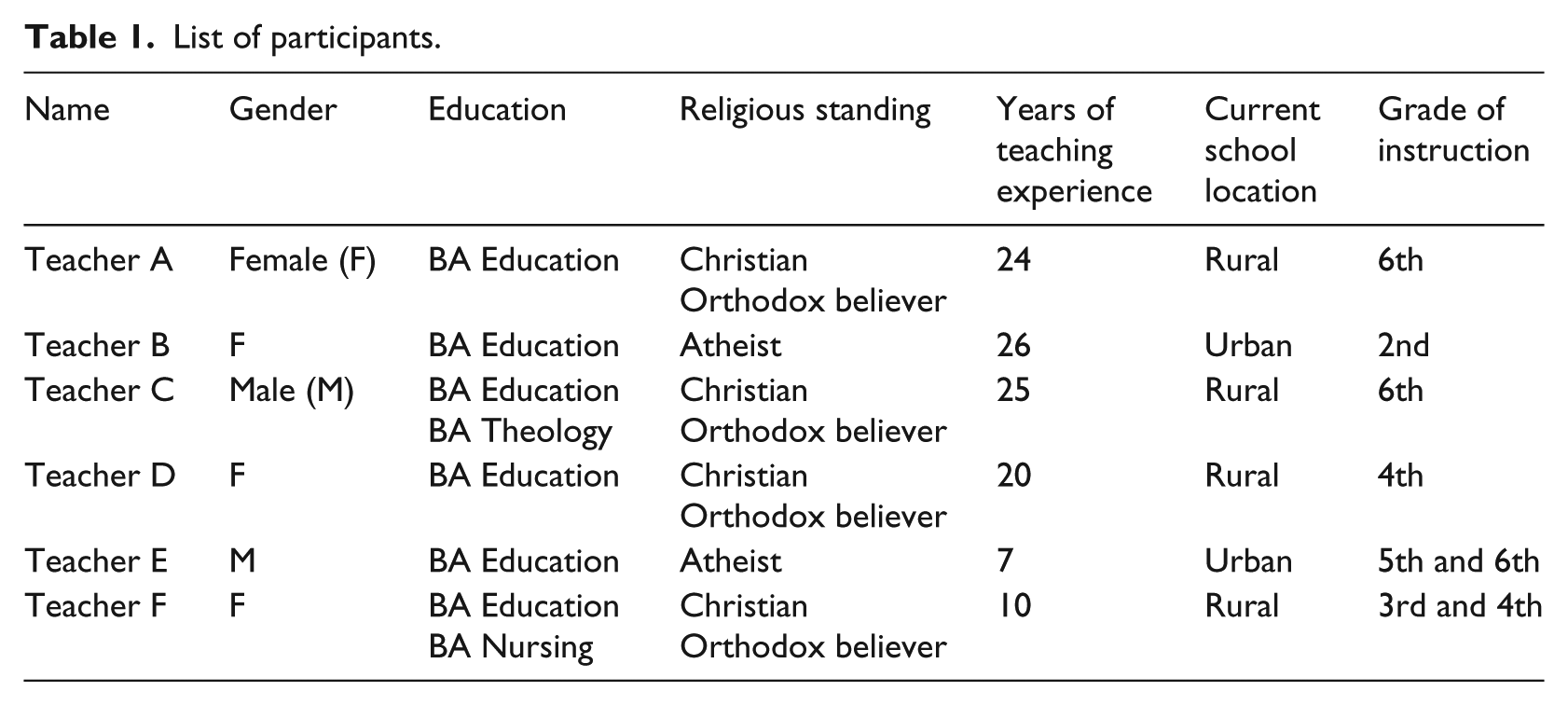
The six participants were selected with the use of snowball sampling on the basis of four criteria: geographic area (urban/rural); gender; teaching experience; and religious standing (Christian Orthodox believer/atheist) (see Table 1). These criteria of ‘purposive sampling’ reflected our experience of working with teachers on these matters for many years (Loukaidis and Zembylas, 2017; Zembylas and Loukaidis, 2018) to ensure that there was maximum variability in their views of religious education.
List of participants.
The research had ethical permission from the Cyprus Ministry of Education and Culture and the teachers had signed a consent form prior to their participation in the study. They were informed about the purpose of the study and they were told how the data would be used. The data collection methods are shown in Table 2.
Data collection methods.
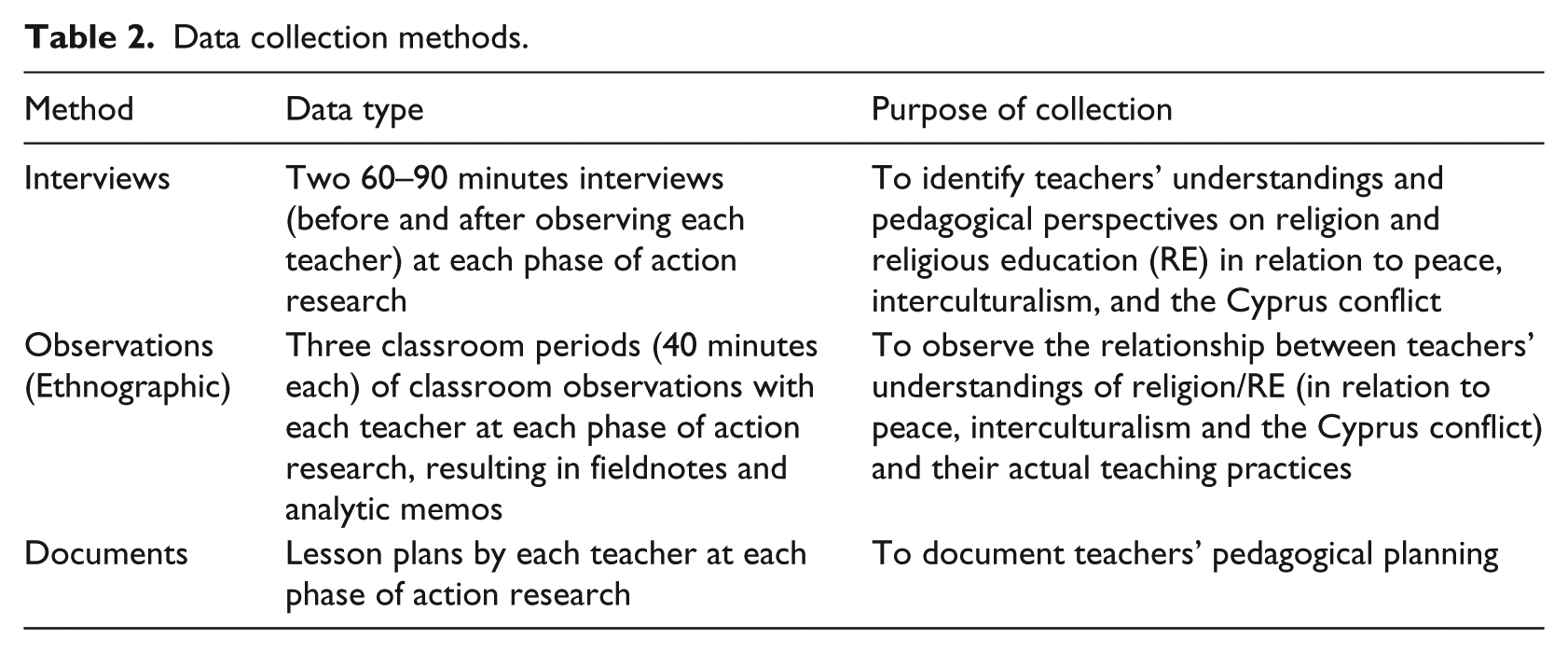
Interviews were conducted with the help of a semi-structured interview protocol aiming at facilitating teachers to elaborate on their understandings and practices of RE. All interviews were conducted in Greek – the native language of participants and researchers alike; they took place at the participants’ preferred location, lasted between 40 and 60 minutes, and were audio-recorded and then fully transcribed. Member checking was used to ensure triangulation and validity of claims made (Denzin and Lincoln, 2000). Selected excerpts identified during the coding procedure were then translated into English for the purposes of data presentation and dissemination.
Observations were carried out in each of the six classrooms for three classroom periods (40 minutes each) in each of the pre- and post-phases, and were conducted based on an observation protocol, paying particular attention to recording: (a) rich descriptions of students’ interactions; and (b) teachers’ pedagogical practices in RE in relation to issues of peace, interculturalism, and conflict. The lessons were also audio-recorded and transcribed, in order to allow us to examine classroom interaction. The teachers’ lesson plans were collected for comparison with their actual teaching practices.
To ensure confirmability and credibility (Strauss and Corbin, 1998) in the analysis of data, the three of us worked firstly with a smaller sample of data in order to identify the main emerging themes, and then collaborated in order to devise a common coding scheme, the validity of which was then tested, before being applied to the analysis of the whole body of data. This scheme was subsequently used for the coding of the whole body of data. The coding scheme was developed under three main themes, which largely corresponded to the research questions presented earlier These three themes are discussed in detail in the next section.
Findings
Teachers’ understandings of religion and RE in relation to the Cyprus conflict
The participating teachers’ remarks verified the widely accepted perception that the Greek Orthodox Church was actively involved in politics, society and the educational system. Teacher C (a priest himself) was very comfortable with the idea of the Church being involved in political life, pointing out that the Greek Orthodox Church had historically played an important role in the life of Greek Cypriots and therefore it should maintain this role.
Other teachers disagreed with this idea and highlighted a different role for both the Greek Orthodox Church and RE in Greek–Cypriot schools; at the same time, these teachers were not so optimistic that a different role could manifest in reality any time soon. For example, Teacher F referred to the possibility of RE promoting interculturalism and peace as a utopian idea in the context of conflict-affected Cyprus – not only because of the powerful role of the Greek Orthodox Church which was impeding this shift, but also as a result of the ‘weight of history’ dividing the two conflicting communities (i.e. Greek–Cypriots and Turkish–Cypriots).
When asked whether the teaching of RE in Greek–Cypriot schools promoted peaceful coexistence with Turkish–Cypriots, participating teachers found this to be a rather challenging and somewhat politically charged question. Four teachers commented that this depended on the teacher and how he or she would choose to approach peace-related issues in RE. Teacher C noted that, although in theory the RE curriculum was set to teach about love in general terms, practically speaking it was difficult to do this, because there were too many sensitivities that influenced teachers’ decisions on whether or not to teach about peace in relation to the Cyprus conflict.
Teacher B had a rather different perspective and suggested that RE did not really help address issues related to the Cyprus conflict, because Greek–Cypriot schools always privileged the point of view of Greek Orthodoxy: ‘I don’t believe that the subject of RE promotes peace. We only teach Christianity and as such, this does not help promote peace between the two communities.’ Teacher D agreed and reiterated once again that the connection between peace and RE depended on the teacher’s approach to this matter. She justified this by saying that there was a widespread fear and insecurity against the Turks cultivated by the Church and the parents.
Challenges teachers face in their efforts to teach about peace and/or interculturalism in the context of RE
As hinted above, teachers confronted numerous dilemmas in deciding whether or how to approach the teaching of RE in relation to the Cyprus conflict. These dilemmas were relevant to teachers’ personal experiences and beliefs, stereotypes about the ‘other’ and societal expectations.
One of the participating teachers (Teacher B), as is shown in the excerpt below, made extensive comments about how her personal experiences from the Cyprus conflict influenced her views on the prospects and challenges of teaching about peace in the context of RE.
Also, Teacher F admitted that although she would be willing to try and teach about peace in the context of RE, she felt emotionally unready because of her personal experiences in relation to the Cyprus conflict.
Other teachers also raised concerns that it might be difficult to address issues of trauma and pain in relation to the Cyprus conflict in the context of any school subject, not to mention in RE. Even though Teacher C addressed the issue of the destruction of religious and cultural heritage in his teaching, he suggested that it might be better to leave more controversial and sensitive issues to a later stage in students’ education.
Other challenges emerged in classroom discussions where several stereotypes about the ‘other’s’ religion were revealed. For example, a widespread idea that emerged in a lesson taught by Teacher D was the notion that Muslims always forced Christians to change their religion during war and conflict; the discussion that followed was emotionally upsetting for many students, as the fear of being forcibly converted to the Muslim religion came up in this discussion. In the excerpt below, it is shown how this idea (which was often taught in schools, according to Teacher D) was reproduced.
Another challenge was also that teachers themselves had misconceptions about the Turkish–Cypriot community’s religion. For instance, Teacher C pointed out repeatedly that the effort to find common ground with Turkish–Cypriots was one-sided, suggesting that only the Greek–Cypriots made openings. This belief was based on a series of assumptions grounded in misinformation regarding the Turkish–Cypriot community (which he referred to interchangeably with Turkey) rather than an informed understanding of current affairs.
The extent to which teachers’ perspectives about peace and/or interculturalism are reflected in their pedagogical practices
The pedagogical approaches that teachers utilised in their designed interventions to address issues of peace and interculturalism could be divided in two categories: (a) those approaches that directly addressed the Cyprus conflict, albeit from different perspectives; and (b) those approaches that chose deliberately to either decontextualise the teaching of peace and/or interculturalism from the Cyprus conflict or avoid addressing such issues at all. It is worth mentioning that while some teachers seemed to adopt a clear stance on how they approached the aforementioned issue, others seemed to employ different approaches interchangeably.
In the case of the first category, participating teachers employed different methodologies, even when teaching the same lesson. This was mostly the case of Teachers E and C, who prepared lesson plans on the different religious communities living in Cyprus. For example, pictures of destroyed or vandalised spaces of worship from both communities were shown, which resulted in emotionally charged conversations in the classroom. As Teacher E explained,
More specifically, Teacher E also wanted to instill in his students the idea that the restoration of religious monuments that was taking place in both communities could promote the goals of collaboration and peaceful coexistence.
On the other hand, Teacher C did not choose to address the construction of a common Cypriot identity but rather presented common efforts to preserve religious monuments that had been destroyed as a result of the conflict. The following excerpt from a classroom conversation is indicative of this teacher’s approach and the reactions of his students.
In his post-observation interview, Teacher C described his lesson as an effort to highlight that despite the destruction of religious places in the north, it was important to promote peaceful coexistence.
In the case of the second category of pedagogical approaches, some teachers chose to discuss issues of peace and/or interculturalism in general terms, thus decontextualising the topic from students’ experiences and the local context of Cyprus. These were mostly Teachers A and D, who, in general, referred to different conflicts in other parts of the world, showed photographs to elaborate on the suffering created by conflicts, and highlighted the negative consequences of conflicts, while avoiding to focus on the Cyprus conflict:
Teachers B and F decided to follow a completely different approach by choosing a topic that was more relevant to interculturalism as opposed to peace – one that focused on the current crisis caused by migration and the consequences caused by refugeedom. Unavoidably, though, the issue of the Cyprus conflict emerged in their explanation of the rationale behind choosing this topic. As Teacher B explained, the goal was to help children disconnect the notion of ‘refugee’ from its Greek–Cypriot connotations (as a result of the 1974 Turkish invasion and the thousands of Greek–Cypriot refugees).
The following classroom episode is indicative of how Teacher B approached the issue of refugeedom, showing once again that despite the teacher’s intention, the Cyprus conflict was unavoidable.
Discussion and implications
This small-scale study can contribute to further understanding of the hypothesis that the politicisation and securitisation of RE reflect deeper framings of the place of religion in education within a particular society (Lewin, 2017). In particular, this study shows the powerful role of context in the ways that RE is politicised and securitised, especially in a conflict-affected society such as Cyprus. Religion in general and the institution of the Greek Orthodox Church more specifically, play a fundamental role in how issues of peace and security are going to be addressed (or not) in schools. Teachers respond to this role by choosing to discuss issues of peace and/or interculturalism in very careful terms, by decontextualising such issues from the political context of Cyprus so as to avoid sensitive issues, or by completely avoiding to address these issues. Teachers’ pedagogical practices, then, show that the political function of RE in conflict-affected societies (Fontana, 2016) very much underpins and frames curriculum and pedagogical concerns. Greek Orthodoxy constitutes a powerful marker of ethnic and religious communal identity in Greek–Cypriot schools that is manifested through an exclusivist approach which privileges Greek Orthodox doctrines and religious beliefs. The reproduction of this exclusivist approach raises serious challenges and dilemmas for teachers in their efforts to teach about peace and/or interculturalism.
However, the findings of this study also show that despite the negative consequences of this exclusivist approach, teachers teach about peace when they are given the opportunity, even in rudimentary ways that attempt to challenge monolithic stereotypes about the ‘other’s’ religion. Despite the challenges from securitisation concerns, teachers can create opportunities to address issues of peace, conflict, politics and religion in pedagogically productive ways. In this manner, teachers can play an important ‘desecuritising’ role in the peace process within conflict-affected societies such as Cyprus. A desecuritising’ role is not easy to be undertaken by teachers, as shown in the study, particularly when the role of context and especially the Church is powerful, yet it is a viable possibility that has potential to reframe the ways in which RE is taught.
Despite the small-scale nature of this study, its findings have important implications regarding the politicisation and securitisation of RE, especially in relation to teachers’ role and their pedagogical practices. Here we want to discuss two such implications. The first one concerns teachers’ important role in creating the pedagogical conditions that address issues of peace, conflict, politics and religion in productive ways, that is, in ways in which a negotiated balance of the emerging challenges and opportunities allows for both a critical and sensitive consideration of peace and security issues in schools (Zembylas et al., 2018). This means that issues of security and peace cannot be decontextualised from the historical and political context in which RE is taught, yet teachers can develop pedagogical practices that gradually and ‘critically’ (Franck, 2015; Moulin, 2009) address peace and security issues, while being sensitive to local concerns. By critical RE pedagogies, we refer to pedagogical practices that adopt a critical approach when analysing religious or other truth-claims (Wright, 2007).
The second implication is that to develop critical RE pedagogies that challenge the normative securitisation regime, teachers need to be provided with opportunities for: teacher training in which teachers can discuss securitisation/desecuritisation concerns in RE and see their role as important actors that can affect peacebuilding efforts in both positive and negative terms; and for institutional support that allows teachers to adapt the existing curriculum and convert its curricular and pedagogical principles into ideas that promote critical thinking, pluralism and dialogue. The present study reminds us that religion and RE are inevitably interpreted and understood in political terms, therefore, the assumption about RE as being concerned primarily with spiritual aims (see Gearon 2012, 2013) may constitute the ground for underestimating the impact of peace and security issues on RE. Teachers need to be offered the tools and support to gain a deeper understanding of the complex ways in which the politicisation and securitisation of RE takes place both within the context of a society and in their own teaching.
In conclusion, the contribution of this small-scale study to the debates on these issues has been to show empirically some of the complexities in the ways in which the politicisation and securitisation of RE takes place within a conflict-affected society. The reproduction of peace and security issues through RE is not the only possibility within a conflict-affected society; however, RE can be one of the tools to challenge normative ways of politicisation and securitisation by reframing pedagogical practices to instill cracks in the normative regime. How these issues are manifested theoretically and empirically within each context requires further empirical research and theorisation. This study, then, is offered as an example to facilitate further this engagement and provide a contextual framing to the complex theoretical issues that concern peace and security issues in RE.
Footnotes
Declaration of Conflicting Interests
The author(s) declared no potential conflicts of interest with respect to the research, authorship, and/or publication of this article.
Funding
The author(s) disclosed receipt of the following financial support for the research, authorship, and/or publication of this article: This research received funding from the Open University of Cyprus (Internal Funding 2016–2018).
