



Abstract
At the European Conference on Educational Research (ECER) in 2016, a panel presented the findings from a survey initiated by the European Educational Research Association Council to examine educational researchers’ experiences with the research ethics review process at their universities. Some researchers appeared to be looking to North America for models to govern and regulate university research ethics. In response, our inquiry began from the question: what can European researchers learn from the way ethical review structures and processes have developed in Canada? But as we approached this question, we encountered a more immediate question: to what extent is it possible to address a diversity of research–ethical concerns via a single, bureaucratic policy? Then, how do standardized ethics regimes fail to account for non-standard research—and thereby fail researchers, participants, and communities?; and what is the alternative? In this paper, we explore the history of the development of an ethics regime for Canadian universities, and changes over time. Based on this review, as well as our personal experiences with community-based research, we argue that efforts to regulate the diversity of social sciences research via a uniform policy almost inevitably miss the mark: one ends up trying to “square the circle”.
Squaring the circle: a critique of Canada’s Research Ethics Regime
At the European Conference on Educational Research (ECER) in 2016, a panel presented the findings from a survey initiated by the European Educational Research Association Council to examine educational researchers’ experiences with the research ethics review process at their universities. The survey data provided a sense of how the process works in different countries and institutions (e.g., how ethics committees are structured, how researchers engage in the work process of ethics review, the average length of the process), researchers’ concerns (e.g., unclear and bureaucratic processes), and areas where improvements might be made (e.g., providing researchers with more assistance to complete ethics review processes). As a respondent on the panel, one of the present authors (Alison Taylor) had a sense that European researchers were looking to models in North America and other countries where ethics regimes are more developed (and enshrined). Accordingly, this article emerged from the question: what can European researchers learn from the way ethical review structures and processes have developed in Canada? As we approached this question, however, we encountered more immediate ones:
(1) To what extent is it possible to address a diversity of research-ethical concerns via a single, bureaucratic policy?;
(2) How do standardized ethics regimes fail to account for non-standard research—and thereby fail researchers, participants, and communities?; and
(3) What is the alternative?
In this discussion, we argue that efforts to regulate the diversity of social sciences research via a uniform policy almost inevitably miss the mark: one ends up trying to “square the circle”.
Drawing from both the existing literature on ethics policy and from our collective experience as researchers, we consider how the Canadian Research Ethics Board’s (REB’s) focus on possible consequences of research manifests as risk-averse “conservatism”, which tends to preclude projects that aim at social change. Legal scholars Palys and Lowman (2010), citing Bernhard and Young (2009), suggest this attitude is inherent to REB regimes, even going so far as to suggest that a “contemporary ethos of risk aversion”—of which the REB regime is symptomatic—“is undermining the contemporary university’s ability to fulfill its social research mandate” (Palys and Lowman, 2010: 266). Haggerty similarly characterizes research ethics protocols as an effort to manage risk; he warns that, by definition, such protocols “constrain scholarly research and, in so doing, structure what truths can be spoken and by whom” (Haggerty, 2004: 392). We build on these critiques of the ever-expanding ethics regime and recruit an historical analysis of “ethics creep” in the Canadian context in order to illustrate that the conservative, risk-averse nature of Canadian Tri-Council REB policy is inherently at odds with research that aims to bring about social change.
This article is organized as follows. First, we discuss the aspirational aims of the Social Sciences and Humanities Research Council of Canada (SSHRC)—a key federal granting agency for the social sciences and humanities—in order to provide a counterpoint to the conservative framework impelled by federal ethics policy.
Second, in order to indicate how “ethics creep” comes into tension with the aspirational mandate of social research, we examine how federal government research-granting bodies have fomented an ethics regime in Canadian universities over the past 20 years. (In this section, Robert K Merton’s (Merton, 1957) reflections on function and dysfunction illuminate the complex and often contradictory role of the REB.)
Third, to illustrate the practical consequences of REB standardization and conservatism, we examine specific cases in which REB guidelines have come into conflict with socially-engaged research projects. This penultimate section discusses REB constraints on research that aims at social change through its approach to knowledge production, including the problematization of research relationships.
In concluding, we encourage our European colleagues to think carefully before adopting the kind of university ethics regimes that have been developed, largely in response to concerns about biomedical research ethics, in Canada as well as the USA, Australia and the United Kingdom. While there has been much tinkering with standardized protocols, the current regime continues to emphasize the risks over the benefits of research and its inherent conservatism discourages research aimed at progressive social change.
The forest, the trees, and what’s between
In scholarly circles there is no shortage of criticism of Canadian and American ethics regimes. Kevin Haggerty’s foundational critique, “Ethics Creep”, “draws primarily from [his] four years’ experience as a member of … the REB for one of Canada’s top social science research universities” (Haggerty, 2004: 393), where he observed, “well-intentioned but onerous regulations [were] justified on the basis of hypothetical worst-case scenarios” (Haggerty, 2004: 403). In response to Haggerty, sociologist Howard S Becker remarks, “some of us have tried new dodges to skirt the requirements” (Becker, 2004: 415) of an increasingly expansive and restrictive ethics protocol; he concludes: “These folks [ethics review boards] will creep us [researchers] right out of business if we don’t watch out” (Becker, 2004: 416). Similarly, Christopher Shea (2000), in the academic magazine Lingua Franca, describes American ethics protocols as a “crackdown” and suggests that the biomedical model of review processes is ill-suited for humanistic and social sciences research. The impetus for the development of research ethics regimes in Australia and the United Kingdom can also be attributed to concerns about biomedical research (Van den Hoonaard, 2001), sparking similar criticism from social science researchers. In Australia, Halse and Honey (2007) made links between the institutional order of ethical review and new managerialism and neoliberalism. In the UK, Hedgecoe (2008) points to the ideological biases of review regimes.
Scholars such as Haggerty (2004), Van den Hoonaard (2001, 2011), and Palys and Lowman (2010) critique ethics regimes in Canada (the REB) and in the USA (the Institutional Review Boards, or IRBs) on principle: as “fetters on … knowledge production endeavors” (Haggerty, 2004: 391); as a manifestation of “moral panic” (Van den Hoonaard, 2001: 7); and as endorsement of so-called “vanilla” research (i.e. research that risks offending no one) (Palys and Lowman, 2010). Conversely, scholars who pursue community-engaged research critique ethics policy on empirical grounds, highlighting tensions between the practicalities of community-engaged research and the formal demands of the REB (upon which research funding depends). As early as 2001, Downie and Cottrell observed that the structures of REB and/or IRB texts provided little room for collaboration with community partners in research design. Over a decade later, Cross et al. (2015) reiterated the need to renovate ethics policy assumptions regarding research process and knowledge ownership. They contend that the “traditional [research ethics] review model complies with a ‘top down’ model of research” (Cross et al., 2015: 1011) in which researchers are presumed to be “experts” while participants become “mere objects of study” (Cross et al., 2015: 1009). Not only are such assumptions often inconsistent with empirical situations (wherein community members may possess privileged knowledge), but also they re-inscribe existing power relations between researcher and researched.
Although research ethics policies have been critiqued on both theoretical and empirical grounds, there is little articulation between these critical literatures. Similarly, there is little consensus about what can be done to improve the situation. For onlookers in Europe and the UK, the question persists: How might nascent research ethics policies avoid the pitfalls of North American models? Here, we do not offer an answer as such; instead, we trouble the very idea of “a single answer”, emphasizing that ethics cannot be one-size-fits-all. As noted, efforts to regulate the diversity of social sciences research via a uniform policy invariably miss the mark: one ends up trying to “square the circle” (on paper, if not in practice). To parse the tensions within research praxis, we first discuss the aspirational (or ideal) mandate of social sciences research, before tracing how existing ethics regimes emerged and the fears from which they hatched.
The aims of social science research
Instead of beginning with a theoretical assessment of REB protocols, we will begin with what social research hopes to achieve. By taking this alternate tack, we hope to get outside of the “dystopic” paradigm of research. This is not to deny the possible consequences of social sciences research—which are, indeed, undeniable—but rather to affirm that such research should be undertaken nonetheless, with situation-specific precautions.
Although individual scholars’ reasons for pursuing research vary, funded research in Canada overwhelmingly aims at the betterment of society, whether directly or indirectly (e.g., through contributions to knowledge in a specific field). This aim, which Palys and Lowman call the university’s “social research mandate” (Palys and Lowman, 2010: 266), inheres in the rhetoric of federally-allocated funding structures. For instance, SSHRC’s “Strategic Plan to 2020” states: Social sciences and humanities research addresses critical questions about who we are as human beings, what we need in order to thrive in complex and challenging times, and where we are headed in the years ahead. It enhances our ability to understand and creatively respond to complex individual, social, cultural and economic issues. It informs and enriches the lives of Canadians. (SSHRC, 2016: 2)
Further, SSHRC expressly connects each of its three central funding programs with a purported social impact:
In order to warrant federal funding, one infers, research must “contribute” Talent, Insight, or Connection to Canadian society.
In the context of federal grant seeking, then, the onus is on researchers to articulate questions and contributions in the register of social impact: why does “X” matter?; why should this research be funded (by a Canadian government agency)? When seeking funding, prospective researchers must speak to “real world”—and preferably nationally framed—concerns. SSHRC insists, quite explicitly, that scholarly research be topical, socially situated, and nationally beneficial. Similarly, Research Ethics Boards (REBs) profess to support socially valuable research while assiduously guarding against harm. In theory, these mandates go hand in hand—but there’s trouble in paradise: in practice, REBs often obstruct the social aims of research rather than supporting them. Precisely by guarding against imagined and anticipated harms, REBs also guard against change, which (in REB guidelines) is coded as inherently risky. Thus while they appear complementary on paper (and onscreen), SSHRC’s research mandate and research-ethical strictures often conflict in practice. In order to probe this empirical tension, we turn an eye to the institutional emergence of research ethics in Canada.
Historical development of an ethics regime in Canada
In 1976, the Canada Council, which became the Social Sciences and Humanities Research Council (SSHRC) a couple of years later, began to develop a set of policies on scientific integrity. In 1978, these policies were implemented by Canada’s three granting agencies: the Medical Research Council (MRC) of Canada (which was replaced by the Canadian Institutes of Health Research in 2000), the Natural Sciences and Engineering Research Council (NSERC) of Canada, and SSHRC (Van den Hoonaard, 2011). This development followed the establishment of IRBs in US universities in the 1970s. In Canada, specifically, attention to research ethics exploded in the 1980s because of concerns that research on reproductive technologies and genetic research was not adequately covered by existing policies (Van den Hoonaard, 2011). Understanding the origins of the subsequent changes to policies and procedures is important in order to answer the question: if this is the solution, what was the problem?
In 1994, Canada’s three major research-funding councils began to develop a shared set of policies and guidelines regarding research ethics. The presidents of the three Councils established the Tri-Council Working Group on Ethics, which had a mandate “to replace existing guidelines with regulations and policies” (Kinsella, 2010, cited in Downie and Onyemelukwe, 2016: 137). This process began the centralization of research ethics protocol, moving forward from the Tri-Council Policy Statement (TCPS), which was to apply to all institutions and individuals receiving funding from any of the three councils. Prior to this, the research councils had disseminated guidelines for ethical conduct, but specific criteria and procedures had been left to universities and disciplines to work out. Only research and researchers directly funded by the councils had been subject to review and, accordingly, practices within universities and disciplines varied, as did procedures used in different contexts and types of research.
As noted above, concerns about biomedical research seemed to be a key driver of and influence on the kind of ethical policies and guidelines developed in Canada and other countries (Van den Hoonaard, 2011). Controversies related to research involving humans, for example, falsification of patient records in a breast cancer study, and use of fraudulent data in publications, together with concerns about accountability to the public also fed into ethics-related regulations (Downie and Onyemelukwe, 2016).
A key rationale for the TCPS involved the assumption that: The fundamental ethical issues and principles in research involving human subjects are common across the social sciences and humanities, the natural sciences and engineering, and the health sciences. (CIHR et al., 2005: i.2)
Policy-makers assumed that harmonizing the policy, by establishing common procedures within a shared ethical framework with universal application, would benefit universities and the public by ensuring that university research met ethical standards. In their analysis of the development of the 1998 policy and responses, Downie and Onyemelukwe (2016) argued that efforts were made to ensure that basic values related to democratic legitimacy, transparency, accountability, representation and community engagement were considered. They suggested, however, that such considerations should have been given more weight in the final version of the TCPS. Although the formulation of the TCPS was extensive—including the publication of an issues discussion paper by the Working Group in November 1994, followed by a draft of the Code of Ethics published in April 1996 (which elicited over 250 comments from the academic community), and a final draft code of ethics published by the Working Group in 1997 (Downie and Onyemelukwe, 2016)—this process largely excluded the perspectives of relevant groups (research participants, community members, and researchers who might have different aims for research and use different methods). For instance, there were no Aboriginal researchers in the Working Group and only one-third of members were women. Moreover, community members had a very limited role because there were no open public meetings. The Councils had the final say on the 1998 statement and apparently eliminated some sections of the Working Group draft.
The 1998 Policy Statement that resulted from the TCPS consultations process was more encompassing, standardized and prescriptive than earlier recommended guidelines: In order to receive funds from any or all of the councils, institutions now have to demonstrate that all research conducted by its members (including students) complies “with this policy regarding research involving human subjects”. Indeed, the opening page in the policy states, “the Councils will consider funding (or continued funding) only to those individuals and institutions which certify compliance with this policy regarding research involving human subjects” (CIHR et al., 2005: i.1). Hence, all research conducted in or through Canadian universities, whether carried out by faculty and staff, or by students as part of course-work and dissertations, is subject to the new ethical review procedures. (Dehli and Taylor, 2006: 10)
From its date of issue, universities were given two years to comply with the TCPS; and so ethical review committees were established, composed of faculty members from multiple disciplines and a community member. The document prescribed that the review be “undertaken in local research institutions by independent, multidisciplinary ethics committees that apply substantive and procedural norms” (CIHR et al., 2005: i.9). Further, REBs (Research Ethics Boards) were to be “established by the highest levels of the institution, and cover as broad a range of research as is consistent with manageable workloads” (CIHR et al., 2005: 1.4). (Note, however, that large institutions could establish more than one REB to cover different areas of research.) Using the TCPS as a template, each institution’s guidelines were to specify criteria for assessing research through an “expedited” procedure versus a “full” review, depending on the perceived level of risk. The TCPS suggested that institutions allow appeals to REB decisions to ensure “procedural justice” (CIHR et al., 2005: 1.10).
Van den Hoonaard (2011) describes commonalities in the governance and procedures of Canadian REBs based on his own experience and the outcomes of 31 interviews with university participants involved in research ethics (REB staff, chairs, members, senior administrators, and researchers). He notes that there is some variation across universities in the way REBs are organized (e.g., by type of research, by discipline, etc.). There are, however, significant commonalities across REBs. For instance, psychologists (who are more likely to favour experimental research designs) tended to be over-represented on REBs regardless of the size of university. Furthermore, ethics committees tend to be autonomous and procedurally “answerable to no one” (Nelson, 2004, cited in Van den Hoonaard, 2011: 89). While there is often more interaction between REBs and researchers in small universities, the framing of research ethics encourages a view of researchers as the source of ethical problems and reviewers as gatekeepers. In this model, consultations and decisions are rarely a matter of public record. In addition, the heavy workload in REBs encourages technocratic rationality, evident in the standardization of forms and use of checklists. Van den Hoonaard suggests that the “minutiae of filling out application forms” distracts from critical reflection on ethics and policies (Van den Hoonaard, 2011: 131) while standardization tends to normalize particular kinds of research (and discourage other approaches). Processes of ethical review are therefore implicated within the ruling relations of research production (Truman, 2003). Discussions about the operation of REBs raise important questions about whether ethics review procedures actually protect research participants—a topic that, ironically, is little researched.
Responses to policy and changes over time
When the draft of the TCPS was circulated in 1996 it met with a significant amount of criticism, much of it from researchers in social sciences and humanities (CAUT, 1997; Van den Hoonaard, 2001). Contested issues included the viability and appropriateness of generating one standard and procedure for all scholarly disciplines; the privileging of medical and psychological models of research; the difficulty of accommodating qualitative, critical, participatory or performance or arts-based research in the proposed review procedures; and the problem of monitoring compliance with the policy. In 2004 a sub-committee of the Interagency Advisory Panel on Research Ethics (PRE) reported that many criticisms and concerns persisted, along with complaints about over-zealous review boards, unreasonable demands for revisions, slow reviews, no appeal procedures, and a lack of transparency in relation to researchers.
Following the development of TCPS in 1998, the document has been updated several times (in 2000, 2002 and 2005) and revised a couple of times (in 2010 and 2014). The 1998 TCPS (including amendments to 2005) was 93 pages long and approximately 40% of the main text addressed research related to biomedical research: clinical trials, human genetics, and human reproduction (CIHR et al., 2005). The 2010 statement was re-drafted partly in response to a flurry of reports by the Social Sciences and Humanities Working Committee (SSHWC) on Ethics outlining the gaps and discrepancies of the TCPS with regard to social sciences and humanities research; revisions included, for example, the addition in 2010 of a new chapter on qualitative and ethnographic research (Van den Hoonaard, 2011). The process leading up to the revised 2010 policy was described as more democratic than the initial process largely because of the creation of the PRE, which was charged with interpreting and revising the TCPS by liaising between the research community and the public. Nonetheless, there continued to be concerns expressed about inadequate engagement with community-research partners in consultations (Downie and Onyemelukwe, 2016).
The 2014 TCPS statement was, at 220 pages, more than double the length of the 1998 TCPS, with only about 10% of the text addressing research related to biomedical disciplines. Comparing the tables of content for the 1998 and 2014 policies suggests some attempt being made to address concerns about a “one-size-fits-all” approach to ethics. For example, discussion about research with Aboriginal peoples (four pages in the earlier version) was later expanded to a 29-page chapter about research with First Nations, Métis, and Inuit (FNMI) peoples. Another obvious difference is the expansion of discussion about research procedures (1998 language) from six pages to discussion about the governance of research ethics (2014 language) in 23 pages.
The 2014 TCPS also devotes more attention to the challenges posed by a harmonized policy, tempering the claim that the three granting councils and the diverse communities to be engaged in research share fundamental common values that can guide ethical research. Chapters on qualitative research (Chapter 9) and research involving the First Nations, Métis, and Inuit (FNMI) peoples of Canada (Chapter 10) provide good examples of heightened awareness of differences in approaches to research. For instance, the chapter on qualitative research begins with the observation that social sciences and humanities researchers often use qualitative research approaches and that the assumptions underlying such approaches may differ from those shaping quantitative research. Much of the chapter emphasizes the diversity of aims, perspectives and strategies within qualitative research. Moreover, it recognizes that traditional assumptions about boundaries in research (e.g., when research begins and ends, relationships between researchers and subjects, etc.) can be problematic—for example, in community-based collaborative research.
The appended chapter on research involving FNMI peoples indicates further that policy authors were grappling with the complexity of research that validates different knowledge systems and seeks to engage in more reciprocal research relationships. It begins from the premise that much previous research has benefitted FNMI peoples neither individually nor collectively, and that more ethical research requires different kinds of relationships between researchers (in particular, non-Indigenous researchers) and communities. New relationships, the 2014 TCPS proposes, are to be more collaborative, respectful, and reciprocal. The authors acknowledge that the interpretation of core ethical values in research involving FNMI peoples is likely to be different than in other research. 1 For example, “concern for welfare” may be expanded to include collective as well as individual welfare. At the same time, a reconsideration of the principle of justice in research recognizes that much past research has devalued and exploited Indigenous peoples and their knowledge, and that future research should accordingly aim to promote reciprocal relationships, build research capacity in communities, and “be relevant to community needs and priorities” (CIHR et al., 2014: 128). Although this appended chapter recognizes the need for different approaches to FNMI research overall, it also makes the point that FNMI groups themselves are not unified or homogeneous and therefore making generalizations about approaches (e.g., to community engagement) is inappropriate.
The 2014 TCPS provides much more direction with regard to issues such as REB membership, authority, and decision-making; review procedures; and appeal processes. It is apparent that over time the ethics machinery and its standard operating procedures have been developed and refined; at the same time, it is also clear that increasing attention has been devoted to the myriad exceptions and diverse perspectives that are to be brought under the TCPS umbrella.
The work involved in developing and monitoring research ethics has expanded to include a variety of national panels and committees (see Figure 1).
The Panel on Research Ethics (PRE), created in 2001, is a 12-member advisory body drawn from diverse disciplines and backgrounds to provide the Agencies with multi-disciplinary and independent reflection and advice on TCPS. The Secretariat on Responsible Conduct of Research (named the Secretariat on Research Ethics from 2001 to 2011) provides substantive and administrative support for the PRE, the Panel on Responsible Conduct of Research (PRCR), and for the three federal research-granting Agencies (CIHR, NSERC and SSHRC) with respect to the TCPS and Tri-Agency framework. Since 2011, the Secretariat has introduced educational initiatives to reach and engage members of the community; for example, an online tutorial called Course on Research Ethics (CORE) as well as webinars and regional workshops on ethics issues (SRCR, 2014).
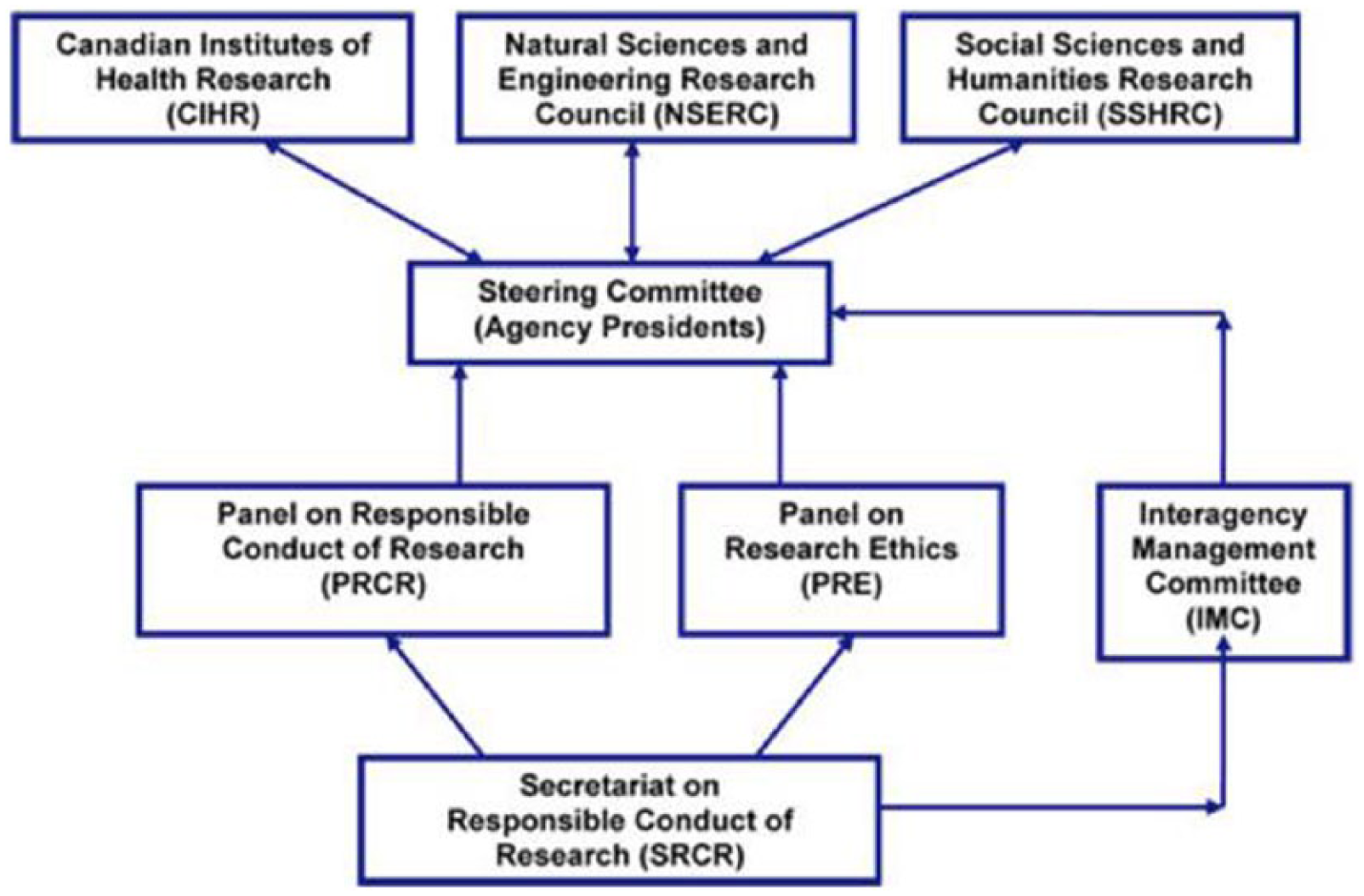
National governance of research ethics by tri-councils in Canada.
CORE provides an applied approach to guidance on TCPS 2 and has been quickly adopted by institutions. For example, 52 of the 54 respondents to a survey of institutions that track completion of the tutorial had made it mandatory for one or more groups (i.e., faculty, students, or research ethics board members) (SRCR, 2014), a figure that has no doubt increased substantially since then.
A fatal function(alism) and a call for change
By tracing the historical development of an ethics regime in Canada, we have described the modifications that have occurred over time as staff and users tinker with the one-size-fits-all model. This model reflects the problematics of “adding and stirring” that have plagued other attempts to reform policy; feminist scholars (e.g. Tickner, 2001) have been critical for some time about the limitations of efforts in international development policy reform to just “add women and stir.”
In what follows, we unpack the claim that Canadian Tri-Council REB protocol is inherently at odds with research that aims to support social change. Over the past 20 years, REB infrastructure has expanded to encompass an ever-increasing cluster of “research” activities and to guard against a proliferation of perceived risks. As Haggerty remarks: The range of potential research related harms envisioned by REBs at times seems to be limited only by the imagination of different reviewers. Any change in a research participant’s condition or disruption of their routine can be conceived of as a potential harm. (emphasis added) (Haggerty, 2004: 400)
Research that directly aims to foment social change is by definition risky, because anticipated change is uncertain by virtue of its very futurity. So, when REBs speculate on potential harms to research subjects, it is difficult to fathom an interpersonal interaction that is totally risk-free. As ethics regimes expand in a Cthulhu-esque sprawl, 2 the only research processes that remain “safe” are those that pose no conceivable threat—in other words, those that essentially preserve the status-quo. In this context, SSHRC’s rhetoric of “social impact” become little more than a semantic exercise.
To illustrate this point further, we sketch a specific critique of the REB’s manifest and latent conservatism, before exploring how this conservatism practically constrains community-engaged research. This discussion takes us into the territory of institutional theory (i.e., the sociology of institutions) and Durkheimian functionalism. To begin, then, let us consider the functions, manifest and latent (Merton, 1957), of the REB in Canada—it is these functions that underpin the tension between research’s social mandate and ethics protocols.
In Social Theory and Social Structure (1957), Robert K Merton parses the varied connotations of the term “function” in sociological and anthropological inquiry, from Arthur Radcliffe-Brown to Talcott Parsons to Émile Durkheim. Functional analysis, Merton explains, addresses how specific social or cultural entities contribute to the maintenance of an integrated system, be it an organism, an institution, or a society (Merton, 1957: 78). In the case of REBs, the immediate system is the university as institution, embedded within the larger system of Canadian society. So far, this conforms to Merton’s description: REBs serve an explicit function within the university and within society, insofar as they “ensure that research is conducted in an ethical manner so as to build public confidence and trust” (CIHR et al., 2014). Function, however, is more complicated than such statements suggest. For one thing, Merton observes, “the reasons advanced” to justify something are not necessarily identical to its “objective consequences” (Merton, 1957: 79–80). Moreover, he asserts: The theoretic framework of functional analysis must expressly require that there be specification of the units for which a given social or cultural item is functional. It must expressly allow for a given item having diverse consequences, functional and dysfunctional, for individuals, for subgroups, and for the more inclusive social structure and culture. (Merton, 1957: 85)
It follows, then, that REBs as “social item[s]” have diverse consequences within the various systems they inhabit. That is, the REB serves an array of functions and dysfunctions in relation to different entities. In relation to specific universities, the REB represents a legal prophylactic against unwelcome accusations and, more importantly, a way of absolving the institution of responsibility for perceived harms. In relation to the University as an institution (with both concrete and mythic dimensions), the REB wards off the spectre of past abuses and anticipated threats. And in relation to society as an imagined collectivity of (potentially) vulnerable persons, the REB serves a social imperative to provide researchers with ethical oversight. These functions overlap to some extent, just as the systems of “a university”, “the University”, and society, overlap. But our point, following Merton, is that the consequences of the REB are not uniformly felt and its functions (and dysfunctions) are not unitary.
Most importantly for our purposes, the REB’s functions and dysfunctions are unified by the common thread of conservatism. Conservatism as a “tendency to resist great or sudden change, esp[ecially] in politics” and, in the biological sense, as a “tendency to resist evolutionary change” (Oxford English Dictionary, see OED (online), 2017) undergirds REB functions, both explicit and implied—that is, both manifest and latent. Here again, Merton’s analysis sheds light. In undertaking functional analysis, he notes, it is imperative to distinguish between the enunciated aim and the objective outcomes of a given social entity—whether an SSHRC program or an REB. Moreover, it is imperative to distinguish between instances where “the subjective aim-in-view [of an entity] coincides with [its] objective consequence” and instances where aim and consequence diverge (Merton, 1957: 106).
Where subjective aims align with objective consequences, one observes a manifest function, “intended and recognized by participants in the system” (Merton, 1957: 106). Equally, where the outcomes of an entity are “neither intended nor recognized”, one observes a latent function (Merton, 1957: 106). We would argue that in the case of the REB both manifest and latent functions are characterized by conservatism; yet the system that the REB manifestly conserves is not identical to the situation that it latently conserves, and therein lies some of its dysfunction. We discuss this discrepancy and dysfunction in more detail in what follows. Another manifest and latent function of REBs is evident in the concern being expressed about compliance to the requirements with the proper completion of REBs standing in for ethical practice.
As “intended and recognized” by those involved, REB functions vary to some extent. However, explicitly-stated aims to minimize risk and “protect [‘xyz’]” are reiterated throughout the Tri-Council Policy Statement: “risk” appears 308 times in the 220-page document, while “protect” appears 112 times (CIHR et al., 2014). It follows that the manifest function of Tri-Council REB protocol is to facilitate minimal-risk research, thereby protecting society and its members. With Haggerty (2004), we observe that perceived risk is ever-expanding as ethics board members anticipate an increasing array of harms that could (hypothetically) result from each research design choice. In this context of harm-proliferation, any change can be (and often is) coded as risk—and so change-oriented research becomes precluded on the grounds of risk-minimization. The REB’s manifest function, therefore, is conservative insofar as risk-aversion aims at conserving the current state of society and its institutions. What current REB reviews largely neglect is the question of who benefits from the research. Like predicting (and precluding) “risk”, articulating anticipated benefit speaks to the challenge of addressing futurity.
The Canadian REB also serves latent functions: functions that are “neither intended nor recognized” (Merton, 1957: 106) by those involved. Rather than enumerate these latent functions, we foreground one that emerges from the REB’s manifest drive to “protect” vulnerable research subjects. A mandate to protect vulnerable research subjects, we contend, presupposes a particular power relation between researcher and participants. Moreover, the artifactual structure of the REB form preserves an ideologically enshrined hierarchy between university and community as knowledge-holders (and participants in a knowledge economy). Compliance with ethics review protocol, as articulated in the 2014 Tri-Council Policy Solution, serves the latent (dys)function of preserving a hierarchy between university and community. This (dys)function has especially significant consequences for community-engaged research, as our subsequent discussion illustrates. In what follows, we unpack this latent (dys)function before discussing how it impedes community-engaged research.
Constraining community engaged research
This section is somewhat experimental. In what follows, we draw upon the experiences of one of the authors (Shauna Butterwick) in dialogue with another (Alison Taylor) to explore how standardized ethics regimes constrain researchers, participants, and communities by failing to account for research that aims at achieving social change.
As a professor whose practice and research focuses on community-based adult education at a large research-intensive university, Shauna Butterwick has engaged in community-engaged research throughout her academic career. One hallmark of community-based projects is that they are often initiated by community organizations or other groups aiming to create change. For example, in 1997, Butterwick began to work with a small group of women on low income and, over time, moved from being an ally in their struggle against punitive welfare regulations to working with them on research about life skills training for women (Butterwick, 2011). Shauna Butterwick’s reflections on this process indicate the complexity of community-engaged research as well as the ways in which such relationships challenge traditional conceptions of research embedded in REB processes and forms. For example, an approved REB application is required before contacting participants, and the application requires researchers to append their interview guide. However, in order to engage with community members in ethical ways, Shauna Butterwick felt the need to reverse the process when she explored collecting new “data” with the women already involved in the project: The questions were thoroughly critiqued. I remember feeling embarrassed (again) when they pointed out the middle-class bias of the questions and how they missed capturing much of the daily struggle of living in poverty. In the end we rejected the idea of these interviews; it would mean asking questions and prying into women’s lives. When you were receiving welfare benefits, women already had enough of that experience. Why would women want to sit and talk about their struggles, how depressing it was to not have enough money to feed their children? (Butterwick, 2011: 64)
Not only does this reflection highlight the humility required of researchers seeking collaborative relationships, but it also points to the ways in which researchers as well as participants must adapt their research methods through their interactions if the research is to have value for research participants and communities. This example exposes the limitations of a policy which presupposes that researchers already know the salient features of the situation they wish to study, and that knowledge construction is linear and one-way. Instead, working with community in reciprocal ways often requires researchers to question their initial assumptions and heightens their sensitivity to potential harm for participants in a process that does not map easily onto the standardized practices required by REBs. In fact, through her efforts to develop reciprocal, ethical relationships, Shauna Butterwick found that her roles were blurred: she became simultaneously researcher, educator, friend, and learner. The research, in short, consisted of a two-year conversation punctuated by efforts to sustain ethical, mutually beneficial relationships in which the focus was on the group’s informal learning as they explored various options of become economically independent. Yet, in the eyes of the REB, Shauna Butterwick was simply a principal investigator conducting a series of interviews in order to address a predetermined research question.
More generally, efforts in support of collaborative research are frequently challenged by implicit assumptions about research expertise within the broader academic community, which are then reflected in REBs. For example, Butterwick describes what happened when she presented a co-authored paper with a community group member at an academic conference: We both noticed a subtle shift when some other academics were asking her questions, whereby she became an object of their inquiry, not a subject of her life or a co-investigator of our research. We debriefed after that event and she shared her observations about the middle class orientation and abstract discourse. (Butterwick, 2011: x)
By conforming to a traditional view of research, which affirms researchers’ autonomy in the pursuit of knowledge, REBs reproduce traditional ideas about university–community relationships and knowledge production (as one-way and hierarchical). Thus research that interrupts these ideas, particularly community-based research which attempts to include the voices of “vulnerable” populations, is likely to undergo a lengthy and multi-stage review process. While such research is not overtly precluded, the process is discouraging for all but the most stalwart and seasoned researchers.
Butterwick offers another example in her supervision of an Indigenous graduate student doing a study of Indigenous learners: Part of the student’s methodology involved conversations with elders who are guiding her in the project by helping her deepen her understanding of how Indigenous teachings apply to her research. REB staff wanted the student to treat Elders as subjects of research, participants to be interviewed. Despite attempts to describe their role as guides and “knowledge holders”, Elders were required to sign consent letters. In those letters, REB requires that research participants be given the names and contact information of university staff to contact if they feel their rights have been violated. These letters puzzled the Elders; their relationship was with the Indigenous researcher, not the university, and if they had any concerns, they would go to her. To call the university with complaints made no sense to them.
The student to whom this refers was also interviewing Indigenous learners about their experiences. These participants were confused by the prominence of the university crest and logo on information letters and consent forms (as required by the REB). While the text of these standardized forms can be altered so that they are less formal, the university logo is a requirement and its presence suggests to participants that it is the university, and not the individual researcher, that is undertaking the inquiry. While the participants were not suspicious or nervous about the role of the university as an institution, they expressed surprise and disbelief that their stories mattered to the university.
This example suggests that although attempts have been made to tinker with the “one-size-fits-all” approach, the ethics regime continues to constrain researchers, participants and communities by conserving dominant ideas about appropriate relationships and practices. In particular, the relationship between researchers and participants is mediated by the institution, because TCPS requires universities (which require REBs, which require department heads, which require… and on down the hierarchical line, to students) to take responsibility for any research conducted by their members.
Two final examples concern REB dilemmas precipitated by practice-based research. In the first case, REB staff became highly suspicious of research undertaken by one of Butterwick’s students who had carried out a small-scale qualitative survey as part of her community-engagement work. This student wanted to include the results of this survey in her graduating paper. Because the research had already been completed, Shauna Butterwick and her student applied for REB approval indicating that the study had been completed as part of the student’s employment and that participants of that inquiry would be sent new consent forms asking them to consent to the inclusion of survey results (and their participation) as part of her graduate paper. In reviewing this application, REB staff asked how it was that this student could have done research on her own without institutional approval. Butterwick replied that many students engage in research as part of their community-based work and academic institutions are not the only sites where valid inquiries take place. Ultimately, approval was given—very reluctantly, and with a stern warning to Shauna Butterwick for not monitoring her students more carefully.
The second example relates to REB protocols and professional doctoral programs, which are becoming more and more ubiquitous in universities. As in the story above, in these professional programs the idea of practitioners engaging in research in their own workplaces challenges traditional ideas about the researcher role. In particular, practitioner-researchers engaged in interventionist research aimed at organizational or social change pose problems for REB policy because they blur the boundaries of where research begins and ends, who is creating knowledge, and how knowledge is to be “captured”. In the current regime, a doctoral student (and school administrator) completing an REB application to engage in research with the student’s workplace colleagues, in order to further their collective understandings about how to implement provincial education reforms within their school district, is required to adopt a researcher role as outsider and expert. For example, in the standardized REB application form (on a university password-protected website), the student must respond to the following.
•
•
•
•
These few items illustrate that research framed as a collaborative activity—which blurs the line between researchers and participants—is likely to be seen as both aberrant and risky.
In short, despite attempts to broaden assumptions about different kinds of research, there is suspicion on the part of REBs regarding non-standard methodologies and aims. To earn the trust of REBs, researchers are obliged to demonstrate their compliance and willingness to do things in the standard way, while—in contrast—earning the trust of community participants often requires them to do things differently. As a result, researchers find themselves becoming contortionists as they struggle with what it means to behave ethically. As these cases illustrate, the consequences of standardization as a form of conservatism are more serious for researchers seeking to problematize assumptions around knowledge and expertise.
Concluding comments
The examples above and the previous discussion illustrate how one-size-fits-all REB policies actually mean that many researchers face the frustration of trying to square the circle. We have attempted to show how policies and practices have become institutional regimes that have expanded to include research which bears no relation to clinical trials, albeit concerns about the ethics of these studies were the impetus for reforms for tri-council policies in Canada. Qualitative and community-based research aimed at progressive social change and collaborative engagement with individuals and communities are considered within the dominant framework as interventions with high potential for harming research “subjects”. While the standardized forms ask about benefits, the emphasis is on assessing, and managing, potential risk; but risk aversion is not conducive to innovation, to research that should make a difference, evident in SSHRC’s stated interest in research that addresses creatively what is needed to thrive in complex and challenging times. This tension is arguably a sign of the changing times where the “time-honoured notion of the academy as the place where knowledge is pursued for its own sake is pitted against the … notion of shareholder value” (Bleiklie and Powell, 2005: 7)—that is, accountability to a wider set of publics. Arguably, however, the attempts of ethics regimes to respond to changes in higher education are perpetually failing one group or another because ethics has become so centralized, standardized, and technocratic. The concern for compliance within the ethics regimes evident in REBs is associated with acquiescence and the maintenance of order.
What is the alternative to the risk aversion and one-size-fits-all approach if research oriented to social change is supported? We are not suggesting that attention to ethical matters is not important. Rather, we encourage our European colleagues to think carefully before adopting the kind of university ethics regimes that have been developed in Canada as well as the USA, Australia and the United Kingdom, largely in response to concerns about biomedical research ethics. While we support the idea that REBs encourage, indeed require, researchers to think carefully about their research design and the potential impact of their research on participants and communities, they have also sparked valid criticism on the part of social scientists and community-engaged researchers because of their focus on risk and their manifest and latent conservatism. This conservatism protects traditional ideas about knowledge and expertise, which are antithetical to calls for universities (by SSHRC and others) to contribute to solving society’s problems and to innovate. They emphasize the risks more than the benefits of research and perpetuate research approaches that maintain the separation between researchers and communities as opposed to building relations of reciprocity and co-inquiry. As the last section of our paper suggests, allowing more space for this kind of research is particularly important for continuing dialogue about what it means to engage in ethical research.
Footnotes
Authors’ Note
Robyn Taylor-Neu is now affiliated to University of California, Berkeley.
Declaration of Conflicting Interests
The author(s) declared no potential conflicts of interest with respect to the research, authorship, and/or publication of this article.
Funding
The author(s) disclosed receipt of the following financial support for the research, authorship, and/or publication of this article: Authors gratefully acknowledge funding for this work from the Social Sciences and Humanities Research Council of Canada.