




Abstract
The present study investigated the requirements for teaching students with moderate and severe intellectual disabilities in inclusive and special education settings, emphasising the skills, knowledge and attitudes that teachers need. Drawing on investigative group discussions with teachers and principals, qualitative content analysis was used to categorise these skills, knowledge and attitudes. Key requirements in teaching this student population include skills to implement individualised and differentiated teaching, as well as creating individually adapted learning materials. Leadership and counselling abilities are also required in order to ensure successful collaboration between different actors by clarifying roles and hierarchies and negotiating work distribution and expectations. The teacher–student relationship should be characterised by an attitude of appreciation, openness and, in particular, a focus on the positive, regardless of the student’s behaviour, requiring a balance between closeness to the student and an appropriate distance. Finally, it is important when teaching this student population to care for one’s own mental and physical health over the longer term. The article concludes by discussing target-oriented strategies and measures for teachers’ work practices and further education to strengthen the requisite skills, knowledge and attitudes, particularly with a view to inclusion.
Keywords
Introduction
In many European countries, students with moderate and severe intellectual disabilities are increasingly taught in inclusive settings for part or all of the school day (see European Agency for Special Needs and Inclusive Education, 2012). However, depending on the country-specific school system and the severity or type of disability, many of these students also continue to attend special schools. Teachers in both inclusive and special education settings report high levels of stress and a number of stress-inducing factors that adversely affect their wellness, job performance and, ultimately, student outcomes (Billingsley, 2004; Emery and Vandenberg, 2010; Hinds et al., 2015; Jennings and Greenberg, 2009; Shen et al., 2015). In particular, regular teachers complain of lacking expertise in inclusive education, especially when dealing with behaviour they perceive as difficult, because it often leads to situations they find difficult to control (see the reviews by Avramidis and Norwich, 2002; de Boer et al., 2010; see also Florian and Rouse, 2009; Savolainen et al., 2012).
In light of these issues, the present study seeks to analyse the requirements for teaching students with moderate and severe intellectual disabilities. Following the triangle of knowledge, skills and attitudes going back to Bloom’s taxonomy (Bloom et al., 1956), which is also the core of some European Union programmes and research contexts (e.g. practices for teacher education: Hollenweger et al., 2015; European Commission/Education and Training 2020 Working Group, 2011), this study emphasises the skills, knowledge and attitudes teachers need. The empirical study is based on investigative group discussions with teachers and principals. The statements in the group discussions were subsequently categorised by qualitative content analysis (Hsieh and Shannon, 2005; Mayring, 2000). The final part of this article summarises the results and illustrates how they can contribute to develop target-oriented strategies and measures for both regular and special needs teachers’ working practices and (further) education – also with the longer-term goal of facilitating inclusive schooling for the target group of students with moderate and severe intellectual disabilities.
Teaching students with moderate and severe intellectual disabilities: developments and findings
To begin, it seems important to outline some illustrative developments and findings from the existing literature.
Students with moderate and severe intellectual disabilities in inclusive and special education settings: definition and country-specific background
The term ‘intellectual disability’ encompasses a wide spectrum of types, characteristics and degrees of severity. The present study focuses on students with moderate and severe intellectual disabilities which are ‘characterised by significant limitations both in intellectual functioning and in adaptive behavior as expressed in conceptual, social, and practical adaptive skills’ (Schalock et al., 2007: 118). In Germany, where the study is conducted, ‘moderate and severe intellectual disabilities’ is a category of education; respectively, a certain area of special needs which is related to limitations in functioning (conceptual, social, practical) as just described (see KMK, 1994). This category is also related to the support measures students receive. One example for such a measure is an assistant supporting a student in class (also in order to enable inclusive schooling). In Germany only a small proportion (8%) of students with moderate and severe disabilities are taught in inclusive settings (Klemm, 2015; see also Fischer and Markowetz, 2016). It is worth noting that the German school system has a highly specialised special education field, with different types of inclusive and special education settings as well as specific support according to the type of disability (see Markowetz and Jahn, 2016; KMK, 1994).There are different schools for students with special educational needs (hearing or visual disabilities, intellectual disabilities, etc.).
Students with moderate and severe intellectual disabilities in school
Teaching students with moderate and severe disabilities is very demanding in terms of education, support and development (e.g. Hallahan et al., 2012; Wehmeyer and Shogren, 2017). This applies to both inclusive and special education settings, where teachers must cope with a range of paradoxes, contradictions and difficult situations (Norwich, 2013). Both regular and special needs teachers emphasise this heavy burden (e.g. Hinds et al., 2015; Jennings and Greenberg, 2009; Shen et al., 2015). In particular, regular teachers complain about insufficient training and a lack of knowledge about dealing with behaviours they perceive as difficult in day-to-day school life (e.g. de Boer et al., 2010; Savolainen et al., 2012). Regular teachers complain about insufficient insight in working practices. Special needs teachers feel better qualified (e.g. Pool Maag and Moser Opitz, 2014), but they also report problems – for example, in planning lessons in inclusive classes. In general, teachers’ stated concerns and attitudes differ significantly with the nature and severity of the disabling condition (Avramidis and Norwich, 2002).
Despite an overall increase, the number of students with moderate and severe intellectual disabilities in inclusive settings remains small (European Agency for Special Needs and Inclusive Education, 2012; see also Fischer and Markowetz, 2016). But the divergent research findings in this area reflect low case numbers and inconsistent methodological approaches. Additionally, research on such topics as learning outcomes among students in different school settings remains limited. A few studies report better learning outcomes in inclusive classes (see the review of Freeman and Alkin, 2000), but long periods of stagnation and erratic progress in the learning process distort the validity of the results and confound interpretation (Maikowski and Podlesch, 2009). Given the limited body of research and the low inclusion rate, this student population demands greater attention, in terms of both research and school practices.
Demands and challenges
As previously mentioned, one of the challenges most frequently reported is the behaviours teachers perceive as difficult (Hinds et al., 2015; Kokkinos and Davazoglou, 2009). Many (meta)studies have demonstrated empirically that moderate and severe intellectual disabilities are often related to emotional and behavioural difficulties (Dekker et al., 2002; Einfeld and Tonge, 1996); in particular, severe forms of disability, language ability limitations and family disturbances are associated with higher rates (Hulbert-Williams and Hastings, 2008; Koskentausta et al., 2007). Teachers complain about behaviours such as kicking, beating, pulling each other’s hair and spitting; refusal; irritating behaviours such as screaming or stereotyping; damaging or destroying objects; and anxiety, agitation and sexualised behaviour (Chadwick et al., 2008; McClintock et al., 2003). Such behaviours are described in inclusive as well as special education settings and cause irritation and anxiety because teachers and students are unused to them (Weiss et al., 2017). Many teachers have reported being unable to calm such students or to reduce their behavioural difficulties. As a consequence, many teachers and students refuse to interact with children or adolescents they perceive as aggressive and frightening, and this is one key aspect of why the inclusion of this student population is failing (Weiss et al., 2017).
The difficult learning preconditions of students with moderate and severe intellectual disabilities require continuing collaboration among many disciplines. But in the area of cooperation and exchange, tensions are stressed. However, often diverging ideas about the ‘right’ attitude to and handling of such students’ behaviours can lead to friction, conflict and rivalry (Friend and Cook, 2003; Rice et al., 2007). Similar factors influence school–parent interaction; although studies reveal some degree of mutual satisfaction, there is also evidence of the potential for conflict, mostly in relation to differing opinions about student support and behaviour, responsibility, reliability and trust (Gwernan-Jones et al., 2015; Lake and Billingsley, 2000; Lasater, 2016). Unclear definition of responsibilities and hierarchy conflicts can also disturb decision-making processes and information disclosure in (interdisciplinary) collaboration (Dallmer, 2004; Friend, 2000). In many cases, teachers express discomfort and anxiety about engaging in collaborative activities (Johnson, 2010; Wilhelm, 2017). Special needs teachers feel mostly (better) prepared for this demand; collaborative teaming is part of their professional image and much more developed. However, many regular teachers are unused to multidisciplinary collaboration (Friend and Cook, 2003).
As moderate and severe intellectual disability encompasses different characteristics and degrees of severity, learning materials and teaching and learning activities must match students’ individual needs within special education or inclusive settings (Scruggs et al., 2012). Literature reviews have documented strong evidence supporting the use of systematic instruction (Browder et al., 2009; Morse and Schuster, 2004), but that instruction must be individually and differentially implemented for each student (Markowetz, 2016; Tomlinson, 2014). Although fine in theory, it is very challenging in practice to run a highly differentiated classroom. Differentiated instruction requires flexibility, both in teaching approach and in adjusting the regular curriculum to meet students’ needs (Obiakor et al., 2012), and it requires teachers to assemble multiple sets of materials. Successful differentiation is especially difficult in inclusive classes involving students across a very wide performance range, and there is evidence that regular teachers do not feel qualified to address these diverse learning needs (McTighe and Brown, 2005).
Research questions and objectives
As illustrated, the demands and tensions of teaching students with moderate and severe intellectual disabilities highlight the complexity and challenges teachers must deal with, with repeated evidence that teachers and future teachers feel somewhat or completely unprepared. This is especially true of regular teachers in inclusive settings, who complain about insufficient insight related to a lack of knowledge, skills and strategies (de Boer et al., 2010; Savolainen et al., 2012). Special teachers also express concern with regard to issues such as handling emotional and behavioural disturbances (Hinds et al., 2015; Kokkinos and Davazoglou, 2009).
The present study addresses these needs by seeking to identify the skills, knowledge and attitudes that contribute to success in teaching students with moderate and severe intellectual disabilities. The central research question, then, is as follows: what skills, knowledge and attitudes are necessary to teach students with moderate and severe intellectual disabilities?
The study’s overall objective is to contribute to the development of target-oriented strategies and measures in this context. These should support professionals and future professionals when teaching students with moderate and severe intellectual disabilities, thus supporting inclusion the of that student population.
Method
Project and research context
The present study is part of the research project ‘Demand Analysis for the Teaching Profession’ at Ludwig-Maximilians University Munich in Germany. The overall goal of this project is to identify the skills, knowledge and attitudes that teachers need in order to cope with the demands and tensions in their professional area. In particular, the present study focuses on those teaching students with moderate and severe intellectual disabilities in both inclusive and special education settings. The practical aim is to develop ideas and measures to address identified demands and tensions for both teachers and students, and to support the progressive inclusion.
Sampling, data collection and procedure
In order to identify the skills, knowledge and attitudes that teachers need, investigative group discussions were conducted. Group discussions focus on identifying the opinions and attitudes of a whole group in terms of collective patterns of orientation. Group members of equal status discuss a special topic (Payne and Payne, 2004). Group discussions also focused on an empirical analysis of social subsystems, collective phenomena and supra-individual behaviour (see Barbour, 2007; Morgan, 1997). Statements in group discussions that conjointly determined a collective pattern of orientation were deemed to be valid, because group discussions are not the origin of a collective pattern, but the discussions provided the necessary room for articulating patterns explicitly. Group discussions are supposed to show structures and phenomena beyond the particular discussion group, and, when conducted properly, they are about experiences and the collective orientation pattern of large social groups (Bohnsack, 2000). The participants influence each other through their answers to the ideas and contributions during the discussion. The moderator stimulates discussion with comments or subjects (Krueger, 1994). Group discussions allow the interviewer to study people in a more natural conversation pattern than typically occurs in a one-to-one interview. It offers the opportunity to interview several respondents systematically and simultaneously (Babbie, 2011). Moreover, they can be used as an occasion for participants to learn from one another as they exchange and build on one another’s views, so that the participants can experience the research as an enriching encounter (Romm, 2015). In contrast to the quantitative approach, group discussions permit verbal legitimation and clarification by experts. Furthermore, more opinions emerge in group discussions than in solely quantitative inquiries as a result of mutually stimulating conversation.
The total sample included 20 teachers and 20 principals who were experienced in teaching students with moderate and severe intellectual disabilities. We work with teachers and principals, because changing the school system and school practices must explore the local knowledge and perceptions of those who are the agents of change – in this case, teachers and principals (see Bergold and Thomas, 2012; Kemmis and McTaggart, 2005). Half of the principals and teachers are working in special education settings, the other half are teaching in inclusive classes for either part or all of the school day. The recruitment was initiated through an announcement made by the head of the project ‘Demand Analysis for the Teaching Profession’ and was then forwarded to the relevant departments in the school administration. Teachers and principals were invited to take part in group discussions at the Ludwig-Maximilians University. The criterion for the sample is multi-annual practical experience in the area of moderate and severe intellectual disabilities at school. The range regarding the practical experience is from six to 35 years. During the selection process, care was taken to include participants from different schools and regional areas to avoid a regional agglomeration (see Lamnek, 1998).
The teachers and principals were divided into twelve discussion groups with three to four participants each (see the considerations regarding group size by Adler and Clark, 2008; Morgan, 1997). Regarding grouping, the discussion groups were arranged to comprise participants from different schools in order to achieve more diverse and broader argumentations and information (Agar and MacDonald, 1995); hence, teachers as well as teachers and principals did not know each other. Moreover, we used the criterion of practical experience to compose the groups. The group discussions lasted for two hours. The course of each discussion was thematically structured following the research questions: what skills, knowledge and attitudes are necessary to teach students with moderate and severe intellectual disabilities?
Each discussion group was moderated by an experienced moderator currently active in teacher education. Prior to the group discussions, the moderators were trained using a guideline. The skills, knowledge and attitudes were documented on paper. During the discussions, the participants were asked for explanations, justifications and examples.
Analysis, interrater_reliability and validation
The analysis was oriented toward qualitative content analysis (Mayring, 2000; see also Hsieh and Shannon, 2005). The goal of content analysis is to reduce the material so that the fundamental content remains and to obtain through abstraction a straightforward corpus that retains an image of the raw material (McTavish and Pirro, 1990; Weber, 1990). The statements from the participants were ordered into categories with the help of the MAXqda program (MAXqda, 2011). For analy-sing the material, a list was drawn up that describes each category by explanations and examples. This list also includes overlaps and distinctions between categories. The categories were integrated and the results ordered. Each category is named after the skill, knowledge and attitude contained therein. The categories could be structured in higher-level areas; therefore, the displayed results follow an order underlying in the raw material (see Coffey and Atkinson, 1996; Patton, 2002). The categories were linked with corresponding justifications and examples in order to explain and to illustrate them.
The inter-rater reliability (IRR) was calculated to verify the quality criteria. The aspects specified by participants were completely doubly encoded by two researchers. Two other researchers supported the analysis. The calculation was conducted by MAXqda. Consensus was reached when at least 80% of the relevant passages were identically encoded. In the literature, a reliability coefficient of .70 overall is seen as satisfactory (Bos, 1989: 212). Altogether, 443 relevant statements were encoded. Only a few statements could not be integrated in the category system. This applies if an aspect is too vague or too general for the meaning to be understood. An example is ‘concepts’ (GE_LE_6), whose exact content and significance could not be clarified. The IRR was initially .82 for all categories altogether, with 363 of 443 possible matches. In some categories, it was less than .80. In order to improve this, the protocols of the group discussion were reconsidered and a communicative validation process was performed (see Kvale, 1995, 2007). The focus of this process was on the categories with an IRR < .80. By revising the categories, a higher degree of selectivity as well as a higher IRR could be reached (.87 with 387 of 443 possible matches; see Table 1). This procedure can be illustrated with an example. In the present study, the idea of ‘being creative’ arises in different contexts.
The category Teaching individualised and differentiated relates to creating specific, tailored and sometimes creative learning opportunities for the individual student: ‘When we explain the number system to a student and he has problems understanding it … I take coloured pencils and demonstrate it. You have to be creative’ (GE_LE_6).
The category Using humour and situation comedy describes the interaction with students, as, for example, in the context of de-escalation: ‘“Come on, let’s get lost and drink a caipi-rinha”. If the situation totally escalates, phantasies and being creative offer a way out to finish the work’ (GE_LE_5).
Category system.
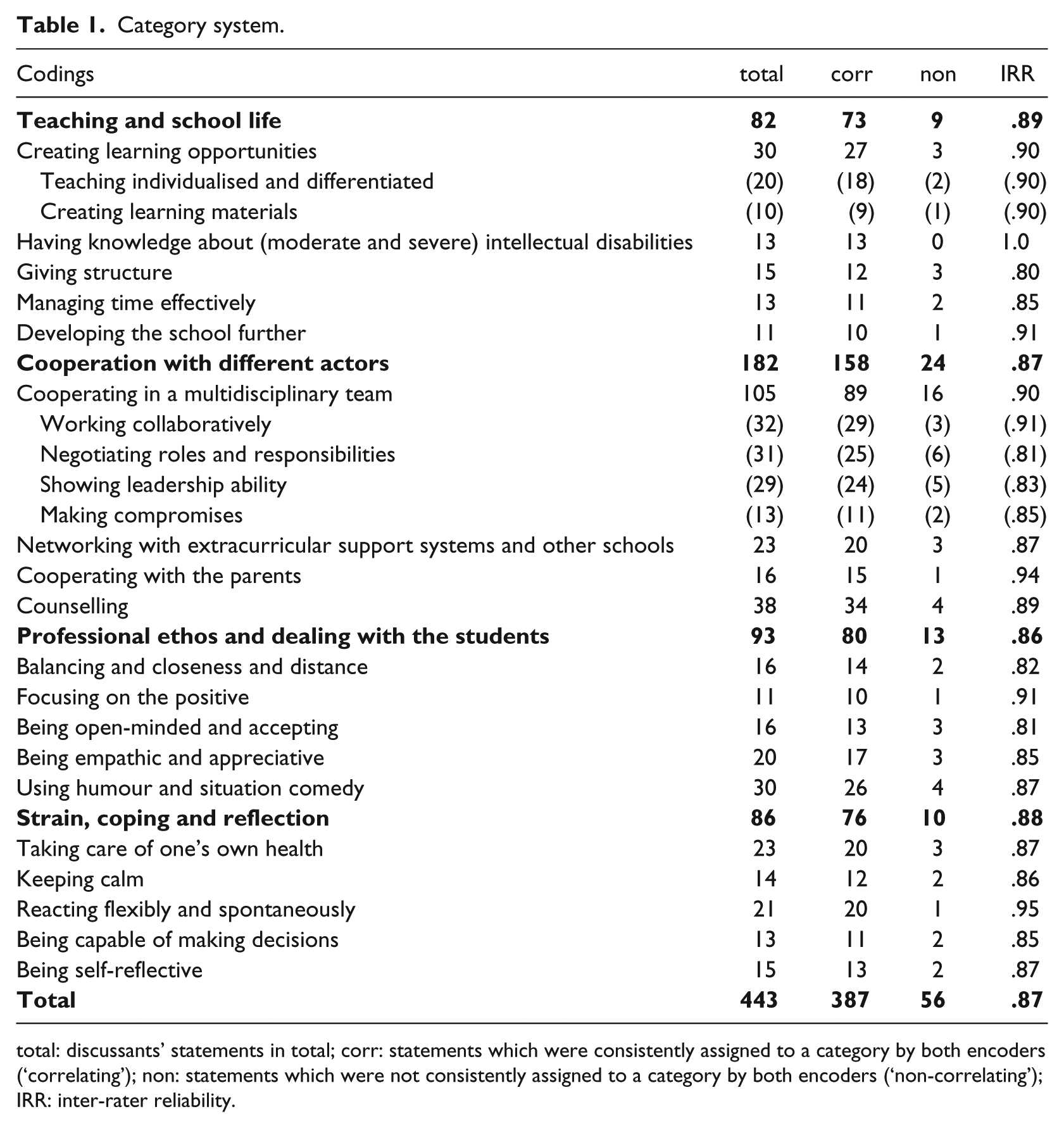
total: discussants’ statements in total; corr: statements which were consistently assigned to a category by both encoders (‘correlating’); non: statements which were not consistently assigned to a category by both encoders (‘non-correlating’); IRR: inter-rater reliability.
Results
Category system and codings
All categories can be ordered in terms of four higher-level areas (see Table 1): Teaching and school life (82 statements); Cooperation with different actors (182 statements); Professional ethos and dealing with the students (93 statements); and Strain, coping and reflection (86 statements). These categories are described in more detail below.
Teaching and school life
Categories related to teaching students with moderate and severe intellectual disabilities in everyday school life are marked by contrasting opinions and show a field of tension. Some teachers shared the view that ‘students should learn in school and that teaching respectively imparting knowledge is “the core business”’ (GE_AB_3). But, in contrast, others stressed that imparting knowledge is clearly subordinate to social aims. These two poles become especially obvious where students with moderate and severe intellectual disabilities attend regular schools; as one teacher stated, ‘for primary school teachers in regular schools, the focus is on imparting knowledge. I think it is more important to establish a reward system for the behaviour with the child’s involvement’ (GE_LE_4).
The largest category (30 statements) is Creating learning opportunities, which relates to Teaching individualised and differentiated (20 statements) because ‘each student has different disabilities, individual and differentiated planned guidance for the individual student is necessary throughout the year’ (GE_LE_5). Significantly, the participants offered a very specific description of differentiation; relating it mainly to organisational processes rather than to knowledge to be conveyed, teachers and principals characterised differentiation as steady improvisation in approaches to the learning subject with the objective of ‘avoiding any period of idling’ (GE_AB_1), as no student should need ‘to wait for a learning offer’ (GE_LE_4). In implementing differentiation, one important condition was Creating learning material (10 statements) tailored individually to students’ individual learning prerequisites. Successful differentiation was seen to be based on multiple sets of materials that students could use at any time, again preventing idling.
However, teaching this student population (implementing differentiation) is also associated with the field of tension regarding Having knowledge about (moderate and severe) intellectual disabilities (13 statements). Knowledge, for example, is defined as ‘clinical pictures, and responses to questions such as “How is intellectual disability defined, and what symptoms and behaviour patterns are associated with it?” and “What is autism?”’. At first glance, such knowledge appears deficit-oriented. But a closer look in the statements in the group discussion showed that such knowledge regarding clinical pictures and behaviour patterns also included students’ talents, strengths and potentials. The tension is that having knowledge is a shared responsibility of many actors: teachers and other professionals need to develop a shared knowledge by collaborative teaming so that all team members are able to profit. This demand may be a source of conflict (see the following section).
Giving structure (15 statements) supports the learning process by structuring students’ daily routine (GE_AB_2): ‘It is necessary to maintain a balance between strictly enforcing structures and routines and concurrently “going along with the students”’ (GE_AB_1). Planning these individual learning processes requires Managing time effectively (13 statements) at the level of the individual teacher. At the school level, the requirement is Developing the school further (11 statements), a field of tension which has a specific meaning. The term ‘school development’ means rather a long process, it refers to many small and practical innovations related to problems that need to be quickly resolved: ‘If a student refuses to go by bus, new ways must immediately be found’ (GE_AB_1).
Cooperation with different actors
Cooperating in an interdisciplinary team is the largest category overall. All group discussions stressed cooperation as a fundamental principle of teaching students with moderate and severe intellectual disabilities in both inclusive and special education settings. But they also stressed different tension fields and conflicting situations. The 105 statements relate to different facets concerning tensions within this category. Working collaboratively (32 statements) characterises the ability to collaborate with many different professions in the school: ‘Teaching students with moderate and severe intellectual disabilities means close cooperation in a team with school assistants, educators, nurses and other professionals for the whole day’ (GE_LE_6). However, interdisciplinary cooperation is marked by role conflicts and role diffusion, which are often caused by diverging attitudes and views on education. There are hierarchical structures, for example, where a teacher is a nurse’s supervisor, but that fact is difficult to enforce if a nurse is older and professionally more experienced than a young teacher. Therefore, hierarchies are often softened and Negotiating roles and responsibilities (31 statements) and Showing leadership ability (29 statements) become significant: ‘Sometimes, you need to show clear leadership in performance reviews’ (GE_EL_4); ‘Especially in an interdisciplinary team, teachers quickly have to make other staff members aware that teachers have the main responsibility and therefore the leadership. Otherwise, the team might fall by the wayside. Teachers have to show a certain authority’ (GE_AB_2). Balancing this field of tension between leading and allowing autonomy requires Making compromises (13 statements), which is also part of leadership ability, in that ‘compromising is the ability to deal constructively with conflicts’ (GE_LE_6).
Networking with extracurricular support systems and other schools (23 statements) includes the ability to involve support systems such as speech therapists, physiotherapists, psychiatrists, day care centres, career counselling and local authorities. In most cases, these networking activities again highlight the tension field of diverging goals and expectations, when many different actors are involved: ‘Each partner sees things differently and has different expectations. And all partners work with the child’ (GE_AB_3). Here, again, cooperation ability means negotiating a common core of agreements, strategies and goals and balancing tensions between the partners.
Cooperating with the parents (16 statements) also entails diverging goals and expectations, especially in situations where parents enforce inclusive schooling of their child against teachers’ recommendations. It is, therefore, a difficult but essential facet of cooperation to accept parents’ decision-making autonomy and to show appreciation for their decisions (GE_LE_4). In particular, cooperation with parents and external support systems requires Counselling abilities (38 statements): ‘This competence is based on listening and on providing opportunities’ (GE_AB_2) – to the parent and to external actors. Effective, target-oriented counselling involves rapid contact with parents and support systems (GE_LE_5). Inclusion increases the need for counselling – for example, with regard to students’ behaviour and interaction with teachers and other students. But, again, the question arises whether every teacher needs to possess counselling abilities, or if this demand is, again, a shared responsibility.
Professional ethos and dealing with students
The professional ethos is characterised by a specific overarching tension: Balancing closeness and distance (16 statements). This is an immanent attribute of the teaching profession itself, but in the context of the present study, it has a special significance. ‘It is the “physicality” of the work - for example, it is difficult when children smell bad or salivate’ (GE_LE_5). The relationship between closeness and distance is influenced by nursing activities such as wiping students’ mouths or toileting. This kind of physical activity complicates distancing or otherwise makes closeness difficult. As a result, many participants described distancing as a cognitive process: ‘I experience many difficult situations. I need to draw a line using my mind’ (GE_AB_1). Many regular teachers highlighted distancing as very challenging, as they are unused to behaviours such as spitting, biting or screaming, or to essential nursing activities.
In the view of both teachers and principals, Focusing on the positive (11 statements) is important: ‘I need the attitude “Every change is progress”. The smallest change makes it worthwhile to continue working and to support the students’ (GE_LE_3). This perspective conflicts with the view that the core business of school is to impart knowledge: ‘On the one hand, the attitude, and on the other hand, the lesson … an ongoing contradiction’ (GE_AB_1). For regular teachers in particular, it is difficult to focus on the positive if students fail to meet performance targets in class and exhibit the spitting, biting or screaming behaviours mentioned earlier. However, teachers and principals agreed that ‘even if a student is totally annoying, it is important to acknowledge situations that reflect something positive. In particular, students who have failed every time in the past need appreciation: “We are happy that you are here in our school”’ (GE_LE_6). Other essential facets of the ethos are Being open-minded and accepting (16 statements) and Being empathic and appreciative (20 statements). These relate to the statement ‘Any behaviour is useful’ (GE_LE_5); as a result, empathy is seen as the ability ‘to put oneself in the students’ position to understand the motives for the behaviour’ (GE_LE_6). Both aspects are, in turn, linked to the balance of closeness and distance. A professional understanding of the reasons for escalating behaviour leads to a realisation: ‘Okay, that behaviour is not aimed against me’ (GE_LE_6).
The professional ethos is supplemented by a dimension that is explicitly part of this higher-level area of teacher–student interaction: Using humour and situation comedy (30 statements). This category entails a positive relationship with students and represents a de-escalation strategy: ‘I always have two options: to be annoyed or to use situation comedy, weeping or reacting with humour’ (GE_AB_1). Fantasies, humour and situation comedy strengthen the relationship with students because ‘if I allow funny situations in class, I can perceive students as humorous’ (GE_LE_5). Humour makes exhausting situations (more) bearable: ‘Our school building gets mouldy, and sometimes you do not get along with a child for a longer period … “let’s take it easy … Come on, let’s get lost and drink a caipirinha”’ (GE_LE_5). Using humour also contributes to balancing closeness and distance (GE_LE_4).
Strain, coping and reflection
The following categories characterise the skills and attitudes that contribute to teachers’ everyday work in both inclusive and segregated classes. All discussion groups consistently stressed further fields of tension: balancing, on the one hand, students’ needs and, on the other hand, Taking care of one’s own health (23 statements). This field of tension is strongly associated with the overarching demand of balancing closeness and distance. An appropriate and healthy balance is to be found between addressing students’ and one’s own needs. Stress resistance and reliability (‘nerves of steel’ (GE_LE_6)) were seen to support one’s ability to withstand the multiple challenges, which sometimes go beyond school (GE_AB_2). Staying healthy and reliable was understood to involve fending actively for oneself; without conscious recovery, time outs, work–life balance, well-being and performance would decline. Regular teachers, in particular, often encounter unexpected events leading to high levels of stress. As mentioned earlier, fending for oneself means distancing oneself – not only from students and their behaviour, but sometimes from the work itself: ‘I need to draw a clear line. I will not go along with it any longer’ (GE_LE_5).
For these reasons, teachers need skills to deal with difficult situations, contradictions and tensions. According to participants, Keeping calm (15 statements) is very important. Not all problems and contradictions can be resolved immediately, and very often there are no (good) solutions, as, for example, when system constraints impede useful solutions, or when the needs of different individuals clash. Calm is a strategy for distancing oneself effectively from burden and workload. But keeping calm is sometimes difficult to realise, because some situations are hard to endure. As a further requirement, Reacting flexibly and spontaneously (21 statements) means ‘to always be prepared for anything; you may need to abandon all your plans because students are mostly infle-xible’ (GE_LE_5). This is challenging for all teachers, but especially for those in inclusive settings who are not used to deviating from their plans to that extent. Reacting flexibly includes Being capable of making decisions (13 statements) and Being self-reflective (15 statements). Self-reflection means ‘to question oneself and one’s own work’ (GE_LE_5), but in the present context there is also a special interpretation. Teaching students with moderate and severe intellectual disabilities is based on ‘dealing with power, and teachers have the power to initiate progress but also to impede’ (GE_LE_5). In this sense, being reflective means responsibly balancing this potential power.
Discussion
Key points for teaching students with moderate and severe intellectual disabilities
The results of the group discussions can be summarised as key points for teaching in both inclusive and special education settings. Some of the key points also affect the political dimension, for example, regarding resources.
Key skills for implementing individualised and differentiated teaching include preventing idling by ongoing improvisation, continuously offering learning opportunities so that no student has to wait, and creating diverse and individually adapted learning materials.
As cooperation inside and outside the school often leads to conflict and is influenced by divergent opinions, leadership and counselling abilities are required to ensure successful collaboration between different actors by clarifying roles and hierarchies and by negotiating work distribution, expectations and needs.
The teacher–student relationship must be based on appreciation, openness and, in particular, a focus on the positive, regardless of the student’s behaviour; to achieve that, distance and closeness to students must be balanced.
In the longer term, teaching this student population requires one to take care of one’s own mental and physical health.
From these key points, strategies can be derived for teachers’ work and training to better prepare teachers and future teachers to engage with students with moderate and severe intellectual disabilities in inclusive and special education classes. Any such strategies and measures must respond to teachers’ concerns and desiderata regarding resources, training and qualifications, and to the need for progressive development of inclusion. These strategies include the following:
1. Individualised and differentiated teaching requires training (and further training) of teachers to adopt different learning approaches and to create diverse learning materials.
There are contrasting opinions about what the objective of the lesson should be when teaching students with moderate and severe disabilities. Some teachers and principals emphasised the importance of social topics, reflecting the findings of several studies (Snell and Brown, 2011; Westling and Fox, 2009). Others considered that imparting knowledge was the school’s ‘core business’. Here, there were obvious differences related to school setting, as teachers in inclusive classes tend to place greater emphasis on the knowledge to be conveyed. This finding may be explained by the fact that many teachers have little experience with students with severe disabilities; only a small percentage of this population attends inclusive settings, sometimes only for a few hours each week (see European Agency for Special Needs and Inclusive Education, 2012). There is, however, some agreement, as both positions stressed the creation of individualised and differentiated learning opportunities as a key skill for teachers. In this context, Hoover and Patton (2004) identified two types of competence that teachers need in order to differentiate curriculum and instruction, both of which are compatible with the two positions as discussed. The first relates to development and implementation, including curriculum development; curricular issues; planning by age, grade and learning style; and ensuring that content, materials, instructional strategies and instructional settings are appropriately related. The second type of competence involves adapting strategies, developing materials relevant to student needs, modifying and adapting instruction, and the use of cognitive strategies and study skills in relation to the curriculum. The latter is exactly what teachers and principals in the present study discussed; strategies for individualised and differentiated lessons not only refer to subject knowledge but to preventing idleness through ongoing improvisation, adopting different learning approaches and creating diverse learning materials. However, it must be pointed out that there is no precise specification of what exactly teachers identified as idleness.
From these results, some conclusions and measures for teacher education as well as administration and policy arise. Teachers and future teachers need to be introduced to the objectives and skills of differentiated teaching. In particular, professionals in inclusive settings are often unused to differentiated and individualised lesson planning and keeping students with different learning preconditions constantly engaged for several hours each day. Teacher training and education programmes must, therefore, emphasise strategies for planning and developing differentiated lessons and learning materials (see Markowetz, 2016; Tomlinson, 2014). That means, on a structural level, that a comprehensive range of low-threshold training offers have to be planned and provided, and existing training programs need to be adjusted and enlarged accordingly. Additionally, the findings of the present study suggest that teachers in inclusive classes need to be supported in their efforts to prevent students from idling or waiting during lessons while the teacher attends to other students, or when a student is unable to follow the current lesson. The availability of multiple sets of materials enables teachers and other professionals (such as para-educators) to quickly create a learning opportunity to prevent idling. This, in turn, requires further training and support by experienced colleagues or special education teachers to develop sets that meet the needs of students. Structural resources to implement such strategies offer, on the one hand, financial leeway for schools in order to independently purchase materials that are tailored to the specific needs of the individual student. On the other hand, professionals such as assistants need to be available quickly and easily to support inclusion and, in particular, differentiated learning.
2. Strengthening leadership and counselling abilities contributes to teachers’ successful in-school collaboration and cooperation with different extracurricular actors and parents.
Collaborative teaching increases students’ learning opportunities, reduces stress on the individual teacher and impacts teachers’ self-efficacy and attitudes (Abbotsford, 2014; Hollingsworth, 2001). Moreover, collaborative problem-solving is central to the success of inclusive schooling (Kugelmass and Ainscow, 2004). For that reason, many researchers have emphasised the importance of developing collaboration, negotiation and collaborative problem-solving skills to meet students’ support needs (e.g. Carroll et al., 2003; Griffin et al., 2006). Traditionally, teaching has been characterised as a lonely profession, as many teachers worked in isolation from their professional colleagues (Rosenholtz, 1989). However, current developments in the inclusion and teaching of students with special needs generally require close and collaborative agreements in relation to joint goals, attitudes and educational issues, as well as cooperation with special education teachers and para-educators. Moreover, it should be noted that educating children and youth with complex needs goes hand in hand with extracurricular service providers. Close and collaborative agreements also include support systems from welfare, therapeutic and medical institutions, etc. (Griffin and Pugach, 2007; Miller and Stayton, 2006; Otis-Wilborn et al., 2005).
Collaborative planning and working is associated with many advantages. It facilitates the implementation of support systems such as ‘positive behaviour support’ (e.g. Bambara and Kern, 2005; Dunlap and Carr, 2007) where student misbehaviour impedes academic and social learning goals, and there is evidence that such support systems can positively change behaviours. Moreover, collaborative working could address the demand of counselling. Teachers consider counselling skills as important, but discussion is needed on the issue of whether intensive counselling tasks are part of teachers’ demand profile. Counselling parents could be a shared responsibility of different professionals in a team that all professions could contribute to. But planning such individualised problem-solving and counselling processes for each child and adolescent according to the setting (inclusive or special education) demands intensive cooperation, especially between general and special educators. Participants in the present study referred to tensions, conflicts and unclear responsibilities in collaborating with different actors that often disturb decision-making processes and information disclosure (see Friend and Cook, 2003; Rice et al., 2007). This raises two important issues: teachers’ leadership behaviour in day-to-day school work; and introducing teachers and future teachers to teamwork.
To be able to work together in an interdisciplinary team, accomplishing one’s individual role while collaborating towards a common goal, teachers need to demonstrate leadership abilities. Clarifying responsibilities and hierarchies according to transparent rules prevents role conflicts and rivalry and strengthens synergy effects. Peus and Frey (2009) postulated a number of principles of effective and appreciative leadership that also apply to school leadership – for example, providing meaning and vision; transparency through information and communication; participation and autonomy; constructive feedback, positive appreciation; personal growth; optimal stimulation by means of goal setting; and being a role model.
Given the increasing number of students with moderate and severe intellectual disabilities in inclusive classes, teachers and teacher candidates need specific training and practice in ‘how to work, communicate, and collaborate’ (McCormick et al., 2001: 130), as well as how to lead. Administration need to think about principals’ training in the context of inclusion. To date, teacher education programmes have often failed to deliver ‘strategies for clarifying roles and building collaborations in formal and informal ways’ (Otis-Wilborn et al., 2005: 149), and experienced teachers are often afraid of losing autonomy (Johnson, 2010; Wilhelm, 2017). Training and programmes for teachers and future teachers should, therefore, place greater emphasis on interdisciplinary in-school cooperation with different professions, including educators, nurses, para-educators and other professionals (speech therapists, physical therapists, etc.). The collaborative allocation of tasks within a multidisciplinary team should result in synergy effects. Hence, programmes should also encourage reflection on professional images to incorporate cooperation. Training courses and teacher education more generally should also emphasise counselling abilities in the context of parental work (Lake and Billingsley, 2000; Russell, 2004). Moreover, teaming processes could be accompanied by supervision; thus, respective resources need to be provided.
3. Teachers need support to balance closeness and distance to the students and to focus on the positive.
Teachers and principals deemed openness, appreciation and a focus on the positive to be essential attitudes (see Hallahan et al., 2012; see also Key Principles of the European Agency for Special Needs and Inclusive Education, 2011). However, even teachers in special education settings noted that these attitudes are sometimes difficult to maintain, and regular teachers in inclusive classes may have difficulty in adopting them. Behaviours such as kicking, beating, pulling other’s hair or spitting are often perceived as aggressive, and the same applies for unbearable screaming. This is particularly true for regular teachers who stress irritation or even anxiety and refusal, especially if their attempts to deal with that behaviour fail. However, such behaviours in students with moderate and severe intellectual disabilities may not involve intentional malice (Meyer and Penz, 2002), as such students may have no other way of reducing their stress-related tensions. But this is difficult to understand for professionals with little or no relevant experience in special needs education. In this context, balancing closeness and distance is an important requirement that may be impeded by physical symptoms such as body odour, salivating or enuresis that students with severe disabilities sometimes display.
As attitudes are stable constructs (Eagly and Chaiken, 1993), attitude change is generally an extended and mentally challenging process that often prompts individual, internal or in-house resis-tance. Among the possible ways of initiating and supporting such change, there is evidence that further qualifications and practical experience of students with special needs can improve teachers’ attitudes to inclusion (e.g. Avramidis and Norwich, 2002; de Boer et al., 2010). To become familiar with this student population, future teachers should, therefore, be exposed to inclusive classes and to students with severe disabilities at an early stage in teacher education. On a structural level, opportunities of work shadowing should be created or extended. Further training also plays a supportive role, as, for example, in addressing escalating behaviour, which is one of teachers’ main concerns in this context (Lindsay, 2007; MacFarlane and Woolfson, 2013; Mand, 2007; Wagner et al., 2006). The group discussions in the present study revealed strategies used by experienced teachers and principals that could be included in teacher training programmes. One example is the use of humour and situation comedy for de-escalation and to balance closeness and distance.
4. Teachers need support to care about their own mental and physical health.
In line with the broad body of evidence (Hinds et al., 2015; Jennings and Greenberg, 2009; Shen et al., 2015), teachers and principals in the present study reported a high burden. In both inclusive and special education settings, professionals complain mainly about behavioural disturbances (Hinds et al., 2015; Kokkinos and Davazoglou, 2009); in inclusive classes, teachers feel additio-nally burdened by having to balance the needs of students with and without special needs. In resisting stress, an attitude of calm is considered important. However, as mentioned earlier, attitudes are stable and change only slowly, if at all (Eagly and Chaiken, 1993). For this reason, it is difficult to encourage calm through training. Nevertheless, teachers and principals identified the need to take conscious care of one’s own health, and both research and practice highlight measures and strategies that could be implemented at different levels, both in school and in teacher education or further education. It is also a task for policy, specifically administration, to implement a range of health-related offers for both teachers and principals. This includes supervision to support teachers and other professionals in dealing with difficult and strenuous situations, as well in balancing closeness and distancing from students, parents and work in general. This also includes individual counselling offers. Therefore, easily and quickly accessible counselling staff is necessary.
At the individual level, teachers need to balance work and leisure time, as relaxation and leisure activities contribute to distance from work and workload, supporting recovery. As both are associated with well-being and health (Sonnentag et al., 2008), as well as with professional efficiency and work engagement (Kühnel et al., 2009), recovery skills and strategies should form part of teacher education and further education. Relaxation programmes have proved especially effective in this regard (van der Klink et al., 2001). At the school level, as noted previously, collaborative work has a health-promoting effect (Johnson and Johnson, 2003) through the division of labour and exchange. In the longer term, issues of resourcing at the organisational level must be discussed, as complex demands and high burden in the absence of sufficient resources and gratification can lead to discontent and negative effects on health (Siegrist, 1996).
Methodological limitations
The moderated group discussions revealed skills, knowledge and attitudes that can contribute to success in teaching students with moderate and severe intellectual disabilities in inclusive and special education classes. The particular advantages of this method, such as picking up other participants’ arguments and opinions, and inquiries by the moderator (see Kitzinger, 1995) contribute to sharpening the focus. Where participants reveal multiple understandings and meanings, multiple explanations of their behaviour and attitudes are more readily articulated (Lankshear, 1993). One example relates to the special meaning of ‘differentiation’ as described in the Results section; a quantitative approach (based, for example, on a questionnaire) cannot adequately address such specific meanings and valuable insights.
The present study also has some limitations, including the well-known difficulties related to group discussions. For instance, it is possible that some teachers did not dare to state their opinions openly, especially if these were provocative, unusual or contrary to the general consensus. Additionally, some participants may have been confused by contradictory opinions or overwhelmed by dominant participants. In such circumstances, fear of exposure can result in socially desirable answers (Sudman and Bradburn, 1982). To mitigate this concern, the groups were composed of teachers from different schools to counteract fears of exposure to one’s own peers.
Research desiderata and next research steps
It is rather difficult to bring teachers of special and regular education together, because both contexts differ in some aspects. For this reason, a next research step could be to sharpen and enhance the profiles of teachers in different working contexts. Aspects such as teacher education and professionalisation, working conditions, different types of inclusive classes, etc. could be taken into account. Moreover, the group discussions reveal some findings on teaching students with severe disabilities that differ from other publications such as Snell and Brown (2011), Thousand et al. (2015) or Giangreco (2017). It is possible that country-specific differences – differences in school systems and teacher education – play a role. For this purpose, as a further research step, such differences could be taken into consideration and studies could compare different countries and school systems with regard to aspects such as instruction and collaborative work.
Footnotes
Declaration of conflicting interests
The author(s) declared no potential conflicts of interest with respect to the research, authorship, and/or publication of this article.
Funding
The author(s) received no financial support for the research, authorship, and/or publication of this article.