




Abstract
This article revolves around the educational policy introduced in Swedish schools that has extended national testing to younger pupils. The policy is intended to support equal assessment and grading. With the exception of short-term preparations for the tests focused on here, the testing routines are regulated by the state. The paper aims to examine how the policy of national testing in grade six is enacted in different school contexts from a pupil’s point of view, and how this affects equivalence in school. A narrative analysis was conducted of pupils’ (n = 150) stories about preparing for national tests in 11 schools. Three forms of enactments were distinguished according to how responsibility for test preparations was allocated in each school. In some schools, teachers invited the pupils systematically to the translation process. In other schools, pupils were given most of the responsibility for preparation and were left alone as actors vis-a-vis the policy. Finally, in schools that applied ad hoc preparations, the pupils’ position as actors became less secure and more multifaceted. This variety regarding the pupils’ test preparations in school stress that the different enactments of this policy of national testing have implications for the interpretation of equivalence in school.
Introduction
This paper investigates how a policy of broad national testing and grading is enacted in Swedish schools by looking through the lens of sixth-grade pupils’ experiences of preparing for those national tests. Recently, Swedish schools began issuing marks to 12-year-old pupils beginning in year six instead of in year eight, and the practice of national testing was expanded by adding exams in the sciences and the social sciences. 1 Expanding national testing is one step in a series of reforms meant to strengthen the impact of the learning goals formulated by the state. The reform is regarded as a manifestation both of the state’s increasing interest in managing and controlling schools and of the call for unambiguous information about schools’ effectiveness from actors in a national school market. The recent re-centralization reforms can be seen as a reaction to the radical decentralization policies that characterized the neo-liberal ideologies of new public management – including increased local autonomy and responsibility for education in local municipalities – that reshaped the conditions in the national school system in Sweden in the 1990s (Carlbaum, 2016). At the same time that neo-liberalism was directing school policies, marketization reforms such as independent (private) schools and free school choice were introduced. 2 Now, however, the central authorities and national politicians are raising serious concerns regarding issues of equivalence between students in different local contexts. In a report from the Swedish National Agency for Education (SNAE), it is argued that the variation in schools’ average results has increased significantly and that individual schools’ populations of pupils are of increasing importance for students’ achievement (Skolverket, 2012: 8). It is argued that these changes have also meant a shift from a compensatory view of equivalence stressing pupils’ rights to support to a stronger focus on equivalent assessments (Englund and Quennerstedt, 2008; Wahlström, 2014). In light of these remarkable shifts in policies between decentralization and re-centralization, and the recent focus on testing for equivalence, we argue that it is interesting to investigate in detail what happens when the policy of national testing is enacted in different local contexts from a pupil’s perspective. Therefore, in this study we direct a certain interest towards pupils’ position not only as subjects of the national testing policy, but also as actors who take part in the processes of translating and enacting that policy.
This paper aims to examine how the policy of national testing in grade six – which is motivated as a way to increase equivalence in schools – is enacted in different school contexts from a pupil’s point of view. We address the following questions: how do schools prepare pupils for national tests and what positions as actors are performed in the pupils’ stories about their preparations? What happens to equivalence when the policy of national testing is enacted in school?
The pupils are the protagonists in this article. However, because schools ‘do policy’ in negotiations between different actors, the pupils’ relationships with teachers and parents form an important backdrop to this study.
National tests in Europe
National testing, defined as ‘national administration of standardized tests and centrally set examinations’ (Education, Audiovisual and Culture Executive Agency, 2009: 11), has expanded in recent decades. The main aims of national assessments concern the certification of individuals’ achievements, demands for accountability and equivalence, and support for learning (Black and Wiliam, 2007). However, the systems of national testing in the European countries differ considerably in terms of the main aims. In countries that introduced national tests early, the tests initially provided a basis for the progression of pupils from primary to secondary school – for example, the Netherlands and Luxembourg – or for certification/grading on completion of an educational level, as in Denmark and Poland. As a result of decentralization policies and growing school autonomy in many European countries since the 1980s, the emphasis in national testing increasingly aimed to monitor education systems as a whole. Reforms in the UK in 1988, in Sweden in 1991 and later in Finland, are examples of how transitions from a regulated school system to results-based management meant that the national tests began to be used to measure quality, equality and school standards. A recent trend in national testing in Europe (e.g. in Denmark and Luxembourg) is that the tests are linked to internal evaluations and self-evaluations in schools in order to improve the quality of teaching and learning (Education, Audiovisual and Culture Executive Agency, 2009).
There are also differences between different countries regarding the scope of the testing, the age of the pupils tested, which school subjects are tested, how often the tests are conducted and routines for marking them (Black and Wiliam, 2007; Gustafsson and Erickson, 2013). There are still some countries (e.g. Bulgaria, Spain and Iceland) where schools are relatively free to implement their assessment policies in practice. In the Netherlands, Germany and Finland, they test samples of pupils to collect information about the development of learning in certain school subjects and quality as measured in relation to learning goals and equivalence (SOU, 2016). In England, Wales and Northern Ireland, recent policy developments have relaxed the hold of external assessment in the early years of secondary education (Gibbons and Marshall, 2010). However, in many countries, including Sweden, the national tests are compulsory for all school pupils. In Sweden, the tests now cover the subjects Swedish, mathematics, English, sciences and social sciences in school year nine, Swedish, mathematics and English in school year six, and Swedish and mathematics in school year three. The policy of national testing in Sweden is further scrutinized in the section below.
A national policy for equivalence
The national testing in school year six in Sweden, which previously covered the school subjects Swedish, English and mathematics, was extended in 2012 to also include tests in one science subject (biology, physics or chemistry) and one social science subject (history, geography, civics or religion). In all, the pupils took 16 subtests during the spring term of 2014 as a result of the expansion of the national testing system.
The more frequent national tests in Sweden from 2008 onwards are part of a change in the national school system towards results-based governance, also including a new grading system and grades earlier in school. This and a new national curriculum stressing ‘evaluations, results, and “clarity” in the Swedish education policy discourse’ (Wahlström, 2014: 738) have consequences for how the issue of equivalence in schools is perceived. Discursively, the concept of equivalence has undergone a displacement whereby the meaning has shifted from an emphasis on ‘goals such as unity, common frames of reference, and equal value of continued studies’ (Englund, 2005: 42) to new goals that can accept individuality and differences, and that link to pupils’ and parents’ freedom of choice in the Swedish school system. It is argued that the understanding of the concept of equivalence is now closely linked to performance in terms of results and grades. Equivalence in schools has become a matter of whether pupils achieve goals set by the state rather than (as before) an issue of compensatory teaching aiming to support learning in a wider sense for pupils from economically and socially disadvantaged backgrounds (Englund and Quennerstedt, 2008). Further, Englund (2005) claims that ‘Equivalence has become a concept whose meaning allows for the process of negotiation and renegotiation to a very great extent’ (p.47), and that these negotiations are due to the now shared responsibility for the interpretation and application of the concept between national levels and local authorities. On a national level, the national tests are a central part of measuring equivalence in education between pupils in different school contexts. Obviously, the results from national tests are only one of several indicators enabling comparisons between schools within a discourse of equivalence. Differences regarding pupils’ grades is another, and the differences between Swedish schools’ results in a PISA (Programme for International Student Assessment) survey were discussed recently in terms of insufficient equivalence (Kättström, 2016). In 2008 a new national agency, the Swedish School Inspection, was instituted to improve and uphold national equivalence in terms of every student’s right to equal opportunities to reach the goals of education (Rönnberg, 2014).
The SNAE is responsible for measuring learning outcomes on a national level, and this body develops the national tests and assessment guides for teachers in order to ensure that pupils receive equivalent assessments. Further, the SNAE benchmarks the outcomes of the national education system and compares it with those of other countries. In the regulations on the administration and implementation of the national tests, most of the procedures are regulated and articulated in detail (Skolverket, 2013). A key word in the centrally produced policy documents is equivalence. According to the official documents, the purpose of the test is to ‘support equal and fair assessment and grading’ and to ‘contribute to the concretization of the [national] curricula’ (Skolverket, 2015). In the name of equivalence, detailed routines are developed concerning how the tests are to be conducted. For example, all the tests are declassified, all the schools receive information about the tests at exactly the same time, and the tests are administered at the same time nationally. The SNAE also provides detailed instructions for the teachers involved in assessing the tests. In short, most of the policy of national testing is narrowly defined in regulations by the central authorities (Skolverket, 2013). Concerning test preparation, on the other hand, there is considerably more scope for schools and teachers to interpret and translate policy in their own ways. Although the organization is quite strict when it comes to what information different actors may have at certain times before the tests, there are no restrictions or recommendations to schools about whether and how they should prepare pupils to take the tests. The SNAE posts a few past national tests that are no longer classified on its homepage for pupils to practice on. The general logic, however, is that pupils should be adequately prepared by the years of teaching and learning they have experienced in the ordinary course of school activities. Two to three weeks before the tests in science and social science, the schools are informed which of the subjects will be tested in their school that particular year. The dilemma that the individual school has to deal with, and that which is focused on in this article, is whether or not the school should use these weeks to prepare the pupils for the tests. This, we argue, raises questions about what happens when the short-term preparations are conducted in different school contexts and issues of equivalence embedded in these enactments. In this paper, therefore, we address how pupils are prepared for the tests in different schools in order to explore how this policy for equivalence is interpreted and enacted from the pupils’ perspective.
Policy actors and enactments
Recent research on policy as it is interpreted, translated and enacted, which draws on the work of British policy researchers (Ball et al., 2011a, 2011b, 2012; Braun et al., 2011), has proven valuable when investigating the ways policies of various kinds take shape in local contexts.
Different kinds of policies produce different kinds of policy subjects and are, to varying degrees, open to interpretation and translation in local school contexts. Ball et al. (2011a) describe the contrasts between ‘exhortative policies’ and ‘imperative policies’ (p.612), along with the implications for the actors involved in enacting policy in schools. The exhortative policies encourage creative translations; they are productions rather than products, and they enable active, creative policy actors. The imperative/disciplinary policies, on the other hand, are ‘readerly policies’ (Ball, 2011a: 612) that pressure the actors (e.g. teachers, pupils) to interpret the policy in a way that is predetermined and that makes practice a product rather than a process. Examples of imperative policies include those involved in the ‘standards agenda (that is the drive to continually raise the level of student performance in tests and examinations)’ (Ball, 2011a: 612). Such policies tend to turn both teachers and pupils into ‘consumers of policy texts’ (Ball, 2011a: 613). However, not everything can be foreseen and regulated when policies become part of the everyday school routine. When policy is enacted in the ‘sophisticated, contingent, complex and unstable’ (Ball, 1994: 11–12) practice, the agency of individual policy actors brings into question the power, intentions and interests of the state. Policy in practice in the daily activities of classrooms and schools involves not only dominance and resistance, but also elements of freedom and chaos, including the ‘concerns, demands, pressures and desires’ (Ball, 1994: 11) of the actors involved. In this sense, no policy is completely imperative or dominant, and there is always room for some creativity among actors such as teachers and, as in this case, pupils. In other words, teachers and pupils are not merely the subjects of policy, but actors of policy as well (Ball et al., 2011b).
Not all policy actors, however, work with policy in the same way and with the same degree of agency, and they are not all equal (Ball et al., 2011b); ‘small’ and middling actors are often neglected (Ball, 2015). Obviously, there are significant differences between different teachers as policy actors in school (Ball et al., 2011b). However, one thing they all have in common is that they are servants with duties – regulated by law – to fulfil. In this sense, there is a monumental difference between the teachers as policy actors described by Ball et al. and the pupils’ positions as policy actors described in this article. The pupils are subjected to the policy of national testing in the sense that they are the ones whose knowledge is tested and, in contrast to the teachers, they cannot influence how this is done but have to accept the routines and standards applied in their school. The teachers’ policy enactments described by Ball et al. (2011b) are directly linked to translations and interpretations of policy documents that most pupils do not even know about, and the pupils’ positions as policy actors are preceded by decisions taken by principals and teachers at their school.
In these senses, the pupils’ positions as policy actors described in this article differ from the policy actors identified by Ball et al. Their distinctions and concepts, however, serve as an important source of inspiration and a point of departure for the analysis in this paper. In order to investigate the different actor positions that take shape in the pupils’ stories about their preparations for the national tests, we apply some of the concepts developed by Ball et al. (2011b: 626; Ball et al., 2012: 49ff). They describe eight ‘actors’, or positions, in their study of how teachers enact policies in UK schools: ‘narrators, entrepreneurs, outsiders, transactors, enthusiasts, translators, critics and receivers’. These positions are not fixed or bound to certain individuals but were developed to describe teachers’ involvement in processes of interpreting, translating and enacting policies. In this article we adhere to the idea that policy is enacted in school and that this involves teachers working in creative ways ‘on themselves, their colleagues and their students in order to do policy and to do it well’ (Ball et al., 2012: 138). Our contribution to this field of research is to investigate how pupils are involved in the enactment of a policy of national testing in Sweden and to describe what positions as policy actors emerge in their stories about preparing for the national tests. The adult policy actors described by Ball et al. influence this analysis. We do not claim, however, that the pupils’ positions as policy actors are synonymous with, or directly comparable to, the adult policy actors described in previous research, as there are many differences between the conditions for adults and pupils in schools. We argue that not every position occupied by a Swedish pupil about to take the national tests is that of a receiver who is a subject of a policy with little or no opportunity to act in creative ways. We attempt to gain a closer picture of the pupils’ positions as actors who possess varying degrees of agency, and to illuminate the nuances and variations in the ways that they construct themselves as actors in relation to the forms of enactments that we have found in the data. In doing so, we will describe some new actor positions, but we also highlight some ‘fragments’ of the positions described by Ball et al. (2011b). By stressing the variations in how the policy is enacted in different contexts, we also seek to contribute to the discussion of equivalence in Swedish schools.
Actors’ perspectives and pupils as actors
A growing body of research on policy as text emphasizes who is involved and how policy is translated and enacted in local contexts, stressing the role of actors’ creativity (Ball et al., 2011a; Koyoma, 2011; Löfgren, 2015a, 2015b; Martino and Rezai-Rashti, 2013; Meo, 2014; Singh et al., 2014). All of these studies privilege the importance of the actors involved in the processes of translating policies in school, but none of them directs attention directly to the pupils. Therefore, we stress the pupils’ point of view, contending that research on policy enactments and actors should consider the pupils not mainly as subjects of policy but, more specifically, as actors who also are involved in the processes of translating and enacting policy in school.
Evidence attests to an increasing interest in pupils’ perspectives on policy research more generally. In a paper about disaffected pupils aged 9 to 16, Graham et al. (2015) report refreshing insights into how these pupils perceive the education system and evaluate education in their lives – even though some of them resist an appreciation for traditional schooling. In another paper about a student re-engagement programme, Smyth and Robinson (2015) interview 12 pupils aged 14–15. They suggest that there is a ‘policy deafness’ (p.232), meaning a lack of will to listen to and involve pupils in policies that aim to increase student engagement. Even though few enactment studies have stressed a pupil’s perspective and pupils as actors, pupils are often described as subjects of policy (e.g. Lindgren, 2007) or mentioned as actors (e.g. Ball et al., 2012). One study that investigates how teachers and children interact when they complete a form called a ‘self-evaluation’ in Swedish classrooms does stress an understanding of pupils as actors (Tanner and Pérez Prieto, 2014). They describe the event of a teacher and pupils jointly filling in the form as a fabrication and as a way to prepare the pupils to present themselves in a performative society. This kind of interest in pupils as actors who take part in the processes of enacting policies, we argue, urgently directs interest to issues of how responsibility for the consequences of a reform is allocated when a policy is translated and enacted.
The research context and processes
This paper draws on data collected in a wider study of national testing and grading policies for school year six that were introduced in Sweden 2012. The research project focuses specifically on elementary pupils’ (aged 12–13 years) experiences of receiving grades and of preparing for and taking the national tests in the sciences and the social sciences for the first time. Pupils from 11 different schools in five different municipalities were interviewed with the purpose of obtaining a great variety of pupil experiences. Two of these schools are very attractive and competitive inner-city schools from a metropolitan city, one of which is a private school. Six municipal schools are located in different socio-economic areas in two large cities of different demographic structures. The other three municipal schools are located in a commuter municipality, a manufacturing municipality and a suburban municipality, the latter in a thinly populated area. In total, we have conducted 80 interviews with 195 pupils, and some of them have been interviewed twice. Pupils were interviewed in groups (n = 2–5) a few days after they had taken the national tests. The analysis in this article, however, is based on what pupils (n = 150) in 42 interviews told us about their preparations for the national tests in the sciences and the social sciences.
We regard each interview as a joint construction between the interviewer and the respondents (Mishler, 1986). Each main question (e.g. can you tell us what it was like to take a national test?) is a broad one meant to capture pupils’ feelings and experiences about performing the test. This question includes sub-questions about their test preparation. In some interviews, the pupils talked and we did not have to refocus the interview, whereas in other sessions, we also used several prompting questions in order to help the pupils remember details. All interviews were audio recorded and transcribed. The names of the pupils in the interview excerpts have been changed.
In the first step of data analysis, we collected everything that the pupils had said about short-term test preparations – that is, all the subject-matter preparations in school or elsewhere that the pupils performed as a group or individually during the weeks before each test. After several readings of these data, we identified three main categories of enactments regarding the preparations. The dividing line between the categories concerned how the schools prepared the pupils, how pupils prepared themselves and how responsibility for the preparations was allocated among different actors in different schools (see Table 1). In the next step, we listened to the interviews, re-read the transcripts several times and conducted a narrative analysis (Polkinghorne, 1995). We regarded the stories that were told among the pupils during the interviews as socially situated actions and as identity performances (Mishler, 1999). In other words, the storytelling is an act of collective meaning-making. By investigating the stories that the pupils told and how they told them, we can analyse how they expressed and made claims for who they are or would like to be as students and how they negotiated a mutual understanding of what the story was about. These investigations aimed to elaborate on how different actor positions, each entailing some degree of agency in the processes of translating and enacting policy, were shaped in the stories. Finally, we distinguished or re-constructed different micro-narratives as analytical units within the various categories. These narratives are short ‘events within brief durations’ (Gergen and Gergen, 1997: 171) and have evaluative points that refer to the storytellers’ identity.
Overview of the policy enactments and positions as actors in pupils’ stories about preparing for the national tests.
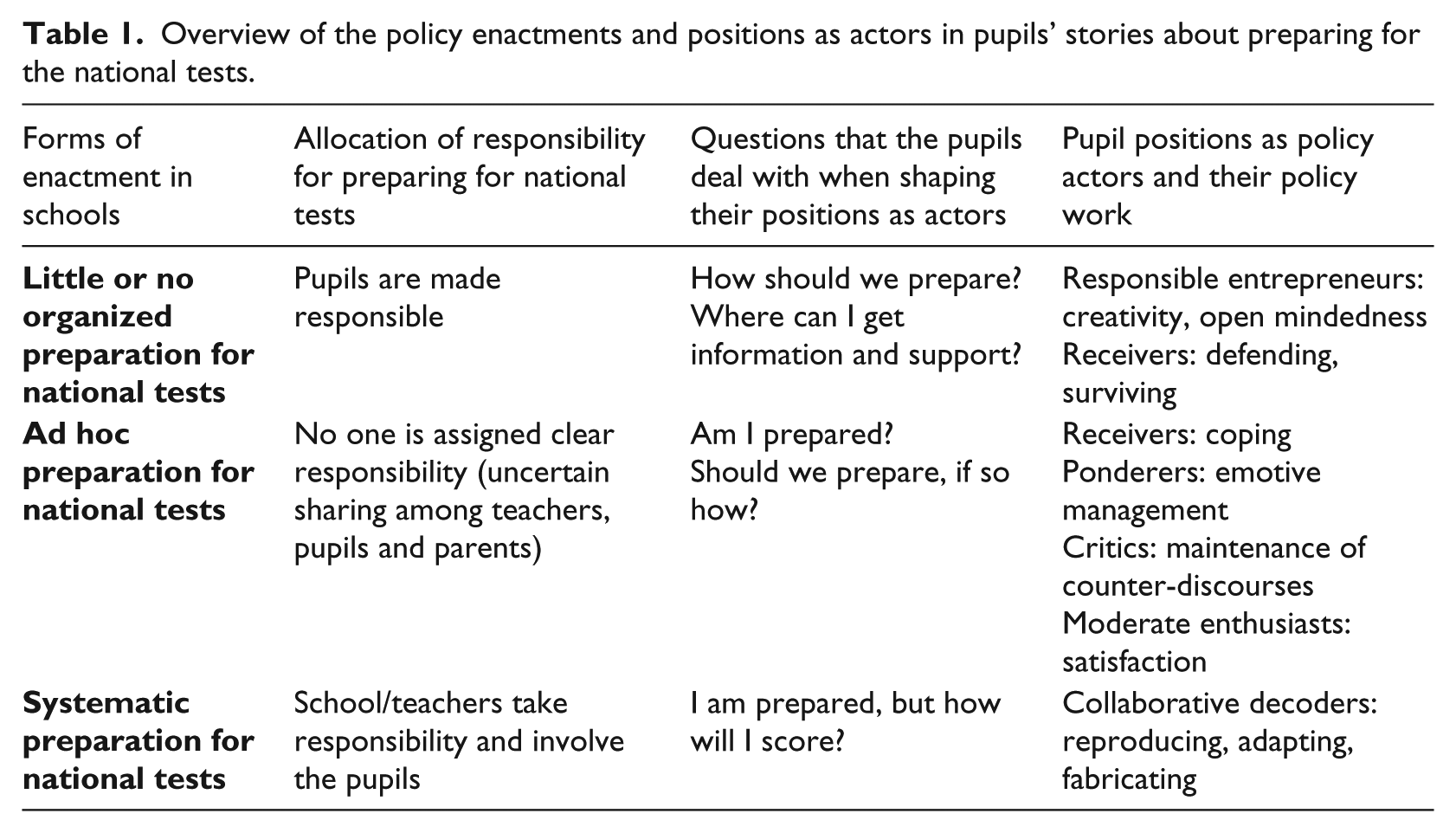
In this paper we illustrate the results with data from three of the municipal schools, here called H, T and B. The three micro-narratives were selected because each serves as an illustration of one of the three forms of policy enactment identified in the data analysis. The dividing line that distinguishes the forms of enactment from one another is the way in which responsibility for test preparation is distributed among various actors in the schools. In addition, the cases to some extent reflect the variety of schools in the data collected. School H was situated in a suburb, T was an inner-city school and B was a multicultural school on the outskirts of a city. However, we do not consider them representative of any predetermined categories (e.g. gender, social class or ethnicity), and even if our intention was to cover the variation of qualitatively different forms of enactment represented in data, this does not necessarily reflect the full breadth of the variation in terms of generalization (Larsson, 2009). Further, the sampling is based on our interpretation of what the pupils said about how the responsibility for the test preparations was allocated in their school, and obviously some differences occurred in what different pupils at the same school said. Some of these differences become apparent through the use of a narrative analysis that takes into account individual students’ voices, but some nuances are likely to be lost.
In the narrative analysis stressing stories as identity performances, we have been attentive to the rhetorical resources storytellers used to create dramatizations indicating that the events actually happened. We have considered how a sense of meaning is reinforced through the use of emotive words, quotations or humour (Bauman, 1986). We have specifically considered reported or quoted speech (Bauman, 1986) and active voicing to construct authenticity; in these instances, pupils have used a third person’s words and tones in their stories to construct reliability (Blomberg and Börjesson, 2013). This analysis serves as a way to focus on what the pupils themselves have highlighted as important events. In the analysis, we investigate the pupils’ performances (Mishler, 1999) as actors involved in processes of enactment in different contexts. As Boje (2008) points out, however, people most often tell fragments of a story since this is often enough for meaning-making in the given situation, and few narratives (or stories) in organizations have the structure that he calls BME (beginning–middle–end).
Results: pupils as policy actors and three forms of enactments
In many of the interviews we conducted for this project, pupils articulated the quandary of whether they ought to prepare for the national tests. The issue of test preparations stood out as a policy dilemma for teachers, pupils and parents that initially caught our interest. It became clear that pupils in some schools had not received any clear instructions about whether or how to prepare for the tests. Pupils in other schools, however, related tales of careful preparation. There is plenty of evidence in the data that schools and teachers act very differently when it comes to preparing pupils for the national tests. In our data analysis, we found three main forms of enactment whereby the schools dealt with preparing their pupils (see Table 1).
One dividing line that distinguishes these forms from one another is the way responsibility for test preparation is distributed among various actors – teachers, pupils, peers and family members. One form of enactment was characterized by a complete lack of organized test preparation in school, assigning most of the responsibility to pupils. Other schools acted in the opposite manner, offering the pupils rigorous preparation during school hours. In between these two opposite forms of enactment were a number of schools that took an ambivalent position when translating this policy. In these schools, the allocation of responsibility to different actors was unclear, and preparations at school were ad hoc in nature. Pupils at these schools talk about fragmentary preparations and of teachers who seem uncertain about how to prepare their pupils for the tests. Our analysis made it clear that different forms of enactment stressed different questions among the pupils in each school context.
In the following narrative analysis, we investigate the positions that different pupils took, along with their performances as actors that took shape in the stories as the pupils dealt with these questions. It is evident that pupils (re-)acted differently depending on the degree to which they were involved in the processes of ‘decoding’ how the national tests ‘worked’ or were designed. In schools that offered extensive preparation for the tests, the pupils generally acted as secure copers or even as collaborative decoders, jointly translating ways of dealing with the tests. In schools that offered little common test preparation, the pupils generally acted as survivors who either prepared on their own initiative or simply chose not to prepare. In the ad hoc schools, characterized by an unclear allocation of responsibility, the pupils performed more diverse actor positions that ranged from very insecure positions (e.g. the ponderers struggled to deal with their feelings of insecurity) to more confident ones (e.g. some pupils enthusiastically chose not to prepare). Thus, it became evident that different pupils in a single given context performed different positions as actors regarding the value of preparing for the test. This was most significant in contexts characterized by ad hoc preparations. The following section showcases the different forms of enactment in the data as illustrated by pupils’ stories about their test preparation. Further, we discuss the diverse pupil-actor positions that take shape in the stories as a way to highlight the variation between pupils’ positions as actors of policy.
Little to no organized preparation: ‘they told us to search for facts’
The first case illustrates a context in which the policy of national testing was enacted with almost no organized preparation in school. Three pupils at School B related their experiences of preparing for the national test in history.
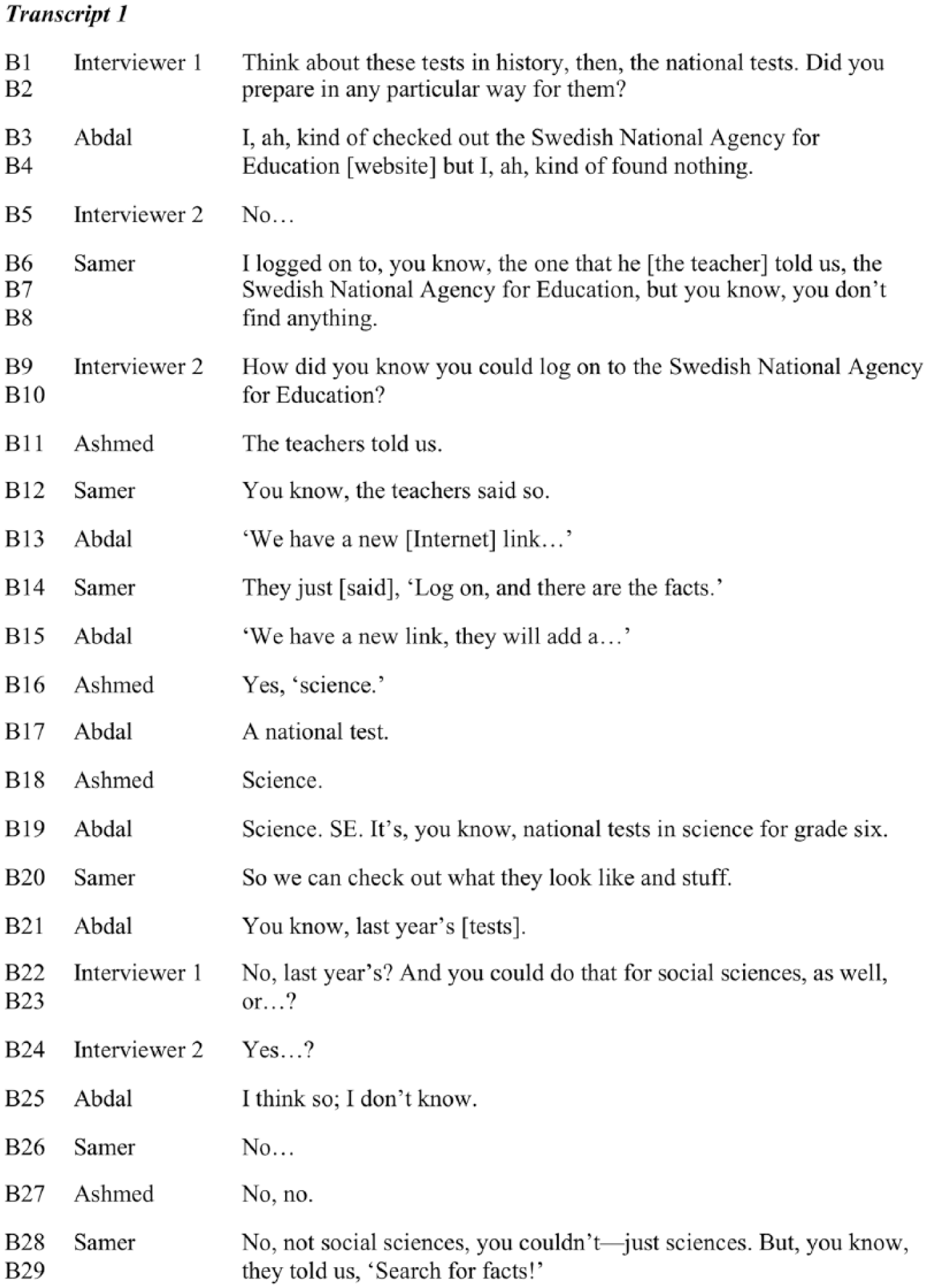
Transcript school B.
In this excerpt, the three boys and the interviewers are intensely involved in a process of constructing and understanding a story about teachers instructing pupils to visit the SNAE homepage in order to prepare for the national history test. In lines 6–14 and 29, the boys agree that the teachers had told them to ‘search for facts’ and to use the website to do so. In this case, responsibility for test preparations has been delegated almost entirely to the pupils. The teachers have a distanced position in this story; they give instructions, but they are not present when the pupils try to follow those instructions. The pupils get to choose between subject positions: they can either reject or accept responsibility for their test preparation.
In the confusion about whether it was possible to access last year’s national tests in history on the website (lines 22–28), somewhat different positions take shape. None of the pupils are critical of their teachers; they accept the transfer of responsibility, but Samer and Ashmed agree that it was impossible to access the old national tests in history (lines 26–28). Here, a pupil position emerges where the pupil is anxious to take responsibility for preparation, even though it was not possible to do so. Abdal’s uncertain statement about accessing the old tests (line 25), however, reflects an insecure position. He did not know whether it was possible to get hold of the previous year’s social science tests, which he would have needed to prepare; here he performs as a receiver trying to defend himself.
The story continues when the pupils talk about the other ways they tried to prepare for the history test. In the following excerpt, it is also evident that the pupils had a very short time to prepare for the test and that they felt it important to take the initiative in doing so.
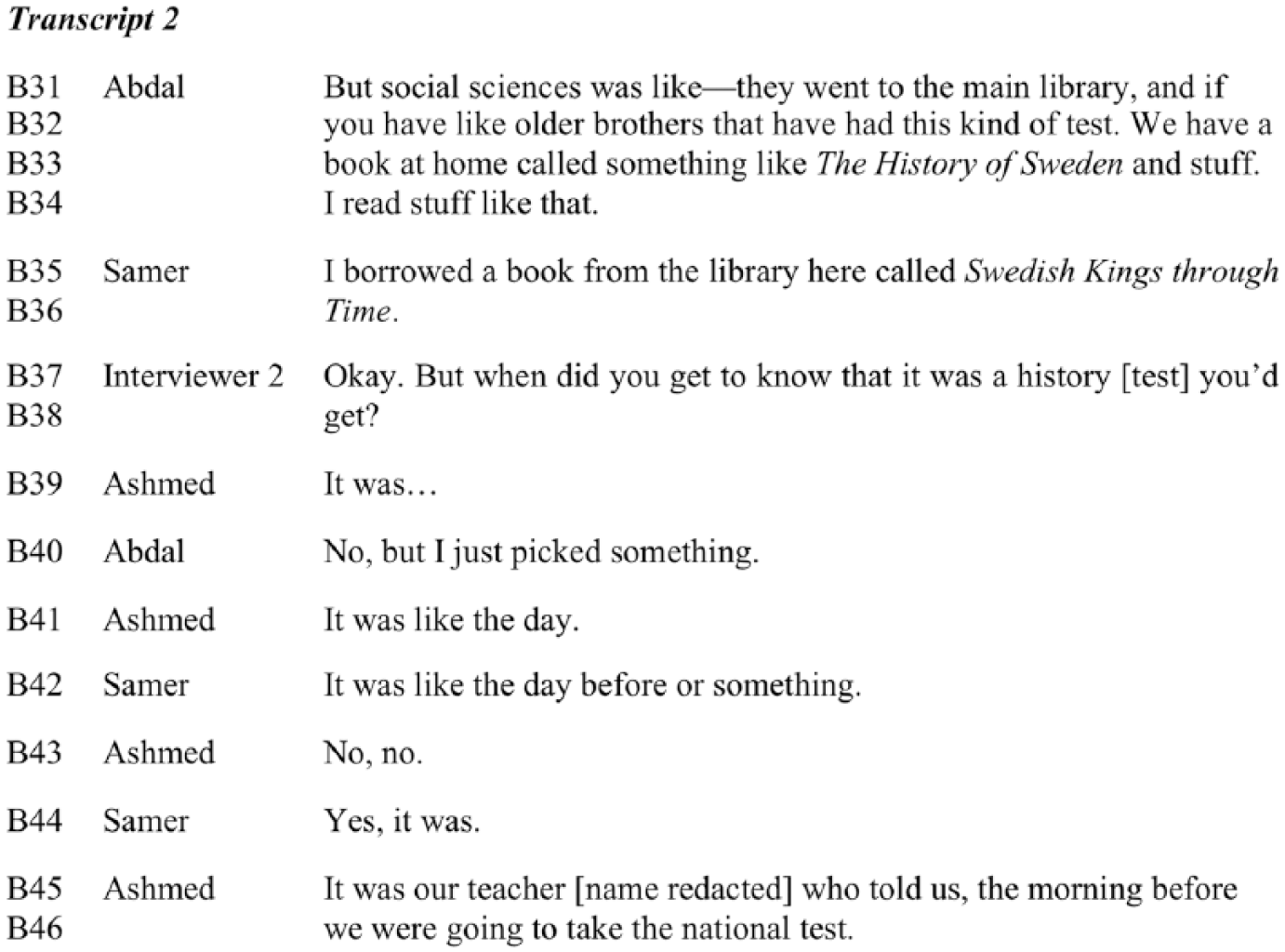
Transcript school B.
Abdal and Samer talk about their own initiatives to prepare for the test by borrowing and reading books, and by talking to older brothers who had completed similar tests. By referring to the titles of the books they claim to have read (lines 33–36), they stress the details and dramatize the importance of their taking on the responsibility given to them by teachers earlier (‘search for facts’, line 29). The pupils here perform as responsible actors, as entrepreneurs trying to find new ways to deal with the situation. Their attempts to take responsibility for their preparations emerge as insecure and sometimes random. Abdal talks about the test in social sciences, not specifically about the history test, and says that he ‘just picked something’ (line 40) when he chose which subject to prepare for. He also stresses the importance of contacts and private recourse (lines 32–33) when preparing. Samer refers to a borrowed book as the main source in his preparations. This story ends when the pupils answer a question about the situation and their feelings the morning they were to take the test. Samer and Ashmed say they were nervous before the test, unsure whether their creative attempts to prepare would be adequate. Samer was worried about not passing the test. Abdal, however, reports that he was not so worried, saying that he has not passed any of the national tests so far. They all agree that the morning of the test was different from other mornings because some pupils were reading privately owned books about history.
This story describes the policy of national testing enacted in a way that transfers responsibility for test preparation from the school and the teachers to the pupils. The pupils occupy a position from which they can choose to accept or reject the responsibility given to them. This story depicts pupils who tried to prepare for the tests in responsible and sometimes creative ways, but it also shows that their attempts were somewhat fruitless and left to chance. They talk about failed attempts to use the official SNAE website. They listened to rumours and made guesses; they had to rely on resources outside school, and their preparations took place within a very short time. The actor positions that take shape in this story are best described as those of, on one hand, responsible entrepreneurs and, on the other, receivers trying to defend themselves. The pupils express feelings of worry, nervousness and resignation.
Ad hoc preparations for national tests: ‘remember, you have national tests tomorrow, so you’d better study’
Another case illustrates a form of enactment in which the allocation of responsibility for test preparation was unclear, and in-school preparations had an ad hoc character. Here, three pupils from School T recount their experiences of preparing for the national test in biology. In the following excerpt from the transcript in box 3, pupils deal with the dilemma of whether they should prepare individually for the tests.
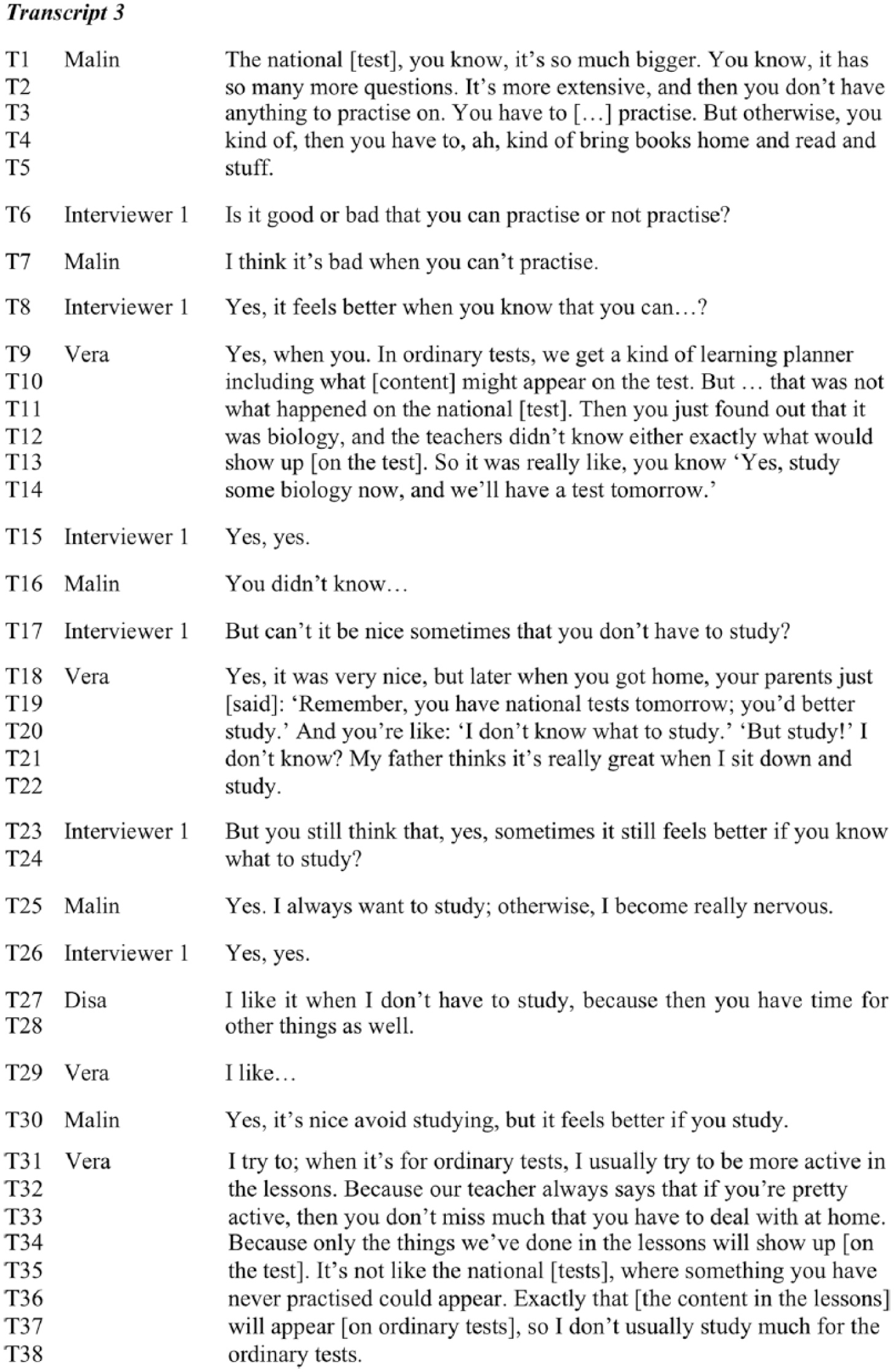
Transcript school T.
In this story, Vera performs as a pupil who is comfortable with the everyday routines in school that enable her to plan her schoolwork (lines 9–10) and adapt her classwork to what is expected (lines 28–31). The everyday school routines and ordinary testing practice make her feel safe; she normally does not need extra preparations (lines 31–33). The national tests, in contrast, stand out as something extraordinary and unpredictable for her in this story (lines 11–14 and 35–36). The problem of how to prepare for the national test is stressed in the dramatization (lines 18–22) that comes as an answer to the question of whether it could be nice not to prepare (line 17). In this dramatization, Vera is given the position of a pupil trapped between the possibility of not preparing and her father’s expectations that she does her very best in school. If she does not prepare, something that she normally does for school, she breaks her safe routines and risks disappointing her parents and herself. If she tries to prepare, however, it is unclear to her how she should do so, and neither the school nor her parents offer any clear support in this regard. The teachers are also given a helpless position (lines 12–14), as they cannot do what they usually do to help her. In this position, Vera becomes a receiver trying to cope with a new routine, but she is also a critic who argues for maintaining a traditional and more predictable agenda that defines how work and tests should be approached in school.
The lack of preparation in school places Vera in a dilemma whereby she accepts the necessity of the national test and expresses a willingness to prepare but lacks the means to do it, hence her expressed feelings of frustration and insecurity. Much the same can be said about the position given to Malin, although she does not say as much in this excerpt. Malin, however, is the one who initially articulates the dilemma and points out each individual’s responsibility for test preparation (lines 1–4). Further, in lines 16, 25 and 30, she expresses her frustration at not being able to prepare the way she likes to. In the story, she performs as a pupil who becomes nervous about the way tests are conducted here. We call this actor position that of a ponderer because such actors expend a great deal of energy reflecting on how to deal with the dilemma without finding a solution; therefore, they keep thinking about how to handle their emotions relating to the dilemma. The third pupil, Disa, stands out as a pupil who appreciates the opportunity to not prepare for the national test. In her comment (lines 27–28) after the dramatization, she relates that she highly values her freedom to do as she likes. She frankly translates the policy in a way that facilitates freedom to spend time on things other than schoolwork. Disa takes a position similar to a moderate version of the enthusiasts. Although she may not fully ‘embody policies in [her] practice’ (Ball et al., 2011b: 630), she makes something good of her situation by following the idea that the tests are supposed to measure what she has learnt during earlier school years, not what she can learn in the few weeks before taking the test.
The responsibility for the work of preparing for the national tests stands out as unclear to the pupils in this school (lines 2–3, 10–12 and 35–36). School T’s enactment of the policy of national testing, specifically in terms of preparation, delegates the bulk of responsibility for why and how the test should be prepared for to the pupils. The pupils describe how they are normally well prepared for tests in school, but that due to the lack of information about what subject will be tested the teachers become insecure and a great variety of different actor positions takes shape. In the story, pupils, teachers and parents are given the positions of actors that accept the policy but have very little scope for creative translations. Even though the focus of this article is on pupils’ positions as policy actors, this case clearly indicates that the policy of national testing is an issue at home as well as at school, and parents are actors positioned as outsiders involved in the processes of enactment. In a previous paper, we have shown that parents and other family members are intensively involved in trying to understand and influence how pupils deal with the national tests and sometimes adapt their daily lives to what they think is expected (Löfgren and Löfgren, 2015). In this case, however, the teachers lack information about which subject will be tested, the parents lack information about the near impossibility of preparing and the pupils perform as either frustrated or content with their inability to prepare effectively.
Systematic preparations for national tests: ‘it’s easy’
The third case illustrates the form of enactment whereby schools take the main responsibility for test preparation. Three pupils at School H discuss the careful process they went through at school before completing the national test in physics. This is not a very dramatic story; preparations appear to have become a part of the routine once the policy of national testing was implemented at this school. Nevertheless, we highlight a series of small dramatizations in the joint construction of the story in which the pupils perform as actors collaborating closely with their teachers and emerge well prepared for the tests. In this case, the policy of national testing was translated in a way that assigned primary responsibility for pupils’ preparation to the school and the teachers. In the classroom, pupils were invited to participate in a process of decoding past tests and, thus, of translating and enacting the policy of national testing.
The three pupils agree that they had prepared a great deal at school before sitting the national test in physics. The pupils discuss in great detail the collaborative preparations of practising with past years’ national tests. Some time before the test, they spent three to four days practising in this way. First, the pupils solved test questions in pairs. Stella says that she thinks ‘we were supposed to learn or to understand how they ask the questions and how you are supposed to think’. After solving the problems, the class went through all the questions in plenum with the teacher. The pupils say that they were encouraged to compare their own answers with examples, supplied by SNAE, of how the questions could be answered; the teacher put these examples on the blackboard. Further, they were asked to discuss and correct their own answers based on the examples and to rank them on a grading scale. The pupils found that some of the questions were hard to solve and analyse in this way, but they learnt something from the exercise. Stella says that through these reflections she has learnt to think in a new way and concludes that she did not have to provide such extensive answers as she had thought necessary.
The following quotes illustrate the embedded and well-informed position given to the pupils when the national tests are prepared for at this school, along with the confident attitudes that follow when the policy is enacted in this way. When pupils are asked about their feelings on the morning of the test, Fred answers that he had forgotten about the test altogether.
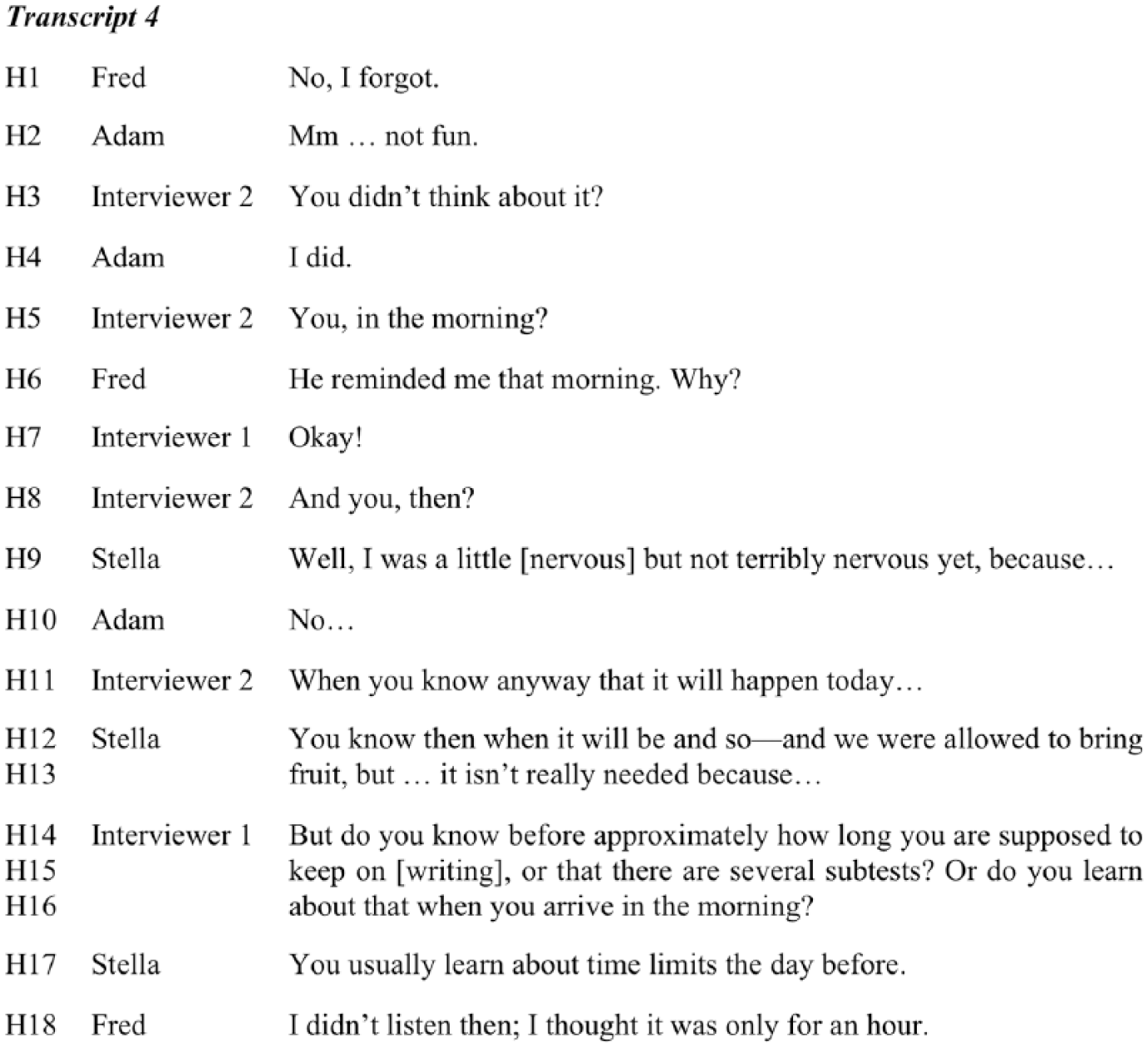
Transcript school H.
the tension between Fred’s relaxed attitude and the other pupils’ better-informed utterances shapes the dramatization. Fred says that he had forgotten about the test (line 1) and had not listened to the teacher’s instructions the day before (line 18). He thus shapes a distanced position vis-a-vis the test. Stella, on the other hand, expresses some feelings of nervousness (line 9), but she also tones down the importance of her unease about the testing situation by discussing the information pupils received about the testing procedures (lines 12–13 and 17). Adam says that he thought about the test (line 4), and Fred says that Adam reminded him (line 6), placing Adam in the position of being well informed. This quote indicates that the pupils feel they were prepared for the test and had access to the information they needed, although it also attests to both some worry and a slight resistance towards the school’s routines before the test. Paradoxically, this dramatization can be understood as a de-dramatization of the pupils’ feelings about sitting for the national test. When the pupils are asked a bit later in the interview about their individual preparations at home, it becomes obvious that they did not feel any need to prepare more than they had done at school.
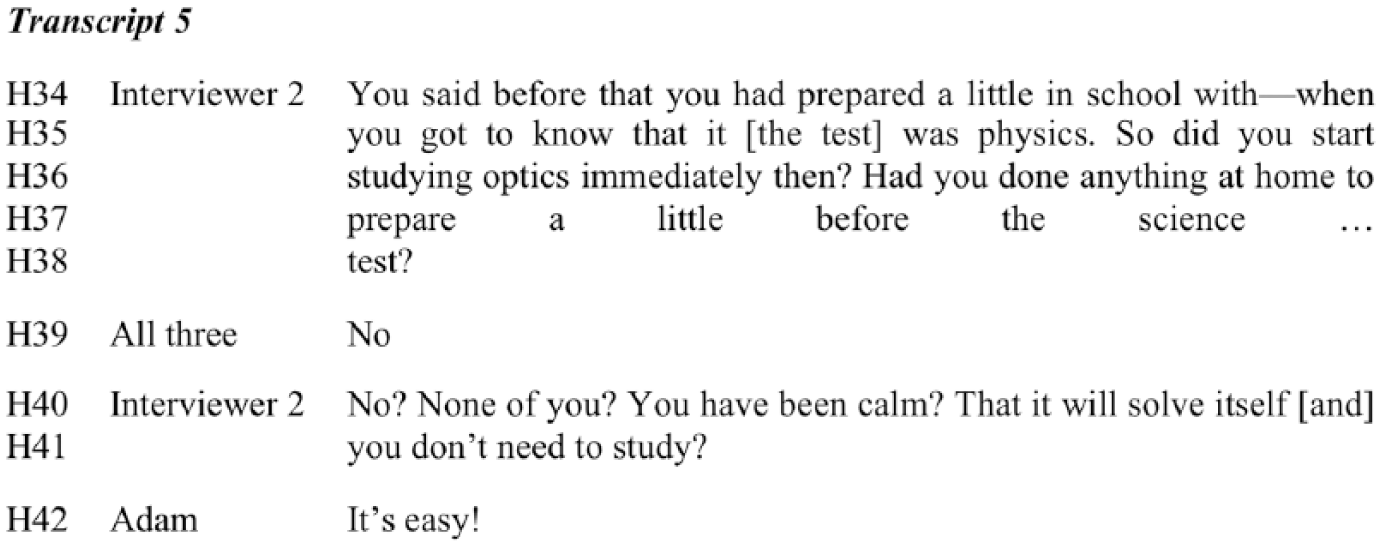
Transcript school H.
The interviewer’s question opens the way for stories about preparations at home, but the pupils all answer with one voice that they have not prepared at home. Adam’s comment ‘It’s easy’ (line 42) indicates his assessment that no individual preparations are needed because he has already learnt what he needs to know. In this sequence, the pupils appear to have been calm and confident before the test.
In this case, the position that takes shape is one in which pupils feel secure and well prepared by the school before the national test in physics. This is expressed in the pupils’ standpoint that individual preparations at home would be redundant, in combination with their extensive and detailed story about their common preparations at school. Of a certain interest, we argue, is that their story is not so much about physics, but rather about how much energy was spent on decoding the structure of a ‘good answer’ in the practice tests as a way to change their thinking and to develop strategies for dealing with similar questions during the actual test. The policy of national testing is in this case enacted such that the school and the teachers take responsibility for preparing pupils for the test.
The policy translation implies that, in this case, the teachers have taken a position of acceptance vis-a-vis the policy of national testing and do everything they can to help the pupils to achieve results that are as good as possible. In this sense the pupils are subjected to policy as policy subjects. The school appears to have fully accepted the performative aspects of the national tests, and the pupils are positioned as actors who need assistance in order to perform successfully. The pupils’ position in this case can be compared to that of many teaching assistants and newly qualified teachers that Ball et al. (2011b: 632) describes as ‘attentive consumers of translation work’. The similarity is that, in their study, senior teachers help their less experienced colleagues in dealing with policies that they do not know much about, and in this case the pupils who do not necessarily see the whole picture of the national testing policy are taught by their teachers how to deal with individual tests. A major difference, however, between the adult actors described by Ball et al. and the pupils’ position as actors in this case is that the adults are responsible for the enactment of the policy, but the pupils are not. We argue that the school, in this case, helps pupils to fabricate the correct, ‘good’ answers and to deal with the performative pressure that accompanies the testing policy. These pupils do not only receive and cope with the tests; together with their teachers, they are assertive and analytical in their approach when they jointly deconstruct past years’ national tests and the answers provided by SNAE. The pupils do not translate the policy in an independent way, but the teachers help them to decode what a proper answer should look like. These pupils’ position could be labelled that of collaborative decoders.
Concluding discussion: pupils as actors and subjects of policy for equivalence
This paper contributes to the field of research dealing with policy enactments in different countries by stressing the positions of pupils as policy actors in a Swedish context, and by focusing on the ongoing discussion of equivalence in schools and pupils’ different opportunities to influence their situation and chances at school.
Policies of national testing have been enacted in different ways and with various aims in different European countries since the middle of the 20th century. In some countries schools are relatively free to develop their own assessment practices, while in others the tests have become strong incentives for governments to implement national curricula and safeguard equivalence in education (Gustafsson and Erickson, 2013). In Sweden, the emphasis on national testing strengthened in the 1990s due to decentralization policies in education, and national tests in grade six were introduced in 2013, partly as a result of concerns about variations in different schools’ average results. This study investigates the enactments of a recent policy for equivalence in Sweden by focusing on the short-term preparations for the tests organized at school.
The results illustrate a significant variety regarding the students’ opportunities to prepare for the tests depending on the ways that teachers and pupils at different schools have enacted the policy. In the contexts where the short-term preparations can be described as an exhortative policy that leaves some space for pupils’ agency and alternative creative actions, the pupils are well aware of how to deal with the tests and perform in line with the national goals for education. In the contexts where the enactment of the policy is best described as unclear and the responsibility for the preparations is diffuse or is put on the shoulders of the pupils themselves, the pupils’ opportunities to perform in line with the goals are jeopardized. Put differently, the enactments of the reform are different at individual schools and seem to shape different opportunities for pupils to perform with some degree of agency. Drawing on previous research exploring how policy is enacted – studies that suggest that identifying responsible persons and that ‘making someone responsible for a policy is the enactment of policy and its embodiment’ (Ball et al., 2011a: 619) – we stress the pupils’ involvement in the processes of enacting policy. We argue that when responsibility for test preparation (or parts of it) is placed on pupils’ shoulders and shared with the teachers, they become not simply subjects that can choose to reject or accept the policy but also actors who take part in the process of translating policy. The pupils’ positions as policy actors described in this article are different from the adults’ (mainly teachers’) positions as actors described in previous research (Ball et al., 2012) as there are many differences in the conditions for adults and pupils at school. For example, the adults have a formal responsibility to enact the policy of national testing and are accountable for how this is done, whereas the pupils have no such responsibility. However, this study illustrates how the different enactments of the policy shape different opportunities for pupils to prepare and create different pupil positions as actors at different schools. We argue that the confident attitude illustrated when the pupils here positioned as collaborative decoders answer with one voice ‘No’ to our question about whether they prepared at home or not, and the pupils’ detailed descriptions of test preparations in the classroom weeks before the test indicate that some schools enact the national testing policy in a way that enables their pupils to deal effectively with the performative national school system in Sweden with greater agency than pupils at other schools. This relatively strong position given to some pupils described here should not be exaggerated as, in this case, the pupils are also clearly subjected to the testing policy. The teachers’ eagerness to involve the students in the enactment of the policy is, however, a little surprising when compared to some studies of actors in other national contexts. There are plenty of examples of how more strictly imperative policies force experienced teachers and pupils to act with ‘little opportunity for sense-making’ or agency ‘within a logic of conformity and the imperatives of performance and competition’ (Ball et al., 2012: 97). For example, studies of how policy actors in New York schools are forced to get involved in standardizing academic assessment (Koyoma, 2011) or how schoolboys in Canada become stigmatized as disadvantaged by an equity policy (Martino and Rezai-Rashti, 2013) illustrate how some policies force people to become merely subjects to policy without options to act. Our findings are in line with studies that describe teachers and pupils as both subjects to policy and as policy actors (Ball et al., 2012). Our findings are also consistent with studies where Swedish pupils are sometimes described as actors with some degree of agency (Tanner and Pérez Prieto, 2014) and sometimes mainly as subjects to policy (Lindgren, 2007).
When discussing the matter of equivalence, this national testing policy needs to be understood in its historical context. Since the concept of equivalence has undergone a displacement whereby the meaning has shifted from stressing goals of unity and common frames of reference to a stronger emphasis on individuality and freedom of choice (Englund, 2005), the national tests have become an important instrument for monitoring and safeguarding equivalence in the Swedish school system. The very idea behind the national tests is to ‘support equal and fair assessment and […] increased goal achievement for pupils’ on a national level (Skolverket, 2015) – hence the heavy state involvement in testing and grading procedures. Between 1990 and 2005, the Swedish school system was highly deregulated and decentralized as a reaction to the previously very centralized system, but it was also criticized for producing inequalities between schools and for being ineffective. The policy of increased national testing in Swedish schools should, therefore, be regarded as a part of the recentralization and restructuring ambitions that now shape conditions in the Swedish school system. The fact that most parts of the policy are quite narrowly defined in written texts from the SNAE reflects the now stronger state interest in schools’ results and the issue of equivalence regarding students’ rights to equal opportunities to reach the goals of education (Carlbaum, 2016), and this interest is mainly in terms of test results and grades (Englund and Quennerstedt, 2008). In this sense, the policy could be described as having ‘imperative ambitions’ to deal with the lack of equivalence between the different schools in Sweden. Our results show, however, that when it comes to test preparation, there are few regulations, and the policy is enacted in different ways in different contexts. One interpretation of this result could be that the different enactments of this national testing policy contribute to growing differences between schools regarding the issue of equivalence. We, however, do not make any such claims of generalization. Rather, we want to emphasize that despite all the efforts made by the national government to measure and showcase differences between schools – through not only national tests but also a reinstated school inspectorate and a new grading system – to secure equivalence in schools we must not forget that the interpretation of equivalence is largely a matter of negotiations in local contexts (Englund, 2005) and that the way a policy is enacted is a matter of how local actors interpret and translate it (Ball et al., 2012). Therefore, it is not so surprising that differences occur, but the more interesting research issue is to investigate how they take shape in schools.
The short-term test preparations, we argue, are an opportunity for schools to give pupils more equal opportunities to succeed in national tests. They are a very delimited chance to compensate for some pupils’ lack of academic assets outside school in a system characterized by testing for equivalence rather than teaching for equivalence (Englund and Quennerstedt, 2008) and an ‘increasingly instrumental understanding of education’ (Wahlström, 2014: 740). In this paper we have illustrated how some schools help their pupils to understand how to deal with the tests and perform in line with the specified learning goals measured in them and how other schools do not. This variety regarding pupils’ test preparations at school emphasizes that the different enactments of this policy of national testing have implications for the interpretation of equivalence in schools.
Finally, it is important to remember that this paper illustrates that independent of how the national testing policy is enacted in schools, the pupils shape significantly different positions in their stories. This indicates that there is no causal connection between the way the test preparations are conducted and the individual pupils’ results or experiences of the test. Likely, pupils’ assets outside school, such as family background and social network, still play a major role in terms of their sense of being in control of the situation and succeeding with their answers.
Footnotes
Declaration of conflicting interests
The author(s) declared no potential conflicts of interest with respect to the research, authorship, and/or publication of this article.
Funding
The author(s) disclosed receipt of the following financial support for the research, authorship, and/or publication of this article: The project ‘Pupils’ stories about grades: A study of pupils’ experiences of getting grades and of conducting national tests in grade six’ was supported by the Swedish Research Council (grant number 721-2013-1668).