




Abstract
This paper has two aims: to introduce readers to Bernstein’s concept of languages of description, interpreted through the lens of ethnography; and to demonstrate the value of this approach to theory-making by showing how a qualitative study conducted on these principles led to new explanations for gender differences in literacy attainment that can be tested using PISA data.
Introduction: Research and languages of description
In a late essay Bernstein used the concept of ‘languages of description’ to explore the role of qualitative research in theory-making (Bernstein, 1996: 134–144). In the essay, Bernstein contrasted the dilemmas faced by an experimental or quantitative researcher with the dilemmas facing the qualitative sociologist or ethnographer. In the first case, the quantitative researcher embeds within their research design the theoretical propositions they want to test. In a quantitative research design, anything beyond the initial hypotheses and the combination of variables built into the model, in order to test them, must remain invisible. A good deal therefore hinges on whether the measures chosen, ahead of data collection, sufficiently represent the salient features of respondents’ social worlds. For respondents have to be able to recognise them to react appropriately to the research design.
In the second case, the qualitative researcher enters the field without already knowing precisely which aspects of participants’ social worlds need attending to and will prove most relevant to the research. Precisely how to bring the data into a well-motivated relationship remains an open question. Consequently, in an emerging design, the qualitative researcher risks being overwhelmed by the sheer mass of unstructured data they collect, able to know only what their research participants have told them, but not what it means.
Bernstein directly addressed the problems qualitative researchers face in working inductively in a field whose structure they do not already grasp by developing the concept of languages of description. For Bernstein, a language of description has two parts: an external language of description or L2 that brings out the salient distinctions operating on the ground; and an internal language of description or L1 that constructs the underlying logic to the categories seen in use. When full developed, L1 specifies more clearly the generative grammar that makes L2 possible. Both languages are analytic in so far as they create new terms in which to describe what has been observed. They then translate the distinctions marked in practice and in the language of participants into a new theoretical language orientated towards the purposes of the research. They operate at different levels of abstraction: L2 provides a language of enactment; L1 a language of explanation (Moss, 2001).
Bernstein recognises that in practice these two languages develop in tandem over the length of the research process. One does not precede the other. He also argues that they need to remain distinct. Terms in one language cannot substitute for terms in another. Importantly, he suggests that to work top-down from the language of L1 to find L2 reduces the dynamic in the language, minimising the possibilities of re-description from the bottom up: the processes of constructing description are not discrete in time… but I believe we must struggle to keep L2 as free as possible [from L1]. This struggle is for pragmatic and ethical reasons… It is ethical, for without some freedom the researched can never re-describe the descriptions made of them. From this point of view L2 …must as far as possible be permeable to the potential enactments of those being described. (Bernstein, 1996: 138)
L2 must stay sufficiently close to the data to capture the logic at play in the social world it reports. By so doing it keeps open the possibility of interrogating the more abstract model created in L1. Otherwise L1 becomes circular and cannot see beyond itself.
Languages of description and research design: Taking aim through the object of enquiry
The task of constructing a language of description has become the starting point for much of my own research. It governs how I think about research design, how I understand and analyse my data, and how I exercise the researcher’s responsibility to the researched. It also underpins how I teach my research students to begin the process of translating the data they collect into an analytic language of their own. To construct a language of description is a profoundly theoretical undertaking that rests upon such acts of translation. It is not easy to do well; not least because, as Bernstein comments, ‘often the researcher does not have a strong internal language of description (L1) but rather orientations, condensed intimations, metaphors which point to relevancies.’ (Bernstein, 1996: 137).
Under these conditions, how the focus for the enquiry is set becomes crucial in helping determine the relations between parts that the language of description can explore. Targets need choosing with care. Looking back at Bernstein’s work we can see how the targets for his own theoretical thinking shift over time from a focus on social class variation in language codes in the home; to the ordering of pedagogic practices in the school; to the changing role of the state in governing education; to the reconfiguration of knowledge in higher education. The inner grammar is consistent. The theoretical language changes as the objects of his enquiry and their relationship to each other shift too. He directs his attention to where it is most needed at the time.
Choose the target carefully and something new and different can emerge to challenge commonplace thinking in ways that matter at the time of enquiry. It is in this sense that I want to make a case for thinking about gender and literacy attainment as a timely object of sociological enquiry. The topic first began to attract my attention back in the early 1990s when boys’ underachievement in literacy suddenly became visible in English education in a way that it hadn’t been before. The change in the discourse seemed to be triggered by girls closing long-standing attainment gaps in maths and science, and beginning to equal or outperform boys in public examinations across the full range of school subjects at ages 16 and 18 (DFES, 2007). Without any compelling account for why this should be so, rather than congratulate schools for the difference they had made to girls and women’s lives, worries surfaced in the public domain that boys were losing out in the educational race for better qualifications.
With the benefit of hindsight, as Arnot and colleagues observe (Arnot et al., 1999), the most likely explanation for girls’ improved educational performance probably rests with the introduction of a statutory National Curriculum to English schools in the 1980s. The new curriculum and its associated testing regime prevented students dropping subjects at 14, and entrenched expectations that most students would be entered for the full range of subjects at 16. Less streaming early on enabled girls to continue to study for higher levels of examination which previously they would not have been entered for (DFES, 2007). The combination of incentives for schools to increase the numbers of pupils taking higher-level exams and improved access probably accounts for the marked improvement in performance. In essence, this was less to do with a triumph of feminist principles in education than the pragmatics of a new policy regime, driven by closer scrutiny of examination performance data.
However, the resulting sudden focus on boys’ underperformance raised suspicions amongst feminist researchers that a feminist backlash was underway. This was fuelled by the most commonplace explanations for boys’ underachievement that began to circulate (Gilbert and Gilbert, 1998; Martino, 2008). These included that they suffered from the absence of male role models amongst the teaching workforce and were put off schooling by the ‘feminised culture’ in infant school classrooms, where women teachers predominated. Boys’ interests were thought to be marginalised in a literacy curriculum based on narrative texts (Millard, 2001). Such explanations seemed to reinstate gender-stereotyped thinking of a kind that feminists had been successfully battling against, just at the moment when greater gender equality seemed to be being realised through girls’ improved educational performance (Epstein et al., 1998).
Yet look more carefully at the data and in fact boys’ underperformance in literacy is of long-standing (Cohen, 1998). When girls and boys have equal access to early years education, a gender difference in literacy attainment appears in the test data. This cannot be accounted for by teacher bias in assessment (Rutter et al., 2004). Instead, what changes over time is how much notice such data attract, the significance they are accorded and the explanations proffered for the gender differences observed. Go back to the war years when educationalists in England were trialling standardised tests of Verbal Intelligence, English and Arithmetic to help determine entry to grammar school, and the fact that boys did less well than girls was explained by the absence of their fathers on war service. The disruption to family life that ensued must mean that boys had neglected their studies (Emmett, 1950). The assumption was that family discipline in the years of peace that would follow would put this right. Nothing much to get concerned about then. By contrast, in the 1990s, news of boys’ underperformance in comparison with girls’ educational success led the popular press to argue that the educational pendulum had swung too far in girls’ favour. Something needed to be done to redress the balance in favour of boys (See Martino (2008) for a critical account of this turn in the discourse).
In this context it seemed urgent to look for a more robust explanation of the gender differences in the literacy performance data that didn’t depend upon stereotyping boys and their interests; that would recognise that not all boys do badly and not all girls do well; and that, most importantly, could provide a social rather than biological basis for any patterns found.
Researching the social construction of gendered patterns in reading: Taking ethnography to the classroom
There are, of course, ways of exploring these issues using quantitative research designs (Sullivan and Brown, 2015). One of the most persistent explanations for boys underperformance in literacy stems from the association in quantitative datasets between high literacy attainment and high levels of commitment to reading for pleasure (OECD, 2011a: 87–115). Such datasets also show that boys are less likely than girls to spend time reading. These correlations are treated as causally related, whichever way the association between higher volume reading and higher attainment is thought to run. They have dominated much of the analysis of reading attainment in the PISA dataset, both in the official commentaries and in follow-up studies published by independent researchers (e.g. Brozo et al., 2007). Working from the consistent correlation between high-frequency reading and higher attainment, one of the hypotheses the PISA dataset is designed to explore is whether the gender gap could be closed by increasing boys’ motivation to read. This is often imagined in terms of giving them better access to more of what they like, often assumed to be non-fiction 1 . Motivation and text type are here interlinked (OECD, 2011b).
But from a sociological point of view, if boys have a preference for non-fiction, such a preference has to be made; it cannot be taken as a given. Where, how, and in and through which kinds of social interactions, might such reading preferences arise? There are a wider set of social questions lurking here about how individuals come to see themselves as readers and the (gendered) terms on which they might do so, which deserve fuller exploration. A qualitative study would be able to take many more such factors into account, whilst remaining much more open-minded about what the precise relationship between such factors might be.
To rehearse the history to the qualitative study that ensued is to clarify that designing a study with Bernstein’s languages of description in mind does not require a fully fledged theory acting as L1 to fix the design in place. On the contrary, if the point is to evolve a new language of description, then L1 needs at the start to be more light touch, an intimation or steering device that usefully frames the study by setting the parameters to data collection in a theoretically motivated way. That is its function at this stage.
In the case of this study, to explore the interaction between gender and literacy attainment I began by choosing research sites which might throw most light on how reading preferences emerge in and through social interaction (Moss, 2007). The study targeted the 7–9 age group because this is the moment when children begin to read independently in the English school system and thus can exercise greater control over what and how they read. To understand how their choices might be shaped by the social context, the study identified four case study schools, two working in areas of high deprivation, two in much more affluent areas. Each pair included one school with performance well above the national average, and one with performance only just at or below the national average.
This led to a school-based case study design encompassing classroom observation, text audits, document collection and teacher and pupil interviews focused on reading in school. This was added to by a neighbourhood audit of resources for reading in the community (e.g. shops and libraries); a parental survey of reading and family leisure activities; parent interviews; and photographs of reading in the home taken by a sub-set of pupils (see Moss (2007) for full details).
The primary objective steering the research design was to map ‘which texts were getting into which contexts for which readers?’, with gender left to one side rather than fully determining the researchers’ gaze. However, the research activity was structured in such a way that the combination of methods would be able to track the terms upon which different types of texts became visible and were made available to readers in social interaction, including how those readers were themselves positioned. It left open as a matter for analytic description what those terms might be.
This is consistent with an ethnographic approach to literacy research which puts the participants’ perspectives first (see Heath, 1983; Street, 2003). By stretching the research frame to include literacy practices at home as well as at school, the research could also explore how far different contexts operated with similar or different ground rules for reading and the salient distinctions this might create for children moving from one setting to another. This moves the research closer towards building a language of description in Bernstein’s terms, as what matters is not just the categories in play ‘here’ but their dynamic relation to each other. Taken together, such data should yield a ‘grammar of possibilities’, what is seeable and thinkable about reading from the perspective of the individual within their wider social and institutional context. In these terms the orientation to the field embedded in the research design brings into motivated relationship those elements that will prove crucial in building both L2 and L1.
Building a language of description: Literacy events as the unit of analysis
To capture the salient differences in ways of reading in school, the research team focused data collection on literacy events. These are defined by literacy ethnographers as ‘any occasion where a piece of written text plays an integral part in what goes on’ (Heath, 1983). If the teacher read out a letter that the school was sending home to parents, then this would count as a literacy event. The text, the nature of the social interaction around the text, how it was made accessible to whom, all would be recorded in field notes. In this way the research team put to one side what they thought the most salient characteristics of any texts might be. Everything rested on the distinctions readers made in practice in the literacy events in which particular texts surfaced.
One of the most surprising aspects of the project was how much teachers themselves drew attention to the different ground rules associated with different kinds of texts through the different configurations of social space in the classroom. There was clearly more than one way of doing reading. Part of what the teachers did was to share these ground rules with their pupils. Through their words and actions, through the social orchestration of the use of space in the classroom, through the roles they assigned to pupils, and the roles pupils took up, they demarcated the range of literacy events that made up the curriculum over the course of a day. Everyday vocabulary used by teachers and pupils made clear distinctions that the researchers hadn’t anticipated. ‘Independent’ or ‘free readers’, for instance, constituted a class of pupils the teacher considered fully proficient in reading, and who were able to choose what they wanted to read for themselves. They could freely access ‘chapter books’, a term used to denote books that were long enough to be sub-divided into chapters and therefore had more print to navigate and fewer or indeed sometimes no pictures. Any of the Harry Potter novels, for instance, would count as a chapter book. Children gaining access to these kinds of books were assumed to have a level of reading fluency that would enable them to cope with the demands of the language and the reading stamina necessary to get from the book’s beginning to the end.
Conversely, pupils not yet accorded the status of ‘free readers’ were expected to read texts the teachers chose for them, with the teacher carefully matching the demands of the text to their judgement of the pupils’ proficiency in reading. One group of texts in common use in the classroom – reading scheme books – are produced by publishers with this precise function in mind. Reading schemes sort and proclaim the proficiency status of the sequence of texts they contain through the size of typeface, leadings and the space committed to pictures on each page. The easiest texts will have the largest typeface, more space given over to pictures and therefore fewer words to read. As the text type shrinks, and the pictures take up less space on the page, so the proficiency level increases. Children are expected to work their way through the scheme, only moving level when the teacher deems them ready to do so. As they move up through the school, the number of children restricted to reading these kinds of books dwindles.
Steering at first by the language in use on the ground, the research team began to recognise how particular combinations of text types, reader positioning and access to texts recurred at different points in the day, each holding different functions in terms of getting the work of the curriculum done. Each configuration of texts, readers and context seemed to be held together by a different inner logic. The research established the criteria by which individual literacy events could be allocated to one category or another. This began the process of building L2.
The key distinctions between literacy events made on the ground could best be described as: Reading for Proficiency; Reading for Choice; and Procedural Reading. Sorting and labelling individual events in this way also re-ordered them, bringing out different aspects of activities which participants might not necessarily have grouped together. It also helped the research team notice contradictions between these different ways of doing reading that might otherwise have passed unremarked, yet which seemed to play a key role in their relationship one to another. For instance, Reading for Proficiency and Reading for Choice together accounted for elements of the literacy curriculum that teachers would easily recognise and explicitly plan for. But they also provided very different logics through which reading behaviours and preferences could be articulated and acted upon.
The logic of Reading for Proficiency was most on display in events involving the ‘reading book’. This is the book allocated to the child by the teacher, and formally used to assess their proficiency as a reader. Children were expected to take this book home to read with their parent or guardian daily, and would be provided with a ‘book bag’ to transport it between home and school, alongside a ‘home reading record’ in which parents were expected to comment on their child’s reading. In many different ways, literacy events and practices involving the reading book highlight that proficiency in reading matters. They also demonstrate very clearly to pupils that the judgement on how well they do rests with adults.
In comparison with Reading for Proficiency, the category of literacy events labelled Reading for Choice was much more diverse. Reading for Choice might include the teacher reading aloud to the class a book chosen for its interest, rather than because it matched pupils’ individual levels of skill, or moments planned into the curriculum when children were free to choose books for themselves using criteria over and beyond the proficiency judgements that governed the selection of the ‘reading book’. This included moments when they could gather in a relatively informal manner in the ‘book corner’ in class, browsing through the range of resources they contained and able to quietly socialise with each other provided they did not disturb other pupils. For teachers, such activities could be justified by citing the value of engaging children in a meaningful response to texts and encouraging them to read for pleasure. For pupils, they often represented time off from the demands of the formal curriculum and greater freedoms to choose what they did.
In contrast to the other two categories, Procedural Reading was not counted as part of the literacy curriculum and was seldom named as a distinct classroom activity, even though this way of reading probably took up most classroom time. These were moments when teachers incorporated written text of many different kinds – writing on the blackboard or computer screen, worksheets, textbooks, notice boards – into the formal and informal curriculum with other teaching and learning objectives in mind. This was reading to get other things done. Whilst passing largely unremarked, these events demonstrated another set of ground rules. Teachers took the responsibility for reading and explaining the text to pupils, and pupils were entitled to ask for help with any difficulty in understanding or de-coding the written text as the activity continued. Assessment of how well or how badly the task in hand had been accomplished would not fall on the pupils’ reading but on a different text, whether written or spoken, which the activity led to.
Each of these ways of doing reading created different terms under which texts could be accessed, with different subject positions for readers to take up. By delineating the competing logics to literacy events in school in this way it became possible to think again about how reading preferences emerge, and what is at stake for children in choosing one kind of text over and above another.
Bringing gender back into the frame: Using L2 to explain reading preferences
Looking across the dataset, gender differences surfaced most clearly in children’s reaction to the ‘reading proficiency’ judgements made about them in class, and in particular the social hierarchies of readers this created. More competent and less competent readers were clearly delineated one from another, by virtue of where they might be asked to sit in class, the reading tasks they were set or the materials they were allocated, and the terms in which they could access them. In these ways, children’s status as readers was always known to their peers. Boys and girls reacted very differently to this state of affairs. In brief, whilst girls designated ‘weak readers’ accepted that positioning and would use it to guide what they read, many boys did not, mobilising the logics associated with ‘reading for choice’ to counter and undermine the logic associated with ‘reading for proficiency’. This became very apparent when documenting who was reading what with whom.
All of the schools where the research was based created some opportunities during the school week for children to exercise self-directed choice over what and how they read. During these times, girls designated as weak readers would often read ‘easy books’ with more proficient girl readers in their friendship groups. In effect, the group would play at ‘reading aloud’ to the teacher. Appearing to be on the receiving end of help from those more expert than themselves did not inhibit this activity for participants, and indeed sometimes became part of the play.
Conversely, boys designated as weak readers never freely shared the ‘proficiency texts’ they had been allotted with other boys. Whenever they could they eschewed books that, through their design features, in any way indicated the proficiency level of the reader (in practice, most fiction texts), choosing instead non-fiction books that were visually rich, and used multiple sizes of font on the same page to signal salience of the text, not the proficiency of the reader. Watching how these readers navigated the texts, it became apparent that they used the images to take up the position of expert and say what they already knew about the subject matter. Choose a striking image from the book – dangerous animals, the machinery of war, desert mummies – and they could talk on the topic without having to navigate their way through the written text at all. Choosing non-fiction thus seemed to act as a way for weaker readers to save face with their peers, enabling them to avoid altogether the status judgements associated with competence at reading.
Yet it also meant that, in effect, they were not practising their skills as readers. The net result of these kinds of behaviours was that the weakest boy readers simply spent less time on text. Many actively avoided those activities that were supposed to address their poor levels of skills. Acceptance of, or resistance to, judgements made about their proficiency as readers seemed to be an important explanatory factor in boys’ trajectories as readers and also in the text preferences they exercised.
How children reacted to the social judgements on their skills as readers, made visible in the classroom, and the impact this had on their willingness to read, suggested a different explanation for boys’ underachievement in literacy. The association of a particular sub-set of boys with non-fiction is a by-product of the reading culture in class, rather than a natural expression of gendered interests which need to be met if boys are to progress as readers. Instead, much of the difficulty for boys placed at the bottom of the ability spectrum seemed to lie with issues of self-esteem, and the challenge of acknowledging their difficulties in reading as a necessary first step in tackling them.
At the other end of the ability spectrum, things looked different again. Documenting the text choices that those labelled free or independent readers exercised showed that both boys and girls who saw themselves as active and able readers consistently chose fiction texts. Yet their reading choices were differently embedded in their social networks. Girls actively committed to sharing favourite texts with their peers, whilst boys who read fiction often and for pleasure were mainly solitary readers, relying on family networks to keep them reading.
The ethnography highlighted the unexpected ways in which gender and designations of ability interacted in shaping pupils’ reading preferences. The tension points in the reading curriculum in school and how this steers reading preferences only became visible by looking across the full range of literacy events in the classroom, and then re-categorising them to bring out the different logics they expressed. The conflicting subject positions they created could be seen at work in both formal and informal contexts, in school and at home.
Classroom observation showed how pupils variously mobilised these different social logics to both accept and resist the judgements schools made about their status as readers. Establish a new language of description for the data and it becomes possible to imagine other ways of reconciling the tension points observed. Give the language of description back to teachers and they can review current practice in this light (Moss, 2000). The language of explanation focuses on the way in which the curriculum creates social hierarchies of knowers, through the pacing and sequencing to knowledge it enacts. This takes us back to the role Bernstein assigns to pedagogic discourse in social reproduction. It also creates a different space for thinking about gender relations and a gender politics of schooling in which the question of whose interests the curriculum serves (boys versus girls?) is replaced by a more precise set of questions about how to make a hierarchical knowledge base more accessible to all.
Putting the ethnography to work: New avenues in research?
The ethnography suggested that schooling itself and the hierarchical social structuring of the literacy curriculum in particular produces a number of tension points which children have to navigate. Gender and the designation of reading ability in classrooms interact. If children’s perceived proficiency as readers is made highly visible in classrooms, this seems to disproportionately impact on boys labelled weaker readers. This could be addressed if teachers found new ways to develop the skills of weak readers whilst maintaining their self-esteem. By contrast, and against stereotype, the ethnography suggested that boys who read for pleasure overwhelmingly invest in reading fiction. The reasons why fewer of them do so could be addressed by more actively promoting fiction reading in class, finding ways that sustain peer reading networks more directly in order to do so. The qualitative study shifts the terms of the debate over gender differences in literacy attainment. It also produces a different set of hypotheses from which to explore the potential causal links between motivation to read, reading attainment and gender.
Go back to PISA data on gender and literacy attainment, and the main hypotheses driving the analysis are that motivation to read matters, that girls are more motivated to read than boys, and that motivating more boys to read means offering them more of the texts they like, especially non-fiction. The main question used to explore the association between text type and motivation to read (DIVREAD in OECD, 2010a) asks: How often do you read these materials
The commentary on the graph which summarises the analysis runs like this: PISA also found that boys and girls have different types of reading interests, which is fairly consistent across countries. Boys’ interest in a wide range of materials including non-fiction, newspapers and comics, but their much lower interest in reading fiction books, suggests that the choices of reading materials may influence the success of any programme to engage boys more in reading (OECD 2011b. Authors italics)
But look carefully at Figure 1.
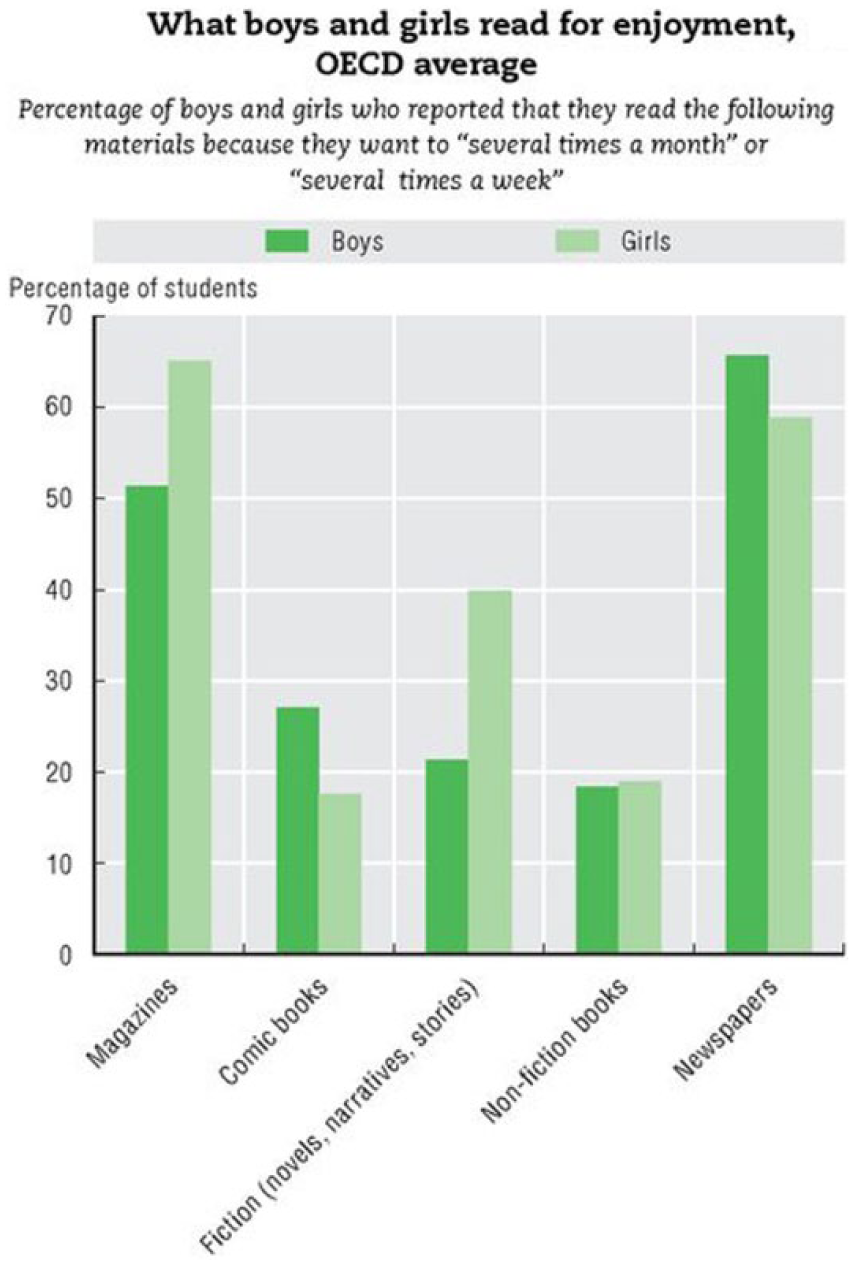
What boys and girls read for enjoyment, OECD average.
In fact, whilst substantially more girls than boys do say they read fiction several times a month or week, slightly more girls than boys report reading non-fiction frequently. Indeed, the key difference hiding in the data may be the amount of reading of any text type that boys engage in compared with girls. This is partly hidden by the assumption that time spent reading a newspaper equates to time spent reading fiction. Yet the investment in time spent dipping in and out of different sections of a newspaper is likely to be considerably less than the time spent getting from the beginning to the end of a fiction text. This has been ignored in the analysis.
The ethnography suggests a different set of priorities for the analysis, first by unpacking the frequency measures so that the analysis separates out high-frequency readers who say they read several times a week from those who only read several times a month; and second by checking whether the ‘substitution’ thesis really holds: that frequently reading other materials besides fiction correlates as highly with higher attainment. Unpack the data in this way, treating the difference in text types as not so much the expression of gender preferences for this content over that, but as a commitment to time spent reading, and it becomes possible to contrast the sustained reading experience that fiction demands with the dipping in and out that comics, magazines and newspapers facilitate. This makes it possible to explore more carefully what the correlation between high frequency of reading and higher attainment really stands for – exposure to any text, or texts that propose a different kind of engagement? A different set of analytic priorities emerge which might lead to reimagining the problem that boys’ literacy attainment poses and its potential solutions.
Developing languages of description: What this means for qualitative research
Bernstein’s concept of languages of description is flexible. It can be taken up in different ways. Applied to this own theoretical work, the level of abstraction of L1 is indeed very high. But the essay ‘Research and Languages of Description’ also directly addresses a problem very familiar in qualitative research (Robson, 2002): how can we bring to light inductively what the researcher does not yet know, and which participants themselves cannot provide a ready-made language for? This is a fundamental issue in theory-making from a qualitative perspective. What distinguishes Bernstein’s approach to this question is the robustness of the relational grammar that he suggests researchers should construct, and his outline of how to go about this.
Description is always, in Bernstein’s view, analytic. The job of the researcher is to devise a language that will bring out the underlying logic to the various enactments they observe and the grammar that makes them possible. This is theory-making. Starting from principles of categorisation that demonstrate what goes together and what stays apart, it is possible to establish what is thinkable with things as they are; but also to reveal what else might be, as the categories observed in place fray at the edges and mutate.
Bernstein’s work is profoundly concerned with change as much as stasis. This is because it is the tension points within and between categories that matter most in his theory, not the categories in and of themselves. The research documented here reinforces the larger project that Bernstein was committed to by identifying more precisely the contrasting logics to reading that structure the school literacy curriculum in England. By showing how these ways of reading are variously mobilised to achieve different ends, the language of description helps construct a new grammar of possibilities, imagining how else such logics could usefully be put to work.
Footnotes
Declaration of Conflicting Interest
The authors declare that there is no conflict of interest.
Funding
This research received no specific grant from any funding agency in the public, commercial, or not-for-profit sectors.