




Abstract
This article examines two approaches to teaching content area literacy: a strategies approach focused on general practices of reading and writing and a disciplinary approach attuned to the particular discourses of particular domains. Basil Bernstein’s theory of the pedagogic device is used to critique both approaches’ assumptions about content area literacy. Neither approach, it is argued, accounts for the ways content areas bring together discourses from multiple fields. The strategies approach, for instance, does not account for the ways literacies in different content areas are bound up with different discourses. The disciplinary approach, on the other hand, conflates content area discourses with university and professional discourses. At the same time, the disciplinary approach minimizes content area discourses’ connections to the discourses of domains such as the public sphere and everyday life. At the end of the article, Bernstein’s ideas are used to formulate questions content area teachers might consider when teaching different ways of reading, writing, speaking, thinking, and listening.
One of the most productive debates currently underway in literacy studies revolves around content area literacies, or literacies used in secondary school math, science, social studies, and so forth. Parties to the debate argue over whether and how content area literacies should be taught as discrete sets of practices used in discrete communities. Some educators and researchers, including authors of popular texts on literacy instruction, emphasize continuities across content areas and promote common strategies for literate work in different subjects. This method is often called a “strategies approach” to teaching content area literacy (see Allen, 2004; Alvermann, Phelps, & Gillis, 2010; Benjamin, 2011; Daniels & Zemelman, 2004; Fisher, Brozo, Frey, & Ivey, 2010; Gregory, 2013; McLaughlin, 2009; Vacca & Vacca, 2005). Other scholars, in contrast, focus on differences among disciplines and encourage teachers to foreground what is unique about reading, writing, speaking, thinking, and listening in different domains. This method is often called a “disciplinary approach” to teaching content area literacy (see Buehl, 2011; Fang & Schleppegrell, 2010; Lee & Spratley, 2006; Moje, 2008, 2010; Moje et al., 2004; Olson & Truxaw, 2009; Pytash, 2012; Shanahan & Shanahan, 2008, 2012). Advocates of the disciplinary approach often call upon teachers to emphasize the unique features of university and professional literacies (i.e., how “real” mathematicians/scientists/historians/etc. read and write).
Although each method has its merits, neither accounts for the many different sides of content area literacies. The strategies approach, for instance, does not attend to the ways literacies in different content areas are bound up with different discourses, or ways of knowing and representing the world (see Fairclough, 2003). The disciplinary approach, meanwhile, conflates content area discourses with university and professional discourses. At the same time, the disciplinary approach minimizes content area discourses’ connections to the discourses of domains such as the public sphere and everyday life. Thus, both the strategies approach and the disciplinary approach are limited insofar as they rely on incomplete models of content areas and their discourses.
To clear the ground in this debate and to reconstruct a foundation for work with content area literacies, I take up the following questions:
What are secondary school content areas? How are they structured and how do these structures evolve?
How are discourses adapted when they are moved from fields outside of secondary schools into content areas?
Within a content area, how are discourses related to one another?
Who is advantaged and who is disadvantaged when content areas and content area discourses are adapted in different ways?
By working through these questions, educators and researchers may better understand the character of content area literacies. They may see how literacy in a content area involves the interplay of competing discourses and they may consider how ordering discourses in different ways advantages some students over others.
To answer the above questions, I proceed as follows. First, I review the strategies approach and the disciplinary approach and I examine the limits of both models. Next, I introduce concepts adapted from Bernstein’s work in the sociology of school knowledge. Bernstein’s work is relevant to the present study because it offers ways of tracking the interplay between fields (e.g., secondary school content areas) and discourses (e.g., everyday discourses and professional discourses). Specifically, Bernstein’s theories show how discourses are recontextualized as they move from field to field. Thus, discursive practice varies in significant ways (a) across content areas (contra the strategies approach) and (b) between content areas, universities, and professional workplaces (contra the disciplinary approach). Bernstein’s theories also provide ways of analyzing the social and political dimensions of struggles over school knowledge. I conclude this investigation by using Bernstein’s ideas to sketch a way forward for literacy instruction in the content areas.
Before I begin, two caveats are in order. First, this article focuses on the content area literacy debate in literacy studies. While other fields, such as social studies education and science education, have addressed questions of disciplinary literacy, limits of space preclude an investigation of more than one debate. Second, although there exist differences of opinion among literacy scholars who advocate for the disciplinary approach to teaching content area literacy, I focus on the arguments of Moje (2008, 2010) and Shanahan and Shanahan (2008, 2012). These three scholars are among the most prominent and frequently cited proponents of disciplinary literacy.
The Debate
Over the past three decades in the United States, many policy makers, educators, and citizens have grown increasingly concerned about adolescents’ literacy skills. Much of this alarm was triggered by the publication of test scores that appear to show students failing to match literacy levels achieved both by previous cohorts of students and by students in other countries (see National Center for Education Statistics [NCES], 2012; Organization for Economic Cooperation and Development [OECD], Program for International Student Assessment, 2010; for a review of international test results and their misinterpretation, see Carnoy & Rothstein, 2013). Concerns about students’ international competitiveness feed a widespread fear that the United States is not producing enough technologically literate workers for a global knowledge economy. Although the decline in students’ achievement and the demand for high-tech workers are likely exaggerated (see Brown, Lauder, & Ashton, 2012; Carnoy & Rothstein, 2013), concerns over these matters fuel important debates over how and why literacy instruction should be reformed.
Educators and researchers committed to improving adolescents’ literacy skills have devised a number of approaches to teaching content area literacy. As Mraz, Rickelman, and Vacca (2009) explain, current proposals for reform build on a long tradition of research and practice. Since the late 19th century, educators and researchers have critiqued older modes of literacy instruction (e.g., the memorization-and-recitation model) and have called for approaches that help students comprehend texts and attend to the specific features of different school subjects (for early examples of scholarship on content area literacy, see Gray, 1919; Thorndike, 1917; Yoakum, 1922). In their history of the sub-field, Moore, Readence, and Rickelman (1983) describe four approaches commonly advocated in debates over content area literacy: focus on strategies; focus on content; set goals for reading content, then teach strategies that will help students reach these goals; and teach strategies and content at the same time. In his updated map of content area literacy, Fang (2012) identifies four approaches taken by contemporary educators: focus on strategies/cognitive procedures; emphasize the specific linguistic practices of specific disciplines (i.e., the disciplinary approach); use students’ sociocultural resources, or “funds of knowledge” (Moll, Amanti, Neff, & Gonzalez, 1992), as bridges into content areas; and pursue critical questions about how content area literacies position and privilege different actors. Echoing Moore, Readence, and Rickelman, Fang notes how educators often blend multiple approaches to literacy instruction.
The strategies approach is of particular interest to researchers, given its prominence in teacher education courses on content area literacy. Although researchers and educators have argued for at least a century that content area teachers should teach comprehension strategies (e.g., summarizing texts), contemporary work on strategies instruction began in the early 1970s, around the time of the publication of Herber’s (1970) Teaching Reading in Content Areas. Contemporary research on literacy strategies draws from work in the learning sciences on procedures skilled readers and writers use (a) to carry out cognitive processes such as anticipating, acquiring, evaluating, reflecting on, synthesizing, and recalling information; (b) to monitor, evaluate, and repair these processes; and (c) to negotiate learning with others (see Bransford, Brown, & Cocking, 2000; Dole, Nokes, & Drits, 2008; Gersten, Fuchs, Williams, & Baker, 2001; McNamara, 2007). Specific strategies include making text-to-text, text-to-self, and text-to-world connections; creating graphic organizers; coding texts (e.g.,! = something important; * = something surprising; ? = something confusing); using Post-It Notes to insert commentary into texts; and keeping “It Says/I Say” journals where students talk back to texts (see Allen, 2004; Alvermann et al., 2010; Daniels & Zemelman, 2004; Fisher et al., 2010; McLaughlin, 2009; Vacca & Vacca, 2005). In teacher education courses on literacy in the content areas, teachers of science, math, physical education, art, and social studies learn a range of general strategies and are encouraged to teach these strategies to their own students. Educators intend for these strategies to help students improve their basic comprehension of content area texts.
Although the strategies approach is endorsed in many teacher education programs and literacy textbooks, some scholars question its usefulness (see Fang & Schleppegrell, 2010; Lee & Spratley, 2006; Moje, 2008, 2010; Moje et al., 2004; Olson & Truxaw, 2009; Pytash, 2012; Shanahan & Shanahan, 2008, 2012). These scholars observe that content area teachers often reject the strategies approach for being more appropriate to English language arts (ELA) than to other content areas. Math teachers enrolled in my own Literacy in the Content Areas courses, for instance, often ask what “It Says/I Say” journals and similar techniques have to do with math. Rather than teach one-size-fits-all strategies derived from ELA, some skeptics argue, teachers should promote disciplinary literacies. Teachers, that is, should emphasize literacies grounded in their disciplines’ unique discourses and practices. In this way, the disciplinary approach builds on Gee’s (2008) argument that literacy education should focus on students’ acquisition of different discourses and the “ways of being in the world” (p. 3) of which those discourses are a part. Moje (2008) explains, The task of literacy education, relative to these goals of learning the discourses and practices of the discipline, then becomes one of teaching students what the privileged discourses are, when and why such discourses are useful, and how these discourses and practices came to be valued. (pp. 100-101)
A biology teacher taking this tack might teach her students how to prepare, present, and rebut arguments in the manner of professional biologists participating in panel discussions. When teachers teach this way, advocates contend, students may develop metacognitive understandings of different disciplines’ modes of being and communicating. Moreover, students may gain better control of literacies that will help them participate in civic life (Moje, 2008, 2010; Shanahan & Shanahan, 2008) and compete in a high-tech global economy (Shanahan & Shanahan, 2008).
Although advocates define disciplinary literacy in different ways, most argue that teachers should show students how to read, write, speak, think, and listen like experts or apprentices (would-be-experts) in a discipline. In other words, explain Shanahan and Shanahan (2012), “disciplinary literacy emphasizes the unique tools that the experts in a discipline use to engage in the work of that discipline” (p. 8). By “disciplinary experts,” they mean university-based researchers and similar professionals (e.g., independent historians). When introducing the disciplinary approach, Moje (2008, p. 100) and Shanahan and Shanahan (2012, p. 7) hold up as exemplars the discursive practices of professional mathematicians, chemists/natural scientists, and historians. For instance, in one of Shanahan and Shanahan’s (2008) major studies, they first examined how experts read disciplinary texts and then they talked with experts, content area teachers, and teacher educators about how experts’ ways of reading could be taught in secondary schools. During these conversations, experts were reluctant to endorse the teaching of literacy strategies when such practices did not fit with experts’ own ways of engaging texts. One of the study’s major assumptions is that the discursive practices of the university and the professional workplace can and should be promoted in high schools.
Recently, scholars have noted how the disciplinary approach jibes with the Common Core State Standards (CCSS); (Buehl, 2011; Collin, 2013; Conley, 2012; Jetton & Shanahan, 2012; Monahan, 2013; Piercy & Piercy, 2011; Warren, 2013; Zygouris-Coe, 2012). Indeed, CCSS focuses on students’ “college and career readiness” and prompts content area teachers to show students how to address “the particular challenges of reading, writing, speaking, listening, and language in their respective fields” (Common Core State Standards Initiative, 2012a). Noting CCSS’ focus on disciplinary contexts, Warren (2013) and I (Collin, 2013) present studies that show how rhetorical approaches to communication can help teachers demonstrate discipline-specific ways of building and acting in different situations. In a similar vein, Monahan (2013) shows how voice can work as an integrative concept that draws together many of the discipline-specific features of science literacy. In his study of how content area teachers can prepare to teach disciplinary literacy and address Common Core standards, Conley (2012) describes how beginning teachers in his literacy classes: investigate topics in their disciplines; consider disciplinary forms of literacy; review diverse forms of instruction; and reflect on the challenges different students face when engaging the disciplines. Hillman (2014), however, notes that despite the recent publication of studies and textbooks on disciplinary literacy and its connections to CCSS, many questions remain about how teachers working in different contexts with diverse students can best prepare to teach literacy in the content areas.
Although advocates of the disciplinary approach offer ideas for engaging the discursive practices of the university and the professional workplace, they do not discuss other practices in other fields, such as citizens’ deliberations in the public sphere (e.g., debates over global warming) or people’s actions in daily life (e.g., everyday quantitative reasoning). In this way, I argue below, the disciplinary approach (a) conflates the content areas of secondary schools with the disciplines of universities and professional workplaces and (b) elides content areas’ connections with other fields. In the disciplinary approach, then, students are positioned as novices working with basic versions of the expert literacies of university researchers and other professionals. It is unclear if and how teachers taking this tack should engage other types of literacies. Although advocates of disciplinary literacy may not oppose attention to the literacies of other fields, they do not explain how the study of other fields’ literacies fits into a disciplinary framework. In a partial exception to this trend, Moje et al. (2004) describe a study in which they prompted students in a high school science class to code-switch between disciplinary arguments and everyday arguments. The latter, however, were not studied much in their own right. Rather, they were used mainly as foils against which disciplinary discourses could be examined.
Critiquing disciplinary literacy from a different angle, Heller (2010) notes the difficulty—if not impossibility—of presenting the discourses of a given discipline. Secondary school ELA teachers wishing to present the discourses of English studies, he notes, would have to choose among multiple and evolving forms, including discourses of Marxism, feminism, critical race theory, and so forth. Heller goes on to argue that because content area teachers work in secondary schools, not universities or other professional workplaces, they cannot be expected to reproduce university and professional discourses in their classrooms. In a similar vein, Popkewitz (2010) writes that efforts to emphasize university and professional discourses in secondary schools fail to account for schools’ distinct pedagogical-psychological regimes of belief. The latter, Popkewitz notes, overpower and rework the disciplinary discourses they engage. Fagella-Luby, Sampson Graner, Deshler, and Valentino Drew (2012), meanwhile, argue that because the disciplinary approach foregrounds complex, specialized practices, it may be inappropriate for adolescent learners who struggle with literacy. To extend this final point, the disciplinary approach may also be inappropriate for younger students and students in the early stages of learning English.
Although the disciplinary approach and the strategies approach may be critiqued from various angles, this study examines how both approaches work from underdeveloped models of content areas and their discourses. As advocates of the disciplinary approach point out, the strategies approach underplays differences across content areas. At the same time, the disciplinary approach underplays differences between secondary school content areas, university disciplines, and professional workplaces. Although these three sites and their literacies are related, they are not the same (for more of this argument, see Deng & Luke, 2008). Moreover, the disciplinary approach overemphasizes content area literacies’ connections to the university and the workplace and underemphasizes their connections to other domains such as the public sphere and everyday life. An alterative perspective is therefore required to bring into view the many different sides of content area literacies.
Bernstein and School Discourse
Arguably the most prominent sociologist of knowledge to study the English school system, Bernstein analyzed how, and with what consequences, disparate groups struggle in and around schools to establish their discourses as legitimate. 1 Along with his contemporaries Ball and Whitty in England, Smith in New Zealand, Anyon and Apple in the United States, and Bourdieu and Passeron in France, Bernstein critiqued the processes whereby powerful groups legitimate their discourses through the schools and thereby create systems that work in their own interests.
Through his investigations, Bernstein developed a number of concepts that illuminate how schools select, adapt, and reproduce discourses. I explain several of these concepts below and modify them to study the characteristics of content areas and content area literacy. In general, these concepts (italicized) fit together as follows. Discourses are selected and adapted for use in schools via the pedagogic device, a social process whereby actors use a flexible system of rules to regulate pedagogic communication (see Bernstein, 1996). To reiterate, the pedagogic device is an unsteady social process, not a physically existing thing. The rules of the device set guidelines for how, with whom, and about what actors should communicate in schools. Thus, whoever gains control over the pedagogic device gains control over school discourse. Because discourses must always be adapted to fit new conjunctions of space and time, however, actors may defy systems of control and mobilize unauthorized discourses and/or perform authorized discourses in unexpected ways. Such actions, however, may not be accepted as legitimate.
Using the pedagogic device, actors identify and relate fields of production (e.g., universities and professional workplaces), fields of reproduction (e.g., secondary school content areas), and fields of recontextualization (e.g., the field of curriculum development). The pedagogic device sets the rules by which discourses are selected from fields of production for study in fields of reproduction. The device also determines how, in fields of recontextualization, discourses are adapted for use in schools. Thus, the pedagogic device sets three types of interacting rules:
Distributive rules: Which discourses from which fields are selected for study? Which students get which discourses when, where, and why?
Recontextualizing rules: How are discourses adapted for use in schools? How are discourses classified, that is, related to one another? Which discourses are emphasized and which discourses are deemphasized?
Evaluative rules: How are students’ discursive practices to be evaluated? What criteria are used to assess and norm how students mobilize discourses to read, write, speak, think, and listen in different fields?
Actors’ uses and adaptations of the pedagogic device are shaped by their ideologies, or group-normed theories of how the world is/should be organized and how social goods are/should be apportioned. Actors draw upon their ideologies, for example, when deciding which books students should read, how they should read, and who should read what. Finally, because discourses are adapted across fields, actors working in schools have relative autonomy over their work. That is, although standards, tests, and professional norms shape their choices, educators do not simply duplicate discourses generated in fields of production. Rather, they adapt, blend, and recreate discourses to suit school contexts.
Although many literacy researchers have cited Bernstein’s general arguments about school discourse and social reproduction (for prominent examples, see Cazden, 2001; Gee, 2008; Heath, 1983), fewer have taken up his concept of the pedagogic device. Chen and Derewianka (2009), however, demonstrate the usefulness of the concept for the field in their study of the ascendancy of skills-based literacy instruction (e.g., phonics) over progressive pedagogy (e.g., whole language). Focusing on England, the United States, and Australia, Chen and Derewianka show how literacy education emerged as an academic “region” comprised of discourses from fields of production including linguistics, psychology, sociology, literary studies, and media studies. Some of the conflict between skills-based and progressive pedagogy played out in fields of recontextualization where actors worked to get their favored discourses recognized as the central components of literacy education (cf. R. Moore’s, 2000, use of the concept of the pedagogic device to assess struggles in the university over the core discourses of the humanities). Because the psychological discourses promoted by advocates of skills-based pedagogy construed literacy skills as discrete, measurable attributes, these discourses meshed with the agendas of state actors committed to high-stakes standardized testing. Skills-based literacy pedagogy was therefore able to acquire strong state backing.
Chen and Derewianka’s arguments about literacy education and testing recall Au’s (2008a, 2008b) work on high-stakes assessment. Analyzing the latter in terms of the pedagogic device, Au shows how high-stakes testing regimes rearrange schooling, in general, and reading, in particular. Specifically, tests select and distribute discourses that are recognized by state agents as (a) legitimate knowledge and (b) representable on tests. Selected discourses are then recontextualized into discrete, testable units (e.g., brief excerpts of texts) and students are evaluated for proficiency in recognizing features of selected material (e.g., they are prompted to find the main ideas in excerpts of texts). Because discourses featured on tests are approved by state agents and because state agents are often drawn from and accountable to powerful groups, the discourses of the powerful are often foregrounded on high-stakes tests. Thus, privileged students tend to recognize the discourses presented on tests and tend to outperform their less privileged peers.
In her study of a rural classroom and an urban classroom in Australia, Jones (2007) mobilizes the concept of the pedagogic device to analyze how two teachers adapted a common literacy curriculum in different ways. Both teachers, Jones explains, were expected to implement Australia’s NSW (New South Wales) English primary syllabus/curriculum. The latter was designed by state curriculum writers as a “strongly sociocultural document” informed by Halliday’s systemic functional linguistics (SFL; Jones, 2007, p. 54). Jones notes how Halliday’s ideas were not directly implemented in either classroom, but were transformed (a) in the recontextualizing field where curriculum writers adapted SFL for use in schools and (b) in different schools, or fields of reproduction, where teachers changed the SFL-inspired curriculum to suit local conditions. Because students in different schools had the curriculum adapted for them in different ways, Jones writes, students were called to acquire different forms of consciousness.
Apple and Wong (2002) use the concept of the pedagogic device to explain how education shaped processes of state formation in Singapore from 1945 to 1965. Given Singapore’s ethnic diversity, state agents and textbook producers found it difficult to create unified national accounts of subject matter. In Bernstein’s terms, they struggled to determine whose discourses and whose languages should be selected from fields of production (cf. Norlund’s, 2011, Bernsteinian analysis of conflicts in Sweden over whose vision of “critical reading” should prevail in schools). The process of selecting discourses was complicated further, explain Apple and Wong (2002), by the “fragmenting” of the pedagogic device through political conflict between actors both outside and inside the state apparatus (p. 183). So intense was this conflict over the legitimation of discourses and languages that the state was unable to use national education, in general, and national textbooks, in particular to form Singapore as a fully integrated and centrally controlled nation. These findings reveal centralized powers cannot always exert full control over fields of production, reproduction, and recontextualization. In situations of less-than-total centralization, educators can often identify spaces in the curriculum for counter-hegemonic work (cf. Kang’s, 2009, use of the concept of the pedagogic device to describe how justice-oriented literacy teachers in South Korea found and widened spaces for critical work with migrant students).
The ideas advanced in the studies described above are extended and adapted below. Although none of these studies address the specific topic of content area literacy, I build on their ideas by considering how actors struggle to privilege certain content area discourses over others (cf. Chen & Derewianka, 2009). I also investigate how actors work to recontextualize discourses and evaluate discursive performances in specific ways (cf. Au, 2008a, 2008b; Jones, 2007). Following Apple and Wong (2002), I describe how actors in the current scene might exploit gaps and tensions in the education apparatus to advance progressive literacy reforms.
The Pedagogic Device and Content Area Literacy
Fields
Bernstein’s theory of the pedagogic device relies on a specific understanding of social fields. The latter are human-made domains in which actors mobilize ways of understanding themselves, relating to others, distributing social goods, acting in the world, and knowing and representing the world. In this view, then, discourses—ways of knowing and representing the world—help constitute social fields. As elements of social fields, discourses co-evolve with fields’ other elements (e.g., ways of understanding the self and ways of relating to others). Discourses, in other words, shape and are shaped by other elements in the social fields in which they are embedded. Therefore, to dis-embed a discourse from one constellation of elements in one social field and to re-embed that discourse in another constellation in another social field is to change the character of that discourse and its new context. For instance, if a discourse is dis-embedded from the university discipline of biology and re-embedded in the secondary school content area of biology, both the discourse and the content area are transformed. As explained below, the disciplinary approach to literacy instruction fails to account for these transformations.
Distribution
Bernstein identifies three types of fields arranged by the pedagogic device: fields of production, reproduction, and recontextualization. In this schema, schools, in general, and content areas, in particular, are fields of reproduction in which actors recreate discourses generated in fields of production based outside of schools. Although schools produce their own discourses (e.g., those of school culture), they are centrally concerned with reproducing and working on discourses produced in other fields. For secondary public schools in the United States, fields of production currently include, but are not limited to university disciplines (e.g., university-based biology, university-based math, etc.); workplaces, in general, and professional workplaces, in particular; the public sphere; and everyday life (see Apple, 1995, 2006). Each of these fields may be differentiated into a number of sub-fields (e.g., the everyday lives of different social groups).
Discourses from fields of production are selected for study in content areas via the distributive rules of the pedagogic device. As the device changes hands in struggles over public schooling, distributive rules are reset and new discourses from new fields of production are selected for study. Thus, discourses from university disciplines, professional workplaces, the public sphere, and everyday life are currently studied in schools not because of some natural logic of education, but because of ongoing efforts to reset the pedagogic device’s rules of distribution. An unsteady consensus now holds that public schools should prepare most students for higher education and professional work and should help students participate more fully in the public sphere and in everyday life. Groups and individuals have struggled at different times, however, to reset distributive rules and to rearrange fields of production. For instance, in the mid-20th century, peaking with the USSR’s launch of its Sputnik satellite, many educators, politicians, and business people in the United States called for content areas to place greater emphasis on discourses produced in the university and in the professional workplace. This effort, they hoped, would yield a more skilled workforce and would help resecure the United States’s position as the most economically and militarily powerful nation on earth (Apple, 1995, 2006; Urban, 2010). Since the 1960s, to cite a different example, multiculturalists have argued that content areas should engage the everyday discourses of marginalized groups. By reforming education in this manner, multiculturalists argue, disadvantaged students will have greater chances to succeed in school (Banks, 2001; Grant & Chapman, 2008). As the examples suggest, each effort to reset distributive rules is shaped by ideological beliefs about what schools should do for whom and why.
Via current rules of distribution, discourses from the four fields of production are reproduced in secondary school content areas. That is, content areas are expected to reproduce not only the discourses of the university and the professional workplace—as is assumed in the disciplinary model of content area literacy—but also the discourses of the public sphere and everyday life (see Deng & Luke, 2008). Students enrolled in chemistry classes, for example, are expected to learn ways of reading, writing, speaking, thinking, and listening that will prepare them for university-level chemistry and/or for work in chemistry-related fields. For instance, students are called to balance chemistry equations in the manner of professional chemists. At the same time, students are expected to learn science literacies that will enable them to make informed decisions in their day-to-day affairs (e.g., consumer decisions based on information written on food labels) and to participate in public debates about science (e.g., arguments over environmental policies). At the conclusion of a lesson on pollution, for instance, chemistry classes may write letters to the editors of their local newspapers outlining their views on environmental policy. Students’ letters may blend scientific discourses of the public sphere, the university, the workplace, and everyday life. In social studies classes, meanwhile, students learn literacies that set them up for work in a range of professions and university disciplines (e.g., those of history, sociology, economics, political science, etc.). They also learn ways of reading, writing, speaking, thinking, and listening useful in public debates (e.g., political debates) and in everyday life (e.g., appreciating family history).
Given the differences among the literacies they promote, content areas are structured as contradictory formations. Importantly, the contradictory nature of a content area is not necessarily good or bad; rather, it is an effect of that content area’s connections to disparate fields of production. In social studies classes, for instance, students are called to engage both university discourses of history and everyday, family discourses of history. Depending on which discourse is being mobilized at a given time, an individual student’s family history may be seen as very significant (family discourse) or not very significant (university discourse). Sometimes, multiple discourses are mobilized in a single assignment. Consider, for example, a family immigration project in which students research their family histories and compare and contrast those histories with academic accounts of their ethnic groups’ patterns of immigration. Teachers must help students shift among their content areas’ competing discourses as they learn different literacy practices.
Besides selecting discourses from fields of production, distributive rules sort different discourses to different groups of students. That is, distributive rules determine which students get which discourses when, where, and why. For example, distributive rules are used to filter university discourses of chemistry mostly to honors classes and everyday scientific discourses (e.g., everyday ways of talking about nutrition) mostly to remedial classes. Although both classes typically engage both types of discourses, university discourses are usually emphasized over everyday discourses in honors classes, and vice versa for remedial classes. In this way, rules of distribution ratify ideological beliefs about different groups of students’ “abilities,” interests, and life trajectories.
Bernstein’s arguments about the distribution of discourses, I write below, point to limitations of both the strategies approach and the disciplinary approach to literacy instruction. Whereas the strategies approach elides the differences among discourses distributed to different content areas, the disciplinary approach occludes discourses produced in fields other than the university and the professional workplace.
Recontextualization
Fields of reproduction do not simply mirror discourses generated in fields of production. Content areas, then, do not just duplicate discourses of the university, the professional workplace, the public sphere, and everyday life. Rather, discourses generated in fields of production are adapted as they are brought through recontextualizing fields. The latter, Bernstein explains, include the Official Recontextualizing Field (ORF) of state agents and departments (e.g., the Department of Education) and the Pedagogic Recontextualizing Field (PRF) of schools, universities, teacher education programs, publishing houses, journals, testing agencies, and private research foundations. Agents in the ORF and PRF reshape discourses selected from fields of production. That is, they create pedagogical materials and practices that present discourses in ways that will be accessible to students. Recontextualizing agents reshape discourses in line with their ideological understandings of the time, space, equipment, and other resources available in schools; the rules of conduct that govern what can and cannot be done in schools; teachers’ knowledge; the interests and capacities of students of different ages, grades, and “ability” levels; and what students will need to know in different domains. Consider, for example, a writer of high school ELA textbooks who wants to present discourses of deconstruction used in many university-level English courses. The textbook writer would likely see the texts of Foucault, Butler, and Derrida as (a) requiring more time to read and digest than is available in most high school ELA classes and (b) too specialized for most high school students. Therefore, the textbook writer might recontextualize university discourses of deconstruction by summarizing deconstruction in accessible language, offering a number of examples from everyday life, and providing a few easy-to-follow exercises that lead students through processes of deconstruction (e.g., read Luna [Peters, 2004] and list the different ways “being a girl” is performed). Although related, the discourse of deconstruction offered in the textbook and the discourses used in the university are different because they operate in different fields.
When a discourse is recontextualized for a new field, it is reshaped in relation to that field’s other discourses. Thus, in a given field, discourses co-evolve. The co-evolution of discourses within a given field may be analyzed via Bernstein’s concept of classification. The latter can refer to the degree of separation among discourses in a given field. Imagine, for example, an idealized content area class that works with only four discourses: a university discourse, a professional discourse, a public sphere discourse, and a discourse from everyday life. Under strong classification, each of the four discourses is studied in its own right and is separated from the other discourses. Although kept apart, the discourses affect one another simply by their presence. The teacher, for example, must shape her class’s work with the university discourse to allow time to study the discourses of the workplace, the public sphere, and everyday life. Alternatively, under moderate classification, each discourse is studied in its own right, but engagement with each discourse is shaped by engagement with other discourses. For instance, work with the professional discourse might be shaped by earlier work with the university discourse and might shape later work with discourses of the public sphere and everyday life. The teacher might prompt her class to compare and contrast the professional discourse they are studying with the university discourse they studied earlier. Finally, under weak classification, the four discourses are brought together to form a hybrid content area discourse. The latter is what Bakhtin (1981) calls a “heteroglot” (p. 291) discourse insofar as it fuses together other discourses’ ways of seeing and representing the world. For example, the default discourse of a social studies class—the general way social studies is thought, talked, and written about—may blend together discourses of the university, the workplace, the public sphere, and everyday life. Given the differences among the discourses of which it is made, the hybrid discourse is structured as a contradictory form. Crucially, each type of classification—strong, moderate, and weak—yields contradictions because the discourses being classified are drawn from different fields of production.
Precisely how discourses are recontextualized in a content area is, in part, a matter of ideology. The ways discourses are adapted and related to one another depends on actors’ visions of what a content area is, what it should be, and whom it is for. These visions, moreover, co-evolve with actors’ understandings of schools’ resources and rules of conduct; teachers’ knowledge; the interests and capacities of different students; and what students will need to know in different domains. For instance, if a high school chemistry teacher sees honors chemistry mostly as a training ground for university-level chemistry, she might emphasize a university discourse of chemistry over discourses drawn from the workplace, the public sphere, and everyday life. Under strong classification, she might devote more time to studying the university discourse than to studying other discourses. Under moderate classification, she might compare and contrast all other discourses with the university discourse. Under weak classification, she might position university discourse as the dominant element in her class’s hybrid discourse of chemistry. When faced with contradictions generated by her content area’s connections with multiple fields, she may foreground relations to the university and background relations to other domains.
Bernstein’s theory of recontextualization illuminates further problems with the strategies approach and the disciplinary approach to literacy instruction. Below, I argue the strategies approach focuses more on recontextualizing ELA discourses in different content areas than it does on recontextualizing discourses specific to those content areas. The disciplinary approach, meanwhile, overemphasizes university and workplace discourses and fails to place those discourses in relation to discourses of other fields.
Evaluation
Finally, the pedagogic device’s rules of evaluation set criteria for assessing students’ discursive practices. Evaluative rules, that is, measure and norm how students use discourses distributed to and recontextualized for content areas. Although they determine how educators and students should act, evaluative rules cannot control how they will act. Educators and students may always break or adapt evaluative rules, but they may face sanction for doing so.
The whole process works as follows (see Figure 1). Discourse A1 is generated in Field of Production P and is selected for study, via rules of distribution, in Content Area C (a Field of Reproduction). Via the rules of Recontextualizing Field R, Discourse A1 is transformed into Discourse A2 and is made suitable for study in Content Area C. As it is integrated into a specific school and classroom context, Discourse A2 is reshaped into Discourse A3. Finally, evaluative rules measure and norm how students use Discourse A3 to read, write, speak, think, and listen in Content Area C. Consider an example introduced above. A university discourse of deconstruction is selected for inclusion in a high school ELA textbook. The discourse must be recontextualized for typical ELA classes that cannot focus solely on the discourses of the university, but must also devote time to studying the discourses of the workplace, the public sphere, and everyday life. Moreover, the discourse must be adapted to suit high school students’ interests and capacities. In the textbook, the university discourse of deconstruction is translated into everyday language and is used to analyze popular novels, films, and television shows. Unlike university texts such as Butler’s (1993) Bodies That Matter, the textbook does not explain how the discourse may be used in the more complex procedure of reading human bodies (i.e., examining how bodies are gendered through the interplay of cultural codes). An English teacher using the textbook with a group of students reluctant to read novels may assign her class only those passages about deconstruction focused on popular television shows. Ultimately, via rules of evaluation, the teacher assesses how students use the adapted discourse (a) to read television shows as ensembles of cultural codes and (b) to talk and write about how different ensembles privilege the beliefs of different social groups.
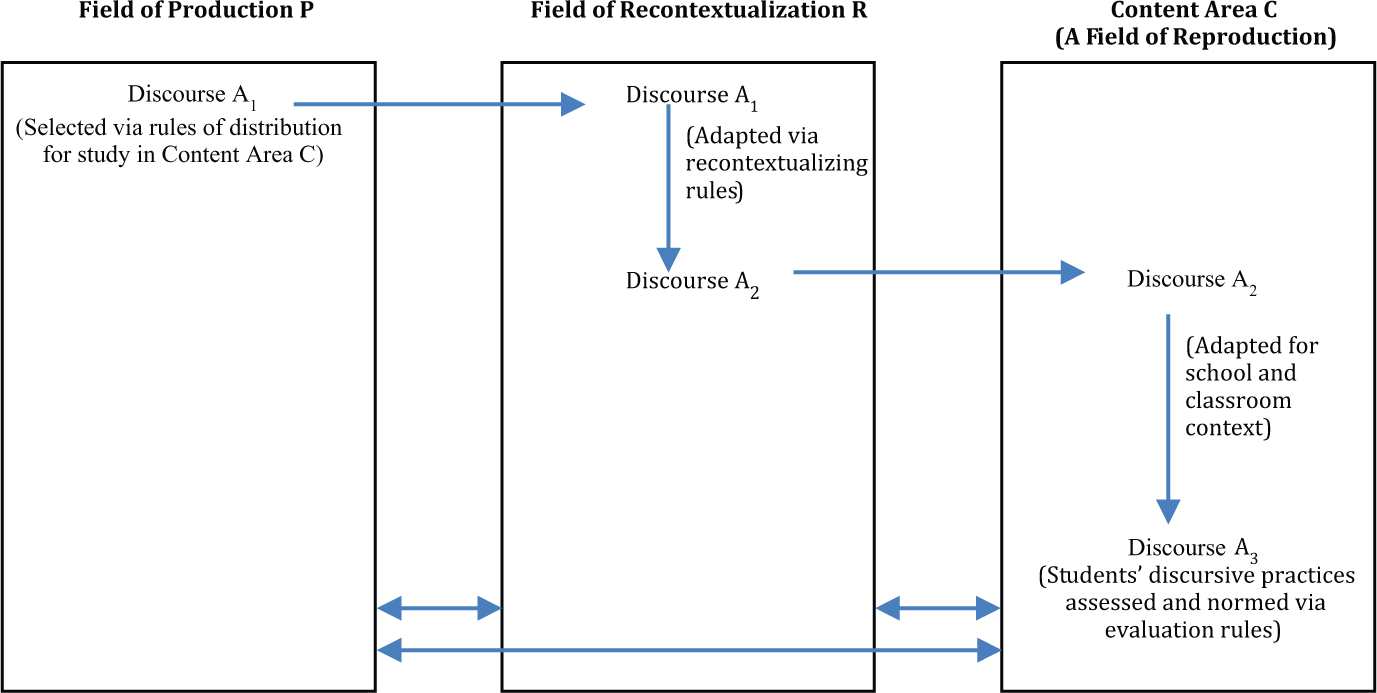
The pedagogic device: Distribution, recontextualization, and evaluation.
By norming how students mobilize discourses distributed to and recontextualized for content areas, evaluative rules draw together the pedagogic device’s full set of rules. As Bernstein (1996) states, “Evaluation condenses the meaning of the whole [pedagogic] device. We are now in a position where we can derive the whole purpose of the device. The purpose of the device is to provide a symbolic ruler for consciousness” (p. 36). In other words, particular forms of consciousness emerge out of the interactions of the pedagogic device’s different rules. For example, students working with the discourse of deconstruction described above are to acquire a form of consciousness through which they may perceive the constructed nature of cultural texts, but not human bodies. This form of consciousness emerges out of interacting processes of distribution, recontextualization, and evaluation.
Reflecting on the rules of the pedagogic device, Bernstein (1996) writes that if the device is a regulator of consciousness, “the question is, whose regulator, what consciousness and for whom?” (p. 37). In other words, whoever controls the pedagogic device sets the rules for who is called to think what when, where, how, and why. Actors may always resist or adapt the rules of the device, but the consequences may be serious.
Bernstein and Content Area Literacy
What does Bernstein’s theory of the pedagogic device reveal about the strategies approach and the disciplinary approach to content area literacy? Beginning with the former, Bernstein’s theory shows the strategies approach misses most of the processes whereby discourses from multiple fields of production are distributed to, recontextualized for, and reproduced in content areas. Instead of offering practices tailored to the specific discourses of specific subjects, the strategies approach prescribes the same ELA-derived practices for secondary school math, science, social studies, and so forth.
Alternatively, the strategies approach may be understood as a bid to rebuild non-ELA content areas by positioning ELA in their fields of production. In this vision, ELA is a kind of meta-field in education whose practices and discourses (e.g., ways of viewing and engaging texts) are distributed to and recontextualized for all other content areas. Through processes of recontextualization, ELA discourses may reshape non-ELA discourses in several ways: Time allotted for working with ELA discourses may take away from time allotted for studying other discourses (strong classification); other discourses may be compared and contrasted to ELA discourses (moderate classification); or other discourses may be blended with ELA discourses into a hybrid content area discourse (weak classification). By positioning ELA discourses at or near the center of the content areas, the strategies approach occludes some of the discourses generated in other fields to which content areas have long been connected. Consider, for example, a chemistry class in which students read three Time magazine articles on global warming and reconstruct the scientific hypotheses at work in those articles. To identify the latter, students must draw upon their knowledge of everyday, civic, professional, and university discourses of chemistry. When scientific discourses are deemphasized in favor of ELA discourses, however, students may focus less on writers’ scientific hypotheses and more on their own overall comprehension of texts. These students, via the evaluative rules of the pedagogic device, would learn to read the world more through ELA-derived processes of comprehension than through specific modes of scientific inquiry.
In limiting or reshaping the many discourses typically studied in the content areas, the strategies approach disadvantages students who rely on content area classes for instruction in those discourses. Privileged students may still learn those discourses in other venues such as summer camps, after-school clubs, museums, and so forth. In these ways, the strategies approach reimagines content areas, recasts their relations to fields of production and to one another, and rearranges channels through which students learn discourses of different kinds.
Continuing, Bernstein’s theory shows how the disciplinary approach centers discourses produced in the university and in the professional workplace. The disciplinary approach does not, however, emphasize the processes by which university and professional discourses are recontextualized for use in secondary school content areas. Instead, it holds up the literacy practices of professionals as models for the literacy practices of young learners. At the same time, the disciplinary approach occludes content areas’ engagements with discourses generated in the public sphere and everyday life. These discourses are not selected for study and are not imagined as shaping or combining with discourses of the university and the professional workplace. In Bernstein’s terms, the disciplinary approach assumes strong classification between university and professional discourses, on one hand, and the discourses of the public sphere and everyday life, on the other. The former are placed at the center of the curriculum, whereas the latter recede from view. In sum, the disciplinary approach reimagines content areas more as training grounds for work in the university and in the professions than as spaces where students learn to critique and participate in multiple fields. Although the domains engaged by the content areas have long included the university and the professional workplace, they have also included the public sphere and everyday life. Thus, the disciplinary approach works from a model of content areas and content area literacies that differs in significant ways from the model assumed in most schools. Put differently, the evaluative rules of the disciplinary approach call students to read the world through discourses of the university and the workplace, not through discourses of the public sphere and everyday life. Insofar as the disciplinary approach de-emphasizes the latter, it closes off avenues through which students from marginalized groups often acquire and learn to critique a range of powerful discourses (see Apple & Beane, 2007; Freire, 1986; Gee, 2008; Ladson-Billings, 1995).
Conclusion: Bernstein, Politics, and Pedagogy
As demonstrated above, Bernstein’s concept of the pedagogic device can be used to analyze the shortcomings of the strategies approach and the disciplinary approach to content area literacy instruction. How, though, might the concept be used both in the political arena and in the classroom to promote or resist new literacy initiatives?
Politics
One of the strengths of the concept of the pedagogic device is its attention to education systems and larger social systems. Thus, in Bernstein’s view, a literacy initiative is never simply a literacy initiative. It is a project to reconfigure the pedagogic device and to shift practice across fields of production, reproduction, and recontextualization. Even when a literacy initiative seems to target only a small part of the education apparatus (e.g., assessment), researchers can use the concept of the pedagogic device to see how the initiative creates pressures for change across whole systems. Bernstein’s ideas can help actors (a) find system-wide gaps and tensions created or exacerbated by reforms and (b) exploit these contradictions to resist regressive initiatives and to promote more progressive efforts. Specifically, the concept of the pedagogic device illuminates the gaps and tensions that emerge between reorganized fields of production, reproduction, and recontextualization. Much of education politics, Bernstein argues, involves groups’ efforts to defend or change how discourses are transformed as they are moved from field to field (see Apple & Wong, 2002; Kang, 2009).
Consider, for example, the literacy initiatives embedded in the CCSS. As noted above, CCSS ratifies a form of disciplinary literacy by calling content area teachers and students to address “the particular challenges of reading, writing, speaking, listening, and language in their respective fields” (Common Core State Standards Initiative, 2012a). Its designers argue that because CCSS only identifies what students should learn (e.g., how to read like a mathematician of a certain type), not how they should learn (i.e., methods of math instruction), CCSS does not amount to a curriculum and does not dictate how teachers teach (Common Core State Standards Initiative, 2012b). However, using the concept of the pedagogic device, researchers can identify and critique the ways literacy initiatives embedded in CCSS work to transform curriculum, instruction, and social relations inside and outside of schools. Although an in-depth critique of CCSS is beyond the scope of this article, a full study might explore the following ideas. Given its focus on standards for student performance, CCSS works primarily through evaluative rules. As Bernstein (1996) notes, however, “Evaluation condenses the meaning of the whole [pedagogic] device” (p. 36). Indeed, CCSS’s rules for evaluating students’ literacy practices assume (a) discourses relevant to the standards have been selected from “appropriate” fields of production (although not all discourses from “appropriate” fields are selected for study); (b) in fields of recontextualization, selected discourses have been transformed in line with the standards and with CCSS tests; and (c) in fields of recontextualization and reproduction, discourses are classified properly (i.e., discourses emphasized in standards and on tests are emphasized in instruction). Thus, although CCSS works primarily through evaluative rules in fields of reproduction, it tightens connections between the latter and fields of production and recontextualization. Regarding fields of production, CCSS pressures educators to eschew non-standard discourses (i.e., those discourses not recognized by the standards). In fields of recontextualization and reproduction, CCSS pressures educators to adapt and teach standard discourses in standard ways (i.e., in ways keyed to standards and tests). Ultimately, by standardizing certain discourses, CCSS validates the groups which control those discourses. Many actors accustomed to decision-making authority in each of the three fields (e.g., teachers and curriculum designers) and in the larger society (e.g., parents) find themselves constrained in this more tightly coupled system.
Although CCSS tightens connections between fields, it does not close up the education system entirely. Following Bernstein, actors who wish to reform or resist CCSS might organize around the gaps and tensions created by the new initiative. They might mobilize local actors upset that their communities are not recognized by CCSS as legitimate fields of production; researchers and other professionals who object to the ways CCSS recontextualizes and evaluates their discourses; teacher educators and curriculum designers opposed to CCSS’s colonization of fields of recontextualization; and educators who wish to retain their authority to change rules of distribution, recontextualization, and evaluation to suit local conditions. At the time of this writing, actors of various political orientations are joining together to form just such a coalition to turn back CCSS in its present form (see Strauss, 2013).
Pedagogy
Although Bernstein’s theory of the pedagogic device has been used to analyze literacy initiatives (see Apple & Wong, 2002; Au, 2008a, 2008b; Chen & Derewianka, 2009; Jones, 2007; Kang, 2009; R. Moore, 2000; Norlund, 2011), it has not, to my knowledge, been used to shape literacy instruction. To begin to address this oversight, I offer some initial thoughts on how the concept of the pedagogic device might inform genre study in content area classrooms. This synthesis, along with other potential adaptations of the theory of the pedagogic device, requires further attention.
The concept of the pedagogic device highlights how discourses are transformed to fit different contexts. In this way, it resonates with ideas developed in rhetorical genre studies (RGS; see Bawarshi, 2003; Collin, 2013; Devitt, 2004; Russell, 1997). RGS figures genres as typified forms of communication grounded in recurrent situations. Thus, recurrent situations give rise to genres and genres help actors build recurrent situations. Genres, in other words, function as rhetorical devices that enable actors to shape communication to fit general domains (e.g., biology) and particular institutional contexts (e.g., high school biology classrooms). Specifically, genres offer actors domain- and institution-appropriate ways of performing identities, relating to others, distributing social goods, acting in the world, and mobilizing discourses. For instance, the genre of the high school lab report calls adolescents to perform the identity of science students, see their teachers as authorities in science, and utilize discourses recontextualized for high school classrooms. The genre of the high school lab report, Bernstein would note, differs from the genre of the professional lab report because the two genres are used in different institutional contexts. The high school lab report and its professional corollary feature different, but related, discourses, identities, relationships, actions, and ways of distributing social goods.
Despite genres’ grounding in specific contexts, a genre used in one setting can be construed as an “antecedent” to one or more genres used in other settings (Devitt, 2004, p. 202). That is, while attending to the particularities of a genre’s immediate context, actors may approach that genre with an eye toward their work with other genres in other contexts. A high school biology teacher, for example, may teach the genre of the high school lab report so as to prepare her students to engage college lab reports and descriptions of scientific studies presented in the popular media. Designing antecedent genres is extraordinarily complex because it requires teachers to attend to the specifics of the secondary school classroom and to anticipate, in a realistic and accessible way, the discourses and practices of other fields. Given this complexity, teachers might collaborate with curriculum designers and actors who work with target genres in other fields (e.g., professional scientists and journalists who report on science). Although this type of collaboration recalls Shanahan and Shanahan’s (2008) study on expert literacy, committees designing antecedent genres would not privilege expert practices, discourses, and identities over the practices, discourses, and identities of the secondary school. Rather, committees would seek to balance the requirements of different genres used in different contexts. In this way, educators can retain the disciplinary approach’s concern with the literacies of the university and the professional workplace, but they can widen their focus to take in the literacies of other fields connected to the content areas.
Extending their work with genres, content area classes might pursue a style of genre study informed by the concept of the pedagogic device. My own model of critical genre study (Collin, 2013), derived from the work of Devitt, Reiff, and Bawarshi (2004), prompts students to collect samples of a genre; identify how the patterns in generic texts circulate the discourses and index the identities, relationships, and actions of recurrent situations; consider how the situations built through generic activity privilege some actors over others; and compose texts in the same genre. Taking a Bernsteinian turn, students could rewrite their texts for different situations. Students might reflect on how they recontextualized the discourses used in the first situation and genre to fit the second. Furthermore, students might consider how they would re-adapt the discourses in question if a political struggle changed the character of the second situation and genre. An ELA class, for example, could study the genre of the high school newspaper op-ed. Working through the steps outlined above, students might discover most writers of op-eds speak from the “we” of the school community and mobilize conflicting discourses of solidarity and individualism. Students might discuss how the genre leaves little room for writers who feel excluded from the “we” of the school community. To explore processes of recontextualization, students could rewrite op-eds for a general middle school context and then rewrite their texts again for the context of a middle school reorganized around principles of social justice.
In this approach, genre study works as a kind of literacy strategy for investigating the relationships between language and situation. Although this strategy works across content areas—all subjects have their own genres—it calls students to attend to the specific discourses, identities, relationships, and actions of specific fields. This approach, in other words, avoids the charge of over-generality often brought against other literacy strategies. Researchers and educators might consider how other strategies pitched at a general level could be adapted to fit the particular features of different content areas.
By studying genres in the ways described above, students might develop deeper understandings of the cultural forms they are asked to engage in different social fields. As the op-ed example suggests, students might benefit from investigating genres used in the familiar context of the school. Although students might investigate genres used outside of schools (e.g., publications from a city’s historical society), students would not seek to gain full control of those genres, as might be expected in a disciplinary approach to content area literacy. Rather, students would learn how to pose and answer questions about the forms and functions of genres used in unfamiliar fields. Crucially, students would explore critical questions about the ways cultural forms are adapted and re-adapted by social actors both to fit new fields and to change the character of the fields in which those forms are used. Thus, in the spirit of Bernstein’s project, students pursuing critical genre study would learn to interrogate the discursive processes by which actors struggle to rebuild schools and the larger social order.
Footnotes
Declaration of Conflicting Interests
The author(s) declared no potential conflicts of interest with respect to the research, authorship, and/or publication of this article.
Funding
The author(s) received no financial support for the research, authorship, and/or publication of this article.