




Abstract
The article presents an analysis of the developments of higher education laws and regulations in the Western Balkans for the period 1990–2015, with the aim of mapping the regulatory arrangements for the private higher education sector and to explore the relationship between public and private higher education in the region. Based on a conceptual framework highlighting the competitive and complementary regulatory design options available in current governance arrangements, the study finds much ambiguity in policy designs regarding how private and public higher education should co-exist in the Western Balkans. As such, it is argued that the study contributes to a better understanding of the unclear role private higher education is playing in the development of the region.
Keywords
Introduction: the Western Balkans region joins a global private movement
There is widespread agreement that higher education policy has considerable impact on the economic, social and cultural development of our societies. More contested is whether this impact is attained better through higher education sectors that are publicly funded and organized, or through a mixture of public and private provision. While this issue attracts considerable interest, as many countries (Pachuashvili, 2011) and sub-national higher education systems such as the United States (Zumeta, 2011) struggle to develop policies that match the ambitious roles being set for higher education, it is a difficult issue to analyze due, in part, to specific national characteristics and historic trajectories related to the development of private higher education (PHE). For example, in Eastern and Central Europe generally, the rise of PHE largely followed the collapse of communist regimes; and whilst significant parallels emerged across countries, considerable variation also emerged (Slantcheva and Levy, 2007). The same can be said about similarities and differences in the ways in which PHE is currently regulated and allowed to operate (Levy, 2011; Pachuashvili, 2011).
However, in general it is possible to identify a number of reasons why and how PHE emerges (Levy, 2006). Most potent in quantitative terms, PHE can be an alternative way of expanding a system when public resources are scarce and, therefore, can be regarded as a desirable or even necessary route to achieving the significantly expanded access that is central to many visions of development. PHE can also be a means for increasing or otherwise enhancing competition in an existing higher education system, or as a way to boost innovation or even excellence. It can also foster more diversity and differentiation of educational offerings (Levy, 1986). The reasons identified and the ambitions set for PHE can vary country to country. The variation may depend on conscious policy assessments of the status, achievements and roles of the public and private sectors, or it might result in less planned manner from myriad social, economic and political forces; regardless, the possible mixes and their implications for provision of offerings emphasize the argument that ‘public policy for private higher education is a matter of global importance’ (Levy and Zumeta, 2011: 346).
This issue of how PHE can be brought into a public policy mix has seldom been prominent in national regulatory agendas. In a historical perspective PHE often grew and developed almost without any conscious and deliberate public policy attached, but increasingly governments are trying to catch up through what a growing number of scholars label as ‘delayed regulation’ (Levy, 2006).
The Western Balkans 1 (WB) is another region characterized by such delayed regulation of PHE. Due to the special circumstances of this region after the break-up of Yugoslavia into new and independent countries, the entire higher education system, including that of PHE, can be said to lag behind developments in other East European countries (Zgaga et al., 2013). In a recent article describing the dynamics of PHE developments in the WB, Branković (2014: 141) argued that issues related to both market adaptation and a search for strengthening the legitimacy of PHE providers is central to understanding the dynamics within the private sector, although the role played by public laws and regulations in this process is often not clear.
In this article we take up the challenge of providing some further clarity on laws and regulations through a more in-depth analysis of the regulatory arrangements of PHE in the Western Balkans. It is argued that this should contribute to a better understanding of the conditions affecting the region’s PHE development. As such, it contributes to the growing global literature on PHE by advancing knowledge of a hitherto little-studied region. Hence, by providing more knowledge on the Western Balkans and their higher education systems, the aims of the current article are to: (1) map the regulatory arrangements for private higher education in the Western Balkans; (2) analyze how current regulatory arrangements in Western Balkan countries frame the roles and the relationship between public and private higher education; and (3) reflect on the current regulatory designs in light of the challenges facing higher education in the region.
The term ‘Western Balkans’ refers here, as many regional treatments do, to Albania, Bosnia and Herzegovina (BH), Croatia, Kosovo 2 , Montenegro, Serbia, and the Former Yugoslav Republic of Macedonia (FYROM). The regulatory arrangements in these countries will be mapped and analyzed for the period 1990–2015. The remainder of the article sets out the theoretical framework of the study; describes the methodology of the study; presents the findings; and lastly reflects on the role of private higher education – historically and in a more future-oriented perspective.
Theoretical framework
After the collapse of communism in Eastern and Central Europe, most countries in this region initiated reforms of their higher education systems that were inspired by ideas of a ‘return to Europe’ (Rupnik, 1992), and where institutions in the region have been actively engaged in European cooperation initiatives (Papadimitriou et al., 2015). At the same time, PHE – which, even prior to communism, had not been a central element of European higher education (Levy, 2014) – was allowed to be established in the region due in particular to the large gap between soaring new demand for HE and the extant capacity of the public sector, although ideological and religious or other factors also played roles (Slantcheva and Levy, 2007). However, central political deliberations about how higher education should develop were rare in determining the size and shape of PHE (Levy, 2006).
Because European higher education generally has experienced numerous reform initiatives during recent decades, there is no shortage of studies of how new forms of regulation have affected the higher education sector in areas such as funding, quality assurance, institutional autonomy, etc. (see, e.g., Shattock, 2014; Texeira et al., 2004; Westerheijden et al., 2007). These studies have tended to focus on particular governance instruments and tools (Hood, 1986), and have often provided detailed analyses of particular reform initiatives (changes in legal frameworks, organization, funding, etc.). Only a few studies have considered the reform initiatives in PHE (see e.g., Levy, 2011), and it is even rarer to find studies analyzing public and private higher education in a comparative perspective.
While existing studies have provided the field with considerable insight on how the governance of higher education is changing, they tend to share some limitations. First, reform and policy development are often interpreted as proactive governmental initiatives. However, while a proactive state indeed produces policy, it is less well-recognized that governmental non-decisions should also be seen as regulatory decisions (Bemelmans-Videc et al., 1998), even if non-regulation may be a product of both aversion to decision-making and deliberate choice. This is an important distinction because deciding upon what and how to regulate can be associated with quite different views of how higher education systems should operate – from being under strict governmental control on the one side to allowing substantial autonomy on the other (Olsen, 2007). The ‘delayed’ regulation observed with respect to PHE can therefore be interpreted as an attempt by various governments to re-think the roles of public and PHE – an important dimension to include in analysis of public policy.
Second, in recent decades it is also possible to note that many Europeans are re-thinking their general approach to governance, and that the prior interest in particular governance tools has shifted towards how the many tools can be better aligned and how more coherent policy strategies and policy designs can be achieved (Levi-Faur, 2011) – what some have labelled as broader policy designs (Howlett, 2014). The basic idea behind this approach is that the ‘new public management’, initially created by the early waves of reform, needs to be re-placed by ‘new public governance’ approaches aiming at a better alignment of public, private and civic actors involved in the governance process (Klijn and Koppenjan, 2012), and with the intended effect of creating more cohesion in the governance arrangements (Maassen and Stensaker, 2011). However, governmental attempts to achieve greater cohesion of their governance raise the need for research to develop tools and perspectives that can analyze this ambition. It can therefore be argued that there is a need for research that compares public and private regulatory initiatives in a more integrated fashion, and analyses concepts and perspectives that can deal with the complexities arising from the governmental ambition of aligning different governance instruments and tools.
The conceptual approach proposed here offers two concepts that go beyond the technicalities of specific policy instruments and which enable us to disclose more of the policy content and the underlying governance rationale. Thus our approach consists of assessing the regulatory arrangements in the region according to how they – not only in the individual countries but also throughout the region – stimulate what we would label as ‘complementary’ and/or ‘competitive’ roles for private and public higher education. We would argue that these two concepts are very relevant and useful for revealing the ambitions behind the new public governance initiatives, especially in a Europe where policy attempts to stimulate competition often go hand in hand with more selective and targeted policy initiatives (complementarity) as a means for driving European economic integration (Levi-Faur, 1999). For our purposes the basic ideas behind these concepts can thus be laid out in the following way: if PHE has mostly a complementary role – offering something different and not directly competitive with what the public higher education sector offers – we would expect to see regulatory arrangements that distinguish this sector from the public providers, either through laws, or through the use of various incentives or sanctions that treat the sectors differently. Possible examples of differentiated regulatory arrangements consistent with increased complementarity are factors such as tuition fees, student recruitment, or quality assurance arrangements. If PHE has a more competitive role, as a general rule we would expect public and private providers being able to operate under more equal regulatory frameworks, and being exposed to the same laws and regulations, incentives and sanctions. Such regulatory designs are often seen as the key ways to stimulate increased efficiency and quality, regardless of whether the service provider is public or private (Hood, 1986; Levi-Faur, 1999, 2011).
An attraction of the competitiveness/complementary concept is that it allows for easier comparisons with regard to how different instruments in reforms are tied together, and the overall direction of the governance initiatives taken. However, we also acknowledge the limitations of such a simplified categorization. It must be emphasized that the two regulatory modes should not be seen as mutually exclusive but, rather, as policy options on a policy continuum, not least given the fact that the distinction between what currently can be described as ‘public’ or ‘private’ is becoming blurred (Scott, 2007). A challenge of seeing competition and complementarity as part of a policy continuum is also how we should interpret situations where competition and complementarity regulations are combined. Such a situation may suggest that policy-makers are unable to develop coherent policy designs, but can also be a result of political craftsmanship, because competitiveness may sometimes be stimulated by establishing regulatory differentiation between the public and the private sectors which can enable more competition; for example, when PHE is granted more organizational or financial autonomy, which can imply competitive advantages with respect to the public sector. 3 To compensate for this problem, the document analysis has also included content-based assessments of the underlying intentions behind the various regulatory arrangements scrutinized.
Data and methods
In this study we mostly use the term private higher education (PHE), although in several regulations the term appeared as ‘non-state’ or ‘non-public’. A reluctance to use the term ‘private’ has been analyzed in the PHE literature (Levy, 2006); this relates to the lack of tradition and legitimacy for PHE in many countries (Slantcheva and Levy, 2007), certainly in Europe. HE is considered as essentially a public good and service. China and even non-communist countries have employed non-public or other purposefully obscuring terms, such as ‘people-run’, or ‘societal’. Permitting PHE seems to have been handled with sensitivity, with no perceived need to proceed too far too quickly. However, as PHE becomes a more and more obvious global phenomenon, using the term ‘private’ becomes less confrontational. Our WB data seem to reinforce the notion of reluctance but, equally, of increasing acceptance; as such we will note specific cases (e.g. Serbia and Albania) in our findings.
This study is based on document analysis of HE laws and regulations in the Western Balkans for the years 1990–2015. The analysis focuses on the national level of HE regulations and reports. Three sources of data were used to map the regulatory arrangements for the PHE and to explore the competition/complementary regulatory mode. National regulations were drawn mostly from the Knowledge Base for Higher Education and Research in the Western Balkans (HERDATA) repository – a recently developed databank focusing on the region. However, regarding 1990–2002 data, data-mining for all countries has been extremely challenging and so, in few cases, we collected national data (regulations) through personal communication with local scholars and agencies (primarily in their local language). The second and the third sources of data were national reports produced by the national governments for the Bologna follow-up and Tempus projects respectively. We have also drawn upon data collected and systematized in another recent study with respect to PHE in Eastern Europe (Levy, 2014).
Our methodology for analyzing the data involved several phases. After all the data were collected, the data (regulations/laws and reports) were read and categorized by two of the authors (the primary ‘coders’). Our point of departure for this categorization was the complementarity/competition mode: laws and regulations were therefore sorted initially with regard to how they integrated or separated private and public higher education according to a variety of themes:
How universities can be established;
Their governance and relation to public authorities;
University autonomy;
Decision-making arrangements;
Faculty hiring and personnel policy;
Funding;
Students’ issues; and
Accreditation.
After this initial phase, we re-analyzed the data with a further review of the laws, regulations and reports collected. This phase can be considered as a more inductive approach which ‘seeks to discover and understand a phenomenon, a process or the perspectives and worldviews of the people involved’ (Caelli et al., 2008: 3). Thematic analysis is a search for issues that emerge as being important to the description of the phenomenon (Daly et al., 1997). Boyatzis (1999: 161) defined a theme as, ‘a pattern in the information that at minimum describes and organizes the possible observations and at maximum interprets aspects of the phenomenon’. The process involves the identification of themes through ‘careful reading and re-reading of the data’ (Rice and Ezzy, 1999: 258), while Fereday and Muir-Cochrane (2006: 82) considered it ‘a form of pattern recognition within the data, where emerging themes become the categories for analysis’.
Through applying the complementary/competition heuristic we argue that a more detailed and wide-ranging overview of how PHE is regulated can be provided. However, it should be emphasized that we do not assert that specific regulatory packages are preferable to others. Rather, the purpose of using the heuristic is to offer some perspectives enhancing our understanding of how regulatory policies concerning public–private sector policy mixes are currently developing. Our more detailed analysis of the content of the regulations that were considered allows us to identify what policy areas (institutional regulation, regulation of student recruitment, tuition fees, etc.) national governments currently regard as interesting and important for regulatory initiatives (see also Zumeta, 2011).
Regulatory arrangements for PHE in the Western Balkans: a short historical account
Here, we will present a short historical account of the regulatory arrangements for WB PHE and the role the sector plays with respect to the number of institutions and share of student enrollment in the different countries.
Our mapping shows that multiple PHE institutions exist in all WB countries. Because data collection and dissemination in the region are in some respects problematic, we cannot claim to have collected exact information about the public or private nature of institutions in all countries (see Table 1). At minimum, however, our data seem to be in agreement with those of Branković (2014: 126) which report more than 200 private HEIs, ‘although the exact number is not known’. Our data further suggest that the number of PHE institutions is still growing in the region, especially in Albania and Serbia.
The landscape of higher education institutions.
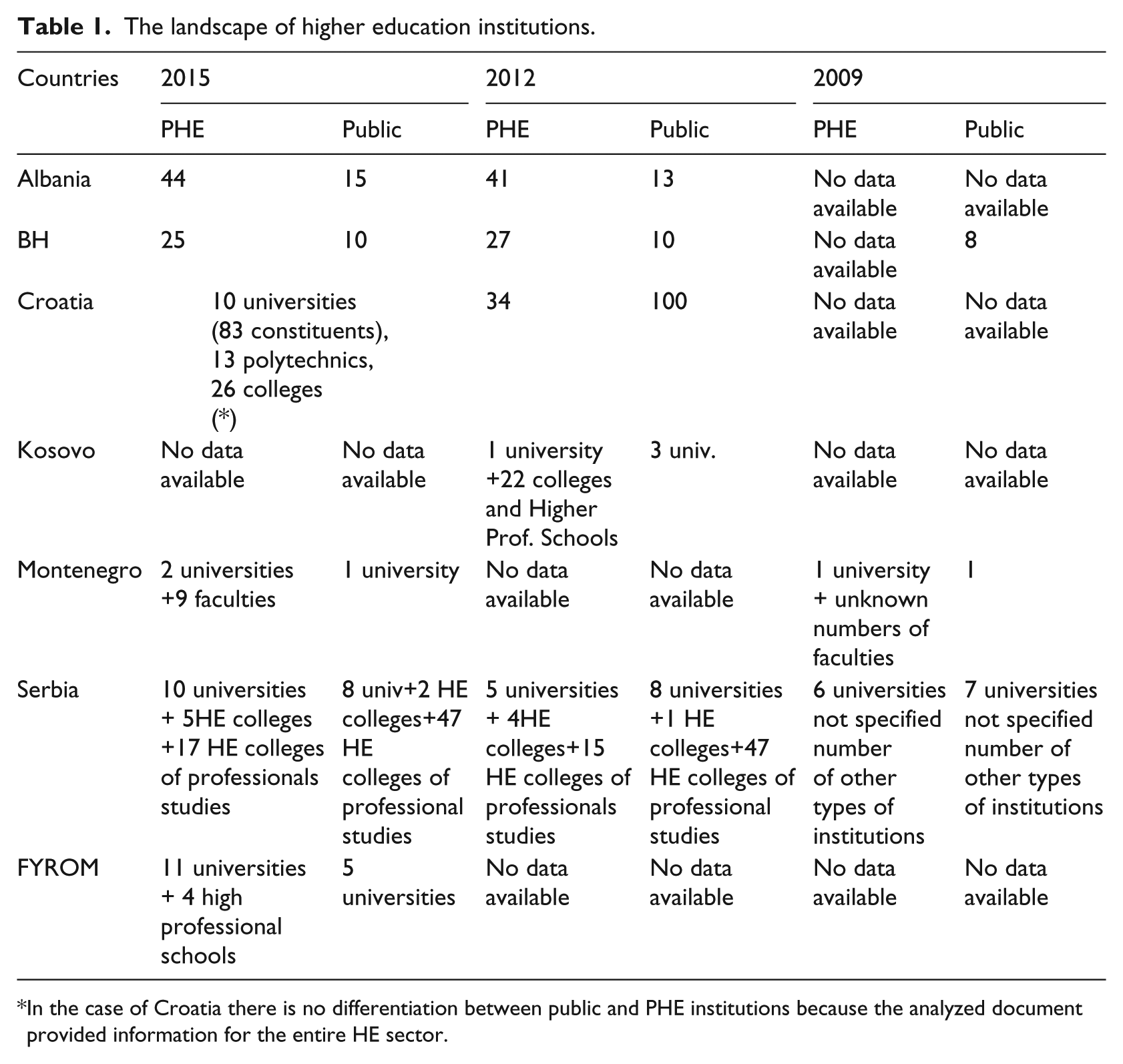
In the case of Croatia there is no differentiation between public and PHE institutions because the analyzed document provided information for the entire HE sector.
Also, despite the problematic nature of some of the data, it is nonetheless reasonably clear that WB follow the pattern generally found for other regions with regard to the number of institutions: the private sector holds a significant number (Levy, 1992). The number is striking when contrasted to share of enrollment (see below) and often there are more private than public institutions (the case for all four WB countries – Albania, BH, FYROM, and Montenegro – where the sectoral numbers below are rather clear-cut). Furthermore, for all the incompleteness of the data, it seems clear that institutional proliferation has been powerful in recent years (2009–2015). 4
Moving to the enrollment side, Table 2 shows data for total enrollment and the private share from 2000 to 2010 (the most recently-available data). FYROM and Montenegro have the highest private enrollments; the percentages for 2010 are 21.2% and 20.2% respectively, followed closely by Albania (19.1%), BH (16.7%) and Serbia (16.5%), then Kosovo (12.0%) and Croatia (6.5%) (see also Levy, 2014). Our data fit particularly well with observations made generally about European PHE, especially about Central and Eastern Europe (Levy, 2012). First and perhaps most striking is the fact that the range of private enrollment shares is very limited – just under 15 percentage points separating the WB country with the highest private share (FYROM) from that with the lowest private share (Croatia). Second, the private shares are low compared to that of other regions and to the global average (roughly 33%). Third, the private share is growing; this is particularly dramatic in the WB because several of its countries had no PHE in 2000. The continued surge, however, is seen even for the period 2005–2010. It appears that the PHE share increases in six of the seven countries, usually by large jumps. The seventh country, Serbia, is an exception, experiencing a decline in the private share; although it is only a small reduction, it could prove significant in that Serbia had been the first WB country to move into PHE as well as the first to move in heavily.
Private share of enrolment for 2000, 2005 and 2010.
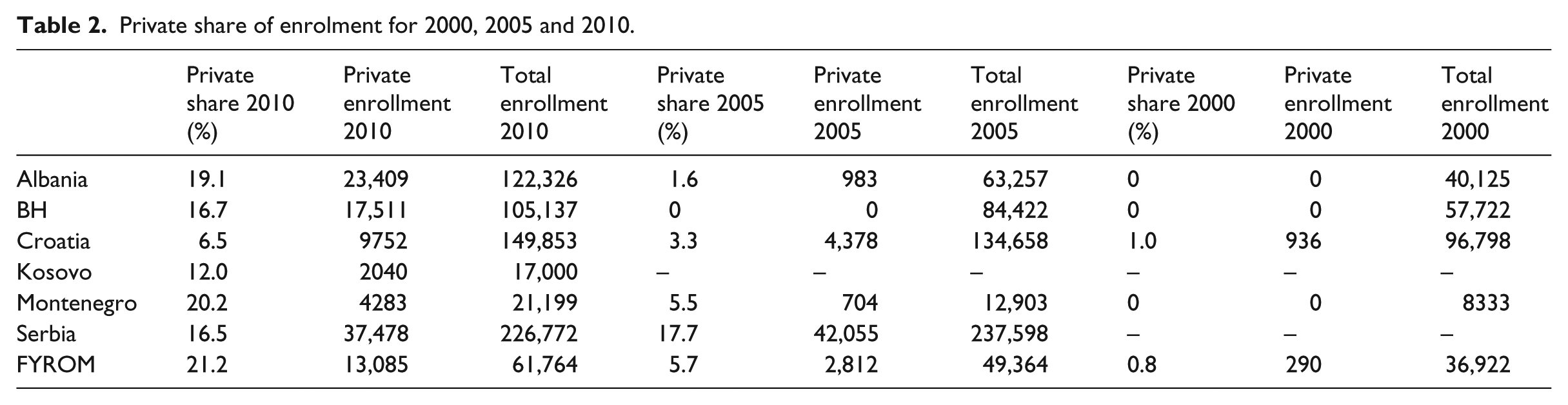
Not only is the Serbian the oldest private sector in the WB (opened in 1989), but also until 2000 Serbia remained the only WB country with PHE; yet currently all the WB’s seven countries have allowed PHE and seen it established. During the period following the collapse of communism, most of the WB was marked by economic and political crises and civil wars, and military conflict: politicians therefore had to reinvent or reconstruct the future of their national higher education systems. This reconstruction, or rebirth, appeared around the time when the Bologna process was initiated, in 1998. Croatia signed the Bologna Declaration (Bologna Declaration, 1999) in 2001 and the remaining five countries (except Kosovo) signed in 2003. While the Bologna Process rests exclusively on voluntary agreements, we found that almost all of the WB ‘borrowed’ the Bologna platform and used it as a basis for developing their national higher education regulations. Typically, all national higher education laws contain statements emphasizing that, for example: …this law provides for the mission, main goals…financing, management, quality assurance in the Republic of Albania in compliance with the European standards. (Albania HE Law, 2007) Science and higher education present activities of special interest for the Republic of Croatia and are constituent parts of the international, particular European, scientific, artistic and educational space. (Croatia HE Law, 2003)
A further broad observation is that in most WB countries not only does the delayed regulation notion operate but also the interest in regulation of HE keeps increasing and this tends to lead to revised or additional regulation. For example, in Serbia new laws on HE appeared in 1998 and 2002. The 2005 law was amended in 2008, 2010, 2012, 2013 and 2014. In Albania, after the multi-party elections in 1992, and the introduction of new, principal constitutional provisions that were adopted during the period 1992–1995, a new law was passed to regulate HE (the Higher Education Law, Number 8461, was enacted on 25 February 1999; see: Albania HE Law, 1999). In the Former Republic of Macedonia and until 2000, higher education was still regulated by the Socialist Federal Republic of Yugoslavia’s (SFRY) Law on Vocational Education (1985), which covered both vocational secondary and all tertiary education (it is not the intention of this article to provide an analysis of that law). ‘Article 46 of the 1991 SFRY Constitution, however, already made a major change by granting autonomy to universities and by requiring that higher education be covered by a separate law’ (OECD 2003: 39). By 2003 policy-makers in Croatia, Kosovo and Montenegro had launched HE regulations for their HE systems. In 2007, BH as well as Albania adopted their own framework laws on HE. FYROM introduced new laws in 2008, 2011 and 2013. Lastly, Kosovo adopted a new HE law in 2011. Despite the increased level of interest in PHE and the passage of PHE-related legislation, no individual country has passed a comprehensive law establishing the rules for PHE.
The relative commonality of delayed and continuing regulation in most countries is not complemented by common terminology from the outset of WB PHE. Instead, we find an interesting diversity in terminology for early PHE in the region. The major case is, of course, Serbia. The word ‘private’ (privat) does not appear in any of the first HE regulations (1990, 1992 for Serbian universities and 1999 for Albanian universities). For example, the 1992 Serbian law for universities states that: ‘… if the founder is not the Republic [Serbia]…’ (Serbian University Law, 1992: Article 10), ‘… [then] half the council members are chosen by professors, academics and founders’ (Serbian University Law, 1992: Article 10). Thus, Serbian regulations in effect acknowledge the presence of PHE when they refer to non-government founders. In its more recent statements, however, Serbia moved closer to using the term ‘private’, although still stopping short of doing so, usinging the terms ‘non-state’ and ‘non-public’. The Serbian Tempus report (EACEA, 2012: 74) stated that, ‘seven public universities (85 faculties), 6 universities established by non-state founders (43 faculties) and more than 80 colleges … are subject to compulsory national accreditation’. Avoidance of the term ‘private’ continues in the latest law (Serbian HE Law, 2014).
However, Serbia is the WB exception. Although Albania, the second country to permit PHE, had its 1999 HE Law stating, ‘higher education in the Republic of Albania is both public and non-public’, its 2007 HE law switched from ‘non-public’ to ‘private’: ‘there are public and private institutions of higher education’. In addition, in other WB countries the term ‘private’ has been used freely. In the FYR Macedonia 2000 HE Law numerous explicit directives for its PHE sector are visible: ‘The provision of this Law, except for the ones explicitly relating to the public higher education institutions, shall apply also on the private higher education institutions’ (Article 4). Although Croatia signed the Bologna Declaration in 2001, we did not find any earlier written HE regulation for analysis. Croatia’s 2003 HE Law stated that HE institutions could be public and private. Similarly, Montenegrin 2003 HE Law stated that ‘higher education institution is founded as a public or private institution’, and Kosovo’s 2011 HE Law stated that ‘[The] Ministry is responsible [for] regulating public and private providers of higher education and approving their Statutes’ (Article 6.1.2).
Serbia illustrates the emergence of PHE prior to establishing regulation. Specific regulations concerning PHE were almost invisible in Serbian (1990, 1992 and 2000) and Albanian HE Laws (1999). The Serbian 1990 university law stated that ‘the Parliament establishes and abolishes the university’ (Article 12). In the Serbian law of 1992, and in the same Article (12) we discovered this change: ‘universities and faculty can be established by the Republic, legal and physical person that can be domestic or foreigner’. The 2002 Serbian HE law states: …in the case when a university or faculty is founded by the Republic, the founding Act shall be enacted by the Government. In the procedure of founding a University of Faculty whose founder is not the Republic, the founder shall carry out a feasibility study to justify the reasons for foundation. (Serbian HE Law, 2002: Article 13)
In contrast to the Serbian case, that of Albania illustrates establishment of regulation preceding the actual presence of PHE. The 1999 HE law stated that: …the permit for opening a new nonpublic higher school is issued not before 6 months after the date of the submissions of the request to the Ministry of Education and Science, and no later than one year from the date of the request submissions to this ministry. (Albania HE Law, 1999: Article 13).
In addition, the same Albanian law stated that ‘admissions to the public higher schools are done though competition’ (Article 31); however, again no reference was made specifically to PHE institutions. One might assume that conditions expressed in HE rules for public universities were perceived as applying equally for both public and PHE, but this perception unravelled following an exhaustive analysis. The FYR Macedonia HE Law (2000) stated that: The Inter-University Conference shall mean a form of cooperation and a body through which common interests are harmonized and decided upon of licensed public and private higher education institutions in the Republic of Macedonia and within which decisions are made on issues of common interest for all the higher education institutions in the State’. (FYR Macedonia HE Law, 2000)
For the period 1990–2002, we did not find specific regulations in the region stipulating the ongoing process, including programs and types of studies, by which the PHE was to be operated and managed. Stated another way, in that early period for most countries there was more ‘establishing’ regulation than detailed regulation. Furthermore, we did not find prohibitions about PHE in laws and regulations. In other words, the regulatory posture was generally more tolerant than the rather small number of private sectors might suggest; but it did not set out a reassuring blueprint.
Whereas this article invokes literature showing delayed regulation after considerable private growth has already occurred, our time periodization concerning initial regulation makes for an interesting juxtaposition: establishing regulation can emerge in the relative absence of PHE. Both phenomena probably reflect the lack of comfort and experience with PHE, political constraints, and low legitimacy for private undertakings. Nevertheless, we identified establishing regulation dating back to 1990, while officially recognized PHE did not emerge in six of the seven WB countries until 2000 (see, e.g., Branković, 2014: 115).
In effect, what we see in the WB appears to be something of a double delayed regulation. First, there are initial PHE institutions, generally not formally recognized and non-legal. Second, there are establishing regulations, essentially doing no more than allowing PHE, making licensing and legal status possible. Third, there is a major proliferation of PHE institutions. Fourth, and finally, there is a wave of regulation dealing in more detail with the ongoing functioning of PHE. This fourth aspect corresponds to the classically identified ‘delayed regulation’ (Levy, 2006); but the second, establishing regulation, is a delayed response to the initial emergence of PHE. Certainly, just as the initial identification of delayed regulation (stages 3–4 here) did not imply a rigid sequence without exception, so our proposal now of a double delay does not imply a rigid progression for stages 1–2. Nor do we postulate an always neat distinction between initial establishing regulation and subsequent more detailed regulation. In any event, because our proposal may merit further exploration in the WB case, it may also merit attention globally. It is possible that many cases presently identified by the 3–4 sequence would also show a 1–2 sequence. Only further research can answer that.
Since 2000, both PHE and regulation have been expanded. As illustrated by our short historical account, PHE in the WB has grown substantially since 1990, and current regulatory arrangements are more attentive to PHE than in the past. Whether this implies a more careful and deliberate political approach with respect to how PHE are regulated is another question to be answered elsewhere.
Current regulatory arrangements framing roles and relationships
Our analysis here focuses on the current regulatory arrangements framing the roles and the relationships between public and PHE in the WB that we label as ‘complementary’ and/or ‘competitive’. For this analysis we are dealing with areas focusing on how HE can be established, its governance and relations to public authorities, its autonomy, decision-making arrangements, faculty hiring and personnel policies (if any), funding, students’ issues, and accreditation. Table 3 summarizes by approximation the governance patterns of public and PHE in the region. In the table ‘Complementarity’ appears with + (positive) and ‘Competition’ with
Complementary and competitive patterns in the governance of public and PHE.
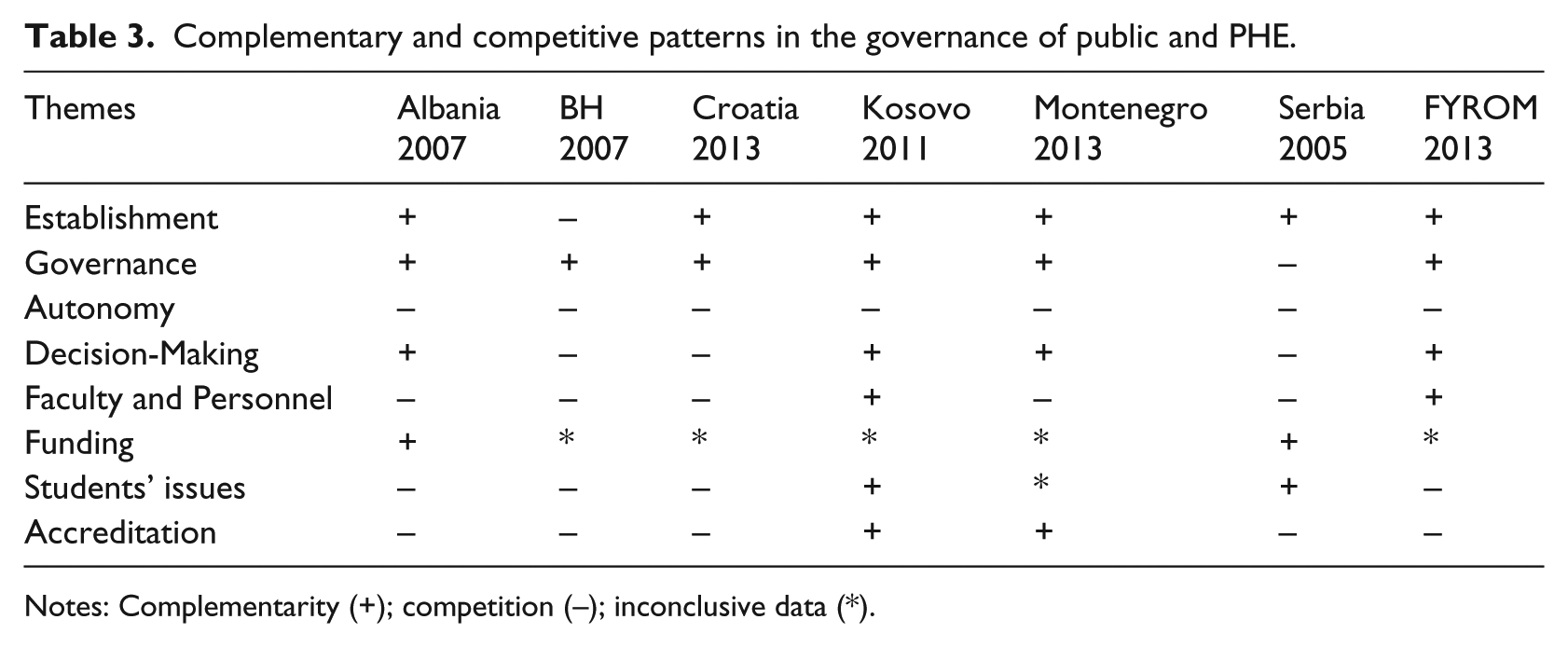
Notes: Complementarity (+); competition (–); inconclusive data (*).
Establishment
Our analysis revealed that the majority of the HE laws in the WB established their PHE for complementarity (+), BH being the exception. For example, in Albanian 2007 HE law several specific articles concern PHE, such as that a PHE can start its activity ‘only after being granted the license’; this is an indication of different treatment of the public and private sectors. Croatia’s 2013 law on science and HE states that HEIs ‘may be public and private’, the public HE established by the Republic of Croatia (paragraph 2), and the PHE ‘shall be established by the decision of the founders’. Moreover, Article 51 of the 2013 Croatia law stipulates areas regarding licenses for the performance of the activity of HEIs and their registration; and whereas almost all paragraphs refer to HEIs, paragraph 9 states explicitly that private higher education institutions shall be obliged to ensure before the commencement of their work, in a manner determined by the Ministry, guarantees for the continuation and completion of the study in the case of termination of the work of the higher education institution’. (Croatia HE Law, 2013: Article 51, paragraph 9)
In Kosovo, the 2011 HE law differentiates the public and the PHE. Article 12 stipulates the establishment of private providers, while Article 14 stipulates issues relating to licensing of HE, and there is a clarification specifically for additional requirements for PHE. In Montenegro the current law on HE was adopted in October 2003, in the same year that Montenegro officially became a Bologna signatory country. The law was subsequently amended in 2008, 2010, 2011 and 2013. The law includes chapters and articles for both sectors, and there are clear signs that regulatory arrangements about establishment and licensing are designed to treat the PHE sector differently. Article 44, dealing with financial guarantees of PHEIs, states that when a private institution submits ‘a request for a license, apart from the fulfilled conditions of Article 25 of this law, it is obligated to submit a work plan as well, including a guarantee of the founder on its financial standing for a minimum three-year period’.
In Serbia, as noted earlier, the 2005 HE Law, amended in 2008, 2010, 2012, 2013 and 2014, regulates the PHE: the law does not use the word ‘private’. For example, Article 40 states that ‘an independent higher education institution may be founded by the Republic or by a legal entity or a natural person, in accordance with the law. Where the Republic is the founder of a higher education institution, the Government shall take the decision on the foundation’. Hence, although not mentioning PHE explicitly, the law still differentiates between the public institutions and ‘the others’. With regard to the establishment of PHE, the sectors are therefore not treated equally.
The FYR Macedonia’s 2013 HE law regulates the conditions and procedures for establishment and termination of HEIs in the country. The law stipulates that HEIs can be public, private–public non-profit institutions and private (profit or non-profit) institutions (Article 16), and the law makes clear distinctions as to what rights and privileges the PHEs are granted. For example, the law states that bankruptcy cannot be initiated against a public HEI, while a PHE ‘may terminate by a bankruptcy in accordance with the Law on Bankruptcy’ (Article 43).
Finally, the BH 2007 HE law uses the word ‘private’ only three times and there are no specific articles dealing exclusively with the establishment of PHEs (competition –). The law requires that both sectors need to be licensed institutions and the Tempus report also states that ‘the Law on Higher Education treats private and public higher education institutions equally’ (EACEA, 2012: 25).
Institutional governance
Regarding institutional governance, our analysis revealed that the majority of the HE laws in Albania, BH, Croatia, Kosovo, Montenegro and the FYROM treat PHE differently (complimentarily +), Serbia being the exception (competition –). For example, in Croatia in the 2013 HE law there is a clarification that [The] Rectors’ Conference shall consist of all the rectors of public universities in the Republic of Croatia. The representative of the Council of Polytechnics and Colleges and the representative of the private universities shall participate in the work of the Rector’s without the right to vote. (Croatia HE Law, 2013)
In Kosovo, the 2011 HE law clarifies the governance in PHE. It states: A private provider of higher education enjoys freedom in its status or other founding documents to approve any model of governance and management, on condition that this model clearly separates the role and competences of the owners from decisions about academic matters and that it allows for the participation of teaching staff and students in decisions relating to academic matters. (Kosovo HE Law, 2011: paragraph 7)
In Serbia, however, the law treats institutional governance equally (competition –). The 2005 HE Law states that …the Statute of the higher education institution shall determine its bodies, in accordance with the law and the Founding Act. A higher education institution shall have an administrative body, an executive officer, professional bodies and Students’ Parliament’ (Serbia HE Law, 2005: Article 50).
In addition, the law states in Article 5 that ‘The Council shall be the administrative body of a higher education institution’.
Autonomy
Regarding institutional autonomy, there is no differentiation between the sectors across all countries within the region (competition –). For example, Article 5 of the Montenegrin HE law states that ‘an institution is autonomous in performing its activities’ and it treats both sectors equally. In a similar vein, the FYR Macedonia 2013 HE law also treats both sectors equally and it makes clear to the founders of PHE that ‘The organ of the founder cannot have rights and obligations that limit and violate the autonomy of the higher education institution …’ (FYR Macedonia HE Law, 2013: Article 60).
Decision-making
Regarding decision-making, in the majority of the systems (Albania, Kosovo, Montenegro and the FYR Macedonia) there are indications differential treatment (complementarity +), whereas in BH, Croatia and Serbia HE law treats the PHE sector equally (competition –). In Albanian HE law Article 13 stipulates the management, administration and decision-taking in public HE; and Article 43 states ‘The founding legal person is responsible for all the activity, administration and the funding of the institution established at such request’ (complementarity +). In Kosovo, the 2011 HE law declares that: A private provider of higher education enjoys freedom in its status or other founding documents to approve any model of governance and management, on condition that this model clearly separates the role and competences of the owners from decisions about academic matters and that it allows for the participation of teaching staff and students in decisions relating to academic matters. (Kosovo HE Law, 2011: Article 12, paragraph 7) (complementarity +)
The Croatian HE law does not differentiate issues about decision-making (competition –).
Faculty and personnel
The majority of the HE laws in the region (Albania, BH, Croatia, Montenegro and Serbia) regulate recruitment criteria for academics and except in Kosovo and in the FYR Macedonia (complementarity +) they treat personnel equally in both sectors (competition The full-time academic personnel employed at a public or private higher education institution shall, upon the approval of the head of the main unit and higher education institution, be entitled to be involved as a guest part-time academic personnel at another public or private high education institution, in the country or abroad. (Albania HE Law, 2007: Article 50)
In Montenegro, with regard to academic staff and academic titles the law covers several articles, but without any particular reference to public or PHE. Article 57 states that ‘academic staff…are appointed by the Senate on the basis of the public competition’; however, is not clear if those regulations refer to public or/and PHE sectors. The 2003 HE Law, and specifically Article 77, stated that the procedures for appointments were regulated by the public institution statute. However, in the 2013 Montenegro law, Article 77, the word ‘public’ is not present. In our analysis we consider those incentives that treat faculty and staff issues similarly (competition –). In contrast, HE law in Kosovo and in the FYR Macedonia provides specific requirements. A more restrictive attitude can be found with respect to faculty and personnel issues, where duration of employment and working conditions are different (complementarity +).
Funding
Regarding funding issues our analysis revealed that HE laws in Albania and Serbia differentiate the sectors (complementarity +). In the Albanian 2007 HE law, Article 63 refers to the responsibilities of the Ministry of Education, and in Chapter 13 it is made clear that only public institutions are eligible for public funding (complementarity +). In Serbia, the 2005 HE law only mentions the financing of HEIs founded by the Republic, without additional articles for the PHE (complementarity +). In contrast, the Croatian law states that ‘it is possible that private higher education institutions may also be funded from the State budget’, and a large number of conditions are stipulated, making it less likely that this will happen; therefore we label this as inconclusive data (*).
In the BH 2007 HE law, Article 19 concludes that: …all funds received from the budget, own, revenue, fees collected and funds from other resources shall belong to the higher education institutions and shall be expected in accordance with the law the stature, and the adopted financial plan. (BH HE Law, 2007: Article 19) (inconclusive data *)
In Kosovo, the law states that The Ministry may provide public funds to licensed and accredited private providers of higher education in support of the Ministry’s objectives. Any private provider which accepts public funds shall be subject to the same accountability and audit requirements as public providers, as set out in Articles 21, 22, 23, 24 of this Law. (Kosovo HE Law 2011: Article 20, paragraph 4)
In our analysis we consider this arrangement in Kosovo as inconclusive data (*).
In Montenegro, several articles explain the principles of funding a public institution, while others – for example, Article 9 – state that the Government of the Republic of Montenegro ‘…can participate in co-financing of private institutions and students enrolled in those institutions’. Article 70 states that The Government may prescribe particular conditions for the use of resources allocated to private institutions; for teaching and research purposes, as well as ask from a private institution to submit the budget proposed for performing its activity for the following fiscal year. (Montenegro HE Law, 2003)
These types of statement make up what we label as inconclusive data (*).
In the FYR Macedonia, also with regard to funding, the sectors are seemingly treated equally, as Article 83 states: The Council shall give a proposal for participation in the financing of private higher education institutions with funds from the Budget of the Republic of Macedonia if the Republic of Macedonia has an interest in meeting certain needs through their educational programs. (FYR Macedonia HE Law, 2013: Article 83) (inconclusive data *).
In the discussion section we will provide additional interpretation about this type of flexibility which currently we label as inconclusive data (*).
Students’ issues
With respect to students’ issues our analysis revealed that no differentiation is made which suggests that in this area PHE should undertake a more competitive (–) role in the majority of the WB (Albania, BH, Croatia and the FYR Macedonia). The exceptions were Kosovo and Serbia (complementarity +); while in Montenegro some parts of the law are more difficult to interpret, not least with respect to students and the financial support for students – for example, the statement that ‘the Government may provide adequate financial support to students for paying tuition fees and other fees in institution, if this serves the public interest’. This type of statement represents what we label as inconclusive data (*). An example of the competitive role is in Albania, where students in both sectors pay fees; and in the FYR Macedonia the law clarifies the conditions and manner of enrolling in studies, and it seems that the law treats both sectors equally (FYR Macedonia HE Law, 2013: Article 108) (competition –). This competitive approach does not seem to apply to students’ issues in Kosovo, where specific requirements are made for PHE (complementary +). In Serbia, there are no specific articles for the two sectors only, but Article 84 states ‘For a higher education institution whose founder is the Republic, the Government shall take the decision on the number of students to be enrolled in the freshers’ year of a study program financed from the budget’ (Serbia HE Law, 2005: Article 84) (complementary +).
Accreditation
Our analysis also revealed that the majority of the HE laws in the WB (Albania, BH, Croatia, Serbia and FYR Macedonia) concerning accreditation issues treat both sectors equally (competition –), the exceptions being Kosovo and Montenegro (complementarity +). In Albania, Article 62 of the 2007 HE law stipulates that ‘the quality assurance and accreditation procedures, standards, criteria and requirements are the same for the public and private institutions’.
In BH, Article 2 emphasizes that the 2007 HE law establishes basic principles and standards of acquiring HE in BH, as well as ‘Recommendations on the Recognition and Quality Assessment of Private Institutions of Higher Education’. In particular, Article 61 clarifies that: …with the date of this Law coming into force, existing private higher education institutions shall receive provisional accreditation from the relevant institution…. Accreditation of higher education institutions shall be contacted in the period of no more than two years from the date of this Law coming into force. (BH HE Law, 2007, Article 61)
The law requires that both sectors’ institutions need to be licensed (competition –).
In Croatia, regarding accreditation, no specific articles on PHE were found; rather, the law emphasized that a ‘higher education program of study shall be evaluated at least every five years’ (competition –). In Kosovo, the law differentiates the private and public sectors in several articles. Article 12 stipulates the accreditation and licensing of private providers; and Article 14 stipulates issues relating to licensing of HE, and there is clarification specifically for additional requirement for PHE (complementarity +).
Finally, in Montenegro articles about accreditation and licensing seem to distinguish the sectors; for example, Article 43 clarifies the examination of the foreign accreditation for the PHE (complementarity +).
Further reflections on the current regulatory designs
Our study both confirms and advances our understanding of the current public–private dynamics of HE. By studying the historical development of regulations addressing the public–private dimension in the Western Balkans, we have shown how delayed regulation (Levy, 2006) indeed emerges and expands in this region.
By means of qualitative analysis of the regulatory frameworks we have found that PHE, from the early 2000s onward, seems to be more acceptable to political authorities than in the 1990s, at least when judged by how these institutions are written about officially. Although legitimacy issues concerning PHE remain a concern in the region (Branković, 2014), the traditional reluctance even to mention PHE (Levy, 2006) has become less prevalent, and the regulatory vacuum often facing this sector seems increasingly to be filled – at least in the majority of the countries.
The new regulatory frameworks offered also seem to lean heavily on European policy processes, particularly the Bologna Process. However, while Bologna is mostly silent on PHE, the WB countries – seemingly influenced strongly by the Bologna Process and of the ambition of returning to Europe (Papadimitriou et al., 2015; Rupnik, 1992) – have experienced rapid growth of PHE, indicating new roles and relationships between the public and the PHE sectors in the region.
It is more difficult to identify a clear regulatory pattern of what roles and relationships the two sectors might develop. Cross-national comparisons show that approaches to regulating PHE are very diverse. As shown in Table 3, the countries differ significantly on a number of regulatory issues affecting PHE, and with regard to institutional decision-making, funding issues, tuition fees, student admission, and accreditation. Some countries have more of a complementary regulatory approach (e.g., Kosovo and Montenegro), while others have a more competitive approach (e.g., Bosnia-Herzegovina). The clearest regulatory patterns are seen in the areas of establishment and governance of PHE, where our analysis suggests that most countries regard the PHE sector as having a complementary role. However, with respect to institutional autonomy, our analysis indicates that competition is the preferred regulatory mode. This is interesting when taking into account that many of the countries have special accreditation requirements for PHE. Because accreditation is one of the most powerful regulatory instruments having a strong influence on the operation of private providers, one could question the consistency with which PHE is regulated in several WB countries, because the institutional autonomy apparently granted to PHE seems to be counteracted by other regulatory instruments. Because the rise of accreditation in Europe is closely related to the Bologna Process, it is possible to argue that this is an illustrative example of the complexities involved when aligning the Process and national policy-making. Hence although we indeed detected delayed regulation emerging during the latter decade, it is difficult to identify any clear visions for the development of the higher education systems, including the public parts, in the countries analyzed. Perhaps a better description of the current situation is that of ‘patchwork regulation’. As demonstrated in the empirical sections, some governments (e.g., FYR Macedonia and Montenegro) have developed regulation providing the government with considerable leeway in what measures can be taken in any given situation. For example, regulations stating that financial support to students in PHE is possible ‘if it serves the public interest’ provide the government with possibilities for making pragmatic and even opportunistic decisions regarding what roles and relationships the public and private sectors should establish. While this increases the flexibility of the regulators, it should also be emphasized that the accompanying lack of predictability increases the level of uncertainly for those being regulated.
If we return to our conceptual framework and the idea of regarding competition and complementarity as ideal-types of design options in a policy continuum, we can argue that the underlying ambition in many European countries of developing more coherent public governance arrangements (Klijn and Koppenjan, 2012) is far from being realized in the region. However, given the fact that the WB region is facing numerous challenges with respect to academic quality and efficiency (Branković et al., 2014; Levy, 2014; Zgaga et al., 2013), it is perhaps not surprising that ‘patchwork regulation’ might be a preferred option for governments. In situations characterized by economic austerity there might be a growing realization that private providers could play an important role in the further development of HE in the region – both by taking on a complementary role, through providing alternative offerings and niches, and by taking on a more competitive role in which both sector quality and efficiency might be improved.
The fact that it is increasingly difficult to label some institutions in the region as either ‘public’ or ‘private’ may also illustrate what Scott (2007: 306) has labelled as the rise of ‘post-public’ higher education – a consequence of an emerging sector where developing (competitive) institutional autonomy is seen as an important point-of-departure and where the private dimension of public institutions increases and vice versa, but where national authorities still want to secure their political influence. Hence, with some exceptions, it seems that the role PHE is intended to play in the Western Balkans is ambiguous, at least when the formal regulatory requirements are considered. Whether the situation is different in practice is a question for further research to answer. In this respect, the Western Balkans may well evolve into a fruitful laboratory for others to study, because the region contains an interesting mixture of public and private providers rarely found elsewhere in Europe (Wells et al., 2007).
Footnotes
Funding
This research received no specific grant from any funding agency in the public, commercial, or not-for-profit sectors.
Declaration of conflicting interests
The authors declare that there are no conflicts of interest.