




Abstract
Several university alliances have been established in Europe in an attempt to influence the development of policies in research and education. As such, these alliances can be seen as being new players in the increasingly complex multi-actor, multi-level governance in this policy domain. The paper compares two key university alliances in Europe; in particular, how membership differences are related to their positions in the policy arena, their policy agendas and their policy formation and lobbying practices. The study contributes to understanding of, first, the role of university alliances in European level policy processes concerning higher education and research; and, second, the implications their involvement might have for future shaping of European initiatives in the knowledge domain.
Keywords
Introduction
Due to the expanding competences of EU institutions, the European public sector in general and higher education and research in particular are subject to multi-level governance arrangements (Piattoni, 2010). These can also be characterized as multi-actor arrangements because of the increasing participation of non-state actors – interest groups, stakeholder organizations – that also operate across governance levels and are often organized into European associations (Elken and Vukasovic, 2014). Involvement of non-state actors in European higher education policy-making mirrors a more general shift towards a corporate–pluralist steering approach (Gornitzka and Maassen, 2000).
This includes the universities. In the European context, they are expected to contribute to building the European Higher Education Area (EHEA) and the European Research Area (ERA), and are affected by decisions taken at the European level. While the relationship between European policy development and changes in national policies has been the subject of much research, and although there are also studies focusing on how universities responded to these changes (see, for example, Elken et al., 2011 for a review of the literature), comparatively much less is known about whether and how universities themselves have an effect on European policy development (but see Beerkens, 2008; Grande and Peschke, 1999; Yagci, 2014).
The limited scholarly focus on the topic is inconsistent with the strong presence of various university alliances on the European stage. Apart from the European University Association (EUA), which claims to be the representative of the interests of universities regarding EU institutions and in the Bologna Process, there are several other alliances. These include:
The European Association of Institutions in Higher Education (EURASHE, counterpart of EUA for non-university institutions);
The League of European Research Universities (LERU);
The Network of Universities from the Capitals of Europe (UNICA);
The Utrecht Network;
The Coimbra and Santander groups of universities in Europe; and
The Compostela Group, which also includes universities in other parts of the world.
In addition, new university alliances are being founded (e.g. the Guild).
Many of these alliances (namely, EUA, EURASHE, LERU, UNICA, Coimbra group) have, as expressed in their mission statements, a mandate to act as advocates of the interests of their members regarding different European actors, including EU institutions. As such, they can be considered interest groups – organizations seeking to influence public policy through lobbying, provision of expert knowledge, etc. (Beyers et al., 2008). Given that interest groups have been extensively studied (e.g., Beyers and Braun, 2014; Beyers et al., 2008; Eising, 2008; Halpin, 2014; Klüver, 2012; Klüver et al., 2015; Kohler-Koch and Quittkat, 2011; Lowery et al., 2008; Saurugger, 2008), and that the influence of European higher education interest groups, including university alliances, on European policy-making has been identified (Klemenčič, 2012; Nokkala and Bacevic, 2014; Yagci, 2014), it is perhaps surprising that higher education research to date has not focused more systematically on European university alliances.
University alliances are essentially meta-organizations; that is, organizations having other organizations rather than individuals as members (Ahrne and Brunsson, 2005, 2008). Their internal structures and procedures, rationale for existence and action, motivation and implications of membership, as well as their behaviour towards other organizations and individuals, are all different from typical organizations having individuals as members. Moreover, university alliances can differ considerably in the ways they are organised. In general, it is possible to sort them along a continuum where, on the one side, there are alliances which build their legitimacy on representativeness (with broad and open membership) and, on the other side, alliances which build their legitimacy on special characteristics (excellence, geographical location, etc.), thus being more selective with regard to potential membership. Along this continuum, one can identify the EUA as belonging to the first category, while LERU is a university alliance belonging to the second category.
The present study aims to increase our knowledge on the role university alliances play in multi-level, multi-actor governance of higher education in Europe. Specifically, the following research questions guide the analysis:
How does membership of European university alliances affect their positions in the European policy arena?
What is the relationship between membership of European university alliances and their policy agendas?
How does membership of European university alliances affect their practices with regard to policy formation and lobbying?
In terms of theory, the article primarily builds on: (a) organizational studies, in particular the more recent insights into meta-organizations (Ahrne and Brunsson, 2005, 2008); and (b) studies of interest groups and their role in European integration processes. Empirically, the study is based on mapping of the key characteristics of the EUA and LERU, focusing, on the one hand, on diversity of their membership and, on the other hand, their positions in the policy arena (i.e. status), policy agendas and their policy formation and lobbying practices, based on analysis of their statutory, strategic and policy documents.
Theoretical framework
University alliances as interest groups
Like many fashionable concepts, multi-level governance (MLG) is multifaceted, signalling upwards, downwards as well as sideways shifts away from the sole authority of a sovereign state (Hooghe and Marks, 2003). Recent conceptualizations also highlight that MLG is also a multi-actor phenomenon, leading to identification of three distinct dimensions of the ‘MLG analytical space’: the centre–periphery dimension, the state–society dimension, and the domestic–international dimension (Piattoni, 2010).
The activities of university alliances seeking to influence European policy-making in the area of higher education and research are related to the latter two dimensions. Regarding the state–society dimension, this is concerned with inclusion of non-state actors in decision-making; that is, the aforementioned shift towards corporate–pluralist steering (Gornitzka and Maassen, 2000; Jungblut and Vukasovic, 2013). Universities and their alliances constitute such non-state actors. With regard to the domestic–international dimension, this is related to the gradual, sometimes stealth, expansion of EU competences across an increasing number of public policy issues (Pollack, 2000). In response to this, non-state actors operating in national level policy arenas tend to mobilize and organize common activities on the European level – for example, in the form of transnational university alliances.
In essence, the combination of shifts in governance arrangements along the two dimensions – state–society and domestic–international – sets the stage for transnational university alliances to act as European interest groups. Interest groups are non-state actors which, unlike social movements, are organized, with a clear political interest and mandate to influence public policy through lobbying, the provision of expert knowledge, and so on (Beyers et al., 2008; Eising, 2008). A distinction can be made between public interest groups active on issues of general concern, and sectoral interest groups active on issues of immediate concern for a more narrowly defined group (Binderkrantz, 2009). University alliances are sectoral interest groups.
From the point of view of policy-makers at the European and national level, interest groups are important because they can potentially provide (or withhold) valuable policy resources such as information, expertise and political support (Braun, 2012). Their involvement is expected to increase the legitimacy of European policy-making (Saurugger, 2008), 1 provided that they faithfully represent their constituents. Regarding higher education and research policy-making on the European level, the lack of involvement of academic staff in decision-making was identified as an indication of dubious legitimacy of the Bologna Process in its early days (Neave and Maassen, 2007). The subsequent opening up of the Bologna governance arrangements for non-state actors seems to have been done in order to boost the legitimacy of the Process (Elken and Vukasovic, 2014).
The literature distinguishes between ‘insider’ and ‘outsider’ interest groups, both in relation to their position in the policy arena and in relation to the practice they adopt for influencing policy-makers (Eising, 2008). ‘Insiders’ have a privileged position and are granted the possibility of engaging with the policy-makers directly. ‘Outsiders’ are not part of the relevant policy arena and opt for public pressure and the use of media to influence policy-makers indirectly. The positioning denotes how relevant policy-makers perceive an interest group, and how and to what extent they are willing to involve it in the process of policy-making. The lobbying practice concerns the interest group’s choice of means for influencing the policy-makers – direct lobbying or indirect public pressure – and this can vary over time or across policy issues (Beyers et al., 2008). Maloney et al. (1994) warned that the ‘insider’/ ‘outsider’ distinction with regard to position should not be conflated with the ‘insider’/ ‘outsider’ distinction concerning lobbying practice; that is, an ‘insider’ in the policy arena can still accept an ‘outsider’ strategy. The choice of lobbying practice is particularly complicated for the interest groups involved in European policy-making, given the variety of actors – the European Parliament, the European Commission, the Council of Ministers, etc. – and the complex relationships between them.
Interest groups are characterized by the tension between the logic of influence – focusing externally on policy-makers – and the logic of membership – focusing internally on the needs and preferences of members (Schmitter and Streeck, 1999). The existence of such tension highlights the importance of membership of interest groups. First, as argued by Binderkrantz (2009), sectoral interest groups (such as the university alliances) must rely on their membership to build their own legitimacy and representativeness. Second, the tension between the two logics, as well as the precariousness of their position vis-à-vis the policy-makers, means that interest groups are continuously experiencing ‘mortality anxiety’ (Gray and Lowery, 1997). While such anxiety can be due to environmental factors – changes in the policy arena and competition from other groups – it can also be linked to internal characteristics, in particular identity (Halpin and Thomas, 2012). For this, it is important to recognize that university alliances operating on the European level are effectively meta-organizations – organizations with other organizations as members (Ahrne and Brunsson, 2008).
Expectations regarding university alliances as meta-organizations
Apart from pooling resources and forming interest groups in order to exert more influence over the policy-makers, one of the main rationales for organizations (in this case universities) to join meta-organizations (in this case university alliances) is the creation of new and/or reinforcement of established organizational categories. For meta-organizations, one can identify a relationship between members’ organizational identities and positions in their policy arenas and the identity and position of their meta-organization in the European policy arena. Such a distinction does not exist in organizations whose members are individuals (Ahrne and Brunsson, 2008). For example, for a European university alliance to recognize itself (identity) and to be recognized (position) as a representative of a particular group, the bulk of its members need to be recognized as representatives of that particular group in their own policy contexts.
This has potential implications for the position of university alliances in the European policy arena. In general, representativity is established by having as many members as possible (Ahrne and Brunsson, 2008: 86). A large number of members is regarded as a way to increase public legitimacy and the likelihood of being recognized as a representative organization, and therefore being granted access to the relevant policy arenas. In the case of organizations seeking to represent the interests of their constituencies on the European level, they should have a sufficient number of members from a sufficient number of European countries. In such organizations, membership tends to be relatively open – for example, to all universities from European countries, regardless of their type (public or private), status and prestige.
However, legitimacy can also be based on status and reputation (Meyer and Rowan, 1977), and some meta-organizations are also formed accordingly – for example by selecting members based on the social status and the reputation of the individual organizations. In the case of the knowledge domain, where status and prestige are important currencies, universities that perform well in rankings – a current proxy for status – are also likely to have more weight in their national and European policy arenas, in particular given the policy focus on excellence and competitiveness based on knowledge (Erkkila, 2014).
In essence, both types of university alliances – one based on heterogeneous and the other based on homogeneous membership – can be expected to have ‘insider’ positions in the European policy arena, albeit relying on different forms of legitimacy; sheer numbers as opposed to high status. By extension, both types of university alliances could also be expected to have primarily ‘insider’ lobbying practices, engaging with the policy-makers directly.
However, differences can be expected to emerge regarding policy agendas and policy formation practices. Meta-organizations with a broader membership base reflect the multitude of potential interests of their members, leading to a comprehensive policy agenda that covers multiple policy issues in one policy domain (Beyers, 2008). At the same time, such broad interests among the members may also be difficult to articulate in distinct ways, resulting in ambiguity of policy positions (Ahrne and Brunsson, 2005: 440; March et al., 1979; Zahariadis, 2003). In turn, meta-organizations with a more selective membership could be expected to have a policy agenda focused on a handful of policy issues, with a more coherent set of policy positions.
Furthermore, the membership profile, and not least their numbers, may affect the specific policy practices employed by meta-organizations. For meta-organizations with a wide and heterogeneous membership (heterogeneous university alliances), the internal hierarchy and internal coordination can be expected to be quite weak (Ahrne and Brunsson, 2005: 441). Under such circumstances one can expect that the distinction between internal policy formation and lobbying is more easily blurred, given that specific preferences and positions are negotiated more in the open. In contrast, meta-organizations with fewer and more homogeneous members (homogeneous university alliances) would be expected to be able to devote time and resources to ‘internal’ consolidation of policies before particular positions are presented to the general public.
Research design
Nine university alliances are currently operating in Europe (see Table 1). Two of these alliances – the EUA and the LERU – have been selected as cases for comparison. In the context of this study both of them are meta-organizations, comprising other organizations, and interest-groups, having an explicit mandate to represent their members towards European level decision-makers; and both have a European focus (unlike, for example, the Compostela group).
University alliances operating in Europe (by decreasing number of members).
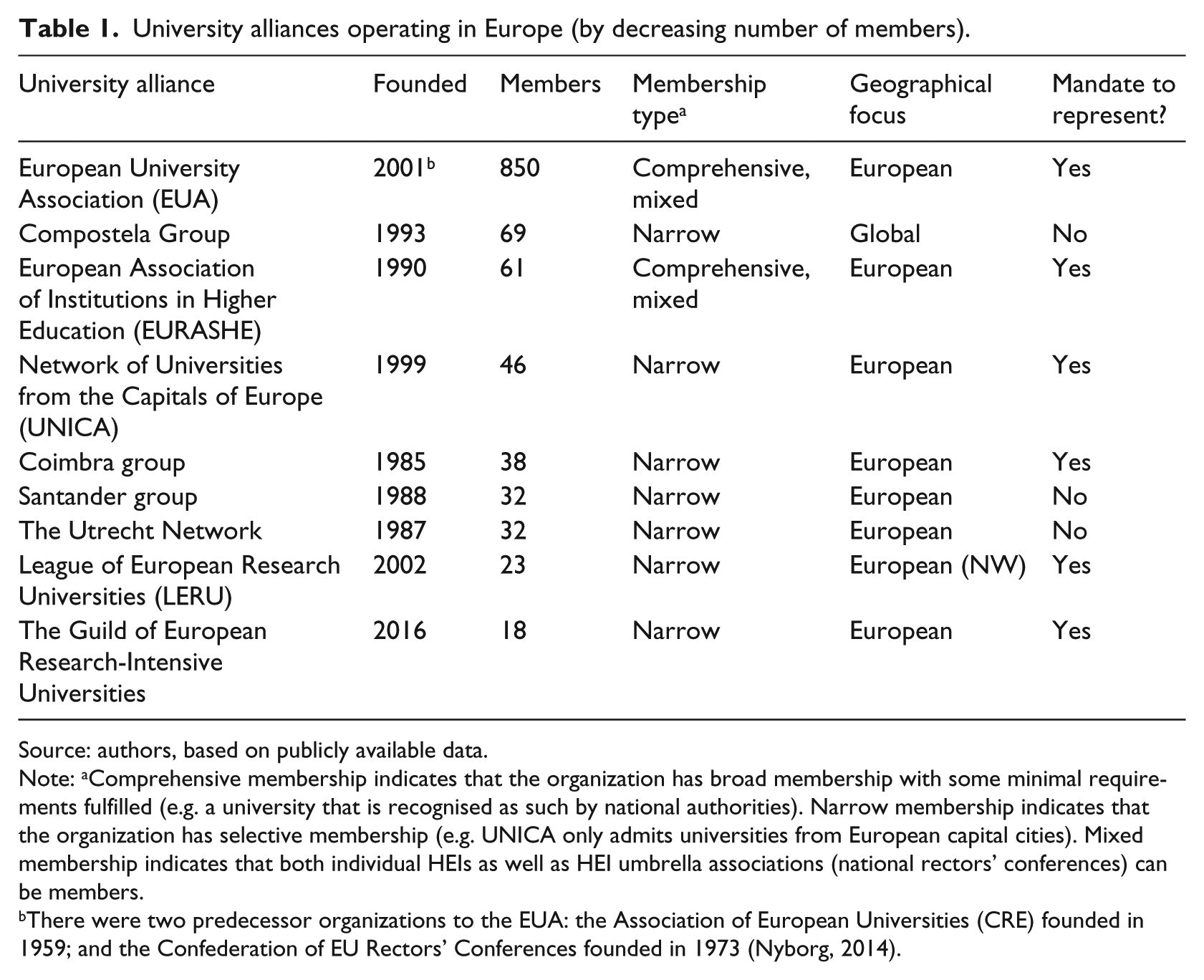
Source: authors, based on publicly available data.
Note: aComprehensive membership indicates that the organization has broad membership with some minimal requirements fulfilled (e.g. a university that is recognised as such by national authorities). Narrow membership indicates that the organization has selective membership (e.g. UNICA only admits universities from European capital cities). Mixed membership indicates that both individual HEIs as well as HEI umbrella associations (national rectors’ conferences) can be members.
There were two predecessor organizations to the EUA: the Association of European Universities (CRE) founded in 1959; and the Confederation of EU Rectors’ Conferences founded in 1973 (Nyborg, 2014).
The key distinction between the EUA and the LERU, in the context of this study, is their membership. The EUA has a broad and comprehensive membership, comprising universities and their national umbrella organizations (e.g. rectors’ conferences) from almost all European countries, and it claims to be ‘the largest and most comprehensive organisation representing universities in Europe’. 2 In contrast, the LERU has a very narrow membership, comprising ‘leading research-intensive universities that share the values of high-quality teaching within an environment of internationally competitive research’ 3 from ten countries situated primarily in the West and North of Europe. More than 75% of LERU members are amongst the top 100 universities (Academic Ranking of World University, ARWU, 2014 results) and all are ranked in the top 200. The EUA’s organizational headquarters are based in Brussels (with a subsidiary office in Geneva), with a secretariat comprising more than 40 people. The LERU’s office includes six employees and is based at one of the oldest universities in Europe (and a LERU founding institution) – KU Leuven.
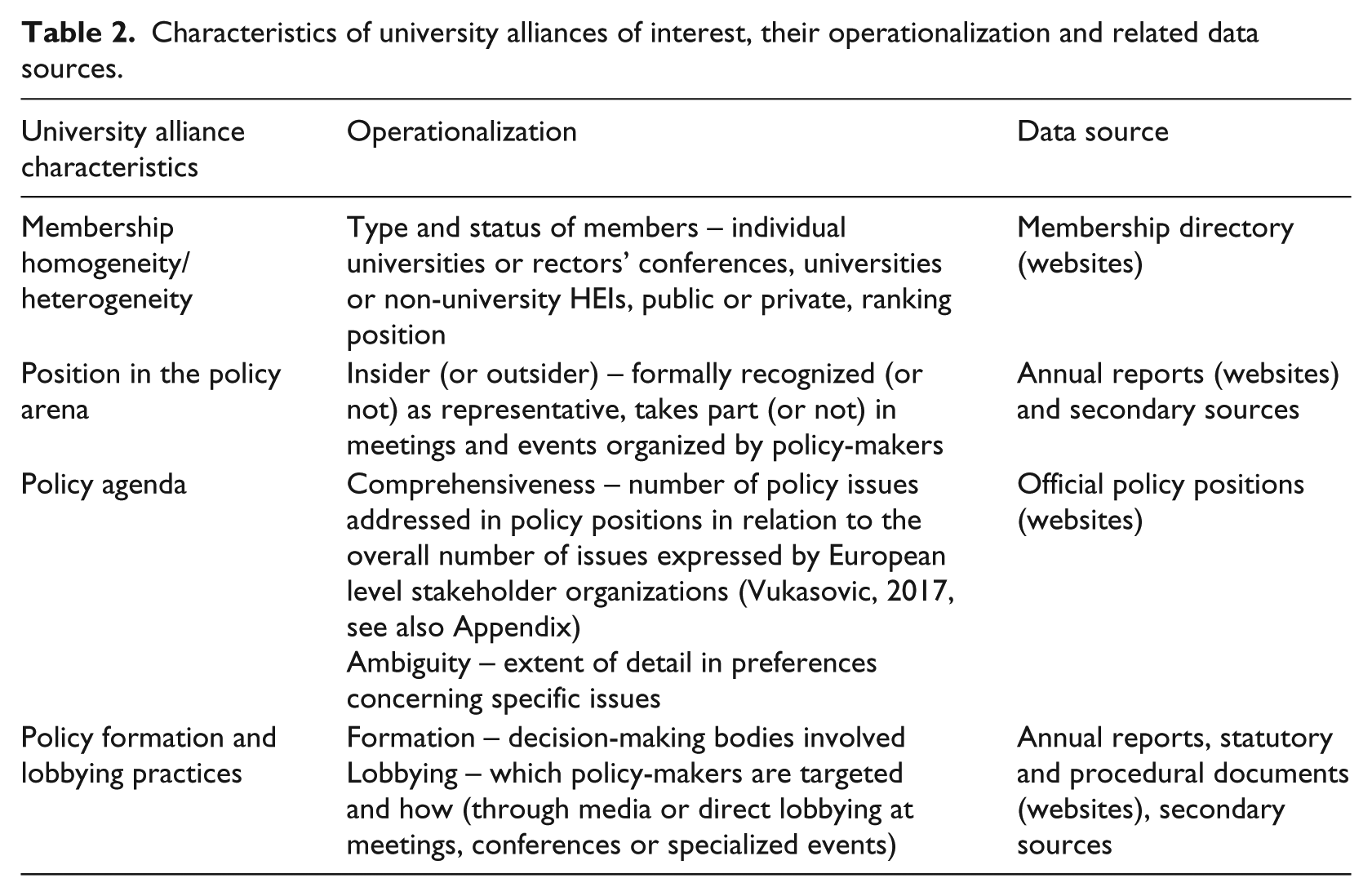
The empirical basis of this study consists of the official policy positions of these organizations (as presented on their websites), organizational mission and value statements, statutes and similar internal procedural documents, work programmes, activity reports as well as secondary sources. Table 2 lists which sources of data were used for each of the key four concepts – membership, position, policy agendas, and policy formation and lobbying practices.
Characteristics of university alliances of interest, their operationalization and related data sources.
Results
Position in the policy arena
European University Association
The EUA is recognized as an ‘insider’: it has an official consultative status in the Bologna Follow Up Group and it is called upon to comment on specific EU proposals. Moreover, it receives a part of its operational funding from the EU, not only through projects but also through administrative/institutional support (Elken and Vukasovic, 2014; Nokkala and Bacevic, 2014). As such it is clearly an ‘insider’ in the policy arena, and has been one since the early days of European initiatives in the area of higher education and research, either as the EUA or as one of its predecessor organizations – the Association of European Universities (CRE) and the Confederation of EU Rectors’ Conferences (Nyborg, 2014). Being recognized as an ‘insider’ implies that the EUA is considered to have the legitimacy as well as the capacity to represent its constituents. The sheer size of membership of the EUA also allows for some independence from the EU with regard to resources. This in turn allows for a large secretariat (in Brussels) in which a number of professionals specialize on various issues, and enables the EUA to take an active role in a number of policy processes. As indicated earlier, the EUA stresses its representativity by highlighting the size and breadth of its membership as well as the transparency and effectiveness of its internal procedures.
League of European Research Universities
While in its early days the LERU formally had the status of an ‘outsider’, it is now shifting towards having an ‘insider’ status. In 2012 it was recognized as a relevant partner by the European Commission, as expressed in their joint memorandum of understanding. This move towards being recognized as an ‘insider’ is not linked to a widespread formal and explicit recognition of the LERU but, rather, is related to nurturing special relationship with the key player – the European Commission – and to informal contacts with a handful of well-targeted actors. The elite character of these connections thus mirrors the elite character of the organization and indicates that legitimacy in European higher education policy coordination is not related to ‘size and diversity’ (as is the EUA case) but to ‘status and prestige’ (as is the case for the LERU).
Policy agendas
European University Association
Since its foundation, the EUA has adopted more than 50 individual policy positions. Almost 20 of those are more generic policy statements adopted bi-annually at the EUA’s main decision-making events – its conventions; the others are positions addressing EU institutions or responding to specific EU initiatives.
In general, the EUA’s policy agenda is primarily focused on:
The rationale for and approaches to European coordination in higher education and research (including the Bologna Process, but also EU initiatives such as the ERC and the EIT);
Organization, purpose and funding of research (including doctoral education);
The quality of higher education and assurance thereof;
The role and purpose of higher education; and
The social dimension of higher education (including issues related to equity).
Other topics, such as degree structure, learning outcomes, qualifications, governance and decision-making, are also addressed but not as frequently as the five issues listed above. The focus on specific topics in some cases reflects the dynamic of EU institutions – for example, lifelong learning (LLL) was most prominent in 2008 around the time of adoption of the EQF – while in others it reflects the EUA’s project activities – for example, the strong focus on quality can be linked to numerous projects the EUA has had on quality and quality culture.
Overall, the EUA’s agenda is quite comprehensive, including all issues addressed by European stakeholder organizations. The main policy documents are the bi-annual declarations 4 which, in most cases, are developed also as messages to the Bologna Ministerial summits. These cover the full range of Bologna action-lines as well as highlighting some issues of specific concern for the EUA (e.g. financing, dissemination of research and open access, etc.). In addition, the EUA also has positions concerning issues beyond higher education and research, such as public service principles for EU civil servants, as well as issues in which HE serves as a policy solution (e.g. energy policy) or issues which might affect HE (e.g. Transatlantic Trade and Investment Partnership, TTIP, negotiations).
The EUA’s policy positions are somewhat detailed and relatively specific. For example, the Antwerp declaration (adopted in April 2015) is organized into three parts. The first targets ‘policy makers, political leaders and decision makers at all levels – regional, national, European’-and identifies stable funding as one of the priority areas. Specific positions in this respect concern arguing against cuts in Horizon 2020 funding in favour of the newly established European Fund For Strategic Investment (EFSI) as well as advocating for ‘minimising discrepancies in the EU 28’, in particular between North/West and South/East. The second part describes a ‘long-term strategic agenda for universities’, highlighting diversity, doctoral training and research, international collaboration, cooperation with industry, etc. The third part defines ‘preconditions for success’, stressing the importance of academic freedom and autonomy and re-iterating the need for financial sustainability (all quotes from p. 1 of the Antwerp Declaration). Similar issues also appear in the EUA’s message to the 2012 Bologna Ministerial Conference which took place in Bucharest. In this document, the EUA reflects on the implementation of Bologna action lines and what ‘the successful development of the EHEA in the coming years requires’ (p. 4 of the EUA Input Statement to the Bologna Ministerial Conference) and as well as what is necessary to further the ‘modernization of higher education systems and of individual universities‘ (p.6 of the same document). Policy documents from the early 2000s (e.g. the 2001 Salamanca Convention and the 2003 Graz Declaration) are also detailed, strongly framed in relation to the Bologna Process, and quite clear with regards to specific preferences; for example, while diversification of funding is encouraged, ‘higher education remains first and foremost a public responsibility… governments must empower institutions … by providing stable legal and funding environments’ (p. 8 of the EUA 2003 Graz Declaration).
In general, the EUA sees European coordination in HE as a positive development and is often an advocate of more ‘European solutions’, arguing that specific challenges put to HE (e.g. ensuring quality) cannot be adequately addressed by national level policies alone. When there is opposition to European developments, it addresses in particular specific aspects of policy initiatives such as the EIT and ERC, or rules for participation in cooperation programmes. Even here the opposition is seldom all-encompassing but, rather, is balanced, highlighting the positive aspects of specific initiatives and warning about potentially negative consequences for the universities. An example of this is how the EUA approaches the topic of excellence: the need to improve quality and provide cutting-edge research is complemented by the focus on broadening access to HE, other purposes of HE (e.g. contributing to democratic citizenship) and the aforementioned ‘minimising of discrepancies’. One of the few instances in which the EUA (interestingly, together with the LERU) voiced a clear and all-encompassing opposition was related to cutting the Horizon2020 funding in favour of EFSI. 5
While the EUA’s overarching policy documents seldom refer to specific quantitative targets or indicators, or describe best practices in fine detail, responses to EU initiatives tend to be more specific – for example, commenting on participation rules in FP programmes, establishing the European Research Council, the ‘3% of GDP for research funding target’, and so on. The fact that these primarily reactive policy statements are more specific should not come as a surprise, given that many EU initiatives contain specific targets themselves, making it easier for the EUA to assess the consequences for universities should these targets be attained and thus facilitating formulation of very specific preferences concerning the targets.
League of European Research Universities
Since its foundation in 2002, the LERU has developed a range of policy positions through its ‘position papers’, ‘advice papers’, ‘briefing papers’, and ‘LERU notes’. These different documents express differences in priorities, such that ‘position papers’ are regarded as high-level policy statements and thus the most important (12 such papers were produced in the period 2005–2014), while ‘advice papers’ are rather more reactions to pressing issues, not least those deriving from the EU-system. The latter papers are more frequent in number; the LERU has produced 17 of these in the 2010–2014 period alone. All of these policy positions are supported by the highest decision-making body within the LERU, the rector’s assembly, which meets twice a year.
In general, the four main issues in the LERU’s policy agenda since 2002 have been:
Issues related to research and innovation (including doctoral education);
European coordination of research;
The social dimension of higher education; and
The role and purpose of higher education.
Other topics have also been addressed, but these appear to be more ad hoc in nature compared to the four issues above which all seem to be quite regular topics on which the LERU concentrates. Issues in the field of education are sometimes also addressed by the LERU, but such issues are very much linked to doctoral training and can be said to be quite closely coupled to the interest in research and innovation. That being said, the prominence of the four topics has varied in the period since 2002.
The dominance of research and innovation on the LERU policy agenda suggests that this alliance is focused in the articulation of its interests. However, in the latter years it is possible to identify a broader policy agenda advocated by the LERU, with a larger number of generic issues outside higher education being addressed; but a closer look at some of these issues shows that many of them are closely linked to Horizon 2020. For example, the LERU declaration on active and healthy ageing in 2013, the conference on energy transitions in the 21st century, the letters and statements concerning intellectual property rights, innovative medicine and open data protection in latter years all relate well to the seven societal challenges which are the basis for the priorities in Horizon 2020.
Furthermore, there is also a reasonably good match between the content of the LERU’s policy initiatives and the three pillars of Horizon 2020: (1) excellence in ground-breaking research and innovation, (2) industrial competitiveness, and (3) societal relevance. When echoing these initiatives in its own policy statements and papers, the LERU has sometimes opted for joining forces with other university alliances outside Europe. For example, in the so-called HEFEI statement launched in October 2013, signed by the LERU and a number of other international alliances such as the American Association of Universities (AAU), Group of Eight in Australia, and the C9 university alliance in China, the importance of excellence is underlined, together with research integrity and academic freedom.
The majority of the LERU policy positions are very strongly linked to Horizon2020, and the priorities of this research programme. Many of these positions are supportive, but some disagreements with the EU agenda and EU priorities do come to the fore from time to time. Examples of such disagreements in latter years can be found when LERU warned against budget reductions in the Horizon 2020, when the LERU expressed its support for Switzerland when that country was temporarily excluded from participating in Horizon 2020 in 2014, and when the LERU advocated for the importance of humanities and social science research, and the lack of opportunities for these disciplinary areas in Horizon 2020.
With respect to ambiguity of policy positions and recommendations, one can distinguish between more general policy positions advocating for university autonomy, academic freedom, the role of higher education, and the right for higher education institutions to set their own priorities. Such issues are usually addressed in mostly generic ways, while reactions to EU developments are much more specific and detailed, leaving little room for interpretations as to what the policy position of the LERU is on these matters.
Overall, the policy agenda of the LERU is concentrated very much on research and innovation issues and this has been the case since the very early days of the alliance (the early 2000s). While the alliance does address issues outside research and innovation, and where in latter years it seems to prioritise expanding its global network to similar university alliances in key countries such as the USA and China, and the wider Asian region, the policy agenda is predominantly linked to the EU initiatives and, more specifically, to Horizon 2020.
Practices of policy formation and lobbying
European University Association
The main decision body of the EUA is the Council, comprising presidents of national rectors’ conferences – that is, the collective full members of the EUA. 6 It adopts, by simple majority, EUA policies and positions, which are developed by a smaller structure, the Board of 9 members, some current and some former rectors, one of them being the President of the EUA (as specified in Articles 18–23 of the EUA Statutes). The Board, together with the Secretary General it appoints, is also responsible for implementation of the work programme. There is also an annual General Assembly comprising all full members (individual universities and their collective structures) and associate organizations (e.g. university alliances, including the Utrecht Network and UNICA), which elects the President and the Board and ‘determines the overall strategic direction’ of the EUA (Article 16 of the EUA Statutes).
The EUA organizes many events, for various purposes. The main events are the above-mentioned bi-annual conventions in which the overarching policy positions are presented to all of the constituents and the public. In addition to this, the EUA also develops and disseminates its policy positions through various topical projects focusing on, for example, quality culture in higher education, learning and teaching, doctoral education, funding, internationalization, and so on (more than 50 projects in total). These projects often provide the basis for the EUA’s policy agenda, by allowing EUA members to become acquainted with developments on the European level or from other European countries, consider different policy alternatives, and develop their own positions. This sometimes results in self-standing policy positions on an issue, or it feeds into the more general policy documents. For example, the quality culture projects as well as the EUA’s Institutional Evaluation Programme 7 contributed not only to the 2004 and 2007 policy positions on quality assurance, but also to specific parts of the bi-annual declarations. 8
While the organization’s policies are developed by the above-mentioned structures and through EUA’s projects, the EUA’s presence ‘in Brussels’ is, according to its own website, also important given that ‘[the] EUA provides input, analysis and evidence-based recommendations to European policy development’ (emphasis added). 9 This is primarily the function of a large Secretariat lead by the Secretary General and currently comprising more than 40 people, organized in topic-based teams focusing on both policy issues (research and innovation, governance and funding, general higher education policy, institutional development and quality) and more organizational aspects (communication, finances and accounting, project coordination). Based on consultation with its members, as well as using insights developed through the different events and projects, the EUA claims to provide expertise and its constituents’ input to the Commission (in particular DGs responsible for education and research), as well as the Committees and individual members of the European Parliament. These contacts are both formal – through organised public consultations including written responses to specific EU initiatives, and informal – through smaller bilateral meetings.
Overall, it is apparent that the EUA has a detailed and institutionalized approach to developing its own policy positions, building on its project activities and events and with a quite clear division of competences between its internal structures. It also has a significant administrative capacity to take advantage of its ‘insider’ position in the policy arena by articulating these positions directly towards the main EU institutions.
League of European Research Universities
The main decision body of the LERU is the Rectors’ Assembly, comprising rectors of all member universities, which meets twice a year. In these meetings, which are hosted by various member institutions, a range of issues is addressed, and policy papers are presented and accepted. Three of the members of the Rectors’ Assembly are in addition appointed to serve on the Board of Directors, and one of these directors has a special appointment as a chairperson. This person presides over the Rector’s Assembly and is the key political figure in between the meetings. The chairperson is supported by the secretary-general, currently located at KU Leuven. Together with a small staff (an additional five members), the LERU office takes care of the day-to-day running of the alliance.
In addition to the formal decision-making bodies and the key administrative staff, the LERU also has a number of committees, working and expert groups. The most important is the Policy Committee which acts as a review body for the development of key position and policy papers. The LERU has also set up various working groups, for example in areas such as alumni, charitable funding, e-learning, ethics, gender issues and some special disciplinary networks (often consisting of deans at member institutions). Expert groups focus on university rankings, research integrity, research data and legal issues (in relation to research projects).
When looking at the external activities of the LERU, the most visible trend in latter years is a consistent and very proactive attempt to link up to other international and high-reputation university alliances. The development and signing of the HEFEI statement (see above) is the most visible outcome of this engagement. However, the LERU is also engaged in other activities such as a regular student conference and the annual LERU summer school for doctoral students.
However, most of the external activities are very much related to EU matters in research and innovation policy. In 2012 the LERU also signed a special memorandum of understanding with the European Commission in which the LERU committed itself to carry out specific actions and processes that could contribute to the realization of the European Research Area (ERA). 10 Although the LERU secretariat is not located in Brussels (it is in Leuven, some 30 km distant), many LERU events take place there.
In the early days of the LERU, statements were mainly published and advertised in a more ‘passive’ fashion, while in latter years one can identify a much more active advocacy by the LERU in making its positions noticed and maximising their potential impact. In the last two or so years the LERU has organized special dinner events for members of the European Commission, and meetings with specific members of the Commission have recently become much more regular. Furthermore, special springtime receptions in Brussels targeting a selected and high-impact audience, and addressing issues such as global health challenges, seem to be the current way the LERU operates in order to advocate its policy positions. Thus the lobbying practice is very targeted, linked exclusively to specific people and audiences.
Discussion and conclusions
As presented above, both the EUA and the LERU have ‘insider’ positions in the policy arena, though on different grounds – the EUA relies on the number of its members while the LERU relies on prestige. With regard to policy agendas, while the EUA has a more widespread agenda than the LERU, the organizations are similar with regard to how specific their policy preferences are; not very specific regarding the more overarching issues, and very specific regarding direct responses to EU initiatives. Moreover, the EUA seems to possess established institutionalized practices relating to policy formation, while the LERU developed its practices more recently. There are also differences concerning the lobbying practices; while the EUA is involved with multiple policy actors on a wide range of issues in both formal and informal ways, the LERU is more targeted and less formal.
These differences – (1) broad (the EUA) versus narrow (the LERU) policy agenda and (2) broad and both formal and informal (the EUA) versus targeted and informal (the LERU) approaches to lobbying – can be related to the membership of these two organizations and their positions in the EU policy arena. As indicated earlier, the EUA is a widespread organization which highlights number of members and coverage of HE systems in Europe, while the LERU is an elite organization which highlights the prestige and status of its members. Here, the EUA and the LERU only partially conform to expectations from the literature on meta-organizations. On the one hand, as expected, the widespread organization (EUA) has a comprehensive policy agenda, while the selective one (LERU) has a more focused agenda. On the other hand, both organizations seem to have some policy positions which are rather specific and coherent, which is not as expected in the case of the comprehensive organization (the EUA).
One possible explanation for the partial discrepancy from our theoretically grounded expectations is related to the position of the EUA in the policy arena. The EUA has an official consultative status in the Bologna Follow Up Group and is called upon to comment on specific EU proposals. It has been an ‘insider’ since the early days of European initiatives in higher education and research (either as the EUA or as its predecessor organizations). As such, the EUA was expected to contribute to policy development and thus was required to develop policy positions on a number of issues. Ad hoc policy formation which takes place outside of the organization would jeopardize the EUA’s ‘insider’ status. Furthermore, this ‘insider’ position may also have given the (quite large) secretariat of the EUA more opportunities to formulate and adopt more specific policy positions.
Our approach of studying university alliances as meta-organizations has also nuanced some of the traditional expectations related to this form of inter-organizational collaboration and articulation of interests. While the comprehensive nature of the policy agendas of the alliances is in line with our expectations, it is more surprising that the lobbying practices are somewhat similar. One possible reason for this could be the ‘lobbying target’ – both organizations see the European Commission as the key actor in the European policy arena. Furthermore, while meta-organizations with large and diverse memberships can be considered as ‘weak’ organizations with respect to their ability to develop strong policy positions (Ahrne and Brunsson, 2008), it seems that these characteristics can be balanced by developing organizational capacity to follow up ongoing policy processes and to acquire the status as an ‘insider’ (the EUA). It is also interesting that individually ‘strong’ universities find it necessary to join forces and to become ‘insiders’ as well. While the LERU in latter years clearly seems to opt for an ‘insider’ position, it is interesting that this has not restricted its behaviour as an ‘outsider’ when protests are launched and made public on certain policy issues. Whether this is a deliberate strategy to balance policy impact with support from its membership, or more a result of ambiguity, is a question for future research to answer.
In the current study we have first and foremost described the formal set-up and the routines and practices that can be identified in the day-to-day running of the university alliances as policy actors. While this approach certainly has its limitations, not least with respect to identifying the actual impact of the university alliances in affecting specific policy outcomes (Börzel, 2011), it is still a valuable approach because we have demonstrated the specific strategies used by two quite different university alliances in their efforts to be included in European multi-actor and multi-level policy processes.
Our findings suggest that there are many ways forward to be included in the European knowledge policy arena. The clearly formulated interest one can detect in the EUA and the LERU to play a role in these processes suggests that analytical perspectives which include societal and international actors are extremely relevant (Piattoni, 2010), and that corporatist models of governance (Olsen, 1988) may become more important for future studies in this area.
What our study has shown is that while organizational characteristics, in particular diversity of the membership of university alliances, may indeed explain the comprehensive nature and ambiguity of their policy agendas, such characteristics should not be seen as deterministic for the role university alliances may play in various policy processes. The reason for this is obvious. The selection between being a ‘insider’ and a ‘outsider’ in a given policy process is not a matter of free choice for a given interest organization; it is also affected by which actors are ‘lobbying targets’ and what the motivations are of these actors to grant ‘insider’ position. As such, the development of both the EUA and the LERU to become more ‘insiders’ can also be seen as a strategy by the European Commission as the most sustainable way to launch and promote its policy initiatives, and as a sign of the importance of actors such as the EUA and the LERU on the supranational policy scene. While these alliances can certainly be regarded as interest organizations in a more narrow perspective, they can also take on the role as experts and/or implementers of policy (Beyers et al., 2008), and as such they possess a range of potential resources, which may explain why they are attractive in the increasingly complex policy processes that are played out at European level. It is reasonably well known that in the knowledge domain the EU may sometimes ‘skip’ the national policy level when launching and implementing certain policy initiatives (Chou and Gornitzka, 2014). In the area of higher education, university alliances could in the future be key actors in European level policy processes. Their transnational nature, the diverse sources of legitimacy they offer to policy-processes, and the potential power they hold through these characteristics makes university alliances very attractive partners for European level policy-makers. Thus our study may with some justification be said to provide a glimpse into the future of European policy-making in the knowledge area.
Footnotes
Appendix
Policy issues identified by European stakeholder organizations (Vukasovic, 2017).
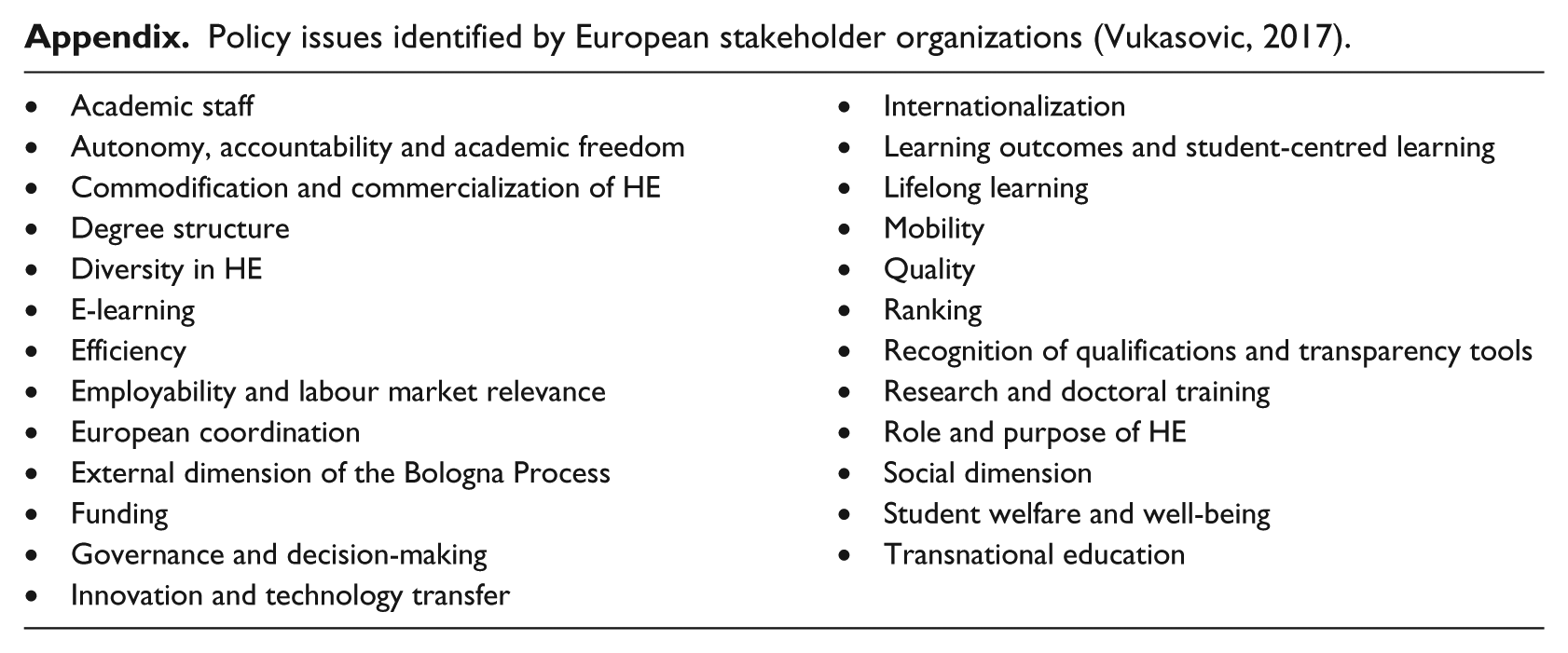
| • Academic staff | • Internationalization |
| • Autonomy, accountability and academic freedom | • Learning outcomes and student-centred learning |
| • Commodification and commercialization of HE | • Lifelong learning |
| • Degree structure | • Mobility |
| • Diversity in HE | • Quality |
| • E-learning | • Ranking |
| • Efficiency | • Recognition of qualifications and transparency tools |
| • Employability and labour market relevance | • Research and doctoral training |
| • European coordination | • Role and purpose of HE |
| • External dimension of the Bologna Process | • Social dimension |
| • Funding | • Student welfare and well-being |
| • Governance and decision-making | • Transnational education |
| • Innovation and technology transfer |
Declaration of conflicting interests
The author(s) declared no potential conflicts of interest with respect to the research, authorship, and/or publication of this article.
Funding
The author(s) disclosed receipt of the following financial support for the research, authorship, and/or publication of this article: Martina Vukasovic acknowledges receipt of financial support from the Research Foundation – Flanders (FWO), grant number G.OC42.13N.