




Abstract
Education policies are increasingly characterized as complex and dynamic, involving a multitude of actors and policy networks. As a result, there is a growing demand in education for research approaches that can help make sense of this complexity. This paper examines the applicability of multi-level governance (MLG) framework as a tool of education research from Canada’s decentralized federalist perspective. By conducting a comprehensive literature review of 50 peer-reviewed journal articles, we determine the applicability of MLG framework, the conditions necessary for its use, and its overall relevance to education policy, which is increasingly characterized by the involvement of a variety of stakeholder groups across government levels and policy sectors. The key findings are presented following Bowe et al.’s (1992) policy cycle framework. We conclude that MLG approach is a strong tool for education research to analyze policy making in federal decentralized educational systems, as it allows a more nuanced perspective for understanding the multilayered policy dynamics often unfolding in the context of federalism.
Introduction
Educational systems globally have become larger and more complex (Rizvi and Lingard, 2010). While education policy remains primarily a government activity, scholars have documented an increase in networked modes of governance in which a variety of stakeholder groups are involved in educational policy making (Ball, 2012; Brown, 2014; Smith et al., 2020). Educational policy spaces are positioned across multiple sites and levels (e.g. international, transnational, national, regional, local, and global), especially in relation to the Programme for International Student Assessment (PISA) and other standardized tests (Miller, 2013; Stack, 2006). In the Canadian context of federalism, scholars have also acknowledged a move towards horizontal governance in which hierarchies are less visible and collaboration is apparent across governmental actors (e.g. federal, provincial/territorial, municipal, and Indigenous governments) and non-governmental actors (e.g. parent advocacy groups, community groups, think tanks, [international] students, private donors, industry) (Capano, 2015; Papillon, 2011; White, 2014). Alcantara and Nelles (2014) pointed out that, in addition to diversity in policy actors, there are a number of ongoing political developments in the education policy landscape that have added to the complexity of understanding education policy (e.g. colonialism, federalism, and intergovernmental relations). Stakeholder relationships have become fluid, asymmetrical, and informal (Newman, 2001), making it difficult for researchers to document and analyze policy dynamics, assess stakeholder influence, or examine policy impact. Insofar as this interplay of actors in the education sector consists in complex webs of relationships, and often relies on “softer” or “voluntary” modes of cooperation between stakeholders (Capano, 2015), the result can be barriers to policy coordination (Jungblut and Rexe, 2017) and accountability (Burns and Köster, 2016). There have been increasing calls for education research to embrace new emerging policy contexts focusing on who does educational policy and with what purpose (Alexiadou, 2016; Moore, 2016). Given that educational policies are enacted on and with many stakeholders, it is important to investigate which actors are (or are not) influencing educational policy, which values and beliefs are being supported by governance structures, and whether the multiple state and non-state actors featured by multi-level governance (MLG) framework can better support student needs. As a result, there is a growing demand to identify research approaches that can help make sense of this policy complexity.
This paper focuses on MLG, an approach that has been utilized in various public policy contexts and to some extent in the post-secondary education context but has been minimally applied within K–12 education policy research. The literature shows that MLG is an appropriate and promising framework to use in analyzing policy complexity, as it was constructed specifically to capture the range of power dynamics within governments and intergovernmental relations (Alcantara and Nelles, 2014; Papillon, 2011). Multi-level governance framework assumes complicated dynamics of governance, in which governing bodies are no longer organized around central-state hierarchies, but where a variety of non-state actors have increasing influence on (education) policy. Supported by findings of a systematic literature review (n = 50 peer-reviewed empirical articles), we argue that MLG as a framework has significant merits for examining K–12 education policy in Canada’s decentralized federalist context.
The paper was guided by the following research questions: In what ways can MLG framework be helpful in examining the complexity in Canadian education policy? How does MLG framework support understandings of cross-policy contexts where education and other policy areas overlap, with a variety of state and non-state actors? What factors need to be considered when applying MLG approach to Canadian education research?
To that end, this paper starts by outlining the historical developments and core premises of MLG framework. Then the consideration of political systems in relation to the MLG context is explained, followed by a comprehensive literature review to explore the applicability of MLG approach to the Canadian education policy landscape. We then provide a review of the emerging themes uncovered in the literature review, and end the paper by providing recommendations for future research in education.
Historical developments and core premises of MLG framework
Multi-level governance framework emerged from European public administration research in an attempt to describe complex political networks involving a variety of stakeholders with competing interests resulting from European integration. Marks (1993) first introduced the term MLG as a means to untangle the multitude of actor relationships in the EU political system. This system, aimed at implementing EU policy directives, includes supranational institutions intertwined with national, regional, and local authorities based on collaborative partnerships. The framework is rooted in longstanding political theories dealing with the intricacies of multi-level economic and political relationships (Buchanan, 1965; Oates and Schwab, 1988; Tiebout, 1956).
Hooghe and Marks (2003) argued that there are two distinct types of governance mechanisms, which are intertwined in the contemporary state. Type I is characteristic of federalism, as it embodies a discrete hierarchy in which there is a clear framework designating particular functions and responsibilities at each level of government (Hooghe and Marks, 2003; Hooghe et al., 2001). In Canada, Type I is seen in federal, provincial, and municipal functions of government that are nested in each other. For example, in the case of education, the Canadian federal government tasks provincial governments with legislating and governing education, while municipalities elect school boards to implement that legislation. Type II involves intersecting (rather than nested or hierarchical) memberships, which are made up of task-specific jurisdictions. In this model, governance is influenced not only by governments, but by public service industries, non-state actors, and supranational organizations involved in a task or policy problem. In the Canadian educational context, Type II is apparent in cross-sector policy work that is enacted in schools. For example, Manitoba’s Wraparound Protocol is published by Healthy Child Manitoba (the health sector) but involves consultations with Child and Family Services, Manitoba Education and Youth Justice, and federally funded initiatives such as Jordan’s Principle 1 (who, in turn, works with non-governmental service providers, First Nations, families, and private practitioners). However, is intended for implementation in schools (Healthy Child Manitoba, 2013). Type II in MLG theory is a helpful tool to understand “overlapping, competing jurisdictions…[with] multiple, functionally specific policy regimes with overlapping national membership” (Hooghe and Marks, 2003: 2). Both types are relevant to education research, as the contemporary political context tends to have more rigid, established governmental systems that operate alongside flexible organizations of stakeholders arranged around education policy issues.
Overall, MLG framework is grounded in the following features that underlie policy making processes (see Table 1): (1) Recognition of complexity in governance systems; (2) Presence of multi-dimensional power relations between governance levels and across policy sectors (Tier 1 and Tier 2); (3) Diversity of stakeholder interest and shared purpose; (4) Horizontal and vertical accountability structures marked by collaboration and interdependency; (5) Fluidity and change in governance systems. (Bakvis, 2013; Hooghe and Marks, 2003; Marks, 1993; Townsend, 2013) Core features of the MLG framework.
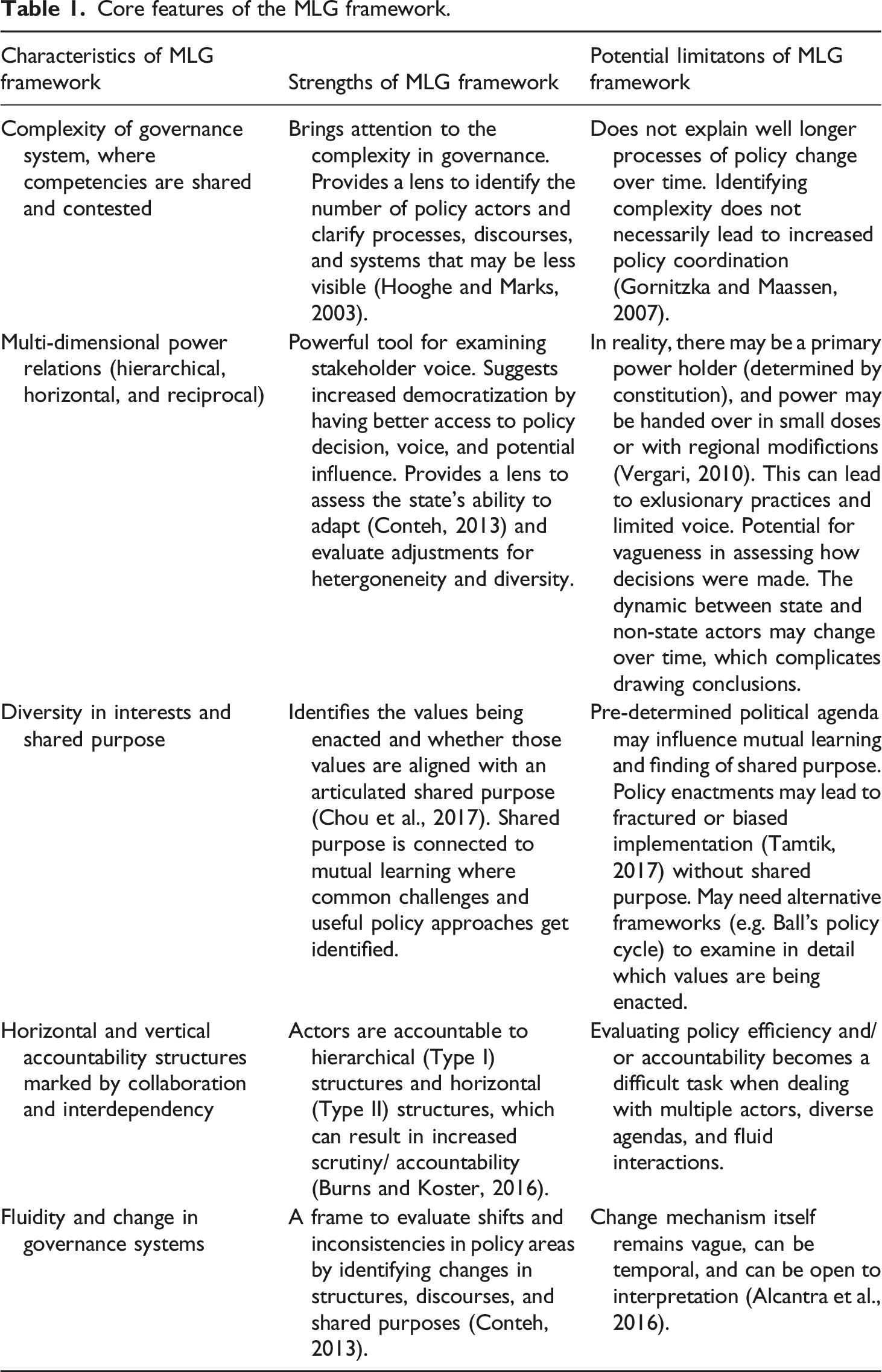
As seen in Table 1 above, the ideas of collective decision-making (Capano, 2015), interdependence among stakeholders (Börzel and Heard-Lauréote, 2009), and mutual learning—whereby multiple stakeholder groups engage in collaborative problem-solving and learning around particular policy areas, either at the national or supranational level (Radaelli, 2009; Zito, 2015)—are central to systems described by MLG approach. Any inquiry into policy governance in such a system must acknowledge the complex and dynamic relationships and accountability structures at play. As evidence of the wide applicability of MLG framework beyond the European Union, there have been studies examining decision-making, policy, and governance structures internationally (for example, in Austria, Australia, Canada, Germany, the United States, etc.) focusing on economic policy, environmental policy, international trade, telecoms, and international relations (Coen and Salter, 2020; Petersmann, 2017; Rajabuin and Middleton, 2013). This broad adoption of MLG framework across multiple domains reflects Conteh’s (2013) argument that, in the contemporary world, decision-making structures focus on governance rather than simply management by utilizing networks, bargaining, and interaction, rather than hierarchies.
The role of a political system in MLG framework
As MLG framework emerged in the context of the European Union, it is important to examine the ways in which a political system, such as federalism, may have an impact on the uptake of MLG approach. Below we discuss some key aspects that need to be considered.
Decentralized nature of policy making
While the EU is moving from a decentralized decision-making system to pan-European dimensions in several policy areas (e.g. social policy, higher education, research policy), Canadian federalism remains decentralized (Papillon, 2011; Verdun and Wood, 2013). In education, provincial governments have always held exclusive decision-making power, while the federal government maintains control over Indigenous education and certain health and social governance policies implemented in schools. This decentralized nature of decision-making has resulted in multiple overlaps of authority and fragmentation of policies (Bakker and Cook, 2011; Colorado and Janzen, 2021). Hueglin (2013) argued that the governance structures of Canada and the EU are similar insofar as policy depends on intergovernmental bargaining and on agreement, rather than solely on constitutional power allocations. While this may be true, Canada’s intergovernmental bargaining system is constitution-bound, relatively ad hoc, and far less flexible in regards to actors at play in a particular policy area (Hueglin, 2013; Verdun and Wood, 2013). In education policy, examples of federal–provincial bargaining are not well documented, partly because there is no need to engage in bargaining when the provinces both fund and govern education. However, there is more evidence of federal–provincial negotiations in the areas of international education (Tamtik, 2020; Viczko and Tascon, 2016), some federally funded education initiatives (Vergari, 2010), and Indigenous governance with reference to education (Alcantra and Nelles, 2014; Papillon, 2011). In those cases, scholars have observed tensions among participants and attempts at establishing firm boundaries between jurisdictions. At the local level, negotiating and bargaining occur in the agreements made between school boards, teacher organizations, provincial ministries, parent organizations, and outside agencies (Osmond-Johnson et al., 2019). The lack of literature on intergovernmental education bargaining provincially and nationally, however, suggests that there may exist jurisdiction and/or accountability gaps resulting from decentralized governance (Millar, 2013) that require investigation.
Coordination mechanisms
The presence of clear policy coordination mechanisms is important in achieving policy coherence in decentralized governance systems. In the EU, Open Method Communication (OMC)—a formal process whereby state and non-state actors work together to share best practices, define mutually agreed upon objectives, and set guidelines for individual member states—is employed (Verdun and Wood, 2013). In Canada, coordination, coherence, mutual learning, and information sharing on a pan-Canadian basis is generally uncommon (Millar 2013). Wood (2013) noted that, in cases where the Canadian federal government shifts governance of an issue to the provincial government, it often determines the amount of money to be transferred and how it should to be distributed (Wood, 2013). In the case of education, this point is less applicable as federal funding typically contributes no more than one percent of K–12 funding (Vergari, 2010), with the exception of Canada’s provincial equalization funding (for under-funded provinces) and funding for Indigenous education. Overall, the lack of federal funding is accompanied by a lack of federal regulations or control mechanisms regarding how education policy should be implemented, which leads to differences in policy priorities and may result in inequalities in access to education. These inequalities apply most directly to First Nations students who live on reserves and where schooling is supported from the federal funds. It often happens that eduction expenditures end up competing with other necessities for which federal lump sums are used, resulting in poorly funded schools, underpaid teachers, and limited educational programming (see Blackstock, 2016; McCue, 2018).
Some formal horizontal and vertical coordination mechanisms do exist in education governance in Canada (Verdun and Wood, 2013). In international education, the Federal–Provincial Consultative Committee on Education-Related International Activities (FPCCERIA), established in 1986, has been documented (Tamtik, 2020). The federal departments most often involved in these discussions are the Department of Foreign Affairs and International Trade (now Global Affairs Canada); Human Resources and Skills Development Canada; Immigration, Refugees and Citizenship Canada; the Canadian International Development Agency; and Industry Canada. A similar committee has been set up for horizontal coordination by the pan-provincial stakeholder Canadian Ministers of Education in Canada (CMEC). The Provincial–Territorial Consultative Committee on Education-Related International Activities (PTCCERIA) has been established to organize province-to-province dialogue and aim for policy coherence. However, there is little evidence on how effective these committees have been. When it comes to the capacity to collaborate with Indigenous governments on (education) policy, the outcome of intergovernmental negotiations has varied considerably depending on the demographic and geographic situation, the resources of Indigenous governments, and the nature of the institutions of Indigenous governance (Papillon, 2011).
Limited shared and coordinated vision for education is characteristic of local-level decision-making as well. Colorado and Janzen (2021: 16) found that provincial documentation published by Manitoba Education showed a “lack of common values and approaches resulting in competing beliefs, fractured purposes, and inconsistent tactics for understanding students and engaging with them.” Public school legislation tends to be province-specific with changes and updates getting tagged onto historical documents in a piecemeal fashion without consideration of broad pedagogical positions. In short, the Canadian federalist system tends to more often be a one-way dispersal of information, rather than the ongoing dialogue that exists in the EU system. Hogl and Nordbeck (2012: 112) suggested policy making in the contemporary sphere can best be understood as navigating “fragmented landscapes of interdependent arenas,” and thus policy coordination efforts are a means to overcoming dissonance and inefficiency across policy sectors. Understandings of policy coordination can be used to examine the “conditions that may be conducive to horizontal cooperation” (Wallner, 2017: 417) to reduce fragmentation between policy sectors. As a result, there is a need to identify factors leading to coordination mechanisms based on mutual learning in education policy.
Who holds power?
Decentralization of decision-making has resulted in an increasing involvement of policy actors within and across jurisdictions. With increased complexity across levels and sectors of policy making, the pressing question of power becomes apparent. In the traditionally hierarchical Canadian context, policy is enacted in a constitutionally established system in which governance structures defend their “turf” because when power is handed over in small doses, stakeholders want to hang on to it (Wood, 2013). Haskel (2013) noted that because there is little representation at the federal level, provinces tend to be independent-minded and exclusionary when dealing with their own population. Vergari (2010) suggested that, even in cases where provinces have agreed to implement similar policies pan-provincially in education, modifications to centrally defined curricula still apply in accordance with local values and priorities. As such, any inquiry into MLG framework from the Canadian perspective must also consider the primary power holder in a particular policy area and by what means that actor is interested in sharing governance, as this will vary jurisdictionally.
The strength of MLG framework over other similar theoretical approaches that aim to capture the complexities of policy making, such as policy network theory (Padure and Jones, 2009), policy assemblage (Gorur, 2011) or policy community (Rizvi and Lingard, 2010), is its distinct analytical promise. While policy network theory has been criticized as working as a descriptive heuristic that lacks analytical power (see Howlett, 2002; Stewart-Weeks, 2006), MLG approach stipulates clear structure in its Tier 1 and Tier 2 forms, which provides analytical direction to trace stakeholders and their relationships. Furthermore, MLG is grounded in political theory and strictly takes a governance perspective for examining economic and political relationships within a political system, rather than viewing policy making as a fluid set of state and societal actors linked together by interests and ideas. Another important distinction setting MLG framework apart from other analytical perspectives is that MLG approach highlights the power of mutual learning in the policy process, which is often overlooked in other conceptualizations (e.g. assemblage). Mutual learning within MLG framework is an important aspect that helps to examine the micro-processes in policy change and draws attention to interdependence in interests, explaining collaboration or resistance in actor dynamics.
Methodology
In order to unpack the complexity of decision-making according to MLG framework and determine further factors that may influence analysis of education policy in Canada, we employed a comprehensive literature review approach (Booth et al., 2016) to collect data. For analysis, our goal was to identify 50 peer-reviewed empirical journal articles within the Canadian policy context that had used MLG approach as their core framework to explore the usefulness of MLG approach for education and, if relevant, identify specific factors that need to be considered. First, we used the key search terms “multilevel governance, Canada” in Google Scholar. The search yielded 42,200 results. We narrowed the criteria by specifying the timeframe as 2010–2020 in order to capture the most recent research articles published on the topic, which yielded 19,500 results. From that pool, we selected the first 50 most-cited articles that utilized MLG in a particular policy context in Google Scholar for review. In our second phase, we were interested in how MLG framework has been used in education research. We then conducted a new search by focusing in particular on education policy by using the following search terms: “MLG, Canada, education” and “MLG, Canada, education, K–12.” The search yielded 1850 results. Within the timeframe of 2010–2020 and within the 50 most cited articles in this search, we focused on articles specifically taking up MLG approach in the education research. In reviewing each of the chosen articles from all searches, we then conducted content analysis focusing on the following criteria: 1. What is the policy sector in which MLG is applied as a conceptual lens? 2. What are the central topics of interest, guiding questions, and goals? 3. What sources and types of data are utilized (theoretical, empirical)? 4. What are the major results, limitations, and/or implications? 5. What are the key findings that are relevant to K–12 education in Canada?
The data was initially organized based on policy sectors and key arguments relevant to K–12 education (see Appendix A). Our next step was to synthesize key findings following Bowe et al.’s (1992) policy cycle analytical framework. Bowe et al. (1992: 19–23) suggested that there are three contexts in which policy is developed: (1) the context of policy influence (“where public policy is normally initiated. It is here that policy discourses are constructed. It is here that interested parties struggle to influence the definition and social purposes of education” [p. 19]); (2) the context of text production (“Policy texts are normally articulated in the language of general public good./…/ Policy texts therefore represent policy. Texts have to be read in relation to the time and the particular site of their production” [p. 20]); and (3) the context of practice (“Policy is not simply received and implemented within this arena rather it is subject to interpretation and then ‘recreated’” [p. 22)]. This analytic framework allowed us to trace and examine the uptake of MLG approach, understand cross-policy contextual peculiarities, and identify factors influencing education policy. In particular, the policy cycle framework allowed to consider multi-level implications in different aspects of policy cycles, rather than just examining the final documents themselves. Hatcher and Troyna (1994) argued that Bowe et al.’s (1992) work provides “theoretical and empirical insights into the complexities of the policy process which barely see the light of day in managerialist studies of policy” (p. 156). It is these complexities that we were interested in learning more about in relation to the applicability of MLG framework to education policy in Canada. We also traced findings on policy coordination and potential overlap or fragmentation in policy areas. In the conclusion section we summarize the key findings based on our research questions.
Findings
Multi-level governance as a conceptual framework has been utilized most to examine policy areas in Indigenous governance, immigration, telecommunications, multiculturalism, municipal urban governance, environmentalism/climate change, international education, and post-secondary education (see Appendix A). Our analysis of the articles showed that those are the areas that feature several commonalities: (1) shared interests from two (or more) levels of government, (2) involvement of diverse stakeholder groups (both state and non-state) with federal oversight (e.g. Indigenous policy, telecommunications, multiculturalism); (3) overlapping Tiers I and II in governance systems; (4) strongly held value positions (e.g. prioritizing social programming versus economic benefits); and (5) high-stakes decisions with significant societal implications (e.g. increase in graduation rates, numbers of youth accessing post-secondary education [Verdun and Wood, 2013]). These same criteria hold true for K–12 education policy.
Emerging themes
When the context of influence, the context of production, and the context of practice were examined for the application of MLG approach to the Canadian educational landscape, several themes emerged, including: the fractured bureaucracy and funding landscape of federalist policy making; ongoing colonialism and effects of colonization in multi-level policy making; the increase in policy voices as a result of enhanced democratization at regional and local levels; opportunities for non-hegemonic voices in the Canadian multi-level policy context; and barriers to coordination of social justice. These themes are discussed below.
Contexts of influence: Economic, historical, social, and political factors in education research
In the context of influence, stakeholders struggle over the construction of formal policy. The private arenas of influence are based upon social networks, political parties, government, and the legislative process (Bowe et al., 1992). Multiple actors advocate for their own distinct values and interests to be represented in policy. In the K–12 context, there has been a rise in the authority of non-governmental actors, including parents and students, to shape the services programs and curriculum content offered by public schools delivering international education. Similarly, multiple researchers (Busemeyer et al., 2013; Gornitzka and Maassen, 2007) have noted that post-secondary education is becoming more politicized, politically salient, and an embedded element of other public policies (Chou et al., 2017). Our literature review suggests that education research must pay attention to particular economic, historical (colonial), social, and political contexts as those significantly shape the actor relationships within the context of influence.
Funding and economics are often intricately woven into the policy context, and access to funds (or lack thereof) has an impact on the governance structures at play. In the context of Canadian social and education policy, it is common for federal money to be offered in exchange for particular programme development with national standards (White, 2014), which can muddy the waters of pre-established (provincial) outcomes. The Early Childhood Agreement in 2000 and the Early Learning and Child Care Agreement in 2003 are two instances in which federal funding was parachuted into existing provincial education policy, resulting in fragmentation to previously determined policy directions (White, 2014). Stevens and Hanschka (2014) noted that, particularly at the local level, individual jurisdictions (i.e. local schools) have different skill levels in applying for grants and funding at the provincial, federal, or non-state levels, which can result in unequal access to additional sources of funding. Finally, policy directions in a federalist system are often driven by economic, rather than ideological, arguments. Capano (2015: 12) found that, in the case of the Conservative government in Ontario, “governance reforms were framed almost entirely in fiscal terms, with centralized funding conceived as a tool to control school board spending rather than a means of achieving equity.”
Canada’s historical context is rooted in colonialism, and this colonial history continues to influence policy and governance. Papillon (2011: 304) noted that, in Canada, negotiated constitutional recognition of Indigenous peoples has been resulting in a “multiplication of decision-making spaces.” While federalist structures have allowed for specific pockets for Indigenous peoples’ involvement, more decision-making spaces have resulted from Indigenous peoples creating themselves opportunities for influence. In Canada, treaties are protected constitutionally, and there are formal MLG systems for Indigenous leadership to work with Type I governance structures. As a result, actors are legion, with pan-Canadian Indigenous organizations, individual Indigenous groups, and municipal, provincial, and federal governments all forming networks of interaction. In this MLG structure, Indigenous governance has an impact not only on Indigenous affairs, but also on education, social services, health, and other policy sectors.
Federalism supports shared competencies and fosters multi-dimensional power relations among interest groups. While some scholars have seen this as a strength of the increased democratization of the policy process (Conteh, 2013), others have criticized the evident overlap between policy areas at different levels of government (White, 2014). In the Canadian context, child and family services, health, and education policy governance see such overlap, given their individual mandates to support children. The result is that there has been increased horizontal shared competency across policy sectors seen both in collaborative frameworks and in co-implemented reports aimed at supporting the well-being of children and youth (for example, Brownell et al., 2015; Joint Consortium on School Health, 2009; National Crime Prevention Center, 2009). While these stakeholders co-govern decisions related to policy arenas other than education, the implementation of those policies happens in schools. Multi-level governance inquiries into the influence of social and health policies on education thus have the capacity to bring to light the multitude of horizontal power relationships, and also to show which aspects of health and child welfare are under-supported in the current context.
The political ideology of an elected government has significant influence on policy and accountability structures, as it has the power to invite partners to the table (Capano, 2015; Sattler, 2012). At the provincial level, then, there will be differences in whom a liberal government versus a more conservative government invites to participate. In addition, provinces work with multiple stakeholders at local levels (including unions, school divisions, school boards, local police, local advocacy agencies, local charities, and child welfare organizations) and provincial levels (including Provincial Advocate offices, Ministries of Education, and provincially-led education reviews). Papillon (2011) suggested that the number of independent actors creates the possibility for change at the ground level, which is vital to democratic policy change and policy action over time. Therefore, any analysis that applies MLG framework in education research ought to compare policy and existing governance structures as a function of a particular political party, yet also be mindful of the bottom-up activities emerging from the ground in both regional or national contexts.
Context of text production: Who has voice?
In any policy area, there are multiple voices and multiple discourses represented in policy processes with diverse actors supporting their own distinct agendas (Viczko and Tascon, 2016). Alcantra and Nelles (2014) noted that being involved in a policy process does not necessarily mean that each actor will be able to affect, or will be happy with the outcomes of, a “negotiated” policy. While policy texts are framed in the language of general public good, Bowe et al. (1992: 21) pointed out that texts are often generalized and written in relation to “idealizations of the ‘real world’; they can also be contradictory”. In this context of text production, the task for education research is to reveal these contradictions and ambiguities, critically analyzing whose voice has been represented and how in policy texts.
Local and provincial political power represents the dominant influence in education policy. Capano (2015: 335) found that, in Canada’s federalist multi-level system, provincial governments concurrently find ways of “legitimizing internal reforms (in the name of standardization and of the pursuit of educational excellence), [while also]… strengthening of interstate cooperation in adopting common strategies,” all with very little federal oversight, direction or assessment. Formal assessment and review of education occurs at the provincial level (e.g. Manitoba’s 2019 Manitoba Commission on Kindergarten to Grade 12 Education, implemented independently of other provincial reviews while the provincial government controls the gathering and sharing of data and the review process [Province of Manitoba, 2019]). Therefore, it is important to examine policy as a function of a particular political party in regional or national contexts. Even if non-hegemonic voices are invited to the table, the dominant political system holds the power to determine the core norms of collaboration (Alcantra and Nelles, 2014).
Multi-level governance approach is a powerful tool for explicating the actors with voice and those who are voice-less in education policies. In the case of Indigenous governance, Alcantra and Nelles (2014) found that, while there has been significant work done to include Indigenous voices in Canadian governance, Indigenous involvement is not automatic for all intergovernmental meetings. Indigenous inclusion depends upon invitations from federal or provincial governments. Furthermore, Papillon (2011) argued that Indigenous Nations with treaty-based self-government agreements often have increased leverage and resources to engage in government-to-government relations and that not all Indigenous governments are equal in their capacity to engage in intergovernmental relations. In the case of education research, this presents some unique challenges. For example, Indigenous students who live on reserve but attend public K–12 schools off reserve require a transfer of funds from their First Nation to their local school board (Bains, 2014). In Ontario, for example, 40% of Indigenous students on reserve attend school off reserve, and, as a result, Ontario First Nations pay in excess of 60 million dollars to local school boards annually. However, despite these parameters for tuition fees and agreements, the Ontario Ministry of Education and the federal Department of Aboriginal Affairs and Northern Development Canada do not keep track of tuition agreements in place between school boards and First Nation communities in Ontario (Bains, 2014). Consequently, there has been concerning amounts of over-charging to First Nations, particularly smaller First Nations with less knowledge of tuition agreements (Bains, 2014). Because tuition agreements are reached at the local level, all First Nations are not necessarily able to advocate equally. Furthermore, in cases where a tuition agreement has not been reached, Indigenous students may be excluded from school enrolment.
In the contemporary context, the public also has increased voice in policy governance. For example, a newly established provincial Human Rights Commissions in Manitoba provides opportunities for citizens to advocate for change to education-related decisions (and other policy areas). In one instance in 2017, parents filed a complaint with the Manitoba Human Rights Commission, arguing that parts of the Manitoba curriculum were discriminatory to LGBTQ2+ students and families; this prompted a review of the current curriculum at the provincial level (Annabelle, 2020). Conteh (2013) argued that MLG framework contributes to the democratization of governance insofar as it allows citizens to become value creators (by engaging in forums, surveys, complaint protocols, advocacy groups, parent advisory committees, and dialogue with locally elected leaders) in the contemporary political context. Certainly, according to MLG approach, there are increased opportunities for local actors to seek out allies beyond the central authority to pursue their interests (Tamtik, 2017). In an era of increasing access to technology and to knowledge, the number of stakeholders able to wade into particular policy areas is increasing.
When considering who has voice in a federalist MLG context, scholars should examine the interdependency among stakeholders. Rodon (2014) noted that horizontal relationships in governance arrangements must be able to respond to contextual realities. In this way, MLG framework can be considered not simply a framework but an “instance” of a specific actor configuration that changes over time as government and non-government actors, as well as contextual forces, change (Alcantara et al., 2016: 6). Voice, in this context, may be unique to the contextual factors at a given moment; that is, in the case of MLG approach, some stakeholders have voice specifically in relation to other factors. For example, as provincial education ministries work to legislate schools within the COVID-19 context, they are limited by and must act within public health guidelines, amplifying any pre-existing co-dependencies between health and education.
Another example of increased interdependency is apparent in the relationship between education and police in an era focused on school safety. Indeed, following an increase in the number of school shootings in both Canada and the United States, school divisions began implementing threat assessment protocols (Harwood, 2011) and engaging non-state actors (such The North American Center for Threat Assessment and Trauma Response [NACTATR]) in developing new policy to determine threats in the school environment. The resulting changes in policy and governance within school districts (for example, Manitoba Education, Citizenship and Youth, 2005) also changed how schools interact with police, social programming, and violence prevention programs. These changes have, in turn, led to a change in the policy governance in these other policy sectors as well (NACTATR, 2020).
Context of practice
The uptake of formal policies is often subject to interpretation, contestation, and resistance. The context of practice recreates policies depending on the differences in the histories, experiences, values, purposes, and interests of local actors (Bowe et al., 1992). As a result, the context of practice can lead to a variety of anticipated effects but also unanticipated outcomes. The role of educational research is to examine those disconnects across multiple levels of the policy-making process. One of the most significant contextual factors at play is the ability of local-level actors to implement directives from higher level governments with fidelity (Stevens and Hanschka, 2014). Institutional environments—the unique constellation of school, school board, school district, parent community, advocacy groups, provincial legislation, and professional associations in a particular educational context—are unique to individual cities/regions and have a significant impact on how effectively policy is implemented (or if it is implemented at all). Thus jurisdiction-specific examinations within MLG framework are necessary (Leo et al., 2012). Rodon and Therrien (2015) noted that often higherlevel governments take on initiatives without knowledge of the implementation capacities of lower levels of government. Therefore, building stakeholder capacity (e.g. more resources, training, knowledge of best practices) at lower stakeholder levels is paramount to implementing coherent pan-national goals in a MLG system (Amundsen et al., 2010; Chu et al., 2018). For example, rural Manitoba school divisions often have difficulty securing basic staffing for their own schools, leading to unavoidable violations of Manitoba’s Public Schools Act (Caruk, 2018). Townsend (2013: 340) argued open systems of policy discussion across levels of government are important so that “an evidence-informed discourse through time [can] lead to a generalized acceptance of broad policy thrusts.” This discussion should also consider regional abilities to implement those policy thrusts.
A primary challenge in MLG framework is efficiency, insofar as governing becomes more difficult when dealing with multiple actors, agendas, and interactions (Hooghe and Marks, 2003). Scharpf (1997) argued that governing bodies may choose to limit the number of autonomous actors, or the interaction by independent actors, in order to make governing more efficient. Rajabiun and Middleton (2013) found that, in some instances, inclusion of non-state partners has the capacity to improve efficiency of a particular policy area if non-state actors already have established infrastructures to work towards pre-determined outcomes. For example, a school district may choose to partner with an existing local mental health organization to support students with mental wellness rather than working alone to develop new initiatives. At the very least, MLG approach allows the examination of the horizontal dispersion of relationships with non-state actors who hold considerable power in governance (Rodon, 2014). Some scholars (Harlow and Rawlings, 2006; Olsson, 2003) have argued that within MLG framework there is a danger of accountability deficits if governments reach out to convenient non-state partners; this may lead to increased bias and lobbying in governance, thereby posing a risk to democratic norms.
Vergari (2010) stated that Canada’s decentralized federalist system is better able to implement meaningful (though not necessarily coordinated) changes to education policy than a nationalist system because, in Canada, provincial governments hold the bulk of the power (despite multiple national, supranational, pan-national, and pan-provincial powers at play). However, while action in policy reform is stronger in Canada’s education context, accountability mechanisms are weaker, as policy tends to be implemented in an extemporaneous manner (Vergari, 2010). Certainly, a key factor to consider in MLG approach is the limited capacity to create policy coherence, which may result in fragmentation of policy implementation. Intergovernmental organizations such as the Pan-Canadian Consortium for School Health, the UN Convention on the Rights of the Child, and the OECD often make pan-national recommendations; however, because Canada does not have a federal department of education, pan-national goals are often implemented in a fragmented way, as evidenced by significant variation in student performance across provinces in Canada (White, 2014). Reidel (2015) noted that Canada often sees examples of one level of government enacting norms that are not echoed at levels or parallel levels of government—for example, local schools prioritizing multiculturalism at the same time as provincial restrictions for immigration and multiculturalism. Papillon (2011: 293) argued that “layering”—the superposition of new practices and norms over time in a rigid federalist system, resulting in “a disjuncture between formal rules and active practices”—has the possibility of influencing policy dynamics. In the context of education, this can be seen in the development of increased horizontal accountability mechanisms to school boards, parents, professional organizations, and students (Burns and Köster, 2016) in order to drive policy forward.
Conclusion
In this paper we have demonstrated that MLG framework is a useful conceptual tool for unpacking the contextual forces and stakeholder relationships that inform education policy in decentralized education systems such as in Canada. Based on the analysis, we have provided a detailed account of the dynamics and contextual factors that need to be considered when using MLG lens as a tool to examine and analyze policy processes in education research. To summarize, our findings show that the MLG approach is applicable to Canadian education policy, as this is a policy sector with increasing involvement of diverse stakeholder groups associated with high-stake decisions that have significant societal implications. While provincial governments control education funding and governance, there are multiple (indirect) influences from the federal government through other policy sectors and (in)formal influences from local and pan-national advocacy groups invested in common goals and outcomes in education. Multi-level governance framework helps to illuminate the multitude of such stakeholder relationships beyond the education sector by looking across levels of government authority and across policy sectors (e.g. social policy, health and justice policy), including public agencies, citizens, and the media.
In cross-policy contexts, education is often required to implement or act on initiatives and directives from other policy areas (for example, following protocols for reporting to Child and Family Services [Province of Manitoba, 2013]). In this context, applying MLG framework allows clarification of which ideas and voices are being invited, heard, and implemented and who is left out. Multi-level governance tends to assume a certain disconnect between policy and practice, as education policies are implemented provincially with a high degree of local contextuality and varying institutional capacity. Therefore, this theoretical framework is important, as is showcases not only the complexity of policy development within a MLG system, but also the complexity of implementation when both vertical and horizontal stakeholders have a voice. In order to determine if educational policies uphold their intended purposes, it is important to map out the norms and interests represented in complex stakeholder relationships, which MLG framework allows. However, given the media’s and parents’ increasing role in education discourses and the strong value positions inherent in policy intended to direct how we educate our children, it should be acknowledged that MLG approach in this context is potentially very fickle and prone to shift depending on which high profile issues arise.
Our findings also point to several economic, historical (colonial), social, and political factors that need to be considered when applying MLG approach in education research. As program funding is often allocated in accordance with specific eligibility requirements, it is important to identify the source and conditions of such funding. Colonial legacy and historical injustices in Canada have a direct influence on the prioritization of certain policy agendas based on the varying decision-making power of stakeholder groups. There is still a significant disparity with regards to how schooling is funded and whose voices are present to inform policy. This disparity is influenced largely by the political ideology of governments in power. All these factors help to identify nuances within the MLG framework dynamics, influencing uptake of education policy and its implementation in schools. Overall, while MLG framework does not assume better policy coordination, it helps to unpack the policy processes that are less visible and harder to detect, yet necessary to consider in education policy research.
Footnotes
Declaration of conflicting interests
The author(s) declared no potential conflicts of interest with respect to the research, authorship, and/or publication of this article.
Funding
The author(s) received no financial support for the research, authorship, and/or publication of this article.
