




Abstract
This article examines the evolution of the policy narrative created by the European Commission around the establishment of the European Institute of Innovation and Technology (EIT) in order to rethink and spearhead new processes of innovation in the European Union (EU) through a better coordination of output in academia, research and industry. A discourse analysis was conducted on several key European Commission documents, later formalized into EU regulations, which confer the EIT its legal basis for its operation. By employing a three-fold policy analysis framework, a series of rhetorical devices are extracted to examine the policy framing, dynamics and instruments that operate as motivators for the construction of a persuasive initiative to be set in action in the service of innovation for a more competitive Europe. Through this investigation, a larger agenda is exposed in the EIT’s policy framework, with wide implications and significant ramifications for the evolution of European higher education.
Keywords
Introduction
Global competition in its various guises, and its potential disruptive effects on the European Union (EU)’s socio-economic cohesion, has become an engrained rhetorical device in the European Commission’s policy initiatives meant to secure the EU’s primacy in the international arena. For the better part of the fledgling third millennium, the EU elites have consistently sought to develop policies directed at redistributing resources to grant the EU a competitive edge over its rivals in the global “econosphere.” Long in pursuit of its contenders in the global economic contest, the EU has been attempting, with mixed success, to close what it perceives as a competitive gap primarily with the United States and Japan (Salajan, 2007). In recent years, the rapid emergence of Brazil, India, China, as well as Russia has only added urgency to the EU’s approach to policies aimed at fostering innovation in the service of socio-economic growth.
Declarative attempts to redefine the purpose of universities in the context of global competition for talent, innovation and knowledge appeared in the EU’s policy rhetoric in the wake of the Lisbon Agenda objectives. European politicians and scholars alike acknowledged the contribution of European universities to the promotion of economic growth and development through their fundamental role in the creation and dissemination of knowledge. In recent years, however, while universities have been recognized as the primary setting for academic and scientific research, their potential for innovation to drive societal change, though well-defined, has often been viewed in policy narratives as hampered by perfunctory applications of research results into industrial production or technological development (European Commission, 2003). Limited budgets and logistics, as well as issues of research coordination further seemed to constrain the universities’ power to drive the radical transformations considered necessary to enhance economic competitiveness across Europe.
In order to address these deficiencies in coordinating research innovation, the European Commission proposed the establishment of the European Institute of Innovation and Technology (EIT), which could lead and pool together research, innovation and higher education for commercial applications. From the onset, however, the EIT proved to be a controversial project, and the European Commission’s proposal to establish it was initially met with skepticism outside the political realm in which it was drafted (Vogel, 2005). It was vigorously criticized in academic circles as a “top-down approach typical of European institutions” (Labi, 2006), and widely derided and dismissed in the press as a bureaucratic new or costly “white elephant” (Daily Post, 2006; Financial Times, 2006; Laitner et al., 2006), a “bizarre idea” (Gannon, 2006), “a far-fetched dream” (Smith, 2007) or “a farce” (Nature, 2008). Yet, nearly a decade later, the EIT is operational, functional and apparently performing as its initiators expected. Nonetheless, the premise upon which the EIT rests, that of spurring innovation and seeking the commercialization of the research output resulting from the intersection of academic and corporate interests it attempts to bridge, merits further examination.
Consequently, this article draws on and informs current debates surrounding the influence of new or emerging ideologies impacting on higher education governance. It applies a critical lens on prevailing ideological strands in today’s higher education, premised on the new public management or managerial self-governance (Hüther and Krücken, 2013), the marketization of higher education through the utilitarian conversion of academic research into commercially quantifiable output (Leathwood and Read, 2013; Lynch, 2006; Thornton, 2009) and the intensification of competition among higher education institutions vying for world-class status through increasingly influential, albeit questionable, world rankings (Chirikov, 2013; Sahlin, 2014; Tadaki and Tremewan, 2013). In this context, the article interrogates the rhetoric woven into the policy narrative formulated in successive iterations of EU’s legal documents establishing the EIT. It examines and problematizes the ideological orientation of this legal framework via a discourse analysis, thereby exposing a series of rhetorical devices that frame the policy language intended to put in motion an initiative regarded as instrumental in raising the standards for and inculcating a new spirit of innovation, entrepreneurialism and excellence in the wider European higher education. Through this examination, the article seeks to provide answers to the following broad guiding research questions: What were the specific policy priorities driving the formulation by the European Commission of a coherent and convincing narrative surrounding the EIT? What explicit and implicit processes of change were sought in European higher education via the creation of the EIT? To what extent is the policy agenda intentionally operationalized to deliver broader innovation objectives, including higher education reform? The rest of the article is structured as follows: the next section traces the history of the EIT idea until its concretization as a legal entity; the following section contains the methodological design; and the succeeding three sections provide the extensive discourse analysis conducted, some implications deriving from the policy narrative and a brief conclusion to the discussion.
Déjà vu
? A historical timeline of the EIT idea
In recent years, accounts regarding the political and legal events that culminated in the emergence of the EIT have appeared in the literature on European educational policy (see, for instance, Den Bak, 2008; Huisman and De Jong, 2014; Jones, 2008; Rohrbeck and Pirelli, 2010; Salajan, 2006). However, these accounts are neither exhaustive nor complete, and omit any mention of precursor EIT models advanced in the past. Therefore, it should be acknowledged that long-forgotten plans, albeit ideational, for the creation of a European institute of technology had existed decades before the EIT in its current format was proposed, and the process has been somewhat similar to another institution-building exercise in the history of the EU, the European University Institute (Corbett, 2003). Tracing these previously abandoned designs provides a historical context to and contrasts the materialization of the current institute. This may also shed light on the pre-existence of concerns with issues or conditions that gradually became fixtures in the European Commission’s rhetoric that eventually framed and instrumentalized the direction of the EIT initiative.
In the run-up to the development of today’s EIT, contemporary media reports suggestively credited then European Commission President Barroso for coming up with the EIT idea, by implying that the institute was his “brainchild” (Enserink, 2007; Gow, 2006; Mahony, 2011). While the modern incarnation of the EIT may have been Barroso’s “own pet project” (Spongenberg, 2007), the claim that it was a novel idea is tenuous. More than twenty years before the European Commission unveiled its intent to establish the current EIT, Pease (1983) presented a well-articulated blueprint for the creation of a European Institute of Technology, by this exact title. More remarkable is that Pease attributed the original idea for the foundation of an EIT to Massachusetts Institute of Technology (MIT) professor Victor Weisskopf, who had conveyed it to Pease in a private communication in 1968. Pease considered that an EIT’s primary role would be to contribute to the overall science and engineering education needs of Western Europe by striving to “promote interchange of ideas, raise educational standards and encourage Europe as a whole to work more effectively together” (Pease, 1983: 178). This vision is fundamentally different from the model of the current EIT, in that the EIT envisioned by Pease would, in equal measure, support and contribute to the efforts of creating a more competitive European educational realm, rather than encourage an elitist and entrepreneurial approach to profitable educational endeavors privileging select universities at the academic pinnacle of Europe that seems to be the focus of the current EIT model. In terms of legal provisions that would permit the foundation of an EIT, Pease singled out Article 235 of the Treaty establishing the European Economic Community (EEC) and further suggested that the EEC could represent a possible source of funding for the EIT. Pease placed the cost estimate of the institute at approximately $20 million per year for a single site campus comprising 2,000 students and 350 staff, and at $200 million per year if the institute were to expand to ten campuses totaling 20,000 students and 3,500 staff.
In terms of its academic structure, Pease recommended that the institute be modeled on the existing western European universities (not vice versa) and that the institute would have to comprise course offerings in social sciences, law, languages and humanities, subjects “already found necessary in the USA institutes” which “would be especially valuable in a European institution” (Pease, 1983: 179). Interestingly, one of those US institutions, the MIT, was the explicit model to be emulated by the current EIT in the European Commission President’s view, though provisions for courses suggested by Pease were never considered in the academic curriculum of the new EIT. Nonetheless, it would seem that many elements of the EIT outlined by Pease have been incorporated into the current EIT.
Approximately five years later, another attempt at creating an EIT seemed to emerge, though it apparently had no connection with Pease’s and Weisskopf’s proposed version of the EIT. Dickson (1988) reported on the intent of the European Roundtable, a group of European industrialists, to set up a European Institute of Technology, once more under this name and again to be modeled after MIT. Then, as now, the initiators of this effort anticipated the political complications that would arise from designating an individual location for the institute and instead conceived of it as a network of research centers headquartered in Paris. A major framing issue that gave the impulse to this renewed proposal was the industrialists’ perception that Europe was at a competitive economic and innovation disadvantage in comparison with the US and Japan. This was baffling and worrisome for the industrialists, as they considered that Europe’s universities were performing at the same level as their counterparts in those two competing countries, yet Europe was far less successful in converting research ideas into profitable products or goods.
Just as Pease had proposed five years earlier, the European Roundtable’s approach was focused on strengthening the ties between industry and universities, so that research conducted in academic circles could benefit the economies of Europe. This new EIT was going to be overseen by a council composed of corporate executives and university presidents, and the corporations represented by the executives would each contribute $250,000 per year for the first two years of the institute’s life (Dickson, 1988). In a very similar fashion to Pease’s plan, this new EIT was to build upon the fortes of existing universities and using their networks of research expertise by inviting them to submit proposals for the creation of research groups that would be tied to corporate laboratories, so that academic research could be channeled eventually into industrial output. As the EIT was going to be a Europe-wide undertaking, the European Roundtable expressed its intent to seek the European Community’s (EC) support for some of the EIT’s initiatives and to consult the European institutions and national parliaments on the nature of the relationship between universities and industry in Europe that the EIT would have had to spearhead. It is impossible to know whether the industrialists actually asked the EC’s opinion on the matter. However, the fact that nearly two decades later the European Commission suddenly rekindled the EIT project suggests that the idea had been circulating in the policy corridors of the European institutions, waiting for an opportune time to resurface.
Consequently, in an effort to keep up with pressures from the US, Japan and emerging competitors such as India, China or Brazil regarding the building and dissemination of knowledge in science and technology, as well as to curb the outflow of talented researchers from the EU to the US, the European Commission advanced the establishment of a European Institute of Technology in a February 2005 Communication to that year’s Spring European Council. In the European Commission’s view, in order to reinforce the EU’s “commitment to knowledge as a key to growth,” the Institute would “act as a pole of attraction for the very best minds, ideas and companies from around the World” (European Commission, 2005: 21). Using this slogan as its guiding principle for promoting the idea of an EIT, in the summer of 2005 the European Commission launched a public consultation through which it posed questions regarding four main aspects of the EIT: its mission; its added value; its structure; and its research priorities. The consultation was intended for an audience comprising stakeholders in academia, the research communities and the business and industrial sectors. Despite its attempt to conceal its preference, the European Commission seemed to favor a network approach to the nature of the Institute. This meant that the EIT was not going to replace any individual “world-class” institution in the EU today, but would rather pool expertise in science and technology by bringing together the brightest scientists and researchers from university departments from across the Member States to develop and disseminate knowledge for cross-sectoral application within the EU. By suggesting that a network approach was a possible avenue for setting up the EIT, the European Commission placed the onus for coordinating the activities of the Institute on those universities or academic departments which chose to engage in developing such a structure. The European Commission lent its logistical support during the entire process and suggested as a possible funding source the soon-to-be-created European Research Council under the EC’s Seventh Framework Programme.
Based on the results of the public consultation, the European Commission issued a new communication to the European Council in which it outlined the features of the EIT. Thus, the EIT would combine and reinforce the three components of what the European Commission referred to as the “knowledge triangle,” namely education, research and innovation (European Commission, 2006a: 4). It would do so through partnerships between elite research teams at universities (formed of academics as well as master’s and doctoral students) and key industry players so that research could be effectively implemented in production processes. The Institute’s mission would be to “perform postgraduate education, research and innovation in emerging trans- and interdisciplinary fields; develop research and innovation management skills; attract the best researchers and students worldwide; disseminate new organizational and governance models; and mark the knowledge landscape with a new European identity” (European Commission, 2006a: 7). The EIT would rely on so-called “knowledge communities” comprising university departments, researchers, industry representatives and individuals from other relevant organizations, all of whom would dedicate their time and resources to the Institute. These knowledge communities would report to the Governing Board of the EIT, a light regulatory body comprising top experts from the same knowledge triangle mentioned above. The Governing Board’s primary roles would be those of setting the strategic priorities of the Institute, running the central budget, managing and evaluating the knowledge communities, ensuring excellence within the EIT and overseeing intellectual property rights matters. Finally, in regard to the EIT’s budget, the European Commission’s expectation was that start-up funds were necessary to launch the Institute, but, as the Institute developed and grew, finances would come from mixed sources, such as competitive EC and national funding, private corporations, and tuition fees. The European Commission’s document expressed the hope that the EIT would give new impetus to academic research and that, by raising the standards of excellence, it would lead the revitalization of European higher education. Following this communication, another round of position papers and statements reiterated previous concerns related to the need to carefully balance the mission of the EIT with the expectations and benefits associated with its inception. It is worth noting here that, in June 2006, the European Commission published another communication to the European Council that reinforced the propositions contained in its previous communication. However, it contained a new recommendation, namely that the EIT be a graduate degree-granting (master’s and doctoral level) institution (European Commission, 2006b).
As a result of these revisions and further consultations between the European Commission, the European Parliament and the Council of the European Union, Regulation 294 was passed and enacted, thus formally creating the legal framework enabling the establishment of the EIT (though the acronym remained, in order to acknowledge its mission focused on innovation and research, the institute’s title was changed to the European Institute of Innovation and Technology). The Regulation reaffirms in unambiguous terms the long-running European political rhetoric concerning the EU’s standing on the world stage and considers the EIT as a key player in the “investment in knowledge and innovation in Europe in order to boost competitiveness, growth and jobs in the European Union” (European Union, 2008: 1). The legal document remains true to the spirit of the previous Communications in upholding the EIT’s primary role to “facilitate and enhance networking and cooperation and create synergies between innovation communities in Europe” and to convert its activities into profitable entrepreneurial outcomes by prioritizing the “transfer of its higher education, research and innovation activities to the business context and their commercial application” (European Union, 2008: 1), while at the same time formally conferring the EIT the right to offer the labeling of diplomas with its insignia for those universities in its consortia that would agree to such an arrangement seen as concurrently boosting the prestige of both the Institute and of its partner universities. It formalizes the existence of the Governing Board, which is legally obliged to direct, monitor and evaluate the activities of the EIT and of the newly-minted Knowledge and Innovation Communities (KICs), the latter of which is also bound to select through a “transparent and excellence-based process” (European Union, 2008: 2). To further highlight the EIT’s importance in raising Europe’s stature in the world economy, the Regulation charges the new institute with the responsibility to “contribute to the competitiveness and to reinforce the international attractiveness of the European economy and its innovation capacity” (European Union, 2008: 2). As expected from a legal document negotiated by the principal European institutions, the EIT was allocated an initial financial envelope of €308.7 million for the first five years from the general budget of the EU, with the expectation that industry would contribute in subsequent years through partnerships set up with the KICs. The rest of the provisions included in the Regulation support the EIT’s mission to stimulate a climate of lucrative collaboration between higher education, research and industry, so that the European economy may profit from the entrepreneurial and innovative spirit it is meant to engender.
This regulation was amended in 2013 by Regulation 1292, which further consolidated the legal basis for the EIT’s functioning and reinforced in some regards its internal structure. Apart from providing clearer definitions of its internal governing and operational entities, the Regulation expanded the declarative mission of the institute by tasking it with “fostering entrepreneurship” (European Union, 2013b: 176). This aim is consistent with framing the EIT as a catalyst for the knowledge triangle within the overarching goals of Horizon 2020, the EU’s Research and Innovation Programme for 2014–2020, funded with €77 billion from the EU budget (European Union, 2013a). Another notable revision to the Regulation concerns the increased focus on the KICs as the engines for generating innovation in priority fields of research to strengthen the EU’s competitiveness and to offer viable solutions to “major challenges faced by European society” (European Union, 2013b: 177). Finally, it is important to highlight the significant financial allocation to the EIT in the 2013 Regulation, with €2.7 billion earmarked for the Institute from the Horizon 2020 budget.
As the review above suggests, from its earliest conceptualizations, which received no credit in later iterations of the idea, the EIT appears to have always been contextualized in the urgency of the EU’s seemingly chronic incapability to convert its enormous academic and intellectual strength into enhanced economic power and, by extension, political clout on a global scale. The following section provides a description of the methodology employed in deconstructing the policy rhetoric surrounding the EIT’s formation through the three-pronged lens conceived by Mendez and Mendez (2010) as a framework for policy analysis.
Methodology
In order to identify and distinguish among the three elements of the Mendez and Mendez (2010) policy analysis framework, this study adopted a mixed methods approach relying on process tracing, and content and discourse analysis of key EU legislation concerning the establishment of the EIT. The analytical framework devised by Mendez and Mendez (2010) rests on policy framing, policy dynamics and policy instruments as the main driving concepts behind policy formulation. These concepts are defined as follows: policy framing refers to the intraneous and extraneous stressors, stimuli or threats that prompt political entities to take action on policy-making; policy dynamics identifies the actors and their roles in the process of policy development; and policy instruments consist of the principal and supporting legal documents that operationalize measures in the policy domain being addressed (Roumell Erichsen and Salajan, 2014; Salajan and Roumell, 2016).
Process tracing involves the examination of events, archival documents and other sources that allows the researcher to detect “the links between possible causes and observed outcomes” (George and Bennett, 2004: 6). The events and processes by which these policy documents came into being were presented in larger detail in the section of this article related to the recent history surrounding the EIT. Although this method was borrowed from Huisman and De Jong’s (2014) analysis of the emergence of the EIT as a policy idea driven by agenda-setters in the European Commission, in this study process tracing is used to elucidate the ways in which the events that led to the development of the EIT can be explained through the policy framing, dynamics and instruments that ultimately led to the materialization of the Institute.
The more detailed empirical exploration of the texts was subjected to a content and discourse analysis, as the inquiry tools with which to extract the deeper meaning of the texts. First, as Krippendorff suggested, “texts inform an analyst about extratextual phenomena, about meanings, consequences, or particular uses” (Krippendorff, 2003: 32). Thus, through content analysis the intent was to compensate for what Krippendorff called an analyst’s inability to “observe phenomena in which they are interested… to happenings behind intentional information barriers, or to events in a distant past or future” (Krippendorff, 2003: 32). Applying this line of reasoning, the key documents analyzed in this study, while publicly available to a worldwide audience, still constitute a filtered message informing the direction of the EIT, one that had been subjected to successive rounds of political negotiation behind closed doors.
Second, discourse analysis avails the researcher of “thinking devices” (Gee, 1999), which can be employed in the investigation of policy documents. By interrogating the text, the researcher may gain insight into how language is utilized to depict circumstances that generate the conditions for a certain political situation to emerge and which, in turn, lends meaning to that specific situation. More explicitly, in Gee’s terms, “not just individuals, but also institutions, through the ‘anonymous’ texts and products they circulate, can author or issue ‘utterances’” (Gee, 1999: 14). In this case, the policies formulated in co-decision procedures among the European institutions giving rise to the EIT, contain “utterances” that convey the intents, desiderata, perceived urgencies and timing, among others, of the need to create the flagship institution. Thus, through content and discourse analysis, the goal was to discern inferences, references and nuances made in the language of these key documents pertaining to the motivations, purposes and envisaged operationalization of the EIT enterprise as expressed through the rhetorical devices embedded in the text. These analytical tools are invoked in seeking to dissect the policy documents along the three branches of the Mendez and Mendez (2010) framework to determine how the EIT’s emergence may be explained through the investigative lenses of policy framing, dynamics and instruments. In the following section, the analysis is presented, taking each of these three elements of the framework in sequence.
EIT policy examined
Content and discourse analysis was performed on five key official documents related directly to the development of the EIT. As shown in Table 1, three of these documents represented Communications from the European Commission to the European Council and the European Parliament and two were the resulting Regulations (the last one as an amendment to the initial regulation) that conferred the formal and legal basis for the EIT’s inception. The rationale for the selection of the five documents rested in the opportunity they provided to trace the gradual molding of incipient policy ideas driven by imperative issues into salient proposals which, in the end, generate the legal framework for the realization of the policy objectives envisioned.
Official European Institute of Innovation and Technology policy documents selected for analysis.
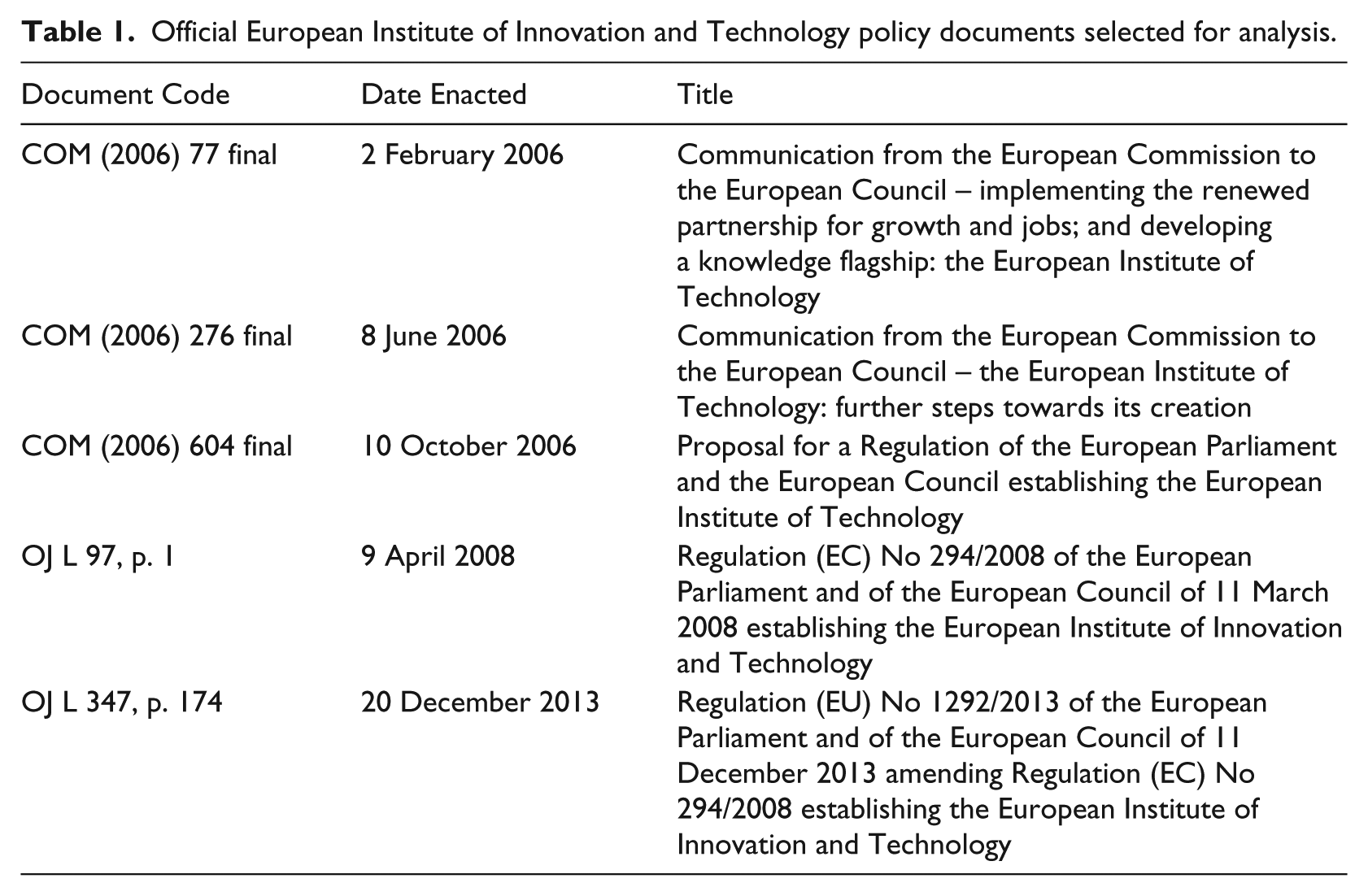
Thus, the first two Communications conveyed the European Commission’s intent, as the primary policy-making actor, to engage its partner European institutions into a dialogue for the development of the EIT. Once the policy issue in these first two documents was defined, the third Communication served as the blueprint for an EU Regulation creating the EIT. Thereafter, the co-decision procedure was activated, prompting the European Parliament and the European Council to adopt the Regulation to establish the EIT, and later amend it to more firmly anchor the EIT as a European agency, as well as to further define and clarify its structure and mission in the quest to foster the entrepreneurial exploitation of research innovation in critical fields for the European economy.
In applying the Mendez and Mendez (2010) threefold analytical framework, a general observation that can be made from the outset is that the documents, as they evolved, display a visible shift in the prominent use of rhetorical devices residing in the policy framing spectrum in the first two Communications to a more predominant use of rhetorical devices concerned with policy dynamics and instruments in the third Communication and, especially, in the ensuing Regulations. In constructing a justifiable rationale for the establishment of the EIT, these rhetorical devices are shaped by strategic and targeted references to matters regarding the urgency of action, the mitigation of imminent and long-term challenges, the necessity for building competitive capacity, the centrality of innovation and entrepreneurship, the promotion of excellence, exemplarity and prestige or other concerns requiring concerted efforts at European level. In addition, it should be noted that the rhetorical discourse exhibited in these policy documents did not emerge in a vacuum, but rather has its origins in precursor legal texts that impose a certain policy direction to subsequent initiatives which are enacted and deemed actionable at a later stage. While all rhetorical devices are present across all documents, the visible transition from issue framing to dynamics and instruments denotes the consolidation of the policy ideas surrounding the EIT that ultimately brought it to fruition. The rest of this section examines in more detail the manner in which a number of prevalent rhetorical devices operate to construct a legal narrative for the establishment of the EIT viewed through the lens of the Mendez and Mendez (2010) framework.
Policy framing
In attempting to craft a persuasive message for the creation of the EIT, the European Commission policy text producers identify the lack of innovative and entrepreneurial drive in the European higher education sector as posing a potential threat to the EU’s capacity to cope with competitive pressures in the global economy. Building up the narrative for the necessity of action in research exploitation by pointing to the lacunae in the higher education–industry–research output nexus, the policy drafters resort to a series of “utterances” that frame this issue as critical in Europe’s quest to gain a leading edge over its competitors. As may be expected from policies advocating for an actionable issue, the text of the documents contains rhetorical devices underscoring the need for immediate engagement on part of the polity facing the defined issue.
Rhetoric of urgency
In their efforts to mobilize European institutions and stakeholders to create the EIT, the policy drafters invoke the necessity for action in the development of a functioning mechanism that would allow the EU to successfully translate research innovation into commercially viable solutions that would surmount contemporary demands hindering further economic growth and development. For this reason, the policy discourse conveys a sense of urgency in meeting this desideratum, in the absence of which the EU is set to underperform in creative and innovative domains.
As an illustrative example of the European Commission’s preoccupation with the EU’s innovation deficit, its first formal communication on the matter places primary importance on “the need for action to reinforce the quality of European innovation systems and remain competitive on the global scene” (European Commission, 2006a: 4). This clarion call to action becomes increasingly pressing by the time the draft proposal for the EIT regulation is presented, as the policy narrative embraces a subliminal foreboding tone suggesting that the EU’s efficiency in delivering lucrative outputs from its research inputs is paramount to its continued progress. Consequently, the letter of the text leaves no doubt in this drive for cost-effective measures by proffering that “there is broad consensus in the Union on the need to take urgent action to develop conditions conducive to a better exploitation of the commercial potential of innovation and knowledge policies, as a key to deliver stronger and lasting growth” (European Commission, 2006c: 2).
While this sentiment is carried over into the final Regulation establishing the EIT, it nonetheless takes on a much more subdued tone, with a single milder reference to the urgency of the state of affairs, highlighting the role of higher education in the EU’s concerted efforts to capitalize on innovation: “there is a need to support higher education as an integral, but often missing, component of a comprehensive innovation strategy” (European Union, 2008: 2). Notably, the amending regulation coming into force in 2013 is completely devoid of similar utterances, with the letter of the text exhibiting the restraint, logic and terse characteristics of a legal lexicon.
Rhetoric of challenges
Another rhetorical device in the policy discourse on the EIT, closely related to the message of urgency discussed above, emphasizes the challenges facing the EU in the absence of a concrete strategy to counteract Europe’s laggard status in innovation. A continuous thread on the rhetoric of challenges can be observed running through the series of policy documents, punctuating the discourse with an ominous prospect for Europe. The early versions of the text identify a challenge presented as an internal threat on which the European institutions seem to be in agreement, that is, the EU’s “inability to exploit and share research and development (R&D) results and consequently to translate them into economic and societal values” (European Commission, 2006a: 4).
Subsequent texts, including the formal regulation affirm that the innovation challenge facing Europe is of such “nature and scale” that Member States alone through “separate actions” are hard pressed to surmount it and, therefore, in these circumstances a concerted community effort coordinated at European level is called for, to the individual and collective benefit of the EU members (European Commission, 2006c: 5; European Union, 2008: 1). The avant-garde of this race against the innovation clock is represented by the EIT, envisioned as a new organization designated to pool resources so that it may respond “to the strategic long-term challenges posed in trans- and interdisciplinary fields of potential economic and societal interest for Europe” (European Commission, 2006c: 7) and, by extension, “promote dialogue with civil society” (European Union, 2008: 1). This political conviction is further augmented in the latest document, as the rhetoric of challenges is inserted prominently in Article 3 of the amended Regulation pertaining to the mission of the EIT, namely “to contribute to sustainable European economic growth and competitiveness by reinforcing the innovation capacity of the Member States and the Union in order to address major challenges faced by European society” (European Union, 2013b: 176). Using the rhetoric of challenges signals the serious concern the European institutions seemed determined to convey in order to pass legislation that would help raise the EU’s ability to translate innovation into competitive potential, an aspect explored in the next sub-section.
Rhetoric of competitiveness
Perhaps one of the longest standing concerns in EU rhetoric, competition is a key fixture in EU policy texts. It is offered both as a motivator for action in essential productive sectors and as a fundamental objective in the realization of a strong Europe. Presented as posing an external threat to Europe’s place in a competitive world is the ubiquitous reference to the EU’s arch-rival in the global economy, the United States. European policies are replete with such obvious allusions to the US (Salajan, 2007) and the texts of the EIT documents make no exception to this trend, particularly in the initial stages of policy issue definition. Thus, rather unfavorable comparisons are made in several aspects in which the US is deemed as surpassing the EU. First, a “fragmentation of the EU knowledge sector” (European Commission, 2006b: 11) is seen as impeding the EU’s capacity to pool together resources in order to increase its potential in transferring innovation to marketable output. Second, the EU is reported as investing less in R&D than the US, leading to an intra-European competition for a proportionally reduced source of investments in lucrative projects. As a result, in a further illustration of the competitive advantage the US has over the EU, the flow of research talent from the latter to the former is observed. Finally, perhaps not coincidentally, the letter of the text suggests, the EU’s higher education continues to lag behind its US counterpart in international rankings.
The motivational function of this rhetorical device manifests itself in the express act of establishing the EIT. In forging ahead with this goal, the policy rhetoric suggests that competitiveness is to be enhanced through the strengthening of the “knowledge triangle,” comprising innovation, research and education, all of which are channeled through the activities of this new European agency. This intent is clearly stated in the European Commission’s second communication on the EIT, contending that the three branches of the knowledge triangle placed at the heart of the EIT are “the main drivers of the global economy” and that ensuring close synergies among them is indispensable in the drive to “boost competitiveness of the EU industry and services and create jobs and sustainable growth in the European Union” (European Commission, 2006c: p. 1).
Rhetoric of innovation
The innovation discourse coincides with the European Commission’s modernization agenda intended to build synergies between the academic sector and industry in order to create the conditions for lucrative partnerships that would convert innovation into commercially valuable research output. Such entrepreneurial research collaboration would, in turn, contribute to the economic and social progress that would equip Europe with the tools to meet the most pressing challenges of the 21st century and enhance its competitive advantage in the global economy (European Commission, 2006a, 2006b; European Union, 2008).
In this context, the EIT is regarded as an important catalyst for innovation and as a transformative engine for the European higher education sector. Its mission is to utilize its innovation capacity to bridge European education and research in an effort to enhance the, seemingly lackluster, performance of higher education in turning out innovative, commercially exploitable research. Through this strategy, it is proposed, the EIT may help Europe in achieving sustainable, long-term economic growth that would ultimately contribute to a prosperous and, presumably, socially progressive Europe that could successfully confront the aforementioned challenges (European Commission, 2006c; European Union, 2008, 2013b). In the EIT legal documentation, innovation becomes both an explicit paradigm and subliminal subtext woven within the very fabric of the legislative oratory pursuing a fundamental shift in the modality in which a more entrepreneurial and competitive Europe may be forged.
Rhetoric of entrepreneurship
In the parlance of the EIT texts, entrepreneurship is virtually inseparable from innovation as the institute’s declared raison d’être. In tandem with innovation, engendering entrepreneurship across the academic and research domains is another core task of the Institute. This focus becomes patently clear in the policy discourse, as the documents consistently invoke the need for, on the one hand, entrepreneurial actors to immerse themselves in the “research/innovation culture” and, on the other hand, for academics and researchers to “understand and develop entrepreneurial skills” (European Commission, 2006a: 6). This perceived cognitive dissonance between entrepreneurs and academics or researchers is upheld in later iterations of the policy documents, which entrust the EIT with the charge to bring together the two categories of professionals so that they may “develop mutual understanding” by sharing a “common culture” of entrepreneurial undertakings (European Commission, 2006a: 8).
In this context, the EIT is seen as giving impetus to a new rapport between business and academia which was intended to result in commercial ventures and the “creation of start-ups, spinoffs and small and medium enterprises (SMEs)” (European Union, 2008: 1). In order to render this objective even stronger, the second part of the EIT’s mission stated in Article 6 of the decision establishing the Institute proclaims that the EIT would contribute to the EU’s apparently chronic competitiveness and innovation deficit by “promoting synergies and cooperation among, and integrating, higher education, research and innovation of the highest standards, including by fostering entrepreneurship” (European Union, 2013b: 176). Thus, innovation and entrepreneurship become essentially the twin pillars of the EIT’s mission to bring about change in the way in which stakeholders in the industrial sectors and higher education working in concert revolutionize thinking on the valorization of research output for the benefit of the European economy and society.
However, a mission, even one that unambiguously relies on the dual engine of innovation and entrepreneurship, may only be effective if some provision is given to the modality in which the EIT, as a place of higher learning, can specifically induce the desired change in the entrepreneurial make-up of its graduates. In this sense, the policy documents outline broad goals on the development of graduate-level curricular programs that specifically address entrepreneurship as a subject of study. Courses designed in this environment, the European Commission indicates, would “help graduates and researchers acquire an entrepreneurial mindset and the skills necessary for knowledge transfer and start-up activities, so that they can fully exploit the innovation potential of their research” (European Commission, 2006b: 6). The importance of master’s and doctoral-level training is further reiterated in the updated decision on the EIT, this time expressly suggesting that courses in academic fields of knowledge that could provide the solutions Europe needed to face its social and economic future had priority in the Institute’s academic curriculum.
Rhetoric of exemplarity
While the envisioned change in the conduct of research on new premises is acknowledged as being potentially protracted and complex, the policy nevertheless intimates that the existing organizations are ill-equipped to affect the radical reorientation needed in the entrepreneurial approaches to innovation. Consequently, the European Commission posits that the EIT will “act as a reference model to inspire and guide long term change” in its quest to create a stronger link between science to society (European Commission, 2006a: 6).
In attempting to set the tone for a new approach to managerial structures in higher education, the EIT is founded on a “two-level model of governance” that blends “bottom-up autonomy and flexibility” with “top-down strategic guidance, coordination… and dissemination of results and good practice” (European Commission, 2006c: 4). So much trust is invested in the EIT’s expected influential stature, that the European Commission considers an indicator of the Institute’s success would be demonstrated through the “extent to which the universities and policy-makers take up the EIT model as a successful new organisational structure for universities” and the testing of “new organizational and governance models” it might offer (European Commission, 2006a: 8). This argument is taken further in implying that the EIT, as a “symbol” for the integration of research, innovation and education, can lead the modernization of higher education and its capacity to manage new forms of innovation and research by impacting on these dynamics “both directly, through its activities and outputs, and indirectly through its governance” (European Commission, 2006c: 4). Through such provisions, the European Commission’s policy discourse designates the EIT as “a competition-driven organizational form that will stimulate change by showing a living example of a different way of working” (European Commission, 2006b: 11).
Thus, the EIT rises above and governs over the European academic space as a “distinctive educational model,” presumably constituting an attractive environment for highly qualified graduate students who are to receive “education at the highest international standard” (European Commission, 2006a: 7) and would connect them to researchers and innovation managers in order to develop solutions for a more competitive knowledge society (European Commission, 2006b).
Rhetoric of excellence and prestige
Though newly-minted, the EIT cannot make abstraction of the necessity to brand itself as a center of excellence in higher education and research, able to attract graduate students, academics and researchers from the world over to conduct innovative activities of the highest international caliber (European Commission, 2006a, 2006b). As enshrined in the decision establishing the EIT, the ultimate goal for the institution is to “become a world class body for excellence in higher education, research and innovation” (European Union, 2008: 4).
One of the concerns expressed in the policy documents regards the perceived lack of performance on part of the universities, which could be countered by creating the conditions for excellence to take hold in European higher education. A three-pronged approach suggested for universities to achieve this goal consists of setting rigorous criteria for the selection of academic personnel that would involve competition, remunerating academics and researchers commensurately with their performance, and, finally, incentivizing their engagement with the business sector (European Commission, 2006a). The impetus for this approach, the discourse argues, would be given by the EIT, which is seen as the engine for “the integration of universities, research centres and companies” that would presumably “give it an edge over traditionally organised universities” (European Commission, 2006a: 7). While not clearly defined, the narrative strongly emphasizes that the EIT has “no obligation to undertake actions which fail to meet the criterion of excellence,” but rather that it “would draw on excellence where it now exists, and encourage its development where it does not” (European Commission, 2006a: 8). The discourse remains equally ambiguous about how the EIT itself would manage to infuse established, reputable and prestigious places of higher learning in Europe with the norms of excellence, but it intimates that it will engender this re-alignment of universities in the image of the EIT because the latter “does something distinctly different” in that “the profile of European excellence developed by the EIT as a permanent body would be unique” (European Commission, 2006a: 12).
Not only is the criterion of the “excellence of outcome” (European Commission, 2006b: 10) placed at the core of the EIT’s institutional set of values, but also other lofty goals hinge on it. By embracing and promoting excellence in innovation, the EIT can become “a clear and visible European brand and be recognized in its own right on the global scene” (European Commission, 2006a: 7), and build a “global reputation and attractiveness” (European Commission, 2006c: 2) that would lure worldwide talent both in the form of individual researchers and partner organizations from inside and outside the EU (European Commission, 2006b, 2006c; European Union, 2008, 2013b).
Policy dynamics
Once policies are framed around a galvanizing issue requiring the immediate attention of policy-makers to act on behalf of the policy consumers, the specific roles of institutional actors need to be delineated. The EIT’s unique institutional configuration generates policy dynamics taking place at two levels through (a) core-function regulations and (b) oversight-function regulations. At one level, core-function regulations operate through contractual agreements among the internal organizational structures of the EIT, embodied by the Governing Board and the KICs. Thus, the evolving legal framework attributes specific functions to the Governing Board, such as outlining the roles and strategic areas of expertise in which the KICs should perform, as well as the coordination, monitoring, and evaluation of their activities (European Commission, 2006c; European Union, 2008, 2013b). At the other level, oversight-function regulations are evident between the EIT, as a unit independent of national jurisdictions, and the EC-level political bodies, primarily the European Commission, the European Parliament and the Council of the European Union, which exercise supervisory control over its functioning. Thus, apart from the expected oversight the EC has over the Institute’s funding and the power to dissolve it, the EIT is bound by law to submit to the EC bodies periodic work programs containing its priorities and initiatives, including “results-oriented” monitoring processes subjected to the close scrutiny of the said European-level institutions (European Union, 2008, 2013b). In contrast to the somewhat pressing and occasionally bombastic language of the policy framing rhetoric contained in the EIT documents, the segments of text detailing the dynamics among institutional entities are unsurprisingly terse, straightforward and technical in nature. Nonetheless, the legal argumentation is couched primarily in terms of rhetorical devices related to innovation, excellence, prestige and credentials.
Rhetoric of innovation and excellence
Consistent with other EU-level legislation addressing educational matters, the dynamics between EU and the Member States in encouraging research innovation is rooted in fundamental legal stipulations codified in the EU treaties. First, in accordance with Article 5 of the Treaty on the European Union, the principle of subsidiarity is invoked as an enabler in vesting the EU institutions with a supportive role in the individual Member States’ efforts to generate the necessary momentum for and create the opportunities required to spur innovation. Therefore, “the proposal establishing the EIT will complement Member States’ efforts to enhance competitiveness by… developing a new governance model of cooperation on innovation, research and education activities at the highest international standards” (European Commission, 2006c: 8). Second, the principle of proportionality ensures that the EC institutions do not overstep the authority of individual Member States in accomplishing these objectives (European Union, 2008). In turn, the EIT is charged with boosting “innovation capacity” both at EC and Member State levels by facilitating “networking and cooperation” and by creating “synergies between innovation communities in Europe” (European Union, 2008 1).
By identifying a perceived “innovation gap between the EU and its major competitors” (European Commission, 2006c: 5), the European Commission proposed the forging of “excellence-driven strategic partnerships” among the various EU-level actors with vested interests in ensuring a functioning knowledge triangle, defined as bringing together research, innovation and higher education. Such partnerships emerge through a “transparent and excellence-based process” set in motion by the Governing Board of the EIT, and are later formalized into KICs in the regulation establishing the EIT (European Union, 2008: 2). In its most current iteration, the regulation explicitly states that the selection of the KICs would be conducted according to “detailed criteria” based on “principles of excellence and innovation relevance” (European Union, 2013b: 177). Their activities are to be guided by the Strategic Innovation Agenda, the core instrument via which the Institute plans its overall direction and priorities over a seven-year cycle. In undertaking these actions, the EIT must also assume the responsibility of conducting periodic assessment of the KICs’ performance “to ensure both the highest quality of outcome, scientific excellence and the most efficient use of resources” (European Union, 2008: 7). While the repetitive usage of these two rhetorical devices echoes to a certain extent the urgency of action apparent in the narrative on policy framing, it concurrently produces a deliberate, though at times ambiguous and vague, association between them.
Rhetoric of prestige and credentials
To incentivize participation in the EIT’s network of innovation and excellence, the policy documents confer partner higher education institutions the right to issue degrees and diplomas with the “EIT label.” Although the stipulation is succinct and unambiguous, on closer inspection, its implications are more nuanced. Thus, beyond “encouraging the recognition in the Member States of degrees and diplomas which are awarded by higher education institutions that are partner organisations” (European Union, 2008: 4), the Regulation indirectly attempts to build an aura of prestige around the branding authority accorded to the EIT and bestow upon the Institute a reputable pedigree to which higher education institutions around Europe should aspire.
In this sense, the EIT’s seal of approval is not just a benign instrument for the Institute’s prime directive to infuse innovation in Europe’s academic landscape, but also a symbol of its envisioned power to stimulate momentous changes in European higher education’s relationship with innovation and research. In sum, innovation and excellence are premised on the prestige of the Institute and vice versa, as rhetorical devices meant to justify the EIT’s role as a mediator and facilitator of interactions between Member State and EC levels in generating creative, sustainable, cutting-edge and profitable solutions for Europe’s competitive advantage.
Policy instruments
All actionable policies and initiatives eventually mature from the stage of problems requiring a solution to legal provisions that take the form of policy instruments. Understandably, and quite expectedly, the discourse on policy instruments governing the EIT is not shrouded as much in persuasive rhetoric as in explicit jargon related to the legislative procedures and documents monitoring the dynamics among European institutions. Nonetheless, the rhetorical devices analyzed above, can still be detected in distinct segments of the policy narrative, nested in and subtly nuancing the technical terminology reserved largely to punctual descriptions of the EU legislation to which the policies establishing the EIT are circumscribed. As such, the EIT Regulation is primarily anchored in Article 157 of the Treaty Establishing the European Community, which entrust the EC and the Member States with the task of creating the necessary conditions “for the competitiveness of the Community’s industry to exist” (European Union, 2002: 103) and to enact measures and policies that accomplish this foremost objective.
Subsequent legal references in the EIT Regulation cite directives, regulations and EC programs that, in turn, draw authority from the EU’s founding treaties. In this sense, the EIT Regulation operates within and supplements a constellation of instruments which ensure the Institute’s operational, structural, administrative and financial oversight. Insofar as rhetorical devices can be clearly distinguished in relation to policy instruments, these succinctly address innovation and credentials.
Rhetoric of innovation
Innovation, as a rhetorical device, is tersely noted as an objective the EC is tasked to support and foster through various existing EU-level programs which, at the time the EIT Regulation was drafted, specifically referred to the Seventh Framework Programme for Research, Technological Development and Demonstration Activities, the Competitiveness and Innovation Framework Programme, the Lifelong Learning Programme, and the Structural Funds. In this context, and in an implicit reiteration of the principle of subsidiarity, the Institute’s establishment is specifically instructed to “complement existing Community and national policies and initiatives by fostering the integration of the knowledge triangle – higher education, research and innovation – across the European Union” (European Union, 2008: 1).
Rhetoric of prestige and credentials
In an effort to build the EIT’s standing and brand recognition, the Regulation acknowledges the exclusive prerogatives of the higher education institutions partnering with the EIT to issue degrees and diplomas, but allows and promotes, through an agreement “between the EIT and the KICs,” the option for said degrees and diplomas to be considered EIT-sanctioned credentials (European Union, 2008: 5).
At times, these rhetorical devices are so closely linked, that it is difficult to disentangle and isolate them as standing on their own. In fact, this analysis attempted, to the extent possible, to deliberately treat each device individually, at the expense of other contextual meanings attached to adjoining devices, in order to exert a narrow focus on the intent, purpose and interpretive power of each device examined. However, such “surgical extractions” of devices from their surrounding narratives were not always possible and, consequently, some of the rhetorical devices had to be investigated in tandem. This points not only to the prima facie semantic complexity of the terminology selected in addressing explicit policy actions, but also to the competing policy strands or streams vying for inclusion in an otherwise dense narrative aimed at convincing political elites and the public at large of the importance and timeliness of the EIT’s creation.
EIT policy narrative effects for European higher education
Having deconstructed the policy narrative in the EIT regulations along the three elements of Mendez and Mendez’s (2010) policy analysis framework, it is instructive to tease out the European policy- makers’ ideological or philosophical orientation in their advocacy for the EIT. Much of the discourse analysis presented above suggests a rhetorical slant towards market-driven conceptions that have infiltrated attempts to reform European higher education in the image of lean, profitable or even profit-making institutions able to operate by the logic of global market dogmas (Pimentel Bótas and Huisman, 2012; Servage, 2009). In order to spur efficiency gains in the manner in which academia operates, policy-makers encourage and promote closer ties with industry, infusing academic governance with new public management practices and budgetary scrutiny over operational and program spending (Hüther and Krücken, 2013), while at the same time seeking to develop an entrepreneurial ethos conducive to the translation of intellectual output and research into commodifiable innovation. In this sense, the EIT may be viewed as the embodiment of late-modern conceptions of knowledge commercialization by international market forces given that, as Cowen (1996) puts it, “universities themselves are commercialised, made financially unstable and absorbed within a research and development industry” (Cowen, 1996: 162). The transition from what Cowen (1996) termed “modern educational patterns” in which the provision of equal opportunities for public education is the paramount factor, to a late-modern approach is grounded in the dynamics of the international markets so that education is placed in the service of generating knowledge competition.
Although a transformation of higher education governing structures may not be an immediate policy objective at this point in the EU institutions’ agenda, such rhetorical devices as innovation, competitiveness, entrepreneurship, excellence or prestige, appear to reveal precisely such a policy intent. This pattern can be detected in earlier exhortations in EU policy narratives on education calling for morphing “educative and training systems” into “a world quality reference by 2010” (European Council, 2002: 18; European Union, 2006: 45). However, advocating for new governing structures based on market demands may not be a suitable model for European universities to emulate, but could be sources of inspiration in the application of innovative output in the service of the public good. It may be argued that universities have already succeeded in “valorizing” their knowledge capital and production through the marketization of their intellectual output. Numerous European universities already routinely enter into partnerships or consortia with corporate actors either through bilateral agreements or via EU-sponsored programs, and the EIT’s reliance on these universities only serves as testimony that it may be an additional or competing structure duplicating interactions already occurring between prestigious European universities, the corporate sector and the ensuing commercialization of academic/research investment (Huisman and De Jong, 2014). Perhaps, rather than spreading the spirit of initiative across the European academic realm, the EIT may, on the contrary, produce concentrations of interests in privileged institutions from which “lesser” or “less competitive” institutions are excluded. Thus, paradoxically, instead of creating a more competitive Europe, the EIT may contribute to a misplaced academic elitism that may undermine the cooperation, rather than competition, needed in European academia to confront the challenges identified in the EIT policy rhetoric.
The rhetorical devices analyzed underscore the allure of such discursive elements as “excellence” and “poles of attraction” in the fabrication of a prestigious institution, able to compete on equal footing with the most celebrated and successful research and higher education institutions in the world. Not only is this rhetoric carefully constructed in the policy narrative, but it also concretely manifests itself in the deployment of the KICs as the incubators of innovation and excellence represented by top-notch higher education institutions throughout Europe. The appendix illustrates the growing network of European higher education institutions associated with the EIT, though, on closer inspection, in many cases some of the same institutions seem to be enmeshed in multiple KICs. As the appendix shows, many of the universities affiliated with the EIT are ranked in the higher echelons in their national and international settings, further bolstering the sense of elitism that is being created through the EIT network. Although the rankings are a relatively novel advent on the European higher education scene (Marginson and Van Der Wende, 2007) and should necessarily be given prudent consideration in light of the methodological variations among them and their subjectivity (Chirikov, 2013; Hazelkorn, 2014; Soh, 2011), they are evocative of the efficiency gains climate and mindset that dominates the policy discourse advocating for reform in European higher education. They also alter universities’ behavior, as these are pitted against one another in a false sense of stimulating competition in which the race to the top becomes a dominant objective for attracting funding and commercial partnerships (Rauhvargers, 2014). Consequently, in building its “symbolic prestige” (Tadaki and Tremewan, 2013: 368), the EIT only benefits from associating with strong consortia of partners from among the highest ranked institutions, although in recent years lower-ranked institutions have also been brought into the fold of the KICs, presumably in a bid to spread excellence as widely as possible and to cast the EIT as an ever-inclusive enterprise.
Conversely, the EIT may only be a model primarily for other elite institutions, not for “middle-of-the-road” institutions with varying scopes and purposes. The aim to provide a standard to be emulated glosses over the need to create and support a strong public higher education sector in an EU that claims to hold equality, equity and “unity in diversity” as some of its core foundational values. The risk in upholding an elitist approach to glorifying a flag-bearing standard for innovation and research in education is that only other elite institutions are attracted, coopted or willing to support such a vision, which may have an opposite effect than expected by the EU technocracy. That is, in espousing an “excellence only” view of performance in academia, the EU policy-makers risk alienating established, solid and durable institutions of higher education that are providing high-quality educational services. For structural reasons or considerations stemming from the very missions of these institutions, they may not be geared or it may not be in their interest to morph into entities adopting the neoliberal conception of profitable innovation premised on the narrow political urgency of turning university preparation into an efficient conveyor of entrepreneurial skills and abilities mandated by the new logic of the “competitive knowledge economy.”
The presentation of the EIT as the epitome of academic excellence may signal the marginalization of the liberal arts and humanities in higher education, which inevitably sink lower on the “hierarchy of academic knowledge” (Giroux, 2002: 442). The choice of elite universities and promotion of “world-class” or “world-reference” universities embodied in the EIT model, inevitably suggests that public universities adopt such a model with at risk of undermining what has been the traditional expectation and function of the European public university: free, equal and equitable access to higher education. This development seems to align with Ozga’s (2012) observation that, in the context of problems related to governance across the EU, the continent is witnessing a departure from classical ideas of education rooted in Enlightenment, as these are supplanted by utilitarian approaches to learning. In being implicitly invited to emulate the EIT model, mainstream higher education institutions situated outside the elite circle of EIT’s partners, are subtly enticed to reconfigure their disciplinary orientation and focus on lucrative subjects that yield market-sanctioned results and entrepreneurial “skills” coveted by the business community.
In this context, it comes as no surprise that the European Commission, as the driver of EU-level educational policies, is increasing its profile in effecting policy changes in European higher education. Whether it has the capacity to increase its powers to enforce compliance with those policies, remains to be seen, although as Maassen and Musselin indicated, in the coming years, “one can expect that the pace of reform in European higher education will be affected as much by the commission’s policy documents and initiatives, as by national reform agendas” (Maassen and Musselin, 2009: 11). Hence, the European Commission is gradually moving from a tacit involvement in guiding higher education governance to an openly explicit ambition to originate change in European higher education governance (Grek, 2010; Huisman and De Jong, 2014), and the EIT may represent the litmus test for such reform initiatives. The EIT’s policy documents clearly demonstrate that the establishment of the Institute is one key avenue through which the European Commission has asserted its determination to reform governance of and innovation in European higher education (Capano and Regini, 2014), as the EIT is presented as a model in this regard (European Institute of Innovation and Technology, 2011). Nonetheless, it is an open question whether the intended impact of the EIT falls within what Altbach considered to be a trend opposed to the “democratization of science and scholarship” (Altbach, 2013: 323), as the Institute seems to have been set up on the assumption that all institutions of higher education should, in one way or another, become centers of excellence in research and innovation. However, what might be of interest to the technocratic, political and academic elites involved with the EIT project, may have little or no relevance for higher education institutions throughout the EU in fields completely unrelated to EIT’s mission, but just as impactful and important for society.
Potential long-term implications of EIT-induced change
Although it is not in the scope of this article to provide an exhaustive list of all possible implications and ramifications of the EIT’s developmental momentum on the further evolution of the European higher education landscape, several possible repercussions stemming from the mounting influence of EU-level policies informed by considerations of economic competitiveness are presented.
First, a deleterious effect on broader conceptions of university autonomy in Europe is a potentially marked risk, as EU institutions, and particularly the European Commission, prescribe the direction in which the EIT is to develop and promote the entrepreneurial academia. Thus, an opposite trend toward heteronomy (Schugurensky, 2013) may take hold in European higher education, as universities come under increased pressure from both governmental and corporate entities to exercise accountability, efficiency, performativity, self-sufficiency and exploitation of intellectual capital for profitable ends. The EIT, as a “pole of excellence” for innovation and entrepreneurship represents the pinnacle of EU-level strategy in this realm, with subtle but persuasive powers of coercion for such interference in altering the traditional status of the European university as a highly autonomous institution, driven by self-governance and the pursuit of knowledge in the public interest.
Second, as universities are encouraged to espouse and emulate the EIT model, more emphasis will likely be placed in expanding curricula related to exact sciences, business and management disciplines resulting in highly, but narrowly skilled, professionals who may lack a more holistic and humanistic understanding of the world around them. The humanities, arts and social sciences in higher education curricula will continue to be marginalized, as departments already grappling with shrinking budgets may be forced to merge in order to both maintain a united front in an adverse academic environment and to deal with faculty members either leaving or being released from their appointments, with decreasing student enrollments acting as both cause and consequence of the aforementioned trend in these particular disciplines (see Erkkilä, 2014; Giroux, 2002; Leathwood and Read, 2013; Lynch, 2006; Stromquist, 2007; Tadaki and Tremewan, 2013). The social sciences are already under pressure from new public management discourse, as departments are shrinking, facing budgetary constraints in an academic climate increasingly dependent on grant funding, which is more accessible for projects in the exact sciences or those that benefit industries considered at the forefront of economic progress and revenue maximization. This runs counter to Pease’s (1983) suggestion that social sciences be an integral part of any technological or entrepreneurial training in an institute that seeks to set the pace for academic excellence. As an illustration of this total neglect of an entire spectrum of disciplines, none of the master’s and PhD programs offered by the KICs at the EIT include any courses in social sciences, humanities and the arts. It appears that the EIT ignores the fact that the technical institute it attempts to rival, that is the MIT, has become over time an inclusive academic institution, which does not disregard the importance of the humanistic element of socially-oriented disciplines.
Third, under the guise of reform spearheaded by the declared goal to create a more competitive Europe, the EU higher education is becoming more like its US counterpart, even as it strives to upstage the US in economic and political supremacy. Through the mentality embraced in the mission, vision and policy discourse embedded in the creation of the EIT, with the intent to replicate the entrepreneurial model across European academia, the EU’s higher education landscape is increasingly and pervasively being infused and governed by the logic of market-driven academic output and competitive advantage. As an added side-effect, as higher education institutions are already coping with strained budgets and the state is contributing less to their finances, universities are systematically compelled to rely on the business and industrial sectors for additional financing. In promoting itself as a pole of excellence, the EIT reinforces notions of private funding for higher education, as funding from the European institutions is conceived of as a small percentage of the financing necessary for the sustainability of the institute.
Finally, the European Commission’s promotion of the EIT model may have serious consequences on university knowledge generation sustainability and continuity. An endemic problem in European consortia is the fragility of project-driven initiatives, which tend to suffer from idea-duplication and a generally short shelf-life once the funding that generated them is discontinued (Salajan, 2007). The EIT itself could be afflicted with this same syndrome in the long run, particularly as many of the universities being part of the KICs have long been exposed to and participated in ineffective consortia. Certainly, KICs partnerships are, in a way, more sophisticated forms of consortia, though they are replicating to a certain extent the trans-European model embedded in European funding schemes, such as Horizon 2020, the Lifelong Learning Programme, the Information Society Technologies Programme, etc. However, given the previous track-record of European consortia-based initiatives, it is plausible to infer that once the immediate incentives to participate in an EIT-endorsed enterprise disappear, member universities of the consortia will withdraw from the common projects, only perpetuating the cyclical race for funding of new projects while unfolding projects are abandoned or yield unconvincing results.
Brief epilogue
This article does not contend that the EIT is a perilous idea for European higher education. In fact, many of the challenges identified by the European Commission as facing Europe may only be more efficiently addressed through an institution such as the EIT. The relative speed with which the idea of an EIT moved to policy stage and generated “tangible outcomes” (Huisman and De Jong, 2014), attests to the importance of such an undertaking in creating a more competitive Europe. However, as the purpose and scope of the EIT was built around the generation of solutions to specific problems considered as impeding Europe’s competitiveness in the global economy, serious consideration should continuously be given to the prevention of an instrumentalization of higher education (Gornitzka, 2013) for narrow market needs.
As a corollary to the concerns outlined here, if elitism and excellence are predicated on collaborative partnerships within highly selective consortia and most interactions occur within this space, how does this engage the society at large in being informed of how the impact of these presumed innovations will affect the social common good? Obviously, there are no easy answers to this question, so it remains to be seen how the EIT policy narrative will play out in the complex dynamics at the intersection of academic, public and market spheres. Nonetheless, as the guardians of the common European good, even as they pursue the noble goals entrusted to the EIT, the EU institutions need to fiercely safeguard and preserve the uniquely humanistic character of European higher education.
Footnotes
Appendix
Higher education partners in the European Institute of Innovation and Technology (EIT)’s Knowledge and Innovation Communities (KICs) i .

| Higher Education Institution | Country a | National rank b | European rank b | World rankings |
||
|---|---|---|---|---|---|---|
| QS c | THE d | ARWU e | ||||
| Climate KIC | ||||||
| Eidgenössische Technische Hochschule Zürich * | CH | 1 | 4 | 10 | 9 | 19 |
| Zürcher Hochschule für Angewandte Wissenschaften ** | CH | 13 | 571 | - | - | - |
| Technische Universität München ** | DE | 3 | 21 | 64 | 46 | 47 |
| Rheinisch-Westfälische Technische Hochschule Aachen ** | DE | 4 | 34 | 141 | 78 | 201–300 |
| Universität Hamburg ** | DE | 5 | - | 223 | 180 | 201–300 |
| Technische Universität Berlin * | DE | 15 | 71 | 144 | 82 | 301–400 |
| Universität Kassel ** | DE | 51 | 291 | - | - | - |
| Brandenburgische Technische Universität Cottbus ** | DE | 74 | 606 | - | - | - |
| Provadis Hochschule ** | DE | 242 | 2327 | - | - | - |
| Københavns Universitet * | DK | 1 | 13 | 73 | 120 | 30 |
| Danmarks Tekniske Universitet * | DK | 3 | 63 | 116 | 176 | 151–200 |
| Universitat de València ** | ES | 3 | 74 | 551–600 | 501–600 | 401–500 |
| Universidad Politécnica de Valencia ** | ES | 10 | 122 | - | 501–600 | 301–400 |
| Aalto Yliopisto ** | FI | 2 | 85 | 137 | 201–250 | 401–500 |
| Université Pierre et Marie Curie * | FR | 1 | 51 | 131 | 121 | 39 |
| Université de Versailles Saint-Quentin-en-Yvelines * | FR | 22 | 335 | - | - | 401–500 |
| École Polytechnique ** | FR | 23 | 494 | 59 | 116 | 301–400 |
| Mines ParisTech ** | FR | 37 | 399 | - | - | 401–500 |
| AgroParisTech ** | FR | 44 | 425 | - | - | - |
| ParisTech Institut des Sciences et Technologies de Paris ** | FR | 165 | 1349 | - | - | - |
| École des Ingénieurs de la Ville de Paris ** | FR | 272 | 2415 | - | - | - |
| Budapesti Műszaki és Gazdaságtudományi Egyetem ** | HU | 2 | 219 | 751–800 | 601–800 | - |
| Debreceni Egyetem ** | HU | 4 | 287 | 651–700 | >800 | - |
| Università di Bologna ** | IT | 1 | 28 | 188 | 201–250 | 201–300 |
| Universiteit Utrecht * | NL | 1 | 7 | 109 | 86 | 65 |
| Technische Universiteit Delft * | NL | 4 | 22 | 54 | 59 | 151–200 |
| Wageningen Universiteit en Researchcentrum * | NL | 15 | 190 | 124 | 65 | 101–150 |
| Norges Teknisk-Naturvitenskapelige Universitet ** | NO | 2 | 59 | 259 | 251–300 | 101–150 |
| Uniwersytet Wrocławski ** | PL | 6 | 289 | 801–1000 | - | - |
| Uniwersytet Przyrodniczy we Wrocławiu ** | PL | 24 | 643 | - | - | - |
| Lunds Universitet ** | SE | 2 | 24 | 78 | 96 | 101–150 |
| Chalmers Tekniska Högskola * | SE | 9 | 109 | 133 | 251–300 | 201–300 |
| University of Oxford ** | UK | 1 | 1 | 6 | 1 | 7 |
| Imperial College London * | UK | 5 | 6 | 8 | 8 | 22 |
| University of Reading ** | UK | 32 | 145 | 188 | 192 | 301–400 |
| Prifysgol Aberystwyth ** | UK | 45 | 237 | 481–490 | 301–350 | - |
| EIT Digital | ||||||
| Technische Universität München ** | DE | 3 | 21 | 64 | 46 | 47 |
| Karlsruher Institut Für Technologie ** | DE | 6 | 38 | 107 | 144 | 201–300 |
| Technische Universität Berlin * | DE | 15 | 71 | 144 | 82 | 301–400 |
| Technische Universität Darmstadt ** | DE | 25 | 127 | 272 | 201–250 | 401–500 |
| Universität des Saarlandes ** | DE | 36 | 171 | 501–550 | - | - |
| Universidad Politécnica de Madrid *** | ES | 8 | 112 | 491–500 | 601–800 | - |
| Helsingin Yliopisto ** | FI | 1 | 17 | 102 | 91 | 56 |
| Aalto Yliopisto * | FI | 2 | 85 | 137 | 201–250 | 401–500 |
| Oulun Yliopisto ** | FI | 3 | 163 | 411–420 | 201–250 | 401–500 |
| Turun Yliopisto *** | FI | 4 | 168 | 276 | 301–350 | 401–500 |
| Tampereen Teknillinen Yliopisto ** | FI | 6 | 224 | 380 | 501–600 | - |
| Tampereen Yliopisto ** | FI | 7 | 221 | 551–600 | 251–300 | - |
| Åbo Akademi ** | FI | 9 | 329 | 551–600 | - | - |
| Université Pierre et Marie Curie * | FR | 1 | 51 | 131 | 121 | 39 |
| Université Paris-Sud * | FR | 2 | 113 | 242 | 179 | 46 |
| Université de Nice Sophia Antipolis ** | FR | 9 | 176 | 601–650 | 401–500 | 401–500 |
| Université de Rennes 1 ** | FR | 15 | 252 | 651–700 | 501–600 | - |
| Université Jean Monnet Saint-Étienne *** | FR | 77 | 615 | - | - | - |
| Eötvös Loránd Tudományegyetem *** | HU | 1 | 181 | - | 601–800 | - |
| Budapesti Műszaki és Gazdaságtudományi Egyetem *** | HU | 2 | 219 | 751–800 | 601–800 | - |
| Università di Bologna ** | IT | 1 | 28 | 188 | 201–250 | 201–300 |
| Politecnico di Milano ** | IT | 6 | 78 | 170 | 201–250 | 201–300 |
| Politecnico di Torino ** | IT | 12 | 162 | 307 | 351–400 | - |
| Università degli Studi di Trento * | IT | 13 | 164 | 441–450 | 201–250 | - |
| Scuola Superiore Sant’Anna di Pisa ** | IT | 31 | 300 | 192 | 190 | - |
| Universiteit Utrecht ** | NL | 1 | 7 | 109 | 86 | 65 |
| Technische Universiteit Delft *** | NL | 4 | 22 | 54 | 59 | 151–200 |
| Technische Universiteit Eindhoven *** | NL | 6 | 65 | 104 | 177 | 201–300 |
| Universiteit Twente * | NL | 7 | 69 | 179 | 153 | 301–400 |
| Lunds Universitet ** | SE | 2 | 24 | 78 | 96 | 101–150 |
| Kungliga Tekniska Högskolan * | SE | 3 | 44 | 98 | 159 | 201–300 |
| Stockholms Universitet ** | SE | 7 | 83 | 195 | 144 | 81 |
| Luleå Tekniska Universitet ** | SE | 11 | 351 | - | - | - |
| University College London * | UK | 3 | 3 | 7 | 15 | 17 |
| University of Edinburgh *** | UK | 4 | 5 | 23 | 27 | 41 |
| Imperial College London * | UK | 5 | 6 | 8 | 8 | 22 |
| EIT Food | ||||||
| Katholieke Universiteit Leuven | BE | 1 | 8 | 71 | 40 | 93 |
| Eidgenössische Technische Hochschule Zürich | CH | 1 | 4 | 10 | 9 | 19 |
| École Polytechnique Fédérale de Lausanne | CH | 2 | 10 | 12 | 30 | 92 |
| Technische Universität München | DE | 3 | 21 | 64 | 46 | 47 |
| Universität Hohenheim | DE | 56 | 315 | 501–550 | 251–300 | - |
| Universidad Autónoma de Madrid | ES | 5 | 94 | 187 | 351–400 | 201–300 |
| Helsingin Yliopisto | FI | 1 | 17 | 102 | 91 | 56 |
| Technion-Israel Institute of Technology | IL | 3 | 106 | 224 | 301–350 | 69 |
| Università degli Studi di Torino | IT | 7 | 97 | 551–600 | 351–400 | 201–300 |
| Uniwersytet Warszawski | PL | 1 | 149 | 411–420 | 501–600 | 401–500 |
| University of Cambridge | UK | 2 | 2 | 5 | 4 | 4 |
| University of Reading | UK | 32 | 145 | 188 | 192 | 301–400 |
| Queen’s University Belfast | UK | 33 | 137 | 202 | 201–250 | 301–400 |
| EIT Health | ||||||
| Katholieke Universiteit Leuven * | BE | 1 | 8 | 71 | 40 | 93 |
| Universiteit Gent *** | BE | 2 | 25 | 125 | 118 | 62 |
| Eidgenössische Technische Hochschule Zürich *** | CH | 1 | 4 | 10 | 9 | 19 |
| École Polytechnique Fédérale de Lausanne *** | CH | 2 | 10 | 12 | 30 | 92 |
| Ruprecht Karls Universität Heidelberg * | DE | 1 | 15 | 68 | 43 | 47 |
| Technische Universität München * | DE | 3 | 21 | 64 | 46 | 47 |
| Rheinisch-Westfälische Technische Hochschule Aachen * | DE | 4 | 34 | 141 | 78 | 201–300 |
| Karlsruher Institut Für Technologie *** | DE | 6 | 38 | 107 | 144 | 201–300 |
| Eberhard Karls Universität Tübingen ** | DE | 11 | 53 | 164 | 89 | 151–200 |
| Universität zu Köln *** | DE | 12 | 61 | 331 | 170 | 201–300 |
| Friedrich Alexander Universität Erlangen Nürnberg * | DE | 21 | 111 | 287 | 160 | 151–200 |
| Københavns Universitet * | DK | 1 | 13 | 73 | 120 | 30 |
| Danmarks Tekniske Universitet *** | DK | 3 | 63 | 116 | 176 | 151–200 |
| Copenhagen Business School *** | DK | 6 | 323 | - | 251–300 | - |
| Tartu Ülikool *** | EE | 1 | 178 | 314 | 301–350 | 401–500 |
| Universitat de Barcelona * | ES | 1 | 36 | 156 | 201–250 | 151–200 |
| Universidad Politécnica de Valencia ** | ES | 10 | 122 | - | 501–600 | 301–400 |
| Universidad Politécnica de Madrid * | ES | 8 | 112 | 491–500 | 601–800 | - |
| IESE Business School Universidad de Navarra * | ES | 54 | 611 | - | - | - |
| Université Pierre et Marie Curie * | FR | 1 | 51 | 131 | 121 | 39 |
| Grenoble École de Management *** | FR | 103 | 772 | - | - | - |
| Université Grenoble Alpes * | FR | 136 | 1022 | 236 | 301–350 | - |
| Institut Mines Télécom *** | FR | 166 | 1367 | - | - | - |
| Semmelweis Egyetem *** | HU | 6 | 457 | - | 501–600 | - |
| Trinity College Dublin * | IE | 1 | 62 | 88 | 131 | 301–400 |
| Università degli Studi di Napoli Federico II *** | IT | 8 | 100 | 481–490 | 401–500 | 301–400 |
| Rijksuniversiteit Groningen *** | NL | 3 | 20 | 113 | 80 | 72 |
| Technische Universiteit Delft *** | NL | 4 | 22 | 54 | 59 | 151–200 |
| Technische Universiteit Eindhoven * | NL | 6 | 65 | 104 | 177 | 201–300 |
| Erasmus Universiteit Rotterdam * | NL | 8 | 81 | 147 | 69 | 101–150 |
| Universiteit Leiden * | NL | 10 | 185 | 109 | 77 | 93 |
| Universiteit Maastricht * | NL | 11 | 196 | 200 | 94 | 201–300 |
| Uniwersytet Medyczny w Łodzi *** | PL | 59 | 987 | - | - | - |
| Universidade de Lisboa *** | PT | 2 | 107 | 305 | 401–500 | 151–200 |
| Universidade de Coimbra *** | PT | 3 | 128 | 401–410 | 401–500 | 401–500 |
| Universidade de Évora *** | PT | 8 | 476 | - | - | - |
| Uppsala Universitet * | SE | 1 | 23 | 112 | 93 | 60 |
| Kungliga Tekniska Högskolan * | SE | 3 | 44 | 98 | 159 | 201–300 |
| Karolinska Institutet * | SE | 4 | 49 | - | 28 | 44 |
| University of Oxford * | UK | 1 | 1 | 6 | 1 | 7 |
| University of Cambridge *** | UK | 2 | 2 | 5 | 4 | 4 |
| Imperial College London * | UK | 5 | 6 | 8 | 8 | 22 |
| Newcastle University * | UK | 14 | 43 | 161 | 201–250 | 301–400 |
| Prifysgol Aberystwyth *** | UK | 45 | 237 | 481–490 | 301–350 | - |
| EIT Raw Materials | ||||||
| Technische Universität Wien *** | AT | 2 | 76 | 182 | 251–300 | 401–500 |
| Technische Universität Graz *** | AT | 4 | 175 | 501–550 | 351–400 | - |
| Montanuniversität Leoben * | AT | 15 | 616 | - | - | - |
| Katholieke Universiteit Leuven * | BE | 1 | 8 | 71 | 40 | 93 |
| Universiteit Gent * | BE | 2 | 25 | 125 | 118 | 62 |
| Université de Liège * | BE | 3 | 104 | 319 | 301–350 | 301–400 |
| Rheinisch-Westfälische Technische Hochschule Aachen * | DE | 4 | 34 | 141 | 78 | 201–300 |
| Technische Universität Darmstadt *** | DE | 25 | 127 | 272 | 201–250 | 401–500 |
| Technische Universität Clausthal * | DE | 64 | 447 | - | - | - |
| Technische Universität Bergakademie Freiberg * | DE | 65 | 477 | - | - | - |
| Technische Hochschule Nürnberg Georg Simon Ohm *** | DE | 140 | 1324 | - | - | - |
| Danmarks Tekniske Universitet * | DK | 3 | 63 | 116 | 176 | 151–200 |
| Tallinna Tehnikaülikooli *** | EE | 2 | 396 | 601–650 | 601–800 | - |
| Ethniko Metsovio Polytechnio *** | EL | 3 | 159 | 401–410 | 501–600 | - |
| Universidad Politécnica de Madrid * | ES | 8 | 112 | 491–500 | 601–800 | - |
| Aalto Yliopisto * | FI | 2 | 85 | 137 | 201–250 | 401–500 |
| Oulun Yliopisto * | FI | 3 | 163 | 411–420 | 201–250 | 401–500 |
| Lappeenrannan Teknillinen Yliopisto *** | FI | 10 | 446 | 501–550 | 501–600 | - |
| Université de Bordeaux * | FR | 5 | 143 | 501–550 | 301–350 | 151–200 |
| Université de Lorraine * | FR | 11 | 201 | 751–800 | - | 201–300 |
| Institute Polytechnique de Grenoble *** | FR | 18 | 290 | - | - | - |
| Université Grenoble Alpes * | FR | 136 | 1022 | 236 | 301–350 | - |
| Sveučilište u Zagrebu *** | HR | 1 | 194 | 601–650 | >800 | 401–500 |
| Trinity College Dublin * | IE | 1 | 62 | 88 | 131 | 301–400 |
| University of Limerick * | IE | 5 | 271 | 501–550 | 501–600 | - |
| Università degli Studi di Padova * | IT | 3 | 50 | 296 | 301–350 | 151–200 |
| Politecnico di Milano * | IT | 6 | 78 | 170 | 201–250 | 201–300 |
| Università degli Studi di Milano-Bicocca * | IT | 15 | 200 | 651–700 | 351–400 | 301–400 |
| Technische Universiteit Delft * | NL | 4 | 22 | 54 | 59 | 151–200 |
| Radboud Universiteit Nijmegen *** | NL | 9 | 90 | 204 | 121 | 101–150 |
| Universiteit Leiden *** | NL | 10 | 185 | 109 | 77 | 93 |
| Akademia Górniczo-Hutnicza * | PL | 4 | 194 | 801–1000 | 601–800 | - |
| Politechnika Śląska *** | PL | 10 | 397 | - | - | - |
| Politechnika Łódzka *** | PL | 12 | 438 | - | - | - |
| Politechnika Wrocławska * | PL | 65 | 1129 | 801–1000 | - | - |
| Universidade Nova de Lisboa * | PT | 5 | 183 | 361 | - | - |
| Universitatea Ovidius din Constanța *** | RO | 20 | 996 | - | - | - |
| Technická Univerzita v Košiciach *** | SK | 2 | 384 | - | - | - |
| Slovenská Technická Univerzita v Bratislave *** | SK | 3 | 404 | - | >800 | - |
| Uppsala Universitet * | SE | 1 | 23 | 112 | 93 | 60 |
| Lunds Universitet *** | SE | 2 | 24 | 78 | 96 | 101–150 |
| Kungliga Tekniska Högskolan * | SE | 3 | 44 | 98 | 159 | 201–300 |
| Chalmers Tekniska Högskola *** | SE | 9 | 109 | 133 | 251–300 | 201–300 |
| Luleå Tekniska Universitet * | SE | 11 | 351 | - | - | - |
| Coventry University *** | UK | 77 | 411 | 551–600 | 601–800 | - |
| KIC InnoEnergy | ||||||
| Katholieke Universiteit Leuven * | BE | 1 | 8 | 71 | 40 | 93 |
| Karlsruher Institut Für Technologie * | DE | 6 | 38 | 107 | 144 | 201–300 |
| Technische Universität Dresden *** | DE | 10 | 48 | 195 | 164 | 151–200 |
| Technische Universität Berlin *** | DE | 15 | 71 | 144 | 82 | 301–400 |
| Universität Stuttgart * | DE | 23 | 121 | 259 | 201–250 | 401–450 |
| Provadis Hochschule *** | DE | 242 | 2327 | - | - | - |
| Universitat Politècnica de Catalunya * | ES | 7 | 102 | 275 | 401–500 | 301–400 |
| ESADE Business School Barcelona * | ES | 52 | 602 | - | - | - |
| Université Pierre et Marie Curie *** | FR | 1 | 51 | 131 | 121 | 39 |
| Université de Bordeaux *** | FR | 5 | 143 | 501–550 | 301–350 | 151–200 |
| Aix-Marseille Université * | FR | 10 | 182 | 411–420 | 301–350 | 101–150 |
| Institute Polytechnique de Grenoble * | FR | 18 | 290 | - | - | - |
| École Polytechnique * | FR | 23 | 494 | 59 | 116 | 301–400 |
| Institut National des Sciences Appliquées de Lyon * | FR | 30 | 359 | 451–460 | 501–600 | - |
| Université Jean Monnet Saint-Étienne *** | FR | 77 | 615 | - | - | - |
| École des Mines de Nantes *** | FR | 94 | 725 | - | - | - |
| Grenoble École de Management * | FR | 103 | 772 | - | - | - |
| Université de Corse Pasquale Paoli *** | FR | 115 | 848 | - | - | - |
| ParisTech Institut des Sciences et Technologies de Paris * | FR | 165 | 1349 | - | - | - |
| Université Paris-Saclay * | FR | 189 | 1593 | - | - | - |
| Technion-Israel Institute of Technology *** | IL | 3 | 106 | 224 | 301–350 | 69 |
| Rijksuniversiteit Groningen * | NL | 3 | 20 | 113 | 80 | 72 |
| Technische Universiteit Eindhoven * | NL | 6 | 65 | 104 | 177 | 201–300 |
| Universitetet i Oslo *** | NO | 1 | 12 | 142 | 132 | 67 |
| Uniwersytet Jagielloński w Krakowie * | PL | 2 | 167 | 461–470 | 601–800 | 401–500 |
| Akademia Górniczo-Hutnicza * | PL | 4 | 194 | 801–1000 | 601–800 | - |
| Uniwersytet Śląski w Katowicach *** | PL | 8 | 362 | - | >800 | - |
| Politechnika Śląska * | PL | 10 | 397 | - | - | - |
| Politechnika Krakowska *** | PL | 13 | 466 | - | - | - |
| Politechnika Częstochowska *** | PL | 26 | 652 | - | - | - |
| Politechnika Wrocławska * | PL | 65 | 1129 | 801–1000 | - | - |
| Universidade de Lisboa * | PT | 2 | 107 | 305 | 401–500 | 151–200 |
| Uppsala Universitet * | SE | 1 | 23 | 112 | 93 | 60 |
| Kungliga Tekniska Högskolan * | SE | 3 | 44 | 98 | 159 | 201–300 |
| Ulster University *** | UK | 54 | 272 | 601–650 | 501–600 | - |
Author’s compilation from EIT and university rankings websites; last updated June 2017.
Country abbreviations according to the International Organization for Standardization code (http://ec.europa.eu/eurostat/statistics-explained/index.php/Glossary:Country_codes):
AT, Austria; BE, Belgium; CH, Switzerland; DE, Germany; DK, Denmark; EE, Estonia; EL, Greece; ES, Spain; FI, Finland; FR, France; HR, Croatia; HU, Hungary; IE, Ireland; IL, Israel; IT, Italy; NL, Netherlands; NO, Norway; PL, Poland; PT, Portugal; RO, Romania; SE, Sweden; SK, Slovakia; UK, United Kingdom of Great Britain and Northern Ireland.
National and European rankings courtesy of the Ranking Web of Universities: http://www.webometrics.info/
Quacquarelli Symonds World University Rankings: http://www.topuniversities.com/
Times Higher Education World University Rankings: http://www.timeshighereducation.co.uk/world-university-rankings/
Academic Ranking of World Universities by Shanghai Jiao Tong University: http://www.shanghairanking.com/.
Core Partner.
Affiliate Partner.
Associate or Network Partner.
Acknowledgements
The author wishes to thank Ms. Corina Salajan from the University of Toronto for her generous assistance in locating and retrieving research literature used in the drafting of this article.
Declaration of Conflicting Interest
The author declares that there is no conflict of interest.
Funding
This research received no specific grant from any funding agency in the public, commercial, or not-for-profit sectors.