




Abstract
This article reviews Emil Kraepelin’s address ‘Hundert Jahre Psychiatrie’, at the opening of the Deutsche Forschungsanstalt für Psychiatrie in 1917, and published as an essay in 1918. Kraepelin’s publication represents a part of his late work: his commitment as a historian of psychiatry. He composed a classic narrative of psychiatric progress, which includes an outlook on desirable future developments in therapy and prevention. The present article considers the essay’s socio-historical context as well as its structure and content. The focus lies on its time of origin around the end of World War I, its sources in relation to the state of the art of historiography at that time and the history of its reception, including the English-language edition of 1962.
Introduction
On 10 June 1917, Emil Kraepelin (1865–1926) delivered the address at the celebration of the opening of the Deutsche Forschungsanstalt für Psychiatrie (DFA) in Munich, the world’s first university-based psychiatric research institute. He later recalled in his Memoirs that the event took place:
in the presence of the King and numerous invited guests and I held a speech entitled ‘One Hundred Years of Psychiatry’ describing the development of our science and concluded from the present state of affairs that research into the question of prophylaxis and successful treatment of mental diseases should begin. (Kraepelin, 1987: 176–7)
1
A ‘greatly’ extended version of this speech was published one year later (Kraepelin, 1918a). Today, again over a century later, Kraepelin’s scientific work has long since been historicised. 2 Yet surprisingly, his famous speech on the history of psychiatry has so far not been evaluated from a historical perspective.
Hundert Jahre Psychiatrie is, on the one hand, to be read as an essay on the history of nineteenth-century psychiatry representing specific historiographical standpoints and, on the other hand, as a public speech in a particular historical situation. This article aims to contextualise the key arguments of Kraepelin’s publication and put them into a historical perspective. I will first approach the primary source with historical methods via its context of origin, describe its content and analyse the rhetorical structure including the illustrations. I then contextualise the sources that Kraepelin used by considering the German-language historiography of psychiatry in his time. After looking at the history of the essay’s reception, including the English-language edition of 1962, we can finally see that Hundert Jahre Psychiatrie is a classic historiography of psychiatric progress, which documents extensive historic material, as well as Kraepelin’s views on clinical psychiatry and health policy before the end of World War I. 3
Historical context of origin
On 10 October 1917, Kraepelin submitted his essay for printing; the 115-page text appeared in the prestigious journal Zeitschrift für die gesamte Neurologie und Psychiatrie (1918a). A book edition in the same year (Kraepelin, 1918b) bore the subtitle Ein Beitrag zur Geschichte menschlicher Gesittung. 4 Kraepelin (1918/1962: 9, 107) argued that within one century, clinical psychiatry had made ‘advances comparable in every respect to those scored in other fields of medical science’, with the ‘great result’ in 1911 of a system comprising 187 public and 225 private asylums, plus 16 university clinics, 85 institutions for ‘alcoholics, patients with nervous disorders and degenerates’ and 16 other specialised wards with altogether 1,376 doctors. In fact, the number of institutions had almost doubled since 1880, while the number of inmates increased five-fold to 239,538 in 1913 (Kolb and Eitner, 1931: 93). This rapid increase in patient numbers and the expansion of the asylum system were widely discussed at the time, 5 but Kraepelin (1918/1962: 9) did not mention the resulting overcrowding of public asylums and the social gradient among the inmates.
In Hundert Jahre Psychiatrie, Kraepelin referred to his own scientific contributions only in passing. His most important work is considered to be the reorganisation of the classification of mental disorders (Heckers and Kendler, 2020; Hoff, 2015). His four-volume textbook (1909–1915, 8th edition) assembled the knowledge of his generation’s clinical psychiatry. During the imperialist age of urbanisation, medicalisation and technification – and despite opponents such as Sigmund Freud (1856–1939) and Karl Jaspers (1883–1969) – Kraepelin became the most internationally renowned German-speaking representative of his discipline, along with Eugen Bleuler (1857–1939). He was nominated for the Nobel prize several times (Hansson, Halling and Fangerau, 2016). His scientific positions around the end of the war have been reconstructed in detail by Burgmair, Engstrom and Weber (2009a: 38–60). Some years later, in the Weimar Republic, his ideas and teachings were viewed more critically, the asylum system came under considerable cost pressure, and strategies of ‘open care’ gained ground. In 1917–18, three challenges preoccupied Kraepelin apart from organising the DFA.
First of all, he was in charge of running the clinic in Munich (see Hippius et al., 2008: 71–110). During World War I, German psychiatry was faced with countless brain-injured and traumatised soldiers plus catastrophic supply conditions, which led to the death of around 70,000 patients (Faulstich, 1998). In the summer of 1917, numerous male staff members of the Munich clinic had been drafted, and a group of wardens threatened to go on strike. In September, the military hospital, set up at the clinic in 1914 to treat injuries, was converted into a facility for ‘war neurotics’. 6 Earlier that year, Kraepelin also had to oversee the treatment of his patron James Loeb (1867–1933) (Von Hirsch, 2019). In July 1918, he made a psychiatric assessment of the writer and revolutionary Ernst Toller (1893–1939). 7
Secondly, in the book edition of his essay, Kraepelin (1918b: preface) was concerned about the long-standing public image problem of his profession; he argues that historical ‘knowledge’ could help in ‘combatting the widespread distrust of asylums and alienists, which is detrimental to the sick’. Indeed, as in other European countries, psychiatry in the German Empire had been strongly criticised by ex-inmates and some of the public since around 1890. The profession, however, perceived this criticism as the aforementioned public ‘distrust’ or, far more defensively, discredited the criticism as ‘anti-psychiatric’ agitation (cf. Brückner, 2021). 8 Kraepelin, by contrast, relied on historical elucidation.
Thirdly, Kraepelin was deeply worried by the course of the war and the political situation in Germany. In April 1917, the USA entered the war, the pacifist left founded the Independent Social Democratic Party of Germany, and Emperor Wilhelm II (1849–1941) announced the end of the three-class franchise system. Between spring and autumn 1917, while drafting and presenting his speech and working on the written version of Hundert Jahre Psychiatrie, Kraepelin entered party politics. He had been involved with notable figures of the Pan-German League since 1916 and taken a leading part in the ‘People’s Committee for the Swift Victory over England’. In September 1917, he joined the executive board of the Bavarian branch of the newly founded, far-right German Fatherland Party, which called for the sacking of the German Chancellor and a ‘victorious peace’ (Burgmair et al., 2009a: 24–37). For Kraepelin, however, these goals did not go far enough, and when the party dissolved at the end of 1918, he withdrew from politics in disappointment.
This is the background against which we have to read Kraepelin’s nationalist and hawkish statements in Hundert Jahre Psychiatrie. In the epilogue of his essay, he wrote: ‘The great war in which we are now engaged has compelled us to recognize the fact that science could forge for us a host of effective weapons for use against a hostile world’ (Kraepelin, 1918/1962: 152). He also called for using science in fighting the ‘internal enemy’. Engstrom, Burgmair and Weber (2016a, 2016b) have interpreted the founding of the DFA on 13 February 1917 as an act of ‘völkisch corporatism’, aimed at asserting the interests of the Empire’s economic, technical and scientific elites beyond state control. Kraepelin obviously succeeded in this to the extent that he was able to portray his long-cherished health policy ideas – containing alcoholism, syphilis and ‘hereditary degeneration’ – as being relevant to the interests of these elites. The historical narrative was intended to demonstrate to the audience the modernity, humanity and effectiveness of his concepts. But what were the arguments that Kraepelin used for this purpose?
Rhetorical structure and historical content
The four main sections of Kraepelin’s speech, comprising introduction, narrative, argument and epilogue, are organised in line with the classic rules of Aristotelian rhetoric. 9 The historical narrative immediately follows the brief introduction (one page) without a subheading; it can be structured into three larger segments: starting with the era before 1800 (17 pages, narrative I), Kraepelin critically assesses developments in the early nineteenth century until around 1840 (51 pages; narrative II) and then praises research and treatment until around 1900 (40 pages; narrative III). In the epilogue (four pages), he finally argues in favour of future medical innovations and prevention strategies.
From a formal point of view, the speech features the well-known stylistic devices of persuasion: medical ethos (author credibility), scientific logos (historical or statistical data) and appealing pathos (towards the audience). 10 Rather than delivering a conventional laudatory or celebratory address, Kraepelin gave a stylistically elevated advisory speech directed at ‘non-physicians’, political decision-makers and colleagues. 11 His argument proceeds in two steps. First, he answers the introductory quaestio ‘whether it is possible to make any appreciable progress toward psychiatric knowledge and understanding’ (Kraepelin, 1918/1962: 9) generally in the affirmative by citing the historical evidence (first conclusio), but denies that this progress also entailed being able to cure a substantive number of patients. Building on a plausible rule (prevention reduces incidence), the next step leads up to the second conclusio in the epilogue: ‘Most promising is the prevention of insanity’ (p. 151). To fill this structure, Kraepelin drew on numerous sources, especially from the nineteenth century. 12 I start by briefly summarizing this material and will then contextualise and discuss his key arguments.
(a) Introduction and narrative I: madhouses around 1800
Kraepelin (1918/1962: 9) begins with the aforementioned quaestio regarding the possibility of progress in psychiatry, which he answers in the positive. To justify this answer, he swiftly moves on to the ‘shocking’ conditions in European madhouses around 1800 and cites reformers who had denounced the then typical ‘dungeons’, ‘chains’ and other cruelties against inmates. Kraepelin (1918/1962: 21–3) explains these measures with the widely held ‘false suppositions’ that mental illnesses were incurable and an expression of the patients’ ‘baseness’. He then demonstrates the contradictions within the late-eighteenth-century body of knowledge by quoting early authors’ critical – but also affirmative – statements on madhouse treatment. His pointed critique acknowledges the inmates’ reactance and highlights the general scarcity of alienists. Yet he concedes that there had also been development of moral treatment by ‘outstanding’ reformers such as Vincenzo Chiarugi (1759–1820), Johann C Reil (1759–1813) and Philippe Pinel (1745–1826).
(b) Narrative II: early anthropological psychiatry (c. 1800–1840)
Kraepelin then focuses on the debates on idealism and materialism, which took place in Germany until around 1840. He first questions natural philosophy approaches on the localisation of psychic disturbances, attributing them to a lack of clinical observation. Kraepelin (1918/1962: 35–41) thus rejects Johann CA Heinroth’s (1773–1843) viewpoint that ‘psychic disorders’ originated from the ‘voluntary pursuit of evil’ as an example of ‘moralistic and theological thinking’ among the proponents of ‘psychic medicine’. In contrast, he maintains that alienists of the ‘somatic school’, such as Christian F Nasse (1778–1851), had ‘recalled the teachings of Hippocrates’ and ‘clearly and categorically’ identified the brain as the ‘source of psychic disorders’ (p. 41). Kraepelin (p. 46) then realises the ‘uncertain ground’ of attempts to ‘delineate physiological bases of insanity’ (‘neural fluid’, blood, bile) and the ‘imposing medley of morbific conditions’ discussed at that time. Models like ‘mania’, ‘melancholia’, ‘imbecility’ or ‘monomania’, which simply categorised patient behaviour, had resulted in arbitrary forms of treatment: ‘nausea treatment’, emetics and purgatives, quicksilver, camphor, skin-irritating plasters and salves – entailing, as Kraepelin notes, most severe damage – as well as electricity, bloodletting, cold showers or the use of coffins, sacks, leather masks and rotary machines. Subjecting patients to such ‘barbarous treatment’ had, however, failed to take psychiatry ‘one step closer to curing insanity’ (p. 69). Kraepelin (p. 82) ironically comments: ‘We must give the old alienists credit for having exhibited both sincerity and inventiveness in putting into practice the therapeutic principles which they considered sound.’ By way of proof, he quotes a passage from a treatise published by Karl G Neumann (1774–1859) in 1822:
They bring the patient to the restraining chair, bleed him, put ten or twelve leeches on his head, cover him with cold, wet towels, pour about fifty buckets of cold water over his head and let him eat thin soup, drink water and take Glauber salts.
13
(Neumann, 1822: 284)
However, Neumann (pp. 281–4) referred to measures generally ‘appropriate’ in dealing with ‘mania’ – and not for ‘a new patient in a stage of agitation’, as Kraepelin claims in introducing the quote. The measures were meant to soothe the patient. Yet, Kraepelin (1918/1962: 96) concedes that such methods also met with opposition, for example by Christian AF Hayner (1775–1837), especially as the ‘worth of meaningful activity, especially farming and gardening’ had been observed early on. Kraepelin emphasises that there had been exceptions, appropriate hospitals – like the Juliusspital in Würzburg – and sensible alienists, but by and large he paints a damning picture of psychiatric practice during the early nineteenth century.
(c) Narrative III: professionalisation of research und treatment (c. 1840–1900)
After nearly 100 pages, Kraepelin (1918/1962: 99) states: ‘A decisive step in the right direction was the construction of asylums and, along with it, the development of the psychiatric profession.’ He points out how scientific observation led to improvements (e.g. private cells) and the establishing of special institutions for ‘curable patients’. He claims (p. 111) that, from around 1840, it was no longer the administrators but the doctors who, with their exemplary experience, steadfastness and virtue, were the ‘soul of the institution’, which ultimately led to ‘the victory of scientific observation over philosophical and moral meditation’. He emphasises that Wilhelm Griesinger (1817–68) recognised that ‘insanity was due to a malfunctioning of the brain’, that clinical instruction was expanded and psychiatric clinics and chairs were established at universities (first in Heidelberg in 1878). In this respect, Kraepelin (p. 113) concludes, Germany was now ‘superior to all other nations of the world’.
He then provides (p. 116) a knowledgeable account on nosology, from the French school to the concept of unitary psychosis developed by Albert Zeller (1804–77). Karl L Kahlbaum (1828–99) was the first to distinguish between ‘the condition of the patient, his transitory symptoms and the basic pattern underlying his disease’. In Kraepelin’s view, this had helped to identify actual forms of disease, with the objectivity of the findings having been corroborated by psychological experiments, autopsies and, from 1870 onwards, the study of brain anatomy. Kraepelin praises discoveries such as the Wassermann reaction for the diagnosis of syphilis in 1906, insights into the significance of metabolic disorders and also, due to the work of Jean-Martin Charcot (1825–93), of reactive disorders (‘hysteria’, ‘accident and combat neuroses’). He largely rejects Benedict A Morel’s (1809–73) religious degeneration theory, speaks more favourably about Valentin Magnan’s (1835–1916) secular version, and expects more solid findings to be generated by modern epidemiology and genetics, namely by Ernst Rüdin (1874–1952), a member of his staff in Munich. 14
According to Kraepelin, sustained progress was made when John Conolly (1794–1866) decided to remove all restraining devices from Hanwell in 1839. This, however, required trained hospital staff; in Germany, the non-restraint system, introduced in 1862 by Ludwig Meyer (1827–1900), was widely accepted only decades later. Kraepelin adds that in 15 years, 15 only one of his patients, an ‘epileptic’, had to be tied to his bed. He condemns isolation rooms as being incompatible with the character of a hospital. Sedatives like chloral hydrate, introduced in 1869, should be ‘considered expedients’ despite bringing a ‘quiet atmosphere’ into the institutions. Other innovations mentioned by Kraepelin include bed treatment in surveillance wards (common since 1900), protracted warm baths to soothe ‘agitated’ patients, farming colonies, pavilion architecture, technical advances (heating, plumbing), the removal of walls, ‘family nursing’ and aftercare by ‘benevolent associations’.
(d) Argument and epilogue: early twentieth century
Kraepelin (1918/1962: 150) concludes by summarising the ‘revolution’ accomplished by developing psychiatry into a science. Yet he adds that ‘treatment probably makes life endurable for a vast number of mental cripples . . . but only rarely does it effect a cure’, and he refers to current figures from Munich-Eglfing indicating that out of 1,183 patients, around 70 per cent ‘were considered incurable’. The focus of future efforts should therefore be on prevention and progress in therapy. Quite abruptly, Kraepelin (p. 151) then speculates that ‘an autocrat in possession of our present knowledge would be able, if he showed no consideration for the lifelong habits of men, to effect a significant reduction in the incidence of insanity within a few decades’. Only scientific research would provide sufficient means for fighting the ‘internal enemy’. Kraepelin (p. 155) eventually emphasises the benefits of the recently founded DFA regarding this purpose and closes his argument with the rhetorical question of whether ‘the German people’ can ‘ignore such important considerations’, and an appeal to Christian compassion.
Visual rhetoric
In the original German editions (Kraepelin, 1918a, 1918b), the argumentation is supported by 35 illustrations (prints, drawings, photographs). Seven of these reproductions had already been published in the first volume of Kraepelin’s 1909 textbook, but their sources were not given there or in the two 1918 publications. The visual communication is essentially in line with the binary relationship between narratives I/II and narrative III: prints taken from the academic literature illustrate the violence of early psychiatry, while the modern therapeutic environment is represented through photographs. The first figure illustrating narrative I (see Figure 1) lacks a full explanation. Kraepelin (1918/1962: 14) writes that ‘those who visited Bedlam in London in 1814’ found one ‘sufferer’ who ‘for twelve years wore rings around his neck and waist and was tethered to a wall’, an ordeal that the administrator justified to an ‘investigating committee of the House of Commons’ as ‘indispensable’. The scandal surrounding the American James Norris (c. 1765–1815) – wrongly presented in the figure caption as a female person 16 – was in fact at the centre of the first parliamentary inquiry into asylums in Britain in the nineteenth century. The doctors in charge were dismissed in 1816 (Chambers, 2009: 190–220), which Kraepelin fails to mention. The poor reproduction used in Hundert Jahre Psychiatrie is based on a drawing that the reformer Edward Wakefield (1774–1854) had made during one of his visits to Bedlam in the spring of 1814. This picture, emblematic of the criticism of asylums, circulated in various versions in the British press. It was made famous by the French alienist Jean ÉD Esquirol (1772–1840), who had included it in his textbook (Esquirol, 1838: 534, plate XXI). Kraepelin could have known this.
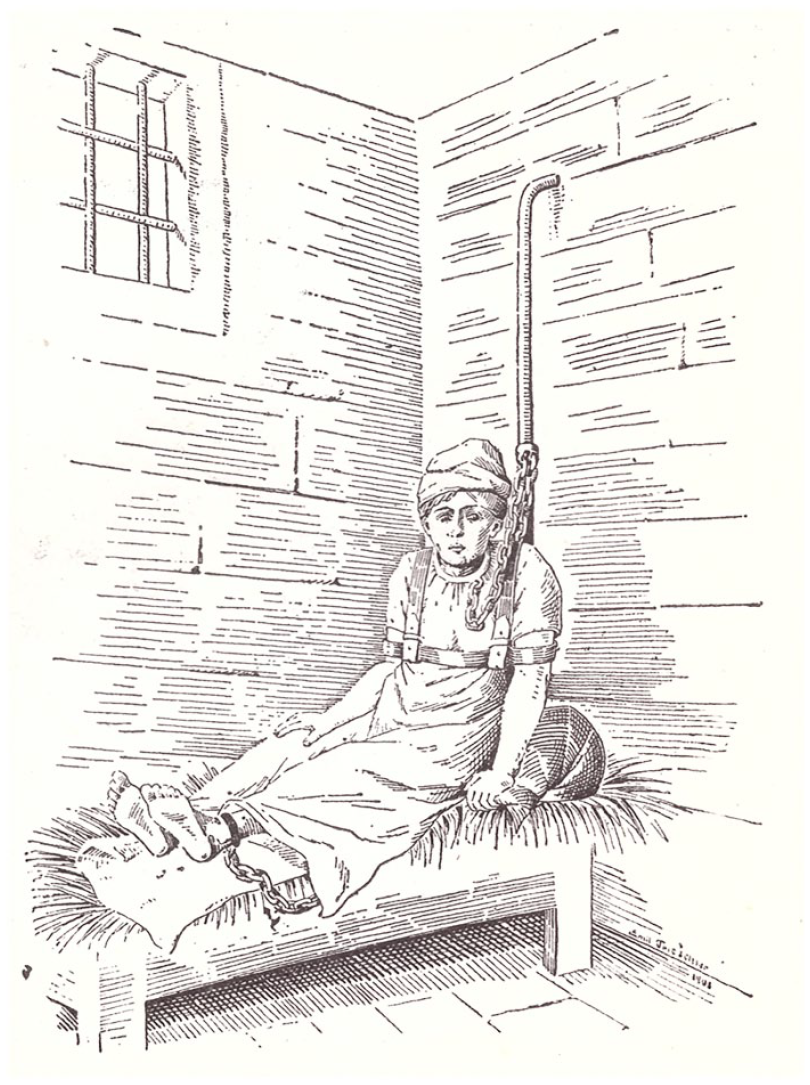
‘A chained sick female with restraint belt’ (Kraepelin, 1918a: 165), showing James Norris (c. 1765–1815) at Bethlem Hospital, c. 1814.
There are 23 more figures in Hundert Jahre Psychiatrie to illustrate similar methods (strait-jackets, rotary machines, gags, water treatments, etc.), followed by 12 figures and photographs demonstrating modern therapeutic approaches (pavilion architecture, occupational therapy, etc.) in line with narrative III. Kraepelin’s Figure 26 intended to show the conditions in a well-equipped surveillance room (see Figure 2). His comment refers to the ‘bed treatment’ introduced around 1900: ‘Patients became calmer and less obstructive; the atmosphere of the insane asylum became more like that of a regular hospital’ (Kraepelin, 1918/1962: 142). He continues: ‘This is most obvious when comparing a surveillance room like the one at our clinic in figure 26 to the old lunatics’ cells’ (Kraepelin, 1918a: 259). The picture emphasises the benefits of the Munich University Clinic: a large, neat, light-filled room with only a few beds. As with the illustration of cell treatment, the purpose is to visualise a practice of knowledge typical of the time. Bed treatment reconfigured the asylum space, and enabled panoptic surveillance and more immediate interventions (Ankele, 2019). 17
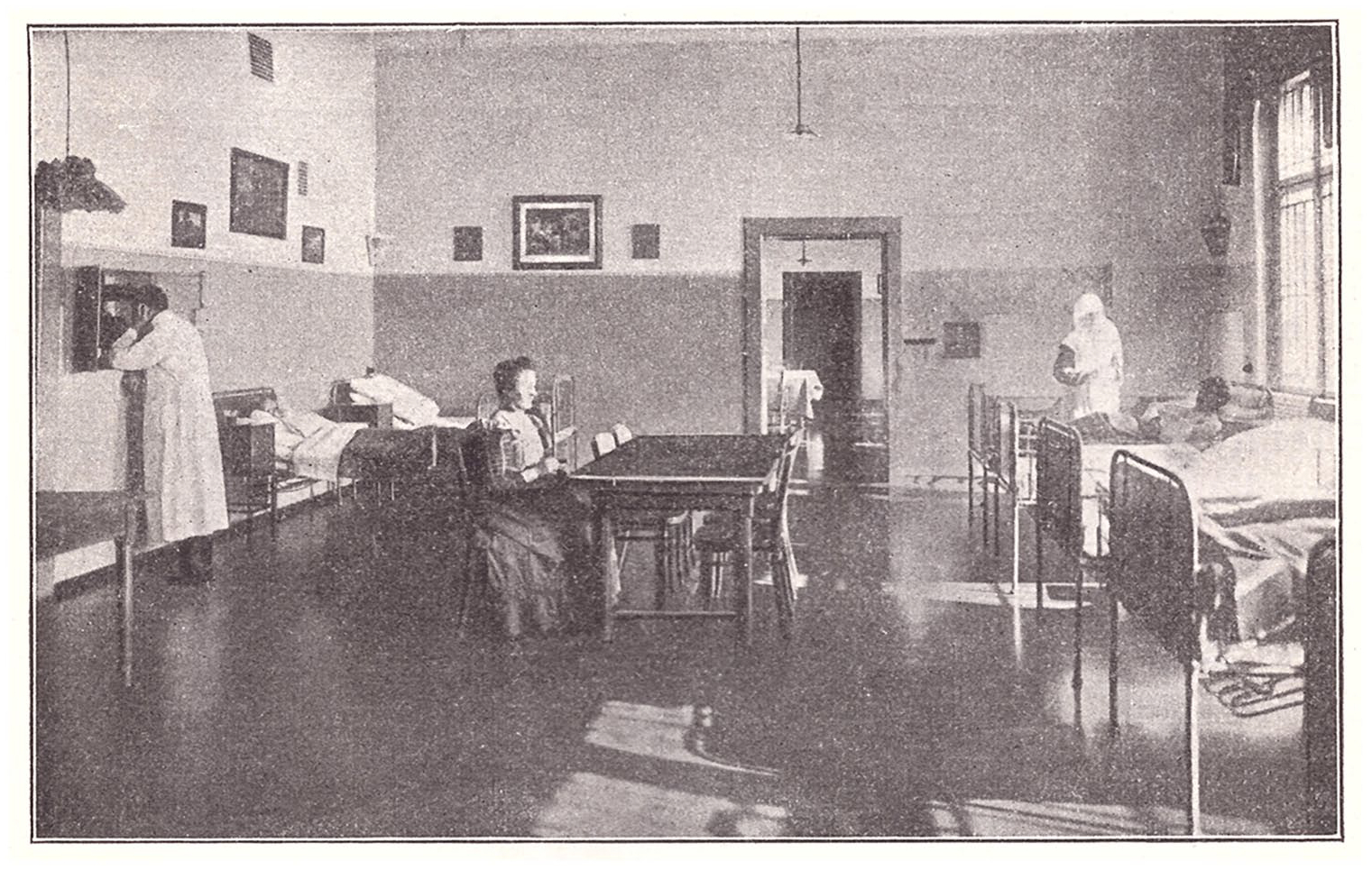
‘Surveillance room at the Munich clinic’ (Kraepelin, 1918a: 259), around 1900.
Historiographic method and sources
Despite not being a historian and initially addressing ‘non-physicians’, Kraepelin (1918a: 161) asserted that his work would also be ‘of interest to academic colleagues’. In the preface to the book edition (Kraepelin, 1918b), he further invited ‘amateurs of moral history, educators and experts in criminal law to trace the development of psychiatry’ from the perspective of intellectual history. According to Peter Burke (2004: 7–10), the genre can be defined as ‘classic cultural history’ – even though Kraepelin barely touched upon philosophical, socio-historical and cultural contexts. Hundert Jahre Psychiatrie certainly conforms with the now-outdated style of whiggish ‘historical accounts written by psychiatrists, about psychiatrists, and for psychiatrists’, as Mark S Micale and Roy Porter (1994: 7) put it. 18 However, such older presentist narratives, which focus solely on medical progress und the standpoint of physicians, also contributed to the development of the early historiography of psychiatry. Today, historians of psychiatry include a plethora of previously neglected actors (e.g. patients, nursing staff, families) and take a multifaceted, ethically reflective stance.
The point of reference for the following analyses of Kraepelin’s historiographical approach is the state-of-the-art historiography of his own time. In 1917, the German-language historiography of psychiatry was barely developed. 19 The classic methods in the general history of medicine had only started emerging around 1900: institutional history, the positivist history of ideas and the history of profession (Roelcke and Frewer, 2001). During the nineteenth century, comprehensive bibliographies and chronologies had been compiled by Johann Baptist Friedreich (1796–1862) and Heinrich Laehr (1820–1905), e.g. Friedreich (1836) and Laehr (1892), in addition to some minor contributions. In 1890, the Schleswig asylum director Theodor Kirchhoff (1853–1922) published the first monograph on the psychiatric history in the German-speaking regions. 20 This work, Grundriss einer Geschichte der deutschen Irrenpflege, presented the ‘cultural history’ of the relationship between religion and ‘insanity’ in the Middle Ages and Early Modern time. 21 In the preface, Kirchhoff lamented his futile efforts to bring together a ‘thought collective’ of interested colleagues. Fifteen years later, the Vienna psychiatrist Siegmund Kornfeld (1859–1927) still concluded that ‘a comprehensive history of psychiatry’ was ‘missing so far’ (Kornfeld, 1905: 601). He starts with the Early Modern era and then presents nineteenth-century psychiatry in two sections of altogether 67 pages, declaring Wilhem Griesinger the decisive ‘turning point’ (p. 659). Kornfeld devoted about two pages to the work of Kraepelin. The latter included a 10-page outline of asylum history in the first volume of the eighth edition of his textbook in 1909, which can be considered the groundwork for Hundert Jahre Psychiatrie. 22 The next historical overview was again produced by Kirchhoff (1912), who wrote: ‘The extraordinary importance of connecting general cultural history and the history of psychiatry is due to the special position of psychiatry at the boundary between body and mind’ (p. 7). To him, the ‘idealistic’ approach of early-19th-century psychiatry was ‘desolate’, the establishment of asylums a ‘blessing’, the elimination of coercive measures ‘humane’ and Griesinger the ‘leader of our psychiatry’(pp. 8, 41, 42, 46).
In 1917, Kornfeld’s and Kirchhoff’s handbook chapters were the only existing complete overviews of the history of German psychiatry in the nineteenth century. 23 Kraepelin (1918a: 272–5) used both these texts, plus 15 less extensive ‘historical accounts’ and 74 primary sources in preparing his journal article. He followed Kornfeld’s and Kirchhoff’s historical patterns and structured the material into several thematic sections (e.g. on treatment, coercive measures, forms of illness, brain psychiatry, etc.). Kraepelin’s references – like Kornfeld’s – come without page numbers. The selection of primary sources seems balanced, but some important players are missing, for example Ernst von Feuchtersleben (1806–49) and Sigmund Freud, who had been briefly mentioned by Kornfeld. Apart from a reference to Chiarugi, Italian sources are also missing. Kirchhoff, Kornfeld and Kraepelin summarised French, British and German sources and (implicitly) referred to plausible indicators (degree of conceptual development, specialisation and institutionalisation, existence of special literature, independent disciplinary development).
As clinicians and self-educated historians, all three authors drew on the classic values of the medical world: arguing about the controversy between idealism and materialism, they specified the bourgeois idea of a historical evolution from barbarism to civilisation in regard to the medical progress in the field of psychiatry. An instructive example of this underlying perspective is that of the stereotypes of ‘psychicists’ and ‘somaticists’, well-known around 1900 and utilised well into the twentieth century. 24 This classification dates back to Friedreich (1836: iii), who used it to describe the infighting over the mind–body problem in the aetiology of early-nineteenth-century anthropological psychiatry and to propagate the ‘validity of somatic theory’. According to Kornfeld (1905: 681), this ‘struggle’ between the schools of thought had inspired discussion and ‘more careful observation’. Kirchhoff (1912: 41) shared this opinion: to him, this ‘dichotomy’, once ‘epoch-making’, was no more than an ‘episode’. Kraepelin (1918a: 192, 187, 237, 242) also identified a ‘fundamental dispute’ from which he, however, inferred the ‘victory’ of scientific research around 1860. He used Friedreich’s classification not only to dismiss natural philosophy approaches and promote a positivist stance, but also to solve the historiographical problem arising when interpreting treatment practices between 1800 and 1840 as both progress, compared with earlier times, and a ‘cruel’ therapeutic ‘self-deception’, compared with his own day. None of the three authors names Friedreich as a source. His biased presentation seems to have developed a life of its own around 1900. In using Friedreich’s model, all three authors’ narratives remained deeply rooted in the early nineteenth century. In a nutshell: Kraepelin did not contribute anything new in terms of content; on the formal side, he complied with the methodical standards of his time.
Science and politics
Maintaining that therapeutic failure requires answers, the four-page epilogue of Hundert Jahre Psychiatrie builds a bridge to the present (Kraepelin, 1918a: 269–72). Kraepelin’s (1909: 595–98) historical reflection had started out from the issue of curability: he demanded the abolition of ‘isolation rooms’ and he used the same wording in 1918, claiming that isolation gave rise to the ‘bestial institutional artifacts’ (Kraepelin, 1918/1962: 141), whose ‘savageness was the horror of their environment’ (Kraepelin, 1909: 595). 25 Regardless of their verbal violence, these phrases can be seen as evidence that he distinguished between hospitalism and primary disease and recommended strict bed treatment (Ankele, 2019: 85–8; Hoff, 1994). Kraepelin always spoke of ‘the sick’ and never of ‘patients’. Despite modernised treatment and a better prognosis for manic-depressive disorders, Kraepelin (1909: 448) considered only ‘fever delirium’, ‘intoxications, infectious and thyreogenic mental disorders’ or ‘certain psychogenic diseases’ as curable but deemed all ‘other forms of insanity’ incurable.
In Hundert Jahre Psychiatrie, he inductively substantiated his assumptions regarding incurability by ‘openly admitting’ that around 70 per cent of those ‘placed in our institutions are according to what we know forever lost . . . even the best of care can never restore them to perfect health’ (Kraepelin, 1918/1962: 149). This logic obviously builds on Kraepelin’s therapeutic scepticism and ‘deep-seated fears, based on degeneration theory and moral convictions’ (Burgmair et al., 2009a: 46). 26 To tackle the key problems – alcoholism, syphilis and ‘hereditary degeneration’ and also ‘morphinism, cocainism and traumatic neurosis’ – he relied on new forms of therapy and, above all, prevention. Despite also mentioning education and welfare in his textbook, Kraepelin (1909: 547) associated ‘prevention’ primarily with negative eugenic strategies, such as ‘marriage bans, castration’, pointing out that legal regulations in this respect were of the ‘utmost public importance’ but hardly to be expected.
The cautiousness shown by Kraepelin in 1909 gave way in 1917 to his welcoming an ‘omnipotent ruler . . . able to intervene ruthlessly’ (Engstrom, 2010: 57). 27 Kraepelin may have been thinking of monarchical rather than dictatorial rule, especially since such demands were not uncommon in his political environment. Ian Kershaw (1987: 18) interpreted the increasing calls for ‘true leadership’, voiced by ‘völkisch-nationalist and rabidly expansionist circles’ in the German Empire towards the end of World War I, as a radicalisation of existing ‘“heroic” leadership ideals’. Debates on racial hygiene, however, abated in the Weimar democracy and intensified again only in the wake of the world economic crisis from 1929 (Kühl, 2014: 128–140). According to Eric Engstrom (2010: 57–8), Kraepelin (1918/1962: 154) suggested a two-way approach in the paragraph in question: he limited the biopolitical trope of the ‘omnipotent ruler’ to prevention, demanding that ‘only scientific research’ be allowed to go further. Kraepelin’s hope for ‘well-planned scientific research’, however, included potential medical innovation (as in the case of syphilis) as well as politically intended prevention. Ultra-conservative politics and science are closely intertwined throughout the epilogue of Hundert Jahre Psychiatrie. This close connection was, indeed, highlighted time and again in the reception of this essay.
Reception and impact
In June 1917, shortly after his speech, Kraepelin received a letter from Paul Mayser (1853–1922), the director of the clinic in Hildburghausen, who had attended the ceremony and suspected that Kraepelin’s therapeutic scepticism had ‘advertising purposes’, as the numbers of ‘incurable patients’ had been known for a long time and ‘prophylaxis’ was just ‘a nice word’ that would not change anything for the foreseeable future. 28 One year later, Johannes R Enge (1918) reviewed the book edition as being ‘convincing’, ‘compelling’ and with ‘impressive’ illustrations. Erich Ebstein (1918) and Hermann Grimme (1921: 136) were similarly enthusiastic, 29 while Karl Jaspers (1920: 404) voiced a very different view: ‘basically interesting material on treatment and care . . . but otherwise absolutely inadequate’. 30 For the English-speaking audiences, Sydney Cole (1921: 379) reviewed Kraepelin’s text as being an ‘oft-told story, but one that we do well to remember’. Miguel Sacristan’s (1887–1956) letter in 1920, asking whether a translation into Spanish was possible, also reflects the international interest. 31 Hundert Jahre Psychiatrie was soon regarded as a sound historical reference.
Seventeen years later, in January 1939, the psychiatrist and racial hygienist Robert Gaupp (1870–1953), a long-term assistant to Kraepelin in Munich, closed a hagiographic appraisal of Kraepelin’s life’s work by saying that Kraepelin, in his ‘fine historical work’, had already ‘anticipated a ruthlessly intervening omnipotent ruler’ and ‘certainly agreed to preventive eugenic measures’ (Gaupp, 1939: 27). 32 After World War II, Kurt Kolle (1898–1975), who held Kraepelin’s chair in Munich from 1952, considered the essay an ‘important historical study’. Kolle (1956: 653) rejected Gaupp’s reading and wrote appeasingly that Kraepelin had been a ‘starry-eyed idealist’ with a naïve, unphilosophical ‘belief in progress’. In the following year, Erwin H Ackerknecht (1880–1969) still counted the text among the ‘more recent literature’ but also stated that despite the ‘wealth of material’, the ‘limitations’ of Kraepelin’s thinking became ‘clearer than anywhere else’ (Ackerknecht, 1957: 74). Ackerknecht was already part of a new generation of medical historians, who started breaking away from presentist narratives.
The English translation of Hundert Jahre Psychiatrie, published in London and New York in 1962 amidst an era of new psychoactive drugs and emerging social psychiatry, met with an ambivalent response.
33
The British medical historian Richard Hunter (1964: 94) saw the essay as a history of psychiatry ‘seen through the alembic of a master mind’. While agreeing that Kraepelin was still professionally significant, the reviewers unanimously criticised the poor quality of the English edition. The text had been translated by Wade Baskin, and the postface was written by the family therapist Peter H Laqueur (1909–1979). The English edition included neither the preface of the book version nor the bibliography and contained only 16 illustrations, only one of which was in the German original. Some passages had been shortened, and some of the content seems distorted. Two of the reviews emphasised Kraepelin’s ‘vivid depiction’ of invasive treatment in early psychiatry and the modernity of his insights (Bennet, 1963; Usdin, 1963); others considered the work as being ‘of value only for a general review of nineteenth-century German psychiatry’ (Dorfman, 1963; Fishman, 1963: 301). Fish (1963) remarked that, for those ‘in search of truth’, it would be better to read Ackerknecht. In 1969, the German-American psychoanalyst Hilde Bruch (1904–84), who had emigrated in 1934, commented on the 50th anniversary of the essay. She appreciated Kraepelin’s ‘humanistic benevolence’ and ‘modern’ ideas but regretted the absence of psycho-social traditions and psychoanalysis. To her, Kraepelin’s name was associated with a ‘pessimism’ that had been more influential on American psychiatry around 1950 than his optimism. Bruch (1969: 261), however, assumed that the profession had now become more self-critical – and this was:
in contrast to the implied omnipotence of the scientific psychiatrist who ultimately became the judge over life and death as when ruthless concepts of prevention, based on the then prevailing psychiatric theories, were put into practice in Germany in such a tragic way.
For the next two decades, including the neo-Kraepelinian turn shown by psychiatry in the 1970s, we can only find some passing remarks on Hundert Jahre Psychiatrie, partly affirmative and partly critical but in sum giving the impression of a ‘much-cited’ text (Peters, 1999: 540). 34 The essay was not reviewed again until the 1990s when members of the consumer/survivor/ex-patient movement based their criticism of psychiatry on Kraepelin’s narratives I and II and, with regard to the essay’s epilogue, called him an ‘intellectual fire-raiser’ in the Weimar Republic (Lehmann, 2017: 114; cf. Breggin, 1997: 159–62; Buck-Zechin, 2011).
Conclusions
In June 1917, the narrative of Hundert Jahre Psychiatrie fulfilled an important performative function: Kraepelin presented a ‘humanistic’ interpretation of the progress made by his discipline, situated these developments in the canon of medicine and used the historical narrative to justify his programme. The print version met the standards of the genre at that time, and the reviewers welcomed the work almost unanimously. The essay represents a part of Kraepelin’s late work that has so far hardly been addressed by scholars: his commitment as a historian of psychiatry. Apart from Hundert Jahre Psychiatrie, this commitment included the founding of the historical archive in Munich, 35 the promotion of Kirchhoff, 36 as well as several obituaries and shorter texts (e.g. Kraepelin, 1921; 1924a; 1924b; 1924c). While the historical narrative of the essay certainly belongs to the past, it also points to the need for more research into the almost 200-year history of the German-language historiography of psychiatry.
The various perspectives of the reception of this essay reflect the changes that psychiatry underwent over the course of another century. The critical reactions by some of Kraepelin’s contemporaries, such as Mayser and Jaspers, remind us that his approach was not uncontested at his time. Considering the challenges that German psychiatry faced after World War I, Hundert Jahre Psychiatrie can be read as a means of coping with contingency and regaining self-assurance. However, this essay was more than a contribution to the historiography of psychiatry: it also contains statements about the deficits of then-available cures and about a possible programme for the future. After all, Kraepelin’s approach to prophylaxis might well be seen in the context of social and mental hygiene, eugenics, welfare, education and psychotherapy, healthcare and social policy, all of which were discussed as means of prevention in his time. 37 Once again, it becomes obvious that Kraepelin’s thinking cannot be reduced to the field of (natural) science: strategies on the prevention of mental suffering are always related to positions on health policy.
According to Engstrom, Burgmair and Weber (2016b: 146), the reception of Kraepelin’s legacy remained divided in this respect: ‘Most historical accounts of Emil Kraepelin are concerned either with the characteristics of his influential nosology or with his contribution to the development of racial hygiene and the murderous policies of the National Socialists in the 1930s and 1940s.’ 38 They propose instead to examine ‘Kraepelin’s work as a research manager’. Indeed, Kraepelin’s speech at the opening of the DFA in 1917 can be seen as part of this, and also addressed the link between science and health politics. The still-ongoing conflicts over the interpretation of the relationship between science and politics and the relevance of this question in the various parts and phases of Kraepelin’s work – also traceable in the reception of Hundert Jahre Psychiatrie – probably constitute a separate topic for future research. 39
In this context, Kraepelin’s argument of a therapeutical crisis is also up for debate. The promises and the reality of psychiatric healing have often been an issue of historical reflection – unlike the actual practices of healing and health promotion. With regard to the 1920s, Hans-Werner Schmuhl and Volker Roelcke (2013: 20) emphasise the variety of methods and the therapeutic pragmatism that preceded the ‘heroic’ somatic therapies of the 1930s (insulin, cardiazal shock, ECT) as well as the desire of the professionals involved to overcome ‘the “therapeutic nihilism” of the past and develop psychiatry into a medical science’. A ‘history of knowledge of healing’ (Höger and Gawlich, 2021), looking at psychiatry during the first third of the twentieth century, might also discuss Kraepelin’s argument of ‘incurability’. 40 All in all, Hundert Jahre Psychiatrie provides an instructive insight into Kraepelin’s historiographical constructions, scientific standpoints and health policy strategies.
Footnotes
Acknowledgements
My special thanks go to Andrea Toenjes for the translation of this text.
Declaration of conflicting interests
The author declared no potential conflicts of interest with respect to the research, authorship and/or publication of this article.
Funding
The author disclosed receipt of the following financial support for the research, authorship and/or publication of this article: This article is available via Open Access under a Creative Commons license (CC-BY-NC-ND) under a grant of Hochschule Niederrhein University of Applied Sciences, Faculty of Applied Social Sciences.
