




Abstract
This paper describes some elements of a specific kind of design-based research, cooperative engineering. In the first part of the paper, we argue that cooperative engineering can be analyzed through a joint action framework. We first present some conceptual tools that the Joint Action Theory in Didactics proposes in order to understand didactic and cooperative action. The second part of the paper is devoted to cooperative engineering, a research process that gathers teachers and researchers through a common project. We first give some root principles of this kind of research endeavor. Then we focus on a specific cooperative engineering, Arithmetic and Comprehension at Elementary School, which aims towards building a mathematics curriculum at first and second grades. After a general description of the research project, we analyze one of its core components, the engineering dialogue. We show how this joint action between teachers, researchers, and teachers and researchers, enables the cooperative engineering team to build and rebuild the curriculum in an iterative way.
Keywords
Introduction
In this paper, we describe some elements of a specific kind of design-based research (Cobb et al., 2003; Collins et al., 2004), cooperative engineering.
In the first part of the paper, we sketch some conceptual tools that, among others, the Joint Action Theory in Didactics (JATD) proposes in order to understand didactic and cooperative action.
The second part of the paper is devoted to cooperative engineering, a research process that gathers teachers and researchers through a common project. We first give some root principles of this kind of research endeavor. Then we focus on a specific cooperative engineering, Arithmetic and Comprehension at Elementary School (ACE), which aims at building a mathematics curriculum at first and second grades. We give a general description of the research project, and then we focus on the rationale and general mathematic and didactic structure of the ACE curriculum. In the last section of this part, we analyze one of its core components, the engineering dialogue. Through two empirical examples, we show how this joint action between teachers, researchers, and teachers and researchers, enables the cooperative engineering team to build and rebuild the curriculum in an iterative way.
The third and last part of the paper is devoted to some conclusive remarks, relating to the way theoretical displacement and enlargement have to be reckoned as a tentative technique to foster theoretical frameworks in didactics.
Joint action in Didactics: a conceptual system
If one were to focus on didactic settings, in which someone tries to help someone else to learn something, one needs a conceptual system in order to describe and analyze teaching–learning activity. First, we have to consider such activity as a cultural activity, in a conception that holds culture as a system of various practices that can be seen as skilled practices. Culture, as a system of skilled practices, “models” people, as Jerome Bruner has pointed out in his book, The Culture of Education: “… its central thesis is that culture shapes mind, that it provides us with the toolkit by which we construct not only our worlds but our very conceptions of ourselves and our powers” (Bruner, 1996: x). Within such a perspective, the didactic joint action can be described first through its logic, which we may call its grammar, in a Wittgensteinian sense (Wittgenstein, 1997).
A general frame for didactic joint action may be found in problem-solving. With this expression, we do not refer to a cognitivist paradigm, but to an anthropological one. By “problem”, we mean something like John Dewey had in mind when he proposed the concept of situation (Dewey, 2008a, 2008b). Facing what he termed a situation, we have to deal with a state of the world in which some elements do not fit together. We have to act in order to transform this undetermined situation into a “unified whole” (Dewey, 2008a). We reconceptualize this contention as follows: in order to solve a problem, we have to transform a set of meanings in a meanings system.
The JATD (Ligozat, 2011; Ligozat and Leutenegger, 2015; Sensevy, 2011, 2012, 2014, 2015; Sensevy et al., 2015; Tiberghien and Malkoun, 2009; Venturini and Amade-Escot, 2013) proposes a conceptual structure in order to describe this process. This conceptual structure gathers many concepts. We will only call for some of them in the empirical description of this paper.
We will focus, indeed, on a particular dialectics, that we call the contract–milieu dialectics. While facing a problem, a situation, one activates a knowledge system that the JATD terms didactic contract (Brousseau, 1997; Sensevy et al., 2015). This didactic contract largely depends on the previous joint action that has been carried out on similar problems; it is the reason why the didactic contract has been described as an expectations system in the French tradition (Brousseau, 1997). If someone has learnt to solve some kinds of problems in a specific way, her recognizing of this kind of problem in her activity will analogically entail a specific epistemic conduct. So, the didactic contract can be seen as the habitual way of acting when facing a given problem. This (didactic) contract can be understood as a system of behaviors that can be described under various descriptions. The same behavior may be considered as a rule, a norm, an attribution of expectation, a habit, and a capacity. Moreover, and this is the most important point in the case of cooperative engineering, it has to be acknowledged as a common background shared by a given collective relating to a given kind of problem. This common background is an “already there”, which enables people to understand each other and to act together. The specific transactions they enact are made possible by this common background.
Describing a joint didactic action thus amounts to identify the meanings system on which problem-solving relies; that is, the didactic contract. In order to understand the way the problem at stake is going to be solved, JATD proposes another notion, that of “milieu” (Brousseau, 1997; Sensevy and Tiberghien, 2015). The role of the notion of milieu is to provide the analyst (the researcher or the teacher) with a way of describing the problem at stake from an epistemic dynamic viewpoint. This notion of milieu can be described as a set of meanings, that can be seen as a set of symbolic forms, that one has to link together in order to solve the problem, to “unify the situation”, in a Deweyan vocabulary. The description of milieu enables to identify and understand the “to be known”, the outcome of the problem-solving process. In that way, this problem-solving process can be thought of as a specific dialectics between the “already there” and the “to be known”.
This dialectics can be sketched as follows. One (an individual, a collective, an individual within a collective) faces a given problem. While facing this given problem, one calls for an “already there”, a specific knowledge system background, the contract, that an analyst (a researcher or a teacher, for example) has to understand if one wants to understand the joint action and its transactions. This contract, as a common background, can be seen as a thought style (Fleck, 1981). But this understanding rests on a complementary effort. The analyst has to delineate the way the problem offers itself to the “solver”. The analyst has to apprehend the way the problem is structured, its symbolic structure. She has to determine the milieu. A necessary step forward will be to inquire into the relationship between the contract (the “already there”) and the milieu (the “to be known”) and the way the milieu can accommodate the contract.
The purpose of this twofold description (contract and milieu) is thus to acknowledge the way in which the contract, as a background knowledge system, enables or not the solver to deal with the milieu, in figuring out the problem structure. It is what JATD calls a mesogenesis process (i.e. the way of transforming a set of elements in a unified and functional system). In some cases, the outcome of such a process is the building of a new thought style, shaped on the basis of the previous “already there”. In some cases, the new thought style is dramatically different from the ancient one, a process that Thomas Kuhn (Kuhn, 1979) has depicted in scientific revolutions through the challenging of the “normal science”.
One may, therefore, consider the didactic relationship (i.e. the ternary relationship between the teacher and the student grounded on the piece of knowledge at stake) as this common building of a thought style relating to the knowledge at stake. Of course, the didactic relationship is an asymmetrical one, in that the teacher knows what the student has to learn. We will see how it is possible to consider this asymmetry in the cooperative engineering research.
Characterizing cooperative engineering
Beyond conceptual–political dualisms
John Dewey (2002) argued that Western Thought is driven by pervasive dualisms that mainly arose from the social structure of ancient Greece, where a strong division of labor opposed slaves and free men. Categories of Thought derived of the political organization in a striking parallel, in which conceptual noble contemplation was opposed to common (not noble) action, as well as theory to practice, ends to means, values to facts, and mind to body. As Dewey put it, the rise of scientific method began to dissolve these dualisms. But Dewey argued that unfortunately this deep evolution did not involve ethics and social science.
With this respect, we contend that one of the main loci of the dualisms in educational science is the usual way of considering teachers and researchers. According to this kind of dualism, teachers are viewed as “practitioners” trapped in a practical relationship to their work, while researchers hold a theoretical, abstract stance.
Cooperative engineering as design-based collaborative research
In contrast, the design-based research paradigm (Cobb et al., 2003; Collins et al., 2004) proposes another system of relationships between teachers and researchers. Penuel et al. (2011: 332) summarized this general design-based research paradigm as follows: … a focus on persistent problems of practice from multiple stakeholders’ perspectives; a commitment to iterative, collaborative design; a concern with developing theory related to both classroom learning and implementation through systematic inquiry; a concern with developing capacity for sustaining change in systems.
This description fits well some of the recent analysis in learning sciences
1
(Anderson and Shattuck, 2012; Koschmann, 2011; McKenney and Reeves, 2013; Ruthven et al., 2009) which, beyond differences, agree to contend that “iterative development and testing of interventions in practice appears promising” (McKenney and Reeves, 2013: 99). Moreover, it paves the way to a specific conception of educational sciences, and especially of “Mathematics Education as a design science”, to borrow the expression from a seminal paper by Wittmann (1995). Wittmann relied on Herbert Simon’s The Sciences of the Artificial (1996) to propose the following statement: … the core of mathematics education concentrates on constructing “artificial objects”, namely teaching units, sets of coherent teaching units and curricula as well as the investigation of their possible effects in different educational “ecologies”. Indeed the quality of these constructions depends on the theory-based constructive fantasy, the “ingenium” of the designers, and on systematic evaluation, both typical for design sciences. (Wittmann, 1995: 363–364)
In another research tradition, we may refer to collaborative research (e.g. Anadon, 2007; Desgagné, 2007; Savoie-Zajc and Descamps-Bednarz, 2007), in which teachers and researchers work together in communities of teaching practices. In the action research paradigm, this collaboration has been crucially seen as a participatory action research (Kemmis, 2009; McTaggart, 1994; Townsend, 2013) in which the teacher is thought of as a researcher (Elliott, 2015; Stenhouse, 1975). In that way, cooperative engineering aims to work out the twofold nature of participation (that of teachers and that of researchers), in a participatory design-based research (Morales Sensevy and Forest, in press). As we will argue in the following, cooperative engineering relied on the Lesson Studies tradition (Elliott, 2015) – in particular, in the way concrete designs are structured in the field.
We now proceed to a description of cooperative engineering’s main features.
Cooperative engineering: a conceptual description
Cooperative engineering: some principles
Cooperative engineering may refer to a methodological process in which a collective 2 of teachers and researchers implements and re-implements (after having analyzed and evaluated the previous enactment) a teaching unit on a particular topic. A crucial point in the making of cooperative engineering is thus its iterative structure. It shares this property with Lesson Studies (Elliott, 2015), in that each occurrence of cooperative engineering is assessed according to the shared ends that the collective assigned to the design, and to the relevance of the used strategies (the means) relating to these ends.
Cooperative engineering proposes a specific way of considering educational research, which rests on the following principles.
A principle of symmetry, which one can conceive of as a kind of Kantian regulative idea, a device for guiding inquiry. Teachers and researchers are both practitioners, but practitioners of different kinds. The idea is that in order to improve an educational process, teachers and researchers are viewed a priori as equally able to propose adequate manners of acting or relevant ways of conceptualizing practice in the elaborated design. This contention brings us to notice a main difference between the classical didactic relationship and what we may call the epistemic cooperative relationship, as it unfolds in cooperative engineering. The epistemic cooperative relationship, contrary to the didactic relationship, does not postulate a fundamental asymmetry (as that of the teacher and the student), but a fundamental symmetry.
As we argued above, the expression “cooperative engineering” refers to a specific kind of design. In this kind of design, participants are linked through a dialogue, which rests on a sharing of epistemic responsibility, as we will show in the following. We characterize this kind of dialogue as an epistemic cooperative relationship.
Arguing in this way leads us to a second principle.
The necessity of acknowledging differences: cooperative engineering requires that every agent plays “her game”; that is, proposes to the collective her first-hand point of view, what she “sees” and what she “knows” from her position – a point of view which is irreducible to any other one. One may figure out the fundamental link between the symmetry postulate and this acknowledging of differences. The first-hand point of view, which one is able to elicit, concretizes differences stemmed from one’s experience. These differences are not those between statuses of someone who knows something versus someone who ignores it – as in the classical didactic relationship. They lie between different experiences in/of the social world relating to the common engineering practice. For example, a teacher may have fostered a given relation to a mathematical practice that enabled her to provide the researcher with a fruitful example of an up to then rather abstract idea. Conversely, the researcher may have built another relation to this mathematical practice that brings the teacher to figure out different ways of accomplishing it. Consequently, one may tell that epistemic cooperative relationship is a specific twofold didactic relationship, in which symmetry rests on the fact that each of the members involved in this relationship may alternatively assume a higher/lower epistemic position. By high epistemic position, we refer to a position in which one brings a prominent contribution to the solving of an engineering problem. A teacher (or a researcher) may alternatively hold a higher epistemic position in the dialogue, in that she enables the collective to move forward in the problem-solving process, and a lower epistemic position when she learns from another participant how to deal with the problem at stake. In that way, the researcher can learn from the teacher, and the teacher can learn from the researcher, both relating to their core practice. This mutual learning is the engine of the cooperative dialogue that we will focus on in the fourth part of this paper.
Indeed, it is in this way that a fundamental purpose of cooperative engineering fosters an enduring dialogue, which concretizes this mutual learning. The engineering project gives a specific end to this learning. As we will see, one may conceive of such a dialogue as a progressive sharing of seeing-as (Wittgenstein, 1997), a progressive shaping of a common thought style (Fleck, 1981). In fact, his dialogue can be seen as the joint transactional construction of a common reference, a common background (Wittgenstein, 1997), gradually shared by all the participants. This sharing supposes the mutual learning between teachers and researchers we referred to above. The progressive common background is notably made of practice and relations to practice whose descriptions emerged from the joint work. This is this common background that one may see as the contract, on the basis of which the practice problems will be tackled.
The necessity of building a common reasoning about ends and means, and thus the potentiality to play both as a collective and an individual the game of giving and asking for reasons (Brandom, 1988). In such a game, each participant becomes able to give the rationale of the elaborated structures, and is able to understand and build a first-hand relationship to this design rationale, beyond any epistemic division of labor. Moreover, each participant becomes able to raise some questions, whether it be “practical” or “theoretical”, relating to the elaborated design. This common reasoning is not an a priori intellectual conception. It is a consequence of the background commonly achieved. By building a common repertoire of described and analyzed practices, participants make themselves capable of designing end-in-views (Dewey, 2008b), which emerge from practical accomplishments in the designing process. They emerge from these practical accomplishments, and, in return, they guide teachers and researchers in the proper engineering process, and teachers themselves in developing classroom strategies. Within this process, end-in-views gradually evolve in the redefinition of the didactic situations.
The engineer stance: it is worth noting that cooperative engineering may foster what we have termed a local practical indistinguishability between the teacher and the researcher. At some moments of practice, both of them share an engineer stance, which means theoretical and concrete ways to respond to a problem of teaching practice. This principle has to be thought of in relation to the “differences principle”. Speaking of a “local practical indistinguishability” between the teacher and the researcher does not mean that they melt together within an unlikely fuzzy stance. It does not erase the differences between the two professions, but it temporally and locally reunites them together under an engineer stance. This stance enables them to share not only the rationale of a given design, but also the knowing of a common range of possible relevant strategies that have to be enacted for the “good functioning” of this design. As previously mentioned, this common range of possible strategies depends on the end-in-views cooperatively designed, and gives birth to an ongoing redefinition of some of them.
The joint action of teachers and researchers in the epistemic cooperative relationship
By relying on a common repertoire of described and analyzed practices, through the unfolding of an epistemic cooperative relationship, teachers and researchers progressively come to share the same contract as a common thought style. Working together on this common repertoire enables them to jointly act within a problematizing process; that is, to understand in a similar manner the contract–milieu dialectics. Indeed, the teachers and the researchers share the same definition of problem (they evolve in the same contract). They see the symbolic structure of the problem in the same way (they face the same milieu). We argue that they engage together in a specific relationship, which we call an epistemic cooperative relationship. This expression is a way to designate the kind of dialogue that emerges from the cooperative work. Through the theoretical notions of “contract” and “milieu”, an epistemic cooperative relationship can be seen as a way to characterize the specific kind of collective inquiry which unfolds in cooperative engineering.
It is critical to understand that the quality and efficiency of this problematizing process deeply depends on the sharing of specific language games that enable the collective “to speak (according to) the practice”, to collectively build “practice-language”; that is, “a language related to a practice or a set of practices” (Collins, 2004: 274), as we will see in the empirical part. The epistemic cooperative relationship asks for a common practice-language.
Arithmetic and Comprehension at Elementary School (ACE), the curriculum
The cooperative engineering team comprises researchers in mathematics education, two PhD students, teacher trainers, pedagogical advisors, and four teachers who implemented the designed sessions in their classrooms, in what we termed “study classes”. The whole team, including study class teachers, is termed Sphere 1 in the following.
The set of teachers of the experimental classes is termed Sphere 2 in the following.
ACE: a first description
The ACE project experiments with the construction of number concepts in 6-year-old and 7-year old students (first and second grades) whom we are investigating. It gathers together five French research teams, each of which has designed a part of the whole curriculum. In this paper, we focus only on the Brittany-Provence team, which is in charge of a domain called “Situations”. The making of the curriculum is based on the work of cooperative engineering (Sensevy et al., 2013).
The first year (2011–2012) of the experiment consisted of designing a curriculum for building the concept of numbers in the first grade. This design process unfolded in a specific way: the experimental situations were first carried out in our four study classes, then redesigned online. The curriculum was implemented in 60 classes during the second year of the experiment (2012–2013) and in 120 classes in the third year of the experiment (2013–2014). At that time, the first-grade curriculum was stabilized in the experimental classes, slowly disseminating in new first-grade classes. The following years of the experiment were dedicated to the same kind of process relating to the second grade: firstly, a tentative design in study classes (2014–2015) that amounted to the proposal of a first curriculum for the second grade, and secondly, an implementation of this curriculum in 120 classes (2015–2016). Our goal is now to stabilize this curriculum at the end of the next year (2016–2017).
This research used a quasi-experimental design. In effect, students’ learning in the experimental classes for the first-and second-grade curriculum was compared with students’ learning in the control classes (pre-test/post-test assessment). For this first-grade experiment, the pre-test showed no significant differences between the control and experimental classes. One may take into account the two main results we obtained by comparing performances of the post-test assessment: (1) for each year of the first-grade investigation (2012–2013 and 2013–2104), the students in the experimental classes outperformed the students in the control classes, particularly for the most conceptually demanding items (e.g. being able to decompose a given number using an additive method); and (2) for each year of the study, the gap between students from underserved communities (priority education zones, per the French system) and students from middle-class communities largely widened throughout the school year in the control classes but stayed at the same level (or shrunk a little) in the experimental classes. This leads us to think that the ACE curriculum is a more equitable program than the traditional one.
The general structure of cooperative engineering in ACE
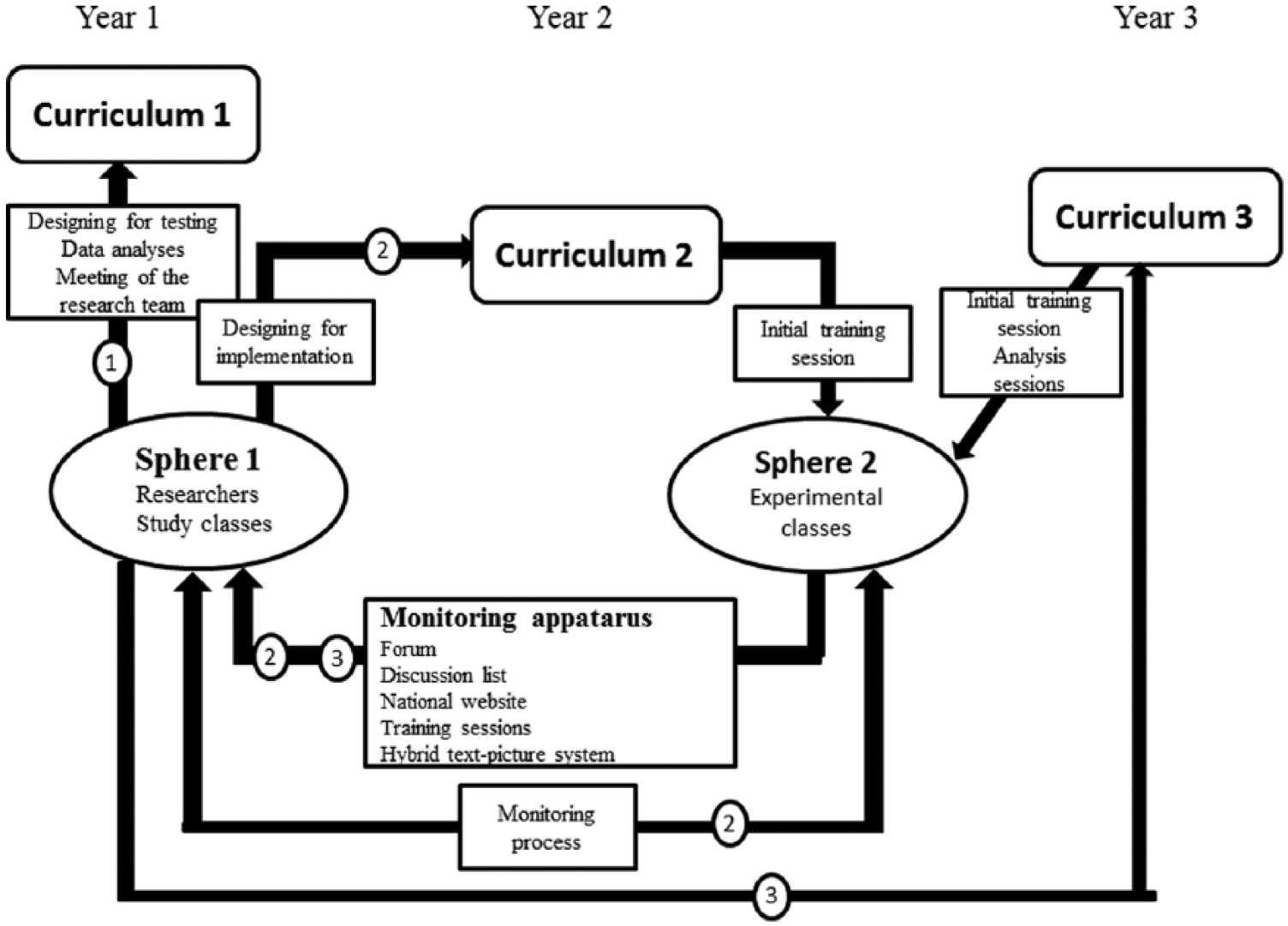
From the viewpoint of its organization, cooperative engineering may be characterized through its twofold structure. One may describe the research design in two spheres. Sphere 1 is composed of the research team itself, which means the four study class teachers, the researchers, the PhD students, the teachers trainers, and the pedagogical advisors. The experimental class teachers represent the Sphere 2, especially among them the 30 teachers in Provence and the 30 teachers in Brittany, who are in ongoing contact with the research team (Sphere 1).
In order to understand the research process, one has to take into account the impact of this twofold structure on the implementation of the ACE sequence. Figure 1 gives a synoptic view of this iterative process, which we can describe as follows.
In the first year of the research project (arrow 1 in the Figure 1), the Sphere 1 designed a first curriculum (termed “Curriculum 1”), tested it in the study classes, then refined it to be proposed to the experimental group (the Sphere 2) in the second year (termed “Curriculum 2” in the Figure 1).
In the second year of the research project (arrows 2 in the Figure 1), the experimental class teachers (Sphere 2) implemented the Curriculum 2 for the first time. The study class teachers (Sphere 1) implemented the curriculum in the same conditions as the experimental group. For them, it was thus the second year that they carried out most of the main situations of this curriculum.
In the third year of the research project (arrows 3 in the Figure 1), the experimental class teachers (Sphere 2) implemented the Curriculum 3, notably after a one-week analysis session of the implementation of Curriculum 2 (this session was called “Appraisal and perspectives”, see below). The control class teachers implemented the Curriculum 3 after a training session. The study class teachers (Sphere 1) implemented the curriculum too.
A synoptic view of ACE.
Before the implementation process, an initial training session enables the experimental class teachers (Sphere 2) to understand the main components of the Curriculum 2.
During the implementation process, the relationships between Sphere 1 and Sphere 2 (represented in the Figure 1 within the rectangle “Monitoring apparatus”) are described in the following. First, we have developed a national website (http://python.bretagne.iufm.fr/ace) and a forum in which every teacher may raise some issues encountered in their implementing of the sequence. Some other teachers may answer these questions; the research team does this systematically. Second, there is a diffusion list specific to the geographic zone (i.e. Provence or Brittany), thanks to the teachers who may notably share various kinds of resources. Third, every six weeks Sphere 1 and Sphere 2 meet in a training session in which they work out the implemented curriculum together.
On this basis, one particular feature of this cooperative engineering resides in the online changes to the curriculum that the research team may propose to the experimental class teachers. In effect, frequent meetings within the research team (Sphere 1) enable these Sphere 1 participants to rely on the study classes’ implementation, and on the observation of certain experimental classes, to design hypothesized curriculum improvements. These improvements are proposed to the experimental class teachers as working hypotheses, on the research website or during the teachers training sessions. This type of structure enables the research team (Sphere 1) and the experimental class teachers (Sphere 2) to enact together a specific kind of cooperative inquiry.
The ACE curriculum: an overview
From a conceptual viewpoint, the ACE curriculum is based on the following principles:
Familiarizing the students with numbers and relations within numbers by focusing first on “small numbers” for a long amount of time (Ma, 2011).
Giving prominent importance to the study of equivalence so that students become able to think of the equality sign not as a hint to produce an operation, but as a relational sign (Brousseau, 1997; McNeil, 2014).
Using the arithmetic operations first as a means to explore numbers and build significant relations between them; for example, in the core situation of this curriculum, the students are guided to refer to a number in an additive form (a sum) and to compare it, in particular, with other additive forms by using seminal conceptual strategies of relevant composition/decomposition (3 + 4 = 3 + 3 + 1 = 6 + 1; 8 + 4 = 8 + 2 + 2 = 10 + 2) and decimal understanding (24 = 20 + 4 = 10 + 10 + 4), a topological approach to numbers.
Using manipulatives and representations in a systematic way by satisfying two criteria. The first one refers to the necessity of enabling the students to rely first on manipulative and concrete “objects”, then to study iconic (analogical) representations of numbers, then to write down equations in canonical form. This process seems very close to the tradition in Chinese textbooks (Bartolini Bussi et al., 2011; Ding and Li, 2014; Sun, 2011) and can be thought of as “concreteness fading” (Fyfe et al., 2014; McNeil and Fyfe, 2012). The second criterion lies in a “translational principle for representations systems”. To understand various properties of numbers, students had to compare different representations of the same mathematical reality to become progressively able to recognize the differences and the similarities between these representations.
The last principle of the ACE rationale holds as follows: to acquaint the student with the historical-cultural sense of mathematics (Bartolini-Bussi and Mariolini, 2008; Radford, 2014) and to apprehend the deep conceptual structure of mathematics (Richland et al., 2012), students had to write mathematics and develop a first-hand relationship to mathematical writing. Entering a culture means becoming familiar with a symbols system (Bruner, 1996; Elias, 1995), which, in our working hypothesis, means becoming skilled with representational and scriptural devices. In a nutshell, the curriculum that we propose is characterized by a connected series of situations, all centered on the founding principles that we have presented above.
The ACE curriculum: a connected series of situations
The initial situation of this curriculum is the “Statements Game”, which has been designed by the research team on the basis of the principles we stated above and which can be described as follows (Table 1).
An illustrated description of the situation.
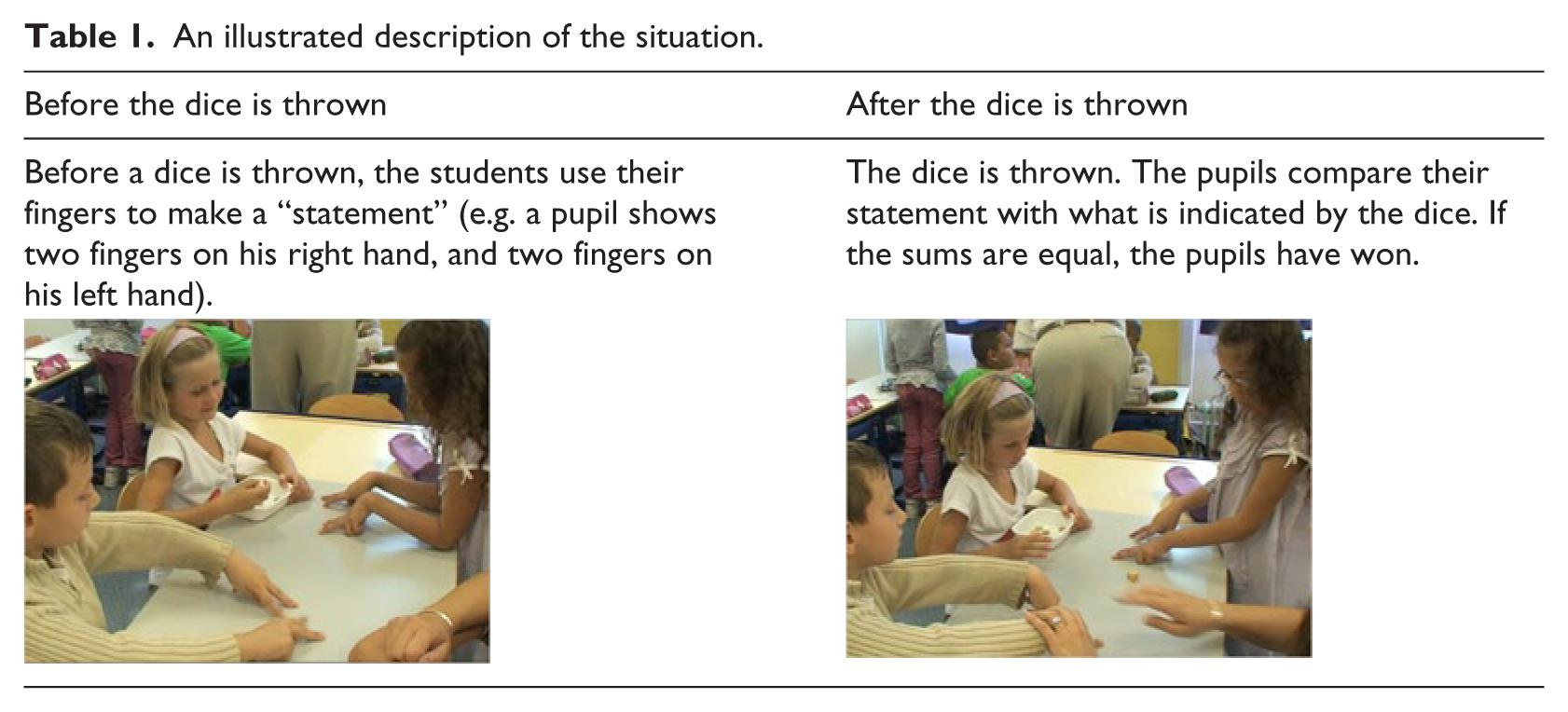
From this initial operation, the progressive complexification of the situation guides the students to increasingly rich comparisons: as the number of hands (students) is increased, the number and the nature of dice (1–10 dice are played with), the rules of the game are changed (e.g. a student no longer wins because he has the same number as in the statement, but because he has a lower or higher number), etc.
The students first play the game orally, then they write down the situations, conceiving the writing process as a way of i) designating the different games that they play, and ii) mathematically modeling this game. When students advance in their mathematical inquiry, the Statements Game situation gives them a concrete and basic reference, which they may always refer to in order to give controlled meaning to a mathematical equation.
Progression is thus characterized by a succession of situations (teaching units), few in number, which the teacher prolongs for a long time in class, in an inquiry approach. The meaning-making process that we wish to establish is characterized by a fundamental principle of continuity. When in class, a teacher passes from one situation to another (e.g. from an additive situation to a subtractive situation), “the old situation” lasts as long as necessary, and it can always be returned to, if need be, at any time of the year. Progress is thus characterized by a kind of interlinked overlapping which allows a global knowledge understanding by students.
ACE, the Journal of Number
A specific tool was implemented in the ACE classroom, the “Journal of Number”. At the end of a particular period of time (a learning unit of two to six sessions), students were asked to write down in this individual journal “something they know about mathematics”, by following a general prompt given by the teacher, often on the basis of a previous student’s production. In the following, we will use an example from the Journal of Number productions in order to show an engineering dialogue.
ACE, the engineering dialogue
In this section, we focus on the transactional collective work within cooperative engineering. We describe this work as a specific dialogue, in which transactions between members of the collective enable them to build a thought style specific to their endeavor. This dialogue is achieved on the basis of a common background (contract) that enables the collective to build together the structure of the problem at stake (milieu).
The engineering dialogue, a first example: the number-line problem
The common solving of the number-line problem
This example focuses on an intersphere dialogue within cooperative engineering. It is centered on the introduction of a system of representation, the number line (i.e. Bartolini Bussi et al., 2011; Schmittau, 2005). Students were thought to use this representation all along the curriculum in order to model the comparison of additive writings they met. For example, to represent the equation “2 + 1 = 3”, students trace a first “bridge” of two intervals from the graduation zero (0) to the graduation two (2). This bridge refers to the first term of the addition. Then they trace a second bridge from the graduation two (2) to the graduation three (3). A third bridge (above the number line) represents the sum of this addition. The following number line (Figure 2) represents the final state of that process.
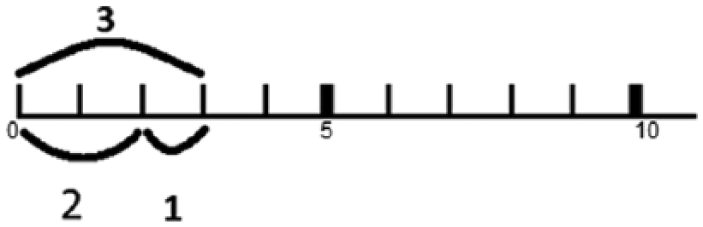
The number line.
During the first implementation of this representational instrument in the ACE curriculum, students and teachers faced a problem. Experimental teachers (Sphere 2) and study class teachers from the research team (Sphere 1) emphasized students’ difficulties to represent “two-terms additive expressions” on this number line. These difficulties were linked to the conceptual leap inherent to the graduating process. Students had to take into account the specificity or the graduation “zero”, as referring to the origin point. Besides, they had to cope with the fact that discrete quantities (e.g. the number of fingers in the ACE Statement Game) are numbered by starting from “1”, whereas continued quantities (as represented on the number line) are numbered by starting from “0”.
So, the cooperative engineering collective faced a teaching problem. In theoretical terms, one could acknowledge this problem by describing its structure as a milieu. For the cooperative engineering teachers and researchers, students and experimental teachers had to articulate a strong link between the number line and the written additive expressions, this relationship enabling them to better conceptualize numbers. But the empirical reality was very different, given that this relationship was not acknowledged by the students.
In order to solve this problem, the cooperative engineering collective had to rely on its common background that one can describe as a common teaching–learning experience notably anchored on a shared representational system.
A first solution proposal was immediately entered on the website forum of the research project by some experimental teachers (Sphere 2). It consists of matching the number line with another representation, the “train line”, which was proposed at the beginning of the curriculum. This train line was composed by manipulatives (small colored cubes). For example, linking cubes enabled students to see the number “3” as a “train line” of three linked cubes. The following schema (Figure 3) shows this method of matching.
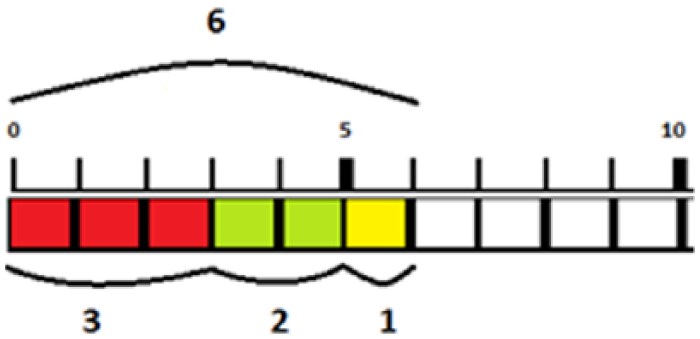
Train-line/number-line matching.
Superposing the train line and the number line enabled the students to understand the core principle of the number line. One can understand the graduation from zero to one as encompassing one cube, the graduation from zero to three as encompassing three cubes, etc.
This improvement proposal was acknowledged and implemented by the research team (Sphere 1). It was then proposed as a working hypothesis to the experimental class teachers.
At the end of the first year of the experimentation (as at the end of each year of experimentation), a week-long analysis session (called “ACE: Appraisal and perspectives”) gathered the experimental teachers (Sphere 2) and the research team (Sphere 1).
Its goal was to build a collective reflection upon the ACE experiment and to enact a cooperative inquiry aimed at redesigning the ACE curriculum for the next year of experimentation.
In this session, the reflection work was organized through specific themes. One of them was “Using the number line in the ACE curriculum”. We now present one excerpt (Table 2) of the discussion between this theme group, who presented its proposal, and the general group (Spheres 1 and 2).
An engineering dialogue, the number line.
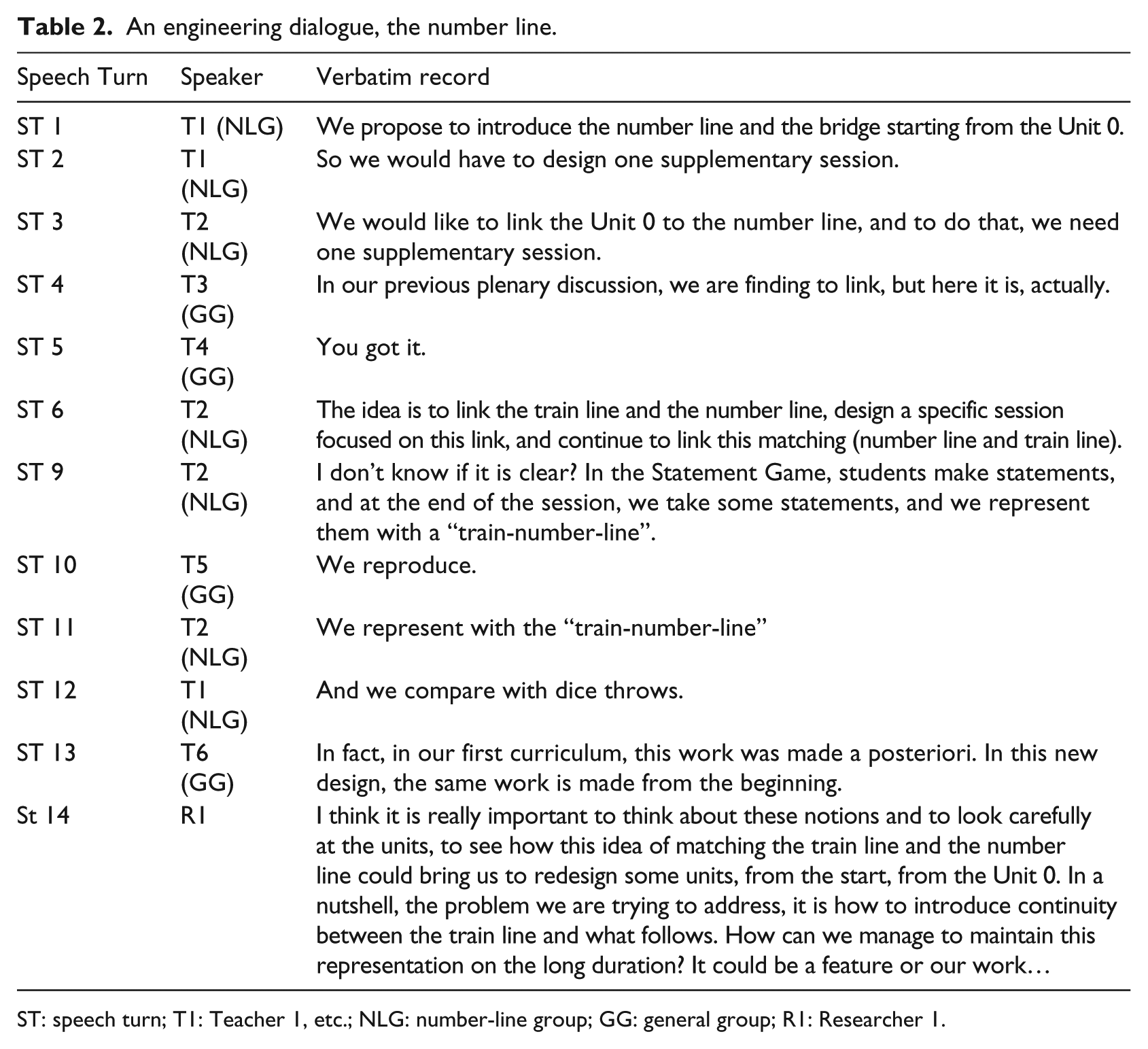
ST: speech turn; T1: Teacher 1, etc.; NLG: number-line group; GG: general group; R1: Researcher 1.
By relying on their implementation experience in the joint action with their students, and their knowledge of the curriculum, experimental teachers propose a deep change in this curriculum. They intend to introduce the number line from the Unit 0, in relation with the train line. Some teachers (T3, ST 4; T4, ST 5; T5, ST 10; T6, ST 13) react by stating that this proposal fits their experience and their concern for establishing continuity in the students’ mathematical experience. R1 (one of the researchers of the team) shows the relevance of the Sphere 2’s reflection. He emphasizes the importance of the didactic continuity by noting the interest of maintaining some representations all along the curriculum.
Solving the number-line problem: the nature of the joint action
This cooperative work can be summarized as follows:
Facing an implementation problem (the students did not make sense of the number line as a model of an additive expression), the collective relied on a common background to tackle the problem. One could think of this common background as a shared teaching–learning skilled experience, a common knowing and using of representational systems (the train line, the number line), and a shared conceptual contention about the necessity of continuity in the students’ mathematical experience.
But this common background was not sufficient to tackle the problem. One may acknowledge the following fact: when facing the problem, the two representational systems and the continuity principle were present in the structure of this problem for the collective, but they were not related together. These already-there meanings could not enable the team to figure out a solution to the problem. In other words, the milieu of the problem was constituted by a set of disconnected elements that one needed to link together to solve the problem.
The collective transactions in the engineering dialogue consisted of transforming this set of unarticulated symbolic meanings into a system of related meanings, a unified whole, to use the Deweyan term, that one can conceive of as a way of describing the mesogenesis process. If one would build an emblematic utterance that summarizes this dialogue, one could choose something like the necessity of matching the train line and the number line to introduce and maintain continuity in the students’ mathematical experience. This utterance expresses a language game anchored in a form of life; to speak in Wittgensteinian terms, a kind of practice-language (Collins, 2004). It may be seen both as the symbolic outcome of the cooperative engineering joint action and the description of a skilled practice. From an epistemological viewpoint, here, it seems important to note that being able to solve a problem, whether it be a student’s mathematical problem or the collective’s engineering problem, amounts to be able to recognize and organize a certain kind of continuity in experience.
When analyzing the transactional process, one could offer a description of the following kind: “the researcher has certain specific resources for theorizing the problem and he uses them for supporting the teachers in the generalization of the problem”. This is an accurate description but this is also a partial description. One could say “the teachers reconceptualize the continuity problem by matching the number line with the train-line”. In this example, it is important to note that the engineer stance, which enables one to rethink the problem and redesign the curriculum, is mainly held by the teachers. The researcher participates in the engineer stance not so much by “generalizing” the problem, but rather by describing it anew. Let us consider his words: “In a nutshell, the problem we are trying to address, it is how to introduce continuity between the train line and what follows. How can we manage to maintain this representation on the long duration? It could be a feature or our work…”. We argue that the main effect of the researcher’s redescription is to propose an engineering challenge grounded in the redesigning process proposed by the researcher (“How can we manage to maintain this representation [the number line] on the long duration?”). In this epistemic cooperative relationship, the researcher learned from the teachers. He learned that the continuity principle that he theoretically thought of, rather abstractly, has to be conceived through the representational systems that have been designed in the ACE program (Joffredo-Le Brun, 2016). The continuity principle was no longer an abstract one, but a way to rely on a given evolutive representational system (i.e. the “number line”, as it has been presented above) all along the curriculum. The assumption of this engineering principle was a fundamental outcome of the epistemic cooperative relationship, and a consequence of the engineering joint action of the teachers and researchers. In a way, it is a kind of common connoisseurship that is developed.
The engineering dialogue, a second example: using students’ production in the Journal of Number
Working out the students’ productions problem in the Journal of Number
This engineering dialogue took place at the beginning of the second year of experimentation. It gathered researchers (Sphere 1) and teachers (Sphere 2). Among the teachers, some were implementing the ACE curriculum for the first year, some for the second year.
In this engineering dialogue, the topic was about the Journal of Number. Let us remind the reader that the Journal of Number is a specific device (an individual notebook) in which students write down mathematical expressions, that the teacher refers to as “something you know about mathematics”.
For instance, after the use of the number line has been worked out enough, a teacher proposed the following prompt: “Write down ‘3 Hands Statement’ and represent them on the number line”. That means that students have to imagine a statement, in the “Statement Game” performed on three hands. For example, students may imagine “0” on the first hand (a closed fist), “3” on the second hand, and “1” on the third hand. From this hands pattern, they have first to write down 0 + 1 + 3, and then represent this writing on the number line. We can see below (Figure 4) one of the first-grade student’s work in the Journal of Number.
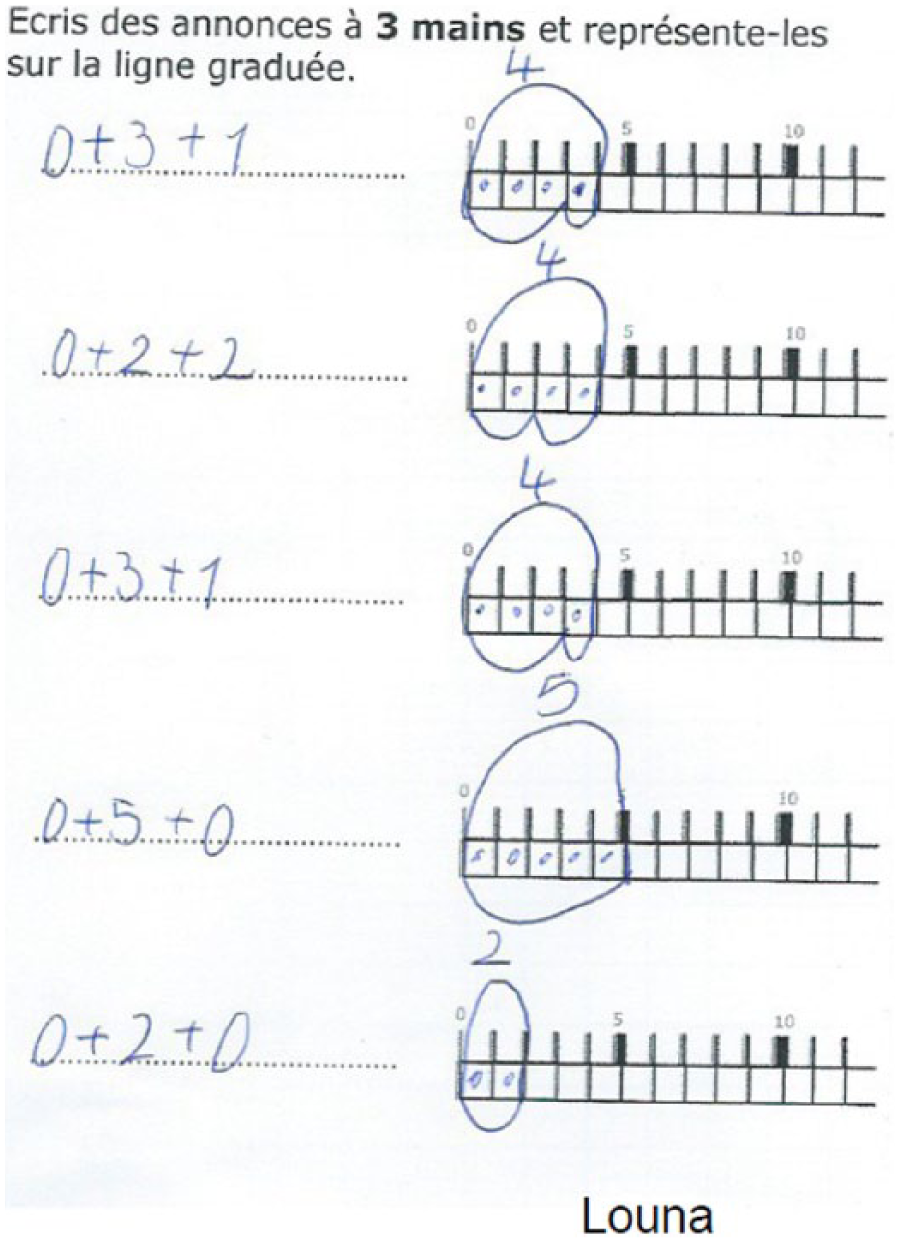
The Journal of Number, example 1.
Another example, among many, refers to the composing–decomposing process, which is emblematic of the ACE curriculum at first grade. The teacher proposed the following prompt: “Write down and additive writing with 6 or 7 terms. Write down this number in tenths and units” (Figure 5). That means that students have first to produce the additive writing (e.g. 3 + 7 + 9 + 4 + 6 + 9, see below). Then they have to compose and decompose the terms of this writing in order to obtain tenths (e.g. they can compose 3 with 7 to obtain a tenth, they can decompose 18 to write down 18 as 10 + 8 in order to exhibit a 10, etc. – see below).
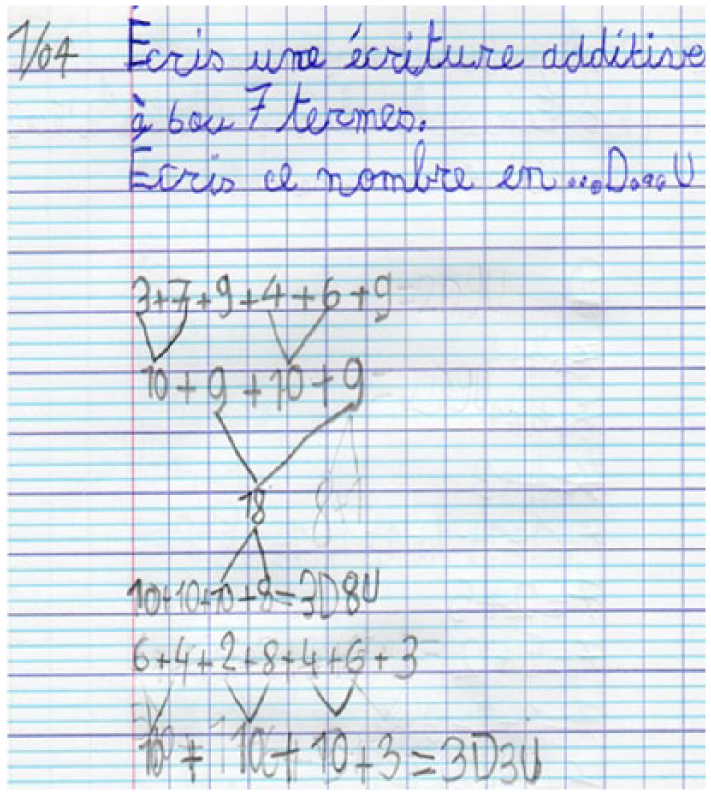
The Journal of Number, example 2.
While considering these examples, it is important to apprehend the kind of activity that students enact. Writing down in the Journal of Number is neither a traditional practice of doing school exercises, nor a problem-solving activity in the usual sense of this expression. Writing down in the Journal of Number means engaging oneself in an inquiry process grounded on reasonably solid knowledge. This writing inquiry is not only a personal one. Like in scientific communities, the personal inquiry is anchored in the collective one, and reciprocally. The personal discoveries relied on the collective, and, in turn, they may provide this collective with fruitful meanings.
In the cooperative engineering dialogue that follows, the topic was precisely the implementation of the Journal of Number. The conversation started by a reminder of the journal’s principles and functions, based on the collective reading of a text presenting the rationale for the Journal of Number. 3 Then the teachers shared their ways of practicing the journal in their class.
The following excerpt (Table 3) focuses on a short dialogue between two teachers (T1 and T2) and a researcher (R2). T1 was in her first year of experimentation, T2 was in her second year. T1 presented a short didactic event that occurred in her class. T1 remarked on a student’s question and his response (by the student himself) in his journal. T1 shared arguments with another (R2) and T2 relating to this event.
An engineering dialogue, student’s anticipation.
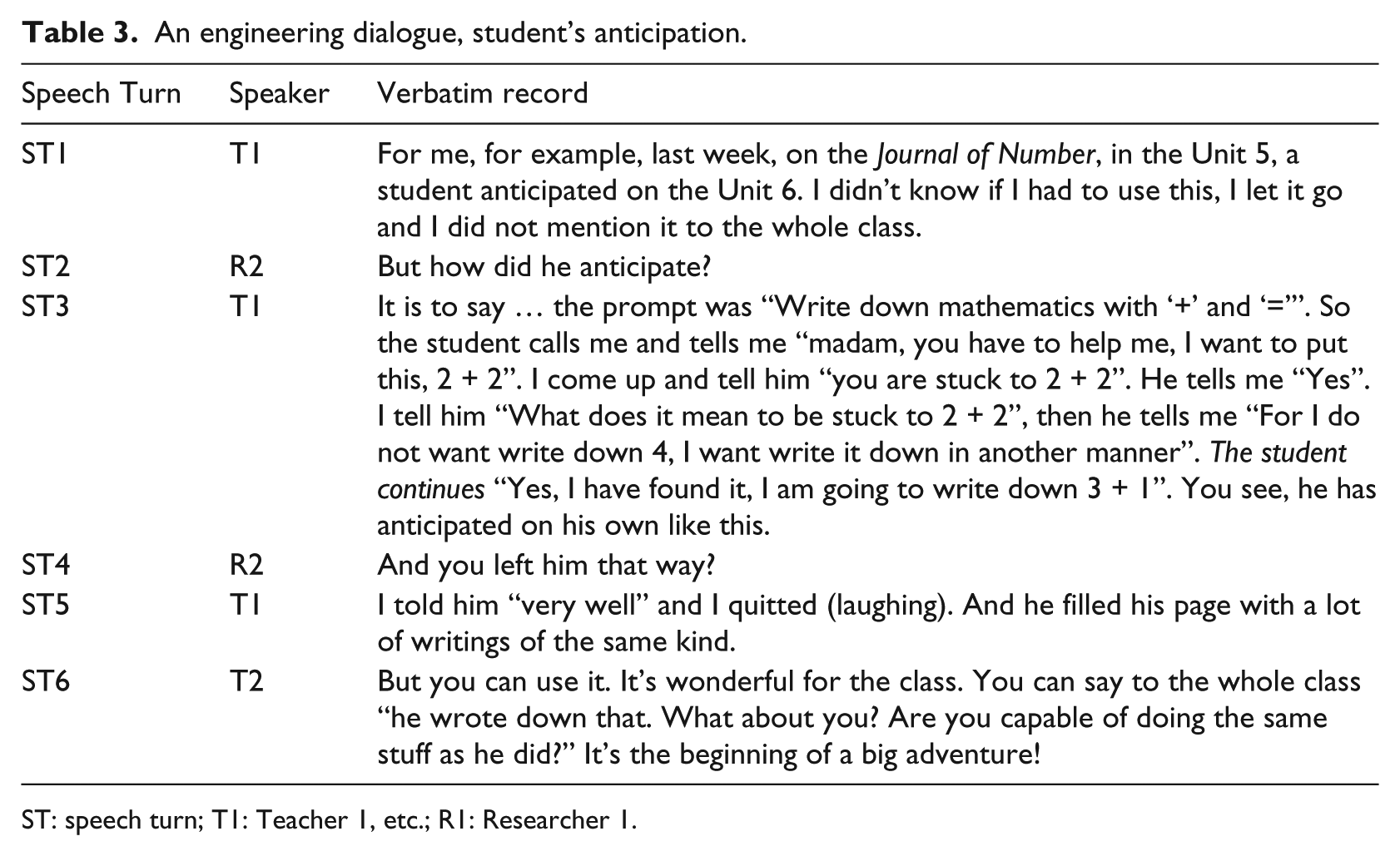
ST: speech turn; T1: Teacher 1, etc.; R1: Researcher 1.
The teacher T1 reported on a didactic event that occurred in her class. One has to keep in mind that this journal session was situated before the Unit 6ttp://python.espe-br. In this Unit 6, students have to study the comparison of two-terms additive writings. Two-dice throwing are compared to two-hands statements. This unit thus brings the students from their current practice (one dice throwing and two hands, with the pattern a + b = c) to a new form of writing (a + b = e + d).
The student that the teacher referred to asked himself how to express an equivalence relation between two two-terms additive writings. His finding (2 + 3 = 3 + 1 = 4) witnesses his grasping of a fundamental meaning of the “equals” sign. One may hypothesize that he had been able to link “4” (the usual way of designating the number) with “2 + 2” (the actual way of designating it in the Statement Game) and “3 + 1” (another way of writing it down). As we have seen above, this meaning (equivalence of addition) is a core goal in the ACE curriculum. While figuring out this meaning, this student anticipated the didactic pace, the didactic time. He was able to “make the didactic time forward”, in that he discovered on his own the mathematical “future” of the Unit 6.
It is worth noting that T1 noticed this student’s expression. She perceived this event as interesting and remarkable enough to be shared with the collective. But her lack of teaching experience in ACE prevents her to be fully aware of its importance in the building of the notion of equivalence. The expression 2 + 2 = 4 = 3 + 1 could be seen as an “ACE emblem”, in that it embeds both the composing/decomposing process and the “equals” sign as a means to signify equivalence. T2, a more experienced teacher of the ACE curriculum, was fully able to see this emblem as such. She encouraged T1 to use her student’s idea to enact in the classroom what we may call an “imitation game”, in which other students in the class would have to imitate the student’s writing (2 + 2 = 4 = 3 + 1). In doing so, students would not be confined to a “duplicate imitation” (in which some behavior is copied without understanding its rationale or principles), but would engage themselves in a “creative imitation”; that is, an imitation grounded on an accurate mathematical use of the symbolic system.
One could emphasize, in this excerpt, the researcher’s (R2) participation in the dialogue. Her role was that of a kind of “maieutician”, who helped T1 to express herself without trying to give her feedback about her practice.
Using students’ production in the Journal of Number: the nature of joint action
The first example showed the collective building of a thought style; that is, the common building of the contract relating to the relationship between continuity and representations. This second example shows a deep contrast between T1, a relative “newcomer” in the ACE program (a teacher in her first year of implementation), and T2, an experienced teacher in cooperative engineering. T2 has appropriated the engineering thought style. She was able to recognize a fundamental stake in the ACE curriculum (the equivalence between two symbolic forms as it is embedded in the “equals” sign), within an actual situation. Further, she was able to share this “seeing-as” with a less advanced pair, by signifying to her a possible action to exploit the student’s discovery in order to enhance the classroom inquiry. The transactional system of the engineering dialogue enables the participants to progressively build the ACE thought style. In other words, T2’s statement (“But you can use it. It’s wonderful for the class. You can say to the whole class ‘he wrote down that. What about you? Are you capable of doing the same stuff as he did?’ It’s the beginning of a big adventure!”) is a kind of incentive (to T1) to reorganize the already-there meanings (the contract) that one may summarize as follows. Rather than only being stuck with the “anticipation move” of the student, use his production as a point of departure for the mathematical enquiry of the whole class (“the beginning of a big adventure”). This crucial change may enable a further change in considering the milieu of the Journal of Number productions. These are not only considered through their “static” properties (the mathematics ideas they embed), but also through their “dynamic features” (the way in which the may be useful for the mathematical practice of the whole class). In fact, the use of the Journal of Number is one of the cornerstones of the ACE thought style. It has been built through an emblematic meeting between an initial theoretical proposition (that of a journal in which students feel free to inquire about mathematical writing) and the creative practical accomplishments of the teachers that bring the whole collective to reconceptualize the initial proposition. From being a relatively peripheral device in ACE, the journal became a springboard for mathematical inquiry, which pervaded all mathematical practice, and reorganized the ACE curriculum. In that way, the thought style that T2 demonstrates can be seen as the outcome of an enduring epistemic cooperative relationship.
Some conclusive remarks
The cooperative engineering dialogue, a theoretical displacement, a theoretical enlargement
As we argued above, the transactional system we sketch in our empirical examples may be analyzed through the categories of contract and milieu. We would like to emphasize the theoretical displacement that these analyses attempt to enact. We argue that the categories of didactic contact and milieu, initially proposed by Brousseau (1997), do not apply exclusively to didactic actions sensu stricto (e.g. in school settings), but to didactic actions sensu lato (i.e. all actions that involve a knowledge trade). We have introduced the notion of the epistemic cooperative relationship to analyze these kinds of actions, which we may consider as twofold didactic actions. In these kinds of actions, members of the cooperative process alternatively learn from others. And they learn not only about the other’s practice, but also about their own practices in the engineering process. For example, teachers and researchers learn together to use the vocabulary of “the continuity of students’ mathematical experience” to redescribe and reconsider practice in the engineering process. As a result, the relationship between “abstract expressions” (like “the continuity of students’ mathematical experience”) and “concrete practice” dramatically changed, in that concrete practices nurtured abstract expressions. In doing so, concrete practices redefined abstract expressions (e.g. “the continuity of students’ mathematical experience” became “the continuity of students’ mathematical experience through the enduring use of representations”). These changes are not only changes in teachers’ or researchers’ practice; they are shared changes in the engineering work and changes concretized in new end-in-views that may guide practice.
From a different but articulated viewpoint, we contend that the contract–milieu dialectics may constitute a descriptive tool to apprehend problem-solving processes. As we outlined above, the sense we ascribe to the notion of “problem-solving” is far from being restricted to the cognitivist tradition. In a Deweyan perspective, we call “problem-solving” all efforts made to cope with an everyday situation in which the agents’ intentions are compromised or the agents’ powers are impeded.
If one tries to analyze this problem-solving process from the “logic of practice” viewpoint, one may apprehend this logic in the following way. First, one has to analyze the knowledge system (the contract) with which the “solving instance” apprehends the problem. In our empirical examples, this knowledge system is built through teaching–learning practice as it unfolds in the ACE program, as a common repertoire of described and analyzed practices, and through the engineering dialogue that gathers together teachers and researchers. Second, one has to be able to describe the symbolic structure of the problem at stake. We have seen that the studied examples show how the cooperative engineering dialogue slowly brings the participants to espouse a common seeing-as (e.g. seeing a number line as an object which can be “explained” by a train line; seeing a specific student’s behavior as a conception to disseminate in the classroom). This common seeing-as is an outcome of the contract–milieu dialectics. The common work against a common background to cope with common problems build a thought style. As Fleck (1981) contended, a thought style is not only a kind of thinking or speaking, but also and above all a way of perceiving. This enables us to emphasize another feature of our using of the contract–milieu dialectics. In order to achieve the aforementioned displacement, it is, for us, crucial to link problem-solving processes, seen through the contract–milieu dialectics, to some “anthropological” and “logical” concepts, such of seeing-as (Wittgenstein, 1997), and thought style (Fleck, 1981), among others. We think that such displacement enlargement can provide the educational sciences with an interesting epistemological technique to foster theoretical frameworks in didactics.
Cooperative engineering: what objects for educational sciences?
We would like to conclude this paper with an epistemological note. To us, it seems that cooperative engineering, along with other forms of design-based research, may encourage us towards a particular effort of identification of what the objects of our inquiry are. Let us consider some of the practices that we have described in this paper. For some scholars, the object of inquiry could be, for example, the conception of mathematical equivalence; for others, the language used in the classroom. We could probably establish a long list of objects of inquiry, according to these “scholars’ preferences”. If one tries to identify what could be “objects of inquiry” (i.e. “objects of science” for cooperative engineering), one could assert what follows by relying on the present paper. One object of inquiry is the way the students and the teacher, in their joint action, are able to use one system of representation (e.g. the “train line”) to understand a novel one (e.g. the “number line”). Another is the way the students and the teacher, in their joint action, are to be able to rely on a student’s proposal (e.g. the passage from “a + b = c” mathematical writing to “a + b = e + d” mathematical writing) to enhance the collective inquiry. A final one, in this description, is the way the teachers and the researchers, in their joint engineering action, move from “organizing the continuity of students’ experience” to “organizing the continuity of students’ experience through representational systems”.
Looking at such “objects of inquiry” could bring us to the following two remarks.
The first makes us argue that such objects emphasize an “actional turn” in the sciences of culture, which seems fundamental for us. The shibboleth here amounts to the reckoning of whether a specific description helps us to understand the logic of practice as it is enacted, the “feel for the game” that practitioners engage, and to possibly perfect these described practices.
The second enables us to understand that such objects do not entail an a priori division of labor between teachers and researchers. According to us, it is a fundamental feature of the anthropological sciences and the sciences of culture to understand the “games” that people play in their everyday life. In doing so, we try to understand “the contingent ongoing accomplishments of the organized artful practice of everyday life”, to quote Harold Garfinkel’s profound sentence (Garfinkel, 1984: 11). This amounts to saying that understanding skilled (collective) practices, and trying to contribute to their enhancement, requires a new epistemology.
Footnotes
Declaration of conflicting interests
The author(s) declared no potential conflicts of interest with respect to the research, authorship, and/or publication of this article.
Funding
The author(s) received no financial support for the research, authorship, and/or publication of this article.