




Abstract
This article discusses problems of reconstructing the recent development in the field of empirical research on education (empirische Bildungsforschung), especially problems resulting from its interdisciplinary character, its divergent institutional contexts and its multimethod approach. The article looks at the position of various disciplines – in particular, science of education (Erziehungswissenschaft) and educational psychology – involved in research on education as an interdisciplinary field of study. Compared to previous times, important shifts concerning the relation between these two disciplines can currently be observed. The argument is about the notion of competence, about the right to define success criteria and about resources. Finally, this discussion focusing on Germany is then placed in the wider context of different cognitive and institutional forms of doing and organizing education studies and research in different countries.
Keywords
What has happened?
‘Prediction is very difficult, especially about the future’. This somewhat worn quip that is attributed to the physicist Niels Bohr, also works the other way round: ‘Nothing is as uncertain as the past’. Although everything has already happened and nothing can be changed, the way to describe and evaluate it can be changed, however. States and political movements, companies and parties, and also families and individuals are continuously engaged in reconstructing their past. They provide themselves with new interpretations of their own history and thus stabilize or contradict their current identity. Scientific disciplines are doing the same.
A look back at the last decades of the development of the broad and interdisciplinary field of research on education in Germany and focusing on the relationship between the involved academic disciplines reveals a certain pattern of interpretation that appears to be widespread and agreed upon. Helmut Fend described this in a lecture entitled ‘50 years of research on education’ (Fend, 2013). In terms of chronological development, there was 1) an awakening phase from 1963 to 1980, being followed by 2) a latent phase from 1980–1995, which was finally was replaced by 3) an actual boom phase from about 1995 to the present day. 1 This periodization is largely congruent with the common reconstructions of the different phases of more or less intensive state-driven educational reform periods in Germany: first, an important reform period from the 1960s to the late 1970s, triggered by the ‘Sputnik-Shock’; second, a political backlash that led to a period of (nearly) non-reform in the 1980s to the 1990s; and third, the beginning of a new important reform period from 1995 onwards, triggered by the ‘PISA-Shock’. Generally, the comings and goings of school reform, on the one hand, and the ups and downs of research on education, on the other, are seen as closely linked. The development of the size of the academic discipline ‘science of education’, if one takes into account the number of professorships in this discipline, fits this three-phase model very well: expansion phase 1965–1980; shrinking phase 1980–1995; renewed expansion, albeit at a lower level, from 1995 to today.
At this point some short remarks concerning the ‘naming’ and terminology are required. In Germany, Pädagogik (pedagogy) is the traditional name for the academic discipline dealing with education. But the concept ‘Pädagogik’ is also related to the practical process of education and to the professions in this field. In the academic world, Erziehungswissenschaft has replaced the older term Pädagogik. The label Erziehungswissenschaft does not mean that theorizing and research in this discipline exclusively follows the standard model of ‘science’, i.e. the natural and technological sciences. The opposite is the case. Erziehungswissenschaft encompasses different pluralistic theories, concepts, methods and relations to practice. Nevertheless, in the academic field, it is understood as a discipline in its own right by nearly all of its members. In general, this self-understanding as a discipline is correct if we keep in mind that disciplines have different degrees of disciplinarity and that today, the concept of a discipline is not as clear as it was in former times. The Deutsche Gesellschaft für Erziehungswissenschaft, DGfE (German Education Research Association, GERA) comprises sections for the history and philosophy of education, school research and teacher education, empirical research, social education, adult education, vocational education, media, gender, etc. Those working in science of education dominantly regard themselves as members of a certain discipline, but they also know that the internal cognitive-academic structure of their discipline is not particularly stable, its standards are debated and its boundaries are relatively open to influences from other disciplines and from the ‘real’ social and political real world of education.
Given this notion of the science of education, what is its relationship to research on education as an interdisciplinary field of study; cf. also Zedler and Döbert, 2013)? The concept Bildungsforschung emerged in the 1970s and is used as the term for an interdisciplinary field of study including several disciplines doing research, mainly empirical research, on problems and themes in the broad field of education. Interdisciplinary fields of study often come together to solve certain problems, to produce usable knowledge, whereas disciplines are stable systems following their internally defined priorities and theory problems. So, in a systematic sense, discipline-driven research and problem-driven research follow different orientations and have different functions in the complete system of knowledge generation in a society. But again, we must bear in mind that this analytic difference is not that strict on the level of doing research, especially in social sciences. The discipline of science of education of course is an important player in this interdisciplinary field, but also educational psychology and other social sciences are important insofar as they conduct research on educational problems and topics. Currently, this interdisciplinary field of Bildungsforschung has founded its own organization, the Gesellschaft für empirische Bildungsforschung (GEBF) (Society for Empirical Research on Education, SERE). The name of this organization indicates that empirical research on education, be it quantitative or qualitative, is its focus, obviously excluding non-empirical work in the field.
These conceptual peculiarities are very complicated and highly contested in the German education research community. It is even more difficult to explain it to an international audience. But it must be kept in mind that all this is not just a question of words. Beyond the different words, the debate is about different world views, concepts of scholarship and science, of interests and ideologies, it is about academic tribes and their territories, and about the distribution of power and resources in the academic field of education.
In the following, I use the term ‘science of education’ if the German academic discipline Erziehungswissenschaft and its multiple approaches, theories, methods are referred to. I use the term ‘research on education as a field of study’ if Bildungsforschung as an interdisciplinary research field related to problems in the realm of education predominantly using empirical methods is meant. It surely has been noted that I do not use the word educational research, which is very common in the English-speaking world. Some German authors, institutions or journals use educational research as the English word for Erziehungswissenschaft (education-as-a-discipline) and for Bildungsforschung (research on education as an interdisciplinary field of study) as well. The term educational research is misleading, because this research is not ‘educational’ (and clearly not ‘educative’), i.e. in itself it is not an endeavour following educative, pedagogical ambitions – only research, innovation and political or practical betterment in the field of education are undiscernibly combined. The issue becomes even more complex if a distinction is made between ‘research in education’ and ‘research for education’. This is not a mere translation problem; the different words indicate different understandings and ambitions of doing research in the field of education. 2
In the following sections I do not take into account all three phases mentioned by Fend (2013), but take a look only at the current boom phase of research on education as an interdisciplinary field of study that began around 1995 and has been going on since. The focus is on the development and current situation in the interdisciplinary field of research on education and the situation and balance of the different disciplines, in particular science of education, working more or less together in this interdisciplinary field.
Although it is widely accepted that research on education is not a single and unique discipline but an interdisciplinary field of research, the questions concerning the situation of the participating disciplines in this field are posed anew every now and then: Which disciplines are involved? How strongly have the participating disciplines been involved? If there is a variation in the importance of the disciplines involved – what exactly is the meaning of ‘importance’ in this context? What is the background or the reason for variations and imbalances? What issues have been worked on and in which discipline? Who benefits, who has lost? Even if you take into account only the last two decades, it is still difficult to reconstruct the development. There are a number of reasons for this. First, the process itself is still in flux, and the interpretation and ordering of the last two decades has not yet reached a canonical form. Second, reconstruction is difficult because the actors involved are all still alive: a serious risk factor if you want to tell a story about them and their work! Developments in research fields and included and/or adjusted disciplines can be seen, ordered and evaluated very differently not only from the outside, but also and especially from the inside, from the point of view of the participating people and groups (see the interviews with major representatives of research on education as a field of study undertaken and analysed by Aljets, 2015). For these reasons the remark from the beginning fits quite well: Nothing is as uncertain as the past! Why so in this case?
Pluralistic understanding of central terms: One of the first elements of uncertainty is the fact that at different times and also currently, something very different has been/is understood by both ‘education’ and ‘research’. Thus, when looking back, it is not immediately clear what is meant by ‘research on education’, where to set the boundaries of this field, which disciplines or sub-disciplines belong to the field, where research results have to be delivered, for whom the research results are or should be of importance, etc. Considering aims, themes and methods of interdisciplinary research on education can be different at different times and between different scientific milieus. In addition, within the involved academic disciplines that deal with education processes (science of education, educational psychology, sociology, philosophy, economy, etc.) a pluralism of theories and methodologies is normal. In a very broad understanding of ‘education’, ultimately every facet of life, human existence, society, etc. can in one way or the other be viewed as an element, a condition or a result of ‘education’. So nearly everything might be the object of research on education. At this point, the research field loses its boundaries.
Different institutional contexts: It must also be kept in mind that research on education as an interdisciplinary field of study is performed in very different contexts: in universities; non-university institutions; private companies; state-driven educational administrations; national or international private or state institutions gathering, analysing and presenting research-based knowledge; in, or tightly connected to, the organizations of the different pedagogical professions (teachers, social workers, adult educators, etc.); and last but not least, in the contexts of different countercultures that define themselves as decisively aside from, and critical to, the mainstream. These different institutional contexts with different philosophies, self-understandings, funding, internal management and relationship to the public lead to very different forms of research on education, so that it seems impossible to tell a simple story about the recent development of this research field.
Different forms of disciplinarity 3 : When it comes to the question of disciplinarity, research on education is an interdisciplinary research field in which several disciplines are involved. In many research projects, people from different disciplines work together. Compared to the development of theory and research in a mono-disciplinary field, it is rather difficult to exactly account for mutual influences, to point out clear and convincing theory and research lines, to explain the emergence and decline of themes, problems and strategies, etc. in interdisciplinary contexts. None of these can be neatly arranged in a stable manner. Interdisciplinary fields are rather fluid, they are open to impulses from outside (politics, administration, society) or inside the academic world (newly entering disciplines, theories, etc.) and give rise to new specializations. There is constant theoretical and methodological import and export, a blending of problems and themes.
At least there is some recent work devoted to the development of research on education as an interdisciplinary field of study.: A data-rich analysis comes from Weishaupt and Rittberger (2013); the latest overview about the growth of research on education as a field of study has been undertaken by Köller (2014). The state of the art in empirical research on education as an interdisciplinary field of study is documented in textbooks and handbooks (Reinders et al., 2011; Tippelt and Schmidt, 2016). Also, the criticism of the growing dominance of empirical research on education is broadly documented (see e.g., Dammer, 2015; Frost, 2006; Gruschka, 2014; see also the collection of critical papers in Baumert and Tillmann, 2016). Anyone who wishes to know something about the near future can take a look at the 400 pages of a recent publication by the German Federal Ministry of Education and Research (BMBF, 2014), entitled Bildungsforschung 2020.
In summary, not only is research on education itself flourishing – be it operated in a mono-, multi-, inter- or transdisciplinary manner, but the intense debates and self-reflection of protagonists, observers and critics about the history, self-concept, output and outcome, problems and future of research on education are flourishing as well, and of course with constantly controversial results! Each comprehensive review, each evaluation of the state of the art can only be an interim report that feeds back into the process it describes.
A new ‘conflict of the faculties’?
It is a pity that empirical research on the development and structure of the science of education (as a discipline) and research on education (as an interdisciplinary field of study), for example that undertaken by sociologists, is not at hand. The important and informative studies on the situation of education-as-a-discipline in the 1980s (Baumert and Roeder, 1989a, 1989b, 1989c) have not found successors. However, the project Monitor Bildungsforschung (MoBi – Monitoring Educational Research) is on the way and meanwhile has published its first results (Bolte et al., 2015). Against the fear of the science of education vanishing in the growing interdisciplinary field of research on education, MOBI shows that the greatest proportion by far of publications on research on education as a field of study comes from the science of education! It would be of great value both for education-as-a-discipline and for research on education as an interdisciplinary field of study to obtain a detailed picture of the actual status from the empirical sociology of science (or from scientometrics). Up to now, only different individual or collectively shared self-perceptions and self-evaluations are at hand; sound empirical evidence is missing or – at best – is on the way.
Currently, there is a more or less open debate between ‘the educationalists’ on the one side and ‘the psychologists’ on the other. 4 At first glance, it resembles the ‘conflict of faculties’ Kant described. The question is whether research on education is too dominated by quantitative empirical research projects stemming from educational psychology and heavily influenced by the psychometric approach of measuring, comparing and optimizing people, processes and organizations. There is also a fear that psychologists (working in research on education as an interdisciplinary field of study) will start encroaching into ‘science of education’ as a discipline, especially in those parts of the discipline traditionally dealing with teaching and learning, assessment and support, qualifications, abilities and competencies in schools and classrooms. In the eyes of some observers, this process of expansion or invasion has direct consequences for curricula and the suitability of academic staff working in those parts of university teacher education devoted to education, learning, assessment, curricula, pedagogical content knowledge, professional identity as teacher, school development, etc. (cf. Terhart, 2014). Because of its (real, assumed, criticized) close connection to school administrations and their interest in managing schools, teachers and classrooms, this area has received a massive political promotion including money and personnel, whereas theoretically and methodologically different research areas have fallen behind. Also in this special debate between the ‘educationalists’ and the ‘psychologists’, strong claims and accusations can be found, but few studies are providing relevant empirical data or indicators (some exceptions are Keiner and Schaufler, 2014; Knaupp et al., 2014; Schmidt-Hertha and Tippelt, 2014).
I turn now to the relationship between science of education-as-a-discipline, on the one hand, and research on education as a field of study, on the other.
Science of education-as-a-discipline as the integrating centre
For one of the founding fathers of the whole broad field of research on education in Germany, Heinrich Roth (1906–1983), the several academic disciplines involved in research on education as an interdisciplinary field of study were not equal. In one of the last papers of the Deutscher Bildungsrat (1965–1975; German Education Council, Heinrich Roth was the chair), entitled ‘Aspects of the planning of research on education’ from 1974, he placed education-as-a-discipline in a privileged position. In his view, this discipline had to be the integrating centre of research on education as an interdisciplinary field of study, because for education-as-a-discipline ‘the pedagogical orientation is constitutive’ (German Education Council, 1974: 16). In addition, he clearly rejects a ‘superscience research on education’ (Superwissenschaft Bildungsforschung) (Roth and Friedrich, 1975: 25).
This position of placing the science of education-as-a-discipline in the systematic centre of research on education as an interdisciplinary field of study and denying it a superior status as a super science is only tenable if it becomes clear what Heinrich Roth and others meant (e.g. Zedler and Döbert, 2013) by ‘pedagogical orientation’, and what might be lost without a science of education (with its ‘pedagogical orientation’) as the integrating centre of research on education as a field of study. For him ‘pedagogical orientation’ meant that as an integral part of their work of producing new research results and insights, all researchers and scholars in the field of education should always have to take into account three important references:
Normativity of education: Education as practice and education as theory are inevitably streaked with normative ideas and convictions about the right and legitimate aims and methods of education and schooling; this also includes ideas and convictions about morally legitimate methods in education.
Proximity to practice: Research in the field of education should bear in mind that it is always involved in developing solutions for practical problems of acting and deciding in a pedagogically responsible manner. The forms of relating to practice can be hermeneutical, critical or technical – but the relation to practical problems is inevitable.
Political approach: Education as part of culture and research on education as reflection about education should be part of the all-encompassing endeavour of human deliberation, of changing education and society for the better. 5
It was this spirit of the early 1970s that inspired the German Education Council to produce the remarkable statement: ‘The entire research on education is placed in the context of a theory of education and this in the context of a theory of society’ (German Education Council, 1974: 29). In those days, the reference to all research on education and normative pedagogical beliefs and the effort to keep research in close contact with the practice and reform of education in society were widely accepted and not subject to debate. Forty years later, Tenorth (2014: 370) remarks soberly: ‘Things are different today’. But how?
Science of education-as-a-discipline is only one discipline among others in research on education as a field of study
To further investigate the question: ‘How are things different today?’ an understanding of ‘discipline’ has to be explicated first, followed by a clarification of what ‘interdisciplinarity’ means in the context of the quarrels between science of education-as-a-discipline and research on education as a field of study.
To differentiate between mono-, multi- and interdisciplinarity is not enough. The boundaries between these three forms is not that easy to draw as Note 3 indicates. For example, it is possible and sometimes necessary to distinguish between ‘fractured-porous’ and ‘unified-insular’ disciplines (see Bender and Schorske’s (1998) work on types of disciplines and scientific developments in the human sciences, and Ambrose, 2006): The first are internally plural and have disagreements about theories and methods, weak disciplinary borders, a negative import balance (i.e. they import more than they export to other disciplines), but have high creativity and innovative potential. The latter are internally highly standardized, are based on a stable consensus concerning theories, methods and evaluation criteria, low interdisciplinary exchange, proceed in the way of ‘normal science’ and show little creativity. The former are constantly moving and alive; the latter are cognitively stable, not very innovative and in a way predictable. The former are characterized by a high level of heteronomy; the latter by a high degree of autonomy. It might be worth noting that these two types represent ideal types only – most disciplines have characteristics of both groups.
Taking this distinction, which somewhat resembles Thomas Kuhn’s well-known separation between a pre-paradigmatic and a paradigmatic status of disciplines, in Germany ‘science of education’ as a discipline can be described as a representative of the first, fractured-porous type of disciplines, whereas the discipline of psychology and its sub-discipline educational psychology belong to the second, unified-insular type of disciplines.
This means, educational psychology already seems to transcend national-cultural peculiarities through thematic integration and exclusion, methodological rigor and disciplined scientific self-governance, whereas (education-as-a-discipline) to a higher extent depends on and is embedded in national or language-based academic cultures. Educational psychology is more oriented on methods, research and disciplinary closeness, whereas education-as-a-discipline focuses upon institutional and professional improvement via reformative reflection or applied research … If we take a look at current job affiliations in educational psychology and education-as-a-discipline, this pattern is in a process of change … Education research as an interdisciplinary field of study – to great parts dominated by educational psychology – is gaining ground when it comes to decisions about the distribution of resources (positions, research money etc.). A problem?
(Keiner and Schaufler, 2014: 294; see also Knaupp et al., 2014: 101)
Sorting science of education and educational psychology on the basis of the two types of disciplines is enlightening because a scientific discipline is no longer just regarded as a system of proven sentences enriched step by step by busy researchers, but taken as a socially and institutionally embedded specialized community of communication, producing acceptable and transportable but also changing knowledge. The concepts of ‘science’, ‘research’ and ‘discipline’ lose their reified character; what they denote becomes fluid and the boundaries become permeable. These research communities are internally variable and can extend or restrict their boundaries; moreover, they are not exclusively tied with stable ropes to certain subject areas. 6
Bender and Schorske (1998) looked at disciplines in the humanities. Gaining an overview of interdisciplinary research fields such as empirical research on education is even more complicated, because this is not a certain stable discipline but an interdisciplinary field of study. Now it is about cooperation in the face of externally induced problems coming out of the real world into the academic and (inter-)disciplinary world, and these problems must be defined and dealt with by its (different) representatives. In these fields of study, different, more or less relevant disciplines or sub-disciplines come together. These disciplines and their actors enter the interdisciplinary field with different theoretical and methodological ‘equipment’, see and define problems in different ways, are to a different extent able and willing to collaborate, have different levels of strategic capability and a competitive sense or consensus orientation. What can be regarded as a success in a certain interdisciplinary field of study depends on internal (scientific) and external (political, administrative) criteria, which are to some extent fluid. In the end, the cognitive and social process of producing, presenting and communicating knowledge within the scientific sphere and to the external public regarded as trustworthy and useful, is most important.
Now one could argue that the most successful research communities – be they mono-, multi-, inter- or whatsoever-disciplinary – will prevail, and therefore rightly so! It is completely irrelevant to the problems themselves and to the public audience which discipline(s) tackles and solves them, and in what faculty the researcher is placed. Successful problem solving will survive; the academic point of origin is of no relevance. Such a ‘Darwinian’ concept of scientific development and success (evolutionary epistemology) appears especially obvious and convincing in the context of interdisciplinary research fields. However, it helps only initially, because a particular difficulty arises from the fact that, when coming from different disciplines and cooperating and competing in the same interdisciplinary field and looking at the same problem, it is not automatically agreed what the problem really is and what the most useful or compelling solution might be. Different discipline-driven problem views and problem solutions compete with each other. Even the definition of the one central problem (or the most central problems) within an interdisciplinary context may be debatable. In this context, it should be noted that in most cases several disciplines and their existing theoretical and methodological repertoire are in search of problems matching their repertoire. So problems have to be sculpted until they fit the existing cognitive and methodological repertoire. And for these problems, each discipline offers itself as a solution – in the hope of gaining resources. And all these problem views generated inside the system of disciplines encounter and compete with views, attitudes and preferences stemming from outside: from educational administrations, political authorities, professions, pressure groups and other stakeholders in the wide field of education. This gives rise to a lot of cross-sectoral coalitions and counter-coalitions.
In the end, it is not just about definitions, solutions, promises of solutions, inclusions and exclusions of paradigms and people. It is about assertiveness and, in the end, real power. Who gets the money? The point now is that the competition between disciplines and different expert cultures is not just settled according to the ‘objective’, scientific performance of the involved disciplines (intra-scientific criterion). Especially in interdisciplinary fields of study, it is dominantly settled according to the assessments of the pragmatic value of each presented or promised result given by others – by other sciences, by non-scientific instances such as the associated policy, administration and practice fields (education institutions, teaching professions) and the general public (education interested audience). There is no Archimedean point giving a basis to express final judgements accepted by everyone. This means that all participants in the interdisciplinary field may and must rely on the trustworthiness of their results, their ability to convince an audience and on their persuasiveness based on their record of former success and their record of avoided mistakes and faults. All this must be done as convincingly as possible to compete with other participants in the discourse.
Disciplinary shifts
With regard to the disciplinary involvement, the role of psychology, more precisely of educational psychology (even more precisely, the psychology of teaching and learning, also diagnostic psychology in connection with the definition of curricular standards and psychometric competency tests), has become much stronger in the last two decades within research on education as an interdisciplinary field of study. However, one must bear in mind that in previous decades, prominent (educational) psychologists played a very important, if not major role in education-as-a-discipline and in the wider, academic and public debates about education as well (e.g. H Aebli, FE Weinert, H Heckhausen, or US scholars such as J Bruner, D Ausubel, R Glaser, U Bronfenbrenner, for example and, of course, J Piaget and L Vygotsky should also be added, among many others). In particular, within the pedagogy of the school, in the field of teaching and learning, in general didactics and subject-specific didactics, references to psychological models and research results on learning and instruction, classroom teaching and student assessment, etc. have always been very great (for differences between the situation in Germany and the United States, see Depaepe, 1997; Terhart, 2012b).
In general, the relationship between science of education and educational psychology was never without strain. In pedagogy and education-as-a-discipline, there were some strong attempts to highlight and emphasize a strong difference by defining an educative or educational, that is: a pedagogical understanding of learning and teaching clearly distinct from a psychological one. The theoretical basis for such efforts came from anthropology, philosophy or certain philosophical schools (Aristotelism, Rousseauism, Kantianism, Pragmatism, Existentialism, Analytical Philosophy, Structuralism, Marxism, Critical Theory in its different branches, Postmodernism, Deconstructivism, Postpostmodernism, etc.), with more or less success. But even these efforts to highlight the difference between an educational and a psychological approach show that educational psychology always formed an important reference point (positive or negative) for the science of education.
A look into the past opens up a remarkable insight. In the 1960s and early 1970s, the (then dominating) traditional academic Pädagogik with its hermeneutic-practical approach accused the (newly emerging) modern science of education of exactly those things which this discipline today criticizes in educational psychology and quantitative, empirical research on education as an interdisciplinary field of study seen as dominated by the psychometric paradigm. That is, not having a specific pedagogical interest or a clear educational orientation, but just following a narrow and technocratic model of human practice, reducing education to learning or competence, missing the genuine pedagogical character of the educational field, and just adding isolated results without a genuine and leading concept of education, development and individual growth in social contexts and the wider society. It always seems to end up in the same strange situation: educationalists define their field in a way only educationalists can accept. Others working in the field of education and using other concepts are regarded as strangers in the field, understanding little or nothing. And the same seems to happen the other way round. At the end of the day, empirical psychologists only believe in the results of empirical psychologists. To use and exaggerate a metaphor coined by Becher (1989): There are several tribes in the same territory. Sometimes they sit together and talk politely, but in fact each of the tribes regards all the others as barbarians.
While the importance of educational psychology obviously has increased within the interdisciplinary field of educational research, the importance and visibility of the sociology of education in contrast has decreased. This is remarkable, because in the 1960s and the beginning of the 1970s, during the period of transition from Pädagogik to science of education, the latter was accused of a wrong and dangerous ‘sociologization’ of educational thinking and theorizing even more fiercely than the current accusations against the ‘psychologization’ of research on education as an interdisciplinary field of study and the science of education. This former strictly defensive and negative attitude to sociology of education can be explained by the fact that in these long-gone days, sociology of education in Germany very often had a clear and deeply rooted critical attitude towards the realities of society, education and schooling, an attitude that could not be found in the former educational psychology to the same extent. So, fighting against ‘leftist’ sociology of education was of central importance in those days; in some respects, empirical educational psychology was a welcome partner in this struggle.
In this context, the relationship between socialization research and educational research plays an important role. While Honig (2009: 788) argues that the former central position of socialization research has been lost to the empirical research on education as an interdisciplinary field of study, the latter in his eyes being dominated by educational psychology working in the quantitative-diagnostic paradigm, it is much more likely to assume that certain traditional, socially deterministic concepts of socialization have actually been overcome in favour of new models of socialization in the context of research on life-course, biography, different lifestyles and self-socialization. It may be that the strong growth and especially the very high public awareness of research on education as a field of study have lowered the former prominence of socialization research, so that now a balance exists in this respect. The new relevance of the inequality issue brings modern sociology of education back in as a reborn player. But as long as there is no solid empirical evidence concerning these processes of change in differentiated expert cultures, the case is open. Further conceptual-analytic clarifications and empirically based work are necessary to gain a clear picture of the changing and dynamic relations between socialization research and education research.
How do the others do it?
Are these just typical German complications? Taking a look at the different situation of education-as-a-discipline, educational studies and the training of pedagogical experts and professionals in Europe and all over the world, reveals that the problems I discussed for the German context are well-known and virulent in many other countries and academic cultures. We have to take into account that the scholarly, academic or scientific forms of discussing and researching problems of education have been institutionalized in many different ways in the different university systems (Bridges, 2006; Furlong and Lawn, 2010; Tibble, 1966; Woods, 1971). But it is not just about differences between academic cultures. 7 In addition, these differences were and are not stable. In many of these different cultures there have been important changes in the academic organization of theorizing and research in education and training for the pedagogical professions.
According to the conventional or standard view in Germany, a mono-disciplinary form has been established. There is a discipline in universities called Pädagogik or Erziehungswissenschaft. This discipline has its own faculties or institutes, its own textbooks and journals, organizations, career paths and programmes of study (Bachelor, Master, Doctoral programmes) preparing for a number of professions in the field of education. This discipline is also heavily involved in teacher education. This picture of a clear-cut, self-confident discipline is the official side. But there always was and still is an element of wishful thinking in this self-painted picture. Taking a closer and more thorough look makes it clear that it is not that simple, and the development of the relationship between science of education and research on education as a field of study described and discussed above clearly indicates the palliate character of the official picture. German science of education is not that clear-cut and disciplinarily stable; indeed, it belongs to the porous-open disciplines and not to the unified-insular ones (Knaupp et al., 2014).
In many other European countries, there is no specialized science of education. Furthermore, in some cases, there is not even the idea that such a distinct academic discipline is necessary at all! Instead, several disciplines deal with educational themes: philosophers do philosophy of education, historians do history of education, psychologists do research on teaching and learning, economists study the economy of education, etc. In addition to this, in some countries, the pedagogical parts of teacher training are not (or are no longer) placed in universities, but in special training institutions (on the level of technical colleges) or directly in schools under the strict regulation of school administration – with severe consequences for the status and size of education in whatsoever form in universities (for the situation in the UK, see Furlong, 2013). The ways education as an academic field is organized and the training for the different pedagogical professions are changing – sometimes in long, sometimes in short waves.
Is it possible to paint a comprehensive and intelligible picture? In other words, is it possible to give structure to this complex and somehow chaotic and contingent field of different ways of organizing education as an academic endeavour in higher education? Perhaps a three-dimensional model is helpful (Figure 1):
The first dimension is constituted by a continuum between a strict mono-disciplinary form versus a multi- or non-disciplinary form at the other end. These are the extremes; several positions in between are possible.
The second dimension is constituted by a continuum between a heavy integration of education-as-a-discipline or field in the preparation of teachers and other education professions versus qualifying for these professions being done outside university and heavily regarded as a process of inculcating practical capacities. Again, several positions in the middle are possible.
The third dimension is where educational expertise is regarded and institutionalized as a purely academic, not applied, field and is following its own problems and rules versus education’s expertise being tightly connected to educational and societal reform movements or to state- or administration- or market-defined challenges and stakeholders. There are also several possible positions in between.
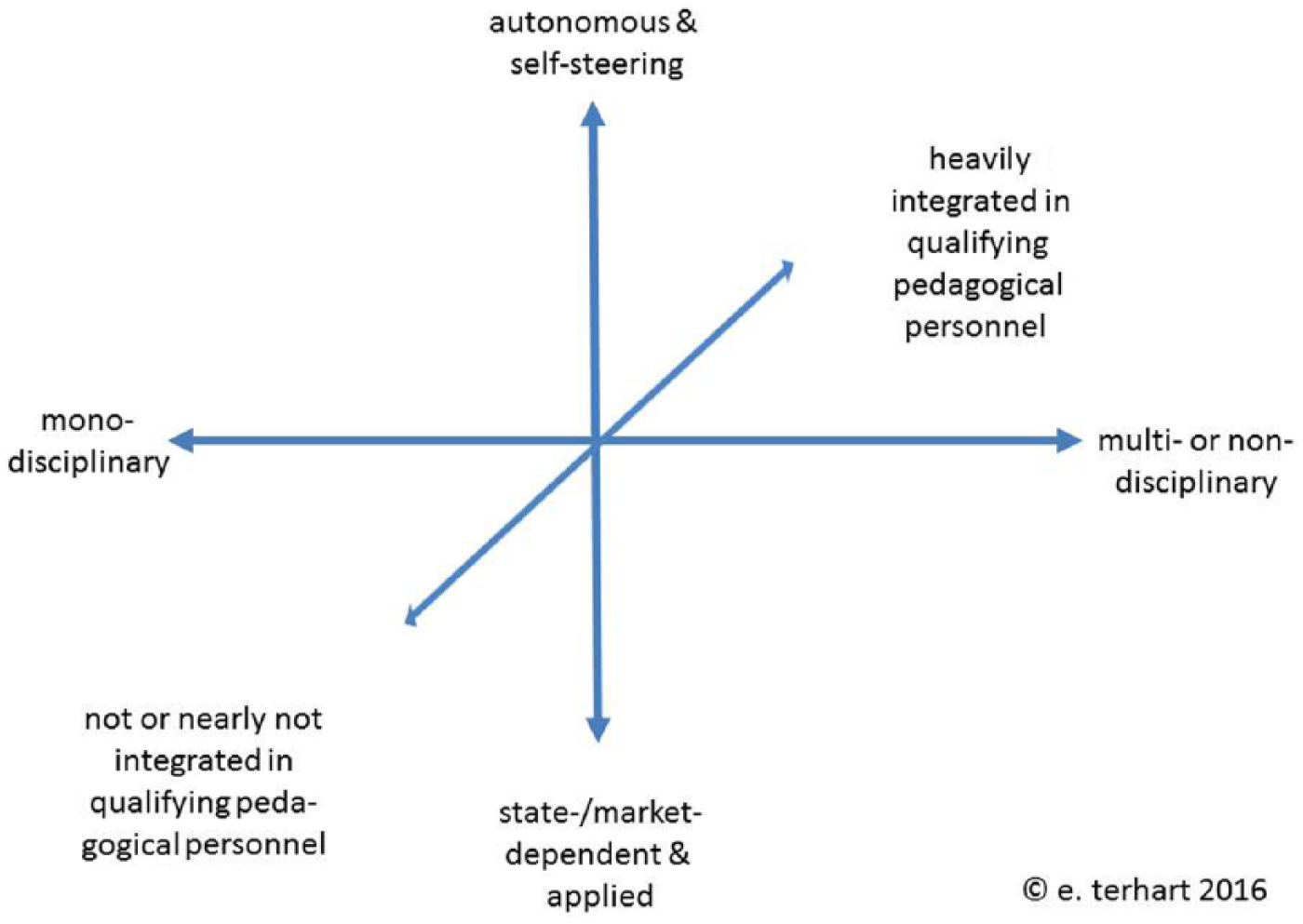
A model of organizing education as an academic endeavour.
These three dimensions open up a systematic space in which the different national institutional forms of education as part of the academic world and the university system can be placed. In addition it should be possible to indicate changes in the forms of institutionalizing education studies and research: because of these permanently ongoing (slower or faster) changes the different forms ‘wander’ through this three-dimensional space.
In the end: just another interim balance
Viewed in retrospect and taking into account all relevant quantitative indicators, the current trajectory of empirical interdisciplinary research on education as a field of study is not only gaining in importance but is also a model of success. It has contributed in a significant and sustainable way to the expansion of knowledge on education, schooling and socialization. Also, the disciplines involved in empirical research on education as a field of study have benefited from the boom in empirical interdisciplinary research. Furthermore, some remarkable shifts concerning the role of the involved disciplines can be observed: the importance and visibility of educational psychology and the quantitative research methodology associated with it have increased, both in relation to the sociology of education and to the science of education.
Interdisciplinary empirical research on education as a field of study has clearly flourished. The involved disciplines benefited from this process to varying degrees. Obviously, different expert cultures in the field compete with regard to the questions: Who sets the right agenda? Who defines the major problems? Who has appropriate the methods to deliver promising and useful solutions? Research on education as a field of study and its disciplines obviously gained a higher status within the academic world and also gained public prestige. But included in this broad success story are obvious thematic and methodological biases, theoretical and conceptual weaknesses, and a number of blind spots. It is also obvious that the ‘science of education’ as a discipline, or at least some of its parts, is under pressure in both the field of research and the field of teacher training. All these limits and weaknesses are well-known to experts and discussed intensively (see Baumert and Tillmann, 2016; Terhart, 2015). Viewing and discussing these limitations of the interdisciplinary field of empirical research on education and its disciplines might lead to mutual learning to overcome certain conceptual and methodological weaknesses.
Visions of homogeneity or the idea that in the end a certain encompassing and unifying grand theory for the whole academic endeavour devoted to education – to take into account the broadest scope – will probably never be realized. The absence of such a grand theory and unifying methodology should not be regarded as a deficit, and its creation should not be proclaimed as the visionary aim of all work. In highly specialized, fluid knowledge and science systems with specialized and also constantly changing and competing expert cultures that deal with constantly changing societal realms and challenges, you have to get used to pluralistic, heterogeneous, fluid, inconsistent and incompatible landscapes of theory and research. There will be no other.
Footnotes
Declaration of conflicting interest
The authors declare that there is no conflict of interest.
Funding
This research received no specific grant from any funding agency in the public, commercial, or not-for-profit sectors.