




Abstract
In the global phenomenon of widening participation policy in higher education, lower retention rates for students from less advantaged socio-economic circumstances have potential to undermine the social inclusion agenda of HE. This might be an issue in Europe but is not necessarily the case elsewhere. In this paper we consider statistical data on Australian university students from under-represented groups, retained at similar rates to those of their more advantaged peers. Our data also include print and online media commentary on student retention. In our analysis we draw on Bourdieu’s social theory, particularly his conceptual tools of ‘cultural capital’ and field ‘distinction’. We argue that less-advantaged Australian university students appear to have greater access to the cultural capital privileged in higher education institutions. This tends to undermine claims of retention problems, and of ‘setting up students to fail’, which dominate quasi-policy media forums and have more to do with mitigating a perceived threat to the distinctive character of higher education. Following Wilkinson and Pickett’s observations on the distribution of economic capital within societies, we suggest that the more even the distribution of cultural capital across systems, institutions and groups, the less students’ socio-economic status has to do with their retention in higher education.
Introduction
Widening participation (WP) policies in the UK and Australia, and other OECD nations, have been based, at least in part, on an agenda of increased inclusiveness and social justice. This has entailed luring into university social groups that have previously not been included, including students from low socio-economic status and ethnic minority backgrounds. Evidence from several European nations (Bowes, Thomas et al., 2013) shows that social class had a marked effect on degree completion in Norway, as did ethnicity in the Netherlands. In the UK the retention of non-traditional students in inclusive ‘equity’ institutions is lower than for their non-WP counterparts (Bowes, Thomas et al., 2013; Bowles, Jones et al., 2013). These data and those from elsewhere, which suggest a lower than ideal retention rate for some nations’ student populations as a whole (e.g. Hovdhaugen, 2009; Ulriksen et al., 2010), have led to the perception that the social inclusion intent of WP policies is under threat. In Australia, however, students from disadvantaged backgrounds are retained at similar rates to their peers, yet there persists a sense of public crisis that WP presents a threat to the quality and integrity of the higher education system as a whole.
This paper sets out to respond to two questions arising from these data and public confidence discrepancies:
Why are students from low socio-economic status (SES) backgrounds retained in Australian higher education (HE) at rates comparable with their peers, and higher than similar students in other HE systems within other OECD nations (particularly in the UK but also within other parts of Europe); and
Given their comparable retention, why does there appear to be such panic in Australia about the retention rates of low SES students in Australian HE?
Our responses to these questions are informed by the social theory of Pierre Bourdieu, particularly his concepts of cultural capital (Bourdieu, 1986) and distinction (Bourdieu, 1984). We draw on comprehensive statistical data from official Australian Government sources to show that in 2011, at the height of the nation’s widening participation (WP) policy and practice, and across the 2009–2013 period more generally, differences between retention rates for low SES students and the general HE undergraduate student population were negligible and more evident in ‘elite’ rather than in ‘equity’ universities (i.e. universities with relatively higher enrolments of students from traditionally under-represented groups). We suggest that these comparable rates of retention imply less differential between low and high SES students’ possession of the cultural capital that defines the HE field than might be the case in the UK and in Europe more broadly.
We also show that, despite the data, the retention of low SES students was and continues to be portrayed as a problem, by parts of government (e.g. Lomax-Smith et al., 2011), the media (e.g. Cervini, 2012) and by universities themselves, particularly by the Group of Eight (Go8) – the association of Australia’s oldest and most prestigious HE institutions. In our view, the perceived crisis of attrition and falling standards imagined by these groups can be explained in terms of Bourdieu’s notion of distinction. Once the preserve of the elite, Australian HE has moved towards a mass and now near-universal system (Trow, 1974, 2006). In particular, reforms introduced from 2009 have led to increasing numbers of students in the system, including non-traditional students previously excluded from university participation. We argue that those who have traditionally benefitted most from an exclusive system perceive this expansion as a threat to the social distinction that a higher education once afforded. By way of illustration, we show how vice-chancellors and others from Go8 universities have deployed a range of rhetorical and material strategies and tactics in an attempt to preserve the distinction of their institutions and the qualifications of graduates they produce.
The paper focuses on the post-2009 period and the re-introduction of widening participation policies in Australian HE (see Gale and Tranter, 2011); this is a period that includes a change of government from social–neoliberal to conservative–neoliberal. 1 It begins with an analysis of the perceived problems of widening participation, particularly in relation to student retention, reported in the print media and – to a lesser extent – in government reports. It then compares these perceptions against statistical data on HE student participation and retention, available from the Australian Government Department of Education. The third section of the paper is more strongly theoretical, taking up Bourdieu’s concepts of cultural capital and distinction to explain anomalies between the perception and the reality of low SES student retention in Australian HE. We conclude with propositions for what this account might mean for HE systems in other OECD nations, including the UK and Europe.
Our analysis draws on newspaper and other media reports on issues pertaining to widening participation in Australia – including participation targets, retention rates, equity initiatives, and government policy – sourced through the Newsbank database as well as websites of newspapers and other media outlets such as The Conversation and the ABC (Australian Broadcasting Corporation). The majority of print media articles come from The Australian, the nation’s only national newspaper and the only Australian publication with a dedicated higher education supplement. Searches were limited to pieces published from 2009 (when the issues in question became a significant concern for the higher education sector) and up to 2015 (the time of writing). The arguments in this paper are based on the prevailing viewpoints of student retention that portrayed the changes to Australian HE from 2009 as a threat to the integrity of the system.
Widening participation in Australia
In 2009, in response to the ‘Bradley Review’ of Australian higher education (Bradley et al., 2008), the then Australian Labor Government introduced a number of targets to improve the international competitiveness and social equity of its higher education system. These included two key targets relating to higher education participation and attainment: that by 2020, 20% of undergraduates in Australian universities will come from low socio-economic status (SES) backgrounds; and by 2025, 40% of 25–34 year old Australians will hold a bachelor’s degree (Australian Government, 2009). Historically, the proportion of undergraduates from low SES backgrounds has been low in Australia – at around 16% to 17% for all domestic undergraduate students (DoE, 2014) – compared with their share of the Australian population as a whole (by national definition, 25%). These targets were accompanied by two further initiatives: (1) unprecedented funding for universities and schools to form partnerships to ‘raise’ the aspirations for and participation in HE of young people traditionally excluded from university, this funding to be delivered via the Higher Education Participation and Partnerships Programme or HEPPP (DoE, 2014); and (2) the staged removal of limits on the number of university places funded by the government in what became known as the ‘demand-driven system’ (Pitman et al., 2015; see Gale and Parker, 2013 for further details of the funding arrangements in Australian HE).
Despite the nomenclature, these reforms were unlike any previous changes to Australian HE in that they were not driven by significant unmet demand for university places but rather by the aspirations of government to transform the nation into a ‘knowledge economy’ while at the same time pursuing greater ‘fairness’ and social justice (Gale and Tranter, 2011; Rizvi and Lingard, 2011). Against this backdrop, more students, particularly those from low SES backgrounds, entered Australian universities, though not in the numbers imagined by the government or sufficient to meet their targets (Sellar et al., 2011; Birrell et al., 2011). The image was of university doors being flung open so that all ‘deserving’ individuals could gain access, regardless of their capacity to pay, in contrast to previous periods of arbitrary limits on student numbers imposed by government.
While there was widespread support for these ‘equity’ policy directions and the cluster of funding priorities that accompanied them, a sense of panic and crisis, that something was awry, also emerged in the public discourse. Notable among the concerns was the view that more students in the system, including more from low SES backgrounds, presented a threat to the quality of Australian HE. This is evident in what became a crisis of attrition and falling standards and was typically expressed in the media (particularly the print media), peak industry groups such as the Group of Eight Universities (Go8), and politicians, including from the political party that first introduced the reforms.
Retention as problem: the crisis of confidence in widening participation
Cognisant of the ‘mediatization’ of policy (e.g. Lingard and Rawolle, 2004), in what follows we focus on ‘analysing messages for policy, as a kind of analysis of policy’ (Gale and Cross, 2007: 6) or of policy in the making. The media messages are arguably an attempt to construct and influence policy agendas that serve the interests of elite groups in the HE system such as Go8 universities (see Bourdieu (1998) for an account of media constructions). The media do not merely report the ‘facts’ but actively construct issues and problems that imply particular responses. However, in this paper ‘naming the messages’ and ‘the assumptions that inform them’ (Gale and Cross 2007: 7–8) are of greater importance to our argument than the extent to which the print media attempts to influence policy.
In our analysis, we characterise this media commentary as having three overlapping strands:
Increased student access leads to increased student drop out, due to the number of allegedly academically ‘under-prepared’ students who also are presumed to have cultural deficits that prevent their social integration into university life;
The extent of drop out is unacceptably high and costly for governments, universities and students; and
Lower university entry scores are indicative of dropping standards, which in turn is assumed to devalue degrees and weaken the nation’s international reputation.
These issues become intertwined and often conflated, and rely on assumptions about ‘non-traditional’ students and their perceived deficits (c.f. Quinn, 2004; Quinn et al., 2005). We begin with what is perceived to be the root of the problem: the alleged academic inadequacies of disadvantaged students.
The perception of ‘under-prepared’ students
Since the most recent introduction of WP policies in Australian higher education in 2009, a key theme in both media reports and official documents has been that ‘drop out’ is almost a foregone conclusion for students from low socio-economic status (SES) backgrounds because they are ‘under-prepared’ for the rigours of university study. This is reflected in official government documents such as Transforming Australia’s Higher Education System (the Government’s official policy document) with its emphasis on the need for increased ‘academic and personal support’ for students from disadvantaged backgrounds (Australian Government, 2009: 13), and the subsequent review of university funding (Lomax-Smith et al., 2011) with its repeated concern for the challenge of retention in the face of increased enrolments of ‘under-prepared’ and ‘less prepared’ students. The explicit claim in these documents is that ‘…in the context of ambitious participation and access targets, there is the risk that universities may enrol less well prepared students and attrition may rise’ (Lomax-Smith et al., 2011: ix, inter alia). In other words, WP is potentially ‘setting up students to fail’ (Cervini, 2012). The logic proceeds: Now that the government has lifted the cap on the number of students institutions can enrol, more students are going to university. To fill course quotas, many universities around the country have dropped their entrance scores. … [but] What’s the use of taking more students if there’s a big chance they will drop out? (Cervini, 2012; emphasis added)
In short, students from disadvantaged backgrounds are seen to be under-prepared to enter the system by virtue of their low entrance scores or ATARs (Australian Tertiary Admissions Ranks). Yet, in Australia, as elsewhere in the world, school SES is closely associated with school achievement and performance on standardized tests (Teese and Polesel, 2003; Perry and McConney, 2010a, 2010b). For students from low SES backgrounds, this typically means they will have lower ATARs. However, ATAR is not a good predictor of academic success at university level – particularly in the health, education and humanities disciplines (Dobson and Skuja, 2005) – nor it is a measure of absolute ability, but a ranking of performance relative to other students in the same year (Pitman et al., 2015). That is, ATARs indicate where students are numbered in the queue for university, relative to other students in the same queue. Thus, from one year to the next, ATARs of 80, for example, are not necessarily comparable since they represent the same placing but in different queues. Moreover, ATARs for particular degrees are historically a product of demand for and availability (partly determined by funding) of places, rather than pure measures of required academic ability. These too can vary from one year to the next. In sum, arguments about students’ relative preparation for university tend to conflate these issues and maintain a simplistic, causal relationship between ATARs and academic preparedness.
Despite the complexities of these associations, the general tenor of media commentary is one of concern, even crisis, as shown in newspaper headlines such as: ‘Unis put on notice over accepting low-scoring students’ (Mather, 2013); and ‘Universities ramp up offers to lowest tier’ (Hare, 2015a). Such reporting appeals to an intuitive logic that simplistically equates school performance with future ability; i.e. a poor student at school makes an equally poor student at university. The following is typical of media accounts of this presumed relationship: The point is, can anyone seriously argue that a school-leaver with an ATAR below 40 [out of a possible 99.95] is going to succeed at university? He or she didn’t do well at school, so why is higher education going to be any different? (Hare, 2015b)
The Go8 has expressed similar views, albeit in somewhat more measured tones, that the ‘participation imperative [needs to be] augmented with consideration of a student’s ability to succeed’ (Go8, 2009b: 4). This link between increased access of non-traditional students and the threat of increased attrition is presented as axiomatic, resulting in media pronouncements such as: ‘the strong correlation between low SES and high attrition was only to be expected’ (Hare 2014; emphasis added). Also seen as inevitable is the increased demand for student support services, such as mentoring schemes, to mitigate the higher risk of attrition: ‘The more diversity we have, the more such a scheme will be needed’ (Souter, in Trounson, 2011b).
Such claims conflate low SES participation rates with institutional retention rates by implying that greater participation will adversely affect overall retention. However, as we argue below, the official data indicate that institutions with higher proportions of disadvantaged students have somewhat better retention ratios than institutions with lower proportions of disadvantaged students. The connection between disadvantaged students and ‘drop out’ made in the above comments assumes a deficit of academic ability and of social integration into university culture. In this, they disregard a variety of other explanations for why students withdraw from HE study. (For example, see Quinn, 2004, and Quinn et al., 2005 for their critique of working class ‘drop out’ in the UK.)
The perceived extent/cost of the problem
This perceived crisis of attrition has been reinforced by media reports of opportunistic research, which draws attention to the proportion of students who abandon their studies: ‘some universities are losing 30 per cent of students in the first year, and … research shows that about one quarter of students seriously consider quitting or deferring’ (James, in Healy, 2010). The media has been keen to highlight these ‘alarming’ results: ‘A study last year found the sector-wide attrition rate is almost 19 per cent. … the drop out rate may well rise as the sector expands’ (Trounson, 2011a). There is also a sense of inevitability, with associations made between WP and increased attrition, relying on the assumption that ‘the institutions likeliest to recruit disadvantaged students are also the likeliest to lose students through attrition’ (Ross, 2011). That is, ‘[s]tudents who withdraw are typically … from under-represented backgrounds’ (Harvey, 2015). As one news article reported: …of the 15 universities already above the 20 per cent target in their recruitment of low-SES domestic undergraduates, nine also have attrition rates above 20 per cent. (Ross, 2011)
However, such claims are based on the assumption that institutional retention rates are affected by the mere presence of students from disadvantaged backgrounds – an assumption we discredit below. Further, the seriousness of ‘the problem’ is often expressed in emotive terms – almost as a way of giving it validity – which evoke combat and violence, evidenced in such headlines as: ‘How unis can win the battle of attrition’(Harvey and Luckman, 2013; emphasis added), and ‘Select few win war on attrition’ (Hare, 2014; emphasis added).
Increased attrition is also reasoned by some to be an inevitable result of widening participation policies, which lead to excessive and unacceptable financial costs to institutions and government; a waste of resources. Stemming the tide is seen to be of ‘urgent economic importance’ (Coates, in Lane, 2014), given that ‘student attrition in Australia’s universities comes at a cost of more than A$1.4 billion a year, or an average of A$36 million an institution’ (Hare, 2010). At the very least, increased attrition has staffing implications: ‘If every student is worth A$10,000 to A$20,000 to a university, it doesn’t take too many [to leave] to make up academic salaries’ (Coates, in Lane, 2014). There are also apparent personal costs for students. Drop out ‘breaks a lot of hearts’ (Souter, in Trounson 2011b; emphasis added). According to the media, it is a ‘shattering experience’ for students who are lured into university by WP policies only to realise that ‘they are not able to cope’ (Cervini, 2012).
Arguments against increasing participation in Australian higher education are thus framed in the media in terms of doing the right thing by students both morally (e.g. not ‘breaking hearts’) and materially. A report by the Go8 takes a similar line: If a student is given a place at a university and fails to progress, he/she will incur a Higher Education Loan Program (HELP) debt which will need to be repaid on an income contingent basis. The private returns on this investment will be limited if the study does not lead to a qualification. There is also the opportunity cost to the student of the time spent studying. And a negative experience could be a disincentive to participate in study in the future and become a basis for discouraging family members and friends. (Go8, 2009b: 4)
The influence of Go8 arguments such as this is evident in how these matters are then reported by the media: attrition, ‘newly discovered’ in the context of WP policies, becomes ‘an opportunity cost to students and a waste of scarce government dollars’ (Hare, 2015b).
Perceptions of quality
A third concern often voiced in the public domain is the potential of WP policies to reduce the quality of HE. In this account, quantity is almost synonymous with falling standards. Such rhetoric dominated the higher education sector in the lead up to the 2013 Australian election. As Peter Coaldrake – president of Universities Australia (the peak industry body in Australian higher education) and Vice-Chancellor of the Queensland University of Technology – commented at the time: …the system has been growing very quickly and there are concerns about the sustainability of that rapid growth. We need to be sure the achievement of that target [of universal participation] should not be at the cost of quality. (Hare and Matchett, 2013)
Particularly in more elite universities, quantity is represented as the antithesis of quality and increased selectivity as its solution: ‘If you are in an undifferentiated group of students … you get a lot of junk. But if you are in a selective cohort, it will lift the standard of everyone’ (Hilmer, Vice-Chancellor, University of New South Wales; cited in Hare, 2013).
2
The logic follows that if the government’s widening participation policies are a given, quality needs to be maintained by a group of selective universities – that is, Australia’s Group of Eight (Go8) elite universities. As the Go8’s CEO, Michael Gallagher, argued in 2009, without this ability to be selective, there is a risk that the system as a whole will: …drift to mediocrity … as some universities will divert resources to do what they cannot do well. … Every university cannot be expected to contribute equally to the nation’s achievement of research excellence and equity of higher education access. (Gallagher, 2009)
Moreover, there is seen to be a ‘considerable reputational risk for the higher education sector as a whole if quality is seen to be compromised’ (Go8, 2009b: 4).
This same mix of concerns about quantity, quality, selectivity and economy also found voice outside the sector, in political campaigns leading up to the 2013 election. For example, Kim Carr, Minister for Higher Education with oversight of the Australian Labor Government’s widening participation policies, conceded that ‘given the strength of growth in demand, it is appropriate to (think about) quality and excellence,’ (in Hare and Matchett, 2013).
The opposition spokesman on universities was more pointed: The retention and graduation of these [under-represented] students cannot be assisted by relaxing standards in a pious desire to see no one is left behind … we cannot allow our university sector to meander into mediocrity. If the increase in student participation leads to falling standards … everyone loses: students whose degrees become devalued, the economy which has to absorb under-qualified workers, and our higher education system, whose domestic and international reputation becomes tarnished. Australian universities cannot afford to sacrifice quality to quantity. To do so would be to compromise the edge that our higher education system gives us in educating our own workforce, as well as sacrifice the desirability of Australia as a top destination for hundreds of thousands of international students. (Mason, 2012)
Once elected, the new Australian Government Minister for Education, Christopher Pyne, reiterated: ‘You must be living in a bubble … if you think that there is not an issue in universities about whether there are quality issues about the extraordinary number of students being enrolled,’ (Pyne, in Griffiths, 2013). In one of his first acts as minister, he determined that: We need to review the demand-driven system of university places because there is some evidence that quality is suffering to achieve quantity and it would be madness for us to throw away our international reputation by lessening quality … It’s a very important reputation to maintain and the poison that would undermine that reputation would be a diminution in quality. (Pyne, in Griffiths, 2013)
The Kemp–Norton Review (2014) was subsequently commissioned and recommended not an end to the deregulation of university places but measures to ensure greater differentiation between universities through the deregulation of student fees.
Retention as evidenced in the data: not a problem particular to socio-economic status
However, the media-induced hype or panic about low SES students flooding Australia’s higher education system and diluting its quality does not match the reality. From 2009 (the first year of the HE reforms) to 2013 (the most recent data available at the time of writing) the number of ‘commencing’ (first year) domestic undergraduate students in Australian universities increased from 204,874 to 263,073 (DoE, Selected Higher Education Statistics, Students), a rise of 58,199 (or 28.4%) in five years. Yet despite this growth, the proportion of students from low SES backgrounds participating in HE has remained relatively stable. Since participation records began in the late 1980s (Martin, 1994) the representation of disadvantaged students has remained stubbornly low at around 16–17% of undergraduates (DoE, 2014; Bradley et al., 2008). Over the period from 2006 (before the introduction of HE reforms) to the height of WP in 2011, the proportion of low SES undergraduate students in public universities increased from 16.1% to 17.3% – a difference of 1.2 percentage points (DoE, data request). That is, although the system increased participation in terms of overall student numbers, it did not widen participation very much, since those from disadvantaged backgrounds remained excluded from HE in proportion to the student population as a whole.
The data on retention provide a similar account. In contrast to media reports outlined above, the retention rates 3 of students from low SES backgrounds are largely comparable to those of their peers. For example, in 2012 the retention rate for all domestic undergraduate students was 81.96% while it was only slightly less for low SES, at 80.08%; a comparability also evident in the years prior (see Figure 1).
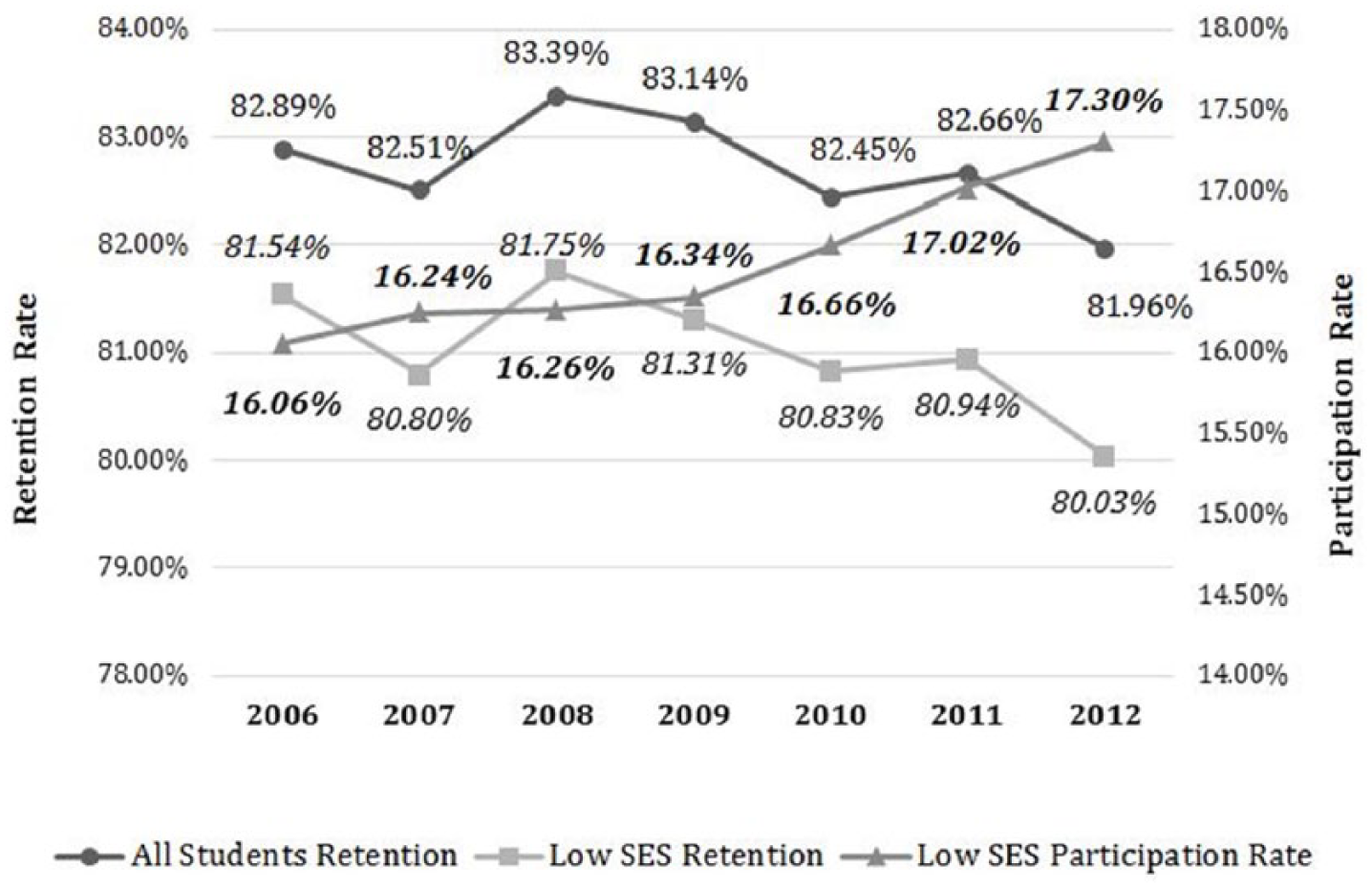
All and low-SES domestic undergraduate retention rates, Table A Institutions, Australia, 2006–2011.
Similarly, the retention ratios 4 of students from low SES backgrounds illustrates that they are retained at about the same rate as their high SES peers. A retention ratio of 1 means that low SES students are retained at the same rate as their high SES counterparts; below 1 indicates a lower retention rate; above 1 a higher retention rate. As Table 1 shows, students from low SES backgrounds across the Australian HE sector are retained at slightly lower rates than their peers with a ratio of 0.98 for most of the years 2006–2012 (2012 is the most recent year for which full retention ratio data are available).
Low SES retention ratios* (undergraduate).
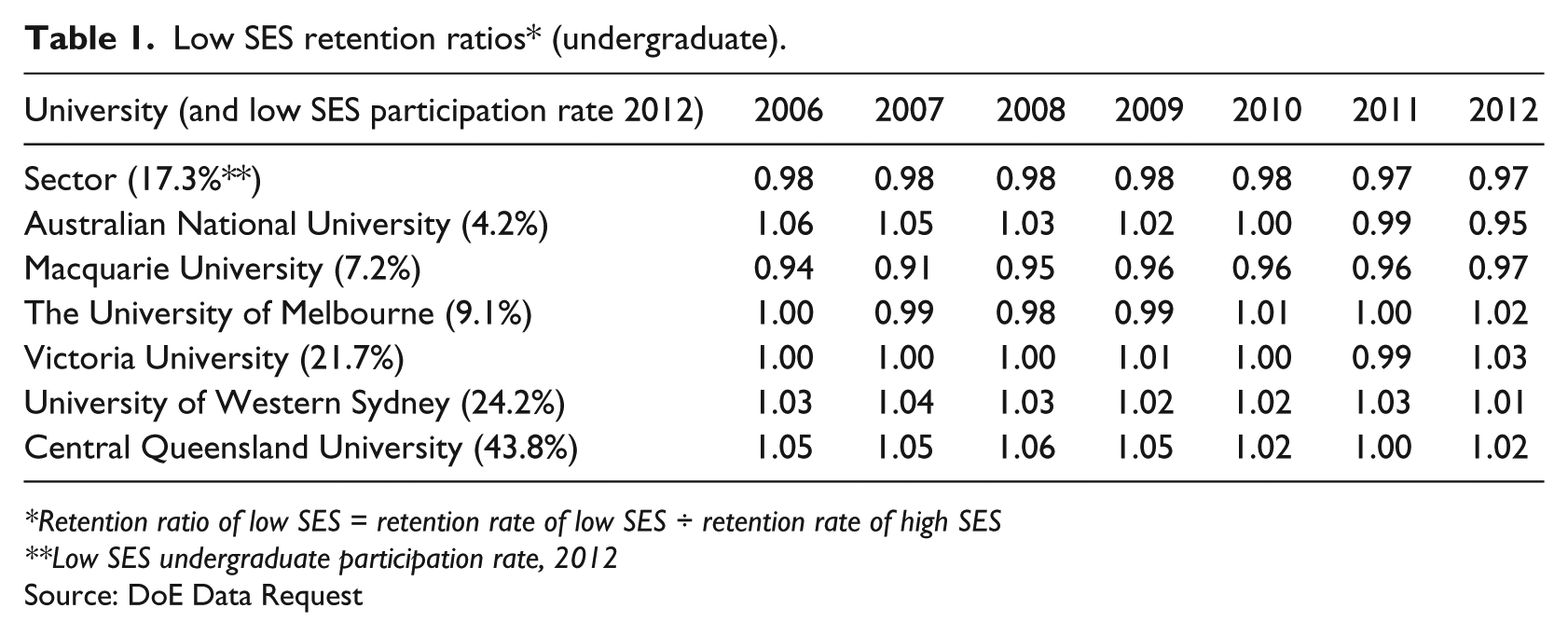
Retention ratio of low SES = retention rate of low SES ÷ retention rate of high SES
Low SES undergraduate participation rate, 2012
Source: DoE Data Request
Table 1 also undermines claims made in the media (e.g. Ross, 2011) that those institutions with higher low SES participation rates experience greater attrition because of the presence of these students. The table illustrates the retention ratios of four institutions: three with lower rates of low SES participation, in universities that are also considered more prestigious or ‘elite’ institutions (high status; low equity); and three with low SES participation rates above the sector target of 20%, regarded as ‘equity’ or ‘recruitment’ universities (low status, high equity). The three universities from this latter category (Victoria University, University of Western Sydney and Central Queensland University – all with very high rates of low SES representation) have retention ratios above 1. Conversely the University of Melbourne (which often appears in international league tables as Australia’s highest ranked university) and Macquarie University have low SES student retention ratios below 1. The Australian National University (ANU) is the exception, with the lowest low SES participation rate in the nation (4.2%), yet its low SES participation ratio has tended to be 1 or better for most of the years 2006–2012, with a more marked drop to 0.95 in 2012.
Overall, these data suggest that, contrary to popular perception, having a larger proportion of students from low SES backgrounds does not drag down an institution’s retention rate. Rather, those institutions with proportionately more low SES students are comparatively better at retaining them and institutions with proportionally fewer low SES students are comparatively worse, with the exception of ANU.
Retention as a function of cultural capital: theorising system, institution, group differences
Given the marked disconnect highlighted above – between the public pronouncements and panic about the ‘problem’ of retention on the one hand, and the official statistics on the other – how might we explain why students from disadvantaged backgrounds are retained in Australian universities at rates similar to their peers, while in other nations they are not? We think one answer can be found in Pierre Bourdieu’s (1986) account of cultural capital, which operates as a kind of certificate of cultural competence often institutionalized in academic qualifications.
Cultural capital is a resource on which people draw in order to navigate social spaces or fields: a knowledge of things valued by the field, including a knowing of how the field operates and how to operate within it. Not all cultural capital has the same value or currency in a given field. People from more advantaged backgrounds tend to have larger reserves of the dominant cultural capital – that is, the cultural capital that dominates the field – enabling them to act like ‘fish in water’ that ‘does not feel the weight of the water, and it takes the world about itself for granted’ (Bourdieu and Wacquant, 1992: 127). In education, this means that students who possess greater amounts of the cultural capital defining the field are able to navigate their way through curriculum, assessment and institutional requirements with relative ease, while others who possess less of the cultural capital dominating the field face greater difficulties: Young people from middle class backgrounds, who are at ease with the language used within educational establishments, the behaviour expected of them, and the values intrinsic to ‘doing well’ at school and college therefore have an advantage over their working class peers, who, Bourdieu argues, have had considerably less access to dominant cultural forms. (Brooks, 2008: 1357)
Bourdieu’s thesis is that the extent to which there is disparity between the cultural capital of schools and that of students explains the ‘unequal scholastic achievement of children originating from the different social classes’ (Bourdieu,1986: 243). We think cultural capital similarly explains differences in student retention between nations, social groups and institution types.
National and system differences in student retention
As with economic capital, cultural capital can be accumulated and exchanged, and possession of more of it enables greater social advancement. Just as possession of economic capital is a marker of material advantage and disadvantage, possession of cultural capital denotes the socially dominant and dominated groups in society. Wilkinson and Pickett (2009) argue that those societies with a more unequal distribution of material wealth experience greater social inequality. The larger the gap between the rich and the poor in a society, the more prevalent are crime, poor health, unequal education outcomes and a range of other similar markers of disadvantage. Conversely, societies that have less disparity between the wealthiest and the poorest are more socially equal, which has benefits for all people. In the same way, we postulate that Australia has a relatively more even distribution of the prevailing cultural capital than is the case in some European nations (such as the UK) that experience lower HE retention among students from disadvantaged backgrounds (Bowes, Thomas et al., 2013). More specifically, in Australia there is less difference in the quantity of the cultural capital that defines the field between advantaged and disadvantaged groups. This is to be expected in a relatively young nation, which has had less time for cultural capital differences to be accumulated to the same extent as in nations with longer Western histories, and is reflected in the student retention data of most Australian universities, with ratios that are close to or equal to 1. Because these ratios are calculated in terms of low and high SES student retention (see Note 2), ratios of around 1 emphasize the closeness and similarities of these two groups in terms of the cultural capital they each possess. To test this proposition, there is clearly a need for more cross-national comparative research that examines in detail official retention and participation rates in different national HE systems.
Institutional differences in student retention
This same observation with respect to national/system student retention differences can be made in relation to differences between Australian universities. The data presented above indicate that the retention of low SES students across the system is lower than the retention rates of mid and high SES groups but that it mirrors that of their institutions as a whole (i.e. with ratios around 1). That is, Australian universities with low overall retention rates also retain disadvantaged students at a lower rate, while the converse is true of institutions with higher overall retention rates. Thus while there is little difference between socio-economic groups within institutions, there appears to be a more significant difference in the quantity of cultural capital between institutions. Universities that typically attract students from more advantaged backgrounds tend to have higher student retention rates overall than those with higher proportions of students from low SES backgrounds. For example, the overall retention rate of undergraduates in 2012 at the University of Melbourne was 90.43%, whereas at Victoria University (which is less than 10 km away from the University of Melbourne) it was 77.05% (see Table 2) The former group at elite institutions arguably possess more of the cultural capital required for academic success at university, while those at ‘equity’ institutions would appear to possess less of it.
Undergraduate retention rates*.
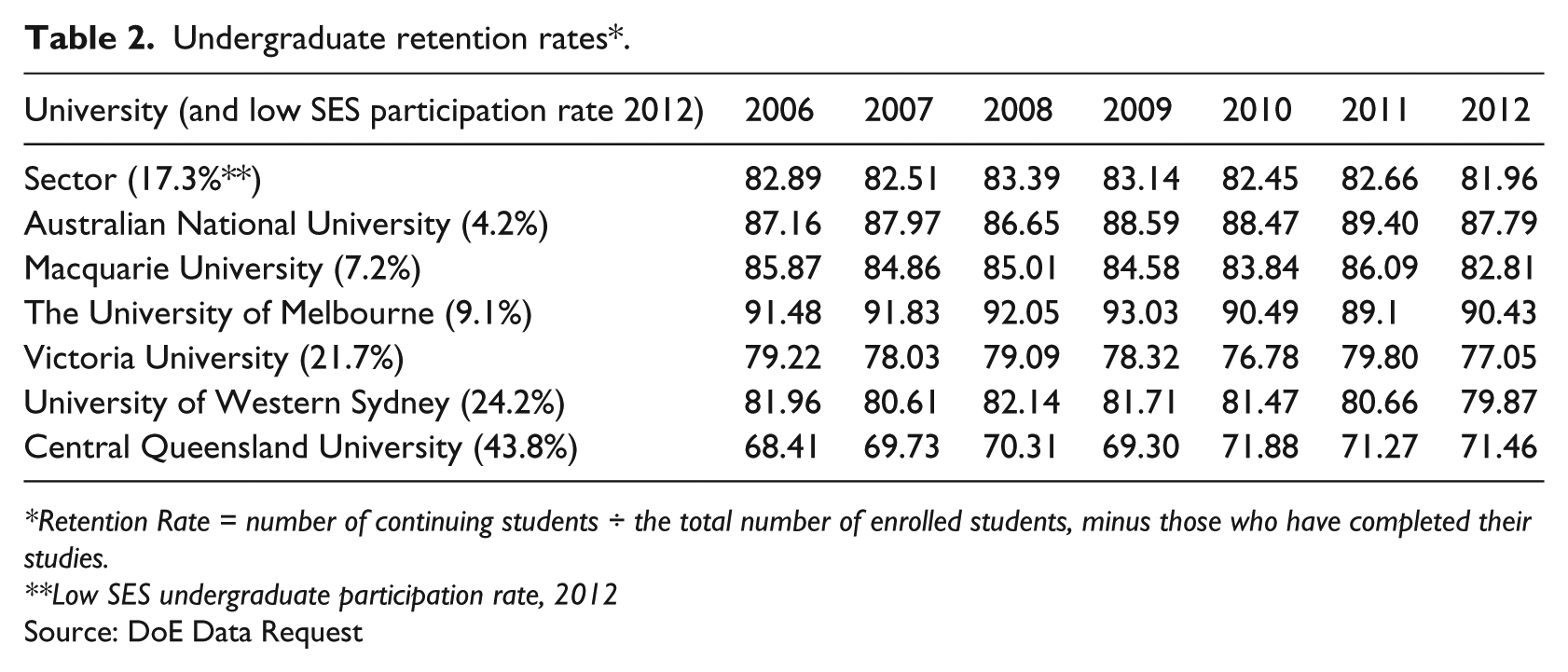
Retention Rate = number of continuing students ÷ the total number of enrolled students, minus those who have completed their studies.
Low SES undergraduate participation rate, 2012
Source: DoE Data Request
Group differences in student retention
While the data show that differences in retention rates between groups (i.e. low and high SES groups) is small, these differences are greatest in Australia’s elite universities, which typically have retention ratios of less than 1. In our account, this suggests a disparity in the quantity of cultural capital possessed by student groups, a difference that is more prevalent in elite institutions with longer histories and hence time to define and accumulate such capital. For Bourdieu (1984), possession of cultural capital is often ‘misrecognized’ as academic achievement and ability. In an HE context, cultural capital is required for student retention as much as an ability and preparedness for university. Grenfell and James elaborate: ‘misrecognition operates in the education system … through an arbitrary curriculum that is “naturalised” so that social classifications are transformed into academic ones’ (Grenfell and James, 1998: 24; emphasis added). Through its misrecognition of cultural capital as preparedness for university, education operates as ‘one of the fundamental agencies of the maintenance of the social order’ (Bourdieu, 1984: 387; emphasis added).
Retaining field distinction: the politics of preserving advantage
In our view, cultural capital is important in explaining differences in student retention across systems, institutions and groups. Systems with comparatively high rates of ‘drop out’ by students from low SES backgrounds would appear to have greater cultural capital disparities than systems with comparatively low rates of drop out by these same students. The same can be said between/within institutions and groups. The fact that cultural capital provides such an explanation is evident in the continued problematization of the retention of low SES students in the Australian higher education system, despite the evidence that shows that attrition is not a problem particular to these students. Instead, ‘the problem’ would appear to be their access to the dominant cultural capital, which undermines the advantages of higher education for traditionally advantaged groups (cf. Brown, 2003; Marginson, 2008). In Bourdieu’s (1984) terms, increased access to and participation in higher education no longer ascribes its graduates with distinction.
Distinction relies on taste: a disposition acquired from one’s social cultural group to ‘differentiate’ between and ‘appreciate’ distinct objects and ways of being and acting. As Bourdieu stated it, ‘Social subjects … distinguish themselves by the distinctions they make, between the beautiful and the ugly, the distinguished and the vulgar’ (Bourdieu, 1984: 6), thus giving different social legitimacy to different kinds of taste (Slater, 1997). A university degree per se loses its beauty, is less distinguished, in ‘mass’ and near ‘universal’ higher education systems (Trow, 1974, 2006).
It is this sense of loss that lies behind the imagined crisis of attrition in Australia. It is what prompts the Go8 to suggest that ‘every university cannot be expected to contribute equally to the nation’s achievement of research excellence and equity of higher education access’ (Gallagher, 2009). Such commentary is arguably an outworking of ‘a system which has become mass in size but which remains elite in its values’ (Wagner, 1995: 21, in Longdon, 2002: 6). The resistance to WP policies seen above is an attempt to protect the distinction (Bourdieu, 1984) and value of the ‘positional goods’ of elite HE in a global market (Marginson, 2006) by limiting access to parts of the market. As Marginson (2006: 4) notes ‘[e]lite degrees and other positional goods confer advantages on some only by denying them to others’. Having positioned themselves in the HE field as superior and distinctive, elite institutions (e.g. Go8 institutions) need to maintain, reinforce and even advance that advantage in the face of massification and universalization (Trow, 1974, 2006), which threatens to undermine their position (Marginson, 2008). In the pursuit of advantage, ‘particular groups are increasingly seen [read: “represented”] as “not fit” for advanced education, as being limited in their abilities, as requiring less of an education than the supposedly more gifted and talented’ (Dorling, 2010: 33).
The persistent rhetoric in the public domain that ‘students who withdraw are typically … from under-represented backgrounds’ (Harvey, 2015) serves to reinstate distinction within the Australian higher education sector and undermine the equity intent of widening participation. In Australia’s case, the rhetoric does not match the reality: student retention is not a function of socio-economic status; and this may or may not be the case in Europe. Either way, the case of WP in Australian higher education highlights the need for policy in OECD nations to move beyond simplistic accounts of retention and attrition that position disadvantaged students as the problem and neglect the power relations that misrecognize them as necessarily under-prepared for higher education.
Implications for higher education in Europe
What then can we say about student retention rates in European higher education? What does the Australian case have to offer by way of explanation? Perhaps the most significant contributions are to offer new foci for research, and to treat with renewed scepticism simplistic accounts offered in the media and by public policy.
Considering the second of these questions first, the Australian example sends European researchers a warning about the self-serving tendencies of popular discourse and its simplistic representation of complex issues in the media and elsewhere. The crisis of retention espoused by elite institutions is often motivated by an interest in maintaining distinction and preserving advantage, which media interests are happy to accommodate. However, issues of retention are too important to be subjected to politicization and self-interest. The warning for European researchers is not to take for granted where the problems of student attrition lie. Persistent problems, such as student attrition, sometimes require re-imagining if they are to be resolved.
More specifically, the Australian case suggests that there is value in European researchers expanding the problem of student ‘drop out’ to include institutions and systems, with potential for investigating how these produce attrition. Bourdieu’s analysis is that education institutions misrecognize the cultural advantages of dominant social groups as academic achievement. Differential access to cultural capital positions disadvantaged groups as less academically able and thus more susceptible to attrition. However, research in European HE that is more culturally informed might reveal how a different privileging of the knowledge of under-represented groups – an epistemological equity in HE (Dei, 2008; Gale, 2013, Gale et al., 2017 forthcoming) – could reduce attrition rates for the disadvantaged. A second refocusing for European HE research is possible through understanding that not all attrition is the result of students being unprepared for HE study. This follows from our first proposition but also from recognition that there are other influences on why students discontinue their studies – including alternative positive destinations as well as financial and family circumstances – and that students from disadvantaged backgrounds tend to be more susceptible to these exit drivers: see Bourdieu on the ‘logic of transmission’ (Bourdieu, 1986: 246) and Gale and Densmore, 2000.
The value of the Australian case to European HE, then, lies not so much in their empirical similarity but in their contrast; their juxtaposition provoking alternative ways of thinking about ‘drop out’ in European HE and thus new avenues for research.
Footnotes
Declaration of conflicting interests
The authors declare that there are no conflicts of interest.
Funding
This research received no specific grant from any funding agency in the public, commercial, or not-for-profit sectors.