




Abstract
Gender-related inequalities in scientific careers are widespread, evidenced by the attrition of women along the different stages of the promotion ladder. We studied the interwoven personal and professional trajectories of researchers in ecology and compared these trajectories between France and Norway. Given their differing welfare state policies and work/family regimes, we expected contrasts in the depth and modalities of the gender gap. We focused on the career consequences of time-use inequalities in the workplace and in the private sphere (domestic tasks and parental care). We find a more frequent assignment of women to less-valued tasks at work (e.g. teaching) and pronounced gender differences in the involvement in domestic and parental tasks, especially in France. Age at promotion and probability to be promoted differed between gender in both countries and more so in France, women being less promoted and promoted later than men. This gender gap was particularly discriminating women with children, when they were either single or with a partner who also was a researcher. These differences are mainly due to a lower scientific productivity of women when they get children. These analyses raise a number of questions on welfare policies and on the definition of academic standards of peer judgment within local employment policies in universities.
Introduction
The gender gap in academic careers is known to be persisting, though to different extents, in most countries where gender studies have been performed. Career attainment of female and male scientists has thus been studied since the 1970s, in North America (Bayer and Astin, 1975; Long, 1990; Long et al., 1993; Zuckerman and Cole, 1975) and more recently in Europe (Acker, 1980; Dubois-Shaik and Fusulier, 2015; Osborn et al., 2000; SHE Figures, 2009). Given that the men/women ratio consistently increases with the advancement of professional careers, most analyses have focused on explaining differences in promotion success of men and women to understand the processes behind this well-known ‘glass ceiling’ effect (Henley, 2015; O’Brien and Hapgood, 2012).
Several subtle processes in the work environment have already been pointed out as acting concomitantly, accounting for the attrition of women along scientific careers. First, the number of published papers has often been shown to be lower for female than for male researchers (Cole and Zuckerman, 1987; Mairesse and Pezzoni, 2015). However, the relation between the number of publications and gender-specific career outcomes is complex. Scientific productivity can mediate the effects of gender on promotion chances, or take part in a circular causation, whereby early career success provides more resources for research and publication, which in turn raises the chances to be promoted and so on (Merton, 1968; O’Brien and Hapgood, 2012; Petersen et al., 2011). According to the ‘male clockwork theory’, the academic career is built upon a male model, which tends to penalize periods of lowered productivity, such as motherhood (Ward and Wolf-Wendel, 2004). The study of such structural factors has been complemented by the identification of men’s and women’s beliefs and attitudes (Sonnert and Holton, 1995). Having been socialized to different behavioural norms, male and female researchers have developed professional ambitions shaped by gender models defining men as more inclined or able to embark upon demanding careers (Marry and Jonas, 2005). The fact that, all other things being equal, women apply less frequently for promotion than men is a compelling example of the role of socialization on the construction of professional ambitions (Sabatier et al., 2006). This is consistent with the observation that, like in other male-dominated working environments (Laufer and Pochic, 2004), academia is characterized by the prevalence of gender-based excellence criteria and promotion systems (Backouche et al., 2009; Van den Brink and Benschop, 2012). Second, allocation of time in less career-wise activities (teaching and pedagogical responsibilities) is more frequently reported by women than men (Lockwood et al., 2013; Zuckerman and Cole, 1975), which, in academic systems where the evaluation of career is mainly based on scientific productivity and impact (Henley, 2015), translates into differential career advancement and reputational gains (Paye, 2013; Rafnsdóttir and Heijstra, 2013; Toren, 1993).
While processes determining the gender gap in scientific productivity and chances of promotion are still debated, a number of studies have pointed to the importance of work–family balance (Van Anders, 2004), parenthood (Cole and Zuckerman, 1987; Kyvik and Teigen, 1996; Ward and Wolf-Wendel, 2004) and family structure (Fox, 2005) on gender differences in professional trajectories. Various studies stress the factor that parenthood accounts for temporary spells of lower scientific performance (productivity, visibility; Hunter and Leahey, 2010; Long, 1992), which can have long-lasting consequences for career advancement (Zuckerman and Cole, 1975). However, the extent to which parenthood impacts careers may depend on the involvement of men in domestic and parental duties, and not only on the family structure. Gender and time-use studies highlight that domestic inequalities are widespread at all levels of professional occupations, though to different degrees depending on country (Forste and Fox, 2012; Sani, 2014). Gender inequalities in science may therefore be produced in the domestic sphere also, through both family structures and involvement in domestic and parental tasks (Comer and Stites-Doe, 2006).
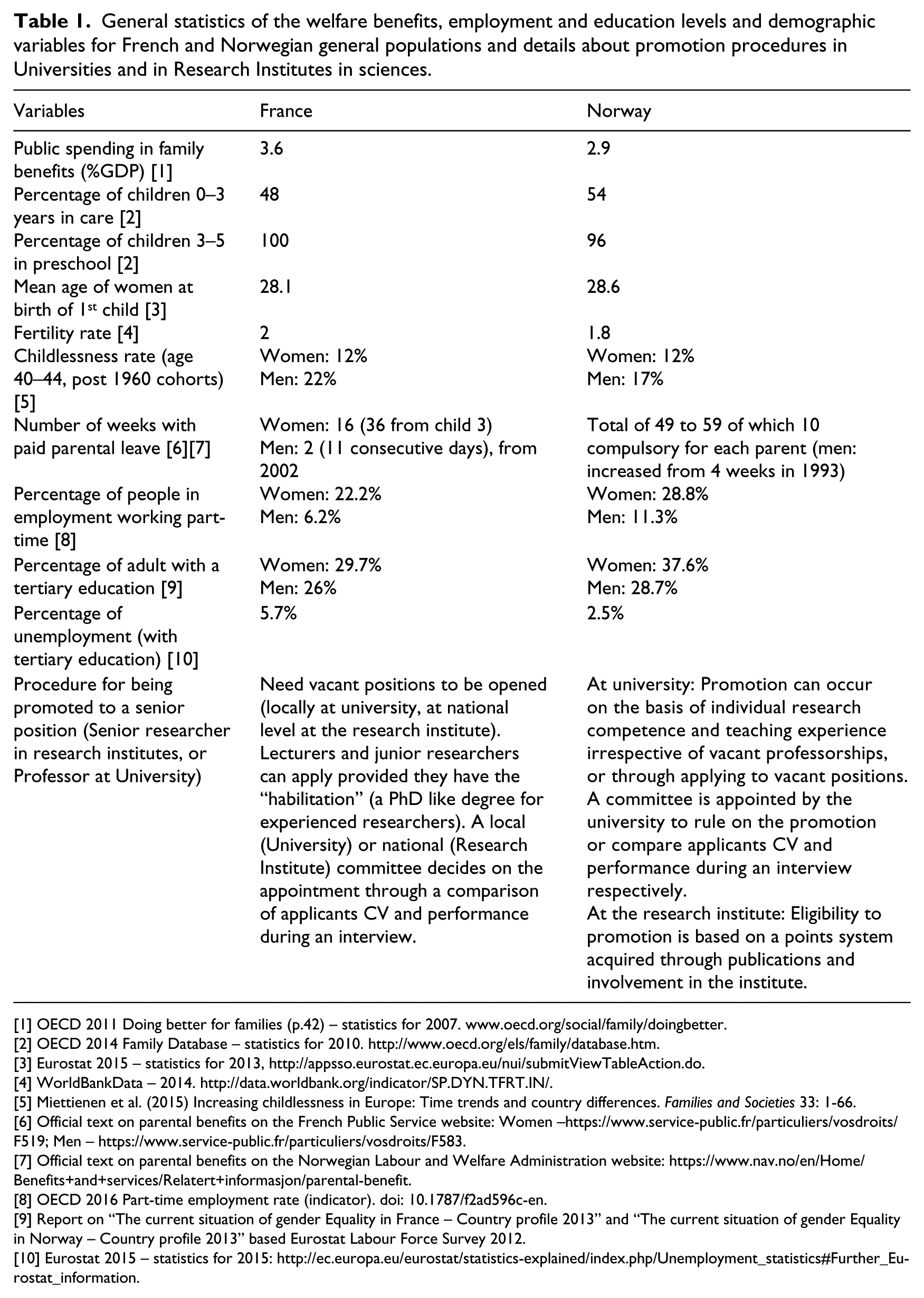
These observations led us to investigate how the articulations between work and family can impact the career dynamics of men and women occupying permanent jobs in scientific research. We compared two countries (France and Norway) that have both implemented welfare measures to help women to combine working and having children, spend a higher proportion of their GDP than EU average on family benefits, provide easy access to care facilities for preschool children, are similar on key demographic components (Rendall et al., 2005) such as the age at birth of the first child birth, the number of children per couple or women childlessness rate (Rindfuss et al., 2010) and have a high proportion of women having completed a tertiary education (see Table 1 for detailed national statistics). These characteristics are all expected to result in reducing gender gaps and differences in career trajectories among men and women who remain childless or not. However, despite these similarities, France and Norway differ in several attributes that could impact women who want to have children to get into and then remain in a scientific career (McGuire et al., 2012; O’Brien and Hapgood, 2012). Women in Norway are, for instance, entitled to a much longer maternity leave than their French counterparts (Table1), resulting in longer research pauses when having children. In addition, age at which lecturers or researchers are recruited to permanent positions is notably higher in Norway than in France (see our results below), which may drive women who wish to start a family out of research to a larger extent than in France, where recruitment often occurs before women start a family (Marry and Jonas, 2005). On the other hand, procedures for promotions are more competitive in France than in Norway (Table 1), and French women who start a family may have slower career advancement than men. In addition, the partition of domestic work between men and women remains more unbalanced in France than Norway (Winqvist, 2004), which could limit time spent working for women in France. Comparing Norway and France therefore provides a way to understand whether high family benefits and ease of access to preschool childcare are enough to help women to pursue a successful career, or if other subtle country-specific processes, at home or in the workplace, impede a better work–life balance for women in academia. We therefore primarily focused on the career consequences of time-use inequalities both in the workplace (time allocation to teaching, research, administration and other tasks) and in the private sphere (involvement in domestic tasks and parental care; Jolly et al., 2014; Toren, 1993), thereby examining the ‘temporal equation’ (Grossin, 1996) of male and female researchers.
General statistics of the welfare benefits, employment and education levels and demographic variables for French and Norwegian general populations and details about promotion procedures in Universities and in Research Institutes in sciences.
[1] OECD 2011 Doing better for families (p.42) – statistics for 2007. www.oecd.org/social/family/doingbetter.
[2] OECD 2014 Family Database – statistics for 2010. http://www.oecd.org/els/family/database.htm.
[3] Eurostat 2015 – statistics for 2013, http://appsso.eurostat.ec.europa.eu/nui/submitViewTableAction.do.
[4] WorldBankData – 2014. http://data.worldbank.org/indicator/SP.DYN.TFRT.IN/.
[5] Miettienen et al. (2015) Increasing childlessness in Europe: Time trends and country differences. Families and Societies 33: 1-66.
[6] Official text on parental benefits on the French Public Service website: Women –https://www.service-public.fr/particuliers/vosdroits/F519; Men – https://www.service-public.fr/particuliers/vosdroits/F583.
[7] Official text on parental benefits on the Norwegian Labour and Welfare Administration website: https://www.nav.no/en/Home/Benefits+and+services/Relatert+informasjon/parental-benefit.
[8] OECD 2016 Part-time employment rate (indicator). doi: 10.1787/f2ad596c-en.
[9] Report on “The current situation of gender Equality in France – Country profile 2013” and “The current situation of gender Equality in Norway – Country profile 2013” based Eurostat Labour Force Survey 2012.
[10] Eurostat 2015 – statistics for 2015: http://ec.europa.eu/eurostat/statistics-explained/index.php/Unemployment_statistics#Further_Eurostat_information.
We investigated researchers in ecology, employed either by a university (with a compulsory teaching load) or by research institutes (with no compulsory teaching), where glass ceiling patterns have already been documented (e.g. Kyvik, 1990 (in Norway); Sabatier et al., 2006 (in France)). Ecology is a field of research where both empirical and theoretical approaches are adopted, and where researchers face contrasted time constraints depending on their involvement in field work. Ecology is also a field where the questions of gender gap have been repeatedly addressed by ecologists themselves (Langenheim, 1996; McGuire et al., 2012; O’Brien and Hapgood, 2012; Primack and O’Leary, 1993), maybe because differences between sexes is a pervasive topic for research in ecology and evolution (Darwin, 1871).
After providing some preliminary figures from our data set, we reported our analyses in three steps. First, we identified a typology of time allocation at work based on the relative allocation to the tasks a researcher has to perform during her/his career (‘Typology of work tasks’, Figure 1), such as teaching and research, but also administrative work, and other responsibilities. We expected strong structures according to the position held by the respondent (with juniors expected to bear fewer responsibilities than seniors, and lecturers to have heavier teaching loads than researchers), by country (with Norwegian academics expected to have a lighter compulsory teaching load than French ones) and by gender (with women expected to be involved more in teaching responsibilities and men more in administrative responsibilities). Second, we explored two aspects of the personal life of researchers (‘Personal life’ box, Figure 1) that could impact their professional advancement: involvement in domestic tasks and involvement in parental care for researchers with different work positions in the two countries (inequalities expected to be lower in Norway than in France; Winqvist, 2004). Finally, we analysed gender inequalities in the unfolding of the academic career (chances of promotion, age at promotion), accounting for family structure, and involvement in domestic tasks and parental care (‘Productivity’ and ‘Promotion’ boxes, Figure 1). Given that the bottleneck to obtain a promotion is narrower in France than in Norway due to different procedures of promotion (Table 1), we expect a lower chance of promotion for women having children, which has been shown previously to impact productivity, in France than in Norway.
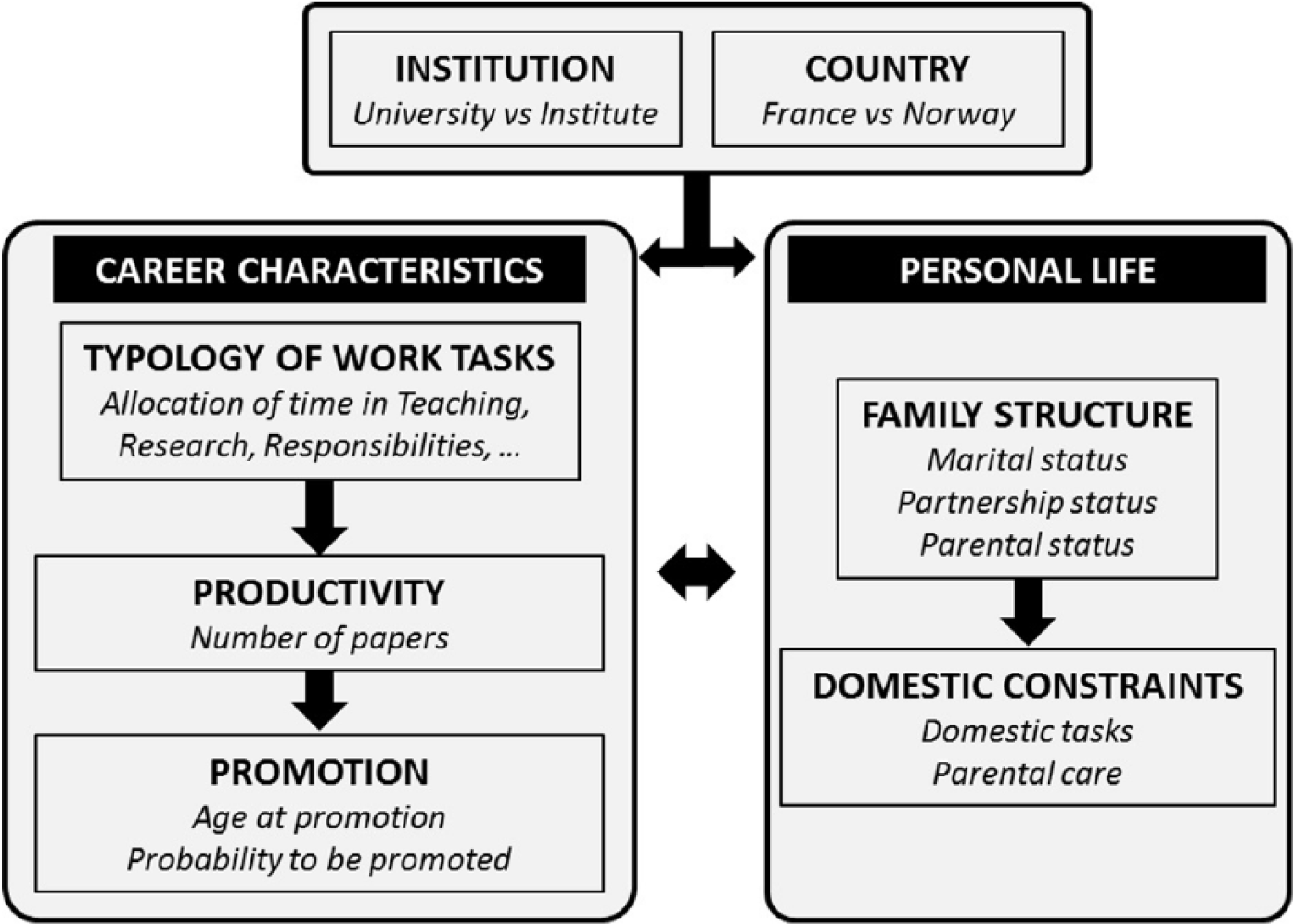
Schematic representation of the variables analysed in this study.
Method and data production
We analysed the answers to an online questionnaire we sent to researchers in 10 laboratories in France and eight laboratories in Norway with the approval of the head of the laboratories, where women accounted for 34% and 23% of the targeted researchers, respectively. In total, 371 persons completed a valid questionnaire (162 in Norway – 46% return rate, and 209 in France – 51% return rate). Of the valid questionnaires, 32% have been completed by women (55% return rate) and 68% by men (47% return rate). All respondents had permanent positions and worked in the field of ecology or evolutionary biology. For the sake of readability, variables are mentioned with a capital letter at the start of the word and are defined in Table 2. The questionnaire included factual questions about personal and career trajectories. Personal situation was described by: Gender, Age, Marital status (Single vs. Couple), Partnership status (partner employed in research or in other sectors), Parental status (having children or not). Professional situation and history included questions about: Age at PhD award, Age at recruitment and Promotion (if any), Working Part- or Full-time. Current position was defined by a Seniority component (Junior vs. Senior) and by an Institution component (University vs. Institute). Another stream of questions allowed us to study more specifically temporal practices at work (Allocation of Time to Teaching, to Responsibilities of Teaching, Administration of Research, Allocation of Time to Common Tasks, and Research Tasks) and temporal practices in the family and personal spheres (Domestic tasks, Parental care).
Description of variables used in the statistical analyses for describing personal and professional life trajectories. The name of the variables is indicated with capital letters in the text as in the second column. The third column specifies whether the variable is continuous or if categorical, gives the name of the different categories.
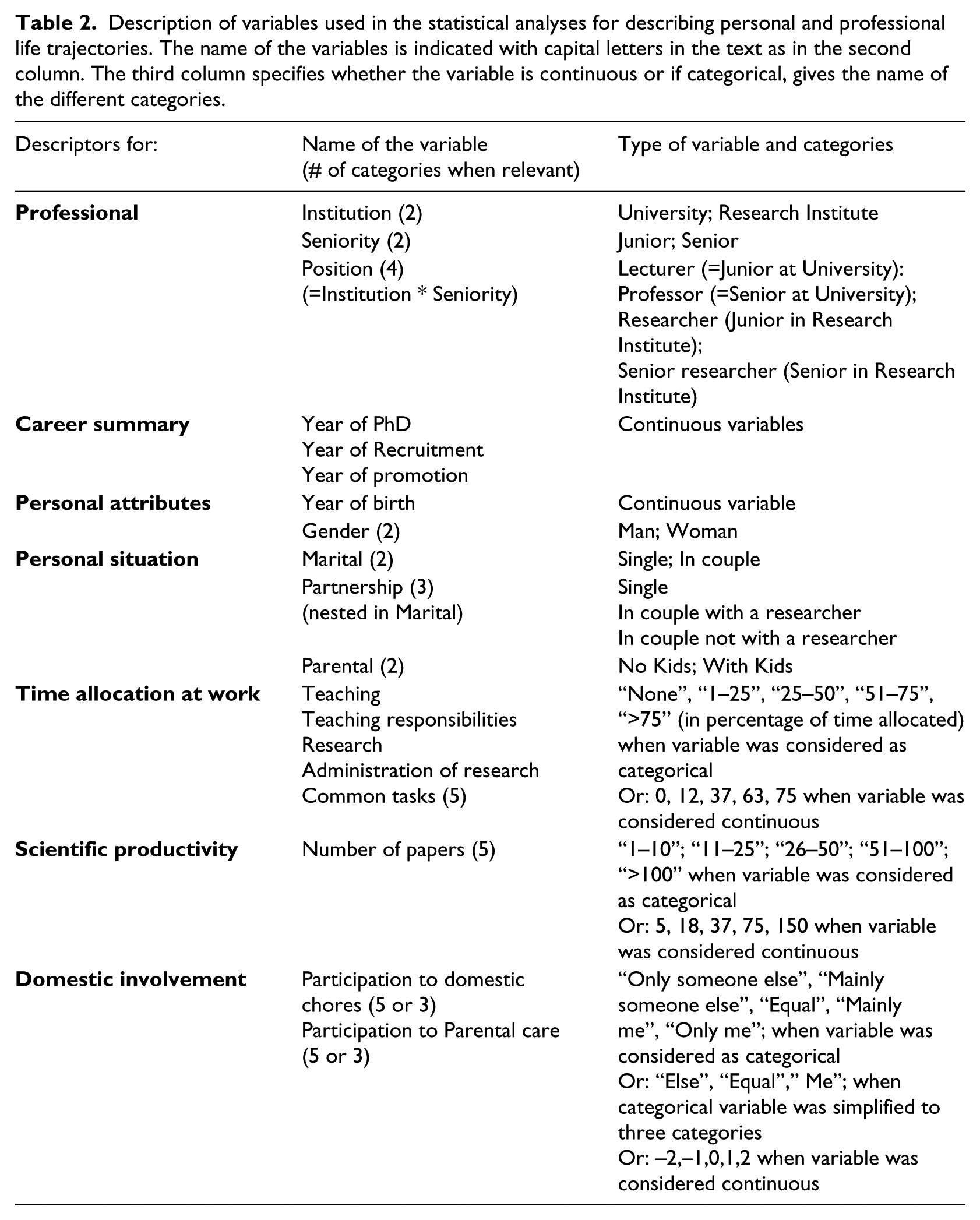
We first analysed time allocation at work (Figure 1), focusing on the proportion of time allocated to Research, Administration of research, Teaching, Teaching responsibilities and Other Responsibilities. Respondents could choose among five categories: None, 1–25, 25–50, 51–75, >75, which were further transformed into a quantitative variable, 0, 12, 37, 63, 75, respectively. This allowed us to calculate the average time spent in each activity by Country, Gender and Seniority level. For a global vision of allocation of time among different tasks, we performed a between-group Principal Component Analysis (PCA) (Dolédec and Chessel, 1987) to identify which variables best explained the different allocations of time between Gender, Position and Countries. Then, focusing on the three variables explaining most of the variation of time allocation, we analysed the effects of Gender and Seniority and their potential interaction on the proportion of time devoted to Research, Teaching, and Common tasks. Given the strong ‘Country’ and ‘Institution’ differences (see results), we replicated the analyses by Country and by Institution.
The gender effect mostly occurred for respondents from University (see results). We thus analysed this group in more detail, using ordered multinomial models with the raw categorical answers for Research, Teaching, and Common tasks. Again, we tested for the main effects of Gender and Seniority, including their potential interaction in both France and Norway. Models were compared using Akaike Information Criterion (AIC). We selected models with the lowest AIC value, based on the parsimony principle as recommended by Burnham et al. (2010).
Then, we analysed two specific aspects of domestic life (Figure 1, box ‘Personal life’), involvement in household tasks (Shopping, Home chores and Meals) and involvement in parental care (Transport of children, Homework, and Other care). Respondents could choose among five responses corresponding to ‘Only someone else, Mainly someone else, Equal, Mainly me, Only me’, which were further quantified by attributing the values −2, −1, 0, 1, 2, respectively. We added these values for the three criteria for involvement of household maintenance and the three criteria describing involvement in parental care, which provided a range of possible values from −6 to 6. We fitted linear models to test for the effect of Country, Gender, Seniority, Parental, Marital and Partnership status on these two synthetic indices. We further investigated the covariation among the six variables used to describe involvement in Domestic tasks and Parental care, focusing on respondents who have children and live as a couple, in order to explore whether respondents that are involved in one task (whether domestic or parental) are also involved in other tasks, or on the contrary, if people ‘specialize’ in some tasks while leaving some others to their partner. We performed a multiple correspondence analysis on the six variables, by reducing the number of categories to three, including ‘Else, Equal, and Me’, and we assessed how the value of each category for each variable covaried by inspecting the correlation circle.
Next, we focused on career trajectories in terms of Age at promotion and Probability to be in a senior position (box ‘Promotion’ in Figure 1). We only considered the major transitions in an academic career (i.e. getting a professorship position at university and a senior researcher position in a research institute). Promotion systems differ between France and Norway (Table 1). We first aimed at evaluating the differences between Country, Gender, Institution, Parental, Marital and Partnership status. Age at promotion was analysed using linear models, and probability to be in a senior position with generalized linear models.
Lastly, we analysed variation in scientific productivity (Productivity as measured by the number of papers published), which is of paramount importance for promotion. We tested for the role of Productivity and for a possible interaction between Productivity and Gender on the probability to occupy a senior position. Respondents could choose among five classes of Productivity (1–10; 11–25; 26–50; 51–100; >100 papers published) which we transformed in a continuous variables (5, 18, 37, 75, 150, respectively). Given that Productivity indeed turned out to influence markedly the probability to occupy a senior position, we then further explored whether Productivity (box ‘Productivity’, Figure 1) varied with Institution, Country, Gender, Parental, Marital and Partnership status, accounting for the number of years since recruitment.
All data handling and analyses were performed with R software (main specific packages used: ‘ade4’, ‘nnet’ ‘visreg’, and ‘MASS’; R Core Team, 2013).
Results
Overall profile of respondents
Respondents were on average 5.8 years older in Norway than in France, likely because we focused on researchers with a permanent position. Indeed, the mean age at recruitment is about 6.4 years later in Norway than in France, partly due to a later start and end of the PhD (longer PhD duration in Norway), and a longer time spent on casual jobs in Norway (Table 3).
Main descriptive statistics of respondents by country and gender.
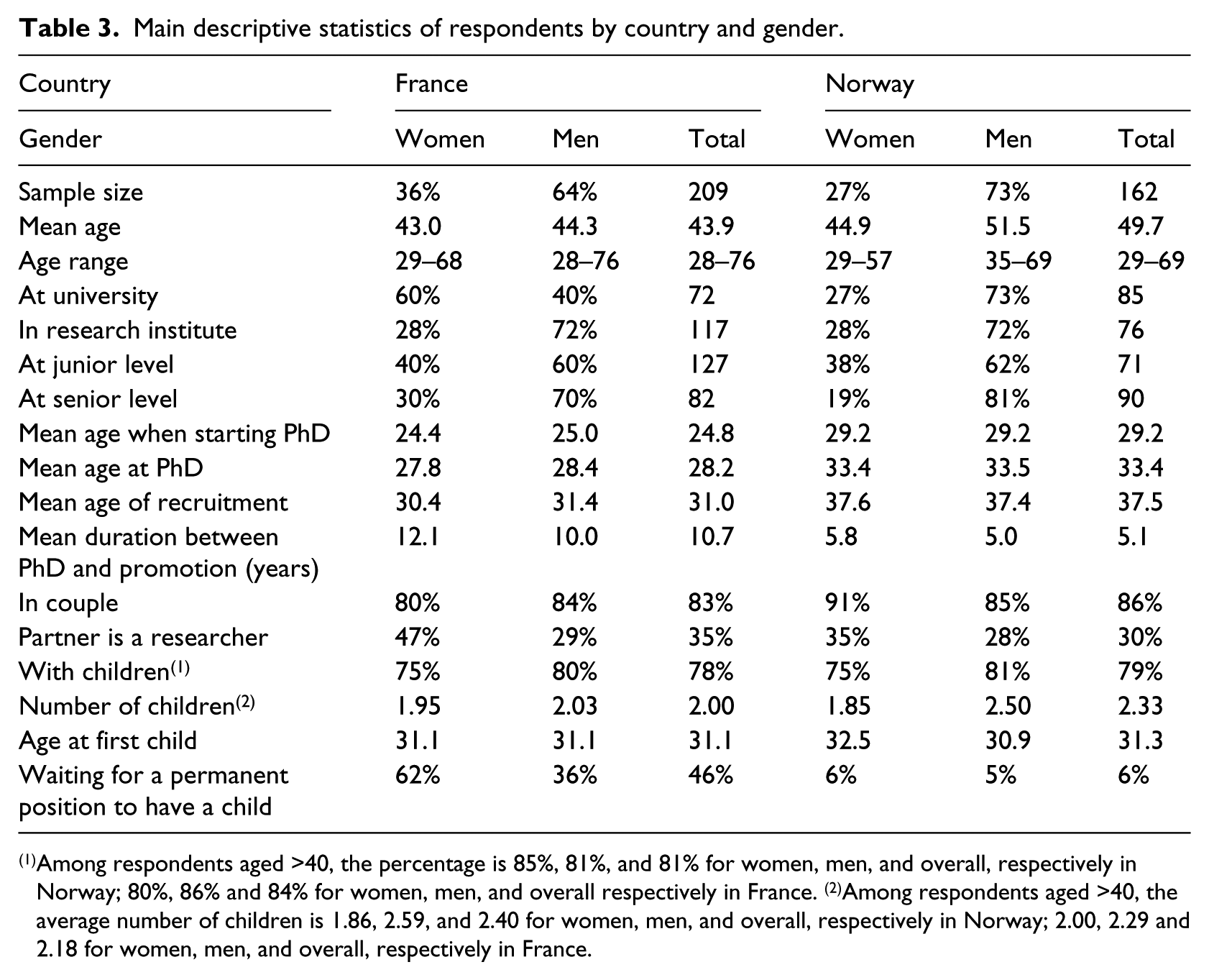
Among respondents aged >40, the percentage is 85%, 81%, and 81% for women, men, and overall, respectively in Norway; 80%, 86% and 84% for women, men, and overall respectively in France. (2)Among respondents aged >40, the average number of children is 1.86, 2.59, and 2.40 for women, men, and overall, respectively in Norway; 2.00, 2.29 and 2.18 for women, men, and overall, respectively in France.
A majority of the respondents worked full-time, but more women than men worked part-time (women: 9.3% in France, 9.1% in Norway; men: 0% in France, 6.9% in Norway, Table 4). Yet, the percentage of men and women working part-time was much lower than in the general population (Table 1), where 22% and 28.8 % of women and 6.2% and 11.3% of men in France and Norway, respectively, work part-time. Strikingly, only women with children worked part-time in France, whereas in Norway, both men and women with or without children could be part-time workers (Table 4). For respondents living in a couple, men had a partner working part-time more often than women in both countries. The gender difference was, however, most pronounced in France (88.3% of female partners vs. 66.1% of male partners worked full-time, Table 4).
Work situation and parental leave (for first-born child) of respondent and respondent’s partner, by Country and Gender.
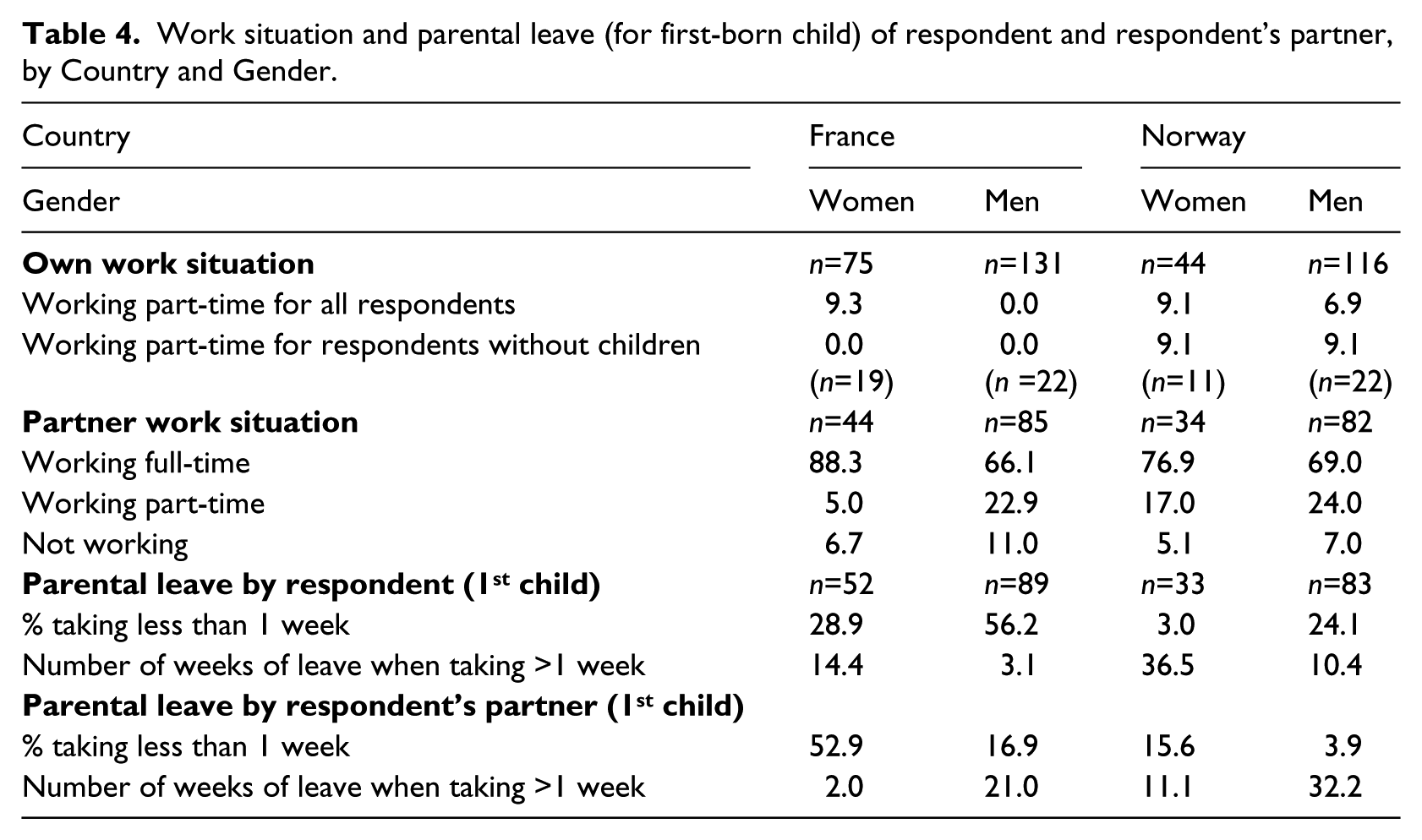
The proportion of respondents >40 who were childless was relatively similar by Gender and Country (slightly less than 20%, Table 3), which is remarkably higher than in the general population for women (12% in both countries, Table 1), but not for men.
The gender and country differences were also strong in terms of parental leave (Table 4). Both the proportion of respondents hardly taking any parental leave (less than 1 week) and the length of the parental leave for respondents taking leave differed by gender and country. Fewer French men took parental leave (44%), which was shorter (3 weeks) compared with women (71% took maternal leave, for 14 weeks on average). In Norway, almost all women took a leave for about 36 weeks, whereas only three-quarters of men took a leave of about 10 weeks. Men and women also differed in terms of having a partner going on parental leave and of the duration of this leave (Table 4). Such gender-specific patterns of leave from both respondents and their partner led men to have shorter interruptions and thereby a weaker impact of parentality on their work compared with women.
A majority of respondents lived in a couple in both countries (86% in Norway, 83% in France). The proportion of respondents living in a couple who have a researcher as a partner was relatively high (about one-third of respondents, Table 3), and more so for women, especially in France (almost half of them declared living with a researcher).
Age at first child was similar in both countries and sexes (close to 31 years of age, see details in Table 3). Women researchers hence had their first child about 3 years later than women in the general population both in France (3.0 years later) and Norway (3.9 years later) (Table 1). Probably as a consequence of the difference in age of recruitment between countries, about one-third of French men and almost two-thirds of French women who had children declared having waited for a permanent job before having their first child, whereas it was the case for only 6% of Norwegian respondents.
Time allocation at work
We first identified the covariation among the five variables measuring time allocation at work by Country, Gender, Institution and Seniority. The first axis of the between-group PCA clearly opposed time allocation to teaching and time allocation to research (Figure 2(a)). The second axis corresponded to a gradient of involvement in common tasks. Three main variables defined the typology of time allocation at work: Research, Teaching, Common tasks. As expected, in both countries, researchers working at universities were closer to the teaching end of the time allocation, whereas researchers working at institutes were closer to the research end of this continuum (Figure 2(b) and 2(c)). Positions on the continuum of research tasks differed between France and Norway. In France, junior researchers were closer to the ‘low involvement’ end and senior researchers were closer to the ‘high involvement’ end, whereas in Norway, all researchers were close to the ‘high involvement’ end of the continuum.
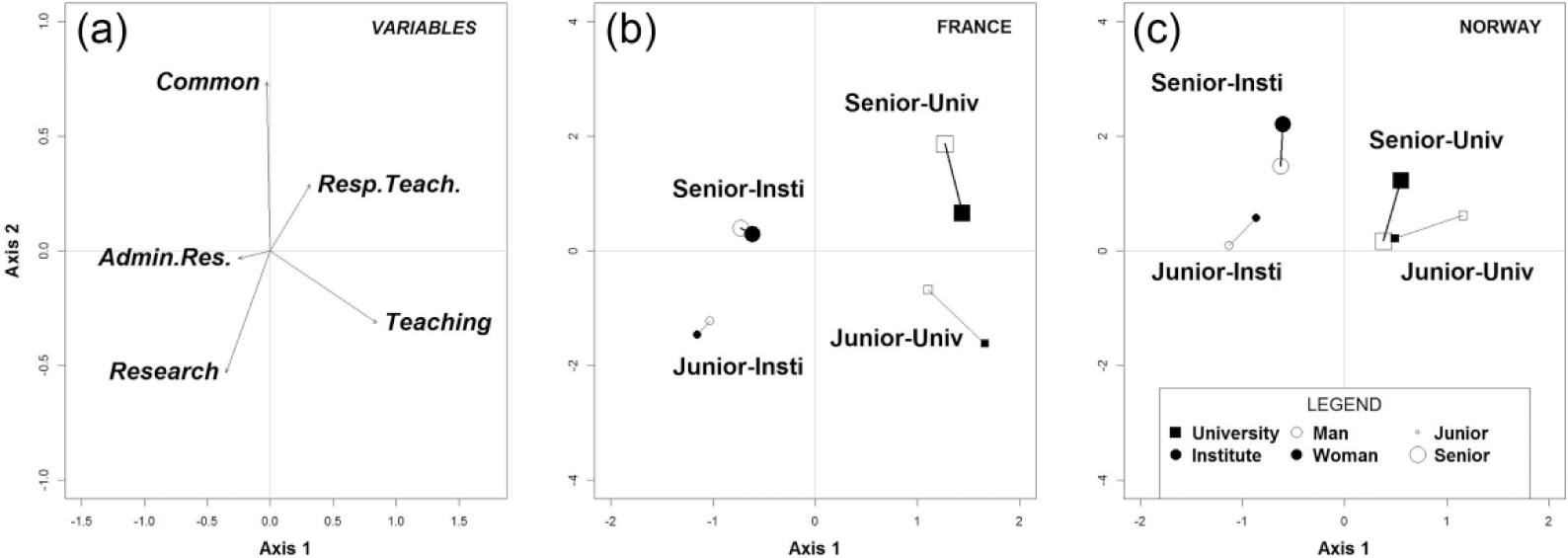
Temporality in allocation of time at work in France and Norway, analysed with a between-groups (Institution, Seniority, Gender and Country) Principal Component Analysis; (a) position of each of the five variables on the first two axes; (b) mean position of groups as defined by seniority, institution and gender in France. Segments pair men and women of the same seniority and institution level; (c) same as panel (b) for Norway. Symbols as followed: circle: Institute; square: University; open symbols: man; filled symbol: woman; small symbol: junior; large symbol: senior.
In France, the analyses of the effects of Gender and Seniority on Teaching, Research, and Common Tasks revealed that women taught more (b=8.07±3.56, t=2.27, p=0.03, Figure 3(a)) while men were more involved in Common tasks (b=7.24±3.32, t=2.18, p=0.03, and Figure 3(c)). Furthermore, Senior respondents allocated less time to Research than junior ones both at University (b=−8.16±4.38, t=−1.86, p=0.07, Figure 3(b)) and Research Institutes (b=−14.73±3.75, t=−3.93, p<0.01, Figure 3(e)) but were more involved in common tasks both at University (b=15.15±3.60, t=4.21, p<0.01, Figure 3(c)) and at Research Institute (b=9.88±2.42, t=4.09, p<0.01, Figure 3(f)).
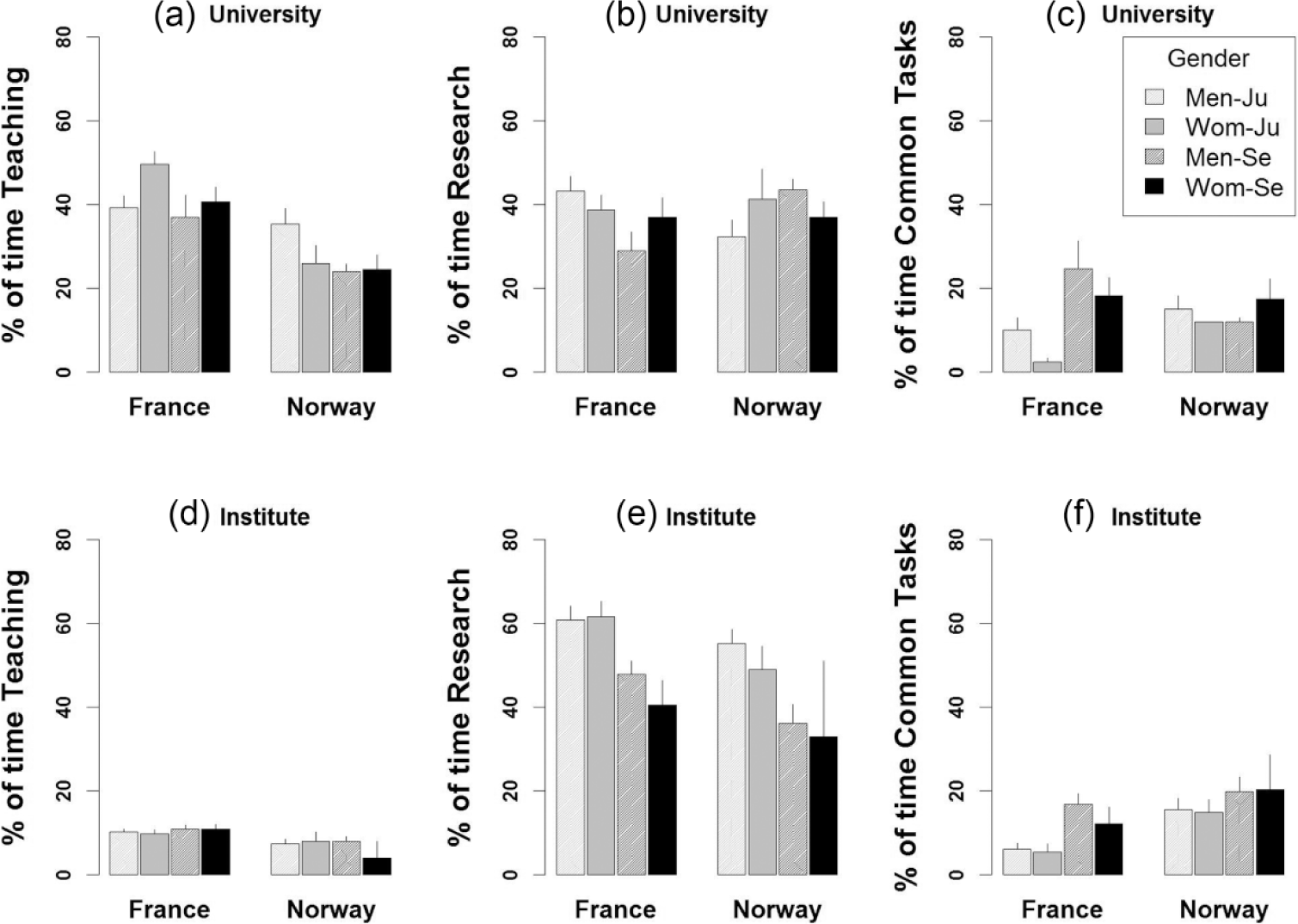
Average proportions (calculated from raw categorical data transformed in quantitative values, see Method section and Table 2) of time spent Teaching (a, d), doing Research (b, e), performing Common tasks (c, f) by Country, Seniority (Junior vs Senior Gender and Institution (a, b and c, University d, e and f, Institute).
In Norway, the only detectable effect was Seniority on Teaching and Research (no effect on time allocated to Common tasks). Both senior men and women at University taught less than junior ones (b=−7.92±3.13, t=−2.53, p=0.01, Figure 3(a)) and senior men and women in Research Institute spent less time doing research than junior ones (b=−17.00±5.01, t=−3.39, p<0.01, Figure 3(e)). We did not find such effect for respondents at University (b=6.51±4.03, t=1.62, p=0.11, Figure 3(b)).
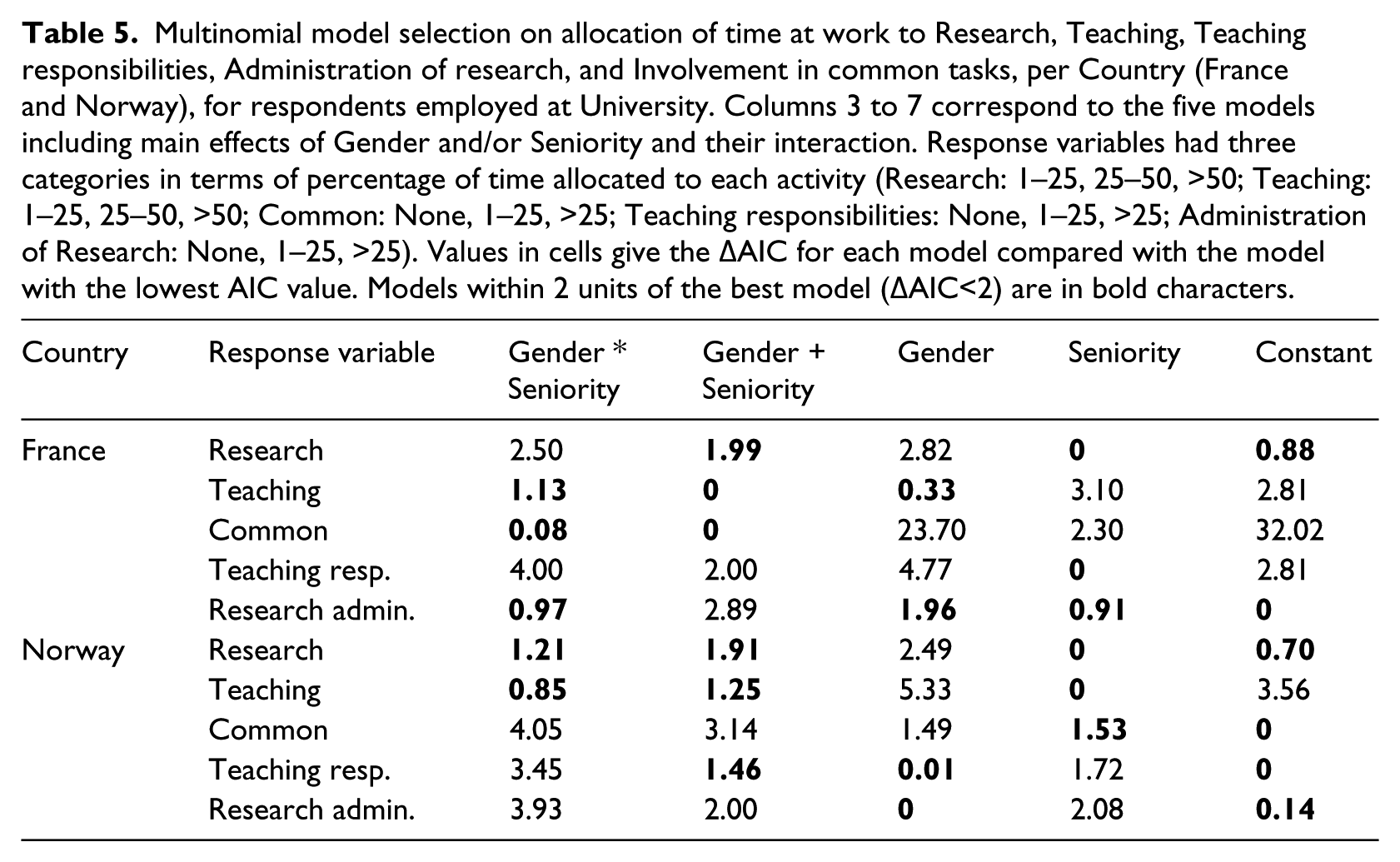
The result that gender mostly matters in France at university for teaching and time allocated to common tasks was confirmed by ordered multinomial analyses (Table 5). These latter, however, revealed some subtle gender and seniority differences in the distribution of the time allocation to teaching that did not show up in the previous analyses. Indeed, more women than men had a high teaching load, especially at Junior level, and more men than women spent less than 25% of their time teaching at both Junior and Senior levels (Figure 4). Men, in turn declared being more involved in common responsibilities, both at Junior and Senior levels. Although more senior men had a high load of common responsibilities (see above), a larger proportion of senior men compared with senior women spent less than 25% of their time involved in common responsibilities, suggesting that the allocation of time at work may be more contrasted in men than in women. No such gender or seniority effects were detected on teaching, research or common tasks in Norway, even when using ordered multinomial analyses (Table 5). This suggests that the Norwegian academic workplace is fairer than the French one, at least regarding division of labour.
Multinomial model selection on allocation of time at work to Research, Teaching, Teaching responsibilities, Administration of research, and Involvement in common tasks, per Country (France and Norway), for respondents employed at University. Columns 3 to 7 correspond to the five models including main effects of Gender and/or Seniority and their interaction. Response variables had three categories in terms of percentage of time allocated to each activity (Research: 1–25, 25–50, >50; Teaching: 1–25, 25–50, >50; Common: None, 1–25, >25; Teaching responsibilities: None, 1–25, >25; Administration of Research: None, 1–25, >25). Values in cells give the ΔAIC for each model compared with the model with the lowest AIC value. Models within 2 units of the best model (ΔAIC<2) are in bold characters.
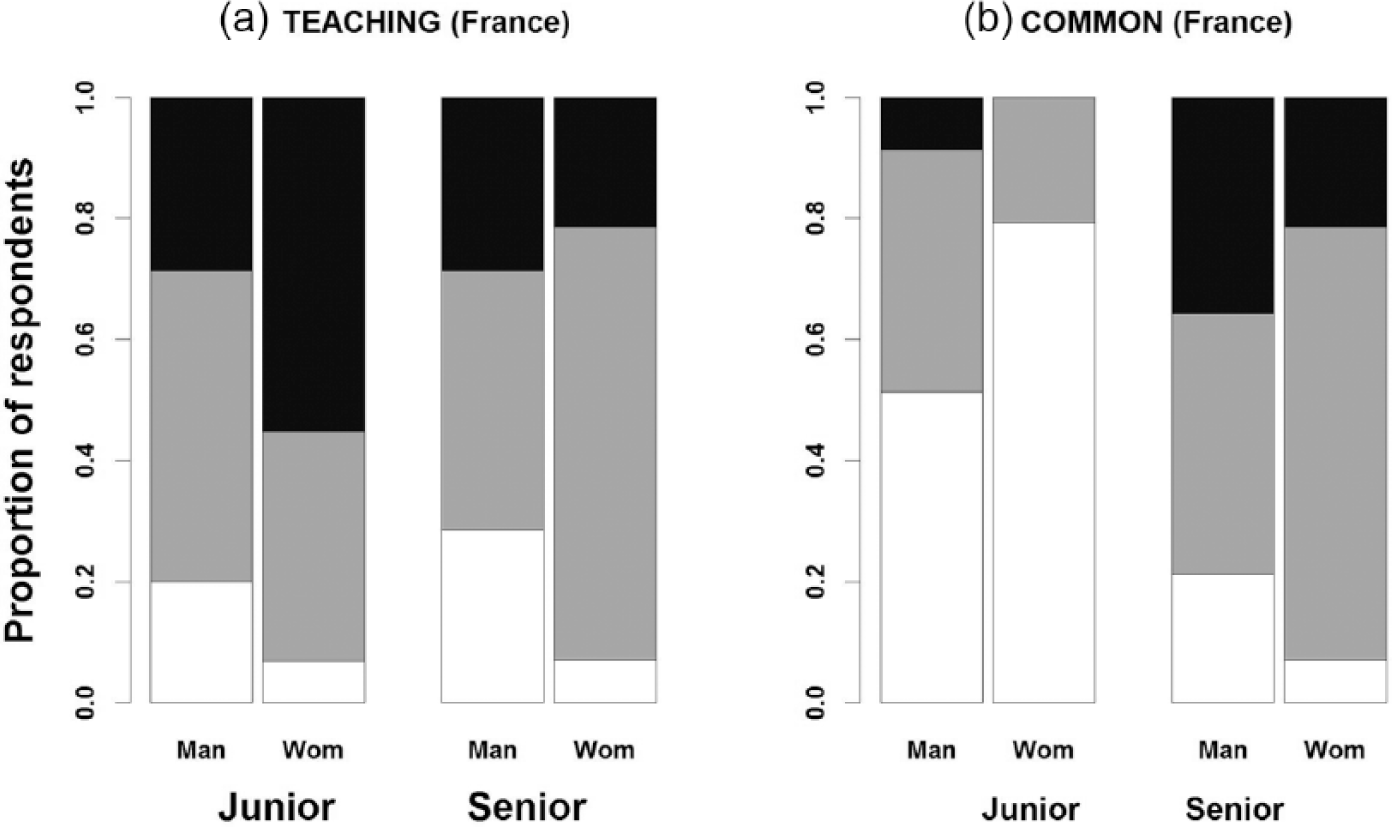
Representation of gender differences in the allocation of time to Teaching (a) and Common tasks (b) for respondents employed at University in France. (a) Gender and Seniority effects on the allocation of time to teaching (1–25: light grey; 25–50: medium grey; >50: black). (b) Gender and Seniority effects on the allocation of time to common tasks (None: light grey; 1–25: medium grey; >25: black).
Time allocation at home
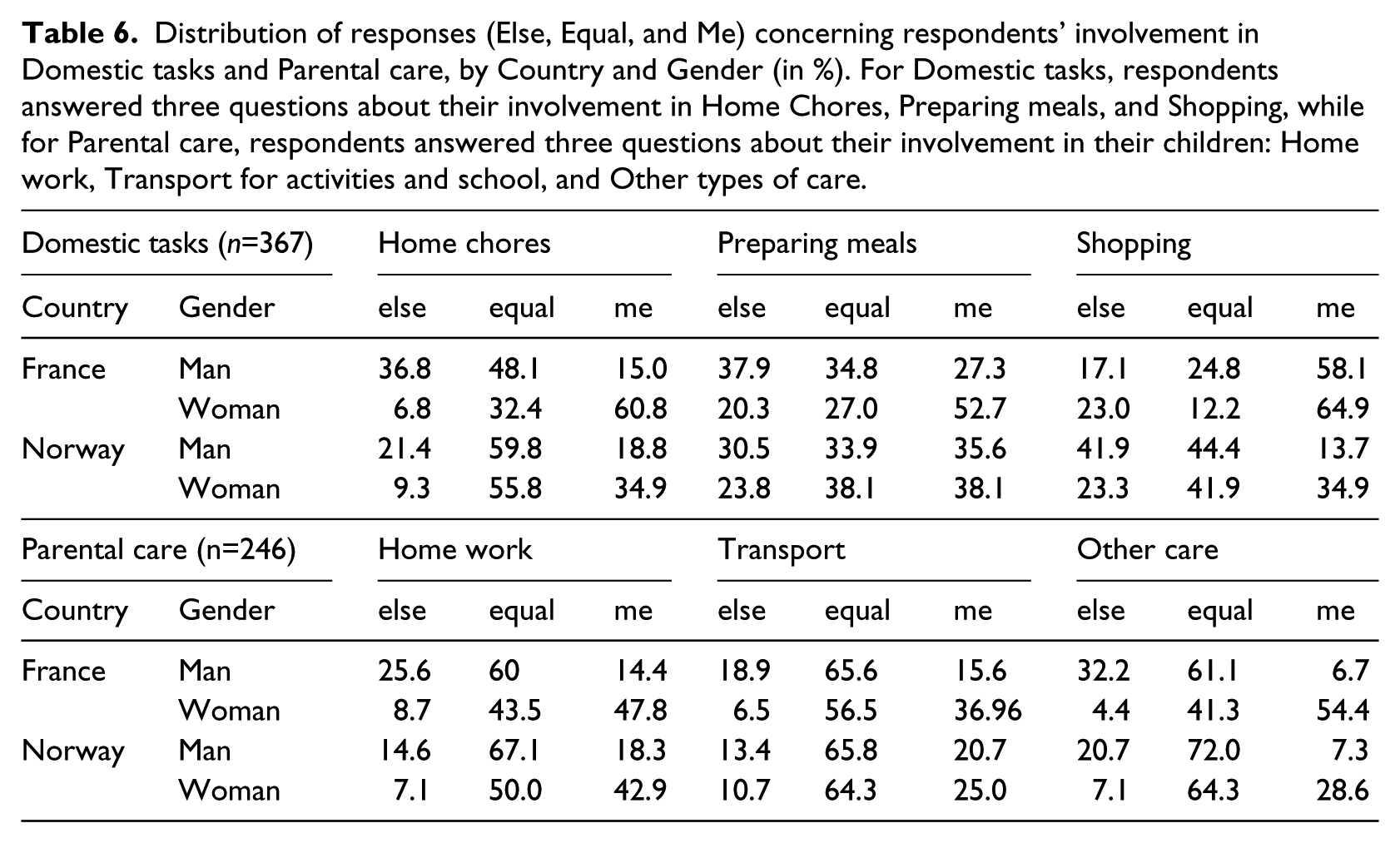
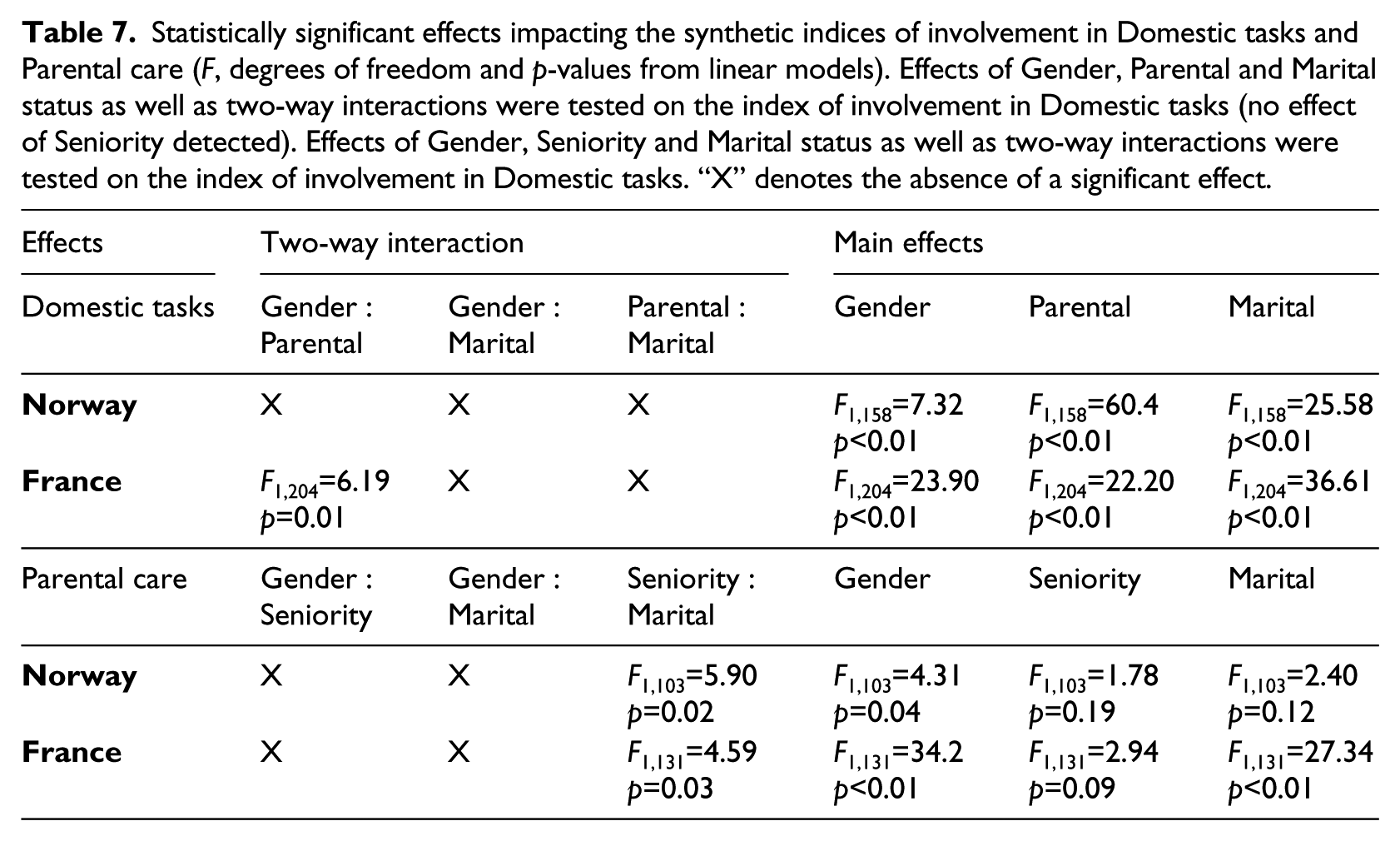
Country differences were important for declared involvement in domestic tasks and parental care (Table 6). Given this strong country effect, we analysed the synthetic indices of involvement in Domestic tasks and Parental care separately for each country (see Table 7 for statistical tests). In general, the overall index of involvement in domestic tasks was higher in France than in Norway (Figure 5(a–c)). In both countries, men and women involvement in domestic tasks depended on whether they had children or not (Figure 5(a, b)). In France, men and women had similar involvement in domestic tasks when they did not have children (both genders declaring on average being more involved than their partner), but women were more involved than men when they had children. In Norway, there were no detectable interactive effects between Gender and Parental status (Table 7), although there was a trend for a more pronounced gender gap for respondents without than with children (Figure 5(b)). As expected, in both countries, respondents living in a couple were less involved individually in domestic tasks than single respondents (Figure 5(c)).
Distribution of responses (Else, Equal, and Me) concerning respondents’ involvement in Domestic tasks and Parental care, by Country and Gender (in %). For Domestic tasks, respondents answered three questions about their involvement in Home Chores, Preparing meals, and Shopping, while for Parental care, respondents answered three questions about their involvement in their children: Home work, Transport for activities and school, and Other types of care.
Statistically significant effects impacting the synthetic indices of involvement in Domestic tasks and Parental care (F, degrees of freedom and p-values from linear models). Effects of Gender, Parental and Marital status as well as two-way interactions were tested on the index of involvement in Domestic tasks (no effect of Seniority detected). Effects of Gender, Seniority and Marital status as well as two-way interactions were tested on the index of involvement in Domestic tasks. “X” denotes the absence of a significant effect.
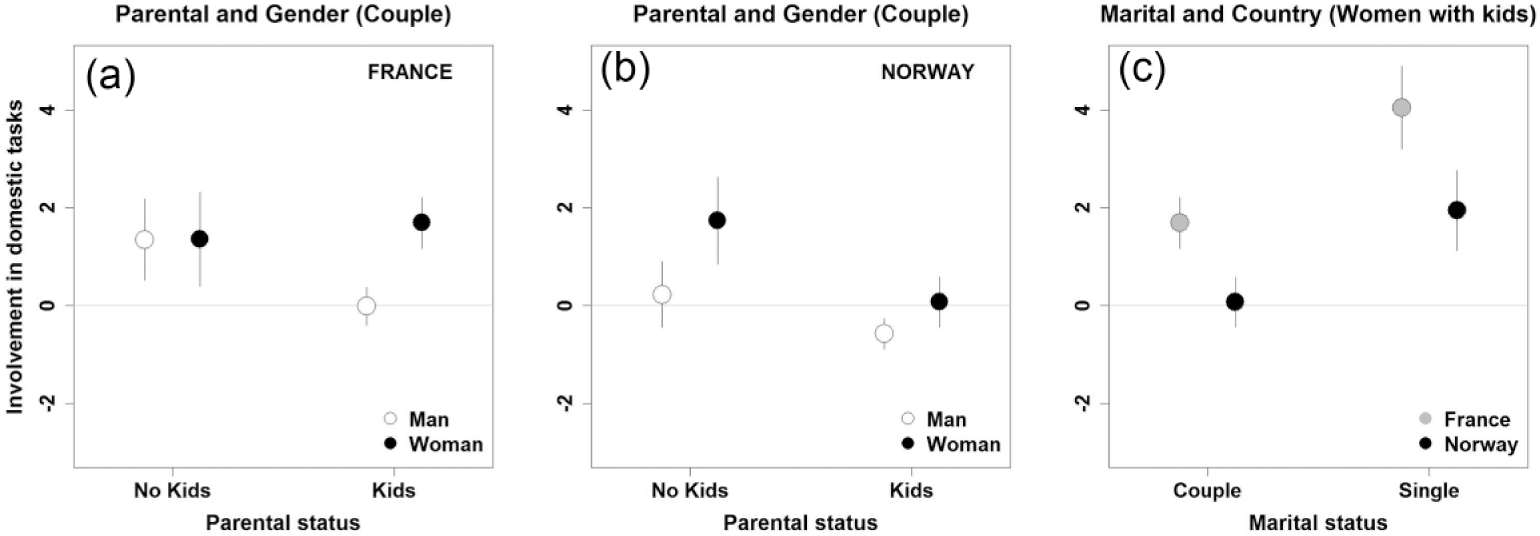
Synthetic index of involvement in domestic tasks depending on Parental status, Marital status, Gender and Country. Each panel shows the conditional effect (with confidence interval) of the focal factors accounting for the other effects retained, based on the models selected as best explaining variation in involvement in domestic task by Country (see Table 7). (a) Interactive effects of Parental status and Gender for France. (b) Interactive effects of Parental status and Gender for Norway. (c) Effects of Marital status displayed for each Country (shown for women with children).
The involvement in activities related to parental care was strongly influenced by the Marital status and by Gender in both countries (Table 6, Figure 6(a, b)), and also by Seniority (Table 7). The gender effect was strong in France, both for respondents living in a couple and single respondents. In contrast, the gender effect was weak in Norway. In both countries, seniority effect had a strong influence on involvement in parental care but only for respondents who were single (most probably because Junior respondents had younger children than Senior ones, Figure 6(c, d))
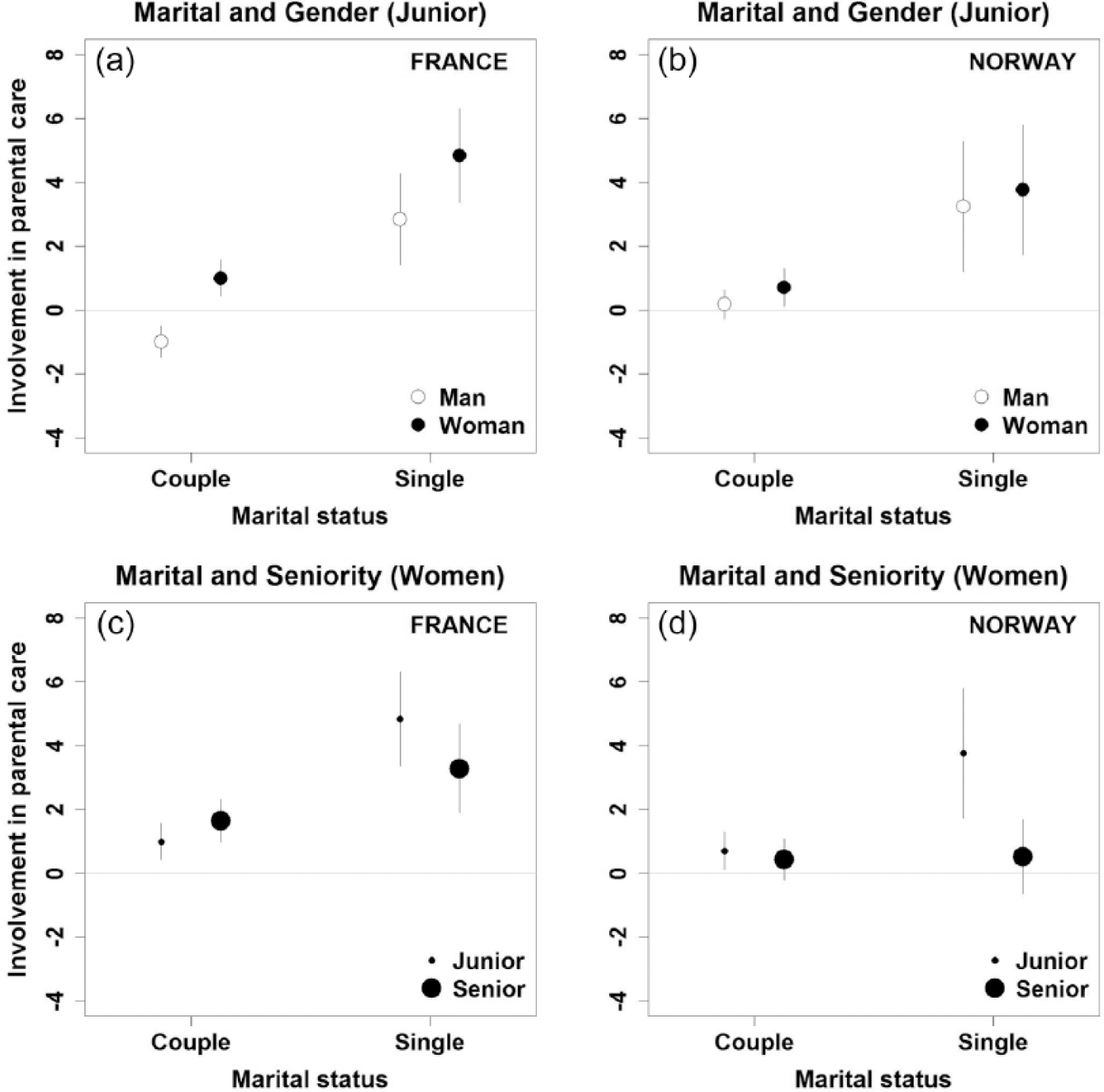
Synthetic index of involvement in parental care depending on Marital status, Gender, Seniority and Country. Each panel shows the conditional effect (with confidence interval) of the focal factors accounting for the other effects, based on the models selected as best explaining variation in involvement in domestic task by Country (see Table 7). (a) Additive effects of Marital status and Gender for France. (b) Additive effects of Marital status and Gender for Norway. (c) Interactive effects of Marital status and Seniority (shown for women in a couple) in France. (d) Interactive effects of Marital status and Seniority (shown for women in a couple) in Norway.
The covariation among variables describing involvement in both domestic tasks and parental care for respondents with children and living in a couple supported a strong segregation of involvement in all dimensions of domestic and parental duties (Figure 7(a, b)). The correlation circle indeed pooled together the Me, Equal and Else answers of all variables.
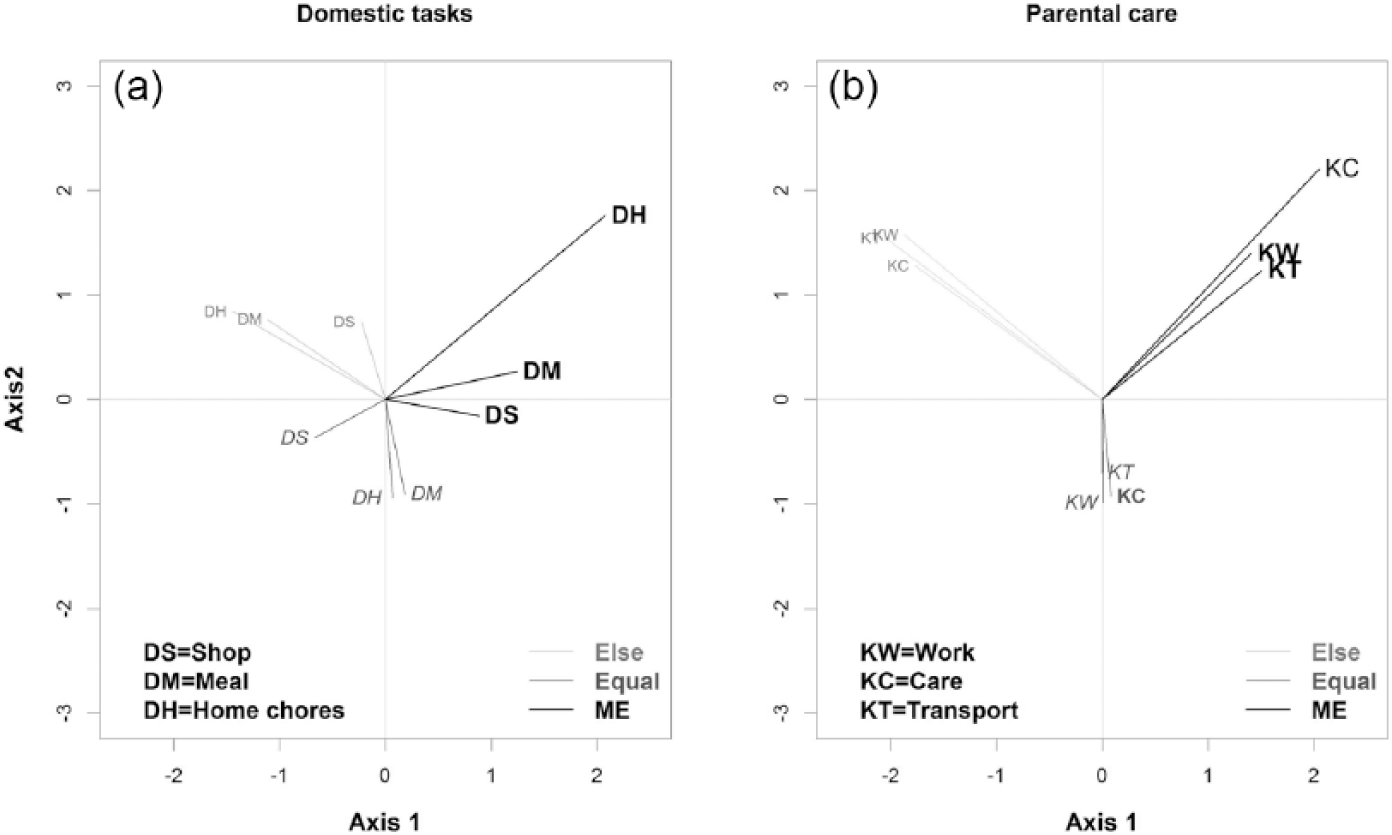
Covariation among variables used to describe Domestic tasks (a) and Parental care (b) including only respondents with children living in a couple. The two panels show the position of each of the three categories (Else: light grey, Equal: medium grey, Me: black) on the same two first axes of the multiple correspondence analyses performed on the six variables (three for domestic tasks – DS: Shopping; DM: Meal; DH: Home Chores; three for parental care – KT: Kid Transport; KC: Kid care; KW: Kid homework).
Effects of personal life and institution on gender-specific promotion
We first focused on age at promotion from a Junior to a Senior position, and on whether it varied with Age at PhD, Country, Gender, Institution, Parental and Marital status, and involvement in Parental duties and Domestic tasks. None of the effects of Institution (F1,143=0.28, p=0.60), Marital status (F1,143=1.57, p=0.21), Partnership status (F1,143=0.28, p=0.60), involvement in Parental care (F1,143=0.32, p=0.57) and Domestic tasks (F1,143=0.03, p=0.87) had detectable effects (nor any of their two-way interaction with Country, Gender and Parental status, tests not shown here). The effects retained in the model were the main effects of Age at PhD and Country, and interactive effects between Gender and Parental status. Age at promotion increased with age at PhD at the same rate in France and Norway (b=0.73±0.09, t=8.16, p<0.01, Figure 8(a)). This slope lower than 1 (95% CI: 0.55–0.90) indicated that the interval between age at PhD and age at promotion decreased with later age at PhD (Figure 8(a)). French respondents were promoted almost 2.5 years later, for a given age at PhD, than Norwegian respondents (b=2.48±0.87, t=2.84, p=0.01). Age at promotion also depended on parental status, but in a gender-specific way (two-way interaction between Gender and Parental status: F1,147=4.30, p=0.04). Accordingly, men with children were promoted earlier, while women with children were promoted later than their counterparts without children (Figure 8(b)) in both France and Norway.
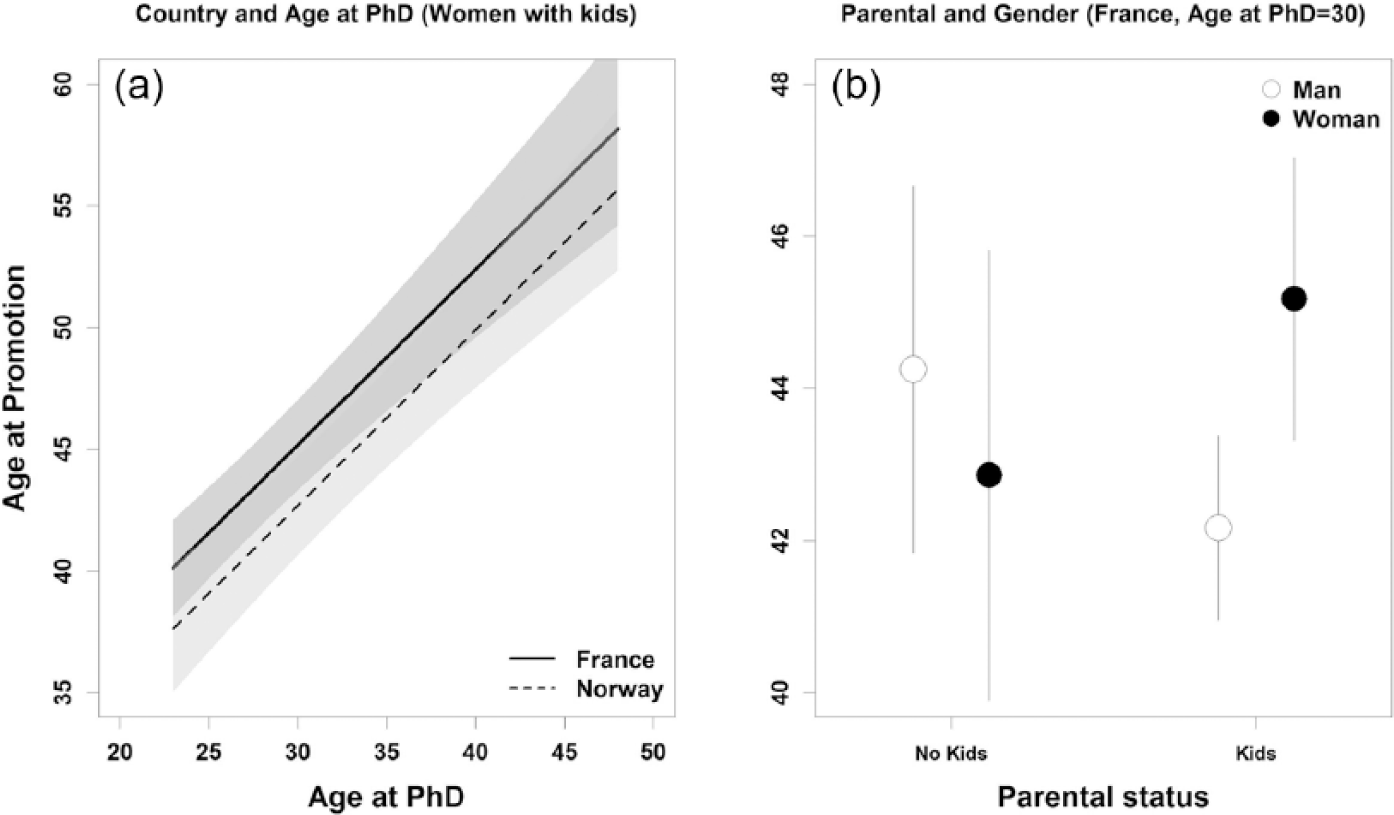
Age at promotion depending on the Parental status, Gender, Country and Age at PhD. Each panel shows the conditional effect (with confidence interval) of the focal factors accounting for the other effects as explained thereafter. (a) Additive effects of Country and Age at PhD (expected values for women with children). (b) Interactive effects of Parental status and Gender (expected values for France, and age at PhD equal to 30).
When analysing the probability to be senior, we tested for the potential effects of the number of years since PhD, Country, Gender, Institution, Marital status, Partnership status, Parental status and involvement in Parental and Domestic tasks with generalized linear models. Three two-way interactions (see below and Figure 9 for interpretation of these interactions) including Gender and Institution (χ2=6.09, df=1, p=0.01), Gender and Partnership status (χ2=8.34, df=2, p=0.01), Gender and Parental status (χ2=6.73, df=1, p=0.05) were retained. Main effects of Country (χ2=23.10, df=1, p<0.01) and Number of years since PhD (χ2=160.00, df=2, p<0.01) were highly significant. Overall, the probability to be senior was lower for a given number of years since PhD in France than in Norway (Figure 9(d)), and as expected, the probability to be senior increased with the number of years since PhD in both countries.
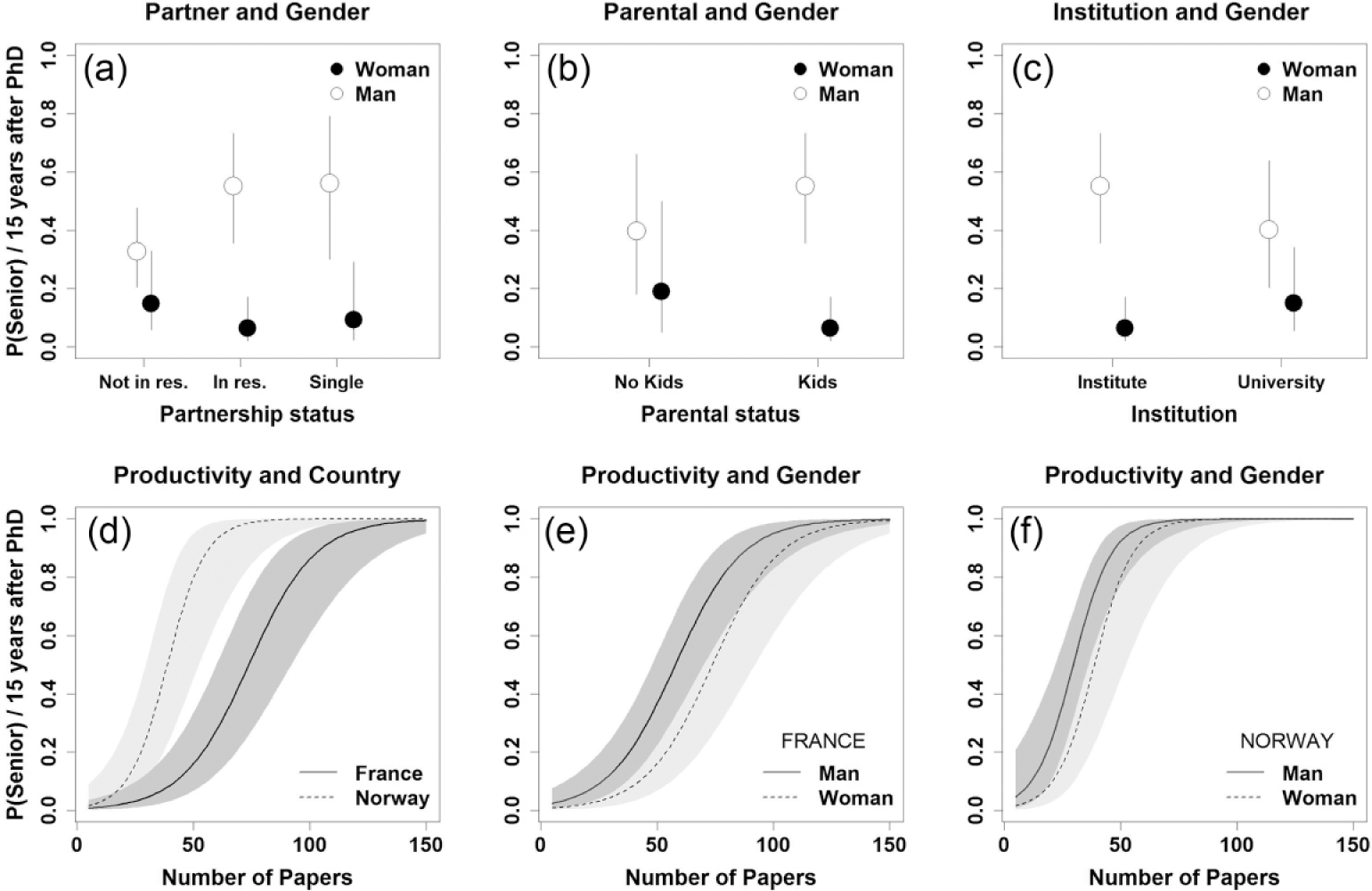
Probability to be Senior (conditional estimates with confidence intervals) according to: (a) Partnership status, and Gender (15 years after PhD, shown for France, Institute and respondents with children); (b) Parental status and Gender (15 years after PhD, shown for France, Institute and for respondents with a researcher as a partner, with children); (c) Institution and Gender (15 years after PhD, shown for France, and for respondents with a researcher as a partner); (d) Productivity and Country (shown for Women working in an Institute – note that in the model including the number of papers, neither partnership status nor parental status matter, see text); (e) Productivity and Gender in France (shown for Institute); (f) Productivity and Gender in Norway (shown for Institute).
Interestingly, the Partnership status better explained the probability to be senior than the Marital status (Figure 9(a)). The probability to be senior did not depend on whether respondents were single or in a couple, but among the latter, depended on whether they were in a couple with a researcher or not. Being in a couple with a researcher was as positive as being single for men and as negative as being single for women, in terms of probability to be senior. The Parental and Gender interaction (see test above, Figure 9(b)) also clearly showed a divergence of influence of personal life on the probability to be senior. While childless men and women did not differ in their probability to be senior (all other variables being equal), women with children had a lower probability to be senior than men with children (Figure 9(b)).
Involvement in Domestic tasks, Parental care and Duration of parental leave did not influence the probability to be promoted once the other effects were accounted for (all p-values >0.15).
Effect of productivity on promotion
Focusing on the importance of the scientific production on the probability to be senior, we found that the Number of publications (considered as a continuous variable) positively influenced the probability to be senior. The model retained included the Number of publications and also the Number of years since PhD (χ2=32.10, df=1, p<0.01, Figure 9(d)), and the two-way interactions between Gender and Institute (χ2=6.68, df=1, p<0.01, Figure 9(c)) and, to a lesser extent, between Country and Number of publications (χ2=3.53, df=1, p=0.061, Figure 9(e, f)). The effects of Partnership and Parental status were no longer detected when the Number of publications was included in the model, suggesting that the effects of personal life characteristics on the probability to be senior may have transferred through the scientific productivity.
We then analysed whether the Number of publications differed by Parental status, Marital status, Partnership status, Institution, Country and Gender, after accounting for the Number of years after PhD. The retained effects included the two-way interaction between Country and Institution (F1,348=19.92, p<0.01) and between Gender and Parental status (F1,348=4.32, p=0.04) with the main effect of the Number of years since PhD (F1,348=224.67, p<0.01). The number of papers increased with the Number of years since PhD, similarly in both countries and gender. The Parental status (Figure 10(a)) had no impact on men’s productivity (b=1.16±5.17, t=0.22, p=0.83) but had a strong impact on women’s productivity (b=−19.14±8.43, t=−2.27, p=0.02). Women with children produced fewer publications. In France, respondents working in institutes had a higher productivity than those at university (b=−25.07±4.43, t=−5.66, p<0.01), while no such difference occurred in Norway (b=6.86±5.45, t=1.26, p=0.21, Figure 10(b)).
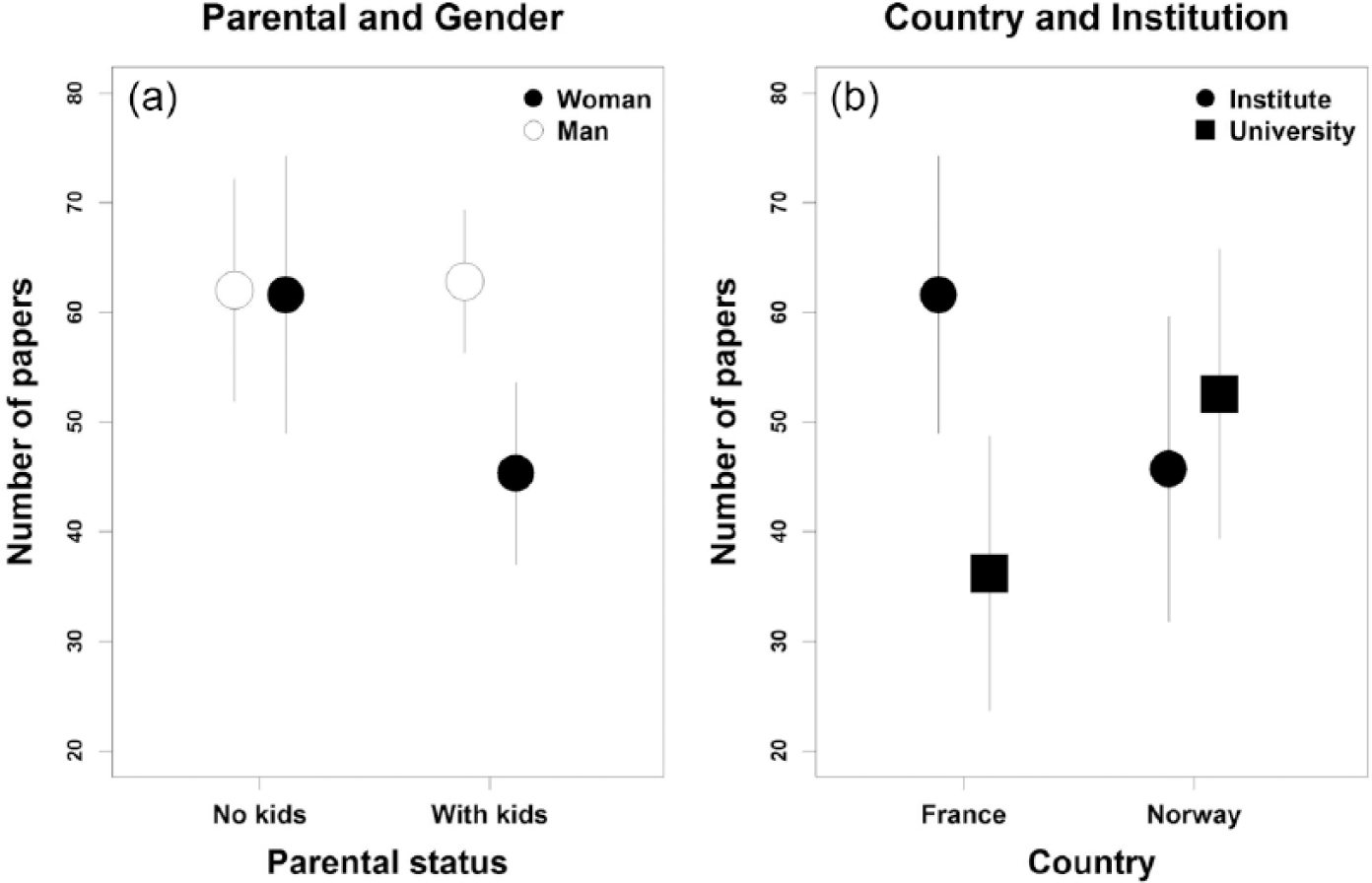
Number of papers (conditional estimates with confidence intervals) 15 years after PhD according to: (a) Interacting effects of Parental status and Gender (shown for France), (b) Interactive effects of Country and Institution (shown for Women, Without children).
Finally, neither involvement in domestic tasks and parental care nor the duration of parental leave had a detectable impact on scientific productivity, for both sexes and in each country (all p-values >0.30).
Discussion
The purpose of our work was to provide an analysis of the gender gap in scientific careers, taking cue from empirical data on academics working in ecology in France and Norway. These two countries have some similarities in terms of welfare policies (e.g. high investment for childcare support for preschool children) but also striking differences in terms of duration of parental leave, unemployment level, traditional partition of housework and parental duties, age at recruitment in a permanent academic position, and procedures of career advancement (Table 1), which we expected to lead to different gender gaps in the unfolding of careers. The hurdles for women seemed to occur at different times in the career and due to different processes. In Norway, a relatively lower percentage of women entered a tenured-track position in the first place, mostly after having started a family, enjoying a relatively low imbalance in domestic housework and parental care, and a relatively rapid accession to promotion; while in France, relatively more women entered a research career, mostly before having children, bear a higher part of the domestic and parental duties than Norwegian women, and are less likely than men to get promoted when they start a family. Our main focus was on time-use differences both in the professional and in the domestic spheres, because they have been previously identified as shaping career differentiation (Rafnsdóttir and Heijstra, 2013; Toren, 1993) even to the extent it affects wages (Buffington et al., 2016). Our results support the existence of gender differences in work allocation to teaching (higher teaching load and/or higher investment in teaching activities for women) and responsibilities (higher responsibilities in common tasks for men) at university mostly, and highlight prominent gender differences in age at promotion and probability to be promoted, especially in France. We also show that some of the impacts of personal life on the probability to be promoted were due to differences in productivity resulting mostly from parenthood. This pattern was reported earlier in ecology (McGuire et al., 2012), and in other fields of male-dominated sciences (Ceci et al., 2014 for a review; Mason and Goulden, 2002). Lower productivity of women did not hold true for single women with no children (similar to Wolfinger et al., 2008), pointing at the complex interwoven relationships between the domestic and the professional spheres (Probert, 2005).
Our exploration of how marital and parental status influenced productivity and career trajectory unveiled complex effects of partnership status and parental status on career dynamics, detrimental to the progress of women with children. We brought to light the contrasted impact on individual career advancement of belonging to a dual-career academic couple, that is, a beneficial effect for men and a detrimental effect for women (Schiebinger et al., 2008; Sweet and Moen, 2004). Further, we uncovered that academics in ecology conform to classical patterns of differentiation of time allocation to domestic and parental tasks (more involvement of women on average), especially so in France where most domestic and parental tasks are carried out by women. Below, we discuss inequalities in workload allocation and career trajectories, and we dwell on the additional roles of institutional and country differences.
Inequalities produced at the workplace
Workload allocation for the main activities carried out by researchers was markedly gender specific (Lockwood et al., 2013). The first and expected difference depended on whether the researcher was employed by a university, with compulsory teaching duties, or by a research institute. The higher compulsory teaching load in France than in Norway accounted for the observed differences in time allocation at work, with a cascading effect on the scientific productivity of researchers at university in France, who had the lowest productivity of all our respondents (Figure 10). Beside this massive effect, we identified a lot of small but statistically significant differences between categories of researchers. For instance, we identified a gap in time-use patterns between men and women holding positions in French universities especially concerning teaching. Men devoted a higher amount of time to research activities and to common tasks than women. The importance of the time spent teaching and responsibilities in some poorly rewarded common tasks, such as committee work, student advising or curriculum development, is often considered as minor compared with productivity in the French system (Pigeyre et al., 2015; see also Henley, 2015 for similar conclusions found in the United States). Therefore, junior women in France suffer from a double penalty in their careers. First their higher teaching load leaves them less time for research and publication, and second they do not invest in tasks that best enhance their chances to be promoted. How and why women invest more than men in teaching early in their career, probably with relatively long-term costs in terms of their scientific output, needs to be investigated further. For instance, interviews with young male and female researchers would be helpful in addition to questionnaires about early career orientation and life–work balance. One hypothesis to explain why women allocate more time to teaching is the better compatibility of predictable duties, such as teaching, with parental care and part-time work. Furthermore, women may be channelled into roles of student guidance through top-down pressure from team leaders (O’Brien and Hapgood, 2012). Norwegian researchers are less concerned by this teaching–research gender gap, maybe because the overall compulsory teaching load is lower. Another gender difference is the high share of working time spent in common tasks by men at the senior level. In Norway, both men and women at the senior level spend more time on average doing common tasks, and less time doing research compared with fellows at the junior level. In contrast, in France this effect is more pronounced for men than for women, both at universities and research institutes, probably resulting from a higher proportion of men having responsibilities as team or institute leaders.
Surprisingly, while we could have expected a larger gender gap in the probability to be senior (for a given productivity and number of years since PhD) at university than in the research institute in France because of the large gender gap in patterns of work allocation at university, we found the opposite (Figure 9(c)). Factors other than the differentiation of work allocation and productivity are clearly involved in the accession of senior position (Marry, 2008). Studying the relationship between the gender gap and the intensity of the junior to senior bottleneck would be enlightening in this respect (Adamo, 2013).
Researchers were not questioned about the total time spent working. The difference in proportion of time allocated to teaching between men and women could also result from junior women spending less time at work than men, possibly as a consequence of higher time constraints due to the work–life balance when having a family. Their teaching duties might represent a higher share than for fellows able and willing to spend more time working. Alternatively, women might value teaching more than men, a possibility that needs to be explored further.
Inequalities produced at home
Outside the workplace, clear differences between sexes still occurred in the social organization of domestic work. Kitterød and Lappegård (2012) proposed a typology of couples depending on whether they were dual-earners or not, and how they shared duties in the domestic sphere. They unveiled that, in Norway, the ‘generalized gender type’ (i.e. equal share of domestic duties between sexes) and the ‘specialized gender type’ (both partners contributing but with a between-sex inequalities of duties) were most prevalent in highly educated partners both working regular hours, most often working in the public sector. Our results on Norwegian researchers support Kitterød and Lappegård’s (2012) findings, and further show that respondents were more of the ‘generalized gender type’ than ‘specialized gender type’ because we found no evidence of partitioning. No duty partitioning occurred in France either, but the patterns there were far from a ‘generalized gender type’. Similarly to McGuire et al.’s (2012) findings when studying ecologists, the sharing of domestic responsibilities (involving home chores, meal preparation, shopping, and also childcare) was highly imbalanced, with fewer men being involved, in France. This gender segregation in duty partitioning might even be greater than the one we assessed from our survey because declaration of involvement in domestic chores is expected to be gender biased (Kjeldstad and Lappegård, 2014). Indeed, men commonly tend to overstate their contribution while women’s answers are more reliable (Régnier-Loilier, 2007). Inequalities we revealed in the domestic sphere could be higher than reported from our data, bolstering the fact that gender segregation of domestic tasks and parental care is pronounced for researchers in ecology in France.
In addition, data about partner’s status revealed that men live more often in a couple with part-timers, while women live more often with potentially time-squeezed partners (especially researchers), a pattern more pronounced in France than in Norway, and previously reported in similar studies (e.g. McGuire et al., 2012). This indicates that, overall, women bear more duties outside work than men. These results are in line with Jolly et al.’s (2014) findings that female physicians spend about 8.5 hours per week more on domestic activities than male physicians. Finally, we found discrepancies in time devoted to maternity/paternity leave. It was no surprise to find that women take a longer interruption from work than men (studied here for the first child). The consequence of the time taken as parental leave did not, however, have any detectable influence on the probability to be senior, or on scientific productivity. The absence of such effects could be explained by the fact that (1) they are redundant with the gender effect because including a difference between men and women at least partly accounts for such gender differences, and (2) they are limited to the first child, who either is born before recruitment (mainly in Norway) or early in the career, and thereby many years before promotion in France (average number of years to promotion is over 10 years in France). Our results on the divergent impact of belonging to a dual-career academic couple on career advancement show that the devil is in the detail. One has to consider not only whether researchers are single or not, but how time-constrained and career-oriented their partners are (McGuire et al., 2012; Schiebinger et al., 2008). Women were in a couple with researchers more than men (especially in France), which leads to a slowdown in the advancement of their career. This raises the question of the causes and consequences of gender-specific assortative mating in academia. Our study suggests that having a researcher as a partner is beneficial in terms of career for men only. Schiebinger et al. (2008), however, unveiled that despite the divergent career advancement in researcher couples, both men and women in academic couples find it beneficial, especially through the sharing of networking and understanding of common constraints. The formation of dual-career academic couples clearly needs to be studied further, by also investigating the timing of couple formation compared with recruitment and decisions about parenthood.
The welfare state in Norway encourages women and men to take long parental leaves, though women still take much longer leaves than their partner (Ellingsaeter, 2013). We could therefore have expected stronger country differences in the gender gap in age at promotion or probability to be senior when comparing respondents with or without children. However, the sharing of domestic duties and parental tasks was much more egalitarian in Norway than in France, so we hypothesize here that the higher involvement of men in domestic duties and parental care may have counterbalanced the impact of a long maternity leave in Norway on the delay in age at promotion compared with men when having children.
Noticeably, a higher proportion of women (but not of men) in research than in the general population remained childless, which could be either a choice of women who do not want children to engage in research, or be a consequence of a postponing the start of a family to the point of never being able to do so, or of the perceived incompatibility of research and family life for some women (Marry and Jonas, 2005). Remaining childless is certainly associated with a greater chance of a successful career (promotion-wise) for women in both countries studied, but whether it is combined with a harmonious work–life balance needs to be explored to a deeper extent.
The mediating effect of productivity on career advancement
As reported in previous studies (e.g. Henley, 2015; Stack, 2004; Xie and Shauman, 1998), we found that career advancement was highly dependent on scientific productivity. Women tend to be disadvantaged compared with men, especially when they are mothers. Unequal home organization and unequal allocation at work to less-valued tasks are two recurring patterns recognized to lead to a double jeopardy for women (Holt and Webb, 2007), even though our relatively simple indices of involvement in parental care and domestic tasks were not retained in our best model describing observed variation in scientific productivity. Scientific productivity thus largely acts as a mediator between a process of task differentiation both in the professional and personal spheres, and results in a process of career differentiation (O’Brien and Hapgood, 2012).
While scientific productivity is obviously of paramount importance for career advancement and is influenced in a gender-specific way by parenthood, other processes are likely at play to produce the observed gender gap in the probability to be promoted. Men were more often in a senior position than women, even for a given scientific productivity, though this effect was weak, especially in Norway. In France, such a disadvantage of women, corrected for gender differences in scientific productivity, had previously been reported in life sciences (Marry, 2008), and calls for deeper investigation of criteria used in the evaluation of careers (Henley, 2015). For instance, higher promotion chances for men could result from a higher allocation of men in tasks associated to common responsibilities (team leader, for instance), which may also be valued during promotion procedures. Other recent studies support that, once productivity and family structure are taken into account, the gender gap in promotion process tends to weaken or disappear (e.g. Ceci et al., 2014). This reinforces the idea that differences lie at least partly in how men and women solve the time equation imposed by work–life balance decisions. Though improving (McGuire et al., 2012), current evaluation procedures are still detrimental to the career of women who want to balance work with a family life (Seierstad and Healy, 2012).
Issues of recruitment and country institutional differences
The sex ratio of the researchers sampled was clearly male-biased because more men than women are employed at university and research institutes, both in France and Norway (34% and 23%, respectively of ecologists are women, see Methods section). This bias cannot be explained by different return rates as they were satisfactory and relatively similar for man and women. The relatively low proportion of women can itself be interpreted as a ‘glass ceiling’ effect taking place in earlier stages of researchers’ careers. The lower proportion of women both among researchers sampled and among respondents in Norway compared with France raises the question of the attrition of women between PhD and recruitment in Norway. The period between PhD and recruitment is a critical transition period during which career and parenthood decisions are likely to be in conflict, which explains inequalities observed in earlier stages of the academic career (Adamo, 2013; Barbier and Fusulier, 2015). In Norway, it is a challenging issue to understand why so few women are recruited as permanent researchers (Ellingsaeter, 2013). This pattern is part of the so-called ‘welfare state paradox’ because women in academia remain few, despite good conditions for maternal leave and return to work and weak segregation at home (Ellingsaeter, 2013; Seierstad and Healy, 2012). Hypotheses proposed to solve this paradox include the relative timing of age at first child and recruitment, and the highly competitive nature of recruitment into a permanent position in academic research (Adamo, 2013) compared with other highly qualified jobs, especially in Norway where unemployment for highly educated people is particularly low. Although testing the importance of the timing of child birth compared with the major event of a career would have been possible with our data, the power of such analyses would have been limited due to the low sample size. As we have targeted most ecology departments in the major Universities of Norway (Oslo, Bergen, Trondheim, Tromsø, Aas, Evenstad), we hit there the limit of working with gender issues when the sex ratio is strongly imbalanced, such as in ecology in Norway.
Conclusions and perspectives
Our analyses open three main perspectives and lines of thought. First, ecological research is a field in which research topics (e.g. biodiversity, evolution, urban ecology), approaches (e.g. experiments in labs, observation in natura, conceptual developments), kingdoms (e.g. animals, plants, fungus), ecosystems (terrestrial, freshwater, marine) and levels of organization (e.g. cell, individual, population) are especially diversified. Our data included information on these issues that was not treated in our analyses. Further studies are needed to assess whether these partitions among topics are gender structured and whether they can account for some differences we observed in research productivity and career advancement. More specifically, the strong reliance of many researchers in ecology on field work, which requires repeated absence from home, often for several consecutive days, has been suggested to be a supplementary challenge for women who want to combine work and family life (McGuire et al., 2012). Such constraints could contribute to the attrition of women after they have been recruited, but could also to lead some PhD students not pursuing a career in this field. In addition to broad national or comparative studies (i.e. comparing fields of research, such as Ceci et al., 2014; Stack, 2004), we call for an in-depth investigation of within-field causes of attrition of women between PhD and recruitment and further from junior to senior positions.
Second, we demonstrated broad gender-specific patterns of inequalities, to different extents, in both professional and domestic spheres, but within each gender, we highlighted the large variability of trajectories. For instance, the proportion of senior men in France declaring having a very high teaching load was nearly as large as the proportion of senior men declaring having a low teaching load, which indicates a diverging typology of time allocation at work within this group. In France, where the promotion to senior level is a competition, some men, as well as women, never manage to achieve senior level. At the same time, there are some successful women (though few, Marry and Jonas, 2005). Cross-sectional snapshots of career and personal life characteristics are limited for understanding what determines the professional trajectories and for identifying the bifurcations among ‘success’, satisfaction or frustration at work. Studies aimed at getting longitudinal information (Fusulier and Carral, 2012) are badly needed in this respect, to set up strategies to survive the ‘academic jungle’ with a satisfactory life–work balance (O’Brien and Hapgood, 2012).
Finally, the comparative results between France and Norway raise the problem of the structural effects of national career systems and their specific rules. It seems that the Norwegian context, where access to tenured positions is late, is disadvantaging women (especially those who have, or intend to have, children) who would like to enter into research permanently. In France, promotion criteria tend to favour people who have maximized scientific productivity without accounting for time devoted and success achieved in lesser-valued activities (such as teaching, Musselin and Pigeyre, 2008; Revillard, 2014; see also O’Brien and Hapgood, 2012 and Henley, 2015 for a discussion of measuring success for researchers employed in universities). Organizational responses to gender-related career inequalities often involve developing monitoring systems for comparing promotion rates between men and women. One interesting question, however, is whether research policies affect the valuation of the different academic activities, and thereby the evaluative criteria used by promotion committees. A number of studies (Paye, 2016) suggest further enquiry on this issue is needed.
To conclude, even in two countries with active policies for helping woman to combine working and family life, the gender gap in academic research remains relatively large. The causes of such gaps are manifold, and lie both in the workplace, in the general society and at home. The effect of starting a family has more consequences on the unfolding of a career for women than men in both countries, but for different reasons: in Norway probably because starting a family, with the long period of associated maternity leave, channels women out of research before applying to a permanent position (resulting in a low proportion of women obtaining tenured positions), and in France because once having a position, it decreases chances to be promoted quickly (resulting in women with children having tenured position to be promoted later than men). The issue of timing between recruitment or promotion and age at which women start a family had been emphasized as a possible cause of differential attrition of women in life sciences and medicine (Adamo, 2013), and should definitively be investigated with long time series and comparative approaches (e.g. among countries and fields of research). The timing of recruitment, the partition of domestic and parental duties, the early career allocation of time into different activities at work, and the overall teaching load, are all potential major drivers of career divergence between men and women, the relative importance of which needs to be explored further at the within-country and between-countries levels, accounting for changes that have occurred in family welfare policies in the last decades.
Footnotes
Acknowledgements
We thank all respondents and colleagues who tested the questionnaire. We also thank Ivar Folstad, Clémence Emprin and Maréva Sabatier for helpful discussions during the design of the study and interpretation of some results, as well as Ingrid Ahnesjö and two anonymous referees for constructive comments on this manuscript.
Declaration of Conflicting Interest
The author(s) declared no potential conflicts of interest with respect to the research, authorship, and/or publication of this article.
Funding
The author(s) disclosed receipt of the following financial support for the research, authorship, and/or publication of this article: This project was partly funded by the program ‘Defi Genre’ from the Centre National de la Recherche Scientifique.