




Abstract
The paper focuses on dual-career academic couples, how they combine careers and parenthood and how their strategies translate into employment pathways of researchers, and especially women researchers. Based on sixteen in-depth interviews with dual-career academic couples, the analysis identified two types of partnerships which differed in terms of how they combined work and parenthood and how they harmonized his and her career: ‘traditional couples’ and ‘egalitarian couples’. While most previous research on dual-career couples analyses the individual level, this investigation considers the couple as a point of departure. The analysis is framed by the linked-lives approach, which studies partners’ work paths as mutually interrelated. The analysis shows that in dual-career academic couples, women’s careers are often perceived to be secondary to men’s careers, but there were differences between women who built their careers before 1989 and contemporary young women researchers. It is argued that gender ideologies have different effects depending on the institutional conditions in which the ideologies are enacted. It is suggested that the paper contributes an important dimension to explanations of the gap in the position of men and women in the academic labour market.
Keywords
Neoliberal reforms in academia have occurred in various cultural settings, and Central Eastern European (CEE) countries are no exception. These reforms are often implemented in environments which are in many respects specific. In the case of the CEE countries in general and the Czech Republic in particular, neoliberal reforms of the academic environment and the labour market interact with a conservative social discourse, unique in the European context, on the division of gender roles, conditions that are unsuitable for combining work and care and dismissive attitudes of political elites toward gender inequality, including the fields of research and development (Tenglerová, 2014).
The unintended consequences of the clash between neoliberal reforms and gender conservatism can be gleaned from the following statistics. The Czech Republic is one of the countries which fares the worst in Europe in many indicators relating to the status of women in science. The proportion of women among researchers was 27.2% in 2014, and the Czech Republic is in fact the only European country where the proportion of women in science is falling. In 2014, the proportion of women among researchers was at its lowest level since 2001, when gender-disaggregated statistical data were first collected – see Tenglerová (2015). In 2013, with 12% of women in scientific and management boards, the Czech Republic was bottom of the list in the EU (EC, 2013).
One of the approaches to explaining the difference between the percentages of men and women in research involved examining the conflict between working and parenting roles and the incompatibility of the performance of the research profession and parenthood (e.g., Mason and Goulden, 2004). As in other professions, the maternal role and related career breaks disadvantage women in building their careers in research (Acker and Armenti, 2004; Bagilhole, 2002; Harley, 2003). This is linked to the concept of the gender culture of the academic world (Acker and Webber, 2009; Bagilhole, 2002; Harley, 2003), conceptualized as a man’s space which professes and reproduces masculine values incompatible with women’s life experience and typical life biography. It may be presumed that in different cultural contexts these above-mentioned factors will play a different role and their impact may differ according to institutional settings and cultural specificities. Based on the evidence from previous studies conducted in the CR (Linková and Červinková, 2013; Vohlídalová, 2013), one of the key problems for women’s careers in the academy is the combination of work and (child) care.
Since most researchers have a partner, and many men, but especially women researchers, live in dual-career partnerships (Dubach et al., 2013; Ferber and Loeb, 1997; Schiebinger et al., 2008; Wolf-Wendel et al., 2003) I focus on dual-career academic couples and the ways in which partners combine their professional careers and parenthood. I ask how these strategies translate into the employment pathways of researchers, and especially women researchers of various generations living in dual-career couples. In view of the demands of the research profession, dual-career academic couples represent a field where the conflicting pressures of the labour market and private life are particularly salient.
My analysis builds on the perspective of linked-lives which views the private and professional lives of both partners as interconnected (Krüger and Lévy, 2001). By focusing on the partners’ work paths as being mutually interrelated, it is suggested that this study contributes an important dimension to explanations of the gap between the position of women and men in the academic labour market in the specific context of institutional and cultural setting. While most previous research on dual-career couples analyses the individual level, this paper takes the couple as a whole as a point of departure.
I first present the theoretical background of my study and the context in which choices of strategies for combining work and life are made in the Czech Republic (i.e. the organization of academia and conditions for parenthood). This is followed with a presentation of the methodology of the joint interview with academic couples, and then the analyses and conclusions.
Life-course, linked lives and coupled careers
The essence of the life-course approach lies in an interest in the ways in which individual aspects of life (such as the work path, the family path and institutional settings) influence each other and how the course of these paths is affected by historical circumstances and changes in institutional frameworks (Elder, 1994; Krüger, 2009; Krüger and Lévy, 2001; Macmillan and Copher, 2005). The life-course approach also pays attention to the ways in which the lives of individual people influence one another, particularly those who are related – such as partners, parents and grandparents (Krüger and Lévy, 2001; Moen and Sweet, 2002). People’s lives, their work paths and family paths are thus regarded not as individual projects but, rather, as a result of a number of other influences. Whereas the current notions of scientific excellence and professional paths exclude all aspects with the exception of individual effort, the life-course perspective brings these other aspects back into play and treats them as crucial factors which have effects on the ways the career game will play out. This approach has informed a number of studies on the position of women in science (see, for example, Bagilhole and White, 2013; Fox et al., 2011; González Ramos et al., 2015; Leeman, 2010; Mason and Goulden, 2004 amongst others).
Han and Moen (1999) talked about the need to view the work path and the family (private) path as interrelated and to take the relationality of the work and family paths of both partners into consideration. These authors criticized the myth of separate worlds which builds on the assumption that work and family lives are two separate worlds, reserved for men and for women, which are disconnected and do not intersect. With the concept of the ‘coupled career’ they insist that the professional path cannot be separated from the family path (Han and Moen, 1999: 99), and regard the couple as the main unit of analysis (Han and Moen, 1999: 101). Such a view provides the opportunity to ask questions about how the partners’ work and family situations are interrelated, or whether and how one partner’s work path affects the work path of the other (Han and Moen, 1999).
The notion of the ‘coupled career’ builds on the concept of ‘linked lives’ which forms the core of life-course approaches (Elder, 1994: 6). The concept of linked lives stresses the need to study how individual life paths are affected by other people and in what ways men’s and women’s life paths shape each other (Moen and Sweet, 2002: 467). In this perspective, men’s involvement in the labour market and their career development are contingent upon the fact that their partners assume a larger part of caring for the home and family and are willing to put their professional career ‘on the backburner’ (at least in certain stages of their life cycle).
The perspective of the coupled career and linked lives is particularly suited for studying men’s and women’s academic careers because evidence suggests that many academics live in dual-career partnerships. The building of two careers is what distinguishes these couples from dual-earner couples where both partners have paid employment but only one of them is building a career (i.e. a job with which people identify, which demands a great deal of involvement and commitment and which is aimed at accomplishing personal goals and achieving success) (Rapoport and Rapoport, 1969: 3). Whether a partnership is dual-career or dual-income usually changes during the life cycle and is related in particular to parenting and the need to resolve the tension between working life and private life. According to Becker and Moen (1999) the proportion of couples among parents of small children who function on the dual-career model is negligible. Almost all are forced to limit their commitments in the work sphere and to reduce their career aspirations for a period of time (Becker and Moen, 1999: 999). The result is that in the life of a couple dual-career periods take turns with periods when the family operates on a dual- or single-income basis.
Krüger and Lévy (2001) place emphasis on the gendered impacts of institutional arrangements which influence relations between men and women in the family and the ways in which men’s and women’s lives intersect with and adapt to one another. As Krüger cautions (2009), the way in which partners’ life paths intersect is not a question of a totally free choice and negotiation. Men’s and women’s life paths must be seen in the context of institutional conditions and structural barriers which shape people’s choices and, relatedly, their life paths (Krüger and Lévy, 2001: 155). Decisions about combining family and work lives are thus affected by many institutions, such as childcare, elderly-care or the educational system, which contribute to shaping women’s and men’s working paths. These institutions co-create invisible rules which to a certain extent limit individual choices and which form men’s and women’s life paths differently (Kruger and Lévy, 2001), thus affecting gender inequalities in society. Family policy and institutional childcare as well as the organization of the academic labour market are among the key institutional conditions that affect combining work and parenthood.
To what extent a woman’s career must adapt to a man’s and be limited by parenthood is not related only to the life-cycle, labour market settings and family policy; an important role is also played by the gender ideology of the couple (e.g. Beets et al., 1997; Kaufman and Bernhardt, 2015). A couple’s gender ideology affects how women’s and men’s careers are combined, to what extent their careers are understood as having equal value in the family, and to what extent both partners contribute to childcare and housework. According to William and Denise Bielby (Bielby and Bielby, 1992) a couple’s gender ideology offers a perspective through which the contributions of each partner to work life and private life are evaluated. This is reflected in the choice of whose career in the couple is given priority and who must adapt. Thus it is neither primarily the economic wellbeing of the family as a whole (see Becker et al., 1977; Mincer, 1978), nor the power between the partners related to their respective earning capacity (Eby, 2001; Green, 1997), that is the key factor.
Family policy and institutional childcare in the Czech Republic
The Czech Republic ranks top among European countries with regard to the greatest impact of parenthood on women’s employment. While in 2013 the employment rate of women with children under six years of age in the EU–27 was on average 15 percentage points below that of women without children, in the Czech Republic the value has for many years been around 40 percentage points (i.e., one of the highest) (EC, 2014: 2). In addition to an overall gender-conservative cultural climate, one of the main reasons for this is the particularly long parental leave (taken mostly up to the child reaching the age of three), taken overwhelmingly by women, coupled with a severe lack of places in care facilities for children under the age of six.
A number of studies carried out in recent years which explore the transformation of Czech family policy point to refamilialisation tendencies (Hašková, 2011; Kocourková, 2002; Saxonberg and Sirovátka, 2006; Szelewa and Polakowski, 2008). The focus of childcare has increasingly shifted from public services to families (especially mothers or grandmothers); the share of children using childcare facilities has decreased (Hašková, 2011: 46). The period during which women remain at home with children has gradually increased: while in the 1970s it was mostly between one and two years, the 1990s saw the stabilization of the three-year parental model which still prevails today (Hašková, 2011: 43–44).
These changes are closely linked to the transformation of family policy. ‘Socialist’ family policies since the mid-1960s gradually extended the period during which mothers could stay at home until the child reached two years of age (Hašková et al., 2009). At the same time, the network of public childcare facilities was gradually enlarged. After 1989, the tendency appeared to be that women and mothers of young children were pushed from the labour market to the home (Křížková and Vohlídalová, 2009). As a result of a radical decline in fertility, and in line with the rhetoric of the 1990s, which condemned nurseries as a communist relic harmful to children, nurseries closed down on a massive scale (Dudová and Hašková, 2010). In the 1990s the full-time mother who stayed at home with children until they were three years old became an almost universal norm. The reform of the ‘multispeed parental leave’, which came into force at the beginning of 2008, has not affected this norm significantly. The so-called ‘multispeed parental leave’ newly allowed parents to choose freely a parental leave period of two to four years 1 (previously they could choose only between three or four years of parental leave); 2 but in reality the choice of the shortest two-year option, which would in many cases be welcome to young researchers, remained purely hypothetical (mainly due to the unavailability of childcare facilities).
Regarding the share of young children in care facilities, the Czech Republic does not fare well and is nowhere near reaching the Barcelona objectives of 90% of preschool children over the age of three and 33% of children under three years of age being placed in formal care. With regard to children younger than three, their coverage through formal care in the CR does not even reach 5% (the EU average was around 26%); in the case of children aged 3–6 the Czech Republic reached the below-average value of 72% in 2013 (compared to 82% in EU–27) (Janta, 2014). These low values for the CR cannot be compensated for by private babysitting services, which, due to their high costs, are used by only around 1–2% of households (Hašková, 2011: 21). The shorter parental leave pays off economically only for women who have significantly above-average incomes (Jahoda and Šinkyříková, 2011), or those who have parents of their own willing to provide time-intensive care for grandchildren.
The model of three-year parental leave is a generally accepted standard considered to be the ‘correct’ form of childcare in Czech society. The public discourse on this issue is controlled by experts who emphasize the negative aspects of collective care on child development (for details see Dudová and Hašková, 2010; Saxonberg et al., 2012). The need for peer contact among children under three is disputed, and intensive maternal care for children up to the age of three is constructed as the only correct model of care. The child’s interests are framed as conflicting with the mother’s economic activity (Dudová and Hašková, 2010: 42–44).
Academic labour market and its transformations
In the last few decades Czech science has undergone major changes. Science and research in the Czech Republic in the 1990s, and before the Velvet Revolution in 1989, was characterized by the absence of research assessment, a low level of competitiveness, and a low rate of competitive funding (Linková and Červinková, 2013; Linková and Stöckelová, 2012). Academic mobility, before 1989, was limited, primarily for political reasons. A key aspect of assessment and career progress was party affiliation, not performance (Šebková, 1994; Štrbáňová, 2007).
The introduction of the Evaluation Methodology in 2004, often regarded as an important milestone in the development of Czech science, became several years later the basis for the allocation of institutional funding for research and development (Linková and Červinková, 2013; Linková and Stöckelová, 2012). As a result, a significant change occurred in the system of Czech research funding, increasingly concerned with and focused upon competition. As Linková and Červinková (2013) pointed out, these processes are the manifestation in the Czech context of transformations of science described by Ziman (1996) as ‘post-academic science’ and by Gibbons et al. as ‘Mode 2 science’ (Gibbons et al., 1994). This ‘new’ type of science is characterized by an obsession with performance measurement and accountability, increased competitiveness and growing precarity (Ziman, 1996: 74–75).
Gradually, institutional funding has decreased and the dependence of academic institutions on competitive funding has increased. In addition, the growing pressure on academic mobility is also in evidence (Červinková, 2010; Vohlídalová, 2014). As a consequence of these processes, the organization of the scientific labour market and research teams has become more dynamic, including aspects such as the disappearance of the position of independent researcher (a senior researcher who usually had a stable work contract, had their own research agenda, and trained students), the increase in the number of temporal postdoctoral positions demanding extreme mobility (in space and time) and competitiveness (Linková and Červinková, 2013), and the overall decline of labour standards in the scientific profession (Bauder, 2006).
Such a highly uncertain work environment presupposes the existence of a perfectly mobile and flexible worker who is willing to devote their full time to work and has no caring commitments in the private sphere. The ideal of the scientific career path continues to be a linear career uninterrupted by long pauses (Acker, 1990; Bagilhole, 2002; Mason and Gulden, 2004). It appears that, in particular, the values concerning maximum work effort, and the need to dedicate oneself more than full time to science and to reduce the lenght of career breaks related to childcare to the absolute minimum, are strongly internalized by Czech scientists and form a kind of unwritten ethos for the performance of the scientific profession (see Cidlinská and Linková, 2013; Linková and Červinková, 2013; Vohlídalová, 2013). Such a notion of a career is strongly gendered: it is tailored to men, or a certain type of masculinity, and disadvantages women. Another example of this is the way scientific excellence is defined, with activities which are often performed by women being systematically excluded (e.g. administration of projects, working with students, and care for the everyday functioning of the workplace). Research assessment procedures usually consider and value absolute performance only and do not take into account the time that was actually spent on these activities (Harley, 2003). For women especially the enormous pressure on academic mobility during the early stages of a career may be equally problematic (Ackers, 2004; Ackers et al., 2007; Leemann, 2010)
The construction of the research profession based on a typically masculine career model offers an explanation of why the organization of science and research institutions is usually at variance with motherhood or active fatherhood (Acker and Webber, 2009; Bagilhole, 2002; Harley, 2003). Motherhood and parenthood often occur and are considered as an event which is not really expected in researchers’ lives (e.g., in terms of the in flexibility of grant programmes, career rules, etc.). If any form of parenthood is admitted, it is “minimal motherhood”. The research profession demands that women return to work as fast as possible, and the notion prevails that it is impossible to catch up on a break of several years. If women decide to take a longer career break, their professional role and research competences are questioned (Linková and Červinková, 2013; Vohlídalová, 2013). Furthermore, the issue of combining work and parenthood is trivialized and relegated to the personal level. Often the opinion is heard that women can freely choose how they will combine work and parenthood and that this decision is an issue of their priorities and motivations. In sharp contrast to this, however, are institutional conditions and the ideology of motherhood which both prioritize a long parental leave. If women return to work earlier, they upset the norm of “intensive motherhood” (Hays, 1996) and thus run the risk of their maternal role being questioned. Women researchers thus find themselves caught between two completely contradictory systems of norms and values. It is clear that the genuine possibility of making a free choice is limited, and that the conditions for combining work and parenthood are inadequate (Linková and Červinková, 2013; Vohlídalová, 2013).
Methodology
The analysis is based on 16 in-depth interviews with Czech dual-career academic heterosexual couples (married and unmarried), in which both the partners were working in research or at a higher education institution. The interviews were conducted in 2009–2010 via the joined interview (Allan, 1980) with both partners at the same time. The sample included women and men researchers of various generations in various life stages – from young doctoral students at the beginning of their research career through to established women and men researchers at the peak of their career and those who were gradually phasing their careers out and whose children were adults with their own families. The age of participants varied between 26 and 75 years. Couples from natural sciences (including medical science) predominated in the sample: two couples comprised researchers in the humanities, one couple comprised one researcher in the social sciences and one researcher in the natural sciences, one couple included researchers in the technical sciences, and 12 couples comprised researchers in the natural sciences (including medical science). A detailed description of the sample is presented in the Appendix. The higher level of representation of researchers working in the natural/medical sciences in the sample occurred for two reasons: (1) couples from the social sciences and humanities were often anxious about providing the interview and they often refused to take part in the project (they were generally more conscious of their privacy than couples in natural science); and (2) whether a researcher is or is not living in an academic couple is usually not made public, and therefore I had to rely mainly on snowball sampling. The recruitment of participants via public advertisements proved to be not efficient enough (only two couples were recruited via public advertisements). However, the composition of the population of researchers in the public research sector in the Czech Republic indicates that the sample may correspond well to the overall composition of the research population (Tenglerová, 2015): natural science (including medical science) and technical science comprised 85.4% researchers, whereas only 14.6% of researchers worked in the domain of the social sciences and humanities in 2014 (Tenglerová, 2015: 24).
In my analyses I build on the principles of grounded theory (Glaser and Strauss, 1967; Strauss and Corbin, 1998), and specifically its constructivist version (Charmaz, 2004) according to which interviews are a reflection of an interpretative process of a person. The goal of the analysis was therefore to understand subjective meanings and to study how these meanings are created by the participants.
The interviews were transcribed verbatim and analysed using Atlas.ti software. In line with the principles of grounded theory the interviews were gradually coded in several stages, from codes narrowly linked with the data to more general and wider analytical categories. Constant comparison was the basic analytical method: that is, seeking similarities and differences in the data between categories, their characteristics, codes, participants and other aspects (Glaser and Strauss, 1967: 22). Also in line with grounded theory, I adopted an inductive approach to formulating theses, hypotheses and typologies.
Analysis
In my sample I identified two types of partnership that differed significantly in how they combined parenthood and two academic careers (i.e. how they interacted and limited each other) as well as what effect parenthood had in particular on the woman’s career: egalitarian and traditional couples. Although some authors believe that dual-career (academic) partnerships are remarkable for their egalitarian gender ideology and attitudes to the division of housework and childcare (see, for example, Austin and Milem, 1997: 141; Duxbury et al., 2007), research has shown that many of them professed a traditional gender ideology (Rusconi, 2002). This finding is also supported in this study: of the total number of 16 couples only six can be regarded as egalitarian partnerships, with the other 10 couples being traditional partnerships.
Egalitarian couples
A traditional division of labour still prevails in the Czech context such that women perform most of the care in the home and family (Chaloupková, 2005). It appears that an equal division of domestic work and childcare is more common among today’s young couples than it was among the older generation. In this study too, egalitarian couples belonged mostly to the younger generation.
Egalitarian couples placed the career of both the partners on the same footing, attributed to it the same significance and actually shared childcare and housework equally. These couples labelled themselves as ‘egalitarian’ and many professed a strong egalitarian rhetoric. An equal division of competences was understood as something matter of fact, necessary and correct. The frequent argument was the same level of seniority of the two partners: We both work in the same position; we do the same things so there is no reason why it couldn’t be like this [with equal division of work and care]. I think that it’s logical that way. (Bořek, 33, M, humanities)
3
Some women and men researchers in egalitarian couples were critical of the traditional division of family roles between ‘man the breadwinner’ and ‘woman the carer’, which they perceived as unsuitable: …I can’t imagine that it [care for a daughter] would be up to me alone. That five days a week my husband would leave in the morning to go to work and come back in the evening. (Věra, 26, F, natural sciences)
The egalitarian organization of gender roles was regarded positively not only by women but also by their partners, despite the fact that this arrangement places greater demands on them in terms of adapting their work paths to the needs of the family and their partner’s career than in the traditional couples. The words ‘share’ or ‘take turns’ were typical expressions used by the partners to characterize how they combined work and care.
Sharing childcare and housework, often in combination with grandparents’ time-intensive help with childcare in the case of young couples and with the help of private childcare and nurseries in the case of older couples, created conditions for women to return from parental leave relatively early. Mostly, they returned after six months; that is, they completed a maternity leave which in the Czech Republic is considered to be the minimal period for parental leave, thereby avoiding the stigma of a longer break seen to breach the ideal of the linear scientific career.
The egalitarian attitudes in these couples to the partners’ work lives are also related to their attitudes to mobility. Usually, they considered the effect of mobility on their partners’ career prospects and refused to expose one another to the problem of ‘tied moving’ (Mincer, 1978) – that is, a situation in which one of the partners moves because of the other partner’s job offer without having an adequate work position in the new destination.
If these couples go on a fellowship, they mostly go together in the way, for example, that interviewees Dita and Dalibor arranged their fellowships, by taking turns as to who chooses the fellowship destination. They choose destinations which ensure that the other partner can also find work at a research institution, even if that means moderating their expectations (i.e. temporarily not working in their specialization, etc.). They did not assume that the person who would be doing the moderating would be Dita alone.
I think a solution would be to go somewhere where Dalibor will be the one doing the primary choosing and then we could go somewhere where I would be doing the choosing. (Dita, 28, F, natural sciences)
This couple also specifically chooses research institutes in countries which offer good conditions for combining work and parenthood in terms of a quality childcare system. Rather than the most prestigious institutes, they seek establishments where both of them will be able to find a fellowship.
Men (and women) from egalitarian couples planned their careers with regard to its effects on their partner’s work path. Men’s (as well as women’s) careers were adapted to the needs of the children and partners (for example, in terms of academic mobility or partial reduction of their workload after the birth of their child). Unlike in traditional partnerships men from egalitarian partnerships reflected spontaneously on the fact that the birth of their child had an impact on their work lives and that they had to slow down a bit (i.e. not applying for mobility grants, turning down additional commitments on boards and committees, etc.). The narratives of these couples did not suggest that the woman’s career should be negatively affected due to parenting, the partner’s mobility or career growth. In all the egalitarian couples in this study, men and women were in a similar position and level of seniority and it was not clear that their work paths diverged significantly during their life course. The overall progression of the work career in this form of partnership was much more balanced than in the traditional partnerships.
Egalitarian partnerships create significantly better conditions for women to combine work and parenthood than do traditional partnerships. However, this arrangement also places many more demands on men to adjust their workloads and career decisions (e.g. concerning mobility) according to their family’s and partner’s needs, especially if there are young children in the family. Thus they could not have built their career as freely as men from traditional couples. It was not surprising, then, that they frequently occupied lower positions in the academic hierarchy, such as independent researchers, postdoctoral researchers or doctoral fellows. The only exceptions of egalitarian couples where men reached higher academic ranks were, first, Nina and Norbert (both full-professors and current or former heads of research institutes) who belonged to the older generation and who started their academic careers during the period of state socialism, when the conditions for combining work and care for young children were much more favourable; and, second, Matěj and Marie (Matěj is an associate professor, Marie is an assistant professor) belonging to the young generation, who were expecting a (first) child and so their careers had developed thus far as a childless couple.
The academic careers of the four remaining egalitarian couples suggest that the current design of family policy and the academic labour market are less favourable to a positive sum game for both partners, although further research to confirm this hypothesis is needed. Moreover, we have to take into account that men themselves evaluated their egalitarian family setting in a very positive way and that they valued the impact of the family setting on their relationship with their children and partner. In the context of well-being and life satisfaction, the egalitarian couples are thus likely to represent a win–win situation for both partners.
Traditional couples
In these couples the man’s career was generally seen as more important than the woman’s. Women’s careers were supposed to adjust to the needs of their partners and children. In some cases this ideology was openly stated during the interview: Of the two of us, my husband is the ‘proper’ scientist. I am more of a research assistant and therefore I could have always made the time somehow [for childcare and house work]. (Eva, 68, F, natural sciences)
The quotation above underscores the typical feature of this group: in the traditional partnerships childcare and housework were constructed as a naturally-given woman’s work which was not usually discussed or negotiated by the partners: I think that my wife took it on somehow just naturally. (Karel, 62, M, natural sciences)
In most cases, at the time of the interview the man was in a higher academic position than the woman. In approximately half of the couples the partners started off at the same starting line (they were often classmates at university). After the birth of their (first) child the difference between his and her work positions started to increase as the woman was automatically expected to adapt her work ambitions to the needs of her partner’s career, the family and the child. The women did not see this as a problem. They often talked about the fact that they themselves decided on this model or that they accepted this situation as a fact. Men in these couples usually built their careers regardless of their partner’s work path. Their career advancement was often contingent upon their partner assuming the entire responsibility for childcare and housework and following their partners on foreign fellowships, often with children.
A typical example of a strongly gender traditional couple were Olga and Ondřej, parents of two children of preschool age. Before the birth of their children both the partners held the same position – they were classmates who graduated together from master’s and then doctoral programmes and went on a postdoctoral fellowship. Olga achieved greater success than Ondřej; she received a prestigious award and managed to publish a paper which experienced a very high level of citations in the literature. She was also more successful in terms of procuring grant projects. Despite this, after their first child was born she reduced her professional activities to a minimum. She understood this course of events, as Ondřej did, as something matter of fact and unproblematic: Ondřej must have a full-time [job] and I will have as much as will be possible. As the children gradually grow up, it will increase. (Olga, 36, F, natural sciences)
While Olga had already been at home on a parental leave for five years at the time of the interview and was gradually returning to work part time, her husband, free from the duties of household care and childcare, gradually progressed to the position of leader of a research team. While the birth of their children significantly affected Olga’s scientific career, Ondřej’s answer to a direct question about whether parenthood affected his life was: I don’t think so. It’s given by the fact that my wife understood that she would dedicate herself to children and I to science. And I was dedicating myself to science before, so from my perspective nothing really significant changed. (Ondřej, 36, M, natural sciences, young generation)
Olga answered the same question in the following way: I won’t be a senior researcher; I will probably never lead a research team. But I can return to work and be useful, even after five years. (Olga, 36, F, natural sciences)
The story of Olga and Ondřej is exemplary of what linked-lives mean in reality, with his steep career progress to the position of a very successful principal investigator being traded off against her career stagnation. The paradox of many traditional couples, as in this case, is that this arrangement is regarded as voluntary, free and advantageous all round, even though many of the women complained about being double-burdened. The different weights given to his and her careers were then reflected in differences in perception of the impact of parenthood on their work lives. While in the egalitarian couples women’s and men’s answers were generally in agreement, in the traditional couples the perspectives of the men and women diverged. Older men in traditional partnerships often remembered the period when they had small children with a degree of nostalgia as a happy time and, similar to young men who have small children today, did not admit that parenthood interfered with their professional life in any significant way. Even if they considered the traditional division of gender roles as something natural, women of all generations talked about feelings of exhaustion, stress, lack of sleep and the difficulties of combining work and parenthood as well as major career stagnation.
Women in traditional partnerships often accompanied their husbands on fellowships and stipend stays where they either did not work at all and cared for children and the home or worked part time, often on very small contracts and without pay. For many women the experience of tied moving in particular was that of a significant brake on their work career and an increase in the difference between his and her position: In the three years we spent in the US I spent only three months in the lab. So compared to women, men are certainly much better off, also because they don’t slide back because of children. (Jiřina, 37, F, natural sciences)
From the perspective of linked lives and coupled careers (Kruger and Lévy, 2001) it appears that the high degree of men’s geographic mobility, on which career development in science is increasingly predicated, is especially contingent upon their partners’ willingness to adapt to the needs of their (the men’s) careers (see also, for example, Leeman, 2010).
Major differences appear between the ways the younger and older generation of traditional couples combine work and parenthood. In both cases childcare was considered to be primarily the woman’s concern; nevertheless, most women researchers in the older generation returned to work after parental leave relatively quickly (generally after one or two years) because of the possibility of placing children in nurseries and the general organization of the research profession at that time. Since the mid-1960s, and especially in the 1970s, during which time the majority of women scientists in my sample gave birth to their children, the condition for a combination of work and care significantly improved. The period of maternal/parental leave gradually extended up to two years of age (in the 1970s) and later up to three years of age (in the mid-1980s) (Hašková et al., 2009). At the same time, a network of public childcare facilities, both kindergartens and nurseries, was gradually enlarged and widely accessible. Women thus had a choice of returning to work from a parental leave early after childbirth – as many women scientists did. As indicated by interviews with women of the older generation, their ideology of motherhood largely reflected the rhetoric then prevalent which emphasised active participation of mothers in the labour market. The academic labour market at that time was characterized by a lack of competitiveness and an absence of performance measurement, and was based on long-term funding which provided conditions that eased the return after a parental leave, as well as the combination of work with care for small children.
After 1989 the tendency was to cut public expenditures for childcare (Hašková et al., 2009) and to push women, and especially mothers of young children, out of the labour market (Křížková and Vohlídalová, 2009). The gender-conservative discourses stressed the women’s right not to be employed and the socialist project of women’s emancipation was subjected to strong criticism. From the 1990s almost all the nurseries and a large number of kindergartens started to be closed down and parents had to accept a lack of childcare facilities and an extremely gender-conservative notion of ‘proper’ motherhood. At the same time, the young generation of women scientists have to deal with combining work and care in the conditions of a neoliberal transformation of the academic labour market resulting in it being organized with regard to competition, research performance measurement, temporary financing and increasing economic insecurity.
While young women today return part time after a parental leave of two or more years and they gradually increase their workload, the older generation of women researchers returned full time and generally dropped out for a shorter period of time (many of them returned after six months or no longer than one year). The handicap of the traditional division of gender roles between women and men of the older generation, in terms of caring for very small children, could have been at least partially compensated for with the help of available childcare facilities and the organization of the scientific labour market at that period, even if it was often at the cost of major efforts. There were two cases among the gender traditional couples of the older generation in which the women managed to achieve a work position comparable to that of their partners despite the unequal family arrangements. Traditional partnerships, viewed in particular against the backdrop of contemporary organization of research and family policy, create an environment much less conducive for building a successful career in science for women than do egalitarian partnerships. Women’s careers in these partnerships can be under permanent threat because the women are always ready to yield to the demands of the partner’s career and the needs of their children and family. The conditions that this model creates for combining work and parenthood are not suited to the needs of the research profession. Parenting and housework are seen in these couples primarily as her, not their common, concern: in particular in relation to parenthood, the gap between his and her careers consequently widens. In comparison with the group of egalitarian couples, there were many more men who reached the higher levels of academic hierarchies in the group of traditional couples – two of the 10 men in traditional couples were research group leaders, four reached the position of full-professors and two were appointed associate professors. The traditional couples thus represent a setting that is strongly beneficial for men’s careers.
Conclusions
The perspective of linked-lives which sees the lives of both partners as interrelated entities brings a complex view of work and life paths of women and men in science and makes it possible to examine how men’s and women’s work paths mutually affect and link with each other. In my analysis I identified two types of academic partnerships which differed in the ways they combined work and parenthood and in the ways they harmonized his and her careers: traditional couples and egalitarian couples. It transpires that a balanced career progress of the partners is contingent upon balanced sharing of roles between the partners and egalitarian gender ideology in the couple. Conversely, situations in which the partners’ career paths start to diverge significantly and women stagnate professionally are related to traditional gender roles in the family when a woman bears the entire responsibility for childcare and housework and when her work path is seen as secondary. There is a trade-off between the man’s career advancement and his partner’s career stagnation.
This typology underscores the important role of the gender ideology and division of labour among partners which affected significantly the impact of parenthood especially on women’s career progress. This finding supports previous studies which linked traditional gender role attitudes with women’s work adjustments after childbirth and egalitarian attitudes with work adjustments of both partners (e.g. Kaufman and Bernhardt, 2014).
This present analysis goes beyond the scope of these unsurprising findings, however. It shows that gender ideologies play an important role, but that they have a different impact on women’s careers depending on the institutional and structural conditions in which they unfold. Comparing couples who built their careers in different conditions and in different institutional settings highlights the different nuances in which these ideologies operate and how they interact with structural factors. The specific context of a Central Eastern European country, in which a radical change occurred between two generations (not only in terms of research work but also in terms of a significant worsening of conditions for combining work and care), allows us to study mutual interactions among the effects of structural and institutional barriers, gender ideologies and the ways these are mirrored in women’s professional careers in science and research.
An inter-generational comparison of the traditional partnerships emphasises that in addition to the gender ideology the organization of research institutions and conditions for combining work and care play a major role. Women researchers of the older generation – who had children at a time when there was no pressure on academic performance, when an interruption of a career as a result of parenthood did not represent an insurmountable problem in building a work position in science because of the then generally limited extent of work flexibility (Linková and Červinková, 2013: 23), and when childcare facilities were generally available – managed to cope with the handicap of the traditional partnership much better than young women scientists of the current generation. Women researchers of the older generation living in traditional partnerships were often able to attain similar and sometimes even higher levels of seniority than their partners. This stands in sharp contrast to the younger generations of traditional couples who usually described the greatest increase in the gap between his and her career advancement associated with parenthood. At the same time, it appears that egalitarian couples managed to compensate for the negative impact of unsuitable conditions for combining work and parenthood, while these negative effects worsened for the traditional couples. The interaction between gender ideology and structural and institutional conditions thus takes various forms and has various effects.
The analysis highlights important sources of gender inequalities in the research profession and a possible explanation for why the proportion of women in Czech science is decreasing. As it transpired, it is necessary to consider both the institutional settings and the discrepancy between the demands of the labour market and the conditions for combining work and care (specifically the unsuitable conditions for childcare, work–life balance and changes in the research profession) as well as how gender roles are organized in dual career couples. This is why institutional actions to advance gender equality in research and developing gender-sensitive practices and procedures are so important, because such actions can mitigate against the gender conservatism at individual level which can be witnessed today in the Czech cultural context.
Footnotes
Appendix
Details of the interviewees
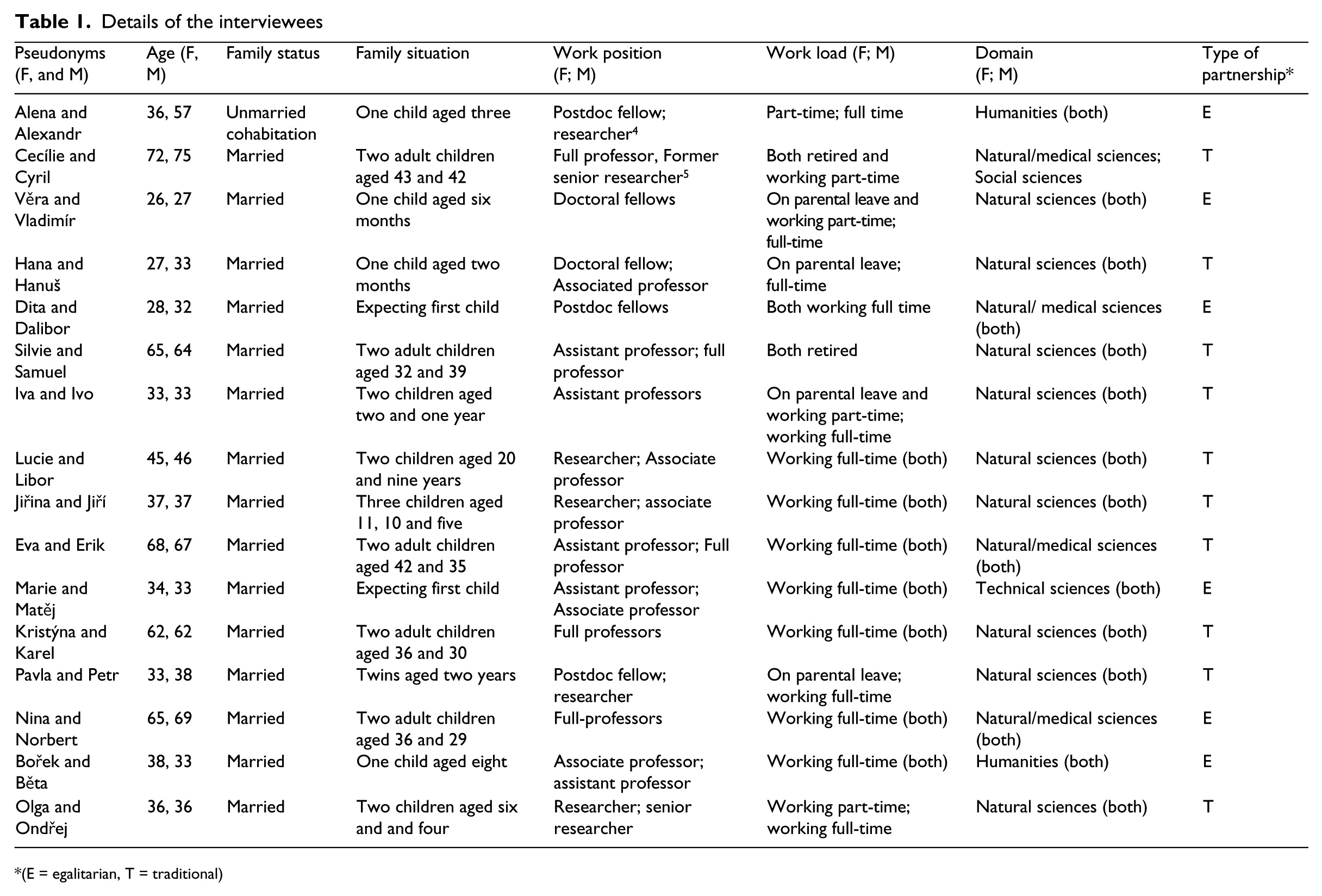
| Pseudonyms (F, and M) | Age (F, M) | Family status | Family situation | Work position |
Work load (F; M) | Domain |
Type of |
|---|---|---|---|---|---|---|---|
| Alena and Alexandr | 36, 57 | Unmarried cohabitation | One child aged three | Postdoc fellow; researcher 4 | Part-time; full time | Humanities (both) | E |
| Cecílie and Cyril | 72, 75 | Married | Two adult children aged 43 and 42 | Full professor, Former senior researcher 5 | Both retired and working part-time | Natural/medical sciences; Social sciences | T |
| Věra and Vladimír | 26, 27 | Married | One child aged six months | Doctoral fellows | On parental leave and working part-time; full-time | Natural sciences (both) | E |
| Hana and Hanuš | 27, 33 | Married | One child aged two months | Doctoral fellow; Associated professor | On parental leave; full-time | Natural sciences (both) | T |
| Dita and Dalibor | 28, 32 | Married | Expecting first child | Postdoc fellows | Both working full time | Natural/ medical sciences (both) | E |
| Silvie and Samuel | 65, 64 | Married | Two adult children aged 32 and 39 | Assistant professor; full professor | Both retired | Natural sciences (both) | T |
| Iva and Ivo | 33, 33 | Married | Two children aged two and one year | Assistant professors | On parental leave and working part-time; working full-time | Natural sciences (both) | T |
| Lucie and Libor | 45, 46 | Married | Two children aged 20 and nine years | Researcher; Associate professor | Working full-time (both) | Natural sciences (both) | T |
| Jiřina and Jiří | 37, 37 | Married | Three children aged 11, 10 and five | Researcher; associate professor | Working full-time (both) | Natural sciences (both) | T |
| Eva and Erik | 68, 67 | Married | Two adult children aged 42 and 35 | Assistant professor; Full professor | Working full-time (both) | Natural/medical sciences (both) | T |
| Marie and Matěj | 34, 33 | Married | Expecting first child | Assistant professor; Associate professor | Working full-time (both) | Technical sciences (both) | E |
| Kristýna and Karel | 62, 62 | Married | Two adult children aged 36 and 30 | Full professors | Working full-time (both) | Natural sciences (both) | T |
| Pavla and Petr | 33, 38 | Married | Twins aged two years | Postdoc fellow; researcher | On parental leave; working full-time | Natural sciences (both) | T |
| Nina and Norbert | 65, 69 | Married | Two adult children aged 36 and 29 | Full-professors | Working full-time (both) | Natural/medical sciences (both) | E |
| Bořek and Běta | 38, 33 | Married | One child aged eight | Associate professor; assistant professor | Working full-time (both) | Humanities (both) | E |
| Olga and Ondřej | 36, 36 | Married | Two children aged six and and four | Researcher; senior researcher | Working part-time; working full-time | Natural sciences (both) | T |
(E = egalitarian, T = traditional)
Acknowledgements
I would like to thank Marcela Linková and Blanka Nyklová for valuable comments and Marcela Linková also for translating the paper into English, and Laura Henderson for proofreading the paper.
Declaration of Conflicting Interest
The author declares that there are no conflicts of interest.
Funding
This work was supported by the Ministry of Education, Youth and Sports of the Czech Republic EUPRO II programme (grant number LE12003).