




Abstract
There is growing evidence that transitions from education to work (and from work to education) can take place several times and occur at different points in an individual’s life cycle. This paper’s overall intention is to contribute to a deeper understanding of higher education graduates’ transitions between education and work shortly after graduation. This contribution draws on the secondary analysis of data collected throughout the employability surveys answered by master’s graduates from two universities (Universidade Nova de Lisboa and Tampere University) in different countries (respectively, Portugal and Finland). Aiming at advancing comparative analysis that enables to illustrate the diversity within Europe in this field, a theoretical framework that comprises societal factors, local constellations of institutional systems (in higher education and in the world of work) and individual agency is outlined. Aspects such as the occupational specificities of the degrees, the institutional reputation of the universities and segmentations of national labour markets are also considered in the analysis. Results suggest many similarities but also significant differences within the transitions experienced by master’s graduates from the two universities, reinforcing the idea that employability is the result of a complex set of factors and variables within a changing inter-relationship of higher education and work.
Introduction
The starting point of this research is an understanding of the changing inter-relationship of higher education and the world of work. Traditionally, transitions or trajectories between education and work after completing higher education have been conceptualised as ‘linear’ or ‘non-linear’ in the research literature (cf. Allen and Van Der Velden, 2007; Looker and Dwyer, 1998). However, when society and working life become more uncertain and complex in European societies, individuals have to make choices concerning transitions between education and work under increasingly uncertain and unpredictable conditions. Also, transitions are currently far from being fixed and exceptional, since they occur more frequently and at different times, framing biographies that are becoming a succession of life transitions (Jarvis, 2009).
As transitions between education and the world of work have become more complex and precarious, it also appears as if these are no longer collective experiences. Instead, contemporary life-course transitions are more or less pluralised and involve increasing elements of individual choice and room for manoeuvre (Field, 2010). Simultaneously, research previously conducted in Europe signals differences between countries, due to different labour market structures, different educational systems and different social policies (Bois-Reymond and Blasco, 2003). Within this general context, the relevance of comparative analysis is substantial.
Focusing particularly on academic trajectories, it is noticeable that higher education certificates are not necessarily a guarantee for a permanent and safe position, yet are still more likely to result in well-paid, high status and protected occupational positions (Bois-Reymond and Blasco, 2003; Machin and McNally, 2007). Additionally, the analysis of international statistical data and other surveys indicates that transitions between education and work along the life cycle are expected to be of particular significance for higher education graduates (Alves, 2013).
With this in mind, higher education can currently be seen as part of a lifelong education system where individuals may return to further their education on a number of occasions (Stiwne and Alves, 2010; Tight, 2012). This is evident all over Europe in the growing proportion of non-traditional students and students of different age groups entering higher education. In fact, returns to higher education have increased in recent years (Machin and McNally, 2007). Accordingly, Schomburg and Teichler (2006) discuss the necessity of viewing the current inter-relationship of higher education and the world of work as a multi-faceted pattern of learning, socialisation and coping with professional tasks.
Another key feature of change in this developing inter-relationship is the growing emphasis on higher education institutions to pay attention to employability agendas and how to equip students with work-relevant skills and knowledge (Harvey, 2000; Tight, 2012). This is reflected, inter alia, in a changed focus in higher education curriculum discourses, where increasing stress is being placed on competence-based and life-choices conscious curricula (Coate, 2009), as well as through a continued debate over the ways in which higher education institutions can contribute to graduates’ employment outcomes (Tomlinson, 2012).
Given this context, the paper’s overall intention is to contribute to a deeper understanding of higher education graduates’ transitions between education and work shortly after graduation. Three main analytical dimensions lead our analysis and are clarified by the following research questions:
Are graduates’ transition patterns from education to employment smooth, uncertain or prolonged? Is it possible to connect identified patterns to variables such as gender and disciplinary domains of study?
Have graduates been working while studying for their master’s degree? Are these situations connected to transition patterns and disciplinary domains?
Have graduates already returned to (or do they intend to return to) higher education? Is this option connected to their transition patterns and disciplinary domains?
The analysis will enable us to characterise the transitions of higher education graduates in different national contexts, aiming at illustrating the European diversity and further reflecting upon the conditions framing transitions. The empirical focus specifically addresses master’s graduates from two universities (Universidade Nova de Lisboa (NOVA) and Tampere University (UTA)) situated in two distinctive European countries (respectively Portugal and Finland). It seemed particularly important to explore transitions in the case of master’s graduates, given previous notions that master’s students and graduates more frequently experience transitions between higher education and work.
Transition regimes, higher education and labour market systems in comparative perspective
Structural factors shape individual biographies and choices, as transitions are closely connected to societal conditions and regulating mechanisms, or to put it another way, societal conditions are more or less shaping transitions and life-course biographies. Walther (2006a) has called these socio-political national differences ‘transition regimes’, a concept which refers to different national and local configurations of the regulation of transitions (Walther, 2006a, 2006b). An examination of these transition regimes focuses on different general dimensions affecting the transition (e.g. employment situation, social security) and on specific dimensions of youth welfare (e.g. the different foci of transition policies in each welfare regime). Transition regimes refer to societal factors that interact with local constellations of institutional systems (higher education and the labour market system) and individual agency within this context. The transition regime model has been utilised in the context of European comparative research on young people’s transitions from education to work (Walther et al., 2006). In this paper, this general model is applied to an examination of higher education graduates’ transition to the world of work. The main assumption is that country-specific linkages between higher education institutions and the world of work create a distinct context for individuals’ choices (Leuze, 2010; Machin and McNally, 2007).
Of the above-mentioned factors framing societal and institutional dynamics, Walther and colleagues (2006) particularly stress the effects of welfare and education systems and youth policies. Transition regimes are more or less based on Esping-Andersen’s (1990) typology of welfare regimes. Esping-Andersen (1990) originally distinguished between liberal (Anglo-Saxon), conservative (Continental) and social-democratic (Nordic) welfare states where the dimensions of the intensity of redistribution (of common goods) and the level of universality of solidarity are varying. In turn, the notion of ‘transition regime’ refers to the fact that the regulation of transitions and life-course trajectories expands beyond institutional governance and includes individual biographical constructions.
Walther and colleagues (2006) have defined transition regimes as four European regime types: the universalistic regime (Nordic); the liberal regime (Anglo-Saxon); the employment-centred regime (Continental) and the familistic/subprotective regime (Mediterranean). The universalistic transition regime in Nordic countries is based on a comprehensive education system, where there are general or vocational routes to higher education. In contrast, the familistic regime in Mediterranean areas is characterised by a lower percentage of standard work places, and the family and the informal economies play a significant role. One of the differences between the two countries we discuss relates to the way in which in northern Europe (including Finland) the welfare state is fundamental to supporting and helping individuals to cope with uncertain trajectories, while in southern Europe (including Portugal) the family is expected to fulfil this role (Bois-Reymond and Blasco, 2003). In fact, the centrality of the family and social networks, combined with national healthcare and scholastic systems based on universalist principles and ideals such as a lack of assumption of state responsability, are specifities that Cocozza (2014) highlights as typical of Mediterranean-area countries, including Portugal, as well as Spain, Italy and Greece.
For comparison, a more detailed description is also needed of the local constellations and relationships between higher education systems and labour markets in compared societies. Leuze (2010) has developed a theoretical framework for her research into transitions between higher education and work in a comparative perspective, which has been applied in this context to shed light on institutional and systemic influences on transitions. Leuze’s work is based on previous studies linking institutional theories to the life-course approach, especially in the context of transitions from vocational education and training (VET) to work (i.e. Kerckhoff, 2001; Marsden, 1999), which are also applicable to graduate employment.
By creatively following this framework, four institutional spheres are explored in a more detailed way: the content of study/discipline (occupational specificity); local university profile and status (institutional reputation for employment); the structure of the graduate labour market (segmentation dynamics); and the effects of prevailing regulative socioeconomical factors (the labour market climate).
According to Leuze (2010), occupational specificity refers to generalist and specialist curricular orientations in higher education. In specialist fields, curricula are designed to prepare students for particular occupations and award the professional credentials needed for employment in fields such as medical and healthcare education. Leuze (2010) discusses how these specialist areas serve as a meaningful internal structure of the labour market, facilitating the acknowledgement of status transfer as well as the process of matching qualifications to skill requirements. However, the way these earned qualifications correspond to certain occupations may differ cross-nationally (Machin and McNally, 2007). In generalist fields, such as social sciences and humanities, curricula have a more broad and non-occupational orientation and provide students with general academic skills, thus giving them greater options for employment and their career. When systems confer more general skills, graduates’ personal profiles and competences have more meaning for employment (Machin and McNally, 2007; Robert and Saar, 2012).
The second dimension, institutional reputation for employment, is based on a university’s profile and status in a national context. Institutional reputation is also associated with international university rankings (see Shumilova et al., 2010). In this respect, those higher education institutions located outside capital areas may, in general, be at a disadvantage due to their relatively smaller size and the fact that they are less comprehensive. Some higher education institutions primarily serve the region, whereas others pursue a more universalist and national or international thrust (Teichler, 2007). More promising employment prospects may be offered in larger higher education institutions located in capital areas, where there are also better employability and career services available. For comparison, it is necessary to take into account what kind of institutional reputation the university has locally and whether this has an effect in terms of employment. Universities in capital regions (such as Lisbon, Portugal) are likely to be in different positions at the national level than regional universities (such as Tampere, Finland). Capital region universities may have a beneficial effect on employment within the country, while regional universities may not have a similar effect.
The next dimension, labour market segmentation dynamics, is a commonly used approach in comparative settings of education-to-work transitions (Leuze, 2010; Lindberg, 2007, 2008). The labour market is nationally divided into several segments which each offer specific career opportunities. However, it must be noted that there are different conceptions of how these segments are defined (Lindberg, 2008). One often-cited distinction is that between occupational and internal labour markets. Occupational labour markets (OLM) channel job-seekers into positions strictly according to their earned formal qualifications, while internal labour markets (ILM) fill open vacancies with an approach which matches the person to the job (Marsden, 1999; Robert and Saar, 2012). One common definition is to divide graduate labour markets along the axes of public, professional and private sectors. Leuze (2010) argues that employment in the public sector is in many cases strongly associated with highly protected labour arrangements within public administration. This is traditionally concretised with explicitly defined ‘ports of entry’ at the lower end of the job hierarchy, stable employment relationships and predictable promotion schemes. Leuze (2010) also discusses how the system of professional employment can be considered to look similar to that of the public sector and, in addition, that specific segmentation between different professions is also obvious. Advanced professional training may form the prerequisite for entry into the profession or professional specialisation, so undertaking further professional and vocational training may offer better prospects for employment in restricted professional fields. Thus, the logic of the OLM system is typical for both of these segments. Leuze (2010) also points out that, in the private sector, recruitment and promotion are normally less influenced by institutionalised and regulative practices, while market mechanisms associated with the application procedures may be predominant. Therefore, private sector dynamics are closer to ILM logic.
The fourth systemic dimension, the labour market climate, is based on the regulative socioeconomic factors affecting the employment prospects of higher education graduates. The simple supply–demand framework between education and work is insufficient to explain the variation in the labour market and employment options in contemporary European societies (Machin and McNally, 2007). Willingness to employ graduates is closely linked to the current economic situation and the economic growth prospects of the various European regions. This may be especially obvious in private sector labour markets, but similar effects are also observable in other sectors. On the other hand, higher education graduates may be better insulated from the risks of unemployment than those entering the labour market with lower-level qualifications (EU Skills Panorama, 2014; Machin and McNally, 2007). Socioeconomic development across countries is having diverse effects on the employment willingness of employers.
Thus, there is a great variation between national economical situations and this should be taken into consideration within comparative perspectives of the transition between education and work. This is shown both in average time spent job-seeking and time till employment (in months) after leaving higher education, and in employment rate (percentage of employed graduates) among higher education graduates when compared to overall employment rates in European countries (EU Skills Panorama, 2014). In this respect, Nordic countries like Finland, Sweden and Denmark have maintained a distinctly shorter time till employment (3.5–3.7 months) and better employment rates (84–90%) when compared to the EU average (EU Skills Panorama, 2014). Similarly, southern European countries such as Portugal, Spain and Italy are close to the average or are well above average in the length of the time taken to access employment (4.7–9.8 months) and graduates’ employment rates have drastically decreased (to 57–71%) when compared to EU averages (EU Skills Panorama, 2014). Additionally, unemployment rates amongst higher education graduates are quite dissimilar, given their slight rise in Finland in the last decade (from 4.4% in 2005 to 5.1% in 2014) and the higher values and pronounced increase in Portugal (from 5.4% in 2005 to 8.9% in 2014) (OECD, 2015). On the one hand, this reveals the low educational attainment level (namely in higher education) that characterises southern European countries such as Portugal, when compared to Nordic ones such as Finland. It suggests that the ongoing crisis which began in 2008 is having a negative impact on employment/unemployment rates, indicating that the economic and social situation is particularly severe in Portugal and other Mediterranean countries (Cocozza, 2014).
In light of these influences, regulative socioeconomic factors in Finland have contributed to a steady continuous willingness to employ graduates, while in Portugal there is a downward trend in this respect. The very different starting points for employers’ general willingness to employ graduates is worth consideration when evaluating transition patterns at the individual level in different parts of Europe.
Transition patterns from education to work and back
It is important to understand the changing nature of transitions between higher education and the world of work. ‘Transition patterns’ of employment begin in the final stages of study, and are affected by various different kinds of complexities and uncertainties which are becoming more prevalent. On the other hand, participation in higher education is no longer a once-in-a-lifetime opportunity (Teichler, 2007; Tight, 2012). However, transitions to employment may have different meanings for different graduate groups. For mature students, who are often second-chance students, graduation gives opportunities for promotion or changing career plans. For younger students, graduation is more likely to mean entering a new career, depending on how well the job meets the acquired qualifications or the job corresponds with the study area.
As the goal of this article is to shed light on transitions through a comparison between the situation of graduates in different parts of Europe, transition pattern as a concept refers to the situation in which a student attains an employment position (or not) after graduation. Evans and Heinz (1994) introduced the concept of transition patterns in a European comparative study. According to Plug and Du Bois-Reymond (2006), transition patterns result from the interplay between the structural dimension of different trajectories and the agency dimension of different transition strategies. In some cases, categorisations of transitions are called ideal transition types. In comparative empirical research, these transition types have been named according to the dominant activity that respondents have reported during their transition processes (see Lindberg, 2007, 2008). Thus, transition patterns are concretised in individual choices and actions, but affected by institutional and societal framing conditions in each national context.
The first transition pattern is defined as ‘smooth transition’, in which the graduate follows a more or less continuous and institutionally predictable transition pattern into employment, or where he/she is still in education and following institutional logic (Plug and Du Bois-Reymond, 2006). If this pattern takes place, the highly educated graduate finds a permanent, full-time position in working life and the work corresponds well with their field of study. These transitions can be considered linear. They may also precede shorter as well as longer trajectories in higher education. This transition pattern takes place without any significant detours, such as switching between temporary contracts, periods of unemployment or drop-outs from studies (Plug and Du Bois-Reymond, 2006).
Secondly, Plug and Du Bois-Reymond (2006: 115) use the term ‘alternative patterns’ for all transitions that do not follow ideal and linear, predictable patterns. In most cases, this term refers to precarious routes to employment or self-employment, or unemployment. In this study we divided these alternative patterns further to ‘uncertain’ and ‘prolonged’ patterns. We considered these subdivisions more suitable for the situation of the highly educated. Similar concepts, such as prolonged or delayed transitions, have been used in higher education-related comparative studies (Lindberg, 2007, 2008).
‘Uncertain pattern’ refers to a situation where a graduate finds a position in working life as in the previous ‘smooth pattern’, but the type of employment is precarious, fixed-term or part-time. There might also be a break before being employed, or the work may not fully correspond to the field of study.
By comparison, when following a ‘prolonged pattern’ the highly educated graduate has not yet reached a position in working life (e.g. as a result of unemployment, being in further education/studying another degree or on maternity leave).
As for the above-mentioned alternative patterns, interruptions may occur in terms of yoyo-movements from education to work and back, but generally the overall educational or labour market situation is gradually improving in the long term (Plug and Du Bois-Reymond, 2006).
There has been an increasing consensus that the employment prospects for younger generations in Europe are changing because of the structural changes in global economies and work, and alternative, precarious employment routes are becoming more common (see European Commission, 2004). When transitions become more complex, they are increasingly developing a ‘yo-yo’, reversible pattern from work (or from precarious positions) back to education (Biggart and Walther, 2012). Walther (2006a) and Biggart and Walther (2012) stress the importance of choice biographies, where individuals need to be more aware of and motivated about their own social integration processes. Many findings in previous comparative studies show that there has been a clear change in different parts of Europe towards the alternative patterns of graduate employment (Kivinen and Nurmi, 2003; Lindberg, 2007, 2008).
Within this context, student employment while studying might represent an important path in the education-to-work transition process, as well as revealing a growing trend towards combining study with work amongst higher education students across Europe (Brennan and Tang, 2008; Robert and Saar, 2012). This trend can be related to the decline in higher education funding, necessitating a more significant financial contribution from students, but also to the current labour market dynamics, which have positions for flexible workers with part-time and short-term contracts suitable for students.
Methodology
The aim of the empirical study is to compare the master’s graduates’ bidirectional transition patterns between work and education in two different European universities in Portugal and in Finland. Furthermore, the goal is to make an overview of transitions and choice biographies in different parts of Europe and in different transition regimes.
Although national contexts are different, the similarities between the two universities (Universidade Nova de Lisboa, Portugal and University of Tampere, Finland) and between their employability surveys have made the comparison possible. The two universities have a similar profile. Universidade Nova de Lisboa (NOVA) is 42 years old and currently has about 19,000 students, 1527 teachers and 707 non-academic staff, distributed through five faculties, three institutes and one school, providing a wide range of courses in all fields of knowledge. Its nine schools are distributed throughout six different locations/campuses within the Lisbon area. Tampere University (UTA) has been located in Tampere for 55 years and was formerly a civic college in Helsinki. This university has about 15,000 students, and its personnel number about 2100 (academic and non-academic). At the beginning of 2011, the former faculties and departments were rearranged into schools: there are currently nine schools and three independent institutes. However, one difference related to its location must be remarked: NOVA is situated in the capital city of Portugal (Lisbon), whereas UTA is in the regional city of Tampere in Finland.
In order to enhance the data examination, the analysis does not focus on all the graduates in both universities. Instead, only the most similar schools have been included for comparison. Thus, graduates from the following six schools were selected as target populations from both universities: medicine; health sciences; economics and management; social sciences and humanities; statistics and information sciences; and biomedical and chemical technology. This option promotes rigorous contrast between the two sets of data from the compared universities.
The research data consist of the annual graduate employment surveys in both universities. The Observatory of Graduates’ Transition into Work at NOVA was implemented in 2010 and has collected data every year since via a questionnaire answered by bachelor’s, master’s and PhD graduates with the intention of characterising their academic and professional trajectories. Meanwhile, the University of Tampere’s Career Services unit has monitored master’s graduates’ employment for over 15 years.
The surveys under investigation were conducted in 2011, questioning graduates that had finished their master’s approximately one year before (graduates of the University of Tampere finished their degree in 2010, while graduates of the Universidade Nova de Lisboa did so in 2009/2010). In NOVA the response rate for master’s graduates was 69.7% (margin of error 1.7%) and in UTA the overall response rate was 62%. The comparison focuses especially on master’s degrees. In fact, it seemed particularly important to explore transitions in the case of master’s graduates because of the application of the Bologna declaration principles, and because of the recent trend of students continuing studies after finishing their first degree and combining work with study.
The type and content of the data in the surveys reveal many similarities. Both surveys include mainly multiple-choice questions, from which the necessary options can be found to form a comparison. Also, both surveys contained enough information on important comparison areas: employment and job situation status after graduation; correspondence of job situation to level of education; working while studying in higher education; returning to education to continue studies; etc. In one specific case (self-evaluation of correspondence of higher education with current job) the numbered scale in Portuguese survey (1–10) had to be adjusted to fit to the multiple-choice options (completely, partly, not at all) in the Finnish survey.
In addition, ‘intentions to return to higher education after graduation’ or ‘working while studying’ were asked differently in the compared surveys. These differences are considered in more detail when presenting the findings from these points. Other clear differences in the response options were not observed in these comparable datasets.
Given these resemblances, it is possible to examine the data in order to draw a comparative analysis of the graduates’ transition patterns. Nevertheless, it should be remarked that a rigorous comparative analysis of the data from both surveys is not possible since different questionnaires were originally used, as well as the procedures and criteria underlying the samples not being exactly the same. In NOVA, the data collection was implemented as a telephonic survey; therefore, high reliability of the data collected is guaranteed, since the sample is statistically representative of the graduates. In UTA the data was collected as a postal survey with total sampling procedure. Thus, no random or partial sampling was conducted.
When analysing the data, we used basic statistical description methods including descriptive statistics and descriptions of relationships and group differences with cross tabulations. Because survey items in both surveys were mainly measured using categorical variables, we examined the possible statistical connections with non-parametric chi-square tests (Argyrous, 1997). This is expected to scaffold a reflection upon the differences, similarities and local disciplinary profiles that will be identified, as well as the factors and conditions framing transition patterns in both of the target populations considered.
In the next section of the paper, a profile of the master’s graduates questioned will be discussed. Following this, a section containing an overview of the transition patterns observed in the samples under analysis precedes a section containing data concerning working while studying for the master’s degree and another section describing intentions to continue further studies in the future. Thus, these latter sections contain relevant empirical data to answer the main research questions that lead our analysis, enabling a general discussion of the main findings in the following section of the paper. Finally, in the last section, the conclusion of the research work reported in this paper is provided and future lines of inquiry identified.
Profile of the master’s graduates
The comparison draws on the graduates from the selected six schools in both universities, namely 533 respondents (out of a total of 959 graduates) in Universidade Nova de Lisboa, and 411 respondents (out of a total of 575 graduates) in Tampere University. It should be remarked that both surveys aimed at guaranteeing high response rates, and consequently questionnaires were sent to all university graduates from Tampere University and a random procedure for selection of respondents was implemented for Universidade Nova de Lisboa. The distribution of the respondents according to the school of graduation can be observed in Table 1.
Percentage of masters in each compared school in Universidade Nova de Lisboa (NOVA) and Tampere University (UTA).
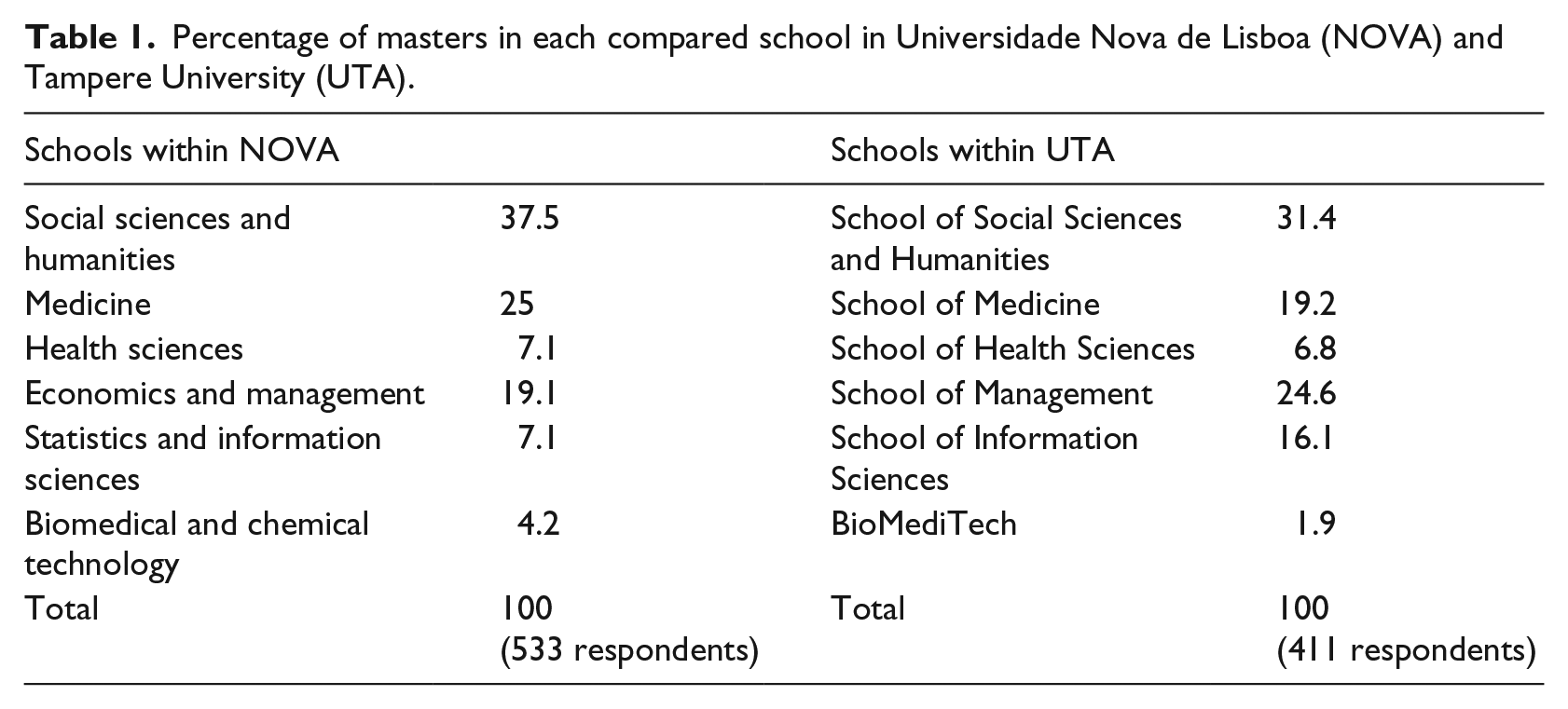
It should be noted that both samples are composed of a majority of women (64% in Lisbon and 74% in Tampere). At NOVA women are the majority in every school except economics and management, while both genders are equally represented in health sciences and in statistics and information sciences. At UTA, the information sciences school is male-dominated, whereas gender distribution is more or less even in management and medicine, and women form the clear majority in every other school considered.
In order to better enable the analysis of transitions, it seemed appropriated to distinguish between ‘professional’ and ‘general’ degrees, inspired by Leuze’s (2010) notion of occupational specificity (see above). This differentiation was drawn accepting that, in both universities, the schools of medicine and health sciences award degrees that correspond to specific professional roles (such as medical doctors or healthcare and nursing professionals), and this is not usually the case in the other schools. We used as a basis a definition that a professional degree yields eligibility for a specific profession, while a general degree offers a more flexible capacity and options for the labour market. Even if the foundations of this analytical strategy can be questioned, we argue that it can be accepted in order to better correspond to the objective of considering different types of disciplinary domains and degrees and their links with the labour market.
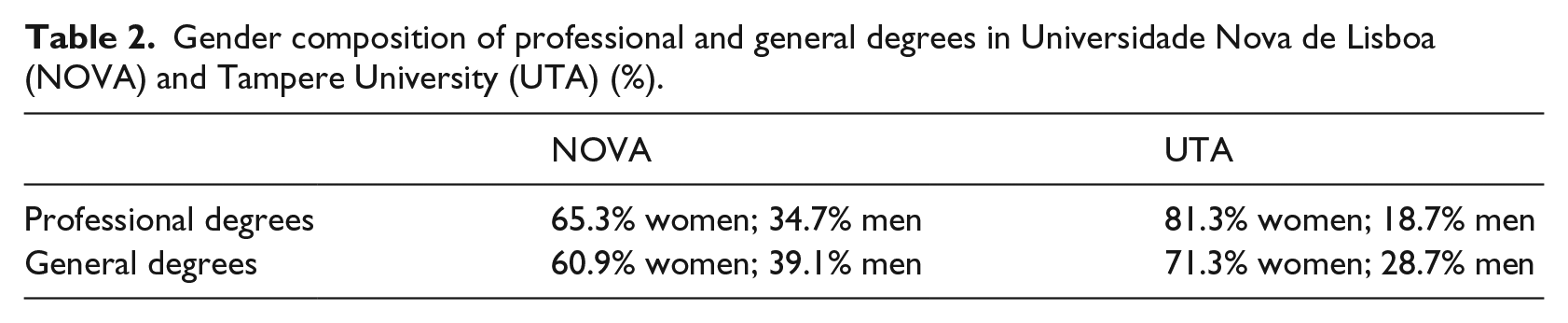
In Table 2 it can be noted that women are the majority in both types of degrees, and that this can be most clearly seen in professional degrees in both universities.
Gender composition of professional and general degrees in Universidade Nova de Lisboa (NOVA) and Tampere University (UTA) (%).
Overview of transition patterns
Given that the purpose of this paper is to shed light on transition patterns experienced by master’s graduates from both universities, a combined variable has been formed enabling us to distinguish between smooth transitions and precarious, alternative transitions (see Plug and Du Bois-Reymond, 2006). We divided these alternative patterns into ‘uncertain’ and ‘prolonged’ transitions and defined the three combined variables in the following way: ‘smooth transition’ corresponds to a group of graduates who have a permanent job when answering the questionnaire and state that their job completely corresponds with their education; ‘uncertain transition’ applies to graduates who have a fixed-term or periodic job one year after graduation and/or their job only partially corresponds with their education according to their own evaluation; ‘prolonged transition’ relates to graduates who are unemployed or are attending further training/studies or are on maternity or health leave at the state of inquiry.
Using the data shown in Table 3, it can be argued that two patterns of transition – ‘smooth’ and ‘uncertain’ – are clearly the most common ones in both universities. However, it should be stressed that at NOVA almost half of the graduates are experiencing a ‘smooth’ transition, while at UTA more than half of the graduates are involved in an ‘uncertain’ transition. It is noticeable also that ‘prolonged’ transitions are more common amongst UTA graduates than in the Portuguese case.
Transition patterns experienced by graduates in Universidade Nova de Lisboa (NOVA) and Tampere University (UTA) (%).
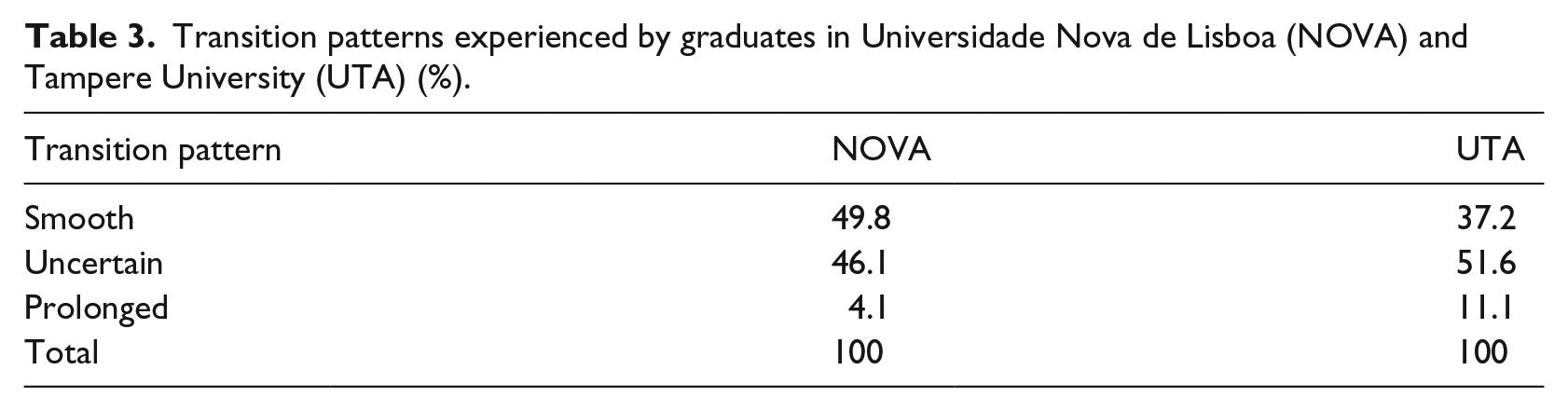
Furthermore, the crosstabulation of the variables ‘transition patterns’ and ‘school of graduation’ indicates a quite strong statistical connection between them in both universities. At NOVA (chi-square 34.973, df=12, p=0.000) it appears that smooth transitions tend to be slightly more predominant amongst graduates from the schools of health sciences, statistics and information sciences or social sciences and humanities, while uncertain transitions are more common in the remaining schools. At UTA (chi-square 43.918, df=10, p< .000) it seems that smooth transition is experienced much more often in the schools of statistics and information sciences, economics and management or social sciences and humanities. Overall, in both universities the school of statistics and information sciences and the school of social sciences and humanities seem to ensure smooth transitions more frequently. When comparing results to our theoretical framework, the greater proportion of the NOVA graduates in the smooth transition pattern may possibly indicate the positive institutional reputation of the capital region university for supporting employment when compared to the provincial University of Tampere graduates’ situation.
When the comparison is continued, the data from UTA suggest that the smooth transition pattern seems to be more typical for general degrees than for professional ones (see Table 4). In fact, at UTA 88.2% of graduates experiencing smooth transitions come from general degrees, whereas more than half (56.9%) of the group with uncertain transitions have finished professional degrees. The differences between general and professional degrees are also found to be statistically significant at UTA (chi-square 32.253, df=2, p< .000) and at NOVA (chi-square 12.342, df=2, p=0.002).
Transition patterns and type of degrees in comparison for Universidade Nova de Lisboa (NOVA) and Tampere University (UTA) (%).
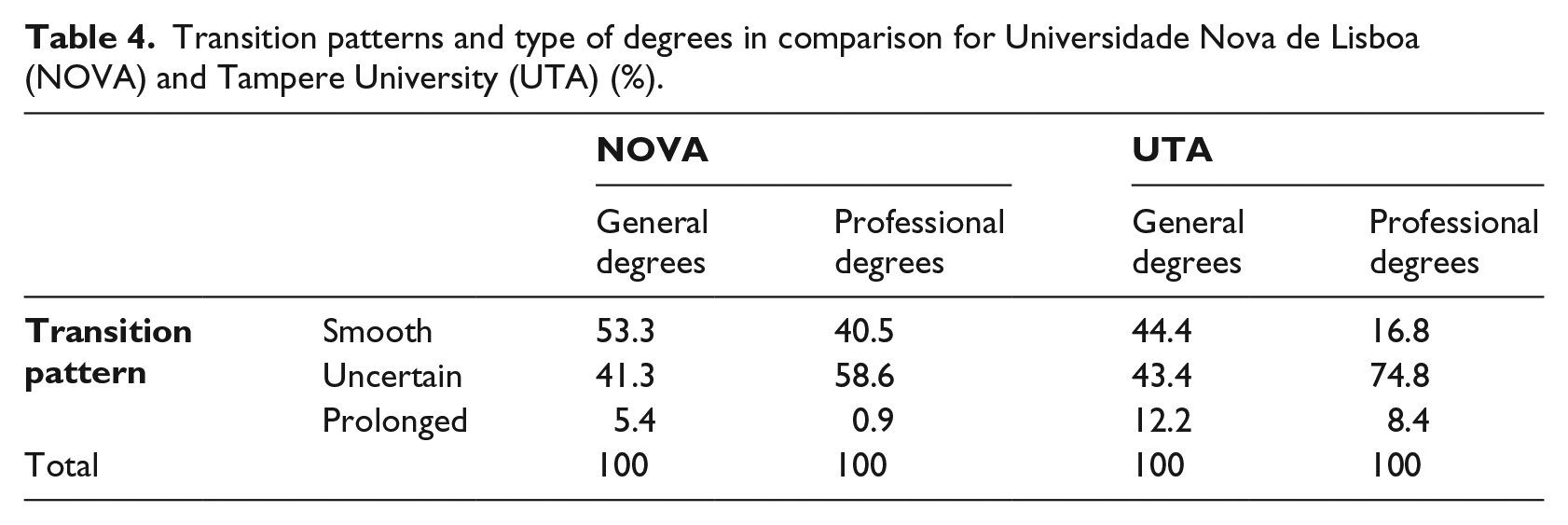
Similarly, the data from NOVA also suggest that within professional degrees, more than half of the graduates (58.6%) are experiencing uncertain transitions, but smooth transitions seem to be more common amongst general degrees graduates (53.3%). This connection is also statistically significant at NOVA (chi-square 12.342, df=2, p=0.002).
Clear differences between transition patterns in professional and general fields among Finnish graduates may indicate that the segmentation dynamics in the labour markets currently affects profession-based fields, mainly according to the OLM logic and through temporary contracts at the start of a career. Among Portuguese graduates this effect is not so distinctive, but rather indicative.
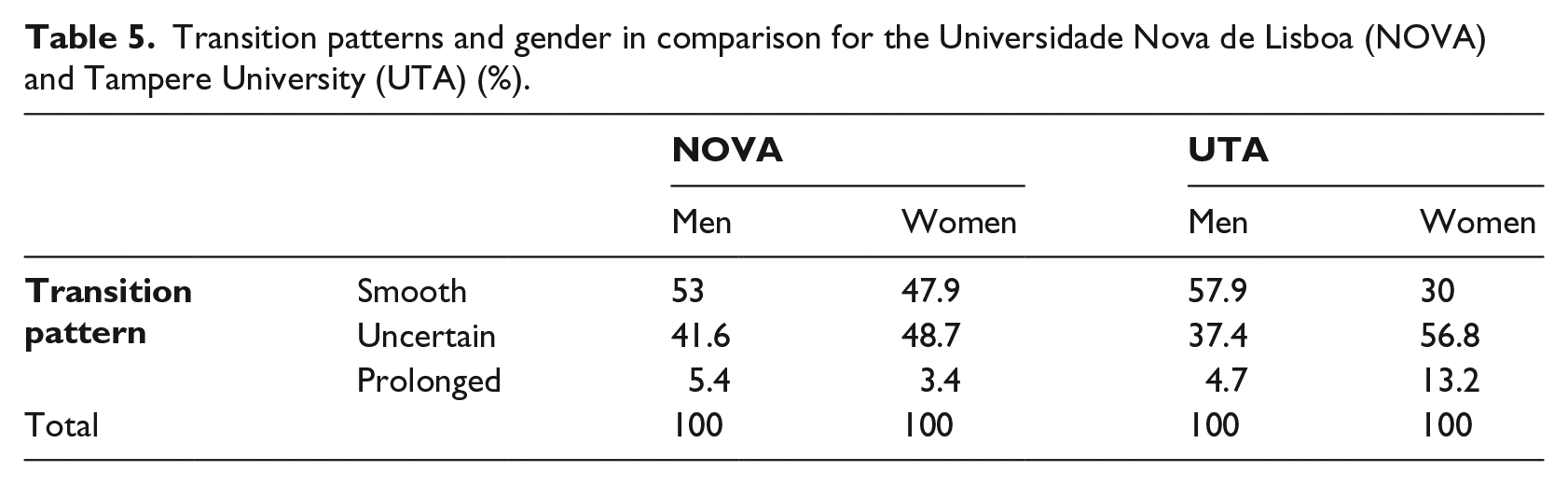
Concerning how the graduates might experience transitions differently according to their gender, the data suggest that men experience smooth transitions more often, whereas women tend to experience uncertain transitions more frequently. This latter trend is slightly identifiable at NOVA but strongly observable at UTA (see Table 5). Hence, statistical connection between these two variables cannot be traced at NOVA; however, at UTA differences between men’s and women’s transition patterns are statistically strongly significant (chi-square 27.493, df=2, p< .000). Women tend to have uncertain or prolonged transition patterns more often according to the Finnish data.
Transition patterns and gender in comparison for the Universidade Nova de Lisboa (NOVA) and Tampere University (UTA) (%).
Working while studying for a master’s degree, and transition patterns
Trajectories in contemporary societies tend to be described as increasingly complex, and working activities are increasingly being combined with study in higher education. Comparative studies have shown that, especially in Finland, students who also work are becoming more common, often as a deliberate option for financing their studies (Kivinen and Nurmi, 2003; Lindberg, 2007, 2008). Confronting the data from the two universities, it can be observed that working while studying has been an option for the majority of the graduates in both universities, namely for 53.1% of the master students from NOVA and for 88.3% at UTA. In Finland it is worth noting that working while studying is the most common way for university students to finance their studies. In Portugal, paying for higher education studies is also a very important reason why students decide to work during their academic trajectories.
In the Portuguese university, the data indicate that those who have worked while studying did so always (53.6%), most of the time (17.1%), sometimes (17.5%) and seldom (11.4%). In the Finnish university, when internships and summer holidays jobs are also taken into account, the percentage of those who have worked while studying rises to 98.1%.
It is noticeable that the data from the two universities reveal a common trend towards working while studying, but the percentage of graduates who worked while studying is significantly higher in Tampere. This trend is similar to the findings of international comparative analyses, which stress that working while studying in higher education is more typical in the north of Europe than in the south (see for instance Alves, 2013). However, comparative analysis in this area of the employability data regarding NOVA and UTA must be considered with caution, since the questions and the options for response in each of the surveys are different.
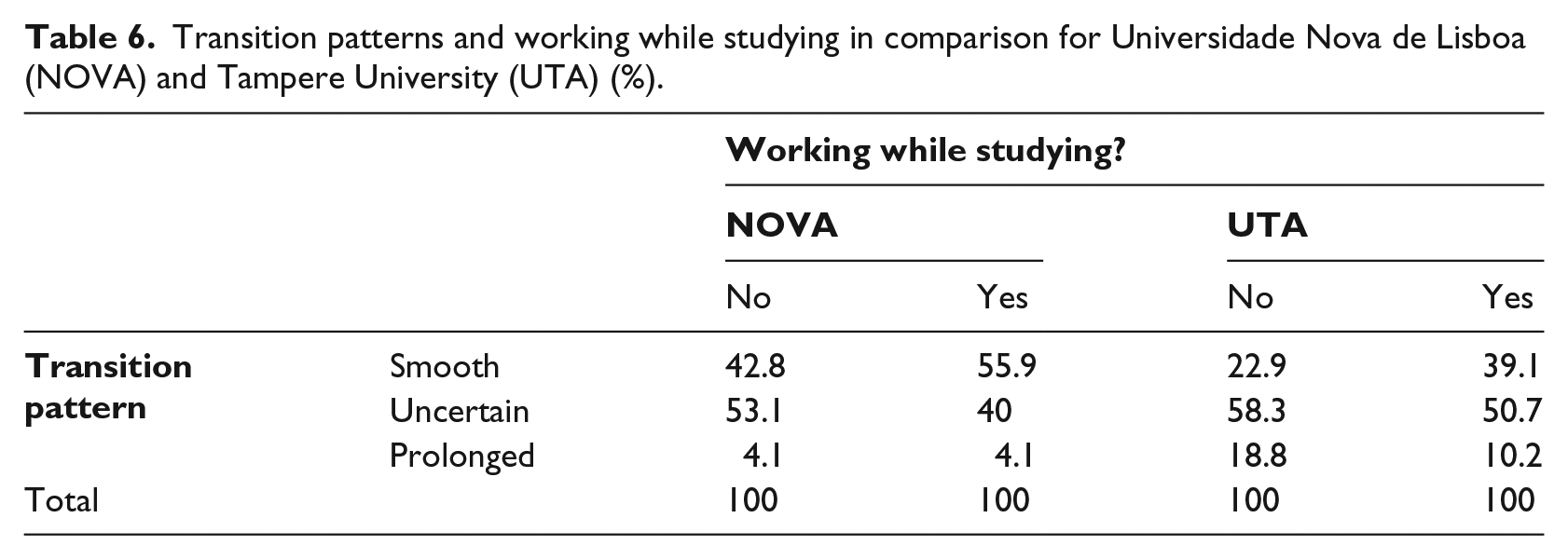
If working while studying seems to be frequent both at NOVA and UTA, can it be connected to the transition patterns experienced after graduation? It seems that there is a statistical connection between these two variables, considering that the analysis of the data shows that working while studying might improve the probability of a smooth transition (see Table 6). This finding is slightly statistically significant at UTA (chi-square 6.243, df=2, p< .05) and at NOVA (chi-square 7.400, df=2, p=0.025).
Transition patterns and working while studying in comparison for Universidade Nova de Lisboa (NOVA) and Tampere University (UTA) (%).
Transitions from work to education
In contemporary societies lifelong learning seems to be a common practice, and this seems to be particularly true for higher education graduates. Therefore, it is not surprising that significant percentages of the graduates stated that they have the intention to continue their studies in higher education in the future. A slight majority (58.2%) had the intention to study further during the next year at UTA, and at NOVA an even higher percentage (66.6%) stated the intention to study in the future. Nevertheless, the values cannot be rigorously compared since in UTA’s questionnaire the intention is situated for ‘next year’ and in NOVA there is no clear delimitation of the future period of time to which graduates should be referring.
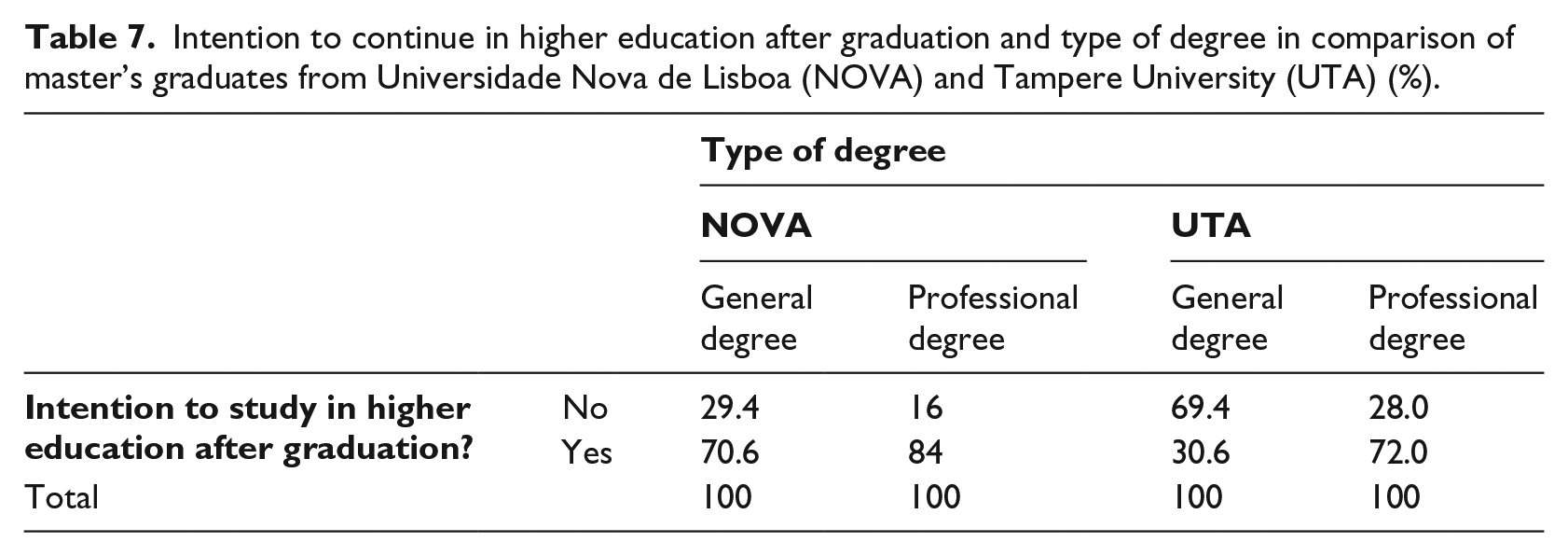
The types of studies to be pursued in the future are similar for both samples of graduates, as they point out the intention to complete a PhD (37.2% at NOVA and 17.8% at UTA) or post-graduation/specialisation studies (33.5% at NOVA and 15.1% at UTA) or teacher’s pedagogical training (this latter one is only valid for the Finnish data: 9.2%). Although the relative proportions are smaller, Finnish graduates from professional fields in particular are more likely to have an intention to study further in higher education than those who graduated from general fields (see Table 7). This difference between intentions in professional and general fields is also statistically strongly significant (chi-square 55.849, df=1, p< .000). At NOVA a similar trend can be traced and is also statistically significant (chi-square 8.888, df=1, p=0.003).
Intention to continue in higher education after graduation and type of degree in comparison of master’s graduates from Universidade Nova de Lisboa (NOVA) and Tampere University (UTA) (%).
Similarities between the two samples of graduates also seem to be noticeable when intention to study is statistically related to the school of graduation. On the one hand, higher percentages of graduates intending to study in the future can be traced in the schools of biomedicine and biotechnology (87.5%), medicine (79.7%) or health sciences (50%) in Tampere, and in the school of medicine (84%) in Lisbon. On the other hand, the lower percentages concerning the intention to study in the future are verified in the schools of information sciences (25.8%) and management (21.8%) at UTA, and in the schools of statistics and information sciences (57%) and social sciences and humanities (64%) at NOVA. The values for NOVA are higher since globally there is a clear majority (larger than at UTA) stating the intention to continue studying, even if, as mentioned above, these results must be compared carefully.
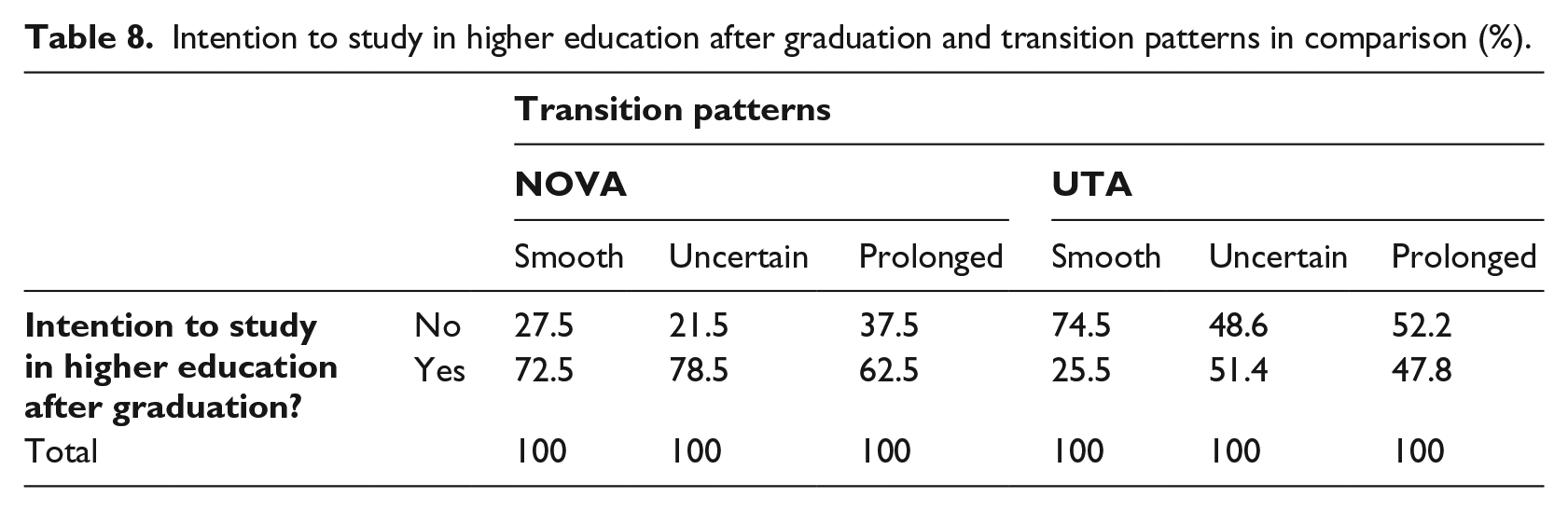
Finally, it is important to remark that the statistical relation between the intention to study in the future and the transition patterns experienced by the graduates is almost non-existent in the case of NOVA. However, the analysis of data included in Table 8 suggests that those experiencing uncertain transitions seem to seek opportunities for further studies slightly more often. In the Finnish sample, graduates experiencing uncertain transitions are more likely to have the intention to further their studies. In fact, the data from Portugal reveal that amongst those graduates experiencing uncertain transitions, 78.5% intend to continue studying, while the same value is 72.5% in the smooth transitions group and 62.5% in the prolonged transitions group. In the Finnish sample the differences between the uncertain and prolonged transition patterns and the smooth pattern is statistically significant (chi-square 25.518, df=2, p< .000). In the Portuguese sample, statistical connection between these two variables cannot be identified.
Intention to study in higher education after graduation and transition patterns in comparison (%).
A more general intention to study in higher education within uncertain and prolonged transition pattern groups seems to indicate a further impact of change in the labour market segmentation dynamics, which affects graduates’ growing willingness to strengthen their working life competences. In addition, among Portuguese graduates the more general intention to continue studying after graduation in the smooth transition pattern group might also result from the fact that NOVA is located in the capital region of the country, where the number and diversity of opportunities for further education are particularly significant.
Discussion
The ‘normal’ linear transition from education to work has never been universal and is increasingly being replaced by de-standardised and prolonged transitions that not only take longer to complete but are also diversified and individualised (Walther and Pohl, 2005). Nowadays, this seems to have become a truism for all graduates, whatever their level of educational attainment. Additionally, in the first years after graduation, it seems much more common for graduates to work in temporary, short-term positions or have longer delays before getting their first job.
Our results confirmed the overall picture of these changing conditions and relations between higher education and the world of work. These trends are identifiable amongst the master’s graduates from both universities, but it is noticeable that these trends seem to be particularly expressive amongst Tampere’s graduates in comparison with the graduates from NOVA University.
‘Uncertain’ and ‘prolonged’ transition patterns seem predominant in both universities, expressing the growing complexity and non-linear nature of transitions in spite of the ‘transition regime’ sphere of influence in different parts of Europe. The fact that ‘uncertain’ and ‘prolonged’ transitions affect a greater number of UTA’s graduates when compared to NOVA’s sample is remarkable. Given the national trends in Portugal concerning higher and fast-growing rates of unemployment among higher education graduates in the last decade, this result might be surprising.
In our interpretation, this might eventually express internal differentiations within labour market systems in countries, as well as the different local profiles and institutional reputations of the two universities under scrutiny within their respective national contexts. Additionally, Coccozza (2014: 256) maintains that ‘in Italy, Spain, Greece and Portugal we witnessed a profound historical and internal differentiation of the dynamics of economic development and, consequently of the labour markets’, which might suggest that labour market segmentation dynamics together with decreasing general willingness to employ higher education graduates could be particularly significant in Portugal when compared to Finland, where the labour market segmentation dynamic seems an essential factor for graduates’ job-seeking and employment.
Nevertheless, the analysis has revealed that the type of transition is statistically connected to the school of graduation and to the occupational specificity of the completed degree in both samples. This implies that these factors shape individual choices and life-course biographies regarding transitions between higher education and work.
It is noteworthy that the results indicate that, in both compared universities, ‘uncertain’ transitions tend to be more common for those who have completed professional degrees. On the basis of this, one could ask whether the focus in labour market segmentation dynamics has changed towards a situation in which job-seekers’ personal skills and competences override the meaning of educational credentials when employers estimate the competences of applicants. According to the findings, it seems that graduates from general higher education domains will benefit from this and, correspondingly, graduates from professional domains will have to fulfil or deepen their expertise portfolio within their professional sector and acquire additional educational credentials in order to ensure better opportunities for stable employment.
This observation leads us to question the interpretation that employability can be enhanced throughout ‘career conscious curricula’, as advocated in the emphasis that higher education institutions must pay attention to employability agendas and to how best to equip students with work-relevant skills and knowledge (Coate, 2009; Harvey, 2000; Tight, 2012). Thus, further analysis is required in order to better explain the differences between general and professional degrees. For instance, the regulations underlying the professions within the health sciences (such as medical doctors and nurses) can introduce particularities regarding access to the labour market (such as requiring internships and experimental periods of work) and thus create a more delayed transition.
It is also worth noting that research focusing on basic and secondary education and using micro-data from 18 countries (15 of them European) stresses that ‘the advantages of vocational education in smoothing entry into the labour market have to be set against disadvantages later in life’ (Hanushek et al., forthcoming: 41), and this analysis and reflection might also be relevant in the case of higher education degrees. To what extent do courses more oriented towards professional training require that the graduates look more frequently and intensely across their professional careers for additionally education and training? Professionalisation has been promoted as a way of improving transitions from education to work, but is it indisputable that it enables the adaptability of workers to structural change across their lifecycles?
Graduates from both universities express intentions to continue studying in the future quite clearly, especially those in medicine and health sciences, i.e. those who have finished a professional degree, and the connection between these variables is statistically significant. In addition, the data suggest that the graduates involved in ‘uncertain’ transitions tend to express more intensely the intention to continue their studies. This suggests that continuing studying might be an option aimed at achieving a better position in the labour market for those who are not excluded from it (i.e. those that are not unemployed), but rather are experiencing difficulties in access to stable employment. Thus, the reasons to participate in education and training across the lifecycle must be explored while considering the graduates’ employment situation, as well as the fact that lifelong learning has been diffused as a common practice and aspiration in contemporary societies, reinforcing the idea of higher education as part of a lifelong system (Tight, 2012).
With regard to working while studying, in accordance with what was expected at the beginning of the analysis, it is confirmed that this is a common practice amongst master graduates in both universities (and more strongly in Tampere). Furthermore, evidence suggests that working while studying might improve the probability of experiencing smooth transitions, since the two variables are statistically connected in both samples.
The changing labour market segmentation dynamics and the shift towards ILM logic when filling jobs is creating an environment in which accumulating work experience while studying might be valued by employers after graduation, since it can be understood as a sign that ‘the job applicant has experience of the labour socialisation process and has acquired some intrinsic characteristics, like a tertiary degree of responsibility and punctuality in everyday working activities’ (Robert and Saar, 2012: 744). Another explanation could be linked to the fact that working during studies can contribute to the accumulation of social capital that facilitates the process of looking for a job after graduation. This might be particularly significant when the student performed a study-related work activity during their studies. Research centred on the specific case of graduates in central and eastern Europe (Robert and Saar, 2012) supports this interpretation by showing that the probability of finding a job after graduation is increased for graduates who have had a study-related work position while attending higher education.
The analysis of employability data from UTA and NOVA also leads us to suggest that students finishing their degrees in due time might experience more difficulties in entering the labour market. This has to be considered when implementing political orientations in higher education that have been pressing students not to take longer than expected to finish their degrees and insist on the need to decrease the delay in completing their studies. Nevertheless, it is worth exploring further the links between study-related work and non-study-related work, as Robert and Saar (2012) indicate that the former has a positive effect on both reducing the search time for a first job and increasing the probability of having a professional job, but the latter affects entry into the labour market and job quality in a negative way.
Finally, one common aspect in both universities under scrutiny that we must highlight relates to the clear feminisation of master’s graduates, which appears to be more intense within professional degrees and less intense in disciplinary domains such as information sciences and economics and management. This indicates that educational choices, namely those concerning studying in higher education and the disciplinary domains of studies, are strongly differentiated by gender, as other research data in Finland and Portugal have already shown (see for instance Alves, 2013; Vuorinen-Lampila, 2014). With this in mind, the framework for researching transitions between higher education and the world of work needs to include individual factors.
Furthermore, although no statistical connection between the variables was traced (especially at NOVA), it is observable that women tend to outnumber men within ‘uncertain’ transitions, while men experience ‘smooth’ transitions more often. This result highlights the importance of considering how social factors (such as gender) shape transitions, individual choices and biographies, as it reflects an international trend towards higher unemployment (Stiwne and Alves, 2010) and greater difficulty in accessing stable positions in the labour market experienced by women. This seems to be a trend, even though females are the majority amongst higher education graduates.
…the reversal of gender positions after entry into the working life is striking; […] girls perform better than boys at school, and in higher education women complete their studies a good deal more frequently than men […] when (former) students enter the labour market the roles are reversed: men benefit from their gender from the very beginning of their careers. (Vuorinen-Lampila, 2014: 284–308)
Conclusion
Overall, even if the concept of ‘transition regimes’ proposed by Walther (Walther, 2006a; Walther et al., 2006) refers to different national and local configurations of the regulation of transitions, the analysis of employability data from the two universities considered in this paper suggests significant similarities regarding higher education graduates’ transitions between education and work in the two countries studied. The general ideas about transition patterns becoming increasingly complex and trends of working while studying for a master’s degree being significant are supported by the data analysed and seem to be especially evident amongst the UTA’s graduates. The intention to continue studying in higher education after concluding a master’s degree must also be signalled in both groups of graduates. The data discussed in the paper suggest that common trends are identifiable in both cases, even if the national contexts regarding higher education attendance and employment of graduates are quite diverse.
Additionally, drawing on the conceptualisation by Leuze (2010), the analysis of the employability data from NOVA and UTA indicates that labour market segmentation in each country, institutional reputation for employment of concrete universities and occupational specificity of higher education degrees are also important factors to be considered in comparative studies of transitions. These factors appear to be linked to differences within transitions between higher education and the world of work experienced by the groups of graduates from Finland and Portugal.
Moreover, other variables (such as gender) are also framing transitions, as the analysis of data from NOVA and UTA clearly shows. In her research about the employment of higher education graduates, Vuorinen-Lampila (2014: 19) stresses, ‘Finland is often perceived as exemplary in terms of gender equality, but one can see that in the labour market there is still much to do if equality is to be achieved’. The confrontation of the data from UTA with the results at NOVA reveals that the gender inequality is more pronounced in the Finnish case, given that the percentage of women amongst graduates is particularly high but they are more frequently involved in uncertain and prolonged transition patterns. These trends affecting master’s graduates from both universities cannot, of course, be generalised to all the higher education graduates in the two countries, and require further research. Also, other variables such as age and social origin might also frame transitions in similar ways, but the data available in both universities did not enable us to conduct that analysis.
Restrictions concerning the arrangements for implementing the surveys and differences in the survey items also had to be taken into consideration and prevented further statistical analysis of the data. Thus, the results cannot be considered directly generalisable, but rather indicative and only partially conclusive. In addition, the results from a single university in compared countries do not allow generalisation of the results either, since employment from different universities may have different manifestations even within one country, as previously suggested in this paper.
Nonetheless, European diversity has been illustrated and common trends regarding graduates’ transitions to (and from) work have been sketched in the paper, arguing that comparative analysis considering various institutions and countries requires that we take into account a complex set of factors and variables. These factors and variables include the profile of educational degrees, specific characteristics of the labour market, gender, economic and employment dynamics, individuals’ aspirations and expectations towards education and work, and so on. The theoretical framework sketched in this article might be an important tool for the future comparative analysis of transitions between higher education and work. Additionally, further comparative analysis cannot devaluate aspects such as (in)equality both across countries and within individual countries. As Tomlinson (2012: 411) highlights: ‘the changing higher education–economics dynamic feeds into a range of further significant issues, not least those relating to equity and access in the labour market’, as the traditional link between higher education credentials and occupational rewards has been disrupted, leading to a stratified and differentiated system of higher education in which institutions and countries provide diverse opportunities to benefit from participation in higher education. These dynamics require extensive investigation in order to envisage the possible future developments of higher education graduates’ employability in European societies, especially in the current context of global crisis.
Footnotes
Declaration of Conflicting Interest
The authors declare that there is no conflict of interest.
Funding
This research received no specific grant from any funding agency in the public, commercial, or not-for-profit sectors.