




Abstract
Student drop-out in higher education is an increasingly important issue across Europe, but there are substantial disparities between countries and institutions which suggest that variations in policies and practices may influence student retention and success. Numerous schemes have been devised to increase student retention, frequently focusing on non-traditional groups. Retention efforts include scholarships and bursaries, enhanced monitoring and support measures, and specialist teams of staff or peer mentors. Theoretical understanding of the withdrawal of non-traditional students typically draws on social and cultural capital concepts (Bourdieu, 1986), which may have led to a rather deterministic approach to student success. Research with non-traditional students on two distinct but related projects at a UK university led us to consider the concept of resilience in helping to understand student retention and success. This paper discusses the concept of resilience and – drawing on our experiences of using a resilience framework for analysis of risk and protective factors in these two projects – considers how it might be of use in supporting student retention in the wider European context.
Introduction
Higher education (HE) across Europe has been subject to considerable changes over recent years. Key are fluctuations in fee regimes (and the extent of government support); differentiation in the types of institutions offering HE; and a general increase in student numbers (massification) combined with moves towards ‘widening participation’, targeting non-traditional students (Jongbloed and Vossensteyn, 2012; Merrill and Johnston, 2011). Non-traditional students are those under-represented in HE – and whose participation may be limited by structural factors. They include first generation students (first in family to participate in HE), mature students, disabled students, single parents, students from low income families, and minority ethnic groups (Crosling et al., 2008). If Europe is to compete globally, opportunities for widening participation in HE must be facilitated (Bourgeois and Frenay, 2001).
Although the focus of early work on widening participation was very much centred on recruitment and outreach, more recently there has been increasing interest in withdrawal and retention (Merrill and Johnston, 2011): Currently too many students in the EU drop out before they complete their higher education degree. Students from a lower socio-economic background and other disadvantaged groups are the most likely to drop out. (Quinn, 2013: 7)
It is not necessarily the case that students who withdraw have experienced more difficulties than those who don’t (Guglielmetti, 2011), but there is evidence that non-traditional students are at particular risk (Corver, 2005; Merrill and Johnston, 2011), thus considerable efforts have been expended in calculating how to support these students. Research indicates that there are substantial variations between different countries (Bourgeois and Frenay, 2001; Merrill and Johnston, 2011; Quinn, 2013), and different institutions (Hatt et al., 2005). This suggests that differences in policies and practices can have a major impact on student retention and success. A growing number of countries are including retention as one of a set of performance indicators on which institutional funding is based, hence understanding the issue is becoming increasingly urgent (Thomas and Hovdhaugen, 2014).
Different national policy contexts frame participation and retention of non-traditional students, and variation in funding regimes make participation more or less possible for low income groups. Some authors argue that the Bologna process has increased the issue of non-continuation, as first degree programmes are reduced in time period, but not in content (Chagas-Lopes and Fernandes, 2011). There are individual variables, such as students’ entry qualifications and personal background, which are likely to impact on retention but which the institution cannot influence (Wolter et al., 2014). However, as Fragoso et al. (2013) argue, there is a need to challenge the widespread view of non-traditional students as a problem for HE institutions, because this diverts attention from the need for institutions to change their culture and practices.
Across Europe, various schemes have been devised which aim to increase student retention, particularly from non-traditional groups. Retention efforts may include scholarships and bursaries, enhanced monitoring and support, and specialist teams of staff or peer mentors. Evidence of the effectiveness of different approaches is limited, although some research suggests that combining financial support with close monitoring of educational engagement can help reduce withdrawals (Newman-Ford et al., 2010). Bursaries alone have been found to enhance retention of low-income students (Carson, 2010; Harrison and Hatt, 2012) – although Harrison and Hatt (2012) found that the bursary’s financial incentive was less important than students feeling socially comfortable at their institution. There remain unanswered questions about why some individuals succeed whilst others do not, even when they are apparently offered the same financial and academic support.
In this paper, we use data from two projects at a UK university with a strong record in widening participation to theorise about the concept of resilience in HE. The UK is one of the more successful EU countries in regard to retention (Quinn, 2013), but there is significant variability across different student groups and institutions. For example, high tariff universities generally have lower drop-out rates overall, but higher drop-out rates of non-traditional students (Quinn, 2013). In England, 41% of 18 and 19 year olds enter university, with almost 80% studying full time (Universities UK, 2015). About 20% live with their parents whilst studying (HESA, 2015), as it is more usual to attend a university in a different area.
The aim of this paper is to explore the potential for using the concept of ’resilience’ to help understand student retention and withdrawal. The next section considers the theoretical understandings of retention and success, and where resilience might offer new opportunities for researchers.
Theoretical understandings of retention and success
Traditional understandings of individual success in HE often draw upon Bourdieu’s theories, including the concepts of social and cultural capital (Bourdieu, 1986). Bourdieu was concerned with social reproduction through education, and articulated several types of ‘capital’ (accumulated labour in embodied form), analysing the ways in which they support the status quo. Social capital is described by Bourdieu as ‘the aggregate of the actual or potential resources which are linked to possession of a durable network of more or less institutionalised relationships of mutual acquaintance and recognition – or, in other words, to membership of a group’ (Bourdieu, 1986: 88). Cultural capital includes personal dispositions such as embodied knowledge, cultural goods such as books, and institutionalised cultural capital such as educational qualifications (Bourdieu, 1986). Described as such, cultural capital can be seen to be very unevenly distributed in the student population, and more so in the population at large.
The implications of Bourdieu’s theory for widening participation have been thoroughly explored by previous researchers: potential impacts for students in possession of limited cultural capital include little confidence in engaging with the language and rituals of HE; uncertainty about what is required of them in writing; and behaviour in seminars and in professional settings (West, 2014). Difficulties may arise from a tension between the habitus (those embodied dispositions that influence behaviour) of non-traditional students (Bourdieu and Passeron, 1977) and that of the university (which legitimises class-based hierarchies in types of knowledge or cultural mores). Reay et al. (2005) draw on Bourdieu’s concepts of cultural capital, habitus and field to explore student choice in HE, and note the uneven distribution of confidence and entitlement which may impact on student retention and success. The unfamiliarity of the HE environment can impact more deeply on students from non-traditional backgrounds, potentially placing limits on learning in the same way that the concept of ‘novelty space’ has been shown to be a detriment to learning for students in an unfamiliar experiential environment (Falk et al.,1978).
Concerns about Bourdieu’s approach include the lack of attribution of agency to students, leading to overly deterministic views of their chances of success. It is clear that even students from apparently very similar home backgrounds can have very different experiences at university. Chapman Hoult (2009) notes that Bourdieu fails to consider the ways in which individual students, with apparently limited educational and cultural capital, both survive and thrive in HE; thus a more nuanced understanding of students’ relationship with their institution might be required. In addition, West et al. (2013) argue that: ‘Learners can, for instance, be considered as potentially more agentic in their social interactions at university, and notions of capital might be broadened to include psychological and familial dimensions’ (p. 120).
Whilst education clearly has the potential simply to reproduce inequalities in society, there are other alternative outcomes for non-traditional groups, and we were keen to explore the possibility of taking a more agentic view of student retention.
A specific model of student drop-out has been developed by Tinto (1975), and is widely used to explore reasons for retention or withdrawal. Tinto’s model has some synergies with Bourdieu in that individual and family attributes and prior qualifications (forms of social and cultural capital) are seen as influential. However, Tinto takes a more expansive view of student success in which aspects of the academic environment (including interaction with staff), and social system (extra-curricular activities and peer group integration) play a key role in the student experience. He concludes that students who are less well integrated into academic and social settings are more likely to withdraw. Although early work assumed that to make a successful transition into HE involved cutting ties with family, friends and past communities, it is now recognised that maintaining this contact can enhance persistence for some students (Tinto, 2006–7).
More recently the theoretical lens of Honneth (1995) has been used to understand how student retention and success can be dependent upon a process of authentic recognition provided by significant others. Honneth attempts to link individual experiences with wider social structures; this is a psychosocial perspective that highlights the importance of inter-personal relations in identity formation and management. HE can be an important locus for the development of self-recognition (West, 2014). Using this lens Fleming and Finnegan (2014) argue that ‘the aim of higher education should be to support the creation and sustaining of narratives and biographies that are loaded with self-respect, self-confidence and self-esteem. These should form the habitus of a learning institution’ (p. 60).
Whilst building on these theoretical perspectives, our research also drew on the concept of ‘resilience’ for understanding the student experience. Resilience can be defined as ‘the ability to recover rapidly from difficult situations as well as the capacity to endure ongoing hardship in every conceivable way’ (Walker et al., 2006: 251). It represents a positive adaptation to threat or adversity, and may lead to ‘surviving’, ‘coping’ or ‘thriving’. Resilience can be seen as an evolving condition, resulting from interaction between an individual, the family and the environment. In the context of HE, ‘endurance resilience’ has been raised (albeit relatively infrequently) in the literature as a potential explanation for student withdrawal or retention (Walker et al., 2006: 253).
This research explored the HE experience of non-traditional students, using a ‘resilience framework’ to analyse interview data. Analysis involved an assessment of the levels of adversity which individuals have encountered through their personal history and educational journey, and evaluating the nature of potentially stressful events they have experienced, and those which enhance their resilience. Although we considered all the contributory factors which might influence resilience and retention, the focus of this paper is primarily on those which are within the institution’s control – building on the theoretical models to provide some practical suggestions for change.
One of the research projects concerns care leaver students, and it is in this context that resilience has been used previously, although it appears to have wider applicability. Studies of academically successful care leavers have started to identify aspects of resilience which enabled students to overcome difficulties faced (‘risk factors’), through having access to so-called ‘protective factors’ that buffer individuals from adversity (Driscoll 2011; Hyde-Dryden (2012); Munson, 2013; Stein, 2008). Previous research suggests that there may be a strong ‘risk gradient’ with some individuals’ levels of risk increasing cumulatively after a difficult start (Masten and Powell, 2003).
The resilience framework offers an alternative model for understanding factors influencing student success in HE. It aims to help answer crucial questions about why some students succeed in the face of adversity while others do not, and what universities and staff can do to enhance the rates of student success and reduce withdrawal.
Aims and methodology
In the light of these theoretical underpinnings, this paper aims to explore the issue of student retention and answer the following questions:
In what ways and to what extent can the concept of resilience be used to help understand individual students’ experiences of HE?
In what ways and to what extent can the concept of resilience be used to help universities put in appropriate support for non-traditional students?
What are the strengths and weaknesses of resilience as a theoretical approach to understanding retention in HE?
In answering these questions, the researchers draw on the findings of two related research projects on non-traditional students. The first project tracked students who had been part of the UK’s National Scholarship Programme (a short-lived bursary and support programme primarily for low income students). The second project involved working with non-traditional students who came to university from local authority care, usually from foster or residential homes. This group of students is described throughout the paper as ‘care leavers’. Both projects touched upon issues of retention and explored factors which make students more likely to continue and prosper at university. The projects are described briefly, and the findings are used to theorise about changes which universities might make to enhance retention, as well as the value of ‘resilience’ in studying retention in European HE.
Project 1: Exploring the experiences of students on the National Scholarship Programme
The National Scholarship Programme (NSP) was a UK scheme which provided financial support (up to a maximum of £3000 in fee waivers, subsidised accommodation costs and direct financial aid) for undergraduates from low-income backgrounds. The scheme went into operation in 2012–13 and it ceased after 2014–15. A national evaluation of the NSP indicated the need for more institution-level research to explore the impact of the scheme (Bowes et al., 2013). Our research aimed to explore the NSP in an institution with a history of success in widening access, and to provide recommendations for enhancing support. Whilst there is no targeted support for non-traditional students (unlike the care leavers described below), all students at this institution are allocated a personal tutor with whom they should meet at least three times per year.
The study used a longitudinal, mixed methods approach (including online questionnaires, interviews and data tracking through the student records system) to provide insight into the student experience at different points during their HE career. The NSP students were the primary focus of the study, since they represent a key widening participation target group – but their experiences were also compared to another group of students (matched as far as possible on gender, disability, generational status and POLAR 1 ) in order to gauge any impact of the scholarship funding. This paper focuses solely on the findings which relate to student support and retention, drawn from interviews and surveys with selected scholarship students and the matched sample. The data collection tools explored background characteristics, expectations, early experiences, academic and pastoral support, and feelings of integration into the university community.
The first year data (on which this analysis is based) included 20 semi-structured interviews with non-traditional students (ten male, ten female from various disciplines, half of whom were in receipt of NSP funding), and two surveys during the first year. The sample of 20 included four students with disabilities, nine mature students and 15 first generation students. Accounts of positive and negative experiences at university were gathered using a critical incident approach (Brookfield, 1987; Tripp, 1993). The critical incident approach is rarely used in widening participation research, yet it provides a simple and appropriate method for encouraging students to reflect on specific concrete experiences (further information is provided in Cotton et al., 2014). All interviews were transcribed fully before analysis. The interviews aimed to collect rich qualitative data, to ensure that the student voice was clearly heard, enabling the construction of models which identify characteristics or activities of students which are related to successful outcomes.
Project 2: Exploring the experiences of care leavers in higher education (CLS)
A large scale project by Jackson et al., (2005) indicated that care leaver students often took longer to complete their studies than others, needing to repeat assignments, modules or even whole years. However, despite increasing interest in widening participation, there is a paucity of research on care leavers’ experiences in HE, and limited evidence about the ways they overcome difficulties, and the sources of support they draw on. Our research explored the whole-university experience of a group of final-year care leaver students in a university which has a significant cohort (there were 119 care leaver students known to the university at the time of the research, around 60% of whom were female). The university provides targeted support for this group through the care leaver service and advice officer.
The study used a qualitative, interpretive approach, involving an independent researcher with significant experience of interviewing vulnerable adults. For reasons of anonymity and data protection, the care leaver advice officer contacted care leavers with information about the research and a consent form. Financial incentives for participation were offered, and there was an opportunity to ask questions prior to agreeing to take part. Interview questions were flexible and tailored to the context but constructed to cover the following areas: preparation for university; induction/transition; financial aspects including amount of paid work; academic experience, including support received; social and personal experience, including support received; support from the local authority; and plans after graduation. Eight care leavers agreed to take part. All were female undergraduate students, aged between early 20s and early 40s, from the following disciplines: Business Administration (2); Social Work (2); Law; Tourism and Hospitality; Health and Social Care; and Criminology and Psychology. Seven were of white British origin and one was from a British Black African Caribbean background. Three had children, ranging in age from 3 to 20 years and six were first generation students. The students came from a range of educational backgrounds: some had successfully completed A levels; others had entered via an Access course or Foundation degree. Some had been in paid employment before starting university; one had overcome drug addiction before starting.
Narrative accounts of their academic and personal experiences were gathered through interviews using the critical incident approach (as outlined above). Interviews were recorded with the students’ permission, assuring respondents of anonymity. They were transcribed fully prior to analysis.
Analysis using a resilience framework
In both our studies, it was clear that students had a variety of risk and protective factors and that the balance of these factors had a strong influence on outcomes. However, there were also students with very few protective factors and a large number of risk factors, but who succeeded in HE. These students seemed to have, or develop, a personal resilience which others lacked.
Significant risk factors are often present prior to starting university (e.g. poor early childhood experiences, or poor academic success in school); thus our main focus was on the protective factors (strong relations with others, living in a close knit community, good support networks), since these are most amenable to influence through institutional policies and practices. Rather than taking a statistical approach, we focused primarily on the interview data and, in particular, on the critical incident analysis to determine the variables which enabled students to overcome issues encountered at university.
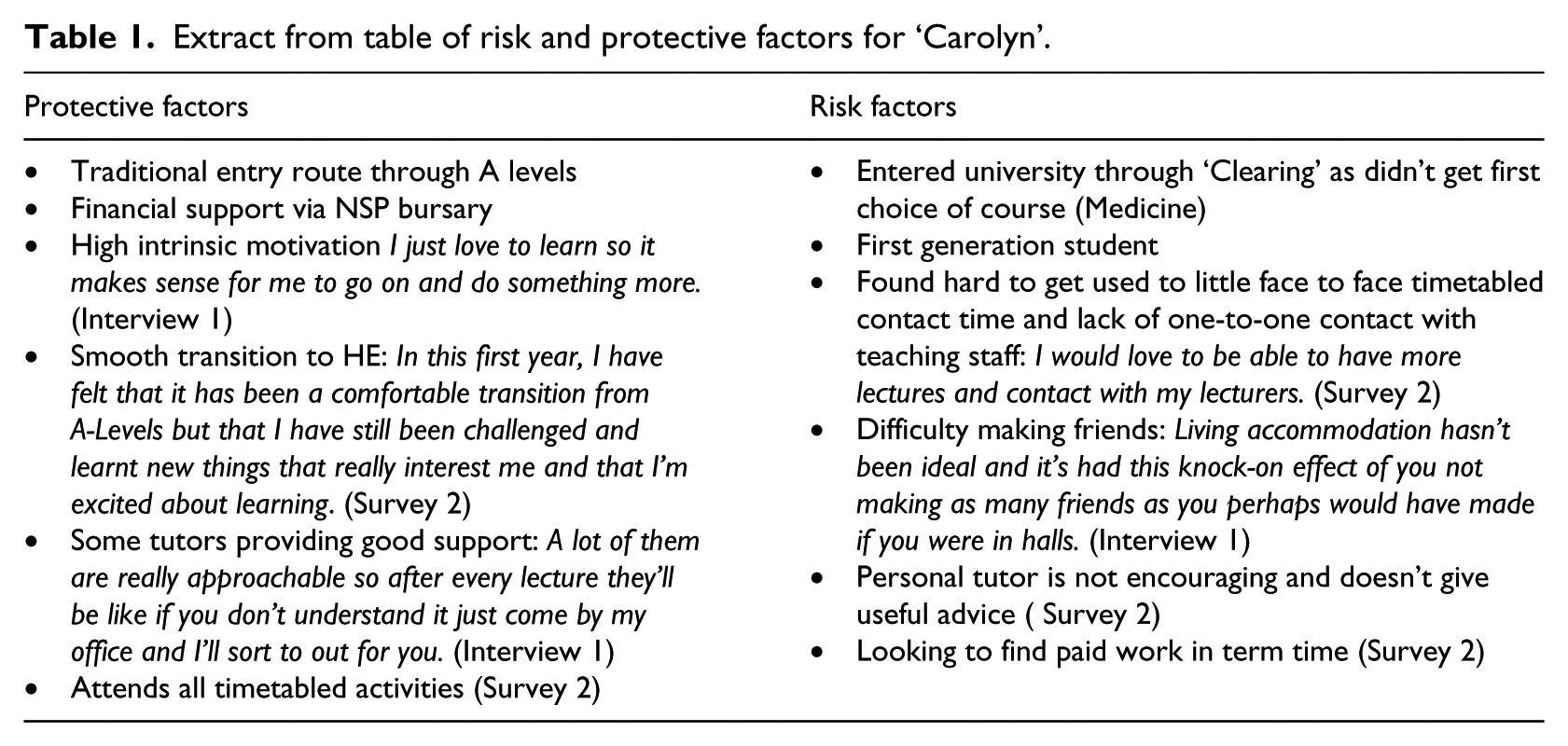
Data analysis used an iterative approach, working with concepts identified as important in the literature and those which emerged inductively from the data. The researchers aimed to identify protective and risk factors for each of the students, through their pre-university and current experiences, and explored the ways in which these events impacted on their student experience, degree result, and subsequent employability. Tables of risk and protective factors were drawn up for each individual, and then collated using the constant comparative method to draw out cross-cutting and recurring themes to identify the major factors across the whole sample (See Table 1 for an exemplar extract). For the purposes of this paper, the main risk and protective factors have been summarised across the combined data sets from both projects to provide a generic ‘resilience framework’ (Table 2).
Extract from table of risk and protective factors for ‘Carolyn’.
Resilience framework (highlighted factors discussed further below).
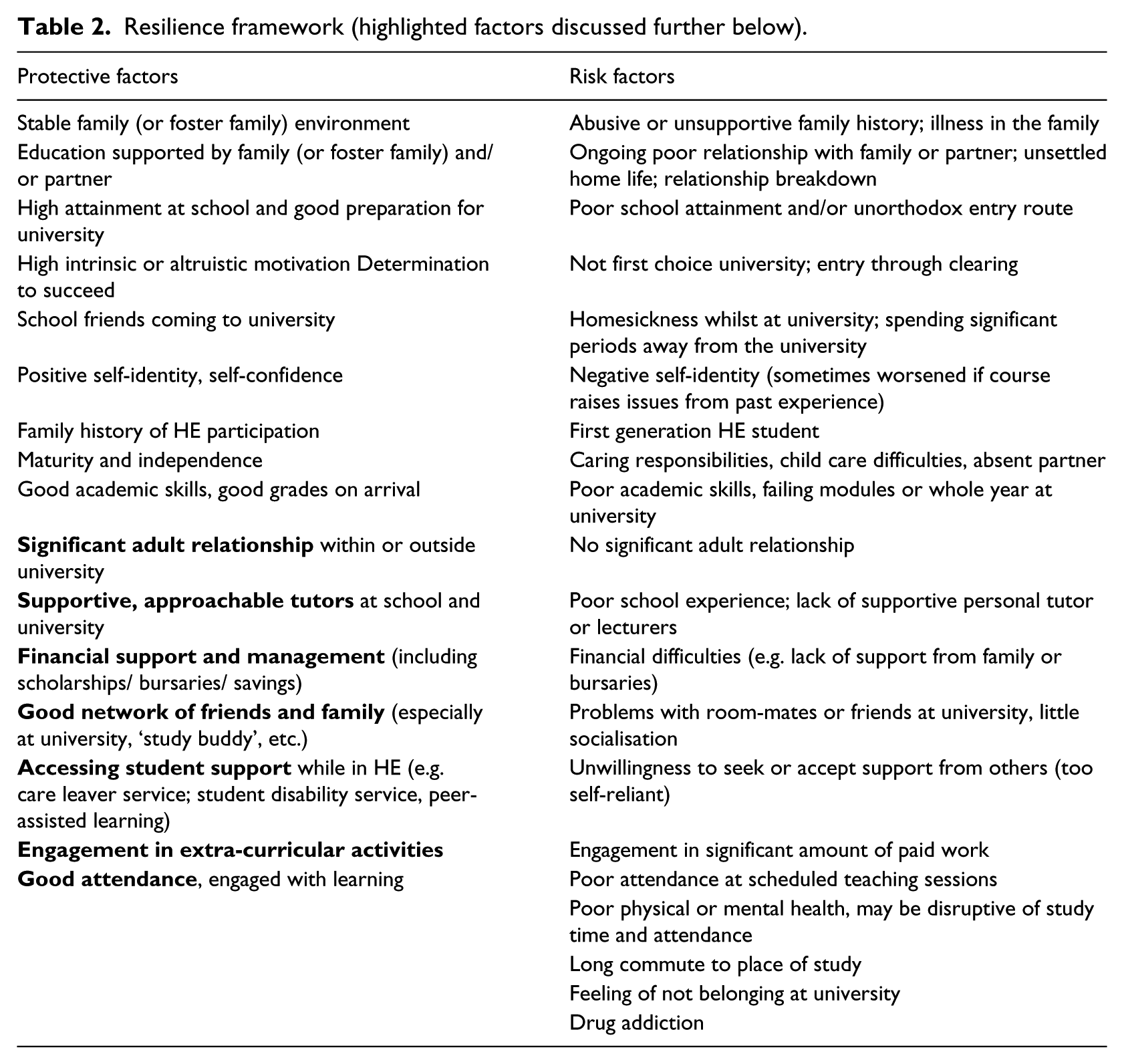
For any individual student, the resilience framework gives an indication of the extent to which they are ‘at risk’ of withdrawal or failure; thus consideration of the breadth of issues involved might prove helpful in terms of encouraging students to self-assess their levels of resilience and directing them to appropriate support services. These analyses give depth to the findings of Jackson (1998), Stein (2008), Driscoll (2013) and Munson (2013) about protective factors that can lead to resilience and future success. Where the risk factors significantly outweigh the protective ones, resilience is decreased and success is less likely. The analysis of individual resilience suggests that protective factors such as high intrinsic motivation and a significant adult relationship can overcome some of the worst risk factors (including poor early family experiences and addictions), leading to surprising resilience and a successful outcome despite prior experiences.
At a group level the analysis indicates that there are a number of protective and risk factors within the control of the institution. The key factors, highlighted in Table 2, are discussed briefly below with illustrative quotes from the interviews. (The first two themes have been merged as a tutor could be the significant adult.)
Significant adult relationship/supportive, approachable tutor
Care leavers could access support from the care leaver advice officer, who provided emotional and practical support, and checked up on individuals’ well-being on a regular basis: She’s sent me regular emails seeing how I am and she’s always made me aware that if I need any support she’s there, from day one she’s always said that … I do get on with it myself but it is nice to know that there is someone if it really gets too much. (Julie – CLS)
The empathetic approach of this staff member provided, for this group of students, the authentic recognition, identified as important by Honneth (1995). The care leaver advice officer provided assistance in accessing university academic and support services (for a group who were unwilling to make a fuss, for fear of being considered difficult – see below). She organised activities which enhanced social and academic integration (such as social events and a support group), an issue which is of crucial importance in retention (Tinto, 1975), and she helped students to access family support when this was needed: She’s been very important, if it wasn’t for her I don’t think I’d still be here, I don’t think I would have got my degree … [the support officer] helped me get home for that week, and I think that week at home with my family showed me that I should be carrying on with my degree. (Susan – CLS)
The data suggest that the provision of targeted support for vulnerable students can ‘tip the balance’ in favour of success, and help them develop the resilience required for successful completion irrespective of social and cultural capital.
For the wider group of non-traditional students in the NSP study, the issue of a significant adult was also important. Without a dedicated support service, how did they develop resilience and overcome risk factors? In many cases, support from a lecturer or personal tutor was important. When the relationship worked well, tutors were approachable, encouraging, and available to talk about non-academic issues, and this support was significant in enhancing the individual’s ability to cope.
I met Dr XXX who’s my personal tutor now [at an induction day], so yeah everyone was really friendly and then we did a three hour practical in the labs … I found the staff and current students there helpful and friendly and amiable. (David – NSP) [The tutor helped with] the stress of not knowing if I’m doing something wrong and then for a little while feeling stressed that you know quite who to go to … I end up going to my personal tutor for things even despite the fact she’s really busy she’ll always make time. (Sharon – NSP)
In contrast, where this relationship was poor or non-existent, it had the potential to increase feelings of alienation amongst students: I’ve seen him once but to be fair I haven’t seen him again, he obviously gave me a bit of a scolding the first time I saw him because I made a couple of mistakes and it’s kind of put me off going to see him again, because I mean no-one really quite wants a scolding. (Marcus – NSP)
The personal tutor, in the positive examples, seemed to replicate the role of the care leaver support officer in terms of providing a relationship with a significant adult, who was interested in the whole person, and enabled signposting to other support services. This tutor could be a crucial source of support for the non-traditional students and helped them adapt to the expectations of university life.
Financial support and management
Finances were a recurring concern to the students in both of our projects, particularly those students in the sample who did not have a bursary: I knew I wasn’t going to be getting a very high level of a loan, a maintenance loan, and I also knew that my parents weren’t going to be able to give me a lot of money either to live on, so I think that was probably one of my main worries that I would not have a lot of money to live on. (Andrew – NSP)
There was constant anxiety that existing funds would not last the year, and although many interviewees had a bursary, they stated that it was difficult to find enough money for day-to-day living. This anxiety, when combined with negative experiences at university, could lead to them considering withdrawal: Because I felt that we had so little teaching time, teachers weren’t very friendly, the fees were through the roof and I could do it at the OU for a third of the price and yeah, I did consider it. (Natalie – NSP)
Many students undertook paid work alongside their studies: And I then had to go and find a job, so since being at uni I’ve worked, since day one of uni because I had to, because all my loan went on my rent and it left me with I think four hundred pounds and I had to then divide that by the months of uni, so I had to get a job. (Wendy – CLS)
The impact of the NSP bursary meant that some students did not have to work. This acted as a protective factor which enhanced student resilience and reduced their stated likelihood of withdrawal. One student noted that he could not have kept up with the academic work if he had a job as well. The bursary alleviated financial stress somewhat, but not entirely: That come in helpful, in particular I used it for buying my ink for my printer, buying text books and stuff like that, I mean it’s not easy living on student finance, I have a bit of money behind me but not so much that I wasn’t eligible for it, you know I’m running out of money to be honest. (David – NSP) [Money on the campus card] made a dramatic impact on how easy and stress free it was at the time, just having that small extra support when you’ve got to wait that two or three weeks for your bursary to come back, and you’ve paid all your rent and it’s literally just your food bill you’re worried about or you haven’t got the book you need or something very small like that, it makes a dramatic difference to people. (Sharon – NSP)
Although the research evidence that financial support improves retention is not clear, there is substantial evidence that it makes students’ lives less stressful.
Good network of friends and family
Many students reported a lack of contact with academic or personal tutors as a concern, and support networks through friends or family were crucial to enhancing persistence: My dad contacts me pretty much every day, my mum will phone me when she’s gets a chance because she works a lot. (Rachel – NSP)
The first few weeks were the most difficult for many students, and this was where the risk of withdrawal was at its highest, as some students struggled to adjust to living away from home: There was just lots of people crying in the toilets for the first few weeks … I was just always going in there and there were girls on the floor crying for their mums. (Natalie – NSP)
Strong links with the family in these early days were often key to student persistence, supporting the position of Tinto’s later work (2006–7). Financial support from family could make the difference between being able to continue with study or withdraw: There have been times when I’ve had to rely on them for money really just to get me through those really difficult patches, which I don’t like having to do because I see myself as a grown-up, an adult and I should be providing for myself, so it’s difficult to have to go to my parents, who have very little money anyway, or to my grandad, and to say I’m struggling. (Tania – CLS) Student finance are awful … I would have been thrown out if my dad didn’t own my house; if it was a normal landlord I would have got thrown out … They wouldn’t give me the letter proving that I was a student so, with the benefit system, if in doubt they stop everything until you prove otherwise and we were just getting to the point where they were just going to stop everything, stop all my housing and child tax credits. (Natalie – NSP)
In addition, friends could form a strong social network for students, which boosted retention in terms of enhancing enjoyment of the university experience and allowed students to support each other through peer learning: That’s one thing I do like about [the university], everyone knows everyone, and you’ll always find someone that you know when you’re out, whereas if you go out in the major cities, like unis, it all seems very like, no-one knows anybody. (Anne – CLS) We formed little groups and we found out our study groups and formed a bond with each other within then, I think that helped. (Julie – CLS) “My best friend is the youngest person in the class funnily enough, my study buddy … is a Russian Turk who’s just turned eighteen so I feed him, he helps me with chemistry, it’s a good relationship, otherwise he would starve. (David – NSP)
In other cases, a lack of social activities embedded into the course could be perceived as a barrier to making links with other students. A single mother reports finding it difficult to make links with others in a similar situation: There was no ice-breakers among students so there was nothing to help us meld together or make friends with each other, so there was, yeah it was just none of it applied to me. (Natalie – NSP)
She goes on to say, “the lack of contact with staff and other students it’s been a much, much lonelier thing than I expected”.
Whilst university staff cannot overtly influence students’ development of social networks, opportunities should be sought to enable student groups to form naturally. Group work, peer mentoring, and peer-assisted learning may help replicate these student groups and ensure that they are available to all.
Accessing student support
There was significant variation between respondents in the extent of use of student support services. In some cases, students had limited awareness of what was available to them: On the tutorials of your first lecturers the teacher should state what’s available you know, for carers, for everything, for disability, I think they should have it also in that package you get in that beginning, I think everything should be included. (Vivien – CLS)
Another issue which arose particularly with care leavers – although it may also be the case for other non-traditional groups – was a concern about drawing on university support services. Despite ample support opportunities, students who would have benefited were sometimes unwilling to access them: I don’t want to be needy so I haven’t drawn on any support within the university other than (my dissertation supervisor). (Jenny – CLS)
Students need to be encouraged to feel that they are entitled to the support that is available, rather than feeling that they are expecting too much in seeking help. Some students were concerned about building relationships with unfamiliar staff, hence the care leaver advice officer facilitated sessions with support teams to enhance engagement. This approach – of targeting support through the course or tutors known to the students could be more widely utilised.
For the NSP students, the issue was sometimes that they were not taken seriously when they tried to get support: It’s difficult as a student to be able to say to a course leader … there’s certain aspects of this degree course that I’m struggling with. I mean I’ve got a friend who’s dropped out because he believed he wasn’t getting any benefit from doing the degree … but when he tried to relate that to the people who matter I think he was just like another number.’ (Ned – NSP)
Some students reported, with surprise, their experience of working with tutors who were not enthusiastic about student support. There was evidence that in places, their expectations of HE were not matched by the reality. In Bourdieu’s terms, this might be understood as a lack of social and cultural capital leading to unrealistic expectations, but equally this could be an example of a failure of the institution to appreciate and cater for students’ needs.
There was some evidence of an emerging consumerist mindset, with students arguing that the university should treat them as ‘customers’ or ‘clients’, and with expectations of support increasing: People get rather aggravated over it saying well this is ridiculous, we pay nine thousand pound a year, there should be that extra support there. (Rachel – NSP)
Nonetheless, other students were very happy about the level of support offered to them from a whole range of sources: XXX in the Disability team has been excellent, all the staff including my tutor, all the chemistry staff have been excellent, all the lab technicians have been excellent. (David – NSP)
David’s case demonstrates the potential for using the resilience framework to provide a more nuanced understanding of individual factors. Despite a number of risk factors including some very serious health issues, David had very quickly acquired a sense of belonging at the university, and had actively taken steps to engage with staff on his course to access the required support.
Engagement in extra-curricular activities
Student concerns about feeling that they did not ‘belong’ at the university came out as a strong theme through both projects. Following Tinto’s model of student engagement, involvement in social activities can be extremely important in terms of integration and enhanced resilience and retention. For some of the respondents, joining clubs or societies was an important part of social integration: I joined societies, that’s how I made other friends. If I was saying to someone to go to uni, go join societies and go do things you can cos you meet more friends. (Anne – CLS) Joining a society was probably the highlight of the year because you meet so many people and obviously in a society you’re joining they have the same interests as you. (Max – NSP matched sample)
However, for others this process was not as straightforward. Students on some courses reported that they had little time for socialising or joining clubs in induction week, a crucial window of time for instigating extra-curricular engagement. Mature students found it particularly difficult, and the mature students’ society provided a lifeline for some: Because most of the first years were nineteen, eighteen year olds, and there was very few other students of their age group, that they found it really quite difficult and isolating at first, once they got to know people it was a bit better. (Ned – NSP) I thought I didn’t really want to be involved socially with university as I thought I’d be too old and wouldn’t fit in social groups so I just went to the academic things at first. (Rick – NSP matched sample)
One of the students, who had a cousin at university but living at home, made an interesting point about the increased development opportunities of leaving home to start university in terms of engagement with all aspects of university life: I’ve learnt things that maybe she won’t have and I find because I’m on my own down here pretty much I think I’ve put myself out there to do all these other things outside of my course, extracurricular things, whereas she doesn’t really do that. (Lisa – NSP matched sample)
Clearly there will always be some students who do not wish to participate in extra-curricular activities, but providing time to explore these opportunities should be an important consideration for universities and course teams.
Good attendance
The literature suggests that a key issue in retention and success is good attendance and engagement with learning. However, for first-year students particularly, the new environment of HE with an increased focus on independent learning, and often limited attendance monitoring may not provide the ideal environment to encourage attendance and engagement. Ned, a mature student, describes the attitude of some of his younger peers as follows: You’re eighteen, away from home for the first time with a little bit of money in your bank, lectures are probably the last thing you’re going to do. You’re only going to realise at the end of year one that you perhaps should have gone to the lectures, you still need to be spoon fed a little bit. (Ned – NSP)
Encouraging student attendance was felt by this student to be an opportunity missed under the current system on his course: I think you probably need that first term at least to be, ok not as structured as sixth form but a gap, a bridge between the two and then in term two you can kind of let people go a little bit more, but I think if you penalise people for their attendance then that’s a massive carrot to get people through the door. (Ned – NSP)
However, an interaction between academic and personal experiences on students’ persistence and success was identified in several interviews. Students reporting socialisation, health or financial problems, for example, were at high risk of academic under-performance and drop-out, often because of attendance issues: My only real problem is just my health. And I’ve got some personal issues outside, which my tutors are aware of … I try not to bother him, I’ve said if I’m not here I’m not putting in extenuating circumstances unless it’s you know, I had a seizure just before Christmas and I missed the lab. (David, NSP)
Because of the varied reasons for poor attendance, punitive measures are probably not the most appropriate; however, attendance and engagement could be enhanced by universities both through curriculum development which encourages interactivity and engagement, and through increased monitoring of student attendance and progression – offering support when needed. Personal tutors, in our research, could be an important mediator when attendance issues arose, as they had responsibility for both academic and pastoral support: I’m still sort of flabbergasted to use a strong word, still quite surprised. I mean particularly at the end of last year, the support that I had, I mean I can contact my tutor at any time. He will contact me if he’s even slightly concerned … I had problems in the family, so I had a week off and he’s on the email asking if I’m okay, because scanning the cards he’s aware that haven’t been in. (David – NSP)
Whilst attendance monitoring can be controversial – especially where this is linked to visa restrictions – increased monitoring of attendance to identify retention issues early on and offer support to students offers considerable scope to increase resilience and retention.
Discussion
Non-traditional students are a large and important group across European HE. However, they should not be viewed as an undifferentiated group, nor as necessarily encountering greater difficulties in HE than ‘traditional’ students. It is not possible, given the small sample sizes here, to draw out specific differences between the different groups of non-traditional students, but it is clear that individual differences in actions and responses to difficult circumstances are at least as important as background variables in retention and success.
This paper illustrates a range of factors which potentially impact on retention of all students, many of which are within the control of an individual institution. The areas in which an institution can be influential include: support for students through personal tutoring; targeted study support; and assistance with social and academic integration. Enhancement of these areas could make a significant difference to the continuation rates of students from non-traditional groups. The resilience framework outlined in Table 2 could play a substantial role in helping tutors understand the range of factors which impact on students’ retention and success in HE (and those which they may not openly declare unless they are provided with a safe space to do so). Encouraging earlier awareness of ‘risk factors’ or ‘flags’ which indicate that there are potential concerns about retention, and encouraging a prompt response would enhance the tutoring system.
Transition was a particularly important point at which the university could support students to develop resilience, with the continuity of personal tutor for provision of academic and pastoral support seen as important. This echoes previous research by Caruana et al. (2011) which identifies transition and personal tutoring as key. Caruana et al. note the importance of rapport, discretion, accessibility and a tutors’ holistic concern for the whole person rather than simply focusing on academic success (Caruana et al., 2011). There is some evidence that higher levels of resource input (spend per student/ student-staff ratio) can increase retention (Wolter et al., 2014), and targeted support for students at risk could be an efficient use of such additional resource.
In terms of theoretical understandings of retention, it is clear that levels of social and cultural capital are important, and can make the transition to HE more complicated for the groups of non-traditional students we studied. There is some evidence from both studies of the potential impact of students’ backgrounds on their confidence in seeking help (or their sense of entitlement – that help is deserved). This may be related to cultural capital or a tension between the habitus of previous experiences and university life – as would be indicated by Bourdieu’s theory. This research also supports aspects of Tinto’s model concerning social and academic integration (tutors, family and friends all play a key role here) – and identifies some of the sticking points for non-traditional students in achieving integration. In terms of whether maintaining links with family and friends was helpful, there was significant variation. In general where strong supportive relationships existed – even where those friends and family did not have familiarity with HE – continuation of such relationships provided an additional layer of social support which was advantageous to student persistence. However, where the relationships were negative, making a break from past experiences was extremely important for students in transition to HE. The use of Honneth’s theory is particularly key in terms of understanding the care leaver experience and seems to have wider applicability: the role of the care leaver advice officer as a trusted adult, who provided ‘authentic recognition’ (Honneth, 1995), and supported vulnerable students to develop self-esteem was probably the most significant factor in retention for this group of students. Students whose backgrounds include a lack of continual and reliable support from a significant other have a particularly large potential gain from the provision of such support in HE. However, using the resilience framework also clarified the importance of ‘authentic recognition’ (Honneth, 1995) to many other non-traditional students, as key emergent variables across the wider group of non-traditional students were ‘significant adult relationship’ and ‘supportive approachable tutors’.
The use of a resilience framework adds an additional layer of analysis to studies of non-traditional students and provides potential benefits both in theoretical and practical terms. Theoretically, it helps focus attention on both individual and structural factors and provides a route to understanding differences in student outcomes in apparently similar circumstances. Practically, it focuses attention on those aspects of the institutional culture and environment that can help students develop the resilience needed for successful completion, and sheds light on the importance of significant adult support – particularly for students who lack support outside the institution. It opens up possibilities for theorising about the transformative aspects of HE which may arise from overcoming adversity to achieve success. Further work using Mezirow’s theory of transformative learning (Mezirow, 2000) might be beneficial in exploring this aspect.
However, it is important not to embrace over-enthusiastically resilience as providing an alternative theoretical framework for understanding student retention and withdrawal. In the same way that Bourdieu can be critiqued for an over-emphasis on structural factors at the expense of individual agency, it is important that in considering resilience, we do not place too much emphasis on the students’ role in their success (or lack thereof). Whilst supporting students to develop resilience to the environment in which they find themselves, HE institutions and individuals should also be challenging the structural issues which make it harder for some students to progress than others. Indeed, the possible existence of mutually reinforcing structural and individual factors which inhibit success is an area for further research.
It is clear that if the socially transformative potential of HE is to be fulfilled, provision must be made to support those students who may find the transition to HE a struggle. Across Europe, issues of retention continue to merit research, yet responding to the needs of the diverse student population has been slow to develop. Continually challenging traditional hierarchies and the ‘deficit model’ of student under-performance is part of an important cultural change which is needed to make the university environment more welcoming for non-traditional students. The resilience framework helps operationalise the various theoretical lenses which can be used to explore retention of non-traditional students across European contexts. Enhancing student resilience is an important step towards increasing retention rates but should be considered as just part of a pattern of change which involves adaptation by all stakeholders.
Conclusions
This paper indicates that the concept of resilience can, in conjunction with other theoretical approaches to understanding retention and withdrawal, contribute to a deeper understanding of both the individual student experience of HE, and indicate potential areas of development for institutions wishing to support such students. The strength of resilience as a concept is its ability to provide a holistic view of the student experience which takes into account pre-university experience and attributes, and experiences whilst studying. However, in considering the notion of resilience, it is important to maintain the focus on the interaction between what the university does and what the students do. For HE to go beyond simply reproducing inequalities in society, attention must be given to structural factors which can enable students to develop increased resilience. Providing appropriate support which acts as a ‘protective factor’ in developing student resilience can help all students to access the transformational learning opportunities which HE offers.
Footnotes
Acknowledgements
We are extremely grateful to all participants who gave up their time to talk so openly to us about their experiences. We would like to acknowledge the support of the Care Leaver Service at Plymouth University, expressing particular thanks to Louise Baker and Nadine Johns. All views expressed in this report, and any errors or omissions, remain the responsibility of the authors.
Declaration of conflicting interest
The author(s) declared no potential conflicts of interest with respect to the research, authorship, and/or publication of this article.
Funding
The author(s) received no financial support for the research, authorship, and/or publication of this article.