




Abstract
Discretion is described as a hallmark of professional work. Professional discretion rests on trust in the ability of certain occupational groups to make sound decisions ‘on behalf’ of societal authorities. It has been suggested that in Europe, managerialist-influenced policies with increased focus on control and accountability have placed pressure on professional discretion. Although earlier studies have demonstrated tensions between external and internal accountability, they have not highlighted how legal forms of authority are key aspects in the regulation of education, or how professionals handle legal standards in their practices. The purpose of this study is to understand the interplay between legal standards and professional discretion. An organisational-routines perspective is used to examine this interplay. Empirically, the students’ legal rights to a good psychosocial environment are used as a case. Based on interviews with principals, deputies and teachers in Norwegian schools, the paper examines how legal norms are translated into social practices, and how practitioners construct and legitimise their work. The study shows how preventive and remedial measures are prevalent in Norwegian schools. When laws and regulations require specific procedures, they are transformed into routines based on the schools’ iterative practices. The study adds an empirical analysis to current understandings of juridification in education.
Keywords
Introduction
International studies on changes in teacher professionalism have indicated increased external pressure from national and local governments (Evetts, 2009; Grace, 2014; Ozga, 2000; Sachs, 2001). Changes in the framing of professionalism have been linked to changes in managerialist-influenced policies, such as new public management (NPM), which have attempted to restructure the provision of education during the last few decades. NPM regimes differ across national contexts (Hood, 1991); however, a common aim of such regimes is that public sector service deliverances should become more efficient and effective. While management discourses continue to emphasise professionals’ empowerment, autonomy and discretion, professionals in schools are increasingly held accountable for adhering to standards and regulations. Although earlier studies have explored how institutional regulative pressure impacts work in public schools (see, e.g. Coburn, 2004; Lundström, 2015; Spillane et al., 2011) and demonstrated tensions between external and internal accountability, they have not highlighted how rational–legal forms of authority are key aspects in the regulation of education, or how professionals handle legal standards in their practices.
This paper aims to understand the interplay between legal standards and professional discretion in schools. Norwegian students’ rights to a psychosocial environment conducive to health, well-being and learning (as articulated in Chapter 9a in the Norwegian Education Act) are used as the basis for a case study that explicitly addresses the requirements and standards set forth in laws and regulations.
Legal requirements in education serve several purposes: to create a climate of opinion, to put forth requirements for schools to follow certain procedures and (sometimes) to regulate activities on a more general level (Ananiadou and Smith, 2002). First and foremost, legal regulation of professionals in education has been achieved by means of normative values and self-regulated motivation. Svensson (2010) described this as control in advance through, e.g. (passive) rules and regulations combined with professional expertise and professional socialisation. However, recent decades have witnessed an increased focus on control in retrospect; for example, when professionals are held accountable for outputs or when inspectors assess schools’ compliance with legal regulations (Hall and Sivesind, 2014). We find it useful to link these two regulative aspects to Evetts’ (2009, 2010) distinction between two forms or ideal types of professionalism in contemporary knowledge-based work in the public sector: occupational and organisational professionalism. The former denotes professionalism as an occupational value; that is, work is controlled by professionals and based on their expert judgement. Organisational professionalism, on the other hand, is characterised by standardised work procedures and practices that are closely linked to organisational objectives, external forms of regulation and accountability measures (Evetts, 2009). However, occupational and organisational professionalism need not be seen as mutually exclusive. While organisational control may affect professional work, exactly how this changes occupational values and the space for professionals’ discretion is an unsettled question, depending on local organisational work contexts and the professionals’ perceptions of legal regulation.
In welfare states, processes of juridification [1] have been identified, indicating more detailed legal regulation and a tendency to frame emerging problems or conflicts in legal terms (Magnussen and Nilssen, 2013). However, the debate on juridification in the education sector has been largely theoretical. It follows that it is important to unpack the way that legal norms are translated into social practices and how practitioners legitimise their work in schools. Through an analysis of the interplay between legal regulation and professional discretion, the reported study will add empirical analysis to current understandings of juridification in education.
The structure of the paper is as follows. We start by briefly presenting the Norwegian context and the section of the Norwegian Education Act addressed in this study. Subsequently, we present our analytical framework and discuss how an organisational-routines perspective can enrich our understanding of the interplay between legal standards and professional discretion in schools. The next section introduces the research questions that guide our analysis, describes our data sources, presents the context for the schools we have studied, discusses the methodology and details our analytical approach. We have chosen to present the findings under headings specifying central legal requirements, as stated in the Norwegian Education Act, in order to demonstrate how legal norms are translated and how school leaders and teachers construct and legitimise their work in practice. We then discuss our findings through the lens of organisational routines, and the paper ends with a discussion of how organisational routines can work as a coupling mechanism between different logics of professionalism when actors in schools attend to legal standards.
Legal regulation in a Norwegian context
Although it is argued that a European policy space is emerging (Ozga et al., 2011), the legal regulation of education remains the responsibility of national governments. In Norway, schools are regulated by over 400 rules, and practitioners in schools are expected to know and understand the law in order to attend to their role as civil servants (Welstad, 2012). User rights are associated with laws and regulations, and local authorities and schools interact with users who are knowledgeable about their rights and connect with individuals in similar situations through social and digital networks. Accordingly, professionals at all levels are compelled to anchor and justify their practices in accordance with the law. The interpretation of legal standards is, nonetheless, usually highly situational and cannot be based on strictly legal considerations; furthermore, teachers and principals have traditionally been highly autonomous. During the last 10 years, however, schools have experienced increased centralised regulation in terms of coordination by measuring, monitoring and evaluating educational outcomes (Møller and Skedsmo, 2013; Skedsmo, 2009). For example, since 2006, national inspection as a governing tool has been used to control the legal practices of municipalities and schools (Hall, 2016), and the inspection is currently developing more in the direction of other European inspectoral systems (Hall and Sivesind, 2015). In addition, evidence-based approaches to school governing and new representations of professionalism in the context of increased external control have been introduced. These recent developments are influenced by international trends which emphasise marketisation, assessment, more detailed legal regulation and managerialism.
In this paper, we use Chapter 9a in the Norwegian Education Act, which deals with the students’ school environment, as a case to investigate how legal norms are translated into social practices, and how practitioners construct and legitimise their work in practice.
The general legal requirement is stated in Section 9a-1 as follows: ‘All pupils attending primary and secondary schools are entitled to a good physical and psychosocial environment conducive to health, well-being and learning.’ Section 9a-3, which concerns the psychosocial environment, emphasises the school’s duty to make ‘active and systematic efforts to promote a good psychosocial environment’, as well as all employees’ obligation to act swiftly and adequately on suspicions that students are subjected to offensive language or acts such as bullying, discrimination, violence or racism. Moreover, the schools’ compliance with the law can be subject to control (Warp, 2012). In accordance with the establishment of students’ individual rights to a good psychosocial environment, schools must process cases as individual decisions according to the rules in the Public Administration Act. According to this Act, when decisions address the rights of one or more specific persons, specific procedures must be followed, and the parties are granted a right to appeal. However, the term ‘good psychosocial environment’ is in itself a dynamic norm whose content and meaning is established in its use; hence, professional discretion is also in play.
For several decades, government authorities and practitioners in many countries, including Norway, have focused strongly on the prevention of bullying (Olweus, 2004; Stephens, 2011). Nevertheless, the number of Norwegian students who report that they have been subjected to offensive words or acts, systematic social exclusion or harassment seems to be relatively stable over the years [2]. Bullying occurs in classrooms, during lunch breaks, in the restrooms and on the Internet. Increasingly, parents bring legal charges related to bullying against municipalities, resulting in court cases that may go far back in time. In a few cases, the courts have sentenced local educational authorities to pay a huge compensation to the child involved. Against this background, in August 2013 the Ministry of Education and Research established a commission to review and evaluate laws and regulations and suggest measures to secure better regulatory compliance in the sector. This work resulted in a green paper, which was launched in March 2015. The commission suggests nearly 100 measures. Some are related to revisions of legal regulations (e.g. strengthening students’ legal protection and rights to appeal and redress), while others target schools’ and municipalities’ practices (e.g. professional development; co-operation across professional groups). While the green paper strongly recommends revisions of the legal framework, it also emphasises the significance of addressing organisational and professional concerns. How the Ministry of Education and Research chooses to follow up such recommendation is still an open question.
Framework for the analysis
While laws regulate actions, in many cases they do not specify in detail what subjects must do. Thus, the regulative impact of legal standards on practice depends on professional interpretation and appropriation of rules as well as how and to what extent professional actions are specified and controlled within the organisations. At the local level, legal standards are often manifested as organisational routines in order to make the norms manageable. A focus on routines will help us to identify repetitive, recognisable patterns of interdependent actions based on the practitioners’ interpretations of the law’s requirements.
While some aspects of legal regulation imply a low level of discretion in interpretation and enforcement, other aspects contain a high degree of discretion at the local level. Benhabib (2004) argued, for example, that people tend to reinterpret guiding norms through iterative acts, rendering them not only the subjects but also the authors of laws. In governing regimes where there might already be tensions between internal and external accountability and between professional and managerial discourses, one might expect tensions to arise between discretion and the legal requirements (Molander et al., 2012), as well as between managers at the municipal level, principals and teachers regarding the interpretations of legal standards. Such tensions may influence professional work.
We conceptualise organisational routines as coupling mechanisms between the two different logics of professionalism in knowledge-based work put forward by Evetts (2009): organisational professionalism characterised by rational–legal forms of authority, standardised work processes, managerialism and externalised forms of control, and occupational professionalism described in terms of collegial authority, trust and professional ethics. In our analysis we use organisational routines (Becker, 2004; Feldman and Pentland, 2003; Sherer and Spillane, 2011) as a lever to identify and explore practices aiming to effectuate the legal requirement to create a ‘psychosocial environment conducive to health, well-being and learning’ for all students. We suggest that, in practice, routines are adapted and accommodated to comply with the situation-specific discretion of professionals.
Changing guises of professionalism?
Evetts (2009: 248) argued that professionalism is currently changing and being changed, and she described two ideal typical forms of professionalism in knowledge-based work: organisational professionalism and occupational professionalism. The first one incorporates rational–legal forms of authority, standardised work procedures and hierarchical structures of responsibility and decision-making. It usually relies on external forms of regulation and accountability measures. In contrast, occupational professionalism incorporates collegial authority, discretionary judgment and relational trust between employers and employees. Accountability is guided by codes of professional ethics monitored by the professions themselves. While occupational professionalism emphasises relationships, organisational professionalism focuses more on structures. Evetts (2009) has argued that increased bureaucracy, output measures and standardised practices are expanding the organisational professionalism through which work and workers are controlled. However, how this happens in education in different national contexts is an empirical question.
In a Norwegian context, it is possible to identify how the characteristics of organisational professionalism are preferred by managers at the municipal level when the quality of education is at stake. In education, newer sets of public management approaches borrowed from the private sector have been introduced, and these approaches include external forms of regulation and accountability measures (Møller and Skedsmo, 2013). The Norwegian discourse of public management at a national policy level echoes the international discourse promoted by the Organisation for Economic Co-operation and Development (OECD, 2012) where performance orientation represents a main pillar closely connected to output control. In Norway, the new governing regime seems to engender a redefinition of teacher professionalism which sustains constructions related to classical professional ideals, but also renders teachers more proactive in terms of creating legitimacy for their work (Mausethagen, 2013). Similarly, Evetts (2009: 257) showed how professionalism as an occupational value persists, and that ‘changes may be more structural while the continuities tend to be relational’. Moreover, the changes to occupational professionalism in an NPM context may both present challenges and provide opportunities for professional work. For example, discourses of professionalism may be ‘taken over, reconstructed and used as an instrument of managerial control’ (Evetts, 2011: 410), so that occupational values are defined and assessed by the organisation. However, NPM is also characterised by discourses of quality, service and care that may or may not resonate with occupational values. In addition, increased regulation may compel practitioners to explicitly demonstrate competence and expertise which in turn could strengthen occupational professionalism.
We acknowledge that the two forms of professionalism discussed by Evetts (2009, 2010) are ideal types, and that professional work is characterised by continuity as well as change. Ensuring a school environment that promotes students’ health, well-being and learning is, on the one hand, a legal requirement to which principals and staff are held accountable. Standardised procedures, managerial control and external inspection warrant legal compliance. On the other hand, a good psychosocial environment is firmly connected to the occupational value of acting in the best interests of students as defined by professional groups, based on professional knowledge and ethics. Hence, organisational and occupational professionalism are concepts that can help us tease out and explore possible tensions and relationships between rational–legal forms of authority and occupational values.
Our framework for analysis is thus based on the assumption that legal regulation of professional work in education is achieved by means of organisational and occupational normative values and self-regulated motivation. At the local level, these norms are often manifested as organisational routines in order to make the norms manageable. A focus on routines will help us to identify repetitive, recognisable patterns of interdependent actions based on the practitioners’ transformations of the law’s requirements.
Organisational routines
According to Feldman and Pentland (2003), most research has confirmed that routines consist of patterns that are repetitive and involve multiple actors. Routines constitute a backbone in an organisation’s work (Levitt and March, 1988; Sherer and Spillane, 2011). Through routines, work activities are (temporarily) stabilised; however, routines are also continuously recreated since actors respond to the outcomes of previous iterations (Becker, 2004; Feldman and Pentland, 2003; Sherer and Spillane, 2011). Routines are enacted in a dynamic interplay between structures, sociomaterial artefacts (e.g. tools, templates, written procedures) and human actors (Pentland et al., 2012). Furthermore, in concurrence with Feldman and Pentland (2003), we acknowledge two recursively related aspects of routines. Distinct actions performed in concrete situations and at specific points in time constitute the performative aspect of routines. This refers to the enactment of the routine in practice as observed, e.g. in field studies, experiments or simulations (Feldman and Pentland, 2003; Sherer and Spillane, 2011). The ostensive aspect is ‘the ideal or schematic form of the routine. It is the abstract, generalised idea of the routine or the routine in principle’ (Feldman and Pentland, 2003: 101) and serves as a broad script for organisational members. Together, ostensive and performative aspects constitute the routine in that the ostensive aspects constrain and enable the performative, and the performative aspects create and recreate the ostensive. Pentland and Feldman (2005: 795) argued that ‘Organizational routines depend on connections, the stitching together of multiple participants and their actions to form a pattern that people can recognize and talk about as a routine’ (Pentland and Feldman, 2005: 795).
Our endeavour in this paper is to analyse the interplay between legal standards and professional discretion. By exploring professional practice through the lens of organisational routines, we aim to distinguish commonalities and particularities in activity patterns in and across the schools and identify how these relate to cognitive, normative and regulative structures. We acknowledge the methodological challenges inherent to this approach; for example, problems related to the limited observability of routines and the subjectivities of those who provide descriptions of their practices (Becker et al., 2005). However, our ambition in this paper is not to give extensive accounts of the routines as such, but rather to use the informants’ descriptions of their routinised practices as a heuristic optic in the analysis. By analysing the stories of school leaders and teachers in six different schools, we will be able to distinguish particularities and commonalities about how work is carried out in practice in the interplay of legal standards and professional discretion.
Methodology and data sources
The paper draws upon findings from a study on the transformation of legal standards into professional actions in schools funded by The Research Council of Norway. The following research questions have guided the study: How do schools work to meet legal requirements? How do practitioners construct and make use of available instruments to monitor the psychosocial environment? How do school leaders and teachers render themselves accountable in the context of increased focus on legal regulation and legitimise their way of promoting a good psychosocial environment for all students? The analysis is based on school leaders’ and teachers’ stories of how they structure their work practices, related to the Education Act, and how local practices in terms of the interactions among school staff emerge and are constituted within organisational and professional work contexts. The analysis is based on qualitative data from three compulsory schools (grades 1–10) and three upper secondary schools (grades 11–13) located in different counties and municipalities. The selection of schools was purposive: the schools we invited to participate all had recent experience with national inspection. To ensure diversity in context we chose schools from different geographical regions, east, west and north in Norway. From each of these regions, two schools were selected, one compulsory and one upper secondary school. In each school, we conducted individual interviews with principals and group interviews with deputies and teachers in 2013 and 2014. All deputies at each school participated in the interviews. We based the selection of teachers for the group interview on subject area and grade level in order to capture a variety of teaching positions. Depending on the size of the school, we interviewed 9–11 people at each site. In total, the analysis is based on interviews with 53 principals, deputies and teachers. Table 1 provides an overview of the participants in the study.
An overview of participants in the study.
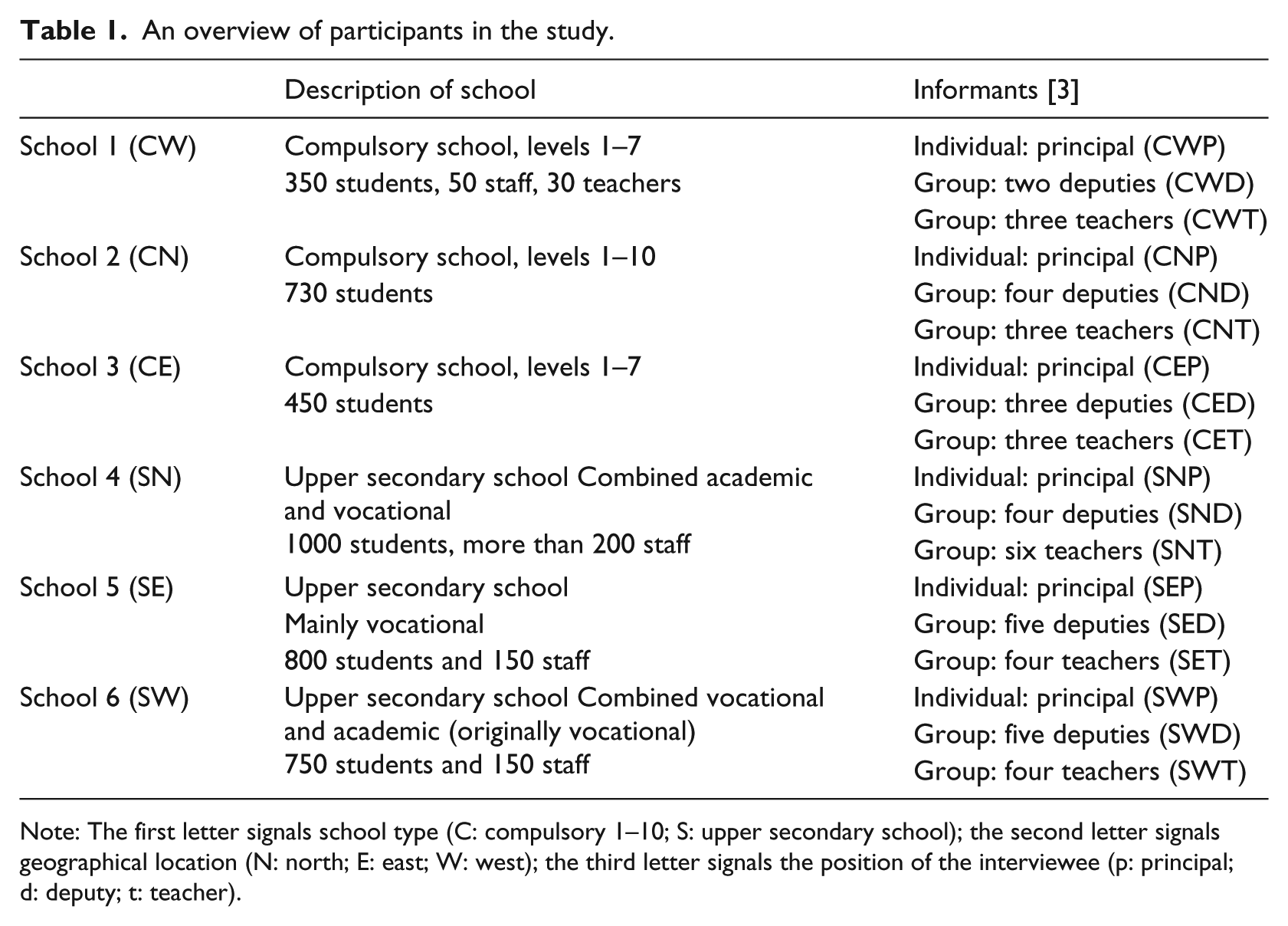
Note: The first letter signals school type (C: compulsory 1–10; S: upper secondary school); the second letter signals geographical location (N: north; E: east; W: west); the third letter signals the position of the interviewee (p: principal; d: deputy; t: teacher).
We used a semi-structured interview guide which covered data on a number of topics, including definitions of a good psychosocial environment, knowledge and attitudes towards the Education Act (Sections 1-3, 5-1 and Chapter 9a) [3]; tools and organisational routines; accountability systems and governing processes. We conducted and audio-recorded all interviews in locations chosen by the informants. Most interviews lasted approximately 90 minutes. We transcribed all interviews, and the two researchers independently analysed the transcripts aiming to identify emergent themes. We used NVivo software as a tool in this process. The procedure enabled us to combine inductive and deductive approaches for the data analysis (Eisner, 1991).
In addition, school documents published on local websites served as secondary sources and contextual information in our analysis of the interviews.
We first performed an inductive analysis, in which we did the following:
- identified chunks of data where the teachers, deputies and principals talked about the psychosocial environment and how they worked with issues related to this;
- organised the data according to emergent categories: definitions of a good psychosocial environment; routines on prevention; routines relating to formal procedures, instruments and mechanisms that guide their interpretation of the law; challenges; competence/support; relations to the municipality and experiences with national inspection;
- developed case descriptions for each school; and
- organised the material according to the categories and across the six schools.
In the second step, we identified the teachers’, principals’ and deputies’ interpretations of the legal regulation as stated in Chapter 9a of the Education Act. We also identified how organisational and occupational professionalism emerged as conflicting and/or consonant aspects of their interpretations. Next, we analysed the participants’ descriptions of their everyday practices to identify organisational routines as they were enacted in and across the schools. Using NVivo 10, we coded the informants’ descriptions of routines according to their ostensive and performative aspects (Feldman and Pentland, 2003). For ostensive aspects, we identified routines as cognitive templates for action (guiding), as legitimation of action (accounting) and as labelling for larger complexes of action (referring). Performative aspects were coded as the informants’ descriptions of how actions were repeated and, over time, became part of the routine (creation); as performance or non-performance of scripts or procedures (maintenance) or as alerting or adaptation of a routine (modification). Through this process, we were able to identify routines as relatively stable structures for thinking and action and as enactments at specific times and situations. This helped us to explore the discretionary space within which professional practice was enacted.
Findings
In the sections below, we present our findings under headings cited from the Norwegian Education Act. In this way, descriptions of routines and professionals’ interpretations are closely connected to the textual formulation of legal standards. We included excerpts from the interviews to illustrate the informants’ framing of their work to fulfil the legal requirements. These predominantly descriptive presentations will be followed by a discussion based on our analytical framework.
‘A good psychosocial environment’ [4]
In the interviews, we specifically asked the principals, deputies and teachers about their understanding of the term ‘a good psychosocial environment’. This question proved to be difficult for them to answer. Rather than providing a clear definition, they would speak in general terms and describe practices that characterise a good psychosocial environment. For example, they would detail how they envisioned the effects of such an environment on students: that the students feel safe and confident, both academically and socially; that they thrive and experience mastery and that they know that they are seen by teachers who will attend to problems if they arise. One teacher (CNT) explained, ‘They are seen by the adults every day. […] [The students] know that we … they are not allowed to fall between chairs, we follow up’.
Moreover, they would describe the responsibility of the school to create such conditions for the students. For example, they would talk about the obligation to create and maintain relationships based on values such as honesty and openness between students and between adults and students. A few of our informants touched on the relationship between a good psychosocial environment and students’ learning opportunities. They argued that feeling safe and confident, both academically and socially, serves as the foundation for well-being. A safe environment can be seen as a prerequisite for learning and mastery and vice versa; more specifically, it is ‘an environment where students thrive and experience mastery. Because I believe that often that … “mastery” word has a lot to do with well-being. And, yes, safety’ (CWT). Also, those with responsibility for vocational programmes in upper secondary schools emphasised the importance of students developing social skills because this is the foundation for establishing a good psychosocial environment. A principal in one of these schools argued that developing social skills was their most important mission: ‘Yes, it is crucial to foster and expand subject knowledge, but to cultivate social skills is even more important’ (SWP).
Our interpretation of these findings is that, although the informants work in environments where the duties and obligations of schools in some respects are spelled out in detail in the law, and where the law even describes penalties (Section 9a-7) and liability in damages (Section 9a-8), the discourses of the teachers and principals are located within an occupational professionalism (Evetts, 2009). Furthermore, these discourses are based on codes of professional ethics and values as well as concern for the students’ interests, and these discourses dominated the talk in compulsory as well as in upper secondary schools.
In the following sections, the construction and maintenance of organisational routines serve as an entry point to disclose how legal regulations are interpreted and operationalised in the principals’, deputies’ and teachers’ practices.
‘Active and systematic efforts to promote a good psychosocial environment’ [5]
All six schools have established routines for systematic work in the school environment. Their efforts vary according to scope, instruments in use and level of enforcement. Perhaps the most prominent example of work to promote a good psychosocial environment is the use of programmes for the prevention of problematic behaviour and for improving learning environments. A range of such programmes have been in use in Norwegian compulsory schools over the last decade (Lødding and Vibe, 2010), and all the compulsory schools in our selection had used several of these programmes.
When preventive programmes are introduced to the schools, normally a strict implementation period follows. This period may consist of professional development measures, e.g. in the form of in-service courses for all or some staff, and work with course material, templates or procedures in groups of teachers. For a while, these efforts may result in the establishment of specific routines. However, over time, the routines fade into the background, and the programmes are reduced to resources that teachers may turn to when problems arise.
We are satisfied with the programme [Step by Step]. I guess it is like most programmes, that by and by one becomes a little … a little tired of the method. But on the other hand, the teachers experience … from what I see, that is … that there are many suitable themes. (CEP)
The programmes the compulsory schools use have different focuses: some are explicitly meant to prevent bullying (e.g. Zero), while others aim to help children develop social competence (e.g. Step by Step). What is common to all of these programmes is that they are designed to regulate work in schools, and that they require comprehensive, systematic and long-term work in order to produce effects (Ttofi and Farrington, 2011). Our data showed how organisational professionalism, the control of work activities and standardisation inherent to the programmes interact with occupational values, such as discretion and occupational control of the work (cf. Evetts, 2009).
The three upper secondary schools have used the programme ‘Guidance and information about mental health among youths’ (VIP). This programme requires inter-professional collaboration between schools and healthcare professionals, and includes professional development for teachers and supervised work in first-year classes. The teachers in one of the schools commended the programme and said that, although they have worked with the psychosocial environment before, this programme seemed different. One teacher said, ‘taking on a programme that places these issues in focus, and where it is introduced in this way, I believe that will have quite another effect’ (SNT). On the other hand, the implementation of the programme in the two other schools was less successful. The teachers explain that issues concerning mental health require specialist competence. After an initial period where the school nurse was responsible for the programme, ‘it was supposed to become a routine in the school, but then we have not been able to follow that routine on our own’ (SET).
Two of the upper secondary schools (east and west) explicitly ground their philosophy on ‘consequence pedagogy’ [6]. They work systematically to develop their consciousness about the importance of building good relationships and how they can use positive communication to help students develop: ‘here we work to develop social competence, which is much wider than supporting students’ academic learning’ (SWD). This could explain why they were reluctant to adopt additional programmes for the prevention of bullying. One interviewee noted, ‘We were requested to join that programme, but then we were exempted on account of the pedagogical approach and our grounding’ (SEP).
All six schools have routines for cooperation with external professionals, such as the psychological counselling service (PPT) and the school nurse; however, the routines differ between the schools. For example, in one of the compulsory schools, the PPT is decentralised to the local school and is a permanent member of a basic team with the school’s leader team and the school nurse. Another school has established a resource team with monthly meetings with the PPT, and one of the secondary schools has regular meetings where the PPT and the nurse participate. One participant explained, ‘There are good routines, I think, in secondary schools. The school nurse, the PPT and the school counsellor are here on some days. So we work closely with them’ (SWP). These arenas work well for discussing problems and for deciding on measures to solve issues related to the psychosocial environment. Issues addressed are predominantly problems that have already been identified by the staff; therefore, it works as an instrument for managing obstructions to a good psychosocial environment rather than promoting such an environment.
Obviously, to ‘promote a good psychosocial environment’ includes the management of problems, but it also involves the incessant work of practitioners in schools to establish conditions where students thrive and feel safe and seen (cf. above). All the schools have established routines for this purpose. For example, one compulsory school has allocated resources to increase the child–adult ratio, and they are especially concerned with the breaks. Breaks are seen as potential arenas for bullying and exclusion. Keeping track of activities is considered vital, and two of the compulsory schools have designated student leaders who are responsible for initiating activities during breaks. Another approach can be to employ social workers. One of the upper secondary schools has employed a social worker who engages with students in different arenas and can monitor what goes on between students. The principal observed as follows:
And I believe it is important … perhaps of uttermost importance here, that we can establish good relationships between … staff, you know, who care for that student. Because I can see that … that it is unbelievable what a social worker can accomplish with students that are perhaps defined as ‘difficult cases’. (SEP)
Other examples of preventive routines are the discussions about school and class rules, which usually take place at the beginning of each school year, and the arrangement of school outings or special days for sports or cultural events.
‘Internal control’ [7]
Section 9a-4 asserts that ‘the school management is responsible for the day-to-day implementation’ of continuous and systematic efforts to promote a good psychosocial environment. In the Directorate for Education and Training’s interpretation, this means inter alia that the school must have routines to monitor the school environment and how individual students experience it; routines to uncover and deal with problems when they arise and routines to ensure that routines are being followed (Utdanningsdirektoratet, 2010).
All six schools have established routines to monitor the school environment; however, such routines are mostly informal or inscribed in other formal regulations. For example, teachers are required to conduct regular conversations with the students, and the students’ well-being is one theme that is expected to be addressed. In teacher team meetings, the psychosocial environment may be discussed. The Student Survey [8] was used as an instrument for monitoring the psychosocial environment. However, the survey mediates different actions in the six schools. For example, the principal in one of the schools used it as verification to find out what ‘in a way differs from what we think’ (CWP). In other schools, staff, students and/or parents discussed the results from the survey in different forums. However, although the schools had routines for discussing the results, only sporadically did such discussions result in school-wide measures. Most often, individual teachers or teacher teams decided what action was needed, if any.
Our analysis shows that issues concerning students’ well-being permeate teacher–student relationships. However, although most schools have established formal routines that include distribution of responsibility and requirements for documentation, such routines are, in some cases, not well known among staff, and in other cases, readily adapted at the staff’s or principal’s discretion. National or municipal inspections help the principal improve their systems. One principal stated that ‘The best part [of the inspection] is that somebody comes from the outside and evaluates our practice. […] every time we have a revision, we improve a little bit. The danger is that it can be ad hoc and not systematic’ (SNP). To help the schools improve their systematic approach, some municipalities require that schools use digital tools to document their work with the psychosocial environment. However, the informants find it problematic that such tools do not take the complexity of classroom practices into account. Thus, there seems to be a gap between what is possible to document and professional judgements of the situation.
‘Investigate the matter as soon as possible’ [9]
School employees have a duty to act on suspicion or knowledge that a student has been subjected to offending words or acts, or when the right to a good psychosocial environment is violated for other reasons. This duty implies making necessary investigations, notifying the school’s principal and intervening when necessary.
All six schools have step-by-step procedures that provide direction to staff about the correct conduct for fulfilling the duty to act. Such procedures were sometimes available on the schools’ external or internal webpages, and usually the procedures had been discussed in staff meetings and with parents. However, this might be insufficient. One deputy worried that ‘we should repeat more often. We do go through [the procedures], but we can be much more to the point and repeat them. Even if the plans are there, we need to specify [the steps of the procedures]’ (CWD). One school had recently experienced a challenging case, and this demonstrated that procedures were not always present: ‘You relax, because all is well. And the awareness has receded into the background; you do not have the readiness when things explode’ (SEP).
Our analysis shows that the staff members seek to solve problems on the lowest level possible. That is, the class teacher is usually the one who identifies problems, either through her own observation or after being informed by students or parents in the mandatory student conversations. Once concerns are raised, further investigation is quickly undertaken. One deputy explained as follows: ‘We need to get an overview to be sure that this is, this teasing and pestering, if there is a pattern to it which implies harassment or bullying. [We have] conversations both with the student who is exposed to the behaviour, and the other students. One by one’ (CWD). Often the class teacher will make informal contact with the parents, e.g. a telephone call, to sort things out. Most cases never get beyond this stage; only in the more serious cases is the principal notified, and even in those cases, problems are usually dealt with in dialogue with students and parents and/or in local resource teams. In very few cases is an individual decision made pursuant to the provisions of the Public Administration Act [10]. One principal stated that ‘I have […] cases I need to look into to decide whether to make an individual decision […]. It is so rare that I have to ask someone how to do it. That is how extraordinary it is’ (SWP).
There are no provisions in Section 9a in the Education Act that specifically state when an individual decision should be made, except when students/parents demand it. Thus, in most cases, it is up to the discretion of the principal to make that judgement. However, any measures taken need to be documented, regardless of the formal status of decisions, and it is not evident from our analysis to what extent this is done. From the perspective of occupational professionalism, it makes sense to deal with problems at a low level and with the students’ best interests in mind. However, from an organisational point of view, the rights of students may not be sufficiently safeguarded.
In sum, our analysis of interviews with principals, deputies and teachers in six schools shows that the informants are aware of and committed to the obligations to provide a healthy psychosocial environment for the students. They undertake a variety of preventive measures, take action quickly and strive to solve problems at the lowest possible level. However, these actions seem to be guided by codes of ethics, i.e. acting in the students’ best interests, more than by the legal text, the national regulations or even formal routines in their schools. Moreover, when the law and regulation put forward specific procedures, they are transformed into routines based on the schools’ iterative practices. We did not find substantial differences between compulsory and upper secondary schools, or between principals’ and teachers’ framing of professionalism.
Discussion
This study aimed to examine the interplay between legal regulation and professional discretion. In the preceding section we have described the informants’ accounts of how they work to meet legal requirements by promoting and safeguarding a good psychosocial environment for their students. Also, we have shown how practitioners legitimise such work. In education, we can distinguish between three interrelated purposes of legal regulation: to safeguard students’ rights, to ensure against incidental decisions and to guarantee due processes (Jakhelln and Welstad, 2012). In welfare states there is a tendency to adopt more detailed legal regulation by introducing legal rights in new areas or by making legal standards and entitlements more detailed (Molander et al., 2012). For example, in 2002 the Education Act in Norway was amended with a chapter on the students’ learning environment. On the one hand, more specified rights and entitlements provide students and parents with possibilities to complain or even take their complaints to court. On the other hand, it enables the generation of measures for holding municipalities, schools, principals and teachers accountable (Molander et al., 2012). Nevertheless, legal regulation can never be detailed enough to address all possible situations, and thus there remains room for discretion. Routines are stable or emergent organisational structures for managing this space. Conceptually, we understand organisational routines as manifestations of cognitive, normative and regulative structures and activities, and we suggest that legal standards have direct or indirect influence on the routines that are established. Examination of routines provides an entry point to understand principals and teachers as agentive professionals at the local level (cf. Feldman and Pentland, 2003).
Empirically, we found that occupational and organisational professionalism emerged mainly as consonant aspects of the way teachers and principals constructed representations of professionalism. The informants adhered to student-centred values, and they acknowledged a broad aim for education: to teach students to master their lives. Working towards this aim included safeguarding students’ attainment of academic and vocational knowledge and skills, but also, and of equal importance, their mastery of social skills. Furthermore, the informants displayed confidence in professional autonomy and discretion. This confidence, however, did not imply an absence of organisational professionalism. All the schools could demonstrate formal procedures for preventing, investigating and handling issues related to the students’ psychosocial environment. Organisational routines worked as coupling mechanisms between regimes of professionalism. On the one hand, we have identified how government regulation through the Education Act is embodied in the formal structure of the schools involved in the project, and as such, principals’ and teachers’ discretionary power is regulated directly by the law. Rational–legal forms of authority are incorporated in the schools’ standardised procedures, and regular meetings work as formal arenas for discussions and deliberations. On the other hand, the legal regulation regarding students’ rights to a psychosocial environment conducive to health, well-being and learning does not specify actions in detail and contains a high level of discretion at the local level. Even though there are available instruments for monitoring students’ psychosocial environment, the principals rarely use these mechanisms for surveillance of classroom practices. A long history of relational trust in teachers seems to trump the need for monitoring in local schools. In addition, the accountability issues regarding students’ rights in this particular area link up with values and norms in actors with discretionary power and can be understood as ‘pull’ mechanisms, not constraints. Providing a good psychosocial environment is about doing a good job which is guided by established codes of professional ethics.
In our analysis, we have been able to recognise patterns of activities (i.e. routines) directed at fulfilling the gist of the laws’ requirement. However, such routines are emergent and adapted according to the actors’ professional discretion. For example, the leaders and teachers act when students are at risk and make efforts to ensure that problems are detected and dealt with. However, the specific action taken in each case varies both within and across the schools. Pentland and Rueter (1994: 491) called routines ‘effortful accomplishments’, and suggested that in the enactment of routines, individuals draw on a repertoire of possible actions. A routine is not always a distinct set of procedures; rather, the routine sets a boundary for what is considered legitimate action. Thus, despite variation, the routineness of the action is retained:
Somehow there is pattern in the action, sufficient to allow us to say the pattern is recurring, even though there is substantial variety to the action, variety to allow us to rule out any two occasions being exactly alike. (Cohen, 2007: 782)
To detect students at risk or possible problems, teachers may observe (more or less systematically) the students in recess or in class; they may talk with the class or have dialogues with individual students and they may discuss students or situations in the team. The principal or deputies may visit classes, open their doors to students and use screenings like e.g. the student survey. By using Feldman and Pentland’s (2003) framework, it is possible to see ‘detecting students at risk’ as the ostensive aspect (i.e. the abstract, generalised idea of the routine) and the situated enactments of the routine as the performative aspect. Similarly, detection of a problem instigates actions, such as conducting investigations, engaging in dialogues with students and/or parents, enrolling expertise or making an individual decision. Some of these performative routines may have fixed procedures; however, even fixed procedures may be adapted to situations. The Education Act provides rational–legal authority for standardised routines (organisational professionalism); however, in performing the routine, occupational professionalism comes to the fore. Even so, the ostensive aspect of the routine is retained because principals and teachers abide by the general requirements stated in Section 9a-1 in the Act.
All the schools are concerned with the prevention of bullying, harassment and racism, and the compulsory schools have used a variety of preventive programmes over the years. Such programmes require certain routines to be followed. In the implementation period, teachers are instructed to follow the steps of the programme. Our analysis shows how the routines suggested by the various programmes gradually fade into the background and eventually are converted into resources to be used at the teachers’ discretion. The ostensive aspect (to work preventively) allows for a variety of enactments.
The principals in the participating schools found that the national inspection was a golden opportunity to scrutinise and adjust their formal routines to be in compliance with the legal standards. They changed their formal routines, for example, regarding documentation and systems (performative aspect). However, they also said that a result of the inspection was greater awareness, which can be interpreted as deepening or changing their understanding of the legal requirements. In this way, the performance of a routine (the national inspection and the associated preparation and discussions) impacted (modified or recreated) the ostensive aspects of their organisational routines (cf. Feldman and Pentland, 2003). It should, however, be mentioned that national inspection within a Norwegian context is not only about revealing a lack of legal compliance, but also about providing guidance and dialogues on how to improve (Hall and Sivesind, 2014). So far, most schools in Norway have had the option of paying little attention to managerial accountability because they do not run any risk by adopting this approach (Møller, 2012: 457). Thus, even though the discourse about possible decline in trust in the teaching profession and juridification seems to gain ground and users’ rights have become targets of negotiation in strategic thinking and action, in education, by and large, teachers in Norwegian schools are entrusted with discretionary power, and it is expected that the teachers exercise self-regulation. As demonstrated in the reported study, professional discretion plays a significant role in teachers’ and school leaders’ enactment of legal standards.
Our data have shown that the respondents seldom make specific references to the Education Act or the circulars issued by the Directorate for Education and Training (Utdanningsdirektoratet, 2010). Nevertheless, the actions they take to promote a good psychosocial environment are well aligned with the law: they make active and (to some degree) systematic efforts; they investigate instances of bullying, violence and racism; they intervene when necessary and they make individual decisions when appropriate. However, rather than accounting for their practices as a response to legal standards, they talk about professional concerns: that students need to be seen by the adults; that they should thrive and experience a sense of well-being; that students must feel safe and supported and that the school should offer opportunities to build sound relationships. Correspondingly, their perceived challenges are not the schools’ systems or formal practices, but rather are related to contextual frameworks (e.g. lack of time for each student) that impede their ability to detect problems, to handle problems skilfully once they are identified and to make distinctions between what is and what is not problematic behaviour.
In this sense, the accounts about how routines are performed in the six schools emerge from occupational professionalism that puts the client centre stage, including ‘the personal and moral dimensions of having a commitment to care that includes a combination of control, duties and decisions’ (Solbrekke and Sugrue, 2011: 13). Above, we have summarised this as a commitment to act ‘in the best interest of the student’. This principle is often used to justify educators’ moral and ethical decisions; thus, it is central to what it means to be a professional (Stefkovich, 2013). Moreover, it is a legal concept, in that it is one of the general principles in the Convention on the Rights of the Child: ‘In all actions concerning children, whether undertaken by public or private social welfare institutions, courts of law, administrative authorities or legislative bodies, the best interests of the child shall be a primary consideration’ (Article 3, Section 1). The professional and legal interpretations of the principle are both dubious. For example, studies have shown that school leaders often interpret the legal standard differently and disagree ‘on the best course of action, and what is truly in the best interest of the student’ (Stefkovich and Begley, 2007: 211). Furthermore, individual teachers may interpret experiences differently to colleagues or parents (Tirri and Husu, 2002). A content analysis of 60 law review articles found that the term ‘best interest’ was commonly used without a clear explanation of the term (Stefkovich and Begley, 2007). Thus, it can be assumed that ‘the students’ best interest’ both as an educational and as a legal principle is a complex and flexible notion which needs to be specified within the circumstances of each case. Different perspectives on the translation and understanding of ‘best interest’ may escalate tensions between the school and the parents; in particular, the principals and the teachers focus on all students in their talk about how to comply with the law, but the law grants individual rights to each student.
Concluding remarks
In this paper, we have reported a study of the interplay of rational–legal forms of authority and professional discretion in education. This is an area of research that until now has received little attention. We suggest that organisational routines provide a ‘window’ into the processes through which legal standards become embedded in educational practices and how organisational and occupational professionalism combine, interact and sometimes merge. This understanding can enable researchers to address questions such as how professional codes of conduct are confirmed or challenged by external legal requirements in schools’ practices, and to understand how professionals handle legal standards in their practices. In this paper legal standards regarding the students’ rights to a good physical and psychosocial environment, as articulated within the Norwegian Education Act, have been used as a case to investigate how possible tensions are played out in practice in Norwegian schools. For this particular case, the analytical distinction between organisational and occupational professionalism helped us illustrate how organisational routines operated as coupling mechanisms between these two different logics of professionalism.
Legal standards normally do not tell you what to do, but instead create circumstances in which the available options in deciding what to do are mediated by institutional factors. Even though the six schools participating in the project generally have different capacities, potentials and limits, the findings were surprisingly similar in the case of providing a good psychosocial environment. We found little evidence that organisational professionalism absorbed or encompassed occupational professional discretion. One explanation might be that the legal requirements in this case are well-aligned with the ethical codes of the teaching profession (cf. Ramberg, 2014) so that the interplay between legal standards and professional discretion creates a dynamic relationship which works to stabilise patterns of actions and generate opportunities for change. Another explanation might be that, in Norway, professional autonomy is still emphasised within a comprehensive education system which is strongly rooted in ideologies and norms, emphasising various aspects of equity that are linked to social-democratic values and participation. While principals and teachers historically have been trusted with discretionary powers, we note that principals’ use of instruments for surveillance of student outcomes have increased, and in the future we may witness efforts that link administrative practice more closely to legal regulations. For example, recently municipalities and principals were offered access to the net based tool ‘RefLex’ designed to help decide whether or not practices are in accordance with the law (Utdanningsdirektoratet, 2015). Over time, such tools may impact on the distinct sets of professional cultures that schools develop in the interface between legal standards, managerial ideas for governing and national legacies of schooling.
This study demonstrates how organisational routines can work as coupling mechanisms between legal mandates from above and occupational values in the context of juridification in education. In particular, it illustrates that although legal regulation has increased, for these six schools and this specific legal standard, there is elbow room that allows for professional discretion. Our findings represent some limitations as the current study builds on practitioners’ accounts of how they work to meet legal requirements. Including observations of practices would have added important insights into the enactment of performative routines. However, even though stories about lived experience can be questioned, they are still important for understanding the interplay between legal standards and professional discretion in particular contexts. We suggest that future research in other contexts should include observation, address important issues such as if and how juridification leads to changes and continuities in professionalism, and also make the case for transnational analysis.
Footnotes
Acknowledgements
The authors wish to thank colleagues involved in the project ‘Legal Standards and Professional Judgment in Educational Leadership’ (LEXEL), the research group ‘Curriculum Studies, Educational Leadership and Governance’ (CLEG) at the University of Oslo, Helen Gunther at the University of Manchester and two anonymous referees for valuable comments on earlier versions.
Declaration of Conflicting Interests
The author(s) declared no potential conflicts of interest with respect to the research, authorship, and/or publication of this article.
Funding
The author(s) disclosed receipt of the following financial support for the research, authorship, and/or publication of this article: This work is funded by The Research Council of Norway; project no. 212328.