




Abstract
Long before Namibia’s independence in 1990, Sweden initiated a policy dialogue with Namibia’s future political leadership. This article reviews the impact of an educational reform in Namibia in the early 1990s called the Integrated Teacher Training Programme (ITTP), which was an outcome of collaboration between the South West African People’s Organisation (SWAPO), the liberation movement and teacher educators from Sweden and other Western countries. Research questions posed concerned: (1) the ITTP’s perceived impact on the participants’ private and professional lives; and (2) the ITTP’s impact on the participants’ views on knowledge and education in relation to democracy. A combination of individual interviews and questionnaires was administered in situ in 2009 in Namibia to 17 former ITTP students who were living in various places across Namibia. This follow-up study indicates that the ITTP was crucial for the participants’ professional careers and private lives. The majority saw education as a key to democracy and social transformation, and considered themselves as important actors at local, regional and national levels in forwarding these aims. However, it is concluded that, while the learner-centred education philosophy initially had a strong impact, its application in teacher education has functioned more than anything as a rhetorical device for nation-building.
Keywords
Introduction
As one of the last nations in Africa to do so, Namibia, earlier known as South West Africa, achieved its independence in 1990 after more than a century of colonial occupation and apartheid policies imposed at the time of the illegal occupation by South Africa (Angula and Grant Lewis, 1997). During the war for independence, the liberation movement South West African People’s Organisation (SWAPO), organised schools, including teacher training for Namibian refugees in various African countries (Dahlström, 1999). A three-year programme entitled the Integrated Teacher Training Programme (ITTP) was set up in a refugee camp in Angola in the mid-1980s. The Swedish government funded it through its aid agency the Swedish International Development Agency.
Sweden initiated a policy dialogue with Namibia’s future political leadership long before independence. A main actor was the Swedish Prime Minister Olof Palme, who in the struggle for the liberation of southern Africa already in the 1970s began to pursue the issue of unilateral Swedish sanctions against South Africa, to be followed by other countries. From 1970 until March 1990, Sweden disbursed some 600 million Swedish kronor (SEK) directly to SWAPO, and around SEK 150 million via the United Nations and other organisations; hence, the profile of the development cooperation programme between the two countries had largely been identified and agreed to at the time of Namibia’s independence. Details of the programme were formalised in a general agreement on development cooperation that came into force on 1 July 1991. Through this process, education along with the transport and communication sectors was taken up by Sweden as areas where Sweden possessed particular competence and resources (Melber et al., 1994).
The ITTP was conducted according to the pedagogical idea of learner-centred education (LCE), and served as the model for postcolonial teacher education reform with the overall idea of preparing future teachers for democracy and social change in the new independent nation of Namibia (Angula, 1999; Dahlström, 1995; Zeichner and Dahlström, 1999). In practice, the programme was organised and carried out by teacher educators from Umeå University in Sweden; led by Lars Dahlström who, along with others, remained influential in postcolonial Namibian teacher education (Angula and Grant Lewis, 1997; Dahlström, 2002; Zeichner and Ndimande, 2008). Against this backdrop, the overarching aim of this article is to describe and analyse the Namibian participants’ perceptions of the ITTP, including the underpinning principles of LCE, at a distance of two decades later, in particular, their views on knowledge and education and their effects on democracy in Namibia today, and on their professional and private lives. The study follows up, in April 2009, the so-called cadre of young Namibians who were selected as those most likely to contribute to democratic development in postcolonial Namibia (Angula, 1999: 11). The following research questions are posed:
What is the ITTP’s perceived impact on the participants’ private and professional lives today?
What is the ITTP’s perceived impact on the participants’ views on knowledge and education in relation to democracy?
The three authors of this article have different experiences of Swedish–Namibian collaboration in teacher education, dating from the mid-1980s to the present time: Erixon Arreman encountered ITTP student teachers in the 1980s and 1990s during school visits in Sweden; Erixon met Namibian teacher education staff and researchers in Sweden and Namibia in the mid-1990s and the mid-2000s; Rehn was a teacher educator in the ITTP teacher team between 1988 and 1992; between 2006 and 2012 he was the coordinator of a Swedish–Namibian teacher education exchange programme (the Linnaeus-Palme programme), funded by the Swedish Aid Agency (Umeå University, 2013).
Namibia – background
When in the 1980s the regime of South Africa started to compel young Namibians to fight against the liberation movement SWAPO, many escaped across the northern border to Angola and joined SWAPO which from the 1960s on had been the major liberation movement in the war to free Namibia from South Africa’s illegal occupation. The struggle for independence was also waged via education, and literacy campaigns and secondary education were organised in various African countries with financial support of foreign donors. For example, most of the first members of the initial Namibian government received their education in the 1960s in education centres in Tanzania and Zambia established by an American government agency (Angula, 1999). After the United Nation’s recognition in 1973 of SWAPO as the authentic representative of Namibia, the international community’s support for education in exile increased (Angula and Grant Lewis, 1997). The Nordic countries, Denmark, Finland, Norway and Sweden, along with Germany and the UK provided much assistance over time (UNESCO, 1995).
Colonial teacher education
Under the apartheid regime separate forms of teacher training were provided for black, coloured and white population groups. Primary teacher training for different black ethnicities was delivered in the northern and north-east rural regions, i.e. in Ongwediva, Rundu and Katima Mulilo, so-called coloured students were trained in their residential area of Khomasdal, outside the capital of Windhoek, and white student teachers had their training in Windhoek (Angula and Grant Lewis, 1997). Teacher training for the native population was based on the Christian National Education curriculum which excluded Mathematics and Science (Rowell, 1995) and had the overall aim of instilling the ideology and segregation practices of the apartheid regime (Pomuti and Weber, 2012). However, such rudimentary teacher training was an important source of employment for the native population, albeit with a low salary and generally poor working conditions.
“A rich country with poor people”
Since independence, Namibia has formally been a democracy, although dominated by a single political party, SWAPO. Today, Namibia has about 2.2 million inhabitants racially composed of three major groups: blacks (87.5%); mixed (6.5%); and whites (6%) (Index Mundi, 2015 a,b). Namibia is a world-class producer of diamonds, gold, copper, uranium and other minerals (Dobler, 2007); the Chamber of Mines of Namibia (2013) and its financial sector are rated as one of the best in Africa (African Economic Outlook, 2012). However, Namibia continues to be a country with huge income inequality, and the black majority remains excluded from education, labour, resources and capital due to institutionalised inequalities (African Economic Outlook, 2012; Melber, 2007). 1 In 2008, one-third of the population lived on USD 1 or less a day, and more than half (52%) was unemployed (African Economic Outlook, 2012: 13). The tough living conditions of the majority of the black population include the rapid spread of HIV/AIDS (Edwards, 2007), with almost one-fifth of the population (19%) affected by 2010 (African Economic Outlook, 2012). The foreign ownership of land after independence, mostly by non-resident Germans, remains a burning issue (Kaapama, 2007; Melber, 2007; Moyo, 2004). By the end of the first decade of the 2000s, Namibia was characterised as “a rich country with poor people” (Jauch et al., 2009).
Namibia is also rich in languages. After independence, 16 native languages were given equal constitutional status, and English replaced Afrikaans as the main official language. In primary education, native languages are used for instruction for the first three years, and replaced by English in grade four (Ministry of Education, 2008). English as the main official language has been strongly supported by overseas agencies including the UK and US administrations; the dominance of English, including an ever-smaller proportion of books published in native languages, has been criticised for creating a barrier to knowledge as well as the marginalisation of minority groups (Brock-Utne, 2000; Watson, 2007).
The Integrated Teacher Training Programme
The ITTP was run twice in three-year cycles between 1986 and 1992, directed at 39 young Namibian exiles of whom 30 were able to complete the programme. 2 The venue for the first ITTP (1986–1989) alternated; half the time in a refugee camp in Cuanza Sul, Angola and half at Umeå University, in the north of Sweden. The second programme (1990–1992) started at the time of liberation and commenced in Sweden after which half the time was spent in Umeå and half in Ongwediva in northern Namibia. As then the only non-USAID-funded project in teacher education, the ITTP had built on a Swedish-funded education project (1983–1986) conducted in the same refugee camp by Dahlström, who had prior experience of human aid in Botswana (Dahlström, 2002). Dahlström contributed to Namibian education for almost two decades (Dahlström, 2002) and many of his Swedish colleagues made major commitments, each for up to ten years (UNESCO, 1995).
The ITTP and the subsequent national teacher education reform which was modelled on it reflected SWAPO’s aims to develop the new nation of Namibia as a democratic society, including the abolition of apartheid and social injustice (Angula, 1999; Dahlström et al., 1999; Zeichner and Dahlström, 1999). The selected participants for the ITTP were similarly seen as important actors in the future reforms and social transformation of Namibia (Dahlström, 2002). The overall pedagogical approach for the ITTP propounds that the student is a subject whose prior knowledge, skills and attitudes should be acknowledged in the process of education. The underpinning principles of the ITTP were influenced by educational strategies and experiences in other African countries, including Freinet’s “Pedagogy of work”, and the concept of learner-centred education, as previously mentioned (Dahlström, 1999; Swarts, 1999). In order to avoid “individual as well as professional alienation”, it was considered important to conduct the programme at the actual site where the ITTP participants lived and had their families (Dahlström, 2002: 96). Two external assessments in the early 1990s were overwhelmingly positive and the model was considered suitable for Namibian national teacher education, despite the small number of participants (Dahlström, 1995), as shown below in an extract from the 1993 assessment:
It is clear that this programme has produced confident, professional and committed teachers, capable of adapting to most Namibian school situations./…/ The confidence of the Ministry of Education and Culture in the ITTP is reflected in the philosophy of the new BETD [Basic Education Teacher Diploma] course. The ITTP has been a creative course, producing proactive, creative and bold teachers (Dahlström, 1995: 283 quoting Goodwin and Rubin, 1993: 28).
After liberation, the new national teacher education programme, on the model of the ITTP, received financial, technical and human support from abroad, including from Swedish teacher educators, and scholars from Denmark, Sweden, the UK and the USA (Angula and Grant Lewis, 1997; Zeichner and Dahlström, 1999). Higher education courses on education policy, language policy, assessment and infrastructure were established to support implementation of the new Namibian teacher education programme; the participants included former ITTP students and teacher education staff of the former white administration who remained in office after liberation (Dahlström, 2003). Sweden along with Germany and Norway were then the largest foreign governmental donors to Namibian education following the suspension of United States funding after independence (UNESCO, 1995). Up until the mid-1990s, Swedish funding to Namibian education covered infrastructures for national administration, teacher education, school buildings, technical support, planning and administration, education innovations, and national literacy programmes (UNESCO, 1995).
Postcolonial education
In postcolonial Namibia, access to free and compulsory education for ages 6–16 is formally granted by the state (Ministry of Education, 2008). Postcolonial teacher training for compulsory education, which gave a Basic Education Teacher Diploma (BETD), as principally based on the structures and pedagogical approach of the ITTP programme, was formally institutionalised in 1995. The Namibian government has ratified international declarations on Education for All, Inclusive Education and the UN Convention on the Rights of Persons with Disabilities. It has also approved international declarations for the promotion of children’s rights (Bequele, 2010) and gender equality (African Economic Outlook, 2012). The funding of education was relatively high in the 2000s: in 2011/12 for instance education received the largest share (22%) of the national budget (African Economic Outlook, 2012); between 2003 and 2006 Namibia had the sixth highest mean funding (6.9% of gross domestic product (GDP)) of education among 52 African countries (Bequele, 2010). In 2009, Namibia’s spending on education (6.4%) relative to GDP was one per cent higher than that of South Africa (5.4%) (UNESCO, 2013), and slightly higher than the average for OECD countries (6.2%) (OECD, 2012: 46). Policies for the protection of children, including the judiciary and social policies and the provision of education and health services, recently led to Namibia ranking second (after Mauritius) in “child-friendliness” among 52 African countries (Bequele, 2010). By the end of the first decade of the 2000s, equality in terms of girls’ and boys’ participation in primary education had been achieved (African Economic Outlook, 2012). Gender equality and the empowering of women are promoted by law, although the position of women is often undermined by a lack of awareness of legal rights and ‘informal practices’, including widespread gender-based violence (African Economic Outlook, 2012: 14).
Despite substantial financial investment in education, the educational performance of the black majority is still strikingly low (OECD, 2009). Many children are denied access to primary education (grades 1–7) due to the imposition of school fees (Embassy of Namibia, 2013), which were not abolished until 2013 (Ministry of Education, 2014). Poor school conditions for black learners have remained, particularly in rural areas (Brock-Utne, 2000; Schweisfurth, 2011). Media reports in the 2000s addressed various weaknesses in the education system, pointing for example to low levels of functional literacy, low English language proficiency in rural schools, high drop-out rates, a high number of those failing school and physically poor conditions of rural schools (The Namibian, 2005; Tueumuna, 2010). By the late 2000s, the Ministry of Education (2008) admitted that the education system was failing to provide high quality education for all, and that there were physical shortcomings in many schools. The poor education outcomes may also be related to the dominance of English; for example, low grade-6 scores in Mathematics are significantly related to English proficiency (Garrouste, 2011). It is therefore suggested that mother-tongue minority languages should be continued beyond the first few years of schooling (Garrouste, 2011; Hays, 2009).
Learner-centred education
In his seminal work on Democracy and Education: An Introduction to the Philosophy of Education originally published in 1916, the philosopher and educationist John Dewey calls for public education for active citizenship, for the advancement of the individual and society. His ideas echo in the ideas of LCE, and the ITTP. LCE is not restricted to Namibia but is a recurrent theme in many national education policies in the global south (Schweisfurth, 2013; Tabulawa, 2003). LCE has wide donor support through aid programmes with proponents arguing from a number of positions, from cognitive psychology to assumptions about LCE as a foundation for democratic citizens and societies. The main arguments underpinning the use of LCE are that it has a profound emancipatory aim; its key purpose is to promote free thinking and further life chances of people who suffer from oppression, including forms of education which keep them subjugated to those in power (Schweisfurth, 2013). The epistemological foundation for LCE is a sociocultural view on learning, as proposed by Vygotsky.
In line with the epistemological foundations of LCE, the wider aims of the ITTP, as emphasised by its instigators, were to shape reflective, critical professionals with leadership competencies and proponents of democracy (Dahlström, 1995, 2002; Swarts, 1999; Zeichner and Dahlström, 1999). As previously mentioned, the underpinning principles of LCE include a view on students as subjects; further, in brief, integration should include political, social and human practices and perspectives on education; production is linked to theory and practice, and educational reflection and critical constructivism is aimed at an understanding of reality. The principles as applied within the ITTP meant that theoretical studies went along with social aspects and practice; for example, production involved cultivating school gardens, building school lavatories, engaging in solidarity projects and raising money for building classrooms; Namibian songs were collected and tape recorded by students, and teaching materials were developed on the basis of local preconditions. To further exemplify, when collecting data for this study we were shown the music tapes and teaching tools by former ITTP students; the teaching tools were kept in the same wooden briefcases which had been produced by the respective student under the guidance of one of us (see Rehn, 2004).
In contrast to the expectations of LCE being an emancipatory and pedagogical strategy, Schweisfurth’s (2011) investigation of the principles and practices of LCE identifies several implemental barriers such as unrealistic expectations and misunderstandings, practical and material constraints, including the question of culture, identity power and agency related to the role of donor agencies in shaping policy. Tabulawa (2003: 7) considers LCE a political artefact of the Western world-view, about how society should be organised and of Western individualistic culture; “a process of Westernisation disguised as quality and effective teaching”. He further contends that the interest of aid agencies in education and teaching modes such as LCE has a wider aim, albeit “under the guise of democratization” (Tabulawa, 2003: 10), to alter the “modes of thought” (Tabulawa, 2003: 10) to comply with Western culture and ideas (Tabulawa, 2003: 10). Although Thompson (2013) acknowledges LCE as a clearly Western product, he argues that it could be relevant to the developing world if translated into the cultural settings in which it is used.
In Rowell’s (1995) study on postcolonial teacher education reform in Namibia, she underscores the policy aims of non-discriminatory education and transformation of society by pedagogical reforms based on LCE. However, it was found that the policy descriptions of LCE were contradictory and revealed a view of learning which had “an unfortunate resemblance to previous teacher-dominated practices” (Rowell, 1995: 7; also see Nyambe and Wilmot, 2008). Dahlström (1995) similarly found that LCE was vividly supported at a rhetoric level, but with a clear tendency in practice of withdrawal of the teacher by late arrival, shortened lessons and teacher absence. A decade later, O’Sullivan (2004: 594) identified “a huge underestimation of what is involved in learner-centred education” among Namibian policymakers and teachers. The teachers in her study interpreted LCE as a lack of teaching and physical absence of teachers. Where textbooks existed, teachers did not use them, claiming that the school had no such books. Routinised use of group work and a question-and-answer method were also reported as general LCE classroom practices along with sharp contrasts between how teacher educators talked about LCE and what they actually did (Nyambe and Wilmot, 2008). Further, O’Sullivan (2004) claimed that the ideas of LCE contrast strongly with the social demands of the majority of the Namibian population, which expect children not to question but to be submissive and obedient and to positively respond to the demands of adults. Similarly, Harley et al. (2000) found that the ideal teacher in postcolonial South Africa is not the real teacher, and that cultural and material constraints imposed by the classroom reality clearly challenge this ideal. The dominant pattern of schooling in Africa, Harber (2012) claims, is also that its processes and structures tend to be authoritarian in nature, despite frequent government statements to the contrary. In addition, hierarchical organisation, transmission teaching and teacher-centred classrooms are reinforced by corporal punishment. Teacher education as the “myth” (Harber, 2012: 57) of the liberal college therefore helps to reproduce authoritarianism.
Dahlström (2002) was critical in his PhD thesis of the Namibian teacher education reform a decade on, using Gramsci’s concept of hegemony. Dahlström identified five aspects of struggles within and between different groups in dominant positions:
Suspicions about external concepts such as participatory democracy, etc. within the new black leadership as a threat to their own position;
Doubts about the reform, which was seen as lowering standards by intellectuals who had served the system before and after independence;
Westernised reform ideas coming from foreign advisers and originating in affluent countries in the North or in other African countries;
A belief in the opportunities created by the reform, despite mistrust in Namibia’s own capacity to carry out the reform – by individuals who had worked for a long time within the system and who argued that reform needed to be initiated and supported from the outside;
A concern among policymakers that foreign influence would take the reform further, although it was also understood that it would take generations to accomplish real change.
Dahlström (2002: 251) argued that the reform model of the ITTP had been discursively maintained by the SWAPO government as successful, although with “modified labeling”, and a “transposed sense of reform”. By the mid-2000s, the education policies remained rhetorically fruitful and part of official knowledge, whereas Dahlström’s perception of the same policies was that they had failed (Dahlström, 2002).
Theoretical framework
In this article a ‘postcolonial’ perspective will be used. As foreigners to Africa, our image of Africa is related to our image of ourselves. Said (1978) theoretically expresses this as a discourse of Orientalism, which he suggests shapes how Westerners think and talk about ‘the Orient’ in relation to ‘the Occident’. Orientalism creates stereotypes of the Oriental through which the West is able to promote the self through the denigration of the other. Orientalism along with other postcolonial theories thus advocated the understanding that we are still living in a world that is marked by colonialism.
According to Arnfred and Utas (2007), two types of images have served as filters for the images of Africa maintained and reproduced in Europe, including Sweden: (1) a romanticising image, “primitive” (Arnfred and Utas, 2007: 6) as unspoiled, rhythmic and sensual (the lost paradise); and (2) the image of the underdeveloped, primitive in a negative sense, as something to deplore, and feel pity for. Both images centre on us as Westerners; our needs and/or feelings of superiority.
Postcolonial theory is often used as a ‘critical idiom’ through which to discursively analyse the continuing legacy of European imperialism and colonialism, and to uncover the oppositional discourses of those who have struggled against its remaining effects (Tikly, 2004). In a critical discussion of previous theoretical frameworks used by comparative researchers to explain the colonial legacy, Tikly (1999) recognises postcolonialism as a process which is not over, and goes beyond the “binary oppositions” by means of which colonialism has been studied in the past such as those between “coloniser” and “colonised”, “First” and “Third World” and “Black” and “White”. This involves a more complex view of colonial culture, politics and identities by focusing on the “unstable”, “hybrid” and “fractured” (Tikly, 1999:. 606) nature of colonial and postcolonial identities. In doing so, postcolonial theory draws attention to processes of transcultural “mixing” and exchange, like for example how non-European elites as defined by race/ethnicity, cast, class and gender also legitimise their dominance over other groups through their control over education systems.
Therefore, for the analysis we also employ a framework of theories on nation-building (Fosse, 1997; Kpessa et al., 2011; Mayo, 1999; Metsola, 2006; Shanyanana, 2011), political symbolism (Halpin and Troyna, 1995; Jansen, 2002), foreign aid (Sogge, 2002) and Halliday’s theory of language functions (Halliday, 1985). For nation-building to happen, according to researchers, policies have the double function of forming civil society and creating and maintaining hegemony. Social service policy thus aims to gain citizens’ loyalty and support. According to Kpessa et al. (2011), politicians are ‘allowed’ by their supporters to present policies as concrete national goals. Education as a constitutive social institution is a particularly important arena for creating and maintaining societal hegemony, contends Mayo (1999: 38). Shanyanana (2011) shows how postcolonial Namibian education policies for democratic citizenship operate at an entirely discursive level and are aimed at policymakers while they lack input from the majority of the population. Metsola (2006) illuminates patterns of political and social arrangements in postcolonial Namibia and how these are related to personalised and bureaucratic power. The living conditions of the black SWAPO elite in power includes, for example, “considerable side benefits, as well as mining concessions, fishing quotas, land or cheap farming loans” (Metsola, 2006: 1120). Fosse (1997) points to ideological conflicts between ethnicity and nationalism, which tend not to be openly recognised by the ruling SWAPO government, some of whom belong to partly Westernised elites. He also discerns a strong ethos of nationalism and “grand ideological constructions” of the government which together function as both an ideology and universal solution to the previous injustices of apartheid (Fosse, 1997: 433). With a focus on foreign donors and foreign aid, Sogge (2002: 41–42) distinguishes three main motives for cooperation in projects abroad: (1) strategic socio-political; (2) mercantile; and (3) humanitarian/ethical. According to Sogge, it was long assumed that Sweden’s official aid to Africa was driven by mainly humanitarian concerns, although commercial aims were later recognised.
The term political symbolism is used by Halpin and Troyna (1995) and Jansen (2002) to illuminate the political and symbolic value of education reforms in postcolonial Africa. Jansen shows how education policymaking in South Africa has given the ANC-led government broad legitimacy, worldwide recognition and financial support, whereas social transition through education “was never on the policy agenda at all” (Jansen, 2002: 203). Similarly, Halpin and Troyna find that policymakers and administrators in the UK and USA have been more interested in the political value or symbolism of borrowed policies in education than in the details and implementation. Further, Halliday (1985) argues that the function of all languages or dialects is to represent a particular perspective of the world or ideology (ideational). In any culture where English is imposed, Western ideas will gain control not only via linguistic superiority but also in considering what is interesting and relevant.
The study
This study has an ethnographic approach. The ethnographer uses the totality as his/her database and accepts the complexity (Hammersley and Atkinson, 2007). For the study, the empirical data collected by all authors of this article were related to relevant policy documents, research literature, and media commentary. With these starting points, it was appropriate to begin with a wide angle, and then zoom in and focus on what was central (Wolcott, 1994: 17). A combination of individual interviews and questionnaires was administered in situ (Guzmán Valenzuela, 2013) in April 2009 in Namibia to a total of 17 of the former ITTP students who we were able to find and contact, and who now lived in various places across Namibia. Finding and interviewing the Namibian participants, of whom 12 were women and 5 men, some 20 years later was possible because one of us who had participated as an ITTP teacher had saved lists of his students (see Rehn, 2004); by use of so-called snowballing techniques (Seidman, 2012) the Namibians were contacted by mobile telephone and/or e-mail to invite them to take part in the study. Oral information on the aims of the study, including guarantees of confidentiality and anonymity of the participants in the report, including the right of withdrawal at any time, was complemented with written information at the time of the interview and questionnaire study. All individuals who were contacted agreed to participate in the study. Six Namibian participants now lived around Windhoek and eleven in the Oshana Region in northern Namibia. An additional interview of a Swedish teacher educator (woman), who was by then retired, was conducted two months later. The interviews with the Namibians were conducted in English, while the Swedish participant was interviewed in Swedish.
For about 10 days at Easter time the researchers travelled a total of 1,500 kilometres by car between Windhoek and northern Namibia. Encounters took place with teachers, pupils and student teachers at the large People’s Primary School (1500 pupils) in Windhoek, and two teacher education institutes, Windhoek College of Education and Ongwediva College of Education, in the north. Observations were made of schools and surroundings, including management offices, classrooms, playgrounds and staff rooms. Field studies included conversations with interviewees and other school staff, student teachers and pupils. Topics included living conditions generally, including family practices (cooking, gardening, cattle rearing and housing conditions), private economy (salaries, property and housing), religious customs and health status, the spread of HIV/AIDS and current treatment practices. Field notes in other social contexts outside the study on situations, places and people we encountered in Windhoek and in rural areas included, for example, housing conditions, advertisement posters, communications and proceedings at parking lots, gas stations, car repair garages, events at a rural guest house, visits to a game park, art exhibitions, cafés, restaurants and different markets and shops. About three-quarters of the study was carried out in informants’ workplaces in Windhoek and Ongwediva while the remaining took place in informants’ homes, gardens, a guesthouse and in a private house in Windhoek.
A questionnaire including personal data (year of ITTP participation, age, mother tongue, current professional position and current workplace) concerned the interviewees’ perceived status of the ITTP diploma today, involvement in other education projects abroad, if any, including funding. They were also asked to comment briefly on how the ITTP had affected their lives. The interviews had four broad themes: the ITTP (selection of candidates; impact on future life; impact of teacher education in Sweden including problems and disadvantages of Swedish–Namibian collaboration; and views on knowledge and education in relation to liberation and democracy). An additional oral question was posed on how gender equity and equal opportunities in today’s Namibia was perceived by the interviewee. The participants were invited to add any issue of interest. The questionnaire and the interview guide were handed over in person to each informant. The interview with the Swedish teacher focused on the informant’s professional and personal ideas on education and experiences over time with the ITTP, and the ensuing teacher education reform, including background data (age and professional experience specialisation). The data collection for the questionnaire and interview lasted between one and two hours. All interviews except one were recorded digitally and transcribed in full. Mostly two, and often all three, of us were present to clarify any questions arising out of the collection of individual data. This enabled us to process the results jointly and discuss and reflect on our responses.
The questionnaire data were organised in two steps: first summarised in text for each individual; then in a second step personal data for each individual were organised horizontally in an Excel file, thereby including data on each individual on the same Excel sheet. The interview material has undergone three so-called transformations (Wolcott, 1994). The first transformation is from speech to writing. From digital registration of sounds, the speech of each interviewee became text in a literal sense – a text event in a research project. Already at this moment, a transformation had taken place since all significant paralinguistic and extra-linguistic signs of importance for the face-to-face meeting were reduced. In the second transformation, the different areas covered by the talks and questionnaires were brought together under the respective questions, which included interview quotations.
The second transformation included a meaning categorisation, whereby the transcribed interviews were coded into themes, enabling a large body of text to be reduced and structured. As grounded in the study’s overall and specific aims, meaningful themes were created by use of the fundamental functions of rapid copy, cut and paste of the word-processing program. The text material resulting from the second transformation consisted of a number of quotations from different interviews, grouped under the respective theme. The third transformation, as enacted on the basis of the themes, concerned making sense by tying together what belongs together, creating images and expressions, relations between different phenomena and creating a conceptual and theoretical context. In this third transformation, the transcripts were read with pen in hand in an attempt to create specific analytical categories.
A methodological implication of this study was the fact that we as researchers were likely to be perceived as representatives of the university that had been responsible for the ITTP programme, and which was now responsible for an exchange programme between teacher education in Sweden and Namibia. We were also, in that sense, representatives of privileged and white Westerners with strong cultural and economic capital; this particular study was carried out by means of Swedish funding. In this context, positive aspects of the ITTP might be emphasised; the interviewees also spoke well of all ITTP teachers, and who were recurrently referred to by their first name and in photographs. They also showed us teaching material from the ITTP period which, as it appeared, was still being used in the classroom. Direct and indirect hopes were also addressed to us and Sweden concerning both material things and new, future educational efforts.
In the analysis of data it is important to assume that statements in an interview are on a rhetorical level in the sense that they do not necessarily say anything about practice; meaning is actively created in interaction between the interviewee and the interviewer (Silverman, 2001). The interviews dealt with experiences that had occurred about 20 years ago; the memories and reminiscences are not only a narrative of past events, but also a narrative in which the past is seen in the light of the present. Further, according to Goodson (1996) a teacher who is being studied is not a free thinker but part of a culture; schools and educational institutes function as public institutions for collective socialisation. A collective memory thus dominates, which Goodson calls the “adapted ego”, in contrast to a more oppositional and individually formed “critical memory” which highlights contradictions and ambiguities.
From a meta-historical perspective, our starting point is that all history, written or told, becomes a type of linguistic fiction, a coded, written artefact representing past structures and processes. Any account of historical events can be arranged and organised in many different ways representing diverse ranges of interpretations and meanings. The events are made into a story by suppressing or subordinating certain events and highlighting others (characterisation, motif repetition, variation of tone, point of view, alternative descriptive strategies, etc.). History told or written guides how we interpret the events being described (White, 1978, 1981). The way of telling stories may differ from one culture to another; accounts of events depend not only on memory, but also on culturally accepted ways to account for them.
The participants
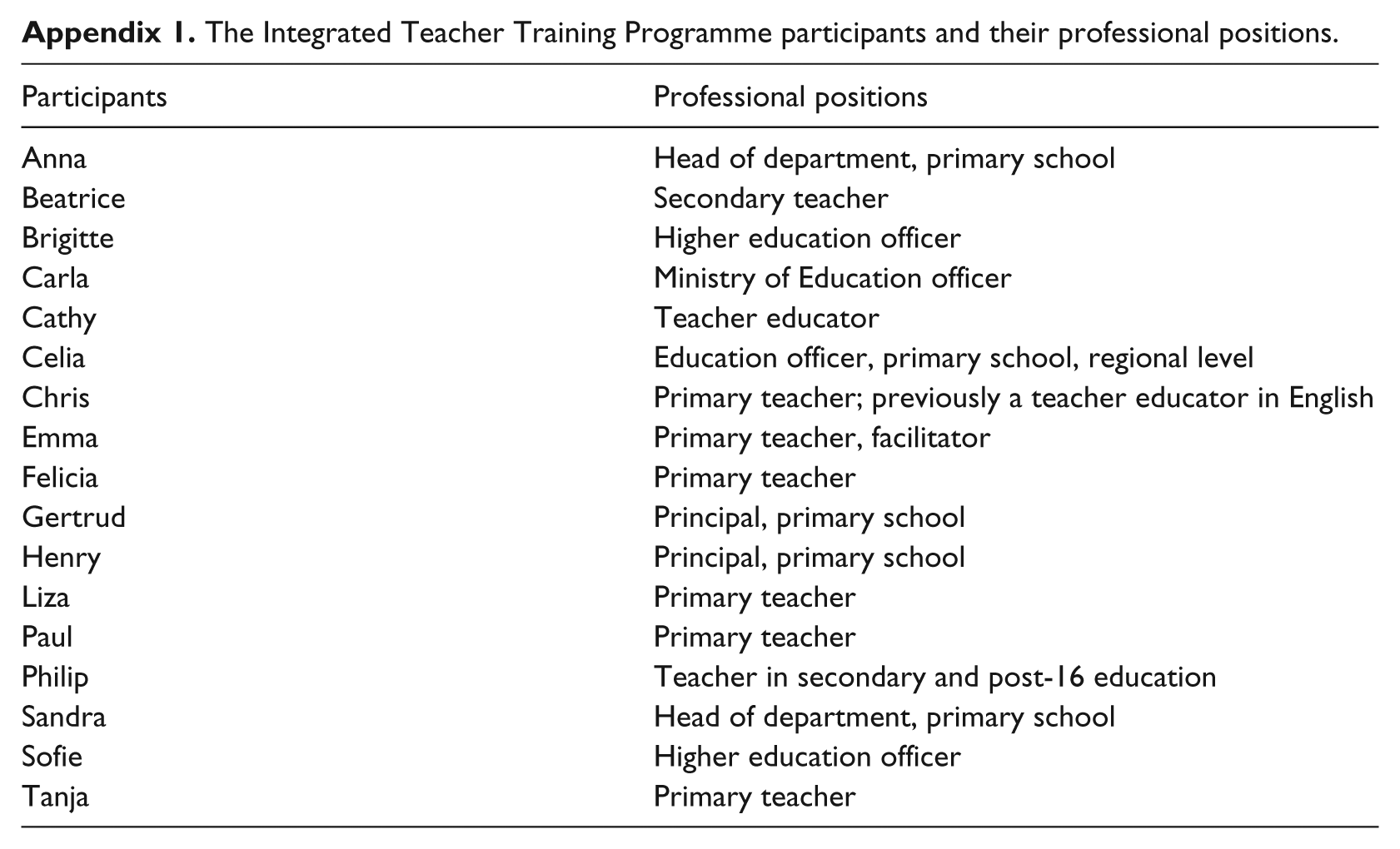
As previously indicated, the 17 Namibian participants in this study constituted all the individuals who we were able to find and reach, during the time of our stay in Namibia in April 2009; by numbers, they constituted more than half of the group who had finished the ITTP programme. At the time this study took place, the ITTP participants were between 39 and 50 years old. They came from five different ethnic and linguistic communities; two-thirds were from the Oshiwambo community, among the others one or two were from the communities of the Oshidonga, Kwantama, Otjiherero and the Oshikwanyama. All held different professional positions in the education sector. Approximately one-quarter were teachers and ‘facilitators’ in primary education; a further quarter were teachers in secondary education or at the post-16 level. About half had held leadership positions at national, regional or local levels, including posts as officers at the Ministry of Education or at the National Institute of Education Development (NIED). Current responsibilities outside teaching included curriculum development at national and local levels, administration of higher and further education, and support and guidance of local teacher staff. (Fictitious names and the professional status of the Namibian informants are presented in Appendix 1.) It was claimed that the salaries were low, though sufficient to support a family and provide basic education for the children in the family. For example, the majority lived in a house of their own. Many interviewees, particularly women, mentioned social and economic responsibilities for extended families, i.e. relatives and orphans. Individuals had participated in other externally-funded projects abroad.
At the time of their recruitment to the ITTP they were all refugees from the war in Namibia. Sofie, now a higher education officer, had escaped to Angola at the age of 11:
/…/ I left Namibia immediately after Christmas 1977 with one of my friends. We went to a refugee camp in Angola where we stayed for many years during the war and I went to [primary] school. /…/ Many women, children and men were killed there [in the camp]. (Sofie, higher education officer)
Previous education included primary or secondary education which had been provided in different African countries (Angola, Cameroon, Rwanda and Zambia); some had undergone rudimentary teacher training aimed at the black population; others had worked as primary teachers or pre-school teachers in the refugee camp. They had been appointed to the ITTP by SWAPO leaders (among them Nangolo Mbumba, a later minister of education), and English proficiency had been assessed by Lars Dahlström and his colleagues (see Dahlström, 2002). It was suggested that SWAPO had chosen the ‘the best people’ which, according to some participants, included those with political awareness and shared values of the liberation movement.
Ethel, a Swedish teacher educator who had been a colleague of Lars Dahlström at Umeå University, was involved in the ITTP and BETD for over a decade (1984–1995). Along with another female colleague, she had first arrived in Angola in 1984 at a crowded refugee camp which had about 20,000 people, and where “there was practically nothing apart from a mass of people, who sometimes carried around their own mattresses". They set up teacher training with “no teaching materials, no books”. While it seemed to her that the camp was “a world of its own that was constructed there, and with no outside contacts”, access to water and electricity was somehow organised, and small houses were gradually erected by a Swedish company.
Perceptions of the Integrated Teacher Training Programme and learner-centred education
The participants were asked about the ways the ITTP had affected them, and this brought back memories of the colonial apartheid system, such as those by Henry:
Coming from a background of apartheid where your input was not asked for, that [what we experienced in Sweden] affected me very much. (Henry, principal)
In line with Henry, others mentioned that the learner-centred pedagogy, including the location of the ITTP programme in Sweden, differed entirely from the pedagogy of the colonial education system:
I know the situation before in Namibia and I know when learner-centred education was introduced in Namibia. Some things that we did in Umeå [Sweden] in my training /…/, what we mean by learner-centred education, was not difficult for me to apply. (Sofie, Higher Education Officer)
According to Brigitte, the learner-centred approach of recognising her previous knowledge and experiences contributed to her self-confidence as a teacher:
In this system [we had had] in Namibia, we had to memorise things – you were taught and you memorised and you went and you passed the exam./…/ From the learner-centred education we learnt that the learner is a focal point /…/ When I went to Sweden then I had to do things on my own. /…/ I really gained a lot there and I got confidence. (Brigitte, Higher Education Officer)
Along with skills in “how to handle learners”, a wide set of practical and creative competencies for the classroom was provided. For example, an ITTP participant (Chris) claimed that the programme had added to his thinking about “possibilities of other venues in education philosophy”, which, according to him, enabled him to contribute to the development of education, including education programmes:
My knowledge on education has advanced – I can participate in debates, workshops, conferences and planning for educational programmes. (Chris, primary teacher)
However, in Sweden, the Namibian context of education was evidently at the fore: “we were not doing Swedish things, we were always referring to the Namibian situation” (Sofie). The emphasis in LCE on participants’ own ideas sharply contrasted with the customs in the black communities according to which young people should not talk too much in front of older generations: “In Sweden, we were encouraged to speak out /…/ but from the experiences I had here in Namibia, we didn’t talk much” (Brigitte). School visits in Sweden provided concrete examples of learners’ participation, and younger pupils’ involvement in negotiations and decisions made a huge impact on many participants:
/…/ a person, one child can write minutes and chair a meeting. I was very surprised. Those learners are educated in the sense that from pre-primary they are being taught in a way that a learner can develop his way of expressing himself, without fear! (Paul, primary teacher)
Even to this day, they saw learning as an active process where learners “involve themselves in teaching”. By drawing on the learners’ experiences as promoted by LCE, it was argued that both teachers and learners could take on new roles enabling the learner to become more autonomous:
The teacher has to be a mentor, an adviser and an organiser /…/ LCE has widened the scope of the children to think on their own and not wait for the teacher to come and give them, they also have to participate. (Carla, education officer, national level)
It was further emphasised that the LCE principle of production, including creativity and variation in teaching methods, provided security in the classroom and freedom from reliance on textbooks. The participants perceived themselves as knowledgeable and qualified teachers able to support both learners and colleagues, as exemplified below:
I am the best teacher /…/ I have gained knowledge, how to solve problems with my learners, how to handle my learners /…/ I can deal with problems with all my colleagues, I can solve them. And I can also share my knowledge. (Emma, facilitator, primary education)
The methods currently used in Mathematics teaching in a large primary school in Windhoek, it was claimed, sprang directly from a single Swedish teacher educator who had applied creative solutions to the teaching of Mathematics:
We are not applying Mathematics the way it is supposed to be, but the way John [ITTP teacher educator] taught. /…/ Like, when you are doing fractions, you take an orange and you cut it; you do it practically. (Anna, head of department, primary education)
After independence, the former ITTP students actively participated as “facilitators” in the implementation within the new national education structures at national and local levels; for example, promoting the ideas of LCE in workshops for teachers, and developing a new curriculum including new teaching materials for compulsory education:
/…/ the teachers came to workshops and I taught them /…/ anything from learner-centred education to how to read and write and then Mathematics, yes all those things. /…/ I was able to participate in developing materials for the whole country, participating in the curriculum and so on. We were the people to hold workshops at NIED [The National Institute for Educational Development] in 1995. (Sofie, Higher Education Officer) We held workshops, and we were placed in different schools. I went to a rural area; they are still asking me to come back and assist them. (Anna, Head of Department, primary school) We have been exchanging our experiences with our colleagues who were not in the [ITTP) exchange programme. Now people are being trained in the way we have been trained because the teacher education programme has been implemented by the ITTP facilitators. I have given mini workshops etc. (Paul, primary teacher)
As expressed by Sofie, the ITTP also laid the foundations for the participants’ further professional development, career and current employment:
I was a teacher, then I became an advisory teacher, then I became a lecturer at the college, then I became education officer. I am now working with the Namibian qualification system, and this is through my experiences, the education I have gone through. (Sofie, higher education officer)
In sum, the participants’ involvement in the ITTP, including LCE, had provided a teacher diploma which was highly regarded and upon which the postcolonial teacher education reform was modelled. LCE as used in the ITTP, and demonstrated in Sweden, was conceived as an appropriate theoretical and practical pedagogy for Namibian education, and which could be provided in very rudimentary conditions. In line with policy intentions, the ITTP came to serve as a springboard for further careers in education.
Perceptions of the teaching profession
When looking back over the nearly 20 years, the informants recounted how participation in the teacher education programme has influenced their lives thereafter. Overall positive outcomes in terms of living conditions, including social and financial independence, were mentioned, as exemplified in the following snapshots: “It changed my living conditions, at the end of the month I can survive” (Philip); “I have my place, my shelter, I have bread on the table” (Beatrice); “I have a house, a car” (Sandra); “I am able to earn money and buy a house, and pay for my children’s education” (Celia). The importance of education was also emphasised as the only safe way to achieve financial security in today’s Namibia.
Some considered that teachers held a high position in today’s society (Emma, Celia, Paul and Philip), while others were not so sure. The former view of teachers as “a symbol of wisdom” (Henry) no longer applied, although many considered that the lower regard of teachers today was due to the increased education level of the population. “We must therefore study more and acquire more knowledge”, Liza said. Anna found that teachers were often criticised for doing a bad job, while she thought that criticism should be directed instead at learners and the generally poor material conditions in education:
When it comes to the learners, most of the blame falls upon the teachers/…/ but they [the critics] don’t look at the learners themselves. There is no good staff room for the teachers, no chairs./…/ The situation for the teachers is not good. (Anna, head of department, primary education)
Another view was that the teacher’s position has been undermined “because of democracy and too many rights given to people” (Cathy). She pointed to the low salaries and poor working conditions for many rural teachers:
We are not well looked after, especially in terms of reward and salary; and working conditions, there is no accommodation, the schools are very far, there are no hostels for the teachers, especially for primary schools. (Cathy)
Liza was pessimistic about whether a better situation for teachers could be negotiated by the teachers’ union, which she implied was controlled by the state: “there is too much politics in the union activities; they are controlled too much by the government”. The shift from previous conceptions of teachers ‘giving’ knowledge (cf. Zeichner and Ndimande, 2008) to a view of teaching and learning as a process of understanding, seemed to have created greater pressure on teachers. Parents wanted to have their say too:
Today, parents are asking their children ‘what have you learned at school, do you have homework to do?’ All that is happening now, but it was not happening before. (Carla, education officer) There is more pressure on education today. The parents of today have gone through education themselves, and they know that there are greater expectations /…/ which is good. (Henry, principal, primary education)
There were complaints about teachers in newspapers, in particular when pupils failed their exams in English. Cathy found that the overall current discourse on education positioned teachers as scapegoats. When pupils failed the national examination in English, complaints came not only from parents, but also from the Parliament and the World Bank.
/…/ they do not understand what education is, that is why they are blaming, and they are not putting much effort into the education, they do not think it is their job, the job is for the teachers /…/. (Cathy, teacher educator)
They said that whereas the teacher training provided by the ITTP was adequate for teaching all subjects at primary level, there was now a demand for specialist teachers in Maths, Science and Languages. Concerning the sharpened regulations on the English proficiency of teachers, interviewees were critical of the lack of their opportunities to update their knowledge and skills in the English language.
The interviews indicate that all ITTP participants had a career in the education field; about half had senior positions at the national or local school level. However, the interviewees claimed that in wider society the position of teachers was increasingly challenged by tighter regulations on academic qualifications, along with frequent criticism of the teaching profession in newspapers. Some claimed that the position of the teacher was undermined in today’s Namibia “because of democracy”.
Perceptions of education, democracy and gender equity
While the participants formulated their views on education and democracy on an individual basis, they shared the view of the need for a linkage between the two in the construction of Namibia. For example, Celia used the metaphor for education as “the backbone of the nation”. Similarly, Paul argued that there could not be democracy without education:
If a person is educated, he or she has also to understand what democracy is. People also have to know their rights, and they also have to understand how independence comes up. (Paul, primary teacher)
The importance of education for future citizens was echoed time and time again, for example, so that “they [children] can be a good nation, to teach them what it is to be a democracy, about political issues” (Felicia). However, criticism of the lack of change despite the promises of a “change for revolution” came from a former freedom fighter. For him, the words liberation, democracy and change “should not be separated”; rather than as is now, they were used by the government to create feelings of unity: “the government says ‘dadadada’, this is our country, our education is really a democracy and liberated”.
They do not know what is going on there, in the concrete [setting] of the classroom, they are just in the planning, in the syllabus and the curriculum which might not be relevant to today’s teaching. (Philip, secondary education)
Others identified conflicts between policy and reality, concerning, for example, school fees. Despite the government’s declarations about free education for all, the demand for payment for primary education effectively blocked access for many children (Embassy of Namibia, 2013). Some argued that so-called school funds which were compulsory to pay should not be regarded as fees, others claimed that the so-called funds were in reality fees, and that such fees, whether they had to be paid for primary, secondary or higher education, were inconsistent with the official declarations of free education:
Even if it is not much in primary school, I think children are paying 450 each, per year, that’s not much. But you buy school material, then it becomes expensive. /…/ I cannot afford for my child to go to university. If a child is going to university, if you do not live in Windhoek, it is more than 20,000 something for the whole year. (Sofie, education officer)
The interviewees mentioned their participation in the national teacher education reform and their difficulties with implementation. Perceptions of resistance to the policies of white education officers from the former colonial regime who had remained in their posts after independence, as detailed by Callewaert (1999), were similarly mentioned by Philip:
Most of the system was controlled by the former colonisers /…/ it was very difficult for us and the ministers to run away from the former system of education and to set our own system. (Philip, secondary teacher)
The problems of implementing LCE in postcolonial education settings were also seen as related to the generally weak educational base in the country that includes many non-qualified teachers. Celia, who works with further education, emphasises that while she is supportive of the teacher education programme there is a need for better teacher training courses in Mathematics, Science and Language. A more critical view, offered by another informant, is that the national teacher education programme has lost its way due to weaknesses in both policies and practices.
We don’t know where to go now /…/ we don’t have the tools to improve the teacher education – that is why we have a problem. (Philip)
In response to the question on their perceptions of gender equality and equal opportunities, both men and women welcomed the formal structures for gender equality. Many mentioned the formal rights that men and women have in today’s Namibia, including the same working conditions. A male principal in primary education (Henry) suggested that a fair “balance” between men and women had been reached in Namibian society, which according to him included “big awareness and sensitivity about gender”. Further, according to the same informant, many parents understand the importance of education also for girls, and “the girls are no longer the girls of yesterday who would say yes and amen to everything”.
However, institutionalised inequities between men and women in teacher education after independence were pointed out. The informant (Cathy), who was now a teacher educator, mentioned the increasing numbers of male students at teacher colleges as being connected to the national regulations imposing less demanding admission criteria for men than for women. Along with colleagues, she perceived a growing tendency among male student teachers to use primary education as a platform for further careers:
Sometimes we wonder if they are coming with interest or if they are using it as a stepping stone to move further on, to climb, also because of the living conditions. (Cathy, teacher educator)
Despite overall claims of gender equity, including a suggested ‘balance’ between men and women, it appeared to us in the interviews, other conversations and visits to informants’ homes that many women had a greater responsibility for the home and also had economic and caring responsibilities for individuals outside their own family.
While the interviewees formulated their ideas on education and democracy on an individual basis, the importance of education for active citizenship was echoed across the interviews. Identified gaps between policy and reality, as mentioned by a few, were seen as related to various factors, including the weak educational base in the country over time, still many non-qualified teachers, and hesitance in adopting new policies among education staff in schools and at higher levels. Gender as an issue of importance in education was only tentatively touched on; on one hand, it was suggested that gender equity was principally achieved by virtue of the growing proportions of girls in education while, on the other hand, it was suggested that men were increasingly using the teaching profession as a career platform.
Analysis and discussion
The overarching aim of this article has been to describe and analyse the Namibian participants’ perceptions of the ITTP, including their views on knowledge and education in relation to democracy at a distance of two decades later. The ITTP entailed collaboration between the SWAPO liberation movement and experts from the West, with the overall purpose to promote democratic development in postcolonial Namibia through new educational structures.
In response to the first research question (1) concerning the ITTP’s perceived impact on the Namibian participants’ private and professional lives today, the study indicates that the ITTP, including the pedagogy of LSE, had a decisive impact on their further lives and professional careers. All of the ITTP participants emphasised particular skills as teachers due to the ITTP. LCE was acclaimed as being a ground-breaking pedagogy including both a hands-on teaching method and a philosophy of education to build on, involving new roles for teachers and learners for furthering the development of education. Some acknowledged, however, that as the ideas of the ITTP programme differed from customs in the black communities, their implementation encountered different hindrances. At the time of the study, all interviewees were employed in the education field; about half held senior positions at the national or local school level. Along with other returnees to Namibia who had gained education through SWAPO, they were employed in the new state and formed the emerging middle class. This offered a contrast to the majority of returnees, who after independence had remained without jobs and without possessions (cf. Metsola, 2006).
In response to the second research question, concerning (2) the ITTP’s perceived impact on the participants’ views on knowledge and education in relation to democracy, the three key concepts were considered as intimately connected to nation-building. As it appeared, policy discourses on liberation, democracy and education tended to be equated with the overall postcolonial situation of independence, freedom from war and formal abolition of discrimination on racial grounds. While the key concepts were positively approved of, there were also criticisms of the government’s policies as mainly being rhetoric, and devoid of meaning. It was suggested that the formerly high regard of the teaching profession was being challenged along with democratic development in Namibia.
As revealed in statistics, policy documents and research, the ambitions for education in postcolonial times do not reflect current educational practices. While Namibian policies for the protection of children, including social and education policies put Namibia in top position among African countries (Bequele, 2010), poor teaching, including teacher absences, poor pupil performance and inadequate physical conditions exist in many schools and classrooms (African Economic Outlook, 2012; Clegg, 2007; Ministry of Education, 2008; Rowell, 2005; Nyambe and Wilmot, 2008).
Reasons suggested for the failures in research of the reforms in Namibia vary. Ideological motives, in the form of outspoken resistance to the new policies by civil servants of the former apartheid administration who had remained in office after independence, are pointed to by the ‘insiders’ Callewaert (1999) and Dahlström (2002). Poor understanding of LCE and misconceptions of teaching and learning processes among policymakers and teachers are evident in research studies (Clegg, 2007; Nyambe and Wilmot, 2008; Rowell, 2005; Schweisfurth, 2013). Namibian policymakers’ inexperience with curriculum development has meant dependency on Western experts and the Swedish Aid Agency (O’Sullivan, 2004). Further, Western individualism contrasts with traditional African cultures and views on children and learning (Tabulawa, 2003). It has also been suggested that the low education outcomes, along with the psychological and physical withdrawal of teachers from classrooms, are related to low teacher job satisfaction, low teacher salaries and the lack of prospects of promotion (George et al., 2008).
An even more provocative explanation of the persistent failures of the reforms is that policy has become merely political symbolism (Halpin and Troyna, 1995; Jansen, 2002), i.e. that structural change through reform was not on the policy agenda, despite the colourful rhetoric of social and economic transformation. Through use of such political symbolism the SWAPO government not only gained legitimacy in the wider global community but also received large amounts of external funding for education, not just from Sweden but also from Germany and Norway (UNESCO, 1995). As Metsola (2006) highlights, many among the black political elites of the SWAPO leadership have achieved considerable economic privileges and ‘side benefits’ and, in so doing, have distanced themselves from the poor conditions facing the general population. Moreover, the persistent strong authoritarian culture within SWAPO has justified national policies through reference to “peace and stability” and “national unity” (Metsola, 2006: 1121). Fosse (1997) similarly identifies an ethos of nationalism and “grand ideological constructions” (Fosse, 1997: 433). Accordingly, this rhetoric serves as both an ideology and a universal solution to the previous injustices of apartheid. Fosse also identifies ideological conflicts between ethnicity and nationalism, which tend not to be acknowledged by the ruling government (Fosse, 1997: 429). Further, as emerging middle class citizens, the former exiles and ITTP participants can be seen as partisans and loyal core supporters of SWAPO.
How can one understand the gap between the ITTP students’ relatively positive statements, alloyed with critical elements, about the ITTP and its impact not only on their own professional lives, but on education in today’s Namibia on one hand, and the picture that emerges from research, statistics and government policy documents on the other?
One explanation is connected with our method, which addresses issues of the reliability, credibility and validity of this study. A methodological issue in this study was the fact that we came as representatives of white Sweden and of the university that had been responsible for the ITTP programme. In such a context, we came to represent privileged Westerners. Given this situation, it might have been natural for our respondents to emphasise the positive aspects of both the ITTP and today’s Namibia. With such an interpretation, it is likely that our respondents only mentioned positive things in the interview because they had achieved privileges and ‘side benefits’ (cf. Metsola, 2006). Following this interpretation, the majority of our respondents have thus internalised the political leaders’ rhetoric. As agents in curricular reforms, our respondents have had to contend with the vested interests of elites, a lack of resources including the hegemony of Western culture and forms of knowledge in an increasingly global world (Tikly, 1999).
A second explanation is connected with the interview method. It should be kept in mind that the interviews dealt with experiences that had occurred almost 20 years before and that memories are seen in the light of the present (Goodson, 1996). The former ITTP students were not free thinkers but collectively socialised and part of a culture dominated by a collective memory, an “adapted ego”. Some of them, however, highlighted contradictions and doubts with their more oppositional and individually formed “critical memory”.
A third explanation is connected with the analysis of data. It is important to accept that statements in an interview are on a rhetorical level (Silverman, 2001). The gap we identified can be explained by differently accepted ways to create stories, all caught up in a story we identified as political symbolism; i.e. a Western concept like other concepts used in this study.
A fourth explanation relates to the language used in the interviews, English. For both interviewers and interviewees in this study English was not the mother tongue. English was a medium through which questions and answers were interpreted. This not only concerns the interview and questionnaire study, but all of the concepts involved in the ITTP. For Halliday (1985), the function of all languages (or dialects) is to represent a particular perspective of the world or ideology (ideational). In the interview and questionnaire study, the manifold underlying mother tongues, Swedish, and the Namibian ones of Oshiwambo, Oshindonga, Otjiherero and Oshikwanyama, meant that the issues treated were constantly negotiated and interpreted. Understanding was therefore always approximate.
Education is an important institution for the formation and control of society (Dewey, 1916/1966; Mayo, 1999). The struggle against colonial domination, Tikly (1999) claims, has often involved a rejection of imposed educational patterns and the establishment of an alternative form of provision. Adopting Bernstein’s terminology, the functioning of a democratic society is related to citizens’ pedagogical rights, including their access to education and their opportunities to contribute to the development of society (Bernstein, 2000).
The ITTP students were a group of black Namibians who in their youth were entrusted with the task, via relatively exclusive education, parts of which were located abroad, of paving the way for pedagogical ideas in the new nation and putting an end to the former apartheid structures and social inequities (Angula, 1999) or, in other words: the ITTP could be used by emerging elites as a tool for transforming colonial subjects into new kinds of postcolonial identities linked to an alternative form of sovereignty under SWAPO’s rule (Tikly, 2004). Since democracy presupposes majority rule, the visions of the future also contained a picture of Namibia governed by the black majority. The cultural and educational forms that emerged were thus both hybrid and global (Tikly, 1999). This is a complex process of transcultural mixing in which boundaries between cultural forms and identities were fluid rather than fixed.
Active citizenship through education and for a democratic, post-apartheid and unified Namibia has been discursively promoted by the SWAPO regime. National policies with shared values and interests have had nation-building effects, and worked to construct bonds and solidarity ties, according to Kpessa et al. (2011) and others (Fosse, 1997; Mayo, 1999; Metsola, 2006). Yet socio-economic inequities and unequal distribution of resources persist in postcolonial Namibia (African Economic Outlook, 2012; Jauch et al., 2009; Melber, 2007). The social and economic inclusion in Namibian society of the ITTP participants implies that, in their loyalty to the state and the party, they tolerate policy formulations that deviate from experienced realities (cf. Kpessa et al., 2011; Metsola, 2006).
Our study highlights Westerners’ understanding of their own role as participants within the reform intents, including a view of their participation as principally grounded in ethical and humanitarian motives (cf. Sogge, 2002). For example, Zeichner and Dahlström (1999: vi) state that they as ‘outsiders’ did not decide or control the forms and aims of the development, but cooperated and participated in the reform work. In the literature on teacher education in Namibia written by those who were then involved, there is a shift from a view of LCE as emerging from the struggles in exile (Callewaert, 1999; Dahlström, 2009; Swartz, 1999; Zeichner and Dahlström 1999) to the acknowledgement of education as a top-down discourse based on cultural and linguistic preferences of experts and donors from Western elites (also see Brock-Utne, 2000; Clegg, 2007; Rowell 1995). Further, identification as Swedish is generally associated with opposition to former colonising powers and support for the victims of colonialism (McEachrane and Faye, 2001). Still, could it be that the Westerners unknowingly carried the two different images of Africa that Arnfred and Utas (2007) claim have served as filters for conceptions of Africa in the West; one of the primitive and good African to be brought up and educated by the West, and the other a primitive to feel sorry for?
However, the gap between rhetoric and practice in education is not only in Namibia, but also in Sweden and elsewhere filled with political symbolism. Despite this, the reform of Teacher Education in Namibia is a reality that has given the ITTP students and their followers, to quote Bernstein (2000), confidence in pedagogical arrangements, enhancement of critical understanding and new possibilities. This is an important step towards social change and democracy, to be followed by further steps.
Footnotes
Appendix
The Integrated Teacher Training Programme participants and their professional positions.
| Participants | Professional positions |
|---|---|
| Anna | Head of department, primary school |
| Beatrice | Secondary teacher |
| Brigitte | Higher education officer |
| Carla | Ministry of Education officer |
| Cathy | Teacher educator |
| Celia | Education officer, primary school, regional level |
| Chris | Primary teacher; previously a teacher educator in English |
| Emma | Primary teacher, facilitator |
| Felicia | Primary teacher |
| Gertrud | Principal, primary school |
| Henry | Principal, primary school |
| Liza | Primary teacher |
| Paul | Primary teacher |
| Philip | Teacher in secondary and post-16 education |
| Sandra | Head of department, primary school |
| Sofie | Higher education officer |
| Tanja | Primary teacher |
Declaration of conflicting interests
The author(s) declared no potential conflicts of interest with respect to the research, authorship, and/or publication of this article.
Funding
The author(s) disclosed receipt of the following financial support for the research, authorship, and/or publication of this article: This study was funded in three parts, including by the national Linnaeus-Palme Programme, the School of Education, and the Centre for Gender Studies, both at Umeå University.