




Abstract
Drawing on the analytic concept of imaginary, this study investigates policy hybridisation in the Finnish early childhood education. Specifically, it illuminates how the interplay between different imaginaries enabled the neoliberal imaginary to oust the social-democratic imaginary through a tripartite process in a case of local productivity policy in the early childhood education sector. The confrontation of the historical trajectories and analyses of a localised hybridisation process suggests that even though historical trajectories play an important role in defining future policy solutions, hybridisations may have the power to transform their direction. We suggest that focusing on both discursive features of policy deliberation and material-technical ways of governing policy directions provide valuable information concerning policy reforms.
Introduction
This article focuses on the enactment of a productivity policy concerning the public sector in the domain of Finnish early childhood education (ECE). Via our study, we aim to take part in a discussion concerning policy reforms in the globalised world. Specifically, we aim to illuminate how we could better understand the formation of policies in reforms that include hybridisation of different policy trends – processes of coalition-building where different policy goals and views concerning the effective means for achieving them are in conflict.
Productivity and performativity seem to become key rationales for education systems throughout Europe. One of the explanations is that discourse on globalisation has turned gazes to national-level economic competitiveness. The prevalent transnational imaginaries of education, the views concerning the eligible society and the role of education in building it are thus loaded with the construction of a ‘knowledge economy’ and ‘learning society’. Within these prevalent transnational imaginaries, education systems are viewed as instruments for economic change, as they build intellectual capital by increasing the capacity for innovation, enhance workforce development and promote self-reliance and resourcefulness (Ozga and Jones, 2006). This kind of transnational narrative of the role of education in building intellectual capital can be recognised throughout all educational levels from early childhood to higher education and it has even become almost like a folklore throughout the Western world (Campbell-Barr, 2012; Jessop et al., 2008). In the domain of ECE, transnational discourses, drawing on the theory of human capital, stress both the importance of ECE as enabling mothers’ workforce participation (see, e.g., OECD, 2007a) and the importance of ECE as advancing children’s learning and development (see, e.g., World Bank, 2007).
However, the discourse on the economic crisis has led to attempts to find financially profitable education policy solutions at both the international and the national levels. In the domain of education and in the society more general, a transnational current for stressing accountability and performativity can be recognised (for recent developments of transnational accountability policies see Lingard et al., 2013). The best productivity of education is believed to be achieved by governing by numbers and assuring quality through checklists, rating-scales and rankings. This is part of the larger paradigm of performativity that Stephen J. Ball (2003) describes as follows: Performativity is a technology, a culture and a mode of regulation that employs judgements, comparisons and displays as means of incentive, control, attrition and change – based on rewards and sanctions (both material and symbolic). The performances (of individual subjects or organizations) serve as measures of productivity or output, or displays of ‘quality’, or ‘moments’ of promotion or inspection. As such they stand for, encapsulate or represent the worth, quality or value of an individual or organization within a field of judgement. (Ball, 2003: 216)
Both of these trends, idea of investment in human capital and demand for accountability, can be recognised from the early childhood sector as well. According to Dahlberg and Moss (2005), the idea of investment in ECE is shaped by a dominant discourse that is located within a neoliberal political and economic context. However, this narrative of investment is not unanimous. Mahon (2010) argues that a close examination of the policy discourses of the Organisation for Economic Co-operation and Development (OECD) and the World Bank suggests that they have gone beyond neoliberal prescription of welfare cuts and structural adjustment over the last decade. This shift is particularly evident in their advocacy of public investment in the ECE system and programmes. Transnational narratives concerning investing in ECE have represented inclusive liberalism – they have moved towards the ideals adopted from the Nordic social-democratic welfare state while still stressing individuality and rights as well.
Yet, our examination of the recent OECD documents has suggested that the era of inclusive liberalism may have come to its saturation point (Paananen et al., 2015). The discourses of the OECD have converged with the discourses of the World Bank’s ‘roll-out neoliberalism’ at least when the investment narrative has become connected with the idea of accountability. Although the narrative of investment is a collection of various rationales emerging from the wide range of policy starting points (Mahon, 2009; Penn, 2011), all in all, however, it can be concluded that transnational trends within the ECE sector include economistic, child-related discourse that highlights advancing children’s learning and development, the economic impacts of it and the demand for accountability in terms of that investment.
These transnational trends are important to recognise since the role of transnational organisations has been noticed as being pivotal in terms of mobilising national educational reforms. They have become ‘central nodes of diffusion’ between transnational and national policies (Jakobi, 2012). These kinds of transnational discourses and paradigms seem to travel globally across national boundaries. Yet, national responses to these kind of transnational policy paradigms are dynamic and unpredictable. Comparative analysis reveals interruptions and faults that prevent change that would be parallel to transnational policies. Simultaneously, it has been argued that the diffusion of transnational ideas and national practices may, under favourable political conditions, produce ‘seismic shifts’ in national policies (Mahon et al., 2012). However, these embedded policies may differ significantly from the transnational and travelling policy paradigms or even contradict them, even though they would use similar deliberation (Cowen, 2009; Seddon, 2005; Silova, 2005).
Hybridisation has been used to explain this kind of seemingly unpredictable change in national policies from the viewpoint of both national and transnational ideals (Maroy, 2009). It has referred to the intersection of different rationales rising from national or transnational ideals. In this article, the concept of hybridisation accounts for dynamics between different imaginaries. We thus extend the focus from outspoken rationales to include also the knowledge apparatuses, that is, the material means by which knowledge is passed on and evolves, that are connected to and reify these ideals.
Since the present understanding of these hybridisation processes is limited, we wanted to examine the elements that enable such hybridisation. It is important that we understand the mechanisms through which imaginaries transfer, travel and change. Without that kind of knowledge, we have no tools for taking part in defining the directions society is developing. Thus, the aim of this article is to examine the hybridisation process, that is, the dynamics between imaginaries, using a case derived from the domain of Finnish ECE as an example and examine whether our framework that focuses both discursive and material-technical features of the phenomenon help us to shed light on the questions about enabling elements for hybridisation and directions of policy trends.
To ground our analysis, we will begin with a historical overview of Finnish imaginaries concerning ECE over the last 40 years. At the beginning of that section, we will explain the concept of imaginaries more thoroughly. Then, we will examine our existing knowledge of the process of hybridisation in the light of previous research. We will explain, how we, following our understanding of imaginary, use the concepts of ‘boundary artefact’ and ‘boundary concept’ to provide a more nuanced understanding of the hybridisation process. Afterwards, we will provide a detailed examination of a localised hybridisation process with the help of our conceptual framework. We will conclude the discussion by reflecting on the implications of our findings.
Finnish imaginaries of early childhood education
An imaginary is a semiotic system that frames individuals’ experience of a complex and multifaceted world and guides collective calculation concerning future strategies (Jessop, 2010). An imaginary gives meaning and shape to education and, more specifically in this case, to ECE. It answers questions about what kind of society is presented as desirable and what the role of ECE in the construction of that society is. By the use of the concept ‘imaginary’ we aim to underline the selective and constructed nature of models: models never reach the complexity of reality but take part in its construction (Jessop, 2008). That is to say that models always reduce complexity of reality by selecting among all possibilities certain ones in terms of both goals and instruments. By doing that, the model and technical arrangements attached to it also direct our perception and actions. Thus, they do not only represent something but also fabricate reality.
The concept of ‘imaginary’ embraces both the ways of speaking about a certain phenomenon and the legitimate ways of transferring and gaining knowledge about it. It highlights the material and discursive mechanisms through which the knowledge is distributed, or how the knowledge is produced and disseminated. Therefore, we need to analyse not only the discursive construction of policy deliberation, but also the technical arrangements, such as binding documents and measurement and evaluation systems, through which ECE is governed. We maintain that the analytical separation of these two components of imaginary helps us understand the processes of hybridisation in a more nuanced way. In order to do that, we first need to examine the Finnish imaginaries of ECE.
Mostly, Finnish ECE has represented Nordic social-democratic tradition. As we have said that we will focus on both technical ways of governing the system and discursive features in deliberating it, we will first shed some light on the governance of Finnish ECE and then the deliberation attached to the binding regulation of Finnish ECE.
The governance of ECE in Finland forms a twofold system where the nation-state and municipalities have their own role in ECE policies. Throughout the 1990s, the Finnish education system shifted from centralised to heavily decentralised. However, minimum standards for staff qualifications and child–staff ratio are regulated by law. The Act on Children’s Day Care (1973) sets the requirements for the staff–child ratio and the staff qualification which are the most favourable in terms of quality of ECE among the OECD countries. For example, these features connect Finland to the Nordic social-democratic welfare regime, which is based on the idea of investment in good-quality public services (Esping-Andersen, 1996; Mahon, 2001, 2002; OECD, 2006).
The principle of universality – the idea that everyone should have access to good-quality services – is also one of the features of the social-democratic imaginary (Mahon et al., 2012). In Finnish ECE, it has manifested in the idea of the subjective right to day care. Since 1990, parents have enjoyed an unconditional right to day care for children less than three years of age in municipal day care. Since 1996, parents of all children under school age have enjoyed the right to a day-care place provided by their local authorities.
In 1998, pre-primary education for six year olds (400 hours per year) became free of charge and was attached to the Basic Education Act (1998). The fee for ECE for those under six years old depends on the income and size of the family. However, fees are moderate; the maximum fee was 264 euros/month/child in public day care in 2014. According to the OECD (2007b), Finnish two-earner families spend approximately 7% of their income on childcare, compared to the OECD average of 17%. Also these reasonable fees resonate with the principle of universality which has been a characteristic feature of welfare services in the Nordic social-democratic welfare regime (Mahon, 2001; Mahon et al., 2012).
Some policies in the domain of Finnish ECE and care have diverged from social-democratic ideals. Such policies include the 1985 decision allowing parents to use the home-care allowance to pay private care service fees and the 1996 introduction of private day-care allowance (Child Home Care and the Private Care Allowance Act, 1996). These policies resonate with libertarian ideals, which highlight freedom of choice and the service nature of the ECE system. They also resonate with the pressure faced by Nordic countries to promote ‘efficiency’ and ‘freedom of choice’ in human services (Mahon et al., 2012). However, the proportion of families using private day-care allowance remains at a relatively moderate level, accounting for about 8% of families who use child-care services (National Institute for Health and Welfare, 2013).
All ECE policies can be roughly divided into three categories according to the deliberation they use (for child-care policy rationales, see Penn, 2011): These categories are: (1) societal utility, (2) individual rights and (3) social justice-related deliberation. Deliberation related to societal utility surrounds the ideas about enabling the workforce participation of women (since they are essential contributors to a dynamic economy and since working mothers contribute to tax revenues and lessen the need for social security payments), ideas about the role of education and lifelong learning as essential to a competitive knowledge economy and ideas about mitigating the expense of remedial measures in primary and secondary schooling and decreasing anti-social behaviour.
Individual rights-related deliberation centre on the idea of children as rights bearers who have the right to protection, provision and participation. Deliberation related to social justice is linked to the role of early education in promoting social mobility, and fostering democratic values. These different aims are not exclusive but rather interrelated. Although the Nordic system is perceived as being built on the idea of social justice, if we examine the discursive part of the imaginary concerning ECE, that is, deliberation concerning the binding regulation of ECE, the view is a bit different. Our examination of deliberation used government bills (n=47) and parliament responses (n=47) concerning institutional childcare and ECE from 1973 to 2014. We begin our examination from the first formulation of the Act on Children’s Day Care (1973), since this was the first law covering the whole institutional ECE in Finland. Relevant documents were identified by using parliament’s database search. The search term used was ‘lasten päivähoito’ (i.e. ‘child care’). There were also documents not generated from this search that were also added to the sample. These documents were identified from earlier historical overviews concerning Finnish ECE (Onnismaa, 2010; Välimäki, 1998). They concerned qualification requirements of child-care centre workers. Following Fairclough and Fairclough (2013), we asked what kind of deliberation was used in these government bills concerning institutional child care and ECE (excluding family day care) and which were confirmed in parliament responses. The results are summarised in Table 1.
Rationales used in deliberation of Finnish ECE policies.
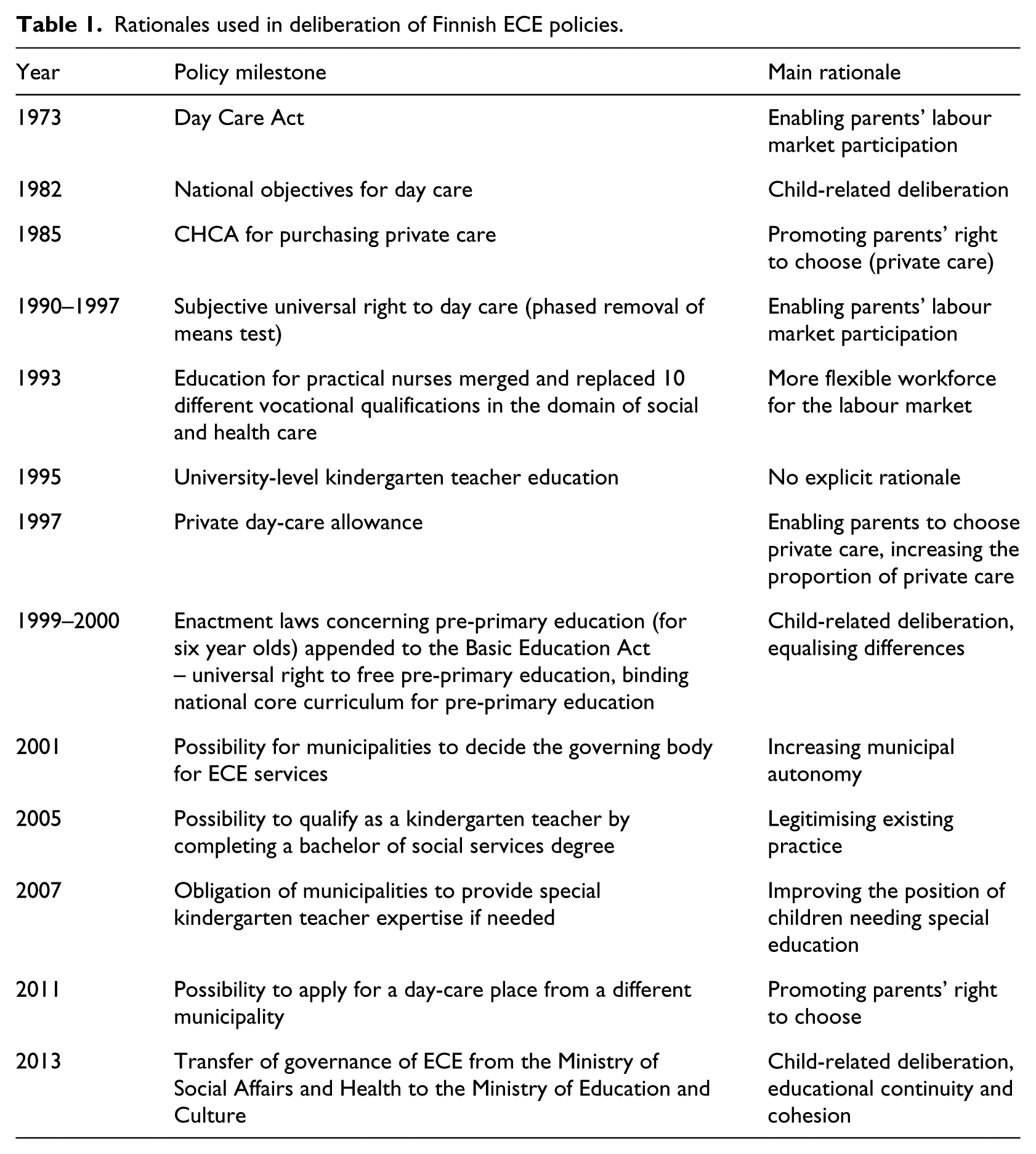
Table 1 shows that although country comparisons suggest that Finland has invested in good-quality public ECE (OECD, 2012), a considerable number of the rationales upon which Finnish ECE policies are deliberated concern labour market needs. These adult-centred rationales are economic in nature in policy deliberation. However, unlike the current transnational investment discourse, economic deliberation does not occur alongside child-related rationales in Finland. In addition, Ojala (1994) and Onnismaa and Kalliala (2010) have found that the first priority of ECE in Finland has been to ensure parents’ participation in the workforce and to address other labour market-related rationales.
Finland has invested in ECE, the ideals that have manifested in policy deliberation have been increasingly dominated by the idea of public services as public expenditure and consumption rather than public investment. In sum, although the Finnish ECE system may be to some extent in line with the transnational policy ideals highlighting a holistic approach, well-educated staff and affordable and reachable services, the Finnish imaginary – combination of policy deliberation and technical governing instruments concerning ECE – differs from it. Child-based deliberation has not merged easily with economic deliberation in Finland; hybridisations have not, to a large extent, materialised in knowledge apparatuses. That is partly because the absence of this kind of technical governing instrument or apparatus has been characteristic for the Nordic social-democratic welfare regime. There has been no mandatory performance requirements for teachers and no performance requirements for children.
Hybridisation: diffusion of imaginaries
There are plenty of promising ideas for the study of the dynamics between different imaginaries, since diffusion of policies and ideas has been discussed within several academic disciplines. In the area of studies concerning education policies in the globalised world, the dynamics between transnational and local policies have been explored through the concepts of ‘policy borrowing and lending’ (Steiner-Khamsi, 2004), ‘diffusion’ (Jakobi, 2012), ‘embeddedness’ (Ozga and Jones, 2006), ‘global/local nexus’ (Steiner-Khamsi, 2012), reception and translation (Steiner-Khamsi, 2014), domestication (Alasuutari and Qadir, 2013) and ‘hybridisations’ (Maroy, 2009; Vandenbroeck et al., 2013).
Here we have chosen to use the concept of ‘hybridisation’ since it allows us to examine and conceptualise the intertwinement both of transnational and national imaginaries and of different national imaginaries originating from, for example, different policy sectors and since it also underlines the unpredictability of the policy direction. Hybridisation processes can lead to very different, even contradictory, changes in national policies. The concept highlights that the responses to travelling policy paradigms are dynamic and sometimes seemingly unpredictable. It aligns with Cowen’s (2009) notion according to which travelling policies go through metamorphoses while located in another context. ‘As it moves, it morphs’ (Cowen, 2009: 315).
The use of the concept ‘hybridisation’ has been criticised as failing to take account of details of the diffusion process such as selectivity of policy borrowing (Steiner-Khamsi, 2012). Why has one particular policy and not some other become received in a particular context? Instead of abandoning the concept of hybridisation, we feel that there is a need for refinement of the concept.
The information concerning hybridisation and diffusion processes is scattered across different disciplines. Yet, there are plenty of fascinating studies we can build on. For example, typical research on hybridisation processes from the point of view of how certain policies have been received and adapted from global to local contexts has been trying to answer the question of how a particular policy is deliberated – which problem policy is said to be resolved or what the ‘selling points’ of the policy are that seem to appeal to local policy actors (Steiner-Khamsi, 2014: 155). It seems to be common to use externalisation (see Steiner-Khamsi, 2004), such as references to other countries, to transnational organisations, or to research to legitimise the reforms. This kind of use of information is described as being ‘evidence-based’ in the sense that reform measures are believed to be established by scientific methods (Steiner-Khamsi and Waldow, 2012; Steiner-Khamsi, 2014; Waldow, 2012).
World cultural theorists such as Meyer and Ramirez (2000) have argued that educational convergence has been made possible through the dissemination of ‘global scripts’ that standardise national education arrangements. Looking from a systems theory perspective, this kind of policy borrowing has been itself noticed to serve as a coalition builder between opposed advocacy groups: borrowed policy option may seem supposedly more neutral than original conflicting local ones (Steiner-Khamsi, 2014). Thus it may serve as a means for reform regardless of the content of the original policy.
These notions made in previous studies informed us when we examined the hybridisation process at hand. In the light of previous research, we believed that it would be beneficial to holistically examine the intersection of both discursive and material-technical features of the hybridisation process. However, we needed more tools to fully understand, conceptualise and theorise the enabling elements of hybridisation.
In addition to macro-level policy research, there is also a line of research in the sociocultural tradition that employs the concept of hybridisation in micro-level discourse practices (e.g., Gutiérrez et al., 1999). On the one hand, this tradition shares our emphasis on cultural mediation – including both its linguistic and material aspects – as a focal point of the formation of social reality. On the other hand, it is significantly different in ways that provide a rich basis for synthesis. In this article, we are creating a prism for examining dynamics between imaginaries by combining these approaches.
The simultaneous existence of plural assumptions and imaginaries – in the Finnish case, a social-democratic imaginary based on the idea of the importance of universal services and equal opportunities and a liberal imaginary stressing the efficiency of the public sector – create contradiction and resistance between the imaginaries. They do not merge easily. Drawing on the work of Akkerman and Bakker (2011), this article conceptualises this resistance as a boundary (see also Heracleous, 2004; Lamont and Molnár, 2002; Paulsen and Hernes, 2003). According to Akkerman and Bakker (2011), a boundary can be defined as sociocultural differences between two or more stakeholder groups that can lead to irregularities in, for instance, practices and valuation processes. Hence, the concept of ‘boundary’ can describe activities and interaction that are situated between two different imaginaries. Boundaries have the potential to trigger a change of practice as well as institutional development. However, historical legacies and institutionally embedded policies and imaginaries are not easily dislodged.
The concepts of ‘boundary artefact’ and ‘boundary concept’ have been applied in educational research for examining how sociocultural differences can come to function as resources for development and learning (Akkerman and Bakker, 2011; Star and Griesemer, 1989). We apply their notions and utilise their concepts as tools for examining the hybridisation process, that is, the dynamics between imaginaries. A boundary artefact refers to an artefact that allows a boundary crossing by fulfilling a bridging function (Akkerman and Bakker, 2011; Star, 1989). It is an object that enables collaboration even in situations where there is no consensus. According to Star and Griesemer (1989), boundary artefacts have different meanings in different social worlds, in what we call the domains of different imaginaries; but at the same time, they have a structure or elements that are common enough to make them usable in different contexts. Meanwhile, a boundary concept signifies a buzzword whose fuzziness allows it to function as an interdisciplinary organiser or a heuristic device and to facilitate communication between different social groups (Löwy, 1992). A boundary concept develops in interaction between different stakeholder groups in hybrid social arenas. Nevertheless, in spite of their development in these hybrid arenas, boundary concepts continue to have divergent meanings and uses. This is why boundary concepts constitute both a means of communication across boundaries and a source of tension, inducing constant debate and reflection on their value and relevance (Miettinen, 2002).
However, the dynamics of the hybridisation process are undertheorised in the context of policy making, which is inherently contradictory and contested. This study seeks to examine whether our conceptualisations would provide tools for addressing this gap in education policy research. We examine the hybridisation process, using an accountability policy case derived from the domain of Finnish ECE.
Selection and characteristics of the case
Since the Finnish education system is heavily decentralised, we focused our search for an example of accountability policy on municipal-level ECE policies. We located a local case where productivity of ECE was continuously measured in order to govern the public ECE. Although this kind of way of governing has not been typical in Finnish ECE policies, the use of these kinds of arrangements is increasing in Finnish municipalities. At the time of writing this article, at least two seminars attended by dozens of municipalities have been held introducing these kinds of measurement systems and arrangements.
The case of the development and the implementation of the matrix of productivity was selected on the basis of mixed purposeful sampling (Patton, 1990) because it was well documented, since it was part of a doctoral study conducted at the Tampere University of Technology. From the case documents we identified key concepts representing both kinds of discourses, national traditions and transnational trends in the preliminary examination of the case documents: ‘quality’ representing child-centred rationale that is widely used in international ECE discourse (Moss and Dahlberg, 2008) but nearly non-existent in Finnish ECE policy discourse (Alila, 2013), ‘national economy’ and ‘efficiency’ representing economic rationales present in both international and national ECE policy discourse and ‘well-being’ highlighted in Nordic ECE tradition. Since we knew that national responses to policy paradigms which are not characteristic of the national tradition are dynamic and unpredictable, we believed that the case was worth examining.
In 2007, representatives of the city of Helsinki’s central administration asked researchers from the Tampere University of Technology to provide external expertise for further development of their productivity measurement methods. As a result of this collaboration, which extended until 2010, a productivity matrix was developed. The Department of Social Services was selected as the target of the project, since it was the largest department of the municipality, with 15,000 employees and an annual expenditure of approximately 2.1 billion euros. Day-care services, 1 which are the focus of our study, were chosen for the pilot phase of the development work.
In addition to researchers from the Tampere University of Technology, five representatives and employees of the municipality – a kindergarten manager, a district manager of child-care services, an early education consultant and two accounting experts – took part in planning the measurement system for child-care services. The development work started with a discussion of the concept of ‘productivity’ and the identification of the purpose and aim of its measurement from both a top-level management and operative level perspective (Jääskeläinen, 2010b). After that, planning was conducted in a total of 10 workshop events, which were prepared and led by the researchers. The actual design of the measurement device was also created by the researchers. The final matrix measured the price of computational day-care day, child–staff ratio, utilisation rate, proportion of children in need of Finnish as a second language teaching, proportion of staff sick leaves and parental satisfaction. The implementation phase included training sessions for managers, analysts and accounting experts working in the organisation, where additional comments on the measurement system were gathered.
The development project had a steering group that, in addition to the researchers, included three representatives of the central administration of the city of Helsinki (chief planning officer, controller and budget director) and one representative each from the Personnel Department and the Department of Social Services. The aim of the steering group was to evaluate the ongoing development work. The group gathered around 15 times during the process.
Interviews with all the members of the development team whom we were able to contact – a researcher, the kindergarten manager, the district manager and one of the accounting experts – constitute the core data of the second part of this study. The opinions of two members of the development team – the other accounting expert and the early education consultant – are not included in our data, since we were unable to contact them. However, the interviewees provided information about the roles of those two members in the development process. Three of the interviews were audiotaped and transcribed, while one was documented based on notes written during and immediately after the interview. The duration of these thematic interviews varied from 55 to 90 minutes. The interviews took place at the workplaces of the interviewees. The discussions concerned the aim and development process of the matrix, enabling factors for implementing the matrix, definitions of key concepts such as productivity and quality and how they were manifested in the matrix and the development work. The interviewees were advised to browse material such as emails, handouts or memos concerning the development work beforehand and keep them at hand to remind them what they felt was important to share. These materials were used in joint reflections during the interview (Wagner, 2006). All the interviewees received information on the research topic. The interviewees also had access to and the opportunity to comment on the interpretations and results of this study.
We also used documents related to the developed measurement device as additional data: a research report on the project by the researchers involved in the development work, as well as the measurement device, that is, the productivity matrix and the documents we received from the interviewees and from the Internet searches related to the case. In the next section, we will explore more deeply the logic of our analysis.
Tracking the dynamics between imaginaries
To track the dynamics between imaginaries, we explored the data in three phases: In the first phase, we asked (1) what kind of imaginaries could be identified from the development process of the development of the matrix for productivity. For answering that question, we identified boundaries within the process. In the second phase, in order to examine the possible policy change we asked (2) what were the enabling elements for the boundary crossing. Finally we asked (3) what kind of embedded imaginary emerged as a result of the process.
At the beginning of the first phase of the analysis, we transcribed the interviews and closely read the documents related to the case. In the domain of policy making, manifestations of hybridisations need to be examined in terms of the variation in the presented imaginaries and the deliberation of policy options, rather than merely exploring differing linguistic codes. Thus, imaginaries and the boundaries affecting the dynamics between them were tracked using tools collected from the continuously developing interdisciplinary tradition of critical discourse analysis, which comprises many different approaches and methodologies (for a recent overview, see Fairclough et al., 2011).
Fairclough’s approach has been used in scrutinising ‘economic imaginaries’ to examine the ‘knowledge economy’ and its relation to education policy (Jessop et al., 2008). In this article, we adopted Fairclough’s (2013) conception of practical arguments as our analytical tool. Practical arguments are seen as chains of means, goals and circumstances. These chains, which can also be described as strategies of action, include statements about actions described as necessary, which are used for justifying and deliberating policy options. Both the documents and interviews were examined in this manner. In addition, we analysed how the collective pronominal ‘we’ (researchers, members of the working group, employees, etc.) was constructed in relation to ‘others’ in the interviews (Fairclough, 2003; Gee, 2013). By analysing the data in this manner, we were able to identify tensions within the hybridisation process.
In the second phase of the analysis, we examined the factors that the interviewees perceived as enabling elements for hybridisation, that is, why the development work succeeded in implementation of accountability policy. The enabling elements we identified were reflected in relation to tensions that we identified. Adopting the concepts of ‘boundary concept’ and ‘boundary artefact’ facilitated a more nuanced examination of the dynamics between existing imaginaries related to the societal role of ECE.
For answering the third question, we focused on analysing the matrix itself. On what kind of features of ECE was it focused on? What kind of imaginary of ECE did it produce?
Between two imaginaries of ECE
By utilising Fairclough’s model of practical argument (2013) and examining expressions referring to tensions between different groups we could identify boundaries between different traditions and means of governing services and between different rationales given to ECE services. The boundary between different traditions and means of governing the service became visible when examining the interviews while the boundary between different rationales could be noticed by juxtaposing the documents and the interviews. We will first examine the boundary between the means of governing and then juxtapose rationales described in the documents and rationales expressed in the interviews.
The interviewees described this development project as the third wave of efficiency measurement and the first successful attempt. The reason given by the interviewees for the earlier failures was the resistance of municipal employees, the day-care centre staff, who failed to take the previous measurement attempts seriously, so that the efficiency measurement was never fully put into practice. The tension concerned the traditions of governance. It was stressed that, in the domain of ECE, there is a tendency to reject the idea of measuring productivity. It represented the aim to increase the accountability of child-care services, which has not been a characteristic feature of Finnish social democratic tradition of governing the child care and education which has been based on trust on teachers’ expertise and professionalism but rather was in line with transnational trends.
This kind of tension is visible throughout the transcribed interviews. Interviewees who had worked in the steering group also reported resistance there. The next excerpt demonstrates how the interviewee experienced the tension between the steering group and the development team: In this process, we had a steering group as well, a steering group from the municipality, in which the outcome of our work was regularly discussed. For both, there was the need to kind of justify these matters and why the choice was made to deal with it in this manner. Obviously, if you are used to a traditional model [of measuring productivity], which this matrix is not, of course this kind of approach has to be deliberated.
The interviewee explicitly described the tension between different levels of the organisation: ‘For both, there was the need to kind of justify these matters and why the choice was made to deal with it in this manner.’
At the same time the steering group was more familiar with traditional efficiency measurements. They were not familiar with the conceptualisation of productivity of public services that is presented in Figure 1. A researcher from the Tampere University of Technology who took part in designing the productivity matrix was an expert in productivity measurements that would resonate with transnational education policy discourse (see Figure 1) but coming from the field of management studies he was not familiar with these transnational education policy trends. Thus, those were not referred to during the process. This kind of boundary between different imaginaries, which is both created and described during the interview, contains a tension that was, however, crossed during the development process.
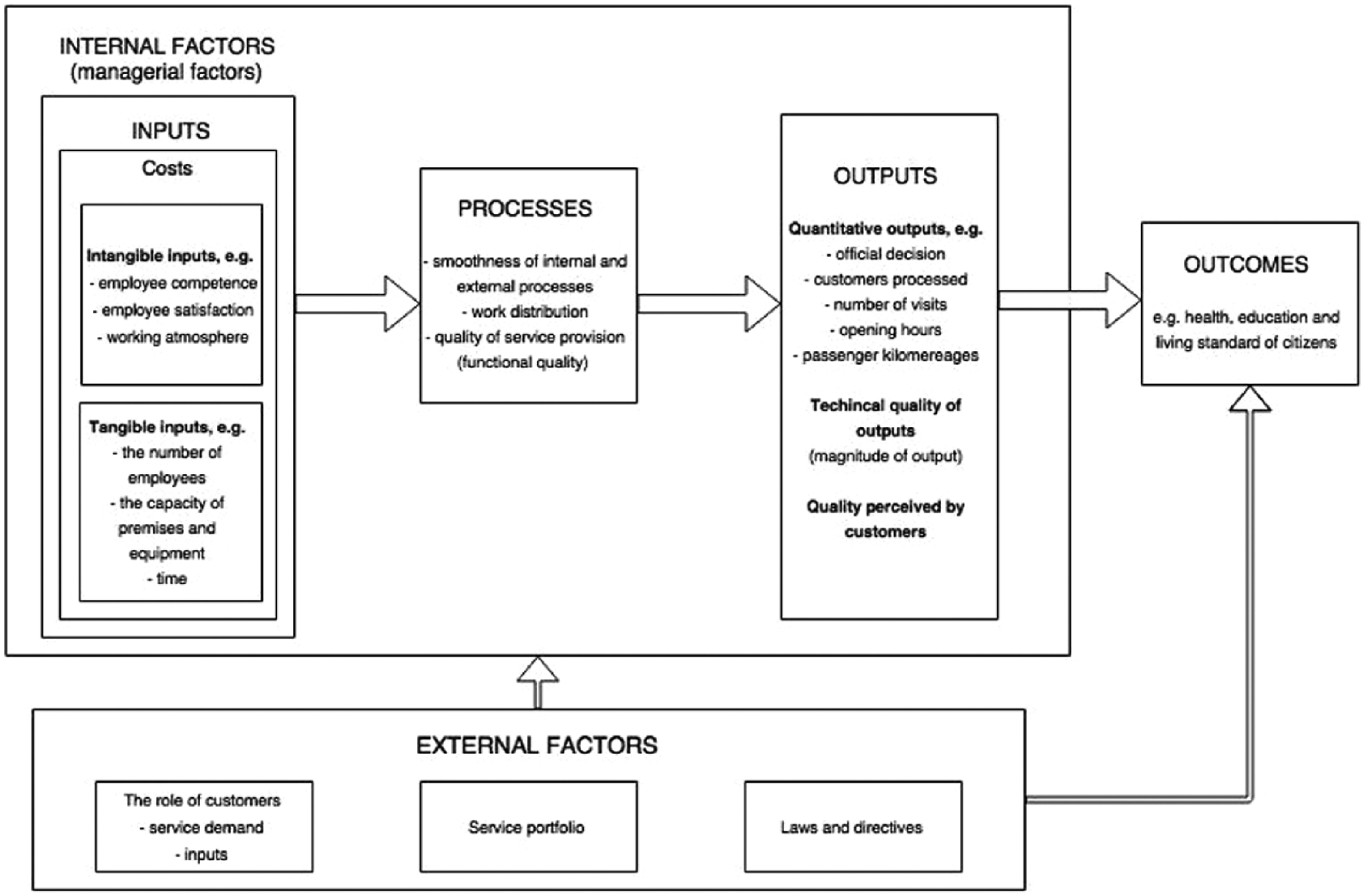
Jääskeläinen’s (2010a) model of public service productivity.
Another boundary could be identified by juxtaposing the practical arguments presented in the case documents and the practical arguments located from the transcribed interviews. The theoretical construction of productivity (Figure 1) in which the matrix is said to be based on is derived from the service management literature (e.g., Grönroos, 2001; Parasuraman, 2002; Rosen, 1993). In this theoretical construction, the productivity consists of the relation between the efficiency of the service and the outputs (both their quantity and their quality) of the service.
The quality of the outcomes was defined to entail and aim for long-term effects in health, education and standard of living. The use of the concept of quality in the model of productivity represents instrumental, utilitarian ideals concerning the role of ECE and is in line with transnational developments (Moss and Dahlberg, 2008). This deliberation in the case documents is thus connected to the transnational human capital paradigm. Although this kind of deliberation has not been common in Finnish ECE policies as we saw from the analysis of Finnish policy deliberation, the long-term rationales resonate well with rationales connected to the Nordic social-democratic welfare regime.
While the idea of increasing accountability was alien to ECE professionals, the investment in human capital discourse was not evident to all the members of the development team or the steering group. The development team concluded that measuring the quality of ECE and thus productivity (long-term outcomes) is difficult; it seems to resist reification through measurement indicators. However, some of them used, in this context, the deliberation that is attached to transnational discourse by referring to quality as a precondition to long-term outcomes and reproduced an imaginary that situates itself in the human capital narrative which has been characteristic of transnational policy paradigm. Productivity is defined both in documents concerning the matrix and by the interviewees as consisting of the efficiency and quality of the service. The documents refer to the service management literature, which highlights the importance of quality assurance in measuring productivity. The theoretical model represents economic and child-related rationales and resonates with the utilitarian imaginary of inclusive liberalism, which has been hegemonic in transnational discourses since the latter half of the 1990s (Jackson, 2008; Mahon, 2010; Paananen et al., 2015).
All the interviewees felt that it was important to have tools for managing costs, that is, they expressed the idea of public services in terms of consumption which have been hegemonic view in Finnish policy deliberation. However, they also stressed that it would be important to examine the quality of the process and the long-term outcome. The interviewees explained that the reason for the resistance that the earlier measurements faced was the design of measurement system – only costs and the number of computational day-care days were included. The interviewees stated that municipal employees had criticised and rejected the earlier ways of measuring efficiency for their narrow view of ‘productivity’ or ‘efficiency’, which lacked the capacity to capture the multiple structural factors that affect the price of a day-care day, the variation in services offered and long-term outcomes.
Both imaginaries – the imaginary representing public services in terms of consumption and the imaginary stressing child-centred, long-term societal effects – were thus present in the interviews. However, although the interviewees stated that the concept of productivity embraced the effectiveness of the services, they clearly wanted to emphasise that the aim of the productivity matrix was not to measure effectiveness but to deliver information about the structure of the cost of ECE services. Thus, although they recognised the importance of ensuring the good-quality services, reducing and managing the costs was the main rationale for them. In fact, they did not think that the matrix measured or increased the effectiveness like the case documents stated. The next excerpt, in which the kindergarten manager reflects the measurement system, highlights these rationales: In my opinion, it is important to note that this is not at all a ready measurement system. Real ways of measuring quality and the mediational factors affecting it should be found. It is, however, extremely difficult, and we are so focused on economic issues, which is okay. In my opinion, this is a good start, and it was worth a go, but it didn’t quite measure the right things. You will probably ask what those right things are. I don’t know. This process looked at why we are working here, what we are doing. We should still keep the things we are doing well. In a car factory or somewhere like that, you could examine the number of cars returned. We can’t do that. It is damn hard to measure it. So it is really about images.
Tripartite process as a necessary condition for hybridisation
Boundary concepts enabling hybridisation
The interviewees considered the use of the concept of quality as an enabling element for crossing the boundary between the steering group and the kindergarten staff. The interviewees explained that one reason for the earlier resistance was the design of earlier measurements – only costs and the number of computational day-care days were included. The interviewees stated that employees criticised and rejected the earlier way of measuring efficiency due to its narrow view of the concepts of ‘productivity’ or ‘efficiency’. They claimed that it lacked the capacity to capture the multiple structural factors that affect the price of the day-care day, the variation in services offered and long-term outcomes. Thus, using the concept of quality was offered as an explanation for the successful implementation of the productivity measurement.
If you think about the implementation of this kind of idea – the idea of productivity – it is really hard to bring to the field, since the associations related to it tend to be negative. It is associated with decreasing the number of personnel and those kinds of things. It certainly helped in bringing the idea to the field that the issue of quality was, to some extent, taken into account.
The concept of productivity that embraced ideas of efficiency and quality was thus used as a boundary concept enabling the formation of a hybrid.
The role of the matrix in the hybridisation process
Our analysis suggests that the interviewees considered the matrix itself as an enabling element for crossing the tension. The interviewees stated that one of the main reasons for adopting the matrix in kindergartens, that is, why this development process succeeded while the two earlier ones failed, was that it offered kindergarten managers a tool for monitoring the composition and development of expenses and made the short-term cost effects of the manager’s decisions visible. The interviewees described how managers became more aware of the role of everyday decisions in the ratio between a day-care day and its costs. Thus, the matrix also served as a tool for management as stated by the kindergarten manager in the following excerpt: If kindergarten managers have found this useful for their work, the reason may be that this [matrix for productivity] puts together different instruments for evaluation so that it becomes an ensemble that you are able, to some extent, to follow. The matrix triggered discussion on leadership and management. Governance and different kinds of practices [tools for management] became more visible.
Thus, one of the enabling elements was that the matrix offered the inscription (Ferraris, 2013) or the incentive to act. In institutions, nothing social exists outside the text; therefore, papers, archives and documents constitute the fundamental elements of institutional reality. Institutional reality is not based on communication but on registration, which has performative power (Ferraris, 2013). This notion aligns to some extent with observations Meyer and Ramirez (2000) have made concerning the dissemination of ‘global scripts’. A characterising feature of these scripts is that they always have performative powers of some kind. The notion kindergarten manager makes about evaluation becoming manageable assemblage, aligns with Jessop’s (2010) idea of models that reduce complexities and thus fabricate our reality.
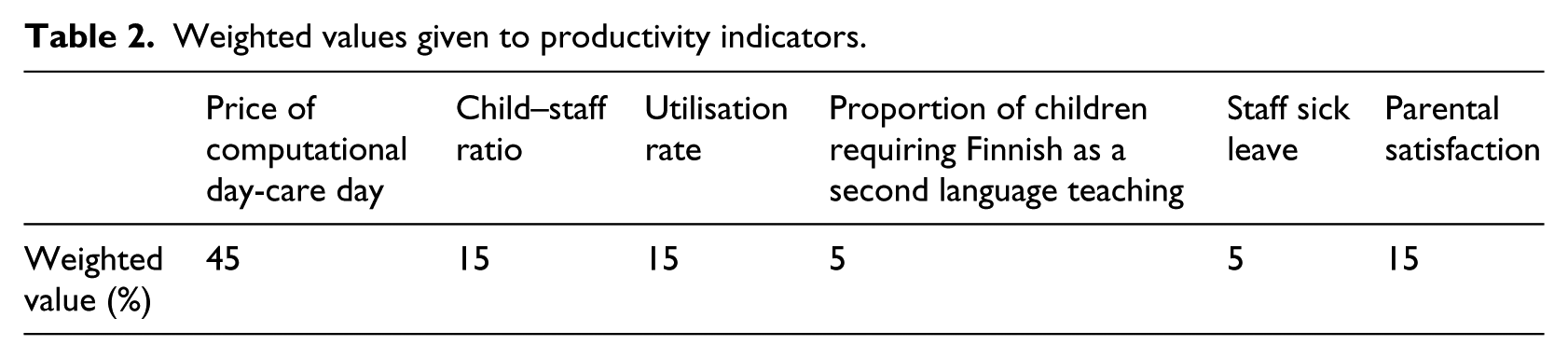
In our case, defining the weighted values for the different indicators played a particularly important role in overcoming the tension between the development team and the steering group. The role of defining the weighted values is demonstrated in the following excerpt in which the interviewee explains how the weighted values were formed: This was a compromise after many discussions, since we knew that there were proponents of the traditional way of measuring productivity who did not think that quality was a necessary part of it. There was also a wish to highlight the traditional [conceptualisation of] productivity, so we made a rather conservative start and suggested that this traditional productivity or cost-efficiency factor, the price of a computational day-care day, be given 45% [weighted value], which is quite a large proportion. So we made this conservative suggestion so that it would actually be accepted – many quarters could accept this. I think that a computational day-care day should receive a high weighted value when we are dealing with productivity.
The interviewee described some members of the steering group as conservative proponents of the traditional definition of efficiency and stated that they were kept satisfied by giving a high weighted value to the price of a computational day-care day of attendance. The combined weighted value of efficiency indicators in the matrix is 75%. In contrast, ‘soft indicators’, as some of the interviewees called the indicators of parental satisfaction and the proportion of children requiring Finnish as a second language teaching, have a combined weighted value of only 25% (Table 2).
Weighted values given to productivity indicators.
Thus, reifying the conservative idea of efficiency in the matrix by defining the weighted values enabled a boundary crossing between the steering group and the development team. This notion resonates well with the suggestion of Gutiérrez et al. (1999) that one of the enabling elements for the creation of hybridity is the use of diverse and even contradictory mediating tools. According to Star (1989: 46), ‘Mediating tools are plastic enough to adapt to local needs and constraints of the several parties employing them, yet robust enough to maintain a common identity across sites.’ In our study, the plasticity of the matrix – the possibility of redefinitions via weighted values – enabled the boundary crossing. Furthermore, the use of multiple, diverse and even conflicting mediational tools (in this case, the matrix) promote the genesis of a hybrid (Gutiérrez et al., 1999). Nevertheless, the use of the matrix, which offered the inscription for action (Ferraris, 2013), was not a sufficient condition for the formation of the hybrid. We will explain this further in the next section.
To sum up, in terms of the enabling elements of hybridisation, the use of a boundary concept and its reification as a boundary artefact that had performative power were necessary conditions for releasing the tension between the imaginaries. To have boundary-crossing ability, an artefact needs to function as an inscription or incentive for action. The creation of a bridge between imaginaries required a tripartite process, which means that a conflict between imaginaries is resolved by invoking a neutral concept – in this case, the concept of productivity, which is turned into a mediating sign by reifying its meaning. The concept of productivity became a matrix to signify functional efficiency. The necessary condition for the formation of hybridisation was that the mediating sign performed as an inscription for action (Ferraris, 2013) via the performative power of the matrix. We summarise these findings in Figure 2.
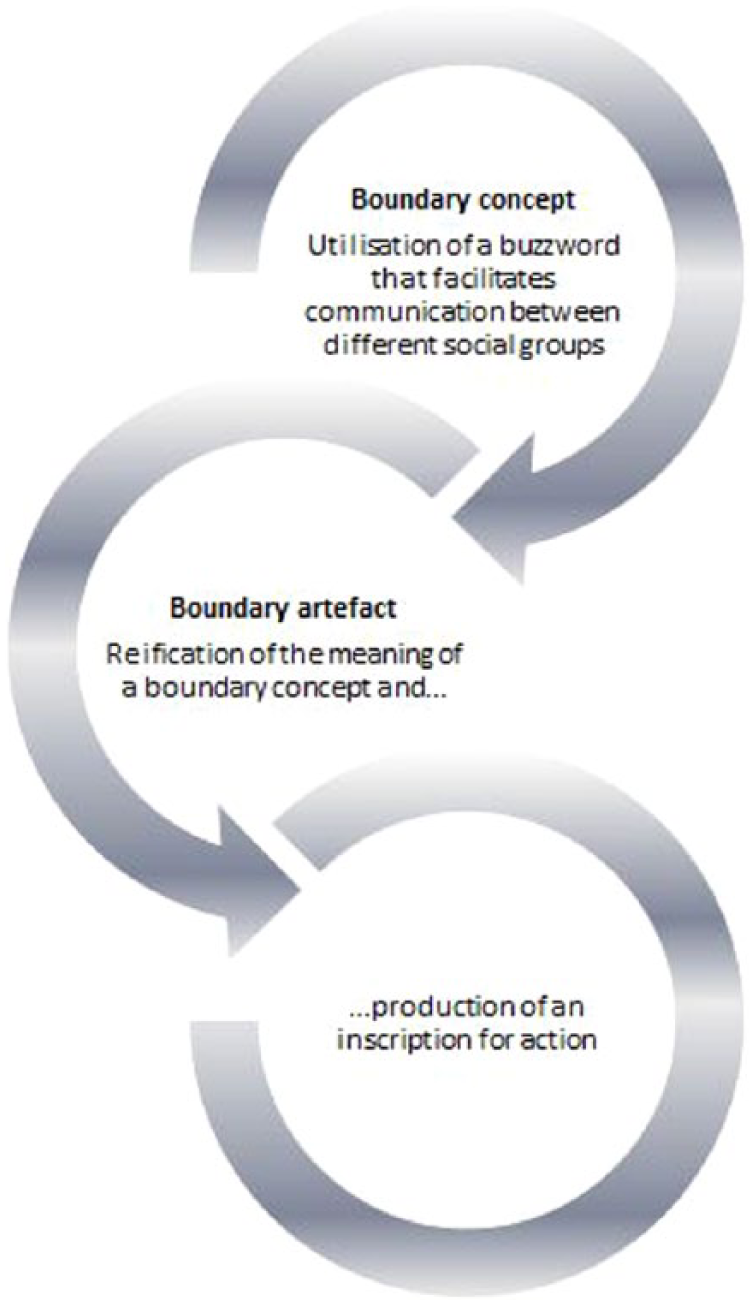
Hybridisation process.
The neoliberal accountability means oust the social-democratic imaginary
When the content of the matrix and how it operated was examined, it became evident that the role of the imaginary that considers ECE as public expense rather than public investment was dominant. This kind of interpretation can be made by examining the weighted values given to the indicators in the matrix (Table 2). The deliberation and argumentative schemes of the interviewees support this interpretation.
In the final matrix, efficiency comprised the price of one computational day-care day (excluding rent), the child–staff ratio, the utilisation rate, staff sick leave and the proportion of children requiring Finnish as a second language teaching. A computational day-care day aims to take into account the different customers with different qualitative needs. Differences in the ratio, regulated by the Day Care Act (1973), are based on the age of the children and the need for special care services. These differences as well as inflation adjustments were considered when defining the price of one computational day-care day. The process quality was operationalised as parental satisfaction. Each indicator was supplied with a weighted value, which defines what percentage of the final outcome is dependent on that indicator. The weighted values given to each indicator are presented in Table 2.
The weighted values of the indicators of productivity of ECE were defined by the development team during the process, and efficiency indicators were given a combined weighted value of 75%. The weighted value of the price of a computational day-care day excluding rent was 45%, and the child–staff and utilisation rate each had a weighting of 15%. ‘Soft indicators’, as some of the interviewees called the rest of the indicators, or ‘quality indicators’ as official deliberation in the documents puts it, obtained a weighted value of 25% (Table 2). One of these soft indicators was the proportion of children requiring Finnish as a second language teaching, which obtained a 5% weighted value and was considered a process indicator. It describes the special nature of the service offered and does not aim to capture mediational effects in long-term effectiveness in the same way as staff sick leave and parental satisfaction. The same notion applies to the construction of the price of a computational day-care day. Although it aims to take into account the qualitative differences in the needs of children, it does not aim to capture mediational effects in effectiveness, as the deliberation that resonated with transnational investment discourses used may have suggested. Weighted values and the interviews reveal that the matrix do not contain the transnational idea of investment in human capital.
The use of the concept of quality in official deliberation in the model of productivity represents, however, instrumental, utilitarian ideals concerning the role of ECE and is in line with transnational developments. It was defined to entail and aim for long-term effects in health, education and the standard of living. This official deliberation is thus connected to the transnational human capital paradigm. In the matrix, process quality was operationalised as parental satisfaction. Although taking parents perceptions into account could be viewed to resonate with Nordic social-democratic ideals about participatory views of quality (see also Paananen et al., 2015), the survey quantitatively measuring parental satisfaction represents libertarian transnational ideals highlighting the role of the parents as customers rather than active participants in defining quality. The interviewees were very sceptical about the validity of operationalising the quality of the services. It was stated that the response rate of the survey targeted at parents was low, while parental satisfaction seemed to be very high in general no matter what was the situation in kindergarten. Although it obtained the highest weight value (15%) of quality indicators, its significance in the matrix was quite modest.
Additionally, an examination of the argumentative schemes used by the interviewees shows that they represented the libertarian imaginary, which emphasises the rationale of reducing the costs of public services. The transnational imaginaries concerning investing in the knowledge economy were not present in the deliberation on the solutions made in the process of developing the matrix. The only aberrations pointed out by the interviewees were (1) the starting point of the process, or why it was important to develop this new way of measuring productivity and (2) the reason that was given to explain the successful implementation of the matrix.
Thus, the boundary concept of ‘productivity’ is used as a redefinition of existing terms that is deployed to serve the interest of the definer (Skinner, 2002) by cutting across boundaries. This highlights the contestable role of concepts: they do not necessarily have a standard core; rather, they are inherently related to other concepts (Palonen, 1999). In this case the meaning of productivity is dependent of the meanings of the concepts of ‘quality’, ‘effectivity’ and ‘efficacy’. These dynamic relations create different normative connotations. This resonates with Palonen’s (1999) notion that linguistic actions modify concept’s normative component by defining the relationship of a concept to its ‘neighbours’.
After the implementation of the matrix, the municipal council asked municipal officials to report on the effects of adopting the matrix in terms of quality. They reported that in addition to following the Day Care Act (1973), which regulates the child–staff ratio, and the Act on Qualification Requirements for Social Welfare Professionals (2005), the variables provided by the productivity matrix gave ‘an accurate and functional description of the quality of day care’. However, both the views of the development team and the results of our examination of the matrix show the opposite. The concept of quality cemented in the matrix represented neither the social-democratic ideal of the concept of quality ECE nor the transnational liberal ideal of quality ECE. The meaning of the concepts of quality and productivity changed during the process; their fuzzy use transformed the imagined function of the matrix from measuring the productivity of services into measuring functional efficiency.
The interviewees wanted to emphasise that the aim of the productivity matrix was not to measure effectiveness but to deliver information about the structure of the cost of ECE services. Thus, the measurement system developed during the process was an instrument for measuring functional efficiency rather than productivity. Although the argument of investment in human capital which is familiar for us from transnational ECE policy discourse was present in official deliberation related to the matrix, when examining the content of measuring system it mainly represented national tradition of examining ECE services as service for enabling parents workforce participation. The mean of measuring represented, however, the transnational development.
In the matrix, the national trend of viewing the ECE services’ main goal from the viewpoint of producing services for parents to ensure their labour market participation was merged with the international trend of governing via the idea of accountability. The end-result represented neither Nordic social-democratic welfare regime’s rationales nor international trends but rather seemed to oppose both of them. Through the implementation of the matrix, the staff became accountable only for reducing the costs of ECE.
Discussion and conclusion
The aim of this article was to examine a hybridisation process through the lens of imaginary using a productivity policy case derived from Finnish ECE policies as an example. Our analysis illuminates that the concept of imaginary that directs us to examine both policy discourses and materialised governance practices has potential to provide more nuanced tools for understanding hybridisation processes.
In our case, international education policies, including the ideas concerning accountability, were not directly referenced. Intersection of transnational trends and national traditions was visible but not highlighted nor even recognised by most participants. In that sense we feel that when examining travelling policies or policy convergence, it is justified and necessary not only to examine those policies that are intentionally borrowed from other contexts, but also those that more or less drift in new places.
Although our case of accountability policy was not an example of intentional borrowing, we could, however, notice similar features in the process under examination that researchers within the conceptual scheme of policy borrowing have detected earlier. For example, in this case of hybridisation, externalisation (see Steiner-Khamsi, 2012) took place as in policy borrowing processes and it was conducted via inviting management studies researchers to help develop a productivity measurement system. This kind of use of experts to justify and speed up reforms has been typical in travelling policy cases (e.g. Waldow, 2012). However, just the use of an external expert was not a sufficient element for overcoming the boundaries between imaginaries.
Our case suggests that overcoming the tension and intertwinement of imaginaries required a tripartite process. In the first part of this process a conflict between imaginaries is resolved by invoking a neutral concept, the concept of productivity, which is turned into a mediating sign by investing it with meaning. In this case, the concept of productivity signified functional efficiency. Also Steiner-Khamsi (2014) has noticed that certain concepts such as ‘21st century skills’ and ‘best practices’ function as catalysts for change. She notes that it might be because there is no agreement about what they actually mean but rather they can be filled with local meanings. Nevertheless, they seem to be powerful because they generate fear of falling behind on a global market (Steiner-Khamsi, 2014). These notions align with our results. These concepts, which we have termed as boundary concepts, have the potential to build bridges among interest groups that otherwise would be opposing each other.
Another necessary condition for the formation of a hybrid was that the mediating sign performed as a prescription for action (Ferraris, 2013) via the performative power of the matrix. This aligns with Meyer’s and Ramirez’s (2000) earlier notion that educational reforms have been made possible through the dissemination of ‘global scripts’ that standardise national education arrangements. These scripts are powerful since they provide clear directives. However, our case illuminates how these scripts may become rotated through other social sub-systems. Also Steiner-Khamsi (2004) and Waldow (2012) have noted that diffusion and borrowing happens across social sub-systems in addition to across countries. We suggest that examining metamorphoses of policies through the lens of imaginary would provide a tentative framework for further examinations so that this kind of transfer between social sub-systems could become more clearly visible as well.
In this case, in addition to overcoming the tension, the imaginaries highlighting the long-term societal effects of ECE (both social-democratic and liberal ideals) were also dislodged by the other imaginary highlighting the short-term costs, although the discursive starting point for the matrix represents a hybridisation. The imaginaries in this case met but did not merge. Rather, productivity was used as a boundary object in bridging the imaginaries, and one, instead of merging with the other, dislodged it. In other words, the imaginary stressing the long-term benefits of a well-organised ECE system retreated from the imaginary stressing the efficiency of public services. The boundary concept and artefacts seem to fulfil the function of making two non-compatible imaginaries work together. For example, Silova (2005) has recognised similar phenomena in the context of Central Asia and illuminated how travelling policies have been ‘hijacked’ by local policy makers and used for their own purposes nationally. Steiner-Khamsi (2014) has made a similar observation. According to her, there could be at least three different types of processes in localised policy cases: a process in which original policy is replaced by a borrowed one, diffusion between two trends and reinforcement of the original one via deliberation originating from transnational discourse. Our results build on this understanding, illuminating that by drawing on the conceptualisation of imaginary a fourth type of process could be identified, or rather, the process of diffusion can be divided into two different kinds of processes, namely, process of hybridisation and process of ousterisation. Whereas in the process of reinforcement, local historical tradition and policy trajectory are validated by using transnational discourses, in the process of ousterisation local expectations and discourses are used for validating a new kind of policy solution that is not in line with those discourses. It is a process where one imaginary uses another imaginary’s discursive means without adapting its rationales in the level of materialised governing tools. Thus, we also argue that with the help of this case we illuminated that examining dynamics between different imaginaries through the lens that takes a discursive turn in policy studies seriously but stresses the importance of material aspects in formation of cultural processes helps us get a more nuanced view of policy diffusion.
The dominance of the imaginary stressing the short-term cost efficiency of public services in the productivity matrix is not a unique case in Finnish ECE. We do not suggest that the whole national ECE ideal and social-democratic policy trajectory was dislodged; instead, we aim to show with this specific case how this kind of development became possible. The same kind of trajectories that aim to increase the productivity of day-care and ECE services can also be detected in other municipalities. These attempts also focus on the efficiency or functional efficiency of services instead of productivity, as was also the case in our example.
In Finnish ECE policies, the dominant imaginary primarily considers ECE an expense for society that is necessary for providing parents with the opportunity to participate in working life. Thus, the child-related liberal idea of investment in ECE that dominates international documents concerning ECE (Dahlberg and Moss, 2005; Mahon, 2009; Penn, 2011) has been absent from institutionalised imaginaries in Finnish ECE. Our interpretation is twofold: first, because Finnish teachers in schools and kindergartens are highly educated and have had rather autonomous positions, there has been no need for or history of measuring the quality of ECE and creating reified standards for it. Also, Finnish ECE was governed by the Ministry of Social Affairs and Health until the beginning of 2013; thus, the national documents guiding the curriculum have been recommendations rather than legal requirements. Second, since the Nordic regimes have had a tradition of providing accessible public services, there has been no need for deliberations on investments in ECE. We suggest that the imaginary stressing efficiency replaced child-related rationales because the social-democratic child-centred imaginary was not manifested in officially binding documents. These developments might indicate why the imaginary stressing the investment on children is lacking in Finland. However, this creates a tension between the imaginary stressing the importance of the efficiency of public services and rationales highlighting the long-term societal role of ECE. Although they are not theoretically incompatible, they are not easily combined due to historical legacies.
However, although the imaginaries manifested and institutionalised in official documents do not meet the international imaginary of investment in ECE, in a more informal context, the idea of investment has begun to appear in discussions on ECE. In addition, the legislation concerning Finnish ECE is under renewal at the time of writing this article. Finnish ECE is at a transition point. We suggest that even though historical trajectories play an important part in defining future policy directions, materialised imaginaries producing inscriptions for action may have the power to transform these trajectories.
Footnotes
Acknowledgements
We would like to thank Jaakko Kauko and the two anonymous reviewers for their invaluable comments and feedback on this article.
Declaration of conflicting interest
The authors declare that there is no conflict of interest.
Funding
This research received no specific grant from any funding agency in the public, commercial, or not-for-profit sectors.