




Abstract
The purpose of this study is to describe, analyse and evaluate the successive comprehensive reforms in Spain as a paradigmatic example of the emergence, evolution and crisis of the comprehensive school. In the first part, we describe the development of the comprehensive school project (1970–2013), using the image of the life cycle, with its corresponding turning points. The second part consists of a diachronic and retrospective critical review of why a progressive educational reform like the one passed in 1990, which was intended to be comprehensive, has paradoxically led to high rates of academic failure and early school leaving. What factors managed to undermine the proposal, leading to the current return to less inclusive solutions? From the perspective of a certain change in cycle, a more objective view is possible.
Introduction
In Spain, a persistent problem in shaping the main core of the comprehensive school (ESO: Compulsory Lower Secondary Education) stems from its hybrid nature (Viñao, 2004). On the one hand, as compulsory education, its objectives are closer to the identity of basic or primary education. On the other, in its curricular design, school organisation, and teaching staff, it is closer in nature to upper secondary, and this is made more pronounced by the fact that it is taught in upper secondary institutes and by the same teachers. This mismatch has been a continuous source of problems in the comprehensive school project, both in curriculum development and in the teachers’ professional identity (Bolívar, 2006). The solutions proposed by the conservative governments (educational laws of 2002 and 2013) have tried to bring lower secondary education closer to upper secondary, reducing its comprehensive nature.
As we will see, a serious problem in developing a comprehensive curriculum has been teacher training (Morgenstern, 1991, 1993). In Spain, secondary teachers are trained according to a specific model. First, the person is a specialist in a scientific subject or discipline. Then, he/she receives pedagogical training, which has generally had a negative rating and a brief duration, creating a strictly academic identity that is not appropriate for comprehensiveness. Solutions proposed to balance the specialised academic training with later pedagogical training have not been successful or had the desired impact. Thus, the teachers are generally not prepared to personally attend to a diverse public in a way that would be consistent with a comprehensive school.
Secondary education, the key to the comprehensive school project, is facing serious problems in Europe (Azevedo, 2000; Franklin and McCulloch, 2007; Pring, 2013). It is involved in a restructuring process to deal with the new challenges, as can be observed in the reforms carried out in recent decades in the majority of the countries (Eurydice, 1997). For example, based on a comparative analysis, Pedró and Puig (1998: 205) state that: ‘in all the developed countries, there is probably no educational level with more institutional and curricular complexity than secondary education’.
In Spain, a set of problems appeared during its practical implementation, especially the difficult balance between comprehensiveness and an increasingly diverse population (cultural, social inequality and special educational needs). These problems led to a social questioning of the comprehensive nature of the ESO (lower secondary education), particularly by the conservative governments. First, they introduced the Organic Law of Educational Quality in 2002 (Ley Orgánica de Calidad de la Educación (LOCE)), which was never implemented, and then the 2013 Organic Law for the Improvement of Educational Quality (Ley Orgánica para la Mejora de la Calidad Educativa). The conservative governments argue that too much comprehensiveness reduces the quality of the system, at the expense of equity.
The basis or undercurrent of a school that wants to be comprehensive is to have produced high indices of ‘academic exclusion’, in many cases dependent on a parallel ‘social exclusion’, without having achieved a compensatory function. The fact that certain contexts and schools have about a 40% failure rate is unacceptable today. This school failure, in turn, increases early school leaving or dropout. The question is: Why has this academic failure rate occurred with the established curriculum? What have factors interfered with its intended inclusive and equitable nature? Furthermore, in recent decades the dominant neoliberal context has dealt strong blows to the comprehensive ideals of previous decades favoured by social-democrat policies.
In Spain, based on the General Organic Law of the Educational System (LOGSE), various diagnoses show that, due to the intersection of diverse factors and social changes, compulsory education, particularly from 12 to 16 years old, presents gaps and deficiencies (organisational and professional) and is going through a period of crisis (Alanis, 2003; Merino, 2004; Viñao, 2004). However, secondary schools, which have come to be called IES (secondary education institutes), have conserved their professional, curricular and organisational structure, and they are incapable of dealing with the challenges of a school population that is no longer exclusively from the bourgeoisie or new middle classes, but instead comes from the new masses of adolescents. The comprehensive objectives of the new educational phase (compulsory lower secondary education) have not managed to create a professional identity for the teachers, as in a shared ‘professional and organisational culture’, because the necessary elements have not been provided.
The comprehensive school project as reform cycle
The educational reforms can be interpreted using the image of the life cycles (Tyack and Cuban, 1995). As in the case of living things, they would have a birth, development and progressive decline, with possible relapses and turning points. As Cuban (1990: 7) says, ‘cycles, of course, do not have to go through preset evolutionary stages […]; cycles can be compared to upward or downward spirals or waves that vary in amplitude and frequency’(Rodríguez, 2000: 3). Therefore, in a recurring vision of change, the reforms are usually repeated from time to time. In a parallel way, there has been talk of waves, which, like a pendulum, rise and fall over time, repeating themselves intermittently.
The development of the comprehensive school in Spain can be best understood as a life cycle. With a beginning and progressive development since the end of the Franco dictatorship, in the search for a more democratic and egalitarian school, it reaches its culmination in 1990 (LOGSE) and later begins a progressive decline, with high and low points as different deficits or insufficiencies are detected. At the same time, its evolution and possible criticisms have been linked to political ideologies and political parties (maximum comprehensiveness in social-democrat policies, and a restricted comprehensiveness or move away from it by the conservatives). This situation has been accentuated because the educational laws have pertained to the political party in power and not to the state (that is, with the consensus of all the parties). Therefore, when the governing party changes, it changes the laws for which it did not vote. Thus, along with the cycle, there is the wave or pendulum, which means that up to seven education laws have been passed and then repealed.
Carabaña (2006) interprets these continuous legislative changes as having had ‘an expressive’ function: ‘to stage for the public the conflict between parties’. Once the governing political party changes, in parallel, it has to stage this change by passing a new law that repeals the earlier one. However, its true capacity to transform reality is limited or invalid. We return to the rhetorical function of reforms mentioned by Tyack and Cuban (1995): changes in institutional practices were often ineffective in satisfying the political rhetoric demanding educational reform. Policy talk and reform follow one after another, while the fundamental ‘grammar of schooling’ remains.
Beginning: first comprehensive school and changes
Common or comprehensive education has a long tradition in Spain. It begins with the concept of the ‘unified school’, adopted during the Second Republic and fostered by pedagogues like Luzuriaga (1922) and by the Institución Libre de Enseñanza (Free Education Institution). Franco’s dictatorship (from 1939 on) marks a parenthesis in comprehensiveness, until it is recovered in 1970. From that time, and for almost half a century, Spain has comprehensive education with a common curriculum: first from 6 to 14 years old (1970–1990) and later from 6 to 16 years old (1990–2014). The comprehensive school is first established in Spain in 1970 by the General Education Law (Ley General de Educación, LGE), with a double dimension: the system’s structure and the curricular structure. This is stated in its Statement of Purpose: ‘The period of Basic General Education, which is established as unified, obligatory and free for all Spaniards, proposes to end any discrimination and form the indispensable basis for equal educational opportunities’. The law even establishes a Multi-purpose Unified Upper Secondary School, consisting of three courses, without establishing differences in the first two. Similarly, according to Manuel de Puelles (2011: 716), ‘the LGE introduces the comprehensive school in Spain, and its basic structure remains until the present day’.
In this last stage of Francoism, with Spain’s gradual economic development and greater openness to the world and the OECD countries, the educational system was modernised, based on the predominant tendencies at that time: one unified and common school from 6 to 14 years old, which was called Basic General Education (EGB), divided into a first stage of five courses and a second stage (superior cycle) with three courses. Antonio Viñao observes (2004: 83): thus, it breaks with the so-called dual system […], relating the reform to renewal projects and reforms like the integrated school or the English comprehensive or the Swedish Grundskola. Moreover, it extends compulsory education to the age of sixteen by establishing that those students who did not go to secondary school after finishing basic general education had to study lower level occupational training.
Reports by international organisations (OCDE, UNESCO) established the main tendencies of the reform, along with the need to provide the qualified human resources required by the economic development. One year earlier, an official report (White Book of Education, Ministry of Education, 1969) formulated a strongly critical analysis of the educational situation as a basis for the planned reform. As a prototype of a short cycle reform, the same year it was published (1970), its implementation began (Bolívar and Rodríguez-Diéguez, 2002).
It has been well-recognised that, at the design level, the LGE (Puelles, 2009; Viñao, 2004) signified a great advance in Spanish education. However, the fact that it coincided with the capitalism crisis of 1973, the end of the dictatorship (1976), and the establishment of democracy (1978) meant that quite soon some of its best promises would go unfulfilled. Thus, already in 1976, some serious deficiencies and dysfunctional aspects were recognised (1976 Report of the Commission Evaluating the Law of 1970, in the Ministry of Robles Piquer), in spite of the progress made in school attendance. The double certificate at the end of Basic General Education (14 years old) had produced ‘two networks’ (Primary Education Graduate–Secondary school, Certificate of Attendance–Occupational Training), as well as the lack of social prestige of the latter, which was viewed as a less important route.
These problems led to considering a curricular and structural reform for the period from 12 to 16 years old, in a unified way, increasing comprehensiveness. Thus, the aforementioned 1976 report (Puelles, 2000: 35) declared with regard to the two networks: It is necessary, then, to reconsider the problem from its origins. The educational system must be unified until the end of Secondary Education or, in other words, until the student completes the adolescent stage.
The LGE had emerged in a developmental context and under an authoritarian political regime, and now it would have to be applied in the midst of an economic crisis and during a period of transition to democracy. With the democratic constitution passed (1978), it was necessary to have a law that included the participatory dimension, as well as the educational decentralisation of the Autonomous Regions (Pereyra, 2002). The insufficiencies detected, along with the new social and political framework, would produce the beginning of a long journey toward a ‘new’ Reform (1982–1990).
The peak: the comprehensive reform of 1990
The new Socialist Party government makes education one of the pillars of its programme of change for greater social equality (Maravall, 1984). In contrast to the top-down reforms, a period of ‘reform experiences’ was initiated, influenced by the Plowden Report (1967), which tried to promote educational change from the schools themselves, as bottom-up innovations (Carabaña, 1988). In 1987, Minister Maravall presented an initial proposal, which would be reformulated with the publication of the White Book for the Reform of the Educational System (1989), seeking an ‘equal schooling, with a common curriculum, recognizing the subjects’ differences’.
The reform culminated with the General Organic Law of the Educational System (LOGSE, its initials in Spanish) in 1990. This law represented the peak of the comprehensive proposals (Boyd-Barret, 1995). Three elements of this law make up the core of comprehensiveness (Marchesi, 1992): – Compulsory education is extended two more years, until the age of 16. A new phase is created (ESO: Obligatory Lower Secondary Education: 12–16 years). – Common curriculum during the entire phase. Until the age of 16, the students could not choose different itineraries (professional studies instead of academic, for example). – Inclusion: Common schooling for all students, with no discrimination, prohibiting their separation by groups in different classrooms based on performance, special educational needs, handicaps, or other reasons. Attention to individual differences through curricular adaptations.
The certificate of ‘Graduate’ in ESO, obtained once the general objectives have been met, gives access to Upper Secondary School and Mid-level Occupational Training, indiscriminately. The students who do not obtain this certificate can only study ‘Social Guarantee Programmes’, with specific routes for continuity (later called ‘Initial Professional Qualification Programmes’. Furthermore, to attend to an increasingly diverse public, the law proposes to combine comprehensiveness with diversity through curricular adaptations. As noted by one of the authors (Coll and Martín, 2014: 449): Opting for comprehensiveness and the inclusive school naturally means that a wide range of measures have to be introduced to meet the needs of diversity in order to best fulfill the learning needs of a heterogeneous body of students. This is therefore an ideological-charged argument associated with the social function of schooling (achieving greater equality in education).
When these measures for attention to diversity are not sufficient, due to their excessively individualistic and psychologistic approach (Bonal and Rambla, 1999), the comprehensive option will not fulfil this social function. In addition, the extension of obligatory and common education until the age of 16 (and not until 15, as in the majority of the OCDE countries) has been a continual source of problems. On the one hand, Upper Secondary School was reduced to only two years. On the other, in the last few years it has become necessary to combine the common subjects with different routes or itineraries that respond to the students’ interests and abilities.
Regarding curriculum design and development, the law proposes a model of open curricular development, but the way it is elaborated contradicts this openness. In a techno-bureaucratic conception of the curriculum, the experts prevail, through normative production, over the teachers in charge of implementing it. Textbooks, commonly employed, establish the real curriculum in the classrooms. It is not sufficient to declare that the curriculum is ‘open and flexible’, when the conditions, ‘school culture’ and organisational changes have not been created to make it open, not just in its design, but also in the schools. It is a decreed autonomy, rather than a constructed one, to use the terms of Barroso (2004). Progressive proclamations of school autonomy, paradoxically, correspond to an administrative colonisation of life in the schools. A new organisational framework was needed for schools, and this was to be provided by the Organic Law of Participation, Evaluation and Government of Schools (1995). It was supposed to respond to the organisational needs arising from the implementation of the LOGSE, resolve some dysfunctional aspects such as school management, reinforce schools’ autonomy, and increase their quality and efficacy, whether through autonomy or through mechanisms of competence and deregulation (often together).
Comprehensiveness vs quality: the conservative government (1996–2004)
After the Socialist government lost the elections, the new Partido Popular government (1996–2004), which had voted against the LOGSE, immediately defended making a clean break from the comprehensive proposals that inspired this law. This rupture has been called the ‘reform of the Reform’ or the counter-reform (Escudero, 2002). From a neoliberal perspective, the intention is to raise the levels of quality through quality plans or by increasing the schools’ freedom of choice. The comprehensive model is questioned in the organisation of Compulsory Lower Secondary Education, especially in the second cycle of ESO (14–16 years old). As discussed in Pérez-Gomez et al. (2004: 481): ‘the compulsory and comprehensive nature of the extension of schooling generates more resistance. […] Compulsory yes, but not comprehensive. Diversified itineraries are proposed, reflecting the demands of the teachers, who were dissatisfied with comprehensiveness (repeating grades, substituting the areas with subjects)’. These changes were established in the 2002 Organic Educational Quality Law (LOCE).
Thus, although the compulsory nature of lower secondary education is maintained, what is referred to as a ‘radical’ comprehensive model is questioned, as it is viewed as a ‘mere extension of primary education’. Therefore, ‘diversification’ in the second cycle of ESO is defended, while strengthening the so-called basic core subjects (Mathematics, Language and Humanities) in the first cycle, as the LOCE does later.
In the second cycle, in addition to reinforcement groups and professional initiation programmes for those who have difficulties in following the studies, two itineraries are established in the third year of ESO (scientific-humanistic and technological), with the former being divided into two in the final year. This distinction is similar to the former Bachillerato (upper secondary) in Letters (humanistic) and Sciences (scientific), as well as Occupational Training (technological). For this reason, at first glance, not all the itineraries have the same status. In this regard, as Manuel de Puelles (2004: 23) points out: The itineraries themselves may not be discriminatory, although the inertia of the educational system will tend to result in the segregation of various classes of education if precautionary measures are not taken. […] It is not itineraries in general that can alter the basic equality of general education, but these specific itineraries.
The academic nature of the subjects is also reinforced, with extra exams for those who do not pass. Moreover, if a student fails more than two subjects, he/she must repeat the course (although only once). Thus, on the whole the intention is to give an identity to the ESO that is closer to that of upper secondary, in congruence with its teachers and the schools where it is taught, as demanded in different forums (Feito, 2002). This can be a source of problems, as it is directed to the entire population, so that differentiation routes emerge (itineraries, reinforcement groups, professional initiation programmes), with the danger that, de facto, they will become segregators.
The LOCE implies a return to a curricular recentralisation, where the academic programmes are established by the administrations, with the teachers in charge of the didactic programme and instruction. Thus, the School Curriculum Project, an innovative element of the previous educational reform that would later become mainly bureaucratic, disappears. In addition, the curriculum moves closer to Upper Secondary, focusing on conceptual concepts, with attitudes and values disappearing, along with the so-called ‘cross-curricular topics’. All of this culminates in accenting evaluation as accreditation in various ways: repeating a course, a numerical rating system, differentiated grading by subjects, and making up failed courses. Likewise, the proposal is for the schools to have external evaluations at the end of each educational phase, which would contribute – like any external test – to further recentralising the school curriculum (Bolívar, 2004).
One frequently repeated criticism of the comprehensiveness of the ESO is that it lowered the students’ requirements and performance levels, as shown by the results of successive editions of PISA (Program for International Student Assessment). It is true that, compared to the other countries, the results are slightly below the mean of the OECD countries. However, they are highly equitable, with comprehensiveness being responsible for a reduction in the influence of social factors in learning, which is quite important. Further, there are few students at high achievement levels. The Organic Educational Quality Law (LOCE) focuses its attention on increasing the results (of the best students, of course), even though it discriminates against the less advantaged students or those with greater learning difficulties.
The return of comprehensiveness (2004–2012)
With the Socialist Party’s rise to power, as promised in its electoral programme, the implementation of the LOCE is paralysed, and there is a period of elaborating a new law. With a will to integrate and reach a broader consensus, a public debate takes place through a document titled ‘A quality education for everyone and with everyone’. ‘Quality for everyone’ tried to reflect its comprehensive and equitable intention, while ‘with everyone’ aimed at dialogue and consensus, in order to avoid new changes in educational laws, which was what the majority of the population wanted. However, even with the consensus of other parties and social organisations, they did not achieve the support of the main opposition party (Partido Popular), which maintained its opposition to the law. Thus, there was a foreshadowing of its repeal and a new law when the government changed.
In spite of this, the Organic Education Law (Ley Orgánica de Educación, LOE) is established in order to create a basic common framework that would guarantee the stability and organisation of the educational system (Puelles, 2009: 456–477). It repeals previous laws and regulates the structure and organisation of the educational system at the non-university level, and it provides a set of measures to resolve any new problems that may arise, especially attention to diversity in an increasingly multicultural population, etc. There is an insistence on the comprehensive nature (now called inclusive education), based on equal treatment and non-discrimination against anyone under any circumstances. The comprehensive project is now called ‘inclusive’ (Ainscow, 2005). Its goals are the objectives established in the programme ‘Education and Training 2010’ of the European Commission. In the curricular area, it introduces the key competences as the common base that obligatory education must guarantee for all students. In this sense, it can be argued that the comprehensive curriculum is defined by its key competences, as in the French ‘common base for knowledge and competences’. However, they are not integrated in the academic disciplines.
The LOE reinforces the comprehensiveness of basic education during ten years of schooling (from 6 to 16 years old), with the suppression of the itineraries of the LOCE and a new ESO (lower secondary) organisation: fewer subjects in the first two years, flexible organisation of the material taught, orientation to preventing difficulties, possibility of promotion with three failed subjects, organisational differences between the first three years and the fourth (16 years old), which has an advisory nature. The LOE introduces some new subjects in the curriculum: ‘Education for Citizenship and Human Rights’ and ‘Sciences for a Contemporary World’. It also establishes diagnostic evaluations of the students’ competences at the end of the second cycle of primary education and the second cycle of secondary education.
The participation of families is again fostered, and the organisational and curricular autonomy of the schools is fomented. Regarding the teachers, special attention is paid to teacher training (initial and ongoing), adapting it to the European Area of Higher Education, with a Master’s degree in teaching for secondary school teachers.
The curricular space assigned to Religion (voluntary for students, with no alternative, and obligatorily offered by the schools), as well as the contents of the new subject of Education for Citizenship and Human Rights, produced a broad political and ideological debate. Along with other factors, these aspects created a breeding ground for defending their change.
Once again, the breakdown of comprehensiveness (2012 to the present)
In spite of a popular outcry against the excessive number of education laws, a new one is passed. The purpose of the so-called LOMCE (Organic Law for Improving the Quality of Education) of 2013 is to end comprehensive education until the age of 16. The argument is that comprehensive education is the reason for Spanish students’ low PISA results, requiring a return to a common cycle from 6 to 14 years old. From the age of 15 on, some students can be guided toward Basic Occupational Training, while others continue in Obligatory Secondary Education, with two differentiated paths in the last year of lower secondary (academic, which leads to Upper Secondary; and applied, directed towards Occupational Training). Thus, two differentiated educational itineraries are established in the fourth year of ESO: one leading to Academic Studies and one to Applied Studies. Depending on the option chosen, an ESO final exam will lead, along with the grades obtained, to the certificate of Graduate in Secondary Education. Obligatory and common education is replaced by a system that, from 14 to 15 years old, leads students along different paths.
A curriculum based strictly on academic disciplines is proposed, putting the criterion of subject matter above that of knowledge areas. With a return to a new centralism in education, the government establishes the curriculum, with a slim margin for the Autonomies. This centralized curriculum is finalized with the ‘standards of evaluable learning’, which will be measured by external tests half way through Primary, at the end of Primary, and at the end of Secondary (to receive the Graduation certificate). Therefore, there is confidence in the pressure of external evaluation tests as the instrument for improvement, based on the stipulated standards. These tests, moreover, must serve to differentiate the good from the bad, to segregate some students from others, in contrast to what ‘comprehensive’ education intended. Thus, school failure becomes an exclusion factor. For students with greater difficulties, redistribution and ‘separate’ or differentiated treatment are proposed.
Policies can be adopted that involve injecting mechanisms with a market orientation, increasing the time and contents dedicated to basic skills, and applying the pressure of external tests, proposed by the LOMCE. The problem is that this external pressure has repeatedly failed in other countries and at other times (Hargreaves and Shirley, 2009; Sahlberg, 2011). Therefore, in order for them to be carried out successfully, new modes of regulation or governance must be employed. The LOMCE proposal implies a regression in the educational model, with a proposal that has nothing to do with the most reliable knowledge in education or the best international experiences. If we want to involve the teaching staff in the improvement, ‘brute’ pressure and ‘cut-backs’ have perverse effects. Professionals are responsible and do their jobs well when they are not being threatened by external pressures. As noted in Hargreaves and Fullan (2002: 20): ‘it’s not the metrics that drive most people, but the work itself – whether it inspires you, what it feels like, what it’s for’.
The problem with comprehensiveness: persistent failure and drop out
When the LOGSE comprehensive project (1990) designed the curriculum and structure of secondary education, the proposal was that 90% of the students would earn the title of Graduate in ESO. Instead, in general in Spain, one in three students does not finish ESO; that is, he/she does not obtain a graduation certificate. According to the LOGSE’s design, the doors to future paths are closed to those who do not earn this certificate. Without it, they are destined for precarious or poorly paid jobs, or to join the unemployment lines, unless they return to the system as adult education students. In fact, 13% manage to return to school as adults after leaving the formal school system because it becomes more flexible and fulfils their job needs (Fernández-Enguita et al., 2010).
On the positive side, the comprehensive school until the age of 16 has meant, on the one hand, that the adult population with upper secondary education certification has increased by 6 percentage points during the 2000–2012 period, although it is still far from the OECD mean. On the other hand, the percentage of upper secondary graduates between 2001 and 2012 has been noteworthy in Spain (OECD, 2014a). Without doubt, these are achievements of the comprehensive project of the 1990s. The problem, however, lies in the high rates of repetition, failure to graduate and early school leaving in lower secondary education (OECD, 2014b).
A set of contents and capacities were established as ambitious objectives for the entire population. Later, in practice, they contributed to setting a standard that only some could reach, becoming a reason to exclude the rest (no promotion, repetition or not graduating). Thus, the comprehensive objectives of the educational law of 1990 (LOGSE) have not managed to address and provide an educational response for the entire school population in a common framework (Felgueroso et al., 2014). When, as occurred in practice, more than 30% do not achieve the Graduation Certificate at the end of lower secondary education, they are destined to abandon their studies. This leads to high rates of early school leaving compared to the European rates (Merino and García, 2010). Thus, the comprehensive model for organizing lower secondary education has been questioned, especially in the last courses (14–16 years old), leading to the proposal of different routes or itineraries in the final courses, which is similar to tracking.
The challenge in Spain, in order to reach a convergence with the European objectives (Education and Training 2020), is to achieve the ‘academic success of all the students’, at least assuring the attainment of the key or basic competences at the end of lower secondary education; another challenge is to increase the percentages of students who reach Upper Secondary, reducing early school leaving. The economic crisis and the lack of employment have lowered the school dropout rates somewhat, from 26.5% (2011) to 23.6% (2013). However, Spain has the highest rate in the European Union. One in three young Spaniards between 15 and 24 years old left school before finishing their secondary education, compared to the European mean of one in five (OECD, 2014b). A large number of young people do not study or work (25.79%), while the OCDE mean is 14.96% (OECD, 2014a). The current LOMCE education reform intends to reduce dropout rates to 15% in 2020, which will be difficult to achieve, considering that the current rate is 21.9% in 2014, according to data from the EU statistical office, Eurostat (April, 2015).
School failure, in addition to the students’ low academic achievement and leaving school without obtaining the Certificate of Graduation in ESO or the certificate corresponding to each country, has some serious social and work consequences for students who have not reached the necessary level of training. School failure we define ‘as the inability of the education system to give compulsory education credentials to every student, and to make possible the continuation of every student to post-compulsory education’ (Fdez. Mellizo-Soto and Martínez-García, 2014: 1). In Spain, with regard to repetition, about one in three students (35%) has repeated a grade at least once by the age of 15. Furthermore, about 30% of the students in lower secondary education in Spain do not graduate with the necessary certificate to access upper secondary education (OECD, 2014b: 6). This is the Achilles’ heel of the Spanish educational system, due to its serious consequences (dropout, unemployment, precarious jobs, etc.), making it a priority to improve this percentage.
The rate of students certified in Lower Secondary Education (Figure 1), after the rise from 2007 to 2009, has stabilised at about 74% (therefore, 26% do not have any certification). This is the mean in Spain, but there are significant differences between regions (there are higher rates of school failure in the south). The difference between girls and boys continues to decline, although slowly, with the girls being 10.3 points ahead in 2011. This high rate of school failure means, in the first place, that the comprehensive school project of the 1990s did not achieve its inclusive objectives. The persistence of the percentage (around 30% exclusion) implies the need to open up other routes or itineraries that do not segregate. It is not so much the students who fail (in terms of ‘it’s their fault’ or ‘due to their conditions’), when the educational and social system does not manage to integrate and guarantee the conditions that would allow citizens’ active participation.
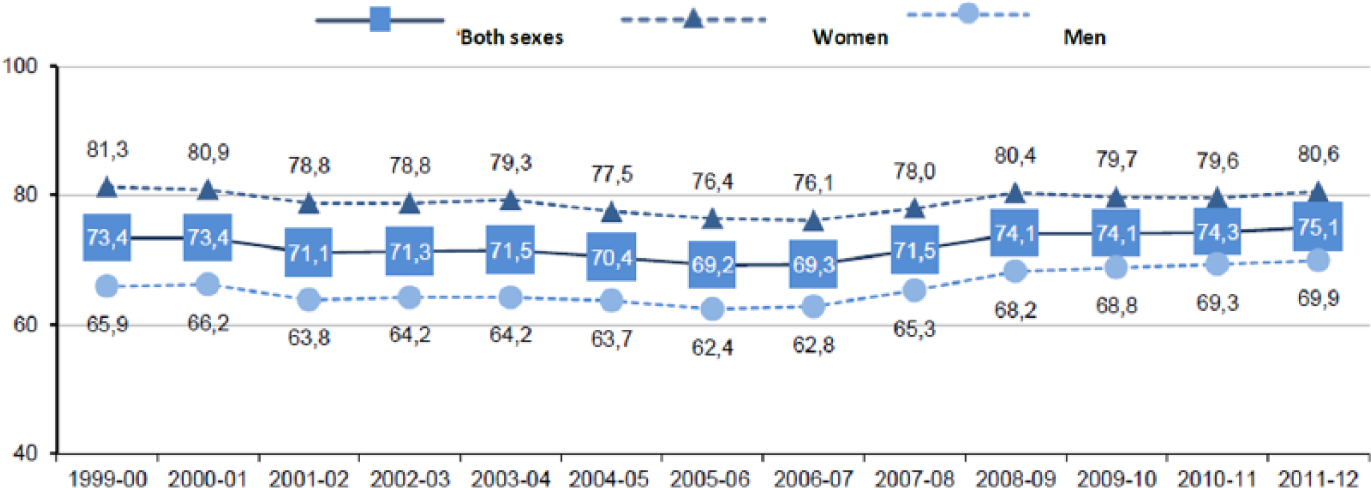
Evolution of the rate of graduates in obligatory secondary education by school year: 1999–2000 to 2011–2012 (INEE, 2014: 9).
We are facing high rates of school failure and dropout, phenomena that are influenced by social, economic and cultural factors, but also by schools. Spain has to drastically reduce school failure in lower secondary (ESO) in order to increase the continuity of students from social groups that are distanced from the school culture. Understanding school failure requires taking into account at least six closely related factors: society, family, educational system, school, teaching in the classroom and student engagement (Martín et al., 2008). To increase the post-obligatory training of young people, it is necessary, among other things, to make the curriculum more flexible, facilitating diverse paths to fit the students’ needs (Ministerio de Educación, 2011).
Guaranteeing educational success to all students means that they must acquire the necessary knowledge and competences for their personal fulfilment in order to exercise active citizenship and become incorporated into adult life in a satisfactory way. In this regard, as stated in a release Comission of the European Communities (2008: 1.7), The challenge facing the EU, then, is to strengthen the reform of school systems so that every young person can develop his or her full potential, through improved access and opportunities, to become an active participant in the emerging knowledge economy, and to reinforce social solidarity.
Redesigning comprehensiveness
The extension of mid-level education to the majority of the population requires completely redesigning the dominant curricula at this level, which is currently directed towards a select, minority population aimed at university entrance or, as another route, an excessively professional orientation. Initially created to serve as a preparatory path for higher or university education, in its curricular orientations, teaching methodology and teachers, it is now being organised as an extension of basic or primary education (Salhberg, 2007). A study by the World Bank (2005) states, and I agree, that we are currently witnessing a ‘change of partners’. Instead of its traditional link to the university, we are now experiencing, with its extension and democratisation, a coupling of lower secondary education with basic or primary education. At the same time, teacher training can no longer remain the same.
Along with the expansion of secondary education, there is also a diversification. Thus, although in the first cycle of lower secondary education there is a high level of comprehensiveness, discussion has arisen about how to organise the last two courses, especially the fourth year, where the problems increase. One way would be to organise upper secondary with two parallel options: a more academic preparation for higher education; and another, more professional education, such as technical and vocational education. This issue has been discussed in Spain because we do not know when to introduce these two options. We are in favour of implementing them at the upper secondary level.
Redesigning the comprehensive curriculum
There is a shared feeling that the comprehensive curriculum, as established in secondary education, does not respond to necessary life skills, and it reduces the significance of academic learning. The students have serious difficulties in finding meaning in the knowledge transmitted in school. The curricular responses must be directed towards organising secondary education around the basic knowledge and skills that are necessary in an information society. Here, its redefinition is based on key competences (Bolívar, 2010).
The key competencies come to define these necessary skills, which can also be identified with the comprehensive curriculum, to which every citizen has a right. With the support of the community, in secondary education the educational administration must guarantee the competences that make up the common curriculum (at least at the lower secondary level). It is necessary to redesign the school curriculum, what to teach in the knowledge society, and determine the basic education from which no one should be excluded. Adopting a key competences approach requires a more interdisciplinary or cooperative effort, consisting of integrating core programmes and school experience.
One lesson learned from the comprehensive experience is that although, a priori, it might seem to contribute to increasing equity, in practice it can also cause certain students to be excluded because they do not find where they fit in this curriculum, with its strong common core. This occurred in France with the ‘unified secondary’, analysed very well by Jean-Yves Rochex (2007), and in Spain (Bolívar and López, 2009). Therefore, even though a common core is reaffirmed, this is not a hindrance to adopting the diversification that corresponds to personalised teaching. The World Bank Report (2005: 209) concludes his analysis: A diversified curriculum is one of the keys to retaining students in the secondary education system, preventing dropout, and ensuring relevant and meaningful certification and accreditation leading to job market entry and to the further educational and training opportunities.
An organisation that wants to propose success for everyone in all schools has to be flexible, offering the possibility that each student can find his or her place for learning. Therefore, it cannot be a forced framework, the same for all, which would exclude those who do not fit, but rather a personalised response. The general objective, given the problem at hand, is to make the system more flexible so that no one is left behind (now almost a third of young people leave their studies early), while at the same time giving much more autonomy. This requires establishing the possibility of different ‘formative itineraries’, instead of forced curricular paths, that can respond to individual biographical projects in a personalised teaching/learning process (Casal et al., 2007). The relevant issue is that flexibility must not lead to segregation, so that the paths always have to remain open, and choosing one does not imply giving up another. Moreover, the necessary autonomy also requires setting limits that cannot be exceeded, in order to avoid students’ segregation or exclusion.
Mismatch between curriculum and teaching competencies
The changes in the curricula have not always been accompanied by teacher training. As stated in the World Bank report on secondary education in the world (2005: xxi): ‘There is a profound mismatch between learning needs, competencies, and skills demanded from students in the knowledge society and the teaching skills of secondary teachers after their passage through teacher training colleges and in-service training programs.’ This problem has seriously affected the development of a comprehensive curriculum in Spain.
When secondary education was a subsidiary of higher or university education, the teaching staff could have an exclusively academic profile to prepare the students for university entrance. But when secondary education was designed for the masses, a new teacher training was required, closer to basic education, where, in addition to having a deep understanding of their disciplinary area, the psycho-educational dimensions would play an important role in their training (Morgenstern, 1993). Instead of being specialists in their discipline, the situation up until now, this professionalisation must lead to creating a teaching professional, as well as an educator. Furthermore, this process contributes to constructing a professional identity focused on education, rather than on the subject matter.
To establish a new curriculum in a prescriptive way, it is not enough to change teachers’ ways of working in the schools. At the same time, it is necessary to redesign the organisational contexts and prepare teachers capable of adequately implementing this curriculum. Studies (Bolívar et al., 2005) have shown that the educational reforms in recent decades have had an impact on the professional identity crisis of teachers. The aforementioned mismatch produces a teacher identity crisis, which, in the end, has negatively affected the comprehensive proposals of secondary education. In Spain, the continuous lack of an initial teacher training, integrated in the degree itself, has given rise to an academic professional identity, which is inadequate for obligatory secondary education.
Conclusions
An unlimited confidence in top-down reforms, mainly curricular, without altering organisational aspects, means that – in the end – school cultures (Tyack and Tobin, 1994) reproduce aspects the reforms want to change. Good designs are not enough if the implementation conditions are not considered. Moreover, in Spain the reforms have intermittently returned for ideological and political reasons: new governments, new educational laws. As Cuban points out (1990: 7), ‘this two-phase cycle is very close to a pendulum swing – conservative to liberal and back again every decade’. In any case, it is a pendulum that does not return to the same place, but rather to a transformed place, in cycles (conservative-social-democrat) that, moving on a superficial level, do not contribute to improving what – at a deeper level – occurs in the classrooms. ‘Schools and classrooms go largely unchanged, although the noise and motion do give an appearance of fundamental reform’ (Cuban, 1990: 10).
In Spain, comprehensive secondary education has become a common source of confrontation among ideologues and political parties, along with other social organisations (Bonal, 2000). The key to the debate is how to achieve an increase in quality without decreasing equity. There are two opposing conceptions of quality: one is linked to greater equality or, at least, compensation for inequalities; and in the other, quality is linked to effort and personal demands and the results obtained, but not to the processes or access routes. Thus, the Socialist Party (PSOE) has defended comprehensiveness as a way to make an educational system more equitable, reducing or compensating for the ‘social determination’ of the teachings. Quality is linked to higher levels of equality and/or compensation for inequalities. In contrast, the conservative side (Partido Popular) has argued that this means lowering the quality, so that from the age of 14, it is better to emphasise tracking in secondary education by creating diverse formative ‘itineraries’. In this case, quality is mainly associated with effort and personal capabilities, seeking excellence by evaluating the results on external tests. Turning an educational problem into an ideological issue has made it impossible to achieve a stable educational solution. Instead, note that, ‘rather than being obsessed with excellence, academic programs for universal compulsory education must be defined in terms of a universal guarantee to meet basic educational needs, while the best pupils can of course go much further. There is no reason that the quality of some pupils’ itineraries should undermine or disqualify the trajectories of others’ (Dubet and Duru-Bellat, 2007: 288).
The aspiration to equal educational opportunities in the 1960s and 1970s through a comprehensive project has finally run its course. If we do not want to leave it to the contingency of neoliberalism, a current solution, drawing on the best of this project, is to assure a common culture for all. The principles of equity imply that all young people (especially the most vulnerable students) have a right to this minimum common culture, suppressing choice at this level, which does not keep them from later going as far as the diverse educational possibilities allow (Dubet, 2004). The first mission of the school system is for all the students to have the knowledge and competences judged to be indispensable and fundamental. This lowest common denominator of obligatory education must guarantee a cultural minimum wage, and – as an analogy – it represents the ‘basic income’ for every citizen or worker. Thus, we defend the new vision of comprehensiveness. As stated by Dubet and Duru-Bellat (2007: 282), in this sense, ‘a fair schooling system – i.e., the least unfair – is not necessarily one that reduces inequalities between the strongest and the weakest but one that guarantees that the least advantaged pupils will acquire what are perceived as basic skills and knowledge’.
In this sense, the comprehensive project is currently being redefined by the key competencies. Determining them for the entire population can be a way to reduce the gap between the goals of equity and equal opportunities and the educational practices that usually reproduce social and economic differences. Moreover, given that learning these skills does not depend on the school system alone, but takes place throughout life, broad policies will be required in countries in order to create a favourable and formally equitable material, institutional and social environment (Bolívar, 2010). Faced with the levels of school failure and dropout described above, it should be pointed out that the drama of the Spanish case is that the system designed to guarantee a fundamental educational right like this one has not been organizationally (culture and management of Secondary Schools and the teaching staff) or pedagogically (structure, organization and development of the curriculum, teaching and evaluation) coherent. The proposed comprehensiveness was nothing more than a set of good intentions; the curriculum has responded more to the old model of upper secondary than to the obligatory education in question; the teachers were not able to effectively interiorize the challenges involved, and they did not have the necessary capacities and commitments to guarantee that increasingly diverse and hostile students would receive the education they deserved. (Escudero, 2014: 18)
On the one hand, the comprehensive school more broadly includes the contemporary transformations of our welfare state and the state’s role in education. On the other hand, there is the question of whether the school should neutralise social and cultural inequalities or, conversely, whether diversity among individuals means inequality. This is the challenge and the main aspect of the conflict about comprehensiveness in compulsory secondary education in the second modernity (Beck, 2000). Disenchanted with equal opportunities (Dubet, 2004), equality is limited to a common cultural minimum. However, there is a ‘third way’ in education and New Public Management. Rather than determining a compulsory curriculum, in post-bureaucratic politics a new education plan should be able to encourage autonomy, which can promote engagement, instead of controlling results, as in accountability (Maroy, 2007).
These new educational demands put the teachers in a new position on the educational scene. The mission of educating all the students in an equitable way with the highest achievement levels possible in an increasingly unequal, diverse and multicultural population requires a more flexible curriculum and more individualised teaching, which presents new challenges to the initial teacher training and training institutions. Therefore, without delay, secondary teachers must receive good pedagogical training integrated in the study of their academic discipline. Through good initial training, we have to strengthen teachers’ knowledge and skills, leading to their ‘professionalisation’. Teachers must be trained to teach students, while making a commitment to work towards equity in public education.
Teachers’ professionalism, in addition to the dimension of knowledge and skills, is based on the emotional dimension on a daily basis, as well as the passion that ‘moves’ one to act, as the professional aspects of the job cannot be dissociated from the personal. At a time when social changes and educational policies are strongly restructuring the school’s role, it becomes essential to understand the emotional side of teachers’ work, both due to their identity crisis and because of the possibilities for reconstructing their identity. In the context of a serious economic crisis, with the corresponding cutbacks in salaries and resources, teachers’ job conditions are being seriously affected, with demoralizing consequences for their work (Müller et al., 2009). This situation will have deep and lasting effects on their commitment, dedication, motivation and illusion towards their work. Without the latter, it is not possible to improve education (Day and Lee, 2011).
Footnotes
Declaration of conflicting interest
The author declares that there is no conflict of interest.
Funding
This research was funded by the Spanish Ministry of Economy and Competitiveness (Research Project, ref. EDU2013-48432-P).
Author biography
 ) and a member of various editorial committees or advisory boards of journals.