




Abstract
Since the 1980s, numerous education reforms have sought to dismantle centralised bureaucracies and replace them with devolved systems of schooling that emphasise parental choice and competition between increasingly diversified types of schools. Nevertheless, the Finnish variety of post-comprehensivism continues to emphasise municipal assignment of school places, in the form of the neighbourhood school principle; albeit, in its current form, with the possibility for locally controlled choice and competition, channelled especially through classes with a special emphasis. Based on nine in-depth thematic interviews with experts in provision, management or evaluation of local level compulsory education, this paper focuses on how the conceivable costs and benefits of school choice are recognised and controlled in urban Finnish municipalities. Two distinctive discourses were found to be embodied in the portrayals of the costs and benefits of choice: the legitimization of school choice; and promoting the comprehensive system. The legitimation of school choice discourse is built on the acceptable, but strictly limited reasons for choice, and necessity of school choice. In contrast, the discourse of fostering the comprehensive system is based on the ideology of equality of educational opportunities. It is constructed upon the traditional, universal, non-selective features of the comprehensive school. Against this background, possibilities for school choice can be, and must be, locally controlled – even restricted, if needed – in order to prevent a vicious circle of failing schools in deprived neighbourhoods.
Introduction
More than 30 years ago, the Swedish educationalist Sixten Marklund (1981: 207) predicted that despite its strong establishment at the primary and lower secondary levels, the comprehensive system could hardly “remain forever as it is at present”, because the Comprehensive era in education was turning into the Post-comprehensive era. This shift can be characterised by the number of options available and the level of centralisation; indeed, the central features of the post-comprehensive era are choice and devolution. According to Marklund (1981: 207), in the post-comprehensive era “the opportunities for individual choice of study courses are increased, and the local education authorities are given increased responsibilities for curriculum planning and use of public resources”.
Marklund’s prediction has stood the test of time. Since the 1980s, numerous education reforms across Europe and beyond have unequivocally sought to dismantle centralised bureaucracies, and replace them with devolved systems of schooling with special emphasis on parental choice and competition between increasingly diversified types of schools and multiple providers of education (Gewirtz et al., 1995; Green, Wolf and Leney, 1999; Whitty et al., 1998). Levin’s (1998) heuristic for the global epidemic of education policy involves replacement of monopolistic forms of generic state provision with competitive individual ones: for instance, the devolution of budgets to the level of institutional provision, insertion of the culture of competition into the daily practices of service delivery, and increased achievement testing with the publication of results.
School choice – that is, “ways to increase some parents’ access to current choices or new choices that may arise as a result of the policy” (Merrifield, 2008: 5) – now features on the political agendas of countries around the globe. In Finland and other Nordic countries, school choice is understood as one of the key elements of the re-examination of the comprehensive school project in Europe, and a manifestation of the post-comprehensive era. On the one hand, it is a widespread and concrete example of the changing relationship between public authorities and markets. On the other hand, the ways in which it has been implemented in various socio-historical contexts demonstrates the presence of different versions and revisions of comprehensive models in Europe, i.e. different varieties of post-comprehensivism.
Demands for increased opportunities for school choice and competition have commonly been underpinned by a range of arguments, including the claim that such reforms will reduce educational bureaucracy, strengthen democracy (the right to choose instead of being assigned), improve efficiency (higher achievements and lower costs), increase accountability, and promote equality of opportunity for the poorest students in low-achieving schools in deprived areas by abandoning the strict catchment area policy (Bunar, 2010; Chubb and Moe, 1990). According to Chubb and Moe (1990: 142), “centralization and bureaucratization are substantially at odds with the effective organisation of schools and the successful provision of education”.
However, claims for competition and choice have been challenged by arguments that label school choice a middle-class enterprise, underscore the demoralising effect of competition (the problem of ‘failing schools’) and interpret higher achievement rates in certain schools as an outcome of their more advantageous social composition (Bunar, 2010). Moreover, a host of research evidence indicates that school choice and the marketisation of education fuels social segregation (Logan et al., 2012; Söderström and Uusitalo, 2010; Waslander et al., 2010).
When contrasted to other European countries, Finland and other Nordic countries are shown to be relatively new at increasing the options for parental school choice (Gewirtz et al., 1995; Green et al., 1999; Reay et al., 2008; van Zanten, 2007). As one of the key elements of the Nordic welfare model (Esping-Andersen, 1990), the comprehensive school system is based on the idea of providing equal educational opportunities, regardless of gender, social class and geographical origin. Until the late 1980s, Nordic comprehensive systems consisted of universal, non-selective basic education, generally provided by the public authorities (Arnesen and Lundahl, 2006; Erikson et al., 1987: vii–viii). Pupils have been generally assigned to publicly-funded schools near their area of residence (Musset, 2012).
The Nordic countries have traditionally been characterised by a high degree of local discretion in decision-making (Arnesen and Lundahl, 2006; Esping-Andersen, 1990). Thus, local-level policies are of particular interest when studying the Finnish context, where local policy-makers, to a large extent, have to decide how to balance the social aspirations and economic requirements of the populace and determine the relative importance of choice and equity, and flexibility and coherence, where these, at times, may suggest different policy options. Before the 1990s, state regulation of local government and finance was considered essential for the attainment of crucial equity and equality goals (Page and Goldsmith, 1987). However, while in the last 25 years decentralisation and new approaches to public management have further increased local autonomy, they have also led to the fragmentation of municipalities, which has weakened the unifying structural principles upon which the comprehensive systems were built (Bogason, 2000).
In broad terms, the Nordic welfare regime has distinctive features: centre–left coalition governments producing high redistribution; strong support for investment in primary and secondary education; active labour market programmes; and high-quality public day care and preschool services (Iversen and Stephens, 2008). Nevertheless, the ways in which national legislation has authorised and obliged local authorities to govern the provision of basic education are different even in neighbouring countries such as Finland and Sweden. Undeniably, different contexts have produced a variety of interpretations of the principles and operations of deregulation concerning choice and competition in local education markets. In Finland, school choice takes place within the public school system, both provided and governed by public authorities, through classes with a special emphasis, which are the main mechanism for exercising parental choice. In contrast, choice takes place both within and between the private and public sectors in Sweden, where the number of free schools and the percentage of students in free schools has risen markedly. A rapid and dramatic restructuring of the free school market has taken place, driven by the rather unique ability from an international perspective of free-school owners to extract profits (Varjo, Kalalahti and Lundahl, in press).
Finland and Sweden are quite different in terms of educational outputs and their areal distribution, with Sweden trailing Finland (OECD, 2014). Besides high overall educational achievements, the success of the Finnish Programme for International Student Assessment (PISA) has been based on small variations in learning outcomes for individual pupils and schools. Nevertheless, very recently a group of such ‘failing schools’ has emerged in the capital city, Helsinki. A gradual differentiation in learning results measured in PISA 2012 and its intertwinement with socio-spatial segregation has been widely noticed in Finnish education policy discourse (Bernelius, 2011; Kupari et al., 2013).
A précis of empirical findings of the conceivable effects of school choice
The focus of this paper is on how the conceivable effects of school choice are recognised and controlled in urban Finnish municipalities. The premise and the context for the paper is the unique form(s) and prevailing discourses concerning the outcomes of Finnish transition from a comprehensive to a post-comprehensive era, focusing especially on the question of school choice. The overall aims are: (1) to elaborate how choice and devolution are manifested in the Finnish basic education system; (2) to investigate how local education authorities sketch the externalities of school choice; and (3) to analyse the ways in which Finnish local education authorities recognise and control the social costs and benefits of school choice.
Economic theorists commonly model individual decision-making as a measurement of possible costs and benefits. Rational choice theory assumes that individuals only consider the costs they themselves bear when making decisions, rather than the costs that may be borne by others. Hence, the social costs and benefits, as estimated from the wider system- or meso-level perspective, may be distinguished from private costs and benefits as incurred and realised by the individual student at the micro-level, for instance (Psacharopoulos and Patrinos, 2004). An externality is a cost or benefit that affects a party that did not choose to incur it. It goes above and beyond the scope of meso-level systems, such as an education system, and evolves into a wider, macro-level societal issue. Negative externalities, in particular, are typically understood to be related to issues such as the environmental consequences of production and use, such as pollution. Nevertheless, education has generally been considered to have significant consequences for society as a whole. Commonly, more education is expected to lead to broader benefits for society, such as better economic productivity, lower unemployment rates, greater social mobility and higher rates of political participation (McMahon, 2004; Weisbrod, 1964).
These questions of costs and benefits are addressed here with a research design that entails three tasks. First, the modification of the comprehensive school system by previous research on school choice is contextualised with a special empirical focus on the local level. The illustration of Finnish local spaces for school choice is a synthesis of the authors’ earlier work and a novel analysis performed for this paper. Second, national responses to increased demands for school choice at the policy level between Finland and Sweden are contrasted (Varjo et al., in press) and local formulations of urban Finnish local spaces for school choice using demographic and financial municipal data, and documents concerning the provision of basic education are analysed (Varjo and Kalalahti, 2011). Issues that are characteristically within the jurisdiction of municipal authorities are emphasised: local models of selection and admission; the specialisation of schools; principles for the local allocation of resources; and quality assurance and evaluation. Finally, the social costs and benefits of choice are revealed as they are manifested and recognised at the local level by utilising nine in-depth thematic interviews with experts in provision, management or evaluation of local level compulsory education. These interviews, analysed for this paper, were conducted in early 2014.
The interviewees were selected from three different institutional spaces (municipals) based on their position. The first two groups consist of civil servants (six interviewees) who are responsible for local education administration; they are either heads of departments or middle-rank officials specialised in issues concerning admission and selection. The third group (three interviewees) consists of persons who are nominated to a position of trust by their political parties, based on the results of municipal elections. As a whole, this study’s interviewees represent the overall authority to provide basic education, including financing, implementation and evaluation.
The interviews were analysed with thematic analysis that was elaborated from categorisations of identified costs and benefits to larger units and discourses. The preliminary categorisations were made with the classification of social costs and benefits and positive and negative externalities of school choice. This classification structure is based on theoretical conceptualisations and applied with the empirical findings. Discourses used in this paper were formulated along the framework of dynamics that connects the political opportune, political possibilities and actors to an analytical frame (Kauko et al., 2012). In this approach the political opportunity of actors is understood as a path-dependency formation of acts that is articulated in the discourses of actors. The categories were re-organised as ‘pathways through the data’ and interpreted in relation to specific policy fields framing the actors (see e.g. Coffey and Atkinson, 1996). By analysing the discursive formations and conceptual categories emerging from these interviews, the conceivable effects of school choice can be portrayed. That is, the basic principles steering actors and directing policy aims in the comprehensive system may be better understood through this analysis.
The emergence of local institutional spaces for school choice
According to Green et al. (1999), after a strong period of centralisation from the 1930s onwards until the late 1970s, the emphasis on traditional Nordic localism reappeared during the course of the 1980s, and this shift in the relationship between central and local government has concerned all Nordic countries alike as substantial control has been delegated to municipalities. However, there are significant differences in the ways in which national legislation has authorised and obliged local authorities to organise and govern the provision of basic education (Varjo et al., in press).
Finnish local government is exceptional in that it has been considered to operate ‘outside’ the sphere of central government (Green et al., 1999; Temmes et al., 2002). The lack of traditional control mechanisms is manifest in the actual scope of local autonomy. For instance, Finland has never had a tradition of mandatory national testing for the whole age cohort or school inspections, and school league tables are in use (Eurydice, 2004; Varjo et al., 2011). The trajectories of deregulation and decentralisation have altered local policies and practices concerning admission to and selection for basic education. The 1999 Basic Education Act (Law 628/1998) only obliges municipalities to assign each child of elementary school age to “a neighbourhood school or some other appropriate place where education is given”; simultaneously, the term ‘school district’ was removed from the legislation. The notion of a neighbourhood school means that children are obliged to attend a designated school defined in terms of proximity and local conditions. Thus, municipalities are empowered to develop distinctive policies and practices in order to allocate children to their neighbourhood schools in an equitable manner (Kalalahti and Varjo, 2012; Seppänen et al., 2012; Varjo and Kalalahti, 2011; Varjo et al., 2014).
The Basic Education Act (Law 628/1998) also enabled parents to choose between schools on the grounds of their particular character and curriculum. Education providers and their comprehensive schools are still required to follow national curriculum guidelines; however, within a given framework they are allowed to specialise in certain areas – that is to develop and express a distinctive character to meet the different demands of parents and the different aptitudes of students. These sub-national constructions have been characterised as “local institutional spaces for parental school choice” (Varjo and Kalalahti, 2011; Varjo et al., 2014).
As a result, educational diversity inside the traditionally homogeneous national curriculum has increased since the 1990s; nevertheless, because of the strictly limited number of private schools, 1 parental choice takes place within the publicly funded comprehensive system. Municipalities, through their elected education boards, have been given powers to decide on the allocation of lesson hours in all the schools under their jurisdiction. Schools have started “taking profiles” (see Ylonen, 2009: 42–43), that is, offering specialisation in particular subjects in the curriculum or placing an emphasis on some more general themes (the environment or communication, for instance). These ‘classes with special emphasis’ (painotetun opetuksen ryhmät) function as separate streams within regular municipal schools. They have more lessons (for instance, in music, sports, science, languages, or arts) than the National Core Curriculum requires. Importantly, the neighbourhood school principle does not concern classes with a special emphasis; they commonly draw in pupils from the whole municipal area because of their particular focus (Seppänen, 2006; Seppänen et al., 2012; Ylonen, 2009). It is important to note that pupils are selected for classes with a special emphasis by aptitude tests, not according to their academic achievements; the law states, “If education is given according to a curriculum with special emphasis on one or several subjects, the admission of pupils may also be based on a test showing aptitude for said education” (Law 628/1998: 28§).
After the new Basic Education Act came into force, most urban Finnish municipalities abolished traditional school districts (koulupiiri) with fixed, publicly-known geographical boundaries for each school in favour of larger catchment areas (oppilasalue) with several schools in each area, forming an “area-based pupil admission model” (Varjo et al., 2013). As required by the Basic Education Act, municipalities assign each child of elementary school age a neighbourhood school from the area. Importantly, the allocated neighbourhood school is not necessarily the closest to the place of residency in terms of geographical location. The Basic Education Act reserves municipalities the right to base the placement of students on local conditions. Hence, the connection between place of residence and the allocated school place is not fixed.
In local contexts which no longer recognise fixed school districts, each child’s equal right to education is clearly safeguarded and articulated by a hierarchy of criteria governing the allocation of school places. In some municipalities parents are additionally asked to express their preference for a neighbourhood school. Nevertheless, the preference criterion is taken into account only after the three criteria of: 1. Special reason; 2. Sibling in the same school; and 3. Proximity. “Finally, and only if possible, the parents’ preference for a neighbourhood school is taken into account” (Espoo 2014: 8, translation by authors). Arguably, this practice can be interpreted as both reflecting generally more permissive local values towards parental school choice among parents, and reconstructing the institutional space for school choice so as to be more open to parental choice.
In some urban municipalities, the link between residential location and school attendance has remained more visible and public, and ‘school-based pupil admission’ (Varjo et al., 2013) resembles the old school district system where each school has its own district, and residence at a certain address (which is located in a certain school district) guarantees a place at a certain school. Arguably, the school-based pupil admission model is more transparent than the area-based model as the geographical coordinates of the districts are publicly available on the internet.
In some municipalities the opportunity to choose a school other than the neighbourhood school has remained relatively limited. In contrast, other municipalities have encouraged their schools to develop distinctive profiles, and asked parents to specify their preferred school. Consequently, the number of classes emphasising certain subjects and the overall emphasis on schools with a specific profile are features that distinguish urban Finnish municipalities from each other (Kalalahti and Varjo, 2012; Varjo and Kalalahti, 2011; Varjo et al., 2014).
When assigning school places, municipalities ensure, on the one hand, equal access to basic education for all pupils according to previously set criteria; on the other hand, municipalities respond to the individual demands of families by offering (limited) possibilities for choice. In Finland, local institutional spaces for school choice have diversified due to the different interpretations and preferences of the municipal actors concerning these two basic admission practices: how they balance their policies in relation to the neighbourhood school principle and open enrolment.
Different interpretations of school choice have affected equal educational opportunities in Finland. School choice policies are particularly questions of urban school choice, as they only occur in larger municipalities with community structures that enable school markets. The Helsinki Metropolitan Area faces particular changes and challenges, with growing segregation in relation to socio-economic differences, neighbourhoods, and schools. In large Finnish cities there is considerable variation in PISA test scores and differences between schools continue to grow (Kupari et al., 2013). Consequently, according to Bernelius and Kauppinen (2011: 230), the association between urban segregation and educational outcomes is evident even in the egalitarian Finnish context. The correlation between socio-economic differences, especially in urban areas, and school achievement, has also been indicated in numerous studies (Bernelius, 2011; Kupari, 2005; Kuusela, 2010a, 2010b).
Under these particular circumstances, there is an interesting contradiction between attitudes towards school choice and actual school choice. A recent Finnish study (Kalalahti et al., in press) revealed that most Finnish parents supported their neighbourhood schools, which allows the students to have as short and safe a route to and from school as possible. According to Kalalahti et al. (in press), middle-class mothers in particular resist public league tables and the specialisation of schools, as in general, highly educated mothers are most aware of the negative outcomes of choice and competition. Nevertheless, despite their opposition to increased choice, they actually form the group that exercises the most parental choice, as more than half (52%) the pupils in classes with a special emphasis come from upper- or upper middle-class families (Kalalahti and Varjo, manuscript; see also Silvennoinen et al., 2015),
Furthermore, it is also interesting to consider the particular local circumstances under which the (relatively weak) emphasis on freedom of education opens up the institutional space for school choice. According to Varjo et al. (2014; see also Kalalahti et al., in press), a considerable number of high-income, highly educated parents active in the public sphere also supported the moderate right and were employed in the private sector, which seems to form a dynamic that promotes school choice, but only if the emphasis towards the universal features of comprehensive schools is weaker. The emergence of new cleavages within the middle class has been considered elsewhere an indicator of its fearful retreat from or eroding commitment to the public sphere (Reay et al., 2008: 239).
Recognising the social costs, benefits and externalities of school choice
The universalism of the Nordic welfare state model has been palpably challenged by reforms emphasising the diversification and privatisation of social and educational organisations. The new public governance has altered towards diverse institutional fields, plural society and consumerism (Anttiroiko, 2010). Another dimension of this novel situation is the stratification of social classes. Societal hierarchies have steadily changed in Finland: differences in income have increased, and the number of low-income families (at-risk-of-poverty rates) has risen rapidly (almost doubled) in the past 15 years. It is also noteworthy that both long-term low-income rates and deprivation have particularly grown in families with underage children, and the number of children living in at-risk-of-poverty families has increased to around the EU average (Lammi-Taskula and Salmi, 2010; Moisio, 2010).
Under these circumstances, it is unsurprising that the need to recognise, estimate and control the possible effects of school choice has emerged. The social costs and benefits of school choice, as outlined in Table 1, are rather well-known and well-articulated issues that are either promotable or avoidable. They mainly concern education systems in general, or actors (schools, families, etc.) within the system. Externalities are more abstract and indirect (often contingent) effects, which take place within, or apply to, a larger societal context (at least partly) outside the scope of the education system (Varjo et al., in press).
Conceivable social costs and benefits and externalities of school choice (Varjo et al., in press).
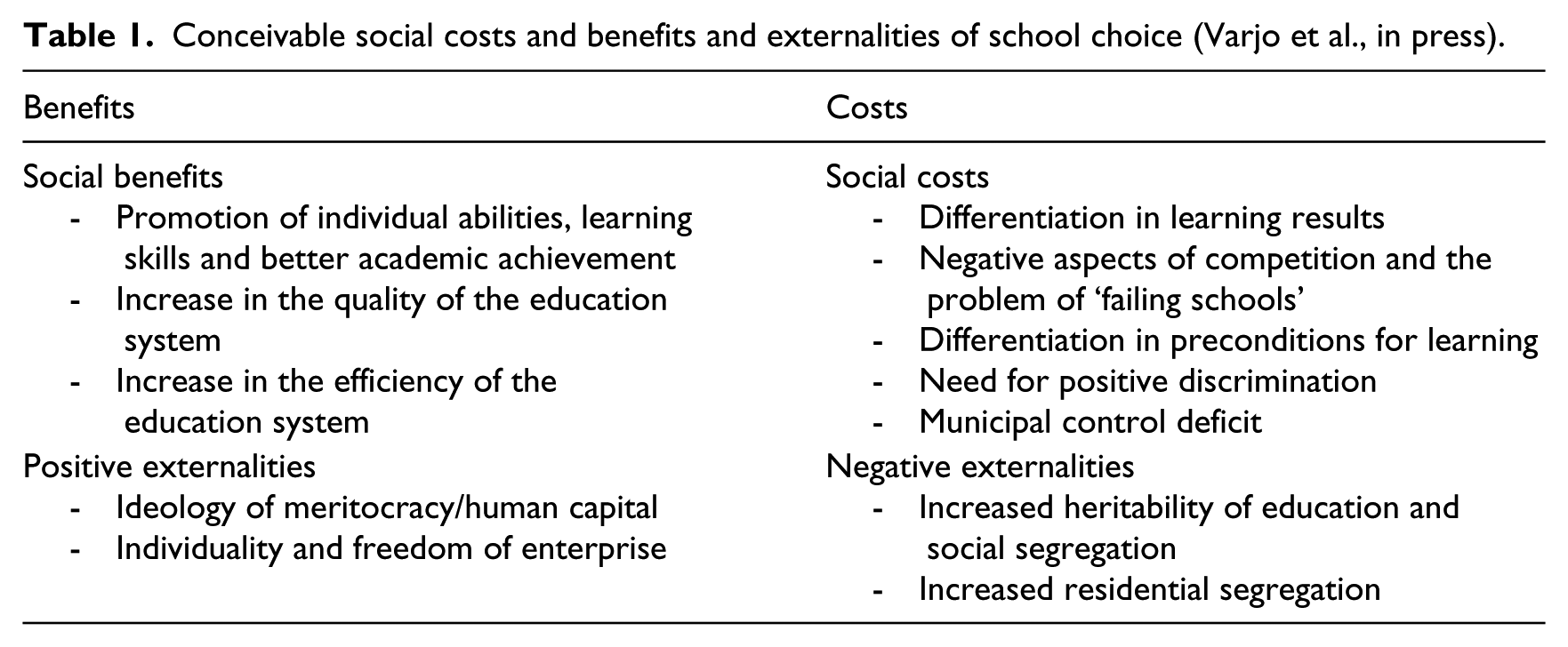
In terms of social benefits, school choice can be interpreted as a policy that supports enabling individual abilities, learning skills and better academic achievement through choice and competition. It is important to note that in practice, parental choice in Finland takes place within the publicly funded comprehensive system. It occurs in two forms: either within each school (in the choice of optional subjects, as part of national curriculum guidelines); or between schools (in admission to a class with a special emphasis). Conversely, in other similar countries such as Sweden the official policy has been to exclusively promote parental choice between both municipal and free schools. Thus, the common objective of supporting individual abilities, learning skills, and, arguably, better academic achievement has led to dissimilar institutional arrangements.
Choice and competition can also be understood as a mechanism for increasing the overall quality of the education system (see e.g. Chubb and Moe, 1990). Arguably, devolution and privatisation have emphasised evaluation and inspection (Ozga et al., 2011). Nevertheless, the ‘Quality through choice’ doctrine is not that prominent in Finland, which might explain Finland’s relative lack of enthusiasm for developing quality assurance and evaluation policies (see Varjo et al., 2013; Varjo et al., in press).
Like quality, choice and competition can also be understood to increase efficiency. In Finland, the devolution of managerial and financial control to the local level has meant wide-ranging freedom for municipalities to make decisions concerning their comprehensive schools and the basic education they provide. It is also clear that, in contrast to its peer countries, Finland does not have a particular focus on school choice, as it is only articulated in very broad terms and in relation to general decentralisation. In contrast, in Sweden, doubts have increasingly been raised over this assumed connection, not least after the precipitous fall of the country’s ranking in international comparative studies such as PISA (Lundahl et al., 2014).
Choice is also understood to have social costs, such as differentiation in learning results and increased socio-spatial segregation. Competition and the problem of ‘failing schools’ is also an issue in Finland. For instance, besides high overall educational achievements, Finnish PISA success has also been based on the small variation in outcomes for individual pupils and schools. Nevertheless, very recently a group of underachieving schools has emerged in Helsinki, the capital city (Bernelius, 2011), and a gradual differentiation in learning results has been widely noticed in Finnish education policy discourse.
Choice and diversification are palpably causing differentiation in the institutional preconditions for learning in Finland, where 30–40 per cent of pupils in larger cities attend classes with a special emphasis. In order to combat differentiation, positive discrimination is clearly required, though to date the measures have been rather weak and somewhat arbitrary. Moreover, despite national guidelines, actual policies and practices concerning the allocation of resources rest very much on municipal decisions (see Varjo et al., in press).
In terms of the positive externalities of school choice, the ideology of meritocracy and the urge to make the most out of the stock of human capital are examples of screening and sorting the future workforce through the education system (Becker, 1964). As indicated earlier, the selection for classes with a special emphasis occurs through aptitude tests. In this respect, the ideology of meritocracy is represented through school choice. Furthermore, individuality and free enterprise are values often connected with choice. In this regard Sweden has been very active in promoting the parental right to choose between publicly funded and independent ‘free’ schools. This gives free school owners opportunities to extract a profit. In contrast, parental school choice in Finland still takes place within the publicly-funded comprehensive system, which is strictly governed by the public authorities (Varjo et al., in press).
Increased heritability of education and socio-spatial segregation are the most obvious negative externalities of choice in education. Individuals are not equally capable of exploring selective education policies; affluent families are the most active and determined in availing themselves of greater school choice (Varjo et al., 2014). The opening of space for school choice increases competition and diversification between schools and it is intertwined with residential segregation. As educational differences grow between neighbourhoods, people with a lower socio-economic status or immigrant background tend to concentrate in deprived areas. Consequently, the education system faces difficulty in providing equal educational opportunities, and thus the need for positive discrimination policies emerges (Bernelius, 2011).
In the following section, the ways in which Finnish local education authorities construct the negative and positive externalities of school choice are elaborated. The analysis is based on nine thematic interviews (with municipal officials or individuals elected to the local board of education). A conceptual framework of social costs, benefits and externalities of school choice (Table 1) is used and squared with the framework of interpretations and understandings of school choice policies, in order to enrich and test the study’s concepts. In the analysis (after a re-interpretation of the original definitions and content of concepts and categorisations), two discourses comprising the conceptual categories of externalities, costs and benefits of school choice, and also a large set of practices and policies articulated to follow from these discourses, are identified.
Compelling negative externalities, vague positive externalities?
Externalities, that is, abstract effects that take place within the larger societal context, play an intermediary role in devolved education systems. On the one hand, they are formed by local-level policies and practices, but on the other hand – as recognised matters of national interest – their scope exceeds that realm of municipal jurisdiction and authority. In this sense, they bridge the local and the national.
Externalities seldom appear as a topic in this study’s interview data. They are connected with the shared belief that school choice inevitably leads to undesirable segregation, not only between individual pupils as learners, but also between different cultural or social groups, schools and residential areas. As was earlier explained (Varjo et al., in press), differentiation operates as the expected root cause of the negative externalities of school choice. All the interviewees considered school choice a question of equal educational opportunities, a principle that has traditionally dominated Finnish education policy. The quality and attractiveness of local schools is seen as the key factor that can form a virtuous or vicious circle within the neighbourhood. It seems that choice is seen as an element in the dynamics of socio-spatial segregation, causing concrete effects, like residential segregation and imbalanced housing markets.
In the interviews negative externalities are articulated as ambiguous but compelling.
The fundamental ethos, regardless of your political allegiance, is equal educational opportunities. My view is that in Finland we a have really strong consensus on the comprehensive school as a vehicle for promoting equality. (Interviewee #7) Personally, I think the decline in PISA results is connected to emerging social segregation. Welfare is being polarised; you can see that in the children and youth. (Interviewee #9)
Positive externalities are connected to the idea that choice has some pedagogical potential. It can be interpreted in the ways the society reproduces its human capital (Becker, 1964). To some extent, the interviewees recognised school choice as both a means of screening and sorting the potential and abilities of individuals, and supporting those same individuals. Nevertheless, these conceptions were neither precisely nor thoroughly articulated. It is also important to note that the formation of the positive externalities of school choice is unquestionably expected to occur within the comprehensive system, without reference to school markets as such.
In this municipality we want classes with special emphasis; that has been the political will of the majority. There are good things behind this: the urge to support pupils’ different capabilities, and so on. (Interviewee #5)
The provision of basic education in Finland is to the greatest extent a local matter. Decentralisation and a strong, shared ethos of the universal comprehensive school have jointly constructed local contexts that are extremely concerned to recognise and control the social costs of school choice, while somehow leaving the possible social benefits aside.
Conceivable social benefits and costs of school choice
Whilst analysing and elaborating the conceivable social benefits and costs of school choice, two distinctive discourses emerge from the interview data. The first can be defined as the discourse of legitimation of school choice and the second as the discourse of promoting the comprehensive system. The legitimation of school choice is founded on its necessity: parents have a principal right to choose. It is also assumed that choice can be utilised as a vehicle for pedagogical development (the pedagogical potential of choice). Nevertheless, these conceptions are always considered against the presumed (avoidable) segregative effects of choice.
The discourse of promoting the comprehensive system is based on the ideology of equality of educational opportunities. It promotes the traditional, universal, non-selective features of the comprehensive school. Against this background, the possibilities for school choice can be, and must be, controlled – if necessary even restricted – in order to prevent a vicious circle of failing schools in deprived neighbourhoods (restricted possibilities to exercise choice). Hence, conscious action is required of local education authorities to safeguard even distribution of resources and opportunities (equalising the preconditions for schooling).
In the next section the key elements and basic principles underpinning the two aforementioned discourses and their conceptual categories in the interview data are described. Then, at the end of the section, forms of governing the balance between social costs and benefits are introduced.
Legitimation of school choice
The interviews enriched an interpretation of the underdeveloped Finnish ‘quality through choice’ doctrine. Generally, the discourse of the legitimation of school choice is built on two conceptual categories: first, parents have a principal right to choose; and second, choice has some pedagogical potential. According to the Universal Declaration of Human Rights, parents have a prior right to choose the kind of education given to their children (see Varjo et al., 2014). It is fair to say that the interviewees in this study emphasise parents’ right to make educational decisions for their offspring, but in quite a bureaucratic and practical manner. Choice is considered as an artifice for keeping parents satisfied with their municipality in general (and local education authorities in particular) and preventing them from appealing against the placement of their child. Moreover, some explicit reasons which could be considered as ‘social’ (that is, siblings or friends at preferred school) are also seen as legitimate reasons for school choice.
We can take health-related reasons into consideration, and issues concerning siblings at the same school, as well. This is very humane; I think they must be taken into consideration. (Interviewee #1)
School choice is also discussed in terms of pedagogical practices, as an opportunity to enrich teaching in a certain subject and take individual aptitude into account more thoroughly. Pedagogical practices are understood as a vehicle for conscious and continuous school-based developmental work. The emphasis on the development of quality, commonly articulated in the technical terms of learning outcomes and attracting of pupils, is obviously an issue that particularly concerns schools located in deprived neighbourhoods.
If we put up a class with special emphasis in a school located in a demanding neighbourhood, we try to ensure that parents, who are generally interested in their child’s hobbies and upbringing, stay in the neighbourhood and don’t send their child to other schools, at least during grades 1–6, perhaps in grades 7–9, as well. (Interviewee #8)
It seems that the notion of the social benefits of school choice is built around professional, teacher-centric notions of quality that emphasise non-competitiveness, and cannot be measured. Generally, economic factors, like efficiency or effectiveness, are missing from the discourse on the social benefits of school choice. In the data, economic benefits are less frequently discussed.
Together, conceptions of parents’ principal right to choose and the pedagogical potential of choice form the basis of the legitimation of school choice in the interviews. They require modest and controlled opportunities to choose, which are considered against the potential social costs of a non-selective comprehensive system. Denial or ignorance of the parental right to choose is seen to cause dissatisfaction with public services and lead to a negative image for the municipality. The interviewees were afraid that families would move their children to schools in other municipalities or that the imbalanced dynamics of school choice would spread to the housing markets. The denial of choice is then associated with the stress of monitoring parental attitudes and complaints, pupil flows to other municipalities and the social composition of residential areas in relation to school quality.
According to my understanding, at least the Greens, maybe the National Coalition Party as well, don’t want to restrict parents’ right to choose a school for their child. The ultimate fear is that if the problem of the diversification of schools is addressed by limiting choice, families would start to select their residential areas based on the images of local schools. (Interviewee #9)
Promoting the comprehensive system
Regardless of their political allegiances, all interviewees (whether officials or politicians) share, at least to some extent, the premise that school choice inevitably fuels social and spatial segregation. An individual’s right to choose automatically means that someone else is inevitably left behind. Hence, choice is something to be treated with caution and managed by public authorities, not markets. It can be argued that the prejudice concerning the correlation between choice and segregation is an unquestioned article of faith among Finnish local education authorities.
It is as simple as that. If all well-educated and active parents get together, everybody else will be shut out. That’s exactly what happens in music classes, you know. (Interviewee #1)
However, concerns about segregation are not grounded in the commonly held belief that schools have or will become differentiated by quality; rather it is more a question of their reputation or image. It is argued that competition between schools increases or decreases the intake of schools depending on their image and, in particular, promotes the emergence of failing schools and school choice as a naturalised social norm at the most abstract level. The interviews created an image of schools trapped in a vicious circle where an unfavourable image inevitably led to difficulties in attracting academically able pupils and competent, highly qualified teachers. To prevent such circumstances, all municipalities thus attempt to enhance the heterogeneity of their schools, in terms of different learners, social classes and specialisations.
It is important to note that complete homogeneity within the comprehensive system is in no way seen as desirable per se. Clearly, choice is a social practice that simply cannot be denied in the post-comprehensive era, even in Finland. The question concerns more the number of choices allowed within the comprehensive system, and for whom they are offered. The approach that all the interviewees emphasise can be described as the conception of restricted opportunities to exercise choice. This amounts to the controlled balance between freedom to choose and the ideology of comprehensivism.
. . . parents really love to talk about their child’s schooling these days. From our point of view, it means that each and every one of our local schools has to be so good that all parents can say that in their neighbourhood school they have this or that. (Interviewee #1)
In order to maintain similar quality levels and evenly distributed options for restricted choice in all local schools throughout the municipal area, conscious measures must be considered and taken. Even though school choice is understood as a profound parental right, the shift from comprehensivism to a school-choice-oriented system means a serious, expensive and laborious compensative system that equalises everything.
One of the key themes in this study’s interviews is conceptions concerning equalising the preconditions for learning. The word ‘equalise’ refers here to the allocation of resources governed by local authorities. The conception of equalising is often contrasted with the benefits of the common comprehensive school. Thus far, emerging school choice has meant allocation of funding for specialisation at the expense of general basic education. The benefits of school choice are estimated in relation to equality and the high quality of the comprehensive system, which are understood not only as basic elements of the equality of individuals, schools and neighbourhoods, but also as having an independent effect on learning results. Combining children of different learning abilities in the same class is seen as both an important means of mixing different social classes and a way of promoting the learning of all pupils through model learning.
Local policies to control diversification and segregation
Municipalities have developed numerous policies and practices to prevent or compensate for social costs. Both discourses – legitimation of school choice and promoting the comprehensive system – are rich in policies and practices related to the conceivable social costs and benefits.
The policy of equalising means the equal and principled allocation of resources within the municipal provision of comprehensive education in the formation of teaching groups. For example, if a school applies for a guaranteed attraction such as a music class, more ‘demanding’ or ‘resource consuming’ obligations might be imposed on the school, such as special education groups or preparatory instruction for immigrant pupils.
. . . when talking about special education or preparatory instruction for immigrant pupils, we have the idea or philosophy that each and every school should do their fair share regarding these matters. We don’t allow free riders, so to say. (Interviewee #5)
The policy of equalising is also present in large-scale efforts to govern admission policies; local education authorities use a wide variety of micro and macro means to ensure the heterogeneity of schools and classes. They modify admission policies through geographical admission districts, set limits for selectivity and encourage schools to draw pupils from neighbourhood areas with the use of an incentive bonus. Nevertheless, explicit quotas for immigrant pupils are viewed as too discriminatory. Equalising can also mean more financial resources (the most common form of positive discrimination) allocated to schools located in deprived neighbourhoods, based on various indicators and measurements.
We have indicators, and based on them a school located in a deprived neighbourhood receives more (financial) resources than a similar school in a more affluent neighbourhood. (Interviewee #5)
Positive discrimination and the governance of admission policies can be also seen as governing segregation by data and co-operation; a fair allocation of resources requires large amounts of information. Governing by data demands a wide variety of statistics, including knowledge about population socio-spatial segregation, learning results and the heterogeneity of schools and classes, measured by socio-economic indicators and ratios of pupils in special education and in classes with a special emphasis.
One way to control the social costs of school choice is to control information and its public availability. This is crucial in Finland, where in compulsory education national examinations for the whole age cohort are not held, and neither governmental organisations nor the mass media publish league tables. All the interviewees share the sentiment that in order to prevent league tables, test results and other school-based performance indicators must remain both confidential and for administrative purposes only (see also Kauko and Varjo, 2008). Hence, the overall attitude towards the mass media as an arena for communicating issues of school choice can be described as sceptical.
Public ranking lists would just increase opting out from certain schools. Kind of cause a vicious circle. It is a delicate question, but journalists also quite well understand the ethical principles involved here . . . . (Interviewee #7).
Another emerging issue is the use and availability of data within the municipal politico-administrative system. To date, in order to avoid any ‘information leaks’, politicians have been practically excluded. Curiously, even the ones elected to a position of trust (like the municipal board of education), do not personally feel the need for this type of data.
As a member of the Board of Education, I don’t expect the local education authorities to deliver a map of the weakest schools in our city to the Board meeting. That would just not be clever. (Interviewee #9)
Despite reservations concerning ‘hot knowledge’ (see Ball and Vincent, 1998; Kosunen, 2014), the governance of equalising policies is shared, consciously argued and thoroughly developed between local authorities and politicians. Vast amounts of data are collected from principals, parents, the education administration and other administrative sectors.
This cooperation is particularly evident in the manifestation of the neighbourhood school principle. Equalising policies are to a great extent founded on the idea of the neighbourhood school, which is the focus of most parental demands concerning quality. In order to maintain the compatibility of the local school for all social classes and individuals, schools and local education authorities have developed a wide variety of measures. Civil servants map out pupil allocation, follow the possible segregation of schools with multiple indicators, develop joint projects with the health and social sectors, target schools with demanding socio-economic compositions, follow the quality of local schools and, finally, strive to enhance the positive public image of all schools.
Cooperation between schools, especially between principals, has been extremely intensive. We have regular meetings on a monthly basis, and I would say that the dialogue has been quite open. Perhaps because the allocation of resources has been transparent from the very beginning. Everybody knows how, and on what grounds, everything is distributed. My opinion is that this why there are no competitive arrangements between schools. (Interviewee #2)
Conclusions
In the post-comprehensive era, governance relations clearly have a transnational dimension, but the relationship between localities, individuals and the national authorities also functions in new ways that allow for multiple flows and directions. The ways it will develop and become embedded in national and local contexts will vary considerably in different contexts, because this relationship is constructed alongside and around existing assumptions and practices (Ozga et al., 2011).
The wide-ranging shift in central–local relations, understood here as a central feature of the post-comprehensive era, has also affected Finland; in broad terms, a substantial degree of control has been delegated to municipalities. However, Finnish endeavours to devolve managerial and financial control to municipalities are connected to general reforms in public administration, without a specific focus on school choice per se.
In contrast to the other Nordic countries, in Finland the way national legislation has authorised and obliged local authorities to govern the provision of basic education is quite peculiar. Devolution has been implemented strictly within the sphere of public authority, as a shift from central government to municipalities, rather than directly to schools. Choice and competition are very much controlled, and to a certain extent, restricted, by the local education authorities. Plainly, the marketisation of basic education (in its literal sense) has not emerged in Finland.
The notion of a neighbourhood school is vital for understanding the Finnish version (and revision) of the comprehensive model. On the one hand, children are still obliged to go to a designated school defined in terms of proximity and local conditions by local education authorities. On the other hand, the Basic Education Act (Law 628/1998) enables parents to choose between schools on the grounds of their particular character and curriculum. Education providers and their comprehensive schools are still required to maintain a national core curriculum; however, within a given framework they are allowed to specialise in certain areas, to develop and express a distinctive character to meet the different demands of parents and the different aptitudes of students. Under these circumstances, different local contexts have evidently produced a variety of interpretations of choice and competition within the comprehensive system.
The aforementioned peculiar twofold approach, as stated in the Basic Education Act, illustrates the Finnish variety of post-comprehensivism. As before, it emphasises municipal assignment as the initial allocation mechanism in the form of the neighbourhood school principle albeit, while simultaneously introducing possibilities for locally controlled choice and competition, channelled especially through classes with a special emphasis.
Within this institutional framework, the interview data with local education authorities show that the social benefits and costs of school choice are also recognised in a two-fold manner: as parents’ principal right to choose a school for their child, and the pedagogical potential that choice contains. Nevertheless, interpretations of social benefits are focused solely on certain aspects of the provision of basic education. They are conceived within the realm of the comprehensive school, as gains are achievable only through a well-governed comprehensive system. Hence, the conceivable benefits of school choice do not involve such notions as for-profit private schools, high-stakes testing and public league tables.
In contrast, the social costs are articulated as more concrete and compelling; the underlying, self-evident assumption is that the uncontrolled diversification of schools will inevitably create a vicious circle of residential segregation. Moreover, recent studies have revealed that a cluster of failing schools has emerged in the Helsinki Metropolitan Area (Bernelius, 2011; Bernelius and Kauppinen, 2011). The idea of the common and universal comprehensive school has evidently been challenged, and thus needs fostering, at least as long as the principle of the comprehensive system enjoys such apparent, wide-spread support. It is important to note that this premise is not only advocated by the local education authorities interviewed in this study, but also by the vast majority of Finnish parents (Kalalahti et al., in press).
Against this background it is no wonder that the Finnish shift towards the post-comprehensive era has been characterised by restricted choice and competition. Besides restriction of choice and competition, promotion of the comprehensive school has been considered to require direct action from local education authorities in order to equalise the preconditions for schooling. In sum, the previous, strictly top-down governance of the comprehensive system has become less hierarchical, but it is still a firmly, now at the local level, governed system that includes both comprehensive and post-comprehensive features. Apparently, devolution and deregulation have caused an ambiguous configuration between national and local level authorities concerning the duties, jurisdiction, and financing of basic education.
In the European context, according to this analysis, the Finnish post-comprehensive system entails an administrative ethos where questions of justice and fairness prevail. This ethos is deeply embedded in the public governance and administration of public services and justifies actions that might be seen as bureaucratic and non-competitive (Anttiroiko, 2010). Nevertheless, the administrative ethos has not been an obstacle to providing high quality and equal education as measured by excellent PISA success, at least so far. Arguably, the strong local emphasis on social costs, the lack of marketisation and the restricted possibilities for exercising school choice have combined to exclude the idea of the potential positive externalities of school choice from the Finnish education policy agenda.
Footnotes
Declaration of conflicting interest
The authors declare that there is no conflict of interest.
Funding
This research has been conducted in two projects: ‘Koulumarkkinat ja segregaatio—kouluvalinnan yhteiskunnallinen hinta’ [School markets and segregation—the social costs of school choice], funded by the Helsinki Metropolitan Region Urban Research Program 2013–2014, and ‘Parents and School Choice. Family Strategies, Segregation and School Policies in Chilean and Finnish Basic Schooling (PASC)’, funded by the Academy of Finland and Comisión Nacional de Investigación Científica y Tecnológica de Chile 2010–2013.