




Abstract
This article is based on a pedagogical action research initiative carried out in a Finnish primary school. Twenty-four 5th grade pupils and their teacher participated in the study. The research initiative was guided by two questions: (1) How do pupils experience their classroom practices? (2) How can pupils participate in the process of developing classroom practices through diamond ranking? Photographs, diamond ranking and written narratives functioned as mediating tools between the pupils’ experiences and the narratives of their classroom experiences. Drama lessons were the experiences that were most appreciated by the pupils. The pupils ranked experiential learning, learning games and group work activities as medium-level experiences in the learning projects. They ranked activities that were strictly structured, such as tasks from a book or notebook exercises, at the bottom of the diamond. In sum, the study reveals that diamond ranking, together with written narratives, worked well as a tool to capture the pupils’ experiences of classroom pedagogy. The activity gave each pupil the opportunity to participate in the process of gathering and analysing data, and to acquire agency in evaluating and developing classroom practices.
Pupils’ participation and agency
The promotion of pupils’ active participation and agency has become the mantra of 21st-century education. Children have become important actors in the family, society, politics and the economy. In the 20th century, children became more vocal, more visible and more demonstrative, in ways that have resonated across our contemporary world; they are considered actors, authors, authorities and agents (Oswell, 2013; Walker and Logan, 2008). Their capacity to determine their and others’ lives has been recognized in research as well. For example, studies by Sargeant (2010, 2014) and Moore et al. (2008) have established children’s competence in articulating their views and opinions, as well as their ability to report on important issues in their lives.
In educational research, pupils’ agency is often related to their right to express their opinions, make suggestions and have an impact on decisions (Gresalfi et al., 2009). In the school context, agency refers to active experiencing and meaning-making; the mindset here is that things are not just happening to the individual, but that the individual can make a difference in his/her own life (Emirbayer and Mische, 1998). Other perspectives of pupils’ agency in the school context are related to pupils’ responsibility in a community and pupils’ rights to be active learners instead of passive objects of teaching (Brown and Renshaw, 2006; Greeno, 2006). In the classroom, pupils should be responsible for sharing their knowledge in planning, implementing and evaluating their learning. They should also be responsible for stating their decisions and their actions, as well as asking for help or helping others (Edwards and D’Arcy, 2004).
Participatory pedagogy offers one approach to supporting pupils’ agency in schools (Niemi et al., 2014b). One of the most important goals of participatory pedagogy is to support the elaboration of the pupils’ voice and agency (Kumpulainen et al., 2011; Kumpulainen and Lipponen, 2010). Participatory pedagogy also stresses engaging pupils in the process of evaluating and developing the pedagogical practices of the classroom (Niemi et al., 2014a, 2014b). Furthermore, participatory pedagogy emphasizes the social nature of teaching and learning. It focuses on developing pupils’ skills for active, investigative, reflective and communicative learning. Learning starts from pupils’ experiences and questions. Pupils investigate and solve problems via peer-led project work, and they are given opportunities to express the outcomes of their work in multiple ways. Learning activities are often based on cross-curricular themes. Through projects, pupils learn to develop their own thinking instead of learning things by rote (Brophy, 2002; Nuthal, 2002; Roth, 2002; Wells, 1999).
Our study allowed pupils to document their classroom life with digital cameras and reflect on their photographs through diamond ranking (Rockett and Percival, 2002) and essays. Our work was guided by two questions: (1) How do pupils experience their classroom practices? (2) How can pupils participate in the process of developing classroom practices through diamond ranking?
Photography, diamond ranking and pupils’ participation in research
The use of visual images and activities has been seen as a way to aid participation in research. The use of visual methods also encourages the involvement of those who find reading and writing uninviting (Clark et al., 2013; see also Dean, 2007; Moss et al., 2007). In particular, visual and spatial activities – drawing diagrams and pictures, sorting images and creating new arrangements – have been seen as a way to provide interaction between research participants, supporting the establishment of connections and the building of understanding (Clark et al., 2013). Both educationalists and social researchers have argued that visual methods are appropriate for the investigation of people’s experiences in institutional settings (Woolner et al., 2010).
The use of photographs has been identified as being particularly helpful for pupils to document and communicate their perspectives on their classroom experiences (Clark, 2010; Cook and Hess, 2007; Kumpulainen et al., 2013; Lipponen et al., forthcoming; Smith et al., 2005). The use of photographs has also been reported to help young people to talk about their experiences instead of discussing them in an abstract way (Cook and Hess, 2007). Photographs taken by pupils can stimulate conversations in which participants share and consider different perspectives (Kaplan et al., 2007; Niemi et al., 2014b). Caine (2010) pointed out the possibility of using visual narratives as a tool to improve classroom practices, because the use of visual narratives holds the potential to engage young children in meaningful and relevant self-expression and exploration in the advancement of social agendas.
A diamond-ranking activity, also known as ‘diamond 9’, has been developed and used by a British team to engage young people in the research process. The method involves a subset of nine photographs. The participants, working in pairs or threes, cut out these pictures and stick them onto a piece of paper in a diamond shape, ranking them by position so that the preferred picture is at the top and the most disliked is at the bottom. The participants also annotate the diamond with comments and explanations (Clark, 2012; Clark et al., 2013; Woolner et al., 2010, 2012, 2014).
Diamond ranking is valuable for extracting constructs and facilitating talk. When ranking items – for example, statements, objects or images – the participants are required to make obvious the overarching relationships by which they organize knowledge. This makes their understanding available for analysis and comparison (Clark, 2012; Clark et al., 2013). In the classroom context, diamond ranking has been used as a tool to elicit pupils’ beliefs because it is considered to be motivating for pupils; it also increases the response rate and the authenticity of their answers (Baumfield et al., 2013; Hopkins, 2008).
Although diamond ranking is a recognized research method, there is little research available that has applied this method in a classroom context. Hopkins (2008) used a diamond-ranking activity to gather the views of pupils aged 11 to 14 on the ‘classroom conditions’ that led them to enjoy their learning. However, Hopkins used 13 statement cards instead of photographs. In our study, we provide new information about how diamond 9s can be used in research as a tool to stimulate pupils’ thinking, and as a method to increase pupils’ participation in the classroom and to support their agency.
Pedagogical action research as a research methodology
Our research methodology relies on the principles of action research; the data is collected in a cycle of planning, acting, observing and reflecting (Carr and Kemmis, 1986). In action research, intervention is done to perceive changes in a prevailing way of acting (Hart and Bond, 1995). Kemmis and Wilkinson (1998) challenged the meaning of intervention by stating that, in action research, practices are studied in order to change them. Kemmis (2006) has also pointed out that, in action research, it is important that the voices of all participants are recognized when reflecting on and developing school pedagogies and pedagogical relationships. However, he has criticized studies that only aim to improve techniques – for example, classroom questioning or assessment – without connecting these questions to broader questions about the role of education in society.
Pedagogical action research is not about improving techniques, but about discovering new ways to gain information about classroom pedagogy. It is participatory by nature; its goal is to work with pupils and to see them as co-researchers. Pedagogical action research is about researching the meaningful experiences of people in a pedagogical relationship (Niemi et al., 2010, 2014a).
In order to provide our research questions with a comprehensive picture, we combined pedagogical action research with narrative inquiry. Narrative inquiry rests on the assumption that humans make sense of experiences by imposing story structures on them. Narrative inquiry also offers a fruitful way of representing and recounting these experiences by providing a structure for understanding and conveying the meaning of the experiences (Webster and Mertova, 2007; see also Bold, 2012). In this study, diamond ranking and narratives according to diamond 9s served as a mediating tool between experiences and narratives about the pupils’ experiences, mediating between life as lived and life as told.
Collecting and evaluating data in the classroom community
This article examines pupils’ experiences of classroom practices. The study took place in an elementary school in a suburban district of the city of Helsinki, Finland. A total of 24 pupils (15 girls and 9 boys) and one teacher participated in the study. The teacher in this study is also the researcher and the first author of this article. The interpretations in the study were made in cooperation with the other authors.
During the study, there were also four student teachers in the classroom doing their teaching practice; they taught half of the lessons of each project. The data collection took place between September 2013 and December 2013. At the time of the research, the pupils were in the 5th grade (approximately 11 years old). The classroom also had several multicultural pupils, two of whom did not speak Finnish as their first language. The data consisted of 327 photographs, 24 diamond 9s and 44 narratives written by pupils. The data also consisted of the teacher’s reflection on the workability of the method.
In our two previous pedagogical action research cycles, which took place between January 2010 and February 2013, we discovered that visual methods provided the pupils with a mediating tool to document and express their experiences. Photo-documentation increased pupils’ agency by providing a way for expression and meaning-making. The method, however, succeeded more in expressing the positive voices of the pupils and failed to properly support the pupils’ critical voices (Niemi et al., 2014a, 2014b). This result led us to apply diamond ranking as a tool in order to reach the pupils’ negative experiences as well.
In this action research cycle, the pupils took photographs during two learning projects (see Table 1). Each learning project lasted for six weeks. In the first project, the pupils studied Finnish forests and made a plant book. Each pupil produced his/her own page for the book. In the second project, the pupils studied the history of ancient Greece. They created a manuscript in small groups and produced a film, the action of which was located in ancient Greece.
The learning projects of the study.
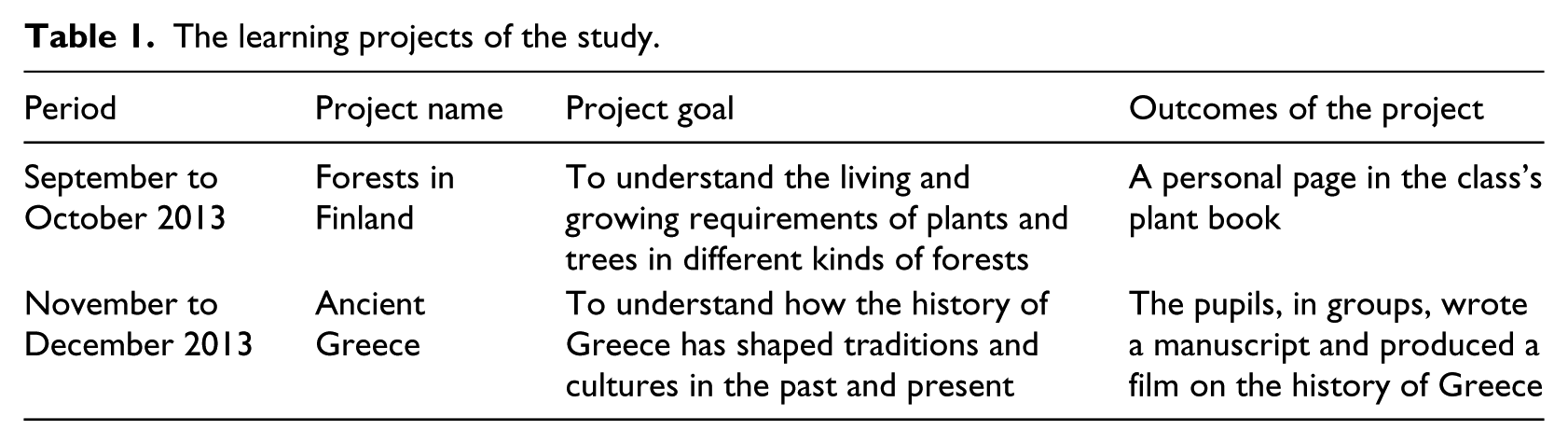
In this research cycle, we had two cameras in the classroom. Each camera was assigned to a pupil for one week. Although only two pupils at a time were instructed to record their experiences of the classroom practices, the other pupils and the teacher also had the right to ask the two pupils to take a photograph of a certain situation. Thus, everybody had the right to document their experiences of the practices, even though they did not have the camera.
At the beginning of the first project, the pupils were informed about diamond ranking. The teacher explained and drew an example of a diamond 9 on the blackboard. She explained that a photograph representing the most positive practice should be placed on the first PowerPoint slide, while photographs of the next two most positive practices should be placed on the second slide. On the third slide, pupils were supposed to place photographs of practices that were medium-level experiences to them. On the fourth slide, pupils were instructed to place two photographs of the practices that were unimportant or uninteresting from their point of view. Finally, on the fifth slide, pupils were asked to place one photograph of the practice that needed the most improvement. These practices ensured that the pupils understood that they also had to take pictures of experiences they did not like and that they knew the teacher expected to receive suggestions on how to improve practices.
At the end of each project, the teacher uploaded the photographs onto the school’s intranet. The pupils then created diamond 9s in pairs on PowerPoint slides for both projects. They were also allowed to add some comments on the slides, but this was not compulsory, as they wrote narratives afterwards. The narratives were written anonymously. The pupils were instructed to share their opinions and to give suggestions on how the teacher could improve those classroom practices that needed the most improvement.
The narratives helped us to understand the ranking of the pupils’ experiences. They gave the pupils a way to explain the meanings behind the photographs. In this sense, the narratives were considered to be a validation tool for photography for the teacher and the researchers (Croghan et al., 2008; Harper, 2003). The students were responsible for their statements and for making suggestions, instead of merely criticizing without providing solutions or better ideas.
During the first project, the pupils took 165 photographs and, during the second, 162 photographs. In both projects, working with the photographs and doing the diamond rankings took about 90 minutes. After diamond rankings, the pupils printed out handouts of the slides and wrote narratives related to the diamonds. In both projects, 22 diamond rankings and narratives were produced.
The data was evaluated and analysed in two phases. The first evaluation was made by the teacher by applying the idea of inductive content analysis (Patton, 2002: 453). The teacher explored all the diamonds and pupil narratives, and categorized the pupils’ experiences into themes. In the second phase, she counted the frequencies of the themes and organized them into the following categories: top, high, middle, low and bottom (see also Clark et al., 2013). The experiences ranked in the bottom rows of the diamonds were discussed with the pupils in order to further develop those classroom practices.
Results
In this section, we discuss the pupils’ experiences of the classroom practices. First, we describe one synthesized diamond (see Figure 1) through story network analysis. In story network analysis, a visual net of the experiences is drawn up and merged to form a new story (Boje, 2001: 63). In this study, the pupils’ experiences that are connected to the net are described through one synthesized diamond. The synthesized diamond also describes the diamond-ranking method and the categories used in the analysis. Second, we present the results of the inductive analysis, which was completed according to the teacher’s pre-evaluation. Then we discuss two different cases, which show how the pupils were able to participate in the process of developing classroom practices through the diamond-ranking activity.
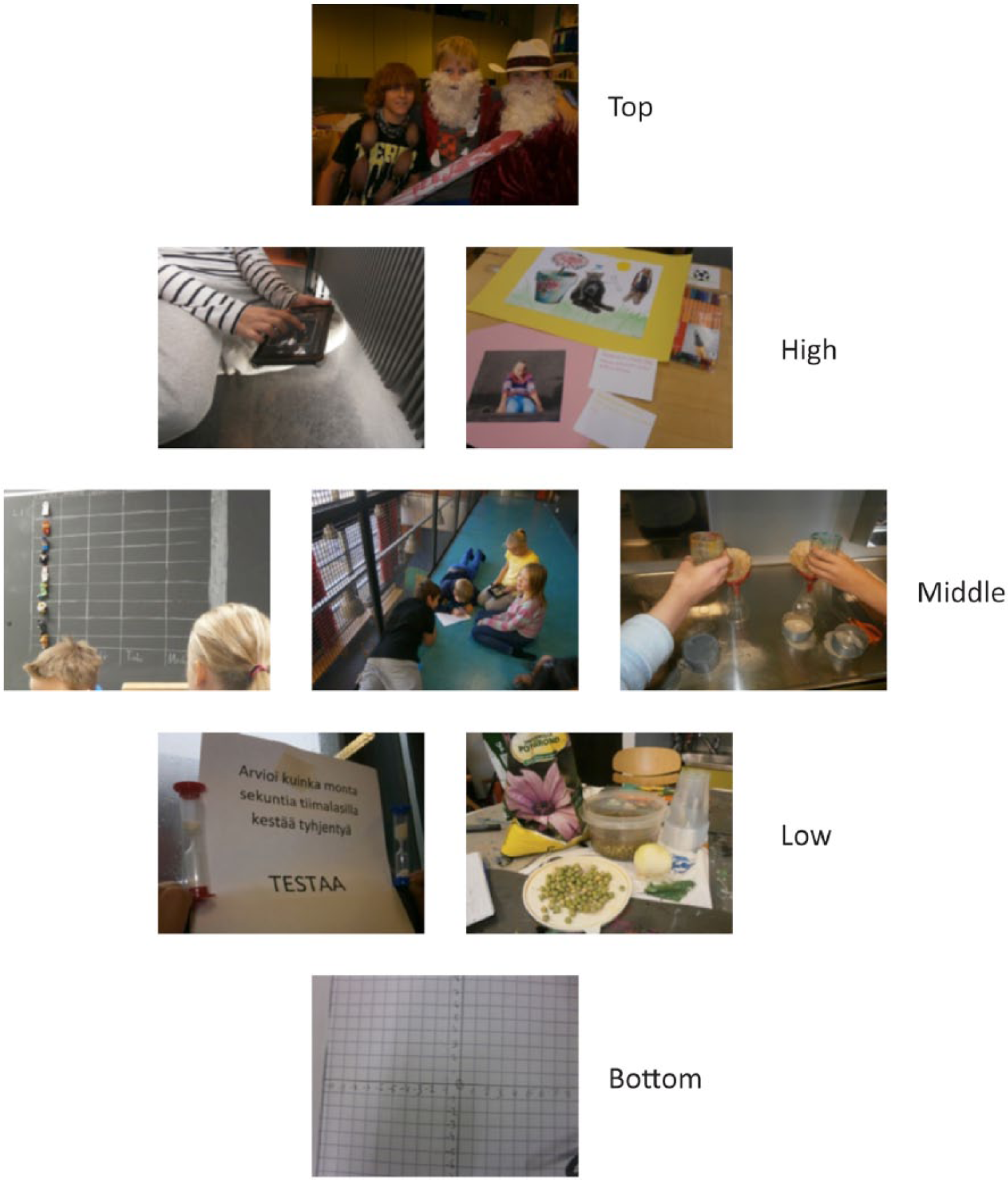
The diamond 9.
Diamond ranking and written narratives as tools to evaluate classroom practices
In both learning projects, the pupils considered drama lessons as the most positive practice. In the narratives of the first learning project, 17 out of 22 pupils ranked drama lessons as their ‘top’ school practice. In the narratives of the second learning project, even more pupils (20 out of 22) ranked drama as the ‘top’ practice. In their narratives, the pupils stated various reasons for choosing drama; these included the games, self-expression, belonging to the class and not having to work with pen and paper. However, self-expression was the most cited reason in the pupils’ narratives: Drama is the best, because you can express yourself. Drama is the first because you don’t have to write down anything, but you can put your soul into the subject. Drama is the best, because I like the games in drama. You can also emphasize different roles and you don’t have to write. Drama is the most important thing to me because you can express yourself in different roles in drama.
While interpreting the pupils’ narratives, we noticed that, in addition to drama, the pupils ranked creative and hands-on activities in the ‘top’ or ‘high’ categories. For example, art subjects, learning games, experiential learning and creative problem solving were ranked in the second row in many cases. However, they were also ranked in the third row in other cases.
In the two learning projects, the pupils ranked experiential learning, learning games and group-work activities in the third row. In their narratives, the pupils expressed their enjoyment of learning by doing: It was nice to research soil, because everyone was able to join in the research. I liked seeing for myself how the plant grows. I liked doing those sense tests myself. It was nice how we studied nutrition [by investigating the nutritional contents on food packages]. I liked taking pictures outside and then gluing the pictures onto the paper. It would have been nice, though, if the teacher had had time to give feedback for everyone.
In their narratives, the pupils also stated that they appreciated working together with their classmates and learning from friends: Station-working in a maths lesson was nice because you were able to learn with your friends and interpret those things together. I liked station-working. I like to work in different groups.
Kaldi et al. (2011) noted that pupils who have become used to project-based learning are less receptive to traditional teaching. In our two projects, the pupils ranked strictly structured activities – for example, a weekly writing task, tasks from a book or working in a notebook – at the bottom of the diamond. In their narratives, the pupils described their experiences as follows: The lowest picture: a weekly writing task. I don’t like to write about history. My suggestion is that we should be able to write more stories. Biology lessons were boring because we only did tasks from the book. We could improve those lessons by doing more plays that relate to biology.
The pupils also ranked situations in which they felt they had to rush to finish their work in the ‘low’ or ‘bottom’ categories: Usually, working in groups is fun, but we did not have enough time. I would have liked to do the task well. I liked station-working, but next time there should be more time.
They also ranked activities in the ‘low’ or ‘bottom’ categories if the task was too easy or too difficult, if the task was not well organized or if they did not find the task meaningful: Why do I have to pour ten decilitres into one litre if I already know that one litre contains ten decilitres? In station-working, you should learn something new from the task and you really should do the task to find that out. Tasks were too easy. Suggestion: more challenging tasks.
Our study revealed similar results to those of Hopkins (2008, 2010). She stated that learning practices requiring active participation are considered important by many pupils. By active participation, she meant learning activities such as scientific investigations, performances, acting, painting and school trips. Like Hopkins, we consider these findings critical to be able to develop school pedagogies in directions that help pupils to enjoy learning and to perform well at school.
However, it is also important to know and understand the activities that pupils find frustrating. In this study, diamond ranking helped us to identify the things that pupils considered inconvenient. The results helped the teacher pay attention to these things in her teaching. Diamond ranking worked well as a tool that expressed critical voices and as an activity that encouraged discussion between pupils. Compared to former studies (for example, Clark, 2012; Clark et al., 2013; Lee and Tan, 2013; Woolner, 2010, 2012, 2014), in this research, the pupils were able to construct the diamond 9s by choosing from 165 photographs. The scheduling of the data-gathering during the normal school day was convenient for the participants. It did not create too much work for the pupils or the teacher, and did not take much time away from other subjects. We also noticed that the more often pupils did diamond ranking and learned the technique, the quicker they were able to finish it.
Narratives were an essential part of the data-gathering process. The narratives were a bridge to the pupils’ deeper meanings. For example, in the first project, station-working was ranked in the third row, while, in the second project, it was ranked in the bottom row. The narratives revealed that it was not the station-working method that was considered inconvenient; the problem was in organization and in tasks that underestimated pupils’ abilities. As Croghan et al. (2008) stated, in order to uncover the phenomenon behind a picture, narratives are essential. Narratives can also be seen as a validation tool for photography for the teacher and the researchers.
Diamond ranking and written narratives as tools to develop classroom practices
Case 1: weekly writing task
The pupils were required to complete a weekly writing task in the classroom. They had to write at least 20 sentences. In the 5th grade, most of the topics are related to history because it is a new subject. The teacher used the weekly writing task as a tool for learning history and writing in Finnish.
In the first narratives, the weekly writing task was ranked mostly (7 out of 22) in the bottom row. Only two pupils ranked the weekly writing task in the ‘high’ category; they did so because they liked to hear others’ stories. The negative statements, meanwhile, related to the topics of the task and how much work the task created: A weekly writing task takes too much time. Could it be only 15 sentences? I don’t like weekly writing tasks. Sometimes I just can’t figure out anything from the topic you have given. My suggestion is that we could write every other week or once every three weeks.
After the teacher had seen the diamonds and evaluated the first narratives, she brought up this topic in the classroom. The pupils and the teacher discussed what to do regarding the issue. For the teacher, it was important that the pupils did their writing; however, the issue was how to make it more convenient for the pupils. In a joint discussion, the pupils suggested that they be allowed to choose to do it with a pen and paper or on the computer. They also suggested giving the class more topics to choose from. They expressed their wish to write about more personal things, which only the teacher would see; these would not be shared with other pupils. The teacher changed the format of the weekly writing task according to the pupils’ wishes.
In the second diamond ranking, the pupils ranked the weekly writing task only twice. In these cases, it was ranked in the second row. The pupils explained that the task was ‘nice’ and that they were able to choose whether to write with a pen and paper or on the computer.
Case 2: notebook exercises in mathematics
In the mathematics lessons, the pupils were first guided to complete tasks from the maths book. After those tasks, they were able to choose whether to challenge themselves and solve difficult problems in groups or to do extra pages from the maths book. In the second diamond ranking, the pupils ranked notebook exercises (12 out of 22) as the practice that should be improved. In particular, doing tasks out of the maths book and using notebooks for those tasks were strongly criticized by the pupils: Notebook exercises are frustrating. That could be improved so that, for example, in maths, we could have a joint notebook with a group of pupils and we could solve problems together in that notebook.
After the teacher had seen the second diamonds and evaluated the second narratives, she brought up this topic in the classroom. The pupils and the teacher discussed what to do regarding the issue. For the teacher, it was important that the pupils completed tasks during each maths lesson. In a joint discussion, the pupils and the teacher made new rules for the maths lessons. After the pupils had completed the basic tasks in the book, they could choose one of four tasks: (1) to solve in pairs the book’s notebook tasks in the lobby, instead of working alone in the classroom; (2) to skip the notebook tasks in the book and try to solve a challenging task created by their teacher; (3) to plan a maths game or other activity on the topic for all the pupils to solve; or (4) to solve the tasks in the maths book.
Because all of the pupils had already participated in data-gathering, the teacher did not start a third round of data-gathering to see how the pupils would have ranked notebook exercises after this case. From the teacher’s perspective, the activity level of the pupils in the maths lessons increased. When they had permission to choose one of the four options, the pupils completed more tasks in the lessons than they had before. Some pupils also started to score higher in maths tests – especially in problem-solving tasks – after the introduction of this new arrangement.
McIntyre et al. (2005) stated that teachers only easily accept those pupils’ suggestions to improve classroom practices that are already in the teachers’ repertoire. This study shows that the diamond-ranking activity, together with written narratives, can help the teacher engage with pupils to change practices in the classroom and genuinely take into account pupils’ suggestions. These elements are considered important when thinking about opportunities for pupils’ agency (see, for example, Gresalfi et al., 2009).
Conclusion
In Article 12 of the United Nations Convention on the Rights of the Child, it is stated that a child shall, in particular, be provided with the opportunity to be heard in any judicial and administrative proceedings affecting the child, either directly or through a representative or an appropriate body, in a manner consistent with the procedural rules of national law. What does it mean for a child to be heard when it comes to schools and pedagogical practices?
In this article, we have described one way to develop the pedagogical practices of a classroom together with pupils. Action research provided the methodological starting point, and the data was gathered in two learning projects. The teacher used photography, diamond ranking and written narratives as techniques to provide the pupils with a mediating tool to document and express their experiences. Our research provides new information on how to implement the diamond-ranking activity in the classroom. Specifically, it provides an alternative way to harness a diamond-ranking activity in the classroom that recognizes pupils’ active agency and sense-making.
These results could be useful in pre-service teacher training and in-service teacher training around Europe as an example of regular school-day practices that pupils can participate in to develop school pedagogy together with their teachers. The method was easy to integrate into the everyday practices of the classroom, and its use did not require additional resourcing. As the method is not specific to any subject or economic situation, it can be considered as a potential method to be used in any European classroom that is committed to promoting students’ active agency in learning and teaching.
In this research, drama lessons and other creative school tasks were the practices that were most appreciated by the pupils. These findings are consistent with those of previous studies on project-based learning and participatory learning (Hopkins, 2008; Kaldi et al., 2011; Niemi et al., 2014a, 2014b). Diamond ranking also worked well as a tool to promote critical voices. In the two projects, the pupils ranked strictly structured activities – for example, tasks from a book or notebook exercises – at the bottom of the diamonds. This supports the results of Kaldi et al. (2011), who reported that pupils who have become accustomed to project-based learning become less receptive to traditional teaching. The pupils also ranked in the low or bottom rows the practices related to situations where they felt they had to rush to finish their work. They also gave low rankings if the task was too easy or too difficult, if the work was not well organized or if they did not find the task rational.
The diamond 9s were implemented on PowerPoint slides from 165 photographs. The method used was a new way of doing diamond ranking. We noticed that the more often the pupils did diamond ranking and learned the technique, the quicker they were able to complete it. Similar to other studies (for example, Baumfield et al., 2013; Clark et al., 2013; Woolner et al., 2010), ours also shows that diamond ranking is a good tool to encourage discussion. However, it is essential to have written narratives as part of the data in order to gather ideas and deepen the interpretations of the diamonds.
An action research study should result in favourable changes to classroom practices (Heikkinen et al., 2007). In this study, our results show that diamond ranking, together with written narratives, worked well as a tool to capture pupils’ experiences of classroom practices. It provided each pupil with an opportunity to participate in the process of gathering and analysing data, and, in turn, to develop classroom practices. Diamond ranking supported the outcome of different kinds of experiences. Our study shows that, in written narratives, most of the pupils stated their opinions and gave the teacher suggestions on how to develop practices. Only a few pupils identified practices they did not like. The pupils’ narratives show that they were taking responsibility for classroom decisions and practices, which is an important part of agency (Edwards and D’Arcy, 2004).
For some pupils, however, written narratives appeared to reduce their expressiveness. It would have been beneficial to interview either all of the pupils or those who had problems with writing. Interviews would have allowed us to deepen our interpretations and to understand the meaning of each photograph more explicitly. Furthermore, interviews would have also given the pupils a better possibility to reflect questions related to the use visual methods and voicing: how we can see the pedagogy of the classroom, how we are allowed to see the pedagogy of the classroom, and how we are made to see the pedagogy of the classroom. These elements can be seen as weaknesses in this study, but they can also be seen as results that can help educational researchers in other European contexts to improve the method in new directions.
As Moore et al. (2008) stated, it is important to engage pupils in improving the issues that affect their lives. This study provides promising results on using photography and diamond ranking as tools to increase pupils’ participation and agency in schools.
Footnotes
Acknowledgements
The research reported in this article is part of AGENTS research project that is financially supported by the Academy of Finland, SKIDI-KIDS research programme [Project no. 135138].
Declaration of conflicting interest
The authors declare that there is no conflict of interest.
Funding
This research received no specific grant from any funding agency in the public, commercial or not-for-profit sectors.