




Abstract
Schools as learning communities have been recommended by the European Commission as an effective model to support school quality and development. Aiming at studying how these schools are achieving such positive results, this article focuses on the analysis of a particular classroom intervention called ‘interactive groups’. A five-year longitudinal case study has been conducted in a socio-economically deprived urban school under the European Union-funded large-scale research project INCLUD-ED: Strategies for Inclusion and Social Cohesion in Europe from Education. Descriptive and interpretative analysis was conducted based on quantitative indicators on school performance in mathematics and including qualitative data from classroom observations and interviews with pupils, parents and teachers. Particularly, the authors aim to explore in which ways and under which conditions dialogic interactions take place in culturally diverse small groups when doing interactive groups in mathematics. Data on school performance in mathematics shows a sustainable improvement over time. Families, teachers and students seem to link the interactions in interactive groups with an improvement in their relationships in the school and in the community. The authors conclude that the dialogical approach identified in interactive groups among students, teachers and parents improves students’ achievement and increases the potential of community-based mathematical interventions in primary classrooms. Lessons learned from this study have informed educational policies in Europe.
Keywords
Noah has been out of school for four years. 1 His family left Senegal when he was a baby. He started early childhood education in Spain but, when he was five, his family was forced to go back to his home country. Then, Noah became one among the 57 million children in the world without access to basic education (UNESCO, 2013). There was no schooling available for Noah in his hometown and he spent most of the time helping his grandparents at home. When he was nine years old, it started all over again. His parents, with no formal education and very poor Spanish, decided to travel again, and managed to settle in the same place and send Noah back to the same school. Noah was not a baby anymore – he had grown up and many other things had also changed in his former school by then. It was a highly multicultural school – more than 70% of the children had come from other countries – but the school faced diversity as an opportunity and implemented effective interventions.
Within this context, children are not placed by ability or excluded from the regular classroom. From the very first day, Noah has been included in the mathematics lesson where all of the children are organized in small mixed-ability groups – they do interactive groups (IGs; Valls and Kyriakides, 2013). Surprisingly, an adult who can be a teacher, a family member or a volunteer from the community coordinates each small group. Noah has joined a group with two girls and a Roma boy, Manuel, who has been his best friend ever since. Manuel explains to him their need to efficiently solve the problem together, quickly and supporting each other, because they only have 20 minutes before moving to another table and devoting time to another activity with another volunteer. Noah finds this quite challenging, but Manuel has never left him behind. At the end of the academic year, Noah has made enormous progress and has almost reached the expected curricular level for his age. Beyond accessing education, the teachers and communities are committed to providing high-quality teaching and learning for all in the classroom and beyond. It is a school that works as a ‘learning community’.
There are more than 190 schools working as learning communities in Spain, Brazil, Peru and Mexico. This model – schools as learning communities – has been proven to create favourable conditions for helping every single child to succeed by increasing the commitment of pupils, teachers, parents and other stakeholders. By taking a whole-school approach, the entire community develops a common vision and basic values to support school quality and development. All agree together on the implementation of successful educational actions – those strategies that have led to better results in many diverse contexts. IGs are one of those successful educational actions identified under the only research project in socio-economic sciences and humanities selected by the European Commission as a success story in Europe – INCLUD-ED: Strategies for Inclusion and Social Cohesion in Europe from Education (FP6, 2006–2011) (European Commission, 2011). The main findings of this project have informed policies and educational practices across Europe, and have created a new educational context oriented towards transforming the classroom, the school and the community. As a consequence, several European Union institutions – the European Commission, the European Parliament and the European Council, among others – have already recommended this model for preventing early school leaving as a priority in European Union strategy by 2020 (European Council, 2011).
Learning communities are based on the dialogic participation of all members of the community, including teachers, students, families and other agents (Flecha and Soler, 2013). This theoretical framework is aligned with many decades of research that has provided evidence of the benefits and challenges of dialogic learning and teaching to improving students’ performance and social and emotional development in the school (Alexander, 2006; Anderson et al., 2001; Gómez et al., 2014; Mercer and Howe, 2012; Rojas-Drummond and Mercer, 2003; Wegerif, 2011). Children’s performance in literacy and science improves through dialogic and interactive teaching when implementing effective collaborative group work (Galton et al., 2009). Then, there is a consensus on the fact that putting children into groups is not enough to improve their results. Research in education and psychology has explored how to make the most of interactive and dialogic teaching and learning: which are the best contexts and under which conditions can dialogic interactions occur? And – even more relevant to us – how far may (or may not) these kinds of interactions have an impact also beyond the classroom or even beyond the school walls? We argue that there is a potential benefit in schools as learning communities to extend dialogic interactions beyond the classroom and affect social relationships in the community. This article aims to analyse how the implementation of IGs in mathematics affects children’s interactions, leading them to improve their mathematical achievement.
In order to address this main objective, a longitudinal case study has been conducted in an elementary school in north-eastern Spain. Particularly, we examine (1) in which ways and under which conditions dialogic interactions take place in IGs, and (2) how far the implementation of IGs in mathematics has led to an improvement in performance and school–community relationships. First, a sociocultural account of learning and development is described as part of the theoretical framework. Second, the research site and methods used are presented in detail. As a result, a detailed vignette of a dialogic interaction between two target pupils is discussed and followed by quantitative data on children’s performance in mathematics over time. The final conclusions and discussion are consistent with previous research on classroom dialogue and interaction, and contribute to advancing knowledge that informs policies and practices in Europe.
Theoretical framework
Learning, as discussed by Vygotsky (1978), Seve (1978) and Wertsch (1985, 1993), emerges from social interactions that have been internalized by individuals. Often, everyday practices show the sociocultural origin of learning and development. Tharp and Gallimore exemplified this with an ordinary child–father interaction: A 6-year-old child has lost a toy and asks her father for help. The father asks where she last saw the toy; the child says, ‘I can’t remember.’ He asks a series of questions: ‘Did you have it in your room? Outside? Next door?’ To each question, the child answers, ‘No.’ When he says, ‘In the car?’ she says ‘I think so’ and goes to retrieve the toy. (Tharp and Gallimore, 1988: 7)
The knowledge about ‘where the toy is’ emerged as a result of the help provided by the father through dialogue with his daughter. This example illustrates Vygotsky’s (1978) approach to the role of interaction in the development of higher psychological functions. Based on his studies, the Russian psychologist proposed the critical concept of the ‘zone of proximal development’ and defined it as ‘the distance between the actual developmental level as determined by independent problem solving and the level of potential problem solving as determined through problem solving under adult guidance or in collaboration with more able peers’ (Vygotsky, 1978: 86). Although this contribution has inspired decades of research on the sociocultural approach to learning and development, the part that appeals to us is the emphasis on ‘adult guidance’.
Later research confirmed that interactions (and the nature of these interactions) are central to understanding how learning takes place. Bruner used the notion of ‘scaffolding’ as a metaphor to describe and analyse how the expert ‘tutor’ (who may be a teacher, a parent, a more able peer, etc.) can support children in their learning process (Wood et al., 1976). According to Bruner (1978), the person who is playing the role of ‘tutor’ is guiding the child to focus his/her attention on the task, helping him/her with directions, in order to reduce the number of steps required to solve the task. Somehow, the ‘tutor’ calls the child’s attention to the key issues required to solve the task and helps him/her not to get frustrated when not succeeding. Rogoff (1990) further elaborated this concept with the notion of ‘guided participation’. According to Rogoff, cognitive development fits in a process framed by guided participation and appropriation. When children are solving a task, they do interact with other peers and adults. In these interactions, adults or other children guide them to find solutions. In this process, what happens is that these children somehow ‘appropriate’ the skills and understandings from those who are providing the adjusted guidance and support.
Later studies have demonstrated Rogoff’s assumptions in the case of mathematics. Yackel et al. (1991) observed how guided discussion in small-group problem solving led teachers of mathematics to build cooperative learning environments for children to solve mathematical problems. They analysed episodes of children’s learning and highlighted the crucial role that intersubjectivity has in order to understand how students solve tasks. This study contributed to opening up research in mathematics education, which was dominated by the radical constructivist approach (Von Glasersfeld, 1995). Lerman (1996) claimed that Cobb et al.’s (1992) results pointed out the need to incorporate the social approach into the individual-centred perspective of cognitive processes in mathematical learning (Beth and Piaget, 1974; Kamii, 2000). Constructivist studies were less likely to explain fully how children build their understanding of mathematical cognitive structures, without taking into account dialogue and communication. For this reason, Lerman (1996) expanded the concept of ‘intersubjectivity’, following Leont’ev’s (1981) and Vygotsky’s (1978) previous works. Lerman particularly builds on the premise that learning emerges as a result of a process of internalization which cannot be understood from a social perspective based on intersubjectivity because ‘the process of internalization [of knowledge] is not the transferral of an external to a pre-existing, internal “plane of consciousness”; it is the process in which this plane is formed’ (Lerman, 1996: 136; quoting Leont’ev’s work).
While exploring intersubjectivity in learning mathematics, Lerman recognized that learning as explained by Piaget and his followers needed to be reconceptualized, incorporating the role of interactions. When a child reorganizes his/her cognitive structures (as an answer to a cognitive conflict), this happens because s/he is in a dialogic process in which s/he exchanges his/her point of view with other persons, and then s/he reorganizes (or creates) a new explanation for a particular concept as a result of the interaction with these persons. Hence, interaction appears to be a crucial element in this process. Elbers and Streefland (2000) illustrated this psychological process within their research conducted on students working collaboratively to find out the height of a tower. Micha, Patrick, Demi and all the students participating in the sequences described by the authors discussed how to use the tower’s shadow to figure out its height. Some of them started the lesson thinking that there was an invariable relationship between the shadow and the tower, and thus the shadow ‘should be’ around twice as long as the tower. However, the teacher asked for further clarification and Saskia, another student engaged in the discussion, put forward the argument that the tower’s shadow depended on the position of the sun. Following this claim, Bart, another student, entered the discussion and introduced another idea, which was to use a strip of wood to compare the scale of the shadows of the tower and the strip of wood in order to figure out the tower’s height. Drawing on arguments based on validity claims, the students were posing and refuting statements in order to explain how to measure the height of the tower. Dialogue became a natural way for them to understand Thales’ theorem.
This links to Mercer’s concept of the ‘intermental development zone’ (IDZ), which moves the focus of the learning process into the communicative and dialogic components. As he writes: This concept is meant to capture the way in which the interactive process of teaching-and-learning rests on the maintenance of a dynamic contextual framework of shared knowledge, created through language and joint action … The concept of the IDZ focuses on the nature of the communicative process whereby the ‘vicarious consciousness’ of Bruner’s conception of ‘scaffolding’ is actually realized; and unlike the original ZPD [zone of proximal development], the IDZ is not a characteristic of individual ability but rather a dialogical phenomenon, created and maintained between people in interaction. (Mercer, 2000: 42)
This approach coincides with relevant contributions in the field of dialogicality, situated in the literature of critical pedagogy. Freire (1970) used the concept of ‘dialogic action’ to explain the power of dialogue for the development of critical consciousness, freedom and autonomy, as well as meaningful understanding to transform thinking through action. Flecha (2000) further developed this idea and proposed seven principles as the basis of his concept of ‘dialogic learning’. According to Flecha (2000), learning emerges from egalitarian dialogue, meaning that participants in the interaction use dialogue to justify their arguments, drawing on validity claims rather than their power position. Interactions within IGs draw on these types of claims. Learning arises from this process of interaction, as a result of the effort learners make in order to find the right argument (the one that fits with the real world and provides a true explanation).
The sociocultural theory, along with contributions from critical pedagogy, provided the framework for an exploration of the interactions that take place at the classroom level and beyond. We argue that transformative human nature is embedded in this theoretical framework. Vygotsky (1978) also claimed that, in order to encourage children to learn, it is necessary to transform their context of interactions. If we assume that learning and development occur as a result of peer-to-peer and adult interactions, we need to ask whether or not all types of interactions are equally effective. With the aim of exploring classroom interactions in a particular intervention – IGs – our research questions are: (1) In which ways and under which conditions do dialogic interactions take place in IGs? (2) How far has the implementation of IGs in mathematics led to an improvement in performance and school–community relationships?
Methodology
The study reported here is part of European Union-wide research conducted between 2006 and 2011 – INCLUD-ED: Strategies for Inclusion and Social Cohesion in Europe from Education – whose main objective was to analyse actions that promote social inclusion and those that lead to social exclusion. For this article, we discuss one of the 27 case studies conducted across Europe: the Spanish case, focused on La Magnolia elementary school. This school met the selection criteria to be part of the project: it served students with a minority background and low socio-economic status; it demonstrated that it was contributing to students’ academic success – in relation to other schools in a similar social situation; and it relied on strong community participation. The school had been working as a learning community for eight years when we conducted the study.
Research site
The school is located in a deprived urban area in north-eastern Spain. Demographic data shows high rates of immigration, which has increased during the last decade because of its social and geographical conditions (low-cost accommodation, lack of services from the city council, etc.). Being in a very challenging situation (with low performance, high rates of school failure and dropout, behaviour problems, and difficulties among teachers and families), the school looked for solutions to improve children’s learning and attainment, as well as their social development and relations with the community. It was in 2001–2002 when teachers proposed to transform the school into a ‘learning community’. This process started with intensive training – a series of workshops – delivered by researchers and practitioners on the theoretical and research basis of the project, as well as the procedures to implement IGs. By introducing this innovation, the school aimed to raise children’s performance and improve social cohesion.
Data collection
With the aim of exploring one particular intervention of the school – IGs in mathematics – the data reported in this article includes classroom observations and semi-structured interviews. These are a subset of the entire data set collected for the case study. Accounting for its limitations, we include here the relevant data for the aim of this article: (a) five classroom observations of IGs in 5th-grade mathematics – the four target children included a Roma boy (Manuel), an African boy (Noah) and two girls (Maria and Lorena) – and (b) seven semi-structured interviews, which were conducted in the school in order to explore their learning experience in the IGs – these involved the target children, their teacher (Sara) and two immigrant mothers who volunteered in the IGs (Maria Elena and Aysha).
The IGs took place once a week. The teacher always organized the activities for the volunteers to facilitate students’ interactions. An observation protocol was designed to observe the children’s interactions in the IGs. Two researchers conducted one observation every two weeks and video-recorded the target group of children. One researcher followed the target children during the whole session. The other researcher observed the dynamics of the class. At the end of each session, the researchers discussed the observations with the teacher and the volunteers – whenever it was possible – in order to also include their perspectives and impressions.
The interviews with the teacher and the volunteers were audio-recorded. An interview script was designed to conduct the semi-structured interviews, including questions regarding the changes they had experienced in their relationship with the children, and between teachers and families, since they had started to implement IGs in mathematics.
Data on the school’s performance was collected, particularly the children’s progress in mathematics, and both the internal school data and the standardized assessment tests since the introduction of IGs in mathematics. The school data was reviewed against the regional average performance in mathematics.
Data analysis
In this article, we discuss the results from two levels of analysis: (1) descriptive, based on evidence provided by the quantitative indicators, and (2) interpretative, based on the analysis of the qualitative evidence. Regarding this second level of analysis, we focus the unit of analysis on the interaction. We study the interaction from the observation and analysis of the communicative acts (Soler and Flecha, 2010) that occurred between the people observed. Indicators of these communicative acts arise either within the framework of the interaction or in the analysis of the dialogue (using interpretative discourse analysis techniques, including the coding and categorization of the dialogues recorded in the interviews and focus groups), or through the analysis of the classroom situations that were video-recorded. The three types of talk defined by Mercer (2000) – cumulative, disputational and exploratory – inform the definitions of our coding scheme to identify which interactions foster learning and which do not. According to Mercer (2000: 42), disputational talk ‘is characterised by disagreements and individualised decision-making, and short assertions and counter-assertions’; cumulative talk refers to when ‘speakers build positively but uncritically on what the other has said; it is characterised by repetitions, confirmations and elaborations’; and exploratory talk takes place when ‘participants engage critically but constructively on each other’s ideas, offering justifications and alternative hypotheses. Knowledge is made publicly accountable and reasoning is more visible in the talk and progress results from the eventual agreements reached’.
Taking as a starting point this characterization of talk, we have defined three situations that may occur in a process of interaction, where ‘argumentation’ is or is not present (see Table 1).
Type 1 resonates with what Mercer (2000) calls disputational talk and it could also be linked to cumulative talk. This is the case of dialogues in which people do not elaborate or rely on reasoning or argumentation – they merely repeat or memorize collections or words, rules, instructions, etc., using statements that are only declarative or informative. Irrespective of whether the talk is characterized by assertions or counter-assertions (disputational talk), or repetitions or memorizations (cumulative talk), it will not move towards a higher psychological function (as defined by Vygotsky), hence there can be no kind of evidence of learning with understanding. Instead, the learning emerging from these interactions may be mechanical, based on repetition and memorization.
Type 2 may involve a process of argumentation, but it is limited. Again, it could either be recognized as disputational talk or be linked to cumulative talk. The definition of these interactions relies on Habermas’s (1984) categories, presented in the first volume of his Theory of Communicative Action, where he introduces the elements of the theory of argumentation. According to Habermas, there are speech acts governed by arguments drawn from power claims. Interactions based on this type of language use are those that we include within this category. We therefore argue that this category is not entirely dialogic.
Type 3 does involve reasoning and argumentation. It corresponds roughly with Mercer’s (2000) concept of exploratory talk, but understood from the basis of Habermas’s (1984) theory of argumentation. In this case, the individual uses language as a mediator of the interaction, using arguments drawn from validity claims. Here, the individual enacts higher psychological functions: s/he has to look for a valid argument to justify his/her statements when talking (solving, etc.) about a task, problem or situation. As we found in the work of Vygotsky (1978) and later authors (Pea, 2001; Polya, 1945), the effort of looking for a valid argument to solve a cognitive challenge within a task is what produces learning. For this reason, of the three types of interaction that we propose here, this is the one that works as an indicator that there is a process of learning with understanding. This type of interaction corresponds to dialogic interaction.
Types of interaction.
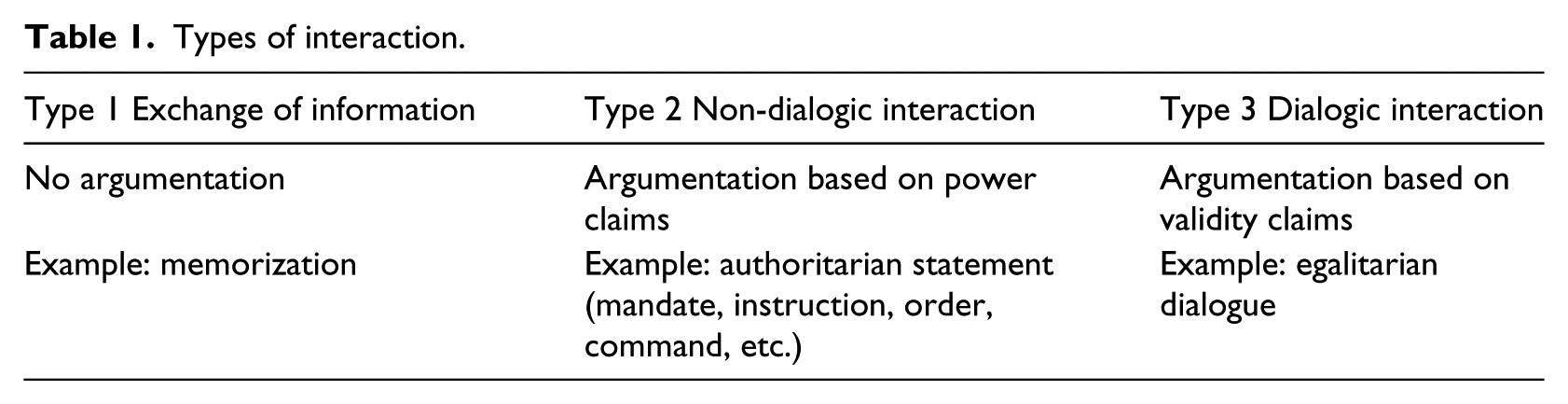
Drawing on these levels of analysis (descriptive and interpretative), we discuss evidence to justify that Type 3 interactions may improve both children’s academic performance and the sociocultural context of the school, looking forward to answer our two research questions pointed out at the beginning of this article.
In order to address the internal validity and reliability (Merriam, 1995) of the study reported in this article, we used triangulation of the data collected (Denzin, 1970; Mathison, 1988), as well as member checks and peer/colleague examination (Merriam, 1995). The coding and data analysis were conducted communicatively and included the participants in the study (Mertens and Sordé, 2014). This communicative approach accounted for the inclusion of the voices of all of the participants involved in the study. Once we had drafted our preliminary results, we summarized the main findings and contrasted our contributions with those of the participants. The school organized an open meeting for the families and other people involved in the school in order to present and discuss our main results. The participants at the meeting contributed with their experiences and knowledge about how IGs worked in the school, the extent to which this practice led students to learn mathematics and the challenges encountered. Subsequently, we conducted a second round of individual meetings with the four target children, the teacher and the two mothers.
Results
IGs and the improvement of students’ performance in mathematics
IGs are a dialogic learning environment where children have multiple opportunities to support others in moving across their zone of proximal development through egalitarian dialogue (Flecha, 2000). IGs are a way to organize children within the classroom, characterized by the following aspects:
Children are grouped in small mixed-ability groups that are as diverse as possible (with five or six children in each group).
A volunteer (a teacher, any other adult from the community or a former student) facilitates the interactions in the groups in order to successfully solve the task through egalitarian dialogue.
In each session devoted to IGs, the children complete as many activities as the groups of children. The members of each group solve one activity each time. The problems to be solved are ‘short’ (taking 15 to 20 minutes each). After the time established by the teacher is over, the volunteer moves from one group to the next in order to facilitate the same activity s/he conducted in the previous group. 2 Thus, over the entire session, all of the children perform all of the activities (Valls and Kyriakides, 2013).
According to Mercer’s (2000) approach, since dialogue is the means by which learning occurs, the IDZ concept actually better captures the dynamics that are occurring in children’s interactions. In Figure 1, we can observe how Manuel – the boy at the front of the photograph – is explaining to Noah – the boy who is looking at the sheet of paper – how to solve a division algorithm. Manuel has finished his work while Noah is still working on the problem. Noah has never studied the basic arithmetic operations before, including aspects such as times tables, for example, because of his personal life trajectory.
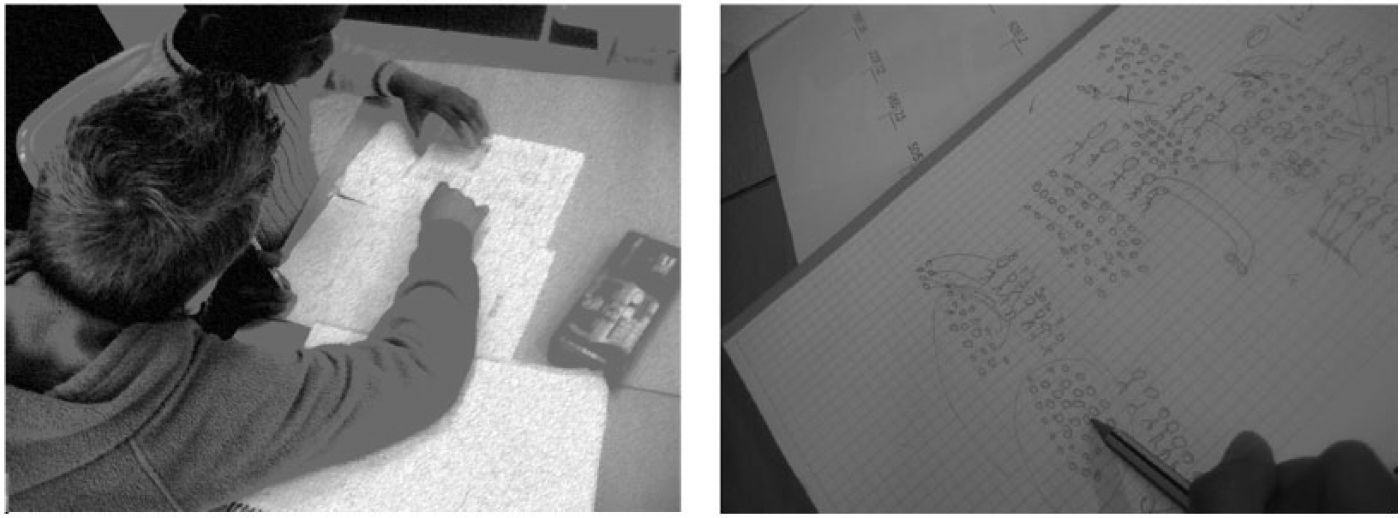
Manuel explains the division algorithm to Noah.
In the situation illustrated in Figure 1, Noah is dividing 21 by 7. In the sequence, Manuel is not giving Noah the answer, but is helping him to solve the task, not by using the algorithm based on the place value (which is what he used in his notebook and what the teacher taught them), but by using symbolic representations (drawings) based on the algorithm of distribution. Noah is actually distributing 21 dots among 7 persons (note that, in the drawing, each person has a capital letter above their head, indicating that the drawings may correspond to real children in the classroom – it is possible that this way would be more meaningful for Noah, who may identify each drawing of a person with a real person in the classroom, which translates the problem into a real distributive situation). In the sequence, Noah does not draw the dots first, but begins by drawing the people. He then draws dots beneath each person until he reaches the required number (21 in this case). Throughout the whole process, Manuel sits close to Noah, supporting him with his explanations about how to group the dots, etc.
Manuel is using talk in an exploratory way. He does not provide Noah with the answer to the task. Instead, he is providing guidance (‘scaffolding’ in Bruner’s terms) to Noah in order to help him distribute the dots correctly among the seven persons drawn on his sheet of paper. Somehow, in this episode, it can be observed that a process of reciprocal teaching (Pea, 1993) is taking place between Manuel and Noah, because both Noah and Manuel are learning and consolidating their understanding about division. Noah is learning what division means by drawing on the use of the distributive algorithm; Manuel is challenged to find an alternative algorithm in order to guide Noah in his work, since Noah does not know his times tables yet. The intelligence required to understand the division algorithm is distributed across these two peers. They use symbols (drawings of children and dots) as mediators to support their arguments (which are based on validity claims rather than power claims).
This episode leads us to identify an example of dialogic interaction (Type 3), as defined above. The drawings act as external symbolic representations, which mediate the cognitive process of learning through this situation of egalitarian dialogue (Flecha, 2000). Manuel, with his guidance, is distributing the knowledge needed to understand the division algorithm with Noah (Rogoff, 1990).
These interactions affect children’s mathematical self-confidence and self-efficacy. The two girls in the group (Maria and Lorena) declare that their expectations about mathematics have changed substantially since they have been engaged in the IGs:
Now I am becoming smart in mathematics.
Our heads are full of numbers; I know everything now! You can make a test tomorrow, and you will see: we know everything!
The positive attitudes towards mathematics, and self-confidence and self-efficacy according to the children’s interviews, are consistent with the achievement data retrieved from the standardized assessment tests in the school analysed. This positive trend in terms of students’ mathematics performance contrasts noticeably with data from Catalan schools. According to data provided by the Catalan Institute of Statistics (Idescat), in Catalonia, the children who get lower grades in mathematics are immigrants (53.8%, compared with 22.7% of native students getting ‘low grades’) 3 . This data provides a general overview of Catalan students’ performances in mathematics. The explanation for these results has been attributed to the children’s immigrant background: because they do not know Catalan (the language of teaching in the region), some researchers and policy makers thought that the immigrant children were unable to understand the text of the problems, and therefore did not respond correctly in the assessment tests (Sanmartí and Sardà, 2007). In contrast, the pupils’ attainment data at the school studied here does not follow this pattern (see Figure 2).
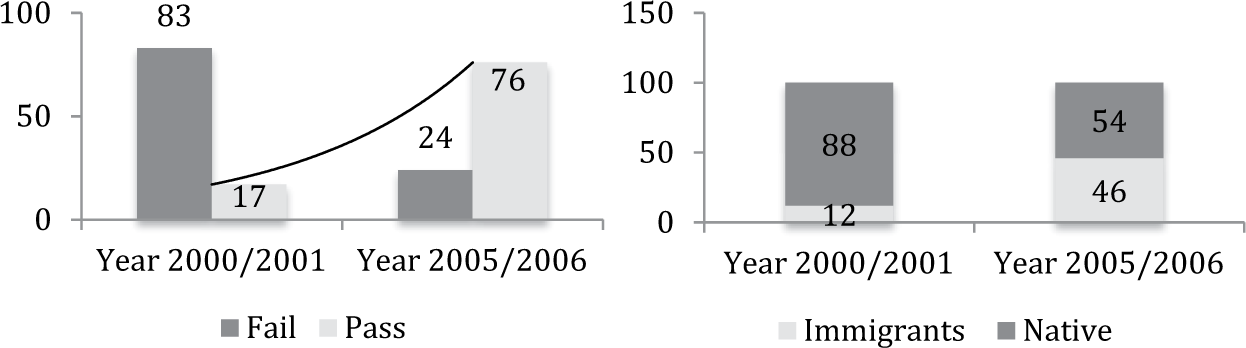
Pupils’ attainment in mathematics versus the percentage of the immigrant population (students enrolled) at La Magnolia school.
The data shows that while the percentage of immigrants increased in the school (from 12% to 46%) in a five-year period, at the same time the achievement in mathematics, rather than decreasing, increased dramatically. During the 2000–2001 school year, only one child in four was able to pass the mathematics assessment test. Five years later, during the 2005–2006 school year, three out of four children succeeded. The difference between this school and the rest of the schools in Catalonia is that teachers use IGs in this school. This is not an isolated case. Data from other learning communities with similarly low socio-economic and minority backgrounds also indicates the same pattern. This data suggests that IGs may play a significant role in improving students’ mathematics learning (analysed in terms of students’ achievement evidence).
In addition, we also found a certain impact looking at the data collected from a ‘subjective’ point of view – asking the students about their feelings regarding the IGs. In this sense, the children’s evaluation of the IGs is positive. Maria, for instance, one of the 10-year-old girls in the target group, reported her positive attitude in the interview: ‘I like IGs because we work more’. Similarly, Lorena, the other girl in the group, pointed out that working in the IGs made them work better: ‘I prefer IGs because we work better when we are together. It’s much more fun!’ Lorena explained that when the children are working within IGs, they can help each other (as seen in the case of Manuel and Noah), and this leads them to learn better. These types of comments suggest that the children feel that their participation within IGs contributes to improving their learning. This is something that coincides with the results found in the data about mathematics achievement that we have collected and discussed over the course of this article.
Transformation of the interactions beyond the classroom
In the sequences that were video-recorded during the sessions, we not only observed children interacting with each other, but also saw parents and other volunteers encouraging the children to justify their answers to the mathematical task set by the teacher. This is the case of Maria Elena, a mother from Colombia who was participating in the IGs as a volunteer. Maria Elena is working with some children in an IG. While children from many different origins are using coins (euros) to solve a set of problems related to rational numbers (presented in decimal notation), Maria Elena says: ‘We have to buy 1 kilo of apples, and it costs 1 euro and 55 cents; and you have to pay them with a 2 euro coin. So, how much [money] do you get back?’
Maria Elena is trying to focus them on the task. She starts to ask the children to give her back the right amount of money according to her question. After each child shows the amount everyone thinks is the right one, she follows up by asking each pupil for their justification. She genuinely challenges the children and positions herself as a co-learner, pretending not to know the right answer. She challenges the children using her own cultural ways of doing and being.
This interaction placed the children in a dialogic stance, since they were requested by Maria Elena to justify their tentative answers in front of their peers, with arguments based in validity claims. Some of the children in the classroom were of Latin American origin, hence they were ‘touched’ by seeing a Colombian woman in their classroom, working with them in the IGs. They were very engaged in the activity, trying to be the ones who Maria Elena was asking to ‘share’ their thoughts about the task.
This episode illustrates how the implementation of IGs opened the possibility for those families who had barely participated in the school to be involved in learning activities. By facilitating children’s interactions in mathematics, women with an immigrant background like Maria Elena, or Aysha, who is a Moroccan mother, committed themselves to the school. Aysha volunteers every week because she feels that her participation fosters children’s motivation: ‘I participate in IGs to support children’s learning in mathematics and, because I’m Moroccan and there are a lot of Moroccan children, my presence has really motivated some of them’. According to Aysha’s experience, her presence in the IGs has positively affected Moroccan children’s motivation towards learning. It seems that her interaction has moved them to take ‘central’ rather than ‘peripheral’ participation in the group (Lave and Wenger, 1991). However, since the IGs are culturally diverse, having minority volunteers has also promoted better intercultural communication, knowledge and understanding among different communities. According to Sara, one of the teachers interviewed: There are Maghrebi mothers who participate on a daily basis in the school and they become a visible and real minority in the community. I think that interaction [between them and non-minority children] brings them [minority mothers and children] closer to some groups with different backgrounds and they have more knowledge of each other.
We argue that the dialogic stance which teachers like Sara facilitate in the classroom while implementing IGs affects the relations between the families themselves and the ways in which they interact. When Maria Elena or Aysha are promoting children’s interactions in a mathematical task, both share a common understanding: improving all of the children’s learning and behaviour, regardless of their cultural differences. Then, the dialogues among them continue beyond the classroom with similar ground rules. According to Aysha’s experience, since she started to participate, supportive relationships and trust have been developed and reinforced in the community: Many people in the community have been sharing knowledge and life experiences, food, and so on. Now we can see Spanish people looking after Moroccan children or Senegalese children and bringing them to the school, or the other way round. The mums who work away from home have the support of other Moroccan or Senegalese women, who pick the children up. There is a starting point and there is already good social cohesion in that sense.
Families link this fostered social cohesion with their participation as volunteers in the school, particularly the mothers and grandmothers who participate in the IGs in mathematics, as we have presented above. They have created a ‘volunteers mixed committee’ and mobilized community members’ participation within the school. People who have never talked to each other before are now sharing their experiences within the IGs. At the same time, they are encouraging the children to interact with each other in order to learn mathematics. The cohesion in the classroom and in the school has increased at the same time as the children have become more focused on working and learning mathematics. The parents are also very happy to attend the class once a week. Some of them have started to participate in other school spaces as a consequence of their volunteering in the mathematics IGs. The persons attending the IGs are very positive about children’s learning. Data collected two years after implementing the IGs in mathematics suggests that the families’ and volunteers’ perceptions about improving mathematics achievement are very positive (see Figure 3).
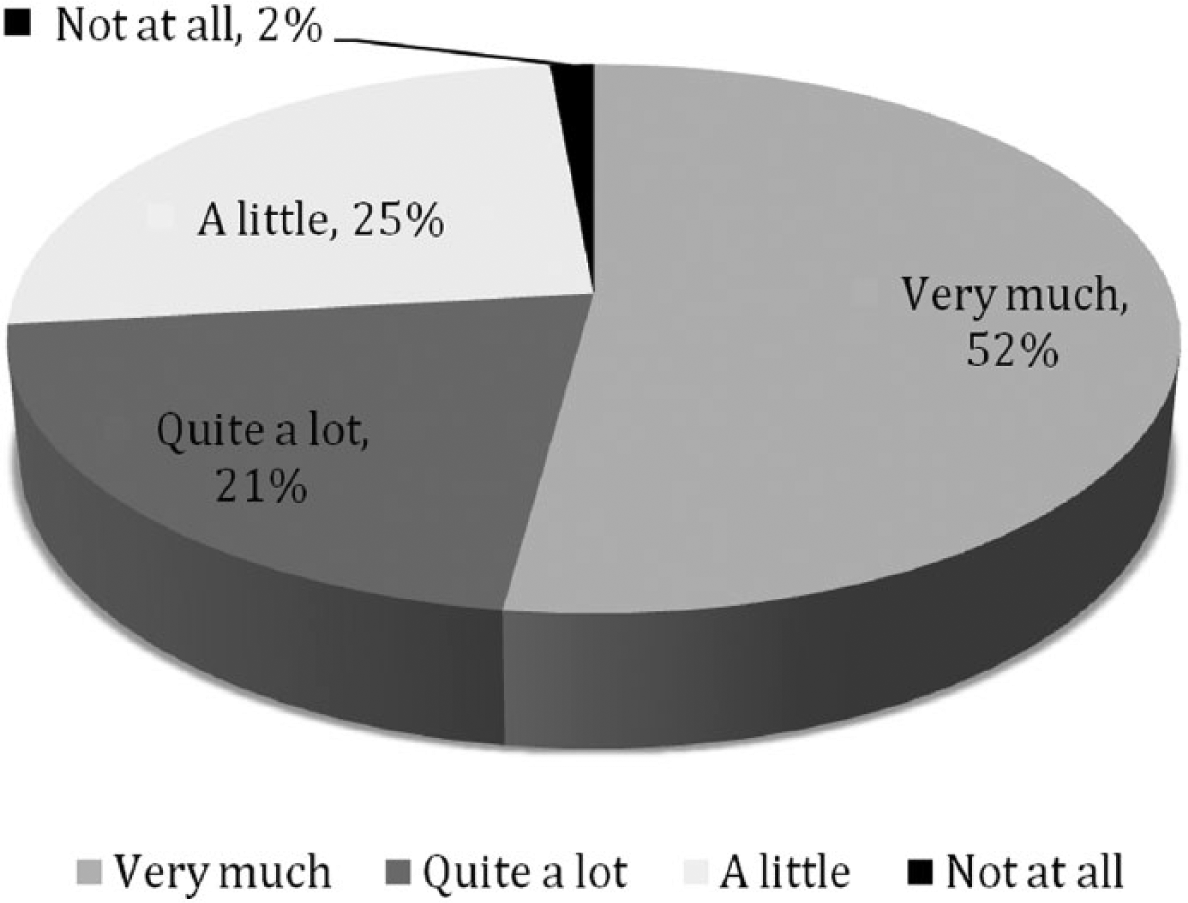
Families’ perception of their children’s improvement in mathematics.
Discussion
Dialogic styles of interaction have been associated with positive outcomes in student learning over four decades of research (Howe and Abedin, 2013). The case analysed in this article is in alignment with the evidence provided by their in-depth review and contributes to the field of mathematics education through the analysis of dialogue and interaction in this particular classroom setting with small mixed-ability groups that include adult volunteers from the community. We have discussed so far how this dialogic approach to teaching and learning has an impact on student performance, as well as the interactions among teachers and relatives in the school.
First, IGs encourage a certain type of interaction, which we define as dialogic and align with Mercer’s (2000) exploratory talk. Children interacting within IGs have to explain the task (how to solve it and what the meaning is of the mathematics question or problem), justify their decisions and make visible their reasoning in a supportive way. The volunteer aims to encourage the children to support each other in the most effective way. Interaction behaviour such as explaining, giving help, questioning or reasoning emerges in the process of solving the task. This is consistent with current international research on developing effective collaborative group work in primary mathematics. 4
Dialogic interactions have been identified in IGs (Type 3, according to our methodological framework) and differ from both Type 1 interactions (which occur when a child mechanically copies another child’s answer) and Type 2 interactions (which occur when a child/adult imposes his/her explanation without any kind of justification or explanation, imperatively). When a child just copies the solution to a (mathematical) task, there is no argumentation, rather a mechanical process where higher psychological functions are not enacted. There is no cognitive challenge in copying, therefore learning is rather limited. Activating higher-order psychological processes requires social interaction according to a two-stage psychological transformation, whereby every function in the child’s cultural development appears twice: first as an interpsychological process and then as an intrapsychological process (Vygotsky, 1981). IGs create the conditions for higher psychological processes to be activated – to transform people’s knowledge and lives through dialogue with others (Flecha, 2000).
Elbers and Streefland (2000) have proved that ‘mathematics understanding’ appears when students engage in a process of dialogue in which they become mutual learners. They claim that this dialogic process occurs when students (and teachers) use inquiry as a method for learning (which is similar to what Freire called ‘the question posing method’) (Freire and Faúndez, 1989). This approach also occurs in IGs, where other different adults lead the interactions and act as ‘guides’, while participating together with the children in their mathematical tasks (Radziszewska and Rogoff, 1991; Rogoff, 1990).
However, putting more adults in the classroom is not enough to promote dialogic interactions in IGs. Teachers and volunteers need to seek a common ground and understanding for their participation to be effective. Only when they facilitate dialogic interactions (Type 3) do IGs become a dialogic space that promotes learning and development through egalitarian dialogue (Flecha, 2000). We argue that this is crucial in order to lead to positive pupil achievement in mathematics.
Second, pupils’ achievement in mathematics has improved since the implementation of IGs in the 5th grade. This has not been an isolated classroom intervention, but part of a community-based school project entitled Learning Communities (Díez-Palomar et al., 2011). In schools as learning communities, pupils, teachers, families and community members develop a shared understanding and basic values to support school quality and development. They create dialogic learning environments – like IGs – where they establish ground rules to guarantee the use by children of arguments based on validity claims in their interactions. Drawing on (Type 3) interactions, children support each other, providing valid arguments, which serve as scaffolding for other children to understand a mathematical task. The results prove that there has been a significant improvement in mathematics performance.
Finally, dialogic interactions in IGs seem to be associated with a change in school–community links. While engaging teachers and families in genuinely collaborative interactions in the classroom, mothers with a minority background move their children and themselves from ‘peripheral’ to ‘central’ participation (Lave and Wenger, 1991). This process has also had an impact in the community in terms of improving intercultural relationships and fostering social cohesion. The dialogical approach identified in IGs among students, teachers and community members seems to increase the potential of community-based mathematical interventions in primary classrooms.
Despite the fact that our results cannot be generalized due to the nature of the case study, lessons can be learned and have already informed educational policies in Europe. Schools as learning communities have been recommended by the European Council (2011) as a successful model to prevent early school leaving and meet the educational goals of the European Union’s Strategy 2020. The school discussed in this article has been implementing this model and IGs for 14 years. Further research is needed to explain the key principles of its success and whether or not it can be replicated. By creating dialogic interactions in the classroom, along with a community-based whole-school approach, the project has become sustainable over time. Today, the children are getting outstanding grades whilst creating supportive relationships in the classroom and positive friendships beyond the school. They are keeping the dream of successful education for all children alive.
Footnotes
Declaration of conflicting interest
The authors declare that there is no conflict of interest.
Funding
This research received no specific grant from any funding agency in the public, commercial or not-for-profit sectors.