




Abstract
Ornamentation is a widespread feature of human material culture, yet its preference varies across societies. We tested the hypothesis that variation in ornamentation preference correlates with socioecological factors, comparing 215 parent–child dyads from three societies differing in WEIRD characteristics: Scotland, Pakistan, and Papua New Guinea. We found that less WEIRD societies exhibit stronger preferences for ornamentation, consistent with adaptive socioecological influences on aesthetic valuation. Moreover, a decline in ornamentation preference with age was observed only in the Western sample, suggesting cultural suppression of ornamentation across development. These findings support the view that children's aesthetic preferences may more closely reflect evolved, foundational biases toward ornamentation, which are subsequently modulated by cultural context. Investigating such developmental trajectories is crucial to understanding the biological basis and evolutionary origins of human aesthetic preferences.
Introduction
Humans have been decorating elements of their environment since at least Middle Palaeolithic (Granito et al., 2022; Riegl & Castriota, 2018). Similarly, archaeological evidence shows that personal adornment, such as beads, was widely spread at least as early as 80,000 years ago (Bouzouggar et al., 2007), and can be found across the globe, from Europe to Australia and Papua New Guinea (Balme & O’Connor, 2019; Schiefenhovel & Vanhaeren, 2017). Such omnipresence of ornamentation has led philosophers and researchers over the last centuries to debate over and study it (Criticos, 2004; Rogers, 1993). Most of these endeavors focused on the ornamentation's functions, and its specific usage and meaning in either prehistoric, ancient, or modern-indigenous people's cultures (Dissanayake, 2015, 2019; Riegl & Castriota, 2018). In the literature on evolutionary psychology, behavioral biology, and anthropology, it is suggested that decorating the environment and the body is not solely a cultural product but may also be an adaptive behavior with a specific biological function.
If we assume that ornamentation has biological significance, the preference for ornamentation may emerge in early childhood. Children spontaneously decorate, color, and paint—these behaviors are observed across cultures (Anastasi & Foley, 1936; Dissanayake, 2001). This suggests that the need for aesthetic expression (or at least the susceptibility to ornamentation) is not solely learned but may have a biological developmental basis. Here, we aimed to address the potential effects of age and nurture on general ornamentation-orientated preferences.
Ornamentation as a Hard-Wired Adaptation
Generally it is widely agreed upon that the aim of decorating objects is to enhance their visual properties, that is, their attractiveness (e.g., Grosse, 1897). However, humans exhibit an innate sensitivity to perceptual features such as symmetry (Van der Helm, 2015), contrast (Peli, 1990), rhythm (Levitin et al., 2018), and repetition (Grill-Spector et al., 2006)—features commonly found in ornaments. Research suggests that aesthetic preferences may be rooted in the brain's perceptual systems, which evolved to efficiently process stimuli from the environment (Ramachandran & Hirstein, 1999; Zeki, 1999). In this view, ornamentation exploits perceptual mechanisms that themselves have adaptive functions but have been “appropriated” by culture for the purpose of expression.
Dissanayake (2019) suggested that art may be a biological adaptation with different manifestations, and putting ornamentation on objects is a universal artistic behavior found in practically every society. First, it marks ownership, as it allows for a distinction between one's and else's objects (Balfour, 1893). Second, it manifests one's membership to a given group and, more broadly, given culture (Dissanayake, 1995), as ornamentation styles are specific to a given society in a given period of time, and more easily understandable by familiars than strangers (Granito et al., 2022). The ability to create ornaments may also serve to reinforce group cohesion—ritual decorations, tribal tattoos, or ceremonial clothing signal group membership and may reduce internal conflict (Boyd & Richerson, 2005). Ornamentation thus becomes a tool of social synchronization and the building of a “symbolic coalition.”
Third and subsequent to that, decoration allows for an expression of one's own identity and individuality (Eibl-Eibesfeldt, 2017). It also serves as honest signal of commitment, given that ritualized, ceremonial behaviors are usually costly (Irons, 2001). According to costly signaling theory (Irons, 2001; Zahavi, 1975), ornamentation can function as a signal of genetic quality or social status. Just as a peacock displays its tail, humans may display ornaments (jewelry, tattoos, clothing decorations) as signals of resources, creativity, or group affiliation. The high “cost” of ornamentation (time, resources, effort) increases its signaling value. This perspective is consistent with recent empirical attempts to test the “art as an adaptation” hypothesis in small-scale societies. For instance, studies among Papuan woodcarvers suggest that artistic production may be linked to social recognition and potentially to reproductive success, although the evidence remains mixed (Sorokowski et al., 2025).
Finally, ornamented objects enhance the prestige of those who accumulate and display them (Sorokowski et al., 2024), whereas ornamentation itself signals status and wealth (Gänsicke & Markowitz, 2019). For instance, through being decorated, axes used by indigenous Papuans lose their functional character, and become either a token of value, or even an equivalent of money (Eibl-Eibesfeldt, 2017).
Importantly, most studies done on ornamentation were conducted on (and most conclusions inferred from) either indigenous societies that have little to no contact with the Western culture (for a review, see Eibl-Eibesfeldt, 2017), or relied on the archaeological findings from times long gone by (e.g., Kuhn & Stiner, 2007). We argue that the matter of ornamentation and its significance is neglected when modern WEIRD (Western, Educated, Industrialised, Rich, Democratic; Henrich et al., 2010) societies are considered. Perhaps it should not be that surprising—a quick look around any major city in the West shows predominantly glass-and-steel, modern buildings of a minimalist design; during the twentieth century modernism in architecture became a Western cultural mainstream (Lau, 2002), with its widely recognized famous spokesmen, Le Corbusier, officially comparing ornamentation to cancer (Le Corbusier, 1987). Similarly, the degree of ornamentation of household equipment and functional items declined, starting as early as in the mid-nineteenth century. The characteristics of China collections—cups, plates, and jugs—in houses of European higher and middle classes shifted from purely decorative to more universal, useful purposes, and along with that fewer ornamentation was implemented; the design became more “serious” (Marchand, 2020). For a striking contrast, think of the French classicistic living room of king Louis XIV, with superfluous and extravagant design, and compare it to the modern austere style of contemporary art and design. Finally, consider the features of contemporary western formal clothes—the attire is plain and toned down in terms of its color or ornamentation; and excessive decoration, which could be considered normative in the previous centuries, may be considered simply as kitsch (Valis, 2003). If a professional meeting in XXI century was attended by an individual with an elaborate coiffure adorned with feathers, flowers and pearls, and florally ornamented cuffs, as was expected in XVIII-century England's court (Vincent, 2009), he would be considered a jester, not a respectable gentleman. Thus, we conclude that the Western culture no longer appreciates nor cultivates the use of ornamentation the way it used to, or the way it is still culturally approved in more traditional societies.
In short, modern Western culture is a negation of ornamentation. Nonetheless, it is possible that people even in the West still prefer colorful ornamentation, and, if given a chance, would choose a decorated object over a plain one. For instance, most recently in the West there is a rise in body ornamentation practices, such as tattooing (Heywood et al., 2012) or piercing (Laumann & Derick, 2006), which may suggest that there is a cultural turning point in the West, and decorative elements are becoming welcome again. Thus, we ask Q1: Do people from different cultures vary in their preferences for an ornamentation presence?
Subsequently, one could inquire whether attitudes towards and the spread of ornamentation rely solely on culture, or whether humans as a species have a certain “hard-wired” preference for decoration, which is only later shaped and possibly suppressed by cultural norms. If the latter is true, then although we may observe significant differences between cultures in how ornamentation is perceived or used, we would expect these differences to be smaller—or even absent—among individuals who are less deeply embedded in their cultural frameworks, such as young children.
Indeed, previous research shows that children enjoy adorning objects and spontaneously engage in decorative drawing from as early as two years of age (Collado, 1999), a behavior reported across diverse cultural contexts (Anastasi & Foley, 1936). This makes children a particularly informative group for testing whether ornamentation preferences are culturally acquired or biologically predisposed. If a consistent preference for decorated over plain objects is observed in children across multiple, culturally distinct societies, it would provide compelling support for the hypothesis that ornamentation has evolutionary roots in human cognition and aesthetic motivation.
Thus, we suggest that children—more than adults—may prefer ornamented objects, and that examining their choices is key to understanding the foundational, potentially universal aspects of human aesthetic preferences. We ask Q2: Do children have a greater preference than adults for the presence of ornamentation?
Considering the above, one might conclude that aesthetics is indeed rooted in evolutionary adaptations, and even as ‘deep’ as in neurobiology. However, although the arguments for that might seem compelling, we lack hard empirical evidence supporting the biology-based origins of our ornamentation preferences, such as neuroimaging or experiments on perception that verify the evolutionary biology hypotheses. Here, we conducted a study to empirically address these claims. We collected data from three countries that significantly differ in terms of how WEIRD they are, namely from Scotland, Pakistan, and Papua. The first region, Scotland, represents the most WEIRD sample in our study (Henrich et al., 2010), followed by Pakistan, which shares some characteristics with the West but also differs in others, and then Papua (West Papua, a province of Indonesia), which is one of the least influenced by the Western culture regions in the world, with this being particularly true for the subregion our study took place in (Baliem Valley).
Methods
We conducted this study predominantly in a cross-cultural, but also cross-generational paradigm, through data collection among both adults and children, in three countries from three continents. We follow the transparency in science code of conduct. The database for this study is publicly available at https://osf.io/e7arn/?view_only=a41a4003468c44e2a3a92be712766ad4.
Ethical Statement
This study was approved by the ethical board of [University of Wrocław], and all procedures were in accordance with the 1964 Helsinki declaration and its later amendments. An informed consent was obtained from all participants.
Participants
Our sample comprises parent–child dyads from three geographical regions that significantly differ culture-wise. We decided for the dyadic approach in data collection in order to avoid hypothetical differences in lifestyle and experiences due to socioeconomical- or social class-related issues. As such, differences between adults and children can be attributed to personal preferences for aesthetics, and not to other sociological reasons. We excluded participants with missing data. In Scotland, we recruited 84 adults (86% female, Mage = 36.1, SD = 6.51) accompanied during the data collection by their 84 children (56% female, Mage = 9.27, SD = 3.86). In Pakistan, we recruited 88 adults (24% female, Mage = 34.3, SD = 9.12) along with their 88 children (28% female, Mage = 9.70, SD = 4.35). Most Scottish and Pakistani participants resided in larger cities (e.g., Glasgow and Edinburgh for Scotland; Karachi and Islamabad for Pakistan). In Papua, we recruited 43 adults (56% female, Mage = 28.5, SD = 4.40) along with their 43 children (53% female, Mage = 6.79, SD = 2.44). They were members of two neighboring tribes, namely Dani and Yali. The former occupy Baliem Valley in the Papuan Central Highgrounds, live predominantly on farming, and have little access to the Western culture, and a moderate access to Asian cultures due to the proximity of Wamena town, where a significant number of Indonesian and Chinese people live (Sorokowski et al., 2023). The Yali people reside east to the Baliem Valley, in Yalimo Highlands, and they farm, hunt and gather for a living. Similar to Dani, they have little to no contact with the Western culture (Sorokowski & Sorokowska, 2012).
Procedure and Measures
The data in Scotland and Pakistan was gathered online by an international research company. In both countries the survey was distributed in English, as it is an official language in the former, and is relatively widespread in the latter (Manan et al., 2016). The data in Papua was gathered personally in the Baliem valley nearby Wamena town and in the Yalimo region through snowball sampling. All the participants (recruited both by the internet research company and individually in Papua) were offered a small remuneration for their engagement.
The participants completed the study individually, with adults and their children providing the responses separately. Only in case their offspring was confused by the study's questions or unable to complete it by themselves, the adult participants were asked to assist them (e.g., by reading the questions out loud to them, or explaining some words or statements). In each dyad, a parent was always first to complete the survey, as to avoid being influenced by their offspring's ratings if a child needed their assistance.
The participants were presented with six pairs of images (see Figure 1). Three of these pairs depicted plates, and the other three depicted shirts. In each pair, one of the objects was covered with an ornament (a twig with leaves, a flower, or an abstract drawing), and the other was plain (i.e., did not have any ornaments). The participants first saw the plate pairs, and then the shirt pairs, however the order in which particular pairs of plates and shirts were shown was randomized. For half of the objects, the one covered with an ornament for presented on the right side, and for the other half it was presented on the left side, in order to avoid a side-preference bias (Casasanto & Henetz, 2012). For each pair, the participants were asked to choose which one of the objects (the plain one or the ornamented one) they like better, then coded—“1” indicating preference for the object on the left, “3” indicating preference for the object on the right, and “2” meaning that both objects are liked equally.

The Ornamented Versus Plain Stimuli Used in the Study.
The selection of stimuli was based on a combination of intuitive and pragmatic considerations. We aimed to use objects that are both universal in their everyday use (such as plates and T-shirts) and culturally non-specific, which made them suitable for testing in diverse populations. The distinction between ornamented and non-ornamented versions was guided by general aesthetic principles rather than culture-specific traditions. For the graphic stimuli, we deliberately contrasted floral and abstract patterns, as these categories are broadly recognizable across different cultural contexts. This approach allowed us to avoid privileging one cultural aesthetic over another and to focus on the general effects of ornamentation versus non-ornamentation.
We also collected demographic data regarding both participants’ and their children's sex, age, and place of residence.
Analytical Approach
All analyses were performed using the jamovi software (version 2.3.12.0).
First, we transformed the ratings of the participants so that “1” always indicated a preference for a plain object, “2” indicating no preference, and “3” indicating a preference for an ornamented object. Then, we summed the scores of each participant, separately for plates and shirts, and then for the two types of objects combined. As a result, we acquired an ornament-preference scale, with higher scores indicating stronger preference for decorations, which comprised two “subscales”—for plates and for shirts, which were highly intercorrelated, r(428) = .543, p < .001. We followed it with a Pearson correlation analysis between t-shirt and plate scores. Second, we run a chi-squared test for differences in sex distribution between the samples, both for a parent's and a child's sex. Third, we implemented t-tests to indicate if participant's sex (both of an adult and of a child) influences their preference declarations for plates, shirts, and both of them collapsed. Fourth, we run Pearson correlation analyses for the participants’ age and their ratings of the objects, and for ornament preference ratings within parent–child dyads. Finally, we implemented a series of ANOVAs with country of origin (Scotland versus Pakistan versus Papua) and age status (adult versus child) as independent variables, and ornament preferences as dependent variables.
Results
We acquired six scores for the ornament preference regarding shirts, plates, and these two combined, separately for adults and for children. Descriptive details are presented in Table 1. Moreover, the preferences for ornamentation in plates and shirts were averagely-to-largely correlated, both in adults and children, showing that although people in general have a certain preference for decoration in general, it is context- (i.e., object-) dependent. Furthermore, a chi-square test of independence showed that there were significant differences regarding the sex distribution among the participants across the samples, both for adults (X2 (2, N = 215) = 66.3, p < .001) and children (X2 (2, N = 215) = 15.1, p < .001). For this reason, we run two independent sample t-tests, with participant's sex as a grouping variable, and the ornament preference scale, along with its subscales, as a dependent variable. We found statistically significant sex differences among adults for plate ratings, shirt rating, and the general ornament preference score, with men showing higher preference for ornamentation than women. The sex differences for ornament preferences did not reach statistical significance among children (see Table 2 for the t-tests’ results). As such, we decided to proceed with including adult participants’ sex in the following ANOVA analyses, but not to include the children's sex.
Descriptive Statistics for the Scores for Ornamentation Preference Among Adults and Children.

Note. *** stands for p < .001.
Independent Sample t-Tests for Sex Differences in Ornament Preferences Among Adults and Children.

Note. The subscales ranged from 3 to 9. The aggregated score ranged from 6 to 18.
We report a strong similarity between parents’ and their offsprings’ ornamentation preference, with the Pearson correlation analyses indicating r(428) = .419, .534, and .559, all ps < .001, for plate ornamentation preference, shirt ornamentation preference, and the aggregated ornamentation preference score, respectively. Furthermore, the Pearson correlation analyses between participants’ age and the rating of the objects found a negative relationship between the age and scores for all three ornamentation preference measures (except for the shirt ratings among adults; see Table S1), meaning that people tend to prefer less ornamented objects as they grow older. However, this effect was driven solely by the Scottish sample, and especially by Scottish children. A follow-up series of t-tests, with participant's age (adult vs. child) as a grouping variable, and the ornament preference scores as dependent variables, showed that statistically significant differences were found only for shirt ornamentation preference subscale among participants from Scotland, t(166) = 3.53, p < .001, d 95%CI [0.229, 0.856], and Pakistan, t(174) = 2.28, p = .024, d 95%CI [0.042, 0.642], and for the aggregated ornamentation preference score among participants from Scotland, t(166) = 2.90, p = .004, d 95%CI [0.136, 0.755], with children scoring higher than adults (see Table 3 for details).
Independent Sample t-Tests for Age Difference (Adults vs. Children) in Ornament Preferences, for Scottish, Pakistani, and Papuan Samples Separately.

Note. The subscales ranged from 3 to 9. The aggregated score ranged from 6 to 18.
The ANOVA variance analyses revealed that one's county of origin significantly influences their preference for ornamentation, with Scotland scoring lower than Pakistan, which in turn scored lowered than Papua (±) in plate subscale, shirt subscale, and the aggregated score (all ps < .001). Furthermore, the effect of age group was also significant, with children declaring higher preference for ornamentation than adults in shirts and in the aggregated score, but not in plate subscale (p = .002, .014, and .362, respectively; see Figure 2). The interaction effect between the country of origin and age group did not reach significance for any ornament preference scores (all ps > .05). For details, see Tables 4 and 5 and Table S5. Given that adult participants’ sex was not equally distributed in the three country samples, and that we found a greater preference for ornamentation in men in comparison to women, we re-run the ANOVA analyses with participant's sex as a covariate. The results were virtually the same, except for the shirt ornamentation preference subscale, where the interaction between country of origin and age group became marginally significant (p = .042). The Bonferroni-corrected post-hocs showed that the difference between parents and children across the samples was primarily driven by the Scottish sample. The details for these analyses are shown in Supplemental Material (Tables S2–S4).

The Difference Between Adults and Children Across the Three Subsamples in Ornament Preference for Plates (Top Left), Shirts (Top Right), and Aggregated Score (Bottom).
The Analysis of Variance ANOVA for the Ornament Preference for Plates Subscale and Post-Hoc Tests.

Note. The numbers in brackets in the first column stand for Mean ± Standard Deviation.
The Analysis of Variance ANOVA for the Ornament Preference for Shirts Subscale and Post-Hoc Tests.
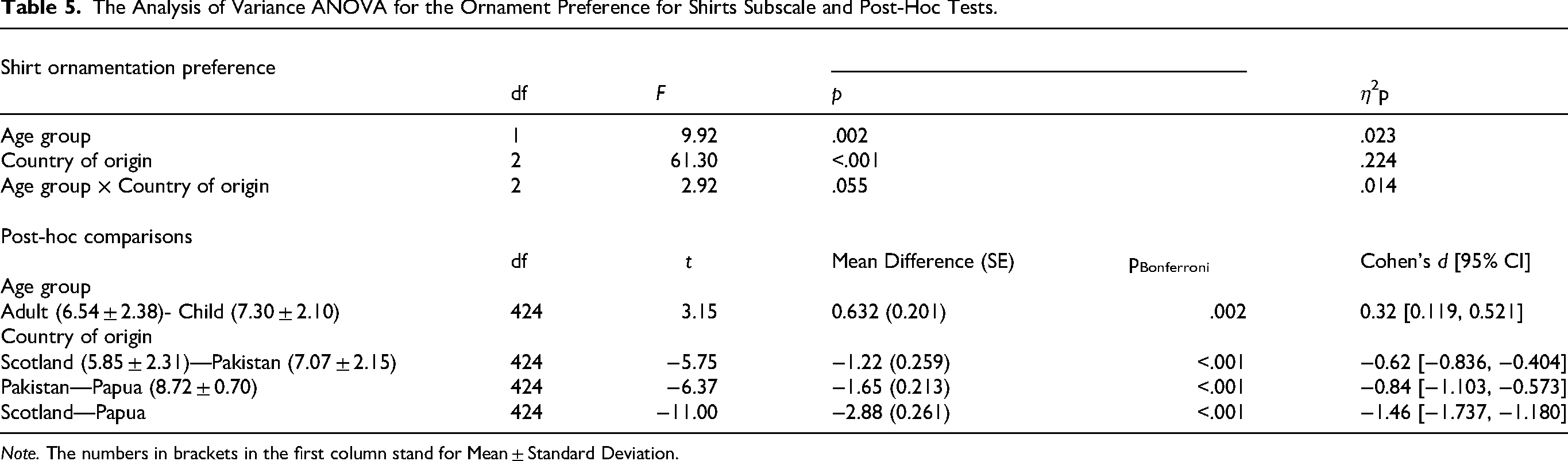
Note. The numbers in brackets in the first column stand for Mean ± Standard Deviation.
Discussion
In this study, we sought for evidence supporting the claims that human ornamentation preference is rooted in evolutionary biology. Namely, we compared the preference for ornamentation between adults and children from three significantly differing cultures, using two exemplary objects: shirts and plates. We showed that people from the Western country (Scotland) prefer less decorations than Pakistani and Papuan people. Moreover, we observed that also Pakistani people prefer less ornaments than Papuan people. Importantly, we also showed that children, in comparison to adults, prefer more ornamented objects, yet this effect was primarily driven by the participants from Scotland (see Table S3).
Apparently, adults from the WEIRD country are indeed relatively weird—their preferences seem the most disconnected from other subgroups in our sample. It seems that, by default, humans do prefer ornamented objects, or at least that there is a higher preference for ornamentation when there are no cultural influences that repress this preference. The younger the sample (i.e., the less influenced by a culture they are brought in, thus the more “innate” their preferences), the greater appreciation of ornamented objects. We argue western culture is, at least currently, particularly discontent with ornamentation. On one hand, this might be an effect of voluntary simplicity and minimalism trends that appeared in the West (Wang & Wang, 2024) as an alternative for capitalistic abundance (Hook et al., 2023). As such, it may be a manifestation of a polemic stand that possibly overshadows an actual preference for ornamentation. On the other hand, it is possible that a more general trend-preference, seen also in architecture or clothing industry since at least the twentieth century, is not merely an arbitrary tendency chosen by art and fashion elites, but it may be shared by the ordinary members of the society. Interestingly, and in line with previous literature (e.g., Noreen, 2021), it seems that this “Western preference” progresses gradually in Pakistan, especially that the Pakistani participants were predominantly from larger cities, but is relatively absent in the indigenous people of Papua, who showed the most pro-ornament attitudes.
Crucially, the second finding of this study allows for a less ephemeral conclusion. Mere cross-cultural differences would not allow for establishing any “baseline” preference. Namely, perhaps the Western culture represents one pole of a preference spectrum, and the Papuan culture represents the other, both being equally “natural.” However, our comparisons of adults and children present a different picture, showing that children (who are still in a process of socialization and are not as much influenced by the applicable cultural standards; Pescaru, 2018) prefer decorated objects to a greater extent than adults. As such, it can be concluded that the ornamentation preference declared by Papuans in general, and specifically Papuan adults, are closer to the “natural preference” regarding ornamentation, using as a proxy children's (culturally less-biased) choices. It seems that it is the Western culture that “unnaturally” disregards ornaments in favor of plain designs. It should be noted, however, that even within the Western culture this “plainness and simplicity” is rather a historical exception, as before the ninetieth century Westerners dressed and lived in a more ornamented way, both fashion- and architecture-wise (English, 2022; Watkin, 2005).
This finding is the first of its kind, empirical support for the evolutionary biology-rooted hypotheses on innate preferences for ornamentation (Carmen & Dillon, 2021). Although it is for the future studies to establish which evolutionary adaptations exactly are responsible for this preference (costly signaling, group identity, status declaration, inclination for symmetry, rhythm or repetition?), our results suggest that this indeed is a cross-cultural phenomenon that can only be suppressed in certain cultural circumstances, as nowadays we find in the West. Our cross-generational (or cross-age) sample characteristics allow for a conclusion that humans prefer decorations by default, and this preference is amendable during an individual's lifespan. The consequences of this cultural disregard towards seemingly evolved preference are yet to be identified.
It should be noted that there are several limitations to our study. First, we tested preferences for ornamentation only in two types of objects, that is, shirts and plates. Future studies should implement a broader array of objects, such as paintings, house facades, sculptures, furniture, and smaller containers. Although recommended for a more nuanced and specific conclusions, we underscore that there might be difficulties regarding the ecological appropriateness of certain objects when comparing in two cultures as distinct as Western and Papuan ones (for instance, comparisons of architectural details when the two cultures are extremely different in that regard). Second, we tested dyads of parents and offsprings, which might have elevated the correspondence between the two age groups within a country due to genetical factors. However, that would make our results more robust, as we found certain differences even within such a related sample. Finally, we assume that due to similarities in architecture, clothing, or fashion influencers across WEIRD cultures, people from the West should all behave similarly to our Scottish sample. Yet, it is possible that some cultural characteristics beyond WEIRDness also influence ornamentation preference. As such, future studies should involve more representatives of strongly WEIRD cultures, along with other non-WEIRD cultures, in order to consider the findings more robust and generalizable.
Conclusion
The preference for ornamentation is influenced by a culture one lives in, with particularly low interest in ornamentation in the Western culture. Moreover, children seem to prefer decorations more than adults. It is possible that WEIRD populations are particularly “weird” in their preference for more plain designs, as they seem to be more remote in their preference from children's ratings, which can potentially serve as a proxy for what is universally and “naturally” more preferred visually, suggesting an evolutionary biology-based roots of aesthetics preferences.
Supplemental Material
sj-docx-1-evp-10.1177_14747049251388596 - Supplemental material for Is Ornamentation a Universal Human Preference? Cross-Cultural and Developmental Evidence From Scotland, Pakistan, and Papua
Supplemental material, sj-docx-1-evp-10.1177_14747049251388596 for Is Ornamentation a Universal Human Preference? Cross-Cultural and Developmental Evidence From Scotland, Pakistan, and Papua by Piotr Sorokowski, Jerzy Luty, Wiktoria Jdryczka and Michal Mikolaj Stefanczyk in Evolutionary Psychology
Footnotes

Ethical Statement
This study was approved by the ethical board of University of Wrocław, and all procedures were in accordance with the 1964 Helsinki declaration and its later amendments. An informed consent was obtained from all participants.
Funding
The authors disclosed receipt of the following financial support for the research, authorship, and/or publication of this article: This study was funded by the Polish National Science Centre, Grant number 2019/35/B/HS1/02293. APC was covered by Being Human Lab funds.
Declaration of Conflicting Interests
The authors declared no potential conflicts of interest with respect to the research, authorship, and/or publication of this article.
Supplemental Material
Supplemental material for this article is available online.
References
Supplementary Material
Please find the following supplemental material available below.
For Open Access articles published under a Creative Commons License, all supplemental material carries the same license as the article it is associated with.
For non-Open Access articles published, all supplemental material carries a non-exclusive license, and permission requests for re-use of supplemental material or any part of supplemental material shall be sent directly to the copyright owner as specified in the copyright notice associated with the article.
