




Abstract
The effects of natural selection on personality traits are still understudied, which is in contrast with their importance for analyzing the evolution of personality. In the present research, we analyzed natural selection on the Big Five personality traits by estimating the relations between personality characteristics and evolutionary fitness (reproductive success: i.e., number of children) using the World Values Survey wave 6 data (N = 22,636; 17 countries). Using multilevel Poisson regression models with random slopes, we obtained a positive linear association between conscientiousness and reproductive success. We also detected a nonlinear association between openness and the criterion measure: additional graphical and ANOVA analyses showed that nonlinearity emerged from the fact that only individuals with above average openness had lower reproductive success. The effect sizes of the associations between personality traits and reproductive success were low. Finally, we detected variation in selection gradients (i.e., differences in fixed model coefficients) across the countries—coefficients with both positive and negative signs are estimated for extraversion, neuroticism, and openness. This variation is in accordance with the state-dependent models of personality evolution, where environment is viewed as an external state—the environment's moderating effect on the personality-fitness link may preserve inter-individual variation in behavior within and between the populations.
Estimating Natural Selection on Personality Traits
Natural selection is one of the fundamental drivers of biological evolution: it acts on any trait that is associated with fitness; evolutionary fitness is a complex feature or of organisms but it can be best defined as an overall potential of individuals to transfer their genes to the next generation (Hunt & Hodgson, 2010). Hence, the most approximate operationalization of fitness is reproductive success (i.e., fertility) usually measured as the number of offspring. If a trait is positively related to reproductive success and this association is at least partially attributable to the trait's genetic variation, natural selection will increase the frequency of its underlying gene alleles in future generations—this may lead to an increase in the phenotypic mean population levels of a trait as well (hence, this change can occur only if a trait shows genetic variation). Therefore, an analysis of the relations between a trait and fitness is a fundamental building block in the exploration of its evolution.
Personality traits are relatively stable behavioral dispositions that show high phenotypic and genetic variation (Vukasović & Bratko, 2015). Thus, they can be targeted by natural selection and evolve; based on this, human behavioral ecologists have analyzed if the personality traits are associated with fitness. The majority of this work has been conducted on the Big Five personality traits (Penke & Jokela, 2016), although some recent work has analyzed the traits from the six-factor personality structure as well (Međedović & Kovačević, 2020; Međedović et al., 2018). Generally, the data suggests that personality traits are under natural selection in contemporary humans: however, it is important to emphasize that the selection gradients vary between the samples. The most robust results obtained relate to the positive relations between Extraversion and reproductive success (Alvergne et al., 2010; Bailey et al., 2013; Gurven et al., 2014; Međedović & Kovačević, 2020) and negative associations between neuroticism and fitness (Gurven et al., 2014; Jokela et al., 2011; Skirbekk & Blekesaune, 2014). The variation is higher for other traits, especially for agreeableness (Jokela et al., 2011) and conscientiousness (Dijkstra & Barelds, 2009; Skirbekk & Blekesaune, 2014), while there are more consistent negative associations between openness and reproductive success (Jokela et al., 2011; Međedović & Kovačević, 2020; Međedović et al., 2018; Mohammed et al., 2020; Perkins et al., 2013).
State-Dependent Models of Personality Evolution
The variation in selection gradients on personality traits is highly expected in a behavioral ecological conceptual framework. Simply put, the relations between personality and reproductive success must be influenced by many factors, including the characteristics of organisms themselves, as well as ecological features. In animal behavioral ecology, the former are labeled as internal states, while the latter are called external states (Dingemanse & Wolf, 2010; Wolf & Weissing, 2010). Certain personality traits may elevate fitness in a particular environment, but they may decrease fitness in other environmental conditions (note that the state-dependent models that invoke the environment as an extrinsic state are practically identical to the concept of variable selection based on environmental heterogeneity; Penke et al., 2007). This would be expressed in the opposite selection gradients in different environments. Furthermore, the evolutionary implications of a variation in selection gradients are much more profound—variation opens the possibility that selection itself maintains the genetic variation in personality because it may act differently on traits in different ecologies (Međedović, 2018a). Genetic variation would consequently further maintain phenotypic variation in personality. Hence, state-dependent models provide one of the answers to the question of why there is variation in personality in the first place.
Empirical examination of the environment as an external state in the evolution of human personality has been conducted quite rarely. However, there are results that show that state-dependent models are indeed plausible. The data suggests that the behavior guided by lower openness and extraversion may be more adaptive in countries with higher prevalence of infective diseases (Schaller & Murray, 2008). Environments affected by violent intergroup conflicts moderate the link between personality and mating, highlighting the adaptive role of extraversion and emotional stability (Međedović, 2018b). Finally, there are indications that environmental conditions affect the link between personality and reproductive success even in preindustrial human societies, that is, in Tsimane forager—horticulturalists of Amazonian Bolivia (Gurven et al., 2014).
Goals of the Present Research
Empirical examination of the links between personality and fitness is associated with many obstacles. Valid examination of selection gradients on a trait ideally should involve representative samples. Furthermore, the variation in environmental characteristics should be large enough to reveal the variation in selection gradients on personality. These research conditions are not easy to achieve, but they do exist in the World Values Survey (WVS), wave 6—the only wave that contains data regarding the Big Five personality traits. The WVS is an international research program that explores values, beliefs, attitudes, and related concepts around the world (WVS: https://www.worldvaluessurvey.org/WVSContents.jsp). An important feature of the WVS methodology is that the data is collected on representative samples for every country that participates in the survey.
The goals of the present research are twofold: first, we aimed to analyze the overall selection on personality traits by examining the links between the Big Five personality traits and reproductive success (number of children). In regard to this goal, we set an a priori hypotheses. Based on previous research on the links between personality and fitness, we assume positive linear associations between conscientiousness, extraversion, agreeableness, and reproductive success together with negative associations between neuroticism, openness, and reproductive success. In addition, we analyzed the interactions between personality traits and participants’ sex (because previous data showed that the links between personality and fitness may differ for males and females; Penke & Jokela, 2016) and quadratic relations between personality traits and fitness (because they could reveal stabilizing or disruptive selection on personality). The second goal of the present research was to estimate the variation in selection gradients between the countries (defined as fixed effects in multilevel models with personality traits as the predictor variables and reproductive success as the criterion measure). If this variation exists, this would be in line with the prediction of state-dependent models of personality evolution where environment (i.e., specific country) is viewed as an external state.
Method
Sample
We used the data collected in wave 6 of the WVS for the current analyses (Inglehart et al., 2014). The data from this wave was collected from 2010 to 2012. Only a portion of wave 6 data contains information about the participants’ Big Five personality traits (36 countries). However, Ludeke and Larsen (2017) warned that this data has psychometric problems reflected in occasional negative correlations between the items of scales that should measure the same personality trait. Finally, Lu and Cui (2022) conducted additional analyses on the WVS6 personality data. They identified 18 countries that contain valid personality data. We followed their recommendations: when we removed the participants with missing values, the final sample consisted of 22,635 participants from 17 countries (51% of female participants; Mage = 41.89 [SD = 16.16]; Meducation = 5.48 [2.50]).
Measures
The Big Five personality traits are measured using the Big Five Inventory—short version (Rammstedt & John, 2007). Five personality traits are operationalized via two items each in this inventory. However, previous analyses (Lu & Cui, 2022) revealed problems with the translation of one of the items that measures openness to experience (“has few artist interests”) and recommended the removal of that item. Therefore, openness is operationalized only via one item in the present analyses: “has an active imagination.” Participants described themselves on a five-point Likert-type scale where 1 stands for “completely disagree” while 5 stands for “completely agree.”
Reproductive success was measured by the exact number of biological children.
We also included participants’ sex, age, education, and social class as the control variables in the analysis. Social class was measured by a single item with 5 response categories: 1—“Upper class,” 2—“Upper middle class,” 3—“Lower middle class,” 4—“Working class,” and 5—“Lower class.” The responses are reversely coded before the analysis so the higher scores reflect higher social class. Education was measured by an item that comprised 9 categories ranging from lowest (“no formal education”) to highest education levels (“university level education, with degree”).
Plan of Data Analysis
Firstly, we calculated Spearman's rank correlation coefficient between the personality traits and reproductive success (number of children is a rank variable with expected Poisson's distribution; Spearman's correlation coefficient does not assume the interval scale of measurement, nor normal distribution of a variable and thus, it is appropriate measure of bivariate associations that include number of children). Afterwards, we fitted the multilevel Poisson regression model where personality traits, together with the control variables (sex, age, education, and social class) were analyzed as the predictors, while reproductive success was set as the criterion measure (participants’ countries were modelled as the nesting variable). We also explored the models with interactions between personality traits and participants’ sex, together with models with quadratic terms for every personality trait (in order to estimate nonlinear associations between personality and fitness). Multilevel regressions were estimated using the lme4 package in R (Bates et al., 2015); we used the lmerTest package (Kuznetsova et al., 2017) to obtain the p values for fixed effects, and the sjstats package (Lüdecke, 2021) to estimate the coefficient of determination. Finally, we analyzed the variation of the selection gradients on personality traits obtained in multilevel regressions (fixed effects).
Results
Bivariate Associations Between the Personality Traits and Reproductive Success
Bivariate associations between personality traits and reproductive success are shown in Table 1. As can be seen, extraversion, openness, and neuroticism are negatively related to the number of children; the association is positive for conscientiousness and nonsignificant for agreeableness. However, these associations are very small in effect sizes—their statistical significance is directly related to the large sample size (correlations are significant even under the Bonferroni correction); only the association between conscientiousness and reproductive success has a somewhat larger effect compared to other coefficients.
Bivariate associations between personality traits and reproductive success.

** p < 0.01.
Estimating Natural Selection on Personality: Multilevel Poisson Regressions
We firstly fitted the random intercept model for the prediction of reproductive success and obtained the following fit indices: AIC = 74,976; BIC = 75,064. Afterwards, we tested the random slopes model: AIC = 73,895; BIC = 74,192. As we can see, the random slopes model has a better fit to the data; in fact, the difference between the models is statistically significant: χ²(26) = 1133.40; p < .001. This is the first result suggesting that variation between the regression slopes across the countries plays a role in explaining observed fertility; the percentage of the criterion's explained variation by random intercept model (marginal R2) is 36% while random slopes model explained 41% of reproductive success's variation. The fixed effects are shown in Table 2. Note that the multilevel model shows only unstandardized coefficients, however, we standardized all variables before fitting the models; therefore, these coefficients can be interpreted as standardized estimates. As we can see, beside sex, age, and education, the only personality trait that predicts reproductive success is conscientiousness, and it has positive contribution to the prediction. Graphical representation of the conscientiousness's regression coefficients across the countries can be seen in Figure 1. There are no significant interactions between personality traits and participants’ sex in the prediction of reproductive success. However, we found signatures of nonlinear association between openness to experience and reproductive success. 1 When we plotted the associations between these two variables (Figure 1) and conducted ANOVA (differences in number of children between openness categories on the single item used to assess this trait: F(4, 22,650) = 16.20; p < .001), we found that individuals above average on openness have a lower number of children (see Figure 2). For example, individuals in the highest category (5) had significantly fewer children than participants from all other categories; participants that marked 4 on the openness item had a lower number of children compared to categories 3 and 2 (the exact number of children and significance tests can be seen in Table A1 in the Appendix. Graphical representation of the openness's regression coefficients across the countries can be seen in Figure 3.
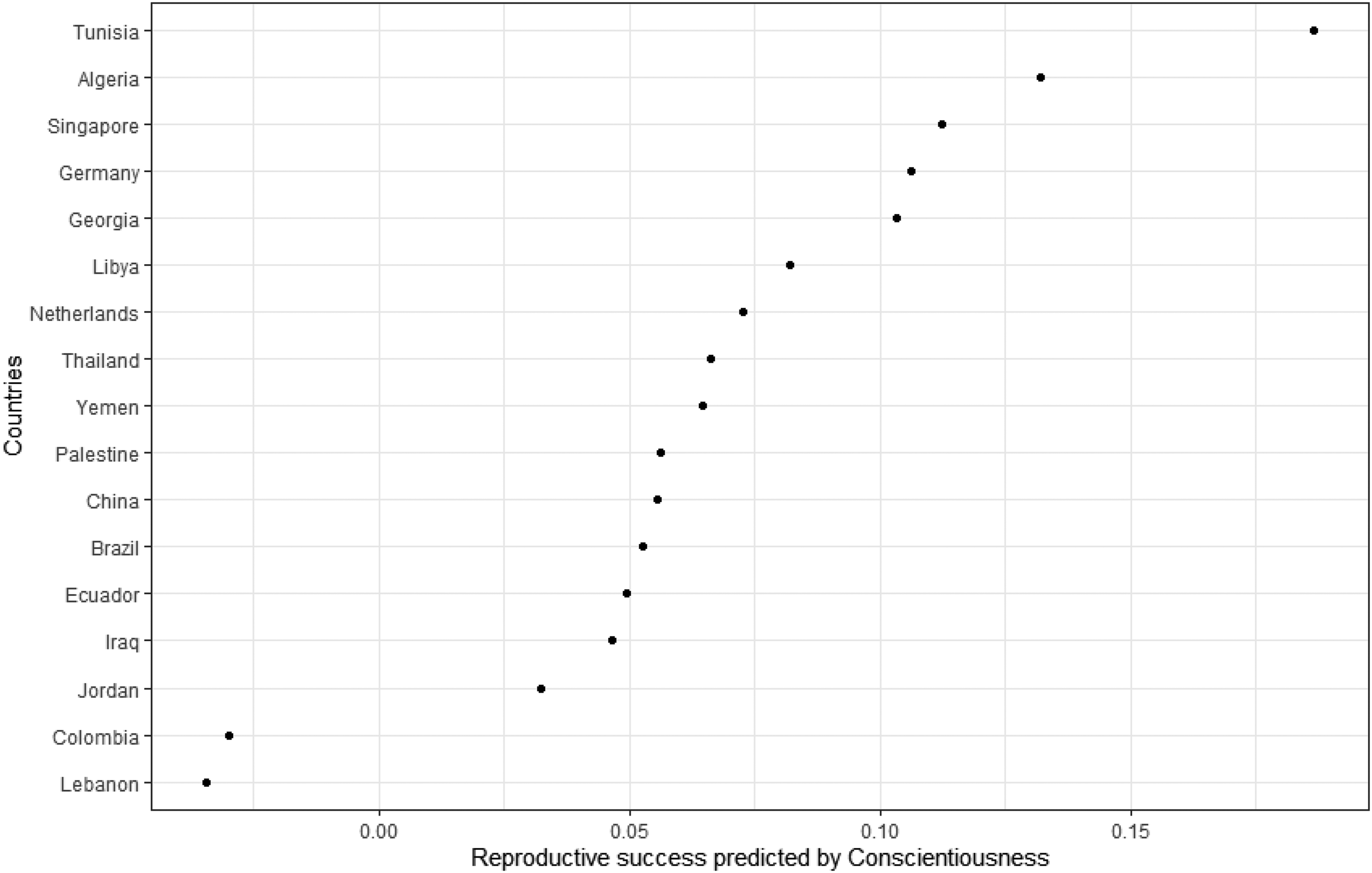
Reproductive success predicted by conscientiousness across the countries. Notes: Fixed effects (β coefficients) of the associations between conscientiousness and reproductive success are extracted from the model and shown on the figure.
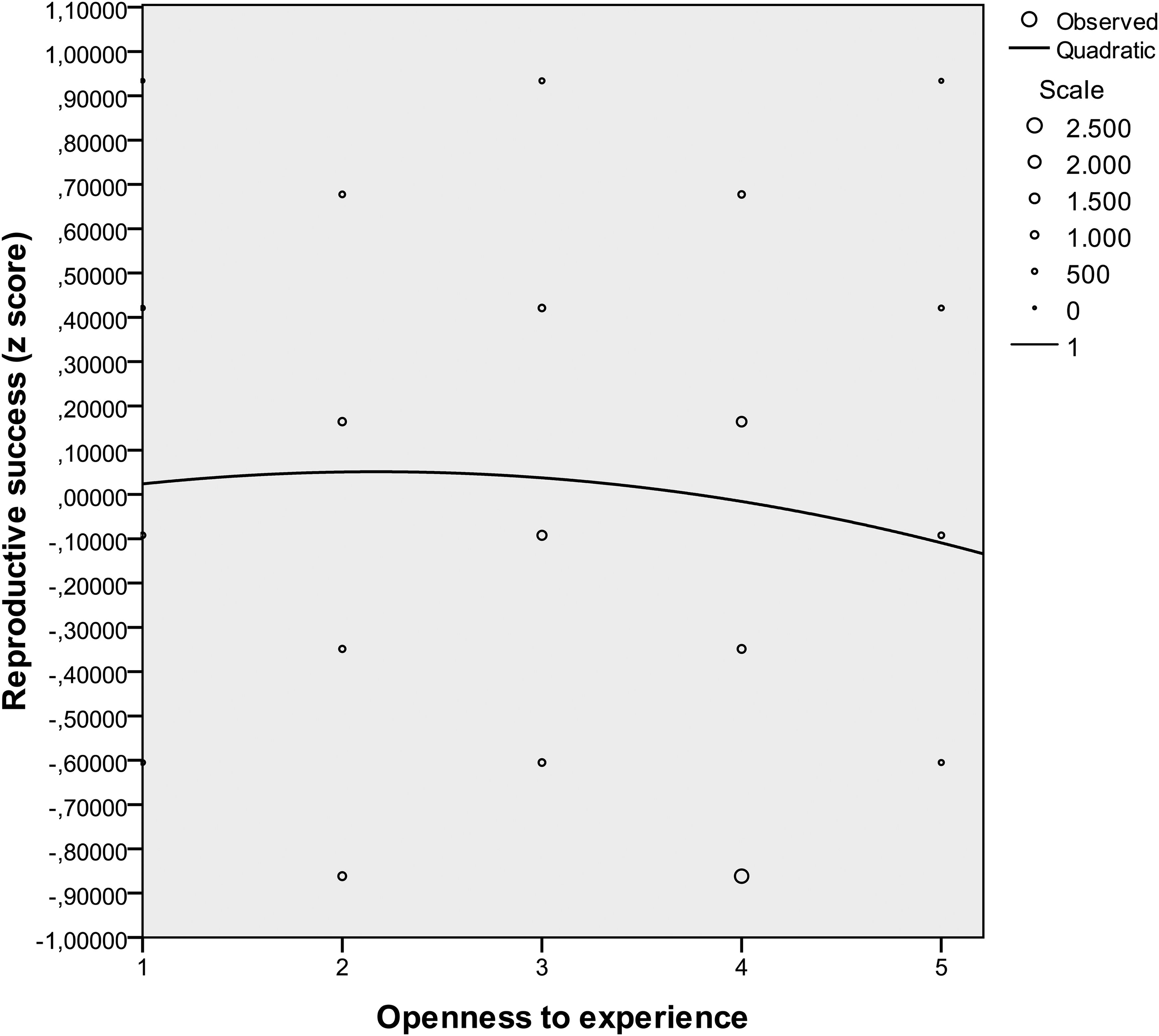
Nonlinear association between openness to experience and reproductive success.

Reproductive success predicted by openness across the countries. Notes: Fixed effects (β coefficients) of the associations between openness and Reproductive success are extracted from the model and shown on the figure.
Multilevel regression models for the prediction of reproductive success.

Notes: β(SE) are the fixed effects—standardized coefficients and their standard errors; SDslopes are the random effects—standard deviations in the slopes across the countries.
*** p < 0.001.
Examining the Variation of Selection Gradients on Personality Between the Countries
The higher fit of the random slopes model, compared to the random intercept model, suggests that there is a statistically significant variation in the selection gradients between the countries. In order to obtain more precise information about the links between personality traits and reproductive success, we fitted Poisson regressions for every country separately. These results are shown in Table 3 (only the results for personality traits are shown, but sex, age, education, and social class were controlled in these analyses as well). The exact regression coefficients confirmed that there is variation in the links between personality and fitness between the countries. For example, there are both positive and negative coefficients for neuroticism (in Iraq and Yemen, respectively), extraversion (in Thailand, Tunisia, and Algeria, respectively) and openness (in Algeria, Georgia, and Germany, respectively). The most consistent data is obtained for conscientiousness (all significant coefficients are positive: Algeria, Georgia, Germany, Libya, Netherlands, Singapore, Thailand, and Tunisia) and agreeableness (all null associations except the positive coefficient for Libya). Note that all regression coefficients, both in the full model and in separate countries, have low effect sizes.
Associations between personality traits and reproductive success across the countries.
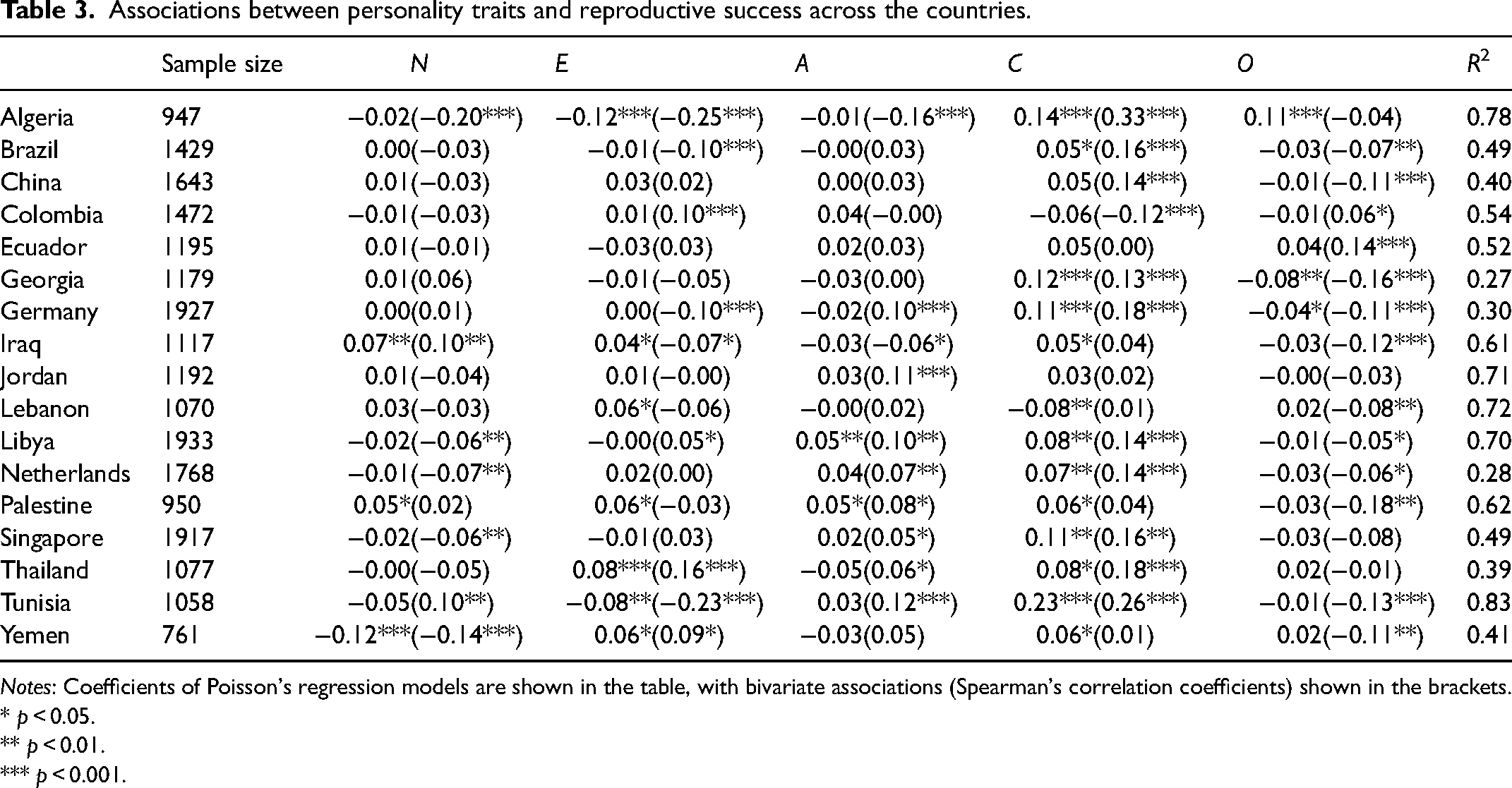
Notes: Coefficients of Poisson's regression models are shown in the table, with bivariate associations (Spearman's correlation coefficients) shown in the brackets.
* p < 0.05.
** p < 0.01.
*** p < 0.001.
Discussion
Analyzing the regimes of natural selection on behavior is the key element and the building block of behavioral evolution research. It helps us understand how gene alleles that represent the basis of genetic variation of a certain trait may change their frequency in future generations: this change may occur if a trait is associated with evolutionary fitness. As a consequence, a genetic change may lead to a phenotypic change; if a trait is positively related to fitness, this could potentially result in the increase of its phenotypic mean level in a population and vice versa. These changes are not only important in our understanding of evolutionary processes, but also have practical implications, since they can affect future demographic trends. The evolution of behavioral processes is a complex one because behavior is not affected only by directional or stabilizing selection—various forms of variable selection can act on a behavior because behavioral traits do not have the same relations with fitness in different conditions.
In the present research, we tried to address both of these questions in regard to human personality traits: natural selection on the traits, which could affect their mean levels, and environmental variability, which may generate variation in the associations between personality traits and fitness. Our analysis showed that personality traits are under natural selection in certain populations, but the directions of selection may differ across the countries due to variation in selection gradients between the countries. The findings of the present research are generally in accordance with the existing data, but bring new insights and incentives for human behavioral ecologists and evolutionary anthropologists.
Conscientiousness and Openness May Be Affected by Selection on a Meta-Population Level
Our multilevel regression model showed the links between two personality traits and reproductive success on the whole sample (17 countries combined). The first one is positive association between conscientiousness and number of children. We did not expect such consistent phenotypic signals of positive directional selection on conscientiousness (the highest number of significant coefficients, all positive) because the results regarding the links between conscientiousness and fertility are mixed (Penke & Jokela, 2016), with many studies showing negative associations (Allen & Robson, 2018; Perkins et al., 2013; Skirbekk & Blekesaune, 2014) while several others have noted positive links (Dijkstra & Barelds, 2009; Gurven et al., 2014), including a positive association between conscientiousness and number of grandchildren (Međedović et al., 2018). Heterogeneity in the existing data is not surprising because it can be plausibly assumed that individuals both high and low in conscientiousness (i.e., impulsive) can achieve high fitness—the former via planned and the latter via non-planned pregnancies: indeed, this hypothesis was confirmed by the empirical data (Međedović & Kovačević, 2020). On the other hand, there are additional characteristics of conscientiousness which may elevate fitness in individuals high in this trait. Fertility intentions and plans (i.e., desired number of children) are robust significant predictors of observed fertility; the data shows that conscientious individuals more accurately and successfully translate fertility intentions into the observed number of children (Allen & Robson, 2018). This is in accordance with the nature of this trait, which marks long-term planning, persistence, and heightened goal-oriented motivation. Secondly, previous findings have shown that conscientiousness is negatively associated with extra-relationship mating, which suggests that individuals with high scores on this trait have increased commitment to current romantic relationships (Jirjahn & Ottenbacher, 2023). This, in turn, makes them more desirable partners—which stands especially for males.
On the other hand, the results regarding openness are highly congruent with the previous data. The majority of the existing effects show negative links between openness to experience and evolutionary fitness. This stands for the number of children as a fitness indicator (Jokela et al., 2011; Međedović & Kovačević, 2020; Međedović et al., 2018; Mohammed et al., 2020; Perkins et al., 2013) and for the number of grandchildren as a long-term marker of reproductive fitness (Berg et al., 2014: Međedović et al., 2018). Our current data has contributed to the existing knowledge by specifying the potential range of selection: openness may not be linearly negatively related to the number of offspring. This effect may be particularly expressed in individuals high in openness—lower and average expressions of openness may not have diminished fitness returns; this was captured by a nonlinear association between openness and number of children in our current data. The key mediator between openness and a decrease in reproductive output is probably a higher age of first reproduction—more open individuals delay their first birth (Međedović & Kovačević, 2020) and enter their first marriage later in their lifetime (Jokela et al., 2011). Aspiring for higher educational levels can contribute to delaying reproduction in individuals with high openness as well (Jokela et al., 2011). Future research may explore if there are additional fitness benefits of openness (e.g., longevity or parental/grandparental investment) because the existing data consistently suggests that selection acts in a way to deplete populational levels of openness.
Variation in Selection Gradients—A Case for State-Dependent Personality Evolution
Can we expect consistent links between personality and fitness? Consistency in empirical data represents a problem in psychology in general (Klein et al., 2018), but conversely, in behavioral ecology there are even theoretical assumptions that predict inconsistency, variability, and heterogeneity. If there were consistent associations between personality traits and fitness, natural selection would deplete genetic variation, which would consequently lead to diminished phenotypic variation in personality characteristics. However, this is not the case: variation in personality exists in every human and numerous non-human populations. Therefore, there may be evolutionary processes that preserve this variation (Dingemanse & Wolf, 2010; Wolf & Weissing, 2010). One of these processes emerges if the environment moderates the associations between personality traits and fitness: this is labeled as state-dependent evolution of personality where the environment is an external state (Međedović, 2018a), or balancing selection based on environmental heterogeneity (Penke et al., 2007). Previous empirical data has shown that the environment moderates the links between personality, mating (Međedović, 2018b), and reproduction (Međedović & Kovačević, 2020). This process exists even in preindustrial populations where fitness benefits of personality characteristics depend on the specific locations where individuals live (Gurven et al., 2014). Fitness outcomes of personality may also be dependent upon the incidence of pathogens in a given population (Schaller & Murray, 2008).
The variation in selection gradients on personality (i.e., regression slopes) that we obtained in the present data are in accordance with environmentally-driven state-dependent models of personality evolution. We obtained slopes that varied both in size and signs of associations between the countries; different countries certainly mark different ecologies. Unfortunately, we cannot pinpoint specific environmental conditions that may moderate the links between personality traits and fitness in the current data. For example, the negative link detected between Neuroticism and fertility in Yemen is in accordance with the majority of existing data (Gurven et al., 2014; Jokela et al., 2011; Skirbekk et al., 2014), but the positive link obtained in Iraq is not. The only detected positive association between Neuroticism and number of offspring in previous research was captured in rural Senegal (Alvergne et al., 2010), but this link was specific for women. However, we did not obtain any sex differences in personality-fitness associations in the current data. Similarly, positive associations between Extraversion and reproductive success are line with the existing empirical evidence (Alvergne et al., 2010; Bailey et al., 2013; Gurven et al., 2014; Međedović & Kovačević, 2020), but the negative effects in Algeria and Tunisia remain a mystery in the present moment. Firstly, we need to replicate these associations in these specific populations. Secondly, we should exert coordinated anthropological, sociological, and psychological effort in formulating exact hypotheses about the mechanisms that can explain the links between personality and fitness in these ecological conditions and empirically test them. Hence, this clearly shows why human behavioral ecology must be an interdisciplinary field that merges various social sciences and grounds them in evolutionary-biological theory.
Here, we must add a word of caution to the interpretation of findings. Both multilevel Poisson's model and the regression models conducted in every country separately showed large number of nonsignificant associations or associations with low magnitude between personality and reproductive success. This suggest that if selection, both directional and variable (which emerges from the different links between personality and fitness in different countries), acts on personality traits, it is quite weak. Recent data suggesting that the balance between mutations and selection may be better candidate for maintaining genetic variation in personality traits than variable (balancing) selection based on environmental heterogeneity represent additional reason for caution (Verweij et al., 2012; Zietsch, 2024). On the other hand, we should keep in mind that personality traits were measured only via two (or even one for openness) items in the present analysis: this may decrease the magnitude of associations between personality and reproductive success. Hence, our estimations should be viewed as conservative ones, which leaves the possibility of additional selection effects on personality above the ones captured in the present data.
Limitations and Future Directions
We directly attributed the links between personality and fitness to natural selection in the present report. Now, we want to explicitly state the caveats of this interpretation and to emphasize the need for caution. Firstly, the strength of the present data is reflected in sample compositions: the analyses are conducted on representative samples, which are a basic prerequisite for making inferences about natural selection. However, we still face three important obstacles in making highly confident conclusions about personality evolution. Firstly, cross-sectional data prevents us from making causal inferences regarding the personality-fitness link; for unambiguous conclusions regarding natural selection on personality, behavioral traits should be measured before individuals produce offspring. However, the existing empirical data show no changes in conscientiousness (Asselmann & Specht, 2021) or even the opposite trend—decreasing levels of conscientiousness after having the first child (Pusch et al., 2019). Hence, our results regarding conscientiousness cannot be explained by the reverse causal link. The levels of openness indeed decrease after having the first child, however, the previous data (Asselmann & Specht, 2021) show that lower openness is initially (i.e., before the first reproduction) linked with having children. Overall, these data support the interpretation of the current findings that selection forces may act on personality, but despite this, longitudinal designs still should be preferred in estimating selection gradients.
Secondly, natural selection may indeed affect a behavioral trait, but the response of the trait to the selection demands that genetic variation associated with a trait participates in differential reproductive success. Hence, genetic (both behavioral and molecular) research on the links between personality traits and reproductive success is highly needed: unfortunately, such studies are still scarce (for rare examples see: Berg et al., 2016; Briley et al., 2017). Finally, basic personality traits, including those operationalized via the Big Five model, are broad, comprehensive, and complex behavioral dispositions. Short personality scales like BFI-10, which was analyzed in the present data, are frequently necessary in large surveys in order to diminish the total number of items administered to participants. However, by simplifying complex personality traits to only a few indicators, these scales certainly elevate the probability of a Type 2 error: there may be effects that we did not capture in the present analyses, but could be detected if personality traits were measured in a more comprehensive and reliable manner.
Concluding Remarks
Selection regimes are complex processes, and every empirical dataset that explores them has limitations and caveats. However, selection and evolution are the fundamental natural forces that shape our biology and behavior. Therefore, we need to examine these processes even when we have imperfect methodological tools and conditions at our disposal. If anything, this research strengthens our conceptual apparatus for thinking and conceptualizing behavioral evolution. We believe that this data, despite its limitations, can contribute to the analysis of biological populational processes that shape our behavioral traits and contribute to their reproductive outcomes. The present data may especially deepen our understanding of personality variation and the behavioral diversity associated with it, which represents a biological advantage for every population because it contributes to the potential for future behavioral evolution.
Footnotes
Declaration of Conflicting Interests
The author declared no potential conflicts of interest with respect to the research, authorship, and/or publication of this article.
Funding
The author received no financial support for the research, authorship, and/or publication of this article.

Notes
Appendix
Difference is mean number of children between the categories of openness to experience. Notes: M(SD)—average number of children with standard deviation in parentheses in every category; S.E.—standard error; Scheffe test was used for estimating statistical significance. * p < .05
Openness: “I see myself as someone who has an active imagination”
M(SD)
S.E.
Comparisons between the categories
Mean difference
S.E.
Disagree strongly
1.97(1.91)
0.04
Disagree a little
2.03(1.89)
0.03
Disagree strongly
0.07
0.05
Neither agree nor disagree
2.02(1.95)
0.03
Disagree strongly
0.06
0.05
Disagree a little
−0.01
0.04
Agree a little
1.88(1.99)
0.02
Disagree strongly
−0.09
0.05
Disagree a little
−0.16*
0.04
Neither agree nor disagree
−0.15*
0.04
Agree strongly
1.73(1.95)
0.03
Disagree strongly
−0.23*
0.05
Disagree a little
−0.30*
0.05
Neither agree nor disagree
−0.29*
0.04
Agree a little
−0.14*
0.04