



Abstract
Attachment styles are frequently viewed from within the evolutionary conceptual framework; however, their associations with evolutionary fitness are very rarely empirically explored. In the present research (N = 448), we analyzed the relations between romantic attachment (anxiety and avoidance) and various fitness indicators in Serbian adults: matting patterns (short and long-term mating), reproductive motivation, reproductive success (age of first birth, number of children, and grandchildren), and kin care (care for biological relatives in general and care for children). Congruent negative associations between insecure styles and fitness outcomes were found: this is particularly true for avoidance, which is negatively related to long-term mating, reproductive motivation, number of children, and kin care. Furthermore, the data showed that reproductive motivation and long-term mating may mediate the links between avoidance and the number of children. Anxiety was negatively related to reproductive motivation and the number of children; this attachment style was also negatively associated with care for children, but only in males. The present data suggest that secure romantic bonding may be evolutionary adaptive; the obtained results contradict some evolutionary theories that assume that insecure attachment has some adaptive benefits as well. Findings provide new insights into the role of romantic attachment in the behavioral ecology of pair bonding.
Introduction
Attachment Theory
According to attachment theory, the attachment system is an innate psychobiological mechanism that motivates the individual to seek closeness with figures who provide support and security when it is needed (Bowlby, 1982). Attachment theory postulates that infants are equipped with a behavioral system that increases their chances of staying close to their caregivers who will feed and protect them. Apart from the fact that the basic evolutionary role of attachment is to ensure the closeness of another who will provide us with protection in the earliest years of childhood when protection is most needed, the attachment system persists throughout our entire life in different forms. According to attachment theory, the connections we made with primary figures during childhood largely influence and define the way we form romantic relationships, as well as characteristics of reproductive behavior (Bowlby, 1969; Shaver & Hazan, 1988): studies conceived that attachment varies through different attachment styles and they are labeled as secure, anxious-ambivalent, disorganized, and avoidant. Later research showed that the main attachment styles relevant to the romantic pair bonding in adults are avoidance and anxiety (Bartholomew & Horowitz, 1991; Brennan et al., 1998).
Individuals with an avoidant attachment style showed difficulties in becoming close to and relying on others (Bartholomew & Horowitz, 1991). They have low trust in others and show a strong need for keeping distance in a relationship, limiting intimacy in order to satisfy the need for autonomy. People with high scores on the avoidance dimension have a positive self-image and high self-confidence. Accordingly, they often consider themselves self-sufficient and do not strive to develop true and open relationships. Adults with anxious attachment patterns show a need for extreme intimacy and merging in a relationship. In a romantic relationship, fear of abandonment and fear of being undesirable to their partner are present (Noftle & Shaver, 2006). As they are overly occupied with avoiding rejection, they have a strong desire for long-term relationships with a relatively high degree of emotional investment. Low scores on avoidance and anxiety are interpreted as secure attachment: these are individuals who feel safe, stable, confident with their partners, and they are more satisfied with their relationships because of lower fear and worry in their pair bonding.
Romantic Attachment in an Evolutionary Context
Researchers often posit that secure emotional attachment is an adaptation evolved by natural selection (reviewed in Fraley et al., 2005). However, in order for a trait to evolve under natural selection, it must show genetic variation. Existing behavioral genetic research is somewhat ambiguous regarding the genetic basis of attachment styles (reviewed in Picardi et al., 2020). The reason for this is that the proportion of genetic variation that explains phenotypic variation in attachment styles is highly dependable on the ontogeny phase: genetic variation is small or negligible in infants (e.g., Roisman & Fraley, 2008), higher in the amount in adolescents (Fearon et al., 2014) and quite moderate in adults (Donnellan et al., 2008; Picardi et al., 2011). However, even if there is a small amount of genetic variation in attachment styles, these traits can potentially respond to selection and evolve.
Scholars usually point out that secure attachment may be an evolutionary adaptation, but the alternative hypothesis states that insecure attachment may have adaptive benefits as well; we will first describe the former assumption. Previous research points to the many adaptive benefits of secure attachment: findings show that insecure patterns of attachment are associated with many psychological problems (Mickelson et al., 1997; Mikulincer et al., 1993) including depression (Hazan & Shaver, 1990), alcohol consumption, and eating disorders (Brennan et al., 1991). Furthermore, the adaptive benefits of secure attachment are also relatively clear—attachment between a caregiver and infant facilitates parental investment in offspring, which is especially needed in a species having children that are highly dependent on adults (Barbaro, 2020; Simpson & Belsky, 2008). In fact, attachment in romantic pairs probably serves a similar function—investment from both parents additionally elevates the offspring's chance of survival; romantic partner attachment generates strong pair bonds that keep parents together and, hence, further facilitates investment (Eastwick, 2009). Parental investment is especially pronounced in contemporary humans due to the transition to low fertility, which means higher investment in fewer offspring (Lawson & Mace, 2011). Parents with secure attachments usually have a more supportive and sensitive relationship with their children than insecure parents (Jones et al., 2015). Therefore, insecure parents may decrease their fitness by not providing their offspring parental care that may be substantial in the offspring's further fitness.
Although parental investment certainly represents an important way of elevating parental fitness, the main fitness indicator is fertility, that is, reproductive success—can secure attachment increase this fitness component as well? Previous research showed that secure attachment to the caregivers (expressed primarily as low anxiety) positively predicted the probability to have children in adults (Hadley et al., 2019). Indeed, there are several ways in which secure attachment can provide elevated evolutionary fitness. Firstly, secure attachment styles are related to long-term mating, which is reflected in satisfying and enduring relationships (Jones et al., 2015; Hazan & Shaver, 1990), in contrast to individuals with insecure attachment who engage in short-term mating with higher rates of relationship breakup (Del Giudice, 2009; Kirkpatrick & Hazan, 1994). The existing research shows that long-term, as opposed to short-term mating, is positively associated with reproductive success (Gutiérrez et al., 2022; Međedović, 2021a, 2021b). Furthermore, there is data suggesting a more precise link between attachment and fertility—women who are strongly romantically bonded to their partner are more likely to engage in physical intimacy during their fertile cycle phase, thus elevating the probability of conception (Eastwick & Finkel, 2012). Hence, individuals with secure bonding in romantic relationships may elevate fitness because they form long-lasting and stable romantic relationships.
Secondly, the attachment may be related to fitness via reproductive motivation. Motivation for parenthood is one of the key determinants of fertility, especially in contemporary humans who are characterized by low fertility rates and elevated intentional control over reproduction (McAllister et al., 2016). This is empirically confirmed by the data showing that individuals with higher reproductive motivation have higher observed fertility (Liefbroer, 2009; Miller et al., 2010). The existing research showed that people with a secure pattern of attachment express greater interest in having children and thus a stronger motive for parenting (Cheng et al., 2015; Nathanson & Manohar, 2012). Decreased reproductive motivation may be especially present in individuals with avoidant attachment in romantic relationships due to worries that they would not be good parents (Rholes et al., 1995) and concerns that their offspring would exhibit maladaptive behavior (Rholes et al., 1997).
Previous theoretical considerations and empirical data suggest that secure attachment is adaptive in an evolutionary sense. However, there are scholars who believe that insecure attachment styles may increase fitness as well. It has been noted that insecure attachment is relatively prevalent in human populations; based on this, some authors asked how is it possible that such a frequent behavioral trait does not serve some adaptive function (Ein-Dor et al., 2010)? Insecure attachment emerges from families where the relations between children and caregivers were colder and more distant and from harsher environmental conditions in general (Ein-Dor et al., 2010; Simpson & Belsky, 2008). In harsh environments, it may be more beneficial for individuals to invest in early reproduction with a higher number of offspring and decreased parental investment. This especially refers to avoidant attachment; this attachment style is related to short-term mating (Schmitt, 2005), which may facilitate reproduction without parental investment. The data suggesting women with insecure attachment tend to have their first child earlier in their lifetime (Chisholm et al., 2005) is in line with this hypothesis as well. Different adaptive benefits may be related to anxious attachment—individuals with this pattern of pair bonding may be more prone to voluntary childlessness in order to help their biological relatives reproduce and care for their offspring (Belsky, 1997). Elevated kin care should result in enhanced inclusive fitness for these individuals: helping biological relatives maximize their fitness may indirectly result in elevated fitness for anxious individuals as well.
Goals of the Present Research
The attachment has been frequently analyzed in the context of evolutionary theory; however, empirical examinations of the links between attachment styles and evolutionary fitness are relatively scarce, at least regarding a major fitness component—reproductive success. The main goal of the present research is to examine the associations between attachment dimensions (anxiety and avoidance) and reproductive fitness (number of children and grandchildren, and the age of first reproduction). Furthermore, we aimed to analyze additional outcomes potentially related to fitness like kin care (care for children and family members in general), mating (short and long-term mating patterns), and reproductive motivation. We also analyzed whether the links between attachment and fitness-related measures are different for males and females because previous research suggests that attachment dimensions may confer different fitness benefits depending on sex (Del Giudice, 2009). Finally, we were interested in mating and reproductive motivation can mediate the links between attachment and reproductive success as a major fitness component. There are two competing hypotheses in the present research: the first posits that secure attachment is beneficial for fitness, that is, positively associated with reproductive success, earlier reproduction, kin care, reproductive motivation, and long-term mating. The alternative hypothesis assumes some adaptive benefits for insecure attachment styles; more precisely that avoidant attachment should be related to reproductive success via short-term mating and earlier reproduction, while attachment anxiety should have positive associations with care for biological relatives.
Method
Sample and Procedure
The data were collected via an online study using the Google Forms platform. Participants were recruited using the snowball technique, via email and social networks: the initial disseminators of the survey were students who participated in the Evolutionary Social Science course at Singidunum University, Belgrade. Participation in the research was voluntary both for students and the study participants: the study goals were presented on the first page of the survey and informed consent was obtained. The final sample consisted of 448 participants of Serbian nationality (63.2% females; Mage = 41.67; SD = 14.53). The educational level of the participants was higher than the Serbian average: 55.1% had finished college, while 28.6% of participants had some other form of higher education, and the rest had finished secondary education.
Measures
We used the short form of the Experiences in Close Relationships Inventory (ECR-S: Lafontaine et al., 2016) to measure Anxiety (item example: “I worry that romantic partners won’t care about me as much as I care about them”) and Avoidance (item example: “I try to avoid getting too close to my partner”). Both scales are composed of six Likert-type items with a 5-degree scale for responding (1—“Strongly disagree,” 5—“Strongly agree”) and we used the mean scores in the analyses. Note that the low scores on these two dimensions are interpreted as Secure attachment—individuals with low Anxiety and Avoidance are securely pair bonded.
Kin care for biological relatives (Family care) was measured using five items (item example: “I spend a great deal of time per month giving informal emotional support to my blood relatives”) from Altruism towards Own Kin scale that is a part of the Arizona Life History Battery (Figueredo, 2007). Parental care was assessed via a 6-item Kin Care—Children scale (item example: “I often think about how I could stop bad things from happening to my children”), which is part of the Fundamental Social Motives Inventory (Neel et al., 2016). Participants provided their responses on 5-degree scales (1—“Strongly disagree,” 5—“Strongly agree”).
In order to measure reproductive motivation, we administered the Reasons for Parenthood scale (Langdridge et al., 2005). Both Reasons for Parenthood (a set of beliefs and motives favoring reproduction; item example: “To carry on our family name and traditions”) and Reasons against Parenthood (cognitions and motivations representing obstacles for becoming a parent; item example: “Having a child would cause financial difficulties”) were analyzed; the former has 20 while the latter has 15 items; the responses were obtained on a 5-point Likert-type scale. Before responding to the items, participants were asked: “How much would you presently value each of the following reasons to became/not to become a parent?” Answers were provided on a 5-point Likert-type scale (1 stands for “not at all” while 5 stands for “completely”). For the participants who had children, the instruction was slightly different: “How much did you value each of the following reasons to become/not to become a parent before you had your first child?”
The number of Sexual Partners was used as a measure of short-term mating success while the duration of the Longest Partner Relationship (in years) indicated long-term mating success.
In order to register reproductive success indicators, we asked participants how many biological children and grandchildren they had (Number of Children and Number of Grandchildren). Since the majority of participants did not have grandchildren, we binarized this measure (0—do not have grandchildren; 1—have grandchildren). Furthermore, we asked the participants who had children, how old they were when they had their first child (Age of First Reproduction). Hence, note that the variables Parental Care and Age of First Reproduction were collected only on a subsample of parents (N = 262; 62.6% females; Mage = 50.08; SD = 9.50).
Data Analysis Plan
Firstly, we analyzed bivariate associations between the measures. Pearson's coefficients of correlation were calculated for all measures except for the Number of Children and Number of Grandchildren—Spearman's coefficient was used for the former and the point-biserial correlation coefficient for the latter. Afterward, we conducted regression analyses where we predicted the variation of the fitness-related measures. Multiple linear regression models were fitted for all criteria measures except for the Number of Children and Grandchildren: The number of children has a Poisson's distribution and thus, Poisson's regression was used to predict this criterion measure; Number of grandchildren was coded as the binary measure, therefore we used logistic regression to predict its variation. In the regression models, we examined the interactions between the participants’ sex and the criteria measures as well. Finally, we wanted to analyze if reproductive motivation and long-term mating may have a mediating role in the links between attachment and fitness; in order to do so, we conducted path analysis using structural equation modeling. Correlation and regression analyses were conducted in RStudio (version 4.1.1) while the path analysis was performed in Amos (version 20).
Results
Correlations Between the Examined Variables
First, we showed bivariate associations between the analyzed measures, together with descriptive statistics and reliabilities of multi-item scales. The results are shown in Table 1. We can see that both attachment styles negatively correlate with the duration of the Longest Partner Relationship (r = −.24; p < .01 for Avoidance and r = −.23; p < .01 for Anxiety) and the number of children (r = −.13; p < .01 for Avoidance and r = −.23; p < .01 for Anxiety), while they are positively associated with perceived obstacles of becoming a parent (r = .16; p < .01 for Avoidance and r = .26; p < .01 for Anxiety). Additionally, Avoidance has negative a correlation with motivations favoring parenthood (r = −.12; p < .01) and care for own children (r = −.23; p < .01). Since the number of children is considered a major fitness indicator, we emphasize the relations between this measure and other analyzed variables as well: it is positively associated with longest partner relationship (with a strong connection: r = .56; p < .01), reasons favoring parenthood (r = .18; p < .01), number of grandoffspring (r = .35; p < .01) and care for family members (r = .17; p < .01); on the other hand, it showed a negative correlation with reasons against having children (r = −.30; p < .01) and age at first birth (r = −.31; p < .01). The majority of correlation coefficients had low effect sizes with only several with moderate effect sizes.
Correlations Between the Examined Variables.

Note. **p < .01; *p < .05.
Prediction of the Fitness-Related Measures
Afterward, we fitted regression models with Anxiety and Avoidance as the predictors and fitness-related measures as the criteria variables (participants’ sex [males are coded by 1 and females by 0], age, and education were controlled in the predictor set as well). The results of the regression analysis are shown in Table 2. Avoidance negatively predicted the longevity of partner relationships, positive parenthood motives, number of children (with a marginally significant coefficient), and both indicators of kin care; on the other hand, its contribution to the prediction of the number of sexual partners and motives against parenthood were negative. Anxiety also positively predicted reasons against having children and had a marginally significant negative contribution in predicting the number of children.
Attachment Styles as Predictors of Fitness-Related Measures.
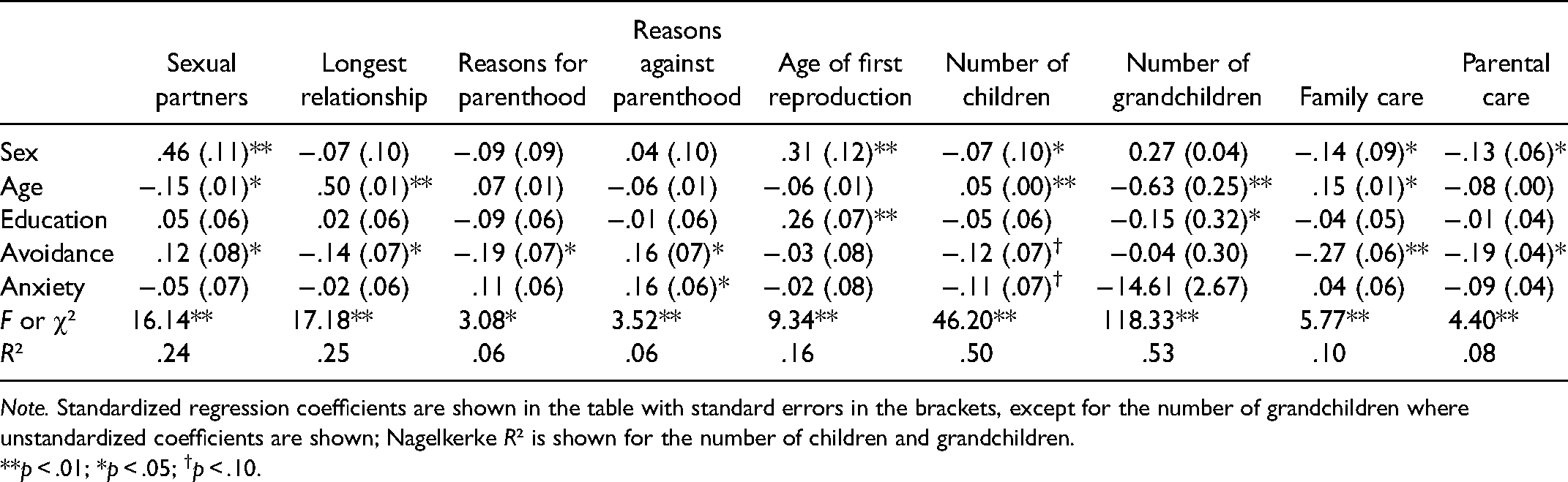
Note. Standardized regression coefficients are shown in the table with standard errors in the brackets, except for the number of grandchildren where unstandardized coefficients are shown; Nagelkerke R² is shown for the number of children and grandchildren.
**p < .01; *p < .05; †p < .10.
We also tested interactions between participants’ sex and attachment styles in order to examine whether the links between attachment and fitness were different for males and females. Only one interaction turned out to be significant: the one between Anxiety and Sex in the prediction of Parental Care (ΔF = 8.23; p < .01; ΔR² = .03; β = −.59; p < .01). The interaction plot showed that males with increased anxiety had lower levels of care for children—a graphical representation of the interaction can be seen in Figure 1.
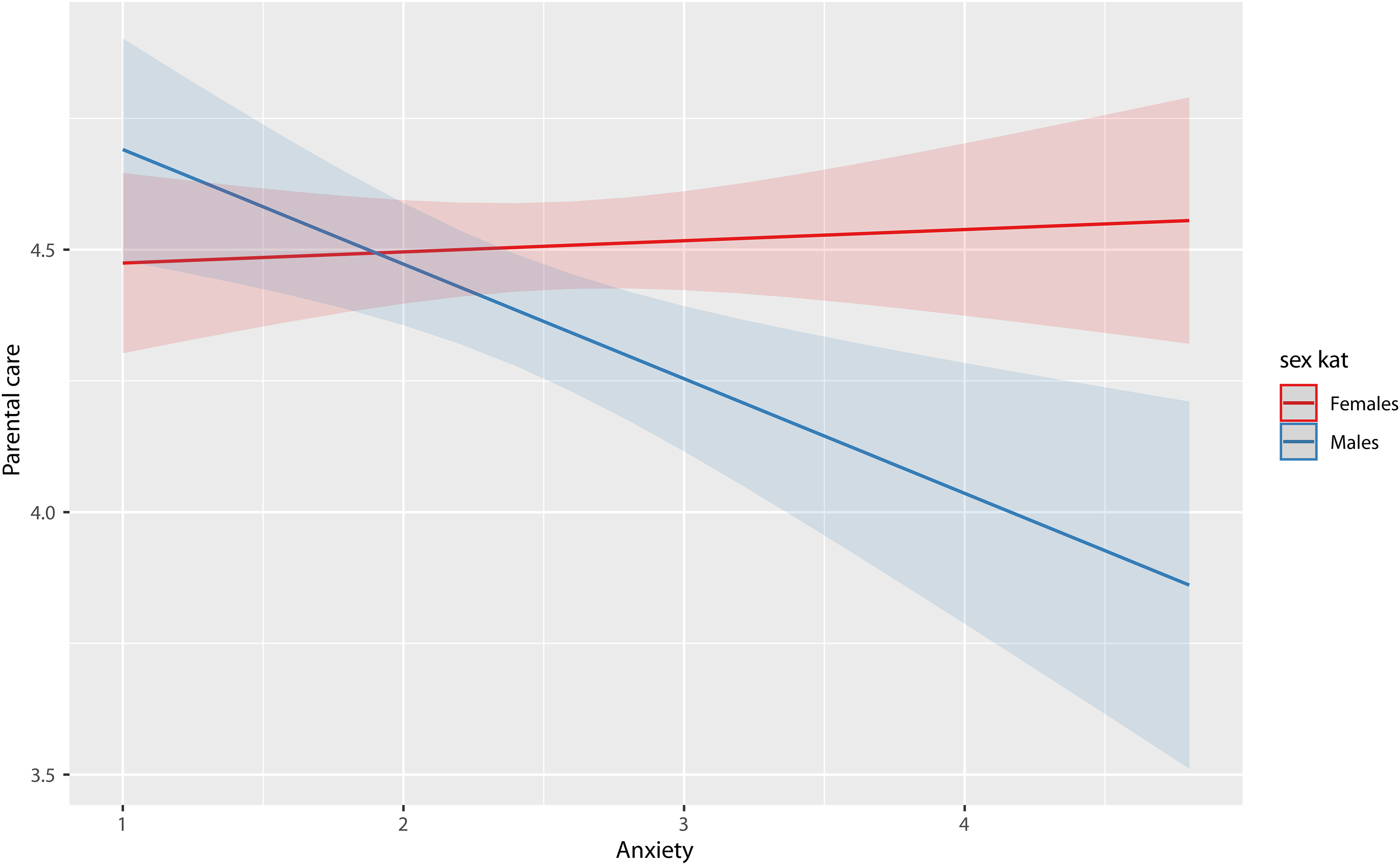
Interaction between participants’ sex and attachment anxiety in the prediction of parental care.
Mediators Between Attachment and Number of Children
Finally, we conducted a path analysis where we analyzed reproductive motivation and long-term mating as the mediators between attachment styles and the number of children. The number of grandchildren was not analyzed because attachment styles were not associated with this criterion measure; short-term mating was not included in the model because it did not correlate with the number of children. Before we modeled the paths, the examined variables were partialized for the variation of sex, age, and education. The original model showed that Reasons against Parenthood did not have a significant path toward reproductive success; hence, it was removed from the model. The final model is shown in Figure 2, and it had very good fit indices (χ²(4) = 4.5; p > .05; NFI = .957; CFI = .994; RMSEA = .017), which is expected since all the variables were modeled as observable. We can see that the negative relation between Anxiety and the Number of Children was direct (thus, with no mediators), while the link between Avoidance and the Number of Children was mediated by both positive motivation for reproduction and the duration of long-term relationships (β = −.07; p = .01). Therefore, the negative relation between Avoidance and Number of Children can be attributed to lower reproductive motivation and shorter romantic relationships.

Path analysis of the mediation effects between attachment and reproductive success notes: correlations are shown as double arrows; expected causal paths are shown as one-sided arrows; all coefficients are significant on the level of p < .01 except the path from anxiety to the number of children (p = .03).
Discussion
Secure Attachment Elevates Reproductive Fitness
Secure attachment enables close affective bonding between children and caregivers and between romantic partners as well and represents one of the foundations for romantic pair bonding. Therefore, many authors try to explain attachment using the evolutionary framework, but the predictions of attachment styles’ adaptive outcomes are somewhat different. There are views that only secure romantic attachment is adaptive because it facilitates fertility via long-term romantic relationships (Eastwick & Finkel, 2012), elevates reproductive motivation (Cheng et al., 2015; Nathanson & Manohar, 2012), and enables biparental care for offspring (Barbaro, 2020; Eastwick, 2009; Jones et al., 2015). On the other hand, there are scholars who believe that insecure attachment styles may be adaptive as well (Ein-Dor et al., 2010; Simpson & Belsky, 2008): avoidance may be related to fertility via short-term mating (Schmitt, 2005) and associated with earlier reproduction (Chisholm et al., 2005), while anxiety may elevate inclusive fitness via enhanced kin care (Belsky, 1997).
The present data unequivocally supports the former hypothesis—anxious and avoidant attachment styles were systemically negatively related to several fitness-related outcomes: long-term mating, reproductive motivation, number of children, and care for children and other family members. Anxiety was not positively associated with care for family members (the associations were nonexistent) as predicted by the hypothesis that individuals with anxious pair bonding may promote their inclusive fitness by helping their family members (Belsky, 1997). Avoidance was unrelated to the age of first reproduction (in fact, both attachment styles were), which is incongruent with the previous findings showing that insecurely bonded women have a younger age at first birth (Chisholm et al., 2005). Compared to the previous study, the present one was based on a higher sample and more precise operationalizations of attachment—therefore it had more power to detect this effect, but still, it was not found. Avoidance was indeed related to short-term mating, which is in line with previous findings (Schmitt, 2005); however, note that this link cannot provide fitness benefits for avoidant individuals because short-term mating is unrelated to the number of children and negatively related to parental investment and number of grandchildren. A similar result was obtained in previous research as well (Gutiérrez et al., 2022; Međedović, 2021a, 2021b). Hence, the present data suggest that secure attachment is adaptive via several fitness indicators and therefore it may be under positive directional selection, although we should be cautious about this interpretation due to the fact that the study sample was not a representative one—replication of these findings on more diverse and representative samples in future studies could provide additional evidence for the selection on attachment styles.
We believe it is important to provide an answer to the question posed by Ein-Dor et al. (2010) regarding why insecure attachment styles are relatively prevalent in humans if they are not adaptive. Firstly, there are many behavioral traits that exist in contemporary humans that are not adaptive—various ultimate mechanisms can maintain genetic and phenotypic variation in these traits (Međedović, 2018; Penke et al., 2007). One of these mechanisms is mutation-selection balance: selection tries to fixate the phenotypic mean of a trait (in this case secure attachment) to a population optimum but inherited and de novo mutations work against selection, generating inter-individual variation (i.e., insecure attachment behavior). This mechanism of natural selection was already shown to operate on psychopathological characteristics (Keller & Miller, 2006) and personality traits (Verweij et al., 2012). Having in mind that insecure attachment styles share a significant proportion of variation both with psychopathology (Mikulincer & Shaver, 2012) and personality (Noftle & Shaver, 2006), even on a genetic level (Donnellan et al., 2008; Franz et al., 2011), mutation-selection balance seems like a plausible mechanism that can maintain variation in romantic attachment styles.
Fitness Costs of Anxious and Avoidant Romantic Attachment
The main fitness indicator in the present research was the number of children. The number of grandchildren is also an important measure of fitness, however, the number of participants who had grandoffspring was relatively small in our sample (this measure is a more precise marker of fitness in older cohorts). However, it is analytically more beneficial not only to explore reproductive success, but also the suit of traits that correlate with it: in line with the previous research, correlation analysis showed that the number of children is related to romantic relationships that last longer (Međedović, 2021a, 2021b), elevated reproductive motivation (Liefbroer, 2009; Miller et al., 2010), earlier age of first reproduction (Kirk et al., 2001; Pelletier et al., 2017), and greater care for family members in general (Međedović, 2021c). Interestingly, there was no relation between reproductive success and parental care, which indicates that a higher number of children does not necessarily imply lower parental investment: the absence of this tradeoff is not surprising in contemporary human populations marked by low fertility patterns (Međedović, 2021c). This pattern of traits related to reproductive success can provide us with an extended analytical framework that enables a greater understanding of the adaptive function of romantic attachment.
Both anxiety and avoidance are negatively related to the number of children, and thus, reproductive fitness itself. Lower reproductive success of insecure attachment can be relatively straightforwardly explained by the negative associations of both attachment styles with the longevity of romantic partner relationships and positive relations with the fears and concerns of having children. Previous studies have also shown that individuals with longer romantic relationships have a higher number of children (Međedović, 2021a, 2021b). In fact, the characteristics of long-term mating that facilitate reproduction are quite congruent with secure romantic attachment—higher quality of relationship (Rijken & Thomson, 2011), partner's positive feeling about pregnancy (Carter et al., 2013), or perceived partner's qualities regarding parenthood (Roberts et al., 2011). Our data also showed that forming stable, intimate, and secure romantic bonding is a partial prerequisite of childbearing motivation as well—insecure individuals find more obstacles and reasons against having children. Fears regarding their parental abilities (Rholes et al., 1995) or maladaptive behavior in their offspring (Rholes et al., 1997) can more precisely depict diminished reproductive motivation.
There are certain differences between attachment styles and their links to fitness-related outcomes. Firstly, avoidance is negatively related to parental care in both sexes, but anxiety negatively predicts parental investment only in males. The fear of partner rejection and relationship breakup apparently distracts men from investing in children, while in women, it is not related to parental care. Secondly, avoidance has several more negative links to fitness than anxiety, including diminished positive reasons for having children and lowered care for biological relatives, which may negatively impact inclusive fitness. Furthermore, its relation with reproductive success is significantly mediated by lower reproduction motivation and long-term relationship, while the link between anxiety and reproduction is more direct. Avoiding intimacy and emotional bonding may be more detrimental to fitness than clingy and fearful romantic attachment.
Limitations and Future Directions
The present study has several important limitations. The sample structure is a major one. The sample is not a representative one: this represents an obstacle for generalizing the results furthermore since it was an online study, it is possible that participants who live in harsh and depriving conditions were not included in the study. Since environmental harshness may be an important ecological factor that influences the links between attachment styles and fitness, future studies should particularly try to involve participants from these environments. The majority of participants in the present study were still in their reproductive phase: although we controlled for participant's age in the main analyses, this still limits the robustness of reproductive success as a fitness indicator. The sample of participants analyzed in the current research originates from a WIERD country (Western, Educated, Industrialized, Rich, and Democratic)—these relations should be analyzed in more diverse societies in order to draw more comprehensive conclusions about the adaptive roles of attachment. The cross-sectional nature of the present study prevents us to conclude on causal links between the examined variables: studies that would examine attachment styles in young adults with fitness indicator information gathered later in their lifetimes could solve the problem of causality. Parental and family care were measured with relatively narrow measures based on a self-report methodology in the present study: more diverse measures of these variables would be fruitful for future studies. Finally, the evolution of attachment is probably culturally dependent because the function of attachment systems may be culturally contingent (Keller, 2013) and the evolution of attachment may be affected by gene-culture coevolution via the processes of social learning (Granqvist, 2021).
Concluding Remarks
The present study offered an empirical answer to the fundamental question regarding the evolutionary status of romantic attachment—is only secure attachment adaptive or do both secure and insecure attachment styles have some adaptive benefits? Having in mind the limitations of the study, it should be considered only as the first step in answering this question. Nevertheless, it represents a part of an exciting journey in analyzing the selection regimes on romantic attachment. It also shows the benefits of the behavioral ecological approach to the examination of fitness outcomes of the behavioral traits, that is, directly measuring fitness components and plausible mediators between a trait and fitness. Since the findings showed the importance of romantic attachment for analyzing reproductive success and parental investment, we hope that the current study can contribute to the field of the behavioral ecology of pair bonding in general.
Footnotes
Declaration of Conflicting Interests
The author(s) declared no potential conflicts of interest with respect to the research, authorship, and/or publication of this article.
Funding
The author(s) received no financial support for the research, authorship, and/or publication of this article.
