



Abstract
Evolutionary scientists studying social and cultural evolution have proposed a multitude of mechanisms by which cultural change can be effected. In this article we discuss two influential ideas from the theory of biological evolution that can inform this debate: the contrast between the micro- and macro-evolution, and the distinction between the tempo and mode of evolution. We add the empirical depth to these ideas by summarizing recent results from the analyses of data on past societies in Seshat: Global History Databank. Our review of these results suggests that the tempo (rates of change, including their acceleration and deceleration) of cultural macroevolution is characterized by periods of apparent stasis interspersed by rapid change. Furthermore, when we focus on large-scale changes in cultural traits of whole groups, the most important macroevolutionary mode involves inter-polity interactions, including competition and warfare, but also cultural exchange and selective imitation; mechanisms that are key components of cultural multilevel selection (CMLS) theory.
Keywords
Introduction
The rise of politically centralized societies and states in human history is one of the central questions in archaeology, anthropology, and other social sciences (Blanton & Fargher, 2008; Flannery & Marcus, 2012; Johnson & Earle, 2000; Sanderson, 1999; Turchin, 2022). For the past century and a half, the studies of these phenomena have greatly benefited by drawing insights from the theory of biological evolution (Carneiro, 2003; Currie & Mace, 2011). Over the last couple of decades, cultural evolution theory has emerged as a powerful tool for the analysis of structure and dynamics of human societies (Richerson & Christiansen, 2013). In this new discipline culture is defined as socially transmitted information, such as ideas, skills, attitudes, and norms, that affects people’s behaviour, practices, and actions. New cultural traits appear as a result of innovation, driven by intentional design, blind trial and error, or, simply, transmission error. They spread by imitation, teaching, and other kinds of learning. Cultural traits can also go extinct. Broadly speaking, cultural evolution is the change of culture over time (Richerson & Christiansen, 2013). Cultural evolution has adopted many methods and insights of biological evolution theory (Boyd & Richerson, 1985; Cavalli-Sforza & Feldman, 1981; Lumsden & Wilson, 1981). Both theories share the focus on variation, selection, and inheritance as the key evolutionary processes; emphasize population (group) level processes; and utilize dynamic approaches with deep similarities in mathematical models describing changes in the frequencies of genes or cultural traits (but there are also important differences, Richerson et al., 2021; Smolla et al., 2021).
Two particularly influential ideas coming from the theory of biological evolution concern the distinctions between micro- and macroevolution and between the tempo and mode of evolution. In evolutionary biology, microevolution means genetic and phenotypic changes within populations while macroevolution is changes above the species level. In spite of this distinction, it is generally understood that microevolutionary processes are sufficient in themselves to explain the patterns of macroevolution including those studied by paleontologists (Simpson, 1944). A similar distinction is often made in cultural evolution (Duffy, 1980; Mesoudi, 2011). Cultural microevolution, thus, can be defined as the change in the frequency of cultural variants within a population (Cavalli-Sforza & Feldman, 1981). Cultural macroevolution, in contrast, is large-scale changes in cultural traits of whole groups (Eldredge, 2009). Some group-level traits reduce directly to individual traits, but others are emergent properties of groups, not reducible to individuals.
The distinction between the tempo and mode of evolution was first made in one of the foundational books of the Modern Synthesis by the paleontologist G.G. Simpson (1944). The “tempo” has to do with “evolutionary rates. . ., their acceleration and deceleration, the conditions of exceptionally slow or rapid evolutions, and phenomena suggestive of inertia and momentum.” The “mode” involves “the study of the way, manner, or pattern of evolution, a study in which tempo is a basic factor, but which embraces considerably more than tempo”. These ideas have had a profound impact on evolutionary biology and paleontology (Fitch & Ayala, 1994; Gould & Eldredge, 1977). The main modes (or mechanisms) in evolutionary biology are natural and sexual selection, mutation, recombination, migration, and genetic drift. The main modes as seen by paleontologists are speciation, phyletic evolution, and quantum evolution (Gould, 1994; Simpson, 1944).
Evolutionary scientists studying social and cultural evolution have proposed a multitude of mechanisms by which cultural change can be effected: random change, biased transmission, and natural selection on cultural traits (Boyd & Richerson, 1992); selective imitation and selective migration (Richerson et al., 2016); cultural group selection (Richerson et al., 2016; Turchin, 2006); genetic group selection (Bowles et al., 2003); self-interested design (Gavrilets & Duwal Shrestha, 2021; Singh et al., 2017); evoked culture (Krasnow & Delton, 2016; Tooby & Cosmides, 1989); cognitive niche (Pinker, 2010; Tooby & deVore, 1987; Whiten & Erdal, 2012); and demographic swamping (Henrich, 2004). Which ones are more important is a controversial topic (Cofnas, 2018; Gavrilets & Duwal Shrestha, 2021; Krasnow & Delton, 2016 Richerson et al., 2016; Singh et al., 2017; Smith, 2020).
Although theoretical archaeology and cultural evolution largely developed in separate streams and some social scientists still debate the usefulness of evolutionary theories in explaining macrosocial change (Manning, 2020; Marcus, 2008; Spencer, 2019; Turner & Machalek, 2018), there are many ideas that cross-cut the two disciplines. For example, following Morton Fried (1967) archaeologists make distinction between “pristine” and “secondary” states, with selective imitation playing a large role in the latter. A particularly interesting theoretical framework is “peer polity interaction” (Renfrew & Cherry, 1986), which evokes the mechanism of cultural group selection. Renfrew, in particular, distinguishes such mechanisms of change as warfare, competitive emulation, symbolic entrainment, and the transmission of innovation, which have obvious parallels in the cultural evolutionary theory.
The discipline of cultural evolution has an enormous potential to throw light on Neolithic Revolution, the rise of cities and states, the spread of world religions and other ideologies (for example, those associated with the Enlightenment), and the recent dramatic improvements in the quality of life experienced by people living in many parts of the globe. These changes can be viewed as “major evolutionary transitions” in human history (c.f. with major evolutionary transitions in biology, Maynard Smith and Szathmáry, 1995). Cultural evolution is part of what might be considered as the third wave of evolutionary thinking in anthropology and other social sciences. The first wave, “classical social evolution” of the nineteenth century, is associated with such figures as Herbert Spencer, Lewis Henry Morgan, and Edward B. Tylor. The second wave, or “neo-evolutionism” of such anthropologists as V. Gordon Childe, Leslie White, Elman Service, Marshall Sahlins, Julian Steward, and sociologist Talcott Parsons was introduced by the publication of Childe’s Man Makes Himself in 1936 and peaked during the 1960s and 1970s. The third wave, in addition to cultural evolution, includes such approaches as evolutionary psychology (Tooby & Cosmides, 1989). Note, however, that cultural evolutionists and evolutionary psychologists disagree about certain foundational issues, for example, the role of cultural group selection in explaining human cooperation and culture change (Chudek et al., 2013; Krasnow & Delton, 2016; Richerson et al., 2016).
Here we use the Tempo/Mode framework to guide our thinking about the evolution of cultural traits that have transformed human societies over the past 10,000 years—political centralization, specialized governance institutions, and the social scale on which humans interact and cooperate. These are macroevolutionary group-level characteristics because, for example, it doesn’t make sense to speak of individuals as “centralized” or not (of course, individuals within the same group can vary in their attitudes and norms, e.g. willingness to submit to the authority). Our work greatly extends earlier studies of cultural macroevolution which focused on state formation (Spencer, 1990) and coevolution of social and political traits in Austronesian-speaking societies of Island South-East Asia and the Pacific (Currie & Mace, 2011).
Tempo: Rates of Change
During the Holocene—roughly, the past 10,000 years—the social scale at which humans interact and cooperate increased by six orders of magnitude, from societies of hundreds (or a few thousand) to hundreds of millions and even billions. A particular form of political organization, the state, arose in mid-Holocene, eventually becoming the dominant form of social organization over the world. Other dimensions of change include increasingly productive economies, widespread adoption of writing and literacy, but also deeper inequalities and entrenched class hierarchies (Flannery & Marcus, 2012; Johnson & Earle, 2000; Kradin, 2021; Sanderson, 1999).
The pattern of evolutionary change was not monotonic. Evolutionary archaeologists view social evolution—the origins and development of new forms of social organization—as a process in which long, stable periods were interrupted by brief periods of rapid change (Marcus, 2008; Marcus & Flannery, 1996; Redmond & Spencer, 2012). Borrowing a concept from biological evolution, Charles Spencer (2019) proposed that the transitions from autonomous village societies to chiefdoms, and then from chiefdoms to the states, can be conceptualized as a shift from one peak to another on an adaptive landscape (Gavrilets, 2004; Wright, 1932).
We can now add empirical depth to these ideas thanks to the massive data on past societies in Seshat: Global History Database (François et al., 2016; Turchin et al., 2015). In an analysis of 51 variables reflecting such characteristics of human societies as social scale, economy, features of governance, and information systems for 414 societies from 30 regions around the world, we showed that these different characteristics show strong relationships with each other and that a single principal component (PC1) captures around three-quarters of the observed variation (Turchin et al., 2018). When we plot this measure of social complexity against time, we observe a variety of patterns of change, including gradual increase, no change, and decline (Figure 1). However, the overall statistical pattern is that of periods of apparent stasis interspersed by rapid change (Figure 2). As a result, the distribution of rates of change is very non-Gaussian, with more than 70% of frequencies clustering at 0, and very large changes (both increases and decreases) much more frequent than would be observed under the assumption of normality.

Trajectories of social complexity in 10 world regions (out of 30 total). (A) Africa and east Asia. Broken lines indicate 95% confidence intervals. (B) Southwest Asia, south Asia, Europe, and Central Asia. (C) Southeast Asia, North America, South America, and Oceania. PC1 has been rescaled to fall between 0 (low complexity) and 10 (high complexity) to aid interpretation. Source: Figure 3 in (Turchin et al., 2018).

Blue bars: frequency distribution of rates of change in PC1 per century in the seshat sample of past polities. Red curve: Gaussian distribution with the same mean and variance as the data.
Mode: Qualitative Patterns and Mechanisms of Change
In the Introduction we listed a great variety of ideas about the mode(s) of social evolution, proposed by cultural evolutionists, evolutionary psychologists, and evolutionary anthropologists. In this section we use the Seshat sample to relate these ideas to data. Our focus is on the transition from centralized societies without internally specialized administration (“chiefdoms”) to societies with internally specialized governance structures (“states”).
For political centralization, we use the Seshat measure of hierarchy that focuses on the length of chains of command. Hier averages the number of levels in military, administrative, and settlement hierarchies (the last one is a particularly useful measure for archaeologically known societies). We use the transition in Hier from 2 to 3 as the threshold, because for archaeologically known societies (in which centralization threshold tends to be crossed) our primary source of information about hierarchy levels is the settlement hierarchy. A settlement hierarchy with two levels could correspond to a chiefly seat with subordinate villages or, alternatively, it could be a result of smaller and larger independent polities (single settlements) coexisting in a landscape. A three-tier hierarchy, thus, is a more secure indicator of a politically centralized society (typically, a complex chiefdom).
The Seshat measure of internally specialized administrative organization is Gov, which aggregates eleven binary variables. The first four variables code for presence/absence of professional military officers, soldiers, religious specialists, and administrative specialists (bureaucrats). Two variables code for bureaucracy characteristics: presence/absence of an examination system and of merit promotion. The next variable, specialized government buildings, is particularly useful for societies known only from their archaeological record. The final four variables code for the characteristics of the legal system: formal legal code, professional judges, professional advocates, and specialized buildings used for legal purposes (courts). Gov is scaled to be between 0 and 1, and we use the mid-point, Gov = 0.5 as the threshold.
Using this operationalization of chiefdom and state, we ask two questions. First, what was the mode of evolutionary change that resulted in a region crossing the Gov = 0.5 threshold? Second (and related to Tempo), how much time elapses between crossing the hierarchy and governance thresholds?
Patterns of Change
The most frequent mode of an NGA crossing the governance threshold is by being annexed by another, larger and more complex state (19 cases in Table 1). In retrospect, this result should not be surprising. As states became the most successful form of sovereign political organization, they spread over and eventually occupied all inhabitable areas on the Earth. This process was mostly a result of conquest and territorial annexation, and this is reflected in Table 1.
Modes of Transition to Statehood Observed in the Seshat Sample.
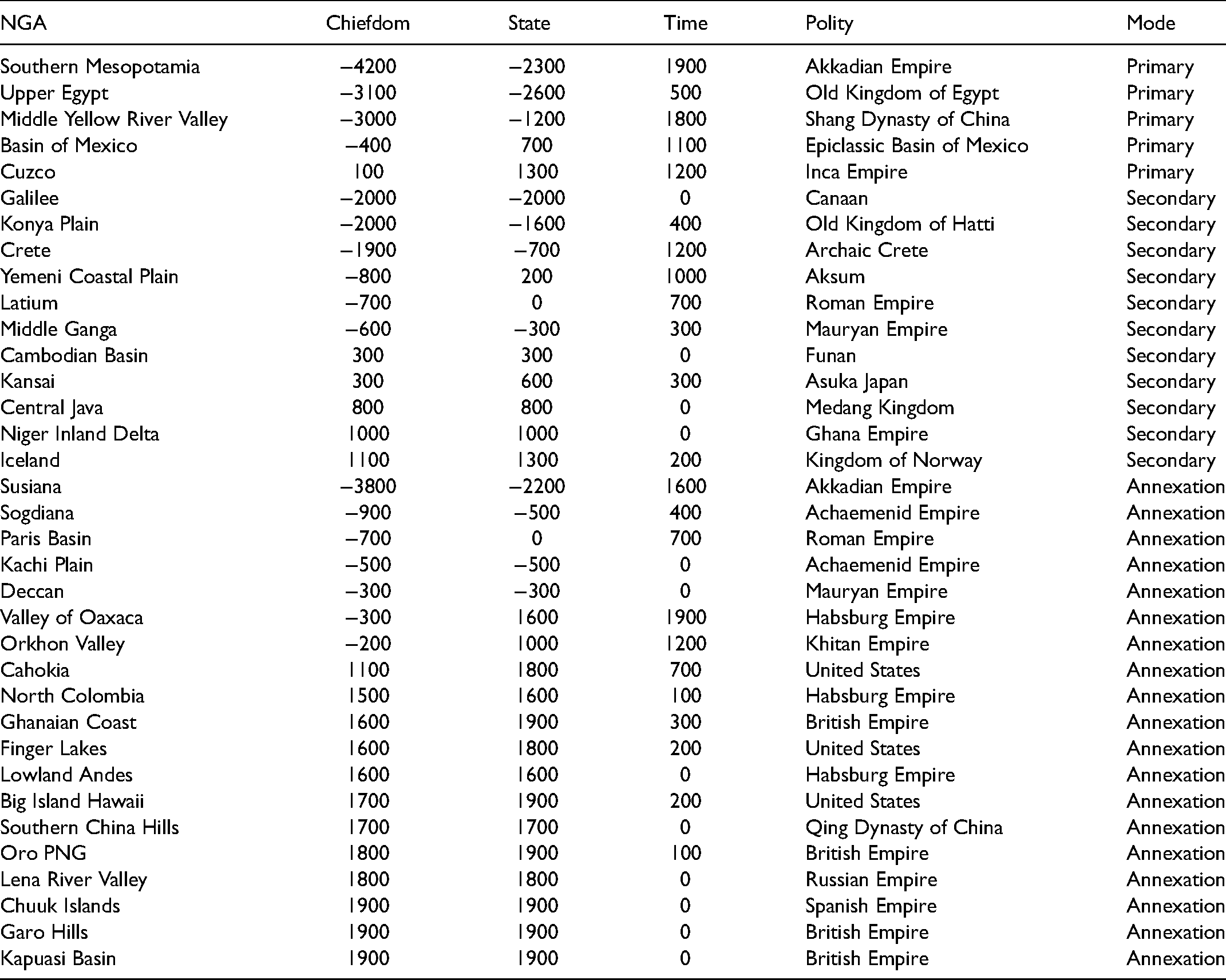
The next largest category is secondary state formation (11 cases in Table 1). Here we follow the established tradition in archaeology that distinguishes between “pristine” (primary, first-generation) and secondary states (Claessen, 2016; Flannery & Marcus, 2012; Fried, 1967; Service, 1975). The list of pristine states varies among authorities, but they are usually considered to include Mesopotamia, Egypt, China, Mesoamerica, Peru, and India (Spencer, 2010). First-generation states are relatively rare, and this is reflected in the Seshat sample (5 cases in Table 1).
As we might expect, primary state formation tends to take more time. The mean (±SD) time between centralization and crossing the governance threshold for primary states is 1300 (±570) years, while for secondary states it is 370 (±420) years. Secondary states benefit from selective imitation of successful “ultrasocial institutions” (Turchin et al., 2013), which enable cooperation at the level of large-scale human groups. For example, state formation in Southeast Asia (represented in the Seshat Sample by Cambodian Basin and Central Java) was very rapid due to the importation of world religions, writing, and governance institutions from South Asia.
Mechanisms of Change
The most general mode of evolutionary change, which results in transitions to states in the Seshat sample, thus, is interpolity interactions: competition (including extreme forms, such as warfare, conquest, and cultural assimilation) and exchange (with an emphasis on its informational dimensions). The operation of this general mechanism is most obvious when a polity loses in competition with a more successful one, resulting in annexation (which is the most common mode of transition to statehood in the Seshat sample). Secondary state formation also involves selective imitation (by definition) as well as interpolity conflict. Despite the quantitative difference between their rates of evolution, as we saw in the previous section, qualitatively the modes of evolutionary change do not differ between the primary and secondary state formation cases. After all, “pristine” states also did not arise in splendid isolation, as is often noted by evolutionary archaeologists. Morton Fried (1967), who first made a distinction between primary and secondary states, argued that the transition from a stratified society (a chiefdom) to a pristine state also occurred in an environment occupied by other similar polities, which developed together as a result of such interactions as competition, war, trade, and cultural exchange. As we mentioned above, later this concept was formalized as the “peer-polity interactions” (Renfrew & Cherry, 1986). In their review of the rise of early states, Flannery and Marcus (2012) agreed: “in the four cases we examined, not one kingdom was the offspring of a rank society that simply got bigger. … Instead, all four kingdoms arose through the forced unification of competing rank societies.”
Other transitions in social scale and complexity of human societies may have also involved the same general mechanism. For example, in our previous research we used agent-based simulations to model the rise and spread of “megaempires”—states that controlled territories of millions of square kilometres and populations of tens of millions (Turchin et al., 2013). The central premise of the model was that costly institutions that enabled large human groups to function without splitting up (ultrasocial institutions) evolved as a result of intense competition between societies—warfare. Warfare intensity, in turn, depended on the spread of historically attested military technologies (e.g., chariots and cavalry) and on geographic factors (e.g., rugged landscape). The model-predicted pattern of spread of large-scale societies within a realistic landscape of the Afroeurasian landmass between 1500 BCE and 1500 CE was very similar to the observed one, with the model explaining 65% of variance in the data. A subsequent spatially explicit statistical analysis confirmed that large-scale societies developed more commonly in regions where warfare was more intense (as proxied by distance from the Eurasian steppe), thus creating a stronger selection pressure for societies to scale up (Currie et al., 2020). This analysis also identified an additional factor: transitions to megaempires were more likely in regions where agriculture has been practiced for longer (thus providing more time for the norms and institutions that facilitate large-scale organization to emerge).
Whereas our previous studies focused on Afroeurasia during the Ancient and Medieval eras, the most recent analysis was global (sampling, in addition, sub-Saharan Africa, the Americas, and the Oceania) and extended temporal coverage back to the Neolithic (where data allowed). We used a general dynamical model, based on the theoretical framework of cultural macroevolution, and Seshat data to test 17 potential predictor variables proxying mechanisms suggested by major theories of sociopolitical complexity (Turchin et al., 2021c). Not limiting itself to testing the effects of each potential predictor in isolation, this analysis tested >100,000 possible combinations of these predictors with three response variables capturing different aspects of social complexity (social scale, hierarchy levels, and the sophistication of governance). We found that the best-fitting models indicate a strong causal role played by a combination of increasing agricultural productivity, antiquity of agriculture, and invention/adoption of military technologies (Turchin et al., 2021c), thus confirming previous studies that had a more limited geographic and temporal scope. Other classes of predictors (proxying functionalist and internal conflict theories) do not appear to play a significant causal role in propelling advances in such aspects of social complexity as social scale, hierarchical complexity, or governance sophistication. Furthermore, our analysis found strong evidence for nonlinear autoregressive terms that stabilize evolutionary dynamics around equilibria set by the values of predictors (agriculture and warfare). These results suggest that periods of rapid change are induced by such technological advances as the joint spread of iron metallurgy and horse riding during the first millennium BCE, or by the gunpowder revolution of the mid-second millennium. Rapid directional change is then followed by a period of stabilizing selection, until another technological revolution elevates the equilibrial level again.
A pattern of apparent stasis interspersed by periods of rapid change, predicted by this model, is consistent with the statistical results in Figure 2. Such a “punctuated equilibrium” pattern is even more apparent when we focus on the evolution of largest and most complex societies worldwide. For example, Figure 3 shows how one aspect of social scale, the territory controlled by largest polities, evolved over the past five thousand years. The most recent rapid growth phase followed 1500; it was preceded by other such periods starting in 500 BCE, 2000 BCE, and 2700 BCE. In between, there was little change in the maximum polity territory. The longest period of no systematic change was during the nearly two millennia between 300 BCE and 1500 CE. Empires rose and fell and the list of three largest polities was constantly updated, but the areas of these polities continued fluctuating around the 3 million square kilometre level.
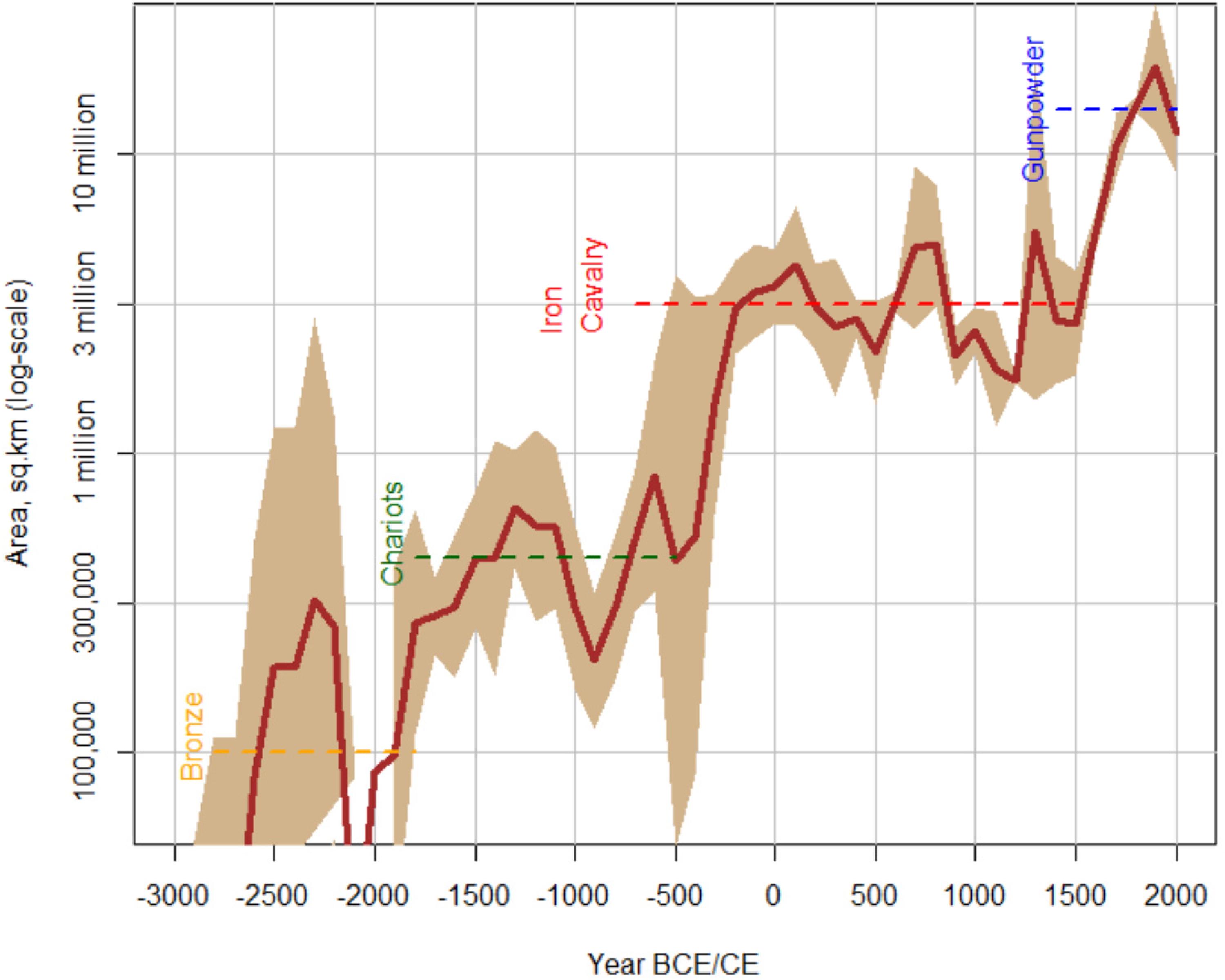
Evolution of largest territorial polities over the past 5,000 years. Brown curve: average territory of the three largest polities. Tan shading: mean ± SD.
Furthermore, periods of rapid change are clearly associated with major technological “revolutions”, especially those triggered by novel military technologies. The most recent military revolution in Figure 3 is the well-known one that originated in Western Europe during the fifteenth centuries. The key innovation was the arrival in Europe of gunpowder and cannon, which were invented in China much earlier (Chase, 2003). The turning point when cannon became the game-changer was the 1450s. In 1453 the French ended the Hundred Years War by expelling the English from the continent (apart from their last foothold of Calais). This was accomplished by a compact French army using siege artillery against the castles held by the English. Three years later, in 1456, cannons were the key to the successful conquest of Constantinople by the Ottomans. Other military innovations rapidly followed: hand-held firearms, field artillery, new fortifications (star-forts, or trace italienne), and new methods of drilling soldiers and battlefield tactics. Equally important were the contemporary advances in ship building and sailing (Cipolla, 1965). The new ocean-going ships, armed with cannon, enabled European exploration and conquest of far-flung territories. Because the sailing ship was so important in transforming local European developments into what became a global event, one of us has proposed that we refer to this period of rapid evolution as the “Gunboat Revolution” (Turchin, 2009).
Several military historians and historical sociologists have advanced the argument that the Gunboat Revolution transformed the scale of war and led to an increase in the authority of the state (Mann, 1986; Parker, 1996; Roberts, 1956; Tilly, 1990). As Charles Tilly famously stated, “War Made the State and the State Made War” (Tilly, 1990). This thesis was not universally accepted (Black, 1995; Duffy, 1980); but currently most of the debate focuses on the particulars of how different aspects of social change, driven by intense interpolity competition, played out in different European states. A recent review concluded that the core argument has stood up well to time (Kaspersen & Strandsbjerg, 2017).
Our research on the Cavalry Revolution provides another well-documented example of how a novel military technology can intensify interstate competition and result in rapid evolution of social scale and complexity. Here’s how we see the sequence of events. Around 1,000 BCE, nomadic herders in the steppes north of the Black Sea improved the bit and bridle to the point where it allowed effective control of horses when riding. Shortly thereafter, thousands of metal bits suddenly appear and spread within the Eurasian steppes and regions south of them (Drews, 2004). The steppe pastoralists combined this technology with a powerful recurved bow, which could be used from the horseback, and iron metallurgy that gave arrowheads greater penetrating power. Horse archers became the “weapon of mass destruction” of the Ancient World (Turchin, 2009). In response to this threat from the steppe, the agrarian societies, which did not have access to plentiful supply of horses, were forced to build large infantry armies, develop new armour, such as the hoplite panoply (Drews, 2004), and new projectile weapons, such as the crossbow which was used in China from the fourth century BCE (Hui, 2005). They were further impelled to mobilize more of their populations towards collective efforts to build and maintain defenses, to produce and distribute enough goods to keep the large armies supplied, and to develop increasingly complex administrative systems to manage all of these moving parts. Ideological innovations—leading to major world religions, such as Zoroastrianism and Buddhism, as well as later Christianity and Islam—helped to unite larger and more disparate populations for such collective efforts (Bellah, 2011; Turchin et al., 2021a).
Remarkably, although the new forms of horse-based warfare spread to different parts of the Eurasian continent at different times, the time lag between this development and the first appearance of mega-empires was always 300–400 years (Table 2). Apparently, this time period was necessary for the selective regime of intense interpolity warfare to generate cultural macroevolutionary change. The Gunboat Revolution required a similar period of time to unfold. Whereas effective gunpowder weapons and new sailing techniques appeared in Western Europe in the fifteenth century, it was only between 1750 and 1850 when European empires had achieved world dominance (Morris, 2010).
Relative Timing of First Appearance of Iron Metallurgy, Cavalry, and Largest Mega-Empires (Defined as States Controlling More Than 3 mln km2). The Dates are Rounded to the Nearest Century Mark, Negative Dates are BCE. “Time lag” = Time Between the Arrival of Cavalry in a Region and the Rise of a Mega-Empire There.

Given that our research has provided strong empirical support for the idea that cascades of technological advances, especially in the military sphere, are an important driver of cultural macroevolution in the long run, it is legitimate to ask, what drives the evolution of technological cascades? A recent study by the Seshat project found that world population size, connectivity between geographical areas of innovation and adoption, and critical enabling technological advances, such as iron metallurgy and horse riding are strong predictors of change in military technology, whereas state-level factors such as polity population, territorial size, or governance sophistication play no major role (Turchin et al., 2021b). What is interesting about this result is that it again confirms the key role of intersocietal interactions: competition and exchange.
Conclusions
We started this article with a list of theories proposed by evolutionary scientists to account for cultural change. Our review of recent analyses using the Seshat Databank suggests that when we focus on cultural macroevolution—large-scale changes in cultural traits of whole groups—the most important evolutionary mode involves inter-polity interactions, including competition and warfare, but also cultural exchange and selective imitation. These mechanisms, of course, are key components of cultural multilevel selection (CMLS) theory (Richerson et al., 2016). On the other hand, mechanisms of cultural change, proposed by evolutionary psychologists, such as evoked culture and cognitive niche, do not appear to offer a productive research agenda for cultural macroevolution (although they may have utility for cultural microevolution). We note that there are clear parallels between the pattern of apparent stasis interspersed by rapid change we observed in our data and punctuated equilibrium in paleontology (Eldredge, 2009; Eldredge & Gould, 1972; Gould, 1994; Gould & Eldredge, 1977). However the underlying mechanisms we have identified here and those in biological macroevolution (Eldredge et al., 2005) are different.
As we noted earlier, social scientists investigating specific evolutionary transitions in human history, often propose theories that are very similar in spirit to CMLS. The core argument of CMLS is that competition between societies, taking the form of warfare, imposes a selection regime that weeds out dysfunctional, poorly organized, and internally uncooperative polities, while favouring those with larger populations and effective institutions. This mechanism is implicitly, and often explicitly, evoked by processual archaeologists studying the evolution of first states and by military historians and historical sociologists studying the rise of the modern state, as we reviewed above.
Our analysis operated above the level of individuals and groups and did not consider the question of how societies managed to successfully organize collective actions underlying major social transitions. Behavioural economics, cultural evolution theory, and evolutionary psychology have identified a number of possible mechanisms including rewards and punishment, social norms, genetic or cultural relatedness, social institutions and inculcation and propaganda which can lead to the success of large-scale collective actions (Gavrilets & Richerson, 2017, 2021; McElreath & Boyd, 2007; Olson, 1965; Richerson & Boyd, 2005; Singh et al., 2017). Interestingly, the importance of collective solidarity for the emergence and persistence of states and empires was already clear to the Middle Ages Arab sociologist, philosopher, and historian Ibn Khaldun who introduced the notion of Asabiyyah to explain the cyclic nature of dynasties in the Medieval Maghreb. Although there are some parallels between the notion of Asabiyyah and modern notions of social identity (Tajfel, 1981; Tajfel & Turner, 1979), identity fusion (Whitehouse et al., 2017) and tight and loose cultures (Chua et al., 2019; Gelfand et al., 2011 Harrington & Gelfand, 2014;), much more work is needed on the psychological aspects of groups solidarity, as well as historical data measuring it.
We emphasize that our conclusions have to be tentative. Cultural evolution is a very young scientific discipline, and we are currently at the beginnings of its theoretical-empirical synthesis. There is a lot of work remaining, including refining theories and models, and especially more data for testing theoretical predictions.
Footnotes
Acknowledgments
We thank L. Betzig for the invitation to contribute to this special issue. PT was supported by the program “Complexity Science” of the Austrian Research Promotion Agency FFG under grant #873927. SG was supported by the U. S. Army Research Office grants W911NF-14-1-0637 and W911NF-18-1-0138, the Office of Naval Research grant W911NF-17-1-0150, and the Air Force Office of Scientific Research grant FA9550-21-1-0217.
Declaration of Conflicting Interests
The author(s) declared no potential conflicts of interest with respect to the research, authorship, and/or publication of this article.
Funding
The author(s) disclosed receipt of the following financial support for the research, authorship, and/or publication of this article: This work was supported by the U. S. Army Research Office (grant number grants W911NF-14-1-0637 and W911NF-18-1-0138, grant #873927).
