



Abstract
Data from 1155 Czech women (493 using oral contraception, 662 non-users), obtained from the Czech National Survey of Sexual Behavior, were used to investigate evolutionary-based hypotheses concerning the predictive value of current oral contraceptive (OC) use on extra-pair and dyadic (in-pair) sexual behavior of coupled women. Specifically, the aim was to determine whether current OC use was associated with lower extra-pair and higher in-pair sexual interest and behavior, because OC use suppresses cyclical shifts in mating psychology that occur in normally cycling women. Zero-inflated Poisson (ZIP) regression and negative binomial models were used to test associations between OC use and these sexual measures, controlling for other relevant predictors (e.g., age, parity, in-pair sexual satisfaction, relationship length). The overall incidence of having had an extra-pair partner or one-night stand in the previous year was not related to current OC use (the majority of the sample had not). However, among the women who had engaged in extra-pair sexual behavior, OC users had fewer one-night stands than non-users, and tended to have fewer partners, than non-users. OC users also had more frequent dyadic intercourse than non-users, potentially indicating higher commitment to their current relationship. These results suggest that suppression of fertility through OC use may alter important aspects of female sexual behavior, with potential implications for relationship functioning and stability.
Keywords
Introduction
Oral contraceptives (OCs) are the most commonly used form of reversible hormonal contraception worldwide (Leridon, 2006). Broadly speaking, they can be classed into two groups: those containing progesterone only, and those comprised of both synthetic estrogen and progesterone. Both types of OCs function to prevent pregnancy by inhibiting natural hormone production through interfering with the hypothalamic-pituitary-ovarian feedback loop. This results in the maintenance of high levels of progesterone (and estrogen in combined methods), which subsequently prevents the release of gonadotropins (LH and FSH), limits follicular development, and inhibits ovulation (Frye, 2006). A range of medical effects of OC use on factors such as physical health (for review see ESHRE, 2005), mood (e.g., Ott, Shew, Ofner, Tu, and Fortenberry, 2008), well-being (e.g., Sanders, Graham, Bass, and Bancroft, 2001) and sexual functioning (for reviews, see Schaffir, 2006; Stuckey, 2008) have been well-documented.
However, emerging evidence from evolutionarily framed studies suggests that OCs may have additional, less explored effects on female sexual interest and mating psychology (reviewed in Alvergne and Lummaa, 2010; Cobey and Buunk, 2013; Roberts, Gosling, Carter, and Petrie, 2008; Roberts et al., 2012). These effects are thought to be associated with the suppression of naturally occurring shifts in female sexual behaviors and preferences which co-vary with hormonal fluctuation during the regular menstrual cycle. For example, several studies have shown cycle-contingent shifts in sexual behaviour, such that during the fertile phase, when conception risk is high, women show greater levels of interest in potential mates (e.g., Haselton and Gangestad, 2006), greater receptivity to explicit courtship solicitations (Guéguen, 2009), and higher levels of sexual arousal while observing sexually explicit materials (e.g., Slob, Bax, Hop, Rowland, and van der Werff ten Bosch, 1996). Research examining partnered women's behaviour across the cycle has likewise shown that the prevalence of extra-pair sexual desire (Pillsworth, Haselton, and Buss, 2004), extra-pair attention (Gangestad, Thornhill, and Garver, 2002), flirtatiousness (Durante and Li, 2009), and extra-pair sex (Baker and Bellis, 1995) increases during cycle phases associated with high conception risk. Furthermore, women paired with men low in attractiveness are less satisfied with their partners, and show greater fertile phase shifts in extra-pair desire and mating behaviors, than women with more attractive partners (e.g., Garver-Apgar, Gangestad, Thornhill, Miller, and Olp, 2006; Larson, Haselton, Gildersleeve and Pillsworth, 2013; Pillsworth and Haselton, 2006). These findings support the idea that increased attraction to men other than the primary partner during the fertile phase may serve as a strategy to aid partnered women in increasing the genetic quality of potential offspring (Scheib, 2001).
Based on the fact that women using OCs do not experience fertile cycle phases, it may be that OC use reduces or nullifies these cycle-contingent sexual changes. Research conducted to test this premise has shown that OC users pay less attention to both sexually relevant stimuli (Laeng and Falkenberg, 2007) and to courtship language (Rosen and Lopéz, 2009) than normally cycling women do. Furthermore, women using OCs do not display cyclical shifts in preference for traits like masculinity and symmetry, which are known to occur in regularly cycling women, and are thought to provide an index of physical quality (e.g., faces and masculinity: Little, Jones, Penton-Voak, Burt, and Perrett, 2002; voices and masculinity: Feinberg, DeBruine, Jones, and Little, 2008; odor and symmetry: Thornhill and Gangestad, 1999). Studies which have directly assessed hormonal levels across the menstrual cycle indicate that the follicular peak in estrogen levels is positively related to fluctuation in sexual desire (Roney and Simmons, 2013), sexual activity (Wilcox et al., 2004), and proceptivity (Bullivant et al., 2004).
In addition to changes in sexual behaviors, women who use OCs have been shown to report higher overall levels of jealousy in studies using both cross-sectional (Geary, DeSoto, Hoard, Sheldon, and Cooper, 2001) and longitudinal designs (Cobey et al., 2012). Interestingly, the effect of OC use on jealousy also appears to be positively related to synthetic estrogen levels found in OCs (Cobey, Pollet, Roberts, and Buunk, 2011). Welling, Puts, Roberts, Little, and Burriss (2012) similarly showed that OC use and dose is associated with a higher prevalence of female mate-retention behavior (e.g., intersexual manipulation). Given the possibility for both endogenic and exogenic hormonal effects in OC users, an important step in future research will be to clearly distinguish between these possible effects. To date, existing research suggests that estrogen levels are a likely proximate factor which may underpin many of the aforementioned effects. Nonetheless, it remains to be tested how other hormones, or interactions between hormones, contribute to these changes. Other correlational work, for example, suggests that relatively high progesterone levels are associated with attraction to male cues of direct benefits of mate choice, such as paternal investment, and, in partnered women, with higher long-term relationship commitment (Jones, Little, et al., 2005; Jones, Perrett, et al., 2005). Progesterone has also been associated with higher affiliative motivation and social closeness in general (e.g., Brown et al., 2009). Indeed, OC users maintain preferences for male traits such as financial success and intelligence to a greater extent than naturally cycling women (Gangestad, Garver-Apgar, Simpson, and Cousins, 2007).
Aims and hypothesis
Here, through use of a representative sample from the Czech Republic, we aimed to test for differences in sexual desire and dyadic sexual activity among coupled OC users and non-users (NU) of reproductive age.
Given that OC use eliminates cyclical shifts in estrogen, and that the hormonal profile of OC users corresponds most closely with phases of low fertility, it is plausible that reductions in attention to sexually significant stimuli and extra-pair sexual desire known to occur at that cycle stage are similarly evident in OC users (Pillsworth et al., 2004). Therefore, we predicted that current OC use would be associated with lower extra-pair interest and behavior in coupled OC users. To our knowledge, this idea has not yet been tested. Specifically, we predicted that OC users would report a lower number of extra-pair sexual partners within the preceding year. Furthermore, since female mate retention behavior is associated with OC use (Welling et al., 2012), and since within-pair sex could be viewed as a form of mate-retention behavior, it was additionally predicted that the frequency of dyadic sexual activity would be positively associated with OC use.
Materials and Methods
Sampling procedure
Data were obtained from four rounds of the Czech National Survey of Sexual Behavior during the years 1993, 1998, 2003, and 2008. Basic descriptive characteristics of the survey have been published in the form of national reports (Weiss and Zvěřina, 1999, 2001, 2003). Data were collected by the socio-demographic agency DEMA using quota sampling (Moser and Kalton, 1971) in which representative sub-groups of the total Czech population (Czech National Office, 1991, 2001) were established according to age, economic status, place of residence, and educational attainment. Project research assistants were then instructed to distribute questionnaires to respondents who satisfied stringent quota criteria within their focus area. Respondents were asked to complete the questionnaire alone and to return it to the assistant in a sealed envelope. Overall, data were collected from 3,858 women in four rounds of the survey; none of the respondents were tested more than once. Table 1 provides a detailed description of the prevalence of OC use in the Czech population in women of reproductive age (18 – 51 years) within each of the survey rounds. The mean rate of OC use in the population of coupled Czech women of reproductive age across all years was 34.4% (see Table 1).
Counts and percentages of naturally cycling women (non-users, NU) and OC users (women aged 18–51 years) in four rounds of the Czech National Survey of Sexual Behavior
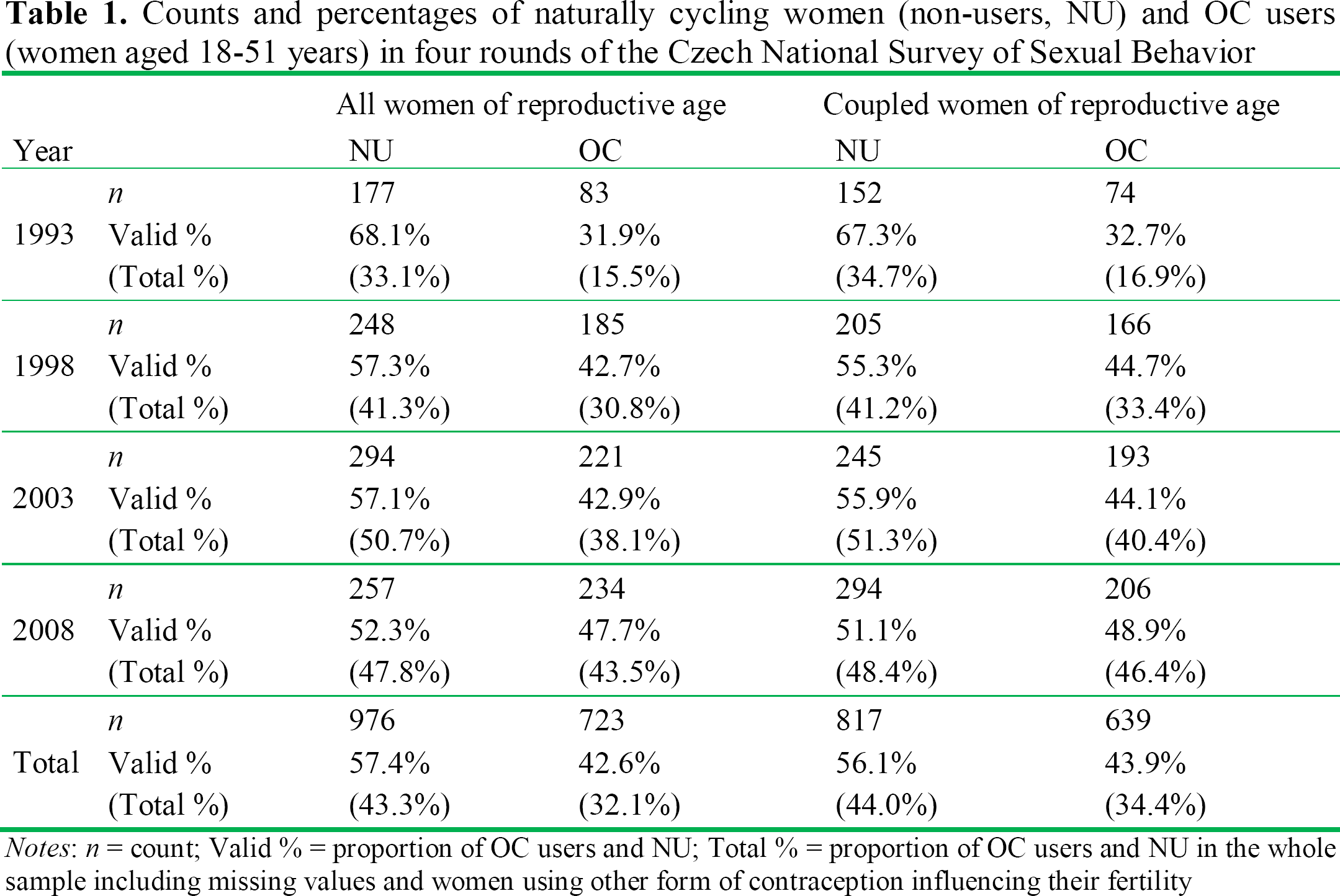
Notes: n = count; Valid % = proportion of OC users and NU; Total % = proportion of OC users and NU in the whole sample including missing values and women using other form of contraception influencing their fertility
Questionnaire of sexual behavior for women
The Czech National Survey of Sexual Behavior comprised 53 items, which stemmed from questions used in previous national surveys on sexual behavior (e.g., Haavio-Mannila and Kontula, 1992) and was specifically developed for the purpose of this National Survey (Weiss and Zvěřina, 1999, 2001, 2003). Each questionnaire also contained questions on socio-demographic characteristics. The sexuality items covered a variety of topics, ranging from frequency of sexual activity to sexual experience, knowledge, and attitudes; here, only items corresponding to our predictions were selected. For the purpose of this study, current extra-pair behavior was operationalized as the “number of one night stands during the last year” and the “number of extra-pair sexual partners during the last year,” and the overall sociosexual restrictiveness of a participant as the “overall number of sexual partners across the lifetime.” Similarly, dyadic sexual behavior was defined using the “frequency of dyadic sexual activities per month” item, whereas sexual desire was defined using the item “ideal frequency of overall sexual activity per month” (therefore it includes desire for solitary and extra-pair sex, as well as dyadic sexual activities). Information pertaining to other meaningful predictors of female extrapair behavior, such as education (Treas and Giesen, 2000), sexual satisfaction and overall sociosexual restrictiveness (Mark, Janssen, and Milhausen, 2011), and the frequency of dyadic sexual activities [e.g., age (years), parity, duration of relationship (months), sexual desire, and sexual satisfaction of women (for a review see Schneidewind-Skibbe, Hayes, Koochaki, Meyer, and Dennerstein, 2008)] were also available and were therefore considered (alongside specific predictions) within the statistical models.
Characteristics of the sample
The data of respondents from the Czech National Survey were only included in analyses if they satisfied a number of criteria. Firstly, participants were excluded if they were not of reproductive age. Reproductive age was classed as beginning at adulthood (age 18) as defined legally in the Czech Republic (the romantic relationships of younger women are quite specific, e.g., they often live with their parents). The upper age limit (age 51) reflects the mean age at menopause across European countries (50.9: Palacios, Henderson, Siseles, Tan, and Villaseca, 2010). Respondents were also excluded if they had a history of hormonal or reproductive problems (e.g., sterilized, previously underwent hormonal therapy) or if they were not in a relationship of at least 12 months (this restriction afforded comparison of the frequency of one-night stands per year as a measure of extra-pair sexual activity). The sample comprised two focus groups of women: those who were using OC and those who were normally cycling and not using (NU) any form of hormonal contraception. Women who a) reported having hormonal problems, b) were using some other form of hormonal contraception, but not OCs (e.g., hormonal intrauterine device or injections), c) stated they were casual OC users, or d) did not report their contraception details, were also excluded from the sample. After these exclusions, the final sample included 1155 women (662 NU/ 493 OC). All respondents were of Czech descent.
Statistical analysis
Initially, chi-square and ANOVA tests were used to determine whether there was a difference between OC and NU respondents with regard to sample characteristics (i.e., age, relationship length and parity) and sexual life history (i.e., age of first sexual intercourse and number of sexual partners). In further analyses, several measures of female sexual behavior were tested using Poisson regression with binomial predictors including contraception use (0 = NU, 1 = OC), sexual satisfaction (0 = Not satisfied, 1 = Satisfied) and parity (0 = No children, 1 = Children), in addition to continuous predictors (current relationship length in months, age in years).
Poisson regression (McCullagh and Nelder, 1989) is an extension of the general linear model used to predict count responses. A restrictive assumption of a Poisson model is that the mean count must approximately equal the variance. However, the observed count often exceeds the variability predicted by the Poisson distribution, thus indicating over-dispersion (Cameron and Trivedi, 1986). In such cases, a negative binomial model was used (see Hausman, Hall, and Griliches, 1984; Sturman, 1999). However, over-dispersion can also be caused by an excess of zero responses. In such cases a Zero-inflated Poisson (ZIP) regression was employed (see Lambert, 1992). While accommodating over-dispersion, ZIP regression also deals with the excess of zeros. First, logistic regression is used to predict the binary response “zero” or “non-zero” group membership and in addition Poisson regression is used to predict counts of one or more (Lambert, 1992). The regression models here were fitted using the pscl package (Jackman, 2012) in R (R Development Core Team, 2008). Comparisons between Poisson regression and negative binomial or ZIP models were analyzed using the Vuong test (Vuong, 1989). Model fit was determined against an intercept only model (null model) using AIC and χ2. In the summary tables, coefficient estimates (B) with standard errors (SE), p-values (p), odds ratios (OR), and 95% confidence intervals are presented for each variable.
Results
Comparison between OC and NU respondents
NUs were significantly older than OC users (NU = 38.26 years, OC = 31.56 years; F(1, 1153) = 163.56, p < .001), had been in their current relationship for longer (NU = 12.23 years, OC = 8.57 years; F(1, 1153) = 53.28, p < .001), and were more likely to have at least one child (χ2 (1155) = 57.20, p < .001). There were, however, no significant differences in the age of having their first date among current OC and NU groups (NU = 15.16 years, OC = 14.94 years; F(1, 1151) = 3.28, p = .07) or first sexual intercourse (NU = 17.62 years, OC = 17.41 years; F(1, 1151) = 3.19, p = .07). Finally, there were no significant differences between NU and OC groups in the number of lifetime sexual partners (p = .47) or one-night stands (p = .24). All analyses controlled for the respondents' age (the covariate “age” significantly predicted the dependent variable in all cases) because a) number of sexual partners accumulates with age, and b) since 1989 (when the communist regime in the Czech Republic ended) there has been significant cultural change, including in sexual and family behavior of Czech citizens (e.g., age of first marriage has significantly increased, more young people attend university, etc.). Individuals who started their sexual life in the post-communist era therefore differ in various aspects of attitude and behavior (e.g., Diamond, Jozifkova, and Weiss, 2011; Raboch, Raboch, and Sindlár, 1996).
Number of extra-pair partners and one-night stands per last year
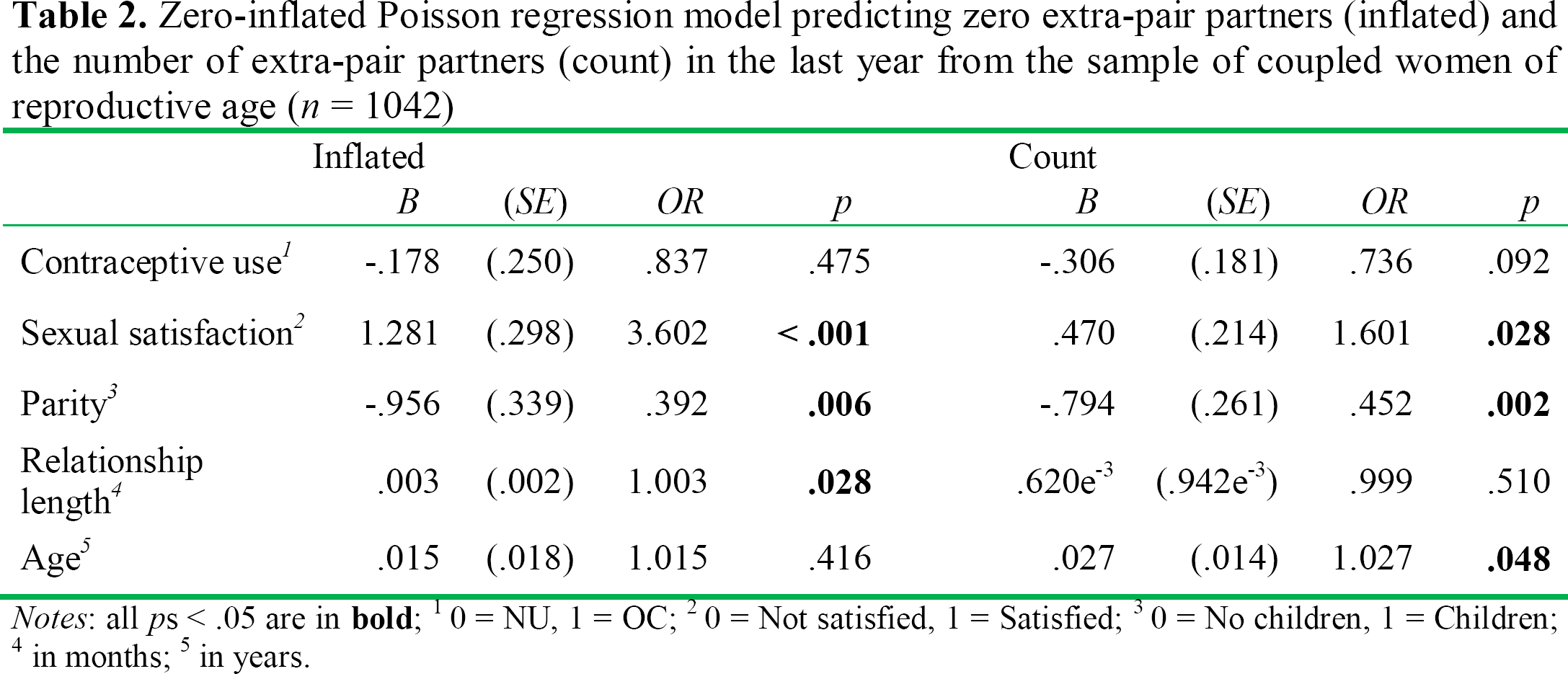
Extra-pair sexual behavior was operationalized by the reported number of sexual partners during last year minus 1 (the female's current partner). Eighteen respondents were excluded because they were not yet sexually active; 160 did not answer this item. The data were shown to have an excess of zero responses, because only 13.4 % of women who answered the question reported having one or more extra-pair sexual partners in the previous year (n = 178; median = 1, M = 1.79, SD = 2.09). The ZIP regression model was shown to be a significant improvement (V = −2.80, p = .002) over the Poisson regression. The full ZIP model was also shown to have a good fit in comparison to a null model with no predictors (ΔAIC = −249.30, Δχ2 (10) = −478.70, p < .001).
Table 2 shows the results of the ZIP regression for extra-pair partners. The zero-inflated portion of the model can be used to predict membership to the zero group; that is, variables can be used to predict the likelihood that women had zero extra-pair partners in the last year, with positive values indicating a greater probability of membership to that group. The probability of having had zero extra-pair sexual partners was greater for women who reported high sexual satisfaction (OR = 3.60; 95% CI: 2.01, 6.47; p < .001) and for nulliparous women (OR = .39; 95% CI: 0.20, .76; p = .006). The probability of membership in the group that reported zero extra-pair partners increased with relationship length by a factor of 1.003 (95% CI: 1.00, 1.01, p = .028) per month. Age and OC use were not significant predictors of having had no extra-pair partners.
Zero-inflated Poisson regression model predicting zero extra-pair partners (inflated) and the number of extra-pair partners (count) in the last year from the sample of coupled women of reproductive age (n = 1042)
Notes: all ps < .05 are in bold;
0 = NU, 1 = OC;
0 = Not satisfied, 1 = Satisfied;
0 = No children, 1 = Children;
in months;
in years.
The count portion of the model can be used to predict the number of extra-pair sexual partners (in women having one or more extra-pair sexual partners in the previous year). Women who reported low sexual satisfaction (OR = .63; 95% CI: .95, .41; p = .028) and parous women (OR = .45; 95% CI: .27, .75; p = .002) reported having fewer extra-pair partners. The number of extra-pair partners, however, increased with age by a factor of 1.027 (95% CI: 1.002, 1.055; p = .048) per year. Women using OCs and relationship length did not significantly predict the number of reported extra-pair partners per year.
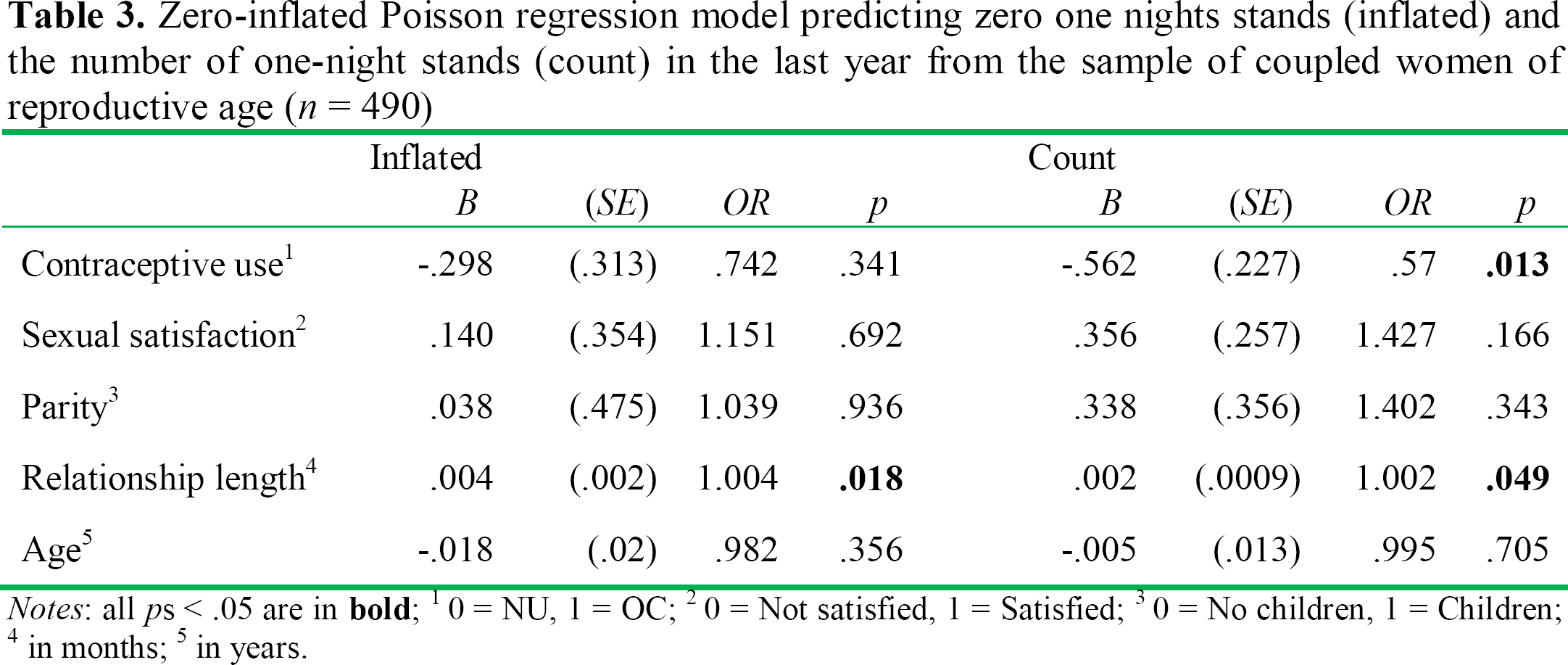
Responses regarding the number of one night stands in the last year similarly contained a large proportion of zeros (81%). Among the 19% of women who reported a one-night stand within the previous year (n = 116), the mean frequency was 1.85 (SD = 2.09). A ZIP regression model fitted was shown to be a significant improvement (V = −2.65, p = .004) over the Poisson regression model. The full ZIP model was also shown to have a good fit in comparison to a null model with no predictors (ΔAIC = −245.66, Δχ2 (10) = −132.80, p < .001).
Table 3 shows the results of the ZIP regression for one-night stands within the previous year. Variables in the inflated portion of the model can be used to predict the likelihood that women had zero one night stands in the last year, with positive values indicating a greater probability of membership to that group. The only significant predictor in the inflated portion of the model, however, was relationship length, such that the probability of reporting zero one-night stands increased by a factor of 1.004 (95% CI: 1.000, 1.007; p = .018) per month. OC use, parity, sexual satisfaction, and age did not significantly predict the reporting of zero one-night stands.
Zero-inflated Poisson regression model predicting zero one nights stands (inflated) and the number of one-night stands (count) in the last year from the sample of coupled women of reproductive age (n = 490)
Notes: all ps < .05 are in bold;
0 = NU, 1 = OC;
0 = Not satisfied, 1 = Satisfied;
0 = No children, 1 = Children;
in months;
in years.
The count portion of the model can be used to predict the number of one-night stands (in women who reported one or more). The strongest predictor of one-night stands was found to be OC use, with users reporting significantly fewer one-night stands (OR = .57; 95% CI: .37, .90; p = .013). Relationship length was associated with a significant increase in the number of one-night stands, by a factor of 1.002 (95% CI: 1.000, 1.004; p = .049) per month. Parity, age, and sexual satisfaction did not significantly predict the number of reported one-night stands.
Desired frequency of sexual activities
When examining the predictors of sexual desire in women, responses to the ideal frequency of sexual behavior (per month) variable were used. The Poisson regression model was found to be problematic (over-dispersion = 8.12). Data were therefore fitted using negative binomial regression (see Table 4), which was shown to be a significant improvement (V = −17.73, p < .001) over the Poisson model. Moreover, the full negative binomial model was shown to have a good fit in comparison to a null model with no predictors (ΔAIC = −524.7,χ2 (5) = −534.7, p < .001).
Negative binomial regression model predicting the desired frequency of sexual activities per month from the sample of coupled women of reproductive age (n = 1110)

Notes: all ps < .05 are in bold;
0 = NU, 1 = OC;
0 = Not satisfied, 1 = Satisfied;
0 = No children, 1 = Children;
in months;
in years.
The predictors age (OR = .982; 95% CI: .969, .996; p = .008) and relationship length (OR = .999; 95% CI: .998, .999; p = .011) were both negatively related to the desired frequency of sexual activities per month. OC use, sexual satisfaction, and parity, however, did not significantly predict the desired frequency of sexual activities per month.
Frequency of dyadic intercourse
In the case of frequency of dyadic sexual intercourse per month, a Poisson regression model was found to be overdispersed (overdispersion = 2.76). A ZIP regression model was, therefore, used and shown to be a significant improvement (V = −2.847, p = .002) over the Poisson regression model. Moreover, the full ZIP regression model was shown to have a good fit in comparison to a null model with no predictors (ΔAIC = −3701.146, Δχ2 (10) = −1861, p < .001).
Table 5 shows the results of the ZIP regression for the frequency of dyadic intercourses per month. Variables in the inflated portion of the model can be used to predict the likelihood that women had zero dyadic intercourses, with positive values indicating a greater probability of membership to that group. The only significant predictor of zero responses, however, was sexual satisfaction, with those reporting high sexual satisfaction having a lower probability of zero dyadic sexual intercourse (OR = .192; 95% CI: .068, .543; p = .002). OC use, parity, relationship length, and age did not significantly predict the reporting of zero dyadic intercourses per month.
Zero-inflated Poisson regression model predicting the frequency of dyadic intercourses per month from the sample of coupled women of reproductive age (n = 1091)

Notes: all ps < .05 are in bold;
0 = NU, 1 = OC;
0 = Not satisfied, 1 = Satisfied;
0 = No children, 1 = Children;
in months;
in years.
In contrast, nearly all of the variables were shown to predict the frequency of dyadic sexual intercourse per month (in women who had at least one intercourse with their partner). Women using OC (OR = 1.048; 95% CI: .941, 1.167; p = .030) and those reporting sexual satisfaction (OR = 1.385; 95% CI: 1.306, 1.469; p < .001) indicated having more sex with their partner, whereas older women (OR = .983; 95% CI: .979, .987; p < .001) and those in longer relationships (OR = .999; 95% CI: .999, .999; p < .001) had relatively less. Parity was the only variable not found to be significantly related to the frequency of sexual intercourse with a partner.
Discussion
The present study aimed to test evolutionary-based hypotheses concerning the relationship between OC use and aspects of sexual behavior of coupled women in a representative sample of Czech citizens. No significant difference was found between coupled OC users and NU in several aspects of their sexual life-history, indicating that the two groups were similar in sociosexual restrictiveness. It was first hypothesized that a link would be found between current OC use and both low incidence and frequency of extra-pair sexual behavior in the previous year. However, only partial support was found for this, as the incidence of having had a recent extra-pair partner or one-night stand was not significantly predicted by OC use. Regression models also indicated that these variables were more closely associated with other relationship-related variables such as sexual satisfaction, parity, and relationship length. However, in women who reported at least one extra-pair partner, OC users had fewer one night stands (and tended to have fewer extra-pair sexual partners) in the previous year than non-users (independent of the influence of age, relationship length, parity and sexual satisfaction). Furthermore, in line with predictions, OC users reported a higher frequency of dyadic intercourse than non-users, although sexual desire was not significantly predicted by the use of OCs. This study also confirmed that age, relationship length, parity, and sexual satisfaction influence self-reported female sexuality data.
Basic demographic characteristics and sexuality-related life history
OC users in the sample were on average younger, had shorter relationships, and were less likely to have children than NU. OCs are the most commonly-used form of hormonal contraceptives used by Czech adolescents (Weiss and Zvěřina, 2003), and they are often the first-choice form of contraception recommended to younger age groups by Czech gynecologists. However, after controlling for participant age, there was no significant difference between OC users and NUs in the age at which women had sex for the first time.
Further, in the representative sample of coupled women, no support was found for the assumption that current OC use is connected with higher sociosexual restrictiveness, although it should be acknowledged that restrictiveness was inferred rather than measured directly. Current OC users did not report higher numbers of sexual partners or one-night stands across their reproductive lifespan compared with NU, and analysis with respect to other variables potentially associated with sexual restrictiveness and sexual responsibility (i.e., prevalence of sexually transmitted diseases; results not shown) did not reveal between-group differences. It could be suggested that the connection between sociosexual restrictiveness and the choice of OCs may rather be limited to the population of pubertal and adolescent women where concerns about unwanted pregnancy with a casual partner is the main motivation for contraceptive use (Bartz, Shew, Ofner, and Fortenberry, 2007). In coupled women, the choice of contraceptive type may be related to other variables. For example, factors such as plans for conception, preferences for the method of application (e.g., a relatively high percentage of parous women in our sample used non-hormonal IUD), and individual tolerance of various OC types (Fait, 2011) could determine the choice of contraceptive method.
Number of extra-pair sexual partners in the previous year
Contrary to predictions, OC use was not found to be a significant predictor of having an extra-pair sexual partner or one-night stand in the last year. As in previous studies, the incidence of any extra-pair sexual contact was predicted mainly by relationship-related variables (e.g., Havlicek, Husarova, Rezacova, and Klapilova, 2011); in this case, perceived sexual dissatisfaction, relationship length, and parity were significant predictors, which suggests that relationship and commitment-related variables are more important influences on the incidence of extra-pair sex in women than demographic characteristics (e.g., age) or current OC use. The importance of relationship satisfaction, and particularly of sexual satisfaction (both are highly correlated in women, e.g., Byers, 2002, Roberts et al., 2012) as motivators of female extra-pair sex was therefore replicated (for a review, see Blow and Hartnett, 2005). In their extensive study of various predictors of extra-pair sex, Mark et al. (2011) also concluded that women who are not sexually and generally satisfied in their current relationship may be more inclined to seek feelings of closeness and connection elsewhere, and that in women (in contrast to men), infidelity is less sexually motivated. This suggests that, for women, extra-pair sex may more often be part of a process of switching into a new long-term relationship (Blow and Hartnett, 2005).
Besides relationship-related variables, a woman's likelihood of having an extra-pair sexual partner is associated with various attitudes towards infidelity and previous experiences of infidelity (Blow and Hartnett, 2005). Thus women whose attitudes towards infidelity are more liberal are more likely to engage in extra-pair sex (Solstad and Mucic, 1999) and women who had extra-pair sex in the past are more likely to do so again (Glass and Wright, 1992). This indicates that the likelihood of engaging in extra-pair sex is related to relatively stable individual differences, particularly in sociosexual orientation, defined as individual differences in the willingness to have casual uncommitted relationships (Penke and Asendorpf, 2008; Simpson and Gangestad, 1991). Among the other sexuality-related personality traits, additional factors linked to sexual risk-taking behavior have also been found to predict sexual infidelity, such as lower propensity for sexual inhibition due to performance consequences and higher propensity for sexual inhibition due to performance failure (Mark et al., 2011). Although it was not possible to directly control for such variables in this sample, the absence of a between-group difference in sociosexual restrictiveness (i.e., overall number of sexual partners) indicates that the other variables are not different between OC users and non-users.
A similar argument might be made with respect to the model predicting incidence of one-night stands in the previous year. The only predictor in the zero-inflated part of the model was relationship length, which was associated with a marginally lower probability of having a one-night stand in the previous year. Neither OC use nor relationship-related variables predicted the likelihood of one-night stands in the previous year. Previous research has found that psychosocial factors (e.g., attachment styles, alcohol use, attitudes about hooking up, sociosexual restrictiveness) primarily predicted engagement in casual sexual contact (e.g., Owen, Rhoades, Stanley, and Fincham, 2010). Taken together, the results indicate that there seems to be other crucial variables connected with relationship functioning and personal factors that mitigate against sexual behavior outside the primary relationship, and that more of the variance may be explained by this trait than the impact of women's hormonal state (menstrual cycling versus OC use). The fact that OC use did not explain the incidence of having had extra-pair sex suggests that shifts in sexual behavior across the cycle do not explain the majority of variance in the likelihood of cheating on one's partner.
However, the count portion of the ZIP model (i.e., including women who reported at least some extra-pair behavior) revealed an additional effect. Here, OC use was the strongest predictor of the number of one-night stands. OC users reported fewer one night stands than NUs, although the association with number of extra-pair sexual partners did not quite reach statistical significance. Such a trend, however, could be explained by cyclical increases in extra-pair sexual desire among NUs during the fertile phase of the menstrual cycle: Such an interpretation is in line with previous findings about extra-pair attention and behavior during the menstrual cycle. It is well documented that female preferences and behavior vary as a function of conception risk. Concentration on short-term mating is thought to peak during the fertile phase, whereas preference for long-term mating occurs in the non-fertile phase of the menstrual cycle (Gangestad and Thornhill, 2008). Specifically, the high fertility phase of the cycle is associated with increased tendencies to engage in opportunistic mating (Durante and Li, 2009), higher extra-pair sexual desire (Pillsworth et al., 2004), increased receptivity to a courtship solicitation (Guéguen, 2009), and perhaps extra-pair intercourse (Baker and Bellis, 1995).
Sexual behavior and desire
In line with predictions, the frequency of dyadic intercourse was higher among OC users than it was within NU, even after controlling for relationship length, women's age, and parity. Higher dyadic sexual activity in coupled OC users might be interpreted as an effort to retain the interest of the long-term partner (Buss, 1988), because sexual contact contributes to higher overall satisfaction in the relationship (Brody and Costa, 2009). Indeed, the suggestion that OC use is related to higher prevalence of female mate retention behavior was recently documented (Welling et al., 2012). We speculate that OC users might therefore be more willing to actively engage in sexual activity with their partner, but, unfortunately, the data in relation to the frequency of intercourse did not include the direction of initiation. This is an area for future research which would help to disentangle this relationship more explicitly.
Alternatively, it could be that OC users are less concerned about the risk of conceiving unintentionally and are thus both more sexually active and satisfied (Oddens, 1999). Indeed, sexual satisfaction of women strongly predicts the frequency of dyadic sexual intercourse, but the effect of OC use here was additional to and independent of this. Furthermore, one might expect that enhanced overall sexual desire under the influence of OCs should lead to the higher frequency of dyadic intercourse. Overall, sexual desire was indeed a predictor of frequency of dyadic intercourse (as was relationship length and age, for a review see Schneidewind-Skibbe et al., 2008), but the model that focused on prediction of overall sexual desire did not support an association with OC use. In other words, we found no support for the idea that enhanced frequency of dyadic intercourse associated with OC use is mediated through a shift in female sexual desire.
Limitations and areas of future research
The research questions and aims of this study were not the main goals of the Czech National Survey of Sexual Behavior; therefore, several relevant questions concerning OC use details (e.g., length of use, OC brand and hormonal concentrations) were not collected. The same applies to some of the sexuality-related measures. For instance, it would be interesting to be able to parse desire for the respondent's partner, solitary desire, and extra-pair related sexual desire (Roberts, Cobey, Klapilová, and Havlíček, 2013). Furthermore, more detailed data concerning female sociosexual restrictiveness and relationship-related variables (e.g., level of commitment, a more precise measure of relationship and sexual satisfaction) would provide more sensitive tests of our predictions. Moreover, questions on extra-pair behavioral tendencies rather than self-reported extra-pair behavior would be preferable, as behavior may be influenced by various factors such as attitudes, social pressure or partners' mate retention behavior, which may not have been accurately gauged through questionnaire responses.
Finally, the current study is based on cross-sectional and correlational data. Given that participants self-selected to use or not use OC, the causal inferences we can draw are rather limited. In future research, use of a randomized double-blind design, as is more common in medical research on OC effects, would get around this issue. A study that incorporates repeated measures, specifically addressing mate preferences and the direction of sexual initiation between primary partners, as well as extra-pair partners, also remains necessary. As it stands, given self-selection of OC use in this sample, there may be inferential problems associated with our findings and therefore they must be treated cautiously until they are replicated. Future research should also seek to control for the cycle stage of the sample of the non-users. This may allow for a more nuanced understanding of the impact of OC use relative to specific regions of the cycle.
Despite these limitations, the use of large representative sampling is relatively uncommon within the relevant literature. The use of this cross-national survey data demonstrates the potential for using the paradigm of evolutionary psychological theory to extend existing knowledge and explanations for socially and medically relevant problems.
Footnotes
Acknowledgements
The study was supported by the grant GACR P407/12/P819 and GACR P407/11/1464. KK is supported by institutional support of Faculty of Humanities, Charles University, Prague, JH and KK by Charles University Research Centre (UNCE 204004), and SCR by a British Academy Mid-Career Fellowship. We would like to express our gratitude to the co-author of the Czech National Survey of Sexual Behavior J. Zvěřina for his permission to analyze the data.