



Abstract
The current experimental study investigated human sharing within a laboratory task that modeled environmental variability. In particular, it sought to assess the efficacy of a risk-reduction model of sharing, which originated from a risk-sensitive optimization model known as the energy-budget rule. Participants were given the choice between working alone or cooperating and sharing accumulated hypothetical earnings with a fictious partner. Failure to acquire sufficient money resulted in a loss of accumulated earnings. To investigate the effects of economic context on sharing, the difficulty of meeting an earnings requirement was manipulated across conditions by changing the monetary requirement that needed to be met in order to bank earnings, which could later be exchanged for real money. In some conditions sharing was the optimal strategy (positive budget conditions), sometimes working alone was optimal (negative budget conditions), and other times neither option was optimal (neutral budget conditions). Gender differences were examined within this context to determine if males and females differed in their sharing behavior. The results suggested that males chose the sharing option more often in the positive budget condition and showed a stronger preference for the work-alone option in the negative budget condition than females.
Cooperation is a pervasive phenomenon found in both human and nonhuman social groups (Jaeggi & Gurven, 2013; Winterhalder et al., 1999). One type of cooperative behavior is sharing resources with other individuals. Sharing involves the transfer of resources, such as food, from one individual to another, typically within the same social group. Sharing can take many forms, including delayed or probabilistic reciprocal giving, intercommunity exchange, and resource pooling (Winterhalder & Smith, 2000). The latter involves the pooling of resources with others and then dividing these resources among those who contributed (Winterhalder, 1986). Regardless of its form, sharing among nonrelatives is somewhat challenging to explain because it results in, at least, a temporary loss of resources. Therefore, one area of interest looks to determine the particular situations that allow for the development and preservation of sharing.
Risk reduction is one model of resource sharing that has been investigated in several anthropological studies (e.g., Bliege-Bird & Bird, 1997; Cashdan, 1985; Kaplan & Hill, 1985). This model assumes that when individuals forage independently, they will vary in terms of their success at acquiring food stuffs due to the instability of food products (Winterhalder et al., 1999). Thus, there is variability in individuals’ daily energy gains. The higher this variability, the more likely one is to experience a caloric or energy shortage. If these individuals pool their food acquisitions together and then divide among individuals in the group, the variability in resources is averaged across all individuals in the group. This reduces the risk that any one individual will experience a shortage. If individuals differ in their foraging success, then foraging independently can be viewed as a high-variance option; whereas sharing reduces the variability in food acquisition and can be viewed as a low-variance option.
According to Winterhalder (1986), sharing can be viewed as a strategy to minimize the chance of a shortfall and should, therefore, be predicted based on an organism’s energy budget. The energy-budget rule is a model of risk-sensitive optimal foraging, which predicts foraging choices in situations where an organism must obtain enough energy to survive through times when foraging is impossible (e.g., overnight) (Caraco et al., 1980; Stephens, 1981). The basic scenario involves a choice between two foraging patches, both with the same mean rate of energy gains, but different variances. One alternative yields a high-variance outcome and the other has a low-variance, or fixed, outcome. When the mean rate of food intake from one of these two foraging patches is sufficient to meet an organism’s caloric (i.e., energy) requirement, the organism is experiencing a positive energy budget. Alternatively, when the mean rate of food intake is insufficient to meet an organism’s energy requirement, the organism is experiencing a negative energy budget.
To reduce the risk of starvation, an organism should prefer the low-variance option when experiencing a positive energy budget and prefer the high-variance option when experiencing a negative energy budget (Stephens, 1981). The risk-reduction model suggests that foraging independently leads to highly variable food outcomes, whereas pooling and sharing food acquisitions reduces this variability. Thus, to minimize the risk of an energy shortage, an individual should choose to share when experiencing a positive energy budget and forage alone when experiencing a negative energy budget.
The risk-reduction model of food sharing has been supported by anthropological field studies that have found that hunter-gatherer societies are more likely to share unpredictable food products than those that are more stable (Winterhalder et al., 1999). For instance, the Aché of Paraguay (Kaplan & Hill, 1985) and Basarwa of Botswana (Cashdan, 1985) were found to share high-variability meat and honey more often than low-variability vegetation. By pooling and distributing unpredictable food acquisitions, it reduces the variability in consumption and the risk of starvation. However, these field studies did not directly examine the predictions of the risk-reduction model, making it unclear if sharing was specifically due to shortfall avoidance. To better understand the effects of shortfall risk on sharing behavior, laboratory studies may prove useful, since they have the ability to isolate and manipulate precise variables. Thus, they allow for a clearer understanding of the extent to which sharing is influenced by a decrease in the risk of experiencing a shortfall.
No studies have been conducted to examine how shortfall risk affects food sharing in humans because of ethical concerns regarding the manipulation of energy gains. However, the energy-budget rule, which the risk-reduction model originates from, has an analog form that can be used with humans. Here, food intake and energy requirements have been substituted for monetary gains or points and earnings requirements (Deditius-Island et al., 2007; Ermer et al., 2008; Mishra & Fiddick, 2012; Mishra et al., 2012; Mishra & Lalumiere, 2010; Pietras & Hackenberg, 2001; Pietras et al., 2003 , 2008; Rode et al., 1999; Wang, 2002). Congruent with an energy budget, an earnings budget is considered negative when the mean rate of earnings from the low-variance option is insufficient to meet the earnings requirement and positive when the mean earnings are sufficient to meet the requirement. A neutral earnings budget is a situation where there is no earnings requirement (i.e., $0.00). These studies have demonstrated that human risk-sensitive choices are consistent with the predictions made by the energy-budget rule. Specifically, individuals showed a preference for the low-variance alternative when experiencing a positive budget and a preference for the high-variance alternative when experiencing a negative budget.
Only a handful of laboratory studies have investigated sharing behavior within the risk-reduction paradigm using monetary or point outcomes (Jimenez & Pietras, 2017, 2018; Kameda et al., 2002; Kaplan et al., 2012; Pietras et al., 2006; Suleiman et al., 2015; Ward et al., 2009). Kameda et al., Kaplan et al., and Suleiman et al. manipulated the variability of earnings and found that, much like anthropological field studies, when outcomes were unpredictable, individuals were much more likely to share than when outcomes were predictable (i.e., low-variability or fixed). However, none of these studies incorporated an earnings requirement; therefore, there was no risk of a shortfall. Jimenez and Pietras, Pietras et al., and Ward et al. created different earnings-budget conditions by manipulating an earnings requirement that participants needed to meet in order to keep their monetary or point earnings. Their results matched the predictions of the energy-budget rule. Participants minimized their risk of a shortfall by preferring to share earnings when experiencing a positive budget and preferring to work independently when in a negative budget.
An extension of research on the risk-reduction model has investigated the effects of social variables on sharing behavior. For example, Jimenez and Pietras (2017) examined whether individuals differed in their sharing choices when they thought their partner was either another person or a computer. They also manipulated the payout of the sharing option such that the partner received more of the monetary earnings than the participant. Jimenez and Pietras found that individuals’ sharing behavior was congruent with the energy-budget rule, regardless of who the partner was or the inequity in payout. Similarly, Jimenez and Pietras (2018) demonstrated that the probability of reciprocation by the partner only influenced sharing behavior when the probability no longer led to a reduction in shortfall risk.
Gender is another variable that may influence sharing behavior. Males and females have been presented with, and had to solve, different adaptive problems over the course of our evolutionary history (Tooby & Coosmides, 1992; Trivers, 1972). This is especially true when it comes to parental investment. Females, typically, are the sex that invests more heavily in their offspring, both in terms of time and energy, than males. Thus, females should adapt a mating strategy that involves being choosier and attempts to avoid exploitation more so than males (Buss & Schmitt, 1993). The social implications of this mating strategy suggest that females should be less trusting and more vigilant about avoiding free riders (Simpson, 2003; Simpson & Van Vugt, 2009). One’s tendency to cooperate and share resources, then, should vary depending on one’s gender, with females being more cautious about engaging in social exchanges than males (Kuwabara, 2005).
Some previous research that has investigated differences in cooperative behavior between males and females supports this hypothesis, finding that females are less cooperative than males. For example, males have been shown to contribute more in a public goods game than females (Sell & Wilson, 1991; Solow & Kirkwood, 2002). Fantino and Kennelly (2009) and Kennelly and Fantino (2007) presented participants with a choice between a cooperative option (receiving $7.00, while a partner receives $9.00) and a competitive option (receiving $5.00, while a partner receives $3.00). They found that males preferred the optimal, cooperative option, whereas females showed no preference between the two. Further, a meta-analysis found that males were more likely to cooperate in same-sex dyads or when the task involved repeated iterations than females (Balliet et al., 2011).
Other studies, however, have found contradictory results. Some studies have found that males and females showed a similar preference for cooperation in the Prisoner’s Dilemma (Caldwell, 1976; Simpson, 2003) and contributed comparable amounts in a public goods game (Cadsby & Maynes, 1998; Sell, 1997; Sell et al., 1993). Walters et al. (1998) conducted a meta-analysis focusing on matrix games, like the Prisoner’s Dilemma, and found that females cooperated more than males; whereas a meta-analysis by Balliet et al. (2011) found that, despite some context specific exceptions like those noted above, males and females had similar rates of cooperation.
The present study looked to further examine the risk-reduction model of sharing and extend it to investigate whether sharing differed across gender. Males and females were exposed to three earnings budget conditions by manipulating the earnings requirement that participants had to meet in order to bank any money they earned on a computer task. The neutral budget had no earnings requirement ($0.00), the positive earnings budget had a low requirement ($0.50), and the negative budget had a high earnings requirement ($0.60). If shortfall risk is a more salient variable than gender, then both males and females should prefer to share in the positive budget, but not the negative budget condition.
Method
Participants
Individuals who were 18 and older were recruited from an introductory psychology course at a small, northeastern university. In total, 20 males and 19 females (n = 39), between 18 and 22 years old (M = 18.82) participated. Most identified themselves as Caucasian (76.9%), followed by African American (7.7%), Asian (5.1%), and Hispanic (2.5%). Participants were compensated through course credit and money.
Apparatus
The research lab consisted of six small, completely walled off cubicles and a common area. Within each cubicle were a chair, desk, and desktop computer with a screen and mouse. Participants used a mouse to respond on a computer task programed in Microsoft Visual Basic 6.0®.
Procedure
All procedures were approved by the Institutional Review Board at the university where the study took place. Participants came into the lab for 2 hours on two separate days, totaling 4 hours of participation. On the first day, participants completed a written informed consent, filled out a demographics questionnaire, and were given minimal instructions to read. Participants were told that they would be working with another participant at a different location throughout the experiment. On each day, participants experienced six 15–20 minute sessions, 12 sessions total, with 5 minute breaks in between.
During each of the sessions, participants encountered 18 blocks in which eight were forced choice and 10 were choice. At the start of each block, the earnings counter was set at $0.00 and two alternatives were presented: a “work alone” option denoted by the letter “A” and a “work with others” option denoted by the letter “C.” In forced-choice blocks, only one option was available, and each option was randomly presented four times, for a total of eight blocks. These blocks allowed participants to experience the outcome of each alternative. In choice blocks, participants were able to choose between the “work alone” option and the “work with others” option. Once participants responded on one alternative, the other alternative disappeared, and the selected condition remained in effect for the rest of the block.
Within each block there were five trials where participants clicked on the letter “B,” which produced either $0.00 or $0.20 at p = .50. Thus, after five trials, participants could potentially have earned $0.00–$1.00, in increments of $0.20. At the end of the five trials, the end of the block, “Your Earnings” appeared above the earnings counter. If participants chose the “work alone” option at the beginning of the block, then the amount earned across the five trials is the amount they had at the end of the block. The “work alone” option, then, has a variable outcome, where participants had between $0.00 and $1.00. If, however, participants chose the “work with others” option, then their earnings are pooled together with the partner’s earnings and divided evenly. The partner’s earnings were negatively correlated with the participant’s earnings so that the pooled total was always $1.00 (e.g., if the participant earned $0.40, the partner earned $0.60). Thus, the $1.00 pooled total was split evenly between the participant and the partner, leaving both with $0.50 at the end of the block. The “work with others” option, then, yielded a fixed outcome.
Regardless of whether participants chose the “work alone” option or the “work with others” option, at the end of the block, earnings were only added to the cumulative counter if it met or exceeded the earnings requirement (see Figure 1). The same requirement was in place for the whole 18-block session. Neutral-, positive-, and negative-budget conditions were created by manipulating the earnings requirement. The neutral-budget condition had no requirement (i.e., $0.00), the positive budget had a $0.50 requirement, and the negative budget had a $0.60 requirement. Therefore, if participants chose the “work with others” option, with a fixed $0.50 outcome, they would meet the earnings requirement every time in the positive budget. They would never meet the earnings requirement in the negative budget. If participants chose the “work alone” option, with a variable outcome, they would meet the requirement 50% of the time in both the positive- and negative-budget conditions.

Illustration of events that occur at the end of the block when participants choose the work-alone option (left column) and work-with-others option (right column).
Budget condition was a within-subjects variable, while gender was a between-subjects variable. Participants experienced each condition four times. At the end of each day, participants filled out a questionnaire asking how many individuals they thought they had worked with and to describe the interaction with their partners. At the end of the second day, for every $3.00 earned during choice blocks, participants earned one opportunity to draw from a prize bowl containing slips of paper with monetary values of $1.00, $1.50, and $2.00. The average payment was $17.00.
Results
Out of the 39 participants that were recruited, nine were dropped from data analysis either because they did not attend the second session or they stated that they believed they were working with a computer, not a partner. Choices of the dropped participants, however, did not differ in any obvious way from the choices of the other participants. The mean number of work-with-others choices for the last two exposures of each condition was analyzed for the remaining 30 participants (15 males and 15 females).
Figure 2 illustrates the mean number of work-with-others choices for males and females across the three earnings-budget conditions. A split-plot ANOVA was used with gender being a between-subject variable and earnings budget being a within-subject variable. Mauchly’s test indicated that the assumption of sphericity was violated, χ2(2) = 11.91, p = .003. Thus, a Greenhouse-Geisser correction was used. A significant main effect of earnings budget as found (F[1.47, 41.28] = 23.66, p < .001, ηp 2 = .46), as well as a significant interaction between gender and earnings budget, F(1.47, 41.28) = 4.93, p = .02, ηp 2 = .15. No significant main effect of gender was found, F(1, 28) = 1.96, p = .17, ηp 2 = .07. Post hoc tests of the main effect of budget, using a Bonferroni adjusted α = .05/3 = .017, demonstrated that participants chose the work-with-others option significantly more in the neutral (M = 4.53, SD = 3.14, p < .001, d = .86) and positive (M = 5.05, SD = 3.47, p < .001, d = .91) earnings-budget conditions than in the negative-budget condition, M = 1.48, SD = 1.86.
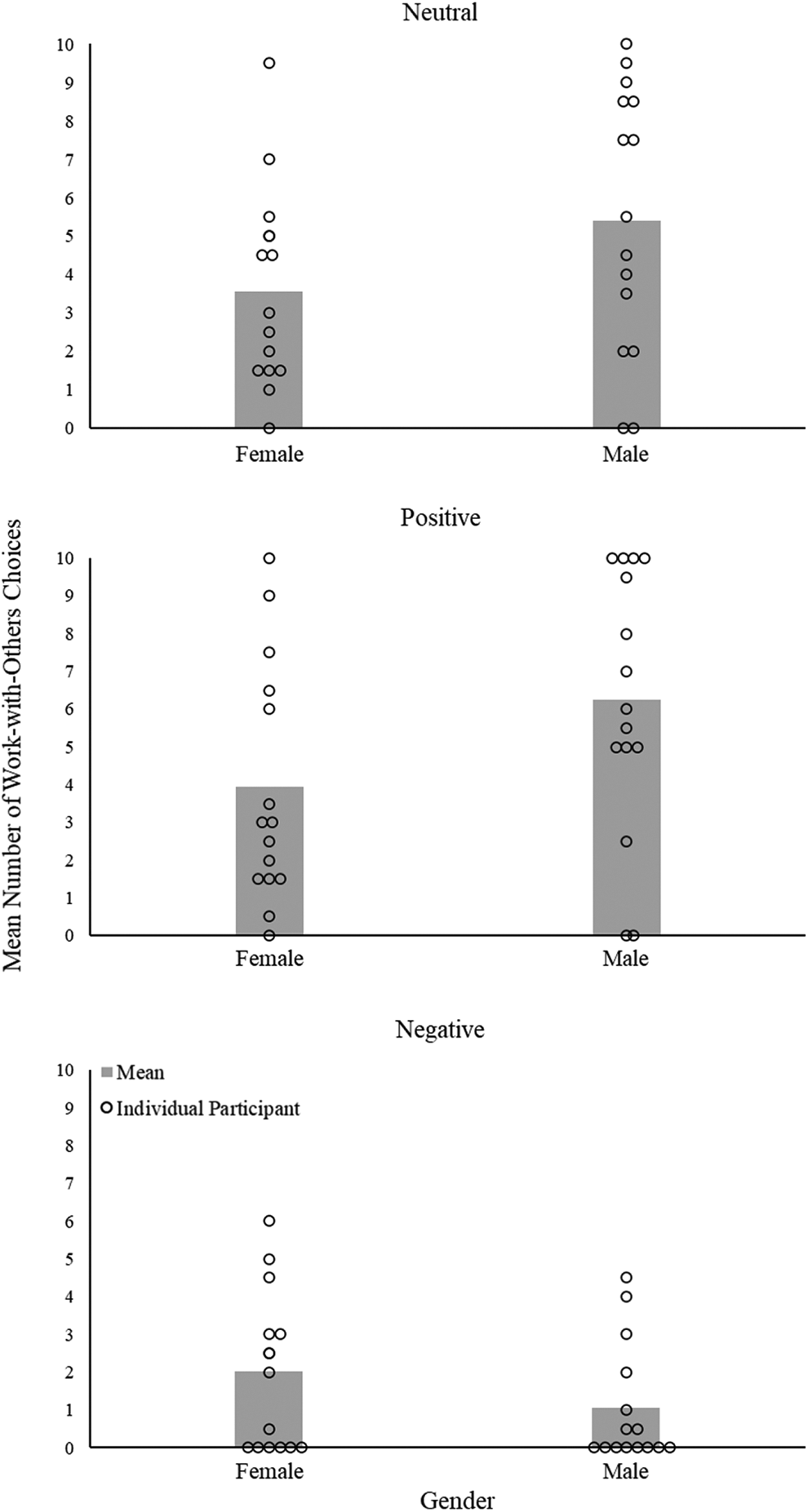
The bars represent the mean number of work-with-others choices in the last two blocks for females and males, while the open circles represent the mean number of work-with-others choices in the last two blocks for each of the 15 female and male participants across the neutral, positive, and negative earnings-budget conditions.
In terms of the interaction, there were no significant simple effects of gender at the neutral (p = .104, d = .61), positive (p = .06, d = .72), or negative (p = .19, d = .49) earnings-budget conditions. However, visual inspection of the data suggest that the interaction most likely lies in the neutral and positive budget conditions. Males, in comparison to females, had a stronger preference for the work-with-others option during both the neutral (M = 5.47, SD = 3.45; M = 3.60, SD = 2.57, respectively) and positive earnings-budget conditions, M = 6.23, SD = 3.46; M = 3.87, SD = 3.15, respectively. In the negative earnings-budget condition, both males and females demonstrated a preference for the work-alone option, M = 1.03, SD = 1.57; M = 1.93, SD = 2.07, respectively. This difference is also found when comparing Cohen’s d across the three conditions, where the effect size between males and females is larger in the neutral and positive conditions than the negative condition. Further, a difference can be seen when the data are analyzed on an individual level. In the neutral budget, three of the 15 (20%) female participants and eight of the 15 (53.33%) male participants showed a preference for the sharing option (i.e., chose the work-with-others option an average of 5.5 times or more out of 10 blocks). Similarly, in the positive budget five female participants (33.33%) preferred the sharing option, in comparison to nine male participants (60%). In the negative budget, 13 female participants (86.66%) preferred the work-alone option over the work-with-others option, while all 15 male participants (100%) demonstrated this preference.
Both males and females mean earnings during choice trials were near the programmed mean earnings for the optimal choice during the neutral budget condition and below the programmed mean in both the positive and negative budget conditions (see Figure 3). Since the outcome of each trial is random, participants may have been “unlucky” and had mean earnings that fell below the programmed mean. The neutral and positive-budget conditions had programmed mean earnings of $5.00. Overall, males (M = $4.90, SD = $0.32) and females (M = $4.98, SD = $0.27) had the highest mean earnings in the neutral budget, where there was no earnings requirement. Both males and females mean choice earnings in the positive budget condition were somewhat below the programmed mean (M = $4.21, SD = $0.70; M = $4.04, SD = $0.81, respectively). If participants demonstrated an exclusive preference for the work-alone option in the positive budget, the programmed mean earnings would have been $3.44. For the negative earnings budget, males (M = $3.13, SD = $1.16) were slightly below the mean programmed earnings of $3.44, whereas females mean choice earnings were even farther below the programmed mean (M = $2.75, SD = $1.10). If participants showed an exclusive preference for the work-with-others option in the negative budget, the programmed mean earnings would be $0.00.

Mean choice earnings in the last two blocks for females (light gray bars) and males (dark grey bar) during each of the three earnings-budget conditions. The mean programmed earnings for optimal choices across conditions are displayed by the black horizontal bars. Error bars display ±1.0 standard error.
Discussion
The present study examined a risk-reduction model of sharing using monetary outcomes in a laboratory setting with humans. In addition, it investigated whether there were gender differences in sharing behavior across three earnings budget conditions: a neutral budget with no requirement ($0.00), a positive budget with a low requirement ($0.50), and a negative budget with a high requirement ($0.60). Collapsed across gender, participants chose the work-with-others option more in the neutral and positive budget conditions, whereas they preferred the work-alone option when they experienced a negative budget.
These results are generally congruent with the predictions of the risk-reduction model, which suggests that individuals should engage in sharing when it reduces the variability of food outcomes and, in turn, reduces the risk of experiencing a shortfall (Winterhalder, 1986). In addition, the current study provides further evidence that human sharing using monetary outcomes in a laboratory setting can be accounted for by the risk-reduction model (e.g., Jimenez & Pietras, 2017, 2018; Kameda et al., 2002; Kaplan et al., 2012; Pietras et al., 2006; Suleiman et al., 2015; Ward et al., 2009), as well as risk-sensitive choice laid out by the energy-budget rule (e.g., Deditius-Island et al., 2007; Ermer et al., 2008; Mishra & Fiddick, 2012; Mishra et al., 2012; Mishra & Lalumiere, 2010; Pietras & Hackenberg, 2001; Pietras et al., 2003 , 2008; Rode et al., 1999; Wang, 2002). Although it is interesting to note that the current participants’ preference for the sharing option when experiencing a positive budget (M = 5.05) was lower than in Jimenez and Pietras (2017) using the exact same methodology, M = 5.54 (Exp 1); M = 6.21 (Exp 2).
Males’ and females’ earnings were near the programmed mean earnings across the three budget conditions, suggesting that their choices were close to optimal. However, there seem to be two exceptions. The first is in the positive budget condition, where the risk-reduction model would predict an exclusive preference for sharing since this option guarantees that one would meet the earnings requirement every time. Both males and females chose the sharing option more in the positive budget than the negative budget, but males’ choices were more optimal, which translated into higher mean earnings. A similar pattern emerged in the negative budget condition. Males and females both demonstrated a preference for the work-alone option, but males made more optimal choices and, therefore, had higher mean earnings than females.
Even with these exceptions, participants’ behavior generally was controlled by reinforcement maximization, which is consistent with previous research that suggests cooperative behavior matches the earnings of each outcome (e.g., Burgess & McCarl Nielsen, 1974; Marwell & Schmitt, 1975). Further, it may be the case that females’ behavior was not as optimal monetarily, but rather that it was optimal from the standpoint of being evolutionarily advantageous. By choosing the work-alone option more than the sharing option in the positive budget, females’ behavior is congruent with the idea that they should be more cautious of free riders (Simpson, 2003; Simpson & Van Vugt, 2009). Thus, perhaps males’ behavior is better explained using proximate reinforcement maximization, while females’ behavior is better described using an ultimate explanation of exploitation avoidance.
Previous research on the effects of gender on cooperation has been mixed, with some finding no difference in the sharing behavior of males and females (for a meta-analysis, see Balliet et al., 2011). However, the current finding that males chose the sharing option more than females in the neutral and positive budget conditions is in accordance with previous studies which have demonstrated that males tend to engage in more cooperative behavior than females (Sell & Wilson, 1991; Solow & Kirkwood, 2002). These results provide further support for an evolutionary explanation of sharing behavior, which suggests that because males and females have different mating strategies, females should be more cautious about being exploited by free riders and, therefore, less cooperative (Simpson, 2003; Simpson & Van Vugt, 2009).
One possible reason for the difference between the current findings and those that suggest male and females share monetary resources at the same rate could be due to the specific task used to measure cooperation. An essential feature of the earnings-budget model is the earnings requirement that participants need to meet to keep any money they have earned throughout the five trials. This monetary requirement is not present in other tasks such as the Prisoner’s Dilemma or public goods game. For example, Caldwell (1976) and Simpson (2003) found no gender difference in cooperative behavior using the Prisoner’s Dilemma. In this task, defecting is associated with lower earnings than cooperating, but the participant still earns some amount of money or points. Thus, perhaps the presence of an earnings requirement, where participants are not guaranteed to bank any of the money they earn, made the possibility of exploitation more salient for females.
Males’ behavior also tended to be more monetarily optimal in the positive and negative budget conditions. That is, they maximized earnings by preferring to share while experiencing a positive budget and preferring to work alone when experiencing a negative budget. This is consistent with the findings of Fantino and Kennelly (2009) and Kennelly and Fantino (2007), who gave participants a choice between a high-earning, cooperative option and a low-earning, competitive option. Here, males demonstrated a preference for the cooperative, optimal option in comparison to females, who did not demonstrate a preference for one option over the other. Thus, the gender by budget interaction may be due to the risk-sensitivity of males and risk-insensitivity of females.
There are several limitations to the present study. One is that although there was a significant interaction between gender and the energy budget, none of the post hoc pairwise tests demonstrated a statistically significant difference. This is most likely due to the power for the pairwise comparisons being below .80, which is typically set as the power required to detect an effect if one exists (Cohen, 1992). A post hoc power analysis for an independent samples t-test, n = 15 for each group, and α = .05 (two-tailed) demonstrated low power for the neutral (.37) and positive (.47) earnings budget conditions. Sample size is one factor that influences power. Thus, increasing the number of participants would have increased power and, in turn, increased the probability that the pairwise comparisons would have demonstrated statistically significant differences between gender at the different levels of the energy-budget.
The major limitation of this laboratory study is that it lacks ecological validity in several ways. For example, sharing outside of the laboratory usually involves costs, such as time and energy, and may take the form of reciprocation where there is a delay between the sharing acts of the individuals in the group. These costs and delayed reciprocation could affect the relative payoffs of sharing. Another mismatch includes the variability of outcomes for sharing. In real-world situations, sharing likely only lowers the variability of food acquisitions, suggesting that the risk of a shortfall decreases, but is not eliminated. In the current task, the sharing option was associated with an immediate, fixed outcome. Every time a participant selected the work-with-others alternative, they earned $0.50 at the end of the block, regardless of how much money was earned throughout the five trials of the block.
Further, the partner was simulated using a computer program. Previous research suggests that the nature of the partner and the interaction between partners influences cooperative behavior. For example, Balliet et al. (2011) found that males were more willing to share with another male partner in comparison to a female partner. Cooperation also tends to increase when the partner is a friend (e.g., Marwell & Schmitt, 1975; Rachlin & Jones, 2008) and when the dyad is able to communicate (e.g., Declerck et al., 2013; Stevens & Hauser, 2004). It may be the case that females’ sharing behavior would increase in both scenarios. Being able to have a discussion with a partner or working with friends may be associated with a higher level of trust and lower risk of exploitation.
Future studies could replicate the essential components of the computer task used here in a board or card game, where individuals can choose to share or not share points they accumulate with a real partner. A point requirement that would need to be met in order to bank those points could then be manipulated to simulate positive and negative earnings-budget conditions and the points could later be exchanged for money. One could then investigate whether males’ and females’ sharing behavior differ when they are working in same-sex versus opposite-sex dyads, when the partner is an acquaintance or stranger, and when communication and strategic planning are allowed or not. This would aid in assessing the generalizability of the risk-reduction model of sharing.
Footnotes
Authors’ Note
Data are publicly available at the first author’s GitHub repository: https://github.com/ststill
7

Acknowledgments
We would like to thank Erika Yost and Steven Beiler for their time and effort in the data collection process.
Declaration of Conflicting Interests
The author(s) declared no potential conflicts of interest with respect to the research, authorship, and/or publication of this article.
Funding
The author(s) disclosed receipt of the following financial support for the research, authorship, and/or publication of this article: This research was supported by the Mentorship Fund provided by the University of Pittsburgh at Johnstown.