




Abstract
In the present study, we aim to examine the mediating roles of the two types of perceived parental influence in the relation between the dual filial piety model and adult children’s long-term mate preferences. A survey was administered to 499 Chinese adult children on their filial piety beliefs, perceptions about parental influence, and long-term mate preferences. Structural equation modeling revealed the following findings. (a) For both genders, reciprocal filial piety was positively correlated with good father/mother traits, and authoritarian filial piety was positively correlated with good gene traits. (b) For both genders, sensitivity from the perceived parental influence mediated the link between authoritarian filial piety and good provider traits. (c) For females, sensitivity mediated the link between authoritarian filial piety and good gene traits. (d) For males, parental monitoring from perceived parental influence mediated the link between authoritarian filial piety and good gene and good mother traits. In addition, authoritarian filial piety was positively correlated with good provider and good mother traits. In summary, filial piety can link both directly and indirectly to mate preference through parental sensitivity for males and females and through parental monitoring mainly for males.
In regard to factors that impact one’s preferences on long-term mates, namely, how humans choose their long-term mates and what characteristics they desire, the issue of parents influencing or trying to influence adult children’s mate preferences is discussed all over the world (e.g., Buunk & Solano, 2010; Dubbs et al., 2012; Feingold, 1992). However, the degree and representation of such influence may vary in different cultures. In China, one of the most typical collectivistic societies, recent researchers have confirmed that parents play important roles in their adult children’s mate selections (e.g., Bovet et al., 2018; Chen et al., 2017). In particular, previous researchers have found that the Chinese Confucian virtue of filial piety could be utilized as a predictor of adult children’s mate preferences (Guo et al., 2017). However, existing literature remains unclear about the process by which filial piety and parental influences are related to individuals’ mate preferences. Therefore, in the present study, we aimed to investigate how the filial piety beliefs work together with parental influence factors and contribute to Chinese adult children’s long-term mate preferences. In addition, we explored the mediating role of the perceived parental influence in the relationship between the dual filial piety model and mate preferences. We also analyzed gender differences in the mediational process.
Mate Preferences
According to evolutionary psychology, mate preferences affect what characteristics are chosen or excluded from mating (Darwin, 1871); thus, they determine the desirability of mate values (Buss, 2003). Previous researchers have found that the process of human mate selection can be influenced by gender (e.g., Buss & Barnes, 1986), culture (e.g., Buss, 1989), and other factors. For example, females tend to choose mates with good resources and provisioning (Marlowe, 2003). Such resource provision maximizes the survival or reproductive prospects of their offspring (Trivers, 1985). In contrast, males place more emphasis on good physiological characteristics (Regan et al., 2000). Therefore, when studying the gender differences of mate preferences, physiological characteristics and resources/provisioning are the two most important mate values to be researched. Physiological characteristics could be classified as good genes, including traits such as physical and facial attractiveness. Resources and provisioning could be classified as traits of good providers, including good financial prospects, ambition and industriousness, favorable social status, and other similar traits (Buss, 1989).
In addition, there is another mate value that has become more important to people who make mate selection than before in the last 3 decades, namely, the good father/mother factor. This mate value illustrates the characteristics of loving and caring for one’s children and partner (Buss & Shackelford, 2008), which are related to the individual’s helpfulness in raising children, including loving them and being warm and kind (Buss & Shackelford, 2008), being affiliative, caring, and gentle toward the partner (Lovejoy, 1981; Urbaniak & Kilmann, 2003), and having good domestic skills, willingness to commit to a relationship, and good parenting abilities (Buss, 1989). In this study, we used the three G’s of mate value—good genes, good providers, and good fathers/mothers—to study mate preferences.
Mate Preferences Influenced by Parents
Parents can be an important influencer in the process of mate selection. In society, choosing a spouse is the joint outcome of individual choices and parental influence over selecting mates (Apostolou, 2008). However, what parents and children pursue in mates is usually different. Previous researchers have revealed that parents tended to prefer having sons- and daughters-in-law who had good provider traits, whereas adult children placed more emphasis on good gene traits such as physical attractiveness (Buunk & Solano, 2010). Because this divergence exists, the final decision of adult children’s mate selection would present how parents’ preferences influence children’s choices (Apostolou, 2008).
Parents’ influence on children can be organized into two aspects: parental monitoring toward children and children’s sensitivity toward parents’ influence (Dubbs et al., 2012). Parental monitoring is referred to as limiting or restricting children’s opportunities to engage in sexually related behaviors, such as implementing a curfew or requiring children to introduce their dates to them. Parental monitoring makes it easier for children to perceive parents’ reactions or opinions about their mates so that children might obey parents’ preferences in choosing their mates. Furthermore, parental influences largely depend on how sensitive the children are toward their parents’ behaviors or opinions about their mates. Adult children who are more sensitive to their parents’ opinions about their mates will be inclined to select mates with traits and characteristics preferred by their parents. In Dubbs et al.’s (2012) study, adult children who rated high in the factor of perceiving sensitivity toward parents were more likely to rate good provider traits as more decisive for a potential mate.
Furthermore, there are differences in parents’ influences on their adult children’s mate preferences across cultures. Collectivist culture stresses interdependence, which enables people to tend to consider more in-group preference over personal desires (Buunk et al., 2008). In regard to choosing mates, parents in collectivistic societies play important roles in selecting and deciding. Previous researchers have claimed that Chinese adult children were most likely to accept their parents’ influence on mate preferences or to develop preferences similar to their parents than participants in other countries (Buss et al., 1990; Nichols, 2013). Nichols (2013) attributed such cultural differences in parents’ influence on an offspring’s mate preferences between Western countries and East Asia to filial piety, which is a traditional Confucian virtue that prescribes how adult children should treat their parents (Yeh & Bedford, 2003).
Filial Piety and Mate Preferences
Filial piety provides a moral underpinning for the parent–child relationship and plays a crucial role in Chinese adult children’s daily lives (e.g., Guo et al., 2017; Leung et al., 2011). Filial piety is defined as children’s beliefs regarding how they should interact with their parents (Ho, 1996). Due to the interdependent nature embedded in collectivistic societies, adult children are expected to take care of their parents physically and emotionally to repay their parents’ favor of raising them (Yeh, 2003). In regard to mate selection, filial piety is important as well. Nichols (2013) assumed that adult children’s compliance with their parents and authorization of parental control over their own mate preferences could be regarded as a presentation of filial piety. A high degree of parental influence on adult children’s mate selection process is acceptable because adult children are moralized on filial piety under the Chinese Confucian concept. In one recent study, Guo and colleagues indicated that filial piety could predict young adults’ mate preferences. Chinese university students who were high in filial piety were more likely to comply with the traditional concepts of obeying parents’ requirements to choose mates who possessed traits their parents preferred (Guo et al., 2017). Chang and his colleagues (2011) indicated that Chinese mate preference has shifted to a greater emphasis on greater financial resources of potential mates for both genders due to dramatic economic growth in China over past 30 years. Therefore, from the perspective of evolutionary psychology, Chinese children who endorse stronger filial piety may be more inclined to prefer good providers when selecting mates, which is consistent with mating preferences valued by parents and modern Chinese societies. However, in existing studies on the relationship between mate preferences and filial piety, researchers have only focused on adult children’s obedience roles based on the family hierarchy and viewed filial piety as a unidimensional construct. In fact, researchers have discovered various elements about filial piety in the process of societal modernization. However, in what way these various elements of filial piety have potential implications for adult children’s mate selection process remains unclear. Therefore, it is important to study how various dimensions of filial piety are associated with parental influences on mate selection and individuals’ different mate preferences.
Yeh (2003, 2006) developed a dual filial piety model proposing two fundamental intertwined aspects of filial piety: reciprocal and authoritarian, which represent two psychological motives that guide children’s interactions with their parents (Yeh et al., 2013). Reciprocal filial piety (RFP) presents children’s genuine love and gratitude toward their parents; it could be expressed as emotional and spiritual support, physical and financial offers, and memorialization. RFP develops with a good relationship and communication between children and their parents (Bedford & Yeh, 2019), symbolizing quality parent–child interactions, which is correlated with supportive parenting, specifically caring for the children (Chen et al., 2016). Growing up in such a warm and caring family environment might motivate these children to pass on such an enjoyable growing environment to their children; therefore, they might tend to choose mates with similar caring moral attitudes toward the family unit. In the current study, we hypothesize that RFP is positively correlated with good father/mother traits that symbolize good parenting of children.
On the other hand, authoritarian filial piety (AFP) emphasizes obligation and compliance. This kind of filial piety requires children to comply with parents’ requirements, even at the cost of suppressing the children’s own needs. Therefore, the mate preferences of adult children who rated higher in AFP might show their parents’ preferences as a result of yielding to their parents’ will instead of following their own desire and preferences. For example, traditional Chinese parents favor in-laws who have favorable social status (Guo et al., 2017); therefore, it could be speculated that AFP is correlated with good providers to present adult children’s compliance. At the same time, children with stronger AFP showed more inappropriate conflict and interparental disputes, implying that children might defer to their parents on account of obligations and not due to their genuine free will (Yeh & Bedford, 2004). These adult children might contradict their parents’ preferences to show their defiance, making it possible for AFP to be correlated with good gene traits to express adult children’s own desires. In addition, roles and obligations valued by those with strong AFP may enable them to expect their partners to possess characteristics consistent with positive family values, such as being a giving and caring father/mother figure as culturally prescribed in Chinese societies. Therefore, we also hypothesize that AFP is positively associated with good father/mother traits in mate preferences.
Filial Piety Belief and Perceived Parental Influence on Mate Preferences
As mentioned above, both filial piety and parental influence are linked to adult children’s mate preferences. We further proposed that parental influence can be one of the mediators that associate filial piety and long-term mate preferences. Rational emotive behavior theory (also known as the ABC Model) proposed by Albert Ellis (1962) has been used to support the mediational model in the present study. According to the ABC model, how people react to certain external events largely depends on how they cognitively process and perceive such events, which is guided by their beliefs (Oltean et al., 2017). In other words, individuals’ beliefs link to their perceptions and interpretations of experiences, which subsequently influence their behaviors. From this perspective, adult children’s filial piety beliefs can guide their perceptions of parental influences on mate selection decisions (cognitive process), which in turn contribute to their mate preferences (behaviors). In this way, it is possible that perceived parental influence plays a mediating role in how the dual filial piety model correlates with adult children’s mate preferences.
RFP is driven by genuine affection and mutuality in parent-child relationships, whereas AFP is driven by obedience and compliance to be culturally acceptable sons or daughters. Despite such contrasting psychological motives, both filial piety beliefs emphasize the importance of being attentive to the needs of parents (Yeh et al., 2013). Those with reciprocal and authoritarian filial piety are both oriented to be more sensitive to parental expectation in various domains, including mate selection due to loving and caring for their parents for those with RFP and due to role obligations and duties for those with AFP. Subsequently, those with higher sensitivity to parental demands about mate selection may link this to mate preference (Dubbs et al., 2012). Therefore, we hypothesize that parental sensitivity mediates the relationship between both filial piety beliefs and mate preference for males and females.
In addition, regarding parental monitoring, previous research has found that monitoring alone failed to influence adult children’s mate preferences (Dubbs et al., 2012). These researchers suggested that parental monitoring might be more effective in shaping children’s mate preferences when they were living with their parents. In China, one traditional Chinese custom is parents are used to living together with their adult sons after they are married (Logan & Bian, 1999), which is also a typical expression of AFP. Living together might enable parental monitoring to continue with adult sons, making the correlation between AFP (traditional filial piety) and parental monitoring reasonable. Furthermore, Chinese parents maintain traditional beliefs that daughters in-law should carry the responsibilities of childbirth and household labor (Cook & Dong, 2011), which represent good genes and good mother traits. As a result, Chinese men with stronger AFP will perceive greater parental monitoring about mate selection, which in turn links to their mate preferences with good genes and good mother traits.
In this study, we sought to determine how filial piety is associated with parental influence as well as how they work together to contribute to adult children’s long-term mate preferences. The analyses were separated by gender. First, we explored the relationship between the dual filial piety model and adult children’s mate preferences. We hypothesized the following: (Ha1) For both genders, RFP is positively correlated with good father/mother traits; and (Ha2) for both genders, AFP is positively correlated with all three mate traits, including good genes, good providers, and good mothers/fathers. Second, we tested whether parental monitoring and sensitivity would serve as mediators in explaining the relationship between filial piety beliefs and mate preferences. In particular, we hypothesized the following: (Hb1) For both genders, sensitivity works as a mediator between both filial piety and mate preferences, including good genes, good providers, and good mothers/fathers. (Hb2) For males, stronger AFP tends to be associated with greater parental monitoring, which is subsequently related to their mate preferences of good genes and good mother traits.
Method
Participants and Procedure
We recruited 499 Chinese adult children to complete an survey online via WeChat using convenient sampling and snowball sampling. We introduced the purpose of the study before the survey, and all participants signed the consent form before proceeding. After screening and deleting incomplete and nonsense responses in the filled-in questions, there were 495 valid questionnaires. The age range of the participants with valid questionnaires was between 18 to 50 years. From the total of 495 participants, we removed those self-identifying as bisexual (8 women and 4 men) or homosexual (17 women and 21 men) from the sample before data analysis because the heterosexual population was the focus of the study. This left a sample with 445 participants (235 women and 210 men); the average total response time was 8 min, 7 s. After completing the questionnaire, all the participants received 3 Yuan (RMB) as a reward and a lucky draw to receive 5 Yuan. Table 1 shows the demographic characteristics of the participants.
Demographic Information.

Measures
Mate Preference Questionnaire
The Chinese version of this scale was developed and used by Lu et al. (2015; for females) and Chang et al. (2017; for females and males). It is made up of 20 items that refer to the three-factor structure of mate preference characteristics: good genes, good providers, and good fathers/mothers. Participants were asked to answer questions specifically about long-term mate characteristics. The questions are rated on a 6-point Likert-type scale, ranging from 1 (least important to me) to 6 (most important to me). There are slight differences in the descriptions between male and female mate preferences. The internal consistency reliability of the six sub-scales, including three factors of mate preference characteristics for both genders, ranged from .66 (female’s good gene sub-scale) to .89 (male’s good provider sub-scale) in this study. This questionnaire has shown good validity among Chinese people (Chang et al., 2017; Lu et al., 2015). The items about good genes for females (to rate) included tall and four other items; the items about good genes for males included young and four other items; the items about good providers for females included wealthy and seven other items; the items about good providers for males included good education and four other items; the items about good fathers included love children and six other items; and the items about good mothers included good at cooking and nine other items.
Dual Filial Piety Scale
Yeh and Bedford (2003) developed this 16-item scale, which is used to measure participants’ reciprocal and authoritarian filial beliefs (Chinese version). It is rated on a 6-point Likert-type scale, ranging from 1 (completely unimportant) to 6 (extremely important). The items in the RFP subscale include “Be grateful to parents for raising you” and seven other items. The items in the AFP subscale include “Live with parents even after marriage” and seven other items. Analysis of internal consistency resulted in Cronbach’s α of 0.90 for the RFF subscale and 0.88 for the AFP subscale in this study. Good validity of the scale was shown in previous research involving Chinese participants (Yeh & Bedford, 2003).
Parental Influence Questionnaire
Dubbs et al. (2012) used this 10-item scale to measure the two different aspects of perceived parental influence of adult children’s mate preferences, parental monitoring, and sensitivity toward parents’ opinions and behaviors about mates. It is rated on a 5-point Likert-type scale, ranging from 1 (not particularly often/likely) to 5 (extremely often/likely). The items in the perceived parental monitoring subscale include “Have your parents ever attempted to influence you to not date someone?” and three other items. The items in the sensitivity toward parents subscale include “How happy would you feel if your parents thought the person you wanted to marry is fantastic?” and five other items. Previous researchers have tested the validity of the scale (Dubbs et al., 2012). The original version of this scale was written in English, the researcher translated it into Chinese, and we followed the back-translation procedure in this study. The internal consistency reliability of the two subscales was .80 and .80, respectively.
Data Analysis
We conducted descriptive statistics and correlation analyses using SPSS 26.0, and we performed structural equation modeling (SEM) using AMOS 21.0 to examine the hypothetical models. Because the reliability of a parcel of items is greater than that of a single item (Little et al., 2002), we used parcels as more stable indicators of latent constructs: two items for each scale were randomly assigned to one of the parcels, and item scores were averaged to compute parcel scores (Bandalos & Finney, 2001). Ultimately, items about good genes of both genders were parceled into 3 dimensions, items about good providers for female preferences were parceled into 4 dimensions, items about good providers for male preferences were parceled into 3 dimensions, items about good fathers were parceled into 4 dimensions, and items about good mothers were parceled into 5 dimensions. Regarding the sensitivity of the χ2 statistic in large sample sizes, we used the χ2/df, goodness-of-fit index (GFI), comparative fit index (CFI), Tucker–Lewis index (TLI), root mean square error of approximation (RMSEA), and standardized root mean square residual (SRMR) as additional fit indices. Previous researchers have shown that the model fit is acceptable when the χ2/df is lower than 3 (Kline, 2015); the GFI, CFI, and TLI are higher than .90 (Bentler, 1990; Bentler & Bonett, 1980); and the RMSEA and SRMR are lower than .08 (Byrne, 2010; Hu & Bentler, 1999). Within the base of our theory, modification indices were used to conduct specification searches if structural models needed to be modified (Kline, 2015), and we tested the significant improvement in model fit with a χ2 difference test and improvement in other fit indices. Finally, we adopted the bootstrapping method to test the mediating effect for the hypothetical model (Hayes & Preacher, 2010). We repeated the bootstrap process 2,000 times. In this study, we determined that the indirect effect was significant when its 95% confidence interval (CI) did not include zero.
Results
Preliminary Analysis
First, we ran an independent t-test to evaluate the gender differences in filial piety beliefs and parental influence. Females showed more RFP beliefs [(M = 39.51, SD = 5.05), t(443) = −3.01, p < .01], less AFP beliefs [(M = 19.65, SD = 6.44), t(443) = 5.04, p < .001], and more sensitivity toward their parents [(M = 21.69, SD = 4.17), t(443) = −2.70, p < .01] than males (M = 37.86, SD = 6.48; M = 23.11, SD = 8.03, and M = 20.60, SD = 4.31, respectively). There was no significant gender difference for parental monitoring.
Second, we conducted analyses of variance (ANOVA) to measure whether mate preferences would vary as a function of demographic variables including sibling numbers, resident region, current status, education level, parental marriage status, parental relationship and income. The results among females showed that educational level had a significant effect on good father [F(4,230) = 3.00, p < .05], and females who had a college education had higher scores than those had an undergraduate education or above (M college = 38.00, SE = 1.09; M undergraduate = 34.86, SE = .35); in the male dataset, the resident region (males living in mainland China had higher scores than those living in Macau (M mainland = 18.16, SE = .49; M macau = 15.89, SE = .51; F(2,207) = 5.14, p < .01), parental relationship (males whose parents did not have a very harmonious relationship had lower scores than those with other parental relationship statuses (M notveryharmonious = 14.60, SE = .69; M notharmonious = 18.53, SE = 1.10; M neutral = 17.96, SE = .78; M harmonious = 16.98, SE = .77; M veryharmonious = 17.69, SE = .66; F(4,205) = 3.04, p < .05) and personal income (males whose personal yearly income was between 150,000 to 300,000 had higher scores than others; (M 150k–300 k = 19.73, SE = .69; M below40 k = 16.31, SE = .98; M 40k–150 k = 16.45, SE = .72; M 300k–420 k = 15.52, SE = .56; M above420 k = 16.33, SE = .66; F(4,205) = 5.30, p < .001) had a significant effect on good provider. These variables were used as controlled variables during the process of testing the structural models.
Third, we calculated and summarized the means, standard deviations, and correlations for the major variables in Table 2. Because the items in the mate preference questionnaire were different between males and females, we separated the following results by gender. For the female participants, good genes correlated with RFP (r = .16, p < .05), AFP (r = .20, p < .01), and sensitivity (r = .16, p < .05). Good providers correlated with AFP (r = .14, p < .05) and sensitivity (r = .21, p < .01). Good fathers correlated with RFP (r = .39, p < .01), AFP (r = .20, p < .01) and sensitivity (r = .18, p < .01). In addition, RFP was associated with sensitivity (r = .30, p < .01). AFP was associated with sensitivity (r = .43, p < .01) and parental monitoring (r = .36, p < .01). For the male participants, good genes correlated with RFP (r = .16, p < .05), AFP (r = .33, p < .01), sensitivity (r = .26, p < .01), and parental monitoring (r = .30, p < .01). Good providers correlated with AFP (r = .35, p < .01), sensitivity (r = .40, p < .01), and parental monitoring (r = .33, p < .01). Good mothers correlated strongly with RFP (r = .52, p < .01), AFP (r = .41, p < .01), sensitivity (r = .35, p < .01), and parental monitoring (r = .25, p < .01). In addition, RFP was positively linked to sensitivity (r = .46, p < .01) and parental monitoring (r = .14, p < .05). AFP was positively linked to sensitivity (r = .48, p < .01) and parental monitoring (r = .37, p < .01). These preliminary findings partially confirmed the hypothesis.
Correlations, Means, and Standard Deviations of the Main Variables.

*p < .05. **p < .01.
Hypothetical Model Test
We employed two models to examine the hypotheses. The first model, shown in Figures 1 and 2, was meant to test the effects of the dual filial piety model on adult children’s mate preferences. We controlled for educational level in the female dataset and for the resident region, parental relationship and personal income in the male dataset for the effects. All goodness-of-fit indices were within the acceptable range (female dataset: χ2(166) = 329.79, χ2/df = 2.06, RMSEA = .067, CFI = .91, TLI = .90, GFI = .88, SRMR = .070; male dataset: χ2(199) = 447.10, χ2/df = 2.25, RMSEA = .077, CFI = .91, TLI = .90, GFI = .83, SRMR = .081). All loading estimates were significant (ps < .001), showing that the measurements of these factors were adoptable. In both genders, RFP was strongly correlated with good father/mother traits, which supported Ha1. Furthermore, in both genders, AFP was correlated with good genes. However, AFP was associated with good provider and good mother traits in males, which partially supported the hypothesis (Ha2).

Model of relationships between dual filial piety and mate preferences in the female group. All coefficients are the standardized solution. Note. *p < .05, **p < .01, ***p < .001.
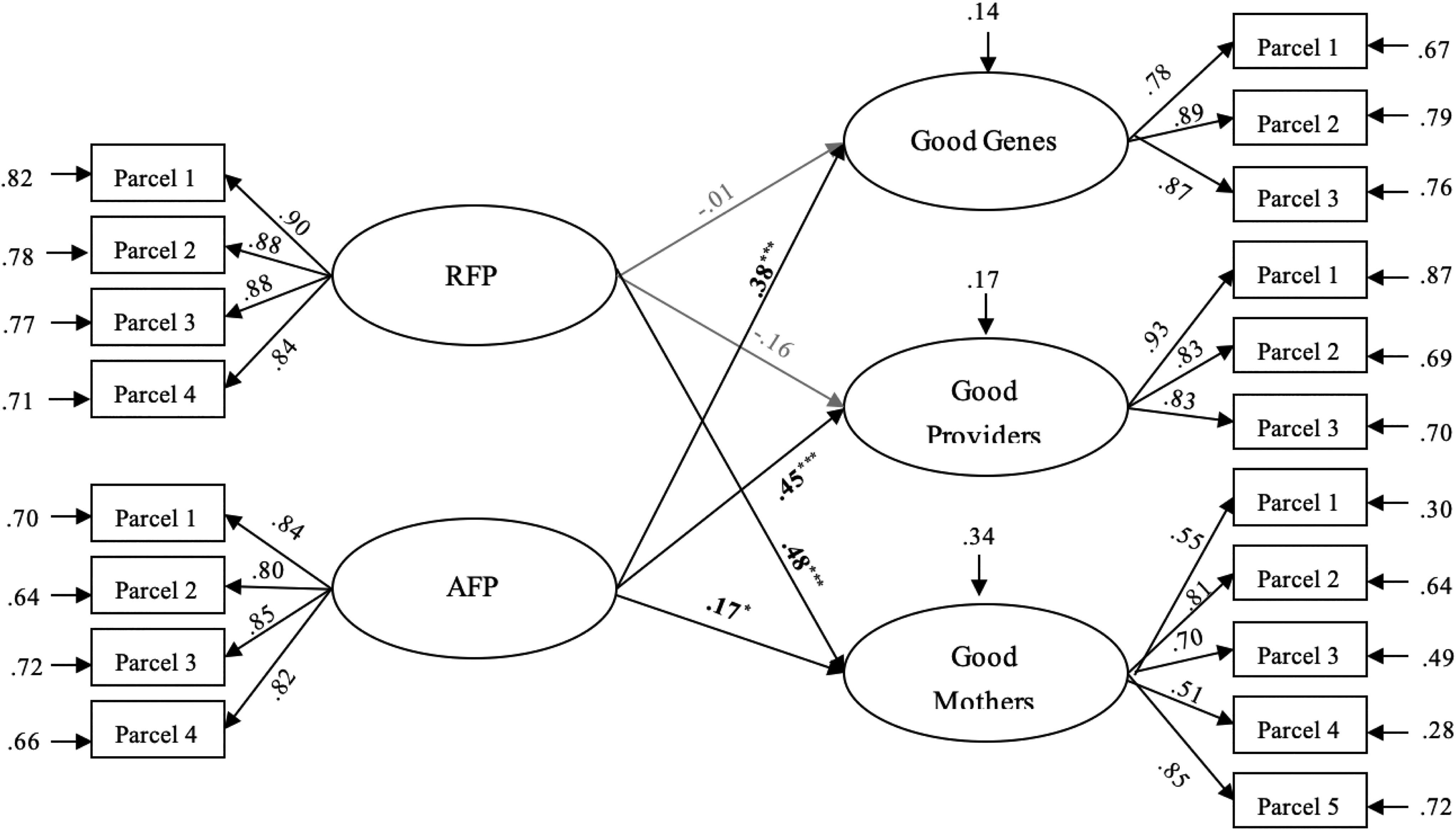
Model of relationships between dual filial piety and mate preferences in the male group. All coefficients are the standardized solution. Note. *p < .05, **p < .01, ***p < .001.
We examined the hypothesized structural models of the dual filial piety model, the two aspects of parental influence, and mate preferences of both genders, resulting in a fit that was not very good (female dataset: χ2(255) = 550.19, χ2/df = 2.16, RMSEA = .070, CFI = .88, TLI = .86, GFI = .85, SRMR = .095; male dataset: χ2(304) = 671.28, χ2/df = 2.21, RMSEA = .076, CFI = .89, TLI = .87, GFI = .81, SRMR = .094). We tested our hypothetical models and verified a reasonable fit for each. The modification indices suggested that deleting some nonsignificant structural paths would improve the model fit significantly. After deleting the paths of RFP → good genes, RFP → good providers, AFP → good genes, AFP → good providers and AFP → good fathers in the female mediational model, Δχ2 = 81.35, Δdf = 2, and ΔCFI = .03 (p < .001); and after deleting the paths of RFP → good genes and AFP → good mothers in the male mediational model, Δχ2 = 67.86, Δdf = 1, and ΔCFI = .02 (p < .001). The two models had higher values for the indices of comparative fit (female dataset: χ2(257) = 468.84, χ2/df = 1.82, RMSEA = .059, CFI = .91, TLI = .90, GFI = .87, SRMR = .066; male dataset: χ2(303) = 603.42, χ2/df = 1.99, RMSEA = .069, CFI = .91, TLI = .90, GFI = .82, SRMR = .079). All loading estimates were significant (ps < .001). Given the fit of the model, no further modifications were made to the structural models; therefore, they were used for interpretations, as illustrated in Figures 3 and 4. In the female dataset, it was estimated that the predictors of good genes explained 6% of the variance, 7.4% for good providers, and 18.9% for good fathers; in the male dataset, 19.9%, 32.8%, and 37.5% of the variance was explained by good genes, good providers and good mothers, respectively.
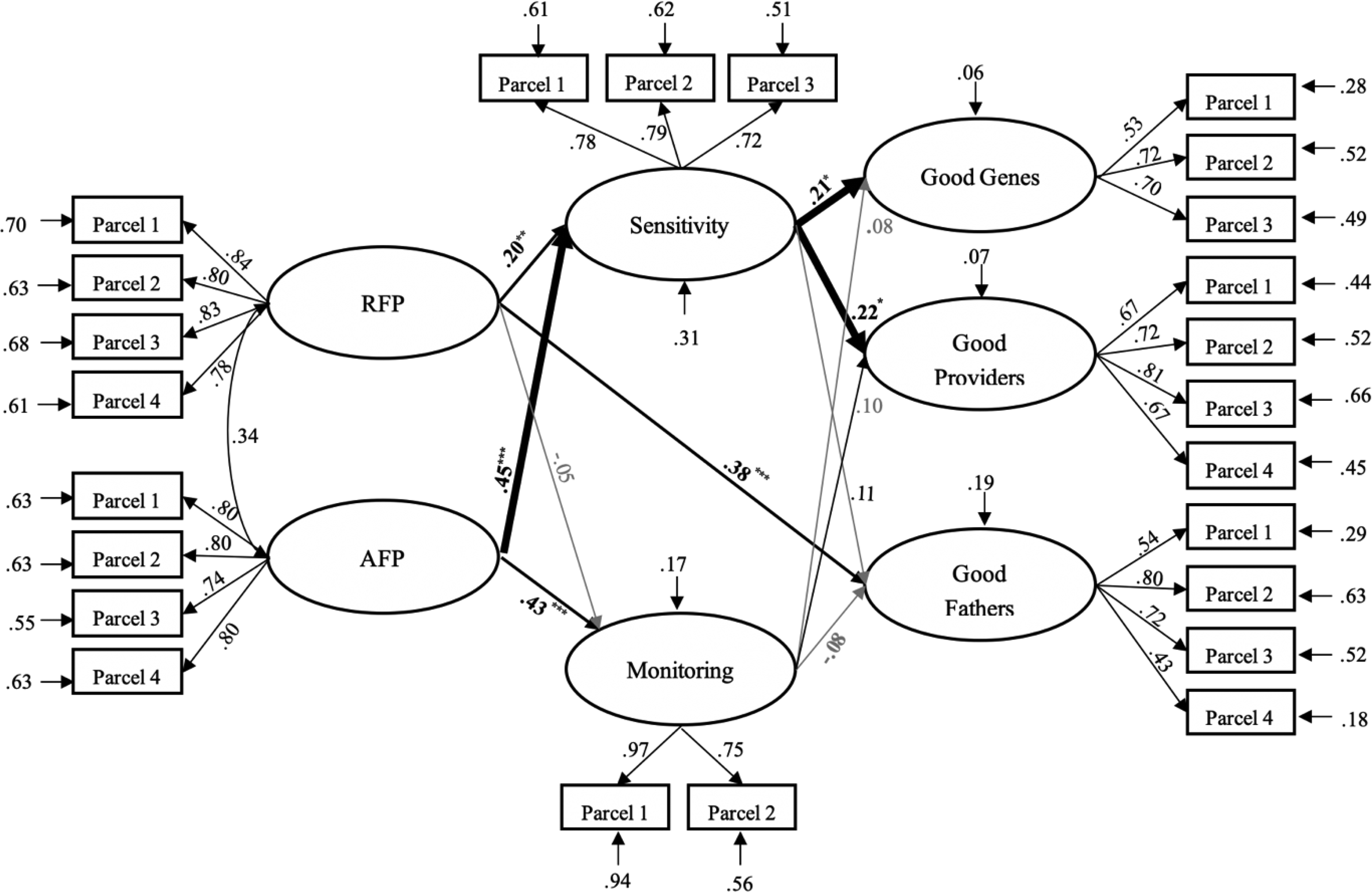
Mediated model of dual filial piety, parental influence, and mate preferences in the female group. All coefficients are the standardized solution. The mediational paths are highlighted. Note. *p < .05, **p < .01, ***p < .001.

Mediated model of dual filial piety, parental influence, and mate preferences in the male group. All coefficients are the standardized solution. The mediational paths are highlighted. Note. *p < .05, **p < .01, ***p < .001.
In the female dataset, the effect of RFP on females’ preference for good fathers was significantly positive (β = .38, p < .001). Simultaneously, RFP had a significant positive effect on sensitivity toward parents (β = .20, p = .008), and AFP had a significant positive effect on both sensitivity (β = .45, p < .001) and parental monitoring (β = .43, p < .001). Furthermore, sensitivity was positively associated with good genes (β = .21, p = .03) and good providers (β = .22, p = .012). In the male dataset, the effect of RFP on males’ preference for good providers was significantly negative (β = −.24, p = .002), and that for good mothers was significantly positive (β = .51, p < .001). The effects of AFP on good providers (β = .22, p = .019) and good genes (β = .22, p = .02) were significantly positive. Simultaneously, RFP was significantly positively associated with sensitivity (β = .32, p < .001); AFP was significantly positively associated with both sensitivity (β = .41, p < .001) and parental monitoring (β = .49, p < .001). Furthermore, sensitivity was positively linked to good providers (β = .38, p < .001), and parental monitoring was positively linked to good genes (β = .28, p = .01) and good mothers (β = .23, p = .023).
Finally, the bootstrapping method was adopted to test the mediating effect for the hypothetical model. The results revealed that the indirect effect of AFP on mate preferences was significant through parental influence. Specifically, in the female dataset, the effect of AFP on good providers and good genes was significant through sensitivity (good providers: estimate = 0.142, SE = 0.043, p = .001, 95% CI [0.064, 0.234]; good genes: estimate = 0.126, SE = 0.047, p = .004, 95% CI [0.036, 0.230]). In the male dataset, the effect of AFP on good providers was significant through sensitivity (estimate = 0.23, SE = 0.062, p = .004, 95% CI [0.134, 0.35]). Its effect on good mothers and good genes was significant through monitoring (good mothers: estimate = 0.122, SE = 0.064, p = .008, 95% CI [0.043, 0.249]; good genes: estimate = 0.146, SE = 0.069, p = .014, 95% CI [0.068, 0.284]). The results partially supported Hb1and Hb2. For both genders, sensitivity mediated the link between AFP and good providers; for females, sensitivity mediated the link between AFP and good genes; for males, parental monitoring mediated the links between AFP and good genes and between AFP and good mothers. However, in both genders, the two types of parental influence were not mediators between RFP and mate preferences as expected.
Discussion
In this study, we aimed to investigate how the various dimensions of filial piety beliefs and parental influence work together and shape Chinese adult children’s long-term mate preferences. This study contributes to the current literature on mate selection research on several points. First, this investigation fills the gap in the potential associations between the two distinct types of filial piety beliefs and adult children’s mate preferences. Second, we revealed the relationship between the dual filial piety model and parental influence in the structural model. Third, we demonstrated the inner mechanisms among mate preferences, filial piety, and parental influence, in which the two aspects of parental influence could serve as mediators between AFP and mate preferences in Chinese adult children.
The results were mainly consistent with the hypotheses. First, the dual filial piety model was correlated with adult children’s mate preferences. Both female and male adult children who had higher RFP beliefs tended to select mates with good father/mother traits. Because adult children’s two filial piety beliefs were rooted in parenting (Chen, 2014), RFP reflected an intimate and affectionate parent–child relationship and warm parenting, which was consistent with the traits of good fathers/mothers, including caring for and loving one’s children. As Bedford and Yeh (2019) pointed out, RFP offered emotional safety and affective bonding with parents during growing stages and strengthened affection and bonding with parents in adulthood. When children grow up, they tend to seek partners who also possess such caring traits so that they can pass them on through the strong affection and parent–child bonding in their own family.
In addition, both female and male participants with higher AFP beliefs preferred mates with good genes presenting their own choices. Among male participants, as expected, they also tended to choose mates who were good providers and good mothers. This finding indicated that males with higher AFP present their compliance and rationalization (Nesse, 1990) to please their parents and follow their preferences as traditional parents favor daughters in-law with greater financial resources (Chang et al., 2011) and being good mothers to take care of their offspring and family (Guo et al., 2017). However, among female participants, the results only showed their defiance to choosing good gene mates. Because AFP mainly represents traditional Chinese patriarchal values, it would be more difficult for females to rationalize such values than males. When female children were aware of their own motives and desires about mates, they might refuse to repress their own mate preferences and rationalize their parents’ choices (Nesse, 1990).
In the mediational model, for both genders, sensitivity served as a mediator between AFP and good providers. AFP, as an indicator of role-based parent–child interactions (Chen & Wong, 2014), was connected to children’s sensitivity toward their parents, which consequently contributed to children’s acceptance of their parents’ preferences. Because AFP is developed in daily family life and requires children to satisfy parents’ expectations and demands, through the process of meeting their parents’ requirements, adult children have the experience of sensing their parents’ opinions, including opinions about their mates. Therefore, adult children with higher AFP tend to sense and accept their parents’ preferences better so that they choose good provider mates who are similar to their parents’ selections.
Additionally, for females, sensitivity partially mediated the relationship between AFP and good genes. This result is consistent with the evolutionary hypothesis of females’ long-term mate preferences: both traditional Chinese parents and nontraditional Chinese daughters prioritize men who offer protection and provisioning resources (Buss & Schmitt, 2019), reflecting good gene and good provider traits. As mentioned above, the belief-shaping process in parent–child interactions with AFP can be linked to female children’s greater likelihood of sensing their parents’ ideas, which contributes to adult children’s better perception of parents’ preferences.
For males, parental monitoring played an important role that mediated the relationships between AFP and good genes and between AFP and good mothers as expected. First, the t-test results in our study showed that male participants endorsed stronger AFP, which was in accordance with the existing study (Yeh et al., 2013). They prefer mates who possess good genes, such as youth and physical attractiveness cues to fertility (Chang et al., 2011), and who are good mothers who will be responsible for household labor and childcare (Cook & Dong, 2011). Second, due to the patriarchal family system in Chinese societies, men are primarily the ones who shoulder the responsibility to continue the family line and maintain close connectedness even after they are married (Blair & Madigan, 2016). Chinese parents may pay close attention to the persons whom their sons are dating by constantly supervising, checking, receiving updates on the progress of relationships, and carefully evaluating whether the persons can smoothly blend into the family system (Liu et al., 2014), and the traditional Chinese custom of living together makes parents’ monitoring of their sons feasible. Therefore, those men with strong AFP may feel more obligated to accept parental monitoring about mate selections due to the compliance nature in their parent-child interactions to choose good gene and good mother mates.
In addition, although the models between males and females cannot be compared equally due to different criteria in mate preference questionnaires, the large discrepancy in explained variances between the male and female groups found in this study might reveal valuable implications. The smaller explained variance in the female group (6%–18.9%) than in the male group (19.9%–37.5%) may be due to the presence of fewer predictors in the female group. However, this finding also indicated that filial piety beliefs and parental influences may be more critical for mate preferences for males than for females.
In this study, we hypothesized that perceived parental influence might mediate the relationship between RFP and mate preferences. However, the results failed to support such hypotheses. Perhaps RFP already resulted in the development of genuine affection from long-term positive interactions between children and parents (Bedford & Yeh, 2019), and adult children voluntarily contributed their love and care toward parents (Huang & Yeh, 2013; Yeh & Cheng, 2005) and internalized their parents’ mate preferences. We can speculate that there is no need for parental monitoring and sensitivity to act on mate preferences. In addition, there are some limitations to this study. First, the data analysis method of SEM could not test for causal relationships between latent variables. There is a probability that the relationships between them are bidirectional. For example, adult children’s filial piety beliefs would influence their mate preferences; similarly, because they prefer mates with good provider traits, they receive higher AFP scores. Second, there might be potential reporting bias in the responses to the questionnaire. Children who are more subject to parental influence (parental monitoring or sensitivity toward their parents) might be less likely to report or recall their parents’ negative comments, which may have biased the results. Third, we designed the questionnaire for adult children; thus, it only covered their mate preferences. There was no chance to measure parents’ preferences for their children’s mates; therefore, it was not possible to confirm each parent–child dyad’s mate preference divergence.
Based on current findings, future studies may consider designing interventions or experiments to manipulate children’s perceptions of parental authoritarian or perceptions of sensitivity and monitoring from parents about their mate selection to examine whether children’s mate preference may change accordingly. In addition, future research may also investigate the role of parents’ childrearing strategies in children’s filial piety beliefs, perception of parental influences on mate selection, and children’s mate preferences. For example, Chinese parents who are independent with high levels of self-care and open-mindedness who grant more autonomy to their children may not strongly emphasize the importance of filial piety in their childrearing and not need to receive resources or benefits from their children’s mate selections. Therefore, they may be less likely to interfere in their children’s mate decisions or to prefer traits of good provider in their in-laws.
The findings of this study have crucial insights regarding the role of the parent–child interaction and family factors in the mate-selection process. In reality, adult children’s filial piety beliefs, which represent parent–child relationship quality, have profound implications for their perception of parental influence, and these factors work together to shape the final mate selection decisions. Derived from a supportive and positive family life, adult children with stronger RFP tend to prefer mates who are potentially good mothers or good fathers. Female adult children who have stronger AFP, which is developed from obedience and compliance during the growing-up process, appear to be sensitive to their parents’ preferences to choose mates who are good providers and have good genes, and male adult children accept their obligations to select mates who are good mothers and have good genes under parental monitoring. Therefore, when selecting mates, adult children should be aware of the potential influence of their filial piety beliefs and parents.
Supplemental Material
Supplemental Material, Supplemental_material - The Mediating Role of Parental Influence on the Relationship Between Adult Children’s Filial Piety Beliefs and Mate Preferences
Supplemental Material, Supplemental_material for The Mediating Role of Parental Influence on the Relationship Between Adult Children’s Filial Piety Beliefs and Mate Preferences by Lu Ran Zhang and Wei-Wen Chen in Evolutionary Psychology
Footnotes
Declaration of Conflicting Interests
The author(s) declared no potential conflicts of interest with respect to the research, authorship, and/or publication of this article.
Funding
The author(s) received no financial support for the research, authorship, and/or publication of this article.

Supplemental Material
Supplemental material for this article is available online.
References
Supplementary Material
Please find the following supplemental material available below.
For Open Access articles published under a Creative Commons License, all supplemental material carries the same license as the article it is associated with.
For non-Open Access articles published, all supplemental material carries a non-exclusive license, and permission requests for re-use of supplemental material or any part of supplemental material shall be sent directly to the copyright owner as specified in the copyright notice associated with the article.
