



Abstract
Perceived temporal distance is explored using an evolutionary-functionalist perspective. Participants imagine themselves in one of three future scenarios: a survival scenario, a high-effort scenario, and a low-effort scenario. After imagining themselves in a future scenario, participants make a judgment of perceived temporal distance. Results suggest a survival perceived temporal distance effect (SPTD effect). Participants report the survival scenario feels closer to them in time than the high-effort and low-effort scenarios in experiments using a within-subjects design (Experiment 1) and a between-subjects design (Experiment 2). The perceived temporal closeness of a future survival scenario is highly adaptive as it motivates effective preparation for a future event of great importance. Furthermore, the perceived temporal distance findings reported here taken together with past research on perceived spatial distance illustrate the value of the functional perspective when conducting research on psychological distance. The SPTD effect is likely related to the well-documented survival-processing memory effect and is consistent with research demonstrating the cognitive overlap between remembering past events and imagining future events.
Our relationship to objects and events varies through time and space. Not only can our distance relationships with objects and events be measured in the physical world (e.g., measuring space in meters and time in seconds), but they can also be measured in the psychological world (e.g., using self-reported measures of perceived spatial distance and perceived temporal distance). Psychological distance refers to the psychological distance between oneself and some object or event. The psychological distance between oneself and future or past events is often referred to as perceived temporal distance. As we move through time, past events distance themselves from the present and future events draw near. At any given moment, some events seem very close to the present while others seem very far away. Construal Level Theory (Trope & Liberman, 2010) is one appealing candidate for guiding research on perceived temporal distance. According to Construal Level Theory, the perceived temporal distance to a given event is related to its level of mental construal and abstraction. However, this study is instead guided by an evolutionary framework and a desire to understand how perceived temporal distance might be adaptive. Therefore, we use an evolutionary-functionalist perspective to explore perceived temporal distance.
Caruso et al. (2013) suggest that the perceived temporal distance to a future event may be related to how much preparation is required to realize that future event. Therefore, future events that require a great deal of preparation may be feel psychologically closer in time than events that require less preparation. In this way, perceived temporal distance functions to help us prepare effectively for future events. There is some evidence that this is true. Jiga-Boy et al. (2010) found that more effortful scenarios feel closer to us in time than less effortful scenarios. When events are perceived as being close to us in time, there is evidence that we are more motivated to engage in activities that allow us to effectively prepare for those events (Peetz et al., 2009). The functional nature of perceived temporal distance is also observed with perceived spatial distance. For example, Proffitt et al. (2003) demonstrated that increased anticipated walking effort to a distant object increased the perceived spatial distance of the object. Similarly, Witt et al. (2004) demonstrated that increased anticipated throwing effort to a distant object increased the perceived spatial distance of the object.
Perceiving effortful future scenarios as close in time is functionally consistent since more preparation is needed to effectively realize high-effort events than low-effort events (Caruso et al., 2013). Similarly, perceiving an object as spatially far away when the anticipated effort to reach the object is high is functionally consistent since more energy is needed to reach it (Proffitt et al., 2003; Witt et al., 2004). In this study, we extend the functional approach suggested by Caruso et al. (2013) for thinking about psychological temporal distance. Specifically, we explore whether future survival events are treated differently than other types of events when making judgments of perceived temporal distance. To do this effectively, we compare participant judgments of perceived temporal distance to a future survival scenario with those of two future non-survival scenarios (a low-effort scenario and a high-effort scenario). A low-effort scenario and high-effort scenario are used for comparison with a survival scenario because in a study utilizing 28 different scenarios, Jiga-Boy et al. (2010) showed that effort was an important factor for predicting perceived temporal distance to future events. Specifically, high-effort events were perceived as closer in time, followed by medium-effort events and then low-effort events.
Research demonstrating cognitive processing differences between survival events and non-survival events is not new. There is considerable evidence in memory research that we are built to prioritize survival information. For example, Nairne et al. (2007) demonstrated that words encoded and processed in the context of a survival situation (i.e., being stranded in the grasslands of a foreign land and needing to figure out how to survive) are remembered better than words processed using other highly effective processing strategies (e.g., pleasantness ratings, schema-based relevance ratings, and self-reference). This survival-processing memory advantage has been studied extensively since its discovery exploring questions that range from its generalizability (e.g., Abel & Bäuml, 2013) and proximate mechanisms (e.g., Kroneisen et al., 2013) to its limitations (e.g, Kroneisen et al., 2014) and the aspects of the survival situation that are critical for the effect (e.g., Tay et al., 2019). The survival processing memory advantage has been replicated many times and researchers can reasonably expect a medium effect size when working in this area (Scofield et al., 2018).
The survival-processing memory advantage informs our study on perceived temporal distance in two primary ways. First, it supports the idea that survival events may be treated differently than non-survival events when processed as future events (e.g., remembered better or perceived as being closer in time) since research on remembering the past and imagining the future suggests considerable overlap between those cognitive processes. Specifically, we see that remembering the past and imagining future events involve similar neural regions (e.g., Addis et al., 2007; Szpunar et al., 2007). We also see that impairment in remembering past events is related to impairment in imagining future events (e.g., El Haj et al., 2015). Furthermore, Schacter (2012) describes the similarity between imagining future events and remembering past events in a review of memory errors. The authors point out that memory errors for past events (postevent misinformation errors and associative memory errors) as well as memory errors that arise from imagining future events (imagination inflation), in part, stem from a shared constructive memory process. Schacter and Addis (2007) also discuss the unique relationship between past events and imagining future events in their review. They argue that the constructive processes used to explain the recall of past events may actually be even more effective in explaining how we imagine future events. Specifically, they note that to imagine a future event one must take bits of information from the past and then combine them, often in new ways, to construct a potential future experience. Despite many similarities between remembering past events and imagining future events, we do see some asymmetries. For example, simulations of future events have more prototypical representations than simulations of past events (Kane et al., 2012) and imagined future events tend to be felt with more emotional intensity than past events (Van Boven & Ashworth, 2007). The emotional intensity asymmetry may be especially noteworthy since emotionally intense events are perceived as psychologically closer to us than emotionally neutral events (Van Boven et al., 2010).
The second way research on the survival-processing memory advantage informs our study is in the methodology. Specifically, the often-used survival-processing paradigm developed by Nairne et al. (2007) provides us with a well-established method for studying survival processing that can be extended to the study of perceived temporal distance. The survival-processing method used in memory research involves having participants imagine themselves in a survival scenario such as being stranded in the grasslands of a foreign land and needing to figure out how to survive. Next, participants rate items (often words) for their relevance to the imagined survival scenario. Memory performance for the items rated (processed) in relation to the survival scenario is later compared to memory performance for items rated using other mnemonic processing strategies (e.g., pleasantness ratings).
In two separate experiments, participants imagine themselves in a future survival scenario. After imagining themselves in a future survival scenario, participants make a judgment of perceived temporal distance to that scenario (i.e., how far away does the scenario feel). Participants also imagine themselves in future low-effort and high-effort non-survival scenarios and make associated judgments of perceived temporal distance. Using an evolutionary-functionalist perspective, we predict that the future survival scenario will feel closer in time than the non-survival scenarios.
Experiment 1
In Experiment 1, participants imagined themselves in three different scenarios (a survival scenario, high-effort scenario, and low-effort scenario). After imagining each scenario, participants reported how far away in time the start of the scenario felt. At the end of the study, participants completed an attention check as a quality control measure. All data were collected online using Amazon’s Mechanical Turk and SurveyMonkey. The seminal paper on the survival processing memory advantage by Nairne et al. (2007) provided the most appropriate guide for a target sample size for Experiment 1. Like Experiment 1 in this study, Experiment 2 in the Nairne et al. (2007) study compared a survival scenario with two control scenarios, used a within-subject design, and used analysis of variance to evaluate group differences. The Nairne et al. (2007) study had 38 participants. A slightly larger target sample size of 50 participants was selected for Experiment 1 in this study because of assumed additional variability as a result of online data collection with Amazon’s Mechanical Turk and SurveyMonkey.
Method
Participants
Participants were recruited from Amazon’s Mechanical Turk and paid $0.25 for completing Experiment 1. There were 50 participants that completed Experiment 1 but 4 participants were removed because they did not pass the attention check. Therefore, data from 46 participants was used for the final analysis. Our participants were recruited from the United States of America and came from 22 different states and territories. The sample included 32 males and 14 females and they ranged in age from 18 to 54 years (M = 28.957, SD = 7.955). This research was approved by the local institutional review board and all participants gave informed consent by completing an online form through SurveyMonkey.
Design and Procedure
Data were collected online using SurveyMonkey on September 23, 2015. Each participant was asked to imagine three future scenarios one at a time that would occur on August 25, 2016: a future survival scenario, high-effort scenario, and low-effort scenario. Scenarios were presented to participants with instructions asking the participants to imagine themselves in that scenario for 10 seconds. After imagining each scenario, participants were asked to make a judgment about how far away the start of the scenario felt using a 7-point scale (1 = very close, 7 = very far). This judgment was used as our measure of perceived temporal distance. The order of the scenarios was randomized. Below are the instructions and scenarios presented to participants.
Instructions: We would like you to imagine the following scenario. After reading the scenario, please close your eyes for 10 seconds and imagine the situation as if you were going to experience it firsthand.
Survival Scenario: We would like you to imagine that on August 25, 2016, you will be stranded in the grasslands of a foreign land, without any basic survival materials. Imagine that you will need to find steady supplies of food and water and protect yourself from predators during this survival situation.
High-Effort Scenario: We would like you to imagine that on August 25, 2016, you will start traveling around the world and visit several foreign countries you have not visited before. Imagine that you will need to locate and pay for places to stay and arrange transportation between countries during your world travels.
Low-Effort Scenario: We would like you to imagine that on August 25, 2016, you will go to a foreign film festival, which is being held at a local theater. Imagine that when you get to the film festival you will need to purchase food and drinks and find a good seat.
The survival scenario is based on the survival scenario developed by Nairne et al. (2007). The high-effort and low-effort events were based on scenarios developed by Jiga-Boy et al. (2010). The high-effort scenario was designed to match the survival scenario as closely as possible except for the survival context.
After making perceived temporal distance judgments for each of the scenarios, participants completed an attention check. The attention check required that the participant identify the date the scenarios were going to occur using the format of “Month Day, Year.” This attention check served as a quality control measure for our online data collection, and attention checks like this one are recommended by Amazon’s Mechanical Turk. The data collected from any participant that did not report the date that the scenarios were going to occur within one month of the actual date were removed from the study.
Results and Discussion
As illustrated in Figure 1, participants reported the survival scenario felt closer in time (M = 4.109, SE = .241) than the high-effort scenario (M = 4.978, SE = .227) and the low-effort scenario (M = 5.30, SE = .221). An alpha level of .05 was used to define significant effects. An analysis of variance revealed a significant effect of scenario type on perceived temporal distance, F(2, 90) = 9.045, p < .001, η2 = .167. Pairwise comparisons with a Bonferroni adjustment indicated the survival scenario was perceived as significantly closer in time than the high-effort scenario (p = .005, 95% CI [−1.514, −.225]) and the low-effort scenario (p = .002, 95% CI [−1.994, −.397]). There was no significant difference between the high-effort scenario and the low-effort scenario (p > .05, 95% CI [−1.043, .391]).
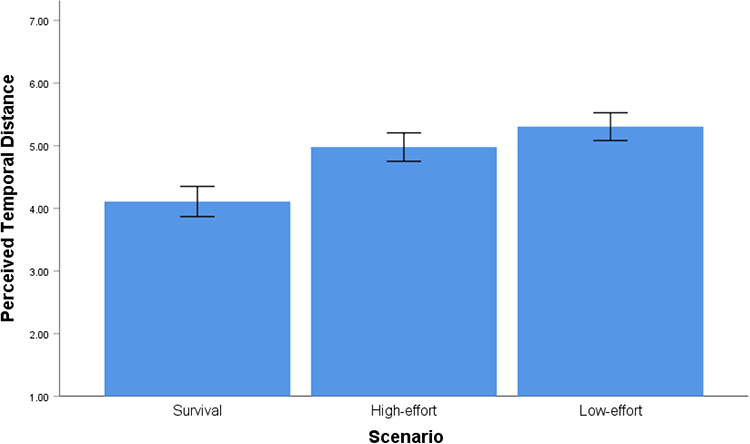
Means with error bars (± 1 standard error) for the survival scenario, high-effort scenario, and low-effort scenario in Experiment 1.
Consistent with an evolutionary-functionalist perspective, the survival scenario was perceived as significantly closer in time than both non-survival scenarios (the high-effort scenario and low-effort scenario). One limitation of Experiment 1 is the possibility of carryover effects (i.e., participants making comparisons across conditions when reporting perceived temporal distance), but this limitation is addressed in Experiment 2 with a between-subjects design. The perceived closeness of the survival scenario relative to the non-survival scenarios reported here is termed the survival perceived temporal distance effect, and a review of the perceived temporal distance literature suggests this is the first report of the effect. Given the novelty of the survival perceived temporal distance effect, there is much work to be done. For example, exploring possible underlying mechanisms, testing its generalizability, and replicating the effect. Although one study cannot fully address all of these things, the focus of Experiment 2 is replication and testing the effect’s generalizability.
Experiment 2
Experiment 1 demonstrated a survival perceived temporal distance effect using a within-subject design. Experiment 2 was designed to replicate the survival perceived temporal distance effect and determine if the effect generalizes to a between-subjects design. A between-subjects design eliminates carryover effects but adds additional variability between conditions as a result of individual differences. Therefore, the target sample size providing 50 observations for each condition (50 total participants) in Experiment 1 was increased to a target sample size providing 75 observations for each condition (225 total participants) in Experiment 2.
Method
Participants
Participants were recruited from Amazon’s Mechanical Turk and paid $0.15 for completing the study. There were 255 participants that completed the study. However, 19 participants were removed because they did not pass the attention check. This left us with data from 236 participants. Our participants were recruited from the United States of America and came from 43 different states and territories. The sample included 133 males, 102 females, and 1 participant that did not identify as male or female, and they ranged in age from 18 to 79 years (M = 34.292, SD = 10.883).
Design and Procedure
The procedure for Experiment 2 closely matched that of Experiment 1. The primary difference was that Experiment 2 utilized a between-subjects design instead of a within-subjects design. Only the procedural differences between Experiments 1 and 2 are described here. Data were collected online using SurveyMonkey on April 23, 2017. Each participant was asked to imagine one of three randomly assigned scenarios that would occur on March 25, 2018: a future survival scenario, high-effort scenario, and low-effort scenario. The completely randomized scenario assignment procedure resulted in 75 participants assigned to the survival scenario, 89 participants assigned to the high-effort scenario, and 72 participants assigned to the low-effort scenario.
Results and Discussion
As illustrated in Figure 2, participants reported the survival scenario felt closer in time (M = 4.227, SE = .188) than the high-effort scenario (M = 4.966, SE = .142) and the low-effort scenario (M = 5.444, SE = .159). Levine’s test indicated the assumption of homogeneity of variance was not satisfied, F(2, 233) = 4.171, p = .017. Therefore, a Welch analysis of variance and a Games-Howell post hoc procedure were used to evaluate group differences. The analysis of variance revealed there was a significant effect of the type of scenario on perceived temporal distance, F(2, 149.962) = 12.207, p < .001, η2 = .103. The Games-Howell test indicated the survival scenario was perceived as significantly closer in time than the high-effort scenario (p = .006, 95% CI [−1.296, −.183]) and the low-effort scenario (p < .001, 95% CI [−1.801, −.635]). There may be a perceived temporal distance difference between the high-effort scenario and low-effort scenario. This difference was marginally significant (p = .067, 95% CI [−.983, .026]).

Means with error ears (± 1 standard error) for the survival scenario, high-effort scenario, and low-effort scenario in Experiment 2.
Experiment 1 provided evidence for the survival processing temporal distance effect using a within-subject design. Experiment 2 replicates the survival processing temporal distance effect and shows the effect generalizes to a between-subjects design. The generalization of the effect from a within-subject design to a between-subjects design is important as it suggests the survival processing effect observed in this study is not simply the result of participants making comparisons across conditions. A significant difference in perceived temporal distance between the high-effort scenario and low-effort scenario was not observed in Experiment 1 or Experiment 2. This was inconsistent with the findings of Jiga-Boy et al. (2010). However, in Experiment 2 the perceived temporal distance difference between the high-effort scenario and low-effort scenario was marginally significant (p = .067). One possible explanation for the discrepancy between the findings reported here and those of Jiga-Boy et al. (2010) are differences in the design and analysis between the two studies. This study utilized pairwise comparisons with a Bonferroni correction (Experiment 1) and a Games-Howell post hoc procedure (Experiment 2) to evaluate group differences between the high-effort and low-effort scenarios while Jiga-Boy et al. (2010) used many scenarios that varied in effort (28 scenarios in Study 1a and 9 scenarios is Study 1b) and a regression model to test the effect of effort on perceived temporal distance.
General Discussion
The present findings provide evidence for a survival perceived temporal distance effect (SPTD effect). Specifically, we see that future survival scenarios feel closer to us in time than non-survival scenarios. One possible interpretation is that the perceived closeness of future survival scenarios is highly adaptive and may help motivate us to allocate the resources needed to effectively prepare for events of great evolutionary importance. This functional interpretation is consistent with previous research that illustrates the functional nature of perceived temporal distance judgments (Caruso et al., 2013; Jiga-Boy et al., 2010). It is also consistent with research illustrating the functional nature of perceived spatial distance (Proffitt et al., 2003; Witt et al., 2004).
The SPTD effect may be similar to the well-documented survival processing memory effect. We now have evidence that judgments of perceived temporal distance are highly adaptive which is consistent with growing evidence that memory is adaptive (e.g., Fernandes et al., 2017; Nairne et al., 2007). Furthermore, the findings and conclusions reported here are not surprising given the overlap of the cognitive process involved in remembering the past and imagining the future (Addis et al., 2007; El Haj et al., 2015; Schacter, 2012; Schacter & Addis, 2007; Szpunar et al., 2007).
The discovery of the SPTD effect provides many opportunities for future research. Since the discovery is quite new, a focus on replication and increasing our understanding of the limits of the effect and its nature are important. For example, does the effect hold both for events with deadlines that are temporally very near and those events with deadlines that are quite distant? Does the effect hold with different populations? This is important since we know that culture influences perceived temporal distance (Kim et al., 2018). What is it about the survival scenario that makes it feel closer in time relative to a high-effort control scenario? Are there other high-effort scenarios that would feel even closer in time than a matched survival scenario? The survival scenario used in this study was not compared to all possible controls. Discussions at conferences and throughout the review process regarding the SPTD effect suggest potential alternative explanations unrelated to survival (e.g., abstractness, death-priming, emotional intensity, and valence). It is certainly possible that control conditions will be discovered that may question the present explanation for the effect. Future work should compare the survival scenario used in this study to other controls and possibly even explore modifications to the survival scenario. Jiga-Boy et al. (2010) demonstrate a clear effect of effort on perceived temporal distance (more effortful future events are perceived as closer in time) in a study that included a panoply of different scenarios (28 scenarios) and controlled for objective temporal distance. Therefore, the high-effort scenario adapted from Jiga-Boy et al. (2010) and used as a control condition in this study provides us with a good entry point for exploring the SPTD effect.
It is also not clear how the SPTD effect is explained using Construal Level Theory (Trope & Liberman, 2010). Construal Level Theory states that psychological distance is related to the level of mental construal and abstraction, and it is commonly used to interpret findings in the area of perceived temporal distance (e.g., Bhatia & Walasek, 2016; Jiga-Boy et al., 2010). Specifically, Construal Level Theory suggests that objects that are psychologically distant are more abstract and at a higher level of construal. For perceived temporal distance, this means that more abstract future events should be judged as more distant and more concrete future events should be judged as feeling closer. In the experiments reported here, future survival scenarios were judged as feeling closer in time in comparison to high-effort and low-effort control scenarios. According to Construal Level Theory, this means that the future high-effort and low-effort control scenarios were more abstract mental contruals than the future survival scenario. However, it is not entirely clear why the future control scenarios would form more abstract mental contruals. Investigating the SPTD effect and Construal Level Theory is another future research opportunity.
This discovery may also have important applications as we see many examples of perceived temporal distance influencing decisions, judgments, and behaviors. Galak et al. (2014) demonstrated that eating behavior is influenced by the perceived temporal distance from one’s last meal. Specifically, if one’s last meal is perceived as more recent, then one tends to purchase a smaller current meal. This research establishes a relationship between perceived temporal distance and action. Kim and Kim (2018) found that smokers exposed to framing that encouraged shorter perceived temporal distance to health risks reported they were more likely to quit smoking. Increasing our understanding of the SPTD effect may allow us to “nudge” people into positive decisions, judgments, and behaviors not only in the areas discussed here like personal health but also in areas such as personal finance and community engagement. We see a similar assertion in a review of studies examining the connection between psychological distance and climate change by McDonald et al. (2015). Specifically, the authors note a potential benefit to climate change attitudes and behaviors by reducing psychological temporal distance to climate change impact. It is probably too early to apply the findings presented in this study to behavioral change, but there may be the potential for application in the future. For instance, could we counteract the inaction that often occurs when people think about potentially distant (in physical time) future events (e.g., the effects of smoking, the effects of diet, retirement, and climate change) that require action now for future success? At some point in the future, we may be able to effectively tackle research questions like this one.
Footnotes
Acknowledgments
I am very grateful for the contributions of the extremely talented student research assistant Sydney Paquin. Her intellectual contributions to project concepts and data acquisition were substantial.
Declaration of Conflicting Interests
The author(s) declared no potential conflicts of interest with respect to the research, authorship, and/or publication of this article.
Funding
The author(s) received no financial support for the research, authorship, and/or publication of this article.
