



Abstract
Social isolation was examined to assess its potential influence on the survival processing effect, which shows that individuals are more likely to remember something when it is processed with regard to their survival. Participants imagined being stranded in the grasslands, going on a space mission, or moving to a foreign land while alone or with a group of friends and rated a list of words for their relevance to the assigned scenario. An incidental memory test showed the typical survival processing effect on recall memory, with a significant interaction showing that the effect occurred in the isolated condition but not in the group condition. A second experiment examined rates of recognition for an isolated and group condition for the grasslands and moving scenarios and found a marginally significant effect of isolation in addition to the typical survival processing effect. Further, in both experiments, the perceived isolation of the isolated and group survival grasslands scenarios was significantly higher than the other conditions. The results are discussed with regard to the self-reference effect and the object-function account of the survival processing effect.
People are more likely to remember information that is processed with regard to a survival context, a finding that has been called the survival processing effect (Nairne, Thompson, & Pandeirada, 2007). The effect has received increased attention since Nairne, Thompson, and Pandeirada (2007), where participants were given a grasslands survival scenario and asked to rate a list of words for their relevance to that scenario (e.g., see Schwartz, Howe, Toglia, & Otgaar, 2014). The scenario suggested they were stranded in the grasslands without any basic survival materials and that they would need to find food, water, and a way to protect themselves from predators. Participants in the survival condition had higher levels of retention on a surprise memory test than participants who rated words for pleasantness, self-relevance, or relevance to a scenario involving moving to a foreign land.
In the past several decades, myriad studies have been conducted indicating that different types of processing produce different levels of memory, which is the idea behind the depth of processing paradigm (Craik & Tulving, 1975). The depth of processing result suggests that information that is processed at a “deep” level, with regard to semantic information, is remembered at a higher rate than information processed at more shallow levels (e.g., by focusing on the structural or phonemic qualities of the words). Rogers, Kuiper, and Kirker (1977) extended this paradigm to include processing with regard to the self. In their studies, they found that participants who processed information in terms of the self were able to remember the information better than information processed at other levels of depth, including the deep semantic level. Nairne, Pandeirada, and Thompson (2008) compared the survival grasslands condition to several conditions that have repeatedly shown to lead to deep levels of processing, including conditions where the participants rated words for imagery, pleasantness, and self-reference and also had participants generate the words and intentionally encode them for a later memory test. Although these alternate forms of encoding have repeatedly been shown to produce high levels of memory, the survival processing condition led to higher rates of retention than those conditions (Nairne & Pandeirada, 2008; Nairne, Pandeirada, & Thompson, 2008).
After several studies showed evidence for an advantage for survival processing scenarios (e.g., see Kazanas & Altarriba, 2015; Nairne, 2010, for reviews), including studies with child participants suggesting the overall evolutionary importance of survival processing (e.g., Aslan & Bäuml, 2012; Pandeirada, Pires, & Soares, 2014), researchers have started to focus on gaining a better understanding of the proximate mechanisms behind the survival processing effect (e.g., Burns, Burns, & Hwang, 2011). That is, researchers are trying to understand what it is about the survival processing condition that leads to increased retention. For example, Weinstein, Bugg, and Roediger (2008) suggested that the effect occurs because our attitude for survival has been shaped by evolution, and thus the survival processing effect would occur for survival scenarios that were similar to those our ancestors faced (e.g., the grasslands survival scenario) but not for more modern survival scenarios (e.g., being in a city and protecting against attackers). When comparing these scenarios, participants had higher rates of memory for the grasslands scenario regardless of whether they were asked to imagine they or their friends were stranded in the grasslands. Weinstein et al. (2008) argued that this is evidence for an evolutionary account of the survival processing effect.
To further explore the evolutionary account, researchers compared an ancestral environment (i.e., the grasslands) to a modern environment (i.e., the city; Soderstrom & McCabe, 2011). They also manipulated the type of threat to something that our ancestors could have faced (e.g., predators or attackers) and an imaginary threat (i.e., zombies in either the grasslands or the city). If the survival processing effect relies on an evolutionary account, then memory should be higher in the grasslands survival condition when the participants have to worry about predators. Although memory rates were higher in all of the survival conditions compared to a pleasantness condition, memory was significantly higher in the grasslands-zombie condition compared to the other survival conditions. These results suggest that the ancestral survival context is not a necessary component of the survival processing effect but that perhaps focusing on threat to the organism is causing the advantage of survival encoding.
In addition to looking at explanations that focus on ancestral survival and threat, there is increasing evidence that the survival processing effect could be due to a greater focus on the function of the objects (Bell, Röer, & Buchner, 2015) and the richness of encoding or elaborative processing of the objects (e.g., Howe & Otgaar, 2013; Kroneisen & Erdfelder, 2011; Kroneisen, Erdfelder, & Buchner, 2013; Röer, Bell, & Buchner, 2013) in the survival grasslands scenario. When comparing the traditional survival grasslands scenario that focuses on several different survival problems (i.e., finding food and water and protecting against predators) to a revised scenario that focused on only the survival problem of finding potable water, it was found that the survival advantage for memory was only present in the condition where multiple problems were included (Kroneisen & Erdfelder, 2011). Kroneisen and Erdfelder suggested that the survival advantage could be due to how the information in the survival condition is processed. That is, when considering the relevance of various words to a survival condition, participants might be more inclined to think about multiple potential uses for the words to solve the various survival problems in the grasslands scenario, leading to a very distinctive and rich elaborative memory trace for those items. In the traditional control condition of the moving scenario, individuals are less likely to think of multiple potential uses for an item and more likely to think of its traditional use leading to a less distinctive and elaborative memory trace. They suggested that the survival memory advantage might not be due to the idea that our memory systems are tuned to process fitness-relevant information but instead might be due to the elaborate memory traces created by participants in the survival condition.
Bell, Röer, and Buchner (2015) directly compared the threat-relevance explanation to the object-function account. As suggested by Kroneisen and colleagues (Kroneisen & Erdfelder, 2011; Kroneisen et al., 2013), the richness-of-encoding account of the survival memory advantage proposes that participants might be more likely to think of multiple uses of an item in the survival scenario compared to other scenarios. Thus, one possible explanation for the effect could be that processing an item in the survival condition and thinking about the potential functions of that item causes an elaborate form of processing leading to increased retention. While holding the survival aspect of the scenarios constant, the researchers found that recall was higher in a condition where participants were asked to process items with a focus on the function of the items when compared to items processed with a focus on the potential threat to the individual (Bell et al., 2015). The results were interpreted as a reflection of the idea that the richness of encoding that is caused when focusing on functions of items is responsible for at least part of the survival memory advantage.
Another potential proximate mechanism that has been studied is social isolation because of its evolutionary relevance (Kostic, McFarlan, & Cleary, 2012). That is, the need to create social bonds and avoid isolation is something that would have been important to survival of the species, and the belongingness hypothesis suggests that human beings are motivated to create and maintain a minimum number of interpersonal relationships (Baumeister & Leary, 1995). Furthermore, if a participant was presented with a socially isolated condition, that might lead the participant to engage in more self-referent processing than in a condition in which there was no social isolation. With regard to the survival processing effect, it has been suggested that the majority of the scenarios that often lead to higher retention tend to have an element of implied social isolation (Kostic et al., 2012). For example, the survival grasslands scenario implies that the individual is stranded alone, whereas the moving scenario implies that the individuals might be moving by themselves, but there will be other individuals in the new land. Furthermore, in Soderstrom and McCabe’s (2011) zombie scenarios, the scenarios infer that the participants will be the only nonzombie creature, and thus they would be isolated from other humans.
To further explore the idea of social isolation playing a part in the survival processing effect, Kostic, McFarlan, and Cleary (2012) utilized a scenario where the participants were asked to imagine being stranded at sea alone or with a group of friends. In a within-subjects design, the participants rated words for their relevance to the two “stranded at sea” scenarios and rating other words for pleasantness. Retention was higher in the two stranded at sea scenarios than in the pleasantness condition, but the group and isolation conditions did not differ. They also examined whether the perceived threat to the participants’ survival was based on being isolated (i.e., a broken down car in “an abandoned, completely empty ghost town without a soul around”) or to the presence of others (i.e., a broken down car in “a run-down urban part of a big city filled with strangers”; Kostic et al., 2012, p. 6). When comparing both of these scenarios to the pleasantness condition, participants’ recall rates were higher in the two survival conditions without a difference in isolation. Thus, in two experiments, recall rates did not vary for isolated versus group conditions. It is important to note, however, that both of these experiments utilized within-subjects designs and neither compared the standard survival grasslands condition under isolated and group conditions. It could be that because the participants were given two scenarios that asked them to imagine being stranded at sea that they did not pay much attention to the difference in the two scenarios—that one was to imagine being alone and one was to imagine being with a group of friends. Furthermore, as the survival grasslands condition was not compared, we do not know whether that ancestral survival condition relies on the effects of implied isolation.
When considering the object-function and social isolation explanations together, it is plausible that participants who imagine being stranded in the grasslands alone would think of more possible uses of items than participants who imagine being in the grasslands with a group of people on whom they could rely for their survival and who could all problem solve together. This idea is in line with the self-reference effect (Rogers, Kuiper, & Kirker., 1977) which shows that information processed with regard to the self is more likely to be remembered. Past research has shown that information that is processed with respect to the self has superior elaborative and organizational properties, when compared to other deeply encoded conditions or when compared to information processed in reference to other individuals (Symons & Johnson, 1997). Thus, in accordance with the self-reference effect, if someone is able to rely on a group of others, they may be less likely to think of several potential uses of an item because they do not have to depend solely on themselves. If this is the case, then participants who imagine being stranded in the grasslands with a group of friends might not show a strong survival memory advantage compared to those who imagine being stranded alone where they would be unable to rely on others.
The present experiments expanded on Kostic et al. (2012) by utilizing a between-subjects design testing the effects of isolation and the self-reference effect in the survival grasslands scenario. The first experiment compared both a group and an isolated version of the survival grasslands scenario, the moving scenario, and a space mission scenario on recall memory. The second experiment compared the isolated and group condition in the grasslands and moving scenarios and tested participants’ recognition memory. It was hypothesized that the typical survival processing effect would be present with memory rates being higher in the survival grasslands condition. It was also predicted, based on the object-function explanation discussed by Bell et al. (2015) and the self-reference effect (Rogers et al., 1977; Symons & Johnson, 1997), that memory rates would be higher in the isolated condition. The experiments were approved by the institutional review board at the University of North Florida.
Experiment 1
Method Participants
The participants were 143 students (113 women) at the University of North Florida. The students completed the study in exchange for extra credit in their courses and provided written consent for their participation.
Materials
The words that were rated consisted of the 32 words used in the original survival processing study (Nairne et al., 2007). In addition to the survival grasslands and moving to a foreign land scenarios from Nairne et al., we created a third scenario to further explore the effect of survival in the grasslands compared to survival in other scenarios: In this task, we would like you to imagine that you are on a solo space mission and that communication was lost to mission control on Earth. You’ll need to repair the communication to Earth with the tools you have on your spacecraft. We are going to show you a list of words, and we would like you to rate how relevant each of these words would be for you in this situation. Some of the words may be relevant and others may not—it’s up to you to decide. In this task, we would like you to imagine that you and a group of your friends are stranded in the grasslands of a foreign land, without any basic survival materials. Over the next few months, your group will need to find steady supplies of food and water and protect yourself from predators. We are going to show you a list of words, and we would like you to rate how relevant each of these words would be for you in this survival situation. Some of the words may be relevant and others may not—it’s up to you to decide.
The degree to which participants perceived social isolation of the different scenarios was of particular interest to this experiment, so a questionnaire was created that was similar to the one used by Nairne et al. (2008). The questionnaire was used to determine the perceived isolation of the scenarios and also asked participants to rate the scenarios on the following characteristics: how interesting it was, how easy it was to form an image, how emotionally arousing it was, familiarity, how unusual the scenario was, how isolated one would feel, the probability the scenario would happen in the real world, and the degree to which the scenario made the participants think about planning ahead. Each item was rated on a 5-point scale, with higher numbers indicating higher levels of the characteristics. The questionnaire also included a place to indicate sex, age, and whether English was the participant’s native language.
Design and Procedure
The experiment was a 3 (scenario: survival grasslands, moving, space mission) × 2 (isolation: isolated, group) between-subjects design. Participants completed the task individually or in groups of up to four people; participants were separated by an opaque divider. Participants were randomly assigned to a condition and told that they would be given an imaginary scenario and that they should rate the relevancy of each item according to that scenario on a scale of 1 indicating totally irrelevant to 5 indicating extremely relevant. The participants read their scenarios on the computer. Before rating the study words, they completed a practice session of rating five words, all of which were office supplies. After the practice and a chance to ask questions, they were reminded that they were going to be rating the items according to the scenario that they had previously read. Each word was presented for 5 s before it disappeared and then the rating scale appeared at the bottom of the screen. The participants indicated their response and the next word was presented. After the word rating, the participants completed a 2-min distractor task, where they wrote down as many states in the United States that they could recall. The participants were then asked to write down as many of the words from the word rating task as they could remember and to not include the practice words. After the 4-min recall test, the participants completed the questionnaire. The participants were then thanked and debriefed.
Results Target Recall
A 3 (scenario: survival grasslands, moving, space mission) × 2 (isolation: isolated, group) between-subjects analysis of variance (ANOVA) was conducted on the recall of target items. See Table 1 for means and standard deviations. There was a significant main effect of scenario, F(2, 137) = 128.16, MSE = 12.42, p < .001,
Mean Target Recall, Relevancy Ratings, Reaction Time, and Perceived Isolation in Experiment 1.
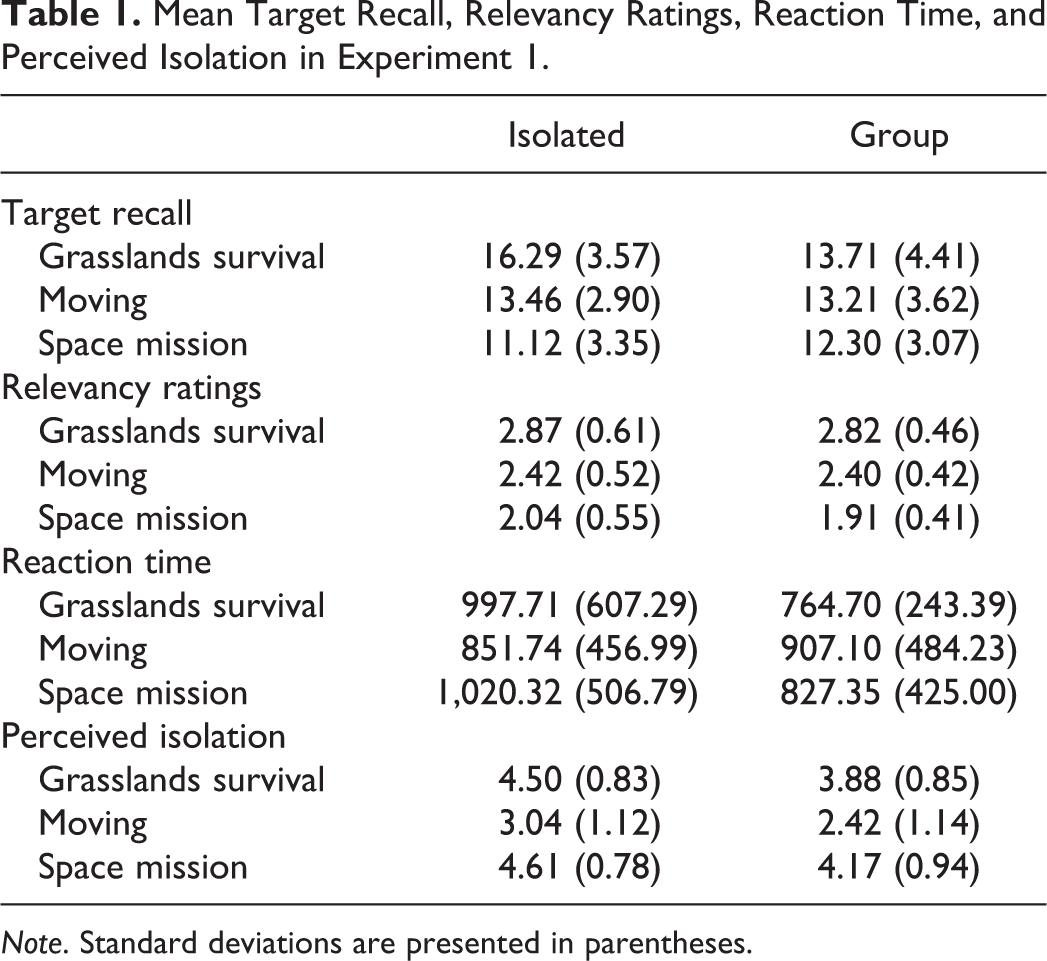
Note. Standard deviations are presented in parentheses.
Relevancy Ratings
To further explore the results of the experiment, two 3 (scenario: survival grasslands, moving, space mission) × 2 (isolation: isolated, group) between-subjects ANOVAs were conducted on participants’ average relevancy ratings for the words and for participants’ average reaction time for making the relevancy ratings. See Table 1 for means and standard deviations. For relevancy ratings, there was a significant main effect of scenario, F(2, 137) = 35.55, MSE = .25, p = .002,
Scenario Ratings: Isolation
The participants completed a questionnaire rating their scenario on a number of characteristics; the characteristic of most interest to this study is isolation. A 3 (scenario: survival grasslands, moving, space mission) × 2 (isolation: isolated, group) between-subjects ANOVA was conducted on the rating of isolation of the scenario. See Table 1 for means and standard deviations. There was a significant main effect of isolation, F(1, 136) = 12.26, MSE = .91, p = .001,
The second experiment was designed to further explore the effect of isolation in the survival processing paradigm using recognition memory. Recognition memory was used as a way to systematically replicate the results of the first experiment with a different memory paradigm, as the survival processing effect has been found in both recall and recognition memory (e.g., Nairne et al., 2007). The space mission scenario was not included in this experiment because it did not produce any novel findings in the first experiment, but both the grasslands survival and the moving scenarios were used in group and isolated conditions to see whether a similar effect would be found with recognition.
Experiment 2
Method Participants
The participants were 96 students (78 women) at the University of North Florida. The students completed the study in exchange for extra credit in their courses. The data from two participants were not included in the analyses that follow because these participants scored more than three SDs away from the mean proportion of target recognition.
Materials
The words that were used consisted of the 128 words from the original survival processing recognition study (Nairne et al., 2007). Half of the words were rated during the relevance rating portion of the experiment, and all of the words were presented during the recognition test. The lists were counterbalanced so that each of the 128 words served as both an old and a new word on the recognition tests.
The scenarios from Experiment 1 were used again, but the space mission scenario was not included. Additionally, the same questionnaire that was used in Experiment 1 was administered again.
Design and Procedure
Experiment 2 was a 2 (scenario: survival grasslands, moving) × 2 (isolation: isolated, group) between-subjects design. Participants were randomly assigned to a condition upon arrival at the experiment. The procedure for Experiment 2 was the same as Experiment 1 except for the distractor task and the recognition test. After rating the 64 words, the participants were asked to work on a country capitals word search task for 10 min. After this distractor task, the participants were given the instructions for the recognition test. The participants were told that that they would be taking a memory test on the words that were presented earlier and that they should indicate whether the word was “old” and one that they had previously seen or was “new” and was one that was not previously presented. The participants were instructed to use the keys on the keyboard that were labeled old (the z key) and new (the/key).
Results
Hits
A 2 (scenario: survival grasslands, moving) × 2 (isolation: isolated, group) between-subjects ANOVA was conducted on the proportion of correct recognition of the target items. See Table 2 for means and standard deviations. Participants had higher rates of target recognition for words in the survival grasslands condition compared to the moving condition, F(1, 90) = 8.05, MSE = .004, p = .006,
Mean Proportion Target Recognition, d', Relevancy Ratings, Reaction Time, and Perceived Isolation in Experiment 2.

Note. Standard deviations are presented in parentheses.
Memory Discrimination (d')
To further explore the recognition data, a 2 (scenario: survival grasslands, moving) × 2 (isolation: isolated, group) between-subjects ANOVA was conducted with d' as the dependent measure; see Table 2 for means and standard deviations. The d' calculation is a signal detection measure of memory discrimination, which includes both hit and false alarm rates (e.g., Snodgrass & Corwin, 1988). As with the analysis on target acceptance, there was a significant main effect of scenario, F(1, 90) = 9.78, MSE = .37, p = .002,
Relevancy Ratings
Two 2 (scenario: survival grasslands, moving) × 2 (isolation: isolated, group) between-subjects ANOVAs were conducted on participants’ average relevancy ratings for the words and for participants’ average reaction time for making the relevancy ratings; see Table 2 for means and standard deviations. For the analysis on relevancy ratings, there was a significant main effect of scenario, F(1, 90) = 19.98, MSE = .26, p < .001,
Scenario Ratings: Isolation
In addition to the recognition data, the participants also completed a questionnaire rating their given scenario on a number of characteristics. A 2 (scenario: survival grasslands, moving) × 2 (isolation: isolated, group) between-subjects ANOVA was conducted on the rating of isolation of the scenario. See Table 2 for means and SDs. As in Experiment 1, participants rated the survival grasslands scenario as being more isolated than the moving condition, F(1, 90) = 29.71, MSE = 1.09, p < .001,
General Discussion
The present experiments replicated the typical survival processing effect showing that information processed within the context of a grasslands survival scenario was better remembered compared to conditions of moving to a foreign land and a space mission. The present experiments extend the current survival processing literature by directly manipulating the isolation of the scenarios by altering the original scenarios to suggest that the participant would be carrying out the scenario with a group of friends. A new scenario that involved a space mission was also used in the first experiment. In addition to manipulating the isolation of the scenarios in a between-subjects design, participants were asked how isolating they found their scenario.
The results of the first experiment indicate that the survival grasslands scenario had higher levels of recall and higher levels of perceived isolation, regardless of the isolation manipulation. There was a main effect of scenario on recall, where participants had the highest recall rates in the survival grasslands condition, followed by the moving condition, and followed by the space mission condition. There was no significant effect of the isolation manipulation and further exploration of the significant interaction showed that the pattern of significant recall results was found in the isolated condition but not in the group condition. Thus, the typical survival processing advantage was found in the isolated condition, which used the standard survival grasslands and moving scenarios employed in previous studies (e.g., Nairne et al., 2007), suggesting that isolation could be solely responsible for the better memory in the survival grasslands condition that is typically found in the survival processing effect. Inspection of the perceived isolation ratings, however, imply that this is likely not the case. That is, participants rated both the survival grasslands and the space mission conditions as being significantly more isolating than the moving condition, yet the pattern of recall was highest for the survival grasslands condition and lowest for the space mission condition, with the moving condition in the middle. Therefore, if isolation was the only factor responsible for the survival processing advantage, it would be expected that the pattern of recall rates and the pattern of perceived isolation across the three scenarios would be similar. Furthermore, if isolation was the only cause for the increase in memory, a significant main effect of isolation on recall rates would be expected, but this was not found.
The results of the second experiment provide additional evidence that perceived isolation is not solely responsible for the survival processing advantage. Although there was a marginally significant effect of isolation on recognition rates, the overall pattern suggested that the typical survival processing effect was found across the isolation manipulation, with higher target recognition and higher d′ scores in the survival grasslands condition. The perceived isolation ratings in the second experiment once again showed that the survival grasslands scenario was perceived as more isolating than the moving scenario, regardless of the manipulation of isolation in the scenarios. In fact, in both experiments, the group survival grasslands condition had higher isolation ratings than the isolated moving condition, suggesting that the survival grasslands condition is perceived by participants as being incredibly isolating, even when they would be accompanied by a group of friends. That is, the group grassland survival condition in both experiments viewed isolation at very nearly 4.0 on the 5-point scale.
These results extend the findings of Kostic et al. (2012) who found that memory was not affected by social isolation. The main difference between the present studies and those of Kostic et al. was the inclusion of a direct manipulation of isolation in the survival grasslands scenario and the assessment of participants’ perceived isolation of the scenarios. Because of these differences, it was predicted in the present studies that there would be a main effect of isolation, with memory performance being stronger in the isolated condition than in the group condition. This prediction is in line with past research on the self-reference effect, indicating that individuals have better memory for items processed with regard to the self when compared to others, due to the superior elaborative and organizational properties of self-referent processing (Symons & Johnson, 1997). The premise of the original survival grasslands scenario is that the person is stranded in the grasslands alone without any indication that there are other individuals who are also in the grasslands; thus, the scenario could elicit self-referent processing in participants, which could be at least partly responsible for the survival processing advantage. The prediction of greater memory in the isolated conditions was not supported in either experiment. There was a marginally significant effect of isolation in the second experiment, and no main effect of isolation in the first experiment, although the typical survival processing advantage was found only in the isolated scenarios and not in the group scenarios. Thus, there is not clear evidence that the isolation manipulation, in and of itself, is responsible for the survival processing advantage.
The present studies did assess participants’ perceived isolation of the various scenarios. In each experiment, both the isolated and the group survival processing scenarios were rated higher in perceived isolation than both the isolated and group moving scenarios. In addition, in the first experiment, the space mission scenarios had high perceived isolation scores. Despite the intentional manipulation of isolation in the scenarios in both experiments, individuals found the survival grasslands scenarios especially isolating, and memory was better in the survival grasslands conditions. Thus, although the isolation manipulation did not lead to a significant difference in memory rates in either experiment, it is possible that the perceived isolation of the survival grasslands scenarios encourages self-referent processing, identifying it as a potential contributor to the survival processing advantage that has been consistently found in the literature (e.g., see Nairne et al., 2017, for a review). Because the survival grasslands scenario is perceived as so isolating, even when this scenario is pitched in a group context as we drew attention to above, it is possible that this leads participants to be more likely to engage in self-referent processing, enhancing memory in survival grassland conditions.
Further, if the perceived isolation of the survival grasslands scenario does lead participants to be more likely to engage in self-referent processing, then the object-function explanation discussed by Bell et al. (2015) is a worthy candidate for interpreting the present results showing the survival processing advantage. Given that the survival grasslands scenarios were perceived as very isolating, not only might this perception trigger engagement in self-referent processing of the information but also make it more likely for participants in these conditions to think of many different, distinct ways that they could use the items. For example, one of the words in the word list was screwdriver. In a survival grasslands scenario, a screwdriver could potentially be used to help build shelter, to break open food, to use for hunting, to use as a weapon for self-defense, and so on. In the moving scenario, however, participants might be more likely to think of fewer and more common tasks for a screwdriver, such as using it to put screws into the wall or for assembling new furniture. Another example is the word car, which could be used for transportation, protection, shelter, or as a weapon in the grasslands scenario and might only be thought of as a means of transportation in the moving scenario. Because the space mission condition included a problem with such a narrow focus of trying to fix communication with earth, it is likely that participants were not encouraged to think of many possible uses of items despite the fact that the scenario was perceived as so isolating. Evidence for this idea comes from the relevancy ratings of both experiments, where the survival grasslands condition had the highest relevancy ratings, followed by the moving condition (and then followed by the space mission condition in Experiment 1), suggesting that participants might have found the items to be more relevant in the survival processing condition because of the multiple uses of the items that they considered, with fewer possible uses in the moving and space mission conditions.
Consistent with the object function argument, multiple utility thinking engaged in by participants should foster deeper processing and thus the richness of encoding in the survival grasslands scenarios could then lead to greater retention rates because the participants have a larger number of distinct memory traces for the items in the survival condition (Kroneisen & Erdfelder, 2011; Kroneisen et al., 2013), and distinct memory traces have been shown to produce stronger and more accurate memories consistent with the distinctiveness heuristic (e.g., Dodson & Schacter, 2002; Schacter, Israel, & Racine, 1999). Also, as noted above, richer encoding, such as thinking of many possible uses of the items, translates to deeper levels of processing (Craik & Tulving, 1975; Kroneisen & Erdfelder, 2011; Kroneisen et al., 2013), a hallmark feature of the self-reference effect. The results of the present studies suggest that isolation is potentially related to the survival processing advantage, with the significant interaction in the first experiment showing that the effect was found only in the isolated conditions and there being a marginally significant effect of isolation in the second experiment. It is possible that, while not necessary for the survival processing advantage, the perceived isolation of the traditional survival grasslands condition encourages self-referent processing, enhancing the deeper processing of the items in the list and leading to stronger memory traces.
As evidence for the survival processing effect increases, the proximate mechanisms underlying the effect will continue to be explored. The current results suggest that the perceived social isolation in the survival grasslands scenario and the self-referent processing that might go along with that condition should be considered as a piece of the puzzle in understanding the mechanisms underlying the survival processing advantage. That is, the results of the present studies do not suggest that isolation, in and of itself, is responsible for the effect but instead advocate that the perceived isolation of the traditional grasslands survival scenario might be just partly responsible for the effect. If so, our results logically point to future studies manipulating perceived isolation and asking participants to report the number of potential uses they can think of for an item in various scenarios. If participants in the survival processing conditions or other conditions that are considered as socially isolating are generating more potential uses for items, then this could help in understanding whether self-referent processing and object-function explanations are working together to produce the survival memory advantage.
Footnotes
Declaration of Conflicting Interests
The author(s) declared no potential conflicts of interest with respect to the research, authorship, and/or publication of this article.
Funding
The author(s) received no financial support for the research, authorship, and/or publication of this article.