




Abstract
Drawing on life history theory, this research explores the moderating role of childhood economic background in the relationship between sex ratio and the female’s mate preference for male resource availability. Using different priming materials, three experiments consistently found that women with a rich childhood economic background showed a stable level of mate preference for good resource—this applied regardless of male- or female-biased sex ratio. But females with a poor childhood economic background showed a higher level of preference for male resource availability under the condition of female-biased sex ratio (vs. the condition of male-biased sex ratio). These findings support the moderating role of female childhood economic background in the relationship between sex ratio and their mating preference of good resources.
From an evolutionary perspective, the selection of mates is crucial for individuals as they seek to reproduce. The mating preference pattern of females can usually be clearly distinguished from that of males. Because of their heavy involvement in child-rearing and the reproductive ceiling age, females have evolved mate selection patterns that focus on male resources (Trivers, 1972)—This has been documented in previous literature that extends across cultures (Buss & Schmitt, 1993; Chang, Wang, Shackelford, & Buss, 2011).
During the past 30 years, when policies have been implemented under the rubric of “reform and opening,” two terms (“naked marriage [裸婚]” and “material girls [拜金女]”) have increasingly drawn attention in the Chinese mass media. The term “naked marriage” relates to a scenario where young people marry without purchasing conspicuous goods such as a car, house, or expensive ring. Those who enter in a marriage of these characteristics are not concerned with male resource availability. They clearly contrast with material girls, who consider male resource availability—such as social status and money—to be the most important factor in their selection of a mate. Why are these girls so different? Drawing on life history theory, this research proposes to explore this question from the perspective of evolutionary psychology.
Sex Ratio and Female Preference for Male Resource Availability
The influence of sex ratio on an individual’s mating behavior was originally examined in the study of animals. From a biological perspective, animal sexual selection would change under conditions of different sex ratio (Aronsen, Berglund, Mobley, Ratikainen, & Rosenqvist, 2013). This change may also be shared in humans. For example, when the sex ratio was biased toward the female, the male’s unrestricted sociosexual orientation behavior (such as multiple mating) increased (Moss & Manner, 2016), as the female’s unrestricted sociosexual behavior decreased (Moss & Manner, 2016). In addition, the sex ratio has a role in the link between men’s different strategic trade-off behaviors in mating effort and parental investment across adulthood (Kruger, 2009). But the extant literature on the relationship between sex ratio and individual’s (especially female’s) mate preference is still very limited. Two hypotheses have been proposed to answer this question—These are the classical sex ratio mate preference shift (also called rational choice theory of mate selection) and the alternative classical sex ratio mate preference shift hypotheses (also called evolutionary psychological hypothesis; Stone, Shackelford, & Buss, 2007).
The classical sex ratio mate preference shift hypothesis suggests that females may demand more for their future spouse under the condition of male-biased sex ratio, as this implies that they would have more opportunities in mate selection. In contrast, women would lower their mate standards, including their demands for male resource potential, when there are more females around them and their selection is limited.
However, according to the alternative classical sex ratio mate preference shift hypothesis, men would display different patterns of unrestricted sociosexual orientation under the condition of different sex ratio (Moss & Manner, 2016; Schmitt, 2005). They may show more unrestricted sociosexual behaviors and promise less to a long-term relationship under the condition of female-biased sex ratio. In seeking to decrease the likelihood they will be cheated, women may increase their mate standards, including male resource availability, under the condition of female-biased sex ratio.
This raises an empirical question: Which of these two hypotheses can better explain the real picture of women’s mating behaviors under the condition of different sex ratio? One study (Stone et al., 2007) suggests that the female’s choice was consistent with the evolutionary psychological hypothesis. When a sample of 5,310 women was taken from across 36 countries and cultures, there was a negative correlation between women’s mate standards and local sex ratio—This indicated that when there were more women and fewer men around them, females may increase their mate standards with the intention of avoiding being cheated. But the authors admitted that the sample size in each country was relatively small and the correlation only reached a marginal significant level. It is also important to note that—with the exception of the significant negative correlation between women’s demand for “good financial prospect” and sex ratio—women’s preference for indicators of good resource (“favorable social status,” “ambition or industriousness,” and “education and intelligence”) did not negatively correlate with sex ratio to a significant extent.
However, the negative association between women’s mate standards and local sex ratio revealed by Stone and colleagues differs from the findings of other research (Bokek-Cohen, Peres, & Kanazawa, 2008) that demonstrates women will, irrespective of male or female-biased sex ratio, always be critical of mate standards. This research suggested they would always be demanding of men’s economic and educational background in both situations. This result seemed difficult to explain with reference to either of the sex ratio mate preference shift hypotheses (Stone et al., 2007). It is therefore the case that the relationship between sex ratio and the female’s mate preference (for good resource) remains vague and controversial.
Life History Theory
Life history theory is a branch of evolutionary biology that focuses on how organisms allocate and prioritize limited resources of time and energy to various fitness-enhancing activities throughout the life course (Roff, 2002). Due to the limited resources, every organism has to face a key trade-off between allocating resources to somatic effort (growth and maintenance of one’s body and mind) and reproductive effort (activities that enhance the possibility of immediate reproductive success). Life history strategy refers to the resolution of different life history trade-offs. Slower strategies prioritize somatic effort over reproductive effort while faster strategies prioritize the latter over the former (Belsky, Steinberg, & Draper, 1991).
According to life history theory, an individual’s life history strategy was mainly shaped by their early childhood (Belsky, 2010; Belsky et al., 1991). Those who grew up in a nurturing environment would develop a slow life history strategy. In contrast, those who experienced a harsh and unpredictable environment would tend to adopt a fast life history strategy (Belsky, Schlomer, & Ellis, 2012). Extant research reveals the relationship between girls’ reproductive strategies (such as age of the first sexual intercourse, number of sexual partners) and the harshness (such as the absence of father) of their childhood living environment (Draper & Harpending, 1982; Ellis, 2004). Mate preference, as an important approach to ensure one’s genes would be successfully transmitted, would also be influenced by childhood environment.
However, it is important to note that life history strategies shaped by early childhood environment may not be explicitly displayed unless confronted with challenges in stressful situation. Griskevicius et al. conduct several studies to examine the role of stressful environmental cues in triggering an individual’s different life history strategies. When adults from a poor economic background were confronted by mortal cues from their environment, they showed a higher level of risk preference and lower level of delayed gratification (Griskevicius, Tybur, Delton, & Robertson, 2011) and in this respect clearly contrasted with those from wealthier backgrounds.
Those from a poorer childhood family background also preferred, under the condition of female-biased sex ratio, to give birth at an earlier stage and privileged this at the expense of investment in their own education and career development (Griskevicius, Delton, Robertson, & Tybur, 2011). A similar tendency was also observed in individual consumption behaviors (Griskevicius, Tybur, Ackerman, Delton, Robertson & White, 2012). A scarcity of women led men to save less money for the future and incur more debt to sustain immediate expenditures. Taking previous literature into account, it is possible that female from different childhood economic backgrounds may show different levels of mate preference for male resource availability subject to the environmental cues of different sex ratio.
Exploring the Relationship Between Sex Ratio and Female Preference for Good Resource From the Evolutionary Psychological Perspective
In contemporary China, the terms “male-biased sex ratio” and “leftover ladies” frequently appear in the media, with the former receiving particularly extensive media attention. Data released by the National Bureau of Statistics of China suggested that there were 700 million men to every 667 million women. The gender ratio at birth was still concerningly high, and 115.88 boys were born to every 100 girls in 2014. The gender imbalance in China is the most serious in the world, which has persisted for the longest period of time and affected the largest population. In the future, it is foreseeable that Chinese men will face substantial challenges when they seek to find a woman to marry. “剩女” (leftover ladies) is another acute social phenomenon in China. In urban parts of the country, there are many women who do not find a partner to marry until they are 30 years of age or older. Most are well educated and have a job with generous salary, but they face a struggling situation to find an ideal partner to marry (Wei & Zhang, 2010).
Because both of these phenomena are clearly evidenced in China, an exploration of the female’s mate preference for male resource availability under conditions of different sex ratio will make considerable practical and theoretical contributions. The existing literature suggests that it is possible that neither rational choice theory of mate selection nor evolutionary psychological hypothesis could clearly explain the female’s flexible mate preference for good resources.
Life history theory can provide a logical explanation for the relationship between sex ratio and the female’s mate preference for male resource availability. Pollet and Nettle (2008) find that local sex ratio and socioeconomic status (SES) affect men’s chances of marrying. As the sex ratio of the states increases, the effect of SES on marriage success becomes stronger. Chipman and Morrison (2013) also observe that under female-biased sex ratio, the fertility schedule of young (under the age of 25) females was likely to differ upon the basis of their SES; they were more likely to give birth in deprived areas. In addition, recent research (Uggla & Mace, 2017) also refers to the role that the female’s educational background plays in the relationship between their sexual selection and adult sex ratio. For example, in the context of female-biased sex ratio, the likelihood of cohabitation decreases, which is particularly true for women with low education. When acknowledged in its entirety, this research indicates that the individual’s economic background needs to be taken into consideration when exploring the relationship between sex ratio and female mating strategies.
Guided by life history theory and previous literature (Chipman & Morrison, 2013; Griskevicius, Delton et al., 2011; Griskevicius, Tybur et al., 2011;Griskevicius et al., 2012; Uggla & Mace, 2017), it is possible to hypothesize that females who grew up in a harsh environment would adopt faster reproductive strategies in response to stressful situation of female-biased sex ratio. In contrast, females with a rich childhood family background would not change their mating strategies in a context of different sex ratio.
The Main Effects of Sex Ratio and Childhood Economic Background on Female Preference for Male Resource Availability
As described above, prior research yielded mixed results on the effect of sex ratio on female preference for male resource availability. While sex ratio was associated with mate preference in some studies (e.g., Stone et al., 2007), such association was absent in other studies (e.g., Bokek et al., 2008). It is important to note that in the study of Bokek-Cohen and colleagues, the mean age of female participants was 36.9 (SD = 8.8) years old, which is much older than that of the majority of unmarried women. However, female participants in the other study (Stone et al., 2007) ranged in age from 17 to 30 years with a mean age of 22.6 years old, which constitutes a more representative sample of unmarried women. Therefore, focusing on unmarried women, we hypothesized that sex ratio would produce a main effect in explaining female’s mate preferences. Following the previous study (Stone et al., 2007), this research proposed that female’s mate preference for good resource would change in line with evolutionary psychological hypothesis.
Studies on the relationship between female’s childhood economic background and mate preference for male resource availability are limited. Studies indicated that there was no obvious differences on female’s mate preference for male resource availability between those with different economic background (rural vs. urban; Lu et al., 2015) or coming from countries with different national economic development level (Buss, 1989). Therefore, we hypothesize that women’s childhood economic background would not produce a main effect on their mate preference for good resource.
The Present Study
To examine whether female’s childhood economic background moderates the relationship between sex ratio and their mate preference for male resource availability, we approached the hypotheses above with three experiments that primed the perception of sex distribution with materials that included a text article, a descriptive story, and photo pictures. In order to avoid the influence of imbalanced sex distribution from the surroundings, we recruited participants from universities with a balanced sex distribution. Finally, we began with the observation that the phenomenon of leftover ladies tends to be concentrated in Chinese metropolises while male-biased ratio is more frequently encountered in rural areas. With the intention to ensure the priming effects in the three experiments, we chose a medium-sized city in central China where sex distribution does not excessively lean in either direction.
Study 1
Method
Participants
We recruited 108 female undergraduates from a university in the central China. Their mean age was 20.51 (SD = 2.06) years.
Research Tools
All the items assessing “resource” and “childhood economic conditions” in this research (including Studies 1, 2, and 3) were 7-point scale that ranged from 1 = the worst in the population (or disagree completely) to 7 = the best in the population (or agree completely).
Preference for Male Resource
Two items (α = .70) were developed to assess participants’ preference for male resource potential—These were “high social status” and “competent and capable of earning money.”
Childhood Economic Status
Following previous literature (Mittal & Griskevicius, 2014), 4 items (α =.77) were adopted with the intention of measuring participants’ childhood economic status. These were (1) “When I was young, my parents were unwilling to spend money on my clothing and food,” (2) “When I was young, my family did not have a stable income,” (3) “When I was young, my family was always worried about the shortage of money,” and (4) “When I was young, my family’s financial condition was worse in comparison with that of my peer’s.”
Sex Ratio Manipulation
Two news articles were used as priming materials in Study 1. The original article came from an online news report and was revised in order to meet our research goal. One article described the preponderance of males in contemporary China, whereas the other focused on the opposite trend—that is, the relative preponderance of females. In order to ensure the comparability, the two articles were the same, and the only exception being that “male” was replaced by “female” in the second article. Each article included about 600 Chinese characters.
In the pilot study, we randomly assigned 41 female undergraduates into two groups. One group would be required to read male-biased sex ratio article whereas the second group would be required to read the other article. After reading the article, the participants were asked to complete a 6-point Likert scale to a single statement (“In the current Chinese society, there are more single female adults than male adults in the mating market.”)—1 indicates complete disagreement with this statement whereas 6 indicates complete agreement. The result indicates that the mean score of the “more female priming” group (n = 22, M = 4.00, SD = .976) was significantly higher than that of the “more male priming” counterpart (n = 19, M = 3.05, SD = 1.39), t(39) = 2.548, p = .015.
Procedure
Participants were randomly divided into two groups: male-biased sex ratio and female-biased sex ratio. During the experiment, they first read the priming article. In order to ensure that participants read the articles carefully, they were instructed that they were taking part in a three-part memory test. In the first part, they would read the memory materials before filling in some items that indicated their mating preference. They then answered one question based on the materials they read in the first part—This was intended to test their memory ability along with whether they read the materials carefully. Participants’ demographic information and childhood family economic background were also collected after the experiment. Upon completion, each participant was given small gifts, such as notepads, in reward.
Correct response to the question in the final part was respectively 56% and 71%, which in both instances was significantly higher than the level of chance (25%). This could also provide evidence of the priming effects.
Results
The Mean Difference Between the Two Experimental Groups
The mean of the two items on preference for male resource was taken, with higher numbers indicating greater preference for male resource availability. The result of independent t test indicated that there was no significant difference between the mean scores of male (n = 49, M = 5.43, SD = 0.98) and female (n = 59, M = 5.44, SD = 0.88) preponderance after priming, t(105) = −0.06, p = .951.
Predicting the Female’s Mating Preference of Good Resource From the Different Sex Ratio, Childhood Economic Condition, and Their Interaction
The mean of the four items on childhood economic conditions was taken, which was then used in the following statistical analyses. The general linear model (GLM) is conducted to analyze the effects of different sex ratio priming (fixed variable: male-biased vs. female-biased sex ratio), female’s childhood economic status (covariate), along with their interaction on the woman’s mate preference of male resource availability. The priming of sex ratio significantly affected the mating choice of “good resource,” F(1, 108) = 5.63, p = .019,
The interaction was then probed by a simple slope test that followed the PROCESS procedure (Hayes, 2013). Surprisingly, the result indicated that female mate preference for male resource availability did not change significantly under the condition of different sex ratio priming—this applied to the mean of childhood harshness, both above (b = .37, 95% CI [−0.18, 0.92], t = 1.34, p = .182) or below (b = −.37, 95% CI [−0.88, 0.14], t = −1.44, p = .154) 1 SD (Figure 1).

The interaction between the childhood harshness and the priming (Study 1: news articles) of different sex ratio on women’s mate preference for good resource. Graphed means represent 1 SD above or below the mean level of childhood harshness.
Discussion
Although the independent t test in Study 1 did not find a significant mean difference on female’s mate preference of good resource between the priming conditions of “more males” and “more females”, the GLM model – which took participants’ childhood economic status into consideration – revealed that priming of sex ratio did significantly affect the female’s mating preference for good resource. In line with our hypothesis, there was a significant interaction between sex ratio and the level of harshness that the female experienced in childhood. Although the simple slope test indicated that the female’s mate preference for male resource availability did not change significantly and that this applied irrespective of whether it was 1 SD above or below the mean for childhood harshness, Figure 1 makes it clear that females with different childhood harshness showed different mate preferences in relation to the priming of different sex ratios. It should be noted that only 2 items (“high social status” and “competent and capable to earn money”) were used to measure the female’s mate preference for good resource in Study 1, which did not fully capture different aspects of good resource. To address this issue, more items would be used in Studies 2 and 3, as this would enable the interaction between childhood economic condition and sex ratio to be probed in depth.
Study 2
Method
Participants
Ninety unmarried female undergraduates who had been recruited from the same university as participants in Study 1 attended the experiment. Their mean age was 20.50 years old (SD = 1.91).
Preference for Male Resource
Following previous literature (Lu, Zhu & Chang, 2015), five items on mate preference for male resource were developed. These were (1) high social status, (2) competence, (3) the ability to make money, (4) ambition, and (5) good educational background (α = .76).
Childhood Economic Conditions
Three items (α = .81) were used to assess participants’ childhood affluence. These were (1) “When I was young my family was well-off,” (2) “When I was young my family had enough money to buy whatever we need,” and (3) “When I was young, our house was better than that of our neighbors.”
Sex Ratio Manipulation
Two stories were developed to prime different sex ratios. One story involved a leftover woman’s struggle to find a potential spouse in the context of female-biased sex ratio. Despite extensive efforts to find a partner (including many blind dates), she was still single. The other story referred to a leftover man’s struggle to find an ideal partner. He continually failed because there were more males and fewer females. To ensure comparability, the two stories were identical, with the only difference that female was substituted for male when necessary. Each story was about 1,300 Chinese characters in length.
Design and Procedure
Similar to Study 1, participants in Study 2 were told that they were about to take part in a memory test. Participants first read the priming materials before reporting on their mating choices. They then answered two questions about the detailed information in the priming materials to identify if they had read the story carefully. They then reported on their demographic information and childhood family economic background. Once the experiment concluded, each participant was given small gifts, such as desk calendars, as rewards.
The percentage of participants’ correct answers to the two questions, which were based on the priming materials, were respectively 68.2% and 52.2%, both of which were substantially higher than the level of chance (25%). The other question (“Do you think the experiences of the lady [or guy] in the story are common among your peers?”) related to a 7-point scale. 64.4% of participants in the male preponderance group and 72.7% in the female preponderance group responded with “popular” or “very popular.” This also provided evidence in support of the stories’ priming effect.
Results
The Mean Difference Between the Two Experimental Groups
The mean of the five items on preference for male resource was taken, with higher numbers indicating greater preference for male resource availability. The independent t test indicated that the mean difference between the priming of the leftover man (n = 44, M = 5.37, SD = 0.69) and leftover woman stories (n = 46, M = 5.65, SD = 0.62) was significant, t(88) = −2.03, p = .05.
Predicting Women’s Mating Preference of Good Resource From the Priming of Different Sex Ratio, Childhood Economic Condition, and Their Interaction
The mean of the three items on childhood affluence was taken, which was then used in the following statistical analyses. GLM was conducted to analyze the effects of different sex ratio priming (leftover woman vs. leftover man) female’s childhood affluence, and their respective interaction, on women’s resource demands. The priming of sex ratio significantly affected the demand for good resources, F(1, 90) = 8.53, p = .004,
By applying the simple slope test (Hayes, 2013), we further decomposed the interaction (see Figure 2). At 1 SD below childhood affluence, the female mate’s preference for male resource availability significantly increased under the priming of female-biased sex ratio (vs. male-biased sex ratio), b = .61, 95% CI [0.14, 1.08], t =2.57, p = .012. At 1 SD above childhood affluence, the female mate’s preference for male resource availability did not change significantly under the different priming of the sex ratio (b = −.02, 95% CI [−0.41, 0.36], t = −.13, p = .901).
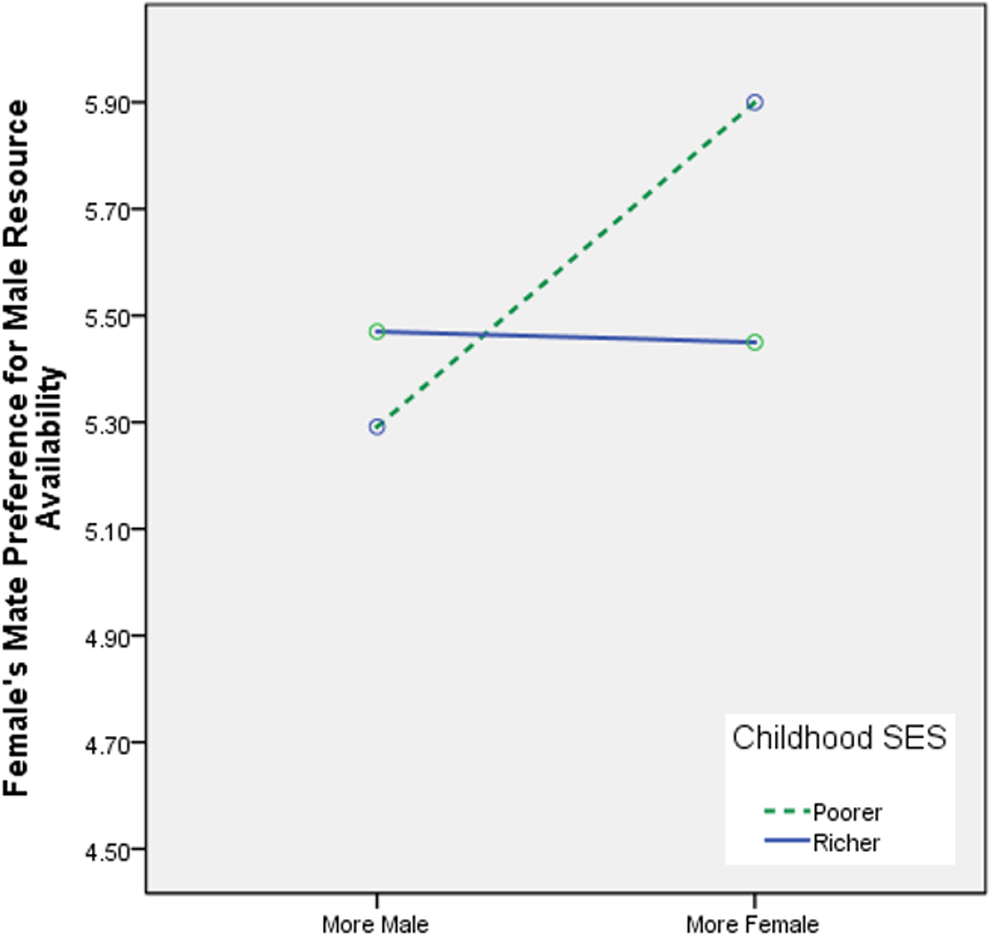
The interaction between the childhood affluence and the priming (Study 2: stories) of different sex ratio on women’s mate preference for good resource. Graphed means represent 1 SD above or below the mean level of childhood affluence. Women who scored 1 SD below the mean for childhood affluence increased their mate preference for resource significantly, but women who scored 1 SD above the mean for affluent childhood kept a relatively similar level of mate preference under female-biased sex ratio (vs. male-biased sex ratio) condition.
Discussion
Same as Study 1, Study 2’s sex ratio and childhood economic conditions also have a significant interaction effect on the female’s preference for male resource availability. In addition, it was only the priming of the sex ratio that demonstrated a main effect on the female’s preference for good resource in both studies. It is important that in Study 2, the simple slope test indicated females with less affluent childhood backgrounds sought to significantly increase their demands for good resources under the condition of female preponderance priming (vs. male preponderance priming). This provided further support for our original hypothesis that individuals with poor childhood backgrounds tend to be more easily triggered by stressful cues in the surroundings.
Study 3
In Study 3, a pattern of face picture priming (Wang, Hou, Li, Li, & Jiao, 2017), similar to that applied in the past research (Durante, Griskevicius, Simpson, Cantu, & Tybur, 2012), was adopted to examine changes in the female’s mating preference for good resources under the condition of different sex ratio.
Method
Participants
Eighty-seven unmarried female undergraduates who were recruited from a university in Southern China took part in this experiment. Their mean age was 20.27 (SD = 1.57) years.
Measures
Preference for male resource
The same 5 items (α =.82) as those applied in Study 2 were used in Study 3.
Childhood economic conditions
The 4 items (α = .84) applied in Study 1 were used.
Sex Ratio Manipulation
Participants viewed eight photos of the face. Each individual photo was accompanied by brief introductory information that included name, sex, hobby, and major interests. Participants assigned to the male condition viewed six male and two female photos; participants assigned to the female condition viewed eight female and two male photos. Each photo was presented randomly in order to balance the sequential effect and all photos of the face were tested in prior research (Wang, Yao, & Zhou, 2015).
Design and Procedure
In Study 3, participants were informed that they were participating in a game where they would guess the personality from pictures of the face. Before viewing the pictures, they were informed that they would see eight photos of the face and that each person would be a colleague from the department they had worked in during their internship period. They were asked to make judgments about each person’s personality, such as whether they were easygoing and/or conscientious, by viewing each photo and carefully reading through the introductory information. After viewing the eight photos, they then reported on their attitudes toward mate selection. Participants then answered two questions that were designed to test the effects on their memory with the intention to ensure that they had viewed the priming pictures carefully. After the whole experiment concluded, each participant was given a small notepad in reward.
The percentage of correct answers to the first question in the third part was 43.6% and 41.7%, respectively, for the two groups, which were substantially higher than the chance level (25%). To the other question (“would males or females be in the majority in the previous eight face photos?”), 69% of participants in the male preponderance group and 77.5% in the female preponderance group responded correctly. This could provide evidence of the priming effect in Study 3.
Results
The Mean Difference Between the Two Experimental Groups
The mean of the five items on preference for male resource was taken, with higher numbers indicating greater preference for male resource availability. An independent t test indicated that the mean difference between the priming of the mainly male pictures (n = 39, M = 5.26, SD = 0.92) and the mainly female face photos (n = 48, M = 5.33, SD = 0.64) was not significant, t(85) = −0.41, p = .69.
Predicting Female’s Mate Preference of Good Resource From Sex Ratio, Childhood Economic Condition, and Their Interaction
The mean of the four items on childhood economic conditions was taken, which was then used in the following statistical analyses. GLM was conducted to analyze the effects of sex ratio manipulation, childhood economic conditions, and their interaction, on women's mate preference for male resource. The GLM results indicated that the priming of sex ratios did not significantly affect the demand of good resource, F(1, 87) = 2.42, p = .12,
Using the simple slope test (Hayes, 2013), we further decomposed the interaction (see Figure 3). At 1 SD above childhood harshness, the female’s mating preference for male resource availability significantly increased under the priming of “more female” (vs. more male) (b = .53, 95% CI [−0.01, 1.07], t = 1.97, p = .053). At 1 SD below childhood harshness, the female mate’s preference for male resource availability did not change significantly under different priming of the sex ratio (b= −.23, 95% CI [−0.73, 0.28], t = −.90, p = .369).

The interaction between the childhood harshness and the priming (Study 3: face photos) of different sex ratio on women’s mate preference for good resource. Women who scored 1 SD above the mean for childhood harshness increased mate preference for resource significantly, but women who scored 1 SD below the mean for childhood harshness showed similar level of mate preference under the priming of different sex ratio.
Discussion
In line with Studies 1 and 2, the results of Study 3 consistently supported the hypothesis that the individual’s childhood economic condition played a moderating role in the relationship between sex ratio and female’s mate preference for good resource. In addition, same as Study 2, the simple slope test demonstrated that women with poor childhood background significantly increased their demand for good resource under the priming of female-biased sex ratio (vs. male-biased sex ratio). Although the priming of sex ratio did not significantly affect the female mate’s preference for good resource in Study 3 (p = .12), this pattern was similar to that demonstrated in Studies 1 and 2. In Study 3, however, childhood harshness did have a significant effect on the female’s demand for good resources, which is clearly distinguished from Studies 1 and 2. Females with a rich childhood demanded more male resource availability.
General Discussion
The Main Effects of Sex Ratio and Childhood Economic Background on Women’s Mating Preference for Good Resources
Of the three studies, only Study 3 indicated a significant main effect of childhood economic status on the female’s mating preference for male resource. Meanwhile, the result with GLM demonstrated that the priming of different sex ratio produced a significant main effect on women’s mating preference for good resources—this was clearly demonstrated by Studies 1 and 2. A similar pattern also emerged in Study 3, although it did not reach a significant level, F(1, 87) = 2.42, p = .12,
Female’s childhood economic background did not produce significant main effect in Studies 1 and 2, which was consistent with the hypothesis. However, female’s childhood economic conditions demonstrated a significant main effect on their mating preference for good resources in Study 3, F(1, 87) = 6.62, p = .01,
The Environmental Cues of Sex Ratio and the Female’s Mating Preference: The Moderating Role of Childhood Economic Background
All of the three studies consistently supported the hypothesis that the female’s childhood economic background moderated the relationship between the sex ratio and the females’ mating preference (for good resource). The findings indicate that the mixed results with regard to the relationship between sex ratio and women’s mating preference in the literature (Bokek-Cohen et al., 2008; Stone et al., 2007) might result from an overlook of the key role of childhood economic background.
Previous research (Wang & Apostolou, 2018) indicates that the similarity (in financial prospect and family economic background) between partners would be a particular concern of Chinese parents when they select a potential husband for their daughter. It is consequently easy to understand why, under the condition of male-biased sex ratio, women with a poor childhood economic background demand less of the partner’s resource availability than those who grew up in a rich family background. Therefore, they may more likely enter a “naked marriage” in this situation. With the exception of Study 2, in which female’s childhood affluence did not show a significant correlation with their mate preference for good resource under the male-biased surroundings, r(44) = .14, p = .386, women’s childhood harshness significantly correlated with their demand for resource in Study 1, r(49) = −.35, p = .014, and Study 3, r(39) = .37, p = .02, under the condition of male-biased sex ratio.
This raises the question of why females with a poor childhood family background showed different mating preferences under the conditions of different sex ratio? According to life history theory, childhood environment plays a key role in shaping individuals’ life history strategies (including reproductive issues; Belsky, 2010; Ellis, Figueredo, Brumbach, & Schlomer, 2009). Individuals with poor childhood family background tend to be triggered by the environmental cues of stress and they adopted faster life strategies in response (Griskevicius, Delton, et al., 2011; Griskevicius, Tybur, et al., 2011).
The female-biased sex ratio, which means that there are too many competitors in the mating market, presents a clear challenge to females who are trying to find a potential spouse. When being confronted with this stressful situation, women who grew up in a poor family background would change their mating strategies. Their flexible mating preferences could be sufficiently explained by the alternative classical sex ratio mate preference shift hypothesis (Stone et al., 2007), which states that females increase their demanding for good resource in order to decrease the possibility of being cheated by men.
Previous research (Uggla & Mace, 2017) found that females with low education struggled to keep a stable pair-bond under the condition of female-biased sex ratio. Based on this result it appears reasonable to conclude that females with poor childhood family background may believe that they are lack of control (Mittal & Griskevicius, 2014) when attempting to find a potential partner who would be loyal to wife and family under the female-biased sex ratio—this clearly contrasts with the situation that would prevail under the condition of male-biased sex ratio. Chipman and Morrison (2013) also observed that in the context of female-biased sex ratio, females in poor areas would be more likely to give birth. They would consequently increase their demands for good resources in order to ensure that if they were emotionally cheated they could at least live a life of material abundance in the short term or raise a child without investing too much. It is important to recognize that in China, it is common for partners to share their money and especially for men to financially support the daily expenditure of women—this applies irrespective of if they are couples or lovers.
At first sight, risk behavior, reduced delayed gratification (Griskevicius et al., 2011), and the female’s preference for male resource availability appear to be completely different responsive choices. However, they are essential preferences for instant gratification or, to put it differently, strategies that lead to immediate enjoyment and pleasure. The generalization of this preference suggests that the female’s mating preference for material pleasures under the condition of female-biased sex ratio can be regarded as a fast life history strategy. In the female-biased situation, the opportunities for a female with a poor childhood family background to become a material girl would increase substantially. The flexible mating preferences displayed by girls with a poor childhood family background are also consistent with the literature (Griskevicius, Delton, et al., 2011; Griskevicius, Tybur, et al., 2011). Future research should attempt to explore the female’s sexual behavior and the male’s sexual selection under conditions of different sex ratio. Both remain understudied and have not been sufficiently investigated by experimental paradigms applied in the current research.
In sum, drawing on life history theory, this research revealed how childhood economic conditions moderated the relationship between sex ratio and the women’s mating preference for male resource availability. The findings of this research establish a foundation upon which naked marriage and material girl, two evident phenomena in contemporary China, can be explained empirically.
Footnotes
Acknowledgments
The authors would like to thank Dr Tommy Cabeza De Baca for his constructive and valuable suggestions on this article. The authors would also like to thank two anonymous reviewers for their feedback which enabled the improvement of our work.
Declaration of Conflicting Interests
The author(s) declared no potential conflicts of interest with respect to the research, authorship, and/or publication of this article.
Funding
The author(s) disclosed receipt of the following financial support for the research, authorship, and/or publication of this article: This research was supported by Humanities and Social Sciences Planning Project of the Ministry of Education (18YJAZH095).