



Abstract
Previous research has shown that individuals who are reminded of their death exhibited a greater desire for offspring than those who were not reminded of their death. The present research investigated whether being reminded of mortality affects mate selection behaviors, such as facial preference judgments. Prior research has shown that women prefer more masculine faces when they are at the high versus low fertility phase of their menstrual cycles. We report an experiment in which women were tested either at their high or fertility phase. They were randomly assigned to either a mortality salience (MS) or control condition and then asked to judge faces ranging from extreme masculine to extreme feminine. The results showed that women's choice of the attractive male face was determined by an interaction between fertility phase and condition. In control conditions, high fertility phase women preferred a significantly more masculine face than women who were in a lower fertility phase of their menstrual cycles. In MS conditions, high fertility phase women preferred a significantly less masculine (i.e., more average) face than women who were in a low fertility phase. The results indicate that biological processes, such as fertility phase, involved in mate selection are sensitive to current environmental factors, such as death reminders. This sensitivity may serve as an adaptive compromise when choosing a mate in potentially adverse environmental conditions.
Keywords
Introduction
Recent research has shown that death reminders can influence human reproductive behaviors (Cohen and Cole, 2002; Fritsche et al., 2007; Rodgers, St. John, and Coleman, 2005; Wisman and Goldenberg, 2005). Studies of birth rates following natural and man-made disasters have shown that increases in birth rates following such events (Cohen and Cole, 2002; Rodgers et al., 2005). Also, experiments have shown that reminding people of mortality can increase their desire for offspring (Fritsche et al., 2007; Wisman and Goldenberg, 2005). These experiments and many others conducted over the last 20 years provide support for terror management theory (TMT, Greenberg, Pyszczynski, and Solomon, 1986; Solomon, Greenberg, and Pyszczynski, 1991; See Greenberg, Solomon, and Arndt, 2008). One of the core tenets of TMT is that reminders of mortality cause a unique change in attitudes and behaviors. The purpose of the present research was to investigate whether reminding one about their mortality can influence other human reproductive choices, specifically how women evaluate the faces of potential mates.
Research on the effect of death reminders on behavior has been viewed as support for TMT, which was inspired by the writings of the cultural anthropologist Ernest Becker (1973) who stated that humans, unlike other animals, have the cognitive capabilities to realize that they will die, which causes deep anxiety. According to Becker, to alleviate this anxiety, humans invest in a shared cultural conception of reality or a cultural worldview. These worldviews not only answer existential questions, such as where did we come from and what should we do, they also provide self-esteem, which buffers the anxiety of mortality. Cultural worldviews also provide an avenue to immortality. By meeting or exceeded the demands of the culture, humans can achieve a literal immortality as with religion, or a symbolic immortality. Symbolic immortality can be achieved by contributing to a meaningful society in such a way that will continue after the individual has died. Individuals can also achieve immortality by producing children that carry on their genes. In any case, thoughts of death are pushed to the back of the mind.
Empirical support for Becker's writings and TMT has come from reminding individuals of their mortality (mortality salience, MS; Rosenblatt et al., 1989). MS is generally manipulated by having the participant describe in writing what will happen to them as they physically die and the emotions that arise from the thoughts of their own death. Participants assigned to a control condition describe in writing what will happen to them physically as they experience an event that does not involve death, such as dental appointment or watching television and the emotions that arise from the thoughts of the event. According to TMT, reminding individuals of their mortality should increase adherence to their particular cultural worldview and set of cultural values (Rosenblatt et al., 1989). This adherence to a cultural worldview not only gives individuals a sense of unity with others, but also gives the individual a sense of being a part of something greater than themselves and something that will endure after the individual ceases to exist. Prior research has shown that participants in MS conditions defend cultural norms more diligently and regard those who do not uphold culture norms less favorably than participants in control conditions (Greenberg et al., 1990; Greenberg et al., 1994; Rosenblatt et al., 1989). This stronger adherence to cultural values seems to be unique to thoughts concerning death.
In addition to defending cultural norms after MS, it has been proposed that individuals attempt to deny their mortality by passing on their genes (Fritsche et al., 2007; Wisman and Goldenberg, 2005). Several TMT studies have provided cross-cultural evidence that the desire for children and the perception of children is influenced by death reminders. In Germany, participants were randomly assigned either to an MS condition or a control condition and then asked to self-report their desire for children (Wisman and Goldenberg, 2005). After MS, men demonstrated a stronger desire for children than men in the control condition. In a separate study, women were randomly assigned to be primed with bogus newspaper articles reporting either the compatibility or incompatibility of having children and a career and were then randomly assigned to an MS or a control condition. Women who were in the children/career compatible group demonstrated a stronger desire for children following MS while participants in the children/incompatible group did not. In the Netherlands participants were randomly assigned to an MS or a control condition and were later asked about their desire for having any children in the future and the strength of their desire for children (Fritsche et al., 2007). The results indicated that after MS both men and women showed a significantly greater desire for children compared with participants in a control condition. Similar results have been found in China (Zhou, Lei, Marley, and Chen, 2009). After MS participants viewed images of babies longer than the control group participants. Individuals in an MS condition were also less likely to complete word fragments with death related words if they had viewed images of baby animals in comparison to participants that had viewed images of adult animals. It has also been found that after being reminded of death, Chinese participants were less likely to support birth control (Zhou, Liu, Chen, and Yu, 2008). Lastly, it has been shown that after MS individuals are more likely to endorse risky sexual behaviors that could result in pregnancy in America (Hirschberger, Florian, Mikulincer, Goldenberg, and Pyszczynski, 2002) and Israel (Taubman-Ben-Ari, 2004).
These experimental studies showing that being reminded of death increases desire for offspring are consistent with studies showing a relationship between increased birth rates and incidents of natural and man-made disasters. Cohen and Cole (2002) examined marriage, birth, and divorce rates in the years following Hurricane Hugo that struck South Carolina in 1989. Birth rates across the state increased significantly from 10 births per 100,000 persons to 41 births per 100,000 persons in the year following Hurricane Hugo. This was a significant increase when compared to the general decline of birth rates for South Carolina from the years 1975 up to 1990. The increase was most significant in the 31 counties that were directly affected by the hurricane. In 2005, Rodgers, St. John, and Coleman reported an examination of birth rates in several Oklahoma counties following the 1995 bombing of the Alfred P. Murrah Federal Building in Oklahoma City. The damage to the downtown Oklahoma City area was extensive and resulted in the deaths of 168 persons of whom 19 were children. In the four years following the bombing, birth rates increased significantly each year in Oklahoma County, the county in which Oklahoma City is located, resulting in 23.2 births per month in 1996, 34.1 in 1997, 54.1 in 1998, and 51.7 in 1999. When compared to the other counties in Oklahoma, it was found that this increased birth rate was unique to Oklahoma County.
Prior research has also shown that persistent environmental stressors, which may result in individuals being reminded of death routinely in daily life, also appear to play a role in birth rates. Wilson and Daly (1997) examined the birth rates in several Chicago neighborhoods that had either long or short life expectancies based on information for the years 1988 to 1993. In the neighborhoods with the shorter life expectancies, crimes such as homicide were frequent. The homicide rates for men aged 15–24 were 300 per 100,000 persons per year for the short life expectancy neighborhoods compared with roughly 25 per 100,000 persons per year for men aged 15–24 in the long life expectancy neighborhoods. Birth rates in the short life expectancy neighborhoods were 190 births per 1,000 persons for women aged 15–19 per year and 224 births per 1,000 persons for women aged 20–24 per year. By contrast, the birth rates for the long life expectancy neighborhoods were significantly lower with 45 births per 1,000 persons per year for women aged 15–19 and 90 births per 1,000 persons per year for women aged 20–24. While these differences are striking it should be noted that the differences in birth rates could also be associated with lack of education in matters related to family planning.
In the present research, we investigated the extent to which being reminded of death could influence how women evaluate the faces of potential mates and how the influence of death reminders might interact with biological determinants of face judgments. Humans are unique in that they do not have to directly experience death reminders, such as in a natural disaster, to be able to contemplate death, and have those cognitions influence their behavior, as evidenced by TMT studies. Whether death reminders can influence mate preferences is less well known, though time perception has been shown to influence social resource exploitation (Kruger, Reischl, and Zimmerman, 2008).
There are numerous studies demonstrating that women's judgments of men's faces are related to biological factors (See Schaefer, Mitteroecker, Fink, and Bookstein, 2009). This is particularly the case when making a judgment concerning facial attractiveness of a potential mate. At points of low fertility women tend to choose faces that are more ‘feminized’ as being attractive however at points of high fertility women tend to choose faces that are more masculine as being attractive (Fink and Penton-Voak, 2002; Johnston 1999; Johnston and Franklin, 1993; Johnston, Hagel, Franklin, Fink, and Grammer, 2001; Johnston and Oliver-Rodriguez, 1997; Little, Jones, and Burris, 2007; Little, Jones, Burt, and Perrett, 2007; Little, Jones, and DeBruine, 2008; Penton-Voak and Perrett, 2000; Penton-Voak et al., 1999; Scarbrough and Johnston, 2005). The presence of masculine features is associated with high levels of testosterone. Testosterone is toxic in high levels and the ability to sustain these high levels of testosterone may act as a signal of genetic fitness. Research has also shown that highly masculine features are associated with socially negative attributes while more feminized features are associated with more pro-social attributes (Boothroyd, et al., 2007; Geary, Vigil, and Byrd-Craven, 2004; Jones et al., 2008; Johnston, et al., 2001). These biologically influenced choices ultimately reflect an adaptive compromise; when to choose good genes and when to choose a good father.
In our research, we utilized a paradigm that has been used successfully in prior research investigating women's preferences for mates. Women are shown a continuum of male faces, varying in masculinity and are asked to select a face that corresponded to an “attractive male.” Prior research has shown that women's preferences for attractive male faces is influenced by their fertility phase. Faces selected during high fertility phrases are significantly more masculine than faces selected during low fertility phases of low risk (Johnston et al., 2001; Penton-Voak and Perrett, 2000).
In the present paper, we report an experiment carried out using the faces created by Johnston et al. (2001). We hypothesized that women who experience death reminders may engage in different reproductive strategies than women who do not experience death reminders. Life History Theory (LHT) provides a coherent framework in which to understand the allocation of resources toward survival and reproductive effort across the lifespan. Reproductive effort is further divided into mating and parenting effort. The allocation of resources is heavily influenced by developmental as well as current contextual factors (Borgerhoff Mulder, 1992; Charnov, 1993; Stearns, 1992; Trivers, 1972). Many women express a preference for a monogamous relationship to a man who will invest heavily in her and her children (Geary, Vigil, and Byrd-Craven, 2004; Whissel, 1996).
We hypothesized that women who are reminded of death during a high fertility phase would prefer signals of investment over “good genes.” LHT posits that reproductive decisions are based on trade-offs. In the case of mortality salience, we predicted that it would be in the best interest of a woman to have a high investing, and thus possibly less masculine partner to assist in childcare in the event of her death. Local mortality risks as well as other contextual factors have been shown to influence women's reproductive strategies (Belsky, Steinberg and Draper, 1991; Brumbach, Figueredo, and Ellis, 2009; Daly and Wilson, 1988; Draper and Harpending, 1982). Our study determines whether thinking about one's own death influences mate preferences.
In the experiment, we randomly assigned heterosexual women who were in a high fertility phase or low fertility phrase to either an MS or control condition and asked them to make judgments about male faces. As in Johnston et al. (2001), we asked women to make 8 face selections: a) the attractive male face; b) the average male face; c) the dominant male face; d) the healthy male face; e) the masculine male face; f) the intelligent male face; g) the good-father male face; and h) and the androgynous face. Regarding predictions for the average male face, dominant male face, healthy male face, masculine male face, intelligent male face, good-father male face, and the androgynous face we expected to replicate the findings of Johnston et al.'s (2001) study that showed no significant differences in choices between women who were at a high fertility phase in their menstrual cycles and those at a lower fertility phase. Regarding predictions for women's preferences for the attractive male face, we expected to replicate the results of Johnson et al. (2001) and Penton-Voak and Perrett (2000) showing that women during the highly fertile phase of their menstrual cycles prefer significantly more masculine faces than women in a lower fertility phase. Further, we expected to find that the effect of MS would also influence women's judgments. We expected MS to increase desire for offspring in women in both the higher and lower fertility phases and lead them to choose a significantly more masculine face than those women in both the higher and lower fertility phases in the control condition.
Materials and Methods
Participants
One hundred thirty nine women, who identified as heterosexual and who were not taking hormone-based contraception, participated in the study. All were undergraduates enrolled in psychology courses at Oklahoma State University. Their age range was 18 to 29 (M = 20, SD = 2.05). Participants received course credit for their participation.
Materials and Procedure
Eligible participants were identified from a pre-screener survey that is taken at the beginning of each semester and required of all participants enrolled in the Department of Psychology's research participant pool. The pre-screener survey consisted of questions concerning sexual orientation, use of hormone-based birth control, date of last menses, length of cycle, and regularity or irregularity of their cycles. The participants used in this study were those that identified as heterosexual, not using hormone-based birth control, and had regular menstrual cycles. Ovulation generally occurs 14 days prior to the onset of menses in women regardless of cycle length (Fluhman, 1957; Lein, 1979; Matsumoto, Nogami, and Okhuri, 1962) with the high points of fertility being between days 10–17 of the cycle and low fertility being between days 1–7 and 20–28 (Dunson, Baird, Wilcox, and Weinberg, 1999). Using the menstrual cycle information that the participants provided on the pre-screener survey, a projection was made to determine when participants would be either in the high or low fertility point of their cycle. Participants were then contacted via email to set up an individual appointment on the specific date that corresponded with the estimation of the point of either high or low fertility. When participants arrived to the session, they were asked to confirm that they were not pregnant and not using hormone-based birth control. To help guarantee that information from the pre-screener survey was accurate, participants were also asked to confirm the last onset of menses and length of their menstrual cycle. A second calculation was then performed to confirm that participants were appropriately assigned to the high fertility or low fertility condition. Due to the large number of qualified participants in the participant pool, and due to the fact that participants were only tested once, this method was deemed to be the most convenient.
All participants were also randomly assigned to either the MS or control condition. Participants assigned to the MS group were given a form and asked to write about the emotions they feel about their own death and what they think will happen to them as they physically die (Rosenblatt et al., 1989). Participants in the control group were also given a similar writing task in which the word ‘death’ was replaced with the phrase ‘an upcoming exam’ (Heine, Harihara, and Niiya, 2002).
Following the writing task, all participants completed the Positive and Negative Affect Scales (PANAS; Watson, Clark, and Tellegen, 1988). This measure has been used in previous terror management studies as a distracter task, occurring between the MS or control manipulation and the measuring of the dependent variable. The PANAS consists of two 10- item scales that provide a brief measure of mood.
Lastly, participants completed the face judgment task. The program developed by Johnston et al. (2001) was used (video was obtained from V.S. Johnson with permission for use in research). The program is a 1,200 frame QuickTime™ movie that gradually morphs an extremely masculine face into an extremely feminine face at the rate of 30 frames per second. The faces used to develop the movie consisted of 16 random male and female Caucasian facial images. The male facial images were of men between 18 and 2t6 years of age and the female faces were of women between 18 and 30 years of age (for details of the program see Johnston et al., 2001). Participants were given an introduction on how to use the Johnston et al. (2001) program and then asked to make the appropriate face choices for each of the categories. The order in which the judgments were made was counterbalanced across participants. For each judgment, participants moved the mouse to view the sequence of faces that ranged from frame 0 “extremely masculine” to frame 1,200 “extremely feminine” with frame 600 depicting an androgynous face. When participants indicated that they had made a choice, the interviewer recorded the number of the frame corresponding to the choice. Participants were assured that there were no right or wrong choices and during this part of the procedure and the researcher was seated behind the participants in order to avoid any possible bias on the part of the researcher.
Experimental design
A 2 × 2 between-participants design was used. The factors were fertility status (i.e., high fertility phase vs. low fertility phase) and conditions (MS vs. control). The dependent variable was the level of masculinization/feminization of the face judgments.
Results
The frame selected for each of the eight judgments was recorded for each participant and averaged for each condition. Table 1 displays the mean frame selections for each judgment for each condition.
Mean Judgments (Standard Deviations) by Question Type from Experiment 1.

An analysis of variance (ANOVA) was carried out for mean frame selection for each type of judgment. In each ANOVA, fertility status and condition were the two between-subjects factors. Significant results were observed only for three of the eight judgments: attractive male face, dominant male face, and healthy male face. These results are displayed in Figures 1–3, respectively.
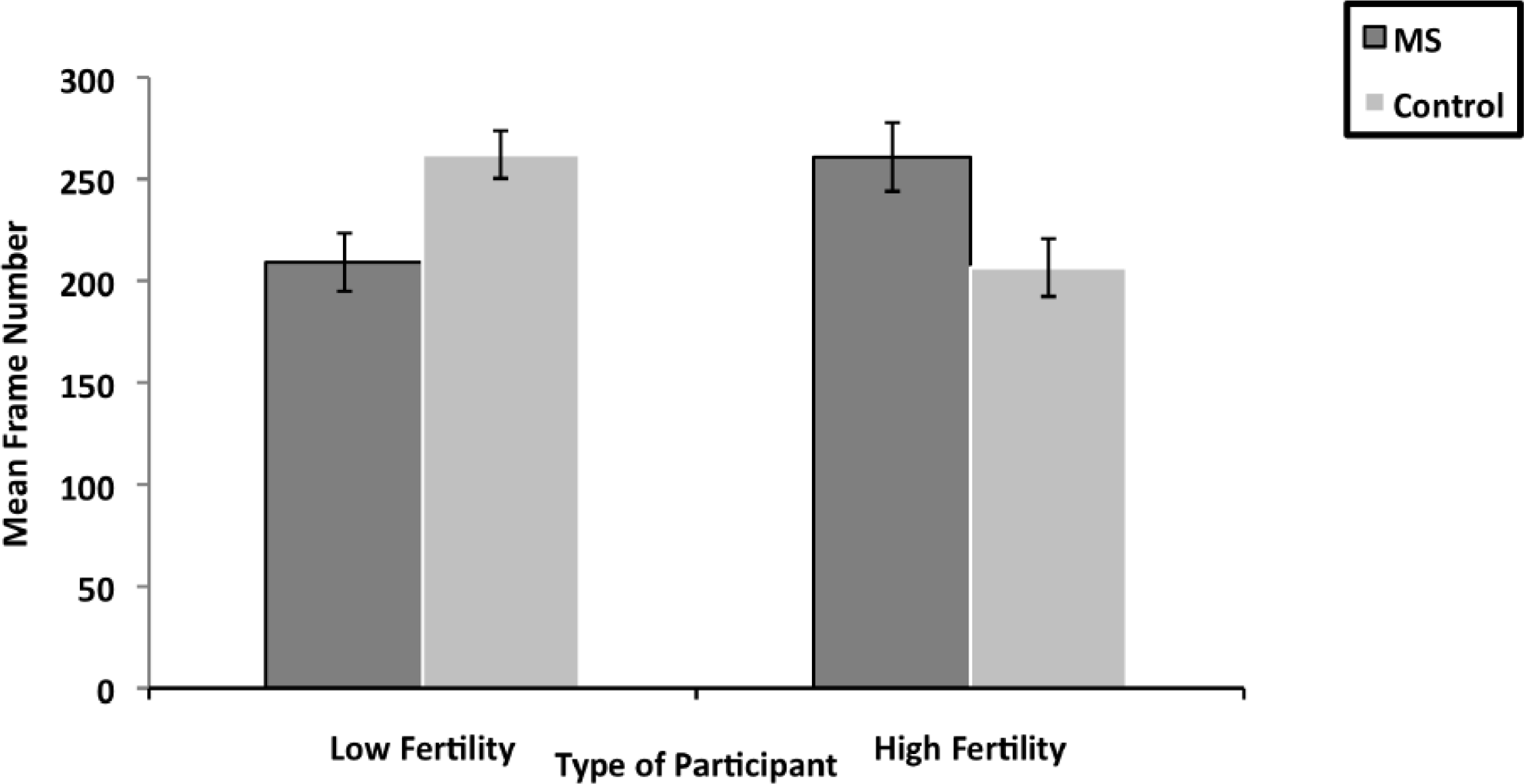
Results of MS and type of participant for the “attractive male face” category.
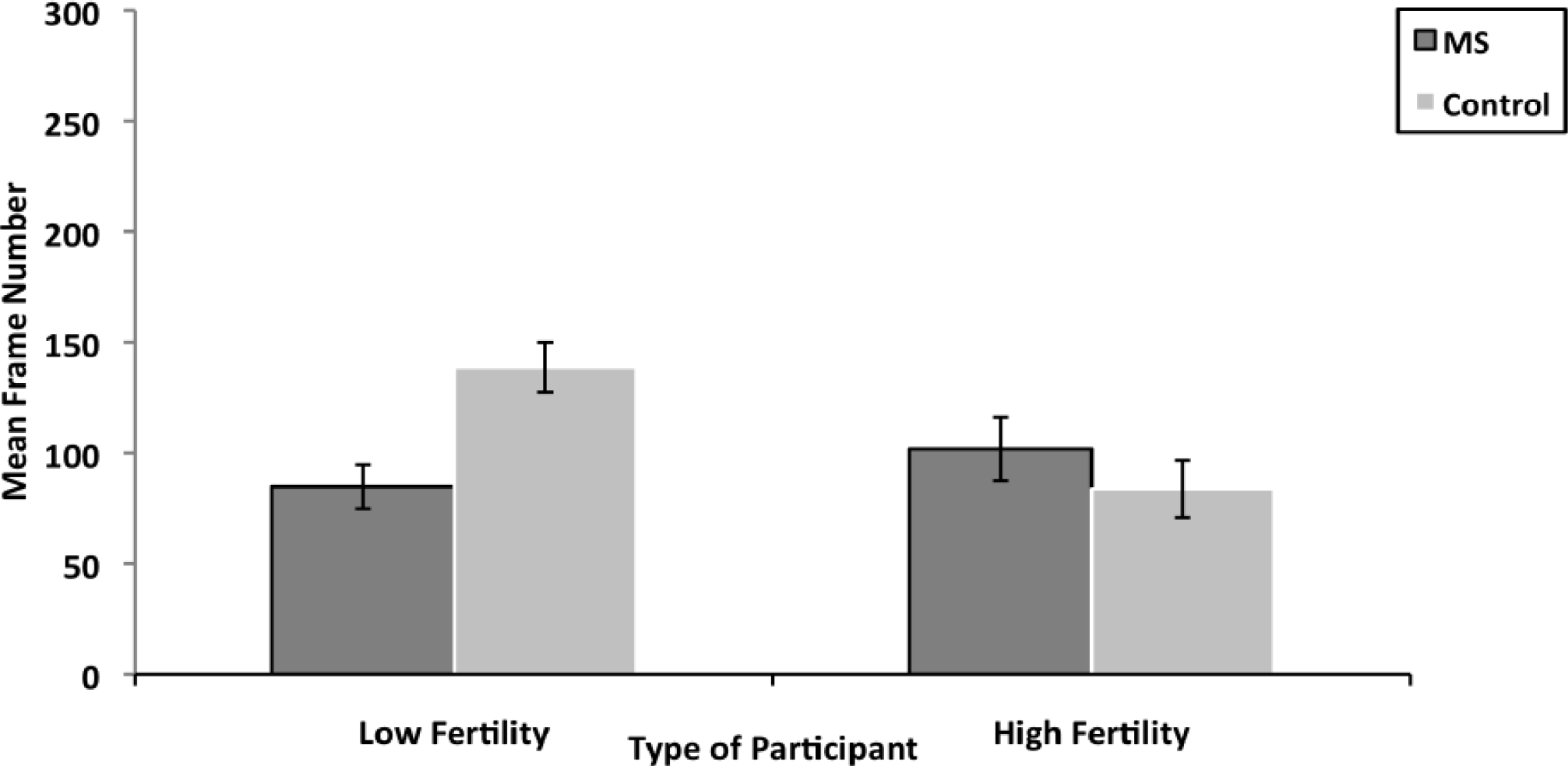
Results of MS and type of participant for the “dominant male face” category.
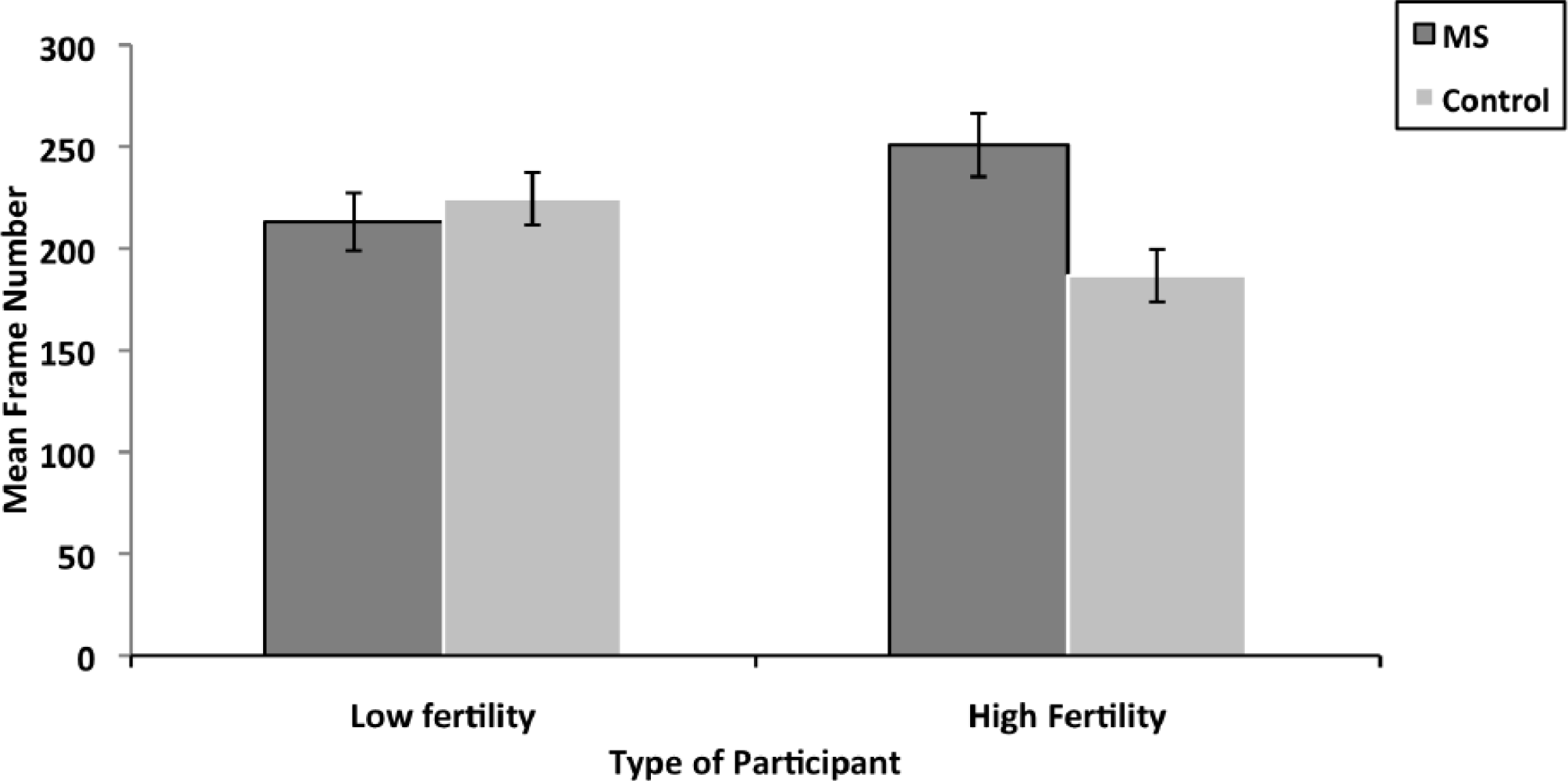
Results of MS and type of participant for the “healthy male face” category.
Women's ratings for the “attractive male face” were determined by an interaction of fertility status and condition, F (1, 135) = 13.88, p < .05, η2 = .09. Pairwise comparisons indicated that non-ovulating women selected a significantly more masculine face in the MS condition than in the control condition, F (1, 77) = 7.99, p < .05, η2 = .09. In contrast, the opposite pattern was observed for ovulating women, F (1, 58) = 6.10, p < .05, η2 = .02. Ovulating women in the control condition selected a significantly more masculine face than non-ovulating women in the control group, F (1, 66) = 9.27, p < .05, η2 = .12. Ovulating women in the MS condition selected a significantly less masculine face than non-ovulating women in the MS condition, F (1,69) = 5.46, p < .05, η2 = .07. No other comparisons for the “attractive male face” were significant, Fs < 1. The main effects of ovulation status and conditions were not significant, Fs < 1.
Women's ratings for the “dominant male face” were also determined by an interaction of ovulation status and condition, F (1, 135) = 8.99, p < .05, η2 = .06. Pairwise comparisons indicated that non-ovulating women in the MS condition selected a significantly more masculine face than non-ovulating women in the control condition, F (1,77) = 12.99, p < .05, η2 = .14. In contrast, the opposite pattern was observed for ovulating women, F (1,66) = 10.34, p < .05, η2 = .13. No other comparisons for the “dominant male face” were significant, Fs < 1. The main effects of ovulation status and condition were not significant: F (1, 135) = 2.48, p > .05 and F (1, 135) = 2.23, p > .05, respectively.
Women's ratings for the “healthy male face” were also determined by an interaction of ovulation status and condition, F (1, 135) = 6.89, p < .05, η2 = .05. Pairwise comparisons indicated that the ovulating women selected a significantly less masculine face in the MS condition than in the control condition, F (1, 58) = 9.71, p < .05, η2 = .14. No other comparisons for the “healthy male face” were significant, Fs < 1. The main effects of ovulation status and condition were not significant Fs < 1.
Discussion
The present results provide new evidence about how environmental factors, such as the presence of death reminders, can influence human reproductive behaviors, such as mate selection. We found that the judgments that women made when selecting the attractive male face were determined by an interaction of fertility status and condition. In control conditions, high fertile phase women preferred significantly more masculine faces than low fertile phase women. These results in control conditions replicated prior research (Fink and Penton-Voak, 2002; Johnston 1999; Johnston and Franklin, 1993; Johnston et al., 2001; Johnston and Oliver-Rodriguez, 1997; Penton-Voak and Perrett, 2000; Penton-Voak et al., 1999; Scarbrough and Johnston, 2005). In MS conditions, high fertile phase women preferred significantly less masculine faces than low fertile phase women and also significantly less masculine faces than high fertile phase women in the control condition. A similar pattern was observed in women's judgments for the dominant male face and healthy male face.
The present results are also consistent with TMT research. First, it has been shown that people in a MS condition will adhere more strongly to socially acceptable norms and will react negatively towards those persons who do not uphold these norms (Greenberg et al., 1990; Greenberg et al., 1994; Rosenblatt et al., 1989). In the present research, the face selected by ovulating women in the MS condition could be considered a more average face than faces chosen by high fertile phase women in the control condition and low fertile phase women in the MS condition. High fertile phase women in the MS condition may have viewed the masculine face negatively because of the association of masculine faces with socially negative characteristics and would view feminized faces more positively because feminized faces are shown to be associated with more pro-social attributes such as being helpful, cooperative, trustworthy, and a good father (Boothroyd, et al., 2007; Jones et al., 2008; Johnston, et al., 2001). Second, it has been shown that following MS, women and men may find the physical aspects of sex and sexual attraction unappealing, as the physicality of sex may be a reminder of one's eventual mortality (Goldenberg et al. 1999; Landau et al. 2006). In the present research, it may have been the case that high fertile phase women experienced the highly masculine male faces as associated with physical sexuality and, therefore, death. Following MS, women who are at a high risk of pregnancy may view mates with highly masculine faces as involving more risk than mates with more feminized faces. It is possible that following MS, high fertile phase women's judgments of male faces are affected both by perceived risk and the extent to which the face fits a cultural norm. In future research, it is necessary to investigate the extent to which highly masculine faces increase death-related thoughts in high fertile phase and low fertile phase women.
Our results suggest that mortality salience may result in an over-ride of the high fertility phase-induced preference for masculine faces and a strengthening of the predisposition for less masculine and likely higher investing mates. These results are consistent with Life History Theory in that an adaptive compromise may be taking place with the high fertile phase women. Our sample was composed primarily of White, middle-class college women who have been shown to express a preference for mates who will invest heavily in her and her children (Geary et al., 2004; Ellis et al., 1999; Low, Hazel, Parker and Welch, 2008; Whissel, 1996). In the presence of a potential environmental threat posed by the MS condition, the highly fertile women may be making an adaptive compromise that favors investment over good genes. Our study shows that death reminders do not have to be directly experienced to influence mate preference, at least temporarily. Further research on populations experiencing harsh developmental environments with higher mortality risks would help fortify this conclusion.
Our results are also consistent with alternative explanations, and thus further research is necessary to distinguish between these alternatives. For example, it is possible that the death reminder influences how women in a highly fertile phase of their menstrual cycles, but not in a low fertility phase, judge the healthiness of male faces. In the present research, we found that highly fertile phase women in the MS condition selected a less masculine face than highly fertile women in the control condition. In comparison, low fertile phase women who experience a death reminder do not view more masculine faces as more unhealthy. Prior research has shown that the perceived healthiness of mates plays an important role in reproductive behavior (See Etcoff, 1999; Fink and Penton-Voak, 2002; Rhodes, 2006 for review). Women seek healthy mates because they can produce children with genetic advantages, such as inherited resistance to disease. Healthy mates may also contribute more in the form of resources or parental care (Andersson, 1994).
In future research, it will also be important to investigate whether women's relationship status influences facial preferences. Prior research by Durante, Li, and Haselton (2008), has shown that the choices that high fertile phase women make can be influenced by whether or not they are in a committed relationship. They assessed the clothing worn by women when they were at high or low risk of pregnancy. They hypothesized that when women were at high risk of pregnancy they would wear clothing that was more sexy and revealing of their bodies. They found evidence to support their hypothesis in both a naturalistic observation study as well as a laboratory study; however, they found that relationship status mattered. Women who were not in committed relationships wore more revealing outfits when they were not at high versus low risk of pregnancy. In contrast, women who were in committed relationships wore revealing outfits both when they were at high and low risk of pregnancy. The authors suggested that the findings involving women in committed relationship may be explained “from an intrasexual competition perspective….[that states that] if mated women are highly satisfied with their partners, they may be inclined to increase their attractiveness in order to remain competitive with members of the opposite sex for their mates' attention, especially at a time when mating decisions can result in potentially high consequences (at high fertility)” (p. 1458). In our future research, we will investigate whether the effect of mortality salience on ovulating women's face judgments for women who are and are not in a committed relationship.
In sum, the present results are intriguing because they show that death reminders can be considered a situational source of influence can impact human reproductive behavior. The present results demonstrated that death reminders influenced women's preferences for male faces. They add to the prior literature showing that death reminders influence men and women's desire for offspring. We anticipate that future research will also show that death reminders may influence additional behaviors related to human reproduction.