



Abstract
Instagram selfies and groupies symbolize social media users’ public display of narcissism. From an evolutionary psychological perspective on the renovated hierarchy of fundamental human motives and needs, this study examined the interaction effects of Instagram photo types (selfies, group selfies, long-shot photos taken by others, and neutral photos) and Instagram peer viewers’ individual difference factors (intrasexual competition [ISC] for mates, need for popularity [NfP], loneliness, and need to belong [NtB]) on intersexual attraction. A randomized between-subjects experiment (N = 110) was executed to see how the interaction affects the intention to date the target opposite-sex person. Multiple regression analyses confirm the moderating effects of ISC for mates, NfP, loneliness, and NtB on dating desire, among heterosexual/bisexual males exposed to female Instagram photos. Viewer characteristics moderate the influence of the potential mate’s photo types on perception and dating desirability. This study makes theoretical contributions to the literature on evolutionary psychology of narcissism and the renovated pyramid of primary needs. With regard to practical implications for online dating apps/social networking sites, neutral photos are more effective to appeal to men who feel lonely and have higher need for belonging and popularity, whereas group selfies are more appealing to men who have lower ISC for mate, NtB, and NfP.
Keywords
Leveraging popular social networking sites, individuals undertake certain forms of behavior to attract as many likes and followers as they can (Utz, 2010). One platform that symbolizes people’s love for strategic self-presentation to the utmost degree is Instagram, a photo-sharing mobile app that popularized the use of quality-enhancing filters. Users flocked to Instagram to post selfies, groupie selfies, and portraits that signify glamour and sexiness, which have been perceived as increased signs of narcissism (Mascheroni, Vincent, & Jimenez, 2015). The current study focuses on how different types of Instagram photos (selfies, groupies, long-shot photos taken by others, and neutral photos) posted by an opposite-sex user affect viewers’ perception of the opposite-sex user and how desire to date the target user is moderated by viewer characteristics.
Narcissism is characterized by grandiose exhibition of one’s beauty and pursuit of others’ admiration. Posting selfies/groupies is associated with narcissism and need for popularity (NfP; S. V. Jin & Ryu, 2018; Wang, Yang, & Haigh, 2017). Selfie-posting characters tend to be perceived as narcissistic by viewers because these characters display high self-trust and self-centered behavior (Kim & Chock, 2017). Studying users’ motivations for posting social media photos has attracted a lot of scholarship (Kapidzic, 2013; Re, Wang, He, & Rule, 2016; Sheldon & Bryant, 2016; Wang et al., 2017), but very few experimental studies examined the audience’s perception from the viewer’s perspective. The present experimental study addresses this gap, by testing (1) heterosexual/bisexual Instagram users’ perception of and intention to date the target opposite-sex user who posts different types of photos (selfies, group selfies, long-shot photos taken by others, and neutral photos) and (2) the moderating roles of peer viewers’ individual difference factors including intrasexual competition (ISC) for mates, NfP, need to belong (NtB), and loneliness, from an evolutionary psychological perspective.
Narcissism and Romantic Attraction on Instagram
Research driven by evolutionary psychology produced interesting results about narcissism, attractiveness, and short-term mating, pointing to the coevolution of narcissistic traits and short-term mating success (Holtzman & Strube, 2011). From an evolutionary psychological perspective, narcissism is correlated with attractiveness because it has been a mate-selection strategy (Holtzman & Strube, 2010). The desire for short-term mating is associated with attraction to narcissistic characters (Dufner, Rauthmann, Czarna, & Denissen, 2013). Narcissism implies an excessive care of oneself (i.e., grooming) and an extrovert personality, which are appealing characteristics in a mate (Holtzman & Strube, 2011). This extroversion increases the chance of approaching potential dates. Narcissism conveys confidence, thus ultimately increasing the chance of mating success (Holtzman & Strube, 2011). It also entails vanity and exhibitionism, which increases adorned attractiveness—that is, taking care of their appearance. As people make associations between these traits—narcissism, extroversion, attractiveness, vanity, and self-flattery—they interpret narcissistic signals as signs of sexual appeal (Holtzman & Donnellan, 2015). This explains the reason for narcissistic personas being perceived as sexy (Campbell, 1999; Dufner et al., 2013). In terms of different approaches to mating relationships, studies have shown that narcissists reported less commitment to long-term romantic relationships (Campbell & Foster, 2002). Narcissists are perceived as better partners for short-term relationships, since they are interested in self-gains and are characterized by unwillingness for commitment (Dufner et al., 2013). Narcissistic dominance is known to be an appealing feature in males as rated by females, but it is interpreted negatively in females as rated by males (Li & Kenrick, 2006).
Since narcissism is perceived to be a negative trait in general, as part of the dark triad (Paulhus & Williams, 2002), photos indicating high narcissism would supposedly be rejected. Despite this negative slant, selfies and group selfies posted on Instagram receive many likes online, especially by opposite-sex others, thus representing a popular social media phenomenon. How could demonstrations of narcissism receive wide approval online? Peer viewers may perceive narcissism or vanity in Instagram characters to be attractive because they signify high self-esteem (Mehdizadeh, 2010) and popularity (Utz, Tanis, & Vermeulen, 2012).
A model of narcissism and romantic attraction proposes that narcissists are attracted to admiring individuals and relatively less attracted to individuals who offer the potential for emotional intimacy (Campbell, 1999). Narcissists, as opposed to nonnarcissists, prefer more self-oriented (i.e., egoistic) and less other-oriented (i.e., altruistic) qualities in an ideal romantic partner (Campbell, 1999). The ways members of the opposite-sex perceive and judge narcissistic personality cues of the potential partner also vary across individuals (Grosz, Dufner, Back, & Denissen, 2015). The correlation between narcissism and intersexual romantic attraction is affected by (1) ISC for mates in planning on a short-term versus long-term mating (Holtzman & Strube, 2010), (2) personality congruence with the potential mate (Burton et al., 2017), and (3) a variety of personality traits such as sensation seeking tendency (Grosz et al., 2015). Among these factors that would produce different outcomes when interacting with perceived narcissism of the target individual, the current study particularly focuses on the moderating effects of viewers’ ISC for mates. If narcissism has had an evolutionary advantage in attracting mates, it is important to understand the fundamental and hardwired motives that make certain people attracted to highly narcissistic versus nonnarcissistic partners. In other words, attraction to narcissistic versus nonnarcissistic partners must be based on primary needs, if it is driven by an evolutionarily adaptive mechanism (Holtzman & Strube, 2010).
One appropriate social media environment that can be utilized to study the interaction between narcissism and romantic attraction is Instagram. Some people use Instagram for dating purposes (Kircher, 2016; Levin, 2016). If certain women are using their physical attractiveness to induce male users’ liking and following (Seligson, 2016), it is important to study the effects of Instagram posts on viewers’ intersexual attraction to the photo poster. Instances of flirting are prevalent on Instagram (Deutsch, 2013). Although Instagram is not a dating app, using Instagram involves viewing personal photos of members from the opposite sex. Viewers can detect the patterns of strategies photo posters use to increase perceived popularity and attractiveness. People post glamorous and sensual photos, assuming an imagined audience who would presumably be attracted to them. Photo posters enjoy it when their Instagram photos are appreciated by other viewers in the form of liking, following, and commenting. Peer viewers’ appreciation consists of two dimensions: (1) system-aggregated quantitative indices of traction such as the number of likes, the number of followers, and the number of comments and (2) qualitative dimension such as positive comments and expressive emoticons. Exposure to Instagram photos of an attractive member from the opposite sex may result in attitudinal (e.g., perception of attractiveness and narcissistic traits of the potential mate) and behavioral effects (e.g., intersexual attraction to and behavioral intention to date her). The current study examined whether the viewers’ attitudinal perception and behavioral intention would be moderated by their own individual difference factors.
Individual Differences in Perceiving Narcissistic Appeal on Instagram
To theoretically elaborate on the effects of exposure to social media contents, it is important to consider the moderating roles of personalities and individual differences (Utz et al., 2012). The individual difference factors examined in this study are (1) innate drive for mating, as indicated by ISC for mates among heterosexual/bisexual individuals, (2) NfP, (3) NtB, and (4) loneliness. These factors were tested based on their conceptual and theoretical relevance to intersexual attraction and their interaction with Instagram popularity cues (i.e., quantitative indices of online popularity including number of followers, number of likes, and number of comments). Practically, these four motivations also represent key aspects of why users do what they actually do on Instagram (e.g., building a followership, connecting with others, looking up photos of attractive people). Most importantly, these factors reflect basic and primary human needs, as theorized in the renovated hierarchy of fundamental human motives (Kenrick, Griskevicius, Neuberg, & Schaller, 2010).
Previous studies have discussed the relevance of ISC for mates (S. V. Jin & Ryu, 2018), NfP (Utz, 2010), NtB (S. V. Jin & Ryu, 2018), and loneliness (B. Jin, 2013; S. V. Jin & Ryu, 2018) to narcissistic personalities. The common theme across these factors is feeling a void in social life and wanting to be associated with more friends or followers. However, previous studies on narcissism attractiveness (Back, Schmukle, & Egloff, 2010; Campbell, 1999; Dufner et al., 2013) did not study the perceiver’s individual difference factors as moderators in social media environments. The perceiver’s dispositions might moderate the appeal of narcissism on Instagram. People with different levels of ISC for mates, NfP, NtB, and loneliness may vary with respect to psychological reactions to photos with different cues of others’ narcissism and sociability shown via selfies, group selfies, long-shot photos taken by others, and neutral photos. Generally speaking, viewers’ individual differences are known factors in shaping the perception and judgment of the other person’s physical attractiveness, since some visual cues in the target person can be interpreted differently based on the viewer’s personality (Andersen & Bem, 1981; Cash, Cash, & Butters, 1983). More specifically, viewers with different levels of popularity-seeking tendency, need to connect, and loneliness may vary with respect to psychological reactions to others’ photos with different cues of narcissism, popularity, and sociability. In addition, viewers with different levels of ISC for mates would indicate different preferences and evaluation criteria for short-term versus long-term mates (Buss & Schmitt, 2019). Based on the theoretical rationales articulated more in detail below, this study tested whether viewers’ ISC for mates, NfP, NtB, and loneliness moderate the effects of opposite-sex others’ different types of Instagram photos. To this end, the formation of the hypotheses about the four moderators was guided by the umbrella theoretical framework of renovated hierarchy of fundamental human needs and motives (Kenrick et al., 2010).
Theoretical Frameworks
Renovated Hierarchy of Needs: Mating, Status, and Belonging as Fundamental Needs
Evolutionary analyses focus on the domain-specific mechanisms designed to solve specific adaptive problems (Kenrick et al., 2010). Therefore, an individual’s desire to date the target person may be dependent on the need that is most salient to the individual (Chisholm et al., 1993). Individuals who feel socially excluded, for instance, tend to make more positive assessment of other people’s attraction and prefer social reconnection over dating (Maner, DeWall, Baumeister, & Schaller, 2007). Cues connoting potential social exclusion activate belongingness goals, as indicated by attempts to establish new social connections (Kenrick et al., 2010). Thus, in order to explain why certain attributes become more attractive to certain mate seekers under various conditions, it is integral to understand the fundamental needs which orient the mate seeker’s personal focus. Following this premise, the renovated model of hierarchy of primary needs (Kenrick et al., 2010) explicates the motives that could have an effect on dating behavior. According to the renovated pyramid of fundamental human needs, there are six primary motives that anchor the functional and developmental mechanisms for human actions: immediate physiological needs, safety, affiliation, status, mating (mate acquisition and mate retention), and parenting (Kenrick et al., 2010). Consistent with Maslow’s (1943) original hierarchy, immediate physiological needs refer to food and basic health needs, safety refers to needs to be physically secure, affiliation refers to needs to belong, and status refers to needs to gain esteem (Kenrick et al., 2010; Mellor, Stokes, Firth, Hayashi, & Cummins, 2008). The revised hierarchy additionally proposes three motivational systems and later-developing reproduction-focused goals of mate acquisition, mate retention, and parenting (Kenrick et al., 2010).
Need for affiliation, need for status, and mating desires are the motives most integral to explain dating from an evolutionary psychological perspective. Basically, these motives relate to how a person socializes with others. These needs develop in sequence as individuals mature biologically, emotionally, and cognitively (Kenrick et al., 2010). Needs for affiliation, status, and mating are also fundamental drivers of a variety of social media behaviors (S. V. Jin & Ryu, 2018), since people use social media for the purposes of connecting with others, projecting desires for fame, and strategically showcasing desired traits as a potential mate (Greenwood, Long, & Cin, 2013; Perloff, 2014). Then, what could be the moderating effects of each motive on evaluation of a dating target? According to Kenrick, Griskevicius, Neuberg, and Schaller. (2010), the needs to affiliate with a group (belongingness) naturally precede the desire to have high social status (fame) and the desire for mating (mate acquisition/retention). The current study aims to test whether viewers’ loneliness (lack of affiliation), NtB (affiliation), NfP (social status), and ISC for mates (mate acquisition/retention) would moderate the effects of different types of Instagram photos on viewers’ dating desire. Thus, the present study investigated how the fundamental motives of the viewer interact with the attributes of the target potential mate in influencing dating desire (Klohnen & Luo, 2003). Contingent upon the viewer’s psychological traits and fundamental motives, visual cues from the potential mate could be interpreted differently as they fulfill the viewer’s different needs and bring about expected functional outcomes (Botwin, Buss, & Shackelford, 1997). For example, a mate seeker in need for affiliation would look for a potential mate that can facilitate that goal and a mate seeker with high ISC would focus on mate acquisition and relationship initiation (Hill, 1991; Schwartz, Lindley, & Buboltz, 2007). The current experiment tested three primary motivational systems delineated in the renovated pyramid of needs: belongingness (operationalized as loneliness [lack of affiliation] vs. NtB [need for affiliation]), status-seeking (operationalized as NfP), and mate acquisition (operationalized as ISC for mate). The four constructs of loneliness, NtB, NfP, and ISC were chosen to conceptually and operationally parallel these motives, as visualized in Figure 1. These motives have never been tested in relation to dating in social media environments. The current experiment addresses this gap by providing literature review on the major tenants of these four constructs and empirically demonstrating their moderating effects.
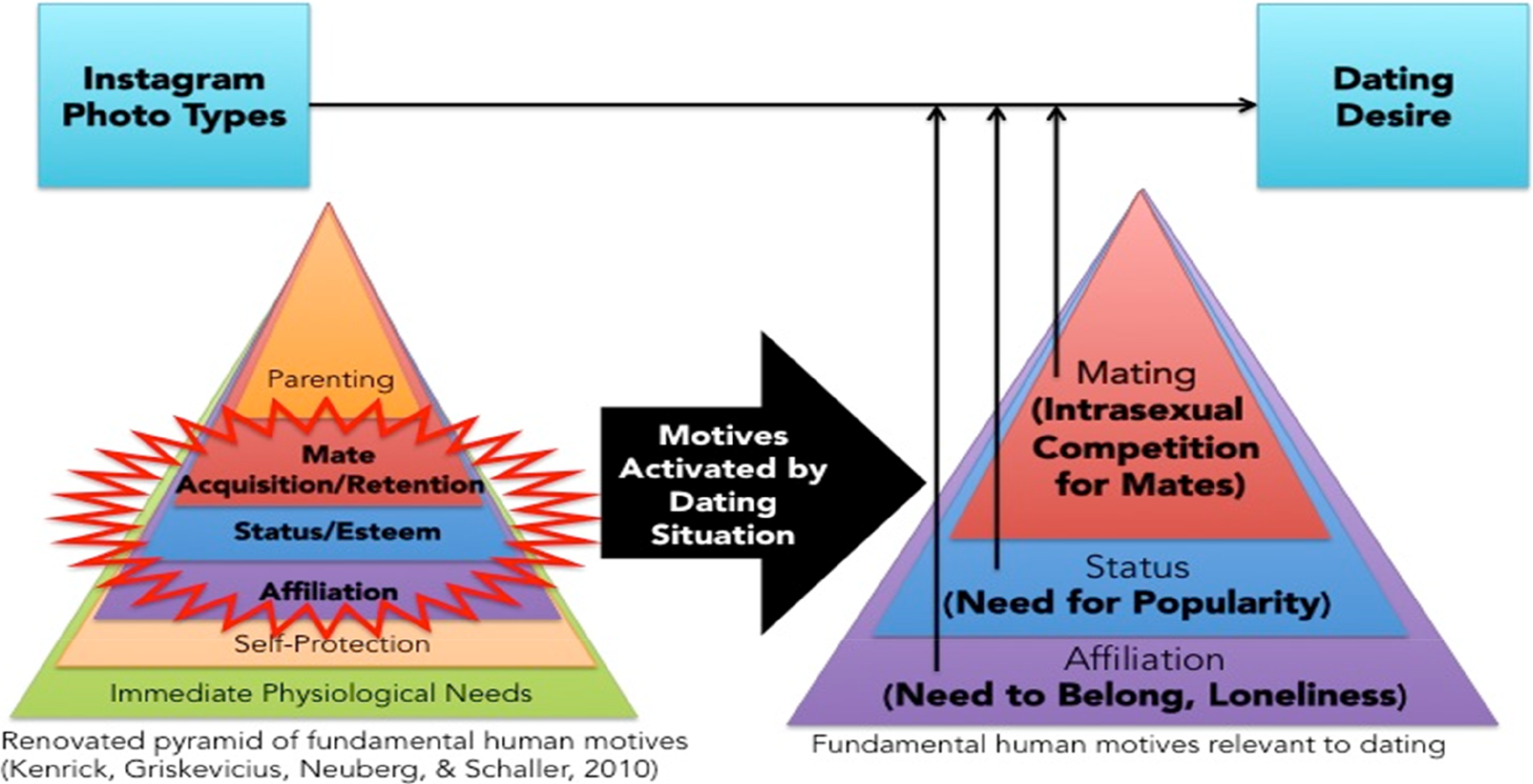
Theoretical model.
Mating: ISC for Mates
One of the primary drives of human behavior, along with survival, is the desire to reproduce (Wiley & Poston, 1986). In pursuing mating opportunities, humans have evolved different strategies for attracting potential mating partners (Buss & Schmitt, 1993), depending on the desired length of the relationship (short term vs. long term) or depending on environments that favor specific traits (aggressive vs. modest; Buss, 1994). For instance, deploying the image of strength in males would help as a mating strategy for short-term mating or for environments that are ladened with constant and preeminent threats. However, potential mates with more agreeable and honest traits would be preferred for long-term relationships or for environments that are safe for survival because they offer the possibility for focusing on raising offsprings (Wiley & Poston, 1996). This variety in the desirability of mate traits is what has caused individual differences among humans; certain traits are more attractive to opposite-sex others with specific personalities and are more effective for certain mating strategies (Buss, 1994). In order to increase the reproductive success rate, there are two approaches: (1) making the individual more competitive compared to same-sex individuals in terms of power and agility (ISC) and (2) increasing desired qualities as prospective mates for opposite-sex individuals by being more attractive (intersexual selection). All organisms pursue these two approaches, but with different weight given to each one based on the conditions and limitations of the environment within which they evolve (Andersson, 1994; Ponzi et al., 2015).
ISC for mates, as the innate drive to pursue mating partners, refers to the rivalry with same-sex individuals over access to mates from the opposite-sex (Buunk & Fisher, 2009) and competitive attitude toward the same-sex others (Buunk, Bucksath, & Cordero, 2017). Men tend to behave more competitively toward same-sex others and more prosocially toward opposite-sex others (Buunk & Massar, 2012). Males’ ISC could play a role in intersexual attraction to and intention to date the target female user in the context of Instagram flirting. Although ISC is a significant factor in explaining human mating behavior (Chen & Chang, 2015) and has been identified as a factor in social media behavior (Hendrickse, Arpan, Clayton, & Ridgway, 2017; S. V. Jin & Ryu, 2018), there is no experimental study exploring its moderating effects on dating intention in social media environments. The current experiment addresses this gap.
Mate attraction is important in ISC (Walters & Crawford, 1994). ISC among females tends to occur more in the domain of physical attractiveness (Buunk & Massar, 2012; P. Dijkstra & Buunk, 2002). For instance, degrading other women’s attractiveness is one strategy for ISC for mates among females (Fisher, 2004), whereas displaying power and wealth is more prevalent among competing males (Buss, 1988; Kenrick et al., 2010; Little, DeBruine, & Jones, 2013). In light of the occurrence of human female ISC with respect to physical traits desired by potential mates, Fink, Klappauf, Brewer, and Shackelford (2014) empirically demonstrated that women with more feminine faces, larger breasts, and lower waist-to-hip ratio received higher attractiveness, femininity, and perceived competitiveness ratings. The literature on ISC has long focused on the differential strategies different individuals use to attract mates (Buss, 1988; Fisher, 2004; Little et al., 2013). However, could ISC tendency as a trait affect evaluation of potential mates? What is the relationship between ISC (within sex) and intersexual selection/attraction (between sexes)?
ISC for mates parallels the mating motive in the renovated pyramid of fundamental human needs (Kenrick et al., 2010). There are two possible predictions that can be made regarding the effects of males’ ISC on mating desire. On the one hand, a male with higher ISC for mates would seek females whose photos display highly attractive and physically desirable attributes (Buss, 1989); this type of females tend to have many followers, who are presumably the male’s competitors, which may further prime and activate the male’s ISC for mate. On the other hand, a male with higher ISC for mates would show consistently high intention to date the target female across conditions, regardless of the photo type, because he tends to innately have higher desire to mate. Since ISC for mates is an evolutionarily adaptive and hardwired mechanism to increase reproductive chances and success rate, avoiding or decreasing mating opportunities needs to be minimized (Buss, 1988). Being selective based on the potential mate’s characteristics manifested in photos, such as physical appearance, personality traits, and popularity, limits mating chances and does not help increase success rate.
Females’ sexy and attractive selfie/groupie-posting behavior on Instagram can be interpreted as an evolutionary strategy to make them more competitive toward same-sex individuals (ISC strategy quantitatively indicated by the number of glamorous and sexy selfies/groupies female users post on their own Instagram profiles) and to increase their attractive qualities as prospective mates for opposite-sex individuals (intersexual selection strategy quantitatively measured by the number of male users’ “liking,” “following,” and “commenting”; Andersson, 1994; S. V. Jin & Ryu, 2018; Ponzi et al., 2015). Female Instagram users’ physically attractive and glamorous selfies/groupies signal higher level of narcissism compared to neutral photos, which may interact with male viewers’ varying degrees of ISC for mates. Furthermore, groupies manifest higher level of extroversion, sociability, and popularity, which may interact with male viewers’ ISC for mates, especially when the target female is surrounded by other males in her groupies. Men, more than women, express interests in short-term relationships and motivation for casual sex. This is evolutionarily rooted in men’s desire to maximize the number of sexual liaisons while minimizing commitment in the relationships (Regan & Dreyer, 1999). Extroverted female personalities are, in general, considered attractive to males (Buunk et al., 2017). However, one caveat to this notion is that high ISC for mates in males is associated with aggressiveness, which entails less preferences for female partners with narcissistic and overtly exhibitionistic traits. Being the center of attention or being surrounded by opposite-sex friends in groupies could increase the competitive tension about relationships. A potential mate’s attractive, sexy, and glamorous selfies and groupies posted on Instagram, as an intersexual attraction strategy, may situationally prime opposite-sex users’ ISC for mates (competition within same-sex others). Consequently, primed ISC for mates could result in intersexual attraction, operationalized as the degree of desire to date the potential mate (attraction to the opposite-sex target), thus rationalizing the hypothesized interaction effects between the potential mate’s photos and opposite-sex viewers’ fundamental mating motives.
Status: NfP
NfP concept has received increasing attention due to the phenomenon of active social media participation for the sake of gaining likes and followers (Utz et al., 2012). NfP is a motivation to appear popular in the eyes of others, by engaging in certain goal-oriented steps, whereas narcissism is an internal belief of superiority. The strategic nature of NfP leads people into relationships that make them feel popular, regardless of how deep or superficial those relationships are (Utz et al., 2012). Essentially, popularity is a sign of a superior status within a social network, being linked to the NtB (affiliation) as well as need to be significant (esteem/status). Having superior status results in more access to resources (Lin & Dumin, 1986), higher attractiveness to potential mates (Ha, Overbeek, & Engels, 2009), and pulling in more friends and social ties (J. K. Dijkstra, Cillessen, Lindenberg, & Veenstra, 2010). NfP has been also linked to high self-esteem and narcissistic traits. Narcissistic individuals engage in more like-seeking behaviors on Instagram, primarily as a way of increasing popularity among others (Dumas, Maxwell-Smith, Davis, & Giulietti, 2017). The NfP is largely shaped by variations in specific personality traits, and one of these traits is entitlement, which is a subset of narcissism (Utz et al., 2012). Entitlement is the belief that one deserves attention and admiration from others (Holtzman & Strube, 2010). This belief would push individuals to seek likes and recognitions from other actors on real and virtual social networks (Zell & Moeller, 2017).
How does entitlement relate to mating strategy? According to life history theory, any organism allocates its resources between survival strategies and reproductive strategies (Figueredo et al., 2005; Kenrick, Gabrielidis, Keefe, & Cornelius, 1996; McDonald, Donnellan, & Navarrete, 2012). These strategies are not only different between species but also within species as they are grouped by biological sexes, environments, and traits. Individuals can either allocate energy for quick reproductive gains (e.g., copulation) or invest energy in survival and nourishment efforts, to have better reproductive opportunities in the future. These two approaches are referred to as short life strategy and long life strategy, respectively (Figueredo et al., 2005; Kenrick et al., 1996). Reproductive efforts are divided between mating efforts and offspring-upbringing efforts (Kenrick et al., 2010), and the allocation of resources between these different efforts is largely shaped by personality traits (Figueredo et al., 2005). Certain traits prefer the short-term gain of mating or entailing a fast life strategy and one of these traits is entitlement (McDonald et al., 2012). Namely, the sense of being entitled to others’ “likes” indicates focused efforts on social rewards and a strategy oriented toward short-term mating. The need to receive social approval (e.g., in the form of likes in social media) motivates some individuals to use others for personal gains (McDonald et al., 2012).
Although NfP is manifested in many forms in social media, from seeking likes and new followers to the desire of producing viral and popular content, it has not been thoroughly discussed as an extension of basic social needs. Since the NtB is a primary drive for human behavior and an antecedent to life satisfaction and improved self-esteem (Moller, Deci, & Elliot, 2010; Zadro, Williams, & Richardson, 2004), NfP can be considered an extension of this drive. According to the updated hierarchy of fundamental human motives (Kenrick et al., 2010), it is not enough to be affiliated with a group (need for affiliation in lower hierarchy of the renovated pyramid of needs), but some individuals further hope to have a recognized status and a central role in their social network (need for status/esteem in higher hierarchy of the renovated pyramid of needs, Figure 1).
What would be the mating strategies preferred by people with high NfP? This question has never been explored before, and the current study explores how people with varying levels of NfP will interpret and respond to social cues present in opposite-sex users’ personal profiles on social media differently. For example, if one considers a potential mate as social resources, females tend to look for males who are socially dominant and popular, whereas males tend to look for females less popular than themselves so that more attention will be allocated toward the self than the partner (Gutierres, Kenrick, & Partch, 1999). From an evolutionary perspective, being associated with popular males would mean more access to resources and cultivation of a stronger prestige (Kenrick, Neuberg, Zierk, & Krones, 1994; Sadalla et al., 1987). In contrast, popular females will not be perceived as attractive for short-term mating if the relationship with them is perceived to be costly because dominant males have a limited threshold of the resources they are willing to invest in a short-term relationship (Barber, 1995). If the potential mate is perceived as demanding more investment of resources than what the dominant male thinks is appropriate, he will forgo pursuing this potential short-term relationship (Barber, 1995).
Online popularity reflects people’s primary need for status (Cheung, Chiu, & Lee, 2011). People with high status-seeking motivation would prefer relationships that can help increase their own popularity (Alterovitz & Mendelsohn, 2011). NfP is also associated with specific behavioral patterns. People with higher NfP are more sensitive to peer group norms and more responsive to what others perceive as acceptable (Baumgartner, Sumter, Peter, & Valkenburg, 2015). People with high NfP tend to publish more self-disclosing information and photos on social media, if they believe these behaviors would increase their popularity (Kim & Chock, 2017). Considering the nature of NfP as general orientation to appear popular, interpersonal attraction in social media environments would tilt toward photo posters with certain personalities who are perceived to also increase the popularity of the viewer with high NfP. That motivation produces different reactions toward Instagram photos. For instance, groupies could attract a viewer with high NfP because the potential date seems to have many friends with whom the viewer can possibly become friends. However, it simultaneously indicates that the viewer would not be the most significant person in the relationship, which motivates the viewer with high NfP and status-seeking motivation to prefer relationships in which they become the center of attention themselves. To males with high NfP, the target female users’ photos with high level of narcissistic cues (self-centered selfies) and high level of popularity (groupies in which the female is already surrounded by other males) would be less appealing than neutral photos. Based on these opposing predictions, the interaction effect between the viewer’s NfP and the potential mate’s photo types on the viewer’s dating desire was proposed.
Affiliation: Loneliness and NtB
Humans, as members of a social species, have a fundamental need for social belonging (Maslow, 1943). The feeling of connectedness with other people improves life satisfaction and social performance (Heinrich & Gullone, 2006). This sense of connectedness is an indicator of (1) a decent level of satisfaction with one’s relationships and (2) a feeling of safety and inclusion in a significant social network. This emotional need is so primal to human beings. To extrapolate the innate and evolutionary root of loneliness and primary emotional NtB, many experiments showed that other social mammals (mice and rats) suffer from social exclusion, which is measured by changes in physiological and mental levels (J. T. Cacioppo & Hawkley, 2009). Based on the necessity of having social connections, the lack of satisfactory connections causes people mental state disturbance, which induces them to be alerted to their inner sense of social exclusion and to find new partners or seek better relationships.
Loneliness refers to the perceived deficit between the social relationships one wants and the relationships the one actually has (Gurung, Sarason, & Sarason, 1997). Mental and physiological well-being of individuals depends on belonging to a caring and protective group. Loneliness signals to the individual the possibility or necessity of altering one’s current social conditions and affiliations (J. T. Cacioppo, Cacioppo, & Boomsma, 2014). From a functional perspective, loneliness serves as an environmentally induced stressor; the threat of being isolated triggers the loneliness signal to push the individual’s focus toward improving current social relationship or finding satisfactory social relationships (J. T. Cacioppo et al., 2014). Since the function of peer social relationships is to enhance psychological and physical well-being of individuals, feeling lonely is an internal signal that stimulates individuals to reexamine whether the current peer relationships fulfill the social need (J. T. Cacioppo et al., 2014). Then, loneliness is not an automatic reaction to being alone. Rather, it is the result of an evaluative mechanism whereby current social relationships are compared to more desired relationships, which makes the person feel unsatisfied with the current ones. This deficit between the current and the ideal can be about either a quantitative aspect “I wish I had more friends” or qualitative aspect “I wish I had better friends” (Russell, Cutrona, Rose, & Yurko, 1984).
Understanding the fundamental root of NtB points to the evolutionary function of loneliness. Studies on NtB indicate that it enhances people’s sensitivity to social cues (Pickett, Gardner, & Knowles, 2004). As social isolation is a threatening condition for social species such as ours, loneliness would trigger functional tactics such as stronger intent to reconnect and focus on self-preservation (J. T. Cacioppo et al., 2014). Lonely people tend to be more motivated to pursue social relationships, but only if they do not feel threatened by these potential connections (J. T. Cacioppo et al., 2014). Since lonely people tend to be dissatisfied with the quality of their relationships, they are more eager to establish new relationships, which is indicated by stronger NtB. Despite the urge to connect, however, lonely people ironically often engage in poor interpersonal interactions that leave them dissatisfied and even lonelier (McWhirter, 1990). There are suggested reasons for this lack of social skills; loneliness leads people to misinterpret social cues, by selectively exaggerating negative cues and being overly cautious of positive expressions (J. T. Cacioppo et al., 2000). Although the connection among loneliness, belongingness, and self-esteem has been mentioned above, one must justify the categorical difference of loneliness as a negative emotion and its evolutionary function. Loneliness exacerbates negative mood, lowers self-esteem, and decreases social life satisfaction (Leary, 1990).
Essentially, loneliness is an aversive signal that triggers the need to renew or replace the current social connections with ones that are supportive and safe. Just like hunger and thirst signify the need for food and water, loneliness signifies the need for connection and belonging. How could loneliness be evolutionarily beneficial when it becomes a predicament to human communication? Lonely people experience anxiety in pursuing romantic relationships as they feel anxious about being rejected (Gurung et al., 1997). Since they preferably seek relationships with minimal efforts in their part, they feel more comfortable with online dating rather than face-to-face dating (Lawson & Leck, 2006). Loneliness in such scenarios works as a defense mechanism. Hypersensitivity to social threats creates barriers to social interactions (Duck, Pond, & Leatham, 1994). The feeling of suspicion is what makes lonely individuals less welcoming of approaches made by others and more hesitant to initiate social interactions with others. Loneliness creates a confirmatory bias in perceiving others as unwelcoming and threatening (J. T. Cacioppo & Hawkley, 2009). Therefore, minimizing perceived threats in interpersonal communications can be beneficial to lonely individuals, as much as it carries cues for safe relationships (Merkle & Richardson, 2000). This makes loneliness an evolutionary disadvantage for individuals in some social situations (J. T. Cacioppo et al., 2014). For instance, avoiding rejection by a potential partner or not engaging in risky encounters can result from the sense of isolation. However, at the collective level, avoiding hostile situations, as a rule, is paramount over seeking new relationships, even at the expense of weakened social ties. Since experiencing negative interactions, especially with potential mates, has grave consequences on self-esteem, avoiding it altogether could be less severe. For that reason, lonely individuals may interpret cues of narcissism of potential partners differently from nonlonely people. Some people find narcissistic, dominant, and confident mates attractive, while other people who prefer safe choices may not find these traits appealing. For visual social media platforms like Instagram, the potential mate’s physical cues could be interpreted in accordance with the criteria through which the viewer perceives certain personalities as desirable or not.
Loneliness hyperalerts individuals to social threats and negative interactions (S. Cacioppo et al., 2016). Being rejected by a potential mate results in negative mood and damages to self-esteem. Therefore, avoiding the encounter altogether would be a safer choice, even if it is still depressing. For that reason, loneliness leads individuals to infer negative traits and emotions from others. It is expected that lonely people would pick “safe choices” as potential mates (Leck, 2006). Feeling of loneliness is also an effective criterion for measuring the current relationship satisfaction, such that it warns people against continuing unhealthy relationships (Flora & Segrin, 2000). Thus, a different evaluative mechanism is expected for lonely people as opposed to nonlonely people. Applying this reasoning to Instagram, the current experiment investigates how loneliness shapes viewers’ perception of different online personalities, in terms of inferring a safe relationship with potential mating partners from their personal photos.
Studies have shown that online dating is preferable for lonely people because it reduces social anxiety (Lawson & Leck, 2006), but they did not point to the types of online daters’ profiles that make them feel more comfortable in initiating contact with. Lonely people tend to engage in more like-seeking behavior on Instagram as a way to increase social acknowledgment and validation from others (Dumas et al., 2017). Research shows an association between loneliness and social media use (Pittman, 2015). Lonelier individuals engage in more like-seeking behavior partially due to motives to increase their popularity among peer users on Instagram (Sheldon & Bryant, 2016). Furthermore, lonely people with higher narcissism spend more time on editing their photos before posting them to Instagram (Sheldon & Bryant, 2016). Simultaneously and ironically, lonely people could interpret other selfie posters’ narcissistic traits as a barrier against a comfortable contact with the potential date because of the self-interested and self-centered character of the narcissist that threatens the lonely people. Conversely, a weaker level of perceived narcissism could signal that the potential date is easier to engage in social interaction with. If the need to get socially connected is the motivation for lonely people to seek short-term dating (Owen & Fincham, 2011), photos indicating friendliness and sociability would increase dating intention. Viewing Instagram photos with no socially threatening pose (e.g., no indication of dominance) could increase dating intention. As selfies are considered as a positive cue for extraversion and narcissism, but as a negative cue for openness and trustworthiness (Krämer & Winter, 2008), they could interact with viewers’ loneliness. Thus, the relationships among viewers’ loneliness, narcissistic appeal on Instagram, and viewers’ interpretation of the potential mate’s narcissistic photos would shape the level of dating intention. For example, some lonely users engage in like-seeking behaviors as a way to feel more connected to others, whereas other lonely users might be dissuaded because they do not feel that others care or are interested in them enough to actually acknowledge or like their photos (Dumas et al., 2017). It can be predicted that viewers with higher loneliness or NtB would interpret neutral photos as “safe” signs for potential mates. In contrast, the effect of groupies would be the opposite because groupie selfies may signal narcissism and popularity of the potential mate who is surrounded by others than viewers themselves. Perceived popularity implicated by groupies would deter lonely viewers’ intention to date the target. This theoretical reasoning guided the formation of the hypothesis about the interaction effects between the opposite-sex viewer’s loneliness/NtB and the potential mate’s photo types on dating desire.
The conceptual and theoretical model summarizing the proposed hypotheses is graphically presented in Figure 1.
Method
Design and Participants
The experiment employed a randomized between-subjects four-group comparison design. Of total of 112 responses, 2 participants who did not respond to “dating desire” items were excluded, thus eliminating missing data on the key dependent variable from inattentive participants (Fleischer, Mead, & Huang, 2015). Consequently, total of 110 participants were included for the final data analysis. Participants were composed of 69 heterosexual/bisexual males (age mean: 32.30, age SD = 8.91, age median = 30) and 41 heterosexual/bisexual females (age mean: 32.41, age SD = 11.11, age median: 32) recruited from Amazon MTurk, following guidelines for running experiments using MTurk (Paolacci, Chandler, & Ipeirotis, 2010). MTurk is increasingly used in scholarly research due to the access to diverse online population in the recruitment process and the reliability of responses (Buhrmester, Kwang, & Gosling, 2011). In addition, MTurk samples are more representative than undergraduate student samples are (Minton, Lee, Orth, Kim, & Kahle, 2012) and the data quality is comparable (Kees, Berry, Burton, & Sheehan, 2017). The study only recruited heterosexual/bisexual members who are interested in opposite-sex partners.
Experimental Procedure and Manipulation Stimuli
After completing the informed consent form online, participants were randomly assigned to one of the four versions of questionnaire conditions containing different manipulation stimuli. Participants were randomly assigned to one of the four manipulation stimuli. Heterosexual/bisexual male participants were assigned to one of the four versions of female Instagram user profile (Figure 2 top), whereas heterosexual/bisexual female participants were assigned to one of the four versions of male Instagram user profile (Figure 2 bottom). Selfies are operationally defined as close-up self-portraits taken with a digital camera/mobile device held in the hand (first column of Figure 2), groupies as close-up group selfie pictures having more than one individual (second column of Figure 2), photos taken by others as long-shot photos of the target person being shot by a third party (third column of Figure 2), and neutral photos as photos without presence of the target person, showing neutral objects (fourth column of Figure 2). Groupie manipulation stimuli were mixed-sex, such that the target individual appears with an opposite-sex other in order to test the effects of ISC for mates. Example manipulation stimuli are presented in Figure 2. The target person was controlled in every condition such that selfies, groupies, and long-shot photos taken by the third party are photos of the identical person. Furthermore, the source of the Instagram profile for each gender group was controlled, such that every condition for each gender contains the same profile photo in the upper left corner of the Instagram account page.

Example manipulation stimuli. The top row shows a female Instagram user to which male participants were exposed to. The bottom row shows male Instagram user to which female participants were exposed to. Selfies are presented in the first column, groupies are presented in the second column, long-shot photos taken by others are presented in the third column, and neutral photos are presented in the fourth column.
Measures
Moderators were measured with (1) ISC scale (Faer, Hendriks, Abed, & Figueredo, 2005; e.g., “I work out, exercise, or watch what I eat because I want a body that will impress potential romantics partners,” “I prefer to go out to clubs with the same sex friends who are less attractive than I am,” “If a competitor thinks that I’m attractive, he or she will stay away from my romantic partner,” with 7-point Likert-type scales ranging from strongly disagree [1] to strongly agree [7]), (2) NfP Scale (Santor, Messervey, & Kusumakar, 2000; e.g., “I have done things to make me more popular, even when it meant doing something I would not usually do,” “It’s important that people think I’m popular,” “I often do things just to be popular with people” using 7-point Likert-type scales), (3) Loneliness Scale (Russell, 1996; e.g., “How often do you feel that there is no one you can turn to?” “How often do you feel alone?” “How often do you feel isolated from others?” 7-point scales ranging from never [1] to always [7]), and (4) NtB scale (Leary, 2013; e.g., “I want other people to accept me,” “I try hard not to do things that will make other people avoid or reject me,” “It bothers me a great deal when I am not included in other people’s plans” using 7-point Likert-type scales).
Perceived narcissism of the target date was measured with (1) narcissistic personality inventory (Raskin & Terry, 1988; e.g., “he or she likes to be the center of attention,” “he or she likes to show off his or her body,” “he or she probably likes to often look at himself or herself in the mirror,” “he or she thinks he or she is so special,” “he or she likes to be complimented,” 7-point Likert-type scales) and (2) valenced narcissistic traits scale (Burton et al., 2017; e.g., “self-absorbed” [1] − “individualistic” [7], “arrogant” [1] − “self-confident” [7], “braggart” [1] − “self-promoting” [7], “rude” [1]” − “upfront” [7], “exploitative” [1] − “strategic” [7]; with 7-point semantic differential scales, lower scores indicating negatively valenced narcissistic traits, whereas higher scores indicating positively valenced narcissistic traits). The dependent variable was measured with dating desire scales (Ha et al., 2009; Landolt, Lalumière, & Quinsey, 1995; e.g., “How interested would you be in dating this person?” “Would you like to go out on a date with this person?” “How appealing do you find this person as a romantic partner?” 7-point scales ranging from “never” [1] to “very much” [7]). The results of reliability testing and descriptive statistics are presented in Table 1 and correlation matrix is presented in Table 2.
Number of Items, Cronbach’s α, Means, and Standard Deviations in Each Sample.

Note. SD are shown in parentheses. SD = standard deviation.
Correlations of Variables.

Note. Date = desire to date; IPA = interpersonal attraction; PN = perceived narcissism; VTrait = valenced narcissistic traits; ISC = intrasexual competition; NfP = need for popularity; Lonely = Loneliness; NtB = need to belong.
*p < .05. **p < .01.
Results
Manipulation Checks
One-way analysis of variance (ANOVA) was conducted to ensure manipulation checks on participants’ perceived narcissism of the target Instagram photo poster. Among male participants exposed to a female Instagram user’s profile, there were statistically significant differences among the four photo type conditions, F(3, 65) = 3.716, p = .016. The means were 5.54 in selfies, 5.38 in groupies, 5.48 in other, and 4.28 in neutral. Likewise, among female participants exposed to a male Instagram user’s profile, there were also statistically significant differences among conditions, F(3, 65) = 3.832, p = .017. The means were 5.97 in selfies, 5.24 in groupies, 5.07 in other, and 3.33 in neutral. Thus, the results of ANOVA confirmed the assumption that neutral photos are perceived to be less narcissistic than selfies, groupies, and long-shot photos taken by others.
Moderating Effects of ISC for Mates, Loneliness, NtB, and NfP
Regression analyses were conducted to test the moderation hypotheses (Hypotheses 1–3). The interaction effects of each moderator and photo type on desire to date the target person were tested. In each regression model, the four different photo types were represented by a set of three dummy variables. The analysis was repeated with a different reference category for dummy coding, so that all simple slopes were compared to one another across all photo types.
In Figure 3, the left panel marked with (M) depicts interaction effects on dating desire by plotting the estimated simple regression lines by each photo type, among heterosexual/bisexual males exposed to a female Instagram user. The R 2 was .212 for the regression model with ISC for mates, .208 for NfP, .182 for loneliness (lonely), and .170 for NtB, respectively. For all four moderators, the simple slope was significantly (at p < .05) different between groupies and neutral, supporting Hypotheses 1–3. Desire to date was positively related to the moderator variables for neutral photos, whereas there was either little (ISC for mates) or negative (NfP, loneliness, and NtB) relationship between dating desire and the moderators for groupies. In addition, the simple slope for NfP was significantly different between groupies and selfies, such that there is no relationship (estimated simple slope = 0.016, p = .918) between dating desire and NfP for selfies, but there is a negative relationship for groupies (estimated simple slope = −0.575, p = .012).

Interaction effects of photo types with moderators on desire to date (date). The left panel (M) shows the results from male participants exposed to female Instagram user. The right panel (F) shows the results from female participants exposed to male Instagram user. Date = desire to date; ISC = intrasexual competition for mates; NfP = need for popularity; Lonely = loneliness; NtB = need to belong.
The right panel marked with (F) in Figure 3 shows the results from the analysis of females exposed to a male user. For desire to date, the R 2 was .451 for the regression model with ISC, .384 for NfP, .243 for Lonely, and .428 for NtB, respectively. No interaction effect was significant in heterosexual/bisexual females exposed to different photos posted by the target male Instagram user (p > .18).
Ad Hoc Analysis for Moderating Effects of ISC Items
The Cronbach’s α coefficient for ISC for mates measure did fall close to the boundary of acceptable level (Table 1). The correlations among individual items ranged from .198 to .474. To ensure the validity of the interaction effect of photo type and ISC found in the regression analysis, a follow-up analysis was conducted to consider each individual ISC item separately. The results are presented in Figure 4. The left panel marked with (M) shows interaction effects in male viewers, and the right panel marked with (F) shows the interaction effect analysis in female viewers.
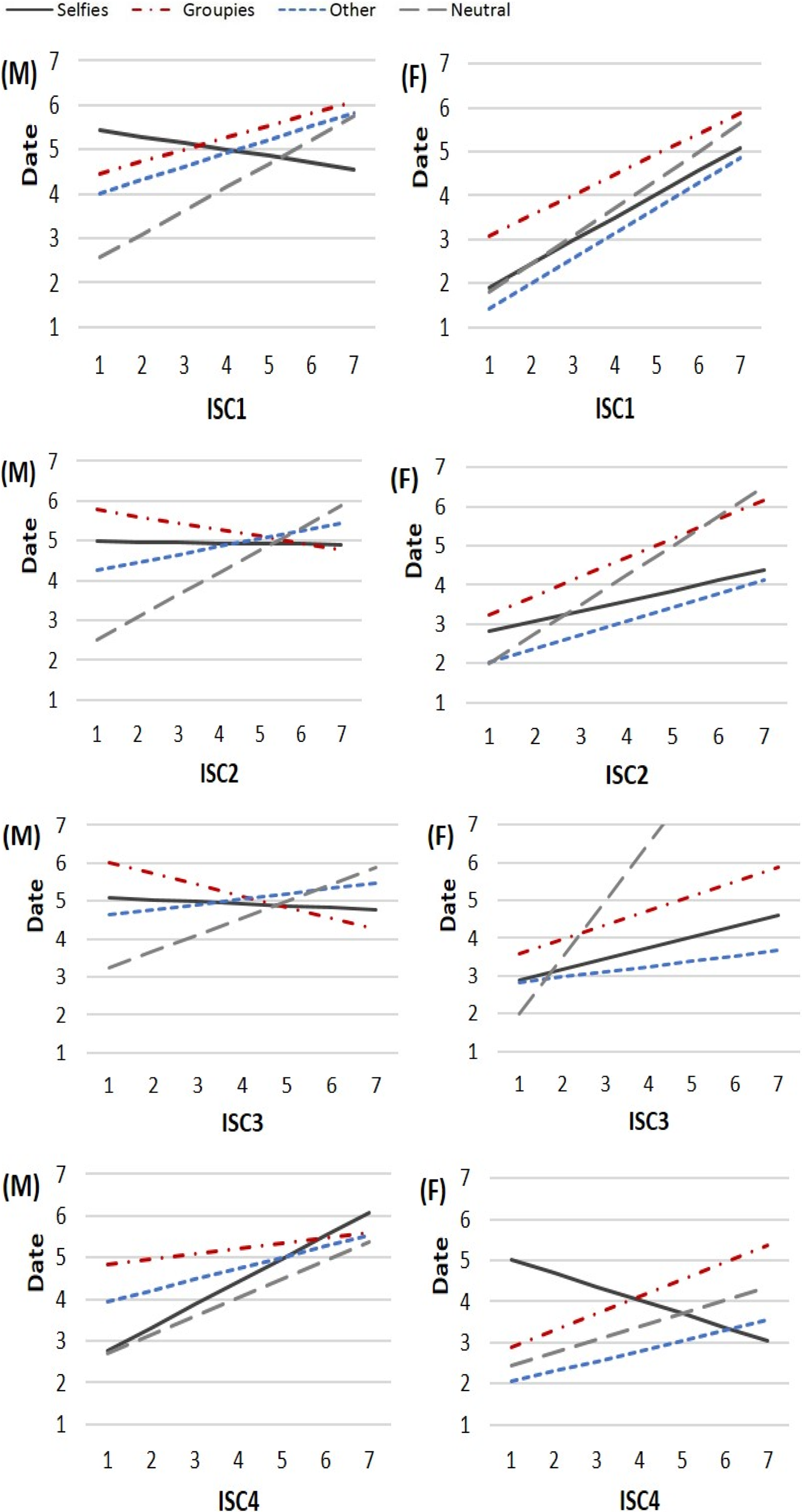
Interaction effects of photo types with individual items of intrasexual competition on desire to date (date). The left panel (M) shows the results from male participants exposed to female Instagram user. The right panel (F) shows the results from female participants exposed to male Instagram user. Date = desire to date; ISC1 = intrasexual competition Item 1 (If a competitor thinks that I am attractive, he or she will stay away from my romantic partner); ISC2 = intrasexual competition Item 2 (I work out, exercise, or watch what I eat because I want a body that will impress [potential] romantic partners); ISC3 = intrasexual competition Item 3 (I prefer to go out to clubs with the same sex friends who are less attractive than I am); ISC4 = intrasexual competition Item 4 (Having a romantic partner is important to me).
In males, the R 2 was .194 for the regression model with ISC1, .169 for ISC2, .216 for ISC3, and .210 for ISC4, respectively. The plots for ISC2 and ISC3 were similar to the plot for ISC composite score in Figure 3. The plot for ISC4 showed different pattern from Figure 3. For ISC2 and ISC3, the simple slopes were also significantly different between groupies and neutral photos. Both ISC2 and ISC3 showed negative relationship with dating desire in groupies, whereas these 2 items showed positive relationships in neutral photos (same results as those for ISC composite score in Figure 3). In addition, for ISC1, ISC2, and ISC3, the simple slope was significantly different between selfies and neutral photos. There was a significant positive relationship between the ISC items (1, 2, and 3) and dating desire in neutral photos, whereas this relationship was negative but did not reach statistical significance in Selfies. There was no significant interaction between ISC4 and photo type.
In females, the R 2 for the regression model was .409 for ISC1, .366 for ISC2, .352 for ISC3, and .330 for ISC4, respectively. The plots in Figure 4 showed similar patterns to the plot in Figure 3, except for ISC4. No significant interaction was found with ISC1, ISC2, and ISC3 (same results as those for ISC composite score). The simple slope for ISC4 was in the negative direction in selfies, whereas this relationship was in the positive direction in other photo types. Between groupies and selfies, the estimated difference in simple slope was 0.745, p = .058.
Discussion
Key Findings
Drawing from the renovated hierarchy of primary human needs (Kenrick et al., 2010), this study addresses people’s intersexual attraction to online photos from the lens of evolutionary psychology. The present article extrapolated the evolutionary root of individual difference factors (ISC for mate, NfP, NtB, and loneliness) relevant to the Instagram photo-posting/viewing culture. The findings confirmed the assumption that a potential mate who posts selfies and groupies is perceived by opposite-sex viewers to be more narcissistic compared to a potential mate who posts neutral photos. Heterosexual/bisexual male viewers’ ISC for mates, NfP, NtB, and loneliness moderate the relationship between photo types and dating desire.
Evolutionary psychological perspectives on ISC for mate, NfP, NtB, and loneliness shed lights on the dynamics of intersexual attraction. The most noteworthy and revealing findings of the current study are the directions of interaction effects. For male viewers, there was a positive association between dating desire and the moderator variables (ISC for mate, NfP, NtB, and loneliness) for the potential mate’s neutral photos (dotted gray lines in Figure 3), whereas there was either little (ISC for mate) or negative (NfP, NtB, and loneliness) relationship between dating desire and the moderators for the potential mate’s groupies (group selfies; dotted red lines in Figure 3). More specifically, heterosexual/bisexual male viewers with higher NfP, NtB, and loneliness levels indicated higher dating intention than those males with lower NfP, NtB, and loneliness levels when they were exposed to the target female Instagram user who posted neutral photos (dotted gray lines in Figure 3). In contrast, heterosexual/bisexual male viewers with higher NfP, NtB, and loneliness levels indicated lower dating intention than those males with lower NfP, NtB, and loneliness levels when they were exposed to the target female Instagram user who posted groupies (dotted red lines in Figure 3). The same interaction appears among lonely males. These results indicate a remarkable similarity among the outcomes of loneliness, NtB, and need for popularity. All these sentiments push individuals to seek stronger social relationships, but for different reasons and motivations as explicated in the renovated pyramid of fundamental human motives (need for affiliation in lower hierarchy vs. status-seeking in higher hierarchy, as visualized in Figure 1). It could be that need for popularity (status-seeking) drives males toward becoming popular themselves, hence being less attracted to a potential partner who posts groupies in which she is already surrounded by another male and who may take attention or popularity away from the viewer himself. Men with high NfP want more attention toward themselves from others, but the target female’s groupies show her being the center of attention and being surrounded by male friends, which explains their relatively unfavorable evaluation of the potential female dater who posted groupies.
Conversely, females with higher ISC for mate, loneliness, NtB, and need for popularity were more attracted to the target male’s groupies. This may indicate different evolutionary strategies between the two sexes. This finding is consistent with the theoretical proposition that women are more likely than men to regard social status (e.g., popularity and fame) as a necessity in a male mate (Li, Bailey, Kenrick, & Linsenmeier, 2002). Furthermore, it could be that females with higher ISC for mates, NfP, NtB, and loneliness look at males with friends as signs of being trustworthy and that trustworthiness makes those men more attractive (Fletcher, Tither, O’Loughlin, Friesen, & Overall, 2004). Neutral photos are the lowest in narcissistic cues and appeal more to men with higher NfP because it could mean they receive more attention from the potential date. This finding is also consistent with the extant literature such that when mating motives are activated, men are motivated by status needs to a greater degree than women, have their sense of status more strongly linked to intrasexual competitive success, and are likely to show off (Kenrick et al., 2010).
In the current empirical data, men with high ISC for mates show consistently high dating intention regardless of the target female’s photo type. This suggests that men with high ISC tendency are not selective about the characteristics they desire in casual dating and don’t tend to select mate based on the mate’s relative competitive success unless they desire long-term mates in whom they will make potentially high investments (Kenrick et al., 2010). Another alternative explanation is that men with high ISC for mate are not shying away from competition, hence not heavily influenced by the personality type of the potential mate (either highly attractive and noticed female in groupies or reserved and less noticed female who only posts neutral photos). In contrast, men with low ISC for mates were heavily influenced by the potential mate’s personality type manifested in different kinds of photos, showing the highest level of attraction toward popular and sociable females (females with high social connection who appear in groupies) and the lowest level of attraction to the less noticed females (females with less social connections who post neutral photos).
Theoretical Contributions and Practical Implications
This study makes contributions to theories of social media effects as well as evolutionary psychological theories of narcissism and romantic attraction. ISC, NfP, NtB, and loneliness, as significant moderators, can be added to the models that explain the association between social media photos and psychological states (Ridgway & Clayton, 2016), as proposed and visualized in Figure 1. This study also reexamined the premise of the narcissism sexual appeal hypothesis. The major takeaway is that individual differences in male audiences play significant moderating roles in their perception of the potential mate’s attraction and intention to date her. Theoretically, those specific traits (ISC, NfP, NtB, and loneliness) parallel three primary human motives (mate acquisition, status, and affiliation) which affect how people react to stimuli of a hypothetical mate. Studies on interpersonal attraction tend to focus on attitude similarity or on the physical attributes of the target (Klohnen & Luo, 2003). The current study experimented with different combinations of motives-stimuli and rendered significant results both in the perception of the target’s personality (level of narcissism) and behavioral intention (dating intention). Although both genders perceived selfies and groupies as more narcissistic than neutral photos, heterosexual/bisexual males with high NfP, NtB, and loneliness unfavorably evaluate selfies and groupies posted by the potential mate, which indicates males’ lower tolerance of narcissistic behavior of potential dates when they feel lonely and have high need for belonging and popularity.
This study provides implications for practical uses of online dating apps and social networking sites regarding strategic self-presentation. For lonely males with high NtB and NfP, viewing neutral photos resulted in higher dating intention, despite the fact that the target female (the source of visual messages) was not seen in the photos, except for the minimal interpersonal cues shown via her profile name and small profile photo in the left corner of her Instagram account page. This study sheds some lights on effective strategies for increasing attraction when appealing to lonely males with high NfP and NtB, by showing the power of neutral photos that do not reveal the person’s physical features but only send implicit signal about personality. Neutral photos can be more effective to appeal to men who feel lonely, while groupies won’t be appealing to them. For dating apps and online dating sites, winning trust and attraction of potential dates is the ultimate goal. Dating site profile pictures portray different personalities, goals, and values of the person and reflect the anticipated nature of the relationship (S. V. Jin & Martin, 2015).
The current findings are also beneficial for social media marketers and influencer marketing professionals. Picking certain types of photos in sponsored posts influences perceived narcissism or attractiveness of the spokesperson/endorser of the promoted brand or cause. It is important to select photo types that elicit the desired affection from viewers, based on the personality profile they have. The results showed that narcissistic visuals interact with male consumers’ ISC, NfP, NtB, and loneliness (moderation effects) in the context of social media–based visual appeals.
Limitations and Future Directions
This study has several limitations that need to be addressed in this line of future research. First, with regard to gender differences, there are many promising avenues for future research. When confronted with highly attractive rivals, women tend to “dislike” such rivals, particularly during periods of high estrogen (Fisher, 2004), or when ISC is made salient when the same-sex rival is conversing with a male (Baenninger, Baenninger, & Houle, 1993; Buunk & Massar, 2012). Future research can experimentally prime females’ ISC and jealousy in the Instagram interface, leveraging its various features and functions. For example, future research can measure female Instagram users’ jealousy and envy, during periods of high estrogen, when male Instagram users “like” and “comment” on attractive female rivals who show off large breasts and low waist-hip-ratio (Fink, Klappauf, Brewer, & Shackelford, 2014) in their Instagram selfies and groupies. Future research also needs to examine differences across sexual orientations (Li, Smith, Griskevicius, Cason, & Bryan, 2010). Competition for mates could produce different strategies not only between two sexes (Buunk & Fisher, 2009) but also between heterosexual/bisexual individuals and homosexual individuals (Li et al., 2010).
Second, as with any experimental study, it was hard to completely eliminate “demand characteristics” although (1) there was no direct interpersonal contact between the researcher and the participant and (2) a between-subjects design rather than a within-subjects design was employed according to Rubin and Badea’s (2010) recommendation. There is a possibility for the research hypothesis to be found out by the participants since participants rated the perceived narcissism of the target before they indicated desire to date the target person. Follow-up studies need to employ additional approaches to minimize or address demand characteristics. For example, future research can employ deception technique or include perceived awareness of the research hypothesis scale (Rubin, 2016) in the postexperimental questionnaire.
Third, future research needs to variate many other attributes of photos (clothes, accessories, facial expressions, background, etc.) to test how these factors affect intersexual attraction and dating desire. To increase external validity, follow-up studies need to manipulate various attributes of the potential target date. These attributes include sociodemographic variables such as ethnicity, age, income, and educational level as well as physical characteristics like body image (thin vs. obese, waist–hip ratio), skin color, hair color, and physical attractiveness level. Additional manipulation of the popularity level of the target date of the opposite-sex (i.e., variating the number of followers [highly popular Instagram user with millions of followers vs. unpopular Instagram user with only a few followers]) may interact with participants’ NfP, loneliness, and ISC for mates.
Fourth, future research needs to differentiate between participants’ intention to maintain a long-term, committed relationship (parenting motives) and desire to pursue a short-term, casual dating relationship (mate acquisition motives). ISC for mates, loneliness, and NfP may have differential effects on dating intention, depending on their motivations for and goals of initiating a romantic relationship (lifetime partner for marriage driven by parenting motives vs. casual date for one-night stand driven by immediate physiological motives or short-term mate acquisition motives, for instance; S. V. Jin & Martin, 2015). Furthermore, people’s dating desire and intersexual attraction may be contingent upon their weighted importance of various partner characteristics including physical attractiveness (as an indicator of health and youth), socioeconomic status (income, occupation, social status, education, intelligence), and personalities (reliable, kind, humorous, creative, etc.; Buss, 1989). Follow-up studies need to further examine these factors by manipulating various characteristics of the target photo poster as well as measuring photo viewers’ weighted importance of each characteristic. Personality match versus mismatch between the poster and the viewer may also play a mediating role in interpersonal attraction.
Despite several shortcomings, this study provides new avenues for research concerning the effects of Instagram posts and the interaction between viewers’ personalities and visual stimuli on dating intention and interpersonal attraction.
Footnotes
Declaration of Conflicting Interests
The author(s) declared no potential conflicts of interest with respect to the research, authorship, and/or publication of this article.
Funding
The author(s) received no financial support for the research, authorship, and/or publication of this article.