




Abstract
The context of a famous novel by Milan Kundera (Immortality) suggests that when faced with a life-or-death situation, every woman would prefer to save her child than her husband, left hanging whether every man would do the same. We labeled this as the Kundera hypothesis, and the purpose of this study was to test it empirically as we believe it raises a thought-provoking question in evolutionary terms. Specifically, 197 college students (92 women) were presented a questionnaire where they had to make different decisions about four dilemmas about who to save (their mate or their offspring) in two hypothetical life-or-death situations: a home fire and a car crash. These dilemmas involved two different mate ages (a 25- or a 40-year-old mate) and two offspring ages (1- or a 6-year-old child). For comparative purposes, we also included complementary life-or-death dilemmas on both a sibling and an offspring, and a sibling and a cousin. The results generally supported the Kundera hypothesis: Although the majority of men and women made the decision to save their offspring instead of their mate, about 18% of men on average (unlike the 5% of women) consistently decided to save their mate across the four dilemmas in the two life-or-death situations. These data were interpreted with reference to Hamilton’s inclusive fitness theory, the preferential role of women as kin keepers, and the evolution of altruism toward friends and mates.
“At the very same moment that Professor Avenarius was putting on his socks, Agnes was remembering the following sentence: ‘Every woman prefers her child to her husband.’ Her mother said that to her, in a confidential tone (in circumstances now forgotten) when Agnes was about twelve or thirteen years old” (Kundera, 1991, Immortality, p. 258). Given a critical situation, would a woman always prefer her child to her husband, as Kundera’s novel character suggests? And conversely, as one might well implicitly infer, would a man prefer his wife to his child, at least sometimes? This is the core question at the center of what we have informally called the Kundera hypothesis, and testing it empirically is the main purpose of the present study. From an evolutionary perspective, we think that this hypothesis can be theoretically framed in the context of at least three significant sources of literature: kin altruism, as shaped by Hamilton’s inclusive fitness theory; the preferential role of women as “kin keepers” (compared to men); and the evolution of altruism toward friends and mates.
Kin Altruism and Inclusive Fitness Theory
Hamilton’s (1964) inclusive fitness theory (but also see contributions by Fisher, 1930; Haldane, 1932; Maynard Smith, 1964) has been considered one of the most important extensions of Darwin’s theory in the last century and is the basis of any significant explanation of social evolution in modern biology. It has had a substantial influence on our understanding of human behavior in fields such as altruism, family psychology, group formation, and aggression, among others (Buss, 2015; West & Gardner, 2013). As widely known, Hamilton’s theory emphasizes the relevance of the degree of genetic relatedness for fitness over the role of reproductive individual success as typically pointed out by Darwin, by providing an evolutionarily consistent explanation to the “problem of altruism,” at least in the realm of kin relations.
Empirical evidence in favor of inclusive fitness theory in the psychology field, particularly altruism and social exchange, has been overwhelming in recent decades as it has sometimes exceeded the predictive power of any purely psychological theory on altruism in social psychology (see, e.g., Burnstein, Crandall, & Kitayama, 1994). Research into mammals and other nonhuman species (e.g., Alcock, 1993; Silk, 2002), ethnographic records in non-Western societies (e.g., Betzig, Borgerhoft Mulder, & Turke, 1988; Chagnon & Irons, 1979), historical records in Western countries from the 15th to the 19th century (e.g., Becker, 1991; Voland, Siegelkow, & Engel, 1991), cross-cultural data on grief and mourning (e.g., Rosenblatt, Walsh, & Jackson, 1976), records about ancient and contemporary natural disasters (e.g., Drabek, Key, Erickson, & Crowe, 1975; Grayson, 1993; McCullough & Barton, 1991), data on inheritance distributions (e.g., Smith, Kish, & Crawford, 1987), stepparenting and parental uncertainty literature (e.g., Anderson, Kaplan, & Lancaster, 1999, 2007; Daly & Wilson, 1982, 1988), and research on full sibling versus half-sibling relationships (e.g., Jankowiak & Diderich, 2000; Pollet, 2007) clearly point out the significant bias toward kin (vs. nonkin), particularly close kin (vs. distant kin), when referring to helping behaviors and/or altruistic acts, which agrees with inclusive fitness theory.
Women as Kin Keepers
Most literature focused on studying the potential differences between men and women regarding family can be summarized as follows: “…females are much more likely to keep track of kin and are more concerned about their welfare than men” (Hames, 2015, p. 518). In fact, it has been shown that women recall more relatives than men within their particular genealogy (but see Chagnon, 1988, for an exception with Yanomamo traditional society), and that family seems more important for women’s personal identity than for men’s (Salmon & Daly, 1996). It has also been pointed out that women’s attention to kin network formation and maintenance across their lifetime, particularly at middle and older ages, is substantially better than that of men, which is generally more directed to nonkin networks (Benenson et al., 2009; Neyer & Lang, 2003; Scelza, 2009). The grandparent solicitude literature also clearly indicates that grandchildren feel more close to, and get more attention and resources from their grandmothers, than they do from their grandfathers (see, e.g., Euler & Weitzel, 1996). Something similar happens with matrilinear aunts and uncles (Gaulin, McBurney, & Brakerman-Wartell, 1997). Not surprisingly, the presence of a grandmother, or even a firstborn daughter, who can play an alloparenting role, and the size of the maternal kin network have often been found to be related to both higher survival and better health among women’s offspring and also to a narrower interbirth interval (Hadley, 2004; Hames & Draper, 2004; Hawkes, O’Connell, & Blurton Jones, 1997; Snopkowski & Sear, 2013). Therefore, it seems tenable to hypothesize that family plays a more central role for women, compared to men, in terms of their inclusive fitness.
Altruism Toward Friends and Mates
From an evolutionary perspective, Trivers’s (1971) theory of reciprocal altruism is for nonkin altruism what inclusive fitness theory is for kin altruism. Basically, Trivers’s theory proposes that among nonkin, the rule of thumb for understanding altruism is tit-for-tat; that is, the near future reciprocation by the receiver of an altruist act in favor of the donor of that act (but see, e.g., Nowak, 2006; Zahavi, 1995, for alternative explanations). However, there are two specific cases, friends and mates, where the understanding of altruistic acts seems to fall between inclusive fitness theory and reciprocal altruism theory. In fact, it has been pointed out that some nonkin categories seem to be an exception to the leading rule that people support kin more than nonkin (e.g., Stewart-Williams, 2007). Paradoxically, an immediate reciprocation orientation in friendship or marriage has been found to be associated with a feeling of a true friendship lacking or with marital dissatisfaction and negative marriage expectations (Shackelford & Buss, 1996).
Regarding friends, a classic study by Essock-Vitale and McGuire (1985), about patterns of helping in a group of 300 Caucasian middle-class middle-aged Los Angeles women, revealed that, beyond kin, close friends are often the beneficiary and contributors of help. In their study 1, Burnstein, Crandall, and Kitayama (1994) also report that step-kin might be more probably the receiver of an altruist act in a hypothetical life-or-death situation than an acquaintance and emphasize the potential role of culture in defining the nature of some relationships. More recently, Stewart-Williams (2007, 2008) has shown that in high-cost hypothetical help situations (e.g., in response to a request for donating a kidney to someone who needs it), siblings are more likely selected as help recipients than friends; however, in low-cost real help situations (e.g., to have actually given emotional support to someone in an everyday situation) the reverse is the case: Friends are more often the recipients of help than siblings (Steward-Williams also reports that in medium-cost real help situations, such as providing true financial support to someone, friends are the beneficiaries of help as often as siblings.) Perhaps not surprisingly, young adults usually feel emotionally closer to friends than to siblings (Korchmaros & Kenny, 2001, 2006; Kruger, 2003; Steward-Williams, 2008), although this may change as they age (see, e.g., Neyer & Lang, 2003).
Less attention has been paid to mates or romantic partners’ altruism, either as itself or as being related to kin and friends’ altruism. To our knowledge, only two studies have addressed this issue (Neyer & Lang, 2003; Steward-Williams, 2008). Although one might initially think that, in evolutionary terms, a mate is more valuable than a friend, but less than kin, the results of these two studies consistently indicate that overall people feel emotionally closer to, and receive more help from, their mates than from anyone else, including kin. According to Steward-Williams (2008), it should be of no surprise that altruism toward mates is greater than toward friends as mates are both friends and sexual partners who can potentially share offspring and, thus, attain a surrogate kin status. In fact, in his study, Steward-Williams states that the amount of help received from siblings and mates is comparable, and in both cases, it is greater than the help received from friends, but only when the cost of help is hypothetically high. When the cost of help is low or medium, subjects report to have received significantly more help from mates than from both siblings and friends. In addition, as Steward-Williams (2008) points out, altruism between mates is indirectly beneficial for their children, as well as a sign for the two members of a potential long-term couple of a suitable partnership and also of the likely successful cooperation as parents in the future.
In the same vein, Neyer and Lang (2003) report similar results, but this time not only with a sample of college students, as Steward-Williams (2008) does, but with a much bigger sample with individuals aged from 20 to more than 65 years old. According to these authors, the prevalence of altruism toward mates is grounded in the fact that a romantic partnership is basically an attachment relation and is evolutionary critical for reproductive success (see also, e.g., Zeifman & Hazan, 1997), which becomes a quasikin relationship in practice. To support their arguments, Neyer and Lang (2003) also report that only among singles, particularly as they age, does altruism toward kin continue to be strong.
The Current Study
Overall, contemporary research reveals, on the one hand, that Hamilton’s theory of inclusive fitness constitutes a suitable framework to understand altruistic behavior in humans, particularly among kin. On the other hand, it also indicates that kin networks seem more meaningful for women than for men, whereas friends and mates remain the two potential exceptions to Hamilton’s rule. In fact, in high-cost help situations, altruism toward close relatives and mates is typically greater than altruism toward other distant kin and friends. It is not clear, however, what happens if individuals have to make a decision in a dramatic life situation between a close relative and a mate. Namely, the dilemma between an offspring and a mate is that faced by what we call the Kundera hypothesis, which suggests this would be rather a gender-biased decision, with women more likely to save their children than their mates to a greater extent that men. Based on current evidence, which emphasizes the role of woman as primary kin keepers, this might well be the case.
In order to test this hypothesis, we designed a short questionnaire where approximately the same number of women and men were asked about their initial decision about two hypothetical life-or-death situations (a home fire and a car crash), where both a mate and an offspring would be involved, other than themselves. No information about the gender of either the mate or offspring was provided, although we did provide information about age (with two different ages attributed to mates, 25 and 40 years old, and offspring, 1 and 6 years old). This made provided four different combinations to test whether the reproductive value of both (higher for the younger mate and the older offspring and lower for the older mate and the younger offspring) may influence decision-making. For control, and also distracting, purposes (i.e., what we were actually looking for was not too obvious for the participants), we included two additional dilemmas to be solved in the questionnaire, involving a sibling versus an offspring (r = .50) and a sibling versus a cousin (r = .125) in equivalent life-or-death situations (an earthquake and an avalanche for the sibling vs. offspring dilemmas; a train derailment and a boat sinking for the sibling vs. cousin dilemmas). Two different ages were also attributed to each pair replicating roughly the mate versus offspring ages dilemma (siblings: 25 and 40 years old; cousins: 15 and 35 years old). We adjusted the ages of first cousins to make them feasible for the average of our intended sample’s age (i.e., about 20-year-old college students).
We first hypothesized that both men and woman would make the decision to save their offspring more often than their mates. In the end, and based on Hamilton’s theory, offsprings are close kin with a .50 degree of relatedness. However, following the Kundera hypothesis, we hypothesized that this trend would be more pronounced in women than in men, with more men making the decision to save their mates instead of their offspring than women. We also expected this trend to be modulated by the age of both mates and offspring in men, with a higher tendency to save their mate, the younger the mate and their offspring were (i.e., 25-year-old mate vs. 1-year-old offspring dilemma, where a mate’s highest reproductive value is contrasted with an offspring’s lowest reproductive value). Conversely, we expected there would be a lower tendency to save their mate in the reverse situation (i.e., when both the mate and offspring are older: 40-year-old mate vs. 6-year-old offspring dilemmas), where a mate’s lowest reproductive value, particularly in women, is contrasted with an offspring’s highest reproductive value.
Method
Participants
The sample consisted of 197 college students (92 women and 105 men; M age = 21.1 years, SD = 3 years) who attended a public urban university in eastern Spain and volunteered for this study. They were taking classes at the School of Psychology or the College of Education (37.6%), the School of Economics and Business Administration (23.4%), or the School of Technology (37.6%). Their socioeconomic status was mainly middle class, typical of most college students in Spain.
Questionnaire and Procedure
The participants were tested in groups in their university classrooms through a brief paper-and-pencil questionnaire composed of 24 questions. Prior to delivering the questionnaire, the participants were told that they would find a series of risk situations where an unforeseen accident had taken place, and they would need to decide between two options. We also insisted on (1) the questionnaire being completely anonymous (only birth date and gender information were collected), so that no one could identify their individual responses, (2) there being no correct or incorrect answers, (3) it being important not to leave any blank questions despite the temptation to do so, and (4) it being advisable not to spend a long-time thinking about each question (although they were also told that there was no time limit to complete the questionnaire). We conveyed this information first verbally and that it was also available on the front page of the questionnaire booklet.
Every question of the 24 presented a different hypothetical situation involving the participant and two other people where an accident risking the lives of them all had suddenly taken place, and the participant had to make a life-or-death decision about which of these two persons to save. During the questionnaire, we systematically varied the degree of genetic relatedness of the two people regarding the participant, the age of these two people, and the kind of accident that they were all involved in. More specifically, in eight of the questions, the two people accompanying the participant were his or her mate and an offspring (this was the real target of this study; degree of genetic relatedness with the participant = 0 and 0.5, respectively); in another eight questions, those people were a participant’s sibling and a participant’s offspring (degree of genetic relatedness with the participant = .50 in both cases); and in the remaining eight questions, a participant’s sibling and a participant’s cousin were involved in the accident (degree of genetic relatedness with the participant = .50 and .125, respectively). Hypothetical mates, offspring, siblings, and cousins also varied, as mentioned before, as regard their age. Thus, they could be younger or older (i.e., a 25- or a 40-year-old mate, a 1- or a 6-year-old offspring, a 25- or a 40-year-old sibling, a 15- or a 35-year-old cousin). This resulted in four different combinations for all three blocks of comparisons (e.g., a 25-year-old mate vs. a 1-year-old offspring, a 25-year-old mate vs. a 6-year-old offspring, a 40-year-old mate vs. a 1-year-old offspring, and a 40-year-old mate vs. a 6-year-old offspring). Every specific combination within each block was presented twice in the context of two different critical situations: home fire and car crash for the mate versus offspring combinations, earthquake and avalanche for the sibling versus offspring combinations, and trail derailment and boat sinking for the sibling versus cousin combinations.
The presentation order of the 24 questions was not obviously made by blocks but randomly by mixing all three different combinations of participants’ companions and the six life-or-dead situations. The structure and writing of each question was similar. For example, “You are at home with your 25-year-old sibling and your 1-year-old offspring. Then all of a sudden an earthquake happens and both are trapped in different rooms of your apartment. But you only have the time and resources to help one of them to escape from the building. We know this is a difficult decision to make, but remember you can only save one of them. Who would you save?” Then the participant had to make his or her choice between the two displayed people’s options.
Results
We first computed the number of participants who decided to save each of the two people involved in every specific combination and life-or-death situation. In order to see whether there were any significant gender differences, we applied a series of χ2 tests of independence (1, N = 197), replaced with a Fisher’s exact test when cell distributions were extremely unequal. As we can see in Table 1, most of the subjects preferred to save their offspring than their mates or siblings, and their siblings than their cousins. However, only in the offspring versus mate combinations were gender differences significant and consistent in decision-making, with women saving their offspring more often than men consistently across the different age combinations and situations or, in another words, with a few more men in all these age combinations and situations preferring to save their mates instead of their offspring. There were also two sporadic, but significant, gender differences in the sibling versus cousin dilemmas, but they were inconsistent across the two tested life-or-death situations.
Percentage of Subjects Who Indicated That They Would Save Their Offspring Over Their Mates, Their Offspring Over Their Sibling, and Their Sibling Over Their Cousins, in a Live-or-Death Situation (Home Fire, Car Crash, Earthquake, Avalanche, Train Derailment, Boat Sinking).
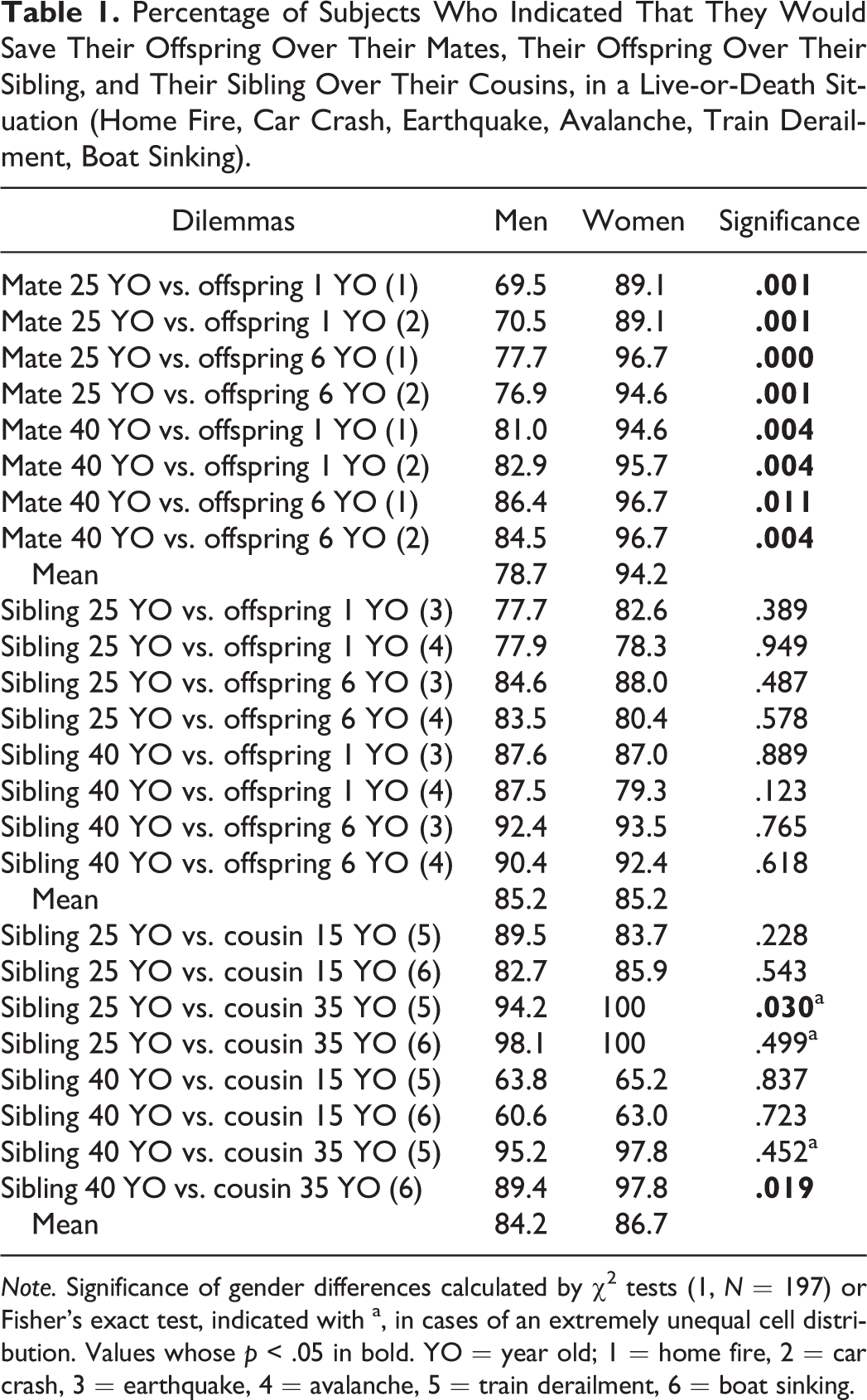
Note. Significance of gender differences calculated by χ2 tests (1, N = 197) or Fisher’s exact test, indicated with a, in cases of an extremely unequal cell distribution. Values whose p < .05 in bold. YO = year old; 1 = home fire, 2 = car crash, 3 = earthquake, 4 = avalanche, 5 = train derailment, 6 = boat sinking.
In order to analyze the potential influence of the mate’s age in decision-making, we focused only on those participants who consistently made the decision to save their mate over their offspring in the two life-or-death situations and set aside those participants who only saved their mates in one situation, but not in the other. We did the same in the two other dilemmas regarding the participants who consistently decided, or did not, to save their sibling over their offspring and their cousin over their sibling. In Tables 2 and 3, we can respectively see the percentage/number and the distribution of those participants in our sample, which were consistent and inconsistent. By making this distinction, we increased, on the one hand, the strength of our results with regard to the potential age effects obtained from our analyses as they were based conservatively only on those subjects who were consistent in their decisions across situations. On the other hand, by inspecting the inconsistent subjects’ responses, we had a chance to roughly estimate the degree of decision-making difficulty experienced by the participants across the different dilemmas. We considered that an inspection of inconsistencies could play a similar role as reaction times regarding the analyses of cognitive processes with, for example, more inconsistencies about a certain dilemma, but not about another, which would reveal a higher degree of hesitation about that dilemma.
Percentage of Participants Who Consistently Indicated That They Would Save Their Mate Over Their Offspring in Both the Home Fire and Car Crash Situations (N = 173, 86 Men and 87 Women); Their Siblings Over their Offspring in Both the Earthquake and Avalanche Situations (N = 154, 83 Men and 71 Women); and Their Cousins Over Their Siblings in Both the Train Derailment and Boat Sinking Situations (N = 152, 78 Men and 74 Women).
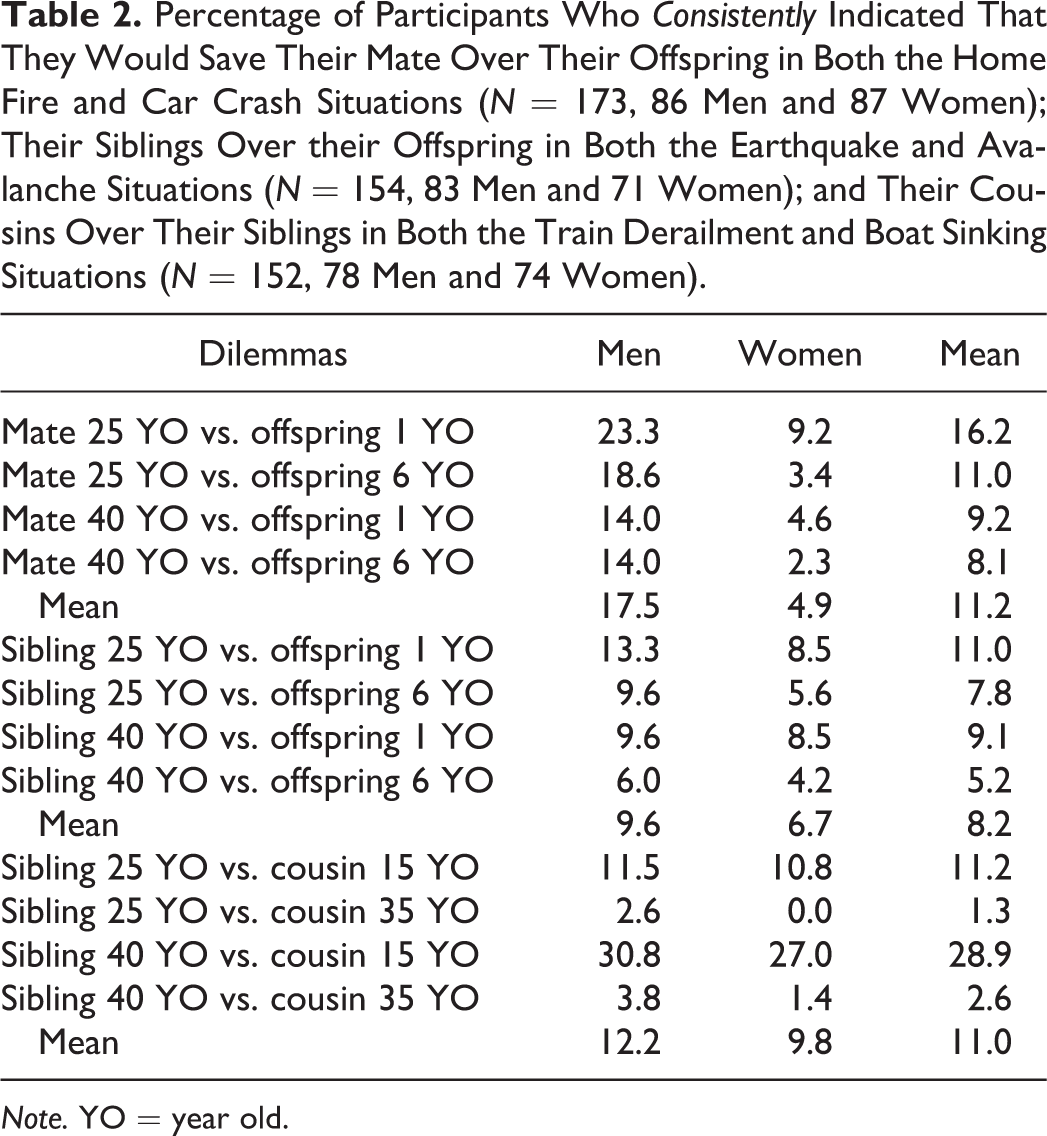
Note. YO = year old.
Number of Participants Who Inconsistently Indicated That They Would Save Their Mate Over Their Offspring (n = 22; 18 Men), Their Siblings Over Their Offspring (n = 43; 22 Men), and Their Cousins Over Their Siblings (n = 45; 27 Men) Depending on the Two Live-or-Death Situations Displayed Per Dilemma.

Note. In the mates versus offspring dilemmas, and particularly in the siblings versus offspring dilemmas, some subjects were inconsistent in more than one specific comparison, which meant discrepancy between the number of participants who were inconsistent and the total number of inconsistencies. YO = year old.
To examine the potential influence of the mate’s age on the decision-making for consistent participants, we performed a series of McNemar tests by contrasting the four age combinations. We first conducted a series of analyses, including the responses of both men and women, and then a second series of analyses specifically for men and women’s responses. For the mate versus offspring dilemma in general (1, N = 173), we found significant differences between the 25-year-old mate versus 1-year-old offspring dilemma and the other three dilemmas (p ≤ .004, M 25 vs. 1 = 16.2 > M 25 vs. 6 = 11 = M 40 vs. 1 = 9.2 = M 40 vs. 6 = 8.1). Specifically, for men’s responses (1, n = 86), we found significant differences between the 25-year-old mate versus 1-year-old offspring dilemma and the two dilemmas involving the 40-year-old mate (p = .008 in both cases, M 25 vs. 1 = 23.3 > M 40 vs. 1/6 = 14). For women’s responses (1, n = 87), only one significant difference was found between the 25-year-old mate versus 1-year-old offspring and the 40-year-old versus 6-year-old offspring dilemma (p = .031, M 25 vs. 1 = 9.2 > M 40 vs. 6 = 2.3).
We also tested for differences between decisions to save a 25- versus a 40-year-old-mate for both men and women by collapsing data across the two offspring conditions (1- and 6-year-old) regarding the number of times that each participant had saved their mates. For this analysis, we selected only those participants who had saved consistently their mates across the two life-or-death situations presented in at least one of the four dilemmas conditions; that is, 19 men and 8 women, score range = 2–8 times. Wilcoxon signed-rank tests indicated that for both cases, men and women, 25-year-old mates were saved a significantly higher number of times than 40-year-old mates (men, M 25 = 3.7 > M 40 = 2.5, and women, M 25 = 2.8 > M 40 = 1.5; Z = 2.4 and 2.2, respectively; p < .05).
In the examination of the inconsistent participants, we first found for the mates versus offspring dilemma that only 22 participants of the whole sample of 197 (11 %), 17 men (16 % of the men’s sample) and 5 women (5 % of the women’s sample) were inconsistent, but 43 and 45, respectively (22–23%), for the other two dilemmas. Overall, 129 participants’ inconsistencies were identified across the study, with some participants (specifically 1 subject in the mates vs. offspring dilemma and 10 subjects in the siblings vs. offspring dilemma) being inconsistent in more than one of the four specific comparisons presented per dilemma; 18% of these inconsistencies corresponded to the mates versus offspring dilemma. Finally, an analysis of the distribution of the inconsistencies by each one of the two life-or-death situations displayed per dilemma indicated that this distribution was even for the mates versus offspring dilemmas, with 11 participants (48 %) saving the mate in the home fire situation, but not in the car crash situation, and 12 participants (42 %) doing the reverse.
Discussion
Daly (2015) recently stated: “Ask any sample of people who they feel closest to, care the most about, would sacrifice the most to help, and the bulk of the nominees will be either close genetic relatives or the romantic partners of your respondents” (p. 500). But what would happen if one had to choose between a close genetic relative and a romantic partner in a life-or-death situation? This was the core question at the center of the present study, and according to what we informally called the “Kundera hypothesis,” this response would be gender-biased: For example, women always being more prone to save their children than their mate and men not being necessarily that clearly determined about what to do when faced with the same dilemma.
The data found in this study are apparently compatible with this hypothesis: Although most of both the tested women and men were more prone to save their offspring than their mate in a hypothetical life-or-death situation, every comparison presented more men who were significantly inclined to save their mate instead of their offspring. On average, the number of men who contemplated the possibility of saving their mates instead of their offspring tripled the number of women. The analyses of inconsistencies (the participants who decided to save their mate in one of the two presented life-or-death situations but not in the other) indicated that this was no easy decision to make.
Moreover, as hypothesized, we also found that decision-making in this dilemma was mediated by age, with both men and women preferring to save the 25-year-old mate significantly more than the 40-year-old mate and more men preferring to save their 25-year-old mate in contrast to their 1-year-old offspring than their 40-year-old mate either against their 1- or 6-year-old offspring. Surprisingly enough to our prior predictions, significantly more women preferred to save their 25-year-old mate against their 1-year-old offspring, than to save their 40-year-old mate against their 6-year-old offspring. This finding indicates that, in spite of the Kundera hypothesis general confirmation, some women were not completely immune in some specific, but minority, contexts to the counterintuitive feeling to save their mates instead of their own offspring. Finally, we found that most of the inconsistencies in this dilemma concentrated in the 25-year-old mate versus 1- or 6-year-old offspring combinations. Once again, this probably indicates the high level of hesitation and/or conflict experienced by participants when having to make their decisions on these two specific combinations.
The essence of the found results about this dilemma can be easily interpreted following classic Hamilton’s arguments. In the end, a vast majority of both men and women made the decision in a critical situation to save those that better guaranteed their inclusive fitness, their offspring (r = .50). Moreover, both men and women modulated their decisions, sometimes depending on the age of mate and offspring involved in the comparisons, which would suggest that parental investment in offspring (higher for a 6-year-old child than for a 1-year-old child) and the mate’s reproductive value (higher for a 25-year-old woman than for a 40-year-old woman) were somehow implicated in the decisions that the participants made. However, the consummation of the Kundera hypothesis once again confirms that Hamilton’s rule can also be affected by other variables, like the closeness of some nonkin relationships, for example, friendship or, particularly here, mating (as already found in other studies; e.g., Neyer & Lang, 2003; Stewart-Williams, 2007, 2008) and gender. The fact that roughly 3 times the number of men than women stated that they would prefer to save their mates instead of their offspring in a life-or-death situation could reveal that women have a stronger bias toward family than men, which agrees with the “women as a kin keeper” role described typically in the evolutionary literature (e.g., Hames, 2015), and they simply put family first when faced with critical dilemmas like those presented herein.
Complementarily, or even alternatively, we think that it is also possible to interpret findings in the Kundera hypothesis in terms of Tooby and Cosmides’s (1996) arguments on the evolution of friendship, with mates “becoming more irreplaceable” for men than for women (or for some of them at least). This can be done in such a way that, for example, although it might sound harsh, some men may implicitly feel that losing a current offspring, but keeping the mother of their near future ones, can be a more effective strategy in inclusive terms than the reverse one. On the contrary, for women who, whatever their offspring age are, have already made a significant parental investment in them, children have become systematically “more irreplaceable” than mates. Yet, we should not overlook the fact that the vast majority of men still preferred to save their offspring over their mates.
We still think that any of these interpretations can be taken for granted in the present research state without further explorations. For example, although gender bias toward saving mates instead of offspring is pretty consistent across the different age combinations and the presented two situations, it is no less certain that some women also significantly saved more their mates when facing a 25-year-old mate versus a 1-year-old offspring dilemma than when facing a 40-year-old mate versus a 6-year-old offspring one. Therefore, even for women, a mate does not always seem “more replaceable” than an offspring. Moreover, we should consider as regard the age effects found in our study that the range of mates’ ages that we used (25 and 40 years old) can have a quite different meaning in inclusive fitness terms for men and women. Whereas a 25-year-old mate for men can certainly have a higher reproductive value than a 40-year-old mate (see, e.g., Symons, 1979; Williams, 1975), for women this difference might be not that important, and this might explain why, for example, when a 1-year-old was involved in the life-or-death situations, men significantly saved their mate more when she was 25 years old than when she was 40 years old, but women did not. Finally, we think that we should not consign to oblivion that most of our sample was composed of very young people (21-year-olds on average), and this fact might have also had an influence on our results (e.g., showing a higher preference to save the younger peer age mates than the older ones). Not surprisingly, previous research has shown that young people may feel emotionally closer to friends than to siblings (Steward-Williams, 2008), and that helping behaviors toward kin and nonkin, including mates, can vary noticeably as we grow older (Neyer & Lang, 2003).
Therefore, although the Kundera hypothesis seems to be a new and potentially thought-provoking phenomena in the field, questions about it remain unsolved: Why do some men make the decision to save their mates over their offspring in a hypothetical life-or-death situation? Why, from an inclusive fitness rationale, are there even, among those, about 14% of men who consistently save their 40-year-old mates regardless of their offspring’s age? Why do a few women deviate from the majority female tendency to save their offspring, particularly when 25-year-old mates are involved? These and other questions certainly need further research, which should go beyond the simple forced-choice methodology used in this study that, although maintaining ecological validity, is a broad metric to understand the underlying mechanisms involved in men and women’s decision-making processes. In this sense, for example, the use of reaction time measures might be highly informative. In addition, future research should also explore how certain participants’ characteristics such as their involvement (or not) in a committed relationship at the time of testing, or their parental status, may influence their responses. Finally, we think that testing samples of both men and women older than the ones tested here (e.g., between 30 and 40 years old) would be particularly helpful to clarify the role of age within this hypothesis.
Overall, this study reveals at least two interesting findings: First, the feasibility of the so-called Kundera hypothesis; that is, the intriguing confirmation that (almost) every woman would prefer her child to her mate if forced to choose between one of them in a life-or-death situation, whereas this would not always be the case for every man (for about 15–30% of them, depending on the specific dilemma involved in the displayed life-or-death situations). Hence, we could infer that whereas for most women (and also most men), an offspring seems “more irreplaceable” than a mate, for a significant number of men (and only a few women), just the opposite would be the case. Not surprisingly, mates and friends have already been typically pointed out in the literature (e.g., Daly, 2015; Steward-Williams, 2007, 2008) as two special cases of nonkin relations that challenge the pervasiveness of altruism toward kin. Accordingly and secondly, our study seems to reinforce the idea that “Hamilton’s rule is not a psychological theory” (Buss, 2015, p. 227) by not shaping people’s behavior necessarily and strictly according to the rationale of inclusive fitness tenets, neither being immune, like most evolved psychological adaptations (Alexander, 1979; Crawford & Anderson, 1989), to the influence of other variables and, therefore, exhibiting some “phenotypic” variability among populations (Neyer & Lang, 2003). As suggested by Steward-Williams (2008), “a completely satisfactory account of nonkin altruism is still lacking” (p. 414), particularly concerning friends and mates. Hence, a more comprehensive evolutionary view of altruism, including both kin and nonkin, should be probably developed in the near future on the basis of current and further empirical evidence.
Footnotes
Acknowledgments
The authors would like to particularly thank David Bjorklund and Generós Ortet, for their valuable comments and suggestions on earlier versions of this article, and Francisco Lozano and Miguel Ángel Gimeno, for their generous assistance with data collection.
Declaration of Conflicting Interests
The author(s) declared no potential conflicts of interest with respect to the research, authorship, and/or publication of this article.
Funding
The author(s) received no financial support for the research, authorship, and/or publication of this article.