




Abstract
Parents and their children are genetically related but not genetically identical, a fact that leads to conflict between the two. One such domain of conflict is mate choice, where in-law and mate preferences diverge. The current research examined this divergence in preferences in the Chinese culture and how it varied across cultural contexts. More specifically, we have employed an online sample of 356 Chinese families, and we asked parents to rate the importance of several traits in a prospective spouse for their children and their children to rate the importance of the same traits in a prospective spouse for themselves. Comparisons of parents’ and children’s answers indicated a disagreement in several domains including good looks and family oriented. It was also found that there was more disagreement between parents and sons than between parents and daughters. Finally, the responses of Chinese parents and their children in the current study were compared with the responses of Greek Cypriot parents and their children from a previous study. It was found that, across several domains, there was more disagreement between parents and sons in the Chinese sample, while for the family oriented and the chastity, there was more parents–sons and parents–daughters disagreement in the Chinese sample. The implications of these findings were further examined.
Parents and their children are genetically related but not genetically identical, resulting in their genetic interests to overlap but also to diverge (Trivers, 1974). Diverging interests may lead to conflict between the two parties, one area being mate choice (Apostolou, 2008a; Schlomer, Del Giudice, & Ellis, 2011; Trivers, 1974). More specifically, mates who are optimal for children are not necessarily optimal in-laws for their parents, and as a consequence, in-law preferences and mate preferences diverge. Thus, the individuals’ children prefer as mates do not always appeal to the preferences of their parents, while the individuals parents prefer as daughters- and sons-in-law do not always appeal to the preferences of their children (Apostolou, 2014b).
There have been several studies that have attempted to examine whether mate and in-law preferences diverge (see Apostolou, 2014b, for a review). However, these studies were confined predominantly to a Western cultural context, while there has not been any attempt to examine cultural variation in this divergence. In order to address these gaps in the literature, the current study aims first, to examine divergence between in-law and mate preferences in a non-Western culture, namely, China, and second, to compare such divergence in China and Cyprus, so as to examine cultural effects. We will begin by discussing first the evolutionary reasoning behind parent–offspring conflict over mating.
Parent–Offspring Conflict Over Mating
All of children’s genes come from their parents, but not all parent’s genes are inside their children. As a consequence, the two parties have common genetic interests as they share some of their genes, but they also have diverging interests as they have genes that they do not share (Trivers, 1974). Therefore, parents would have been selected to “care” about the fate of the genes they share with their children as well as the fate of their genes they do not share with their children. Their children, on the other hand, would have been selected to care about the fate of the genes they share with their parents, but not the genes they do not share with them. In effect, there is a divergence of interests which is likely to lead to parent–offspring conflict. Such conflict is manifested in different domains, one being mate choice (Apostolou, 2008a).
So far, three areas of disagreement over mating have been identified, namely, looks, personality, and family background (Apostolou, 2015; Buunk, Park, & Dubbs, 2008; Perilloux, Fleischman, & Buss, 2011). We will discuss the evolutionary reasoning behind this disagreement here, but for a more detailed analysis of the theoretical reasons behind it, the reader can see Apostolou (2014b, 2017a).
To begin with, in order to have children, individuals have to share their genes with the genes of their partners. Therefore, the latter’s genetic quality is of high fitness importance to them because if they get partners with poor genetic quality, their children will suffer survival and reproductive penalties. Accordingly, individuals have evolved to value good genetic quality in a prospective mate (Buss, 2017). Individuals have also evolved to value this trait in a prospective mate for their children because the latter’s genetic quality would determine the fitness of their grandchildren and thus their own fitness (Apostolou, 2008a). However, individuals are more closely related to their children than to their grandchildren, so the fitness stakes of good genetic quality are higher in a prospective mate than in a prospective in-law. In effect, in-law and mate preferences for good genetic quality would diverge, with this trait to be preferred more in an in-law than in a spouse (Apostolou, 2008a, 2015; Perilloux et al., 2011).
In contemporary and in historical preindustrial societies, mate choice is regulated, with parents choosing spouses for their children (Apostolou, 2012; Broude & Green, 1983; Coonz, 2006). Parents would use their children’s marriages as a way to form beneficial alliances with other families (Coonz, 2006). In this respect, the family background of a prospective mate for their children had been of high fitness value for them. For instance, an alliance with a family that would supply them with resources and support in times of need would make a great difference to the parents’ fitness, especially if we consider that in preindustrial societies, there are no social support and protections systems. Thus, parents have evolved to value considerably the family background of a prospective spouse for their children. On the other hand, because historically, children would not make marital arrangements with other families, the family background of a prospective spouse was less relevant for them than it was for their parents. As a consequence, in-law and mate preferences would diverge, with more value to be ascribed to the family background of a prospective in-law than of a prospective mate (Apostolou, 2008b).
Children have closer contacts and different type of interaction with their mates than parents have with their in-laws. Therefore, certain personality characteristics in a prospective mate may have little relevance for parents but are much more relevant for their children (Apostolou, 2014b). For instance, having an exciting personality may turn interaction between spouses more pleasant and stable, but it may not have such an effect on the interaction between parents and in-laws. Accordingly, traits, such as a good sense of humor that predict better intimate relationships, are more important in a mate than in an in-law; thus, in-law and mate preferences are expected to have diverged over these dimensions.
Overall, the above theorizing has identified that good looks (a proxy of good genetic quality; see Gangestad, Thornhill, & Yeo, 1994) and exiting personality, would be valued more by children in a spouse than by their parents in an in-law, and family background traits would be valued more in an in-law than in a spouse. Several studies have confirmed that in-law and mate preference diverge in this way (Apostolou, 2008a, 2008b, 2015; Apostolou et al., 2014; Buunk et al., 2008; Dubbs & Buunk, 2010; Dubbs, Buunk, & Taniguchi, 2013; Perilloux et al., 2011).
From divergence in preferences to conflict
Parent–offspring conflict over mating does not arise because in-law and mate preferences diverge but because such divergence results in asymmetrical compromises, which in turn, result in each party inflicting an opportunity cost to the other (Apostolou, 2011). Let us use one example in order to demonstrate how this argument works. When a son is looking for a mate, he would ascribe considerable importance to good looks. However, people vary in their mate value and have evolved to prefer to mate with individuals who have a similar or superior mate value to their own. Ideally then, he would like a mate who tops this dimension; yet, getting such a mate is not easy because he is constrained by his own mate value. Consequently, he needs to make compromises in other traits in order to get more of good looks (see Li, Bailey, Kenrick, & Linsenmeier, 2002). He may, for instance, be willing to accept as a partner a very attractive woman who comes nevertheless from a much poorer family background than his own.
Such compromise is not optimal for his parents because good looks are not as beneficial for them as they are for him, while the family background is more beneficial for them than it is for him. Thus, if they were to exercise choice, they would make different compromises; they would, for instance, be willing to accept a daughter-in-law who comes from a well-off family background but who is not very attractive. In effect, their sons’ choice inflicts an opportunity cost on them, which equals to the fitness benefits coming from the well-off family background that they would get if they were to exercise choice for their son, and they do not get because their son exercises choice for himself. Such opportunity cost results in conflict between the two parties, with parents trying to impose their choices on their son and the son to make his parents accept his choices (Apostolou, 2016). This argument has been examined theoretically (Apostolou, 2016, 2017a) and tested empirically (Apostolou, 2011).
Overall, if parents and children had identical preferences, they would make the same compromises and there would be no conflict between them. Accordingly, it is reasonable to consider divergence between in-law and mate preferences to be a proxy of parent–offspring conflict over mating: When the two diverge, children’s mate choices would involve an opportunity cost for parents and conflict would arise.
To sum up the argument on parent–offspring conflict, differences in genetic relatedness between parents and children result in certain traits in a prospective mate for the latter to provide asymmetrical fitness benefits to each party. Thus, each party aims to get mates and in-laws, respectively, who score higher in traits that give them more benefits. But because mate choice involves compromise, in order for one party to get more of a beneficial trait, it has to compromise in other traits, inflicting in effect a cost to the other party, who does not gain as much from this compromise, and it would be better off in making a different compromise. The cost involved translates into selection pressures exercised on individuals to evolve mechanisms that would enable them to make the compromises that give them the most fitness benefits. Such mechanisms are in-law and mate preferences, which diverge over traits that provide asymmetrical benefits to each party. These preferences, however, are not static, but they are responsive to the specific environmental conditions that parents and children find themselves into.
Cultural effects
The evolutionary argument on parent–offspring conflict predicts that such divergence in preferences would be found consistently across different cultures. For instance, because genetic relatedness does not vary with the cultural context; that is, individuals in all cultures are more closely related to their children than to their grandchildren, good genetic quality is expected to be more important in a spouse than in an in-law in most cultural settings.
Moreover, in-law and mate preferences are conceptualized to be mechanisms which have evolved to enable individuals to make optimal in-law and mate choices (Apostolou, 2014b; Buss, 2017). Still, the factors that determine the fitness value of a trait are not always constant but are likely to be affected by the environmental setting. To use one example, good health may be of higher fitness importance in a period of plague than in a period, where there are no major health hazards. Since factors such as health hazards can vary from place to place and from time to time, in-law and mate preferences are expected not to be rigid but to adjust to local conditions.
In effect, considerable cross-cultural variation in in-law and mate preferences is expected to exist. A recent study examined in-law preference in China and compared them with in-law preference in Cyprus (Wang & Apostolou, 2017). Consistent with this argument, it found considerable similarity but also significant differences. If cultural factors affect preferences, they could potentially affect how in-law and mate preference diverge and thus the degree of parent–offspring conflict over mating.
The proposed evolutionary framework predicts that there would be disagreement over specific domains that would be consistent across cultures. It predicts further that the degree of this disagreement, as well as the disagreement in other traits, may vary with the cultural context. Research on parent–offspring conflict over mating took place predominantly in Western societies, and to our knowledge, there has not been any attempt to examine cultural variation in conflict.
One recent study, attempted to examine conflict in a non-Western environment. More specifically, Guo, Li and Yu (2017) compared the preferences of children for a spouse and the preferences of their parents for an in-law in China. Consistent with the proposed framework, they found that traits associated with family background, including similar political background, similar religious background and religious were preferred more by parents than by their children. On the other hand, traits associated with good genetic quality including good looks and physically attractive were preferred more by children than by their parents. Also, traits that connote better intimate relationships including pleasing disposition, dependable character, exciting personality, and easygoing were also preferred more by children than by their parents.
This study provided strong support for the evolutionary prediction that the specific areas of conflict will be found consistent across culture. However, one limitation of this study is that it employed instruments which were originally developed to measure mate preferences, so important areas of agreement and disagreement between parents and their children may have been lost. In addition, there was no attempt to compare the data that were obtained with data from other cultural context.
The current study attempts to extend this research by measuring in-law preferences in China using an instrument developed for this purpose. It aims further to make comparisons between cultural settings. More specifically, on the basis of the proposed theoretical framework, we aim to test following hypotheses: (1) In the Chinese setting, there would be divergence between in-law and mate preference and (2) there will be divergence in the degree of such divergence between the Chinese and the Greek Cypriot culture. With respect to the first hypothesis, we predict also that (a) traits associated with good genetic quality and good intimate relationships would be preferred more by children in a spouse than by their parents in an in-law and (b) and traits associated with good family background would be preferred more by parents in an in-law than by their children in a spouse.
Method
Participants
The participants of the study completed an online survey. More specifically, we recruited students registered in courses in psychology in three Chinese universities, who contacted their parents about taking part in a research on mate and in-law choice. Parents who agreed to participate were forwarded the link of the study. To distinguish between couples, each family was ascribed a unique number, and participants would enter this number prior to answering the survey.
After completing the survey, each participant received a moderate compensation. Overall, 356 Chinese families took part in this research (712 parents, 390 children). The mean age of mothers was 46.57 (SD = 3.99, range = 32), and the mean age of fathers was 48.50 (SD = 4.19, range = 38). All parents had only one child. The male children had a mean age of 21.78 (SD = 3.28, range = 18). The female children had a mean age of 20.11 (SD = 2.13, range = 17).
Moreover, 13.2% of the participants lived in a rural area, 25.5% lived in a small town, and 61.3% lived in an urban area. Finally, all of the parents in the study were married.
Material
The survey for parents had two parts. In the first part, participants were asked to fill their demographic information (such as sex, age, educational level, marital status, and sex of child). In the next part, the participants were asked to rate how desirable they considered a set of 88 traits in the prospective child-in-law, using a 4-point Likert-type scale (0 = unimportant, 1 = somehow important, 2 = important, 3 = indispensable). In particular, the following question was asked: 如果让您来选择未来的儿媳或女婿,以下特点您觉得重要程度如何?请根据自己的真实想法进行选择。 (If you could choose your future daughter-in-law or son-in-law, how would you value the following characteristics?)
Statistical analysis
In order to identify divergence in preferences and cultural effects, we run a doubly multivariate analysis. This analysis is statistically equivalent to repeated measures multivariate analysis of variance and was employed here because we wanted to compare the preferences of parents with the preferences of their children which should not be treated as independent. Accordingly, participants’ responses were entered as the dependent variables, and the role (parent/child) and the culture (Chinese/Greek Cypriot) were entered as the independent variables.
Results
For our analysis, we could not enter the sex of the child and the sex of the parent as independent variables because Chinese parents had only one child so they gave ratings only for a son- or for a daughter-in-law, while many Greek Cypriot parents had both daughters and sons, so they gave ratings for both in-laws. Thus, the analysis was run for each parent–child dyad, namely, mothers–daughters, mothers–sons, fathers–daughters, and fathers–sons. Previous research on in-law preferences in China has identified 10 domains of interest (Wang & Apostolou, 2017), so for each parent–child comparison we run 10 statistical tests, one for each domain. In order to avoid α inflation, we applied Bonferroni correction and we reduced the α to .005 (.05/10).
Mothers Versus Children
Mothers versus daughters
Starting with mothers and daughters, as we can see from Table 1, with the exception of the “good cook/housekeeper,” the role came significant in all comparisons. More specifically, for the “kind and understanding” and the “strong personality,” in some subtraits, daughters gave higher scores, while in others mothers gave higher scores. Moreover, for the “similar religious and ethnic background,” mothers gave higher scores than their daughters in all subtraits.
Comparisons Between Mothers and Daughters.

With respect to the “family oriented,” mothers gave higher scores than their daughters in all subtraits, with the exception of the “respectful,” where daughters gave higher scores than their mothers. For the “reliable,” in some subtraits, daughters gave higher scores, while in others, mothers gave higher scores. Finally, for the “chastity,” mothers gave much higher scores than their daughters.
For the “good looks,” daughters gave higher scores than their mothers in all subtraits, with the exception of the “athletic,” were mothers gave higher scores than their daughters. For the “well-off” domain, mothers gave higher scores than their daughters, with the exception of the “financially independent” subtrait, where daughters gave a higher score. For the “exciting personality,” in most subtraits daughters gave higher scores than their mothers, but for the “affectionate” and “imaginative,” mothers gave higher scores than their daughters.
Mothers versus sons
Moving on to comparisons between mothers and sons, from Table 1, we can see that for all domains the role came significant. For the kind and understanding, the well-off, the strong personality, the good cook/housekeeper, the similar religious and ethnic background, the family oriented, the reliable, and the chastity domains, mothers gave higher scores than their sons in all subtraits.
With respect to the good looks, for the subtraits “nice body,” “good looking,” “thin,” “beautiful eyes,” and “charming,” sons gave higher scores than their mothers. However, for the “tall” and the athletic, mothers gave higher scores than their sons. With respect to the exciting personality, sons gave higher scores than their mothers to all subtraits, with the exception of the affectionate and the “generous” where mothers gave higher scores.
Fathers Versus Children
Fathers versus daughters
Moving on to comparisons between fathers and daughters, as we can see from Table 2, with the exception of the good cook/housekeeper, the role came significant in all other comparisons. For the kind and understanding, the strong personality, and the well-off, in some subtraits, daughters gave higher scores, while in others, fathers gave higher scores.
Comparisons Between Fathers and Sons.

For the similar religious and ethnic background, in all subtraits, fathers gave higher scores than their daughters. For the family oriented, fathers gave higher scores in all subtraits, with the exception of the “loves my daughter/loves me” and the “loves his family” for which daughters gave higher scores. With respect to the reliable, fathers gave higher scores to all subtraits, with the exception of the “trustful” and the “honest” for which daughters gave higher scores. Also, for the chastity, fathers gave higher scores than their daughters.
For the good looks, daughters gave a higher score in all subtraits, with the exception of the athletic for which fathers gave a higher score. With respect to the exciting personality, daughters gave higher scores than their fathers in all subtraits, with the exception of the “lively” and the generous, for which fathers gave higher scores.
Fathers versus sons
Moving on to comparisons between fathers and sons, from Table 2 we can see that, for all domains, the role came significant. With respect to the kind and understanding, the well-off, the strong personality, the good cook/housekeeper, the similar religious and ethnic background, the family oriented, and the reliable domains, fathers gave higher scores in all subtraits than their sons. Fathers gave also higher scores than their sons for the chastity domain.
For the good looks, sons gave higher scores for the good looking, the thin, and the charming, while fathers gave higher scores for the nice body, the tall, and the athletic. For the exciting personality, sons gave higher scores in all subtraits, with the exception of the affectionate and the generous, for which fathers gave higher scores.
Overall, across the different domains, there were significant effects, but the most consistent differences were over the good looks, with the exception of the father–son comparison, where some subtraits were preferred more by sons and others more by fathers, and the exciting personality were preferred more by children in a spouse than by their parents in an in-law. On the other hand, the well-off, with the exception of the father–daughter comparison where there was no clear trend, the similar religious and ethnic background, the family oriented, and the chastity were preferred more by parents in an in-law than by their children in a spouse.
Cultural effects
With respect to cultural effects, we were interested to know whether the divergence between in-law and mate preferences would vary with the cultural context. In different words, we were interested to know whether there were significant interactions between the role and the culture variables. As we can see from Tables 1 and 2, such interactions were found in several domains.
Starting from mothers and daughters, for the good looks, the strong personality, the reliable, and the exciting personality, there was more divergence in preferences in the Greek Cypriot sample than in the Chinese sample. A typical example of such interaction is depicted in Figure 1 for the exciting personality domain. We can see that, when we moved from the Chinese to the Greek Cypriot sample, the scores of mothers remained relatively unaffected, but the daughters’ scores increased considerably, resulting in more divergence in preferences between the two parties. On the other hand, for the family oriented and the chastity, there was more divergence in preferences in the Chinese sample. Nevertheless, in mothers–sons comparisons, for all significant interactions, there was more disagreement in the Chinese than in the Greek sample. There was one exception, namely, the good looks, where there was more disagreement in the Greek sample.
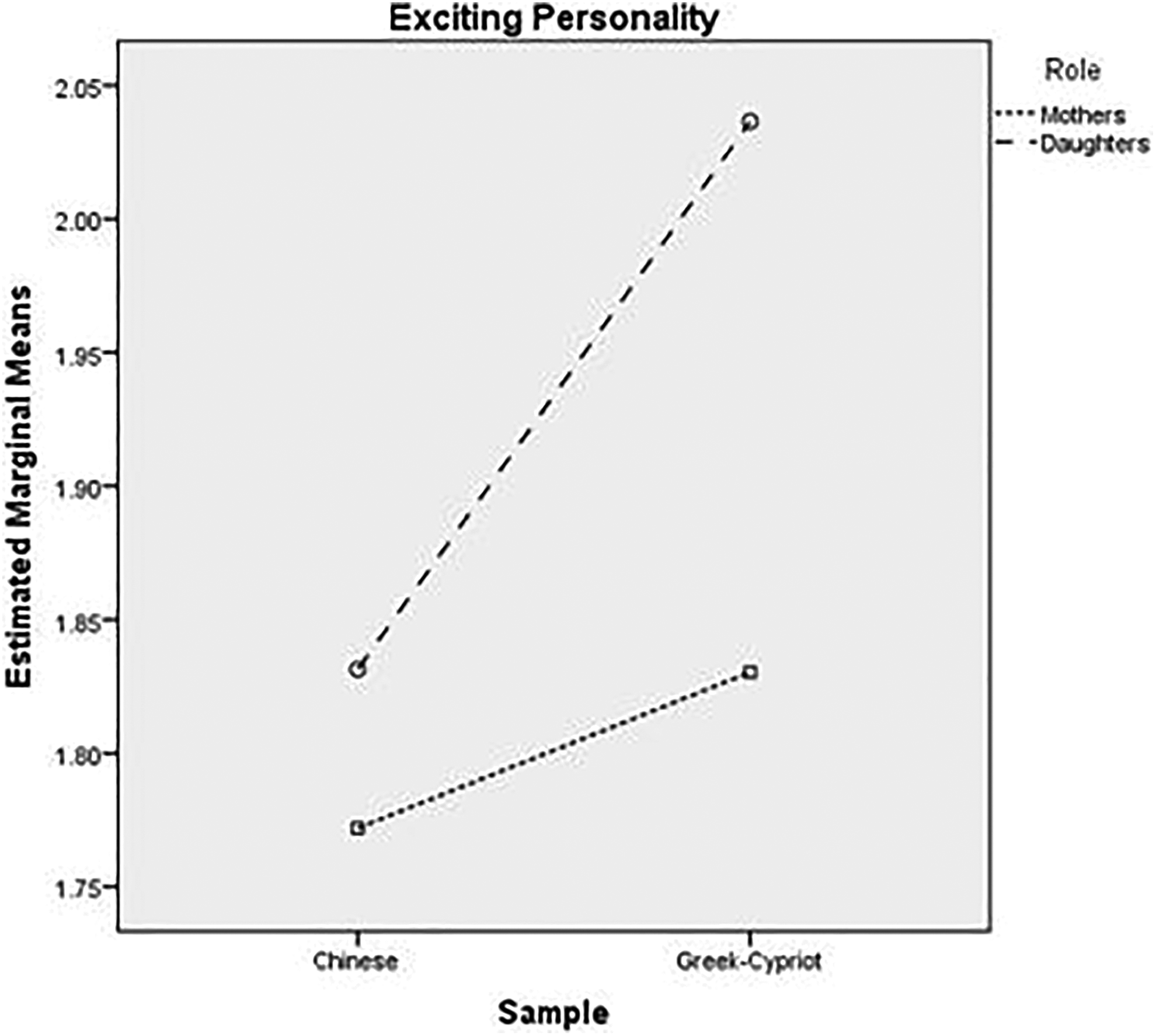
The figure above depicts the interaction between the role and the sample for mothers and daughters for the “exciting personality” domain. We can see that there is more mothers–daughters disagreement in the Greek Cypriot than in the Chinese sample.
Moving on to fathers and daughters comparisons, for the kind and understanding, the good looks, the exciting personality, and the reliable, there was more disagreement in the Greek sample. For the well-off, the degree of disagreement was similar in the two samples, but in the Chinese one, fathers gave higher scores than their daughters, while in the Greek Cypriot sample, fathers gave lower scores than their daughters. Finally, for the similar religious and ethnic background, the family oriented, and the chastity, there was more disagreement in the Chinese sample.
With respect to fathers and sons, in all significant cases, there was more disagreement in the Chinese sample. One example is depicted in Figure 2 for the strong personality domain. We can see that, in the Greek Cypriot sample, the means overlapped, but when we moved to the Chinese sample, the scores of sons decreased more than the scores of fathers, resulting in disagreement between the two. There was one exception, however, namely, the good looks, where the degree of disagreement was similar in the two samples, but in the Chinese one, fathers gave higher score than their sons, while in the Greek Cypriot one, fathers gave lower scores than their sons.

The figure above depicts the interaction between the role and the sample for fathers and sons for the exciting personality domain. We can see that the scores of the two parties were very similar in the Greek Cypriot sample but diverged considerably in the Chinese sample.
Overall, that there was more parents–sons disagreement in the Chinese than in the Greek Cypriot cultural context, where there was more parents–daughters disagreement. The exceptions were the family oriented and the chastity domains, where there was little if any disagreement in the Greek Cypriot culture but considerable disagreement in the Chinese one.
Daughters versus sons
The above interaction effects hinted that there could be role and sex interaction effects in the Chinese culture. In order to investigate this possibility further, we performed a series of doubly multivariate analyses, where participants’ responses for each domain were entered as the dependent variables, the role (parent/child) as the independent within-subjects variable and the sex of the child as the independent between-subjects variable. The analysis was performed separately for mothers and for fathers.
The results are presented in Tables 1 and 2. Starting from mothers, for all significant results, there was more disagreement between mothers and sons than between mothers and daughters. There was one exception, namely the good looks where there was more mothers–daughters disagreement. This pattern was confirmed for fathers and children, where in the case of the good looks, there was more fathers–daughters disagreement, but for the remaining significant interactions, there was more fathers–sons disagreement.
Overall, more parents–sons than parents–daughters disagreement was present. This interaction came about from, when moving from daughters to sons, parents’ and sons’ scores declined, but sons’ scores decline more than parents’ scores, resulting in more disagreement.
Discussion
Our findings indicated that Chinese parents and their children were not in agreement over mate choice, with significant differences to have been identified in most domains. It was also found that there was more disagreement between parents and their sons than between parents and their daughters. Finally, cultural differences were found, with parents–sons disagreement being higher in the Chinese culture and parents–daughters disagreement being higher in the Greek Cypriot culture.
Consistent with the predictions of our theoretical framework and the results of previous research in the area, the similar religious and ethnic background and the well-off domains were preferred more by parents in a prospective spouse for their children than their children for themselves. In addition, the good looks and the exciting personality were preferred more by children in a spouse than by their parents in an in-law. There were exceptions, however, with the well-off for the father–daughter comparison and the good looks for the father–son comparisons, where certain subtraits were preferred more by one party and others more by the other party.
For most of the remaining domains, significant differences in preferences between parents and their children were observed. These differences were not predicted by the evolutionary framework and most probably reflect the effects of other factors. One such factor is likely to be an age-cohort effects. In particular, China is experiencing a radical transformation toward a more Westernized way of life which is more likely to have affected the younger generations. Thus, younger people are more likely than their parents to prioritize on career over family (People.cn, 2013) and to be more sexually liberated (He, Du, Xu, & Zhu, 2018). Such differences can account for the consistent difference where Chinese mothers and fathers appeared to place more emphasis on the family oriented and chastity than their children.
We also found that, in most domains, there was a larger discrepancy in preferences between parents and sons than between parents and daughters. More specifically, when we moved from daughters to sons, the parents’ and their sons’ scores decreased, but the latter’s scores decreased more sharply than the former’s scores. One reason for this decrease is that, in China, there is the belief called 阴盛阳衰 (Yin Sheng Yang Shuai) that women perform better than men in many fields (Wang & Chang, 2008; Sun, Li, & Zhao, 2010). Such belief may lead young women and their parents, in comparison to young men and their parents, to demand more for their future partners and in-laws.
A more important factor explaining this difference is the shortage of available brides that has resulted in an increase in the mate value of women as opposed to the mate value of men. More specifically, Lu, Zhu, and Chang (2015) defined the mate value as three Gs: good genes, good providers, and good parents (see also Chang, Lu, & Zhu, 2017). Yet mate value is also determined by the forces of demand and supply; for instance, individuals with good genes have a higher value in the mating market if they are few others with good genes available as mates, but a lower value if there are many others with good genes available as mates.
In order to control population growth, China had enacted the one-child policy (Potts, 2006), which has resulted in most families having one child. Chinese parents demonstrated a preference for male children, which has led to more sons than daughters (Cai & Lavey, 2003). The resulted lack of balance in the sex ratio translated into a lack of available brides and a surplus of available grooms. Thus, women and their parents could afford to be choosy in mate and in-law choice, respectively, but men and their parents could not. Therefore, men and their parents became less choosy, which was reflected in the strength of their preferences.
This argument explains why the scores declined when we moved from daughters to sons, but it does not explain why sons lowered their standards more than their parents. One possible explanation is that, when they have high standards, and given the shortage of brides, both parents and their sons risk failing to attract a bride and a daughter-in-law, respectively. But the stakes are higher for a son, who forgoes the opportunity to have children, than for his parents, who forgo to the opportunity to have grandchildren. Consequently, sons may be more willing to make compromises in order to attract wives than their parents in order to attract daughters-in-law. Another possibility is that parents are unwilling to discriminate between their children. Consequently, the scores that parents gave for their daughters may have acted as anchors for the scores they gave for their sons. Their sons, on the other hand, had no such anchors, and so, they decreased their scores more than their parents.
The unbalanced-sex ratio effect may also be responsible for not finding the predicted effect in the good looks domain in the father–son comparisons. It could be the case, for instance, that sons were predisposed to value beauty more than their fathers, but the shortage of women motivated them to decrease the emphasis they placed on this trait much more than their fathers. If this is the case, we would expect that the predicted difference (i.e., sons to ascribe more importance to good looks than their fathers) would emerge when the sex ratio becomes more balanced.
Furthermore, the unbalanced-sex ratio effect could also account for many of the observed differences between the Greek Cypriot and the Chinese parents. In particular, for several traits we found that, in the Chinese sample, there was more parent–son disagreement than in the Greek Cypriot sample. In the republic of Cyprus, where there has been no one-child policy and the sex ratio was balanced, the parents–sons disagreement was significantly lower. Another cultural difference was the conflict over the family oriented and the chastity which was observed in the Chinese sample but not in the Greek Cypriot sample. One possible explanation is that the Republic of Cyprus has not experienced a rapid change toward Westernization; thus, there was no age-cohort effect in these domains.
The first main conclusion of the present research is that Chinese parents and their children were not in agreement over mate choice. This disagreement is likely to result in conflict, with children bringing home mates who do not appeal to the preferences of their parents. Accordingly, we would expect interfamily friction and manipulation to arise where each party would attempt to influence the choices of the other (Apostolou & Papageorgi, 2014) that future research needs to explore.
The second main conclusion is that, in-law and mate preferences are not rigid but they adapt to environmental factors; as a consequence, cultural factors could affect the divergence of preferences between parents and their children and the resulting conflict in the specific domains. As the comparisons between Chinese and Greek Cypriot samples have demonstrated, cultural factors may affect whether there is a disagreement over a specific domain, what kind of disagreement and the degree of this disagreement. Thus, cross-cultural variation is expected, where, in accordance with the predictions of the evolutionary theory, there would be parent–offspring conflict over mating, but its specifics would vary from culture to culture.
It would also be expected to vary in a specific culture from time to time. For instance, China has recently relaxed the one-child policy (see The Communist Party of China [CPC] the fifth Plenary Session of the 18th CPC Central Committee Bulletin, 2015), which suggests that the balance in the sex ratio will be eventually restored that, in turn, will affect conflict. On this basis, we could predict that in a future time, the parent–daughter conflict will increase and the parent–son conflict would decrease. Future research needs to test this prediction.
The current study found that there was more overall disagreement between parents and sons than between parents and daughters. Yet this finding should not be translated to mean that more parental control would be exercised over sons than over daughters. More specifically, parents are motivated to influence their children’s mating decisions because if they do not do so they will suffer an opportunity cost (Apostolou, 2016, 2017b). One component of this opportunity cost is the diverging opportunity cost that results from diverging interests between parents and children: If children are left to exercise mate choice on their own, they will get mates who are not best for their parents. Our results suggest that son’s more than daughters’ preferences from the respective preferences of their parents, which in turn makes the opportunity cost higher for the former. Yet the diverging opportunity cost depends also on the parents’ capacity to inflict a cost on their children to align them with their will, which is usually higher for daughters who are more dependent on their parents’ resources than sons (Apostolou, 2016). Without further research, we cannot say whether the diverging opportunity cost is higher for daughters or sons, but it is reasonable to say that it is not very different for the two parties.
Moreover, a second component of the opportunity cost is the converging opportunity cost that arises from converging interests between parents and children (Apostolou, 2016, 2017b). In particular, due to factors such as young age and lack of experience, if children are left on their own, they may end up making erroneous mate choices which would be harmful for them and for their parents. The latter, by being older and more experienced, can influence their children’s mating decisions in ways that would enable them to avoid such errors. The converging opportunity cost is usually higher for daughters than for sons because erroneous mate choices have more consequences in terms of pregnancy or reputation. Also, women are more vulnerable to sexual attack or deception by men who either lack desirable traits or do not want to commit to a relationship (Apostolou, 2017b). The shortage of women may increase such attacks and deception considerably, as a substantial proportion of men could not gain sexual access to women in a different way, which would increase considerably the opportunity cost of leaving a daughter unprotected. Therefore, the converging opportunity cost would be much higher in the case of daughters than in the case of sons.
Overall, the diverging opportunity cost is expected to be similar for daughters and for sons, but the diverging opportunity cost for daughters to exceed considerably the converging opportunity cost for sons, we would predict that the total opportunity cost of free mate choice would be higher for daughters than for sons. On this basis, we predict that Chinese parents would attempt to control more their daughters’ than their sons’ mating decisions, a prediction which awaits further confirmation.
One limitation of the current research is that it was based on self-report data. Thus, participants may behave differently, than they have indicated here, when the situation in question actually arises. A further limitation is that the current study employed an instrument which was developed to measure in-law and mate preferences in a different cultural context. Therefore, although inclusive, this instrument may not have captured preferences and thus, possible disagreement, for traits that have only local importance.
Also, the method employed by the current study prevented us from distinguishing between evolved predisposition effects and age cohort or other effects. In order to do so, a different method is required where parents would be asked to rate traits in a mate for themselves and in a mate for their children (Apostolou et al., 2014). Last but not least, our study was focused on parents–children disagreement over mate choice; yet, evolutionary theorizing, supported by empirical evidence, suggests that such disagreement exists also between individuals and their siblings (Biegler & Kennair, 2016; Kennair & Biegler, 2015). This aspect of intrafamily disagreement was not examined here, and future research needs to investigate it.
The current study has offered evidence that parents and children in China are not in agreement over mate choice, while comparison between Chinese and Greek Cypriot families indicated that culture-specific factors, such as the unbalanced sex ratio, may influence the degree of this disagreement. Much more work is required, however, in order to understand such disagreement and how it varies with the cultural context.
Footnotes
Declaration of Conflicting Interests
The author(s) declared no potential conflicts of interest with respect to the research, authorship, and/or publication of this article.
Funding
The author(s) disclosed receipt of the following financial support for the research, authorship, and/or publication of this article: This study was supported by the Social Science Fund of the Faculty of Social Development and Public Policy, Fudan University.