




Abstract
The mate choices of children do not always meet with the approval of their parents. As a consequence, the latter employ a battery of tactics that they use to manipulate the mating behavior of the former. This paper offers the first taxonomy of parental tactics of mate choice manipulation. In particular, in Study 1, 57 semi-structured interviews revealed 72 acts that parents employ to influence their children, and 27 that they employ to influence their children's partners. In Study 2, 405 parents rated how likely they were to use these acts to influence their daughters' and sons' mate choices. Factor analysis of participants' responses revealed 12 manipulation tactics that parents use on their children, and four manipulation tactics that they use on their children's partners.
Keywords
Introduction
When two parties have conflicting interests, they frequently attempt to manipulate each other so as to promote their own ends (Buss, 1987). In the context of mating, the most characteristic example is relationships between couples. Couples have common goals (e.g., to have children), but also conflicting goals (e.g., to have sex with other partners). Conflict gives rise to acts of manipulation in which one party attempts to manipulate the other in doing something that best fits its goals. For instance, a wife, in order to ensure that her husband's resources are diverted exclusively to her, threatens him with divorce if he ‘fools around’ with other women. Substantial research has revealed a plethora of such manipulation acts that cluster in broader categories of distinct manipulation tactics (Buss, Gomes, Higgins, and Lauterbach, 1987; Buss, 1988, 1992; Buss and Shackelford, 1997; de Miguel and Buss, 2011).
However, in the mating arena it is not only partners who disagree and attempt to manipulate each other, but also parents who disagree with the mate choices of their children and try to manipulate them for their own ends (Sussman, 1953). Despite the evolutionary significance of parental control over mating (Apostolou, 2007b, 2010) and the high degree of parental interest over children's mate choices (Apostolou, 2011; Perilloux, Fleischman, and Buss, 2008), there has not been any attempt to examine if and how parents manipulate their children's mating behavior. The purpose of this paper is to address this lack of research by demonstrating that parents attempt to influence the mate choices of their children, and by examining the tactics they employ, to offer the first taxonomy of parental tactics of manipulation over mate choice.
Parent-Offspring Conflict over Mating and Tactics of Mate Choice Manipulation
Parents and children are not genetically identical, and thus they do not share the same interests with respect to mate choice, as specific traits in a mating candidate give unequal benefits to each party (Apostolou, 2007a, 2008a; Buunk, Park, and Dubbs, 2008; Trivers, 1974). Accordingly, each party has evolved to prefer more the traits that give it more benefits. So far, research has established that good looks and exciting personality are preferred more in a spouse than in an in-law, while good family background and similar religious background are preferred more in an in-law than in a spouse (Apostolou, 2008a,b; Buunk et al., 2008; Perilloux, Fleischman, and Buss, 2011).
As in-law and mate preferences do not overlap, the mate choices of children do not always comply with the wishes of their parents. In consequence, there are substantial evolutionary gains for parents who are able to influence the mate choices of their children in choosing mates that best fit their preferences (Apostolou, 2010). This suggests that parents have evolved to be efficient manipulators of their children's mate choices. In turn, this raises the question of which tactics parents use to manipulate mating.
Buss (1992) identified twelve tactics which people, including parents, use in general when they intend to manipulate others. Building on this work, Butkovic and Bratko (2007) constructed an instrument to examine manipulation within the family unit, though without focusing on mate choice. However, since manipulation tactics are expected to vary according to the goals toward which they are directed (Buss et al., 1987), and given the specific evolutionary problem that parents have of influencing their children's mating decisions (Apostolou, 2007b), research on the general tactics of manipulation is insufficient to identify the full range of manipulation tactics that parents employ to influence mate choice.
Some studies offer information on the specific tactics that parents use to manipulate mating. In particular, Sussman (1953) reports that parents employ means such as ‘cajolery, persuasion, appeals to loyalty, and threats so as to influence the mating behavior of their children’ (see also Bates, 1942). Another study found that modern Chinese parents, although they cannot impose their choices on their children, continue to exercise the role of facilitator through their own social networks (Ikels, 1985). Chinese parents in the USA try to create environments in which their children can meet other Chinese children of desirable background (e.g., by staging a barbecue and inviting desirable mates) (Ikels, 1985).
These studies are, nevertheless, only indicative as they were not specifically designed to identify manipulation tactics and they report only a very limited number of manipulation acts. The present research aims to close the gap in our knowledge by making a taxonomic contribution that is, discovering, naming and ordering the major ways in which parents manipulate the mating decisions of their children. Study 1 attempts to identify the battery of manipulation acts, and Study 2 attempts to cluster these in broader manipulation tactics.
Study 1
Participants
Participation was on a volunteer basis and no compensation was given. For the purpose of this study, both parents, who could indicate the tactics they use on their children, and younger individuals, who could indicate the tactics their parents use on them, were recruited. In more detail, the primary target group for this study was students but, to obtain a more representative sample, administrative staff and members of faculty were also interviewed. Accordingly, 61% of the sample consisted of students, 21% of faculty members, and 18% of administrative staff. Overall, 57 Greek-Cypriots took part (32 women, 25 men). The mean age of women was 28.7 (SD = 6.8), and the mean age of men was 31.7 (SD = 9.2). Also, 26.3% of the participants had children, with the mean age of the oldest child being 11.3 (SD = 8.7). Finally, 38.6% of the participants were single, 26.3% were in a relationship, 22.8% were married, and 12.3% were divorced. Participants were recruited by posting an advertisement on the University's website.
Method
The study took place in a medium-sized private university in Cyprus. In order to identify the various manipulation acts that parents employ to influence the mate choices of their children, a series of semi-structured interviews was conducted. Interviews took place in a psychology lab located on the university premises. The interviews were in Greek and lasted 45 minutes on average.
At the beginning of the interview, participants were asked to sign a consent form and, following that, they were asked to indicate their personal details (sex, age, marital status, number of children, sex of children). The interview consisted of three parts. In the first part, participants were asked to report and discuss the various ways in which their parents and the parents of their current or previous mates tried to influence their romantic relationships. In the second part, participants were asked to report and discuss the various methods that the parents of their friends, relatives, and acquaintances have used to influence the mate choices of their children. In the third part of the interview, held only with those who were parents, participants were asked to describe the various acts that they themselves had used to influence the mate choices of their daughters and sons.
During the interview process, the word “manipulation” was not used as it has a negative connotation that may influence participants' responses. Follow-up and probing questions were used in order to get more detailed information on specific acts of manipulation.
Results
From the interview process, 223 acts that parents use to influence the mating behavior of their children were recorded. Based on content similarity, several acts were eliminated. For this task, two independent graduate psychology students (a man and a woman) were employed. The research assistants were asked to read each act independently and identify those which had very similar content. Each assistant came with a list of overlapping acts and they were then asked to classify them into meaningful categories. When this stage was completed, they were asked to nominate an act that best represents each category so that the remaining acts were not carried to subsequent analysis. If there was a disagreement (e.g., an act was not identified as overlapping by both assistants), they were asked to reconsider it and attempt to reach an agreement. If agreement was not reached, the acts in question were carried over to subsequent analysis. Overall agreement between coders was high (interater reliability = .91). At the end of this procedure 72 acts that targeted children were identified.
Parents also influence the mate choices of their children by manipulating their children's partners. Accordingly, 108 such manipulation acts were identified. Content similarity using the procedure described above eliminated redundant acts (interater reliability = .94), producing a list of 27 acts that parents use on their children's mates.
Study 2
Participants
Two research assistants were employed for the purposes of this study. They recruited individuals who volunteered to participate in research on family relationships (no compensation was given). To qualify for participation, an individual had to have at least one child. Upon completion, participants put the questionnaire in an unmarked enveloped and sealed it.
In this study, 405 Greek-Cypriots took part (272 women, 133 men). The mean age of mothers was 50 (SD = 9.1), and the mean age of fathers was 43.7 (SD = 9.3). Participants had a mean of 1.15 (SD = .7) male children and a mean of 1.21 (SD = 1.1) female children. The mean age of the oldest female child was 12.3 (SD = 10.4) and the mean age of the oldest male child was 11.92 (SD = 10.6). Moreover, 90.1% of the participants were married, 5.9% were divorced, 1.7% were widowed, 1% were single and .7% were in a relationship.
Method
The manipulation acts identified in Study 1 were used to construct an instrument that measures manipulation tactics. In particular, the survey consisted of three parts. In the first part demographic information was collected (sex, age, marital status, number of daughters and sons, ages of the oldest male child and the oldest female child). In the second part, participants were asked to rate the likelihood that they would use the 72 acts identified in Study 1 in order to manipulate the mating behavior of their children. The following seven-point Likert scale was used: 1 = not at all likely to do it to 7 = extremely likely to do it. Using the same scale, in the third part participants were asked to rate the likelihood that they would use the 27 acts identified in Study 1 in order to manipulate the partners of their children. The order of presentation of parts two and three (children, partner) was counterbalanced across participants.
Results
Acts of manipulation targeting offspring and factor loadings for manipulation tactics
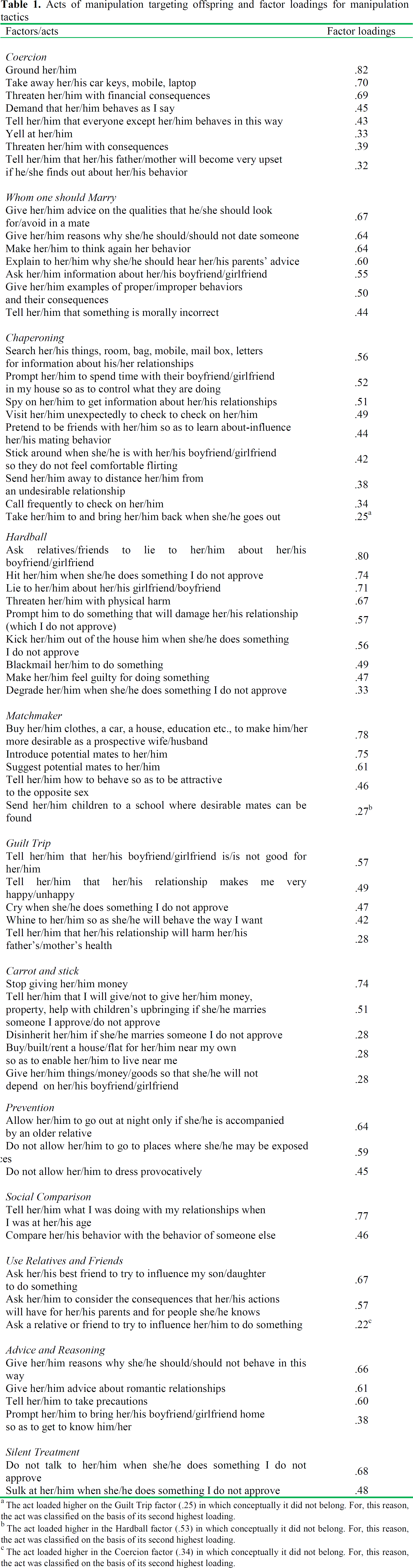
The act loaded higher on the Guilt Trip factor (.25) in which conceptually it did not belong. For, this reason, the act was classified on the basis of its second highest loading.
The act loaded higher in the Hardball factor (.53) in which conceptually it did not belong. For, this reason, the act was classified on the basis of its second highest loading.
The act loaded higher in the Coercion factor (.34) in which conceptually it did not belong. For, this reason, the act was classified on the basis of its second highest loading.
Six of these tactics (each tactic will be discussed in detail in the next section), namely Coercion, Hardball, Reason, Monetary Reward (named here Carrot and Stick), Silent Treatment and Social Comparison overlap with manipulation tactics that were found in other studies (i.e., Buss, 1992). Note, however, that this overlap in tactics does not mean that their contents are also identical as the specific manipulation acts in each category here are not the same as the ones identified in other studies. Moreover, the Guilt Trip tactic involves acts such as whining and crying which were also identified by previous studies but were clustered under different tactics. The remaining five tactics, Whom one should Marry, Chaperoning, Matchmaker, Prevention and Use of Relatives and Friends, appear to be unique in manipulating children's mate choices.
Acts of manipulation targeting offspring's partners and factor loadings for manipulation tactics

The Hardball and Monetary Reward (named Lure here) replicate tactics identified in other studies (i.e., Buss, 1992), whereas We are Family, and Dirty Laundry appear to be unique in manipulating children's partners. Scales were checked by means of reliability analysis (Cronbach's α). Internal consistency (a) ranged from .54 to .94, with a mean of .77.
Tactics Used on Children
Coercion
Coercion takes many forms including yelling and threatening. The threats can be general, but frequently they involve financial consequences. In particular, parents tell their children they will kick them out of the house, will stop giving them money, and will cancel their credit cards. In one case, parents threatened their daughter that if she got a divorce, they would also divorce. One tactic reported, usually by mothers, is to use the other parent as a threat: “If your father finds out about your behavior he will become very upset.”
Whom One Should Marry
Parents advise their children about what they should be looking for in a mate: “You should look for someone who has a good job, has money, and comes from a good family.” They frequently employ reasoning to justify the advice they give: “If you marry this wealthy guy, you can have everything you want in life.” Parents also advise their children on whom they should avoid: “Do not marry a woman who has had many boyfriends before you because she will keep having boyfriends after she marries you.”
If their children date individuals they like, they persuade them to stay with them by emphasizing their good qualities: “She is beautiful”, “He has a good character”, “She will receive a good dowry.” Similarly, if their children date someone whom they do not like, they persuade them to break up the relationship by focusing on the mate's negative qualities: “He is short”, “She is a foreigner, irritable, cold, does not have a job.” Parents accompany their advice with reasoning: “He is quite old and in a few years he will not be able to satisfy you sexually”, ”He has children from a previous marriage so half the money he makes will go to his other family.”
Finally, parents communicate to their children the qualities which they think that they should look for in a mate by asking them specific questions about their partners: “Is she from a good family?”, “What are her parents' jobs?”, “Does he have a good job?”, ”How much money does he make?”
Chaperoning
Parents chaperone their children in order to prevent them from forming undesirable relationships. They accompany their daughters and sons to social events (e.g., parties), check the place before they leave them there, and come to pick them up at a specific time. Moreover, parents prompt their children to bring their boyfriends and girlfriends home and spend time there in order to be able to keep an eye on what they are doing. Additionally, they spy on them, follow them around, listen to their phone conversations and even ask other relatives and friends to spy on their children and report back to them. A few parents have also reported creating a Facebook profile for the sole purpose of spying on their children.
Finally, another tactic that is used by parents, especially mothers, is to pretend to be friends with their children. It is not unusual for mothers to state explicitly that they try to maintain a friendly relationship with their daughters because they think it is easier in this way to control what they are doing.
Hardball
Parents employ deception, primarily to undermine an undesirable relationship. In particular, they lie about the behavior and character of an undesirable mate: “People told us that he is a gambler, that she is a slut”, “When you were away, we saw her with other men.” In one case, a father took his daughter to the police station where she was falsely told that her boyfriend was involved with drugs. Less frequently reported is the use of physical punishment: Parents beat their teenage daughter for finding her with a boy, or slap her for dressing provocatively. In one case, a son who was studying abroad returned home and brought with him his girlfriend to introduce her to his parents. The father, upset by the fact that his son was dating a foreign girl, kicked her out of the house and physically attacked his son, breaking his nose. Degradation is also used: “You look like a whore with that earring on your nose.”
Matchmaker
Parents not only tell their children what to look for in a partner, but also actively try to match them with mates with desirable qualities. One common tactic is to organize dinners in restaurants with friends who have sons and daughters they approve of, or they invite desirable individuals home for dinner when their children ‘happen’ to be there. In one case, a father kept sending his daughter to get his prescription from a doctor he aspired to have as an in-law (his daughter ended up marrying him).
Moreover, parents ask their children to consider specific individuals as prospective partners, giving them their mobile phone numbers and prompting them to call them. Finally, parents use indirect ways to increase their children's exposure to desirable mates; for instance, they send their children to expensive private schools where desirable mates can be found. Apparently, people do not have only superior education in mind when they pay high tuition fees.
Guilt Trip
To discourage an undesirable relationship parents frequently say that it makes them very unhappy. Moreover, it is not unusual to imply harm to their health: “If you marry him I will die”, “This relationship is killing me.” In one case a mother fell on the couch pretending that she could not breathe. In another case, a father was falsely admitted to hospital. Mothers also use the health of their husband: “If you marry him your father will die”, “Think of your father, he comes home and he does not speak.” Moreover, parents frequently whine to their children about marriage and having children: ”I want to see you married and have grandchildren before I die.”
Carrot and Stick
With this tactic, parents give material incentives to their children to make them behave according to their wishes. One inducement that parents commonly use is a house: “If you marry him, we will give you this house to live in with your husband.” Moreover, parents give other financial incentives, usually for the purpose of breaking up an undesirable relationship. A mother offered to buy a Mercedes for her son if he broke up with his girlfriend; he did so and she did so. In another case, parents offered their son the ownership of their hotel if he would divorce his wife. Parents also manipulate inheritance rights: “I will wait to see whom you are going to marry and then I will make my will.”
Prevention
Under this category falls a series of acts which aim to prevent children from attracting unwanted attention and being exposed to undesirable mates. In particular, parents do not allow their children to go to places like nightclubs and bars, where they feel that they may get carried away. If they give their permission, they usually ask that they return at a specific time. It is also common for parents to insist that when they are going out their children are accompanied by an older relative, usually a sibling, the most usual scenario being an older brother accompanying his younger sister.
Social Comparison
Parents compare their children's behavior with desirable or undesirable behavior exhibited by other individuals, including themselves. The pressure is usually put on daughters to get married and have children: “You are still single - when I was your age I was married and I had two children”, “Look around the neighborhood, everyone your age is married and you are still single.” Negative examples are also used: “This friend of mine got pregnant and destroyed her life, make sure that this does not happen to you.” In one case, a mother pointed to an old lady who was ill and had no relatives to look after her, telling her daughter: “If you do not marry and have children, you will end up like her with nobody to look after you when you are old.”
Use of Relatives and Friends
Parents attempt to influence the mating behavior of their children through the use of relatives or their children's friends. If parents feel that some relatives are close to their children and the latter trust them, they may ask them to intervene. For instance, it is frequently reported that parents ask their children to prompt their brothers and sisters to break up an undesirable relationship or to get married if they are involved in a desirable one. Parents also ask their children's close friends to intervene. In one case, they approached their daughter's best friend to ask her to tell their daughter that her boyfriend was no good, they did not suit, he was taking advantage of her and she could not see it, so she should break up with him.
Advice and Reasoning
Apart from advising their children on the qualities that make a good spouse, parents give more general advice, frequently accompanied by reasoning. In particular, parents advise their children on how to maintain a good relationship: “Do not cheat on your wife”, “do not take a relationship for granted”, “do not let your relationship end up being routine.” They also advise their children, particularly their daughters, not to start having sexual relationships early: “Be choosy whom you date so you do not get hurt”, “Do not sleep with your boyfriend very early in the relationship”, ”Do not sleep around because you will acquire a bad reputation and then nobody will want you as a wife and you will end up a spinster.”
Silent Treatment
When their children are involved in an undesirable relationship, parents frequently do not to talk to them as a means to exercise pressure to break up. In one case, a father did not talk to his daughter for three years while she was dating an undesirable man. Silent treatment is often accompanied by sulking, especially when parents and children live in the same house.
Tactics used on children's partners
Hardball
Threats are common practice to drive away unwanted mates. There were instances where a father was reported to threaten an undesirable boyfriend with a hunting rifle: “Stay away from my daughter or else I will kill you.” Threats can also materialize, with fathers and other relatives being reported to have physically attacked undesirable boyfriends. Intimidation is also frequently used: “You are no good for my son”, “My daughter is better than you”, ”You are incompetent.” Moreover, there were instances reported where intimidation was used against the parents of an undesirable mate: “Our son is not for your daughter.” Parents also make undesirable mates feel unwelcome by being rude to them or by not talking to them.
We Are Family
In this tactic parents aim to make desirable mates feel part of their family. Some common acts, performed primarily by mothers, are to cook for desirable mates, invite them home for dinner, send them food through their children, look after them, and wash their clothes. Moreover, parents invite desirable mates home on various social occasions (e.g., birthdays), or ask them to join them in different recreational activities (e.g., short trips). They give them assistance when needed, help them with their jobs and studies, and they call them to inquire about their well-being.
Dirty Laundry
Parents keep their children's mates in check by continuously looking for information about them. In particular, they employ their network of friends, relatives, and acquaintances to obtain information about their children's mates. A commonly reported act is for parents to ask a friend or a relative working in the police to check the records for any information on their children's mates and their families. They also hire private detectives. In one instance, a father hired someone to spy on his daughter's boyfriend from another country with the hope that some illegal activity would be found that could be used to prevent the renewal of his visa. Parents are also interested in the family background of their children mates and sometimes they visit the latter's parents in their workplace so as to gain first-hand information.
Lure
Parents approach directly and encourage desirable individuals to make relationships with their children. They promise them money and property (usually a house) along with assistance with child-rearing, if they marry their daughters or sons. When these individuals comply, parents make good on their promises.
Sex and Age Effects
To examine whether sex differences exist in the use of tactics of manipulation a series of t-tests was conducted for each of the manipulation acts. Given the large number of comparisons, the alpha level was set to .001. A significant difference was found for the “Cry when she/he does something I do not approve,” where mothers' reported willingness to use this act (M = 2.56, SD = 1.79) was higher than fathers' (M = 1.76, SD = 1.37) [t(403) = −4.56, p < .001, d = .50]. Similarly, for the “Give her/him advice on the qualities that he/she should look for/avoid in a mate,” mothers' reported willingness to use this act (M = 4.68, SD = 2.14) was higher than fathers' (M = 3.80, SD = 1.93) [t(403) = −4.01, p < .001, d = .43]. Finally, for the “Search her/his things, room, bag, mobile, mail box, letters for information about his/her relationships,” mothers' reported willingness to use this act (M = 2.49, SD = 1.78) was higher than fathers' (M = 1.75, SD = 1.25) [t(401) = −4.25, p < .001, d = .48].
To examine whether sex differences existed in the use of tactics of manipulation employed on children's partners, a series of t-tests was conducted for each of the manipulation acts. As before, the alpha level was set to .001. The results produced no significant differences with the exception of the “look after her/him” act which approached significance [t(399) = −3.14, p = .002, d = .34]. In this case, mothers' reported willingness to use this act (M = 4.35, SD = 1.97) was higher than fathers' (M = 3.7, SD = 1.90).
Finally, in order to examine whether responses were affected by the age of participants' children, a series of multiple regressions was applied on each act with the age of the oldest female and the age of the oldest male child as the independent factors. As before, the alpha level was set to .001. The age of participants' children did not come significant with the exceptions of the “Visit her/him unexpectedly to check on her/him” for which the age of oldest boy came significant (p < .001) with a negative coefficient(-.07), the “Take her/him to and bring her/him back when she/he goes out” for which the age of the oldest girl came significant (p < .001) with a negative coefficient (-.05), and the “Take away her/his car keys, mobile, laptop” for which the age of the oldest girl came significant (p < .001) with a negative coefficient (-.04).
Frequency of Use
Frequency of manipulation tactics

Means and standard deviations of the likelihood of manipulation tactics use
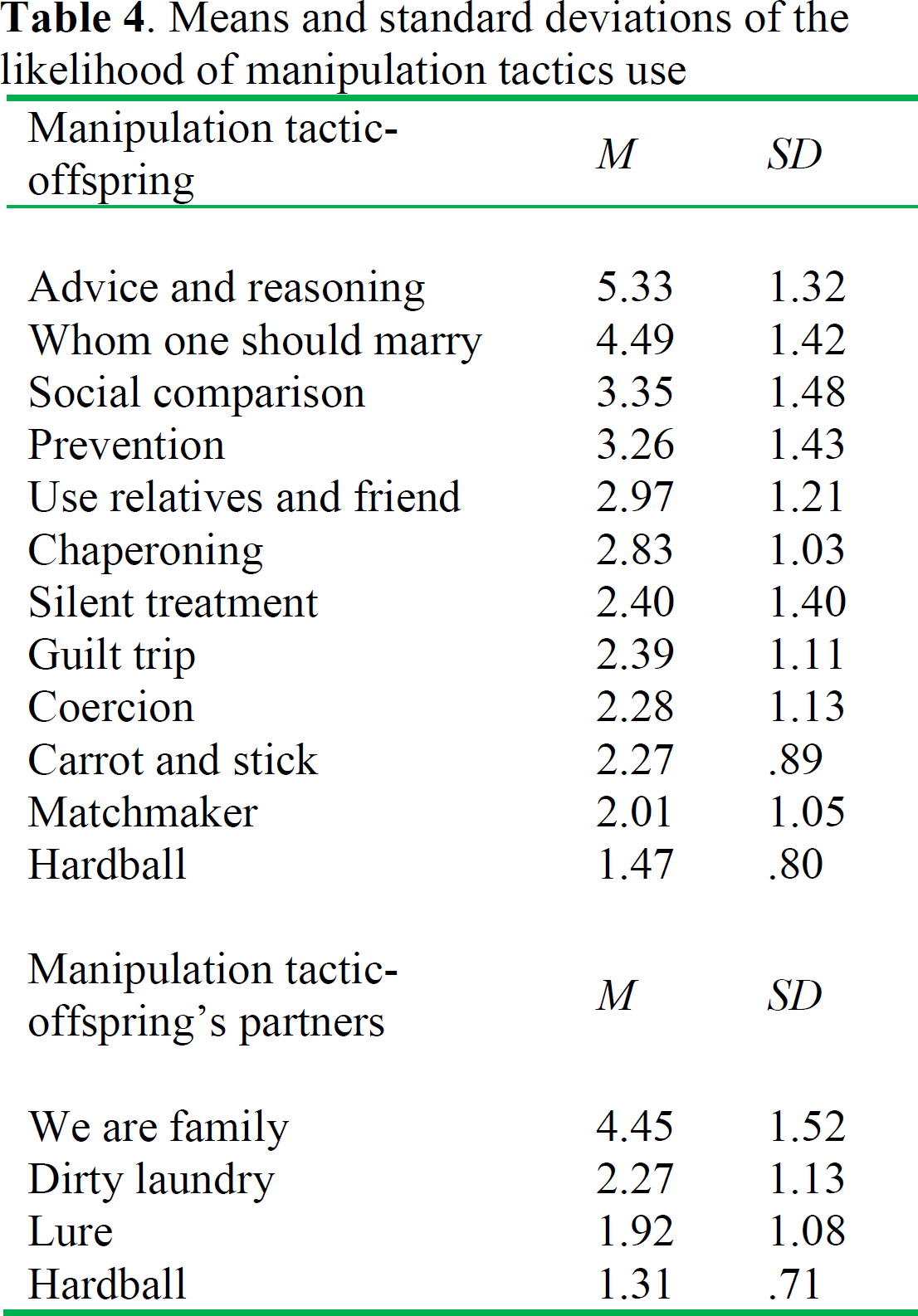
One interpretation is that parents employ the Hardball more frequently than they are willing to admit. Another possibility is that the participants in Study 1 may have been over-reporting the tactics (i.e., the Hardball) that they thought other parents (as opposed to themselves or their own parents) were employing. In consequence the Hardball tactic may have been correctly gauged by Study 2 as not being as prevalent as other manipulation tactics.
Finally, to examine which tactics were reported by parents as more likely to be used on children's partners, four composites were computed by summing the acts shown in Table 2 for each tactic. Each composite was divided by the number of items that composed it, and means and standard deviations were computed. The results are presented in Table 4. The We are Family tactic had the highest mean whereas the Hardball had the lowest. This corroborates the findings from Study 1 (Table 3) which indicate that the We are Family is one of the most frequently used tactics. The Hardball in Study 1, however, received much higher frequency than we would expect on the basis of its mean in this study; this is an indication that parents employ this tactic more frequently than they are willing to admit.
Discussion
Parents actively engage in influencing the mate choices of their children and for this purpose they employ a wide range of manipulation acts. These acts can be classified in twelve manipulation tactics that target children and four manipulation tactics that target their children's partners. This taxonomy has revealed seven tactics (five targeting children and two targeting their partners) which appear to be unique in manipulating children's mating behavior. In addition, certain tactics are more likely to be used than others, and the use of a tactic depends to some extent on the sex of the parent.
With respect to the last point, it seems that when there is a sex difference, it is usually the mother who is more willing to use a given tactic. One possible explanation for this is that mothers may have evolved to be more manipulative than fathers. In more detail, in contemporary and historical pre-industrial societies, marriage arrangements are dominated by male parents (Apostolou, 2010; 2012). Fathers dominate over mothers because they are physically stronger and control more resources while they have a better access to weaponry (Apostolou, 2010).
On the other hand, mothers, by being physically weaker, having less access to weaponry, having little control over wealth, etc., need to resort to manipulation if they are to effectively promote their interests. To put it another way, men's greater physical strength and control of resources would exercise evolutionary pressure on women to become more manipulative in order to counterbalance the male advantages and promote their own interests. This being the case, manipulation should be the realm of women who would be more likely to use it in order to influence their children (see also Apostolou, 2011).
The manipulation acts reported here range from straightforward ones such as “beat up a child for misbehaving” to less direct ones such as “pretend to be friends to learn and influence the mating decisions of children.” Acts like the latter can be quite efficient and are worthy of special mention. First, they are not easy to detect; for instance, in Study 1, in many instances mothers reported to pretend to be friends with their daughters in order to learn and influence their relationships. Accordingly, many female participants said that they had a friendly relationship with their mothers and they would talk to them and get advice from them on relationship issues. When explicitly asked, however, all believed that their mothers were not pretending, but were truly their friends.
Moreover, it has been found that parental interference can fuel romantic passion (named the Romeo and Juliet effect): As parents increasingly complain about a young couple's relationship, the partners increase their feelings of love for one another (Driscoll, Davis, and Lipetz, 1972). Thus, by advising their children under the guise of friendship, parents avoid the negative impact of the Romeo and Juliet effect.
One limitation of this research is that it is based on self-report data. Consequently, certain tactics may be under-reported or over-reported (e.g., parents may use physical violence on their children more frequently than they are willing to report). In addition, not all of the participants in Study 2 had children who had reached sexual maturity. If parents' answers are influenced by the age of their children, this may have introduced a bias in the obtained results. Regression analysis indicates that this is not a concern; yet, future research should attempt to replicate the results of this study using only parents with sexually mature children.
Still, certain acts are influenced by the age of children. For instance, the likelihood of use of the “Take her/him to and bring her/him back when she/he goes out” and the “Take away her/his car keys, mobile, laptop” is negatively related with the age of children, indicating that these acts apply primarily to younger children. This is expected given that it is difficult for parents to force say, a daughter who is 30 years old to be taken somewhere by her parents. Similarly, parents can take away the things of their teenage children as a punishment for not complying with their will, but this is not something they can do easily for their older children.
Moreover, this study is confined only to a single culture and what is found here may not be necessarily true in a different cultural context. For instance, the Advice and Reasoning and the Whom one should Marry tactics are reported as the most likely whereas the Hardball is the least likely to be used. This is well adapted to the realities of a Western post-industrial society where children of marital age are independent of their parents and physical violence is punishable by law. In different cultures, however, the frequency of use may follow a different hierarchy. For example, in pre-industrial societies, parents arrange the marriages of their children and use the Hardball tactic to eliminate any deviation from their will (Stephens, 1963). Therefore, future research should attempt to examine the impact of society type on the choice of manipulation tactics.
Further empirical work is needed to advance our understanding of manipulation tactics. In particular, it is likely that the choice of tactics is contingent on the sex of children, with parents being more likely to use certain tactics on their daughters than on their sons and vice versa. For example, Chaperoning may be used more often on daughters who are more likely to be the target of sexual assaults (see also Cowan and Avants, 1988). Future research can investigate this by asking parents to rate how willing they are to use a set of manipulation tactics separately for their sons and for their daughters.
Certain characteristics of parents may also affect the choice of tactic to be used. In particular, the Carrot and Stick tactic may not be preferred by parents who are relatively poor, as there is no point for instance, in disinheriting a child if there is no inheritance in the first place. Moreover, research indicates that personality also plays a role in the choice of tactics (e.g., Buss, 1992; de Miguel and Buss, 2011). Accordingly, future research should examine whether the use of a tactic depends on the personality of the parent or the personality (or the perceived personality) of the children. For example, parents low in emotional stability may use Hardball more frequently, whereas they may use Guilt Trip if they perceive their children to be high in agreeableness.
Finally, the present research is based on an evolutionary framework that indicates that parents disagree with their children over mate choice, which in turn gives the latter the incentive to manipulate the mate choices of the former. Nevertheless, different theoretical frameworks on parenting may make similar predictions; for instance, parents want to protect their children from harm by helping them to select a good partner. Therefore, future theoretical work should attempt to construct a more coherent theoretical framework of manipulation tactics, perhaps by integrating insights from different theoretical perspectives.
Overall, manipulation is a fascinating but underexplored aspect of human behavior. This research contributes in bridging the gap in our knowledge by providing the first taxonomy of tactics that parents employ to influence their children's mate choices. Future studies should attempt to investigate how effective these tactics are in actually influencing mating decisions, and to identify counter tactics that children are likely to use to defend themselves from their parents' manipulation.