




Abstract
The facial traits and appearance of political candidates have been found to predict election outcomes across countries with different electoral systems and institutions. Research over the last decade has provided two different versions of this overall conclusion. First and most thoroughly studied, candidates who from their mere faces are evaluated as more competent get more votes on Election Day. Second, recent research finds that the ideological leanings of candidates and the voters they cater to also matter: Right-wing and conservative candidates receive more votes if they look more dominant, while liberal candidates lose votes when looking dominant and masculine. In this article, we investigate whether these patterns extend to candidate selection and support within parties as determined by party organizations. We test this through an original combination of naive respondents’ trait ratings of candidates in Danish local elections and these candidates’ positions on the ballot as decided by nomination processes within local party organizations. The results strongly support that the conclusions in previous studies extend to dynamics within the party among party members: Danish local party organizations tend to nominate facially competent candidates at the top of the ballot regardless of their ideological leaning. Moreover, liberal and conservative parties position dominant-looking candidates significantly different on the ballot with liberal parties being less likely to assign facially dominant candidates to top ballot positions. These results add important new insights about the underlying psychological processes causing appearance-based voting and relate to the ongoing discussion about the quality of public opinion formation.
Keywords
A number of recent studies have shown that individuals’ preferences for politicians are influenced by the physical features of the politician such as their facial appearance or the pitch of their voice. In actual electoral races, for example, candidates with facial and vocal traits that are perceived as “competent” gain more voters (e.g., Berggren, Jordahl, & Poutvaara, 2010; Klofstad, 2016; Laustsen, 2014; Olivola & Todorov, 2010; Todorov, Mandisodza, Goren, & Hall, 2005). Also facial and vocal traits that make a person appear “dominant” have been found to influence election results but in more complex ways: Conservative candidates gain more votes when they look or sound dominant, while liberal candidates in contrast lose votes when evoking such dominant impressions (Laustsen, Klofstad, & Petersen, 2015; Laustsen & Petersen, 2015, 2016).
Political scientists have viewed these effects against the background of democratic ideals. These ideals emphasize how citizens should vote for a candidate that best represents their preferred set of policies. In this regard, the physical appearance of the candidate arguably ought to play no role. In light of these ideals, political scientists have argued that voters’ reliance on the physical traits of political candidates provides new evidence for irrationality and uninformedness of most voters (cf. Banducci, Karp, Thrasher, & Rallings, 2008; Olivola & Todorov, 2010; Lenz & Lawson, 2011; see also Achen & Bartels, 2004; Healy, Malhotra, & Mo, 2010; Rutchick, 2010). In a nutshell, these findings have been taken as yet another verification of the saying, sometimes attributed to Churchill, that “the best argument against democracy is a five-minute conversation with the average voter.”
Evolutionary psychologists, in contrast, have viewed these findings in another light. Physical features in the face or the voice have been evolutionarily recurrent cues to ancestrally relevant traits such as prowess and strength (Laustsen & Petersen, 2015, in press; Spisak, Homan, Grabo, & van Vugt, 2012; Tigue, Borak, O’Connor, Schandl, & Feinberg, 2012; van Vugt & Grabo, 2015; von Rueden & van Vugt, 2015). According to an emerging view, it is therefore plausible that the effects of physical features in modern elections reflect a psychological system of adaptive followership designed to generate preferences for leaders with traits that were ancestrally relevant for problem-solving (Laustsen & Petersen, 2015; Spisak, Dekker, Krüger, & van Vugt, 2012; van Vugt & Grabo, 2015; von Rueden & van Vugt, 2015). In this view, the reliance on the physical traits of political candidates does not reflect a lack of political sophistication. Rather it reflects the activation of an exceptionally sophisticated psychology in a modern context (i.e., political elections) that resembles its environment of evolutionary adaptedness (i.e., followership decisions).
In this article, we seek to add to this discussion by analyzing the effects of the facial traits of political candidates among a population who cannot be accused of being politically uninformed or unaware: active members of political parties. We analyze how facial traits shape the degree of internal organizational support a candidate receives as indexed by a candidate’s position on local election ballots in Denmark. These ballot positions are determined through nomination processes within the local party organizations and are important assets for the candidates during the actual election (Blom-Hansen, Elklit, Serritzlew, & Villadsen, 2016; Ho & Imai, 2008; Meredith & Salant, 2013). We focus on the effects of the two most well-studied physical traits, facial traits related to perceived competence and dominance, and demonstrate that active members of political parties are influenced by these traits in ways comparable to the general public. These findings not only provide additional evidence for the existence of these effects but also provide evidence that they are unlikely to emerge from lack of political engagement or sophistication.
Modern Elections and Evolved Followership Psychology
Studies have identified at least two sets of robust findings that link candidates’ facial appearance to election results. First, and most well-established, studies document that candidates—regardless of their gender and partisan affiliation—stand a better chance of getting elected the more competent they appear (e.g., Hall, Goren, Chaiken, & Todorov, 2009; Laustsen, 2014; Olivola & Todorov, 2010; Todorov et al., 2005). This finding most often emerges from a research design in which naive raters—individuals completely unfamiliar with the candidates—indicated their competence perception of each of the candidates based solely on immediate and spontaneous perceptions from face photos of the candidates. Next, these ratings are averaged across raters yielding average candidate scores of facial competence which are then used to predict the real electoral success of the candidates (usually also controlling for factors such as gender, age, incumbency, etc.).
Second, using survey and laboratory experiments, candidates who appear dominant and masculine are found to be preferred above their feminine and nondominant appearing counterparts in experimental contexts of social conflict (Laustsen & Petersen, 2015, 2016, in press; Little, Burriss, Jones, & Roberts, 2007; Spisak, Dekker, et al., 2012; Spisak, Homan, et al., 2012). Importantly, the effects of the degree of conflict are paralleled by the effects of individual differences that relate to the perceptions of conflict such as political ideology. Conservatives are found to prefer dominant appearing leaders more than liberals, and this tendency has been linked to psychological tendencies to favor group dominance and hierarchy as measured by social dominance orientation (Laustsen & Petersen, 2015, 2016, in press; Laustsen, Petersen, & Klofstad, 2015). These findings have been extended to actual elections (utilizing the above described research design) such that conservative candidates (i.e., candidates representing conservative parties and, consequently, catering to conservative audiences) are found to receive more votes when they look dominant whereas dominant-looking, liberal candidates receive fewer votes (Laustsen & Petersen, 2016). 1
These findings can be, and have been, interpreted as the reflection of an adaptive psychological system of followership (Laustsen & Petersen, 2015, in press; Spisak, Homan, et al., 2012; van Vugt & Grabo, 2015; von Rueden & van Vugt, 2015). Over the vast majority of evolutionary history, humans lived in small-scale societies consisting of a few hundred individuals. While group-living exerted significant fitness advantages, it also created a series of social problems related to the coordination and assurance of contributions to collective action (e.g., Cosmides & Tooby, 1992; Tooby, Cosmides, & Price, 2006; van Vugt, 2006). One way to solve problems of coordination is by handing decision-making authority to a single person, the leader (Spisak, Homan, et al., 2012; van Vugt, 2006; van Vugt & Ahuja, 2010; van Vugt, Hogan, & Kaiser, 2008). Therefore, according to researchers of evolutionary models of leadership, the forces of natural selection selected for psychological mechanisms regulating whom to follow and grant decision-making authority to. These psychological mechanisms as a whole comprise what is referred to as the followership psychology or the psychological system of adaptive followership (see, e.g., Laustsen & Petersen, 2015; van Vugt & Grabo, 2015; von Rueden & van Vugt, 2015).
While being composed of a large number of specific mechanisms, researchers (Spisak, Dekker, et al., 2012; Spisak, Homan, et al., 2012) recently presented the “biosocial leadership categorization model” that divides these mechanisms into two broad categories related to general and context-specific leadership evaluations. This model proposes that followership decisions are two-step processes: First, followers categorize potential leaders from nonleaders through assessments of each potential leader against a cognitive template or mental prototype of general leadership abilities. This first processing step identifies the pool of individuals who could potentially lead the group. It is likely that this first step focuses on general correlates of competence. Being competent in the sense of being intelligent, able to catch the attention of people, able to “get the job done” is, for example, something that should be valued in leaders in general. Because of the small-scale nature of ancestral groups, the set of ancestrally recurrent cues to these traits would obviously be rich. At the same time, it is plausible that this set would include physical cues such as physical attractiveness and physical cues to determination including posture and gaze (although it should be noted that research has yet to establish an empirical association between such cues and actual leadership abilities).
Second, after initial identification, the model proposes that followers factor in the specific set of problems facing the group and, hence, seek to identify the leader most optimal under present circumstances. At this second stage, followers again evaluate a potential leader against an existing template, but at this stage, the template specifically relates to the current problem context (Spisak, Homan, et al., 2012; for similar nonevolutionary models of implicit- and contingency-based leadership theories, see, e.g., Lord, Foti, & De Vader, 1984; Schyns & Meindl, 2005). Past studies have focused on a particular type of problem that our ancestors recurrently faced: social conflict. Moreover, it has been argued that preferences for leaders should depend on the extent to which such conflicts are present as, for example, reflected in the historical traditions of Native Americans of having both a war and a peace chief (Hoebel, 1954; Price & van Vugt, 2013). Between-group conflict is one of the most cooperative endeavors that exists, and it requires intensely coordinated action to prevail against other groups (Laustsen & Petersen, 2015; von Rueden, Gurven, Kaplan, & Stieglitz, 2014). In situations of social conflict, followers should therefore put premium on traits that predict abilities to enforce collective action such as dominance. Also at this stage, the set of relevant ancestrally recurrent cues could include physical ones such as bodily or facial features relating to masculinity and strength (see Sell et al., 2009, 2010; Tigue et al., 2012). Under peaceful situations, in contrast, followers should generally avoid assertive and potentially exploitative leaders (Boehm, 2000; Bøggild & Laustsen, 2016; Hibbing & Alford, 2004; Price & van Vugt, 2013; van Vugt & Ahuja, 2010; van Vugt et al., 2008).
As described above, a number of studies have found evidence consistent with this and demonstrated that preferences for dominant and masculine facial features increase in the face of war and conflict (Hall et al., 2009; Laustsen & Petersen, 2015, 2016, in press; Little et al., 2007; Little & Roberts, 2012; Little, Roberts, Jones, & DeBruine, 2012; Spisak, Dekker, et al., 2012, Spisak, Homan, et al., 2012; Tigue et al., 2012). As also noted, individual differences in perceptions of conflict predict preferences for dominant facial features. This research has in particular focused on political ideology. Hence, conservatives and liberals differ in their fundamental worldviews, with conservatives generally seeing the social world as more competitive, conflict-ridden, and threatening than liberals who, in contrast, tend to perceive the world as more safe, secure, and friendly (Duckitt & Sibley, 2010; Hibbing, Smith, & Alford, 2013; Jost, Glaser, Kruglanski, & Sulloway, 2003; Oxley et al., 2008). Consistent with this, conservatives tend to have a stronger preference for facially dominant individuals as leaders than liberals (Laustsen & Petersen, 2015, 2016; for a similar test with respect to preferences for vocal cues to dominance, see Laustsen et al., 2015). 2
This model, we argue, provides an integrative explanation for the previous findings on the role of facial traits related to perceived candidate competence and dominance in modern elections. Modern elections are essentially contests between political candidates for leadership and, hence, should activate any psychology designed for followership in voters. In contrast to individuals in ancestral groups, voters in modern environments are rarely personal acquaintances with their potential leaders. However, because of the mediatized nature of modern politics, modern voters do have significant information about the physical characteristics of candidates and would be able to form impressions of competence and dominance on this basis. Consistent with the notion that competence enters at the first stage of followership decisions, all voters should prefer candidates who appear competent, and in support of this, preferences for competent candidates do not seem to differ across the ideological spectrum. At the second stage, in contrast, preferences for candidates who appear dominant should indeed vary with perceptions of conflict and individuals who do not believe that society faces social conflict—such as liberals—should prefer nondominant leaders (see Laustsen, 2016; Laustsen & Petersen, 2015, 2016, in press).
From the perspective of evolved followership psychology, these effects reveal that modern voters utilize shallow but potentially relevant cues when making voting decisions. Within political science, in contrast, it has been argued that these effects reflect irrational voters who lack sophistication and political engagement. To substantiate this claim, Lenz and Lawson (2011) demonstrate that the reliance on facial cues of competence is greatest among individuals who know the least about politics in the United States and watch a lot of television exposing them to candidates’ visual appearances. Moreover, a set of studies find that trait judgments based only on rapid exposures to faces (as short as 100 ms) are highly correlated with judgments made without any time constraints (Olivola & Todorov, 2010; Willis & Todorov, 2006). In direct relation to electoral contests, Ballew and Todorov (2007) show that the effects of facial competence on voting decisions are largest when raters are not asked to deliberate and make good competence judgments of the faces and that very brief exposures to candidate faces (100–250 ms) are as good at predicting election results as are judgments made without time constraints. In sum, this suggests that face-based character judgments constitute a heuristic device made obsolete by more systematic thought. Still, at present, it is safe to say that the evidence for the assertion that physical cues are primarily used by political unsophisticated individuals is mixed. Hence, another recent study, while well-powered, failed to find any evidence of the interaction between sophistication and the tendency to rely on facial information among Spanish subjects (Brusattin, 2012). In this study, individuals irrespective of sophistication were influenced by facial cues of competence. Similarly, Laustsen and Petersen (2016) found that the effects of facial dominance on electoral success obtain both for candidates who have and have not been in office before, even while voters would be expected to have more and alternative information about incumbent candidates.
One potential reason for the mixed findings is that, in general, political scientist have found it difficult to obtain individual difference measures in the mass public that clearly distinguish between those who approach politics in rational, “unbiased” ways and those who do not (compare, e.g., Kam, 2005; Taber & Lodge, 2006). In this study, we therefore follow an alternative research strategy. We focus directly on a subject population that clearly is highly engaged in politics and have important stakes in making the right political decision. As population, we focus on active members of party organizations, who make decisions about which candidates can run for office, and we examine these party organizations’ actual choices of candidates in real-world elections. Specifically, we focus on how local Danish party organizations order candidates on election ballots.
If these decisions are shaped by evolved followership psychology, we should expect two predictions to hold true within these organizations. First, in connection to the evaluation of general leader potential, we predict that all party organizations—regardless of their ideological leaning—will put a premium on candidates who look competent. This is captured by the facial competence prediction: Facial competence will positively predict candidates’ nomination success for all candidates regardless of ideological leanings. Second, in connection to the evaluation of problem-specific leader potential, we expect that conservative party organizations will evaluate dominant-looking candidates more positively than their liberal counterparts leading conservative constituencies to put a premium on facial dominance, while liberal constituencies should prefer nondominant-looking candidates. This leads to the facial dominance prediction: Facial dominance will be a relatively more positive predictor of nomination success for conservative than for liberal candidates.
Method and Material
To test our predictions, we follow existing studies on face-based voting and combine naive respondents’ ratings of candidates’ traits—that is, competence and dominance—from mere photos of the candidates with actual data on the candidates’ success. Prior work has provided evidence that ordinary voters’ electoral behavior and preferences correlate with face-based trait inferences of the candidates. In the below analyses, we change the focus from such party external processes to party internal processes of nomination of candidates linking candidates’ visual appearance to a valid measure of the support from within their own party: ballot position (see Blom-Hansen, Elklit, Serritzlew, & Villadsen, 2016).
Data were collected from the 2009 Danish local elections in the three municipalities, Brønderslev, Frederikshavn and Mariager Fjord, which provide a total of 268 candidates of whom 257 were running for one of the eight main Danish parties (the remaining 11 candidates were running for “local parties” campaigning on local matters only. Consequently, these candidates are not possible to position in either a liberal or a conservative party block). While these data have previously been used to investigate the relationship between candidates’ facial competence and dominance, respectively, and their electoral success (see Laustsen, 2014; Laustsen & Petersen, 2016), they have not been used to explore relationships with candidates’ nomination success as measured by their ballot positions.
Danish local elections are held each fourth year. They are proportionally representative elections with multiple candidates nominated from, most often, eight or nine parties in each municipality or district. Voters can vote either for the party or for a given candidate from a party with approximately 75% of the voters choosing the latter (Elklit, 2013, p. 50). Media coverage and public attention is typically lower on local than on national elections in Denmark, and this attention and interest difference is also apparent in turnouts for the last local and national election, respectively: 71.9% of the registered Danish voters took part in the 2013 local elections (65.8% in the 2009 local elections), while—in comparison—85.9% voted in the 2015 national election.
To conduct our analyses, we gathered data on all candidates running in three different municipalities where altogether 25 party organizations nominated on average 11 candidates to their ballots (range = 1–31, median = 8). In Denmark, it is the local party organizations that determine how many candidates are running for seats in the municipality council (from their given party) and the order in which they are listed on the ballot. However, no formal rules exist regarding the exact procedures for intraparty nomination processes. This leaves some room for procedural differences between parties. According to Blom-Hansen, Elklit, Serritzlew, and Villadsen (2016, p. 174), “(T)he order of the candidates on the list is normally decided in two steps, in some—but certainly not in all—cases by a ballot among local party members.” The top ballot position is usually allocated first and reflects who will be the party’s mayoral candidate. In the second step, the order of the remaining candidates is determined. In this way, the final ranking of the candidates reflects “the order in which [a given party] would like the candidates elected” (Blom-Hansen et al., 2016, p. 174). Consistent with this, existing research shows that this signal is used by voters such that candidates higher on the ballot receive more votes than candidates lower on the ballot (see Ho & Imai, 2008; Meredith & Salant, 2013). Blom-Hansen et al. (2016) characterize the details of the nomination process as “an internal party matter,” where local party committees construct their lists in different ways. However, for our present purpose, the most important feature of these intraparty nominations is that they—despite differences in exact procedures—all express local party organizations’ and party members’ candidate preferences, often formed on the basis of intraparty debates and speeches from the candidates. 3 Overall, a candidate’s position vis-à-vis fellow partisan candidates constitutes a valid and direct measure of her or his success in party internal nomination contests.
Operationalizations
Facial traits
To get reliable measures of candidates’ facial traits, we first compiled standardized photos (200 × 250 pixels) of the 268 candidates (70 females and 198 males) 4 running for city councils in the three northern Danish municipalities from an online database offered by the regional newspaper. Next, we recruited respondents who were fully unfamiliar with the candidates to rate facial competence and dominance (as well as other traits) from the photos. Specifically, we recruited 646 young Danish raters (approximately 16–20 years old) from high schools in other geographic regions than the municipalities in which the candidates were running for city councils. 5 Importantly, rater age should not affect ratings of facial traits since even 3- to 4-year-old children are demonstrated to make reliable and consistent judgments of competence and dominance from faces (Cogsdill, Todorov, Spelke, & Banaji, 2014). The raters were randomly assigned to a subset of eight or nine candidates and instructed to rate the candidate faces on seven different traits using 0–10 scales (“0” indicated minimal and “10” indicated maximum degree of a given trait): dominance, physical strength, attractiveness, friendliness, accountability, competence, and intelligence. This yielded a respondent-to-candidate ratio of 19 following other similar rating tasks in previous work (Banducci et al., 2008; Rosar, Klein, & Beckers, 2008). To reduce the number of rated traits, we conducted a principal component factor analysis which showed that the traits cluster along two separate dimensions of competence (with the traits accountability, competence, and intelligence loading the strongest) and dominance (with dominance and friendliness loading the strongest—and friendliness negatively so), respectively (see table 1 in Laustsen & Petersen, 2016, p. 198, for specific factor loadings and details on the principal component factor analysis). In the following analyses, we rely on the candidates’ independent factor scores on the competence and dominance dimensions as our measures of competence and dominance. To ease interpretation, we recode both scales to a common 0–1 framework on which “0” and “1” reflect low and high competence (M = 0.58, SD = 0.18) and dominance (M = 0.37, SD = 0.17), respectively (for more information on the used facial materials and the rating task, see Laustsen, 2014; Laustsen & Petersen, 2016).
Prediction of Candidate Ballot Position From Facial Traits.
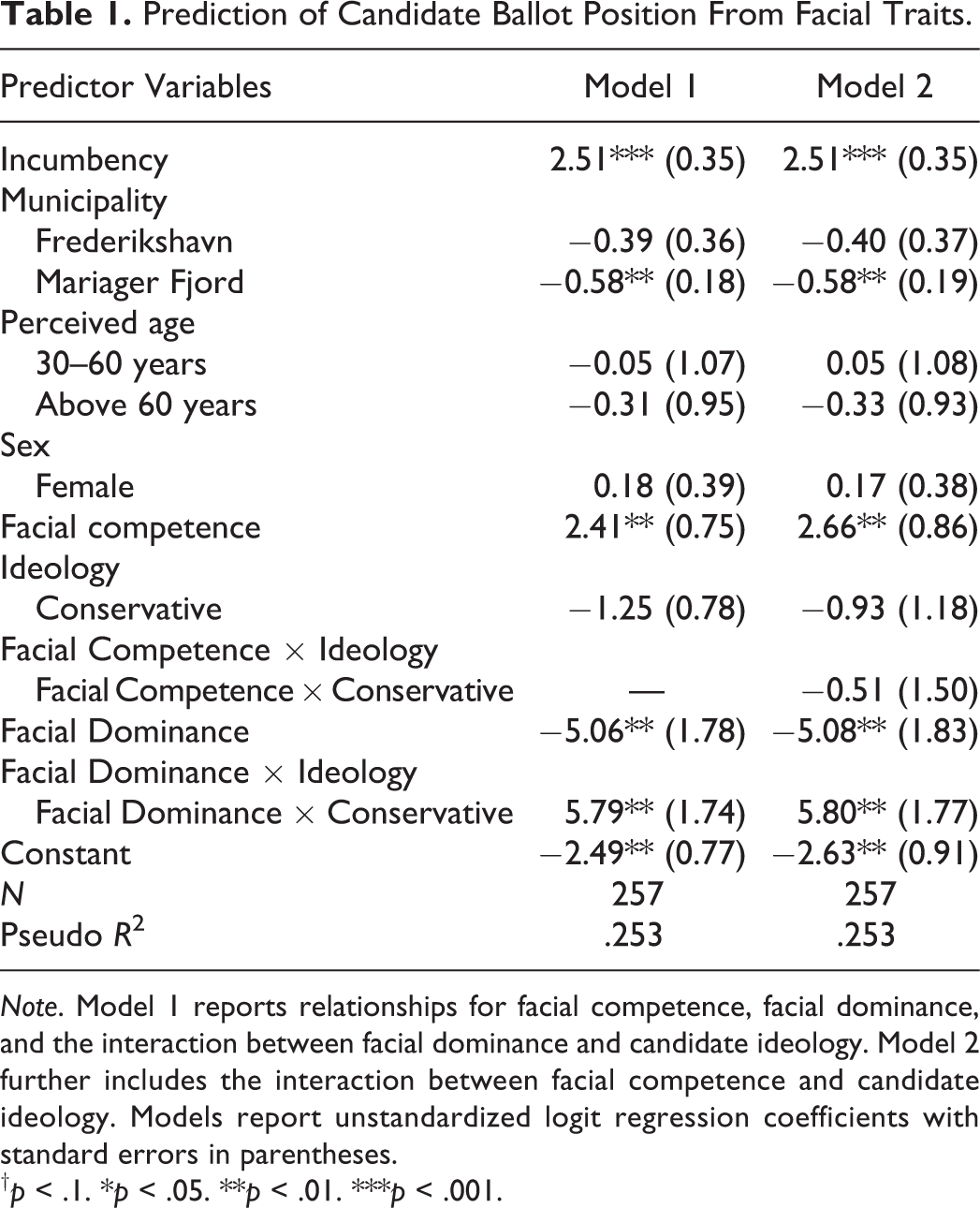
Note. Model 1 reports relationships for facial competence, facial dominance, and the interaction between facial dominance and candidate ideology. Model 2 further includes the interaction between facial competence and candidate ideology. Models report unstandardized logit regression coefficients with standard errors in parentheses.
† p < .1. *p < .05. **p < .01. ***p < .001.
Within-party support
As operationalization of our primary dependent variable, the support from members of the local party organization, we employ candidates’ positions on the ballot in the 2009 local election. As described above, local parties prioritize their candidates on the ballot providing a valid measure of party organizations’ candidate preferences. That is, the top candidate is put on top of the list, followed by the second-most preferred candidate, and ending with the least preferred candidate at the bottom of the list. Since a higher ballot position translates into more votes in actual elections (Ho & Imai, 2008; Meredith & Salant, 2013), a good ballot position is an important objective in within-party competition. Because the number of nominated candidates vary across parties (with more candidates nominated by larger parties), we cannot use candidates’ actual position on a given ballot since for instance being positioned as Number 5 is different in a party nominating altogether 12 candidates compared to a party only nominating 5 candidates. Instead, we employ a dichotomous measure of whether a candidate was located in the upper 20% of the ballot (coded “1”) or whether she or he was nominated below the top 20% (coded “0”). Importantly, because being positioned within or below the top 20% on a given ballot constitutes a somewhat arbitrary success criterion, we employ a series of alternative dichotomous measures of nomination success (positioned within or below the upper 25%, 30%, 40%, and 50%). The results of these analyses are reported in the Online Supporting Materials.
Candidates’ ideology, age, sex, incumbency, and municipality
We include the candidates’ ideology as moderator throughout the analyses. Due to the relatively low number of candidates from smaller parties in this sample, ideology is measured dichotomously based on candidates’ party affiliation and the block affiliation of that party (either the liberal and left-leaning political block or the conservative and right-leaning political block). Candidates from the liberal block are coded “0,” while candidates from the conservative block are coded “1.” 6
In the analyses, we further control for candidates’ sex, age, and incumbency. Because data on candidates actual age were unavailable, we rely on a trichotomized categorical variable of the candidates’ perceived age (under 30 years, between 30 and 60 years, over 60 years of age) as rated by a group of raters (following Berggren et al., 2010). 7 Finally, we control for incumbency measuring whether a given candidate had already won a seat at the previous corresponding election or whether she or he held any regional or national seat while running for the city council. Finally, we control for municipality to cancel out potential differences across districts. 8
Analyses
We test our prediction that candidates’ facial traits also relate to their ballot positions using logistical regressions for predictions of a top 20% ballot position. Following standard procedures, we include robust standard errors clustered at the party level (cf. Berggren et al., 2010). Because only 257 of the candidates represent mainstream parties with a clear block affiliation (with either the right-wing and conservative or the left-wing and liberal Danish parties), models in the main text are based on these candidates (results for facial competence replicate using all 268 candidates; see Online Supporting Information S.I.8). We report regression coefficients with corresponding standard errors and level of significance, and to ease interpretation, we illustrate main findings with predicted probabilities for being positioned in the top 20% of the ballot for low and high levels of facial competence (across all candidates) and for low and high levels of facial dominance (for liberal and conservative candidates separately). 9
Results
We test whether candidates’ facial competence and dominance predict their ballot positions. That is, we test whether, across the 257 candidates from the main Danish parties, facial competence positively predicts candidates’ chances of being positioned in the top of the ballot and whether facial dominance is a relatively more positive predictor of a top ballot position for conservative than for liberal candidates. Table 1 reports the full regression models for predictions of ballot position as measured by whether a candidate appears in the top 20% of the ballot or not. Model 1 estimates the main effect of facial competence and the interaction between facial dominance and candidates’ ideology. Model 2 further includes an interaction between facial competence and ideology. Across all candidates, facial competence constitutes a positive predictor of candidates’ nomination success (Model 1: b = 2.41, p = .001), and this effect is not moderated by candidates’ ideology (Model 2: b = −.51, p = .732). 10 The results also support that facial dominance is a relatively more positive asset for conservative candidates than for their liberal counterparts since the interaction between facial dominance and candidate ideology is negative and statistically significant (Model 1: b = 5.79, p = .001). 11 Table 1 provides the full models from these analyses.
To provide an in-depth interpretation of the results, we report predicted probabilities for being positioned in the top 20% of the ballot for candidates high and low in facial competence and facial dominance, respectively. Moreover, we report predicted probabilities for facial dominance for conservative and liberal candidates separately due to the interactive nature of the facial dominance prediction. We follow the observed values approach holding all other variables than the primary independent variable (facial competence or facial dominance) at their actual observed values (Hanmer & Kalkan, 2013). Finally, to represent a candidate high or low on either facial competence or facial dominance, we calculate predicted probabilities for the 10th (low) and 90th (high) percentiles of the distributions on either facial competence or facial dominance.
Starting with facial competence, we find that a candidate positioned at the 10th percentile of the facial competence distribution has a predicted probability of 11% of being positioned among the top 20% on her or his party’s ballot. In contrast, a candidate high in facial competence (positioned at the 90th percentile) doubles the chance of being allocated a similar top ballot position with a predicted probability of 23%. That is, just as previous studies find that competent-looking candidates receive more votes from the voters on Election Day, this result shows that also members of political parties—presumably high in political interest and knowledge—are affected by candidates’ facial appearance as they nominate competent-looking candidates closer to the top of the ballots. Figure 1 illustrates this result graphically.

Predicted probabilities for position in top 20% of the ballot for candidates low (10th percentile) and high (90th percentile) in facial competence. Dashed lines are 95% confidence intervals.
Turning to the role played by facial dominance in nomination success, we report predicted probabilities for liberal and conservative candidates high and low in facial dominance, respectively. From Table 1, we already saw that facial dominance plays a significantly different role depending on the ideology of the candidate. Interestingly, we find that among conservative candidates, facial dominance does not seem to affect nomination success. A candidate low in facial dominance (at the 10th percentile) faces a chance of 19% for a position in the upper 20% of the ballot, while a candidate high in facial dominance (at the 90th percentile) has a chance of 22%. Whereas facial dominance seemingly does not matter for nomination success among conservative candidates, we find a clear relationship between facial dominance and nomination success on the liberal side of the ideological spectrum. Here, a candidate low in facial dominance (at the 10th percentile) has a 22% chance of a top ballot position, while candidates high in facial dominance (at the 90th percentile) correspondingly only holds a 5% chance of the same top ballot position. That is, whereas we replicate the finding from studies on candidates’ electoral success that facial dominance interacts with candidate ideology (see Laustsen & Petersen, 2016), we find no positive effect of looking dominant on nomination success among conservative candidates. What drives the interaction between facial dominance and ideology on nomination success is instead the negative consequences of looking dominant for the liberal candidates (see Discussion section for further explanations). Figure 2 reports the predicted probabilities for candidates high and low in facial dominance from liberal and conservative parties, respectively.

Predicted probabilities for position in top 20% of the ballot for candidates low (10th percentile) and high (90th percentile) in facial dominance from liberal (left-hand panel) and conservative parties (right-hand panel), respectively. Dashed lines are 95% confidence intervals.
In sum, these results support the “biosocial leadership categorization model”—as presented by Spisak, Homan, et al. (2012)—in which leader evaluation follows a two-step procedure first related to general leader competence and second related to task-specific leadership ability. Specifically, facial competence appears to influence evaluations of context-general leadership ability, while facial dominance is factored into context-specific evaluations. Since perceptions of the social world is colored by ideological outlook (see also section “Modern Elections and Evolved Followership Psychology”), partisans on opposing ends of the ideological spectrum value facial dominance differently. Particularly, dominant-looking liberal candidates stand a worse chance than their nondominant-looking colleagues in receiving a top ballot position. However, although the relationship is in the expected direction, we do not find that conservative partisans significantly assign more dominant-looking candidates to a top ballot position. 12
Finally, the reported results replicate across a series of alternative estimation procedures. We substituted the “top 20% measure” of nomination success with other measures such as “top 25%,” “top 30%,” “top 40%,” and “top 50%.” We also employed a continuous relative measure of nomination success by dividing ballot position by the total number of candidates nominated within the party. Across these different operationalizations of nomination success facial competence constitutes a robust predictor of nomination success across all candidates. Likewise, facial dominance in all of the alternative models reduces liberal candidates’ chances of being nominated in the top of the ballot (see Online Supporting Information S.I.3–S.I.7 for full models and graphical illustrations of predicted probabilities for these alternative operationalizations of nomination success). 13 That is, regardless of the employed operationalization of nomination success—spanning distinctions between the top 20% and the lower 80% to a split between the top and bottom halves of the ballot and a continuous measure—the results remain unchanged: Facial competence and facial dominance predict candidates’ success in party internal nomination contests following a pattern parallel to results obtained in prior studies investigating candidates’ electoral success in real-world electoral contests. Below we discuss the normative consequences of these findings in relation to democratic ideals about informed and deliberate decision-making processes among the public, and we stress the most pressing questions for future research on appearance-based voting.
Discussion
In this article, we have extended previous findings of associations between candidates’ facial appearances and their electoral success by investigating how appearance also relates to party internal nominations of candidates. In parallel to previous findings that ordinary voters use candidates’ facial appearances as cues to leader abilities, we find that naive respondents’ ratings of candidates’ faces also relate significantly to decisions taken in intraparty nomination processes. Our findings both replicate and extend previous research on face-based voting, add insights to evolutionary models of leadership, and nuance our understanding of the relationship between candidates’ facial appearances and their success as candidates.
Specifically, we found that Danish local partisans regardless of their ideological leaning tend to assign competent-looking candidates to the top of the ballot. Moreover, we also replicate the interaction between facial dominance and candidate ideology previously reported for the voter level and in survey experiments (Laustsen & Petersen, 2015, 2016). That is, not only were all partisans in these Danish municipalities putting a premium on a competent face; in line with evolutionary models of leadership and followership, they also differed in preferences for a dominant face based on their ideological affiliation: Liberal partisans positioned dominant-looking candidates significantly lower on the ballot than their conservative counterparts.
These findings are important for several reasons. First, our findings replicate findings that have previously only been obtained among lay-voters. Hence, our results show that not only lay-voters but also partisans—who we should expect to be more politically interested and knowledgeable than the average citizen—are attracted to candidates based on their facial appearances. In contrast to the argument that facial features influence electoral decisions “primarily among less knowledgeable individuals” (Lenz & Lawson, 2011, p. 574), partisans follow the same patterns in candidate face preferences as ordinary citizens. The similarity of our findings to prior results from experiments and observational studies is important because it underlines the universality of the psychology underlying leader preferences across followers high (partisans) and low (most ordinary voters) in political sophistication, knowledge, and interest. The political importance of appearance-related cues might not be part of a story about an ill-informed and uninterested electorate after all. Instead, we suggest that the appearance effect of candidates’ faces reflects that modern citizens’ preferences for political candidates are (at least partly) regulated by a sophisticated, evolved followership psychology.
Second, evolutionary leadership scholars have suggested that an evolved followership psychology regulates leader preferences and that it is informed by two distinct evaluation processes: evaluations of general leadership ability and evaluations of problem-specific leadership ability. According to this theory, a follower initially sorts out the potential leaders from nonleaders, and next from this pool of potential leaders, the follower seeks out the individual who seems best capable of solving the problem experienced as most salient to the follower (Bøggild & Laustsen, 2016; Spisak, Dekker, et al., 2012; see also Lord et al., 1984). Our results provide novel support for this two-step model of followership decisions and leader preferences. Consistent with the existence of an initial overall evaluation, we found that more competent-looking candidates—regardless of ideological affiliation—received better ballot positions. Consistent with the existence of a subsequent problem-specific evaluation, we found that ideological affiliation—most likely because conservatives tend to perceive the social world as more conflict-ridden and competitive than liberals (Duckitt & Sibley, 2010; Hibbing et al., 2013; Jost et al., 2003)—shapes the effect of dominant looks such that dominant-looking candidates received a relative better ballot position among conservatives than liberals (see also Barker, Lawrence, & Tavits, 2006; Laustsen, 2016; Laustsen & Petersen, 2015). To the best of our knowledge, these findings constitute the first empirical test and support of the proposed psychological system of adaptive followership based on data from intraparty nomination processes. 14
One potential counter argument against this interpretation is that the associations between facial appearance and candidates’ success—both in terms of electoral and in terms of nomination support—could reflect that the members of the party organizations themselves recognize the electoral benefits of promoting candidates with particular appearances because they have either an explicit or an implicit sense about which type of candidate (and appearance) their constituency prefers. Even if this alternative interpretation is valid, the present findings would still suggest that modern-day party members factor in ancestrally relevant appearances and poses when promoting candidates for modern leader positions. That said, we think that two observations speak against this interpretation. First, the data analyzed here were collected from low-salience Danish local elections in 2009 in which campaigns—according to the best of our knowledge—are much more likely to focus on classic campaign objectives such as getting a candidate’s personal message out, meeting the voters, and perhaps participate in debates against other candidates (although most likely only a handful of the most politically interested voters would show up in the audience). In addition, a report based on self-reported campaign strategies from 2,083 of the candidates who ran in the 2009 Danish local elections does not mention visual appearance or character traits a single time (Hansen & Hoff, 2010). 15 Second, members of the party organizations could in theory be aware of central findings linking candidates’ facial competence to electoral success (cf. Todorov et al., 2005), but it seems less plausible that they should have known about the ideological difference in the role played by facial dominance, since these relationships were not explored and published until years after the election (cf. Laustsen & Petersen, 2015, 2016). Third, if party organizations’ strategic nominations were causing the observed pattern, it seems as a missed opportunity for conservative parties to not position the most dominant-looking candidates at the top ballot positions. Based on this, we think it is most likely that the results reflect that both partisans’ and voters’ candidate preferences are shaped by an evolved psychology of followership.
One difference between the present findings obtained among party members and past findings obtained among lay individuals should be noted. Studies on lay individuals often report that conservatives have a positive preference for dominant leaders (e.g., Laustsen & Petersen, 2016). In contrast, the differences we found among liberal and conservative party members were driven by liberal members: They showed a negative preference for dominant leaders. A potential explanation for this difference in results could relate to the fact that within small local party organizations, members are much closer to the candidates than the average voter. They will, for example, participate in small meetings and group discussions together. Because dominant individuals are seen as exploitive and untrustworthy, previous research has found that people often shun them in closer relationships (see Laustsen & Petersen, 2015). Such considerations could offset the often-found positive preference for dominant leaders among conservative party members. Given this, future studies could address whether preferences for dominant leaders are shaped by the proximity to the leader.
We also want to highlight a number of other pressing questions for future studies to investigate. Most importantly, it remains unclear what is actually perceived as a competent face and, consequently, causes the relationship between naive respondents’ ratings of political candidates’ faces and the success experienced by these candidates on Election Day. While scholars have sought to disentangle the effect of looking competent from the so-called halo (or spillover) effects related to attractiveness, results so far remain mixed. Some studies find that facial competence outperforms attractiveness (e.g., Olivola & Todorov, 2010; Todorov et al., 2005), some studies find attractiveness to be a stronger predictor than competence (e.g. Berggren et al., 2010; Verhulst, Lodge, & Lavine, 2010), and still others find that facial competence and attractiveness exert distinct effects on electoral success (e.g., Laustsen, 2014). In addition, Olivola and Todorov (2010, pp. 97–100) have tried to link perceptions of competence to other face-based trait perceptions. Yet, still it remains unclear what more specific traits such inferences are potentially based on.
Relatedly, future research should also strive to obtain measurements of the exact—and strictly noncontrollable—facial metrics of politicians that are reflected in trait perceptions of both facial competence and dominance. With respect to facial dominance, studies outside the realm of politics relate the facial width-to-height ratio to behavioral measures of aggression and untrustworthy behavior (see, e.g., Carré, McCormick, & Mondloch, 2009; Stirrat & Perrett, 2010), suggesting that this measure might also be relevant to integrate in future studies on face-based trait inferences in politics.
Finally, we believe that one of the major questions arising from both the present article and the past literature is whether or not inferences from candidates’ faces tell “something real” about the candidates or if it only reflects invalid and shallow judgments. One way future research might address this question is to investigate how trait inferences from candidate faces relate to other outcome measures than candidates’ success in elections and, especially, postelection outcomes. For instance, future work could explore if face-based trait inferences relate to candidates’ policy positions, their behavior in debates, or in other types of work in parliament. In this way, future research would be able to provide additional traction on the question of whether the relationships between candidates’ physical appearance and their electoral success are antithetical to democracy or not. Previous research have proceeded from different premises in relation to whether voters vote on “something real” when voting on the basis of facial traits (e.g., Laustsen & Petersen, in press; Lenz & Lawson, 2011). However, the here observed similarity between intraparty nominations (the results presented in this article) and voter preferences (the results presented in previous studies) suggests that voters’ preferences for physiological features in candidates could be the reflections of an evolved followership psychology and, hence, increases the plausibility that differences in candidate appearance are associated with outcomes beyond electoral success. This suggests that when voters make decisions on this basis, they might not necessarily act in an ill-informed and uninterested manner. Instead, they could be actively trying to identify the best leader to solve the problems facing society. At the same time, it is important to note that the evolutionary perspective opens for two arguments for why facial traits might not track actual ability in modern leaders. First, given differences between ancestral and modern environments, different traits might lead to leader competence then and now (cf. van Vugt & Ahuja, 2010). Second, while evolved followership might be functionally calibrated to track the personalities of potential leaders, facial traits are presumably not the most valid cues to personality (see Laustsen & Petersen, in press, pp. 3–4), and it is even a possibility that reliance on facial traits in personality assessment reflects a nonadaptive by-product of mechanisms designed to read expressions of emotions in the face (e.g., Olivola & Todorov, 2010, p. 86). In this way, addressing the political implications of the relationship between candidate appearance and electoral success opens for a number of interesting questions both theoretically, empirically, and normatively.
Conclusion
The present article provides novel insights about the role played by candidate appearance in real-world elections. In short, we have shown how modern political behavior might be explained by evolutionary psychological theories integrating insights and principles from across the natural and social sciences (see also Fowler & Schreiber, 2008; Hatemi & McDermott, 2011; Oxley et al., 2008; Petersen, Sznycer, Sell, Cosmides, & Tooby, 2013). Specifically, the results provided here support the notion of an adaptive psychological system of followership that—according to our results—could be regulating preferences for political candidates among even highly interested political partisans.
Supplemental Material
Supplemental material for When the Party Decides: The Effects of Facial Competence and Dominance on Internal Nominations of Political Candidates
Supplemental material, for When the Party Decides: The Effects of Facial Competence and Dominance on Internal Nominations of Political Candidates by Lasse Laustsen and Michael Bang Petersen in Evolutionary Psychology
Footnotes
Declaration of Conflicting Interests
The author(s) declared no potential conflicts of interest with respect to the research, authorship, and/or publication of this article.
Funding
The author(s) received no financial support for the research, authorship, and/or publication of this article.
Supplemental Material
Supplementary material for this article is available online.
Notes
References
Supplementary Material
Please find the following supplemental material available below.
For Open Access articles published under a Creative Commons License, all supplemental material carries the same license as the article it is associated with.
For non-Open Access articles published, all supplemental material carries a non-exclusive license, and permission requests for re-use of supplemental material or any part of supplemental material shall be sent directly to the copyright owner as specified in the copyright notice associated with the article.
