




Abstract
Previous research has shown that manipulating the pitch of a face (tilting the face upward or downward) affects the perceived femininity, masculinity, attractiveness, and dominance of the given face. However, previous research has not considered the influence of direct eye gaze on dominance perceptions or the ambiguity surrounding the proposed social signals sent from a static face. The current research used 94 participants across two studies (women = 63%, age: M = 31). Stimuli varied in head pitch angle, eye gaze, and motion/static appearance. Participants rated the stimuli for levels of masculinity, femininity, attractiveness, and dominance. Both studies confirmed that pitching the face upward at incrementally increasing angles resulted in a linear increase in ratings of masculinity, physical dominance, and social dominance and a linear decrease in ratings of femininity, physical attractiveness, and behavioral allure. Study 2 showed that these effects can be dependent on either the perceived structural change of the face or the actual movement of the face, and these are different for each rating category. The perceived dimorphism, attractiveness, and dominance of a face will change dependent on the angle of pitch it is presented but also whether it is moving or not, where it is moving in space, and what direction it is moving.
Male and female faces structurally differ in consistent ways, with females having larger eyes and smaller jaws, on average, and there are differences in what is considered attractive in male and female faces. The features that comprise typical female attractiveness are commonly agreed upon in the literature, whereas male attractiveness is less consistent (Perrett et al., 1998; Rhodes, 2006). Factors that increase femininity, such as increasing eye and lip size, have also been shown to increase female attractiveness (Fraccaro et al., 2010; Perrett et al., 1994). Masculine faces on the other hand are wider, longer and have increased jaw size and a larger brow ridge compared to feminine faces (Weston et al., 2007). With masculine faces shown to be more attractive to women, especially when judging faces for short-term relationships (Jones et al., 2018).
In an attempt to understand the possible evolutionary origin of this sexual dimorphism in human faces, Burke and Sulikowski (2010) manipulated the pitch of a face (tilting the face upward or downward) and showed that this influenced ratings of perceived masculinity, femininity, and attractiveness. They suggested that this might be reflective of the height dimorphism present in humans, since men are, on average, taller than women, and faces viewed from above (simulated by pitching the face downward) appear to have larger eyes and smaller jaws, whereas viewing from below makes jaws look bigger and eyes smaller. Twenty different faces, 10 of each sex, were created with five versions of each to represent different angles of pitch—two pitched up, two pitched down, and one straight on. Participants were asked to rate these faces for attractiveness, masculinity, and femininity. A linear trend was found for both femininity and masculinity, with femininity increasing as pitch decreased, while masculinity decreased as pitch decreased. Attractiveness was shown to be influenced by a pitch for female faces, but not for male faces. The sex of the observer did not affect femininity or masculinity judgments, or the attractiveness ratings of female faces, but it did affect the attractiveness ratings of male faces.
A factor that was not explicitly considered by Burke and Sulikowski (2010), but that may well play an important role in understanding the relationships between pitch, masculinity/femininity, and attractiveness, is that face pitch and facial masculinity have also been shown to influence perceived dominance (Mignault & Chaudhuri, 2003; Neave et al., 2003). Watkins et al. (2010) studied male participants with respect to two hypothesized types of dominance: physical and social. Physical dominance is the ability of one person to exert their physical presence over another person, whereas social dominance refers to successful leadership, negotiation skills, and taking control over group situations. As masculinity of male face stimuli increased, so did ratings for both dominance types. For female faces, however, a difference emerged. Female faces followed the same trend as male faces for physical but not social dominance, with social dominance ratings increasing as female faces became more feminine, not masculine. This also provides strong evidence that masculinity and dominance possibly involve two distinct mechanisms, at least when judging female faces.
Other studies have shown that eye gaze (Main et al., 2009) and head tilt/pitch (Mignault & Chaudhuri, 2003) to be central factors in judgments of dominance. The study by Main et al. (2009) used two different eye gaze conditions, averted and direct, to assess the role this plays on the dominance of both male and female faces. Male faces were rated as more dominant than female faces when gaze was direct but not averted. This suggests several factors underlying judgments of dominance. Mignault and Chaudhuri’s (2003) study investigated the effect of tilting the head of stimuli up or down (pitch) on judgments of dominance. They found ratings of dominance increased as head tilt angle increased, indicating that dominance might also be influenced by dynamic processes.
While providing valuable information about face pitch and dominance, the stimuli used by Mignault and Chaudhuri’s (2003) study of head tilt and dominance were of poor visual quality limited by the technology available at the time. The faces, although 3D, were monotone with no contrasting colors, the eyes were closed, and the skin appearance had a very rough texture. Current technology allows the extension of this research in new ways, such as integration of head tilt and eye gaze in more realistic stimuli, removing these past limitations.
Previous studies have also tended to include a small number (frequently one) of factors simultaneously, therefore, leaving out at least some of the picture. The current studies are designed to incorporate more of the variables known to influence facial attractiveness in as extensive an approach as practical and to determine the underlying interactions between them. It will integrate the factors of both social and physical dominance as studied by Watkins et al. (2010) into the existing face pitch manipulation used by Burke and Sulikowski (2010). In Study 1, eye gaze, as studied by Main et al. (2009), will be included as a potential source of additional dominance variation. In Study 2, behavioral allure—a construct designed to measure whether the act of tilting the face down is attractive regardless of the intrinsic attractiveness of each face—will be used. This construct is taken from Sulikowski et al. (2015) who showed that the overall attractiveness of females is affected by the behavior of tilting the face down.
We expect to replicate and extend previous findings, including the linear effects on masculinity, femininity, dominance, and attractiveness scores as face pitch varies. Femininity ratings of female faces are not expected to differ from female attractiveness ratings, whereas masculinity ratings of male faces are expected to show a different function across variation in face pitch to male attractiveness ratings. Social dominance ratings are also expected to be higher for female faces than physical dominance ratings, but no difference is necessarily expected for male faces. Given previous findings showing that increases in dominance for raised head tilt and direct eye gaze separately, an interaction is hypothesized in which direct eye gaze is predicted to show higher ratings of both physical and social dominance for faces tilted upward than faces tilted downward, but averted gaze is not expected to be different for either. No specific predictions are hypothesized regarding the interaction between masculinity and dominance due to the convoluted nature of the literature, but by measuring the effect of face pitch on each of these judgments, using the same stimuli, and a wider range of face tilts than were used by Burke and Sulikowski (2010), we may be able to partially disentangle the effects of dominance and attractiveness.
Study 1
Method
Participants
Participants were 49 volunteer members of the public. There were 20 men (age: M = 30.9, SD = 16.6) and 29 women (age: M = 26.5, SD = 11.6). Both studies in the current research were conducted under the approval of the University of Newcastle’s Human Research Ethics Committee (reference H-2009-0312). All participants in both studies provided written informed consent before taking part in the research. In order to determine the required sample size, a priori power analysis was performed using the partial η2 values from Burke and Sulikowski (2010) and Mignault and Chaudhuri (2003), as their methodologies closely resembled the current research. Analysis showed that in order to achieve a power of .8 for measures of masculinity involving stimuli that varied in pitch, the number of participants required was 24. All other measures required fewer than this, so 24 was accepted as the required sample size. The current research exceeded this target in both studies.
Stimuli and Apparatus
FaceGen Modeller v3.5 software was used to generate and manipulate 10 different faces, five of each sex. The number of faces used was designed to ensure that any findings were not attributable to the effect of any one identity. The faces were set to be of similar age, race, and attractiveness.
Twenty-two different head tilt angle and eye gaze combinations for each face were created (see Figure 1). Head tilt angles consisted of five angles down, five angles up, and one straight on. There was approximately 4° of tilt between each level. After tilt manipulation, each face was adjusted so that eye gaze was directed at the observer. Then, another version of the face was created, which had averted gaze by approximately 20° to the right of the screen. This process resulted in the production of 220 stimuli.

Examples of the stimuli presented to participants for each rating task including all 11 head tilt angles with both direct (Panel A) and averted (Panel B) gaze.
A single laptop computer with a 40-cm display was used to run the experiment, controlling for differences in screen size and size of stimuli presented. The computer monitor was distanced approximately 40–50 cm away from the eyes of the participant. SuperLab v4.5 software was used to control the experiment and record participant data.
Procedure
The rating of the stimuli required participants to assign a whole number from 1 to 9 for each task. For ratings of perceived masculinity of male faces, 9 represented extremely masculine and 1 represented not masculine at all. Similarly, for femininity of female faces, 9 represented extremely feminine and 1 represented not feminine at all. For physical dominance, 9 represented extremely physically dominant and 1 represented extremely physically submissive. For social dominance, 9 represented extremely socially dominant and 1 represented extremely socially submissive. For attractiveness, 9 represented extremely attractive and 1 represented extremely unattractive.
For the physical dominance condition, participants were told to consider whether the face was representative of someone who would win a fistfight with an individual of the same sex. In the social dominance condition, participants were told to consider whether the face was representative of someone who tells other people what to do, is respected and influential, and is often a leader. These examples replicate previous studies that have found differences in definitions and perceptions of social and physical dominance (Watkins et al., 2010).
All stimuli were presented in random order within each rating task. In order to reduce the possibility of carry-over effects from previous tasks, the order of the rating tasks was also randomized for each participant. Each participant therefore rated each stimulus 4 times, once each for masculinity/femininity, physical dominance, social dominance, and attractiveness.
Design and Analysis
The experimental design was a 4 (judgment) × 11 (head tilt angle) × 2 (eye gaze) × 2 (sex of participant) mixed design. Data were prepared for analysis by averaging individual participant scores for each judgment task. These averages were calculated for each stimulus face sex at every tilt angle and each eye gaze condition. For example, all responses within the judgment task of attractiveness for male face stimuli at a tilt angle of −2 with averted eye gaze were averaged. Mixed analyses of variance (ANOVAs) were conducted separately for each sex of stimuli to determine whether head tilt angle, eye gaze condition, and participant sex played a significant role in determining participant responses for judgments of masculinity/femininity, physical dominance, social dominance, and attractiveness. This analysis was run separately for both male and female stimuli based on the previous research of Burke and Sulikowski (2010), which established this effect as significant. Additionally, both sexes were not rated for the same dimorphism category; males were rated for masculinity, females were rated for femininity. Bonferroni adjusted pairwise comparisons were conducted for significant main effects and interactions to determine the nature of the differences. All data from Studies 1 and 2 are publicly available at https://osf.io/kaf6b/
Results
In order to check for the effects of participant fatigue due to a large number of ratings, they were required to make (880 each), interrater reliability was tested by computing the intraclass correlation coefficient (ICC). A high degree of agreement was found between participants with an average measure ICC of .94, F(175, 8400) = 15.96, p < .001.
Male Faces
All main effects were significant, with the exception of head tilt which approached significance (Table 1). The main effect of judgment type is not theoretically important, but the way in which it interacts with other variables is. The interaction between judgment type and eye gaze is illustrated in Figure 2. Bonferroni adjusted pairwise comparisons indicated that eye gaze had a significant effect on attractiveness judgments (mean difference (MD) = −.15, SE = .03, p < .001), physical dominance (MD = −.14, SE = .04, p < .001), and social dominance (MD = −.24, SE = .07, p < .001), but not masculinity (MD = −.05, SE = .03, p = .11). However, contrary to predictions, this interaction did not depend on head tilt.
Main Effects and Interactions Observed in Study 1.


Average participant rating scores for male faces over all judgment conditions separated by eye gaze condition. *p < .001.
The significant judgment type by head tilt interaction suggests that the effect of head tilt varies according to the different judgment conditions. An analysis of the contrasts underlying this interaction revealed a linear trend interaction, F(1, 47) = 21.8, p < .001, and a significant quadratic trend interaction, F(1, 47) = 13.6, p < .001 (Figure 3). Figure 3 also suggests that although social and physical dominance ratings were very close in value, the overall trend for each is different, as physical dominance follows a quadratic function, whereas social dominance follows a more linear trend.
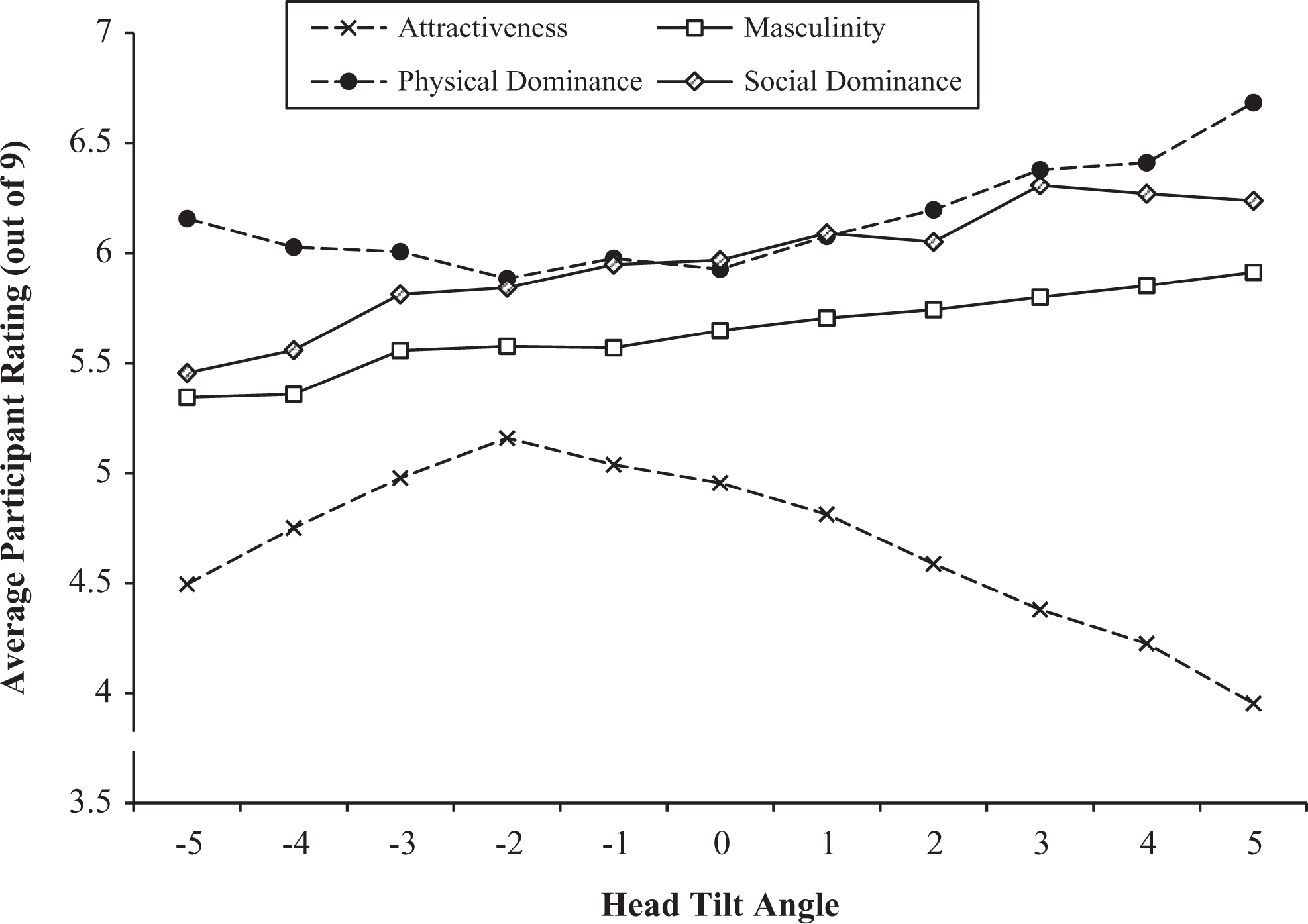
Average participant rating scores for male faces over all head tilt angles and judgment conditions.
Female Faces
The between-subjects effect of participant sex was not significant, but all within-subjects variables showed significant effects (Table 1). The interactions between judgment type and head tilt and between eye gaze and head tilt were also found to be significant.
An investigation of the main effect of judgment type was conducted using a Bonferroni adjusted pairwise comparison. This analysis revealed that attractiveness judgments were only significantly different from judgments of physical dominance (MD = .58, SE = .17, p = .01). Femininity and social dominance judgments were also only significantly different from physical dominance (MD = .55, SE = .18, p = .03, and MD = .61, SE = .14, p < .001, respectively) and not each other (all p > .05).
The contrasts underlying the interaction between judgment type and head tilt revealed significant linear, F(1, 47) = 39.7, p < .001, and quadratic, F(1, 47) = 14.6, p < .001, trends. As illustrated in Figure 4, both social and physical dominance judgments increase largely monotonically, and linearly as the head tilts further up. Both femininity and attractiveness, on the other hand, decrease as the head tilts further up and show very similar quadratic and linear trends.

Average participant rating scores for female faces over all head tilt angles and judgment conditions.
The interaction between eye gaze condition and head tilt angle was found to be statistically significant; however, since this interaction is independent of judgment type, this finding is essentially uninterpretable. In line with the findings for male faces, the interaction between eye gaze, judgment type, and head tilt was found to be nonsignificant, contrary to predictions.
Discussion
From these observations, we can conclude that ratings of attractiveness, femininity, masculinity, physical dominance, and social dominance for both male and female faces differ according to changes in head tilt as hypothesized. These changes, however, were only linear for ratings of male faces for masculinity, female faces for physical dominance, and both male and female faces for social dominance. Contrary to the expectations based on previous studies (Burke & Sulikowski, 2010; Mignault & Chaudhuri, 2003), a curvilinear trend emerged for ratings of femininity and attractiveness of female faces, and new quadratic relationships between physical and social dominance across changes in head tilt were discovered for male faces. Part of the difference in functions may be a consequence of a more fine-grained manipulation of head tilt, compared to that used by Burke and Sulikowski (2010), enabling us to discover more subtle effects.
As expected, femininity ratings of female faces did not differ significantly from attractiveness ratings of female faces. The trends for both variables were virtually identical, indicating a very strong relationship between judged femininity and judged attractiveness for female faces. Increasing the downward tilt of female faces rapidly reached a plateau, for both kinds of judgments, suggesting a ceiling effect. Much of the effect of head tilt on these judgments is a consequence of upward tilts decreasing both attractiveness and femininity judgments.
Consistent with previous research, head tilt had different effects on perceived masculinity and perceived attractiveness of male faces. As in Burke and Sulikowski (2010), masculinity linearly increased as the head tilted further up, but in the current study, attractiveness showed a strong quadratic trend, peaking when the face was tilted slightly downward. Interestingly, in terms of understanding this function, judged physical dominance showed the opposite quadratic trend. Head tilts that increased perceived physical dominance decreased perceived attractiveness, and the tilt with the lowest judged physical dominance was rated as the most attractive. This suggests that rated attractiveness is perhaps the inverse of rated physical dominance and that perceived dominance might be driving the changes in perceived attractiveness as head tilt changes. This will be investigated in Study 2. Unlike physical dominance, social dominance increased linearly as heads tilted further up. The increase in perceived physical dominance at extreme downward tilts might plausibly be a consequence of this being a dynamic threat signal. This possibility is also investigated in Study 2.
No ratings of female faces were influenced by the sex of the rater as predicted. The finding that men rated masculinity and physical dominance of male faces as different to each other whereas women did not also suggests a sex difference in making these judgments, at least for male faces.
Social dominance ratings of female faces were significantly higher than physical dominance ratings as predicted. Male faces were not rated differently in terms of average score for both social and physical dominance, also as predicted. It is important to note that while these predictions about overall ratings were met, the underlying trends for each target sex did differ.
The difference between averted gaze and direct gaze for judgments of attractiveness, physical dominance, and social dominance for male faces was not directly predicted, but is also not especially surprising, since a direct gaze presumably intensifies most social judgments. The fact that eye gaze made little difference to masculinity judgments suggests that participants were using structural information from the face to make that judgment.
The novel finding that male faces were rated differently by men for judgments of masculinity and physical dominance, but that women rated them similarly, adds a layer of depth to this established sex difference. One possible interpretation for this outcome was suggested by Watkins et al. (2010). They proposed that this male ability to differentiate masculinity and physical dominance might have evolved as a survival adaptation. Sensitivity to cues of dominance and masculinity in the faces of other men, as well as the ability to distinguish between the two, would enable less dominant men to easily identify highly dominant men who pose a physical threat and allow them to employ strategies to appease or avoid them in order to escape an unwanted confrontation.
The findings of the current study show that for female faces, social dominance scores did not increase as head tilt decreased (which does increase perceived femininity), contrary to predictions based on the findings of Watkins et al. (2010). While the finding that female faces were rated higher for social dominance than physical dominance compared to male faces which were rated similar for both dominance types replicated the Watkins et al. (2010) study, the interpretation of these results in the current study is different. As observed in Figure 3, note the distinction between the quadratic trend of physical dominance and the linear trend of social dominance for male faces, while the ratings for female faces (Figure 4) for both social and physical dominance follow the same linear pattern. Although not directly compared, it may be possible that physical and social dominance are different constructs for male faces, but not for female faces, which would be in contrast to the conclusions drawn by Watkins et al. (2010). It may be that this discrepancy is a consequence of an indirect manipulation of masculinity/femininity in the current study, via head tilt, and a more direct manipulation, via facial morphing, in the Watkins et al. (2010) study.
The conclusions of Main et al. (2009) regarding the interaction between gaze type and face shape were not replicated in the current study. The present study found no interaction between judgment task, eye gaze condition, and head tilt angle (as a proxy for face shape). Again, the conflicting results may be explained by the use of head tilt as a determinant of not only masculinity, but dominance in the current study. The faces in the Main et al. (2009) study were manipulated to be either masculine or feminine.
Study 2
Study 1 reveals that face tilt has an effect on perceived social and physical dominance and that these judgments sometimes dissociate from perceived masculinity/femininity and attractiveness. Given that face tilt affects this social signal and that it also affects perceived attractiveness, there is the possibility that head tilt is used as a dynamic signal and that the effects observed in Study 1 and in previous studies that manipulated face tilt are at least partially a consequence of participants, assuming (perhaps unconsciously) that the tilted faces have been moved to that position as a dynamic signal.
In studies like Burke and Sulikowski (2010) and Study 1 of the current research where multiple images are shown and rated, participants are not made aware that the faces are being presented at differing pitches. This would mean that the ratings given to those faces are probably based on the participants’ perceptions that the image is a true representation of face shape and configuration. This ambiguity poses an issue because changing the pitch of the face is akin to changing the viewing angle of the face, which changes where the features of the face are in relation to each other or its featural configuration (Kappas et al., 1994). Therefore, if an observer was provided with information that the change in featural configuration was due to a change in viewing angle, then this may influence ratings. The observation that stimuli used in studies of facial dimorphism and/or its functions are of an ambiguous nature, led to the question for Study 2: Would the results shown previously be replicable when using stimuli that moved in the way intended to be represented by the static images?
In order to achieve this aim, stimuli of stationary faces presented at differing angles of pitch (static stimuli) as well as stimuli of faces in motion (dynamic stimuli) will be used. The dynamic faces will tilt up and down in pitch, both to and from the center position, in order to reduce any ambiguity and instead give the impression of a deliberate signal from the stimuli. Including static faces in the current study will enable us to compare the effects of static and dynamic faces that are otherwise identical.
Based on the findings of Sulikowski et al. (2015), an additional judgment category was also included in this study. In attempting to test whether the menstrual cycle variations in facial attractiveness originally discovered by Roberts et al. (2004) were a consequence of subtle variations in head tilt, Sulikowski et al. (2015) discovered that head tilt best predicted variation in “behavioral allure,” a measure of behavioral attempts by the owner of the face to appear more attractive rather than the physical attractiveness of the face. Since this social signal is also likely to be dynamic—allure might be a consequence of a subtle downward head movement—we included it as a judgment in the current study alongside attractiveness, femininity, masculinity, and physical and social dominance.
Method
Participants
Study 2 used 45 participants. Thirty participants were undergraduate psychology students recruited via the University of Newcastle’s research participation system and were given course credit for participation in the study. The remaining 15 were volunteers recruited from the local community. There were 30 women (age: M = 32.7, SD = 12) and 15 men (age: M = 34.3, SD = 14.3).
Stimuli and Apparatus
Stimuli were created using photographs of 10 male and 10 female faces. The individuals in the photographs were of Caucasian appearance with estimated ages ranging from 20 to 30 years and were chosen as they matched the demographic of the expected participant pool. The photographs were imported into FaceGen software that created a 3D model of each individual’s face and allowed for tilting the face within the range of +15° upward to −15° downward. These angles represent the likely range of movement between average height humans during conversation (Burke & Sulikowski, 2010).
For each face, seven static images were created: one at 0° pitch, three tilted upward (+5°, +10°, and +15°), and three tilted downward (−5°, −10°, and −15°). For each image, eye gaze was corrected to be always looking directly ahead at the observer. The dynamic set of stimuli was created with four variants of movement, all of which moved smoothly, while eye gaze stayed fixed straight ahead at the observer. One variant started at 0° pitch, then tilted upward to +15°, one variant moved from 0° to −15°, one from +15° to 0°, and one from −15° to 0°. The four variants therefore possessed a different combination of movement range (top or bottom) and direction (upward or downward). All variants spent 1 s at its starting position, took 1.76 s to move to its final position, remained on screen for a further 0.8 s, and then disappeared to a black screen. Pilot testing suggested this combination of temporal speeds provided adequate time for participants to process the original appearance of the face, witness the change of configuration in real time, and then process the final appearance of the face, while still maintaining life-like speeds (see Figure 5).

Examples of dynamic stimuli. Faces are depicted in their starting position; arrows indicate the direction of movement.
For both sexes, each model was randomly numbered from 1 to 10. Two groups of models were then created. The first group consisted of the static images of Models 1–5, plus the dynamic images of Models 6–10. The second group was comprised of the converse images to the first group. This technique counterbalanced the stimuli in a way that did not allow the same model to be shown to an individual participant as both a static and a dynamic image. This step was enacted as a means of ensuring participants were more sensitive to the dynamic cues as opposed to the structural cues of the face. If the participants were more familiar with how the identity looked as a static image, then the movement effect may have been reduced. This process resulted in 110 stimuli per group (70 static, 40 dynamic).
Study 2’s tasks were created using SuperLab software and completed by all participants on the same 40 cm laptop computer. Each stimulus was presented on screen at a size of 12 cm2, approximately 40–50 cm away from the participant. All responses were recorded by SuperLab via the laptop’s keyboard.
Procedure
Ratings were made for six different categories for each stimulus: femininity, masculinity, physical attractiveness, behavioral allure, physical dominance, and social dominance. At the beginning of each category, on-screen text instructed participants on how to make the ratings, similar to Study 1. The additional category, behavioral allure, was defined by the statement: “rate the attractiveness of the face based on the behavior that the face is actually engaged in.” Participants gave a score ranging from 1 to 9 to each stimulus, with 1 being the least that face represented the given category, 5 being average, and 9 being the most.
The decision to rate both sexes of stimuli for femininity and masculinity is considered a methodological improvement over Study 1, as the two constructs are not necessarily sex exclusive. That is, some men can be considered as physically feminine, just as some women can be considered as physically masculine.
Participants were randomly allocated to either group of stimuli, while order of ratings category was randomized to reduce carry-over effects. Individual stimuli were presented in random order within each category. Participants rated every stimulus once for each category. This differs slightly from Study 1 which only rated female faces for femininity and male faces for masculinity. This resulted in 660 ratings per participant, taking approximately 45 min to complete.
Design and Analysis
Due to the lack of theoretical importance and impracticality of interpreting results when including the different judgment types in the ANOVA model, we have opted to analyze each judgment category separately. For judgments of static stimuli, the study was a 2 (participant sex) × 2 (stimuli sex) × 7 (pitch angle) design, for each judgment type. Scores were averaged within their pitch angle, within sex of stimuli, and within rating category, per participant. The data were then analyzed using a mixed ANOVA for each rating category.
Before analyzing the dynamic stimuli data, all responses occurring less than 1 s after stimulus presentation were excluded. This ensured that scores to be included in analysis occurred after each stimulus had begun moving. This resulted in the removal of 398 individual responses across the 45 participants (11% of total responses). The scores given to stimuli were aggregated within each of the four variants. The ANOVA model used for analysis was a 2 (participant sex) × 2 (stimulus sex) × 2 (movement range) × 2 (movement direction) mixed design. This process was completed separately for each rating category.
Results
Static Stimuli
The results support previous findings (Burke & Sulikowski, 2010) that facial pitch influences perceptions of femininity and masculinity (Table 2). As indicated by significant linear trends, the stimuli were perceived as progressively more feminine, F(1, 43) = 4.6, p = .038,
Main Effects and Interactions Observed in Study 2’s Static Stimuli.
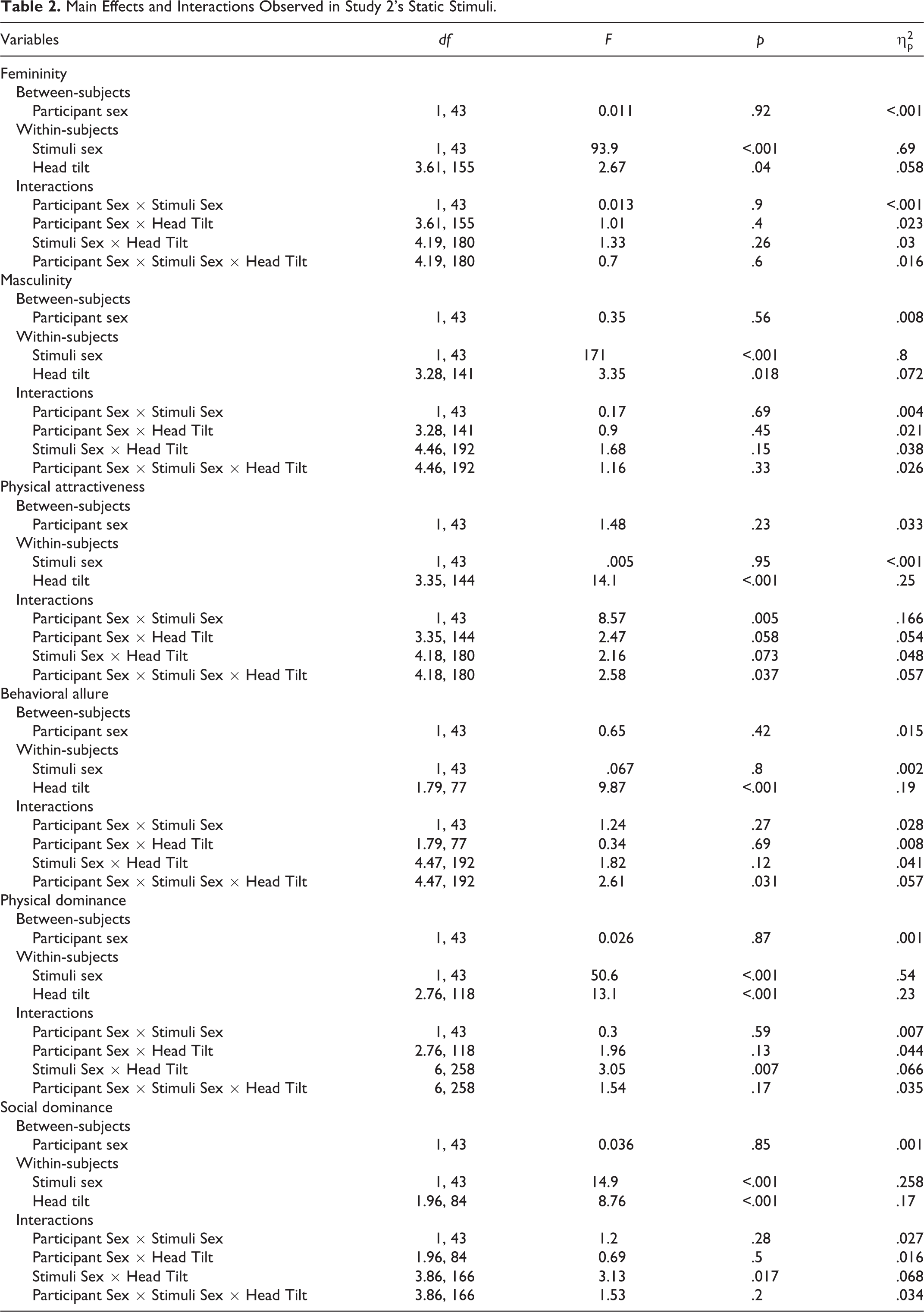

Average participant rating scores for all static faces over all head tilt angles and judgment categories in Study 2.
Physical attractiveness and behavioral allure results also support previous findings (Sulikowski et al., 2015), with pitch being a main effect for both categories. The faces were perceived as progressively more physically attractive, F(1, 43) = 28.1, p < .001,
Figure 6 shows that results for physical dominance ratings were supportive of previous findings (Mignault & Chaudhuri, 2003), with the main effect of pitch being significant. The faces were rated as progressively more physically dominant the further up in pitch they were depicted, with the converse being true the further down in pitch they were depicted, F(1, 43) = 16.6, p < .001,
Dynamic Stimuli
For ratings of femininity, the effect of both movement range and movement direction was significant (Table 3). Stimuli in the top range received lower scores (marginal mean (MM) = 3.54, SE = .17, 95% CI [3.2, 3.88]) than those in the bottom range (MM = 3.7, SE = .16, 95% CI [3.38, 4.03]). Importantly, stimuli that were moving downward (MM = 3.69, SE = .17, 95% CI [3.36, 4.02]) received higher femininity scores than those moving upward (MM = 3.55, SE = .17, 95% CI [3.22, 3.89]; Figure 7). This result is consistent with Study 1’s findings that femininity ratings of female faces become progressively more feminine the further down in pitch they are tilted.
Main Effects and Interactions Observed in Study 2’s Dynamic Stimuli.


Mean scores given to dynamic stimuli separated by range of movement and direction of movement. *p < .05.
Both direction of movement and movement range had no significant effect on ratings of masculinity. As there were no main effects of direction or range on ratings of masculinity, this suggests that featural configuration of the face is the only determining factor for this category.
Physical attractiveness scores did not differ according to movement direction, but the effect of movement range was significant, with the bottom range judged as most physically attractive. A notable three-way interaction occurred between participant sex, stimuli sex, and movement range. This appears to be a result of female participants rating female stimuli (MM = 4.23, SE = .21, 95% CI [3.79, 4.66]) as less attractive than male stimuli (MM = 4.4, SE = .29, 95% CI [3.83, 4.98]) in the bottom range of movement, yet more attractive in the top range of movement (MM = 4.13, SE = .21, 95% CI [3.7, 4.57]; MM = 4.1, SE = .26, 95% CI [3.57, 4.63]), while male participants were consistent across both movement ranges. This is a unique finding as results from Study 1 (and other studies) show that men and women rate female faces in the same pattern.
For ratings of behavioral allure, there was a main effect of direction of movement and movement range. Downward movement was rated higher than upward, and the bottom range was rated higher than the top range. The possible height difference implied by this variant suggests this finding is likely due to the reduced ambiguity of the stimulus. Movement direction also had an interaction with sex of the stimuli, likely due to the spreading of ratings given to each sex of stimuli from upward movement to downward movement. That is, the increased ratings of female stimuli from upward movement (MM = 3.97, SE = .21, 95% CI [3.55, 4.4]) to downward movement (MM = 4.53, SE = .22, 95% CI [4.09, 4.98]) were more extreme than the increased ratings of male stimuli from upward (MM = 3.82, SE = .2, 95% CI [3.42, 4.21]) to downward movement (MM = 4.07, SE = .21, 95% CI [3.65, 4.5]).
For ratings of physical dominance, there was no effect of movement direction or movement range. These results mirror those of the masculinity category, suggesting the mechanisms driving these two constructs are closely linked, which was not entirely the case in Study 1 but has been suggested numerous times in the literature.
In the social dominance category, stimuli moving in an upward direction were rated as statistically significantly more socially dominant across both ranges of movement. However, movement range had no effect. Although Mignault and Chaudhuri (2003) did not differentiate between physical and social dominance, these results support their claim that it is the pitching up of the face which signals dominance.
Discussion
The aim of Study 2 was to test the effect of stimuli that actually moved in the way intended to be represented by the static stimuli used in Study 1 and other previous research (Burke & Sulikowski, 2010; Mignault & Chaudhuri, 2003; Sulikowski et al., 2015; Watkins et al., 2010). It also included an assessment of static stimuli of the same faces used for dynamic stimuli and rated by the same participants. The results from the dynamic stimuli were mixed, while the static stimuli’s results almost wholly replicated previous research.
Adding credence to the findings of Study 1, and Burke and Sulikowski (2010)—that the result of pitching the head is a change in dimorphic appearance—is the current finding that the effect is robust across both sexes of stimulus and participant. Additionally, for the static stimuli at least, we have improved the validity of this methodology by showing that when replicating the effect in slightly different ways (i.e., by rating both sexes on femininity and masculinity), the effect is still consistent.
The dimorphism results from the dynamic stimuli are also of interest to facial research, as they show that pitching the head upward or downward can affect ratings of femininity, but not masculinity. Contrasting this with the static stimuli results implies that it is the featural configuration of a face that determines the level of masculinity perceived regardless of other factors. This is strengthened by the fact that the femininity of faces in the top range of movement was rated lower than the bottom range. A possible cause is that inferred height of the hypothetical face owner is contributing to ratings. As the stimuli moving downward in the top range of pitch can be perceived as a taller person looking down at the observer (Burke & Sulikowski, 2010), it is possible that participants considered those stimuli as less feminine because females on average are the shorter sex; so a taller person is less feminine by nature, regardless of sex.
In the physical attractiveness category, again the static stimuli results replicated previous research, but when considered alongside the dynamic stimuli’s results, the conclusions become mixed. The Participant Sex × Stimuli Sex × Movement Range interaction effect seen for the dynamic stimuli has also challenged some previous findings. Women rated the female stimuli in a different pattern compared to how the men rated the female stimuli, which has not been the norm in past research (Glassenberg et al., 2010; Swaddle & Reierson, 2002). This raises the question: Were women judging the bottom range less attractive because they were aware of the faces’ true featural configurations before movement? We considered this type of participant response as a possibility, but for all faces and by all participants; and only that it would reduce scores, not push them in the opposite direction. This is a question for future research, with the role of female intrasexual competition a possible variable, as this behavior resembles a form of derogation technique (Buss & Dedden, 1990). Conversely, there is also the possibility that males are less sensitive to the change in featural configuration as they use both the face and body as a means of determining attractiveness, whereas females predominantly focus on facial features (Wagstaff et al., 2015).
The static stimuli rated for behavioral allure returned similar evidence to that found by Sulikowski et al. (2015), and the pattern of the data is closely aligned with that of physical attractiveness. The dynamic stimuli rated for behavioral allure also showed a pattern of the data consistent with expectations based on Sulikowski et al. (2015). Results from this construct are difficult to interpret, and likewise so is rating faces on this construct, as indicated by anecdotal responses from participants. At this stage, we can only speculate that responses are based on a reduced ambiguity as to the signal being sent, an ambiguity which is present in the static stimuli. With static stimuli, the participant is not able to determine whether the face is moving upward or downward, but with the dynamic stimuli, it is clear to the observer that the face is purposely pitching up or down from a specific position. Why certain gestures would be more behaviorally alluring is unknown, but speculation would suggest gestures of courtesy. For example, faces pitching downward in the top range of movement could be perceived as a taller person looking down, bringing their attention to the observer. A counter to this argument is that the face moving from an upward position to center can still be perceived as someone of similar height; they would just be moving their head back to its original position. Even so, the gesture would be the same.
The mechanism for the increased ratings of physical dominance for static faces depicted at −15° (this effect was also seen in Toscano et al., 2018), and Study 1 of the current research may be working in a similar fashion to a mechanism found by Hehman et al. (2013). They showed that pitching the face either up or down reduces the facial width-to-height ratio. This reduction then results in ratings of increased intimidation, but the effect is greater when the head is pitched down. Alternatively, as the brow of the face can appear furrowed or “v-shaped” when the face is pitched down, participants may have seen this as a sign of aggression, and made their ratings based on that perception (Kappas et al., 1994; Witkower & Tracy, 2019).
The pattern of ratings given to dynamic faces for levels of physical dominance closely matched those given for masculinity, again suggesting that this construct is influenced more by featural configuration than the direction of movement. On the other hand, social dominance ratings did show a significant difference based on the direction of movement. Although Mignault and Chaudhuri (2003) did not differentiate between physical and social dominance, these results support their claim that it is the pitching up of the face which signals dominance. Additionally, the current finding suggests that it is not just the fact that a face is pitched upward per se, but it is the actual behavior of upward movement that signals dominance, a conclusion that is not possible based on scores given to static stimuli alone.
Linking the above results together, it is possible to conclude that a large group of signals are perceived in the dynamic stimuli simultaneously. There is evidence to suggest this occurs in static stimuli, with the mechanism for a change in attractiveness ratings being a multitude of social and emotional signals such as dominance, happiness, and guilt (Mignault & Chaudhuri, 2003). If this is true for the dynamic stimuli, then it is possible to draw more conclusions from the data, especially in relation to the direction of movement analyses.
It is clear that presenting faces at differing tilts of pitch affects perceptions, as this effect has now been shown 3 times—in Burke and Sulikowski (2010) and both Studies 1 and 2 of the current research. It is also clear that these perceptions are affected differentially, depending on whether the face is moving or not, where it is moving in space, and what direction it is moving. This, in addition to the fact that the two stimuli types in Study 2 were of the same faces and were rated by the same participant is strong evidence for validity of the method and the robustness of the constructs measured. This also leads us to argue that using dynamic stimuli is a more ecologically valid approach to the study of dimorphism, as dynamic stimuli are more representative of the way humans move in everyday circumstances and appear more lifelike by virtue of the fact that they move.
They are limited in that participants are still unaware as to the height difference between themselves and the hypothetical person they are rating. This leads to a question for future research: When a participant is asked to rate the behavior of a face that is pitched up (or down), are they making their rating based on the belief that the face belongs to someone who is taller (or shorter) than them and is gazing down (or up) at them or the belief that the face belongs to someone of similar height who has tilted their face up (or down) while maintaining gaze? These are two different beliefs that would not necessarily elicit the same response from observers. Therefore, if in the future this method is used again with either static or dynamic stimuli, a solution would be to include the participants’ beliefs as a variable, either by questionnaire post hoc or by instruction beforehand.
This limitation can also be hedged against the reduced ambiguity as to the nature of the signal when using dynamic stimuli. Overall, results obtained using dynamic stimuli provide more information about human behavior and are therefore more generalizable to the real world. As such, this leads us to believe that dynamic stimuli are suitable for use in studies of facial dimorphism, attractiveness, and dominance.
Footnotes
Declaration of Conflicting Interests
The author(s) declared no potential conflicts of interest with respect to the research, authorship, and/or publication of this article.
Funding
The author(s) disclosed receipt of the following financial support for the research, authorship, and/or publication of this article: This research was supported by the University of Newcastle’s School of Psychology Honours Program, and the University of Newcastle's Faculty of Science Research Training Program.
