




Abstract
Research has demonstrated that wearing red can have significant effects on perceptions of the wearer. However, these findings are based on impressions formed while viewing static images. Here, I focus on perceptions of political leaders and show participants short videos in order to investigate color effects in stimuli with increased ecological validity. Viewers watched videos of politicians and made judgments regarding how dominant, how good a leader, and how believable the politicians appeared to be. The colors of the politicians’ ties were digitally manipulated to be red or blue. Whether the politician was familiar (Study 1) or unfamiliar to viewers (Study 2), tie color had no effect on perceptions. Even when the sound was muted in order to increase the influence of visual cues (Study 3), I found no clothing color effect. Finally, when only presented with a static image (Study 4), wearing red still had no effect on judgments. These results suggest that, at least in a political setting, wearing red has no effect on perceptions. Therefore, real-world applications associated with red clothing may be limited.
In the last few decades, researchers have explored the relationship between color on the one hand and affect, cognition, and behavior on the other. Specifically, studies have suggested that context plays a crucial role in determining the nature of this influence (color-in-context theory; Elliot & Maier, 2012; for a review, see Elliot & Maier, 2014). In the current work, I focus on how color might alter our judgments in a leadership context.
Perhaps the greatest attention in this literature has been given to the color red. In sporting contexts, wearing red leads to more wins in combat sports (Hill & Barton, 2005; cf. Pollet & Peperkoorn, 2013), soccer (Attrill, Gresty, Hill, & Barton, 2008; cf. Allen & Jones, 2012; García-Rubio, Picazo-Tadeo, & González-Gómez, 2011), Australian rugby (Piatti, Savaga, & Torgler, 2012), and online computer games (Ilie, Ioan, Zagrean, & Moldovan, 2008). There may be several explanations for these effects, including players wearing red showing increased physiological arousal (Dreiskaemper, Strauss, Hagemann, & Büsch, 2013), players choosing to wear red because they have higher testosterone levels (Farrelly, Slater, Elliott, Walden, & Wetherell, 2013), and referees awarding red players more points (Hagemann, Strauss, & Leissing, 2008) perhaps due to an increase in visibility (Rowe, Harris, & Roberts, 2005).
Red has also been associated with dating contexts. Evidence suggests that women who choose to wear red are communicating their sexual intent and interest (Elliot, Greitemeyer, & Pazda, 2013; Elliot & Pazda, 2012). Indeed, women more often choose red clothing at peak fertility (Beall & Tracy, 2013; Eisenbruch, Simmons, & Roney, 2015). Conversely, women wearing red are seen as more attractive, more sexually receptive, and as having higher sexual intent (Elliot & Niesta, 2008; Elliot, Tracy, Pazda, & Beall, 2013; Guéguen, 2012; Guéguen & Jacob, 2013; Niesta Kayser, Elliot, & Feltman, 2010; Pazda, Elliot, & Greitemeyer, 2014; Roberts, Owen, & Havlicek, 2010). This link between wearing red and sexual intent/attractiveness is often explained as an extension of signaling in the animal kingdom, where red sexual swellings are evident when females are most receptive (e.g., Prokop & Hromada, 2013).
Rather than sports or dating, the current work focuses on wearing red in a leadership context. How might red affect impression formation when considering a leader or someone in a high status role? Although there is plenty of intuition and folk wisdom regarding how wearing red might cause someone to look more dominant or powerful (e.g., a “power tie”), there is far less scientific evidence on the subject. We know that red causes members of the opposite sex to be seen as more attractive (Roberts et al., 2010). In particular, women saw men wearing red as more attractive because they were perceived to be higher status, although judgments of likability, agreeableness, and extraversion were not affected (Elliot et al., 2010). However, these results may only be true for dating contexts. Within competitive scenarios, red geometric shapes are seen as more dominant and aggressive (Little & Hill, 2007) as are imagined opponents (Feltman & Elliot, 2011). Finally, men wearing red were rated as more dominant and aggressive in context-free judgments (Wiedemann, Burt, Hill, & Barton, 2015).
Two studies in particular have considered how wearing red might affect perceptions in an achievement context. While most studies altered the color of T-shirts or other items of clothing, these two studies also specifically manipulated tie color. Maier and colleagues (2013) found that, when participants were asked to consider someone in a job application setting, men wearing red ties were rated as less likely to be hired and as having less earning and leadership potential (but were not less likable). Further analyses suggested that both leadership potential and perceived ability mediated the relationship between red and hiring likelihood. Bashir and Rule (2014) investigated perceptions of a communicator who was ostensibly conveying an informational message. The message was perceived to be more accurate when delivered by the model wearing the red tie (although he was rated as less likable and less attractive).
In the current studies, I consider the effect of wearing red on the perceptions of political leaders. The results of recent research have directly motivated the following hypotheses regarding politicians: (1) wearing red should decrease perceived leadership ability (Maier et al., 2013), (2) wearing red should increase perceived dominance (e.g., Wiedemann et al., 2015), and (3) wearing red should increase perceived believability (Bashir & Rule, 2014). Of course, I acknowledge that these researchers did not consider red clothing within a political speech context, and as such, it is possible that their findings are of little relevance here. However, given the lack of prior research regarding politicians or speeches, these three hypotheses represent a reasonable starting point.
While previous research in this field has tended to consider clothing color manipulations in static images (for an exception, see Hagemann et al., 2008), I began by using videos as stimuli here. We live in an age where social media, television news, and YouTube are constantly providing us with video clips, interviews, speeches, and so on. Simply, we are frequently shown these types of exposures rather than photographs alone. Does wearing red affect our perceptions of dynamic stimuli? One could argue that the absence of red effects in videos would imply that earlier results are less generalizable than previously thought. Videos of political leaders provide far more information than static images, and so it may be that what they say (e.g., Shamir, Arthur, & House, 1994) and how they say it (e.g., Awamleh & Gardner, 1999; Kramer, Arend, & Ward, 2010) overshadow any effects due to clothing color.
Study 1: Video of a Familiar Politician
In this first study, participants watched a video of a familiar politician. This allowed me to ask whether prior knowledge or opinions about a politician might overshadow any effects caused by wearing red.
Participants
Sixty undergraduate students at a university in the northeast of England (age M = 20.07 years, SD = 2.19 years; 43 women) volunteered to take part in exchange for either money or course credits. For Studies 1–3 presented in the current article, participants provided either written or verbal consent before taking part and received a verbal debriefing upon completion. The study’s design and procedure were approved by the University of York psychology department’s ethics committee (identification number 408) and conform to the Declaration of Helsinki.
Stimuli
A video of Barack Obama (the U.S. president at the time of data collection) delivering his acceptance speech at the 2008 Democratic National Convention was downloaded from YouTube. This was trimmed to a 1 m 23 s clip, where Obama remained centrally within the frame throughout and featured a segment of his speech where he discussed the “American promise.”
In the original clip, the tie Obama wore was maroon with light diagonal stripes. Using Adobe After Effects CC 2015 (Version 13.5) software, two new versions of the clip were created (see Figure 1). In one, the maroon part was changed to red (hue: 360°, saturation: 100%, brightness: 100%), and in the other, it was changed to blue (hue: 240°, saturation: 100%, brightness: 100%). Importantly, only hue was altered while saturation and brightness were held constant (e.g., Valdez & Mehrabian, 1994). In all other ways, the two new videos were identical.

Images representative of still frames of Barack Obama from the “blue tie” video (above) and “red tie” video (below). Original still frames are not provided due to copyright restrictions. Image attributed to Ralph Alswang (Own work) [CC BY-SA 2.0].
Procedure
Participants were pseudorandomly assigned (half in each condition, with the order randomly shuffled) to watch either the “red tie” or “blue tie” video. The video was presented on a MacBook Air laptop using QuickTime Player and was set to fill the screen (28.5 cm × 17.8 cm). No instruction was given for them to follow while viewing the video, and on-ear headphones were worn. Once the video had finished playing, participants were given a pen-and-paper questionnaire to complete. In this, they were asked to make three ratings of the speaker based on the video they had just seen: (1) “How good do you think this person is as a leader?” (2) “How dominant do you think this person is?” and (3) “How believable do you think this person is?” A labeled 1 (Not at all) to 9 (Extremely) scale appeared on the sheet and participants were instructed to use this in order to make their ratings.
Next, participants were asked whether they could identify the speaker (from their experiences prior to watching the video). They were then asked to guess the purpose of the study, including whether they had noticed anything suspicious about the video or if anything had been altered. Finally, participants reported their age, sex, and whether they suffered from any form of color blindness.
Results and Discussion
All participants were able to identify Obama from prior knowledge/experience, and no one made any guesses about the purpose of the study that mentioned color or clothing. One participant reported being gray–green color blind (which did not affect the colors used here) and so her data were not excluded from analyses.
Exploratory analyses of the ratings in this study, as well as the three studies that follow, found that the assumptions underlying parametric testing were not always met. I therefore present the results of the parametric tests in the main text and also include nonparametric results in Table 1 for comparison. In all cases, the outcomes of these approaches did not differ.
Summary of All Four Studies, Illustrating the Mean Ratings for Each Trait and Video/Image.
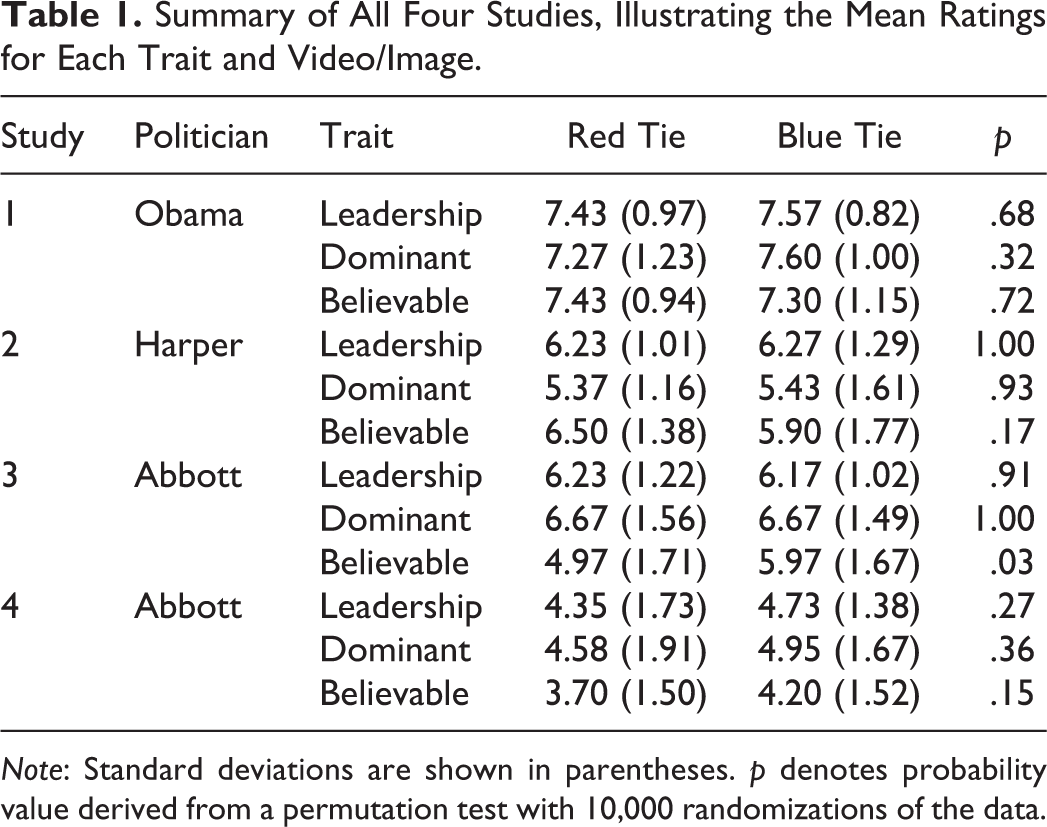
Note: Standard deviations are shown in parentheses. p denotes probability value derived from a permutation test with 10,000 randomizations of the data.
Independent samples t-tests showed that tie color had no effect on ratings of leadership, t(58) = −.58, p = .567, d = .16; dominance, t(58) = −1.15, p = .255, d = .29; or how believable Obama appeared to be, t(58) = .49, p = .624, d = .12 (see Table 1 for the means). Considering the potential for overlap across the three traits, I found that leadership was significantly correlated with both dominance, r(58) = .47, p < .001, and “believable,” r(58) = .40, p = .001. Dominance did not significantly correlate with “believable,” r(58) = .21, p = .109.
Overall, I found no evidence that wearing a red (vs. blue) tie altered perceptions of a familiar political leader. Perhaps participants’ responses were overly influenced by prior experience of the politician, limiting the possibility that wearing red could alter judgments. In the next study, an unfamiliar politician was used in order to address this question.
Study 2: Video of an Unfamiliar Politician
In the second study, participants watched a video of an unfamiliar politician. Here, I predicted that red clothing might have an effect on perceptions because participants had no prior experience with the person they were viewing (in line with previous studies, e.g., Maier et al., 2013).
Participants
A new group of 60 undergraduate students at the same university in the northeast of England (age M = 19.47 years, SD = 1.68 years; 48 women) volunteered to take part in exchange for either money or course credits. (The data from two additional participants were excluded after reporting that they recognized the politician.)
Stimuli
A video of Stephen Harper (the Canadian prime minister at the time of data collection) delivering a speech regarding his Conservative election campaign was downloaded from YouTube. This was trimmed to a 1 m 23 s clip where Harper remained centrally within the frame throughout and featured a segment of his speech where he discussed the management of the economy.
In the original clip, the tie Harper wore was blue with light polka dots. Using the same procedure as in Study 1, two new versions of the clip were created.
Procedure
The procedure was identical to Study 1.
Results and Discussion
No participants were able to identify Harper from prior knowledge/experience, and no one made any guesses about the purpose of the study that mentioned color or clothing.
Independent samples t-tests showed that tie color had no effect on ratings of leadership, t(58) = −.11, p = .911, d = .03; dominance, t(58) = −.18, p = .855, d = .04; or how believable Harper appeared to be, t(58) = 1.46, p = .149, d = .38 (see Table 1 for the means). Again, I investigated the relationship between the three traits and found that leadership was significantly correlated with both dominance, r(58) = .39, p = .002, and believable, r(58) = .33, p = .009. Dominance did not significantly correlate with believable, r(58) = −.02, p = .872.
Again, wearing red had no influence on perceptions of the politician. Although participants had no prior beliefs about the person here, it may be that other factors were still overshadowing the effect of red clothing. The content of the speech, as well as the pitch and so on, can have significant effects on subsequent judgments (Klofstad, Anderson, & Peters, 2012; Tigue, Borak, O’Connor, Schandl, & Feinberg, 2012). Perhaps people’s ratings were largely influenced by these factors, overshadowing any effects due to clothing color. In the next study, I address this issue.
Study 3: Video of an Unfamiliar Politician Without Sound
In the third study, participants watched a video of an unfamiliar politician without sound. Again, I predicted that red clothing might have a measurable effect on perceptions because participants could no longer be influenced by what the politician was saying. Of course, nonverbal cues, including hand gestures and facial expressions, would still be present.
Participants
A new group of 60 undergraduate students at the same university in the northeast of England (age M = 19.40 years, SD = 1.68 years; 54 women) volunteered to take part in exchange for either money or course credits. (The data from eight additional participants were excluded after reporting that they recognized the politician.)
Stimuli
A video of Tony Abbott (recently having finished his term as the Australian prime minister at the time of data collection) delivering a speech regarding his plans to defy a leadership challenge was downloaded from YouTube. This was trimmed to a 1 m 29 s clip where Abbott remained centrally within the frame throughout and featured a segment of his speech where he discussed how his party (Liberal) differed from the Labor Party.
In the original clip, the tie Abbott wore was blue with light pin dots. Using the same procedure as in Studies 1 and 2, two new versions of the clip were created.
Procedure
The procedure was identical to Studies 1 and 2 with the important caveat that the video was played without sound (and no headphones were worn).
Results and Discussion
No participants were able to identify Abbott from prior knowledge/experience, and no one made any guesses about the purpose of the study that mentioned color or clothing.
Independent samples t-tests showed that tie color had no effect on ratings of leadership, t(58) = .23, p = .819, d = .05, or dominance, t(58) = .00, p = 1.00, d = .00 (see Table 1 for the means). Interestingly, participants rated Abbott as more believable when wearing blue (M = 5.97) rather than red (M = 4.97), t(58) = −2.29, p = .026, d = .59. However, this difference was no longer significant after Bonferroni correction (α = .017) for multiple comparisons, and in fact, was in the opposite direction to that predicted by previous research (Bashir & Rule, 2014).
Again, I investigated the relationship between the three traits. In this study, all three were significantly correlated: leadership and believable, r(58) = .55, p < .001; leadership and dominant, r(58) = .59, p < .001; and dominant and believable, r(58) = .40, p = .002.
Even without sound, wearing red had no effect on participants’ ratings of an unfamiliar politician. Therefore, it seems reasonable to conclude that any effect that wearing red might have on perceptions is overshadowed by other factors in video stimuli, for example, how the person moves, their facial expressions, and so on. This begs the question: Can wearing red have an effect in the baseline condition—a static image? Previous research suggests that a red tie does have significant effects on perceptions (Bashir & Rule, 2014; Maier et al., 2013), although this has yet to be tested in a political leadership context. This question is addressed in the final study.
Study 4: Static Image of an Unfamiliar Politician
In the final study, participants viewed a static image of an unfamiliar politician. Without the numerous additional influences inherent in video stimuli, and in line with previous research using images, I predicted that red clothing would have an effect on perceptions.
Participants
A new group of 112 people took part online using the Qualtrics survey platform, recruited via word of mouth and through social media. Volunteers did not receive reimbursement for their participation. Participants provided consent onscreen before taking part and received an on-screen debriefing upon completion.
From the initial sample, data provided by 28 participants were excluded: the second response from an IP address (4), recognition of the politician (19), tie color mentioned as study purpose (1), technical issues (1), and color blindness (3). The final sample therefore comprised 84 participants (age M = 34.62 years, SD = 11.74 years; 50 women). Forty-three of these took part in the “red tie” condition and 41 in the “blue tie” condition.
Stimuli
The same still frame was taken from each of the two versions of the Tony Abbott video used in Study 3, resulting in two identical images that differed only in tie color. A point in the video was chosen where Abbott was facing forward but with his mouth open slightly (as he was speaking throughout the video).
Procedure
The procedure was similar to the earlier studies. Participants were shown either the red tie or blue tie image onscreen, along with sliders (depicting the same labeled 1–9 scale) allowing them to rate the image for the three traits. Responses were self-paced. As previously mentioned, participants were then asked if they could identify the speaker and if they could guess the purpose of the study. Finally, they were asked to provide their age, sex, and whether they suffered from color blindness. Allocation to the red or blue condition alternated based on the order in which participants completed the study.
Results and Discussion
Independent samples t-tests showed that tie color had no effect on ratings of leadership, t(82) = −1.12, p = .267, d = .24; dominance, t(82) = .94, p = .348, d = .21; or how believable Abbott appeared to be, t(82) = −1.51, p = .136, d = .33 (see Table 1 for the means). Again, I investigated the relationship between the three traits. All three were significantly correlated: leadership and believable, r(82) = .73, p < .001; leadership and dominant, r(82) = .59, p < .001; and dominant and believable, r(82) = .33, p = .002.
The samples of raters in Studies 1–3 were predominantly women. It is possible that red effects have a larger influence on men in the present context, given that only male politicians were shown. I therefore compared the responses of the men who viewed the red (n = 18) and the blue (n = 16) tie images. Again, tie color had no effect on ratings, all ts < .46 and all ps > .648. This was also the case for the equivalent permutation tests (all ps > .719).
Surprisingly, even in static images, when an unfamiliar politician wore a red tie, participants’ responses remained unaffected. Possible explanations for this will be discussed below.
General Discussion
Across four studies, using three different political leaders, I found no effect of tie color on judgments. When observers were familiar with the politician (Study 1), wearing red (in comparison with blue) had no effect on ratings of leadership, dominance, or how believable the person appeared to be. These results were replicated when viewers rated an unfamiliar politician presented both with (Study 2) and without sound (Study 3). Finally, when participants rated a static image of an unfamiliar politician, I found no effect of tie color (Study 4). Therefore, the current set of studies provides no evidence of a color effect in a political speech context.
In all four studies, I found significant correlations between the three trait judgments. This is perhaps unsurprising, given that the qualities people look for in a good leader are likely to include dominance and believability. However, research also suggests that the importance of such traits may vary depending on the context. For example, a more trustworthy facial appearance is more highly valued in peacetime rather than wartime (Little, Roberts, Jones, & DeBruine, 2012). Therefore, future research might consider specific leadership contexts and how these may interact with clothing color.
In contrast with previous research using static images (Bashir & Rule, 2014; Maier et al., 2013), the current findings suggest that wearing red has no effect on observers’ judgments when viewing either videos or images. Although the reason for this cannot be determined from the series of studies presented, I can rule out familiarity as an explanation since I found an absence of effects in both familiar and unfamiliar conditions. Similarly, the removal of sound in Study 3 meant that the overshadowing of speech content was not the reason for a lack of an effect. Finally, even a static image showed no color effect, suggesting that perhaps it is the particular speech context that is the cause. While previous studies have demonstrated red effects in a variety of situations, there are no investigations directly addressing a political speech context that I can draw upon. Therefore, it may simply be that red can affect job application contexts but not political contexts, for example.
However, there is no obvious reason why red ties in a specifically political context should have no effect, so what differences in the stimuli used here might explain the current result? Both the videos and static image in this article contained ecologically valid, but potentially influential, additional details. Although tie color was manipulated to appear red or blue, the patterning (stripes, dots) remained. It is unclear whether this factor could influence the impact of color on perceptions. Also, the suit jacket and other items of clothing provided color surroundings for the tie itself. Similarly, the backgrounds of the videos contained textures and colors (sometimes including red) rather than being plain or white (Maier et al., 2013; but for a realistic background, see Bashir & Rule, 2014). These too might interact with, or overshadow, clothing color effects.
Importantly, politicians in the real world are usually viewed in front of colored and patterned backgrounds, wearing varying colors of clothing. If color effects are only present when backgrounds are white, for example, then this would be a major limitation for any practical application of this research. Indeed, researchers have previously suggested that visibility could play a role in red effects (Rowe et al., 2005). Further investigations might consider the influence of different background colors on perceptions of leadership and other traits.
Taken together, these additional details could mean that tie color was not sufficiently salient to influence judgments in this context. Given the limited effect that clothing color likely has, perhaps only relatively ambiguous situations are affected. In the case of politicians, viewers may quickly form strong opinions based on previously developed heuristics (Ballew & Todorov, 2007). Even when undecided, there were numerous additional cues in the current stimuli that could affect responses above and beyond simple tie color.
In several countries, there are preexisting associations between certain colors and political parties. For example, in the United Kingdom, dark blue is linked with the Conservatives, while the colour red represents the Labor Party. Perhaps in a political context, these color associations may be more influential than general red-attractive or red-dominant links. It may be worth investigating the political leanings of future participants and how these could affect ratings.
Another potential explanation might be the particular traits investigated here. For a politician, wearing a red tie might not affect perceived dominance, leadership ability, or believability but may, for example, increase how attractive he appears. It may also be necessary to model mediating pathways through traits like “anger” or “likability.” While this is impossible to rule out without collecting additional ratings for a variety of characteristics, this seems unlikely given previous findings regarding the current set of traits. Further, while it may be useful for a politician to be rated as more attractive, one could argue that it would be equally or even more important to be seen as a good leader. Therefore, any real-world application of red clothing would be limited if it only affected attractiveness in this context.
In the set of studies presented here, the majority of raters were women. It is possible that women and men are differently influenced by viewing red (e.g., Elliot & Niesta, 2008), although no effects were found in Study 4 when only men’s responses were analyzed. Further research might specifically consider sex of rater in order to investigate the potential for an interaction between this factor and the particular color context.
In each study, only one stimulus was presented to each participant. While this design has been widely used in this field (e.g., Elliot et al., 2010), some researchers have increased their statistical power by presenting multiple images and averaging scores for each color condition (e.g., Roberts et al., 2010). However, the risk in showing several videos or photographs to the same participant is that they are more likely to spot the manipulation and guess the purpose of the study. Here, the lower statistical power was improved through multiple studies. Even so, asking future raters to view a number of videos, varying in both identity and tie color, may help with the detection of potentially small effects.
The lack of a red effect in this article might also simply speak to the generalizability of this phenomenon. As mentioned already, the particular context, the salience of the red stimulus, the uncertainty or ambiguity in the decision, and numerous other factors may determine whether a red effect can be detected. A growing number of researchers have failed to find effects in various contexts (Allen & Jones, 2012; Arthur, Cho, & Muñoz, 2016; García-Rubio et al., 2011; Hesslinger, Goldbach, & Carbon, 2015; Larsson & von Stumm, 2015; Lynn, Giebelhausen, Garcia, Li, & Patumanon, 2013; Pollet & Peperkoorn, 2013; Smajic, Merritt, Banister, & Blinebry, 2014; Steele, 2014). As such, the current results might be the result of difficulties in generalizing to real-world contexts or situations where a variety of influences are present.
In conclusion, wearing a red (vs. blue) tie had no effect on perceivers’ ratings of leadership, dominance, or how believable politicians appeared to be, using both short videos and static images. These findings suggest that red effects may have limited real-world applications within a political speech context and that the “red power tie” is only a myth.
Footnotes
Acknowledgment
I thank Renée Lefebvre for comments on the article, and Mila Mileva for creating the Qualtrics survey used in Study 4.
Declaration of Conflicting Interests
The author(s) declared no potential conflicts of interest with respect to the research, authorship, and/or publication of this article.
Funding
The author(s) received no financial support for the research, authorship, and/or publication of this article.