



Abstract
According to the Fundamental Motives Framework, basic goals such as protecting oneself, forming coalitions, and avoiding disease have emerged as a result of evolutionary processes to enhance reproductive fitness. This article introduces the Situational Affordances for Adaptive Problems (SAAP), a measure of situation characteristics that promotes or prevents the achievement of these evolutionarily important goals. In Study 1, participants rated a recent situation they encountered using a preliminary version of the SAAP. Using factor analysis, the measure was reduced to 28 items. In Study 2, the factor structure was confirmed. Studies 3 and 4 evaluated the psychometric properties of the measure including its predictive validity. Future studies can use the SAAP to investigate differences in the everyday experience of these fundamental motives.
Introduction
Every day people find themselves in a number of different contexts or situations, which provide both opportunities and obstacles or affordances (Gibson, 1979; McArthur & Baron, 1983; Neuberg, Kenrick, & Schaller, 2010) for achieving one’s goals. For example, spending an evening at a bar can provide an opportunity to relax, to spend time with one’s romantic partner, and to enjoy oneself. The situation can also include obstacles to achieving those goals in the form of another bar patron flirting with your romantic partner. Despite decades of research purporting the power of the situation as a determinant of behavior (e.g., Mischel, 1968; Ross & Nisbett, 1991), research identifying the psychological properties of situations has been sorely lacking (Frederiksen, 1972; Funder, 2001, 2006, 2008; Hogan, 2009; Johnson, 1999). Unlike the Big Five or HEXACO models of personality psychology, there is no consensus as to a common set of characteristics (i.e., a taxonomy) that researchers can and should use to measure the wide variety of situations humans encounter (Hogan, 2009; Reis, 2008).
This is not to suggest that researchers have not tried to remedy this issue. Several efforts have been made to identify situation taxonomies using empirical approaches (Rauthmann et al., 2014; Sherman, Nave, & Funder, 2010; Yang, Read, & Miller, 2006). The application of the lexical hypothesis, the notion that meaningful differences will be encoded in language, to situations has been met with mixed results. In an early study, Van Heck (1984) searched Dutch dictionaries for words relevant to situational features. A subsequent cluster analysis suggested 10 types of situations such as “intimacy,” “recreation,” and “interpersonal conflict” (Van Heck, 1984). More recently, Edwards and Templeton (2005) asked university students to rate a set of dictionary words that completed the phrases, “That situation was ____.” and “That was a ____ situation.” Their factor analysis revealed four types of situations—positivity, negativity, goal achievement, and socialization (Edwards & Templeton, 2005). Yet another lexically oriented approach used Chinese idioms as a basis for a situation taxonomy (Yang et al., 2006). Interestingly, a cluster analysis of these idioms revealed two dimensions of situations as initiating or constraining goals (Yang et al., 2006), aligning with the notion of situations as affordances for goal achievement. Indeed, this same group of researchers later suggested that situations be conceptualized in terms of the goals a person is attempting to achieve (Yang, Read, & Miller, 2009).
An alternative empirical approach for conceptualizing situations is to consider what basic situational features allow for the expression of personality characteristics. One such measure, the Riverside Situational Q-sort (RSQ; Sherman et al., 2010; Wagerman & Funder, 2009), was developed along these lines. Most recently, Rauthmann and colleagues (2014) factor analyzed the RSQ across several diverse samples (e.g., community members and different cultures) and identified eight dimensions of situations, provisionally named DIAMONDS. These include, duty (whether a task needs to be accomplished), mating (the presence of potential romantic partners), and sociality (the potential to communicate with others and/or to form close relationships) to name a few.
Theoretically Derived Situation Taxonomies
As an alternative to such empirical efforts to identify and quantify meaningful features of situations, one might begin with a theory that offers a set of specific predictions about how situations may be related to individual’s cognitions, emotions, and behavior. Perhaps the most prominent example to date using this approach is the Atlas Of Interpersonal Situations (H. Kelley et al., 2003). This taxonomy uses six dimensions identified by interdependence theory (H. H. Kelley & Thibaut, 1978; Thibaut & Kelley, 1959) to “define 20 of the most common situations encountered in ordinary social life” (Reis, 2008, p. 317). The situation taxonomy provided by interdependence theory is grounded in social exchange theories and, as such, is useful for understanding behavior in social exchange situations. The Fundamental Motive Framework (Kenrick, Griskevicius, Neuberg, & Schaller, 2010), on the other hand, offers a more distal perspective—grounded in human evolution—that is useful for explaining behavior oriented toward goals relevant to recurrent adaptive problems. Thus, a situation taxonomy grounded in the fundamental motives framework ought to be useful for understanding behavior in situations that promote or prevent the achievement of goals with relevance for fitness.
A Taxonomy of Situations Based on Evolutionary Theory
Over our species’ history, humans have faced a number of recurrent adaptive problems, including avoiding disease, protecting oneself, forming groups and allies, gaining status, attracting and retaining mates, and caring for one’s kin. These are adaptive problems in the sense that people who caught diseases were grievously injured, did not form successful alliances with others, were of low status, failed to mate, lost their mate, or did not invest in kin, were at a fitness disadvantage relative to others who more successfully navigated these obstacles, and thus were less likely to pass on their genes. Kenrick and colleagues (Kenrick, 2011; Kenrick, Li, & Butner, 2003; Kenrick, Griskevicius, et al., 2010; Kenrick, Neuberg, Griskevicius, Becker, & Schaller, 2010) posit that these recurrent adaptive problems shaped human motivation, and the ensuing motives are therefore fundamental. In other words, people have at least seven core social motivations or goals: self-protection, disease avoidance, affiliation, 1 status, mate seeking, mate retention, and kin care. Indeed, it has been argued that such adaptive problems “define situations” (Buss, 2009, p. 241). Because these goals are shaped to help an individual address the recurrent adaptive problems of social life, it stands to reason that modern humans bring this psychological endowment to the perception and navigation of social situations today.
Situational Affordances for Adaptive Problems
A number of laboratory experiments have shown that (sometimes subtle) situation changes (or manipulations) to temporarily activate each of the fundamental motives lead to predictable, motive-consistent, changes in thought and behavior (e.g., Griskevicius et al., 2009; Griskevicius, Tybur, & Van den Bergh, 2010; Maner et al., 2005; Maner, Gailliot, Rouby, & Miller, 2007). However, no concise instrument presently exists that can measure situational affordances for these seven goals in everyday situations.
Researchers have attempted to use existing situation measures to tap the fundamental motives in situations. A recent study demonstrated that the RSQ can be used to indirectly assess the extent to which situations are relevant to the fundamental motives (Morse, Neel, Todd, & Funder, In press). However, their results indicated that the RSQ may lack content coverage in the domains of disease avoidance (i.e., only a single item seems relevant at face value) and kin care (i.e., no items in the RSQ refer to helping one’s family members). This is perhaps unsurprising because the RSQ was not designed to measure the presence of pathogens or to distinguish between who (specifically) is receiving help. Furthermore, the full RSQ consists of 81 items (version 2.0; version 3.15 contains 89), which may not be feasible to administer in many research endeavors.
If researchers seek to quantify the motive-relevant affordances of situations and thus bring the study of these situations to life domains beyond the laboratory, a concise and easily administered measure provides an essential tool. The present research is designed to fill this void through the development of the Situational Affordances for Adaptive Problems (SAAP). In this article, we discuss the development of the SAAP in both a community (Study 1) and a college sample (Study 2), in addition to psychometric properties such as reliability (Study 3); discriminant validity (Study 4); and convergent, incremental, and predictive validity (Studies 3 and 4).
Study 1: Item Creation and Scale Development
Purpose
Study 1 was designed to accomplish two goals. First, it was our intent to create a pool of items that could ostensibly measure the characteristics of situations that might promote or prevent achievement of the seven goals just mentioned. We used Kenrick and colleagues’ (2003) operational definitions of the seven goals as a guide in generating items for the SAAP. We also considered prior research, which indicates that several of the goals contain lower order subfactors (Neel, Kenrick, White, & Neuberg, In press). To guide participants to rate their immediate context, and not perform a global assessment of their general daily life, item phrases were written with the stem “In this situation … ” (e.g., “In this situation ….sharing with others is important”). After refining and rewording, our initial measure consisted of 85 items (available in Supplemental materials).
Because the item content of this measure intentionally included semantic similarity and because of a desire to develop a shorter measure of these seven broad constructs, our second goal was to empirically reduce the initial 85-item set to a 28-item version, with 4 items for each construct. We chose 4 items in an effort to balance adequate internal consistency, scale length, and goal affordance content coverage. To do so, we asked an adult Internet sample to recall and describe a recent situation they experienced and then to rate that situation using the initial 85-item measure. A number of exploratory factor analyses were then used to identify the best 4 items per motive that could comprise a reduced 28-item version of our measure.
Participants
Sample size selection
In each of the studies, we aimed to gather data from N = 200 participants because this provides a 95% confidence interval (CI) for a Fisher’s transformed r of approximately ±.14, which is an acceptable level of precision in our view. Past experience with these populations suggests a 10% exclusion rate, 2 thus we gathered data from 220 participants in each study.
Two hundred and twenty participants were recruited from Amazon’s Mechanical Turk (AMT). Twenty-one participants were excluded prior to analyses because they wrote descriptions that included more than one situation (e.g., “I was doing my daily running outside and followed it up with a quick shower and then went to bed.”). The final sample comprised 94 males and 105 females (M age = 33.20 years, SD = 12.36). The ethnic breakdown for the sample was 80% Caucasian, 6% African American, 5.5% Asian, 5.5% Hispanic/Latino/Latina, and 3% Other. Participants were compensated US$0.50 for completing the study. The study was approved by the institutional review board (IRB) at Florida Atlantic University.
Measures and Procedure
Participants responded to the posting of a human intelligence task (HIT) on the AMT website, which was only viewable to individuals with an IP address in the United States (for a further explanation of AMT for psychological research, see Buhrmester, Kwang, & Gosling, 2011). 3 After completing a brief demographics questionnaire, participants were instructed to recall a situation they experienced the previous day at the same time they were taking the survey (24-hr prior). Participants were prompted to recall specific details of the situation with the following instructions: “Please include: (1) what you were doing, (2) where you were, and (3) who was with you.” The instructions requested participants recall only one situation. To that end, we provided a hypothetical response (“I got home from school, went shopping with my mom, and then had dinner”) and provided instructions to write only about one thing they were doing (“I was shopping at the mall with my mom”). We also instructed participants that if they were sleeping at the indicated time, they should write down what they were doing right before they went to sleep or right after they woke up.
Participants rated their situation on the 85-item version of the SAAP using a 5-point Likert-type scale to rate each item from 1 (strongly disagree) to 5 (strongly agree). Items were presented in a random order for each participant.
Analytic Strategies
As mentioned previously, the aim of one study was to reduce the 85 items to a 28-item measure (4 per construct) that both represented the content of the seven goals’ affordances and yielded reliable composite scores. In doing so, we employed three different analytic strategies.
One-factor solutions
One method of identifying items with the best 4 items for each goal was to calculate the first unrotated principal component for each subset of items intended to promote or prevent the same goals. Based on the resulting unrotated pattern matrix, we selected the four highest loading items. This strategy maximizes internal consistency (i.e., coefficient α), so long as the items consist of one construct, while potentially sacrificing breadth in item content (e.g., a bloated specific).
Four-factor solutions
To identify items that could best maximize content breadth, we again grouped the items by goal, but this time extracted four principal components using a varimax rotation and retained the highest loading item from each component. This strategy resulted in the lowest possible reliability, so long as the items consist of one construct, while maximizing item content coverage.
Part-whole solutions
Using the part-whole function available in the “multicon” package (Sherman, 2015) in R (R Development Core Team, 2015), we computed all of the possible 4-item combinations for each subset of items, created their respective composites, and correlated them with the full-scale total score using all of the items (i.e., all possible part-whole correlations). We then selected the 4-item combination that correlated the highest with the full scale. This approach was designed to identify the 4 items that could best represent the full scale, without particularly focusing on reliability or content coverage.
Results
The 4-item sets, coefficient α, and correlation with the entire scale for these three analytic strategies are available in the Supplemental materials. We first evaluated the 4-item sets for each situation domain based on their internal consistency and correlation with the total scale. We dropped the four-factor solutions from consideration because they did not appreciably increase content coverage. Additionally, although we had written items to measure subfacets of the affiliation and mate-seeking constructs (e.g., Neel et al., In press), exploratory factor analyses demonstrated that these items cross loaded on more than one factor. These items were subsequently dropped from further consideration.
Because the one-factor solutions produced sets of items that covered nonoverlapping content, we used these solutions for all seven motives. The resulting 28-item measure is presented in the Appendix. Table 1 presents the intercorrelations, reliabilities, means, and standard deviations (SDs) for each of the respective composites for the final measure. The means for males and females for each factor did not vary in a consistent pattern (in this sample and in the subsequent samples) and are thus not considered further. To explore the adequacy of our 28-item set, we conducted a confirmatory factor analysis using the “Lavaan” package (Rosseel, 2012) in R with full information maximum likelihood (FIML) estimation. 4 Three fit indices were calculated to evaluate our model fit: root mean square error of approximation (RMSEA), comparative fit index (CFI), and the Tucker–Lewis index (TLI). All three indicated adequate fit: χ2(329) = 683.552, p < .001, RMSEA = .074 (90% CIs: [.066, .081]), CFI = .906, and TLI = .891. Of course, these fit indices should only be considered descriptive as this model fit was based on the results of exploratory procedures on the same data set. Thus, we attempted to confirm this factor structure in Study 2.
Intercorrelations, Coefficient α, Means, and Standard Deviations for the Situational Affordances for Adaptive Problems (Study 1 and Study 2).

Note. Study 1 (N = 199) scale intercorrelations are below the diagonal and Study 2 (N = 189) scale intercorrelations are above the diagonal.
Study 2: Confirming Factor Structure
Purpose
Following the exploratory analyses of the Study 1, we sought to obtain an additional sample to confirm the factor structure of the SAAP. Additionally, to examine convergent validity of the SAAP, participants completed a measure of the psychological properties of situations, the RSQ (Wagerman & Funder, 2009). However, to save room and reduce overlap with results from a later study examining convergent validity (Study 3), we do not report convergent correlations with the RSQ here (also available in Supplemental materials).
Participants
Two hundred undergraduate participants from Florida Atlantic University were recruited through fliers posted in the psychology department. Eleven participants were excluded from analyses: 10 participants wrote descriptions that included more than 1 situation. One participant completed the study twice, and his or her additional data were not included in the final analyses. Twenty-five participants were missing data on some measures. Therefore, the sample sizes vary depending on the specific analysis. The final sample comprises 119 females, 69 males, and 1 who did not indicate. The mean age was 18.74 years (SD = 1.88), with an ethnicity breakdown of 51% Caucasian, 18% African American, 17% Hispanic/Latino/Latina, 10% Other, 3% Asian, and 1% no response. Participants were compensated with partial course credit. The study was approved by the Institutional Review Board at Florida Atlantic University.
Measures
SAAP
The 85-item version of the SAAP administered to participants in Study 1 was used in this study. As in Study 1, participants used a 5-point Likert-type scale to rate each item from 1 (strongly disagree) to 5 (strongly agree). Items were presented in a random order for each participant.
Procedure
Participants came to the lab and completed all parts of the study using computerized survey software. The procedure for the first part of Study 1 parallels that of the Pilot Study. Namely, after completing a demographics questionnaire, participants were asked to recall a situation they experienced the previous day at the same time they were taking the survey (24 hr prior). Participants were again prompted to recall specific details of the situation with the following instructions: “Please include: (1) what you were doing, (2) where you were, and (3) who was with you.” The instructions requested participants recall only one situation. If participants indicated they were sleeping at the indicated time, they were instructed to write down what they were doing right before they went to sleep or right after they woke up. 5
Results
Table 1 presents the intercorrelations, coefficient α, means, and SDs for each of the seven SAAP factors based on the items identified in Study 1.
Confirmatory Factor Analyses (CFAs)
To investigate the fit of the 28-item measure identified in Study 1, we used the Lavaan package (Rosseel, 2012) in R to conduct a CFA with FIML estimation. Because many of the latent factors are correlated to some degree (e.g., mate seeking and mate retention) and there is no theoretical rationale suggesting they should be orthogonal, we allowed all of the latent factors to covary in our model. We again calculated the RMSEA, CFI, and TLI fit indices to evaluate model fit. All three indicated good fit: χ2(329) = 594.429, p < .001, RMSEA = .065 (90% CIs: [.057, .074]), CFI = .918, and TLI = .906.
Discussion
The goal of Study 2 was to confirm the factor structure of the measure identified in Study 1. Using three different fit indices, we found that the factor structure fits adequately in a less heterogeneous sample (e.g., young university students). While the obtained internal consistencies for the seven factors were also adequate, coefficient α is not always the best indicator of reliability (McCrae, Kurtz, Yamagata, & Terracciano, 2011). Study 3 was designed to examine other psychometric properties such as test–retest stabilities, convergent, incremental, and predictive validity.
Study 3: Examining Test–Retest Reliability and Convergent Validity
Purpose
The objective of Study 3 was three-fold. First, both Study 1 and Study 2 showed that the internal consistencies of the seven-factor composites were acceptable. However, a more relevant indicator of reliability is the stability of scores obtained from ratings separated by time (McCrae et al., 2011). This study examines the test–retest reliabilities of the SAAP over the course of approximately 1 week. Second, this study evaluates the convergent validity of the SAAP with another measure of situations, the S8* (Rauthmann & Sherman, In press). The S8* is an optimized measure of the aforementioned DIAMONDS situation characteristics recovered from the RSQ by Rauthmann and colleagues (2014). Finally, this study examines the convergent and incremental predictive validity of the SAAP in predicting behaviors related to the seven goal-affordance motives.
Participants
Time 1 Sample
Two hundred and twenty participants were recruited from AMT. Twenty-three participants were excluded prior to analyses: 15 participants who did not pass the survey’s validity checks 6 (e.g., marking 5 to an item that asked participants to mark 1) were excluded. Five participants wrote descriptions that included more than one situation, and one participant completed the S8* but not the SAAP. Furthermore, the random time selection software malfunctioned for two participants. Because participants were given the option to not respond to any particular survey item, sample sizes vary depending on the specific analysis. The final sample comprised 97 males and 100 females. The average age was 37.11 years (SD = 12.92). The ethnic breakdown for the sample was 73% Caucasian, 10% Asian, 9% African American, 5% Hispanic/Latino/Latina, and 3% Other. Participants were compensated US$0.75 for completing the first part of the study. The study was approved by the Institutional Review Board at Florida Atlantic University.
Time 2 Sample
All two hundred and twenty participants in the Time 1 sample were invited to participate in the Time 2 sample. Of these, 188 (85%) completed the second part of the study. Twenty-two participants were excluded prior to analyses: 15 participants who did not pass the survey’s validity checks (at both Time 1 and Time 2) were excluded and four participants wrote descriptions at Time 1 that included more than one situation. The two participants for whom the random time selection software malfunctioned and one who did not complete the SAAP at Time 1 were also excluded from these analyses. In line with the survey procedures at Time 1, participants were given the option to not respond to any particular survey item, thus sample sizes vary depending on the specific analysis.
The final sample for Time 2 (i.e., participants that had valid data for both time points) comprised 79 males and 87 females. The mean age was 38.47 years (SD = 13.18). The ethnic breakdown for the sample was 73% Caucasian, 8% African American, 5% Hispanic/Latino/Latina, 10% Asian, and 4% Other. Participants were compensated an additional US$0.75 for completing the second part of the study.
Measures
S8*
The S8* (Rauthmann & Sherman, In press) is an optimized 24-item measure of the psychological properties of situations represented by the “Situational Eight” DIAMONDS (see Rauthmann et al., 2014). Sample items include “A job needs to be done,” “It is possible to deceive someone,” and “Close personal relationships are important or can develop.” Participants used a 7-point Likert-type scale to rate each item from 1 (strongly disagree) to 7 (strongly agree).
Behavior Checklist
To examine the predictive validity of the SAAP, we generated a list of behaviors thought to be relevant to each of the respective SAAP domains (see Table 2 for the 56 items). For example, self-protection behaviors included items such as, “I defended myself,” “I protected myself from physical danger,” and “I felt concerned for my physical safety.” Participants indicated using a yes/no format whether they did or did not engage in each of the 56 behaviors. The items were presented in a random order.
Means and Correlations Between Behavior Checklist and Time 2 SAAP (Study 3).

Note. N = 166. (r) indicates that the item that can be reverse coded, and they were not reverse coded in this analysis. SP = self-protection, DA = disease avoidance, AF = affiliation, ST = status, MS = mate seeking, MR = mate retention, KC = kin care. SAAP = situational affordances for adaptive problems.
Procedure
Time 1
As in Study 1, participants responded to the posting of a HIT on the AMT website, which was only viewable to individuals with an IP address in the United States. The procedures for this study were similar to that of Study 2, with only two modifications. First, participants in this study indicated when they went to bed and when they woke up on the prior day. Then, specially designed software calculated the hours that the participant was awake the prior day and randomly selected one time interval. All times were in 15-min intervals (e.g., 9:15 a.m., 9:30 a.m., and 9:45 a.m.). Participants were prompted to recall their situation at this randomly selected time with modified instructions, specifically, “Please include: (1) where did it take place? (2) who was with you? (3) what were you doing? (4) what was happening? what took place?” Participants were provided with the same instructions regarding reporting only one situation (see Study 2 Method). Participants rated their situation using the 28-item SAAP identified in Study 1 and confirmed in Study 2 in addition to the S8*.
Time 2
Participants were e-mailed approximately 1 week after their participation in Time 1 and invited to participate in the second part of the study. An average of 8.51 days (SD = 1.03) elapsed between Time 1 and Time 2 participation. After returning to the survey website, participants were presented with the same situation they wrote during Time 1 and again asked to rate that same situation using the SAAP. It is essential that participants rated the same situation they rated the prior week so that test–retest reliability could be examined. Participants also indicated whether they engaged in any behaviors related to the seven goals with the behavior checklist.
Results
Test–Retest Reliabilities
To address our first objective, evaluating the test–retest reliabilities of the SAAP, we first created composites of the participants’ Time 1 and Time 2 scale ratings, respectively. The internal consistencies ranged from .78 (disease avoidance at Time 1) to .97 (mate retention at Time 2). Next, we correlated the Time 1 and Time 2 scale scores. The descriptive statistics are presented in Table 3. The test–retest reliabilities averaged .68 (range = .55–.79, see the far right column of Table 3). Overall, these test–retest reliabilities are quite good, especially considering the brevity (4 items) of the measures. 7
Coefficient α, Means, and Standard Deviations for SAAP (Study 3).
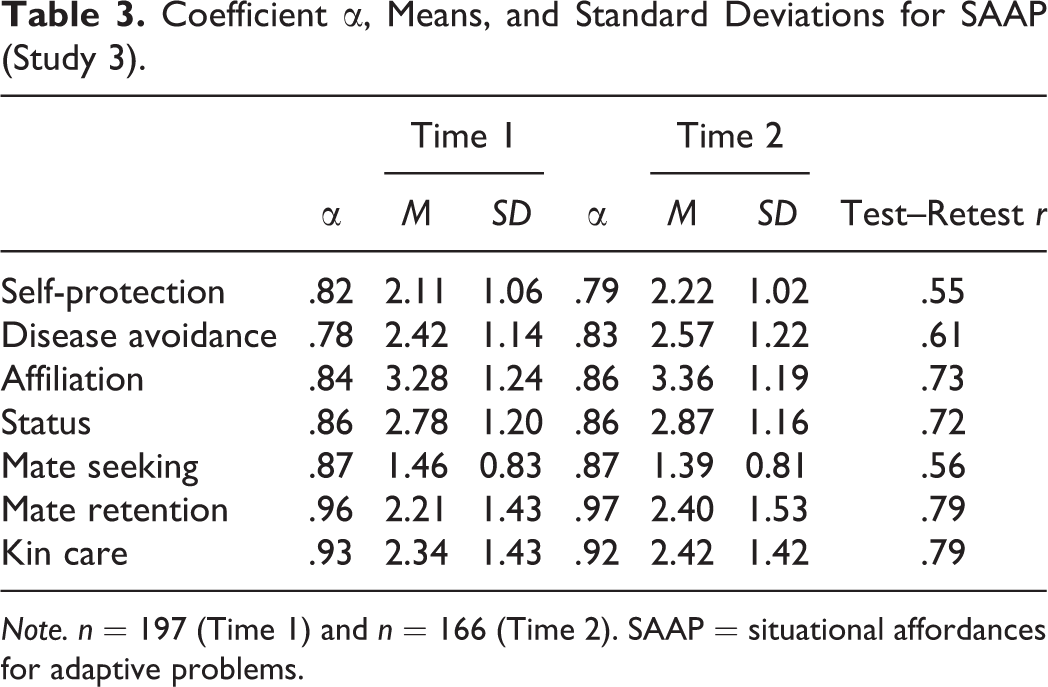
Note. n = 197 (Time 1) and n = 166 (Time 2). SAAP = situational affordances for adaptive problems.
Convergent and Discriminant Validity
To address our second objective, evaluating the convergent and discriminant validity of the SAAP, we compared its validities to those from ratings of the S8*. To reiterate, the S8* is an optimized measure of the “Situation Eight” DIAMONDS, which is an empirically derived taxonomy of situations that taps eight major psychological characteristics of situations such as duty, mating, and sociality. Participants’ composite scores on the DIAMONDS were correlated with the SAAP scores from Time 1. These correlations appear in Table 4.
Correlations Between Time 1 SAAP and S8* (Study 3).

Note. N = 197. D = duty, I = intellect, A = adversity, I = intellect, O = positivity, N = negativity, D = deception, S = sociality. SAAP = situational affordances for adaptive problems.
Although the SAAP correlated modestly with many of the DIAMONDS scales, there were, unsurprisingly, stronger associations between scales that shared overlapping content (e.g., mate seeking of the SAAP and the mating dimension of DIAMONDS). However, it is of note that there were weaker associations between kin care and all of the DIAMONDS factors. This is ostensibly due to the fact that the DIAMONDS taxonomy of situations does not measure goals or psychological characteristics of situations that involve taking care of one’s family.
Predictive and Incremental Validity
Finally, to address our objective of examining the predictive validity of the SAAP over an existing measure of situations, we first correlated participants’ Time 2 SAAP scores with the 56 goal-related behaviors, see Table 2. In general, participants engaged in behaviors that were consistent with their perception of the goals operating within the situation. For example, participants who scored high on the SAAP mate-seeking scale tended to endorse items such as, “I pursued a romantic or sexual opportunity” (r = .48), “I flirted with someone” (r = .52), and “I felt attracted to someone” (r = .46).
Next, to demonstrate the incremental validity of the SAAP, we conducted hierarchical linear regressions. In the first step, we predicted each individual behavior checklist item from each of the Time 2 DIAMONDS scores. We also made a note of the overall model fit (R) for each regression. Next, as a mid-step, we calculated semipartial correlations (see Table 5) to estimate the degree to which the SAAP scales are uniquely related to the behaviors after controlling for the DIAMONDS and the other SAAP dimensions. Finally, as the second step in the hierarchical regression, we added both the SAAP and the DIAMONDS as predictors of each behavior. We retained the model fit (R) for each of these models and calculated the change in model fit (reported as R in Table 5). As evidenced by the multiple-R changes in Table 5, the SAAP is still able to predict the goal-relevant behaviors even controlling for the DIAMONDS. This is particularly evident for SAAP domains such as kin care, which is not well captured by the DIAMONDS taxonomy.
Semipartial Correlations Between Behavior Checklist and Time 2 SAAP (Study 3).
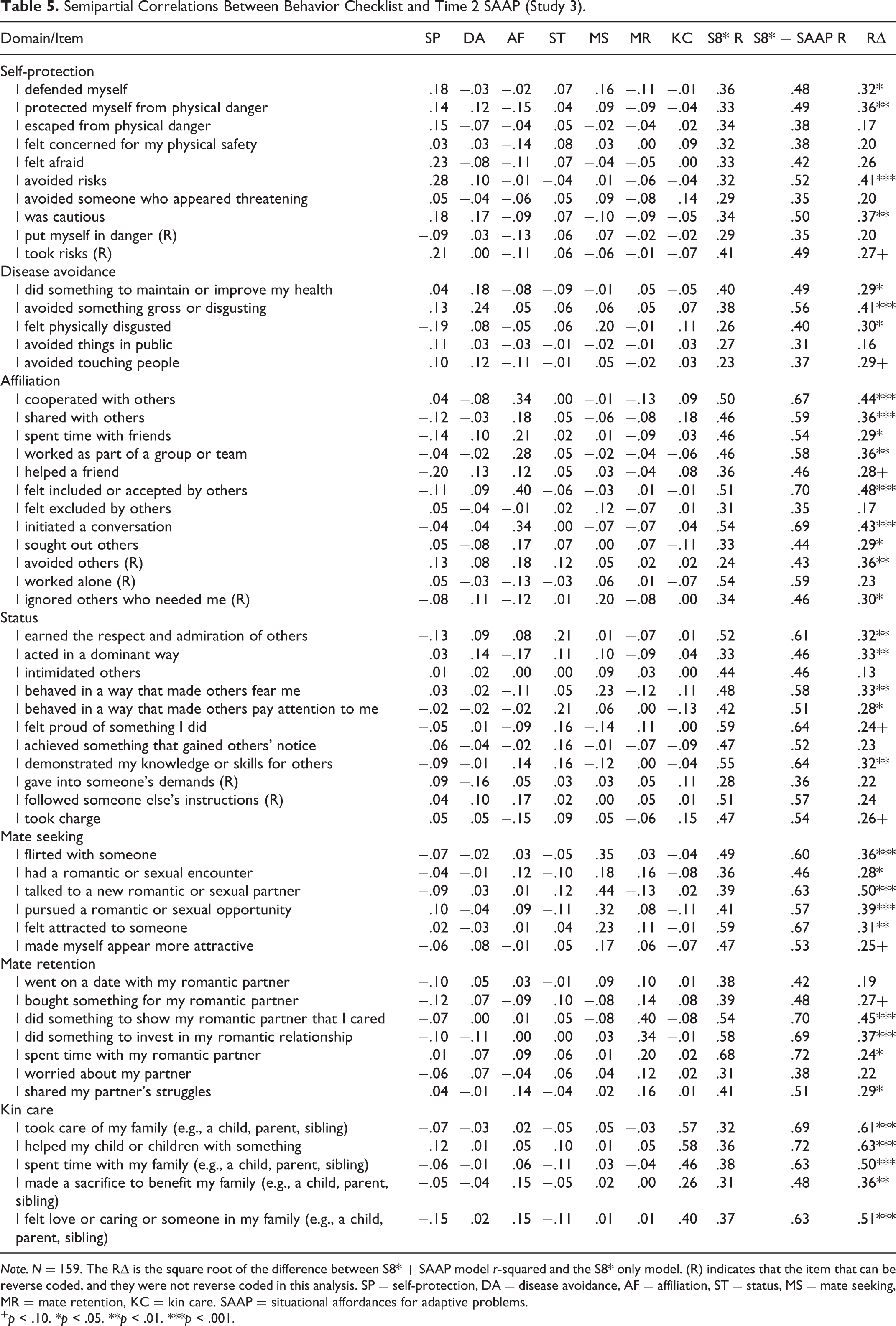
Note. N = 159. The RΔ is the square root of the difference between S8* + SAAP model r-squared and the S8* only model. (R) indicates that the item that can be reverse coded, and they were not reverse coded in this analysis. SP = self-protection, DA = disease avoidance, AF = affiliation, ST = status, MS = mate seeking, MR = mate retention, KC = kin care. SAAP = situational affordances for adaptive problems.
+ p < .10. *p < .05. **p < .01. ***p < .001.
Discussion
Study 3 demonstrated both test–retest stability, convergent, and incremental validity of the SAAP. First, when two SAAP ratings of the same situation were obtained across approximately a week, scores were moderately stable. Second, while the SAAP correlated with many of the DIAMONDS scales, one SAAP domain—kin care—was only modestly associated. This is unsurprising primarily because the DIAMONDS taxonomy is derived from a situation taxonomy (the RSQ) that was not developed to measure these situation characteristics. Thus, although the Situational Eight DIAMONDS (and its predecessor, the RSQ) may serve as a proxy for some of the SAAP domains (e.g., Morse et al., In press), it is evident that some content coverage is lacking from a fundamental motives perspective.
Study 4: Convergent and Discriminant Validity
Purpose
Study 3 provided initial evidence for convergent and incremental validity of the SAAP. The purpose of Study 4 was to provide further evidence of convergent and discriminant validity of the SAAP using stimuli designed to prime the seven fundamental motives. Prior research has used short stories (approximately 600 words in length) specifically designed to prime a fundamental motive of interest (e.g., Griskevicius et al., 2009; Griskevicius et al., 2010; Maner et al., 2007). For example, Griskevicius and colleagues (2009) primed mate seeking with a short story about encountering and spending time with an attractive member of the opposite sex. Thus, when asked to rate a situation reflected in the priming story, raters should be especially sensitive to the items relevant to that fundamental domain. For example, participants should rate the SAAP mate seeking items high, and all other items low, for the mate seeking story from Griskevicius and colleagues’ (2009) experiment.
Procedure and Materials
Ten naive research assistants 8 (6 males and 4 females), unacquainted with the purpose of the present study, were instructed to read short stories designed to prime one of the seven fundamental motives, respectively. 9 To reiterate, the short stories rated employed here have been used in prior experimental research (e.g., Griskevicius et al., 2009). The research assistants then rated the short story using the 28-item SAAP using a 5-point Likert-type scale ranging from 1 (strongly disagree) to 5 (strongly agree). This procedure was repeated for each of the stories.
Results
To examine whether the SAAP is sensitive to these experimental primes, we aggregated the ratings across research assistants (after first forming composites for each rater). Figure 1 visually displays the means for each motive priming story. The standard errors for these means were small, which indicates that the means are quite stable. 10

Plots of the Situational Affordances for Adaptive Problems scale scores for each motive priming story. The arms around the means are 95% confidence intervals based on N = 10 ratings. SP = self-protection, DA = disease avoidance, AF = affiliation, ST = status, MS = mate seeking, MR = mate retention, KC = kin care.
The plots demonstrate that the SAAP does an adequate job of measuring the degree to which situations induce these fundamental motives. Indeed, the aggregate SAAP scores indicate that raters consistently judged the stories as eliciting the primed motive well over the midpoint of the scale. Similarly, these ratings provide evidence of discriminant validity of the SAAP. When raters rated a situation within one specific priming stimulus, they did not rate other unrelated motives as being relevant. 11 For example, when kin care was primed, no other motive was rated higher than 2.5. This is important because it suggests that the SAAP factors can accurately assess each respective fundamental motive.
Discussion
Study 4 provided evidence of convergent and discriminant validity of the 28-item SAAP using stimuli designed to prime the fundamental motives. Most importantly, this measure appears to capture situational characteristics that might induce the fundamental motives theorized by Kenrick and colleagues (2003; Kenrick, Neuberg, Griskevicius, Becker, & Schaller, 2010). Because the SAAP is designed to measure evolutionarily important goals of situations, it is essential to demonstrate that the SAAP can capture the situation characteristics that might make these motives salient and indeed they do. Study 4 also provides evidence for the discriminant validity of the SAAP in that raters indicated low situational affordances for motives that were not primed.
General Discussion
Human behavior is sensitive to moment-to-moment circumstances (i.e., situations). Decades of research have been devoted to the task of identifying the essential psychological characteristics of situations (e.g., Block & Block, 1981; Edwards & Templeton, 2005; Funder, 2006; Rauthmann et al., 2014; Sherman et al., 2010; Van Heck, 1984; Wagerman & Funder, 2009; Yang et al., 2006). Despite recent efforts to revive situation research (e.g., Reis, 2008), and the development of new instruments for measuring the psychologically important characteristics of situations (e.g., Rauthmann & Sherman, In press; Sherman et al., 2010), more work needs to be done in this arena to better identify the most basic features of situations (Yang et al., 2009).
While a small, but growing, body of research has focused on empirical routes for deriving the basic features of situations (e.g., Edwards & Templeton, 2005; Van Heck, 1984; Yang et al., 2006), little research on situations has been guided by theory (cf. H. Kelley et al., 2003). Using evolutionary psychology as a guide (Kenrick, 2011; Kenrick et al., 2003; Kenrick, Neuberg, Griskevicius, Becker, & Schaller, 2010), the present studies provide a substantial contribution to the literature on situations by developing a theoretically guided measure of situations, the SAAP. This is a crucial endeavor for several reasons.
First, this research advances our knowledge of situations from an evolutionary perspective. Using the Fundamental Motives Framework, the SAAP offers a means of measuring situational characteristics that facilitate or threaten adaptively relevant social goals. The second is more pragmatic. When someone is being physically attacked, nearly everyone would agree—the law included—that it is reasonable to defend oneself by any means necessary. What is unacceptable, however, is aggression that results in the death of an innocent person when no imminent threat existed. Are some people more prone to perceive situations as necessitating more self-protection than they actually warrant? Additional studies could investigate this possibility by designing paradigms that require participants to rate ambiguous situations using the SAAP. Thus, the SAAP may be helpful in elucidating stable differences in construal of situations (cf. Serfass & Sherman, 2013). The third reason for development of the SAAP is that it allows us to test predictions derived from an evolutionary perspective in real-world situations. Much of the research stemming from the fundamental motives framework has thus far been limited to laboratory experiments. Understanding how actual situations experienced in real life impact thought, behavior, and emotion requires tools for assessing and quantifying the characteristics of such situations. The SAAP allows one to measure day-to-day or moment-to-moment changes in situations’ perceived relevance to adaptively relevant social problems.
Limitations
Some readers may be concerned that the means across the subscales of the SAAP in the three studies were low. Indeed, the scale means were often below 3 (i.e., the scale midpoint), although, in most instances, the means for the subscales never fell below 2 (with the exception of mate seeking in Studies 1 and 3). However, the low means do not, and did not in this case, preclude (a) meaningful variance in the scales and (b) associations with theoretically relevant behaviors. This is most evidenced in Study 3, where all scales of the SAAP showed strong associations with relevant outcomes. Furthermore, just because a kind of situation (e.g., self-protection) is rare does not mean that it would not have a substantial impact on an organism’s fitness or require precise attunement and coordination of the organism’s response. Indeed, people likely possess mechanisms for responding to particular adaptive problems that, while only deployed in rare circumstances, are nonetheless consequential for fitness (e.g., encountering dangerous conspecifics). These points notwithstanding, we caution readers from interpreting the means for the scale reported here as population norms for these scales and recommend that local norms be used until such population norms may be established.
Readers may likewise be concerned that the correlations among these subscales are moderately high. For example, across the three studies, mate seeking and mate retention as well as status and affiliation were strongly related to each other. However, the fundamental motives framework (Kenrick et al., 2003; Kenrick, Neuberg, Griskevicius, Becker, & Schaller, 2010) does not posit that these motives are orthogonal. More importantly, when all of the SAAP scales were simultaneously allowed to predict outcomes (see Study 3), they still provided predictive validity in a theoretically meaningful fashion. Thus, although the scales of the SAAP are correlated with each other, they are clearly not so highly correlated as to be considered identical.
Because situations cannot rate themselves (Rauthmann, Sherman, & Funder, In press), there may also be concern that ratings of situations on the SAAP items assess an individuals’ personality as much as their perception of the situational characteristics. Of course, self-reports of situations are colored by an individual’s unique perception, or construal, of the situation (Rauthmann, Sherman, Nave, & Funder, In press; Serfass & Sherman, 2013; Sherman, Nave, & Funder, 2013). However, the empirical evidence to date indicates that people readily agree about what situations are like and the amount of construal in a single situation rating is quite small (Rauthmann, 2012; Sherman et al., 2010).
We also note that, across these three studies, there were no consistent gender differences in the means for each factor of the SAAP. For example, based on traditional gender roles regarding women caring for children, it might be expected that women would be more likely than men to perceive that their kin needing help. Indeed, we did find mean-level differences in the experience of kin care for men and women, but this difference was of moderate size and was not statistically significant. The lack of consistent differences across the seven factors might be due to a methodological limitation (e.g., only 69 men vs. 119 women in Study 2). Alternatively, as an anonymous reviewer noted, it is possible that men and women share many of the same adaptive problems measured at this level. Future research should continue to explore these possibilities.
Finally, this initial sample was North American. It will be important to extend this examination of adaptively relevant situations to a more culturally and ecologically diverse sample. Indeed, tools such as the SAAP may help us to understand the extent to which people in different cultures encounter different adaptively relevant social situations and to examine those ecological factors that may account for differences between and within populations in the prevalence and construal of these situations. Nonetheless, the SAAP is designed to measure affordances for adaptive problems facing all humans and, as such, we suspect that non-North American populations should have similar factor structures and properties. Finally, the sample for two of the studies (Studies 1 and 3) were recruited online using AMT. Although the population of participants on AMT is typically considered quite diverse in terms of demographic variables (e.g., age, gender, and ethnicity), there may something unique about the kinds of situations experienced by a “worker” on AMT. Thus, the results obtained here may not generalize to participants recruited in an “offline” setting. Based on prior studies comparing Internet and college samples, we suspect that this is somewhat unlikely (see Gosling, Vazire, Srivastava, & John, 2004).
Future Directions
The primary goals of the studies presented here were to contribute to the development of the SAAP and validate its psychometric properties. Future studies should integrate the SAAP into novel research paradigms inside and outside the laboratory. As we have seen, evolutionary psychologists are already priming these fundamental motives in lab experiments (e.g., Griskevicius et al., 2009; White et al., 2012). Researchers can now employ a reliable and validated measure rather than relying on ad hoc manipulation checks to ensure successful priming.
Extending beyond laboratory experiments, the SAAP provides a tool for measuring situationally influenced goal activation in vivo. For example, experience-sampling studies can employ the SAAP to understand how momentary shifts in situational affordances lead to changes in goal strivings (e.g., behavior). Further, such changes in behavior can then be linked to changes in life outcomes at the level of single individuals (e.g., how do situational opportunities or threats to goal achievement relate to smoking behavior?) and organizations (e.g., how do organizational dress code policies affect perceived at-work affordances for mate seeking and what is their impact on workplace productivity?).
Conclusion
Situations importantly influence the way people think, feel, and behave. Yet only a small body of research attempts to quantify the psychologically important features of situations. This article contributes to this growing literature by providing an instrument for assessing situational characteristics that may elicit seven fundamentally important human motives. With such a tool in hand, future research can focus on understanding how situations influence human motivation and ultimately, behavior.
Footnotes
Appendix
Acknowledgment
We thank Kevin Lanning for his comments on a previous version of the article.
Author’s Note
All statistical analyses were conducted using R.
Declaration of Conflicting Interests
The author(s) declared no potential conflicts of interest with respect to the research, authorship, and/or publication of this article.
Funding
The author(s) received no financial support for the research, authorship, and/or publication of this article.
