



Abstract
In visual displays, people locate potentially threatening stimuli, such as snakes, spiders, and weapons, more quickly than similar benign stimuli, such as beetles and gadgets. Such biases are likely adaptive, facilitating fast responses to potential threats. Currently, and historically, men have engaged in more weapons-related activities (fighting and hunting) than women. If biases of visual attention for weapons result from selection pressures related to these activities, then we would predict such biases to be stronger in men than in women. The current study reports the results of two visual search experiments, in which men showed a stronger bias of attention toward guns and knives than did women, whether the weapons were depicted wielded or not. When the weapons were depicted wielded, both sexes searched for them with more caution than when they were not. Neither of these effects extended reliably to syringes, a non-weapon—yet potentially threatening—object. The findings are discussed with respect to the “weapons effect” and social coercion theory.
Introduction
Many studies report faster detection of potentially threatening objects in visual displays compared to similar benign objects. Such biases of visual attention are thought to ultimately result from selection pressure to quickly recognize potential threats. Preferential detection of spiders compared to mushrooms (Flykt, 2005; Öhman, Flykt, and Esteves, 2001) and beetles (Sulikowski, 2012), and snakes compared to flowers, frogs, and caterpillars have been reported for adults (Flykt, 2005; Öhman et al., 2001) as well as children (LoBue, 2010a).
People also exhibit biases for dangerous man-made objects. Adults detect guns faster than toasters (Fox, Griggs, and Mouchlianitis, 2007), guns and knives collectively faster than clocks and toasters (Blanchette, 2006), and guns and syringes collectively faster than cups and mobile phones (Brosch and Sharma, 2005). Backward-masked guns also attract visual attention in a dot-probe paradigm (Carlson, Fee, and Reinke, 2009). Three-year-olds who have had negative experiences with syringes, but not with knives, locate syringes more quickly than pens in a visual search task, but do not locate knives more quickly than spoons (LoBue, 2010b), suggesting that experience and familiarity with potentially dangerous objects can lead to the development of visual sensitivity to such objects, even in the absence of an innate sensitivity to the objects' shape.
Since experience and familiarity are likely to be crucial to the development of an adult bias to detect weapons, a sex difference in that bias might be predicted. Object play in children follows a predictable developmental path (Vig, 2007) and is likely an important component of the ontogeny of adult cognition and behavior (Alexander, Wilcox, and Woods, 2009). Parents are more likely to permit sons than daughters to play with toy weapons (Cheng et al., 2003), and sons are more likely to own weapon toys (Hellendoorn and Harnick, 1997). In controlled studies, boys spontaneously spend more time playing with toy weapons than do girls (Hellendoorn and Harnick, 1997), and provisioning toy weapons results in increased play-aggression in boys but not in girls (Goldstein, 1992). These sex differences in object play are not likely to be the result of conscious awareness of gender roles (Eisenberg, Murray, and Hite, 1982). They emerge before children learn to categorize masculine and feminine objects: Children as young as 20 months old are more likely to imitate play with own-sex typical rather than opposite-sex typical toys (including guns as a male-typical toy; Fein, Johnson, Kosson, Stork, and Wasserman, 1975), while boys as young as 9 months (Campbell, Shirley, and Heywood, 2000) and girls aged 3–8 months (Alexander et al., 2009) exhibit visual preferences for own-sex typical toys.
Early sex differences in weapon play may serve a preparatory function, steeling males for an adult life involving physical conflict. Greater engagement with toy weapons in young boys may be followed later in life by more vicarious exposure to weapons for adolescent males, compared to females, through video games and movies (Funk, Baldacci, Pasold, and Baumgardner, 2004). By adulthood, large sex differences in the propensity to bear weapons (Archer, 2009), instigate physical violence (Georgiev, Klimczuk, Traficonte, and Maestripieri, 2013; Wrangham and Glowacki, 2012), and to be the victim of weapon-related violence (Daly and Wilson, 1990) can be observed—all favoring men. Such sex differences in physical aggression (reviewed by Archer, 2009; Georgiev et al., 2013) are culturally ubiquitous, observed in all societies that have been examined (Ellis, 2008; Puts, 2010), from hunter-gather groups (Wrangham and Glowacki, 2012) to modern Western democracies (Archer, 2009).
Understanding the evolution of specific visual sensitivities requires a consideration of the fitness costs and benefits of those sensitivities (Miller and Bee, 2012). The variety of visual stimuli for which humans show an attentional bias is extensive: spiders (Öhman et al., 2001), snakes (Flykt, 2005), various predators (Quinlan and Johnson, 2011), guns (Fox et al., 2007), knives (Blanchette, 2006), syringes (Brosch and Sharma, 2005), and emotionally expressive faces (Öhman, Juth, and Lundqvist, 2010). The scenarios in which each of these stimuli might be encountered, the benefits of being faster (or even just more likely) to detect and respond to such stimuli, and the costs of failing to detect them are likely to vary substantially from threat to threat (Öhman, Soares, Juth, Lindström, and Esteves, 2012). There are also costs associated with exhibiting a large number of visual sensitivities in terms of relatively lowered sensitivities to the remaining visual landscape (Dukas and Kamil, 2001), as well as costs associated with responding quickly and exclusively to one object if other important objects may also be present (Abbott and Sherratt, 2013). Whether the specific advantage of developing an attention bias for weapons relates to weapons specifically or violence more generally, one would predict those selection pressures to act more strongly on men than women. If the general costs of possessing sensitivities to multiple visual stimuli (as outlined above) are similar in men and women, then one would predict the cost-benefit trade-off to result in men expressing a stronger visual attention bias for weapons compared to women. To the best of our knowledge, although several studies have reported an attentional bias for weapons (Blanchette, 2006, Brosch and Sharma, 2005; Fox et al., 2007), none have reported sex differences in this bias. The current study investigated this possibility.
Recently, Sulikowski (2012) demonstrated that snakes and spiders elicit both fast detection and cautious responding. Comparing response times between target-absent trials (i.e., trials in which the visual display does not contain the search target) and target-present trials reveals that when participants search for more dangerous targets they locate those targets more quickly (i.e., faster responses in target-present trials) but take relatively longer to decide that these targets are absent (i.e., relatively slower responses on target-absent trials). This was interpreted as an increase in caution—participants traded off speed of responding for a reduction in the likelihood of missing a potentially dangerous target. Sulikowski (2012) observed significantly more caution when participants searched for lethally venomous spiders compared to non-lethal spiders. Even greater caution was exhibited when the lethal spider targets were pictured on a person's hand, implying a more immediate threat. This finding suggests that the mechanisms of implicit threat evaluation are sensitive to both the identity and context of the target object.
Social coercion theory (Bingham and Souza, 2009, 2012) postulates a pivotal role for weapons in the evolution of human sociality and, ultimately, in the emergence of many uniquely human behaviors (Okada and Bingham, 2008). The capacity to wield and launch (manually) projectile weapons facilitated a uniquely low risk method of violent social coercion: the credible threat of co-operative attack by many, from a distance, on a lone social offender. This theory sees weapons not just as apparently dangerous objects, but as the original tools of social order, and suggests that weapons depicted in hands (i.e., wielded) would be seen as an especially salient social threat.
The current study, therefore, had two broad aims. Firstly, we wished to investigate the possibility of a sex difference in the strength of the attention bias for weapons. Secondly, we wanted to test whether the higher caution levels reported by Sulikowski (2012) when participants were searching for venomous spiders would also be observed for weapons. Since guns and knives present a maximal social threat when they are wielded, we hypothesized that depicting these items held in hands would result in participants displaying more caution, relative to when they were not wielded. In Experiment 1, participants searched for guns, weapon knives, staplers, and cooking knives under two conditions: targets depicted held and not held. We predicted that the guns and weapon knives would be located more quickly than the staplers and cooking knives, and that this bias would be larger in men than women. We further predicted that more caution would be exhibited when searching for guns and weapon knives depicted held, compared to not held, with no corresponding differences in caution when searching for the cooking knives and staplers. Experiment 2 attempted to replicate the findings of Experiment 1 and investigate whether the higher caution displayed toward wielded weapons would generalize to a “wielded,” threatening, non-weapon object: a syringe.
Experiment 1
Materials and Methods
Participants
Forty-eight participants (33 female; primarily first-year university students) aged from 18 to 50 years (M = 23.81, SD = 6.39) volunteered, and all gave informed consent. Participants completed a series of visual search tasks (some of which are reported in Sulikowski, 2012) in addition to those reported here. All tasks were completed in a counterbalanced order over the 48 participants. The ethical aspects of the study were approved by the Macquarie University Human Research Ethics Committee.
Design
The experiment contained 2 (target group) x 2 (threat) x 2 (context) conditions, manipulated within-subjects, and one between-subjects variable (sex). The 18 trials of each condition (9 target-present and 9 target-absent trials) were blocked and presented in random order within each block. Half of the participants (counterbalanced) completed the four “no hands” conditions (in random order) before the four “hands” conditions (also in random order).
Stimuli
Stimuli were RGB color photographs (converted to rectangles of 198×283 pixels at a resolution of 72 ppi using Adobe Photoshop v11.0.2 for Mac). Each trial presented a 3 × 3 array of nine such images against a black background.
Target stimuli. The targets for the eight conditions were from four object categories (staplers, guns, “food” knives and “weapon” knives) in each of two contexts (hands and no hands). Nine target images were used across the nine target-present trials of each condition, each presented in only a single trial. Within each condition, the target images appeared in each of the nine possible locations exactly once. Targets for the “hands” context showed the object being used (e.g., a pointed gun or a knife chopping food), whereas for the “no hands” context the targets were pictured in appropriate contexts but not held (e.g., a gun sitting on a table with some bullets, or a knife on a chopping board with food).
Distractor stimuli. Two sets of distractor stimuli (containing no overlapping images) were used within each of the two contexts (held and not held), with each set being used for either the gun/stapler or weapon/cooking knife targets within each context. Each set contained 81 images, nine from each of nine distractor categories. The nine distractor categories for the “no hands” sets were shoes, clocks, bowls, chairs, books, lamps, paintbrushes, bottles, and mugs. The nine distractor categories for the “hands” sets were watches, pens, tennis racquets, tools, knitting needles, guitars, hands, paintbrushes, and keyboards. Each image in the “hands” set showed the distractor object being held or used. Each image in the “no hands” set presented the object in an appropriate context, with no hands depicted.
Arrays. Target-absent arrays were made up of one image from each of the nine distractor categories, with each corresponding target-present trial including the same images, but with one of them replaced by a target. In both the “hands” and “no hands” contexts, the gun/stapler and cooking/weapon knife pairs of targets used the exact same arrays, such that the target-absent trials (and target-present trials, except for the actual target) of these pairs, presented identical stimuli. Illustrative examples of arrays are shown in Figure 1a (no-hands) and 1b (hands).

Illustrative examples of arrays used in the (A) “no-hands” and (B) “hands” conditions of Experiments 1 and 2; and (C) the “context-free” condition of Experiment 2
Procedure
Participants completed the experiment on an iMac computer with a 17-inch monitor. The stimuli were delivered by Superlab v4.0.3c for Mac. Screening procedures asked participants not to continue if they had violent experience with weapons or would feel uncomfortable viewing pictures of them. This process did not rule out any participants.
Participants were told to search for “guns,” “staplers,” or “knives” (used for both the cooking and weapon knives) at the beginning of each block of trials. Each trial began with a fixation cross (500 ms) followed by the search array, which remained on the screen until participants responded. Participants responded by pressing either the “s” key or “k” key, which were labeled as “absent” and “present” (reversed for half the participants). There was no inter-trial interval and no feedback was given.
Mean accuracy (of target-present trials) and mean reaction time (RT, for target present trials where the participant responded correctly) were calculated, and a third dependent variable—the caution score—was calculated from the RT of target-absent and target-present trials as follows: (RTabsent – RTpresent) / (RTabsent + RTpresent). This normalized score is directly proportional to the relative difference between the mean RT of the target-absent and target-present trials. Relative, rather than absolute, differences in response time are appropriate because of scalar expectancy theory and Weber's law (Gibbon, 1977). Sulikowski (2012) provides a detailed explanation of the derivation of this measure.
Results
All dependent variables were analyzed using a 2 × 2 × 2 × 2 mixed ANOVA with threat (2 levels: weapons and gadgets), hands (2 levels: hands and no hands) and target group (2 levels: guns/staplers and knives) as within-subjects variables and sex (2 levels: male and female) as a between-subjects factor (IBM SPSS Statistics V20.0.0.1 for Mac). Sex was subsequently removed from the accuracy and caution analyses, as it did not explain significant variance as a main effect or as part of an interaction term. The target group variable groups the guns and staplers together, and the cooking and weapon knives together, as the targets within each of these pairings are matched in basic physical properties and were surrounded by identical distractor stimuli. Although we predicted that weapons would be found faster and more cautiously than gadgets and that the addition of hands would result in more cautious search for the weapons only, no specific predictions are made about the target group variable. Any differences between the two groups could potentially be due to features of either the targets or the distractors, and no predictions are made as none are justified based on the theoretical perspective of this study. Main effects and interactions involving this variable are therefore not reported.
Accuracy
Accuracy was significantly higher for the weapons than the gadgets (F1,47 = 26.08, p < 0.001, ηρ2 = 0.36) and also for the “no hands” compared to the “hands” conditions (F1,47 = 21.94, p < 0.001, ηρ2 = 0.32). A significant threat-by-hands interaction qualified these main effects (F1,47 = 63.35, p < 0.001, ηρ2 = 0.57) and revealed that both were largely due a significant decrement in accuracy from the no-hands to the hands condition for the staplers (p < 0.001) and the cooking knives (p < 0.001), with no decrement in accuracy observed for the guns (p = 0.75) or the weapon knives (p = 0.08; see Figure 2a).

The mean (±se) accuracy (A) and reaction time (B) when locating weapons and gadgets when displayed in hands and not in hands in Experiment 1
Reaction time
Weapons were found significantly faster than gadgets (F1,46 = 56.16, p < 0.001, ηρ2 = 0.55), and the inclusion of hands resulted in longer reaction times overall (F1,46 = 97.84, p < 0.001, ηρ2 = 0.68; see Figure 2b). A significant hands-by-threat interaction (F1,46 = 29.50, p < 0.001, ηρ2 = 0.39) occurred as the slower reaction time in the hands compared to the no-hands condition was larger for the gadgets than for the weapons, being significant for gadgets within both male and female groups (all ps < 0.001) and for the knives within both sexes (both ps < 0.001), but not for the guns for either men (p = 0.20) or women (p = 0.25). There was no main effect of sex (F1,46 = 0.37, p = 0.54), but a significant sex-by-threat interaction (F1,46 = 7.47, p = 0.009, ηρ2 = 0.14) revealed that the decrease in reaction time from gadgets to weapons was larger for men than it was for women (see Figure 3a).

The mean (±se) response time for men and women to detect the gadgets and weapons, respectively, in Experiment 1 (A) and Experiment 2 (B), and to detect the pens and syringes in Experiment 2 (C)
Caution
There were significant main effects of threat (F1,47 = 6.24, p = 0.02, ηρ2 = 0.12) and hands (F1,47 = 20.30, p < 0.001, ηρ2 = 0.30), qualified by a significant threat-by-hands interaction (F1,47 = 10.57, p = 0.002, ηρ2 = 0.18) as participants responded significantly more cautiously when the guns (p < 0.001) and weapon knives (p = 0.02) were in hands compared to when they were not, while there was no significant effect of hands for either the staplers (p = 0.25) or the cooking knives (p = 0.73; see Figure 4). Further, the higher caution levels for weapons compared to gadgets was significant for in-hands conditions (p < 0.001), but not for the no-hands conditions (p = 0.43).
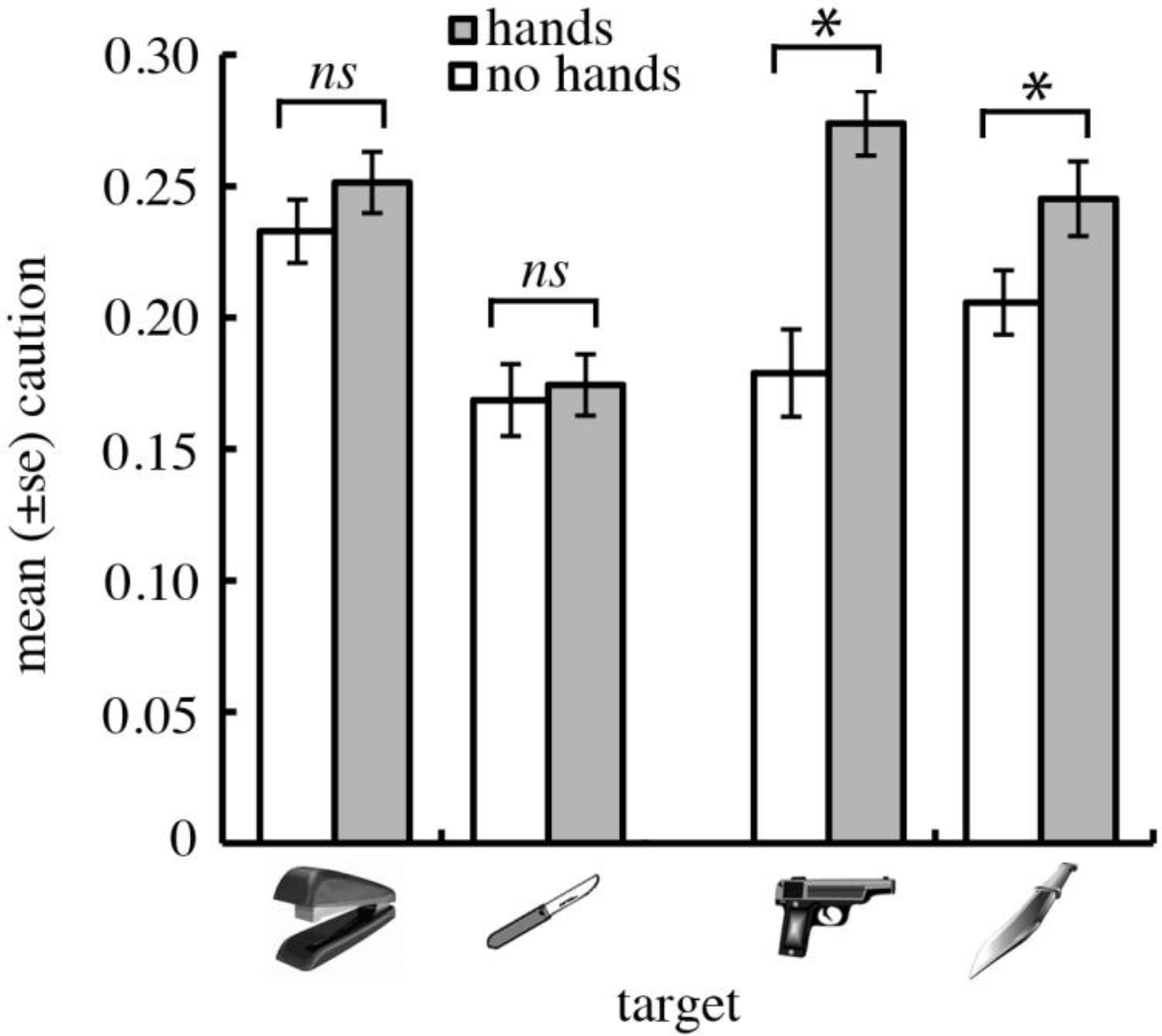
The mean (±se) caution expressed toward the weapons and gadgets in the hands and no-hands conditions of Experiment 1
Discussion
This experiment replicated the previously reported faster reaction times when locating threatening—compared to benign—man-made objects. We also demonstrated that participants behaved more cautiously when searching for weapons, using a caution score previously shown to increase with an increasing level of threat implied by target images. In contrast to previous studies, however, the weapons in this study were only located more quickly and cautiously than the gadgets when they were presented wielded in hands—a context that increases the level of threat implied. Our hypothesis that the weapons bias would be significantly stronger in men than women was also upheld.
Experiment 2 followed the same basic design as Experiment 1, but included additional context-free conditions (where the objects were pictured without backgrounds) and also included two more types of targets: syringes and pens. The inclusion of the context-free conditions was to determine whether the placement of the weapons in hands increased the caution levels (in addition to that which would be expressed in response to the weapon itself) or whether the pictures of the weapons not in hands (an explicit cue that they are not currently being wielded) lowered the caution levels that would otherwise be expressed. The inclusion of the syringes (and pens, for comparison) was to determine whether the increased caution in response to the weapons being wielded would be restricted to weapons or would generalize to other threatening, non-weapon objects. We similarly wanted to test whether the male advantage for locating weapons would be restricted to weapons or extend to syringes—the only non-weapon threatening object for which a threat bias has been previously reported (Brosch and Sharma 2005; LoBue 2010b).
Syringes were chosen as the non-weapon threatening object as they are a recognizable source of pain. Unlike weapons, however, they are not obviously associated with interpersonal violence and aggression. We would, therefore, not expect to see a sex difference in response time to them if the male advantage to locate weapons does, in fact, reflect an adaptive response of some kind to the threat of physical violence.
Experiment 2
Materials and Methods
Participants
Seventy participants (44 female) aged from 18 to 48 years (M = 20.57, SD = 4.45) completed the study as part of undergraduate research experience. All gave informed consent for their data to be published. The ethical aspects of this experiment were approved by the Charles Sturt University, School of Psychology Ethics Committee.
Design
The experiment contained 6 (target type) × 3 (context) conditions, all manipulated within subjects. The 18 trials of each condition were blocked. Trial order (within each block) and block order was randomized for each participant.
Stimuli
Individual image and 3 × 3 array sizes were as described for Experiment 1.
Target stimuli. The target stimuli for the eight conditions that were repeated from Experiment 1 (staplers, guns, “food,” knives, and “weapon” knives; in hands and not in hands) were as described for Experiment 1, but none of the actual images used in Experiment 1 were re-used; all new exemplars were sourced. The target stimuli for the 10 additional conditions of Experiment 2 featured: pens and syringes (six new conditions: both in hands, not in hands, and against a white background) and the original four target categories (stapler, guns, and weapon and cooking knives) against a white background (four new conditions).
Distractor stimuli. None of the distractor images used in Experiment 1 were re-used for Experiment 2. Three distractor sets (with no overlapping images) were created for each of the three context conditions (hands, no-hands, and context-free), with each set being used for one pair of threatening/benign targets: guns/stapler, weapon/cooking knives, and syringes/pens. As in Experiment 1, each set contained 81 images: nine each from nine categories. The distractor categories were the same for all the sets: books, paintbrushes, hairbrushes, tools, bottles, mugs, clocks/watches, tennis racquets, and bowls. These objects were pictured explicitly not held (“no-hands” conditions), held (“hands” conditions), or with the object only against a white background (“context-free” conditions; see Figure 1).
Procedure
The procedure for Experiment 2 was the same as described for Experiment 1.
Results
A series of planned ANOVAs and contrasts were carried out to answer the specific research questions posited concerning the effects of sex and context on response times, and caution expressed to weapons, and whether these patterns extend to a non-weapon dangerous object (syringes).
Are wielded weapons especially threatening, or are unwielded weapons benign?
Caution. In Experiment 1, relative to the gadgets, more caution was only displayed toward the weapons when they were displayed in hands. In Experiment 2, we tested whether more caution would be displayed to weapons if the context was ambiguous (not explicitly showing the weapons to be held or not held). Planned linear contrasts revealed that caution scores for the weapons (guns and weapon knives) were significantly higher than for the gadgets (staplers and cooking knives) in both the no-hands (F1,68 = 11.58, p = .001, ηρ2 = 0.15) and hands (F1,68 = 56.64, p < .001, ηρ2 = 0.45) conditions, but not in the context-free condition (F1,68 = 2.60, p = .11; see Figure 5). However, paired comparisons confirmed that in the context-free condition guns were located with more caution than staplers (p = .02), but no difference in caution was expressed toward the weapon and cooking knives (p = .58). A repeated-measures ANOVA comparing the levels of caution displayed to the weapons (guns/knives) and gadgets (staplers/knives) across the hands and no-hands contexts revealed a significant threat-by-context interaction (F1,69 = 4.49, p = .04, ηρ2 = 0.06), confirming that, consistent with Experiment 1, relatively more caution was displayed to the weapons (compared with the gadgets) when they were held in hands than when they were not. When a similar repeated-measures ANOVA compared weapons and gadgets across the no-hands and context-free conditions, there was no significant threat-by-context interaction (F1,69 = 1.20, p = .28), suggesting that displaying weapons explicitly not held did not result in decreased levels of caution than was expressed in response to the weapon displayed out of context.

The mean (±se) caution expressed when searching for the weapons and gadgets in the no-hands (A), hands (B), and context-free (C) conditions of Experiment 2
Reaction time. The same analyses were applied to the reaction time data and showed that participants located the weapons significantly faster than the gadgets across all three conditions (no-hands: F1,69 = 43.71, p < .001, ηρ2 = 0.39; hands: F1,69 = 162.08, p < .001, ηρ2 = 0.70; context-free: F1,69 = 75.42, p < .001, ηρ2 = 0.52; see Figure 6). A repeated-measures ANOVA comparing weapons and gadgets across the no-hands and hands conditions revealed a significant threat-by-context interaction (F1,69 = 27.09, p < .001, ηρ2 = 0.28). Consistent with Experiment 1, participants showed a larger decrease (relative to the gadgets) in reaction time when searching for weapons in hands compared to not in hands. A repeated-measures ANOVA comparing weapons and gadgets across the no-hands and context-free conditions revealed no significant threat-by-context interaction (F1,69 = 0.003, p = 0.96), indicating that the decrease in reaction time from gadgets to weapons was similar in the no-hands and context-free conditions.

The mean (±se) response time to locate the weapons and gadgets in the no-hands (A), hands (B), and context-free (C) conditions of Experiment 2
Are men faster to find weapons and does this extend to non-weapon syringes?
In Experiment 1, men located the weapons—but not the gadgets—significantly faster than women. To determine whether this same effect could be replicated in Experiment 2, we first conducted a mixed ANOVA with target group (2 levels: guns/staplers and knives), threat (2 levels: weapons and gadgets), and context (2 levels: no-hands and hands) as within-subjects measures and sex as a between-subjects measure. We found that the threat-by-sex interaction was significant as predicted (F1,68 = 6.43, p = .01, ηρ2 = 0.09), with men finding the weapons significantly faster than women (p < .001) and no sex difference in time to locate the gadgets (p = .34). When the same analysis was repeated with the context variable extended to include context-free conditions, the sex-by-threat interaction persisted (F1,68 = 6.34, p = .01, ηρ2 = 0.09), as did the male advantage to locate weapons (p < .001) but not gadgets (p = .27; see Figure 3b). A mixed ANOVA comparing response times of men and women to pens and syringes (threat variable) across the three context conditions found no significant threat-by-sex interaction (F1,68 = 2.75, p = .10), as men found neither the pens (p = .73) nor the syringes (p = .082) significantly faster than women (see Figure 2c). When the three contexts were examined separately, there were no sex differences in response times to pens (all ps > .55), but men did locate syringes in hands faster than women (p = .01). There were no sex differences in locating syringes in the no-hands (p = .95) or context-free (p = .66) conditions.
Are non-weapon dangerous objects treated like weapons?
Caution. To determine whether or not the higher levels of caution displayed to wielded weapons extended to non-weapon dangerous objects when depicted held, we conducted a repeated-measures ANOVA that compared caution scores to syringes and pens across the three context conditions. Overall, participants expressed greater caution to the pens compared to the syringes (F1,69 = 44.37, p < .001, ηρ2 = 0.39). There was a significant threat-by-context interaction (F2,138 = 73.94, p < .001, ηρ2 = 0.52), as more caution was displayed toward the pens than the syringes in the no-hands (p < .001) and hands (p < .001) conditions, but not in the context-free condition (p = .78). Paired contrasts confirmed that for both the pens (p = .007) and syringes (p < .001), significantly lower caution was exhibited when they were depicted in hands compared to no-hands, confirming that the higher caution displayed to wielded weapons did not extend to either non-weapon object (see Figure 5).
Reaction time. A repeated-measures ANOVA with threat (2 levels: pens and syringes) and context (3 levels: hands, no-hands and context-free) showed that syringes were located significantly more slowly than pens (F1,69 = 31.35, p < .001, ηρ2 = 0.31), with a significant threat-by-context interaction (F2,138 = 236.80, p < .001, ηρ2 = 0.77). Participants located the pens more quickly in the no-hands (p < .001) and hands (p < .001) conditions, but located the syringes more quickly in the context-free condition (p = .002; see Figure 6).
Discussion
Experiment 2 confirmed that weapons are located more quickly and cautiously than gadgets, and that the difference in caution is larger when the weapons are depicted wielded. These effects did not reliably extend to syringes (a non-weapon, yet “dangerous” object) when compared to pens, with syringes only being located more quickly in the context-free condition and not more cautiously than pens in any of the three context conditions. We were also able to replicate the male advantage for quickly locating weapons (and not gadgets) and, again this finding did not extend reliably to syringes, with men locating syringes more quickly than women in the hands condition, but not in either the no-hands or context-free conditions. Experiments 1 and 2 demonstrate that weapons are located more quickly than non-weapon objects, even more so by men, and are also searched for with a higher level of caution than non-weapon objects. This difference further increases when the weapons are depicted in hands, a context that increases the immediacy of the implied threat.
General Discussion
The stronger weapons bias in men, compared to women, occurred in both experiments, and so was replicable across samples and robust to changes in the stimulus set. Previous authors have highlighted both the threat status (Öhman et al., 2001) and relevance (Brosch, Sander, Pourtois, and Scherer, 2008) of stimuli as key determinants of how effectively such stimuli will capture visual attention. Given the sex differences in propensity to instigate and be the target of weapons-related violence (Daly and Wilson, 1990), it is somewhat surprising that no studies to date have investigated the possibility of a sex difference in the weapons bias. None of the studies previously reporting a weapons bias (Blanchette, 2006; Brosch and Sharma, 2005; Fox et al., 2007) examined participant sex as a factor. The sample characteristics of these studies (all used relatively small, heavily female-biased samples) probably account for why no such sex differences were reported. As far as we are aware, this is the first report of a sex difference in response times to locate threatening stimuli. Whether such a sex difference might also emerge for other threatening targets is not clear. Whereas previous threat bias studies have not reported significant effects of sex, it may be that—as with the weapons bias—such effects are waiting to be discovered.
The male advantage to locate weapons was apparent whether the weapons were depicted wielded or not. There were no sex differences in time to locate any of the non-weapon targets in any of the three contexts, with the one exception of syringes depicted in hands, which were located more quickly by men. Although these findings are generally consistent with the notion that the male advantage to locate threatening man-made objects is restricted to weapons, further investigations with a wider array of non-weapon threatening objects is necessary to draw firm conclusions. It is not clear whether the male advantage to locate syringes held in hands is a robust finding (a replication with a different stimulus set and different participants would be the first step to establish robustness), but if it is, it suggests an intriguing possibility: Men may be more likely to attend preferentially to objects that could be dangerous, even if the object is not a weapon per se. Thus, men might exhibit not just a stronger weapons bias than women, but may more broadly define what is considered a weapon. By presenting participants with a wider variety of objects as targets, whose status as weapons is ambiguous (e.g., hammers, axes, baseball bats), we could determine whether there is a male advantage in locating such threat-ambiguous targets, and whether men—compared to women—detect a larger set of threat-ambiguous targets more quickly than shape-matched benign targets.
We also note that participants may have perceived the syringes not just as sources of potential physical pain, but also as indicators of drug addiction (and negative associated stereotypes such as poverty and violence), or of hospitals (and associated concepts of disease and contaminants). Further investigations, perhaps using other primes of the concepts noted above, are required to understand exactly how or why prior knowledge of and experience with syringes contributes to an attention bias for them as reported previously (Brosch and Sharma, 2005; LoBue, 2010b), or to participant's responses to them in the current study.
Although a weapons bias has been reported several times, and a sex difference in this bias was established here, a thorough mechanistic and adaptive explanation for this bias remains open to debate. Greater male engagement with weapons and violence during childhood, adolescence, and adulthood suggests that prior experience with weapons likely plays a proximate role in the ontogeny of the weapons bias. Meer exposure to weapons facilitates responses to aggression-related stimuli (Anderson, Benjamin, and Bartholow, 1998) and can induce more aggressive behavior (Berkowitz and LePage, 1967; Carlson, Marcus-Newhall, and Miller, 1990), a phenomenon known as the “weapons effect.” Sex differences in unprovoked aggression are large and reliable, favoring men (Bettencourt and Miller, 1996). The male advantage to respond to weapons in the current study could reflect a weapons effect—the priming of an aggressive response—that is larger in men than in women. Consistent with this interpretation, men become more physiologically aroused in response to aggression-relevant stimuli (Frankenhaeuser, 1982; Knight, Guthrie, Page, and Fabes, 2002). If true, priming participants with an aggressive scene should result in facilitation of the weapons bias in the same way that priming participants with a fearful facial expression facilitates location of predatory, but not non-predatory, animals (Quinlan and Johnson, 2011).
The ultimate roots of attention to weapons are less certain. Social coercion theory (Bingham and Souza, 2009, 2012) proposes that projectile weapons, in particular, played a crucial role in the evolution of human sociality. If correct, this would make weapons—wielded weapons in particular—extremely salient social stimuli. Beyond the physical harm they could potentially cause, they may be perceived as the ultimate tool of coercion, inducing fear, obedience, and conformity. This is certainly consistent with the high levels of caution exhibited towards weapons, which further increased toward wielded weapons. Whether it also necessarily accounts for an attention bias towards weapons or the sex difference in this bias is more difficult to say. If attention is driven by salience and relevance, in the absence of a specific benefit afforded by fast detection, then social coercion theory may predict the observed sex difference if men bear the majority of the responsibility for using violence, or the threat of violence, to enforce pro-social behavior. Additionally, if the attention bias for weapons is intimately linked to said weapon's coercive potential, we may expect a systematic difference in responses to weapons that can be launched from a distance (central to the low-cost of weapons-enforced social coercion; Bingham and Souza, 2012) such as guns, and those that must be used in direct combat such as knives. According to social coercion theory, the fastest response times and highest caution would be predicted in response to distal rather than direct weapons.
These considerations also set up an interesting alternative hypothesis: If faster visual orienting (especially in men) toward weapons is not due to their social salience, but rather due to a benefit it affords during direct combat (in which men, both currently and historically, engage in more frequently), then we would predict the opposite pattern—faster response times to direct combat weapons, such as knives. The current study does not permit a direct comparison between response time to the different weapon types (they were presented surrounded by different distractors), but future studies could certainly test these competing predictions.
As previously noted (Sulikowski, 2012), caution scores afford comparison of threat-related effects across conditions where comparisons of target-present response times are not suitable. In the present study, comparisons between the “hands” and “no-hands” response times are hard to interpret as the inclusion of hands is predicted to increase response time due to increased target-distractor similarity (Duncan and Humphries, 1989) but also to decrease it due to increased levels of threat. It is difficult to predict a priori which of these effects would be larger and by how much (see also Sulikowski, 2012). The caution score, however, is standardized across very different absolute response times and can therefore reveal that weapons depicted wielded are perceived as more threatening.
The caution score also alleviates concerns that faster detection of the threatening target could potentially be due to low-level stimulus features (color, shape, contrast) that impact on reaction time and happen to differ between threatening and non-threatening targets (Quinlan, 2013). Differences in caution scores (because they are standardized) are unlikely to be due to low-level stimulus features (see Sulikowski, 2012 for a detailed explanation of this argument). Additionally, the sex differences in the present study are more consistent with a threat-based visual attention bias and difficult to explain from the perspective of confounded stimulus properties. The latter would require sex differences in low-level visual perceptual processes—for which there is little evidence anyway—and for these differences to happen to coincide with incidental differences between threatening and benign targets. Threat-based explanations, which can account for the patterns of both reaction time and caution observed, are more parsimonious.
In the context free condition of Experiment 2, participants did not differentiate between the weapon knives and the cooking knives in either reaction time or caution. This is not surprising as, without the context cues (food or attack) provided in Experiment 1 and in the hands and no-hands conditions of Experiment 2, there was little to differentiate the two categories of knives. In Experiment 1, the cooking knives included mostly blunt knives, such as bread and butter knives and cheese knives. Accuracy to locate these knives—in the hands condition, especially—was quite low. We suspected that this could be due to the fact that these kinds of knives are atypical. To provide a more robust test of the weapons bias and the effects of context, the cooking knives in Experiment 2 included more sharp cutting knives, more structurally and functionally similar to the weapon knives. The decreased response time and increased caution toward the weapon knives compared to the cooking knives in both the hands and no-hands condition of Experiment 2, therefore, provide strong evidence for the effects of context in these tasks.
Unexpectedly high levels of caution were expressed when searching for staplers in Experiment 1 and when searching for pens in Experiment 2. The high caution toward staplers in Experiment 1 (which did not carry over to Experiment 2) may have been because many of the stapler targets in Experiment 1 were bright red. This was not intentional, but happened to be true of the collection of stapler images we had available for Experiment 1. Different (non-red) exemplars of staplers were used for Experiment 2. Given the biological relevance of red as a warning color (Stevens and Ruxton, 2012) and its effect on human hazard perception (Braun and Clayton-Silver, 1995) and behavior (Elliot, Maier, Moller, Friedman, and Meinhardt, 2007), it is conceivable that the redness of the staplers in Experiment 1 was perceived as a danger signal, eliciting extra caution during search.
The high caution in response to pens is more perplexing. Although they were brightly colored (including red), the mix of colors in the pens makes the explanation offered above for staplers less applicable. Low accuracy could lead to high caution if participants happen to realize their errors in a condition and are subsequently more careful. This is also unlikely to account for the high caution toward pens, as accuracy when searching for pens tended to be relatively high (94–98% for both sexes in each of the three conditions presenting pen targets). A further possibility could lie in the superficial shape similarity between pens and other stabbing implements/weapons (a similarity that may have been primed by the presence of actual weapons in other conditions of the study).
Both sexes more rapidly detect weapons than non-weapons amongst other non-weapon objects in a visual display. This bias is stronger in men than in women, which implies that adaptive benefit of the bias is also likely greater in men than in women. Such benefits could relate specifically to perception of weapons or may be associated with violence more generally. Either way, engagement with weapons and violence, which is greater in males at all stages of development, is a likely candidate for the proximate cause of the weapons bias. Both sexes also evaluated wielded weapons as more threatening (searched for them with more caution to lower the probability of a miss) than weapons presented explicitly not held or without any context cues. In the current study, these effects did not extend to syringes, but further investigations are required to properly determine whether these effects are genuinely specific to weapons or may generalize to other potentially threatening non-weapon objects.
Footnotes
Acknowledgements:
We thank Prof. Ken Cheng of Macquarie University for allowing us access to his undergraduate student participants for Experiment 2. We also thank two anonymous reviewers for helpful suggestions and insights that greatly improved the manuscript. The first author (Danielle Sulikowski) was supported by an Early Career Researcher Faculty Compact Grant from Charles Sturt University.