



Abstract
Parents and children are genetically related but not genetically identical, which means that their genetic interests overlap but also diverge. In the area of mating, this translates into children making mate choices that are not in the best interest of their parents. Parents may then resort to manipulation in order to influence their children's mating decisions in a way that best promotes the former's interests. This paper attempts to identify the structure of manipulation tactics that parents employ on their daughters and sons, as well as on their daughters' and sons' mates, and also to estimate their prevalence. On the basis of the structure of the derived tactics, four hypotheses are tested: Mothers are more willing than fathers to use manipulation tactics; parents are willing to use more manipulation on their daughters than on their sons; the personality of parents predicts the use of tactics on their children and on their children's mates; and the personality of children and of children's mates predicts the use of tactics on them. Evidence from two independent studies provides support for the first three hypotheses, but mixed support for the fourth hypothesis. The implications of these findings are further discussed.
Introduction
Parents and children are not genetically identical, which means that their genetic interests partially overlap and partially diverge (Trivers, 1974). This leads to agreement but also to disagreement between the two parties, one area being mate choice (Trivers, 1974). More specifically, parents and children agree on the latter seeking to find mates endowed with good qualities; they disagree, however, on the ideal combination of these qualities (Apostolou, 2011).
For example, consider the case of genetic quality. The coefficient of relatedness of parents to children is 0.50, but the coefficient of relatedness of grandparents to grandchildren is 0.25. Therefore, the probability of a particular gene of an individual being passed on to the next generation by a spouse or in-law would be 50% or 25%, respectively. This means that parents obtain less genetic benefits from a prospective mate of high genetic quality than their children (Apostolou, 2007; Buunk, Park, and Dubbs, 2008). Accordingly, both parents and their children would agree that genetic quality is important in an in-law and in a mate, but the latter would consider it more important than the former. This disagreement is reflected in the divergence between in-law and mate preferences, with beauty (a proxy of good genetic quality; see Thornhill and Gangestad, 1993) being preferred more in a spouse than an in-law (Apostolou, 2008; Buunk et al., 2008; Perilloux, Fleischman, and Buss, 2011).
Asymmetrical preferences lead to conflict between parents and children as a result of the trade-off nature of mating: Constrained by their own mate value, parents and children have to make compromises with respect to a mating candidate's desirable qualities. Nevertheless, since the two parties do not share identical preferences, they will be inclined to make different compromises (Apostolou, 2011; Buunk et al., 2008). Consequently, if children solely exercise mate choice, they will compromise more than their parents would like over certain traits (e.g., industriousness and social status) in order to get an attractive spouse. Conversely, genetic quality associated with beauty is less important to parents, thus the advantage from this trait is insufficient to compensate for the loss of other desirable traits. For that reason, the children's mate choice may impose a cost upon parents in the form of losses in desirable traits (Apostolou, 2011). This cost gives parents the incentive to control their children's mating decisions in an effort to acquire in-laws who best fit their own, rather than their children's, preferences (Apostolou, 2014).
Parents have an additional reason to control their children's mating. Parents may be concerned that children lacking experience may make the wrong choices or fall prey to individuals who want to exploit them. This would have a negative fitness cost on parents, who, in order to reduce this cost, would interfere so as to motivate their children to make wiser choices and protect them from making bad ones. In sum, conflicting and diverging interests over mating give parents the incentive to exercise control over their children's mating decisions.
In pre-industrial societies, parents are able to control their children's mating decisions directly and to impose on them their in-law choices (Broude and Green, 1983; Stephens, 1963). Parents are able to do so because they can apply physical force on their children, and because their children at marital age are dependent on parental investment (Apostolou, 2010). These parental advantages are lost, however, in post-industrial societies where the rule of law and the protection of individual rights prevent parents from applying physical force on their daughters and sons. Furthermore, in post-industrial societies marriage usually takes place at an age when children are financially independent. As a consequence, parents can no longer impose direct control over their daughters' and sons' mate choices, and instead resort to manipulation in order to influence mate choice indirectly (Apostolou, 2013). The purpose of this paper is to explore this parental manipulation and to identify some of its key contingencies.
Parental manipulation over mate choice
Manipulation is employed in a wide range of circumstances, and research has revealed a plethora of manipulation acts that cluster in broader categories of distinct manipulation tactics (Buss, 1988, 1992; Buss, Gomes, Higgins, and Lauterbach, 1987; Buss and Shackelford, 1997). Buss (1992) identified 12 tactics that people, including parents, use when they intend to manipulate others. Such tactics include “coercion” and “hardball” where individuals use acts such as demanding conformity and posing threats in order to get their way. Other tactics include “charm” and “monetary rewards” where individuals use acts such as making compliments and giving money to influence others. The tactics “reason,” “silent treatment,” “pleasure induction,” “social comparison,” “responsibility invocation,” “regression,” “reciprocity-reward,” and “debasement” complete the list.
Building on this work, Butkovic and Bratko (2007) constructed an instrument to examine manipulation within a family unit. Using factor analysis, they managed to classify 22 acts of manipulation into three broader types of manipulation tactics, which they labeled “indirect tactics for coercion,” “direct tactics,” and “indirect tactics for humoring.” The focus of this research was, however, to study manipulation within the family in general, and not over mate choice in particular.
Nevertheless, manipulation tactics are expected to vary according to the goals towards which they are directed (Buss et al., 1987). Given the specific evolutionary problem that parents face influencing their children's mating decisions (Apostolou, 2010), existing research on general tactics of manipulation is insufficient to identify the whole battery of manipulation tactics that parents employ to influence mate choice.
A number of studies offer information on the specific tactics that parents use to manipulate mate choice. In particular, Sussman (1953) reported that parents employ means such as “cajolery, persuasion, appeals to loyalty, and threats so as to influence the mating behavior of their children. p.80” Bates (1942) found that American parents rely primarily on advice to influence mate choice. For example, they assist and encourage the development of relationships of which they approve, and advise on, rather than dictate, their children's choices. Another study found that modern Chinese parents in the USA attempt to create environments in which their children can meet other Chinese children of desirable background (e.g., by staging a barbecue and inviting desirable mates; Ikels, 1985).
These studies are insufficient to account for the full extent of parental manipulation, as they were not specifically designed for this purpose and they report a very limited number of manipulation acts. To address this limitation, and in order to identify the full range of manipulation tactics that parents use, one study employed a series of interviews with parents and children and identified 72 acts that parents use on their children to manipulate their mate choices (Apostolou, 2013). As parents can influence mate choice by manipulating the mates of their children, this research also identified 27 acts that parents use for this purpose. Parents were then asked to rate how likely they were to use these tactics on their children and on their children's mates. By applying principal components analysis, these acts were classified into 12 tactics that parents use on their children and four tactics that they use on their children's mates.
The current research aims to extend this work by identifying the key factors which are likely to predict the use of parental manipulation tactics over mate choice. Before discussing manipulation contingencies, it is worth noting that this study also aims to address several limitations of the Apostolou's (2013) study. The prevalence of each tactic was estimated by calculating the mean scores that parents gave for the acts composing it. However, these estimates are likely to be biased because parents may not give accurate scores for their willingness to use specific tactics. For example, they may use the “hardball” tactic more than they are willing to admit. The present study aims to address this limitation by estimating the prevalence of each manipulation tactic not only on the basis of parents' ratings, but also on individuals' (children's) ratings of the tactics their parents have used on them.
Furthermore, Apostolou's (2013) study did not distinguish between daughters and sons and daughters-in-law and sons-in-law, as parents were asked to indicate how likely they were to use manipulation acts on their children and on their children's mates. This is a limitation because the structure of manipulation tactics may also depend on the sex of the children and the sex of the children's mates. To address this issue, the present study aims to derive the structure of manipulation tactics using a larger sample of parents who were asked to indicate their willingness to use manipulation separately for their daughters, sons, daughters' mates and sons' mates.
Manipulation contingencies
Fathers vs. mothers. Women invest more in their children (9 months gestation period, breastfeeding, etc.) and their biology constrains the number of children they can have. Men, on the other hand, invest less in their children and the number of children they can father is limited only by the number of women they can access. The result of this asymmetry is that men fight intensely for access to women, a scarce reproductive resource (Trivers, 1972). Traits that enable men to dominate over their rivals are selected and increase in the population, a process called intrasexual selection (Andersson, 1994). Such traits include stronger muscles, bigger body size, and behavioral adaptations such as aggressiveness, dominance, etc.
These traits, however, enable men not only to dominate over other men but also over women. In particular, across different cultures and times, men dominate the political and economic realms (Whyte, 1978). In the realm of family, men dominate over their wives and daughters in a system of family organization known as patriarchy (Smuts, 1995). In post-industrial societies, women have equal rights to men, they control wealth, they have access to weaponry, and they even dominate certain realms such as education (Smith, 2014). But this is evolutionarily novel, with anthropological and historical evidence indicating that women spent most of their evolutionary past in a context where they had little control over wealth, little access to weaponry, and their individual rights were not well protected (Apostolou, 2014; Whyte, 1978).
Women being physically weaker, having less access to weaponry, having little control over wealth, and consequently being less aggressive, need to resort to manipulation in order to promote their interests effectively. To put it differently, men's greater physical strength and control of resources exert an evolutionary pressure on women to become more manipulative in order to counterbalance these male advantages and promote their own interests. On this basis, it is predicted that women have evolved to be more manipulative than men. Mothers, then, may be more likely than fathers to resort to manipulation in order to influence their children's mate choices.
Furthermore, due to internal gestation, mothers are 100% certain that their children are their own; this is not the case for fathers, however, who are less certain about paternity. This indicates that mothers see their interests as being more overlapping with the interests of their children, and so they have a stronger concern about the latter's mate choices. For instance, a bad mate choice on behalf of their children that compromises the fitness of their grandchildren (e.g., a mate who is likely to run away) will be more costly to mothers, who are certain that these grandchildren are actually their own, than to fathers, who are less certain. Accordingly, mothers will be more likely to interfere than fathers if they believe that a choice is not good for their daughters or sons.
Overall, it is predicted that mothers will be more willing to employ manipulation in order to influence the mate choices of their children compared to fathers. Parents manipulate their children's mate choices not only by applying manipulation on them, but also by applying manipulation on their mates; thus, it is further predicted that mothers will be more willing to apply manipulation on their children's mates compared to fathers.
Daughters vs. sons. Another consequence of the asymmetry in parental investment, with women being a scarce reproductive resource, is that parents are more interested in controlling the mate choices of their daughters than of their sons (Perilloux, Fleischman, and Buss, 2008). In particular, as men strive to gain access to women, by controlling the latter, parents can better control mate choice (Apostolou, 2010). Furthermore, due to the risk of pregnancy and the value that men ascribe to the chastity of women (Buss, 2003), the mating behavior of daughters is likely to be more consequential than the mating behavior of sons. For instance, a sexual adventure can commit a daughter's parental investment to a man that her parents do not approve of, and/or damage her reputation, compromising her future chances of attracting desirable mates. Last but not least, parents cannot be certain of their relatedness to grandchildren fathered by their sons, but they can be certain about their relatedness to their grandchildren mothered by their daughters. This means that parents may have more genetic interests at stake in the mating choices of their daughters than of their sons, which in turn would motivate them to control their daughters more.
Overall, as parents are more interested in the mating behavior of their daughters than of their sons, it is predicted that they will be more willing to use manipulation on the former than on the latter.
Personality. Personality predicts many aspects of human behavior and it is also likely to predict the use of manipulation tactics. In particular, several studies on manipulation have found personality effects (e.g., Buss, 1992; de Miguel and Buss, 2011) that are also expected to be present in manipulation over mate choice. For example, parents who score highly on agreeableness may be less willing to use manipulation tactics that involve acts of deception or acts of physical punishment. Thus, it is hypothesized that the personality of parents will predict the use of manipulation tactics on their children and on their children's mates.
It is also likely that the use of manipulation tactics is predicted by the personality of children. In particular, how effective a tactic is may also depend on the personality of children. For instance, children who score highly in agreeableness are likely to be more easily moved by parental manipulation acts such as crying or looking sad. Therefore, parents may adapt their choice of manipulation according to their children's personality. On this basis, it is further predicted that the use of manipulation tactics is contingent on children's and on children's mates' personality traits.
In sum, this study aims to test the hypotheses that mothers are more willing than fathers to use manipulation on their children and on their children's mates, that parents are more willing to use manipulation on their daughters than on their sons, and that the personality of parents, their children, and their children's mates predicts the use of manipulation tactics.
Study 1
Materials and Methods
Participants
Four research assistants were employed for the purposes of this study. They recruited individuals who volunteered to participate in a study on family relationships (no payment was given). In order to qualify for participation, an individual had to have at least one child. A snowball sampling technique was used where the research assistants first recruited several parents and then obtained references for other parents who might have been interested in participating in the study. The research took place in the Republic of Cyprus, and the participants came predominantly from the two biggest cities of the republic: Nicosia and Limassol. The data collection process lasted approximately 2 months. This study did not employ couples (i.e., fathers and mothers came from different families). The participants were initially asked to sign a consent form, and then they were given the survey. Upon completion, the participants put the questionnaire in an unmarked enveloped and sealed it.
Participants included 838 Greek-Cypriots (498 women, 339 men). The mean age of mothers was 40.6 years (SD = 9.8), and the mean age of fathers was 43.7 years (SD = 11). Participants had a mean of 1.2 (SD = 0.8) male children and a mean of 1.2 (SD = 0.8) female children. The mean age of the oldest female child was 14.2 years (SD = 11.3) and the mean age of the oldest male child was 15 years (SD = 11.3). Moreover, 86.3% of the participants were married, 7.6% were divorced, 2.9% were single, 1.4% were widowed, and 1.6% were in a relationship.
Procedures
The survey consisted of four parts. The first part comprised demographic information (sex, age, marital status, number of daughters and sons, ages of the oldest male child and the oldest female child). In the second part, participants were asked to consider a scenario where they had a daughter and a son who had reached sexual maturity and then rate the likelihood of using the 72 acts identified by Apostolou (2013) in order to manipulate the mating behavior of each. In the third part, participants were asked to consider a scenario in which their daughters and sons were dating someone, and then rate the possibility that they would use the 27 acts identified by Apostolou (2013) in order to manipulate the mates of their daughters and sons. In all cases, a seven-point Likert scale was used which ranged from 1 = “not at all likely to do it” to 7 = “extremely likely to do it.”
In the fourth part, participants were given a personality test. For this purpose, the BFI-10 (Rammstedt and John, 2007), which is composed of 10 items that measure the Big Five personality dimensions, was used. Participation in the survey was voluntary. The questionnaire was rather long, as participants had to rate many traits for both their sons and daughters. Thus, this instrument was chosen because it is not lengthy, yet it maintains high validity and reliability, and it correlates strongly with longer instruments that measure the Big Five (Rammstedt and John, 2007). Finally, the order of presentation of parts two, three and four, as well as the order of presentation of children (daughters, sons) and of children's mates (boyfriend/husband, girlfriend/wife) was counterbalanced across participants.
Results
Tactics' underlying structures
Daughters and sons. Principal components analysis with direct oblimin rotation was applied to the 72 acts of manipulation. The direct oblimin method was chosen over the varimax rotation because the presence of non-correlated tactics is unlikely. This analysis was conducted twice, once on the ratings that participants gave for their daughter and once on the ratings they gave for their son. The results suggested a 12-factor solution (Eigenvalue > 1) in the case of both children. The KMO statistic was .94, indicating a very good sample adequacy. Bartlett's test of sphericity was also significant (p < .001), indicating that the exploratory factor analysis was meaningful for this dataset. Acts loading on each factor can be seen in Table 1. The scales comprising each factor (the collection of items) produced by the principal components analysis were checked for internal consistency by means of reliability analysis (Cronbach's α). Internal consistency (α) for daughters ranged from .51 to .91, with a mean of .72, and for sons it ranged from .56 to .90, with a mean of .75.
Acts of manipulation and factor loadings for manipulation tactics used on daughters and sons

For daughters, 12 tactics emerged (see Table 1), which largely overlap with the tactics that have been identified by Apostolou (2013). In particular, we have been able to replicate 8 of the 12 tactics: “hardball,” “matchmaker,” “coercion,” “prevention,” “whom one should marry,” “carrot and stick,” “chaperoning,” and “guilt trip.” Two more tactics that emerged here are closely related with previously identified tactics. In particular, the “advice and support” tactic is close to the previously identified tactic of “advice and reasoning.” However, although there is some overlap, acts associated with reasoning do not load on the tactic that emerged here. It appears that acts associated with support (usually when something goes wrong with respect to romantic relationships) load highly instead. Similarly, the “social comparison and moral advising” is close to the “social comparison” tactic; however, the tactic that emerged here also has an aspect of moral advising. It seems then that parents use social comparison to demonstrate to their daughters what is morally right and wrong. The “use of relatives and friends” tactic did not emerge here. Instead, one tactic that emerged is “monitoring,” where parents closely monitor their daughters' activities and try to get information about their behavior. Finally, the “emotional manipulation” tactic is similar to the “silent treatment” tactic, although in this case several acts that involve emotional manipulation also load.
For sons, 12 factors emerged as well (see Table 1). Nine of these closely overlap with previously identified tactics: “hardball,” “matchmaker,” “coercion,” “prevention,” “whom one should marry,” “carrot and stick,” “chaperoning,” “guilt trip,” and “use of relatives and friends.” As in the case of daughters, the “advice and support” tactic emerged, which is similar to the previously identified tactic of “advice and reasoning.” Also, the “emotional manipulation” tactic emerged, which is similar to the “silent treatment” tactic. The social comparison tactic did not emerge, but as in the case of daughters the “monitoring” tactic emerged. Overall, it appears that the structure of parental manipulation on sons is similar to the one on daughters. But there are differences, one being that the “social comparison and moral advising” tactic emerged only for daughters, whereas the “use of relatives and friends” tactic emerged only for sons.
The tactics of manipulation employed on children. Before proceeding further, we can briefly summarize the tactics that parents employ in order to influence their children's mating behavior. In the “coercion” tactic, parents employ acts like yelling and demanding conformity. In the “hardball” tactic they employ acts such as deception, threats, degradation, and physical violence in order to influence their children. The “whom one should marry” tactic involves parents giving advice to their children on what they should be looking to find in a mate. In the “chaperoning” tactic, parents closely guard their children in order to prevent them from getting into undesirable relationships, whereas in the “prevention” tactic they employ a series of acts which aim to prevent children from attracting unwanted attention or being exposed to undesirable mates. In the “monitoring” tactic, parents employ acts such as spying in order to monitor their children's behavior. In the “guilt trip” tactic, parents attempt to make their children feel guilty about their behavior. Similarly, in the “emotional manipulation” tactic, parents employ acts such sulking and whining in order to influence their children's behavior.
Moreover, in the “carrot and stick” tactic, parents provide financial incentives to their children in order to comply with their will. In the “use relatives and friends” tactic, they employ individuals such as relatives or their children's friends and ask them to influence their children (mainly their sons) on their behalf. In the “social comparison and moral advising” tactic, parents compare their children's (mainly their daughters') behavior with desirable behavior exhibited by other individuals, and they also employ acts which involve references to what is morally correct. In the “matchmaker” tactic, parents tell their children what to do in order to look desirable to prospective partners, and they actively try to match them with appropriate individuals. Furthermore, in the “advice and reasoning” tactic, parents provide advice on romantic relationships usually followed by reasoning why children should behave in a particular way. Finally, in the “whom one should marry” tactic, parents give advice to their children on the specific qualities that they should be looking for in a mate.
Daughters-in-law and sons-in-law. Principal components analysis with direct oblimin rotation was applied to the 27 acts that parents use on their children's mates. The analysis was conducted twice, once on the ratings that participants gave for a prospective daughter-in-law and once on the ratings they gave for a son-in-law. The results suggested a four-factor solution for daughters-in-law and a three-factor solution for sons-in-law (Eigenvalue > 1). The KMO statistic was .93, indicating a very good sample adequacy. Bartlett's test of sphericity was also significant (p < .001), indicating that the exploratory factor analysis is meaningful for this dataset. The scales comprising each factor (the collection of items) produced by the principal components analysis were checked for internal consistency by means of reliability analysis (Cronbach's α). For daughters-in-law, internal consistency (α) ranged from .61 to .93 with a mean of .79, and for sons-in-law it ranged from .67 to .92 with a mean of .82.
For daughters-in-law, four tactics emerged (see Table 2). Three of these tactics, namely the “hardball,” the “we are family,” and the “dirty laundry” replicate previously identified tactics (Apostolou, 2013). The previously identified “lure” tactic (where parents use money and other means to attract desirable in-laws) did not emerge here. Instead, a different tactic emerged, namely the “coercion” tactic where parents employ acts such as threats to coerce their prospective daughters-in-law to follow their wishes.
Acts of manipulation and factor loadings for manipulation tactics used on daughters-in-law and sons-in-law
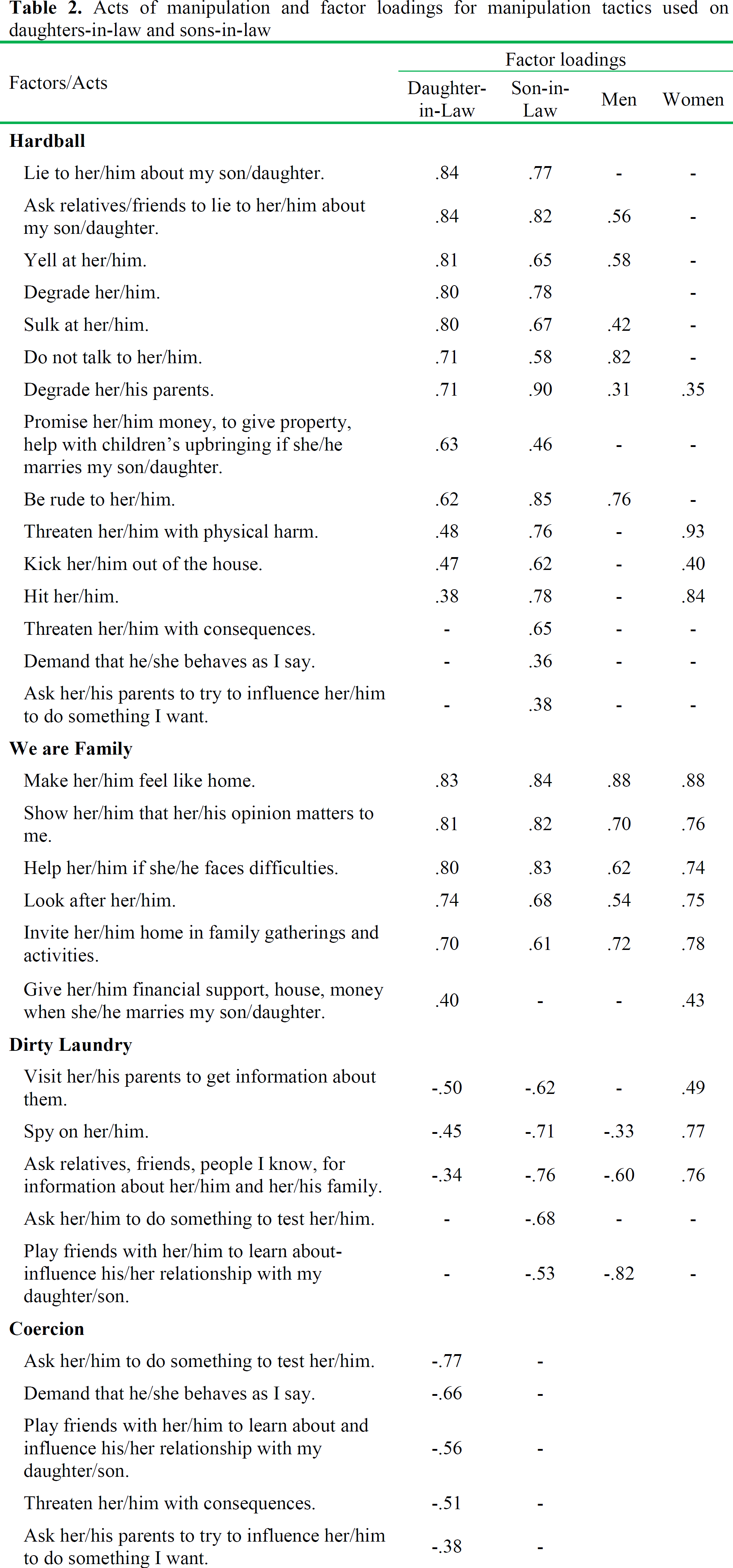
For sons-in-law, a three-factor solution emerged (see Table 2). The three tactics, namely the “hardball,” the “we are family,” and the “dirty laundry,” replicate previously identified tactics. As in the case of daughters-in-law, the formerly identified “lure” tactic did not emerge. Contrary to daughters-in-law, the “coercion” tactic did not emerge in the case of sons-in-law.
The tactics of manipulation employed on children's mates. Before we move on to further analysis, we briefly discuss the tactics that parents employ on their children's mates. To begin with, in the “hardball” tactic threats, degradation, deception, and physical violence appear as acts used to drive away an unwanted in-law. In the “coercion” tactic, demands for conformity, but also threats, are used on a prospective in-law (mainly on daughters-in-law). In the “dirty laundry” tactic, parents keep their children's mates in check by continuously looking for information about them. Finally, in the “we are family” tactic, parents aim to make desirable mates feel like they are part of their family.
Prevalence
To estimate the tactics' prevalence, means for the different manipulation tactics were computed and the results are presented in Table 3. At the top of the hierarchy for both sons and daughters we find the “advice and support” and the “whom one should marry” tactics, indicating that parents prefer to take the advice road. The “prevention” tactic also rates highly on the preference of parents. Further down the hierarchy we find tactics such as the “matchmaker” and the “guilt trip.” The position of the “hardball” tactic at the bottom of the hierarchy indicates that it is least likely to be used by parents, perhaps only as a last resort.
Means and standard deviations of manipulation tactics in Study 1

Moving on to prospective in-laws, the mean scores indicate that the preferred tactic is the “we are family,” and the least preferred one is the “hardball” tactic. It can also be seen that the “coercion” tactic comes second in the parents” hierarchy for daughters-in-law.
Daughters vs. sons
The tactics' structures indicate that there are two non-overlapping tactics, which only appear on one of the two sexes. More specifically, the “social comparison and moral advising” tactic is used predominantly on daughters, whereas the “use of relatives and friends” tactic is used predominantly on sons.
With respect to the overlapping tactics, we wanted to investigate whether parents are more willing to use them on their daughters than on their sons. However, because the acts that load on each tactic were not identical for sons and daughters, new variables for each tactic that included only the overlapping acts were computed in order to make comparisons more meaningful. For instance, for the “hardball” tactic, two new composites were computed: one for sons and the other for daughters, based only on the acts that loaded on this tactic for both sons and daughters. In each pair of composites, a paired-samples t-test was applied and the results are presented in Table 4. We can see that for five tactics there is a significant difference, with parents being more willing to apply them on their daughters than on their sons. Please note that both this analysis and the subsequent analysis involve multiple comparisons that may inflate the alpha level. As this is the first time that such analysis takes place, and because we did not want to miss any important differences, the alpha was not set to a more conservative level. Nonetheless, the reader should be aware of the possibility of alpha inflation.
Sex differences in manipulation tactic use in Study 1
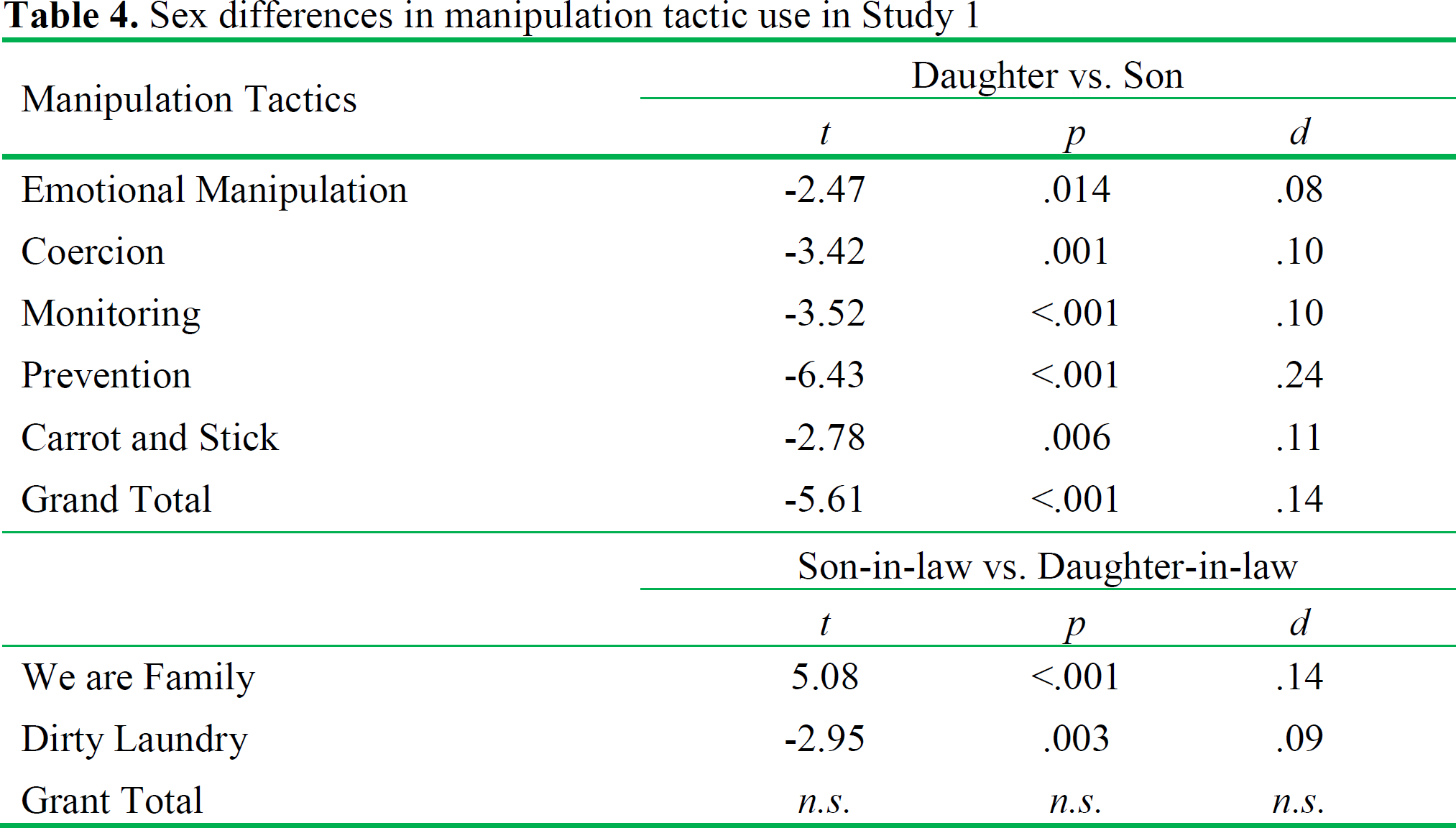
Using this procedure, we were able to examine whether the use of each tactic was contingent on the sex of the child. It is important to note a limitation here, as many acts were dropped, which might have potentially resulted in a different factor structure and altered the conceptualization of each factor. Accordingly, the present results need to be reexamined in future research that uses a methodology specifically designed to identify whether specific tactics are more likely to be used on daughters than sons.
Finally, in order to get an overall measure of parental willingness to apply manipulation, a grand total was estimated by averaging all 72 acts for sons and for daughters and then conducting a paired-samples t-test analysis. The results indicate that parents were more willing to apply manipulation on their daughters than on their sons (see Table 4).
Sons-in-law vs. daughters-in-law
As before, in order to identify whether parents' use of manipulation tactics is contingent on the sex of the in-law, new composites were computed based only on the acts that were present in both daughters-in-law and sons-in-law. A series of paired-samples t-tests was applied on each tactic, and the results are presented in Table 4. We can see that parents are more willing to use the “we are family” tactic on their prospective daughters-in-law than on their prospective sons-in-law, while they are more willing to use the “dirty laundry” on their sons-in-law than on their daughters-in-law. Comparisons between grand totals found no significant differences, indicating that parents were not willing to use more manipulation on either their sons-in-law or their daughters-in-law.
Mothers vs. fathers, personality, and age effects
Children. To examine whether the use of manipulation tactics can be predicted by the sex, the personality, and the age of parents, a series of MANCOVAs (Multivariate Analyses of Covariance) was applied to each tactic separately for sons and daughters. In particular, the acts that composed each tactic were entered as dependent variables and the sex, personality (five variables, one for each personality dimension), and age of parents were entered as independent variables. The age of the oldest son was also entered as an independent variable when the analysis was performed for sons, and the age of the oldest daughter was entered as an independent variable when the analysis was performed for daughters. Backward elimination method was applied in order to reach the best model for each tactic.
As we can see from Table 5, with respect to daughters, fathers indicated a higher willingness to use the “prevention” and the “chaperoning” tactics compared to mothers, whereas mothers indicated a higher willingness to use the “advice and support,” the “emotional manipulation,” and the “whom one should marry” tactics compared to fathers. With respect to sons, fathers were more willing than mothers to use the “hardball” tactic, whereas mothers indicated a higher willingness to use the “advice and support,” the “emotional manipulation,” and the “whom one should marry” tactics than fathers.
Personality, sex, and age effects on manipulation tactics used on children in Study 1

Note. “-” indicates a negative relationship and “+” a positive relationship
In order to identify whether mothers were more willing than fathers to employ manipulation on their children, an independent-samples t-test was applied to the grand totals of sons and daughters, with the sex of the parent being entered as the independent factor. The results indicated that mothers were more willing than fathers to use manipulation on daughters, t(601) = −3.71, p < .001 (two-tailed), d = .33, as well as sons, t(589) = −2.33, p = .020 (two-tailed), d = .20.
With respect to personality, the most consistent predictor of manipulation use was conscientiousness, which was significant for several tactics in both daughters and sons (see Table 5). The coefficient of this trait was always negative, indicating that the more conscientious parents are, the less willing they are to use manipulation on their children. Moreover, emotional stability and extraversion appear to predict the “advice and support” tactic, but only for daughters. Finally, emotional stability predicts the use of “coercion” for daughters and the use of “whom one should marry” for sons.
The age of parents was also a significant predictor for many tactics of manipulation for both daughters and sons. Age was almost always a negative coefficient indicating that as parents are getting older, their willingness to manipulate the mate choices of their children decreases. Note that this is a real effect, as the age of parents does not constitute a proxy of their children's age (i.e., older parents having older children) since the age of the oldest child was also entered as an independent variable.
In-laws. A similar analysis (i.e., MANCOVA) was performed on the manipulation tactics parents used on their in-laws. For daughters-in-law, fathers reported more willingness to use the “hardball” and the “coercion” tactics compared to mothers, whereas mothers were more willing to use the “we are family” tactic compared to fathers (see Table 6). For sons-in-law, fathers were more willing to use the “hardball” tactic, whereas mothers were more willing to use the “we are family” tactic (see Table 6).
Personality, sex, and age effects on manipulation tactics used on children's mates in Study 1

Note. “-” indicates a negative relationship
To investigate whether mothers were more willing than fathers to use manipulation on their in-laws, an independent-samples t-test was applied to the grand totals for both in-laws, with parents' sex being entered as the independent factor. The results indicated that mothers were more willing than fathers to use manipulation on their prospective daughters-in-law, t(681) = −2.84, p = .005 (two-tailed), d = .25, as well as their sons-in-law, t(699) = 5.88, p = .001 (two-tailed), d = .26.
Personality was an important predictor, but only for the “hardball” tactic (see Table 6). In particular, the “hardball” tactic for daughters-in-law is predicted by conscientiousness and agreeableness, and for sons-in-law it is predicted by agreeableness, emotional stability, and openness. Finally, age was also a consistent predictor of the use of manipulation. The age variable was always a negative coefficient, indicating that as parents age, they become less willing to use manipulation on their prospective in-laws.
Study 2
Methods
Participants
The same four research assistants of Study 1 were employed for the purposes of the second study. They recruited individuals who volunteered to participate in research on family relationships (no payment was given). The data collection process lasted approximately 1 month. The study took place in the Republic of Cyprus, and the participants came predominantly from the two biggest cities of the republic: Nicosia and Limassol. The participants were initially asked to sign a consent form, and then they were given the survey. Upon completion, the participants were asked to put the questionnaire in an unmarked enveloped and seal it.
In this study, 494 Greek-Cypriots took part (284 women, 210 men). The mean age of women was 27 years (SD = 11.2), and the mean age of men was 27.4 years (SD = 9.7). In addition, 72% of the participants indicated that they did not have children. Moreover, 42.9% of the participants were single, 27.8% were married, 25.8% were in a relationship, 3.2% were divorced, and 0.2% were widowed.
Procedures
The survey consisted of four parts. In the first part, demographic information was collected (sex, age, and marital status). In the second part, participants were asked to rate how frequently they perceived their parents to have used on them the 72 manipulation acts of Study 1 in order to manipulate their mating behavior. In the third part, participants were asked to rate how frequently they perceived the parents of their mates to have used on them the 27 manipulation acts identified in Study 1. In all cases, a seven-point Likert scale was used, which ranged from 1 = “they never do it” to 7 = “they always do it.” The order of presentation of parts two and three (parents, mates' parents) was counterbalanced across participants. In the fourth part, participants were given the BFI-10 (Rammstedt and John, 2007) to measure the Big Five personality dimensions.
Results
Prevalence
On the basis of the tactics' structure derived in Study 1, we estimated mean scores for each manipulation tactic, which can be seen in Table 7. Both daughters and sons reported the “advice and support” and the “whom one should marry” tactics to be more frequently used on them, followed by the “prevention” tactic. Further down we find tactics such as the “emotional manipulation” and the “guilt trip.” The least frequently reported tactic was the “hardball.” Furthermore, when participants indicated their experience as prospective in-laws, they reported the “we are family” to be the most frequently used tactic, and the “hardball” to be the least frequently tactic used on them (see Table 7).
Means and standard deviations of manipulation tactics in Study 2

The hierarchy of tactics that parents were willing to use (Study 1) appeared to be very similar to the tactics children reported that their parents used on them. This is confirmed by correlation analysis. In particular, the order hierarchy for a daughter produced in Study 1 was correlated with the order hierarchy for daughters produced in this study. Spearman's correlation was .82, whilst the respective correlation for sons was .85. With respect to in-laws, Spearman's correlation for sons-in-law was 1.0 (indicating a complete overlap), whilst for daughters-in-law it was .80.
These results indicate that there was a consistency between what parents said they did and what they actually did as indicated by their children. Thus, the possibility of report bias by parents with respect to the more frequent use of tactics such as the “hardball” than hey were willing to admit, mentioned as a potential source of distorted information in Study 1, is minimized. Triangulation of parents' data with children's data suggests an agreement of the two sources, as children also reported the “hardball” to be the least frequent tactic used on them.
A further observation is that the mean scores that individuals reported in Study 2 were smaller than the mean scores parents reported in Study 1. One possible interpretation of this finding is that parents reported more willingness to apply manipulation than they actually did. Another possible interpretation is that a property of effective manipulation is not to be perceived as such; therefore, much of the manipulation may go undetected by children. Consequently, individuals may have reported being less manipulated because there may have been many instances in which their parents employed manipulation without them being aware of it.
Daughters vs. sons
To examine whether manipulation is contingent on the participants' sex, new variables were computed on the basis of overlapping acts. A series of independent-samples t-tests was applied on each manipulation tactic, with the sex of the participant being entered as the independent variable. The results indicated that for the “advice and support,” the “emotional manipulation,” the “prevention,” and the “guilt trip” tactics, women report significantly more manipulation than men (see Table 8). Note that parents in Study 1 reported higher willingness to use the “prevention” and the “emotional manipulation” tactics on their daughters than on their sons.
Sex differences in manipulation tactic use in Study 2

An independent-samples t-test was applied to the grand totals, which indicated that women reported an overall higher level of manipulation than men, t(383) = −4.09, p < .001 (two-tailed), d = .48. This is consistent with the findings of Study 1, where parents reported a higher willingness to manipulate their daughters than their sons. It is also interesting to note that the effect size in this case is more than three times bigger than the effect size found in Study 1 (i.e., d = .14), where the grand total of sons was compared with the grand total of daughters. One possible explanation is that parents may be less willing to report that they intend to apply more manipulation on their daughters than on their sons.
Daughter-in-law vs. son-in-law
As before, new variables were computed on the basis of overlapping acts in order to make meaningful comparisons between in-laws. A series of independent-samples t-tests was conducted on each manipulation tactic, with the sex of the participant entered as the independent variable. The results indicated that women reported “we are family” to be more frequently used on them than men (see Table 8). This is consistent with the results of Study 1, where parents indicated that they were more willing to use the “we are family” tactic on their prospective daughters-in-law than on their prospective sons-in-law. Finally, an independent-samples t-test was applied on the grand totals, but no significant difference was found. This finding is also consistent with the results of Study 1, where parents reported an equal willingness to use manipulation on their prospective daughters-in-law and on their sons-in-laws.
Personality and age effects
To examine whether the use of manipulation tactics could be predicted by participants' personality and age, a series of MANCOVAs (Multivariate Analyses of Covariance) was applied to each tactic for both women and men. In particular, acts composing each tactic were entered as dependent variables, and the personality (five independent variables, one for each personality dimension) and age of participants were entered as independent variables. Backward elimination method was applied in order to reach the best model for each tactic.
The results indicated that the agreeableness personality dimension predicted several tactics. For women, agreeableness predicted three tactics: “advice and support,” “prevention,” and “social comparison and moral advising” (see Table 9). The coefficient was negative in all three cases, indicating that women who scored high on this trait were less likely to report that their parents had applied these tactics on them. For men, on the other hand, agreeableness predicted five tactics: “hardball,” “advice and support,” “emotional manipulation,” “carrot and stick,” and “guilt trip.” With the exception of the “carrot and stick” tactic, for which the relationship was negative, the relationships were positive, indicating that higher scorers on this trait were more likely to report that their parents had applied these tactics on them. Agreeableness also predicted the use of “hardball” on sons-in-law (see Table 10).
Personality, sex and age effects on manipulation tactics used on children in Study 2

Note. “-” indicates a negative relationship and “+” a positive relationship
Personality, sex and age effects on manipulation tactics used on children's mates in Study 2

Note. “-” indicates a negative relationship and “+” a positive relationship
Apart from agreeableness, different personality factors seemed to predict different tactics (see Tables 9 and 10), but a clear pattern did not emerge. As a matter of fact, certain results look counterintuitive. For instance, for women there was a positive relationship between the “prevention” tactic and conscientiousness, indicating that the more conscientious daughters were, the more likely their parents were to use this tactic on them. Actually, we would expect the opposite result: The more conscientious daughters were, the less likely their parents would be to use this tactic on them. One possible explanation for this finding is that what is actually measured here is not whether the personality of children predicts the tactics that their parents use on them, but instead whether the personality of children predicts which tactics they are going to report. For instance, more conscientious daughters may be more likely to report that their parents have used the “prevention” tactic on them.
Moving on, age appeared to predict several tactics for daughters. With the exception of the “advice and support” tactic where the relationship was negative, for the rest of the tactics the relationship was positive, indicating that older women were more likely to report these tactics. For men, age only predicted the “emotional manipulation” and the “carrot and stick” tactics. For daughters-in-law, age predicted most of the tactics used (see Table 10), with the relationship being positive. Age did not predict tactics used on sons-in-law. In most of the cases, age had a positive coefficient; this is likely to partially reflect an accumulation of experience effect, where older individuals have experienced more manipulation from their parents, and thus, they are more likely to report it.
Exploring the factor structure
The tactics that parents employ on their children should be mirrored in the tactics that individuals report that their parents use on them. Consequently, it is hypothesized that the factor structure identified in Study 1 will also appear in Study 2. It is not, however, expected that the two factor structures will be identical, one reason being that many manipulation acts can go undetected, which in turn may result in individuals not reporting or underreporting them and consequently affecting the factor structure derived from their responses.
In order to examine the degree to which the factor structure of Study 1 is replicated here, principal components analysis with direct oblimin rotation was applied to the 72 acts of manipulation. This analysis was applied twice, once on the ratings that female participants gave and once on the ratings that male participants gave. The results for women suggest an 11-factor solution (Eigenvalue > 1), with the KMO statistic being .87. The results are presented in Table 1. The “carrot and stick” tactic was not replicated, whilst the rest of the tactics produced were closely related to the tactics identified in Study 1, albeit with some different manipulation acts loadings. In particular, it appeared that for “social comparisons and moral advising,” the moral advising acts did not load, whereas for “advice and support,” the support acts did not load.
The results for men suggest a nine-factor solution (Eigenvalue > 1), with the KMO statistic being .82. These are presented in Table 1. The “use of relatives and friends,” “chaperoning,” and “prevention” tactics were not extracted. One possible reason why the last two tactics were not replicated here is likely to be that men may be less willing to report that their parents have employed such tactics on them.
Moreover, principal components analysis with direct oblimin rotation was applied to the 27 acts that participants reported their mate's parents have used on them. This analysis was applied twice, once on the ratings that female participants gave, and once on the ratings that male participants gave. The results for women suggested a three-factor solution (Eigenvalue > 1) with the KMO statistic being .88. These are presented in Table 2. We can see that the produced factor structure is similar to the one produced in Study 1, but we were not able to replicate the “coercion” tactic. The results for men also suggest a three-factor solution (Eigenvalue > 1) with the KMO statistic being .85. These are presented in Table 2 where we can see that the factor structure closely overlaps with the one produced in Study 1.
Discussion
The current research attempted to identify the structure and prevalence of manipulation tactics that parents employ to influence their children's mating behavior, and to identify the primary factors that predict the use of these tactics. Parents reported more willingness to employ advice and less willingness to apply more direct and aggressive approaches such as physical punishment. The willingness to use tactics is mirrored in individuals' (children's) reporting of tactics employed on them. Also, consistent with the original hypotheses, parents reported that they were willing to employ more manipulation on their daughters than on their sons, and women reported more manipulation by their parents than men. In addition, mothers indicated more willingness to employ manipulation on their children and on their children's mates than fathers.
As hypothesized, personality predicted the use of tactics, with conscientiousness constraining parents' willingness to apply manipulation on their children. Children's personality also appeared to play a role, but the results were not clear-cut. The role of children's personality in determining their parents' use of tactics needs to be re-examined with a different research design, where parents will be asked to rate their children's personality, and then indicate their willingness to use manipulation tactics on them. Another finding was that older individuals reported more manipulation by their parents, but this is more likely an accumulating experience effect rather than a real age effect. Finally, the age of parents was negatively related to their willingness to apply manipulation on their children and their children's mates.
One possible explanation for the latter finding is that the residual reproductive value of younger parents is higher than the residual reproductive value of older parents. In other words, parents have more reproductive years ahead of them when they are younger than when they are older. In a pre-industrial context, and most probably during ancestral times, parents would control their children's mate choices so as to arrange beneficial marriage alliances, and they could divert this cost in their own reproductive effort (Apostolou, 2014). For instance, a father could use the bridewealth he received from the marriage of his daughter to get an additional wife for himself, while a mother could use the resources derived from a beneficial alliance to mother additional children. However, these reproductive benefits are exhausted with age, which means that older parents have less to gain from controlling their children. As a consequence, there will be less intense selection pressures exercised on older parents to control mating, which in turn may result in older parents being less interested in using manipulation to influence their children's mate choice.
Our findings suggest that the highest degree of manipulation will come from relatively young mothers with low conscientiousness and will be applied predominantly to their daughters. Highly conscientious, older male parents are the least likely to apply manipulation on their children and especially on their sons. When parents apply manipulation, it will predominantly take the form of advice, whereas tactics such as the “hardball” will be left as a last option.
Parents have a wide and diverse battery of tactics that they use to manipulate their children's mate choices. The next question that future research can address is how effective these tactics are in actually modifying children's behavior in a way that complies with their parents' wishes. If tactics are indeed quite effective, this would mean that individuals' mating success is determined not only by how desirable they are to the members of the opposite sex, but also by how desirable they are to their prospective mates' parents.
One limitation of this research is that it is based on self-report data. This is particularly important in assessing the prevalence of tactics such as the “hardball,” since parents may be more willing to use them than they are willing to admit. This limitation is partially controlled by Study 2, where individuals reported the tactics that their parents have used on them. The results of Study 2 mirrored the results of Study 1, but reporting biases cannot be totally eliminated. For instance, it may still be the case that children are less willing to report that their parents have used acts such as physical violence on them.
Another limitation is that this research is based on a nonprobability sample, which means that certain population groups may be over-represented or under-represented. Accordingly, because factors such as education, social status, wealth, etc. are also likely to influence the use of tactics, these biases may affect the mean scores in both studies. We do not think that this is a serious impediment to the results produced here, but future research needs to replicate these findings in different samples, and also to explore how other factors are likely to affect the use of tactics. Last but not least, this research is based on a single culture and its results cannot be directly generalized to other cultural settings. Accordingly, future research should attempt to measure tactics and replicate their contingencies in different cultural contexts.
People use a plethora of tactics to manipulate each other. Manipulation appears to feature prominently between parents and their children, with respect to the latter's mate choices. This research has provided evidence that manipulation is predicted by the sex of the parent, the sex of the child and the personalities of both parties. Future research needs to identify further contingencies of this important and fascinating aspect of human behavior.
Footnotes
Acknowledgements
The authors would like to thank two anonymous reviewers for their constructive feedback which enabled the improvement of this work.