



Abstract
To the extent that sex differences are mediated by mechanisms such as sex-roles and beliefs, individual differences in these more proximate traits should account for significant portions of relevant sex differences. Differences between women and men in reactions to sexual and emotional infidelity were assessed in a large sample of participants (n = 477), and these target reactions were evaluated as a function of many potential proximate mediators (infidelity implications beliefs, gender-role beliefs, interpersonal trust, attachment style, sociosexuality, and culture of honor beliefs) and as a function of participant sex. Results found a consistent sex difference that was not mediated by any other variables, although a handful of other variables were related to male, but not female, individual differences. These findings suggest particularly promising directions for future research on integrating evolutionarily based sex differences and proximate individual differences.
Introduction
Evolutionary approaches have had a dramatic impact on the study of interpersonal relationships over the past two decades, and much of the attention regarding these findings has focused on comparisons between men and women as groups (for a review, see Buss, 2011). Although some current work in the field is pursuing a biologically and ecologically informed view of personality and other individual difference factors (Buss and Hawley, 2011), relatively little attention has been given to within-sex individual differences, such as endorsement of gender roles and attachment styles. In part, this emphasis is a reflection of an evolutionary perspective in general. Because men and women (like males and females of most species) are thought to have faced slightly different evolutionary selection pressures, particularly in the arena of intersexual relationships, it is a fairly short step to the study of sex differences in cognition and behavior (Symons, 1979).
These intersex comparisons highlight the importance of ultimate-level mechanisms that have evolved in response to differential selection pressures, compared to proximate mechanisms that are learned and developed over an individual's lifespan and produce within-sex variations. Within-sex variation, however, is important not only for the sake of better understanding individuals beyond biological sex categories, but because patterns of within-sex individual differences can reveal the viability of various theories about differences between the sexes. Specifically, to the extent that certain proximate mechanisms proposed to underlie sex differences are also manifested as measurable individual differences within biological sex categories (e.g., sex-roles, stereotype endorsement, cultural attitudes, etc.), these measurements are also implied to account for significant portions of relevant sex differences. A primary goal of this work is to determine the extent to which differences (between the sexes) on these proximate factors might be producing sex differences in jealousy.
One of the most well-known sex differences to emerge from evolutionary social psychology is the difference between women and men in their reactions to sexual and emotional infidelity. Men appear more likely than women to be upset by the prospect of sexual infidelity in a relationship, as contrasted with emotional infidelity; the opposite appears to be true of women (Buss, Larsen, Westen, and Semmelroth, 1992). This phenomenon is often demonstrated by asking members of both sexes forced-choice questions wherein participants indicate if they would be more distressed knowing that their partner is emotionally, compared to sexually, involved with another person.
More men than women choose sexual infidelity as relatively more upsetting, across a variety of cultures and methodologies, ranging from forced-choice items like that above to the coding of interrogations regarding the nature of a discovered act of infidelity (e.g., Buss, Larsen, Westen, and Semelroth, 1992; Buss et al., 1999; Buunk, Angleitner, Oubaid, and Buss, 1996; Portilla-Ferrer, Henao-Lopez, and Valencia, 2010; Guadagno and Sagarin, 2010; Kennair, Nordeide, Andreassen, Stronen, and Pallesen, 2011; Kuhle, 2011). This differential responding is generally thought of as a difference in the source of jealousy, as a distressed or upset reaction to either type of infidelity can be considered an emotional state in response to a perceived relationship threat, that then drives behavior designed to address that threat (Daly, Wilson, and Weghorst, 1982).
Although these two types of infidelities can occur together, the distinction created by a forced choice methodology can provide insight into which of these types of infidelity is relatively more distressing and reveal patterns of responding that can inform evolutionary predictions about sex differences in sexuality and parental investment. The evolutionary rationale for a sex difference in reactions to different types of infidelity comes from two implications of parental investment theory, which applies to humans and other mammals with a high level of possible parental investment (Buss, Larsen, and Westen, 1996; Buss et al., 1992; Buunk et al., 1996; Trivers, 1972). Men face a problem of paternity uncertainty. Men can never be absolutely certain that an infant carries their genes. In other words, men always have a non-zero risk of cuckoldry, or investing in children that are not their actual offspring. Investing resources into another male's offspring is a doubly damaging action from a genetic point of view. Not only is a male squandering resources that could be devoted to his own offspring, but he is actually helping a competitor's offspring. This prospect should make men differentially sensitive to sexual infidelity on the part of their mate.
Women, on the other hand, confront a different potential problem of ensuring continued paternal investment by the sire of their child. A man could conceivably increase his fitness, his contribution to the genes of the next generation, by turning to other women and thereby decreasing investment in the current relationship. With this in mind, that man's emotional commitment to his current relationship is a concern from his mate's point of view. If a woman were to become pregnant from a pairing in which she did not secure emotional commitment, she could face the cost of significant investment, at least 9 months gestation and subsequent lactation, without contributions on the part of her mate. This possibility should make women differentially sensitive to emotional infidelity of their mate.
These explanations have not been without some controversy. Some (Burchell and Ward, 2011; DeSteno, 2010; DeSteno and Salovey, 1996a, 1996b; Grice and Seely, 2000; Harris, 2000, 2003a, 2003b; Harris and Christenfeld, 1996a, 1996b; Mathes, 2003; Nannini and Meyers, 2000) have argued that the sex difference in jealousy could be attributable to other factors; namely, proximate mechanisms such as culturally learned beliefs that men and women have about members of the opposite sex. A recent meta-analysis found that responses to infidelity scenarios varied as a function of culture, beliefs about the covariation of infidelities (e.g., presumed sexual involvement given emotional involvement), and methodology — demonstrating the inconclusiveness in the field regarding an evolutionary explanation of this phenomenon (Carpenter, 2011; but see Sagarin et al. (2012) for an alternative analysis).
Scrutiny of within-sex variations in responses to infidelity can help evaluate a number of ongoing debates about the relative importance of proximate, sociocultural causes. These debates include the role of specific beliefs about infidelity within and between each sex, and the roles of more general personality traits (e.g., attachment, trust) and cognitive styles. To address these debates, attachment style, interpersonal trust, beliefs about infidelity, sociosexual orientation, and gender roles will be evaluated as potential proximate predictors of reactions to infidelity scenarios. Through the inclusion of these proposed proximate predictors in our model, this work will address concerns regarding the explanation of behavioral phenomena with evolutionary theories without first ruling out other mechanisms (DeSteno and Salovey, 1996b).
Different research methodologies and responses to infidelity scenarios
The original sex difference findings in reactions to different types of infidelity (Buss et al., 1992) used a forced-choice format because scale measures tend to yield ceiling effects (i.e., all types of relationship infidelities tend to be rated as extremely upsetting). Indeed, initial attempts at using independent rating scales to measure reactions to sexual and to emotional infidelity failed to find significant sex differences (Carpenter, 2011; DeSteno and Salovey, 1996a; DeSteno, Bartlett, Braverman, and Salovey, 2002; Harris, 2003a).
DeSteno and colleagues (2002) argued from their null results that the observed sex differences from forced choice measures are a methodological artifact. However, sex differences in relative distress associated with different types of infidelity have also been illustrated in the types of questions men and women asked their partner regarding the nature of their partner's extra-pair relationships, directly addressing DeSteno's (2010) call for an “in vivo” study of jealousy (Kuhle, 2011, pg. 1355). Indeed, in a direct comparison of independent studies that measured reactions to hypothetical and actual infidelities, no significant differences in responses were found (Sagarin et al., 2012).
Applications of rating scales in subsequent studies (and in a meta-analysis of 45 such studies; Sagarin et al., 2012) have found that sex differences continue to be manifested (Pietrzak, Laird, Stevens, and Thompson, 2002; Sagarin, Becker, Guadagno, Nicastle, and Millevoi, 2003). In a direct comparison of two methodologies, Edlund, Heider, Scherer, Fare, and Sagarin (2006) found that men and women from a non-student sample who had experienced actual infidelity showed significant sex differences in jealousy responses. These results held for both forced-choice measures as well as continuous measures. In summary, although different response methods may alter some aspects of the results, the fundamental sex difference in response patterns is relatively consistent.
A method for data collection that can assess both the relative strengths of people's reactions to sexual and emotional infidelity and also reveal reliable sex differences is the 6-item questionnaire developed by Buss et al. (1999). This Infidelity Dilemmas Questionnaire (hereafter, IDQ) consists of six forced-choice items that all are variations on the basic theme of choosing whether sexual or emotional infidelity is worse. To circumvent the ceiling effects mentioned above and still obtain an index of individual differences in reactions to infidelity scenarios, the six-item IDQ will be used as the primary dependent measure in the current work. By collapsing the six items of the IDQ for each person to create a 7-point scale (0–6), we can determine how frequently one type of infidelity was chosen as more upsetting than the other for each person (for example, see Dijkstra et al., 2001; this is the same practice as with many personality trait measures, including the MMPI). Thus, this is a measure that relies on forced-choice items, but can also provide some assessment of both within-sex and between-sex individual differences in strength of responses.
Proximate mediators of sex differences in jealousy
The issue of what measures should be used to assess the socially learned ideas, values, or beliefs that potentially mediate a sex difference in reactions to infidelities is also potentially contentious. A number of candidate measures have been proposed by various researchers, each with arguments in its favor; as such, the following will be included in the present model to determine the extent to which they mediate differences in jealousy between men and women.
Specific beliefs about infidelity. One of the most direct methods for assessing the role of proximate beliefs in different reactions to infidelity has been to ask respondents for their beliefs about and reactions to infidelity scenarios. Beginning with DeSteno and Salovey (1996a), some studies have asked people to not only react to infidelity scenarios, but also to rate the conditional likelihoods of one type of infidelity given the other type exists (e.g., “If B.F. has slept with someone, how likely is it that B.F. is forming, or will form, a deep emotional attachment to this individual?”). DeSteno and Salovey (1996a) found that this measure of differential infidelity implications was a better predictor of responses to infidelity scenarios than participants' sex. Also, a meta-analysis has revealed that beliefs about the covariations of infidelities partially mediate reactions to infidelity scenarios (Carpenter, 2011). Again, though, attempts to replicate these results have been problematic. Buss et al. (1999) expanded on the DeSteno and Salovey (1996a) work in multiple ways, and not only failed to find the same primacy of beliefs over sex as a predictor of reactions but also provided other measures that ran counter to the rational beliefs / “double-shot” argument (also see Ward and Voracek, 2004). According to this double-shot argument, to the extent that an individual endorses these conditional likelihoods (for example, indicating that women are more likely to be in love with someone given known sexual involvement), a particular form of infidelity is now perceived as a double-shot of infidelity (a woman's sexual involvement would suggest emotional involvement as well) and would therefore be perceived as more distressing.
Attachment style, trust, and stereotype-based thinking. A number of other researchers have proposed that attachment style and information processing styles play a role in explaining sex differences in reactions to infidelity. The basic logic for each of these proposals is that existing sex differences in these traits could be the underlying source of the sex differences in reactions to infidelity. Traits proposed to play such a role include:
Reactions based on advocacy of sex-stereotypes, gender roles, or gender norms. The rational beliefs view rests, essentially, on a set of stereotypes (about patterns of infidelity) that men and women can hold about members of the opposite sex. As an extension of the sex differences in differential infidelity implication idea, more general views about the differences between men and women should also be related to reactions to relationship infidelities. Some findings have supported a possible link between gender role beliefs and reactions to infidelities (Bohner and Wänke, 2004).
Interpersonal trust. It has been proposed that a key aspect of relationship infidelities is the violation of trust (e.g., Goodwin and Cramer, 2002). Individuals low in interpersonal trust may be more prone to suspect and/or fear an infidelity. The general idea of sex differences in reactions to interpersonal violations of trust has received some attention (Abraham, Cramer, Fernandez, and Mahler, 2001–2002; Cramer, Manning-Ryan, Johnson, and Barbo, 2000), but little work has been done on how it may relate to reactions to infidelities.
Adult attachment styles. Levy, Kelly, and Jack (2006) found that attachment style explained sex differences in reactions to infidelities such that dismissing-avoidant participants were more distressed by sexual infidelity than emotional infidelity, and that men were more likely to report dismissive-avoidant attachment. Similarly, Levy and Kelly (2010), as well as Burchell and Ward (2011), found that attachment avoidance was a significant predictor of reactions to infidelity, particularly for men.
Sociosexual orientation. The idea that sociosexuality — the restrictions and limitations that one places on sexual activity in relationships — would be related to jealousy over sexual infidelity has been raised at least twice in the literature. Harris (2003 a) predicted, but failed to find, a significant correlation between sociosexual orientation and reactions to actual infidelities (although there was a consistently positive relationship between unrestricted sociosexuality and focus on sexual aspects of the relationship). Mathes (2005) did find a stronger sex difference in reactions to relationship infidelities when participants considered long-term relationships rather than short-term relationships, which could be considered a pattern related to sociosexuality.
Belief in a culture of honor. Vandello and Cohen (2003) have drawn an explicit connection between strong cultural beliefs in the importance of personal honor and strong reactions to female infidelity. Those with strong culture of honor beliefs react more strongly (i.e., are retaliatory) to insults, with a greater willingness to engage in aggressive and domineering behavior after the insult.
Studies that investigate one or two of the above factors are useful, but this can inadvertently generate demand effects, artificially inflating the importance of the measured factors. This research will take a multi-measure/multiple hypothesis approach for two distinct and critically important reasons. First, this approach will provide a level playing field, a consistent set of conditions in which each potential factor has the same chances of being a significant predictor. Second, this design is the most effective and realistic method for identifying significant predictive factors when embedded within a larger, more ecologically valid context. Specifically, we predict that (H1) sex differences will be present in responses to our main dependent measure, the IDQ. We also predict that (H2) the proximate factors outlined above will demonstrate significant sex differences. Using regression we will (H3) determine the extent to which these differences might explain sex differences in jealousy. Further, we will (H4) determine whether or not the double-shot hypothesis is supported with the current sample.
Materials and Methods
Participants
Participants were 477 heterosexual adults (238 men and 239 women, with an average age of 19.04 years and a standard deviation of 1.98 years). Participants who self-identified as non-heterosexual were excluded from further analyses, as such DII ratings for same-sex targets were removed from subsequent analyses. All participants were undergraduates at a public research university in the Midwestern U.S. and participated as partial fulfillment of an introductory psychology course requirement. Participants were treated in accordance with university Institutional Review Board (IRB) guidelines, and their participation could be terminated at any point without penalty.
Materials
As participants were offered the opportunity to withhold responses for sensitive items, cases were excluded listwise from the analyses in the event of non-response (there were only 18 missing cases in the entire data set) for the Infidelity Dilemmas Questionnaire, Beliefs about Covariations of Infidelities Questionnaire, and Sociosexual Orientation Inventory. The following instruments were used to measure the factors described previously:
The Infidelity Dilemmas Questionnaire. The 6-item Infidelity Dilemmas Questionnaire (IDQ; Buss et al., 1999) measures reactions to sexual and emotional infidelity, and includes forced-choice items of the following sort: “Which would distress you more: Imagining your partner enjoying passionate sexual intercourse with another person or imagining your partner forming a deep emotional attachment with another person?” Choosing sexual infidelity was coded as a “0,” and choosing emotional infidelity as more upsetting was coded as “1”; therefore, higher scores were associated with greater relative discomfort associated with sexual infidelity. This scale demonstrated good consistency within the current sample, α = .82.
Differential infidelity implications. Beliefs about the differential implications of infidelity types (differential infidelity implications, or DII) were assessed for both opposite-sex and same-sex persons for each participant. The inclusion of same-sex targets is consistent with Buss et al. (1999), who pointed out that the original DeSteno and Salovey (1996a) measure of beliefs including only opposite sex targets was incomplete. However, we have limited our sample to include only heterosexuals, and therefore responses for same-sex targets will be eliminated from subsequent analyses. For example, “If B.F. develops a deep emotional attachment to a man, how likely is it that B.F. and this man are now, or soon will be, sleeping together?” These items were considered individually and not collapsed into a single scale. The initials in these items were designed to represent a typical male or female, as opposed to someone they know (i.e., their own romantic partner). Each question was answered via a 9-point scale anchored with “very unlikely” and “very likely.”
The Rotter Interpersonal Trust Scale. Interpersonal trust was assessed using the Rotter Interpersonal Trust Scale (RITS; Rotter, 1971), which is designed to measure interpersonal trust orientation. The RITS consists of 20 statements (e.g., “People seem to be in search of opportunities to belittle and degrade me.”) that respondents rate in terms of how much they agree or disagree (on a 4-point scale from “totally disagree” to “totally agree”). This scale also demonstrated good consistency within the current sample, α = .85.
The Relationship Questionnaire. Adult romantic attachment style was measured using the Relationship Questionnaire (RQ; Hazan and Shaver, 1987), in which respondents first choose one of four descriptions as best describing their relationship style (secure, fearful, preoccupied, dismissing) and then also rate how well each of the four descriptions matches their own relationship style (on a 7-point scale anchored with “disagree strongly” and “agree strongly”).
The Sociosexuality Inventory. Sociosexuality was assessed using the Sociosexual Orientation Inventory (SOI; Simpson and Gangestad, 1991), which measures the general attitudes one holds towards sexuality and sexual relationships (ranging from an insistence on commitment and closeness in a relationship prior to engaging in sex with a romantic partner, to feeling relatively comfortable engaging in sex without commitment or closeness). The SOI consists of seven items that ask about relationship history (e.g., “With how many different partners have you had sex on one and only one occasion?”) and relationship attitudes (e.g., agreement with “Sex without love is OK” on a 9-point scale from “I strongly disagree” to “I strongly agree”). The internal consistency reliability of the attitude items appears to be good, α = .84.
Culture of Honor Scale. Belief in a culture of honor was measured with a Culture of Honor Scale (CHS; Cherulnik, Sarten, Johnson, and Vandello, 2000), which was designed to assess individual and regional (i.e., geographical) variations in culture of honor as a dimension of social norms of masculinity. This construct is considered a dimension within male role gender norms; indeed, the Male Role Norms Scale and the CHS are correlated with one another (r = .56, p < .001). The CHS consists of 22 items (e.g., “A man can't afford to risk his reputation by backing down from a challenge.”) that respondents rate in terms of how much they agree or disagree (7-point scale from “disagree completely” to “agree completely”). This scale demonstrated high reliability within the current sample, α = .88.
Participant's gender-roles and advocacy of gender-norms or stereotypes were assessed via four measures:
The Bem Sex Role Inventory. The Bem Sex Role Inventory (BSRI; Bem, 1974) has long been used as a measure of feminine and masculine characteristics (including undifferentiated and androgynous types). The BSRI consists of 60 adjectives (e.g., “dominant”), with 20 distractor items, that respondents rate in terms of how often it characterizes them (on a 7-point scale from “never or almost never” to “always or almost always”). The difference between an individual's masculinity subscale score and their femininity subscale score defines their “androgeny” score. This scale demonstrated consistency within the current sample (Femininity subscale α = .82, Masculine subscale α = .85, “Neutral” or Distractor items α = .71).
The Personal Attributes Questionnaire. The Personal Attributes Questionnaire (PAQ; Spence and Helmreich, 1978) is an adjective endorsement measure of sex roles that includes three scales: Masculinity (higher scores indicating more stereotypically masculine item endorsement), Femininity (higher scores indicating more feminine item endorsement), and Masculinity-Femininity (responding on a continuum from feminine, “not at all aggressive,” to masculine, “very aggressive,” with higher scores indicating more masculine endorsement). The PAQ consists of 24 items that ask respondents to place themselves along such polar continuums (e.g, between “very submissive” and “very dominant”). This scale also demonstrated adequate consistency within the current sample (Masculine-Feminine subscale α = .64, Masculine subscale α = .76, and Feminine subscale α = .81).
The Male Role Norms Scale. The Male Role Norms Scale (MRNS; Thompson and Pleck, 1986) measures endorsement of a male sex-role ideology. The MRNS has three correlated subscales: Status, Toughness, and Anti-femininity. Items are scored such that higher averages are representative of more traditional beliefs about the male role. The MRNS consists of 26 statements (e.g., “A man should never back down in the face of trouble.”) that respondents rate in terms of how much they agree or disagree (on a 7-point scale from “very strongly disagree” to “very strongly agree”). This scale demonstrated high reliability within the current sample (Status subscale α = .79, Toughness subscale α = .77, Anti-femininity subscale α = .80).
The Attitudes Towards Women Scale. The Attitudes Towards Women Scale (ATWS; Spence and Helmreich, 1978) is a measure on which a high score indicates a profeminist, egalitarian attitude, whereas a low score indicates a traditional, conservative attitude. The ATWS consists of 15 statements (e.g., “Women should worry less about their rights and more about becoming good wives and mothers.”) that respondents rate in terms of how much they agree or disagree (on a 4-point scale anchored with “disagree strongly” and “agree strongly”). This scale also demonstrated adequate internal consistency within the current sample, α = .81.
Procedure
Participation was facilitated through an online data collection system, SONA (Sona Systems Ltd., 2011; Fidler, 1997). Participants enrolled in the study through their personal SONA accounts and were first shown information about the study as well as an informed consent form. They were then presented with the surveys in random order; the order of questions within surveys was also randomized where appropriate. Further, participants were given the option to withhold response to sensitive items (e.g., SOI and IDQ items). Their responses were assigned identification numbers and saved directly to the SONA website for later extraction.
Results
In support of our initial prediction (H1) regarding sex differences in jealousy, every item on the IDQ showed a significant sex difference (see Table 1). These results can also be viewed in terms of the frequency distributions of the collapsed scores (cross tabulated by sex), which reveals two distinct but overlapping distributions: women cluster at the low end (more upset by emotional infidelity scenarios, coded as “0”), whereas men cluster at the high end (more upset by sexual infidelity scenarios, coded as “1”; see Figure 1). A t-test of the collapsed scores found an overall significant difference between men and women, even after a Bonferroni correction for familywise error (4.064 versus 2.139, respectively; t(468) = 9.94, p < .001, δ = 0.917).
Percentages of men and women choosing sexual infidelity as more upsetting than emotional infidelity, across the 6-item Infidelity Dilemmas Questionnaire, for female (n = 239) and male (n = 238) participants

Note: With a Bonferroni correction, all of the above are significant (p < .008)

Distribution of men and women choosing sexual infidelity as more upsetting than emotional infidelity, using summed scores from the 6-item IDQ measure
In accordance with our second prediction (H2), regarding sex differences on our included proximate measures, a number of these measures showed significant sex differences (again, after imposing a conservative Bonferroni correction). These comparisons are demonstrated in Table 2. Not surprisingly, many of the gender role scales and other measures of gender norms showed statistically significant differences. To address our third prediction (H3), the degree of overlap between these sex differences and the differences between men and women in their reactions to forced-choice infidelity dilemmas will be considered. We will begin by testing the viability of predictions (H4) regarding the double-shot hypothesis and determine the extent to which these beliefs might mediate the relationship between sex and jealousy.
Scores of men (n = 238) and women (n = 239) on other measures used in this research, organized by the magnitude of sex difference effect occurring in the measures

Note: With a Bonferroni correction, the only significant finding above that would no longer be considered significant would be attachment style (p < .004)
Do specific beliefs about infidelity implications explain reactions to infidelity scenarios?
A 2 (participant sex: male vs. female) × 2 (conditional statement: sex given love vs. love given sex) ANOVA was conducted to determine the extent to which beliefs about the covariation of infidelities (in scenarios involving opposite-sex targets, represented by the “conditional statement” factor) is associated with reactions to infidelity scenarios (IDQ summed scores served as the criterion). There was a main effect for participant sex, such that males were more likely to indicate that sexual infidelity was more upsetting, F(1, 468) = 89.89, p < .001, η2 = .162. However, there was no main effect of conditional statement, F(1, 468) = .46, p = .500, η2 = .001, and no interaction between participant sex and conditional statement, F(1, 468) = .63, p = .428, η2 = .001.
To determine the extent to which covariation of infidelity beliefs (assessed via the DII) might mediate the relationship between participant sex and jealousy, just two items (Item 1 and Item 6 in Table 1) from the IDQ were used as our criterion. These two items do not explicitly dissociate the two infidelity types. As such, responses to these items might be particularly prone to the influence of differential infidelity implications. Simultaneous regressions were conducted using the DII ratings for opposite sex persons as a potential mediator, and using participant sex as the target variable by applying the MacArthur approach (Kraemer, Kiernon, Essex, and Kupfer, 2008). This approach determines the presence of mediation if the following criteria are met: the independent variable (IV) is related to the dependent variable (DV), the IV is related to the proposed mediator (M), the M is related to the DV, and there is either a significant interaction between the IV and M when using the DV as the criterion or there is a main effect of M on the DV after controlling for the effects of the IV (Kraemer et al., 2008).
These findings indicate no mediation of the relationship between participant sex and reactions to infidelity as assessed by IDQ items 1 and 6; specifically, no significant main effects of DII ratings were observed, though the main effect of DII ratings for opposite sex targets approached significance (DII opposite sex target, β = −.291, p = .053). No significant interactions between sex and DII ratings were observed, although the interaction between participant sex and DII ratings for opposite sex targets approached significance (DII opposite sex X sex, β = .285, p = .052). In sum, these results replicate the findings of Buss et al. (1999), rather than those of DeSteno and Salovey (1996a): Participant sex is more predictive of reactions to infidelity (main effect of participant sex, β = .405, p < .001) than specific beliefs about differential infidelity implications, and this effect does not seem to be mediated by these beliefs. Therefore, the double-shot hypothesis (H4) is not supported in the current data.
Now we will turn to our third prediction (H3), determining the degree of overlap between the sex differences for our proximate measures and the differences between men and women in their reactions to infidelity scenarios.
Do attachment styles moderate reactions to infidelity scenarios?
Compared to Levy, Kelly, and Jack's findings (2006, 2010), men did not show a strongly disproportionate tendency to have a dismissing attachment style, although there was a slight sex difference (this result is also consistent with other research, e.g., Collins and Read, 1990; Feeney and Noller, 1990; Hazan and Shaver, 1987; Levy and Davis, 1988). Out of 238 men, 46 men, and 22/239 women, selected dismissing as the most accurate description of their relationship style. There was not a disproportionate number of men for all types of non-secure attachment (135/238 for men and 147/239 for women), nor were there significant differences between men and women for the separate ratings of each attachment style (with the exception of fearful attachment style; F(1,475) = 11.19, p = .001, R2 = .023; for which women were more likely to report fearful attachment; see Table 2).
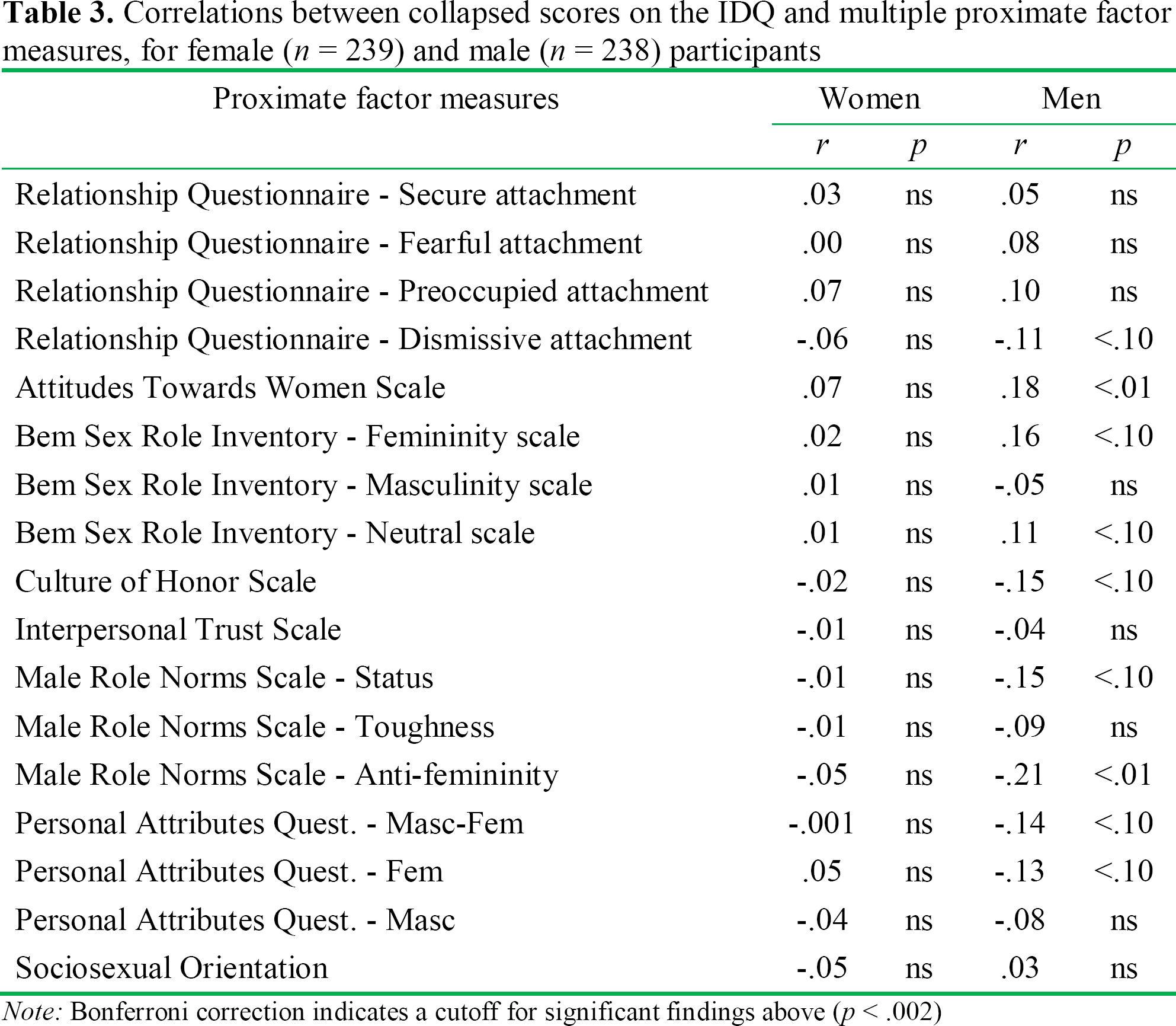
A 2 (participant sex: male vs. female) × 4 (attachment style: dismissing, fearful, preoccupied, and secure) ANOVA indicated no significant differences in reactions to infidelities by different attachment styles, F(3,470) = .09, p = .965, R2 = .204, and no interaction between sex and attachment style, F(3,470) = .98, p = .400, R2 = .204. Bivariate correlations resulted in no significant relationships between the IDQ and the included measures of attachment style (see Table 3).
Correlations between collapsed scores on the IDQ and multiple proximate factor measures, for female (n = 239) and male (n = 238) participants
Note: Bonferroni correction indicates a cutoff for significant findings above (p < .002)
Do sex-roles, sociosexual orientation, trust and beliefs moderate reactions to infidelity scenarios?
Bivariate correlations were calculated between the IDQ collapsed measure of infidelity reactions and sex-roles and beliefs measured (Bem Sex Role Inventory, Personal Attributes Questionnaire, Male Role Norms Scale, Attitudes Toward Women Scale, Rotter Interpersonal Trust Scale, Sociosexual Orientation Inventory, and Culture of Honor Scale). Correlations were conducted separately for women and men, and included the subscales for each measure (see Table 3).
Although every item on the IDQ, and a number of the individual difference measures used in the present study, showed significant sex differences (see Table 2), there were no significant correlations between any of these measures and the IDQ for female participants. Male ratings on the IDQ were related to a few of our measures of sex roles and beliefs, however all these correlations were fairly low, at r = 0.21 or less. Also, when a Bonferroni correction is imposed the only relationship of these which remains significant is the relationship between male IDQ responses and the Male Role Norms Scale Anti-Femininity subscale. This relationship indicates that men who showed a differential bias towards being upset by sexual infidelity demonstrated less anti-feminine sentiment.
Another way of assessing the relative importance of variables in association with a target outcome is to conduct regression analyses. Specifically, simultaneous regressions were calculated for all the participants (again, employing the MacArthur approach to investigate potential mediating relationships; Kraemer et al., 2008) and for both men and women separately based on the rationales that either a) sex as a predictor variable could be masking an underlying predictive variable, or b) there are two distinct sex-differentiated distributions (see Figure 1) that could have distinct predictive factors. All the potential predictor variables were included (i.e., measured proximate factors). 1 Although some of these proximate factor scales were strongly related to one another (i.e., subscales measuring gender roles and gender role attitudes such as the Culture of Honor Scale, the Attitudes Towards Women Scale, and the Male Role Norms Scale), most of these correlations are fairly weak, below 0.3 (see Table 4).
Correlations between proximate factors in regression models

Notes: Correlations significant at the .001 level are starred (*), and correlations significant at the .05 level are bolded. However. Bonferroni correction indicates that significant findings must be associated with p-value smaller than the following: p < .0002. This cut-off would only indicate that strong correlations (.6-. 9) are significant. Further, the abbreviations above refer to the following scales; ATW (Attitudes Towards Women Scale), MRNS (Male Role Norms Scale), BSRI (Bern Sex Role Inventory). PAQ (Personal Attributes Questionnaire). SOI (Sociosexuality Inventory), COH (Culture of Honor Scale), RITS (Rotter Interpersonal Trust Scale). RQ (Relationship Questionnaire), and the IDQ (Infidelity Dilemmas Questionnaire)
Participant sex was the only significant individual predictor of reactions to infidelity scenarios after controlling for the main effects of all measured predictor variables and interactions between these variables and participant sex (this significant individual predictor and the adjusted R2 are presented in Table 5.1). Specifically, male sex was predictive of greater relative sexual jealousy. Addressing our third prediction (H3), this pattern of results indicates — as there are no significant main effects of proximate variables or significant interactions between these proximate variables and participant sex — that participant sex is not mediated by the effects of any of the measured proximate variables.
Simultaneous regressions, using all potential predictors (other than nominal scale data) of collapsed scores on the IDQ

Notes: Adjusted R2 = 0.198; Analyses run for all participants
The same regression was run again, this time excluding sex as a predictor as well as the interaction terms (regression in Table 5.2) so that other predictors (e.g., that contribute to sex differences but are nevertheless not directly related to infidelity responses) could be discerned. This regression analysis found that lower scores on the Attitude Towards Women Scale and higher scores on the Personal Attributes Questionnaire were predictive of stronger reactions to sexual infidelity. These two individual difference measures were possibly indexing aspects of masculinity (e.g., conservative attitudes about the female role and personal levels of masculinity). Interestingly, anti-feminine sentiment as measured by the Male Role Norms Scale Anti-femininity subscale was related to greater relative distress associated with emotional infidelity. Combined, these three predictors produced an adjusted R2 of 0.113; still less than the adjusted R2 of the first analysis (0.198; the adjusted R2 of just sex in the first analysis was 0.196).
Simultaneous regressions, using all potential predictors of collapsed scores on the IDQ
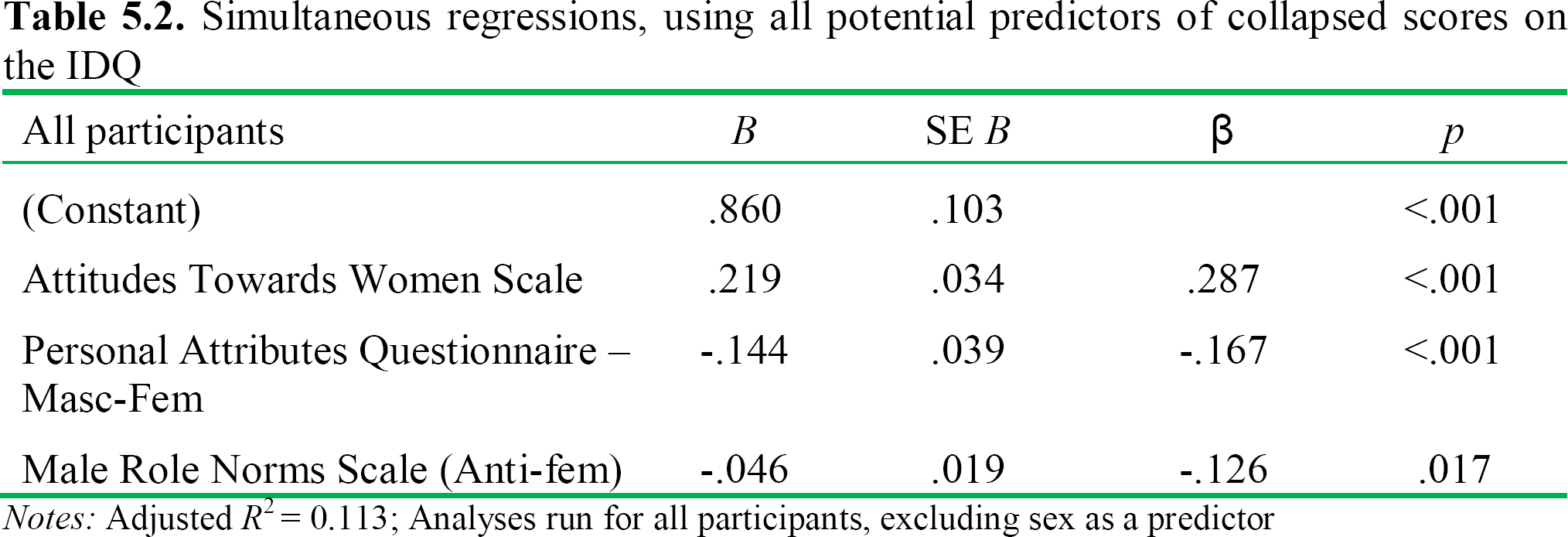
Notes: Adjusted R2 = 0.113; Analyses run for all participants, excluding sex as a predictor
The regression analyses using only male participants (regression in Table 5.3) found one of the same predictors from the analyses using all participants (i.e., Male Role Norm Scale Anti-Femininity subscale), and this predictor was in the same relationship to the target variable. The regression analyses using only female participants found no significant predictors. In sum, these results indicate that (H3) sex differences in the included proximate factors do not account for the differences between men and women in their reactions to forced-choice infidelity dilemmas.
Simultaneous regressions, using all potential predictors of collapsed scores on the IDQ

Notes: Adjusted R2 = 0.039; Analyses run for male participants only
Discussion
Our prediction that (H1) sex differences would be present in responses to our main dependent measure, the IDQ, was supported. Specifically, we identified what appear to be two overlapping distributions (one for males and one for females; see Figure 1) replicating previous findings (Buss et al., 1992): Males reported that sexual infidelity scenarios were relatively more distressing than emotional infidelity scenarios, and the opposite was true of females.
A central purpose of this research was to identify strong candidate factors which produce differences in reactions to infidelities, particularly proximate factors that hold up when placed in direct comparison with other potential factors. Participant sex emerged consistently as the largest significant predictor of infidelity reactions, so the following discussions are all in relation to that finding. Sex differences were found across a range of the potential predictor measures, consistent with our hypothesis (H2), so there can be little doubt that the circumstances existed for detecting potential relationships, were they there (i.e., there are no valid concerns regarding sufficient sample size, valid instruments, statistical power, etc.). By and large, though, the predictive relationships were not there. Indeed, whereas relationships between sex and most of the proposed proximate mediators were demonstrated (see Table 2), the effect of sex on reactions to relationship infidelities was not mediated by any of the measured proximate factors, addressing our model proposed in our third hypothesis (H3).
Although the measures of attachment, sociosexual orientation, sex roles and beliefs used in this research frequently showed large and significant sex differences (see Table 2), there were no significant correlations between these measures and the IDQ for female participants. There were only small correlations between these measures (i.e, r < 0.21) and male IDQ responses — after imposing a Bonferroni correction, the only significant relationship was between MRNS Anti-femininity subscale and male IDQ responses. These results indicate some secondary relationships between sex-roles and reactions to infidelities (for men), and these findings can help to guide further research.
There was no support for the hypothesis (H4) that differential infidelity implication (DII) beliefs specific to each sex are the underlying cause of sex differences in reactions to different infidelities. In fact, men and women were fairly similar in these beliefs (see Table 6). Although the main effect of differential infidelity implications for opposite sex targets (and its interaction with participant sex) approached significance, participant sex was found to be a significant predictor of reactions to infidelity after controlling for these effects. Contrary to the findings of DeSteno and Salovey (1996a), the effect of participant sex does not seem to be mediated by beliefs about the covariation of infidelities.
Differential infidelity implication ratings for male and female participants, evaluating both male and female targets for both types of conditional implications

Specifically considering the role of attachment in reactions to infidelity, no significant relationships were found between reported levels of attachment style and collapsed IDQ scores. Also, t-tests did not reveal a significantly disproportionate number of men in our sample as dismissively attached (see Table 2). Therefore, we were unable to identify sex differences in attachment that might be driving the observed sex differences in reactions to infidelity. Based on these considerations and the regression analyses, we therefore cannot say that the Levy et al. (2006, 2010) conclusions about the importance of adult attachment style were supported in this context.
In sum, regression analyses indicated that participant sex was the strongest predictive factor, predicting a greater proportion of variance than all other significant, proximate predictors combined. Further, the effect of participant sex on reactions to relationship infidelities was not significantly mediated by any of the measured proximate variables.
Lack of relationships
No factors showed a stronger relationship with reactions to infidelity than participant sex. Hence, although some factors may moderate this sex difference — perhaps by accounting for within-sex variability — none are contenders to supplant sex as a primary predictive factor and none (within the context of this study) mediate this sex difference. A number of previously suggested mediating or supplanting factors simply did not maintain their importance when embedded with other factors. Sociosexuality, for instance, was not at all associated with differences in reactions to infidelity situations (contrary to the predictions made by Harris, 2003a). This and other failures to find significant relationships in this study (e.g., the lack of a relationship between collapsed IDQ scores and interpersonal trust) were not due to lack of power, as other sex difference effects were readily attained. These sex differences observed in proximate variable scores suggested that a mediating relationship could exist, but none were found. These results speak to the ongoing debate concerning whether sex differences in jealousy are the result of an adaptation which facilitates the absorption of social norms (e.g., proximate factors) or an adaptation which addresses fundamental male and female reproductive goals. Particularly, this research finds no evidence that the specific beliefs about infidelity, sex roles, attachment styles, reported sociosexual orientation, or cognitive styles are driving the consistent sex differences found in reactions to different types of infidelity scenarios.
Limitations
There were, however, some relevant limitations to this study. First, this study relied upon a young (mean age =19 years), ethnically-restricted sample (83.5% White/Non-Hispanic), which notably restricts our ability to generalize to ethnically diverse and older, married, or cohabitating populations, who might face different dilemmas regarding the incidence of and reactions to relationship infidelities. A young sample may be particularly problematic in the domain of romantic jealousy, as previous work has demonstrated that jealousy can depend on sexual experience (Buunk, 1995), experiences with infidelity (Sagarin et al., 2003), and age (Green and Sabini, 2006). Further, our use of a forced-response online format to facilitate thorough responding may have restricted our sample. Stieger, Reips, and Voracek (2007) found that males were more likely to drop out early from studies employing forced-responding. This could have (at least in part) contributed to our largely female sample. Also, although the current work did address several potential proximate mediators regarding reactions to infidelity, it is possible that unmeasured proximate variables could still be contributing to the observed sex differences.
It is also worth noting that there are practical and theoretical issues associated with making a distinction between ultimate and proximate factors — which have been confused since this distinction was developed within the field of biology (Ariew, 2003; Mayr, 1961). Just as a strict nature-nurture distinction is far too simplistic to describe the ways in which psychological phenomena come about, ultimate and proximate factors work together in order to produce behavior that is both adaptive and situationally appropriate. However, such a distinction can facilitate the understanding of both “how” certain behaviors are shaped (through proximate mechanisms) and “why” certain proclivities to behave exist in the first place (through ultimate mechanisms; Alessi, 1992). According to Mayr (1988), “there is always a proximate set of causes and an ultimate set of causes; both have to be explained and interpreted for a complete understanding of the given phenomenon” (p. 28).
The finding that a number of variables, found to have effects in other studies, did not have significant effects in this research indicates that there may indeed be a concern about the robustness of these effects. It was a hypothesis of the current study that these effects could become weaker when placed in a larger context (i.e., with other factors included to mitigate demand effects or other salience-enhancing factors). This is a serious concern in terms of practical significance, as real-world contexts are unlikely to include either explicit or implicit cues that one should systematically attend to a particular dimension that could be relevant to a sexual or emotional infidelity situation.
In summary, these results directly address ongoing debate concerning whether sex differences in jealousy are the result of an adaptation which facilitates the absorption of social norms (e.g., proximate factors) or an adaptation which addresses fundamental male and female reproductive goals. Previous research has demonstrated this sex difference in reactions to infidelity across different cultures, for example in Norway (Kennair et al., 2011), Colombia (Portilla-Ferrer, Henao-Lopez, and Valencia, 2010), and Romania (Brase, Caprar, and Voracek, 2004), and one potential inference from the current work is that sex differences in proximate mechanisms are similarly unlikely to explain these cross-cultural consistencies in reactions to infidelity but may be able to account for some of the cross-cultural variability.
Footnotes
1
A simultaneous regression employing the MacArthur approach is particularly useful for this situation, as it controls for the main effects (and interactions between potential mediators and the target variable) of potential mediators. If the main effects or the interaction terms are significant, then the associated variables are said to mediate the relationship between the target variable and the outcome.
Acknowledgements
The author would like to thank Michelle Frank for assistance in data collection, Sandra Brase, the University of Missouri evolutionary reading group, and several anonymous reviewers for their advice and comments on this work. Correspondence concerning this article should be addressed to Gary L. Brase, Department of Psychology, Kansas State University, 492 Bluemont Hall, Manhattan, KS 66506, or via email at: