



Abstract
Men are generally more distressed by a partner's sexual infidelity whereas women are generally more distressed by a partner's emotional infidelity. The importance of the identity of the interloper, however, has been neglected. We explored the influence of relational proximity (i.e., the degree of genetic relatedness) on distress about infidelity. In Study 1, participants were most distressed when the imagined infidelity occurred between their current mate and close kin. In Study 2, relational proximity mattered more than the type of sexual behavior, the likelihood of contracting a sexually transmitted disease, and the likelihood of the infidelity leading to a damaged reputation. Together, the results indicate that identity matters, especially if the interloper is someone with whom we have familial bonds.
Introduction
Buss and colleagues' (1992) evolutionary model of jealousy within mating contexts predicts that women and men will be distressed by different types of infidelity due to sex-specific issues relating to parental investment. Women are never concerned about the maternity of their child because the process of fertilization occurs internally. However, the rearing of a child requires a vast quantity of resources, so women must consider the commitment of their male partner and how he will allocate paternal care. Consequently, women are thought to be concerned about the emotional dedication that their partner displays to themselves, as well as toward other women, as the latter identifies the possibility of infidelity. In such cases, emotional infidelity might indicate potential loss of their partner's resources to these other women and their children, which leads to distress and jealousy. This conjecture has been supported by previous studies, in which women have reported higher distress from imagining their partner's emotional infidelity, as opposed to sexual infidelity (Buss et al., 1992).
In stark contrast, men are presented with a different set of issues, according to parental investment theory (Trivers, 1972). Without genetic testing, men can never be entirely certain of the paternity of their child, and hence, there is always the possibility of being cuckolded. Males face a significant reproductive loss if they are cuckolded, such as a loss of the expended mating effort, loss of the female parental effort to another man's children, and potentially investing valuable resources in children which are not genetically related (Buss et al., 1992). Thus, due to this uncertainty of paternity and the possibility of investing resources into another man's child, it can be predicted that men are most highly distressed by their partner's sexual infidelity. This prediction has been confirmed in a number of studies (Buss et al., 1992; see Buss and Haselton, 2005 for a review; Harris, 2003 for contradiction).
Investigations of this sex difference have relied upon various methods, and yet consistently found the same pattern of response, such that men are more concerned about sexual infidelity and women about emotional infidelity. The most frequently used method is that in which participants are presented with a hypothetical scenario and then, using a forced-choice format, select either sexual or emotional infidelity as the most distressing (e.g., Buss et al., 1992; 1999; Buunk, Angleitner, and Oubaid, 1996; DeSteno, Bartlett, Salovey, and Bracerman, 2002; Sagarin, Becker, Guadagno, Nicastle, and Millevoi, 2003). More recently, Schützwohl (2004) used this approach and measured response times in decision-making, which revealed the same sex difference as that previously documented. It has also been examined with continuous measures, and among those who have experienced actual infidelity (Edlund, Heider, Scherer, Farc, and Sagarin, 2006), such that those who recall the experience more vividly respond in the predicted manner (Strout, Laird, Shafer, and Thompson, 2005). This sex difference has been replicated in populations throughout the world including the United States, Japan, Korea, Germany, and the Netherlands (Buss et al., 1992; 1999; Buunk, Angleitner and Oubaid, 1996), as well as among university students (e.g., Buss et al., 1999) and older, community populations (Shackelford, Voracek, Schmitt, Buss, Weekes-Shackelford, and Michalski, 2004).
As an alternative to asking individuals to imagine or recall an experience of infidelity with which they have been directly involved, Michalski, Shackelford, and Salmon (2007) investigated individuals' responses to a sibling's partner's infidelity. The results of their study parallel the previously described evolutionary model of jealousy; regardless of a person's sex, individuals were most upset by their brother's partner's sexual infidelity and sister's partner's emotional infidelity. The authors propose that this finding demonstrates that the participants viewed the infidelity from an evolutionary analysis of reproductive costs. That is, it was more costly for the participants' brothers' partners to engage in sexual infidelity because of paternity uncertainty and more costly for their sisters' partners to engage in emotional infidelity due to the high probability of decreased access to resources.
Although we agree with the basic ideas included in this framework, and commend Michalski and colleagues for performing research that includes an examination of people from a family-dynamics standpoint, there remain several unanswered questions. For example, how do varying levels of genetic relatedness impact these perceptions, especially when these individuals are the recipients rather than the initiators of the infidelity? Thus, in the two current studies, we extend the work of Michalski et al. (2007) to include a wider assortment of kin and acquaintances, and more specifically the infidelity of one's partner with one's relatives, as opposed to the infidelity of one's relatives with an unidentified person. This perspective is critical, as infidelity of one's partner with close kin will probably have considerable impact on the family with respect to social bonds and feelings of trust, as well as the division of resources within a relationship.
From a strict inclusive-fitness perspective, one might think that individuals would find their mate's infidelity with siblings and other genetic relatives to be more palatable than infidelity with non-relatives and strangers. Inclusive fitness refers to how adapted an organism is to its environment, and is typically measured in terms of the percentage of one's genes that are passed along to subsequent generations, whether it be directly by the individual or by kin who share the individual's genes (e.g., Hamilton, 1964). In terms of relational proximity, our parents, siblings, and children are first degree relatives and share approximately 50% of one's genes, whereas aunts, uncles, grandparents are second degree and share 25%, while cousins, nephews and nieces are third degree and share 12.5%, and co-workers, former lovers, friends and strangers are presumably unrelated. While it is possible that one would be less distressed by the infidelity involving kin, which makes sense when solely considering a genetic perspective, it neglects important issues such as social bonds and the establishment and maintenance of trust in relationships that are so crucial in our species, and that are so integrally interwoven with kin networks.
As Kurland and Gaulin (2005) suggest, the familial link is especially important for breaches of trust. They propose that altruistic relations between the nuclear family will dominate kin relationships, such that conflict will increase and cooperation will decrease with decreasing genetic relatedness. Moreover, occurrences of deceit, manipulation, and exploitation will increase as genetic relatedness decreases among kin. A breach of trust made by a member of one's nuclear family would be the most appalling and carry with it the most detrimental consequences for those involved, as it is these individuals who are supposed to form the primary social support network. Further, if one no longer feels that a particular family member can be trusted, then she or he may not be allowed to fully participate in family activities, and hence, receive fewer benefits, such as resource sharing and support. Similarly, a family member who feels that she or he cannot trust another member might withdraw any resources or support that she or he would ordinarily give in terms of childcare or helping with family duties, and instead, invest such efforts elsewhere.
Familial discord becomes increasingly important if there are children involved. For example, if one's father has an extradyadic affair that produces another child, one's paternally provided resources are reduced, as they will now have to be shared with the other mother and child. In their study on the Ache of Paraguay, Hill and Hurtado (1996) demonstrated that the absence of a father triples a child's probability of dying due to illness and doubles the probability of death at the hands of another Ache member, kidnapping, or being sold into slavery. Survival aside, a decreased ability to rely on one's father for resources may diminish one's pool of resources that otherwise may have been used to pursue and obtain a mate, through actions such as giving gifts or dressing stylishly. Within Western societies, it has been found that high levels of paternal investment, for example, income and play time, are correlated with better child outcomes, such as enhanced social and academic skills, and also higher socioeconomic status in adulthood (Geary, 2000).
Study 1
To date, there is no published study in which researchers have investigated the identity of the person with whom one's partner is engaging in an extradyadic relationship; specifically, there has been no examination on the influence of genetic relatedness on distress from infidelity. Further, there has been no comparison of distress resulting from a mate demonstrating sexual interest in the partner's kin versus non-genetically related acquaintances (e.g., friends, co-workers, strangers). Just as infidelity involving one's kin could influence family dynamics, we propose that sexual interest would also be hazardous to effective family functioning. Sexual interest could allude to a possible infidelity that might occur in the future. That is, there has been no exploration of what happens when a same-sex relative is viewed as a potential mating rival, or of the resulting distrust that occurs when one's mate interacts with same-sex kin after sexual interest has been expressed.
In Study 1, we proposed three hypotheses based on Buss et al.'s (1992) evolutionary model of jealousy and genetic relatedness. First, we hypothesized that the relational proximity matters, such that the more genetically related one is to a particular kin member, the more distressed one will be about infidelity. Regardless of the participant's sex or the type of infidelity, individuals will be the most distressed by a partner's infidelity with kin with close genetic proximity, as opposed to kin who are not as genetically related, or with individuals who are entirely unrelated, including friends, coworkers and strangers. To clarify, if a woman's mate commits sexual infidelity with her sister or her mother, she should be equally distressed by both of these because she shares approximately equivalent genetic relatedness with each of these individuals (i.e., 50%), and much less distressed if the infidelity involved her cousin or a co-worker. We expected the same pattern, regardless of whether it was sexual or emotional infidelity, and hence, we did not examine sex differences in relation to the form of infidelity.
Second, using the same rationale, we hypothesized that the more genetically related one is to a particular kin, the more distressed she or he would be when sexual interest is expressed by one's current partner toward this individual. Sexual interest could act as a forerunner for a potential act of infidelity, and hence, it should also cause distress to be reported in the same pattern mentioned above. To test the first and second hypothesis, the extradyadic relationship is hypothetically composed of the participant's current partner and varying individuals who are the participant's kin or acquaintances.
Third, we hypothesized that participants will be least likely to pursue a sexual or emotional relationship with the partners of close kin (note that we specified that these partners were themselves not kin, for example mother's partner is not one's father). Although one is genetically unrelated to these partners, it would be a breach of trust to become involved with the mates of close kin, and such violations of trust should occur with increasing rarity as the degree of relatedness increases (e.g., Kurland and Gaulin, 2005). We expected the same pattern, regardless of whether it was sexual or emotional infidelity, and hence, we did not examine sex differences in relation to the form of infidelity.
Materials and Methods
Participants
The final sample included 194 women (age, in years, M = 20.93, SD = 4.11), and 65 men (M = 21.85, SD = 3.03). All participants were undergraduate students enrolled in a psychology course, at any year of study, at Saint Mary's University, in Nova Scotia, Canada. Approximately 70% of the participants self-reported that they were Caucasian. They received partial course credit for their voluntary participation. Of these 259 participants, 24 reported that they were not seeking a relationship, 61 reported that they were not dating but seeking a relationship, 10 reported that they were dating multiple people, 26 were dating casually, 125 were dating one person in a committed relationship, and 13 were married or in a common law relationship. Of the participants who reported being single, 21 had never been in a relationship.
Due to the fact that participants were asked to envision their partners engaging in a sexual relationship with their same-sex relatives, it was assumed that individuals were engaging in heterosexual sex. Therefore, 23 participants who were homosexual or bisexual were excluded from the analysis. Similarly, only participants who were not in adoptive families were included in analysis because genetic relatedness was an important variable, and it is possible that adopted individuals experience unique attachment to their families and mates (e.g., Feeney and Passmore, 2007). Eleven participants were excluded from the analysis on the basis of this assumption. According to their self-reports, the majority of participants had living parents (98% mother, 96% father), siblings (90%), aunts (96%), uncles (95%), and at least one cousin (98%). A lower number of participants had a living niece or nephew (25%), or child (5%).
Materials and Procedure
A paper-and-pencil survey was created and consisted of items pertaining to relevant familial information, such as number of siblings and living relatives. To address our research question, we developed items that specifically instructed female participants to imagine their current romantic partner engaged in sexual activity with no emotional involvement (i.e., sexual infidelity), in an emotional relationship without sexual activity (i.e., emotional infidelity), or indicating sexual interest in the following individuals: mother, sister, daughter, friend, former lover, aunt, niece, cousin, coworker and stranger. These individuals were the same for males, except of the opposite sex (e.g., brother instead of sister). Thus, for sexual infidelity, for example, participants were told, “Imagine that your romantic partner engaged in sexual activity, with no emotional involvement, with the following people. Imagine also that everyone is 18 or older. Please rank these people, from 1 (most) to 10 (least), according to which encounter would distress you the most, second most, and so on. Use each number only once.” The emotional infidelity item was similar but asked participants to imagine “an emotional, romantic relationship, without sexual activity.” The sexual interest item asked participants to “Imagine that the following people have suggested that they are sexually interested in your current romantic partner” with the rest of the wording matching that of the other items.
Finally, participants were asked, “Imagine that you are not in a relationship and that each of the people listed below (sister, daughter, mother (partner is not your father), friend, and stranger) has a partner that you consider desirable. For each person, if their partner indicated that they are interested in you, how likely is it that you would try to pursue a sexual encounter with their partner? For each person, circle one response.” They were provided with a Likert-type scale ranging from 1 (definitely would not) to 5 (definitely would). They were then asked the same but for an “emotional, romantic relationship.”
If participants did not have the specific kin relationship, they were asked to hypothetically imagine that they did so. Similarly, if they were not currently in a serious romantic relationship, they were asked to reflect upon one that they have had in the past, or to imagine one they might have in the future. Surveys were completed in private and returned to the researcher in a sealed envelope.
Results
Sexual Infidelity
As can be seen in Table 1, the rank positions of 1 to 3 were held unanimously by first-degree relatives, but they were not in an identical order for females and males. Mean ranks were significantly different, both within female and male subsamples (Friedman tests; χ2 = 640.22, df = 9, p < .001; χ2= 90.40, df = 9, p < .001, respectively). Post hoc comparisons revealed that, for females, it was most distressing for their mate to commit sexual infidelity with their mother, followed by daughter or sister, who were rated as causing equivalent distress. Men considered it the most distressing for their mate to commit sexual infidelity with their father, followed by their brother, then by their son (Wilcoxon signed-rank tests, all ps marking significance ≤ .007).
Mean ranks for distress about sexual infidelity stratified by participants' sex.

Performing the same form of analysis for the remaining positions would yield over 400 comparisons, and hence, would be unreliable. Therefore, we averaged the ranks of the people with the same degree of relatedness (our dependent variable) and analyzed these values using a mixed Analysis of Variance (ANOVA) model. The between-subjects factor was the sex of the participant, and the within-subjects factor was the degree of relatedness (1°, 2°, 3°, or ∞). As shown in Table 2, participant sex was not a significant factor, F(1,222) = 0.58, p > .05, ηp2 < .01. Degree of relatedness was significant, however, F(3,666) = 89.50, p < .001, ηp2 = .28, as was the interaction, F(3,666) = 4.81, p <.01, ηp2 = .02. For females, first degree relatives were ranked as significantly more distressing than second degree, second and third degree were not different, and third degree was rated more distressing than infinite degree. For males, first degree was ranked as significantly more distressing than all other relations, who did not significantly differ from each other. Women also ranked sexual infidelity with first degree relatives as causing significantly more distress than men.
Sexual infidelity average ranking by relational proximity.

Although we did not have a hypothesis concerning romantic relationship status, we also explored its impact on the results. Relationship status did not influence the degree of relatedness of the person whose sexual infidelity distressed participants the most (chi-squared test of independence; χ2 = 16.75, df = 10, p <.05 [p derived by Monte Carlo methods due to the sparseness of the table with the number of random samples drawn being 10,000]). Testing independently for females and males also did not alter this result, as 75% of the participants ranked first-degree relatives highest, in that sexual infidelity involving these people would remain the most distressing.
Emotional Infidelity
The mean ranks were significantly different within both the female and male subsamples (χ2 = 584.13, df = 9, p < .001; χ2 = 77.79, df = 9, p < .001). As can be seen in Table 3, for females, positions 1 to 3 were again occupied by first-degree relatives. However, positions 2 and 3 were switched compared to the rankings for sexual infidelity, such that in this case, mother caused the most distress, followed by sister and daughter who were tied, as revealed by post hoc tests (all ps marking significance < .001). For males, only positions 1 and 2 were occupied by first degree relatives (father and brother, respectively). In contrast to sexual infidelity, position 3 was held by friend, whereas position 4 was occupied by son. For men, positions 1 to 3 appeared interchangeable, as there were no significant differences in post hoc tests. Even though differences of mean rank on positions 3 and 4 were statistically also not discernible, it was found that the first position was distinct from the fourth position, such that father was distinct from son (p = .005).
Mean ranks for distress about emotional infidelity stratified by participants' sex.

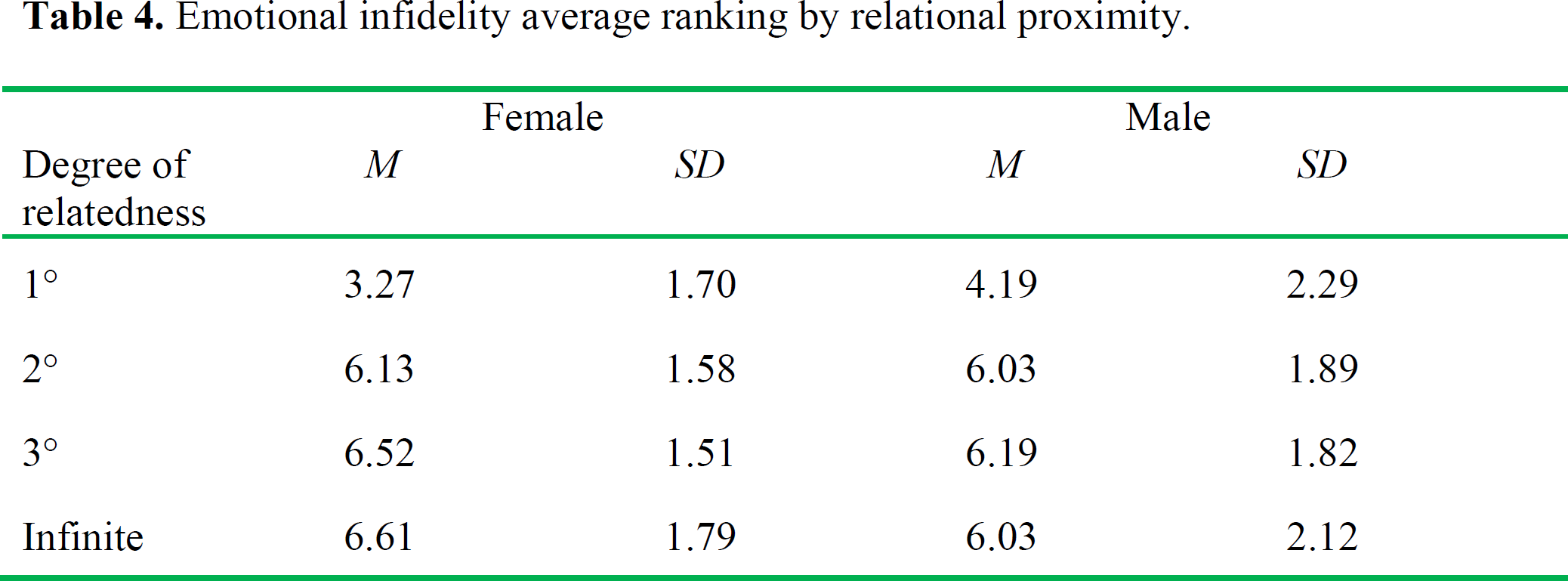
Using the same procedure described above, we then averaged the ranks of the people with the same degree of relatedness and analyzed these values using a mixed ANOVA model. As shown in Table 4, participant sex was not significant, F(1,222) = 0.10, p > .05, ηp2 < .01. Degree of relatedness was significant, F(3,666) = 70.95, p < .001, ηp2 = .24, as well as the interaction, F(3,666) = 4.79, p < .01, ηp2 = .02 (see Table 4). Both females and males ranked first degree as significantly more distressing than second, third, and infinite degree relations, who were not significantly different from each other. Women also ranked emotional infidelity with first degree relatives as causing significantly more distress than men.
Emotional infidelity average ranking by relational proximity.
As seen with sexual infidelity, relationship status did not influence the degree of relatedness of the most distressing person (χ2 = 6.75, df = 10, p > .05 [p again derived by Monte Carlo methods]). Stratification by sex did not alter this result, as 67% of the participants ranked first-degree relatives highest, in that emotional infidelity involving these people would remain the most distressing.
It is important to note that there was very little variation regarding the choice of the most distressing person for the sexual versus emotional infidelity, as 77% of the participants named the same person for both scenarios (chi-squared test of independence; χ2 = 828.61, df = 49, p < .001 [p derived by Monte Carlo methods]; contingency coefficient C = .89). Stratification by sex did not alter this result.
Sexual Interest in Mate by a Family Member
As seen in Table 5, mean ranks were significantly different, both within female and male subsamples (χ2 = 596.49, df = 9, p < .001; χ2 = 135.31, df = 9, p < .001). Positions 1 to 3 were the same for female and male participants (parent, sibling, child) and post hoc comparisons revealed a significant ordering with the first position (parent) being distinct from the second (sibling) and third position (child), which were equivalent in both subsamples (all ps marking significance < .001). Relationship status did not influence the degree of relatedness of the most distressing person (χ2 = 5.47, df = 10, p > .05 [p derived by Monte Carlo methods]). Stratification by sex also did not alter this result, and 74% of the participants ranked first-degree relatives highest. Furthermore, there was high agreement (62% concordance) regarding the most distressing person concerning sexual infidelity and the most distressing person having sexual interest in one's own partner (χ2 = 598.33, df = 56, p < .001 [p derived by Monte Carlo methods]; C =.86). Stratification by sex did not alter this result.
Mean ranks for distress due to sexual interest stratified by participants' sex.

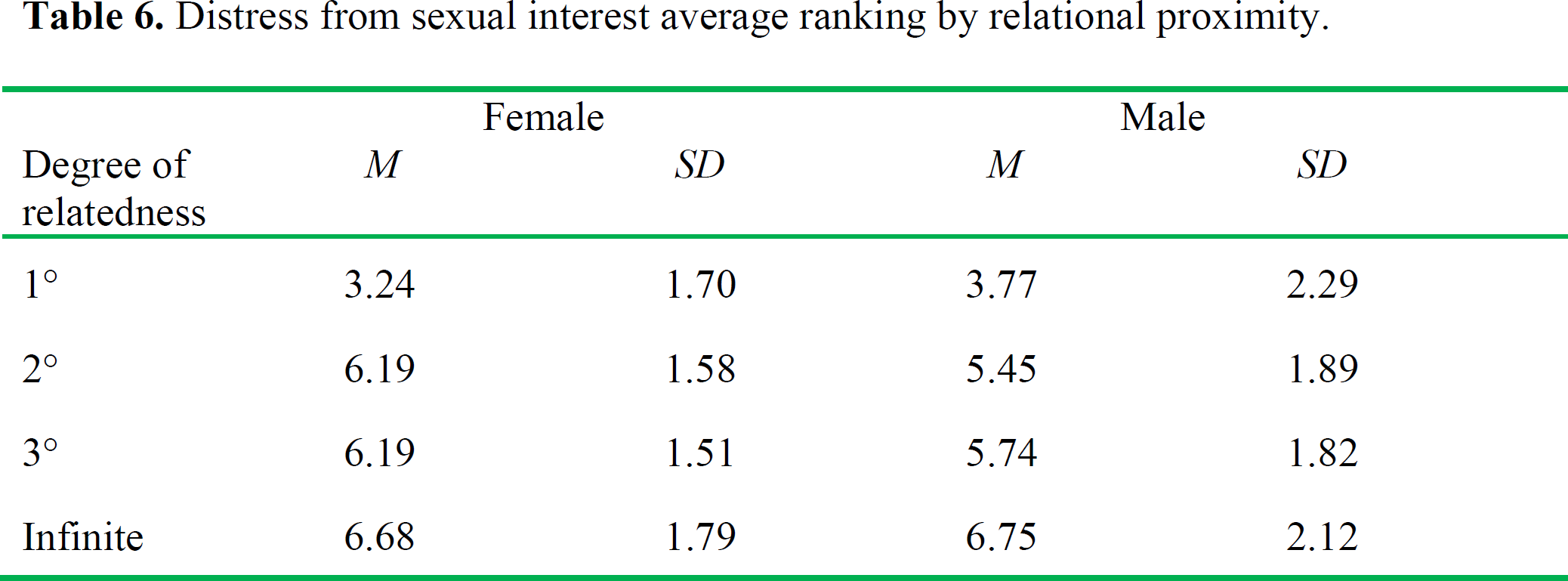
We again conducted a mixed ANOVA, in the aforementioned manner. As seen in Table 6, this revealed a significant sex difference, F(1,220) = 4.61, p < .05, ηp2 = .02, as well as a significant effect due to degree of relatedness, F(3,660) = 96.62, p < .001, ηp2 = .31, and a significant interaction, F(3,660) = 3.88, p < .01, ηp2 = .02. For both women and men, first degree caused more distress than second, second and third were equivalent, and third and infinite were significantly different. Women again ranked sexual interest in a mate by first degree relatives as causing significantly more distress than men.
Distress from sexual interest average ranking by relational proximity.
Sexual Interest in Other Person's Mate
Unlike the previous items, for this question (and the one below) participants rated how likely it would be that they would try to pursue a sexual encounter with the partner of five individuals (sibling, child, parent, friend, and stranger) who vary in their degree of relatedness. A mixed ANOVA design was used, such that the between-subjects factor was participant sex and the within-subjects factor was the type of relation (e.g., sibling, friend). Both factors had a significant impact. There was a main effect due to sex of participant, F(1,253) = 23.00, p < .001, ηp2 = .08, such that the mean sex difference in ratings was 0.41 (SD = 1.27) with men's ratings being higher than women's. The type of relation yielded F(4,1012) = 371.72, p < .001, ηp2 = .60. The means for each relation were significantly different from each other for every comparison, as shown in Table 7, such that a child's partner would cause the most distress, followed by a parent's partner, sibling's partner, friend's partner and stranger's partner. The interaction was, however, not significant, F(4,1012) = 1.81, p > .05, ηp2 < .01.
Likelihood of pursuing a sexual relationship with person's partner.

Emotional Interest in Other Person's Mate
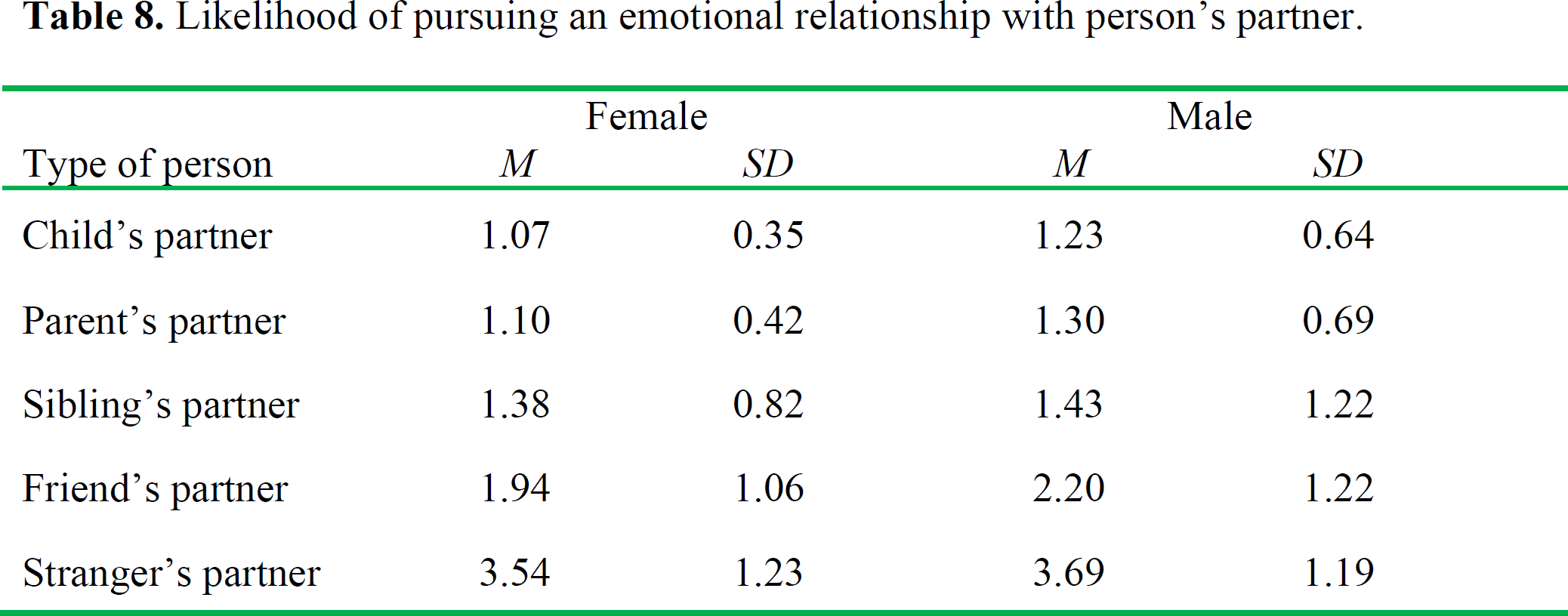
Finally, emotional interest in the partner of various relations was explored. A mixed ANOVA revealed only the type of relation had a significant impact, F(4,1008) = 361.98, p < .001, ηp2 = .59. As shown in Table 8, the means for each relation were significantly different from each other for every comparison and were in the same order as sexual interest. Participant sex was not significant, F(1,252) = 3.66, p > .05, ηp2 = .01, nor was the interaction, F(4,1008) = 0.53, p > .05, ηp2 = < .01.
Likelihood of pursuing an emotional relationship with person's partner.
Study 1 Discussion
Our findings clearly indicate that the person involved in the infidelity matters, and both of our hypotheses were supported. We found that participants are the most distressed when an imagined infidelity occurs between their current romantic partner and closely related kin. As predicted, this pattern is stable across participant's sex and the type of infidelity. Second, we supported our hypothesis that individuals are the most distressed when a closely related genetic relative expresses sexual interest in one's current partner. We also found that one is least likely to consider the partner of close kin as a viable option for a potential sexual or emotional infidelity. Therefore, the results of this study reveal that it is not sufficient to ask participants to envision their partner's engaging in a specific type of infidelity, but it is also necessary to specify the identity of the interloper.
Although informative, one limitation of Study 1 was that it relied upon the rankings of individuals. It would have been useful to examine the amount of distress one would feel towards an infidelity involving a specific individual (e.g., a sibling), rather than how the distress would compare across relations (e.g., a sibling versus a stranger). In order to address this limitation and to elaborate on our understanding of the variables that impact on the phenomenology of infidelity reactions, Study 2 was performed. A second limitation is that Study 1 was an examination of infidelity within a narrow context, and thus, factors such as the potential for sexually transmitted diseases or the consequences for one's reputation were not considered. Study 2 was created to investigate these contextual issues.
Study 2
Study 2 was designed to replicate and elaborate on the findings from Study 1. It used a Likert-scale rating system, as opposed to a rank-ordering system, to see if the general pattern found in Study 1 replicated across these two different methodologies. Additionally, for the sake of brevity, Study 2 used only four targets that were derived from the targets used in Study 1, such that they reflected the spectrum of relational proximity conceptualized in Study 1. Specifically, Study 2 asked participants to rate several infidelity scenarios as they pertained to interlopers who were same-sex siblings, same-sex best friends, prostitutes and strangers. Given the prevalence of prostitution (Burnette, Lucas, Ilgen, Frayne, Mayo, and Weitlauf, 2008), we concluded that prostitute would be an important kind of interloper to examine. In addition to the use of these four kinds of interlopers, we examined the effects of five additional variables that should bear on distress reactions to infidelity. These are discussed in turn.
Sex. A great deal of past research has shown that reactions to infidelity are often sex-differentiated (Michalski et al., 2007; Buss et al., 1992). As reviewed, much of this work has shown that males are more distressed by their partners engaging in sexual infidelity while females are relatively distressed by their partners engaging in emotional infidelity. The current study focused only on instances of sexual infidelity. Accordingly, this methodology may allow for an assessment of whether these standard sex differences emerge in a context in which only one type of infidelity (sexual) is examined.
Relationship Status. A problem that has been cited by past researchers pertains to the fact that the imaginary scenarios used in this kind of work lack ecological validity (see Strout, Laird, Shafer, and Thompson, 2005; Landolfi, Geher, and Andrews, 2007). One particular variable that has been found to have important effects on infidelity reactions is whether the rater is, in fact, involved in a monogamous relationship (see Buss et al., 1992; Landolfi et al., 2007). Generally, being involved in an actual relationship has been found to increase the magnitude of distress reactions to infidelity, although the results from Study 1 suggest otherwise.
Type of Sex. Past research on reactions to infidelity has neglected to explore the influence of different kinds of sexual infidelity. While sexual infidelity may certainly take many different forms, we chose to examine the distinction between two discrete and common forms: vaginal intercourse versus oral intercourse. From a strict fitness-optimization perspective, it makes sense that vaginal intercourse would be more distressing than oral intercourse for both sexes. For a male, a female partner engaging in vaginal intercourse with another man could lead to cuckoldry. For a female, a male engaging in vaginal intercourse might lead to the possibility of him siring children with the interloping female and, consequently, diverting his time and resources to this other female.
Sexually Transmitted Disease. One obvious adverse outcome associated with infidelity pertains to the likelihood of one's partner contracting a sexually transmitted disease. Such diseases are often quite dangerous and/or fatal, and this facet of such diseases was likely more relevant under ancestral conditions before modern medicine. To explore this issue, we examined responses to infidelity varying whether the infidelity was likely or unlikely to lead to a disease.
Reputational Effects. Via gossip and other means (De Backer and Gurven, 2006; Kniffin and Wilson, 2005), instances of infidelity are often made public to broader social networks that are of interest to the individuals involved. Being known as the victim of infidelity can be damaging in several ways. For example, for a male, being publicly cuckolded may be a shameful event that reduces his status among his male peers. For members of both sexes, being a known victim of infidelity may elicit pity from others, an outcome that may actually serve to lower one's standing within the group. All things being equal, if someone had to be the victim of infidelity, he or she would probably prefer that the situation were not broadcast publicly.
Materials and Methods
Participants
Participants included 283 females (age in years, M = 23.74, SD = 7.81) and 101 males (M = 26.83, SD = 11.20). As in Study 1, only heterosexual individuals were included due to the nature of the research questions that underlie this work. These individuals were mostly undergraduate and graduate students at the State University of New York at New Paltz. However, the link to the survey was made available online and was advertised on such websites as the Human Behavior and Evolution Society site. As such, this sample reflects a population that is relatively diverse in terms of age and geography.
Materials and Procedure
A survey was created using surveymonkey.com software. This survey asked participants for their sex, age, sexual orientation, and relationship status. Next, participants were presented with infidelity scenarios that represented four different kinds of interlopers: same-sex sibling (closest to self in age), same-sex best friend, prostitute, and stranger. For each of these four targets, participants were presented with eight scenarios. These scenarios represented each possible combination of type of sex (vaginal versus oral), likelihood of disease (high versus low), and likelihood of the infidelity being broadcast publicly (high versus low). Within each target, these eight scenarios were presented in a newly randomized order to each participant. An example scenario (which corresponds to the “stranger” interloper, vaginal intercourse, high probability of disease, and high likelihood of public broadcast) is as follows: “Your partner had vaginal intercourse with the stranger. There is a good chance that he/she got a sexually transmitted disease. Everybody will find out about it.”
Results
A mixed ANOVA, with both between and within-participant factors, was computed with sex and relationship status as between-participant factors and the following four within-participant factors: type of interloper (with four levels: sibling, friend, prostitute, and stranger), type of sex (vaginal vs. oral), probability of disease transmission (high or low), and likelihood of public dissemination (high vs. low).
Within-Participant Main Effects
The first analysis was designed to see if the findings from Study 1 replicated. Across all participants, there was a substantial and significant main effect for target, F(3,453) = 40.27, p < .05, ηp2 = .21. Consistent with Study 1, distress scores increased as relational proximity increased (with distress increasing from stranger, prostitute, friend, and sibling, accordingly; see Table 9 for descriptive statistics). Further, a significant main effect was obtained for type of sexual interaction with vaginal intercourse being more distressing than oral intercourse, F(1,151) = 26.07, p < .05, ηp2 = .15. Probability of disease also had a significant effect, with high probability corresponding to more distress than low probability, F(1,151) = 28.25, p < .05, η p 2 = .16. Finally, there was a significant main effect for reputation, with high probability of the infidelity being public corresponding to more distress than the low-probability scenario, F(1,155) = 6.68, p < .05, ηp2 = .04.
Mean distress scores representing main effects for target, type of infidelity, disease probability, and likelihood of reputation effects.

Note. Means represent 1-10-point Likert scale with 10 representing “most distressed”; means with different subscripts (within variables) are significantly different from one another (p < .05)
Between-Participant Effects
Neither sex of participant, F(1,151) = .40, p = ns, nor current relationship status of participant, F(1,151) = 1.23, p = ns, was significantly related to distress across all conditions. In other words, there were no significant sex differences in distress ratings overall, and there were no significant overall distress differences as a function of whether participants were actually partnered or not at the time of the data collection. Interestingly, however, across all conditions, there was a significant sex-by-relationship status interaction, F(1,151) = 3.97, p < .05, ηp2 = .03 (see Table 10). Across all conditions, females who were involved in relationships were most distressed by thoughts of infidelity whereas males who were not in relationships were most distressed by thoughts of infidelity.
Mean distress scores across all ratings as a function of participant sex and relationship status.

Note. Means represent 1-10-point Likert scale with 10 representing “most distressed”; means with different subscripts are significantly different from one another (p < .05)
Interactions
Our examination of interaction effects was streamlined in a few respects. First, one level of the target variable was removed for these analyses. Specifically, these analyses were conducted with the omission of same-sex sibling ratings. These data were omitted to help increase statistical power. Many participants in the study did not have same-sex siblings. Accordingly, the N for this level of this variable was not deemed sufficient for the analyses described here. Additionally, we chose to select specific interactions of interest to present, as the total number of possible interactions, 56, would be unwieldy to report here. Further, interactions based on more than two variables examined concurrently are often post-hoc in nature and are commonly not replicable (see Tabachnik and Fidell, 2007). As such, only results from interactions that were of a priori theoretical interest are included.
We suspected that we might find a sex-of-participant by type-of-sex interaction such that males would be more distressed by vaginal-sex infidelity than oral-sex infidelity relative to females. In fact, there was no significant such interaction, F(1,243) = .62, p = ns.
We also predicted a sex-of-participant by likelihood of public knowledge interaction, such that males were predicted to be more distressed than females by infidelity that is likely to become public. This interaction was, in fact, significant, F(1,243) = 8.61, p < .05, ηp2 = .03. Interestingly, however, inconsistent with our prediction, the interaction was actually due to the fact that females rated infidelity that goes public (M = 8.92, SD = 1.77) as more distressing than non-public infidelity (M = 8.36, SD = 1.91) compared with males who did not show a significant difference (M = 8.69, SD = 1.72, vs. M = 8.58, SD = 1.87, respectively).
To see if the sexes differ in the degree to which likelihood of disease resulting from infidelity is distressing, we looked for a sex-of-participant by likelihood of disease interaction. No such interaction was observed, F(1,243) = .76, p = ns .
We next looked for three interactions regarding the target-of-infidelity variable. Specifically, we looked to see if target interacted with sex of participant, likelihood of disease, and likelihood of infidelity being made public. Target did not interact significantly with sex of participant, F(1,486) = 2.30, p = ns. However, it did interact significantly with both likelihood of disease, F(2,486) = 19.95, p < .05, ηp2 = .08, and likelihood of the infidelity going public, F(2,486) = 6.25, p < .05, ηp2 = .03.
The interaction between target and disease is driven by the fact that infidelity leading to a disease from a stranger or prostitute is relatively distressing, compared to infidelity not leading to a disease by one of these targets, and compared with the distress that would result from infidelity with a same-sex best friend. In fact, the latter is rated as more distressing overall (see Table 11).
Mean distress scores across all ratings as a function of target and likelihood of disease.

Note. Means represent 1-10-point Likert scale with 10 representing “most distressed”; all means are significantly different from one another within levels of target (p < .05)
The interaction between target and likelihood of the infidelity going public is similar in nature to the interaction between target and likelihood of disease resulting from the infidelity. This interaction is driven by the fact that the infidelity going public seems distressing relative to the infidelity not going public if the target is a stranger or a prostitute. However, as with the comparable analysis for the likelihood of disease, the overall distress for the best friend target is significantly higher than for the other two targets for both high and low likelihood of infidelity going public (see Table 12). Given how high the means are for the best friend ratings, this interaction may be driven by a ceiling effect for these ratings.
Mean distress scores across all ratings as a function of target and likelihood of infidelity becoming public.

Note. Means represent 1-10-point Likert scale with 10 representing “most distressed”; all means are significantly different from one another within levels of target (p < .05)
Study 2 Discussion
Using interloper targets who represented the different ranges of relational proximity that were included in Study 1, we replicated the general finding of Study 1 by showing that distress to infidelity increases as relational proximity between the self and the interloper increase. The current study included several other variables, allowing for a comparison of the effect sizes across the independent variables. The results of the effect size analysis are provocative. While all the within-participant factors in this study yielded significant main effects, relational proximity between rater and interloper clearly showed the strongest effects (with a ηp2 of .21). Accordingly, whom one's partner cheats with seems to make a larger difference, in terms of emotional reactions, than whether that infidelity is of the vaginal or oral variety, whether that infidelity is likely to lead to a horrible disease brought into the dyad, or whether that infidelity is likely to become broadcast publicly.
Implications for Sex Differences in Reactions to Infidelity
Unlike Study 1, which addressed both emotional and sexual infidelity, Study 2 focused exclusively on sexual infidelity. An interesting outcome of this methodology speaks to the issue of sex differences in reactions to infidelity, which has been a hot-button issue in the social psychological literature for years (see Buss and Haselton, 2005). Simply, there was no effect of sex on the distress ratings in this study. Males were not more distressed overall, compared to females, when thinking about the different kinds of sexual infidelity scenarios presented here.
One difference between this study and past studies on this topic pertains to the fact that only sexual infidelity was examined. Accordingly, participants were not able to anchor their responses to one kind of infidelity based on how distressed they were by thoughts of the other kind of infidelity. This methodological feature of Study 2 allows for an interesting examination of this issue. Perhaps sexual infidelity is simply as evolutionarily costly to both sexes. For men, it broaches the issue of cuckoldry; for women, it broaches the issue of loss of biparental care and resources. As Buss and Haselton (2005) write, the sex differences that have been documented are more about sex differences in the relative amount of distress to sexual versus emotional infidelity. As such, when only one kind of infidelity is examined, and relative comparisons are not made by participants, these sex differences may disappear.
General Discussion
Our findings indicate that at least two evolved mechanisms are at work in affecting reactions to infidelity: increasing inclusive fitness needs and maintenance of social family bonds. Hamilton's (1964) theory of inclusive fitness suggests that one should be most interested in promoting the transmission of common genetic material by close relatives, regardless of the identity of their sexual partner. For example, if one's sister has a child, regardless of who the father is, then the individual's inclusive fitness has been increased. If the father is one's own mate, it does not matter, as inclusive fitness has remained increased. However, for humans, there is much more to consider than just increasing inclusive fitness; for both males and females, maintaining social bonds with kin members is crucial. The studies described here provide evidence of this latter issue.
Additionally, Study 2 provides evidence that there are several proximate factors that have clear implications for distress following infidelity. While infidelity is distressing in a vacuum, infidelity that represents vaginal intercourse, infidelity that is likely to lead to a disease, and infidelity that is likely to have reputationally damaging effects are all more distressing, across the sexes, than infidelity that does not fit these criteria. However, in spite of the significant effects of each of these factors, relational proximity was the most important variable.
Why Should Relational Proximity Matter So Much?
This general finding is very eye-opening. Consider the following: in Study 2, participants were more distressed by the idea of their partners cheating by receiving oral sex with a disease-free friend than they were by the idea of their partners having vaginal intercourse with a disease-laden stranger! Apparently, relational proximity between self and interloper matters quite a bit. From an evolutionary perspective, this finding implies that, perhaps, the fitness costs associated with having one's partner cheat with friends and family members were, in the long run, greater than the fitness costs associated with these other variables, such as bringing home a sexually transmitted disease. This analysis underscores the importance of social relationships - both familial and otherwise - in human evolution. Keeping good social and familial connections is crucial to the success of any human.
Further, under ancestral conditions, people were primarily surrounded by kin and individuals with friendship ties (see Dunbar, 1993). Accordingly, we may have been selected to be particularly sensitive to instances in which our mates cheated with interlopers from these two classes (friends and family). Access to strangers and prostitutes was clearly limited under most of human evolution. Accordingly, while such kinds of individuals may make up the a large proportion of interlopers under modernized social conditions, our minds may not yet be prepared to see such interlopers in as threatening of terms as friends and family members. In fact, given how widespread mate-poaching is (see Schmitt et al., 2004), infidelity typified by a mate cheating with someone relatively close actually remains a clear and major threat to mateships under modern conditions.
Limitations to the Current Research
With all survey research there is the limitation of self-report and the possibility of error. The samples in these studies were composed predominantly of undergraduates, which are not representative of a community sample, and furthermore, they may not have had much experience in long-term relationships. The demographics of this sample may provide a partial explanation for the results, specifically for female participants' reports of distress between sister and daughter. The vast majority of participants did not have children and therefore it might have been especially difficult to imagine the amount of distress they would feel.
Also the notion that participants are asked to hypothetically envision their significant other engaging in any type of infidelity with kin or acquaintances is problematic, because it is very difficult to imagine the level of distress one may experience as a result of the infidelity. However, it does not seem to matter whether one asks those with actual experience with infidelity or not, as all people tend to respond in the same manner (e.g., Edlund et al., 2006, but see also Harris, 2003).
In Study 1, we were unable to examine differences in perceptions between emotional and sexual infidelity, and further unable to examine sex differences with the form of infidelity. In keeping with past research that demonstrates sex differences depending on the type of infidelity, it is possible that men, specifically, would be more distressed by sexual infidelity involving one's mate with close kin, and women, specifically, would be most distressed by emotional infidelity involving one's mate with close kin. Study 2 had a similar limitation in focusing exclusively on sexual infidelity, thereby not allowing for an examination of how the independent variables in that study would have impacted responses to emotional infidelity. Future research is needed to address this limitation.
Conclusion
By examining the effects of relational proximity of interloper as well as the effects of type of sexual act, likelihood of disease, and likelihood of reputational damage, the findings from the studies described here shed light on the nature of responses to infidelity. The primary finding, underscored across both studies, pertains to the major impact of relational proximity on infidelity reactions. Inconsistent with what would be predicted by a strict inclusive-fitness analysis, the closer the interloper was to the participant - in terms of both genetic relatedness and in terms of social networks - the more distressed the participant would be by his or her partner cheating with that individual. While these findings clearly have important implications for our understanding of the nature of reactions to infidelity, they have broader implications regarding human nature as well. Without question, social bonds that are familial and extra-familial matter a great deal in our species (Dunbar, 1993). The data presented here provide insights into just how important the fitness benefits of solid social bonds are relative to the fitness costs of being the victim of infidelity. While being a victim of infidelity is clearly detrimental from a fitness perspective, losing crucial familial and social bonds may have been an even more detrimental outcome to our hominid ancestors.