



Abstract
Previous studies show that in many pre-modern and traditional populations the presence of a grandmother correlates with increased child survival rates, maybe as a result of improved child nutrition. Grandmaternal investment aimed at improving grandchildren's nutritional status in subsistence societies may have different outcomes in contemporary affluent societies. Using the British Millennium Cohort Study I investigate the association between maternal and paternal grandmothers' childcare and early years overweight in the UK. Results show that children who were cared for mainly by their grandmothers between the ages of 9 months and 3 years were more likely overweight at age 3 than children who were cared for by their parents. My results are in line with Pearce, Abbas, Ferguson, Graham, and Law (2010), although they did not distinguish grandmothers by lineage. Grandmothers may influence children's nutritional status in contemporary societies, but as with many evolved behavioral strategies the outcome may be no longer beneficial.
Introduction
Evolutionary theory argues that humans are a cooperative breeding species, which means that people other than the biological mother of a child can improve the child's development, health, and well-being (Hrdy, 1999, 2009). Such alloparents include the father, aunts, uncles, and grandparents who may increase their inclusive fitness by investing in their close kin (Hamilton, 1964). In pre-modern and traditional populations the beneficial effects of kin investment are often measured by child survival (Coall and Hertwig, 2010). According to Sear and Mace's (2008) review, grandmothers in particular have a positive effect on increased child survival.
The Grandmother hypothesis states that the long postmenopausal life span of women might be an evolutionary adaptation, because of the support that these older women provide to their children and grandchildren (Lahdenperä, Lummaa, Helle, Tremblay, and Russell, 2004). Women survive well beyond their fertile years, which is rare among animals, including other great apes (Hawkes, O'Connell, and Blurton Jones, 1997). The debate continues as to whether female menopause is indeed an adaptation or by-product or something else (see e.g., Coall and Hertwig, 2010; Kachel, Premo, and Hublin, 2011; Lahdenperä, Gillespie, Lummaa, and Russell, 2012). Even though postmenopausal lifespan is not necessarily an adaptation, there is evidence for the beneficial impact of grandmothers' presence to child survival.
A significant way that grandmothers may have increased their grandchildren's survival rates in pre-modern and traditional populations was to improve grandchildren's nutritional status (Mace and Sear, 2005). For example, Hawkes and colleagues (1997) found that among Tanzanian hunter-gatherers, help especially from grandmothers improved children's nutritional status (see also Sear, Mace, and McGregor, 2000).
In subsistence societies, the grandmaternal support that improved children's nutrition status may have significantly decreased child mortality. In modern western societies with low child mortality rates, grandmaternal support may still improve children's nutritional status. However, grandmaternal support in modern societies may detrimentally affect children because it may increase the likelihood of a child becoming overweight. Studies have shown that childhood overweight and obesity correlates, for example, with increased risk of diabetes, heart diseases, and premature mortality in later life (see Al Mamun, Cramb, O'Callaghan, Williams, and Najman, 2009; Ebbeling, Pawlak, and Ludwig, 2002; Reilly and Kelly, 2011).
Studies from contemporary societies show that living with grandparents may increase children's risk for overweight (Davis, McGonagle, Schoeni, and Stafford, 2008; Velez et al., 2008; Watanabe, Lee, and Kawakubo, 2011). Pearce and colleagues (2010) studied with the British Millennium Cohort Study (the same data I use in this article) an association between childcare and child overweight. They found that children who were cared for by their grandparents were more likely to be overweight than those cared for by parents. The present study is an extension of the analysis of Pearce and colleagues (2010). My contribution is to distinguish the effects of maternal and paternal grandmothers. Many evolutionary studies have shown that maternal and paternal grandmothers are not in an equal position with each other both in pre-modern (e.g., Jamison, Cornell, Jamison, and Nakazato, 2002; Ragsdale, 2004; Voland and Beise, 2002) and modern (e.g., Bishop, Meyer, Schmidt, and Gray, 2009; Danielsbacka and Tanskanen, 2012; Danielsbacka, Tanskanen, Jokela, and Rotkirch, 2011; Euler and Weitzel, 1996; Pollet, Nettle, and Nelissen, 2006, 2007; Tanskanen, Rotkirch, and Danielsbacka, 2011) populations. These results are often explained with paternity uncertainty and the different reproductive interests between maternal and paternal grandparents (see Coall and Hertwig, 2010; Euler, 2011).
Maternal and paternal grandmothers may not increase grandchildren's nutritional status equally (Sear and Mace, 2008). Using data from rural Gambia, Sear and colleagues (2000) showed that grandchildren living with their non-reproductive maternal grandmothers had a greater likelihood of better nutritional status than others, but living with paternal grandmothers had no significant effect on grandchildren's overall nutritional status. In addition, in the Kipsigis population from Kenya, kin support was associated with infants' well-being to a greater extent in rich than in poor families (Borgerhoff Mulder, 2007).
In the present study, I analyze the association between grandmaternal childcare and child overweight in the UK. I am especially interested in whether maternal and paternal grandmothers have different effects. In addition, following Borgerhoff Mulder's (2007) finding that in a developing country kin influences child well-being more in rich than in poor families, I study whether grandmaternal childcare has different effects according to mothers' socioeconomic positions.
Materials and Methods
This study uses the Millennium Cohort Study (MCS) from a representative survey carried out in the UK. The aim of the MCS was to collect longitudinal information on children born at the beginning of the new millennium. The MCS looked at children, and their parents or parental figures who answered questions concerning their cohort member children. I analyzed the data from the second wave of the MCS. The second wave was collected in 2003–2005 when the children were approximately three years old (M = 37.7 months, SD = 2.5), and included 15,109 families (see Hansen, 2010 for more detailed data description).
Cases where the main respondents were the biological mothers of the child were selected. Only those cases where mothers lived with the cohort member child and child's biological father were included. In cases of twins and triplets, only one child of the set was included. In addition, mothers who did not report their childcare arrangement and children with no height and weight information were excluded. These selections left me with 9,000 observations in the sample.
The dependent variable was the child's overweight (including obesity) at 3 years old. In the second wave of data collection, trained interviewers measured and weighed the cohort member children. Overweight was defined by the International Obesity Task Force cutoffs for body mass index, which are sex and age specific (at age 3 years: males = 17.89; females = 17.59) (Cole, Bellizzi, Flegal, and Dietz, 2000). Altogether, 23.6% of the children in the study sample were overweight.
The main explanatory variable was the childcare arrangement reported by mothers. In the second wave of the MCS mothers reported whether they have used childcare arrangements and what the main arrangement was. Mothers were asked to report the main source of their childcare arrangement between the children's ages of 9 months and 3 years. I have classified the scale into 6 categories: 1 = Parents (no care, respondent herself or partner), 2 = Maternal grandmother, 3 = Paternal grandmother, 4 = Other relative, 5 = Friend or neighbor, 6 = Formal provider (registered childminder, unregistered childminder, workplace or college day nursery crèche, local authority day nursery crèche or private day nursery crèche) (see Table 1).
Descriptive statistics (n and %/mean)
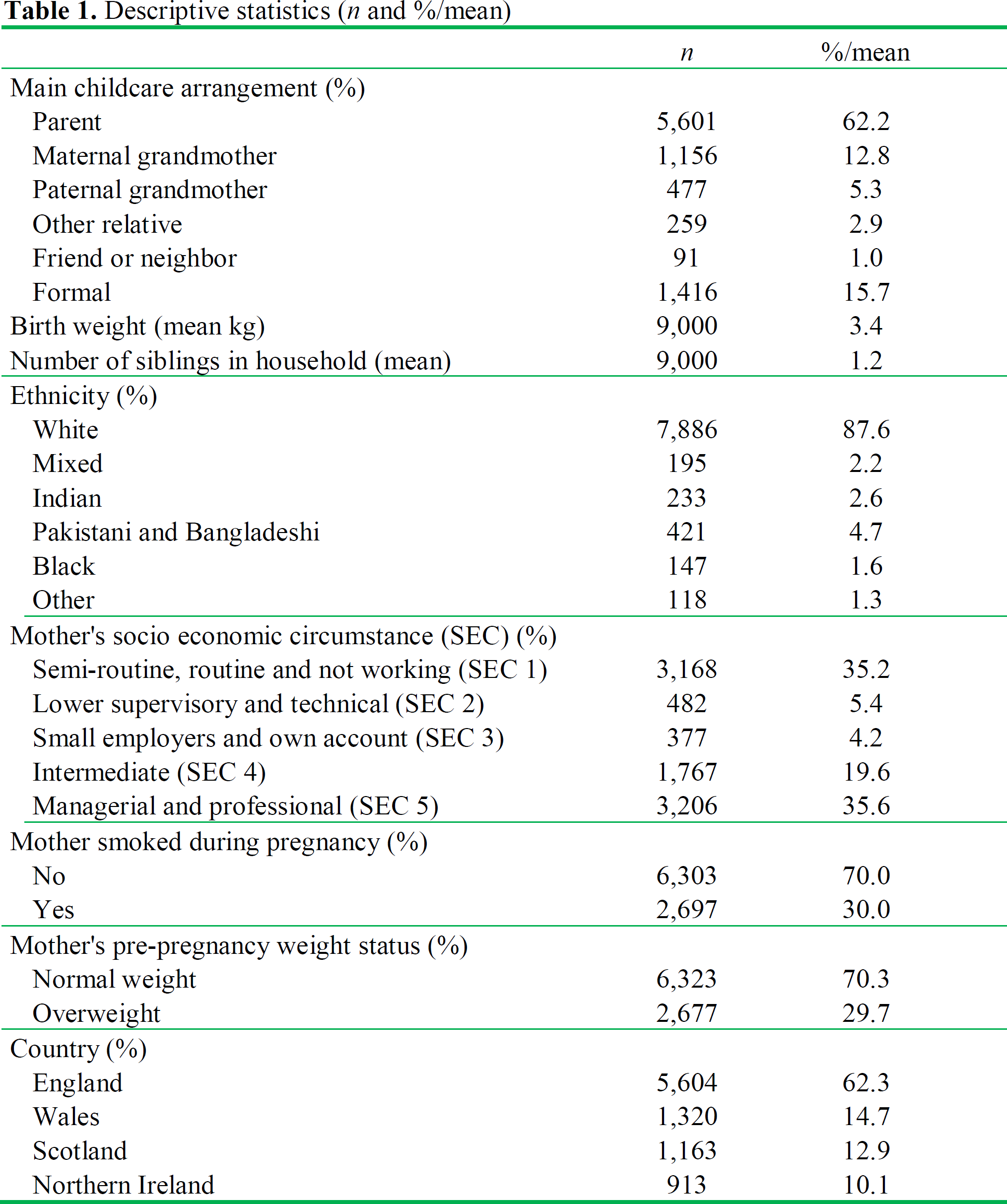
I ran my analyses in two phases. First, I employed binary logistic regression models to analyze an association between childcare type and child's overweight. Second, I studied an interaction between grandmaternal care and mothers' socioeconomic circumstances. I ran the models as unadjusted and adjusted. Since the results in adjusted and unadjusted models are quite similar I show only the adjusted results. In the adjusted models I controlled for several potential confounding variables that are shown to correlate with early years overweight (see Brophy et al., 2009; Pearce et al., 2010). These factors are child's birth weight, number of siblings in household, ethnicity, mothers' socioeconomic circumstance, smoking during pregnancy, pre-pregnancy weight status, and country (see Table 1). Since mother's age, breastfeeding duration, education, and the existence of maternal or paternal grandmothers do not significantly correlate with child's overweight status these variables were not added in the models. With the exception of the child's birth weight and number of siblings, all variables are categorical. For the analyses I have transformed them into the dummy variables.
Results
Table 2 shows the results (the overall model: -2LL = 9485.6; X2 = 340.7, df = 21, p < 0.0001; Nagelkerke R2 = 0.056). Parent was chosen as the reference category; an odds ratio above 1 indicates higher likelihood for child's overweight compared to those who receive main child care from their parents, and an odds ratio below 1 indicates the opposite. Child care support from relatives other than grandmothers or friends and neighbors between the child's ages 9 months and 3 years increase the likelihood for child's overweight at the age of 3. However, these differences were not statistically significant. In addition, formal childcare arrangements did not increase or decrease the likelihood for early years overweight. The results are quite similar in unadjusted and adjusted models.
Predicting child's overweight (including obesity) at the age of 3 years by childcare type between the ages of 9 months and 3 years (odds ratios and 95% confidence intervals) (n = 9,000)

Table 2 also shows that in the case of maternal and paternal grandmothers the odds ratios are above 1, which means that those children who receive primary childcare from their grandmothers are more likely overweight than those who receive childcare from parents (parent 22.9%, 95% CI = 21.8−24.0; MGM 26.1%, 95% CI = 23.6−28.6, p = .019; PGM 26.2%, 95% CI = 22.3–30.1, p = .095; n = 9,000). The difference is significant in the case of maternal, but not paternal, grandmothers. This is due to the relatively low number of paternal grandmothers who are the main childcare providers. When compared between maternal and paternal grandmothers results show no statistically significant differences: paternal grandmothers being the reference category, maternal grandmothers' odds ratio is 0.97 (95% CIs = 0.75–1.24, p = .795; n = 1,633) (results not shown in tables).
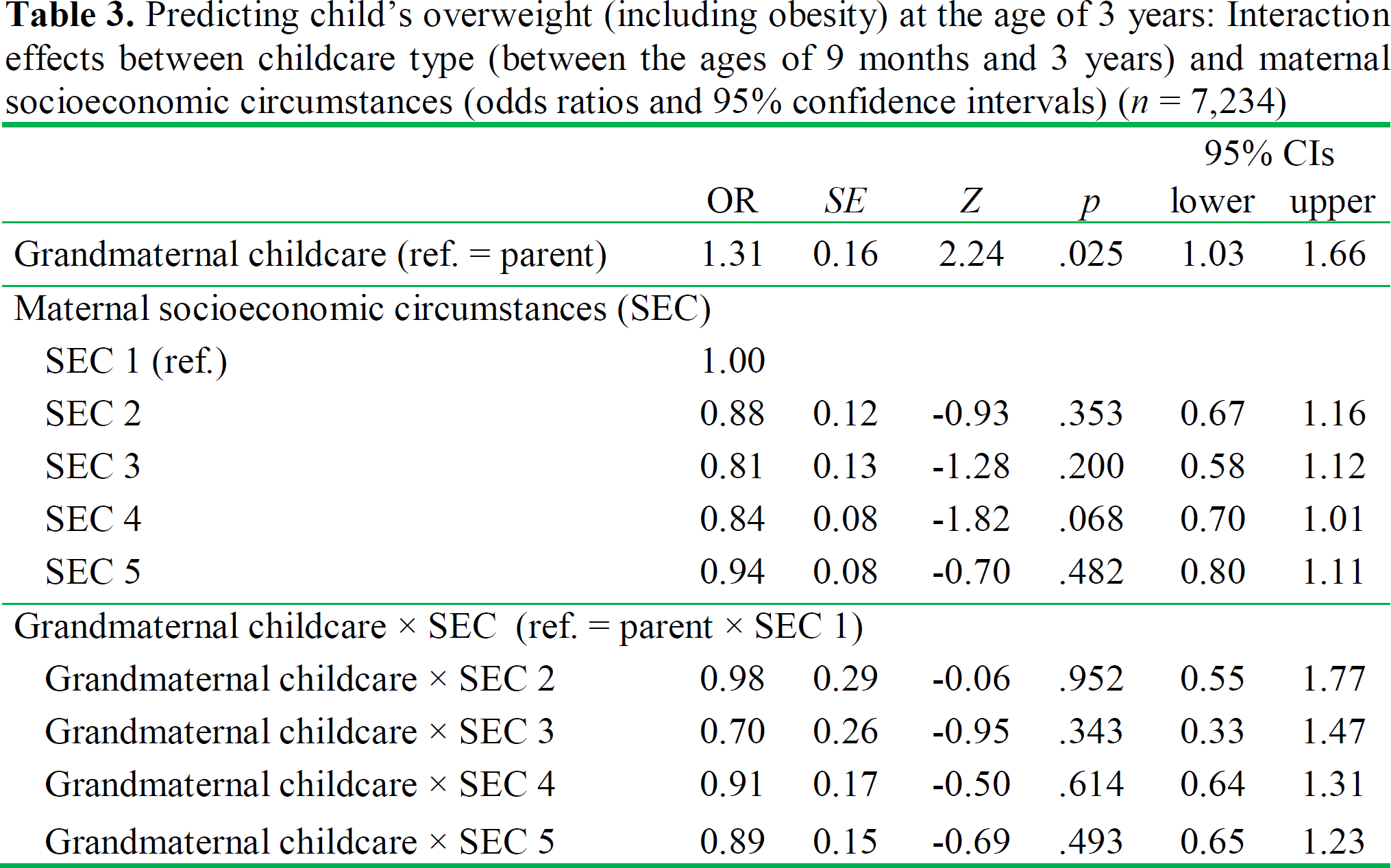
Next, I study the interaction between grandmaternal care and mothers' socioeconomic circumstances. The results are presented in Table 3 (the overall model: -2LL = 7630.4; X2 = 277.1, df = 21, p < 0.0001; Nagelkerke R2 = 0.057). Both grandmother types are included in the same category since the previous analyses show that they do not differ from each other. The results do not show significant differences according to mothers' socioeconomic circumstances.
Predicting child's overweight (including obesity) at the age of 3 years: Interaction effects between childcare type (between the ages of 9 months and 3 years) and maternal socioeconomic circumstances (odds ratios and 95% confidence intervals) (n = 7,234)
Discussion
The present article studied the association between grandmothers' childcare support and grandchildren's overweight in the UK. Children whose main child minder between the ages of 9 months and 3 years was a grandmother were more likely to be overweight at the age of 3 than those cared for by their parents. The results are in line with the study of Pearce and colleagues (2010) with the same data. Thus, the present study showed grandmothers' investment correlating with grandchildren's increased risk of overweight in contemporary societies, but this does not vary by lineage. That is to say, grandmothers may impact grandchildren's nutritional status in modern states as they did in some traditional populations (see Hawkes et al., 1997; Sear et al., 2000). Findings from the present study show that maternal and paternal grandmothers seem to increase the risk of child overweight equally.
According to Borgerhoff Mulder's (2007) analysis, kin increase child well-being more in rich than in poor families. In the present study, I analyzed interaction effects between grandmaternal childcare and mothers' socioeconomic circumstances. However, I did not find convincing support for the prediction that grandmaternal care differently influences child overweight status in different socioeconomic positions.
Previous studies have shown that in contemporary societies grandparents may improve grandchild well-being. Many studies have detected a correlation between grandparental investment and child well-being measured, for example, by the child's psychological adjustment, academic achievement, and mental and physical development (e.g., Tanskanen and Danielsbacka, 2012; see Sear and Coall, 2011 for review). The present study shows, however, that grandparental investment may not always be beneficial for children in contemporary societies. To conclude, the results show that the same grandmaternal behavior that may have had beneficial effects for grandchildren in our evolutionary past may have opposite effects in modern societies.
Footnotes
Acknowledgements
I thank Mirkka Danielsbacka, Markus Jokela, Anna Rotkirch, two anonymous reviewers and the editor Rebecca Sear for their helpful comments. The study is part of the Generational Transmissions in Finland (Gentrans) project at the University of Helsinki funded by the Academy of Finland (250620) and Alli Paasikivi foundation.