



Abstract
The majority of research examining sex differences in risk-taking behavior focuses on overt physical risk measures in which failed risk attempts may result in serious injury or death. The present research describes sex differences in patterns of risk taking in day-to-day behavior among Dutch cyclists. Through three observational studies we test sex differences in risk taking in situations of financial risk (fines for failing to use bike lights, Study 1), theft risk (bike locking behavior, Study 2) as well as physical risk (risky maneuvers, Study 3). Results corroborate previous findings by showing that across these domains men are more inclined to take risks than women. We discuss how these findings might be used in an applied context.
Introduction
Risk taking is a pervasive and inevitable part of life. Evolutionary theory suggests that differential selection pressures exist between the sexes on their willingness to incur risk. This can be derived from the fact that in many species, including humans, males tend to have a greater variance in reproductive fitness (Bateman, 1948; but see Snyder and Gowaty, 2007). This variance is a consequence of asymmetries in gamete production, whereby one sex produces ‘cheap’ gametes and the other ‘expensive’ gametes. Due to sex differences in gametic investment, in many species, especially in mammals, males tend to compete to a greater extent over access to mates than females do (Trivers, 1972; Andersson, 1994). Consequently, this creates an asymmetry in the degree of intrasexual competition between the sexes, which may lead to a greater willingness for males to take risks in an effort to reproduce successfully. In other words, successful risk attempts would contribute to male reproductive success more than to female reproductive success.
To date, a variety of studies provide evidence which supports this evolutionary perspective on risk taking in humans. For example, research has shown that men are more likely to be both the perpetrator and the victim of lethal violence (Wilson and Daly, 1985; Daly and Wilson, 1988). Health risk behaviors such as use of alcohol or drugs are also known to be more prevalent among men than women (e.g., Tyler and Lichtenstein, 1997; Spigner et al., 1993). Apart from risks which are overtly life-threatening or otherwise detrimental to health, research has shown that men are more economically risk prone than women. For instance, men take greater financial risks and weigh monetary financial risk attributes, including the possibility of loss, less heavily than women (Powell and Ansic, 1997; Eckel and Grossman, 2002; Hallahan et al., 2003; Olsen and Cox, 2001). Since additional resources are less likely to influence a woman's reproductive success, the potential gain from gambling is lower for women than it is for men. In contrast, men can benefit more from acquiring greater amounts of resources and are therefore more inclined than women to take risks to do so. This may be particularly true in environments where men differ dramatically in their resource potential or where competition for female mates is relatively high.
Sex differences in risk taking behavior are even apparent in young children. In a naturalistic study of children's risk taking behavior at a petting zoo, Ginsburg and Miller (1982) showed that boys were more likely to engage in ‘high risk’ activities such as riding elephants, feeding animals and petting the burro. Similarly, other research has shown that young boys generally rate risk potential as lower than young girls do when shown photographs depicting play activities that varied from no risk to high risk (Hillier and Morrongiello, 1998). Together these findings indicate that sex differences in risk taking are present early in development, suggesting the existence of a biological sex difference in the predisposition for risk seeking behavior, with men being more inclined to accept risk than women.
Sex differences in risk taking have also been intensively studied within the area of traffic psychology. Motor vehicle fatality accounts for a large proportion of annual deaths worldwide. According to the WHO (2002), 1.26 million individuals worldwide died in a traffic related accident in the year 2000. Robust sex differences in risk taking in everyday traffic behavior make this a pertinent domain for targeted risk intervention strategies. To date, existing research has shown that men are more likely to be involved in motor vehicle fatalities even when controlling for driving experience (e.g., Jonah, 1986). Such fatalities have been observed at even higher rates when young people are driving with co-passengers, suggesting that risky behavior is enhanced when an audience is present (Chen et al., 2000). In a similar vein, men have been shown to be less likely to wear a seatbelt than women (Lerner et al., 2001; Calisir and Lehto, 2002). Men are also more likely to report speeding and are more likely to have been previously fined for speeding (Whissell and Bigelow, 2003; Bina et al., 2006; Harris et al., 2006), which may be explained by the fact that they perceive traffic risk as lower than women do (DeJoy, 1992). Work by Pawlowski and colleagues (2008) provides additional support for the notion that men take greater risks in traffic than women do. They showed that when crossing a road by foot, men were more likely than women to initiate crossing when it was risky to do so. This was particularly true for men when women were present in the area. The authors explain this finding in light of the idea that male risk taking may also serve as a cue to mate quality. Choosing to engage in physical altercations or to otherwise accept risk can be viewed as costly to the individual. However, should an individual succeed in taking these sorts of risks without incurring negative consequences, one might conclude that the individual is of high physical quality. In this way, successful risk taking can be seen as a means by which men can advertise their current quality relative to others.
In this paper, we expand the literature on sex differences in risk taking in traffic by presenting the results from three studies, which examine day-to-day risk taking among cyclists commuting in Groningen, the Netherlands. While generally cycling is engrained into daily life within Dutch culture, Groningen has among the highest rates of cycling. 1 Given the prevalence of trips made by bike in the Netherlands, a study investigating cycling and risk taking from an evolutionary perspective may have relevant outcomes for cycling risk prevention strategies. In line with evolutionary psychological research on motor vehicle risk taking presented above, we predicted that, across several domains, men would take greater risks than women when cycling. All research reported herein was approved by the Psychology Ethics Review Board at the University of Groningen.
Study 1
Study 1 examined sex differences in the use of bicycle lights. Dutch law requires that cyclists use both a front and rear light to draw attention to themselves when visibility is poor 2 . Lights can be fixed to the bike or be clipped to the rider. Failing to use lights can be considered an assay for risk taking for two reasons: (1) the absence of lights may result in poor visibility of the cyclist to passing motorists, thereby increasing their likelihood of being struck, and (2) cyclists spotted by police without functioning lights can incur financial fines of €45. 3 Since men are more risk prone, we predicted that their propensity to take risk would translate to everyday situations, including situations not directly related to reproductive success such as use of lights on one's bike. We therefore predicted that male cyclists would be more inclined to cycle without lights than female cyclists.
Methods
Observations were carried out by a single adult male observer at a location within the city center of Groningen that is commonly used by cyclists (Hereplein). All observations occurred between the hours of 10pm and 12pm and were taken during Spring 2011. The observer sat unobtrusively on a bench and recorded the gender and presence or absence of lights for each cyclist who passed. A total of three days of observation were completed resulting in a sample of 555 cyclists, of which 257 were men and 298 were women.
Results
Of the total sample, 34.6% of men (89 out of 257) and 20.4% of women (61 out of 298) did not use lights on their bike. This sex difference was statistically significant (X2(1) = 14.03; p < .001; Figure 1), indicating that men are more likely than women to cycle without lights when it is risky and unlawful to do so (see Figure 1).

Results from Study 1 showing the percentage of individuals not using lights on their bike when riding in the dark for female (n = 298) and male (n = 257) cyclists. (p based on X2 test with frequencies).
Study 2
Study 2 assayed risk taking by examining patterns in how individuals lock their bike. While crime rates within the Netherlands are generally low, bike theft is a pervasive problem. In 2006, the Dutch national statistics bureau reported that 760,000 bikes were stolen within the Netherlands. This equates to one in twenty bike owners losing their bike to thieves each year. Moreover, the north of the Netherlands, where Groningen is located, has the highest rate of bike theft (adjusted for rate of urbanization) in the country. 4 Since bike theft is a realistic concern, we examined differences in how an individual locks their bike as an assay of risk taking. While virtually all cyclists use at least one lock, some make use of two or more locks, which can be viewed as being more risk aversive. Indeed, some Dutch city municipalities and police services specifically recommend that individuals use two locks to secure their bike in order to thwart theft, as it has been suggested that this deters thieves (e.g., Gemeente Delft 5 ). We first examined whether there was a sex difference in the likelihood of using more than one lock. Since previous research suggests that male risk taking is influenced by the presence of others (e.g., Pawlowski et al., 2008), we also examined differences in bike locking by individuals traveling with an opposite sex or same sex individual. We predicted that men would be less likely than women to use more than one lock to secure their bike. Further, we predicted that male risk taking (use of fewer locks) would be lower in opposite sex pairs than in same sex pairs. This prediction is in line with the findings reported by Wilson and Daly (1988) showing that married men (e.g., partnered men) were less likely to take physical risks than unmarried men.
Study 2.1
Methods
Study 2.1 was conducted at a location close to the University of Groningen central library (see Image 1). This area is a very popular location for students and other members of the general public to park their bikes while in town. In this instance the observer (FL) noted the gender and approximate age of individuals as they locked their bike as well as the number of locks they used to secure their bike. A total of 171 individuals, 79 men and 92 women, were observed over three days in April 2011. Perceived age was coded in the following bins: 16–18, 19–24, 25–30, 31–40, 41–60, and over 60. Because of the location, most participants were likely to be students. This was reflected in our (perceived) age distribution, as 95.9% (164 out of 171) of our cases fell within the 18–30 age groups, therefore leaving left too few cases for statistical analyses of the relationship between age and locking behaviour. Only one individual observed had more than two locks available and we therefore coded this individual as having two locks.

Bicycles parked in the vicinity of the University of Groningen central library (Photo by FL)
Results
There was no sex difference in the number of locks available to be used in our sample of cyclists (X2 (1) = 2.18; p = .140). However, men were less likely than women to use two locks to secure their bike. In total, 37.0% of women (34 out of 92) and 21.5% of men (17 out of 79) used two locks rather than one lock (X2(1) = 4.84; p = .028; see Figure 2).

Results from Study 2.1 showing the percentage of men (n = 79) and women (n = 92) who used only one lock to secure their bike.
Study 2.2
Methods
Study 2.2 was conducted in the immediate vicinity of a large movie theatre in the city center of Groningen (see Image 2). A single male observer (FL) examined pairs of individuals who arrived at the theatre together on bike and their subsequent locking behavior. We recorded information on the number of locks used and which individual from the pair locked their bike first. We examined differences in locking behavior between pairs, which were composed of individuals of the same sex (n = 40) or mixed sex (n = 85). Age was coded using the same bins as used in Study 2.1. Again, only 13.2% of all individuals observed fell outside the 18–30 age groups, leaving too few cases for statistically meaningful analyses. Since only one individual observed had more than two locks available (as in Study 2.1) we coded this individual as having two locks. For seven of the individuals observed, we could not unobtrusively gauge how many locks were available on their bicycles so these data are missing.

Bicycles parked in the vicinity of a large movie theatre where we observed couples' locking behaviour (Photo by FL)
Results
We found a significant correlation between the number of locks available (Kendall's τ b = .23; p = .036; n = 81) and the number of locks used among mixed sex pairs (Kendall's τ b = .33; p = .002; n = 85). In contrast, these correlations were not significant in same sex couples (locks available: Kendall's τ b =−0 .091; p = .570; n = 40; locks used: Kendall's τ b = -.061; p = .702; n = 40). Thus, locking behavior of individuals in a mixed sex pair was significantly related, whereas locking behavior was not related in same sex pairs.
We then examined whether male and female couples differed in the number of locks used to secure their bike. Of the 19 same sex male pairs, 23 men (60.5%) used one lock and 15 men (39.5%) used two locks to secure their bike. Of the 21 same sex female pairs, 22 women (52.4%) used one lock and 20 women (47.6%) used two locks on their bike. As in Study 2.1, men were more likely to use one lock than women. However, this difference was not significant (X2 (1) = 0.54; p = .463).
Further, results indicated that in mixed sex pairs when the man locked his bike first, the number of locks he used did not correlate with the number of locks used by his female partner (Kendall's τ b = .048; p = .772; n = 37; Figure 3a). However, when the woman locked her bike first, we found that the number of locks used by the woman was a strong predictor of the number of locks used by the male partner (Kendall's τ b = .55; p < .001; n = 48; Figure 3b). Thus, in mixed sex pairs, women were not affected by the locking behavior of male partners, but men were more likely to copy their female partner's locking behavior.

Results from Study 2.2 showing the percentage of cases where one lock was used when the (a) male partner (n = 37) and (b) female partner (n = 48) locked their bike first. p-value for the Kendall τ b correlation for the number of locks used between individuals in the pairs.
Study 3
Study 3 examined overt behavioral risk taking among cyclists who crossed a train track after a train had recently passed but prior to the cessation of warning lights. This situation presents a very serious potential risk because a second train may be approaching on the opposite track, which is not visible to the cyclist. At the train track crossing there is an explicit warning sign indicating that cyclists should not cross while the lights are flashing and that a second train may pass (see Image 3). Crossing the railroad before the warning lights are off can also result in a hefty fine of €85 from local police 6

Warning sign instructing cyclist to ‘WAIT until the red light has ceased because another train can come’ (photo by FL).
Methods
Observations for Study 3 were conducted by a single adult male observer (FL) during several sessions in June, 2012 at a railroad-crossing located nearby the Groningen Central Station. While risky and illegal, it is not uncommon for individuals to cycle across the track after a train has passed but before the warning gate is fully erect and the warning lights and bells have ceased. A total of 339 individuals (169 men, 170 women) were observed crossing the track after a train had recently passed. Of this group, 89 individuals crossed when it was unsafe to do so. Observations were recorded with respect to the gender of individuals who crossed the tracks prior to it being safe to do so versus those who waited until it was safe to cross.
Results
Of the total participants observed, 55 men (32.5% of total number of men) and 34 women (20.0% of total number of women) crossed the tracks while it was illegal to do so. This difference was significant (X2 (1) = 6.89; p = .009), suggesting that men were more likely than women to illegally cross the train tracks and thus take a substantial physical risk (Figure 4).
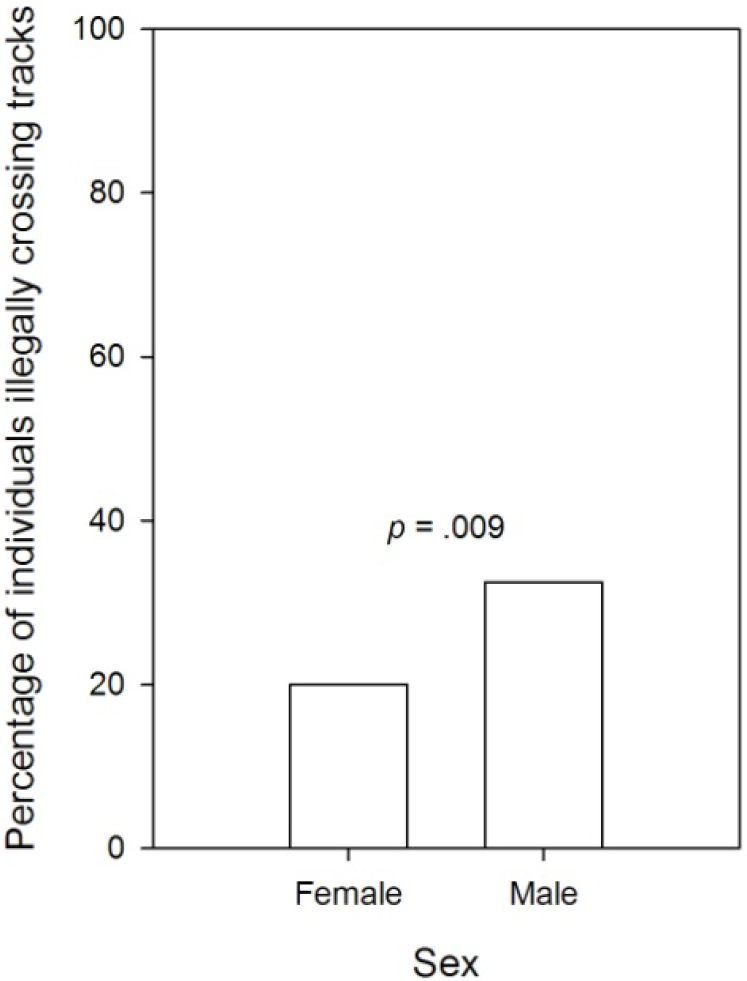
Results from Study 3 showing the percentage of individuals illegally crossing the tracks for female (n = 170) and male (n = 169) cyclists. p-value for sex difference based on X2 test.
General Discussion
Across three studies examining risk taking behavior among Dutch cyclists we find that men tend to take greater risks than women do. These findings complement the existing literature on sex differences in risk taking across various other domains and more specifically the literature focusing on risk taking in motor vehicle traffic behavior (e.g., Wilson and Daly, 1985; Powell and Ansic, 1997; Hillier and Nirribgiello, 1998; Pawlowski et al., 2008).
Study 1 examined differences in light use among cyclists. It showed that men were more likely than women to cycle without lights when it was dangerous and illegal to do so. Study 2 examined differences in how individuals lock their bike. Study 2.1 showed that men were more likely than women to use one rather than two locks to secure their bike. Men may perceive the time it takes to lock their bike twice as too ‘costly’ (i.e., a waste of time) as they may perceive the risk of bike theft to be lower than women. Alternatively, men may perceive the risk of theft similarly to women, but low enough not to warrant the extra time cost of using an additional lock. Study 2.2 showed that individuals in mixed sex pairs display similar locking behavior: both individuals in the pairs resembled one another both in the number of locks available and the number of locks used. In contrast, individuals of the same sex arriving at the movie theatre were not similar in their locking behavior. These results suggest that there is some positive assortment with respect to risk taking in mixed sex pairs. Unfortunately, we do not know whether the individuals in mixed sex pairs were actual romantic couples. For many of those observed, however, we believe that this is likely to be the case (particularly because we observed couples near a movie theatre). If so, this suggests that we have documented some evidence for assortative pairing in terms of risk taking behavior or, more generally, for psychological traits that might in some way be related to risk taking proneness. Previous research has shown assortative mating with respect to antisocial behavior (Krueger et al., 1998), which may relate to risk taking and unlawful behavior. Likewise, research has shown assortative mating for cigarette smoking and alcohol consumption, both of which can be considered as health related risk taking behaviors (Agrawal et al., 2006).
We also found some evidence that, among mixed sex pairs, men adjusted their behavior with regards to risk in line with the women's behavior. When women locked their bike prior to men, men were more likely to copy the women's behavior. In contrast, women did not respond to the locking behavior of men, showing no copying when the man locked his bike first. Thus, male risk taking behavior could be in part a context-sensitive signal, whereby men are sensitive to the sex of the audience and vary their inclination to take risk accordingly. It appears that when a man is aware of a woman's preference they are less motivated to display risky behavior. This finding is in line with the idea that psychological states relate to the promotion or demotion of risk taking behavior (e.g., Baker Jr. and Maner, 2008; Pawlowski et al., 2008). Men may also feel less inclined to ‘show off’ by taking risks when they already have a partner because the potential gains (e.g., attracting a partner when you already have one) from risk taking may not be as high (Frankenhuis and Karreman, 2012). Previous research by Pawlowski et al. (2008) and Frankenhuis et al. (2010) has shown that men are more likely to take risks when women are present. It may therefore be, given our results, that the context of risk taking behavior is highly relevant (e.g., Baker and Maner, 2009), suggesting that risk taking may function differently when used to attract a (short-term) unknown partner as in Pawlowski et al. (2008) and Frankenhuis et al. (2010) versus to maintain or impress a longer-term known partner. Kelly and Dunbar (2001) indeed suggest that women prefer men who take risks, and furthermore that men are aware of this preference. A study by Frankenhuis and Karremans (2012) also supports this idea. These authors showed that partnered men who were more committed to their relationship were less risk taking in the presence of women than those who were less committed. In the same paper, the authors also show that when single men played a financial risk task, they adjusted their level of risk taking to be in line with what they thought women would find attractive. Taken together, these findings suggest that male risk taking in the presence of women may be context specific.
If opposite sex pairs tended to represent couples in Study 2.2, our result is then consistent with the work of Frankenhuis and Karremans (2012) as well as Daly and Wilson (1988) who showed that being invested in a relationship (e.g., being married) is negatively associated with risk behavior. Our finding is also in line with the hormonal literature on partnership status and competitive behavior: high testosterone has been implicated in competitive behavior and research indicates that being in a relationship is associated with decreased levels of testosterone (e.g., Gray et al., 2004; Pollet et al., 2011). This suggests that partnered men may be less inclined to take risk and compete. Future research which focuses more specifically on the relationship status and relationship quality of the men who do/do not take risks may help to clarify our results.
Study 3 examined differences in behavioral risk taking of individuals crossing a railway track prior to the cessation of warning signals after a train had recently passed. In line with the results reported in the aforementioned studies, men were more likely than women to cross the railway track when it was dangerous to do so. Since there is a possibility that a second train will pass in the opposite direction, cycling prior to the cessation of warning lights is extremely risky.
Future research should aim to consider how differences in participant age contribute to the findings reported herein. Although there is a large literature describing age differences in risk taking behavior, with younger individuals perceiving risk as lower than older individuals (e.g., Wilson and Daly, 1985; Cohn et al., 1995), due to the observational nature of our studies, unobtrusively assessing the age of cyclists was often difficult. This was particularly true in the case of Study 1, which was conducted in the evening hours. In Study 2, where this was attempted, the ranges of ages observed were not adequate to test this hypothesis critically. This skew can be explained by the fact that Groningen, where the studies were conducted, has a very large proportion of students, which biased our sample to young individuals.
Furthermore, a limitation of Study 2.2, which examined locking behavior among same and opposite sex couples, is that we could not infer the actual relationship status of the pairs observed. As stated previously, future research could employ the use of questionnaires after observations to ascertain the type and quality of the relationship. Indeed, whereas previous research suggests that being partnered reduces male risk taking behavior (a finding consistent with our results), it has also been shown that being invested to a greater extent in a relationship is negatively related to risk taking behavior (Frankenhuis and Karremans, 2012). Finally, a limitation to all studies is the use of a single observer to code behavior. While we feel it is unlikely that this introduced bias in our results, given that many assessments were dichotomous (e.g., used lights versus did not use lights, one lock vs. two locks) rather than graded assessments, it is worthwhile to note that multiple observers from which an inter-rater reliability value could be calculated may be preferable.
Taken together these studies corroborate an evolutionary analysis of sex differences in risk taking behavior. It is worthwhile to note that this paper contains a description of all of the observational studies we designed to assess this topic. Hence, there are no additional studies which we obtained null results for and subsequently failed to report. This suggests a degree of robustness in our findings. Our results provide grounds to suggest targeted risk intervention strategies specific to male cyclists. It is important to understand and mediate the factors that cause heightened male risk taking behavior since negative implications of failed risk attempts can be costly. For example, in this study we have shown that men take greater risks in their cycling behavior in areas which can result in a broad range of negative outcomes including physical injury or death, property theft or financial fines. This suggests that a greater concern for male risk taking among Dutch cyclists, in combination with targeted intervention strategies, may help to reduce failed risk attempts.
The results reported here document yet another means through which evolutionary psychological thinking may be used to address applied issues. Indeed, applied evolutionary psychology has received a growing focus in recent research with contributions made in settings including marketing, medicine, technology, communication and crime (e.g., Roberts, 2012; Roberts et al., 2012; Tybur et al., 2012; Petersen and Aarøe, 2012). Our results are among the first to apply evolutionary thinking to traffic behavior in cyclists and provide a starting point for more detailed studies in this area.
